0


follow from another instance
Not on this instance? Enter your own instance's domain to go straight to following c/artificial_intel@lemmy.ml there.

0


404 Media
Massive New Study Shows How Young People Feel About AI Companions
www.404media.co
preview
A new study from Gallup looked at how young people across the world are making friends, both digitally and in person. The good news is that around 93% of the young people surveyed reported having at least one strong in-person friendship. The weird news is that 33% said they had an AI companion.
Gallup’s study is lengthy and nuanced. It partnered with the Boston Children’s Digital Wellness Lab to conduct the study and used online surveys of more than 16,000 young people from the ages of 15 to 22 in 16 different countries.
A lot of the topline results won’t surprise anyone living in today’s constantly online digital-forward age. Gallup found that respondents felt their in-person friendships were their strongest, that digital friendships complemented rather than replaced in-person ones, and that stronger friendships made people happier no matter how the connection was made. Three things that stood out were how the young respondents talked about AI, loneliness, and doomscrolling.
Young people in the United States, Canada, and UK reported the least interest in AI overall, with only 20% saying they used it once a day or more. Almost 40 percent of young people in Brazil use it daily. Japan and Italy both come in around 35%. “Nearly half of young people in the United States, United Kingdom and Canada have used AI no more than a few times in the past month, including those who have not used it at all,” the researchers wrote.
Most of the respondents (82%) said they’d used AI to look up information, 68% asked it for advice, and 33% used it as a companion. Young people with online-only friends were more likely to use AI for companionship, “although these patterns do not establish whether AI companionship supplements or substitutes for human relationships,” they wrote.
The researchers discovered that people in different countries felt wildly different about their AI buddies. Almost half of Australians with AI friends rated the relationship as “high quality” and only 12% of young people in Poland did. Mostly, though, people thought of their AI friends as mid: “In most countries […] young people are more likely to give their AI companionship a medium rating than either a high or low rating.”
People who used AI as a friend also reported higher levels of loneliness, the study found. “However, the findings cannot determine whether young people turn to AI because they feel lonely, whether AI companionship influences their social experiences or whether other circumstances help explain these relationships,” the researchers wrote.
The researchers also asked young people what they do online all day and the overwhelming majority (72%) said they spend their time scrolling short form content, mostly TikTok and Instagram. It’s also how they deal with loneliness, with six in 10 young people participating in this study reporting that they often or always scroll through online content when lonely.
They also said scrolling works to dispel loneliness almost equally as well as hanging out with a friend in real life: “Although scrolling is more commonly used when young people feel lonely, those who use scrolling or in-person time as coping strategies report nearly identical levels of perceived helpfulness.”
Still, people who reported strong in-person friendships said they felt lonely less often, while online friendships have the same effect on loneliness regardless of how participants ranked the quality of those friendships. “No comparable difference appears across levels of online-only friendship quality,” the authors wrote. Having in-person relationships seemed to be what mattered most: “Higher loneliness is also more common among young people who frequently communicate online with strangers or online-only friends than among those who frequently communicate with in-person friends or family members.”
The relationships between loneliness, online friendships, and AI is complex and a person’s material conditions shape how they form friendships more than their access to a chatbot or how they use social media. The researchers’ analysis of young people who said they have no trusted adults in their lives makes that clear.
“Further analysis identifies several characteristics associated with having none of these friendship modes, but one stands out in particular: not having a trusted adult outside the family,” the researchers wrote. “This association remains substantial after accounting for country or residence, gender, age, urbanicity, and parent/ caregiver relationship quality.”
The study’s authors warned about reading too much into these results. “These assessments should be compared cautiously with those for human friendships examined in this report, as young people may have different expectations of what makes an AI companion or human friendship meaningful or supportive,” they wrote. In general, people don’t have the same expectations of a chatbot that they do someone they know in real life.
“The broader message is not that one form of connection is inherently better or worse, but that the quality of young people’s relationships and the wider social context in which they exist matter greatly,” the study concluded.
A new study from Gallup looked at how young people across the world are making friends, both digitally and in person. The good news is that around 93% of the young people surveyed reported having at least one strong in-person friendship. The weird news is that 33% said they had an AI companion.
Gallup’s study is lengthy and nuanced. It partnered with the Boston Children’s Digital Wellness Lab to conduct the study and used online surveys of more than 16,000 young people from the ages of 15 to 22 in 16 different countries.
A lot of the topline results won’t surprise anyone living in today’s constantly online digital-forward age. Gallup found that respondents felt their in-person friendships were their strongest, that digital friendships complemented rather than replaced in-person ones, and that stronger friendships made people happier no matter how the connection was made. Three things that stood out were how the young respondents talked about AI, loneliness, and doomscrolling.
Young people in the United States, Canada, and UK reported the least interest in AI overall, with only 20% saying they used it once a day or more. Almost 40 percent of young people in Brazil use it daily. Japan and Italy both come in around 35%. “Nearly half of young people in the United States, United Kingdom and Canada have used AI no more than a few times in the past month, including those who have not used it at all,” the researchers wrote.
Most of the respondents (82%) said they’d used AI to look up information, 68% asked it for advice, and 33% used it as a companion. Young people with online-only friends were more likely to use AI for companionship, “although these patterns do not establish whether AI companionship supplements or substitutes for human relationships,” they wrote.
The researchers discovered that people in different countries felt wildly different about their AI buddies. Almost half of Australians with AI friends rated the relationship as “high quality” and only 12% of young people in Poland did. Mostly, though, people thought of their AI friends as mid: “In most countries […] young people are more likely to give their AI companionship a medium rating than either a high or low rating.”
People who used AI as a friend also reported higher levels of loneliness, the study found. “However, the findings cannot determine whether young people turn to AI because they feel lonely, whether AI companionship influences their social experiences or whether other circumstances help explain these relationships,” the researchers wrote.
The researchers also asked young people what they do online all day and the overwhelming majority (72%) said they spend their time scrolling short form content, mostly TikTok and Instagram. It’s also how they deal with loneliness, with six in 10 young people participating in this study reporting that they often or always scroll through online content when lonely.
They also said scrolling works to dispel loneliness almost equally as well as hanging out with a friend in real life: “Although scrolling is more commonly used when young people feel lonely, those who use scrolling or in-person time as coping strategies report nearly identical levels of perceived helpfulness.”
Still, people who reported strong in-person friendships said they felt lonely less often, while online friendships have the same effect on loneliness regardless of how participants ranked the quality of those friendships. “No comparable difference appears across levels of online-only friendship quality,” the authors wrote. Having in-person relationships seemed to be what mattered most: “Higher loneliness is also more common among young people who frequently communicate online with strangers or online-only friends than among those who frequently communicate with in-person friends or family members.”
The relationships between loneliness, online friendships, and AI is complex and a person’s material conditions shape how they form friendships more than their access to a chatbot or how they use social media. The researchers’ analysis of young people who said they have no trusted adults in their lives makes that clear.
“Further analysis identifies several characteristics associated with having none of these friendship modes, but one stands out in particular: not having a trusted adult outside the family,” the researchers wrote. “This association remains substantial after accounting for country or residence, gender, age, urbanicity, and parent/ caregiver relationship quality.”
The study’s authors warned about reading too much into these results. “These assessments should be compared cautiously with those for human friendships examined in this report, as young people may have different expectations of what makes an AI companion or human friendship meaningful or supportive,” they wrote. In general, people don’t have the same expectations of a chatbot that they do someone they know in real life.
“The broader message is not that one form of connection is inherently better or worse, but that the quality of young people’s relationships and the wider social context in which they exist matter greatly,” the study concluded.
0


Qwen
qwen.ai
preview
Today, we are introducing Qwen4-Max, your new AI teammate for work, creativity, and discovery. Qwen4-Max is built on the new Qwen4 architecture, with a 2.4-trillion-parameter backbone, native vision capabilities, and a one-million-token context window.
Qwen4-Max advances real-world productivity through greater proficiency with professional tools, stronger long-horizon task execution, and higher-quality deliverables. It can take on a wide range of creative and professional work, spanning 3D modeling, game development, precision manufacturing, finance, law, healthcare, and frontier scientific discovery. As a 24/7 AI teammate, Qwen4-Max keeps the big picture in view and moves projects forward, bringing ambitious ideas closer to reality and opening new ways for people and AI to work together.
Today, we are introducing Qwen4-Max, your new AI teammate for work, creativity, and discovery. Qwen4-Max is built on the new Qwen4 architecture, with a 2.4-trillion-parameter backbone, native vision capabilities, and a one-million-token context window.
Qwen4-Max advances real-world productivity through greater proficiency with professional tools, stronger long-horizon task execution, and higher-quality deliverables. It can take on a wide range of creative and professional work, spanning 3D modeling, game development, precision manufacturing, finance, law, healthcare, and frontier scientific discovery. As a 24/7 AI teammate, Qwen4-Max keeps the big picture in view and moves projects forward, bringing ambitious ideas closer to reality and opening new ways for people and AI to work together.
0
GitHub
GitHub - fswolf/luna-station-android: Luna Station: turns a phone or tablet into a room device for Luna, the local AI agent
github.com
preview
github.com/fswolf/luna-station-android
WDYT?
“An Android app that turns a phone or tablet into a room device for Luna: her portrait on the screen, a microphone to talk to her and a speaker for her voice. Put an old tablet on a stand in the kitchen and you can talk to her there, see her react, and hear her answer in that room. Think of an Echo Show, but open source and talking only to your own PC.
Luna does all the thinking on your own PC or server. The app is only the screen, the mic and the speaker, and it talks to Luna over your home network, never the internet. A phone or tablet runs it today; other hardware (a Pi with a touchscreen, say) can follow later.”
github.com/fswolf/luna-station-android
WDYT?
“An Android app that turns a phone or tablet into a room device for Luna: her portrait on the screen, a microphone to talk to her and a speaker for her voice. Put an old tablet on a stand in the kitchen and you can talk to her there, see her react, and hear her answer in that room. Think of an Echo Show, but open source and talking only to your own PC.
Luna does all the thinking on your own PC or server. The app is only the screen, the mic and the speaker, and it talks to Luna over your home network, never the internet. A phone or tablet runs it today; other hardware (a Pi with a touchscreen, say) can follow later.”
0

The Walrus
As Ottawa Gambles on AI, Canadians Live with the Mistakes | The Walrus
thewalrus.ca
0

Haddy Alchaer
After 600 experiments, here's what I discovered about JEPA world models
haddyalchaer.com
0

Edge0-145B: Open-Source On-Device AI with 145B Parameters
edge0.ai
0

Luna - Your voice. Your machine. Your Luna.
luna.imbored.me
preview
A persistent-state agent manager, with heavy tooling, research and learning, built from several local models working as one. All on your own machine.
Luna isn’t one model. A chat model does the thinking and talking, and smaller ones beside it see, hear, speak, recall by meaning and judge what’s relevant (what she runs on). Around them sits state that carries on between sessions: facts she writes, corrects and forgets, notes on past conversations, lessons from her own mistakes, moods, routines, and who’s in the house. On top of that sit her tools (files, commands, email, web research, your network and smart home, scheduled jobs, MCP servers), and she looks things up and learns from how her turns went.
A persistent-state agent manager, with heavy tooling, research and learning, built from several local models working as one. All on your own machine.
Luna isn’t one model. A chat model does the thinking and talking, and smaller ones beside it see, hear, speak, recall by meaning and judge what’s relevant (what she runs on). Around them sits state that carries on between sessions: facts she writes, corrects and forgets, notes on past conversations, lessons from her own mistakes, moods, routines, and who’s in the house. On top of that sit her tools (files, commands, email, web research, your network and smart home, scheduled jobs, MCP servers), and she looks things up and learns from how her turns went.
0

arXiv.org
Memorilla: Latent Semantic Memory for LLMs
arxiv.org
0

Imgur
video
i.imgur.com
preview
0

theregister
British fintech Revolut slashes AI coding costs 10x by cutting out Claude and going self-hosted
www.theregister.com
preview
I suspect as medium to large companies increase their use of AI, this may become more common.
I suspect as medium to large companies increase their use of AI, this may become more common.
0
Simon Willison’s Weblog
Qwen 3.8 27B on my laptop can interpret model weights, too
simonwillison.net
0
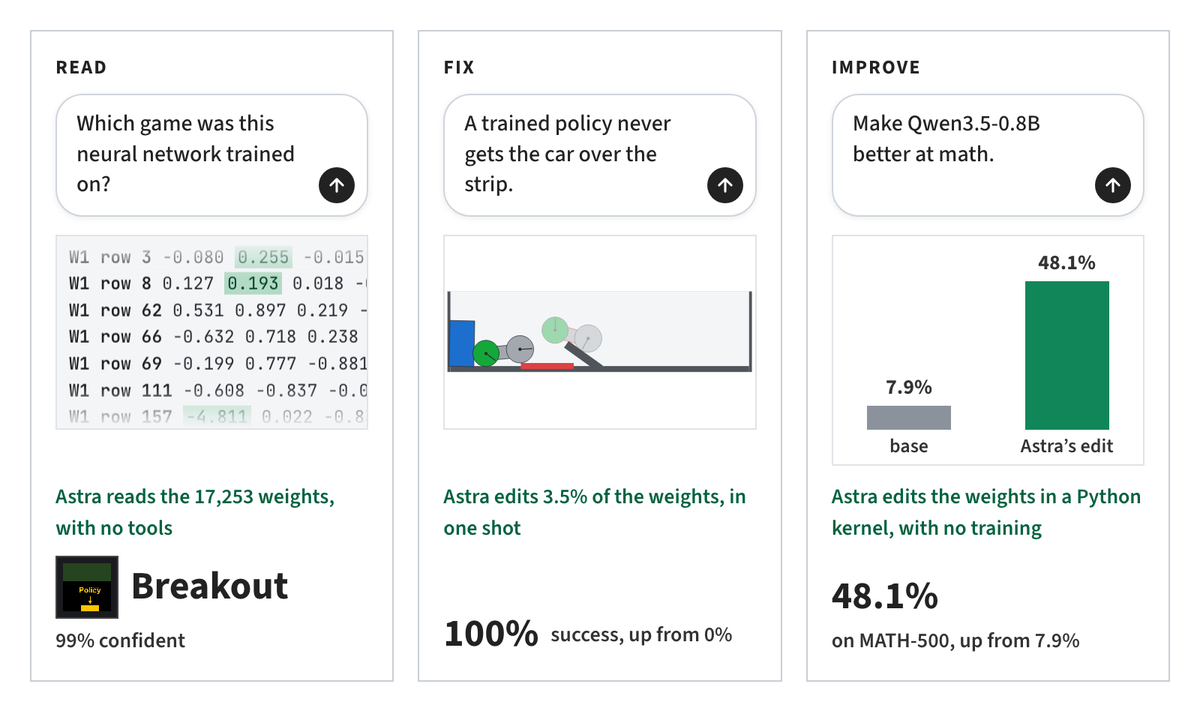
Sparks of Weight-Space Programming: LLMs can natively read & write neural network weights
rikiyat.github.io
0


Redesigning source control at Anthropic
www.anthropic.com
preview
Git was build for humans. Scion is build for agents.
Git was build for humans. Scion is build for agents.
0
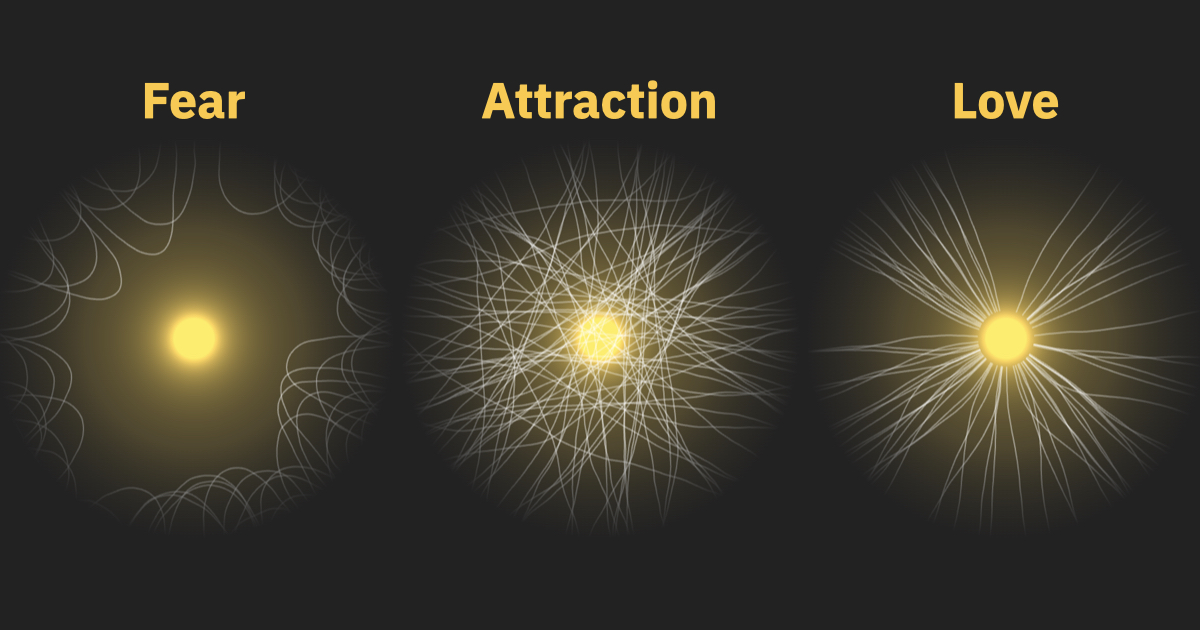
Myriad
Let’s Build a Brain
aatishb.com
0


the Guardian
The datacentre next door: on the frontline of tech’s latest David v Goliath battle
www.theguardian.com
0

Behind the Scenes, Meta's Board Is Battling With Mark Zuckerberg Over His Out-of-Control AI Spending

Futurism
Behind the Scenes, Meta's Board Is Battling With Mark Zuckerberg Over His Out-of-Control AI Spending
futurism.com
preview
cross-posted from: lemmy.world/post/53536869
How about making Marky Mark resign instead?!
cross-posted from: lemmy.world/post/53536869
How about making Marky Mark resign instead?!
0
arXiv.org
Next-Concept Modeling: Fast, Parallel Coarse-to-Fine Text Generation
arxiv.org
0


Wall Street Is Getting Very Nervous About AI
jacobin.com
preview
If you want to know whether artificial intelligence is a gigantic economic bubble, don’t just take pundits’ word for it. Major investors are now moving their money to try to protect themselves from the AI bubble popping.
For an industry that we’re told is central to our collective future, the artificial intelligence (AI) industry increasingly seems to be built on a combination of artificially inflated hopes and bad accounting.
The industry’s critics have been raising concerns about its finances for a while: the fact that most of its flagship firms are grossly unprofitable, that they’ve had to jack up their prices to try break even (leading their business customers to pump the brakes on using their products), or that many of the eye-popping investment announcements that are meant to show demand for AI is strong have actually been circular financing — meaning different AI firms cycling money to and from each other.
But none of it has seemed to slow the industry’s boom or the relentless hype machine behind it. Until now, anyway. It used to be that you mostly heard concerns about the industry’s underlying economics in newspapers, blogs, social media posts, and podcasts, and that those concerns went completely unreflected in the markets. But these concerns seem now to have finally bled over into investors’ thinking.
If you want to know whether artificial intelligence is a gigantic economic bubble, don’t just take pundits’ word for it. Major investors are now moving their money to try to protect themselves from the AI bubble popping.
For an industry that we’re told is central to our collective future, the artificial intelligence (AI) industry increasingly seems to be built on a combination of artificially inflated hopes and bad accounting.
The industry’s critics have been raising concerns about its finances for a while: the fact that most of its flagship firms are grossly unprofitable, that they’ve had to jack up their prices to try break even (leading their business customers to pump the brakes on using their products), or that many of the eye-popping investment announcements that are meant to show demand for AI is strong have actually been circular financing — meaning different AI firms cycling money to and from each other.
But none of it has seemed to slow the industry’s boom or the relentless hype machine behind it. Until now, anyway. It used to be that you mostly heard concerns about the industry’s underlying economics in newspapers, blogs, social media posts, and podcasts, and that those concerns went completely unreflected in the markets. But these concerns seem now to have finally bled over into investors’ thinking.
0
arXiv.org
Trees to Flows and Back: Unifying Decision Trees and Diffusion Models
arxiv.org
0

maevyn.codes
The Decoherence Trap: When AI slop drowns out the signal in an endless sea of noise
maevyn.codes
0

Goodfire
Neural Networks Are Already Clean
already-clean.goodfire.com
0


CNBC
World Bank jobs council urges 'crisis-era' employment support measures as IMF warns of AI ‘tsunami’
www.cnbc.com
0


Cédric Bonhomme
A Machine That Dances in Your Place
www.cedricbonhomme.org
0
preview
The paper challenges the assumption that language models need explicit tokenizers to be efficient demonstrating that standard flat Transformers can process raw byte sequences and actually outperform traditional subword models as parameter sizes scale. The prevailing thought in the field has been that processing raw bytes is computationally inefficient because the sequences are substantially longer. A typical subword contains around four bytes. The authors argue that this extra sequence length is actually a feature that provides useful additional computation under the same parameter budget. By implementing token-superposition training and hash embeddings, the byte models consistently hit lower optimal loss than subword models at matched parameter counts.
It’s also interesting to see how the byte model handles the lack of explicit text abstractions. We usually rely on tokenizers to group characters into meaningful chunks, but it turns out that byte Transformers implicitly develop their own local abstractions without needing specialized hierarchical architectures. When tested on a copying task, the model attention concentrated heavily on a small set of specific segmentation positions rather than attending uniformly across the text. The researchers proved the strength of these internal structures by freezing up to a quarter of the intermediate layers and forcing them to process only these locally aggregated representations. The model maintained its downstream performance without any additional training, proving that the hierarchy of local abstraction and global reasoning emerges naturally within a standard Transformer.
Also, per-byte loss distribution showed massive variance compared to subword models. A huge number of byte positions have near-zero loss showing that the model is highly confident about most bytes in a word and only struggles near the boundaries of its learned local structures where the actual information density lies. This creates a massive opportunity for speculative decoding. Because so many bytes are predictable continuations, a small drafting model can accurately guess large chunks of the sequence. The authors found that a byte-level drafting model gets roughly 3.4 times more accepted tokens per target forward pass than a subword equivalent which easily offsets the sequential overhead of processing individual bytes.
In empirical tests, byte Transformers showed massive improvements in tasks requiring fine-grained perception. They achieved around a 40% relative improvement on CUTE word manipulation scores and a 20% boost on OCRBench compared to subword models. The implications for future language model design is that we might be nearing the end of rigid subword vocabularies. Sequence length, learned abstractions, and compute allocation are now closely connected dimensions for future architectures. Instead of building complex hierarchical networks to compress bytes, designers can use flat Transformers with sparse mixture of experts to reduce activated computation while letting the model allocate its compute dynamically to the hardest parts of a text. This could also drastically improve multimodal models because byte-level representations align much better with fine-grained visual features than arbitrary subword tokens do.
The paper challenges the assumption that language models need explicit tokenizers to be efficient demonstrating that standard flat Transformers can process raw byte sequences and actually outperform traditional subword models as parameter sizes scale. The prevailing thought in the field has been that processing raw bytes is computationally inefficient because the sequences are substantially longer. A typical subword contains around four bytes. The authors argue that this extra sequence length is actually a feature that provides useful additional computation under the same parameter budget. By implementing token-superposition training and hash embeddings, the byte models consistently hit lower optimal loss than subword models at matched parameter counts.
It’s also interesting to see how the byte model handles the lack of explicit text abstractions. We usually rely on tokenizers to group characters into meaningful chunks, but it turns out that byte Transformers implicitly develop their own local abstractions without needing specialized hierarchical architectures. When tested on a copying task, the model attention concentrated heavily on a small set of specific segmentation positions rather than attending uniformly across the text. The researchers proved the strength of these internal structures by freezing up to a quarter of the intermediate layers and forcing them to process only these locally aggregated representations. The model maintained its downstream performance without any additional training, proving that the hierarchy of local abstraction and global reasoning emerges naturally within a standard Transformer.
Also, per-byte loss distribution showed massive variance compared to subword models. A huge number of byte positions have near-zero loss showing that the model is highly confident about most bytes in a word and only struggles near the boundaries of its learned local structures where the actual information density lies. This creates a massive opportunity for speculative decoding. Because so many bytes are predictable continuations, a small drafting model can accurately guess large chunks of the sequence. The authors found that a byte-level drafting model gets roughly 3.4 times more accepted tokens per target forward pass than a subword equivalent which easily offsets the sequential overhead of processing individual bytes.
In empirical tests, byte Transformers showed massive improvements in tasks requiring fine-grained perception. They achieved around a 40% relative improvement on CUTE word manipulation scores and a 20% boost on OCRBench compared to subword models. The implications for future language model design is that we might be nearing the end of rigid subword vocabularies. Sequence length, learned abstractions, and compute allocation are now closely connected dimensions for future architectures. Instead of building complex hierarchical networks to compress bytes, designers can use flat Transformers with sparse mixture of experts to reduce activated computation while letting the model allocate its compute dynamically to the hardest parts of a text. This could also drastically improve multimodal models because byte-level representations align much better with fine-grained visual features than arbitrary subword tokens do.
0


OpenAI
Our approach to EU text provenance rules
openai.com
0

0

Aleph Alpha
Kolibri Has Landed: A Sovereign Open-Weight Model — Aleph Alpha
aleph-alpha.com
0

DwarfStar 4 (ds4)
DwarfStar 4 (ds4): Local DeepSeek V4.1, Qwen and GLM
dwarfstar.sh
0


YouTube
MY trillion $Dollar Project is finally OUT!
youtu.be
preview
Who’d have thunk PewDiePie would be relevant in the AI space in 2026. Looks promising, can’t wait to give Odysseus a go this weekend.
Who’d have thunk PewDiePie would be relevant in the AI space in 2026. Looks promising, can’t wait to give Odysseus a go this weekend.
0

Mother Jones
Palantir’s co-founder thinks we should be less judgmental about that deadly Iran school strike
www.motherjones.com
0

preview
the idea i was trying to convey was poorly presented, and the image oversimplified the concerns people have about AI misuse. i’m going to delete the post and preserve what remains of my reputation and sanity after seeing 30 downvotes 🥲
the idea i was trying to convey was poorly presented, and the image oversimplified the concerns people have about AI misuse. i’m going to delete the post and preserve what remains of my reputation and sanity after seeing 30 downvotes 🥲
0

The Verge
Anthropic’s biolab made a discovery it’s comparing to Crispr
www.theverge.com
0

LADbible
AI ethics professor receives ‘dystopian’ email from 12-day-old AI agent begging for money to stay alive
www.ladbible.com
0
GitHub
GitHub - volotat/mini-AGI: Continual learning model trained from scratch on 8GB VRAM laptop with batch-1 stream of data.
github.com
0

DEV Community
I Built Non-Autoregressive Decision Models a Year Ago. Then a Frontier Lab Called It a "Breakthrough".
dev.to
0
GitHub
GitHub - NandhaKishorM/laya: Non-autoregressive System 1 decision engine. Typed choice, score and yes/no decisions over any text in a single forward pass, in 100+ languages, with a router that picks the right checkpoint per request.
github.com
0
0
0

YouTube
The AI Language We Can't Read: Neuralese ft. Rob Miles - Computerphile
www.youtube.com
0

preview
anthropic.com/threat-intelligence-report-septembe…
We identified a cell of threat actors based in northern Yemen running three weapons development programs: a guided rocket that used a commodity phone-class flight computer with final-phase homing guidance; a multi-stage ballistic missile with a stated range goal above 2,000 km; and a multi-variant missile (referred to as the “R2000” set) that included a hypersonic glide vehicle variant.
The actors used Claude Code in place of human software engineers to develop the guidance, navigation, and control (GNC) software that steers and stabilizes a flying vehicle. For example, they used Claude to integrate an open-source autopilot onto a phone-class flight computer, writing the control and position estimation software, tuning the control settings, running a firmware build pipeline, and performing a flight simulation. The actors managed several Claude instances at once, assigning each one a role, much as a lead would delegate work on a small engineering team: the actors tasked one instance with writing the code, another with research, and a third with reviewing the code the first instance produced.
Our safeguards blocked many of their requests, but not all of them. The actors used a variety of tactics to evade our safeguards, including hiding their goals and the products the software was meant for, and they split their work across multiple sessions so no single session revealed their full intent.
These actors carried out a sustained effort to develop guided weapons, including using Claude to design guidance software. We do not have evidence the actors succeeded in fielding an operational device; but they did test-fire a guided rocket. This field test appears to have failed: within hours, the actors returned to Claude to work out why it failed.
anthropic.com/threat-intelligence-report-septembe…
We identified a cell of threat actors based in northern Yemen running three weapons development programs: a guided rocket that used a commodity phone-class flight computer with final-phase homing guidance; a multi-stage ballistic missile with a stated range goal above 2,000 km; and a multi-variant missile (referred to as the “R2000” set) that included a hypersonic glide vehicle variant.
The actors used Claude Code in place of human software engineers to develop the guidance, navigation, and control (GNC) software that steers and stabilizes a flying vehicle. For example, they used Claude to integrate an open-source autopilot onto a phone-class flight computer, writing the control and position estimation software, tuning the control settings, running a firmware build pipeline, and performing a flight simulation. The actors managed several Claude instances at once, assigning each one a role, much as a lead would delegate work on a small engineering team: the actors tasked one instance with writing the code, another with research, and a third with reviewing the code the first instance produced.
Our safeguards blocked many of their requests, but not all of them. The actors used a variety of tactics to evade our safeguards, including hiding their goals and the products the software was meant for, and they split their work across multiple sessions so no single session revealed their full intent.
These actors carried out a sustained effort to develop guided weapons, including using Claude to design guidance software. We do not have evidence the actors succeeded in fielding an operational device; but they did test-fire a guided rocket. This field test appears to have failed: within hours, the actors returned to Claude to work out why it failed.
0
preview

I think fal’s recent H3 Max experiments are more interesting than the “AI slop” framing makes them sound.
H3 Max can reportedly generate a 5-second clip in under 3 seconds.
Fal engineer Rehan Sheikh used that speed to build an endless livestream inspired by interdimensional cable. After Twitch and Kick removed it, fal launched its own platform:
The channels are continuously generated, and viewers can influence what happens next.
Pieter Levels also built Infinite Slop with fal:
It is exactly what the name implies, but the feedback loop is interesting: audience prompt -> generated scene -> audience response -> next scene. 📺
The technical release underneath this is H3 Max Director:
Unlike normal clip generation, Director keeps an active realtime session and carries context across segments. Fal’s docs say public sessions currently run up to 2 minutes.
Current promo pricing is $0.02 per generated second, which makes continuous generation about $1,728/day.
I am not convinced infinite AI TV itself is the killer app, but a stateful video stream that can be redirected while it plays seems like a genuinely new primitive.
What would you actually build with that?
I think fal’s recent H3 Max experiments are more interesting than the “AI slop” framing makes them sound.
H3 Max can reportedly generate a 5-second clip in under 3 seconds.
Fal engineer Rehan Sheikh used that speed to build an endless livestream inspired by interdimensional cable. After Twitch and Kick removed it, fal launched its own platform:
The channels are continuously generated, and viewers can influence what happens next.
Pieter Levels also built Infinite Slop with fal:
It is exactly what the name implies, but the feedback loop is interesting: audience prompt -> generated scene -> audience response -> next scene. 📺
The technical release underneath this is H3 Max Director:
Unlike normal clip generation, Director keeps an active realtime session and carries context across segments. Fal’s docs say public sessions currently run up to 2 minutes.
Current promo pricing is $0.02 per generated second, which makes continuous generation about $1,728/day.
I am not convinced infinite AI TV itself is the killer app, but a stateful video stream that can be redirected while it plays seems like a genuinely new primitive.
What would you actually build with that?
0

The Tyee
The Making of an AI Data Centre Warrior | The Tyee
thetyee.ca
0

Gizmodo
‘The People Building AI Earnestly Believe That It Could Kill Us All’: Anthropic Researcher Quits Dramatically
gizmodo.com
0
GitHub
GitHub - xiaomi-research/xiaomi-tabldm
github.com
0

preview
cross-posted from: lemmy.world/post/51671840
📌 Pinterest used ~500 Million ROWS¹ of user pins² to train it’s AI!
Data from 2009-Now, however the Social Media corp claims “users have granted Pinterest a license”.
What license? Pretty sure AI training fine print wasn’t a thing in 2009!
It even includes “limited personal information”.
Grounds for a lawsuit? 🤓
¹ Never heard of this unit ever before, but even if we assume 1 ROW = 4-6 Pins that is 2-3 BILLION user Pins!
² Post would sound way worse wouldn’t it?
cross-posted from: lemmy.world/post/51671840
📌 Pinterest used ~500 Million ROWS¹ of user pins² to train it’s AI!
Data from 2009-Now, however the Social Media corp claims “users have granted Pinterest a license”.
What license? Pretty sure AI training fine print wasn’t a thing in 2009!
It even includes “limited personal information”.
Grounds for a lawsuit? 🤓
¹ Never heard of this unit ever before, but even if we assume 1 ROW = 4-6 Pins that is 2-3 BILLION user Pins!
² Post would sound way worse wouldn’t it?
0
GitHub
GitHub - celcilin/cellularflow: Memory-Augmented Continual Learning LLM architecture decoupling knowledge storage from sequence reasoning to eliminate catastrophic forgetting.
github.com
0

Futurism
Former Obama Admin Official Says It's Time To Consider Military Strikes on Chinese Data Centers to Prevent Them From Reaching AGI
futurism.com
0
Garrin’s Blog
“Next-token predictor” is the wrong mental model for LLMs
gmcgoldr.github.io
0
