
0

Shoes on the Danube Bank / Cipők a Duna-parton [Budapest, Hungary]

preview

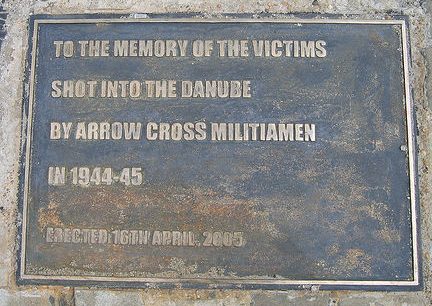
English inscription:

To the memory of the victims shot into the Danube by Arrow Cross militiamen in 1944–45.
Erected 16 April 2005.

And some context from Wikipedia:

The Shoes on the Danube Bank (Hungarian: Cipők a Duna-parton) is a memorial erected on 16 April 2005, in Budapest, Hungary. Conceived by film director Can Togay, he created it on the east bank of the Danube River with sculptor Gyula Pauer to honour the Jews who were massacred by fascist antisemitic Hungarian militia belonging to the Arrow Cross Party in Budapest during the Second World War. They were ordered to take off their shoes (shoes were valuable and could be stolen and resold by the militia after the massacre), and were shot at the edge of the water so that their bodies fell into the river and were carried away.

0

Tibetan National Martyrs' Memorial [McLeod Ganj, Himachal Pradesh, India]

preview

Inscription:

Please remember them. In Tibet 122.
Tapey · Phuntsok · Tsewang Norbu · Lobsang Kelsang · Lobsang Kunchok · Kelsang Wangchuk · Choephel · Khaying · Norbu Dramdul · Tenzin Wangmo · Dawa Tsering · Palden Choetso · Tenzin Phuntsok · Tsultrim · Tennyi · Sopa Rinboche · Lobsang Jamyang · Rigzin Dorjee · Sonam Rabyang · Lobsang Gyatso · Dhamchoe Sangpo · Tenzin Choezom · Nagdrol · Tsering Kyi · Rinchen · Dorjee · Gepey · Jamyang Palden · Losang Tsultrim · Sonam Dhargye · Lobsang Sherab · Chimey Palden · Tempa Dargey · Choepak Kyab · Sonam · Dorjee Tseten · Dhargye · Rikyo · Tamding Thar · Tenzin Khedup · Ngawang Norphel · Dekyi Choezom · Tsewang Dorjee · Lobsang Lozin · Lobsang Tsultrim · Dolkar Tso · Choepa · Tashi · Lungtok · Lobsang Kalsang · Dhamchoe · Yungdrung · Gudrup · Sangye Gyatso · Tamdin Dorjee · Lhamo Kyab · Dhondup · Dorjee Rinchen · Tsepo · Tenzin · Tespak Kyab · Lhamo Tseten · Dorjee · Dorjee Lhundup · Samdup · Dorjee Gyal · Dantin Tso · Tsegyal · Kalsang Jinpa · Gonpo Tsering · Nyingkar Tsering · Nyinchak Bum · Khabum Kyab · Tenzin Dolma · Chagmo Kyi · Sangdhak Tsering · Wangchen Norbu · Tsering Dhondup · Lubum Tsering · Tadin Kyab · Tadin Dorjee · Sangay Dolma · Wangyal · Kunchok Tsering · Gonpo Tsering · Kalsang Kyab · Sangye Tashi · Bendey Khar · Tsering Namgyal · Kunchok Kyab · Sungdue Kyab · Lobsang Gedun · Pema Dorjee · Kunchok Phelgye · Bhenchen Kyi · Pasang Lhamo · Tsering Tashi · Tsering Phuntsok · Kumchok Kyab · Lobsang Namgyal · Drukpa Khar · Namlha Tsering · Rinchen · Sonam Dhargyal · Sangdak · Tsesung Kyab · Kalkyi · Phagmo Dhondup · Kunchok Wangmo · Lobsang Thogmey · Lhamo Kyab · Thubten Nyandak · Atse · Kunchok Tenzin · Jugtso · Lobsang Dawa · Kunchok Woeser · Tenzin Sherab · Wangchen Dolma · Kunchok Sonam · Shichung · Tsering Gyal

Outside Tibet 7
Thumpten Ngodup · Lhapa Tsering · Sherab Tsedor · Bhutuk · Jampa Yeshi · Drupchen Tsering · Karma Ngedon Gyatso

Sculptor Mr. Chen We[indecipherable]
Patron: Mr. Xue Wei Mrs. Qi [indecipherable]
10 3 2014

(Tibetan text not transcribed)

Additional context from the HMDB page (https://www.hmdb.org/m.asp?m=253744):

More about this marker. The marker is located in McLeod Ganj in Dharmshala, the Indian city which the Tibetan government-in-exile, headed by the 14th Dalai Lama, is currently based in.

Regarding Tibetan National Martyrs’ Memorial. The memorial remembers the many Tibetans who have self immolated to protest and raise awareness of the continued Chinese occupation, oppression, and cultural genocide of Tibet and its people.

0

Dallas Carroll

preview

Inscription:

Dallas Carroll 1994 - 2021

This skatepark will always miss you and the good times.
Enjoy your time above riding the skies.

RIP Dallas.

Inscription:

Dallas Carroll 1994 - 2021

This skatepark will always miss you and the good times.
Enjoy your time above riding the skies.

RIP Dallas.

0

1962 Student Protests in Quetzaltenango [Quetzaltenango, Guatemala]

preview

Inscription:

Compañero estudiante:
Nunca olvides la sangre
generosa de los martires
universitarias caidos en
l>as gloriosas jornadas
de marzo y abril de 1962 que se inmolaron por darte
una patria mejor
5º aniversario – A.C.D.O.
Quezaltenango, 21 abril 1967

English translation:

Fellow student:
Never forget the blood that was spilled here by the university student martyrs that fell on those glorious days of March and April of 1962.
They sacrificed themselves to give you a better nation.
5th anniversary - ACDO
Quezaltenango, April 21, 1967

A brief Google search didn’t turn up much information about the protests. The best I have is the brief summary on hmdb.org:

Regarding 1962 Student Protests in Quetzaltenango. In March and April, 1962 there were widespread protests throughout Guatemala against then-President General Ydigoras Fuentes, who was widely seen as having been elected in corrupt elections. There was also considerable anger for Guatemala having allowed the U.S. to train Cuban exiles in Guatemala for the 1961 Bay of Pigs invasion. In this early phase of the Guatemalan civil conflict, that would go on until a formal peace treaty was signed in 1996, it was common for student protests to be met with intense violence by military forces, resulting in many student deaths. In future years the conflict would generally move away from urban centers and towards more rural areas.

https://www.hmdb.org/m.asp?m=100773

0

BME Church National Historic Site [St. Catharines, Ontario, Canada]

preview

Inscription:

The Salem Chapel, British Methodist Episcopal Church was the first Black church in St. Catharines. Originally known as the African Methodist Episcopal Church, the name was changed to reflect their loyalty to the British Empire. In 1793, the “Upper Canada Act Against Slavery” was passed, allowing Blacks aged 25 years and older freedom from slavery in Canada. This created a safe haven for African American runaway slaves and made Canada the destination for many who fled. As a result, hundreds of escaped slaves settled in St. Catharines and created a vibrant Black community.

The original church was a small log building that held about 70 members and was built on the land behind today’s church. The freedom seekers who settled in St. Catharines constructed this church, dedicated in 1855, to replace the smaller one. Some of the original pews that they built are still in use on the balcony level. The BME Salem Chapel is also significant for its ties to Harriet Tubman, nicknamed “Black Moses”. This brave freedom fighter was instrumental in freeing hundreds of slaves using the Underground Railroad system. Harriet Tubman called St.Catharines and the BME Church home for almost a decade. In 2000, this church became the first National Historic Site in St. Catharines.

Text on right side of marker:

1855
The BME Church is known for
its ties to Harriet Tubman,
a brave freedom-fighter
who freed hundreds of
slaves using the
Underground Railroad.

https://www.hmdb.org/m.asp?m=75867

https://www.pc.gc.ca/apps/dfhd/page_nhs_eng.aspx?id=1900

0

Caymanian Catboat 1904- [George Town, Cayman Islands]

preview

Inscription:

For the first half of the twentieth century, the catboat was integral to the economy of the Cayman Islands and the daily life of Caymanians. Designed primarily for catching turtle far-out at sea and carrying them to schooners for shipment to market, it was also used for fishing close to shore, for transporting people and goods around the islands, and even as an ambulance. Most children learned their sailing skills in small catboats, and catboat races were a favorite recreational activity when people had time to spare. With the decline of turtling and the arrival in the Islands of automobiles and outboard motors, the catboat gradually fell into disuse. In the 1990’s the establishment of the Maritime Heritage Foundation and the Cayman Catboat Club led to a revival of interest in this unique craft, and today the Caymanian catboat is celebrated as a living icon of Caymanian culture.

Here’s the monument where the marker is placed:

https://www.hmdb.org/m.asp?m=266531

And here is a Cayman catboat in use:

0

Julius' Bar "Sip-In" [New York City, USA]

preview

Inscription:

On April 21, 1966, members of the Mattachine Society, a pioneering gay rights organization, challenged a regulation that prohibited bars from serving LGBT people by staging a “Sip-In” at Julius’, a bar with a large gay clientele.

With reporters and a photographer in tow, the activists announced that they were homosexuals, asked to be served, and were refused. This early gay rights action and the attendant publicity helped to raise awareness of widespread anti-LGBT discrimination and harassment. Julius’ was listed on the National Register of Historic Places in 2016.

https://www.hmdb.org/m.asp?m=198561

0

James Joyce Pub Award, Bushwells Bar [Dublin, Ireland]

preview

Inscription:

This pub has been granted the
James Joyce Pub Award
for being an authentic Irish pub

‘A good puzzle would be to cross Ireland
without passing a pub.’ Ulysses

James Joyce identified and described the
characteristic ambience of Dublin pub life
so successfully that the characters in Ulysses
may be fictional, but they are based on a
multitude of living beings, characters who
Joyce found in pubs just like this one.
This establishment remains an outstanding
example of the tradition which
Joyce immortalised in his works and is a
truly authentic public house which
throughout the years has retained
it’s down to earth genuineness of
atmosphere, friendliness and
presence of good company.

James Joyce [signature]

Best Drinks Best Bar

https://www.hmdb.org/m.asp?m=241142

0

Molly Amalie Rubinstein [Gamle Oslo , Norway]

preview

This is another Stolpersteine plaque commemorating victims of Nazi extermination.

Inscription:

På Økern bodde
Molly Amalie
Rubinstein
Fødselsår 1913
Deportert 1942
Auschwitz
Drept 1.12.1942

English translation:

In Økern lived
Molly Amalie
Rubinstein
Born 1913
Deported 1942
Auschwitz
Killed December 1, 1942.

https://www.hmdb.org/m.asp?m=262889

0

Nuclear Accident at Three Mile Island [near Middletown, Pennsylvania, USA]

preview

Inscription:

On March 28, 1979, and for several days thereafter — as a result of technical malfunctions and human error — Three Mile Island’s Unit 2 Nuclear Generating Station was the scene of the nation’s worst commercial nuclear accident. Radiation was released, a part of the nuclear core was damaged, and thousands of residents evacuated the area. Events here would cause basic changes throughout the world’s nuclear power industry.

https://www.hmdb.org/m.asp?m=900

0

Earl Eugene Scruggs, January 6, 1924 - March 28, 2012 [Nashville, Tennessee, USA)

preview

Inscription:

Earl Scruggs was the most influential and most imitated banjo player in the world. On December 8, 1945. He joined Bill Monroe’s band and helped give birth to bluegrass music when he introduced his innovative and exciting 2-finger style of playing 5-string banjo on WSM-Radio’s Grand Ole Opry.

Before Earl’s Opry debut, 5-string banjos had become widely thought of as stage props used only by comedians playing rowdy old-time styles. Earl’s refined musicianship electrified audiences and banjo sales skyrocketed, his way of picking became known around the world as “Scruggs Style.”

In early 1948, Earl and Lester Flatt formed a band that Earl’s loving wife, Louise, began managing in 1966, “Flatt & Scruggs” became one of the most successful country music acts of the era. In 1962, Flatt & Scruggs provided the banjo-driven music for the theme song of the hit TV series, The Beverly Hillbillies. The 1967 film, Bonnie and Clyde, featured their 1949 recording of Earl’s composition, “Foggy Mountain Breakdown.”

Flatt & Scruggs split up in 1959 and Earl found many new fans when he bridged generations and musical genres by forming the “Earl Scruggs Revue” with sons Gary and Randy. It was a pioneering band in merging country and bluegrass sounds with elements from rock music. Youngest son, Steve, also became a musician and joined the Revue.

In his latter years, Earl’s musical journey continued with his “Family & Friends” band, standing ovations awaited him at every turn, and Earl remained the modest and unpretentious man he had always been throughout his legendary career.

Earl Scruggs, who was also a gifted guitarist, was a true icon in the music world and an inspiration to countless musicians, though his strings are now silent, echoes of his sparkling Scruggs-style sound will linger in the air forever.

https://www.hmdb.org/m.asp?m=163420

0

What is a Shotgun Shack? [Rolling Fork, Mississippi, USA, reported missing]

preview

Inscription:

Cabins once lined roadsides in the Delta
Known as shotgun shacks, these houses were common in the Mississippi Delta near agricultural fields. Each home featured three to five rooms with no hallway just a series of doors leading from room to room. They were called shotgun houses because you could shoot a shotgun through the front door and it would go out the back door without hitting a wall.

Sharecroppers lived here
From 1865 until the 1960s, sharecropping was used in the Delta. A plantation owner would supply a home to a sharecropper’s family. In exchange, the workers (both black and white) would farm “on shares” and settle up with the landowner at the end of the season. Once the owner deducted expenses, however, the families received little profit.

Comforts were limited
With no insulation, these single-wall houses were often freezing in winter and blazing hot in summer. Pages of newspaper were used as wallpaper, adhered with glue made from flour.

Mechanical cotton pickers replaced sharecroppers
When workers moved north to find better paying jobs in the 1930s, owners discovered faster, cheaper ways to harvest their cotton. The Rust mechanical cotton picker (above), introduced in 1935, picked in an hour what four workers would need a day to gather.

Few shotgun shacks remain
This symbol of the South is rapidly disappearing. This shack was located on the Helena Plantation before being moved here. Though less than half the size of a complete cabin, this home depicts the type where many Southerners were born, including McKinley Morganfield (Muddy Waters), who lived in a shotgun shack until he was three.

https://www.hmdb.org/m.asp?m=157609

0

G.F. "Betico" Croes

preview

Inscription:

G.F. "Betico” Croes
1938 - 1986

Luchado incansabel pa Aruba su Status Aparte.
Pueblo a honre cu e titulo di “Libertador”

Fought for the right of "Status Aparte” for Aruba
~ autonomous status in the Dutch Kingdom ~
The public honored him with the title of
Aruba’s “Liberator”

https://www.hmdb.org/m.asp?m=119528

He had a sad end. From Wikipedia:

Gilberto François “Betico” Croes (Papiamento pronunciation: [beˈtiko kɾus]; 25 January 1938 – 26 November 1986) was an Aruban political activist who was a proponent for Aruba’s separation from the Netherlands Antilles. This eventually occurred in 1986, but following a car accident on 31 December 1985 (the night of status aparte), Croes lapsed into a coma and never became conscious to see his accomplishment.

0

High Water Mark DC [Washington, DC, USA]

preview

Inscription (High Water lines from floods are recorded on the display):

— 5 ft

2010 -
1979 -
1976 -
1955 -

— 6 ft

1984 -
1985 -

— 7 ft

1937 / 1996 -
1972

— 8 ft

— 9 ft

1942 -

— 10 ft

1936 -

— 11 ft

100 year (as of 2020)

— 12 ft

— 13 ft

— 14 ft

500 year (as of 2020)

— 15 ft
(NAVD88)

https://www.hmdb.org/m.asp?m=204401

0

Constitution Elm [Corydon, Indiana, USA]

preview

Inscription:

Constitution Elm
On this spot, beneath the shade of the elm the Constitution of Indiana was framed in June, 1816

This tree lived until 1925, attaining a height of fifty feet. A trunk diameter of five feet and a spread of one hundred thirty- two feet.
This monument was erected in 1936

https://www.thisisindiana.org/directory/constitution-elm/

0

Nazi-Recht (Nazi Law) Wege gegen das Vergessen 1933-1945 Aachen [Aachen, North Rhine-Westphalia, Germany]

preview

Inscription:

Während des nationalsozialistischen Regimes wurden politisch unliebsame und jüdische Richter, Staatsanwälte und andere Bedienstete entlassen und durch angepasste oder regimetreue ersetzt, um die nationalsozialistische Herrschaft durchzusetzen und zu sichern.

English translation:

During the National Socialist regime, politically unpopular and Jewish judges, prosecutors and others employees were dismissed and were replaced by those who were more pliant or loyal to the regime in order to secure and enforce National Socialist rule.

https://www.hmdb.org/m.asp?m=234884

0

Trail of Death [Lexington, Kentucky, USA]

preview

Inscription:

On October 26, 1838 about 800 Potawatomi Indians being forcibly removed from Indiana camped on the river bank opposite Lexington. They ferried the Missouri River on October 27 and were marched on to Northeast Kansas.

This monument is in memory of
Ka-beam-sa
by the Kabance Family
August 2000

https://www.hmdb.org/m.asp?m=90921

0

José Matías Delgado [Lima, Peru]

preview

Inscription:

La Embajada de la República de El Salvador hace un justo reconocimiento y merecido homenaje al presbítero y doctor salvadoreño
José Matías Delgado
Padre de la patria, héroe y prócer nacional de la independencia de Centro América
Lima, Perú 13 mayo de 2014

English translation:

The Embassy of the Republic of El Salvador makes a just recognition and deserved tribute to the Salvadoran priest and doctor
José Matías Delgado
Father of the nation, hero and national leader of the independence of Central America
Lima, Peru May 13, 2014

https://www.hmdb.org/m.asp?m=192312

This guy’s Wikipedia page is a good read. He was a revolutionary priest with massive popular support.

On 5 May 1824, he was named the first bishop of San Salvador by the local civil authorities and not by the Catholic Church. This entangled him in a serious and long-lasting controversy with the Archbishop of Guatemala and with Popes Leo XII and Pius VIII, which lasted until his death.

https://en.wikipedia.org/wiki/Jos%C3%A9_Mat%C3%ADas_Delgado

0

Margot Frank, a Stolpersteine marker [Aachen-Mitte, North Rhine-Westphalia, Germany]

preview

This is one in a series of Stolpersteine plaques commemorating victims of Nazi extermination.

Inscription:

Hier wohnte
Margot Frank
JB. 1926
Flucht 1933 Holland
Interniert Westerbork
Deportiert 1944
Bergen-Belsen
Ermordet märz 1945

English translation:

Here lived Margot Frank. Born 1926. Fled to Holland in 1933. Interned at Westerbork. Deported in 1944 to the Bergen-Belsen concentration camp. Murdered in March, 1945.

https://www.hmdb.org/m.asp?m=242655

0

Crucifixion Tableau “Behind the Lord’s Buttocks” [Aachen, North Rhine-Westphalia, Germany]

preview

Inscription:

An dieser Stelle wurde 1792 ein Missionskreuz In Holz errichtet. Dieses wurde 1897 durch eine Kreuzigungsgruppe in Stein ersetzt, die 1941 in den Kriegswirren entfernt wurde und verloren ging. Durch die Initiative der Bürgergemeinschaft Henger Herrjotts Fott wurde am 27.8.1989 diese neue Kreuzigungsgruppe errichtet und eingeweiht. Geschaffen von Bonifatius Stirnberg.

English translation:

In 1792 a mission cross of wood was placed at this location. This was replaced in 1897 by a crucifixion group in stone, which was removed in 1941 and lost in the chaos of war. Through the initiative of the Henger Herrjotts Fott (“Behind the Lord’s Buttocks”) society, this new crucifixion tableau was erected and inaugurated on August 27, 1989. Created by Bonifatius Stirnberg.

https://www.hmdb.org/m.asp?m=237189

0

John Brown's Convention 1858 [Chatham, Ontario, Canada]

preview

Inscription:

On May 10, 1858, American abolitionist John Brown held the last in a series of clandestine meetings here at First Baptist Church. Brown planned to establish an independent republic within the United States and wage guerrilla war to liberate the South from slavery. He came to Upper Canada to recruit blacks who had fled here in the wake of the Fugitive Slave Law (1850). On October 16, 1859, Brown and 21 supporters seized the government arsenal at Harpers Ferry, Virginia, and held it against counter-attack for two days. Brown, executed as a traitor, became for many a martyr and hero. His actions escalated the tensions between North and South that led to civil war in 1861.

French Text:

Le 10 mai 1858, l’abolitionniste américain John Brown tient la dernière réunion d’une série de réunions clandestines ici à la First Baptist Church. Brown prévoit établir une république indépendante aux États-Unis et mener une guerre de partisans pour libérer le Sud de l’esclavage. Il vient au Haut-Canada recruter des Noirs qui s’étaient enfuis ici après l’adoption de la loi sur les esclaves fugitifs (1850). Le 16 octobre 1859, Brown et 21 partisans s’emparent de l’arsenal militaire à Harpers Ferry en Virginie et résistent aux contre-attaques pendant deux jours. Brown, qui est exécuté en tant que traître, devient pour beaucoup un martyr et un héros. Ses actions intensifient les tensions entre le Nord et le Sud qui aboutissent à la guerre de Sécession en 1861.

https://www.hmdb.org/m.asp?m=71386

0

Geographic Center of Delaware [Felton, Delaware, USA]

preview

Inscription:

In the vicinity of this marker, a Flat Outline Map of the State would be exactly balanced.

In 1989, a curious seventh grader from the Caesar Rodney School District asked where the center of Delaware was located. With the help of his teacher and the Kent County Department of Planning, it was determined that the geographic center of the state was located approximately eleven miles south of Dover in the field just south of this marker, on the Killen Farm.

https://www.hmdb.org/m.asp?m=39607

0

Harmony [Puyallup, Washington, USA]

preview

Inscription:

“Harmony”

Created by Japanese American artist, George Tsutakawa, is dedicated to the memory of over 7,600 people of Japanese ancestry who were imprisoned on the fairgounds from April to September of 1942.

This sculpture is a column made of dark bronze. Figures of men, women, and children are cut in silhouette into the sides of the column. The negative, open spaces form interesting patterns that shift as one examines the column from various angles.

“I wanted to depict people of all races and creeds living in harmony. Then these sad things won’t be happening over and over again.”

George Tsutakawa August 21, 1983

I pulled the pictures from this article about Japanese internment, particularly in the Pacific Northwest. I recommend it: https://www.worldwariimonuments.org/items/show/44

Here is the sculpture. The artist is the older man in white:

0

Kaibab Squirrel Area [Arizona, USA]

preview

Inscription:

Kaibab Squirrel Area
Has been designated a
National Natural Landmark
This site possesses exceptional value as an illustration of the Nation’s natural heritage and contributes to a better understanding of the environment.

1965
National Park Service United States Department of the Interior

https://www.hmdb.org/m.asp?m=94912

To understand why it’s interesting, refer to the Kaibab squirrel page on Wikipedia:

The Kaibab squirrel (Sciurus aberti kaibabensis) is a tassel-eared squirrel that lives in the Kaibab Plateau in the Southwest United States, in an area of 20 by 40 miles (32 by 64 km). The squirrel’s habitat is confined entirely to the ponderosa pine forests of the North Rim of Grand Canyon National Park and the northern section of Kaibab National Forest[1] around the town of Jacob Lake, Arizona. This squirrel is not found anywhere else in the world.

0

Selee Satanic Mill [Easton, Massachusetts, USA]

preview

Inscription:

Mill Pond
Site of the sawmill built by John Selee in the 18th century and continued by his son, Nathan, a wizard who purportedly used satanic imps to run the mill at night.
Easton Conservation Commission
6.6 acres
Acquired in 1999

https://www.atlasobscura.com/places/selee-satanic-mill-marker

0

The Rose Haydee Building [Central City, Colorado, USA]

preview

Inscription:

The first lady of the early Colorado state was Rose (Brown) Wakely, better known by her stage name, Rose “Haydee”. The dark-eyed beauty came to Colorado in September, 1859 – and the miners fell in love with her at once. She became the most popular entertainer in Central City. Then, suddenly, she disappeared.

Now among her many admirers was Thomas Evans, a gambling man of rather “satanic good looks.” And it was suspicioned no coincidence that, on Tuesday, November 13, 1860 – just prior to a performance starring her, Rose and the gambling man were gone!

Following the town’s suspicions, Justice Downing issued a warrant “for the arrest of an individual who has abducted a young girl…for the basest of all imaginable purposes.”

The fugitive Evans was overtaken “on the road to the States” and, with his sweet young charge, hauled back to Central City. He was brought to trial for the abduction under a handy and sturdy tree to facilitate hanging. But Rose saved this gambling man by saying that they had been married!

The next day, November 24, 1860, Rose Haydee became, through marriage in earnest, Mrs. Thomas Evans … they of Central City, Colorado.

https://www.hmdb.org/m.asp?m=51835

0

"To the Land Where Beauty Does Abide" - SS Tutshi Memorial [Carcross, Yukon, Canada]

preview

Inscription:

“To Dad,
Well, here were are, sailing up the Taku Arm, in the wilderness of the Yukon, on the quaintest old stern-wheeler steam-boat you ever saw. The plumbing is the bowl and pitcher type, but it is all so much fun.”

The southern lakes became a popular tourist attraction for Inland Passage travelers who could afford an excursion into the interior.

The SS Tutshi was constructed in 1917 to accommodate an increasing number of tourists. Tourism declined during WWI but later rebounded and the sternwheeler was expanded three times in order to meet the demand for staterooms. In 1925 the Tutshi was converted from wood to oil to preserve the quiet during night-time stops.

The gardens and hospitality at Ben-My-Chree became a popular tourist destination for the Tutshi. WP & YR purchased and maintained Ben-My-Chree as a tourist destination after the owner died in 1930.

There was a piano on the freight deck and in 1952, two of the waiters played for dances. Canvas, stored in a roll and suspended from the ceiling, was dropped down and pulled tight as a dance floor.

The low population and construction of all-weather roads in the 1940s led to the end of Yukon’s paddlewheel era.

https://www.hmdb.org/m.asp?m=248654

0

Aioi Bridge [Hiroshima, Japan]

preview

Inscription:

The former Aioi Bridge was built in 1932, in a distinctive “T” shape. The apparent target of the atomic bombing on August 6, 1945, it was subjected to an estimated blast pressure of seven tons per square meter - 15 times greater than normal.

Under this sudden pressure, the bridge thrashed like a leaf-spring being snapped back and forth with the slab floor up in the air. Fortunately, collapse was averted and, when repaired, Aioi Bridge was usable for over 35 more years. However, age took its toll, and Aioi Bridge finally had to be replaced with this new bridge in October, 1983.

The calligraphy for the name of the bridge on the newel post was written by Hirokichi Nadao, former speaker of the House of Representatives.

October, 1983 Hiroshima National Highway Work Office Ministry of Construction

https://www.hmdb.org/m.asp?m=243960

The bridge before the war:

0

Gay 90's Pizzeria [Pleasanton, California, USA]

preview

Inscription:

Here stands one the first commercial buildings in Pleasanton, possibly as old as 1864. Originally a general store, this building has been a bar, brothel, bank and unofficial Wells Fargo stagecoach stop. Since 1959 it has become well-known as the first pizza parlor in the Tri-Valley.

In the dusty days of the American West, ten rooms above the bank served weary travelers with rest and recreation. Today some people believe the building is haunted by a full-figured female ghost, know locally as the Blue Lady, seen from a second story window. An underground tunnel system once connected several buildings and businesses along Main Street and it’s also believed haunted. Although long since closed, the tunnels were built and used by Chinese laborers working on the railroads in 1880’S. This attractive building is representative of commercial Italianate architecture.

Plaque placed 2016 / 6021
By Joaquin Murrieta Chapter 13
E Clampus Vitus

https://readtheplaque.com/plaque/gay-90-s-pizzeria#gsc.tab=0

0

Neg Mawon Emancipation Monument [Roseau, Dominica, possibly removed?]

preview

Inscription:

This monument is a symbol of freedom and emancipation. It is a tribute to all the enslaved Africans who suffered and were executed in the history of Dominica.

It honours the Maroons who risked their lives to fight for the emancipation of all. It pays homage to those who were sold and executed at the Old Roseau Market and who were held at the Barracoon Building in Roseau before being sold and sent to the plantations.

This monument salutes the memory of our African ancestors and the immense contribution of their skills to our early infrastructure and the development of agriculture in Dominica through the shedding of their blood, sweat and tears.

It celebrates the powerful and lasting influence which our which our African ancestors had on Dominica’s present day culture, especially in our forms of music, language, costumes and cuisine.

This memorial is a reminder to all Dominicans that we should continue to sustain our African heritage and its many cultural expressions.

Hmdb.org says the marker is missing. Google Street View shows it in place, but the picture is 6 years old. If anyone is traveling to Dominica soon, go take a look and see if it is there!

https://www.dom767.com/dompedia/neg-mawon-emancipation-monument/

https://www.hmdb.org/m.asp?m=94220

0

The Empty Pocket Pays - Great Railroad Strike of 1877 [Pittsburgh, Pennsylvania, USA]

preview

Inscription:

In 1877, The Pennsylvania Railroad Company (PRR) was the largest corporation in the world. In that year the PRR, like railroads across the country, instituted massive lay-offs and wage cuts—reportedly due to declining profits. When workers on the B&O Railroad struck in July of 1877, the sentiment quickly spread to the PRR. In cities, like Pittsburgh, trains barreled through the middle of densely populated neighborhoods, creating pollution and posing a major safety hazard. The seething frustration of workers and citizens alike created a powder keg, which exploded in Pittsburgh as a strike blossomed into a three-day riot.

Venting their anger at the exploitation of workers and the deterioration of public life caused by the PRR, rioters burned railroad buildings and looted freight cars. The destruction included 125 locomotives, 3,500 rail cars, two roundhouses, the Union Depot and a Grain Elevator. The corporation’s president, Thomas Scott claimed no responsibility for the damage the PRR wreaked in the lives of his employees, nor the community. Yet, Scott insisted that the county be held responsible for damage the public dealt on private property. Allegheny County absorbed $4 million in property damages, while the Pennsylvania Railroad Company did not a spend penny.

https://www.hmdb.org/m.asp?m=26104

0

Native American Village and Ceremonial Site - Columbus Landing Site [Christiansted in St. Croix, Virgin Islands]

preview

Inscription:

This site marks the only point on the United States Territory where members of the crew of Christopher Columbus came ashore on his second voyage to the New World in November 1493. It also relates to the first recorded altercation between Europeans and the native people of the western hemisphere, at a point on the other side of the bay, known as “Cape of Arrows”. The site on which you stand was a Native American village and ceremonial site, and includes the site of the only known ball court (or batey) in the lesser Antilles. Later after the demise of the native population on St. Croix, an earthen fort was erected, the remains of which can be seen, and was successfully occupied by European powers, including the English (1641-1645-50), Dutch (1642-1645, and French (1650-51) (1665-1733). In 1788 a Danish Customs House was built nearby to thwart smuggling, and during the 1920’s. Danish archaeologists carried out extensive excavations on the prehistoric village site.

https://www.hmdb.org/m.asp?m=60782

0

Santa Claus [Albion, New York, USA]

preview

Inscription:

Charles W. Howard 1896-1966
In 1937 he established here
a world famous Santa Claus
school, the first of its
kind & 1953 Christmas Park
Macy’s Thanksgiving Day Parade Santa Claus

Source: https://www.hmdb.org/m.asp?m=78150

Inscription:

Charles W. Howard 1896-1966
In 1937 he established here
a world famous Santa Claus
school, the first of its
kind & 1953 Christmas Park
Macy’s Thanksgiving Day Parade Santa Claus

Source: https://www.hmdb.org/m.asp?m=78150

0

Johann Friedrich Böttcher - Goldmacher / Alchemist [Enns, Austria]

preview

Inscription:

Der Goldmacher und spätere Erfinder des europäischen Porzellans - Johann Friedrich Böttcher - wurde auf der Flucht vor dem sächsischen Kurfürsten am 20. 6.1703 in diesem Hause festgenommen. Er soll die Goldmachertinktur-das Arcanum hier liegen gelassen haben.

(English translation:)

The alchemist and later-on the inventor of European porcelain, Johann Friedrich Böttcher, was arrested in this house on June 20, 1703 while fleeing from the Saxon Elector. He is said to have left the “Goldmaker’s Tincture” - the Arcanum, the recipe for making gold and curing diseases, here.

https://www.hmdb.org/m.asp?m=210662

0

Kings St. Coal Wharf - Skinner & Eddy Shipyards - Site of Hooverville [Seattle, Washington, USA]

preview

Inscription:

A coal wharf was located at the waterfront during the late 19th century. Coal was transported here by railroad from Newcastle and Renton. Abandoned in the early 1900’s, the wharf soon became the Skinner & Eddy Shipyard.

During World War I, the shipyard set records in ship construction, building 75 vessels – one-tenth of the nation’s total wartime shipping tonnage. Following the war, an attempt to reduce wages at the shipyard resulted in the first city-wide strike in the country, which immobilized Seattle for five days.

During the depression of the 1930’s, the abandoned shipyard became a part of Hooverville, the well-known Seattle shantytown which housed displaced citizens until World War II.

https://www.hmdb.org/m.asp?m=48123

0

Gettysburg Address [Gettysburg, Pennsylvania, USA]

preview

Inscription:

ADDRESS BY PRESIDENT LINCOLN
AT THE DEDICATION OF
THE GETTYSBURG NATIONAL CEMETERY
NOVEMBER 19, 1863.

Four score and seven years ago our fathers brought forth on this continent, a new nation, conceived in liberty, and dedicated to the proposition that all men are created equal.

Now we are engaged in a great Civil War, testing whether that nation, or any nation so conceived and so dedicated, can long endure. We are met on a great battle-field of that war. We have come to dedicate a portion of that field, as a final resting place for those who here gave their lives that that nation might live. It is altogether fitting and proper that we should do this.

But, in a larger sense, we can not dedicate - we can not consecrate - we can not hallow - this ground. The brave men, living and dead, who struggled here, have consecrated it, far above our poor power to add or detract. The world will little note, nor long remember what we say here, but it can never forget what they did here. It is for us the living, rather, to be dedicated here to the unfinished work which they who fought here have thus far so nobly advanced. It is rather for us to be here dedicated to the great task remaining before us - that from these honored dead we take increased devotion to that cause for which they gave the last full measure of devotion - that we here highly resolve that these dead shall not have died in vain - that this nation, under God, shall have a new birth of freedom - and that government of the people, by the people, for the people, shall not perish from the earth.

Image source: https://unsplash.com/photos/a-sign-on-a-rock-in-a-cemetery-N04QVacUvPw

Inscription source: https://www.nps.gov/places/000/battleground-national-cemetery-gettysburg-address-plaque.htm

0

Strangers from the Clouds [Plymouth, Washington, USA]

preview

Inscription:

“I gave my hand to them all and made signs of my friendly disposition”

On October 19, 1805, William Clark and three men traveling ahead of the rest of the party arrived at a Umatilla village near here. Upon seeing Clark, the villagers ran back to their lodges and closed their doors. Clark opened the door to one lodge, went inside with pipe in hand, and found them in great distress. By signing, he tried to assure them of his peaceful intentions. Just before he went to the village, Clark has shot and killed a crane. The sound of the gun, the sight of the bird falling from the sky, and the sudden approach of the strange-looked explorers caused great concern among the villages. Clark said the villagers thought he and his party came “from the clouds … and were not men.”

The People of This Land The Columbia River and surrounding plains provided abundant resources. This region was heavily populated when the Expedition passed through in 1805-06, Clark wrote, “I Saw Several Horses and persons on horse back in the plains … Encamped … nearly opposit to 24 Lodges … This Tribe can raise about 350 men.”

October 19, 1805 “found 32 persons men, women and a few children … in the greatest agutation. Some crying and ringing there (sic) hands, others hanging their heads. I gave my hand to them all and made Signs of my friendly dispotion and offered the men my pipe …”

“as Soon as they Saw the … wife of the interperters (Sacagawea) they pointed to her and imediately all came out and appeared to assume new life … the sight of This Indian women … confirmed those people of our friendly intentions…” ~ William Clark ~

Lost in Translation Not all encountered with American Indian tribes went smoothly. Local tribes spoke a variety of languages the explorers were unfamiliar with. Conversations often flowed through a series of translations - sign language, multiple native languages, French and English - taking a long time to complete. Not all signs of friendship, such as Clark’s handshake and unannounced visit, were universally understood.

Umatilla People The Umatilla tribes lived along the banks of the Columbia and Umatilla rivers, in the midst of one of the world’s richest fisheries. Now part of the Confederated Tribes of the Umatilla Indians Reservation, the tribe is actively involved in this region. In you journal keep track of the names of tribes along the Lewis and Clark Trail.

Source: https://www.hmdb.org/m.asp?m=158634

0

Black Cat Tavern [Los Angeles, California, USA]

preview

Inscription:

At midnight on January 1, 1967, undercover LAPD officers raided the Black Cat Tavern in Silver Lake. 14 men were beaten, dragged outside, and arrested. Six men were charged with lewd conduct for same-sex kissing. Outrage over the raid spurred two new California gay rights groups to organize hundreds of protestors to demonstrate against police entrapment and arbitrary arrest. The peaceful demonstration that took place outside the Black Cat Tavern on February 11, 1967 was Southern California’s first public protest for gay rights.

Events like the Black Cat Tavern protest, and earlier demonstrations at Compton’s Cafeteria in San Francisco, were critical milestones in California’s LGBTQ+ history, opening the floodgates for new civil rights strategies within the LGBTQ+ community that led to the repeal of discriminatory laws in California.

California Registered Historical Landmark No. 1063.

Plaque placed by the California Department of Parks and Recreation in cooperation with The Black Cat, the California Landmark Foundation, and the Bill Beaver Project, October 1, 2023.

Source: https://www.hmdb.org/m.asp?m=233806