showing posts tagged #dndhomebrew — clear

0

[Planescape] Avernus - Taming Nightmares and Environment Hazards

preview

So, my party is in Avernus right now. They needed some faster transport and a herd of Nightmares was nearby. Their guide showed them how to tame them. And now I will show you ;)

Of course afterwards they used the horsies to ride across Avernus to the next location, and I made a little table to see if anything would happen. I’ve shared both of these ‘encounters’ below, hopefully it’s useful for you to use in your next game!

Taming Nightmares

Roll a D12: that’s how many are in the herd.

Every player can approach a Nightmare one at a time. They can lure them with something to decrease the difficulty to tame them. Standard is DC15. If they think of an especially tasty treat (the GM can decide if the Nightmare thinks how tasty it is) you can decrease the difficulty by 5 or 8 points. Or maybe decide to have it always work?

For my adventure it would be logical to have the Nightmares run away after travelling for a few hours so I gave them the “Unstable” trait. As in you are unable to put them in a stable ;) .

Travel through Avernus

Roll a d4; that’s how many hours it takes to go from one location to the next on the back of a Nightmare.

For every other hour of travel in which you do not have Fire Resistance roll a DC12 Constition Save. On a fail add a level of Exhaustion.

Roll a d100;

  • 100-75: You watch as thin arcs of hot-white and yellow fire streak across the sky. At this distance it’s a beautiful sight.
  • 75-50: A group of fireballs light up the clouds above as they burst through the ash and continue their journey across the sky. You can hear them raging from the ground.
  • 50-25: The ground shudders as a few huge fireballs crash over a cliff nearby: their debris rockets all around your, missing some of you by only a few feet. You look around, ears ringing and covered in ash and soot. Everyone seems fine, but that was way too close for comfort.
  • 25-0: Thinking back you felt an enormous heat behind you in the moment just before the impact. Then the earth blew up and threw you several feet forward. A second impact thundered next to you as rocks pelted you and all the air was sucked out of your lungs. You tried to breathe in but everywhere was fire. Feeling the intense heat burn your clothes and skin you tried to roll and put out the flames, seeming to roll into more burning rock in the process. You found somewhere that was not on fire and through the smoke and flame you could see your companions screaming and trying to put out the flames on their clothes. It would take a good quarter of an hour before everyone was calm again. Avernus had seen you and thrown it’s sky down upon you. But at least you’ve survived.

Have the party roll a DC 15 Dex Save. The fireballs deal 2d6 Bludgeoning and 10d6 Fire damage which is halved if you make the save.

(The picture is a painting by Hieronymus Bosch called Hell. I thought it would be appropriate.)

0

Character Heirlooms

Picture of an envelope, a canteen and a six-sided dice
preview

Sometimes when I roll a new character I have an idea all worked out; the background leads to the class which looks cool with a certain type of species, you probably know the feeling.

Other times not so much. Other times I need a little help, preferably from a random table ;) . So that’s why I created a page (formatted for easy printing) that I hope you’ll find useful as well. I put it here: buriedaeons.neocities.org/projects/heirlooms/

Please let me know if you like it and/or if you think some tables could use some improvement! I’m curious to see what you guys think.

0

Pathfinder v1.0

preview

The Ranger may actually be my favourite class because of its mesmerizing blend of warrior tropes, nature-themed abilities and pet (sub-)classes being my jam in every game I play. That being said, I find the DnD rendition of this iconic class an aimless and uninspired mishmash of dull features that never quite manage to differentiate it from other classes, thus resulting in the Ranger playstyle feeling like a mix of Fighter, Rogue and Druid, while never reaching the heights of any of those classes.
Things didn’t improve with DnD 2024, which scrapped most of its unique features and replaced them with spell-like effects in an attempt to fix the quirkiness of the original class (which had, admittedly, a lot of features that never amounted to much because of how narrow and restrictive they were)

When I decided I’d finally play as a Ranger, I set out to create a homebrew class that would tick all my boxes and give it a unique identity of its own. From the combined efforts of a friend and myself, the Pathfinder was born.

The main feature distinguishing the Pathfinder from the Ranger is the inclusion of the pet right off the bat at 2nd level, now a part of the core class instead of being relegated to a single subclass: this was done as I felt the pet was THE defining feature that set the Ranger apart. The pet’s capabilities were also expanded with 10 distinct stat blocks that should allow for much greater customizability than the generic “Beast of the Land/Sea/Sky” from DnD5e, which often feel as amorphous blobs with little thought given to the animal they’re meant to represent.
From there, we focused on salvaging and enhancing its nature-themed features to further define the Pathfinder as an intrepid explorer and expert survivalist.

The class has not yet been playtested, but I will report back once I do and update the class accordingly.

PDF DOWNLOAD: mega.nz/file/WU8nHJoI#eii47dPmBNTYQrSC9IucIpdlX0I…
HOMEBREWERY LINK: homebrewery.naturalcrit.com/share/3_tXaVnD67Lx

Or open the spoiler below to read the class directly from Lemmy (it may take a while to load):

spoiler

Page 1 - Cover Page 2 - Class features Page 3 - Class features Page 4 - Class features Page 5 - Class features Page 6 - Subclasses Page 7 - Subclasses Page 8 - Subclasses Page 9 - Appendix: Tamed beasts Page 10 - Appendix: Tamed beasts Page 11 - Appendix: Tamed beasts Page 12 - Appendix: Tamed beasts Page 13 - Appendix: Tamed beasts Page 14 - Backcover

0

[feedback requested] Incorperating the Fiery Faith passive for the Barbarian Zealot

preview

I am trying to translate the Fiery Faith passive from Vermintide 2 for a players Barbarian Zealot. As the passive states it should be a high risk high reward kind of thing.

The most simple 1-on-1 conversion imo would be:

“For each 1/4th (rounded down) missing from your max health you gain a +1 bonus to attacks.”

Which sounds the most fitting and true to it’s original intent, but it might be a tad too strong. Maybe a more hardset table of tresholds would be better; something like “at 30 health gain +1 to hit, at 15 health gain +2 to hit and at 5 health gain +1 to damage and +2 to hit”.

Two other ideas came to mind:

  • As a bonus action, deal yourself ‘x’ damage to get a bonus on your next attack.
  • When getting attacked, forego your AC and take the hit. Take a dice closest to the amount of damage you took (rounded down) and add it to your next attack as bonus damage.

These could work in their own way, but I feel that they don’t really hit the high risk high reward side that the original passive has: keeping your health as low as possible to deal as much as possible damage.

What do you guys think? Any advice to get it as close to the original passive but keeping it balanced? Or maybe a different idea? Would love to hear your thoughts!

P.s.: typed on phone, please excuse any typos!

0

Black Feather Rogue

preview

Hello lovely people! We are proud to announce the release of a new subclass for rogues: the Black Feather Rogue.

Drawing upon the forces of natural magic, the Black Feather blends roguish cunning with druidic transformation to yield a formidable spy and skirmisher. In their raven form they can dodge attacks, find a safe perch, or reposition to make a sneak attack.

Feedback, opinions, and suggestions are always welcome.

0

Occultist v1.0.5 - Revamped Warlock (DnD5e and DnD2024 compatible)

preview

This is the finished version of my Occultist class, a revamped Warlock that’s meant to refine and streamline the OG class.

The Warlock is my favourite class in the game, but its reliance on short rests to recharge spell slots and the pitiful amount of invocations known turn DnD’s most customizable class into a boring slog of “I cast Eldritch Blast” and “As my first invocations, I take Agonizing Blast and Devil’s Sight. Again”.
By adding the Patron’s expanded spell list (which goes up to 9th level) automatically to their spells known, gaining more invocations (10, compared to the OG Warlock’s 8) and rebalancing the invocations (including adding higher level Pact-exclusive invocations up to 14th level), the INT-based Occultist allows for much greater build variety, while retaining what made the original class so loved by many.

The 1.0 update includes four Pact Boons (Blade, Chain, Talisman, Tome), four subclasses (Archmage, Deep One, Greatwyrm, Undying) and 50+ Eldritch Invocations, including seven pact-exclusive invocations for each Pact Boon.

Read and/or download the PDF here

Or click the spoiler to read it in image form (it may take a bit to load)

Occultist - Page 1  Cover Occultist - Page 2 - Class features Occultist - Page 3 - Class features Occultist - Page 4 - Class features Occultist - Page 5 - Class features Occultist - Page 6 - Pact Familiars Occultist - Page 7 - Pact Familiars Occultist - Page 8 - Eldritch Invocations Occultist - Page 9 - Eldritch Invocations Occultist - Page 10 - Eldritch Invocations Occultist - Page 11 - Eldritch Invocations Occultist - Page 12 - Otherwordly Patrons Occultist - Page 13 - Otherwordly Patrons Occultist - Page 14 - Otherwordly Patrons Occultist - Page 15 - BackCover and Credits

If you like what I do and wish to support me, please consider visiting my Ko Fi page :) ko-fi.com/taverntalesdnd

0

Magic-averse Staff - An weapon for people who have a strong distaste for the arcane

preview

Text version:

Magic-averse Staff (Wondrous item)
Weapon (Quarterstaff), Rare (requires attunement)
This weapon, with its unassuming appearance, stands as a silent testament to resilience and serves as a steadfast companion for those who choose to tread less travelled paths.

  • Weightless. This weapon has the Light and Finesse property, as the wood it’s carved from is very sturdy, but also unusually light.
  • Pierce Magic. Attacks made with this weapon bypass the Armor Class bonus derived from magical sources, such as magical armour or the Shield spell.
  • Arcane Scourge. If you hit a celestial, a fiend, or a creature that has the Spellcasting trait with this weapon, you roll one additional damage die.
  • Spell Breaker. A creature hit by this weapon has disadvantage on Constitution saving throws that it makes to maintain its concentration on a spell.
  • Fizzle Magic. The staff has three charges. While wielding this staff, you can expend one charge to cast Counterspell (only if you are one of the targets of the spell, or you are included in the area of effect of the spell) or two charges to cast Antimagic Field (no material components needed). Charisma is your spellcasting ability for these spells. The staff regains all charges daily at dusk.

Cursed. While attuned to this item, you cannot cast spells or be attuned to other magical items. If this curse is broken, the wood from which this quarterstaff is carved rots away, resulting in the destruction of the item.

0

Inspiration - Teamwork makes the dream work!

preview

Text version:

Inspiration

When a friendly creature within 30 feet that is aware of you fails an attack roll, an ability check or a saving throw, you can Inspire that creature to make it reroll the die.

Limitations. (a) You can only Inspire another creature once per long rest; (b) If you give or receive Inspiration, you can’t give or receive Inspiration again until the end of the current round.

Flavour is a welcome addition. When inspiring another creature, you are invited (but not required) to describe how you are doing it: for example, you may hype them up, warn them of an incoming danger, or throw a passing comment that may help them achieve success in a task.

No beggars allowed. Inspiration should feel genuine and come from the heart: this mechanic is meant to incentivize bonding and roleplay, not min-maxing. At the DM’s discretion, you lose the ability to give and receive Inspiration until you finish a long rest if you ever explicitly refer to this mechanic, such as asking others to give you inspiration, or making a throwaway comment about it (for example: “Could you please give me inspiration on this roll?”, “It would be cool if somebody could help me out on this roll”, “Man, I feel really inspired right now”, “Don’t waste your Precision Attack on this roll, I’ll just inspire you if you fail”).


This mechanic is meant to replace the original inspiration. Instead of the DM awarding Inspiration to a player, it’s the players themselves who help each other during hard times.

0

The Disciple v0.5 - Revamped Monk

Imgur imgur.com i.imgur.com
preview

In the past few months, I’ve been hard at working creating revamped versions of subpar classes for the original game: the Heroic Warrior (revamped fighter), the Highlander (revamped Barbarian), and this one’s the Disciple, my revamped Monk.

As always, the purpose of my reworked classes is to make them more fun to play, giving more choices to the player both during the character creation process and in day-to-day play, and to raise their power level to a more acceptable standard, while also keeping as many of the core features as possible and not raising the bar of complexity.

Unfortunately, with DnD 2024 approaching I doubt that these classes will see much use, so unless I really need them for my weekly plays with my party, I doubt I’ll keep working on them, as I think there’s just not enough demand. For this reason, these classes are presented as-is, even if they are incomplete (the Disciple, for example, has perfectly functioning class features but no subclasses) for the folks who, like me, is considering sticking to 5e.

Ko Fi: ko-fi.com/taverntalesdnd
MEGA (pdf download/online pdf reader): mega.nz/file/KY1H0BiI#Yf6DCCvjj-XzjY4nFMQCu1ay-Ni…

Disciple - Page 1 Disciple - Page 2 Disciple - Page 3 Disciple - Page 4

0

Highlander v0.5.1b - Revised Barbarian

Imgur imgur.com i.imgur.com
preview

Since DnD2024 is releasing soon and there’s not much point in working on 5e classes anymore, I’m releasing everything I’ve created in the past few months, even if it’s not finished.

The Highlander is my revision of the Barbarian. The revision aims at improving both the performance of the class (which, as most people know, was pretty much dead weight after lv~8) and the feeling during play (which means, having things to do other than raging and smashing stuff), while also keeping the core mechanics as close to the original source as possible, and without adding unnecessary complexity.

The class was meant to be played alongside my other homebrew classes, of which I’ve already released the Heroic Warrior (revamped Fighter). As you can clearly see, this homebrew is not finished: the class itself is functional, but there is only one subclass. I was planning on going back and adding new subclasses after I played a campaign as a Barbarian to get a general feel of how it plays, but I never got the chance and, with DnD2024 approaching, there’s not much point anyway, as I don’t think that people will play 5e classes anymore.

Having said that, I hope that you’ll enjoy it. Feedback are always welcome, and I’m always curious to hear others’ opinions on my design choices. Maybe one day I’ll finish working on it!

PDF download/online reader: mega.nz/file/nIM2wKaQ#8mb9UbEGy908cSDe9CCyOdITa5H…
Ko Fi: ko-fi.com/taverntalesdnd

Page 1 Page 2 Page 3 Page 4 Page 5

0

Heroic Warrior v1.4.10 - Revamped Fighter

preview

In the past few months, I have been working on revamped classes for DnD5e for personal use. This is my revamped Fighter, which I’ve played in a (still ongoing) campaign for the past few months and had a blast with.

Unfortunately, with DnD 2024 approaching, I see very little incentive in working on this still. I don’t even think people will be interested in trying it with the new rules. I don’t like DnD 2024 and the 2024 Fighter looks bland and boring to me, so I’ll keep playing this one instead, but I don’t see myself updating it further in the future unless I find a really broken combo that needs addressing.

Please, enjoy :)

Online reader and PDF download: mega.nz/file/6UVCFDxS#QFJOdoH2bqGX78fWGZ9JdrrsEYS…
Ko Fi: ko-fi.com/taverntalesdnd

page 1 - Class features Page 2 - Class features Page 3 - Class features Page 4 - Class features Page 5 - Martial Archetypes Page 6 - Martial Archetypes Page 7 - Martial Archetypes Page 8 - Martial Archetypes Page 9 - Martial Archetypes Backcover and Credits

0

Magical items based around impacting luck, for good or bad!

preview

So these items are “kind of” cursed, where instead of them just being “using these are a bad idea” they are “using these are risky” these are potential gifts from the God of Chance, entertainment, gambling, and risk.

Any suggestions on these, or any new ones you think I should add?

Orb of random dragon! - Throwing this orb as a bonus action to the ground summons a draconic spirit from another dimension, roll to choose the color. It may or may not be hostile to you. The dragon can return to their plane at any time and vanishes back if slain. Single use.

Double or nothing - A magical coin with an X on one side and a winking dragon on the other. On taking damage, as a reaction flip a coin. Heads you take double damage, tails you take no damage. Single use.

Mirrored coin - On breaking this coin as a bonus action you let out an aura of bad luck that lasts for one minute. You have disadvantage on all saving throws, and any saving throws you force another creature to make they also have disadvantage. Single use.

Amulet of bloody good luck - Before making a saving throw you can activate this amulet as a reaction and roll a d10 and add the result to your saving throw. You take 5 force damage ignoring temp HP * the amount rolled on the d10.

Push your luck - On failing a saving throw as a reaction you may roll again using this bracelet, if you fail again you suffer the normal consequences as well as getting 2 levels of exhaustion.

Staff of odds - This magical staff with a laughing jester atop it has a -2 to hit on any spells cast from it, but crit on a 20 or 19

Call to the unknown - A golden wired diamond ear piece. Expend a spell slot as an action while targeting a creature. A spell of that level + 1 is randomly cast targeting that creature. Concentration is held by the Call to the Unknown and must be destroyed to end the effects early.

All on black - A necklace of a roulette wheel. As a bonus action activate the necklace by spinning it and roll a d10. On evens instantly have the benefits of a long rest. On odds, fall to 0 hp and become cursed for 12 hours. While cursed this way you are stable, can not regain HP, and this curse can not be removed except for Wish or act of god.

Dressed to kill - This wispy reaper like cloak means you no longer roll death saving throws, but die if you hit 0 hp as you are whisked into the cloak. Creatures you reduce to 0 hp instantly die even if they would normally stabilize or have death saving throws, as the soul is instantly brought into the shroud. The creature can not go to a clone or be revived until freed from the cloak.

0

Advent's Amazing Advice: The Night Before Wintermas, A Holiday One-Shot fully prepped and ready to go!

preview

I hope everyone is having a Fantastic December! With the Holidays in full swing, I wanted to give everyone here a present, by doing all the prep work for a fantastic Holiday One-Shot for you! Then, in turn, you can gift that experience to your players! And what better gift is there for players who have been so good, than an opportunity to let loose and be evil for a change! Yes, that’s right, The Night before Wintermas is specifically designed for Level 5 Evil/Neutral aligned players.

Thanks to the creative mind of jmanc, you’ll bring your players to The Town of Frosthold and join a morally bankrupt Toy and Tabacco company to put an end to Santa’s charitable operations by Infiltrating his workshop and dealing with the problem for good!

Experience holiday music to fit every scene, face your favorite Christmas Characters…in a battle to the death, earn unique magic items to help you take on the fat man, and live vicariously through your newly evil characters! This is a One-Shot you won’t want to miss!

Without further ado:

Included in The AAA Collection is:

  • A Word document with all my notes including links to music tracks for ambiance and fights
  • Special PDF for the encounter. This includes the enemy stat block organized neatly along with an initiative tracker and a spot to mark HP
  • An Alternate encounter PDF for Frosty and The Snowmen *(Updated 2023)
  • Custom Maps for Santa’s Grotto
  • Custom Boss Fight Music
  • Handouts for the Scrolls of Haste and Invisibility
  • A Preview PDF of Flee Mortals

Other One Shots, Adventures, and Campaigns:

I hope you enjoy this as much as I did! If you have any advice on how I can improve my notes further, please let me know either here or leave a comment on the Google doc itself! If you’d like to support me, shape future releases, and get content early, feel free to check out my Patreon!

Cheers,

Advent

0

Advent's Amazing Advice: Grammy's Country Apple Pie, A perfect One-Shot for kids and adults alike fully prepped and ready to go!

preview

Welcome back to Advent’s Amazing Advice! The series where I take popular One-Shots, Adventures, Campaigns, etc. and fully prep them for both New and Busy DMs. This prep includes fully fleshed-out notes, music, ambiance, encounter sheets, handouts, battle maps, tweaks, and more so you can run the best sessions possible with the least stress possible!

We’re back at it again with another Level 1+ One-Shot, this time by the amazing Jennifer Adcock! Grammy’s Country Apple Pie is the perfect One-Shot to run for a group of kids who are looking to just have some fun. They can go in the hard way and try to fight everything or they can try to practice those bard-like skills and converse their way through the challenges!

In Grammy’s Country Apple Pie, a wizard named Tyndareus develops a craving for a special treat from his childhood, he will stop at nothing to get his hands on the best apple pie in the whole world. He hires your group to seek out the bakery that once produced the wonderful dessert – unfortunately for them, the bakery has long since been overrun by goblins. But all is not as it seems at Grammy’s Bakery, and Tyndareus isn’t the only one who’d do anything for those pies.

Parents and Teachers can oftentimes be even busier than the rest of us and with this Fully Prepped One-Shot I hope I can help get families together and bring new generations of players to the table!

Without further ado:

Included in The AAA Collection is:

  • A Word document with all my notes including links to music tracks for ambiance and fights
  • Special PDF for all encounters. This includes the enemy stat blocks organized neatly along with an initiative tracker and a spot to mark HP
  • Custom Maps of Grammy’s Bakery

Other One Shots, Adventures, and Campaigns:

If you see something you think I can improve, add, change, etc. please let me know. I want this to be an amazing resource for all DMs and plan to keep it constantly updated! If you’d like to support me, shape future releases, and get content early feel free to check out my Patreon!

Cheers,

Advent

0

Advent's Amazing Advice: The Haunt, A Halloween-Themed One-Shot fully prepped and ready to go!

preview

Welcome back to Advent’s Amazing Advice! The series where I take popular One-Shots, Adventures, Campaigns, etc. and fully prep them for both New and Busy DMs. This prep includes fully fleshed-out notes, music, ambiance, encounter sheets, handouts, battle maps, tweaks, and more so you can run the best sessions possible with the least stress possible!

It’s October, the month of Halloween, so of course I had to prep a spine-chilling One-Shot! The Haunt is one of the highest-rated 5th-Level Horror-Themed One-Shots around by Phil Beckwith. In it, your players will have to survive, solve puzzles, and uncover the mysteries of Montarthas Manor.

In ages past, an ancient town was lost and destroyed by a siege of orcs. Only one building survived and to this day, the manor is the only still standing building to be seen for miles around. Some say it is haunted, a few whisper of great treasures within, whilst others whisper that it is the manor itself that lives! No one knows for sure, only that a great evil haunts its halls. Do you dare enter Montarthas Manor?!

Without further ado:

Included in The AAA Collection is:

  • A Word document with all my notes, including links to music tracks for ambiance and fights
  • Special PDF for all encounters. This includes the enemy stat blocks organized neatly, along with an initiative tracker and a spot to mark HP
  • Handout for The Scroll of Invisibility
  • Custom Maps (Credits: just_2_clarify, Before the Lore, Anonymous, PogS_3)

Index:

Other One Shots, Adventures, and Campaigns:

As always, If you see something you think I can improve, add, change, etc. please let me know. I want this to be an amazing resource for all DMs and plan to keep it constantly updated! If you’d like to support me, shape future releases, and get content early feel free to check out my Patreon!

Cheers,
Advent

0

Samurai V2.0 re-classes of sokoku vol.1

preview

drive link

the samurai is a versatile martial class that channels the mystical arts of their ancestors.

please give feedback.

currently I’m thinking of restricting the uses of stances to one minute and a number of activations equal to 1/4 level rounded up, let me know what you think? and if you have any ideas for subclasses let me know?

and I’m sorry for not holding up to my commitment to writing the articles I promised. I will work on them but I got caught up in planning for the game I’m running and helping a friend with a project and reviving my classes of sokoku (a series of classes I made for a rokugan game some time ago)

0

Advent's Amazing Advice: Phandelver and Below: The Shattered Obelisk, A Campaign Fully Prepped and ready to go! (Part 1 Cragmaw Hideout)

preview

Welcome back to Advent’s Amazing Advice! The series where I take popular One-Shots, Adventures, Campaigns, etc. and fully prep them for both New and Busy DMs. This prep includes fully fleshed-out notes, music, ambiance, encounter sheets, handouts, battle maps, tweaks, and more so you can run the best sessions possible with the least stress possible!

Phandelver and Below: The Shattered Obelisk stems from The Lost Mine of Phandelver a classic and beloved starter set that many new DMs run. Even with this being the most recent release it still has an issue, the same as with many others…it doesn’t describe the best way to transform the book’s contents into an actual session. The Book-to-session conversion can be difficult between figuring out when things should happen, understanding motivations, and even organizing encounters.

Well, fortunately for you, 99% of that work is done! Only a few things are really left:

  • Read the book, I know surprising, but It can be extremely confusing when you don’t know where everything leads to.
  • Consider the needs of your group. As you’ve heard or are about to hear a million times, every table is different. If you plan on combining this with a campaign, you’ll have to make tweaks here and there.
  • These notes aren’t meant to be the end-all-be-all. Tweak to your heart’s content, and don’t consider any of what’s written to be set in stone. For me having notes like this helps give me the confidence to go off the rails and follow along with what my players want. It helps me understand where things were meant to go and why. Having that understanding allows me to guide the players and create other new and interesting stories. These are all things that will come with experience, though, so don’t freak out and enjoy the journey!

Advent’s Notes: I was surprised with how few changes were made in the book considering how long this adventure has been around and all the wonderful things the community has come up with, I was even more surprised when they started adding more monsters to Cragmaw Cave. It’s already pretty rough in there and with the additional creatures, it’s almost assured there’s going to be a TPK. I’ve kept most of the fights the way they were with only a few minor adjustments, the most important changes are just subtle nods to the Psi Goblins that will be encountered later on.

Without further ado:

Included in The AAA Collection are:

  • A Word document with all my notes, including links to music tracks for ambiance and fights
  • Special PDFs for all the encounters. This includes all the enemies’ stat blocks organized neatly, along with an initiative tracker and a spot to mark HP.
  • An additional PDF with Sildars stats should he join the party as an ally
  • Custom maps of Cragmaw Hideout. I enlarged and printed this out for my players as a battle map!

Index:

Other One Shots, Adventures, and Campaigns:

As always, If you see something you think I can improve, add, change, etc. please let me know. I want this to be an amazing resource for all DMs and plan to keep it constantly updated! If you’d like to support me, shape future releases, and get content early feel free to check out my Patreon!

Cheers,

Advent

0

Scaling stat blocks [taking requests]

preview

drive link

the parenthesis are areas to write in with pencil.

this one is a proof of concept that I drew up really quickly for my group, I’ll run it by them and make revisions. but I’d like to have plenty of stat blocks in this format and maybe you would too, like a scaling brown bear for a moon druid. so let me know what monsters I should stat like this and I’ll release them in a beta state to collect feedback before finalizing them for you.

thanks!

0

Running monsters 1: commanders, shamans, and secondary objectives

preview

I’ll be writing more articles here so stay tuned if you’re interested, and check out my previous articles below.

click to expand

___ Creating character kits instead of classes for 5e? “dead” levels, casting, and balancing How much is a ki point worth? an in depth look

now on to the article. I’ll address these topics in order, so,

starting with commanders.

Commanders can be used to keep low level monsters relevant as the party levels up, or to give uniqueness to specific enemy npcs. They also give the party a good secondary objective to combat that I will talk about later on.

Building a commander is simple, but they offer a lot more than just the monster; giving them individual motivations, styles of command, and names can go a long way for roleplay. Just don’t get too deep into the lore of one commander when it’s likely the party will hit first and ask questions later. To build one; first take a monster, give them a background (no shame in just rolling the tables), then give them 1 to 3 class levels (if it’s more than three the balance kind of breaks down), then adjust stats and equipment.

If you give them a spellcasting class I suggest picking just a couple spells that are signature to the commander instead of filling out a whole list, you don’t even have to choose from spells they are eligible for either.

Remember that each class level they receive confers 1 CR and to adjust their proficiency bonus accordingly. I suggest adjusting their ability scores by improving one by 1 and another by 2, and if their CR becomes 4 (I round up in this case) or increases past 4 by giving them levels then they get an ability score increase like they reached level 4 in a class.

Shamans

Shamans are an idea inspired by the monster manual entry for aarakocra. In order to add shamans to an encounter; choose one spell of preferably lower level, add a number of monsters designated as shamans equal to the level they plan to cast the spell at, then set a number of turns the shamans need to perform the ritual to cast the spell.

The reason why I suggest a lower level spell is that, if the shamans are upcasting the spell, not all of them are required to finish the ritual. They might want to cast a 7th level thunderwave, but if only four shamans survive to the end of the ritual it gets cast at 4th level.

Whether the shamans use; their action and their movement, just their action, or only a bonus action each turn to maintain the ritual depends on the encounter balance you want.

In order to calculate the XP of the encounter using shamans; quarter the XP for each shaman that has to use it’s action and movement to maintain the ritual, half the XP for each shaman that uses only their action to maintain it, and shamans that only use a bonus action to maintain the ritual are valued at full XP.

Secondary objectives

Now that I’ve introduced commanders and shamans let’s talk about how they can be used for secondary objectives.

Commanders and secondary objectives:


Breaking morale. For this secondary objective you may use the optional morale rules in the Dungeon masters guide. Or, I use a modified set of rules for morale that I will detail. Morale checks are still DC 10 wisdom saves and are called when the following conditions are met;

  • The creature is surprised
  • The creature’s commander is reduced to half HP for the first time
  • The creature’s commander is killed
  • The creature’s allied forces are reduced to half the starting amount

For small groups, each enemy unit makes morale checks when the situation calls. For large groups, break them into ‘divisions’, if you have twelve kobolds make two divisions of six or four divisions of three (mark them so you don’t lose track) each division makes the morale checks as if they were one creature.

As long as the commander can be seen by the unit or most of the division they add their commander’s charisma modifier to their morale check. Commanders automatically pass morale checks but may decide it’s advantageous to call off the attack and retreat.

On a failed morale check the creature or division gains the frightened condition and must run from the fight, they may be rallied by the commander only if they broke during the previous round or the same round on a turn before the commander.

A new charisma skill is added for npc commanders that they may be proficient in, leadership. The commander may use their action to rally their forces only once per encounter with a DC 15 leadership check and rallied forces are still frightened but are allowed to move back into the fight.

Diplomacy. If the party has prior knowledge of the commander or commanders, they might try to use diplomacy to evade fighting against a greater or even force. The party may try appealing to the commander’s individual motivation or their history for leverage in diplomacy. For example the party are in the territory of the goblin clan four fingers, but are ambushed by goblin clan red beetles. Kricket is a goblin warchief of clan red beetles that had brought an entire invading force and surrounds the party. The party recalls that they previously learned goblin wars are settled when one of the clans clan staff is stolen by the other, and they were already on their way to four fingers clan to retrieve a stolen item. They use diplomacy in the midst of the fight leverage an end to the fight, saving their lives, by offering to steal the four fingers clan staff for Kricket. Kricket figures he can’t lose anything by trusting the party and lets them go, if the party holds up their promise and returns with the clan staff in 24 hours they can even gain a powerful ally.

Killing the leader. Sometimes it’s that simple. Killing the leader may spark the rest of the enemy forces to drop their weapons and flee, beg for mercy, or praise the strength of the party in a worshippy kind of way.

Shamans and secondary objectives:


Break the spell. You may set up an encounter where the shamans have cast a summon spell such as summon shadowspawn. The shamans don’t have to concentrate on the spell but killing a shaman reduces the level of the shadowspawn by 1, reducing its stats and reducing its current hit points by 11 (or by how much the health scales by level for the chosen spell). For this objective I would multiply the XP value of the shamans by 2.

Stop the ritual. This one’s obvious, but it doesn’t have to be a spell that the party needs to watch out for, it could be resurrecting a lich, or binding and draining energy from a hero npc. And maybe only one shaman is required to complete the ritual to put the party under a real time crunch. Or you could layer it and have shamans making a wall of force that need to be eliminated along with some henchmen before the party can proceed to the actual ritual and begin disrupting it.

0

[Feedback Requested] A funny way to help mitigate the Martial-Caster disparity.

preview

Basically what’s in the meme. I don’t know if this is an appropriate post here, but I don’t have all the specifics.

The gist though is pretty much as described - limit break is its own resource(Like a channel divinity charge) that you can use for Action Surge and then, perhaps, a new ability for each subclass. These charges would refresh on short rest(that’s important) and you could maybe even gain a third ability of your choice at higher levels, and of course you gain more charges as you level.
Champion’s could be called Honour-Bind and act as a sort of pseudo Compelled Duel ability, to force aggro on you(advantage on Opportunity Attacks, Crossbow Expert negated if it isn’t against you, bonus to AC for not having any allies within melee range but having multiple enemies within melee range, etc).
Banneret could get Rallying Cry as this instead of just a pathetic add-on to Second Wind - The user and everyone who hears it gains 5 or so turns of a bunch of Temp HP, immunity to frightened, advantage against poisoned and charmed, some sort of bonus to damage dealt with attacks, and then maybe even instantly stabilizes if they’re on death saves, or even just straight-up gets up at 5 HP.
This is made with the idea of BattleMaster maneuvers being resourceless and available to all martials in mind(hence the title), but if it’s still a subclass it could just outright gain a huge bonus to its maneuvers for a time.
Rune Knight could just slightly buff its third level Giant’s Might ability(The thing that makes you beeg) and have that as its Limit Break.
This was also made with the idea of making Barbarian a fighter subclass in mind, and of course, Barbaric Rage is that subclass limit break.
Maybe even Ranger, and a version of Hunter’s Mark becomes their Limit Break? For instance, you could split into three different versions - Pinpoint, which would give you bonuses to attacks against your mark(which are different, but not necessarily strictly better or worse, depending if they’re melee, ranged, or even with spells), Chase, which would speed you up and make it easier to slow down, grapple, tackle etc your mark(or pick it up or steal it if it’s an object), and Stalk, which…well, lets you hide and stalk your mark, maybe even allowing bonus action dodging. Maybe that’s a bit too many subclasses for one class, though…

This was obviously conceptualized for D&D, though I think it would work in other games like Pathfinder just as well. Any sort of tips for what exactly to do with this?

0

Psi Warrior 5e v1.5 [feedback requested]

preview

v1.5 drive link

feel free to leave any feedback or questions but there are some specific points I would like feedback on. I’m looking for feedback for the spell list, mantle spells, and the bestial mind mantle. I feel like the bestial mind mantle is a little too powerful and would like some ideas on how to fix it.

the Psi warrior is designed to be a versatile half caster with the option to focus on martial combat or caster prowess. but also it’s to fill a gap in class themes without a convoluted psionic system or one poorly translated from 3e.

thank you for reading

0

So you've beat Baldurs Gate 3, well now it's time you had a real DnD Adventure!

preview

Have you gotten with Astarion or maybe you were blown up by Gale for the hundredth time? Are your adventures as wild as you had hoped…have you even gotten out of character creation!? Well if you’re one of the legendary few who have, why don’t you take a step into the real world of D&D so you can go back into an imaginary one!

I get it, DMing for the first time can be scary, you might not even know where to start. The prep alone can seem like a mountain to climb. You find a cool-looking One-Shot open the PDF or book and just think to yourself, how in the heck do I turn this into an actual session?

Well, I’ve got you covered! I want as many people out there as possible to experience the Amazing world of D&D and most importantly DMing! I’ve taken the following One-Shots and Mini-Campaigns and fully prepped them so you can run an unforgettable session with ease! The best part, all of it’s free for you to use!

Let’s dive in:

A Most Potent Brew: This One-Shot brings together a group of rookie adventurers on a classic quest; clearing out a cellar from some rats. Things take an unexpected turn though and lead them to their first dungeon! This level-one One-Shot will take your players into the depths of a brewery, that turns out to be connected to an abandoned mage tower basement. Will your players survive their first adventure slaying giant rats, centipedes, and more?

Coming in at approximately 2-3 hours of play, this is the perfect one shot for both new players and DMs to show what D&D is all about, without being an overwhelming 6hr+ session!

(Credits: Winghorn Press)

The Wild Sheep Chase: This One-Shot is on par with some of the craziness that you can experience in Baldur’s Gate 3! Your party will be enjoying a relaxing time at a tavern when a sheep suddenly bursts in and grants them a scroll that allows them to speak with each other. Your players will go on an epic chase, face off against polymorphed guards, and even fight a dragon…made out of a bed!? You can’t make this stuff up…oh wait!

(Credits: Winghorn Press)

Dragons of Stormwreck Isle: This Mini-Campaign is for when you’re ready to step things up and want a more serious Adventure. You’ll go from level 1-3 learn of the history of Stormwreack Isle and face off against…you guessed it a dragon!

(Credits: WoTC)

The Lost Mine of Phandelver: This Mini-Campaign spans from levels 1-5, the only thing past this would be a full-blown campaign, but let’s not get ahead of ourselves! This one is a classic, the very first starter set that WotC released and it stands the test of time, Heck, they’re making an expansion for it coming out later this month! You’ll face not 1 but 2 dragons, explore deadly dungeons, save a town, and live out all of your heroic fantasies! When you’ve done a one-shot or two I couldn’t recommend running this more!

(Credits: WoTC)

If none of those tickle your fancy I’ve got over 2 dozen more sessions fully prepped and ready to go for you, here’s a preview of what else I have to offer!

Index:

Other Fully Prepped One-Shots, Adventures, and Campaigns:

If you’d like to support me, shape future releases, and get content early feel free to check out my Patreon!

Cheers,

Advent

0

Spellslinger Mage v2.0 [feedback requested]

preview

v2.0 Drive Link

A spellslinger mage is an arcane caster who masters the basic magic of the cantrip. they forgo learning how to use a limited number of leveled spells in order to learn how to use their cantrips with greater power and efficiency. in other words it’s a spellcaster that doesn’t use spell slots.

thank you for reading. any feedback is welcome but I am looking specifically for feedback about the break dice resource and if it now appears / feels distinct from the fighter.

v1.2.5 (old)

0

Psi Warrior 5e v1.1 [two new subclasses]

preview

drive link

any feedback on the subclasses, spells, and spell list is appreciated. you can leave a comment or send a private message. Thank you

the Psi warrior is designed to be a versatile half caster with the option to focus on martial combat or caster prowess. but also it’s to fill a gap in class themes without a convoluted psionic system or one poorly translated from 3e.

0

Advent's Amazing Advice: The Wild Sheep Chase, A One-Shot fully prepped and ready to go!

preview

Sometimes you just don’t want to prep. Sometimes you get a last-minute call to run a session. Maybe it’s your first time DMing and you don’t know where to start.

Whatever the reason, prep may seem like a mountain to climb. Well, allow me to help you! I remember when I was first trying to figure everything out and I stumbled across The Wild Sheep Chase. It’s a fantastic One-Shot by Richard Jansen-Parkes that you can get for free over on the DMsguild. The only issue at times can be how do I convert this pdf into an actual session?

Some DMs have a gift, they can read it once and go from there, some are masters at improv, storytelling, and off-the-cuff humor. Well, I unfortunately don’t fit that boat and I’m sure many others out there are just like me. I need a ton of notes; because once I’ve got things organized, then I feel comfortable taking things in new directions.

So welcome to Advent’s Amazing Advice! The series where I take popular One-Shots, Adventures, Campaigns, etc. and fully prep them for both New and Busy DMs. This prep includes fleshed-out notes, music, ambiance, encounter sheets, handouts, battle maps, tweaks, and more so you can run the best sessions possible with the least stress possible! Onboarding new DMs should be easy and I hope with this I can help grease the wheels!

Without further ado:

Included in The Complete Collection are:

  • A Word document with all my notes including a link to music tracks for ambiance and fights
  • Special PDFs for all the encounters. This includes all the enemies’ stat blocks organized neatly along with an initiative tracker and a spot to mark HP.
    • A complete spell list for Noke which gives full details so you’re not bouncing around for info.
  • A map of Shinebrights tower. I use this as a reference when drawing out the map for my players
  • A handout for The Scroll of Speak with Animals

Index:

Other Fully Prepped One-Shots, Adventures, and Campaigns:

As always, If you see something you think I can improve, add, change, etc. please let me know. I want this to be an amazing resource for all DMs and plan to keep it constantly updated! If you’d like to support me, shape future releases, and get content early feel free to check out my Patreon!

Cheers,

Advent

0

Psi Warrior 5e v0.9 [feedback requested]

preview

drive link

the Psi warrior is designed to be a versatile half caster with the option to focus on martial combat or caster prowess. but also it’s to fill a gap in class themes without a convoluted psionic system or one poorly translated from 3e. it’s the first one I’ve drafted that I’m happy with. I think the trance was a fun idea for a gimmick but I’m unsure if I executed it very well in the currently only available subclass, let me know?

feel free to leave any feedback or questions but there are some specific points I would like feedback on. I’m looking for feedback for;

the spell list. anything to add / take away?

the concept, does it have a strong enough identity? / how can I make its identity stronger?

and balance. is the autohypnosis feature too strong or too weak? are any of the new spells to strong or to weak?

0

[draft 1] The Trading Symposium - Where player can get high-end stuff.

The Homebrewery - Make your Homebrew content look legit! The Trading Symposium - hahattpro homebrewery.naturalcrit.com
preview

Have you ever wondered where players can acquire legendary weapons? From a street vendor? A city shop? Nah. Ward of Armor-piercing Magic Missiles or Legendary Rings of Charming don’t appear at city vendors so frequently.

And what about when a player wants to unload their useless but highly rare items? How can a fruit seller afford to pay 50,000 gp for The Golden Skull of Rahul? (Hint: he sold all his children for that)

==================

I add a basic idea and some flavor text.

I took the idea from Chinese novel (xianxia, wuxia) where main hero get his stuff at auction house and secret trading market. High end item should not available on every street vendor :D .

What do you think ?

0

trails ARCUS unit rules 5e.

preview

A friend of mine has been planning to run a game based on the trails game series and has proposed some interesting rules for the arcus units.

I realize the amount of crossover in the people interested in 5e and trails is probably very small so let me explain. An arcus unit is a small device that allows humans to channel the same magic monsters do. The unit uses small marbles called quartz, refined from rare minerals called sepith, to grant these powers. This is almost the only way to use magic as a human.

Charge points and prepared spells:

  • Use the DMGs spell points optional rule but call them charge points.
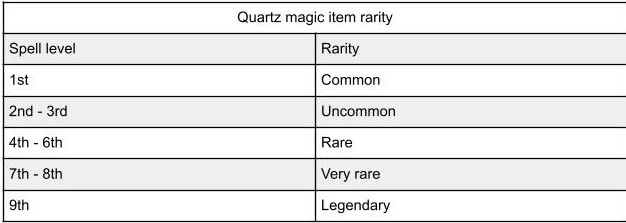
  • Every character can prepare up to six spells by placing quartz into their arcus units. These quartz can be exchanged for others that the character possesses upon completing a short or long rest.
  • Quartz are magic items and not tied to any specific class, classes do not learn spells on their own and are unable to prepare them without quartz.
  • The maximum spell level a character can prepare is the highest spell slot they would have at their level. For classes that do not normally cast spells they follow the same third spell progression as eldritch knight and arcane trickster.

Quartz magic item rarity

Casting rules changes:

  • Classes that do not usually cast spells use the same third progression as eldritch knight and arcane trickster (including charge points) however unless they are; eldritch knight, arcane trickster, or four elements they do not add their proficiency bonus to their spell attack modifier or spell save DC. for these classes they choose weather their casting ability is; intelligence, wisdom, or charisma
  • After casting a spell the character enters a delay period

Delay period:
After casting a spell there is a delay before it takes effect, during this time they are concentrating on the spell, if they lose concentration before the spell takes effect then the spell fails.

The delay period depends on the spell level and caster status of the character. Once calculated as described below, create a marker on the initiative that is the character’s initiative minus the delay, that marker is when the spell takes effect.

Calculating delay:

  • Non / third caster Delay = 2x spell level

  • Half caster Delay = spell level

  • Full caster Delay = 1/2 spell level

0

Creating character kits instead of classes for 5e?

preview

Introduction

When homebrewing in 5e sometimes you come across the problem of whether a concept has enough of an identity to be its own class or if it should be a subclass. And maybe there is a strong enough identity there for it to be its own class but it has so much overlap with another class that it doesn’t feel like it’s own. Or maybe it’s just for a character concept that can’t quite be achieved through multiclassing.

Well what if there was a homebrew option that could solve this? Well I can’t promise that character kits will solve all of these problems all the time, but it’s an interesting option to consider.

So what is a character kit?

A character kit is a set of modifications to a class that a character can choose that act as a give and take. They give the class a distinct identity while not changing the core aspects of the class or disrupting its compatibility with its subclasses.

The idea of a character kit is not new and neither is it mine. It comes from D&D second edition. And even though it is a concept from a previous edition it works quite well in 5e, I have made some before and even prepared a few as examples here.

Character kit examples

You will probably notice each of these kits has a holy theme, while this was unintentional and I only realized it after preparing them, it does show how kits can be used to greatly expand player freedom in a restrictive campaign theme such as being members of a divine order.

  1. Holy assassin (rogue)

A discrete warrior of the church, they take care of zombies, demons, and worse without the public ever suspecting.

Benefits:


Channel divinity At level one you gain the cleric ability channel divinity and can use it to turn undead. When you use your Channel Divinity you must then finish a short or long rest to use your Channel Divinity again. You do not gain more uses of this ability as you gain levels in this class.

Cleansing strike Starting at first level, when you successfully use your sneak attack feature against a fiend or undead your sneak attack dice become d10 for that attack and the attack’s damage becomes radiant.

Destroy undead When you reach 5th level in this class you gain the cleric feature destroy undead. This feature improves as you level up as shown on the cleric class table

Religion proficiency You gain proficiency in the religion skill

Hindrances:


At first level you do not gain expertise or thieves cant, in addition you gain one less proficiency

  1. Holy lance (paladin)

A divine guardian who operates at a distance, picking off foes with strikes guided by their god.

Benefits:


Ranged smite You may use your divine smite and smite spells on ranged attacks with; spears, javelins, short bows, and longbows.

Fighting style options When you choose your fighting style at second level, the following options are added to the list you pick from.

  • Archery. You gain a +2 bonus to attack rolls you make with ranged weapons.

  • Ranged protector. When an ally within 60ft of you becomes the target of a ranged attack you may use your reaction to use your ranged or thrown weapon to intercept the attack reducing the attack roll by 1d8. You may expend a spell slot to increase the amount of dice rolled to reduce the attack roll by 1d8 per level of the spell slot. To intercept a ranged spell attack you must expend a spell slot.

Banners Each aura you get as a paladin is attached to a holy lance rather than originating from you. When you roll for initiative you may throw these lances up to 120ft to a space that you can see (no action required). If you lose these lances or they are destroyed you may perform a one hour ritual over a short or long rest to cause them to appear as new before you.

Hindrances:


Your hit die becomes a d8 for this class and you cannot wear heavy armor

  1. Evangelist (bard)

A preacher and orator who specializes in healing through the power of their god.

Benefits:


Strength in faith Starting at level one whenever you cast a spell that restores hit points or gives temporary hit points, that spell restores twice as many hit points or provides twice as many temporary hit points.

Recited verses Beginning at third level you gain a bonus to religion checks equal to your charisma bonus

Enemy of evil At level three you have advantage on Charisma checks against any; aberrations, fiends, and undead, as well as on Intelligence checks to recall information about them, and you can’t be charmed, frightened, or possessed by them. you also learn abyssal, infernal, or deep speech.

Spellcasting focus You may use a holy symbol as a spellcasting focus

Hindrances:


You do not gain expertise at third level

Love thy enemy Whenever you cast a spell that deals damage, each target is considered resistant to that damage unless they were already immune.

0

"dead" levels, casting, and balancing

preview

“Dead” levels, casting, and balancing

Another article designed to help people homebrew in 5th edition.

When reading the players handbook or SRD you’ve probably noticed that each of the classes capable of casting spells have levels that there is nothing written in the “features” column of their class tables. You’ve probably heard this referred to as “dead levels” which, while not a very accurate name for it, is the common name and what I will be using for the rest of the article.

So why are there dead levels? And why do some classes have more of them than others?

The first one is easy, dead levels exist because gaining a new level of spell slot is considered a feature. After all, gaining a new level of spell slot is an increase in both number of options and power.

As for the second question. If you look closely, with only a few exceptions, the only times a caster gets a feature at the same time as a new level of spell slot is; when they gain their first level spell slot, when a feature they already have scales, and halfcasters at 5th level to scale their non-resource combat option. The exceptions are; artificer 9th level, bard 3rd level, cleric 17th level, arguably sorcerer 3rd level, and warlock 3rd level. While I do not have a clear idea why these exceptions exist as they do, they are indeed exceptions and it should be carefully considered whether or not an exception like this is appropriate for any class you design.

Exploring non-standard casting.

In 5th edition there are a few different kinds of casters each with their own purpose;

  1. Third caster: for lightly supplementing a classes abilities, these are only used in official content as subclasses

  2. Half caster: for an even blend of martial and casting prowess

  3. Full caster: for a class that’s biggest feature is casting

  4. Pact caster: for sustained but potent casting

With the variety available of proven kinds of casters it’s unlikely that you would need to venture from these to achieve the concept of a class, but maybe you do and that’s what we will explore from here.

Why use non-standard casting?

Maybe you are making a class that has a focus on casting but with an identity formed by abilities outside of casting, like the artificer, in this case you might use a half caster or even a third caster but round up at level one. Or maybe the class you are making has another substantial resource to track.

Whatever your reasons are it is important to keep in mind the following;

  1. Fractional casters (third casters, half casters, or others) gain spellcasting at the level where their fraction becomes at least 1. After they gain spellcasting, their spellcasting levels (consult the multiclassing rules) are rounded up rather than rounded down when not multiclassing. For a casting focused class or one that uses spell slots as it’s primary resource give spellcasting at level 1 and round up always.

  2. A class should never achieve a higher level of casting than a full caster of equivalent level.

  3. There is never a reason to have a caster be less than a third caster as it is low enough casting to not warrant any dead levels.

Not using fractional casting but still using a table that resembles a regular caster would make multi-classing rather difficult, so if you decide a on making a non-standard caster that doesn’t use fractional casting I would suggest making the resource that powers it not spell slots or to model it similarly to pact casting. In any case, if a class would gain a spell slot at the same or a later level than a third caster would then it should not be considered a strong enough feature to be the only feature gained that level.

sample tables for non-standard casting

0

How much is a ki point worth? an in depth look

preview

Introduction

When homebrewing, it is important to understand the values of the game resources both, for creating new ways to use them such as new spells, and for creating new resources as part of; subclasses, magic items, or new classes.

If you don’t care to read this whole discussion, the value of 1 ki is equal to one spell level in 9 out of 10 cases as shown by comparing ki abilities with spells. But that’s not all we will be discussing here, in addition we will look at how ki progression compares to spell progression of half and full casters.

side note: I have looked at the value of a ki point before and came to the same conclusion. But I thought I would do more comparisons to casters this time since I often hear a monk compared to a half caster and this comparison has been used to create full caster psionic classes.

base class comparisons

  1. Flurry of blows
    Value: 1st level spell slot
comparison notes

At level one we can expect this ability to be dealing around 2d4+6 damage. without calculating for accuracy that’s an average of 12 damage, compared to the DMGs spell creation guide a first level spell should be dealing 2d10 damage (average 12). While this ability does require the use of your bonus action which would be a value increase it is offset slightly by the requirement that it is used on the same turn as the attack action.


  1. Patient defense
    Value: <1st level spell slot
comparison notes

While this is a powerful ability, when compared to the defensive capability one can get with a 1st level spell slot this pales. For this we are comparing it to the shield spell. Patient defense is used as a bonus action and not a reaction making it less valuable, additionally we can calculate the average roll adjustment by disadvantage as about 3.4 (this article does a good job of explaining). Of course 3 is less than 5 making this ability absolutely not worth a 1st level spell slot


  1. Step of the wind
    Value: 1st level spell slot
comparison notes

Escaping from a melee is highly valuable to characters with low health, it’s one reason misty step is a common ‘must have’ spell. While this ability can’t get you as far and has less overall functionality, that should be expected since misty step is a 2nd level spell. If you have allies you can position yourself around so pursuers provoke opportunity attacks then this is definitely worth it.


  1. Quickened healing
    Value: 1st level spell slot
comparison notes

Since this is a simple healing spell we can compare it directly to cure wounds. At 4th level this heals 1d4+2 (average 5) versus cure wounds that we can expect to heal 1d8+2 or +3 (average 8 or 9). With the lower healing and the inability to target allies, why would I place this as a value of 1st level spell slot? Because it scales to 1d6+3 the very next level to an average of 7 and continues to scale after that.


  1. Focused aim
    Value: 1 ki to 1 spell level
comparison notes

This ones a little tough. Increasing your attack roll by 2 is statistically going to increase your damage for the attack by 10% by increasing your accuracy. For comparison spells that increase your accuracy are… true strike… Well, we will compare it anyway. This ability is made less valuable by comparison because true strike increases your attack roll by 3.4 (I’ll direct you to this article again) and also this ability requires resources. However this ability is made more valuable by; not requiring an action, by being usable after you know the result of your attack, and not needing to use it the turn before you intend to attack. Overall I’d say the positives outweigh the negatives enough for this to be worth it. I’d say that in a vacuum this is in my opinion slightly less valuable than divine smite.


  1. Diamond soul
    Value: 1st level spell slot
comparison notes

For the comparison we will use silvery barbs. This ability is made less powerful than silvery barbs by; only affecting saving throws, and not also having a second effect. It is made significantly more powerful by not requiring a reaction.


  1. Empty body effect one
    Value: indeterminate. I would feel very good using a 4th level spell slot on this however, it is powerful.

  1. Empty body effect two
    Value: depends
comparison notes

It is still the full effect of the 9th level spell, just with seven less targets. It is only really useful if the DM allows it to be useful and is prepared to handle the spell, which is harder to do when only one member of the party is astral projecting.


Subclass comparisons

To not cause these comparisons to overstay their welcome I’m only going to point out monk subclasses with casting

  1. Way of shadow
    The way of shadow subclass can cast four different 2nd level spells from 3rd level, on a 1 ki to 1 spell level rate. This casting is actually a faster progression than half casters have and as fast as a full caster. However the progression is flat as those are the only spells they can cast and they cannot upcast them.

  1. Sun soul
    The sun soul has, at 6th level the ability to cast burning hands, a 1st level spell for a 1 + 1 ki per spell level cost. The fact that it is being cast as a bonus action is likely the cause for this 1 ki tax. You might note that with 1 ki placed at one 1st level spell slot of value it is worth 2 sorcery points, enough to use quickened spell metamagic. The only other observation I will make is that it’s a bit late to be getting a 1st level spell.

  1. Four elements
    For some reason the monk of four elements is really bad at doing the one thing it’s supposed to do, with the redeeming feature of having spell progression of a half caster as a subclass. Every spell has a 1 ki point tax applied.

Spell slot growth comparisons

These numbers will be presented in both charts and graphs. When looking at these numbers it is important to note that spell slots, with some exceptions, recover at long rests and not short rests like ki points.

Below is a chart and graph comparing the growth of the number of spell slots between half casters, full casters, and the growth of ki points for the monk


and below is a chart and graph comparing the growth of combined spell levels. that is the level of each spell slot added together.


If you read this far. let me know if you want to join me in making a half caster, ki caster. I have some ideas laid out already for an elemental focused class in this fashion, but I would need some help because I am currently working on an update to a previous class I made.

0

Advent's Amazing Advice: The Lost Mine of Phandelver Fully Prepped and Ready to Go! Part 1 Cragmaw Hideout

preview

Welcome to Advent’s Amazing Advice! The series where I take popular One-Shots, Adventures, Campaigns, etc. and fully prep them for both New and Busy DMs. This prep includes music, ambiance, encounter sheets, handouts, battle maps, tweaks, and more so you can run the best sessions possible with the least stress possible!

The Lost Mine of Phandelver is a classic, one of the very first Mini-Campaigns that new DM’s run. Hell, it’s part of the starter set after all! The issue though, as with many other Campaigns, is that it doesn’t describe the best way to transform the contents of the book into an actual session. The Book to session conversion can be difficult. Between figuring out when things should happen, to understanding motivations and even balancing encounters.

Well fortunately for you 99% of that work is done! Only a few things are really left:

  1. Consider the needs of your group. As you’ve heard or are about to hear a million times, every table is different. If you plan on combining this with a campaign you’ll have to make tweaks here and there. (Bonus points if you include your players’ backstory)
  2. These notes aren’t meant to be end-all be-all. Tweak to your heart’s content and don’t consider any of what’s written to be set in stone. For me, having notes like this helps give me the confidence to go off the rails and follow along with what my players want. It helps me understand where things were meant to go and why. Having that understanding allows me to guide the players and create other new and interesting stories. These are all things that will come with experience though, so don’t freak out and enjoy the journey!

Without further ado:

Included in The Complete Collection are:

  • A Word document with all my notes including a link to music tracks for ambiance and fights
  • Special PDFs for all the encounters. This includes all the enemies’ stat blocks organized neatly along with an initiative tracker and a spot to mark HP.
    • An additional PDF with Sildar’s stats should he join the party as an ally
  • A map of Cragmaw Hideout. I enlarged and printed this out for my players as a battle map!

Index:

The Lost Mine of Phandelver Index

  • Part 1 - Intro and Cragmaw Hideout
  • Part 2a - Phandalin (Coming Soon)
  • Part 2b - Redbrand Hideout (Coming Soon)
  • Part 3a - Reign of Iron (Coming Soon)
  • Part 3b - Ruins of Thundertree (Coming Soon)
  • Part 3c - Cragmaw Castle (Coming Soon)
  • Part 4 - Wave Echo Cave (Coming Soon)
  • Part 5 - Side Quests (Coming Soon)

Other Fully Prepped One-Shots, Adventures, and More:

As always, If you see something you think I can improve, add, change, etc. please let me know. I want this to be an amazing resource for all DMs and plan to keep it constantly updated! If you’d like to support me, shape future releases, and get content early feel free to check out my Patreon!

Cheers,

Advent

0

Feat: Whip Master | Wha-pow!

preview

Homebrewery Link

Want to be DnD Indiana Jones? Follow your dreams! Whips are awesome and underutilized, so try out this feat to enjoy them in all their greatness!

Feedback always welcome.

Homebrewery Link

Want to be DnD Indiana Jones? Follow your dreams! Whips are awesome and underutilized, so try out this feat to enjoy them in all their greatness!

Feedback always welcome.

0

CR 0 - Knucklebiter Gnat [OC]

preview

Based on a true story:

The Knucklebiter Gnat must be defeated before attempting to go to sleep. If the character fails to destroy it, it will harass them all night and instead of getting the benefits of a long rest, they will gain one point of exhaustion.

It’s a fun little thing, I think. Everytime the characters find it (investigation/perception vs. its Stealth) they get to make 1 attack against it. If it is not killed, the character may try again.

Add more Gnats until the characters give up and simply don’t care.

Next day hit them with the exhaustion. From now on, you can force your party to have to fight Knucklebiter Gnats now and again because it’ll be horribly annoying not to and, as people in real life, they’ll get increasingly irritated and extreme in their measures to try and hunt those little monsters down.

Ideal for swamp, temperate and desert climates.

Bonus for storytelling: After a night with one of those around, narrate every failed skill check or attack with “You cannot concentrate due to the horribly itchy bites left by the Knucklebiter Gnat. Being this distracted, you fail to spot the trap.”

0

Feat: Club Master | Bonk Your Heart Out

preview

Homebrewery Link

Probably one of the least-used weapons in my experience: the club. But if you want to play Gorb the Early Hominid and bonk stuff, I got you covered.

Feedback always welcome!

Homebrewery Link

Probably one of the least-used weapons in my experience: the club. But if you want to play Gorb the Early Hominid and bonk stuff, I got you covered.

Feedback always welcome!

0

(x-post) I'm answering questions to fill out my homebrew pirate campaign. come on us.

Help me flesh out my homebrew pirate world by asking me questions about it - Lemmy lemmy.ml
preview

I hope I’m doing a x-posr right, I’m pretty new here. I assume you can follow this link to join the conversation. Let me know if I messed up 😋

I hope I’m doing a x-posr right, I’m pretty new here. I assume you can follow this link to join the conversation. Let me know if I messed up 😋

0

It's Homebrew Time! This time, I'll be sharing the Archer Class: A non-caster (depending on subclass) alternative to the ranger, with a bit less focus on nature (open images in new tab if too small)

preview

cross-posted from: lemmy.world/post/1155710

cross-posted from: lemmy.world/post/1155710

0

Wizard, Elementary Magic: master the basics

preview

You like cantrips? I like cantrips! Is it excessive? Maybe!

I’m not a big fan of the optional rules that allow casters to swap cantrips, as it seems to run against the lore of cantrips themselves. And there are some amazing options that are often passed over because of their niche use cases. This subclass is designed to allow you to live all your cantrip dreams!

Comments and feedback are always appreciated.

Homebrewery link

0

Barbarian Path of the Primordial: channel the fury of the elements

preview

Every time you rage, choose one of the elemental planes and gain advantages based on that element.

Happy to receive general impressions and constructive critiques.

Homebrewery link

Every time you rage, choose one of the elemental planes and gain advantages based on that element.

Happy to receive general impressions and constructive critiques.

Homebrewery link