0
preview
Predation upon the curious, is that it?
Predation upon the curious, is that it?


Not on this instance? Enter your own instance's domain to go straight to following c/elephants@lemmy.world there.
showing posts tagged #elephants — clear
Predation upon the curious, is that it?
Predation upon the curious, is that it?


Evidently this image dates to the 15th century, and is found in the manuscript “Morgan 1045,” from the backside of leaf 22, in the Morgan Library & Museum.
It seems that this book was partly intended for amusement and educational value, but this specific image may also be based on misunderstandings about what elephants were actually like, given their general non-existence in Europe. Then there’s the castle, which may be an attempt to represent a “howdah” (i.e. elephant saddle), or may even have a chess-like implication. For example, precursors to chess arose in India, such as chaturanga / chaturaji, and elephants were major pieces in that game.
More quirkiness of this kind can be found here:
!trippinthroughtime@lemmy.ca

Another guest post from !animals@lemmy.world as I slowly make my way through the archives…
This is a 25-foot statue of the Hindu deity Ganesha, meticulously crafted entirely out of green bananas. Created by the Natraj Club in Sambalpur, Odisha, India, the sculpture utilized over 5 tons of bananas. The banana sculpture is designed to be eco-friendly, with the fruit distributed to devotees and the needy after the festival concludes. --courtesy of the Evil Empire
And remember-- next time you take a photo of something to be shared on the internet, place a Banana-Ganesha next to it to help add scale. :D

It was suggested I cross post this here, I hope you like it.
cross-posted from: lemmy.world/post/48516438
I think she likes you!
Timelapse: bsky.app/profile/…/3mow6eb4cac2n
It was suggested I cross post this here, I hope you like it.
cross-posted from: lemmy.world/post/48516438
I think she likes you!
Timelapse: bsky.app/profile/…/3mow6eb4cac2n

Another guest post from !animals@lemmy.world. These two are Asian Elephants at the Albuquerque, New Mexico zoo. Things start rather indifferently, before a switch gets flipped around the 0:45 minute mark.
IIRC from a separate video, musician Allan McKenzie later donated his instrument to the zoo in honor of the performance and pachyderm reaction. Assuming anyone’s able to play it, of course. My personal experience with a didgeridoo is that it requires extraordinary breath control to play continuously… indeed, I understand that one must inhale through one’s nose as one exhales (and plays) through one’s mouth(!)

Here’s a guest post from !animals@lemmy.world, encouraged by @jeena@piefed.jeena.net.
I’ve had to speculate on this shot (as seen in the title), as information was limited. There are also versions of this pic in ‘setting sun’ colors, so this may indeed be color-shifted a bit. In any case, I find the new color scheme quite lovely!
Btw, the African bush elephant is the largest land animal in the world, with adults weighing in at ~7 short tons.


cross-posted from: aussie.zone/post/29899976
cross-posted from: aussie.zone/post/29899976


cross-posted from: sh.itjust.works/post/52344871
cross-posted from: sh.itjust.works/post/52344871


cross-posted from: lemmy.world/post/25610463
cross-posted from: lemmy.world/post/25610463

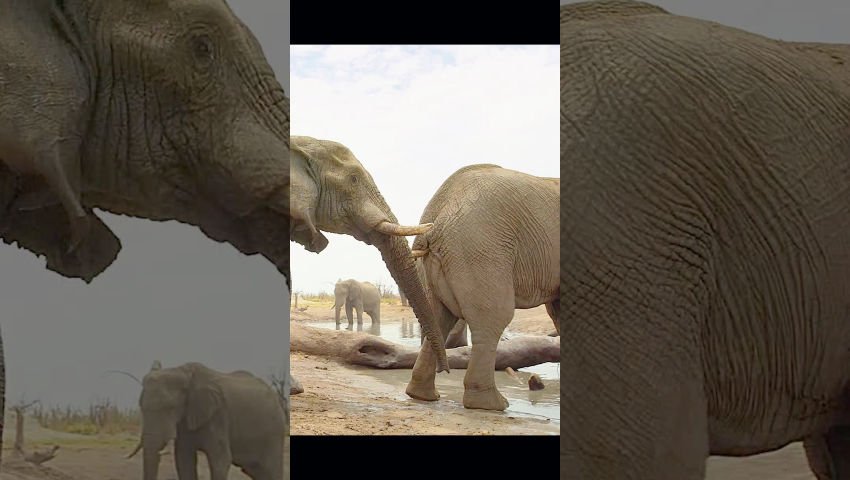
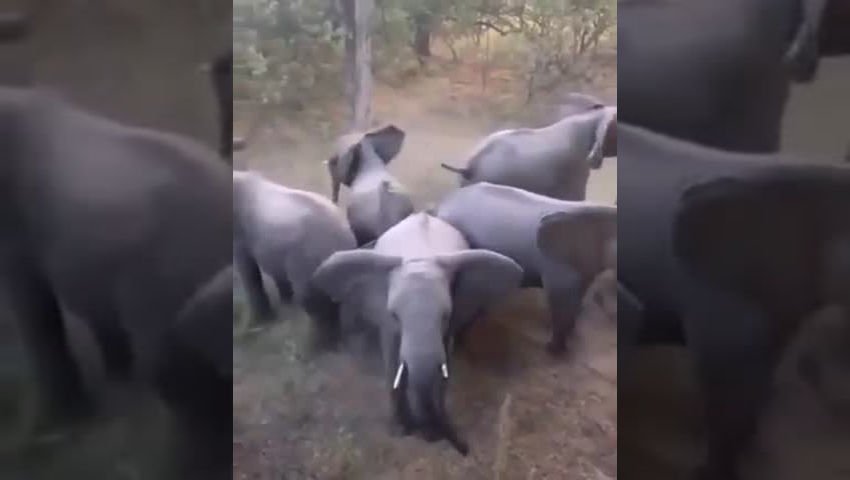


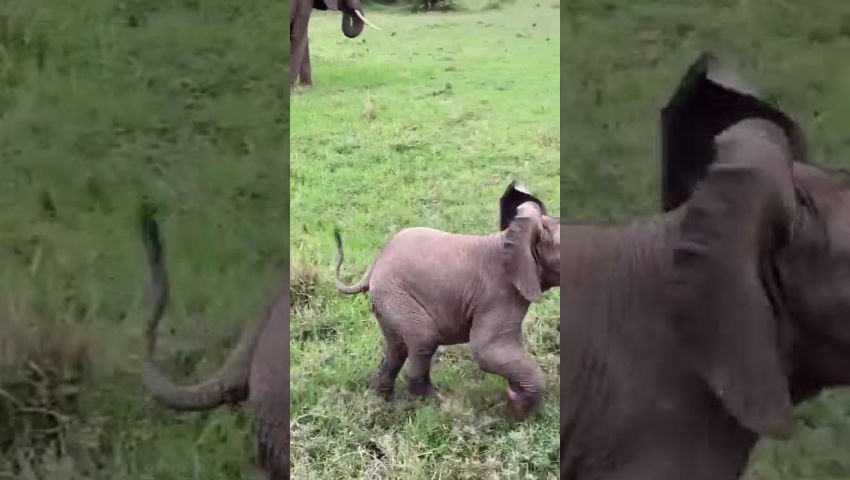

web.archive.org/…/https%3A%2F%2Fwww.bbc.com%2Fnew…
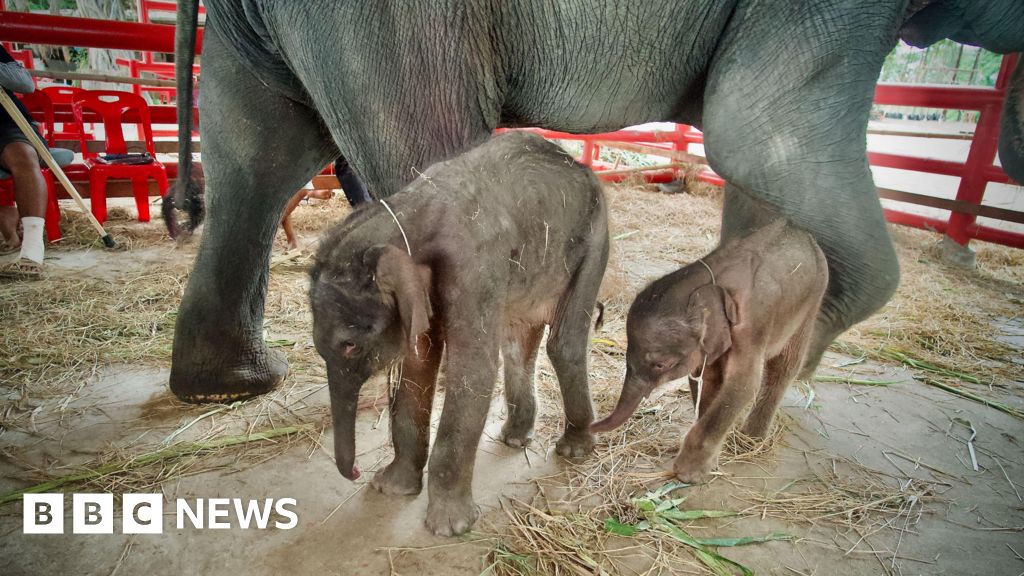
An Asian elephant in central Thailand has given birth to a rare set of twins, in what caretakers have described as a miracle.
The mother, 36-year-old Chamchuri, was not expected to deliver twins and when she gave birth to a male calf last Friday, staff at the Ayutthaya Elephant Palace and Royal Kraal, had thought the delivery was done.
But while cleaning up the first calf and helping it stand on its feet, they heard a loud thud and realised that Chamchuri had given birth to a second calf, a female.
The second birth sent the mother into a panic and caretakers had to restrain her to prevent her from stepping on the female calf. One caretaker was hurt in the melee.
Dramatic footage on social media showed a crowd of caretakers - known locally as mahouts - frantically separating the female calf from the mother, with blood from the birth still visible on her hind legs.
Twins occur in only one percent of elephant births and male-female are even more rare, according to Save the Elephants, a research organisation.
“Once we pulled the second baby elephant out, away from the mother, the baby stood up. We were all cheering because it’s a miracle,” veterinarian Lardthongtare Meepan told the BBC.
“We’ve always wanted to see elephant twins but not everyone can see this because it doesn’t happen a lot,” said Ms Meepan, who grew up at the elephant park, and is herself a mother of twins.
Charin Somwang, a 31-year-old mahout, broke his leg while restraining the mother.
“I was so happy, I couldn’t feel the pain,” he told the BBC, adding he felt the extent of the injuries only when he was brought to the hospital.
“It’s normal that the new mother will always try to kick or push the baby… I was afraid that she might break the baby elephant, so I put myself forward and tried to block the mother from the smaller one,” said Mr Somwang, who has been working at the park for 15 years.
Elephants are considered sacred in Thailand, where a majority of the population is Buddhist. They are also a national symbol.
Since the birth, the Ayutthaya Elephant Palace and Royal Kraal has featured the twins in live streams on social media.
Park visitors, including children, are also allowed to see the twins, but only after disinfecting their footwear and their hands.
A sign near the nursery reads: “Please don’t touch the elephant babies”.
They will be named seven days after birth in accordance with Thai custom.
At 55kg (121lb) the female calf is slightly smaller than usual and has to step on a stool during feeding with her mother. Her brother is heavier at 60kg.
The park claims its elephants were rescued from begging on the streets. In 1989, Thailand banned logging in natural forests, leaving mahouts who worked in that industry jobless.
This forced them to make elephants perform tricks for tourists in exchange for money. This practice was outlawed in 2010 - though there are still rare cases of this happening.
In Ayutthaya, Thailand’s former capital, some elephants carry tourists on their backs to temples and historic ruins.
Conservationists oppose elephant riding as they say this stresses the animals out and amounts to abuse.
An earlier report by the World Animal Protection (WAP) says that harsh methods are used to get a wild elephant to carry a human on its back. The process starts soon after it is captured. It is often referred to as “breaking-in” or “crush”.
Aside from Ayutthaya, elephants have also become tourist draws in highland villages in Chiang Rai and Chiang Mai in the north, where tourists can feed them with bananas, go walking with them and bathe them with mud.
The Asian elephant is an endangered species due to poaching, illegal trade and habitat loss, according to the International Union for Conservation of Nature.
More elephants are used for tourism in Thailand - over 3,000 - than anywhere else. Unlike other countries with captive populations, those in Thailand are nearly all privately owned.
Compared to their African counterparts, Asian elephants have smaller ears round and hunched backs.
Meanwhile, visitors continue to flock to the park in Ayutthaya to see the twin babies, as they await their names.
They walk in a small pen covered with hay as they roll their trunks on their mother’s leg.
“I am always happy when I see elephant gives birth,” said Mr Somwang, their mahout who is recovering from injury.
“It doesn’t need to be twins. Elephant babies always bring joy,” he said.
cross-posted from: lemmy.world/post/16413050
Every Elephant Has Its Own Name, Study Suggests [Paywall removed]
cross-posted from: lemmy.world/post/16413050
Every Elephant Has Its Own Name, Study Suggests [Paywall removed]


asian vs african
asian vs african