0


Interesting Engineering
UK firm achieves first commercial tritium breakthrough for fusion fuel
interestingengineering.com


Not on this instance? Enter your own instance's domain to go straight to following c/fusion@lemmy.ml there.


An optimized compact stellarator with four simple coils is obtained from direct optimization via a coil shape. The new stellarator consists of two interlocking coils and two vertical field coils similar to those of the Columbia Non-neutral Torus (CNT) (Pedersen et al., Phys. Rev. Lett., vol. 88, 2002, pp. 205002). The optimized configuration has a global magnetic well and a low helical ripple level comparable to that of Wendelstein 7-X (W7-X) (Wolf et al., Nucl. Fusion, vol. 57, 2017, pp. 102020). The two interlocking coils have a smooth three-dimensional shape much simpler than those of advanced stellarators such as W7-X. This result opens up possibilities of future stellarator reactors with simplified coils.
An optimized compact stellarator with four simple coils is obtained from direct optimization via a coil shape. The new stellarator consists of two interlocking coils and two vertical field coils similar to those of the Columbia Non-neutral Torus (CNT) (Pedersen et al., Phys. Rev. Lett., vol. 88, 2002, pp. 205002). The optimized configuration has a global magnetic well and a low helical ripple level comparable to that of Wendelstein 7-X (W7-X) (Wolf et al., Nucl. Fusion, vol. 57, 2017, pp. 102020). The two interlocking coils have a smooth three-dimensional shape much simpler than those of advanced stellarators such as W7-X. This result opens up possibilities of future stellarator reactors with simplified coils.
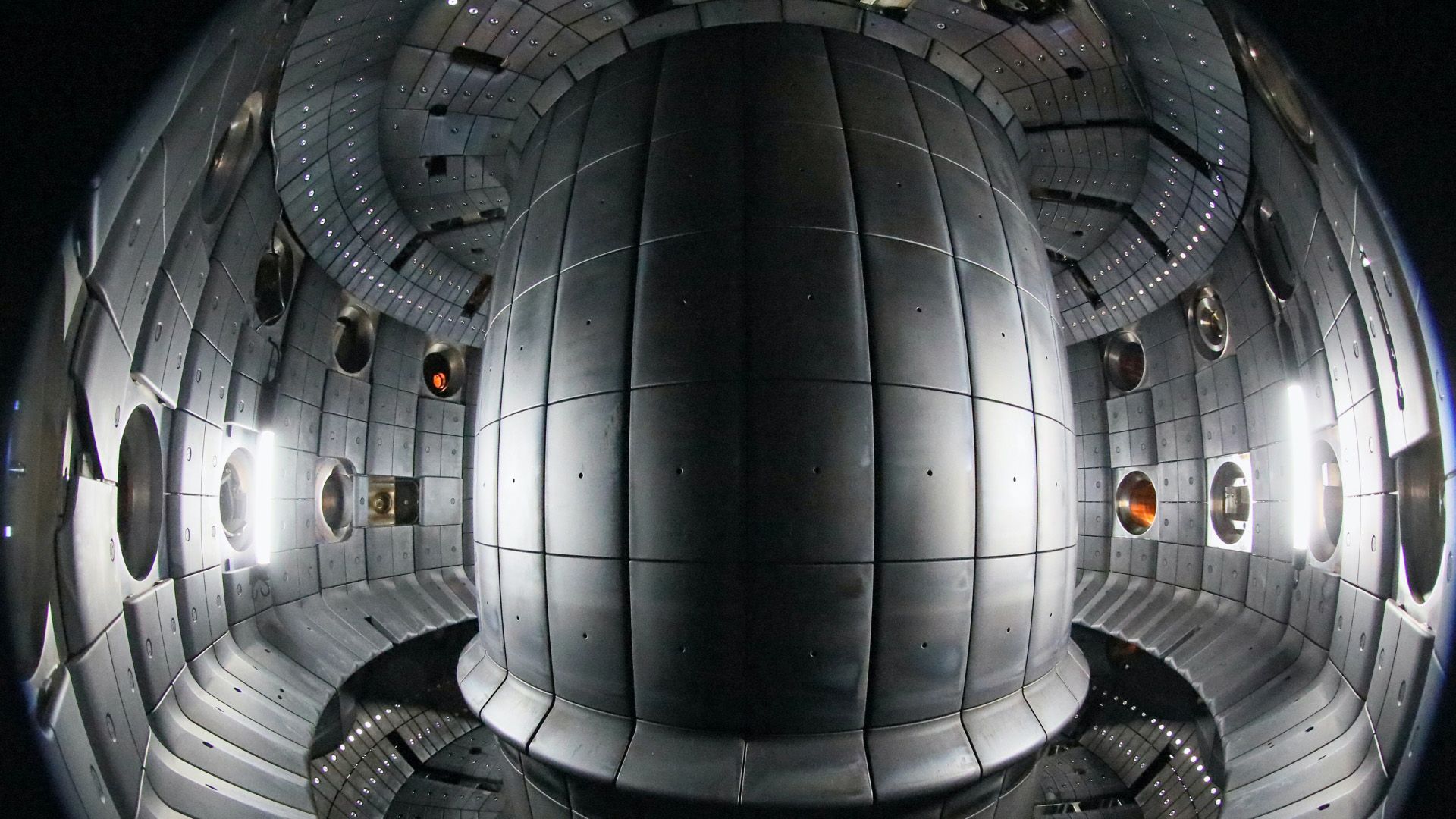
Fusion reactors could generate more power thanks to a reworking of Greenwald’s Law.
The research, led by physicists from the Swiss Plasma Center at École Polytechnique Fédérale de Lausanne (EFPL), has determined that the maximum hydrogen fuel density is about twice the “Greenwald Limit” – an estimate derived from experiments more than 30 years ago.
A study about the discovery was published May 6 in the journal Physical Review Letters.