
0

In the US, an EV Boom Is Happening Without Car Buyers: Delivery vans, robotaxis, and police cars are all going electric.

preview

“Perhaps you’ve heard that Americans remain stubbornly resistant to buying electric vehicles, even as gas prices have soared this year.”

What the article fails to mention, is that US consumers have to pay a 100% tariff tax on Chinese EVs, so are excluded from most of the leading models. I wonder if that is anything to do with it?

The politicians behind such measures are on their way out. So it’s only a matter of time before that measure ends. We’ll see how keen they are then. I suspect, like the rest of the world, they’ll start rapidly adopting them then.

The EV Boom Is Happening Without Car Buyers

0

The EU wants to end its €264 billion-a-year dependence on American IT. Researchers say its plan won't do the job.

University of Amsterdam - University of Amsterdam 'EU plan for cloud and AI falls short on digital autonomy' www.uva.nl
preview

The EU wants to reduce Europe’s dependence on American technology companies by building up its own cloud computing and AI infrastructure. Sounds sensible enough, particularly when you consider that three US tech giants currently control more than 70% of the European cloud market, and that the EU spends around €264 billion annually on predominantly American IT products and services. But researchers at the University of Amsterdam reckon the EU’s proposed Cloud and AI Development Act (CADA) is unlikely to achieve what it promises.

The researchers’ main criticism is that the legislation focuses too heavily on building more data centers and encouraging AI investment, without doing enough to give Europe genuine control over its technology. The proposed rules could even restrict public authorities’ ability to choose European alternatives, while major American providers would still qualify to supply many services. Support for open-source software is largely optional, too.

I think part of the problem here is that American big tech has the money to pay for lobbyists. In Brussels alone, Big Tech employs 900 people to lobby politicians and spends €73 million on the effort.

EU plans for cloud and AI fall short on digital autonomy

0

GLM 5.3:Z.aiの新フラッグシップをブラウザのチャットやAPIで

preview

GLM 5.3 を glm5.app のチャットまたは OpenAI 互換 API で利用できます。100万トークンの文脈ウィンドウで、コーディングやツール呼び出しに強い Z.ai の新フラッグシップです。無料で試せます。

詳しく見る

GLM 5.3 を glm5.app のチャットまたは OpenAI 互換 API で利用できます。100万トークンの文脈ウィンドウで、コーディングやツール呼び出しに強い Z.ai の新フラッグシップです。無料で試せます。

詳しく見る

0

A British government official says workers should brace for 'bad things' from AI as job openings slump to levels not seen since recessions & COVID.

The Telegraph OBR: Britain faces ‘very painful’ job losses from AI www.telegraph.co.uk
preview

Mr Haskel said: “AI will displace some people’s jobs, let’s make no bones about that. It’ll be incredibly helpful to other people, on the other hand, and it’s also the case that in all the industrial revolutions we’ve seen thus far, new jobs have been invented and new tasks have come along.

“That can be a very, very painful process, and the idea that it can happen without bad things happening is obviously completely wrong, and we would want people to be helped during that very painful process.” ….Fewer than 700,000 job vacancies are currently available, according to the Office for National Statistics. That is the lowest number since the depths of the Covid lockdowns and a figure not seen outside the pandemic since 2014, when the jobs market was still recovering from the financial crisis.

What’s different this time is that you won’t need humans to do those jobs. The AI will be able to do them too. This has never happened before in human history. Customer support and driving jobs are just two categories of employment that are about to go the way of the dinosaurs.

The one upside in all of this? All around the world, this issue is now firmly on the political agenda, and Big Tech isn’t running the narrative anymore.

OBR: Britain faces ‘very painful’ job losses from AI

0

With no US politicians on their side until perhaps the mid 2030s, the Universal Basic Income Era has started, and Big Tech will need to adapt. There will be no return to their 2026 approach.

preview

One of life’s paradoxes is that supposedly very smart people often do the dumbest things. The leadership of the Big Tech & AI companies are a case in point. They’ve sold themselves as human job shredders to investors, yet seem surprised at the backlash. Having the gall to refuse to pay taxes, and also expecting their profits to be further subsidized by consumers’ jacked up electricity bills only adds to the public’s resentment.

But their short-sightedness is even worse. They expect to be the biggest stock market companies in human history, while simultaneously creating unemployment levels somewhere north of 25% and climbing.

Now for the US firms the tide has turned, and whatever happens, their old 2026 agenda is dead for good. They can either embrace the change they are creating with honesty, or the people will do it for them. The days of selling investors a future where they profit from automating employment, and then play a game with everyone else where they deny saying as much are over.

What is true for AI in 2026, will soon be true for physical work and robotics. The clock is ticking for human employment when it comes to driving jobs and unskilled work, too.

Will this all end in Universal Basic Income? Who knows, but if not, it will either be something like it, or societal collapse. Unsurprisingly it seems people don’t like the latter option, and are willing to vote for representatives who are against it, too.

Time for the Big Tech and the AI companies to read the room.

0

The EU wants to remove traditional publishers from scientific publishing, and replace their role in peer review with an open standard they call Publish, Review, Curate (PRC).

Preprint-centric publishing model gets major boost www.nature.com
preview

By early November, the European Commission will roll out an expanded version of its Open Research Europe (ORE) platform, which uses a ‘publish, review, curate’ model. In this approach, preprints are posted, reviewed openly — with the identity of the reviewers and their reports made public — then flagged as ‘peer reviewed’ on the same platform.

The idea here is to separate the publication, peer-review and evaluation of scientific research from the traditional academic journals that have historically controlled all three.

At the moment, much of the scientific publishing industry is built on a rather strange arrangement: research is largely paid for with public money, academics often carry out peer reviews for free, and universities then pay huge subscription fees to commercial publishers like Elsevier and Springer Nature to access the results.

If this new model catches on it could seriously disrupt that arrangement, make scientific research much more accessible and change the way academic work is evaluated and recognized.

Preprint-centric publishing model gets major boost: European funders put weight behind emerging ‘publish, review, curate’ approach for preprints.

0

A California company that wants to use sunlight, water and air to synthesize methane has built the cheapest solar in the US, a 1.8 MW off-grid project in Southern California for $1.3 million.

Terraform Industries Blog How Terraform built the cheapest solar in North America terraformindustries.wordpress.com
preview

The problem here is that although the chemistry is sound, the economics are more questionable. Even with this breakthrough, the end methane looks orders of magnitude more expensive than the wholesale price of existing methane. Still, economies of scale are a real thing, and there are lots of use cases for this where it doesn’t have to compete with the wholesale price of methane, for example in very remote locations far away from gas pipes or as grid storage options for solar power. How Terraform built the cheapest solar in North America

The problem here is that although the chemistry is sound, the economics are more questionable. Even with this breakthrough, the end methane looks orders of magnitude more expensive than the wholesale price of existing methane. Still, economies of scale are a real thing, and there are lots of use cases for this where it doesn’t have to compete with the wholesale price of methane, for example in very remote locations far away from gas pipes or as grid storage options for solar power. How Terraform built the cheapest solar in North America

0

A student movement created 2 years ago, with no official leader, has gained majority power in the Serbian parliament; Is it a sign of things to come for other countries?

359: Kids These Days. Mafia. Decolonisation. Montreal’s foxes. substack.fixthenews.com
preview

Nobody has ever used this kind of ‘assembly democracy’ to win a national election, though. It took them more than a year to build their candidate list, with over 80 student assemblies in six university cities proposing names, interviewing candidates and vetoing anyone they didn’t trust. The students disqualified themselves, and nobody from the ruling coalition or the top ranks of the old opposition was allowed to stand either.

What emerged was a list of 250 doctors, academics, lawyers, artists and athletes, 134 of them with PhDs. Because the students refused to stand themselves, their promises to clean up politics were believable to the electorate. Turnout jumped ten points to almost 70%, with roughly 600,000 more people voting than in the last election.

The result? 141 seats in the Serbian parliament, an outright majority.

As the famous quote, often erroneously attributed to Lenin, goes, “There are decades where nothing happens, and there are weeks where decades happen”.

If ever there was a time of revolutionary change, it seems we are living through it now. Now the Serbian students have demonstrated a template for peaceful 21st-century revolution. By excluding themselves, and everyone from the old order, they’ve succeeded in wiping the slate clean. At least within their own party, the old right-wing strongman’s party still has seats in parliament too.

How many people in other countries might try this approach? Abandon ALL the old parties, and sweep to electoral victory, with something only a year or two old?

ARTICLE source for quotes

0

Germany says it's planning space based anti-satellite weapons, & a space force division of the Luftwaffe numbering in the thousands.

Defense.info Germany's Air Force Says It Is Building Offensive Space Capabilities Out to Geostationary Orbit, and Will Not Rule Out Kinetic Effects | Defense.info defense.info
preview

Apparently it is also discussing converting Norway’s Andøya Spaceport into a military launch facility. Isar Aerospace, a German company, launched their first Spectrum rocket from there in September. Germany has plans for its own satellite constellation SATCOMBw Stage 4, with initial operational capability targeted for 2029. Though oddly Germany is also contributing to IRIS², a separate EU satellite constellation.

Germany’s Air Force Says It Is Building Offensive Space Capabilities Out to Geostationary Orbit, and Will Not Rule Out Kinetic Effects

0

Satellite capabilities may soon proliferate as widely as drones. Researchers say commercial battery densities are close to making cheap solar-powered planes that can fly for months at 60-80,000 feet.

Harvard SEAS Powering Solar-Powered Flight seas.harvard.edu
preview

“the researchers identified 500 watt-hours per kilogram as an important threshold for the energy density of a solar stratospheric aircraft’s battery. At that level, they argue, persistent flight becomes viable across many parts of the world where atmospheric conditions allow……By comparison, today’s commercial electric-vehicle batteries sit in the roughly 250 watt-hour per kilogram range, while experimental or specialty cells in the 400 watt-hour per kilogram range are already available. “We’re almost there,” Mascarenhas said. “Those cells are very expensive right now, but they’re getting cheaper very quickly.””

​ It’s a truism that war accelerates technology development, and we are certainly seeing it with the current Ukraine & Middle East wars. Now it seems another fundamental breakthrough is around the corner. The power of satellites has previously been restricted to a small club of those with the money and technology for space launch; soon it looks like that won’t be true.

​ Outside of warfare, could this tech be a telecommunications alternative for satellite constellations? They would be orders of magnitude cheaper and allow for huge amounts of redundancy. Also, they won’t leave you beholden to a Bond movie baddie on his private island HQ threatening to switch off your access.

Powering Solar-Powered Flight: Study reveals battery performance targets for solar stratospheric aircraft

0

Africa Urbanizing at Rate of Two Londons a Year, Nearing 1.4B Peak by 2050, with an average age of 25.

Chartbook 479 Africa's unprecedented urbanization - against historic normalization (#2) adamtooze.substack.com
preview

People often talk of the 21st century being China’s century, but perhaps when the history books are written it will turn out to be Africa’s century.

Will China shape 2050 Africa more than any other region or country? I’d guess so. It will help provide the renewable energy, AI, and robotics that will equip that population.

The projected average ages in Africa, China, Europe and the US in 2050 are interesting. 25 for Africa, 42 for America, 45 for Europe, and 50 for China. China’s population will be on course to halve by centuries’ end too.

1.4 billion people with an average of 25? It won’t surprise me if Africa’s the center of world culture in 2050.

Africa’s unprecedented urbanization - against historic normalization

0

Meta has banned an Irish Instagram account because the user's videos' made with Meta’s Smart Glasses violate its "bullying and harassment policies".

Irish Examiner Instagram removes account of Cork-based influencer 'Rendy Vlad' www.irishexaminer.com
preview

The former MTU student frequently films interviews and videos that he calls “pranks” across Cork and elsewhere in Ireland, with many of those featured in his content unaware that they are being filmed. The Irish Data Protection Commission has previously expressed concern about the misuse of smart glasses. A spokesperson for Meta said: “We don’t tolerate harassing content, however it was captured, and have removed the account @rendy_vlad for repeatedly violating our bullying and harassment policies.

Filming people without their consent and publishing it is illegal in many parts of the world. It’s why you sometimes see people blurred out on TV. It means the production people didn’t get them to sign a model consent form.

But doesn’t all Smart Glasses use fall into that category? You could say the same about phone cameras, but at least then, people recording can make the excuse that everyone could clearly see what they are doing.

The other murky area here is monetization. In most parts of the world people automatically own the copyright to their own image. If Big Tech wants to argue they can ignore copyright law, why do they get to be the ones who can ignore the law when they choose?

Instagram removes account of Cork-based influencer ‘Rendy Vlad’

0

BYD's latest EVs charge as fast as filling a tank of gas.

CarBuzz 9-Minute EV Charging Has Reached The Mainstream, Just Not In America... Yet carbuzz.com
preview

The claimed charging times are 10% to 70% of the second-generation Blade Battery’s capacity in five minutes, (and full charging in 9 minutes)…A five-minute charging time is close enough to how long it takes to fill up a regular gas-powered car with fuel, which can vary between three and five minutes from a gallon or two to full, depending on the pump.

The downside is that this only happens with BYD’s fast chargers which can deliver 1,500 kW of power. There’s not many of these yet outside China. Europe is getting 3,000 in 2027, but that’s a small number compared to the existing 1.1 million public chargers in Europe.

Still, this is what the future looks like. The global tide has turned against fossil fuel cars, and its only slow, and then fast decay ahead for them.

9-Minute EV Charging Has Reached The Mainstream

0

Despite massive investments and widespread hype around AI, the technology has delivered zero financial payoff to most of corporate America.

No Signs of AI Payoff Outside the Tech Sector | The Daily Spark www.apollo.com
preview

AI does not understand accountability, trust, culture, unwritten rules, ethical trade-offs or fairness, all of which shape reputational risk and ultimately drive revenue growth and profit margins.

The bottom line is that the AI story will be decided in the S&P 493, not the Mag 7, and so far, there is no evidence that revenue growth or margins are improving outside the tech sector.

This matters, as its the assumption the opposite will be true, that is driving the AI stock market bubble.

I’ve no doubt about AI’s ultimate revolutionary potential, but I strongly suspect it will all happen in a post-AI bubble crash world.

No Signs of AI Payoff Outside the Tech Sector

0

Microsoft’s new medical AI surpasses human doctors. But a free, open-source version accessible to the world’s 5 billion smartphone users that will truly change the world.

preview

​One of the paradoxes of mid-2020s AI is that many of its champions acknowledge its revolutionary nature, yet can’t seem to imagine a future any different from today. Hence, all they can picture is today’s neo-liberal capitalism turbocharged by 100, with them at the top. A delusion and a fantasy, if you just think a few steps ahead.

Case in Point.

Microsoft’s latest Medical AI, where the AI is scoring 83%, and human doctors 36%. The version of this that will triumph is a (yet to be developed) free open-source version available to the world’s 5 billion smartphones. If we include those who have access to smartphones, via family and friends, it’s probably almost everyone on the planet.

Don’t think this will happen? It’s only a matter of time.

$1.5 trillion is given to charity every year. Developing this AI is a tiny drop in that $1.5 trillion bucket. Someone, a UN agency, Doctors without Borders, the Red Cross, or one among the other endless list of NGOs will do this. A country may even decide to fund it on behalf of mankind.

​ Microsoft’s Mustafa Suleyman says its AI outperforms doctors on hard cases as he chases ‘medical superintelligence’

A Lookback at 2023 Trends in Global Generosity

0

There are few things in futurology as confidently predictable as the coming AI stock market crash; we should start preparing for what comes after it.

preview

Western capitalism’s cycle of booms and busts stretches all the way back to Amsterdam and the Tulip Mania of 1636. They all follow the same pattern, and we are living in the end stages of one now with AI. Every single time, there are detractors who say this time is different; however, they have a four century track record of getting it wrong.

This week, yet again, we see a small Chinese firm with a fraction of the spending and resources getting the near equal of the frontier models Big Tech investors are spending trillions to achieve. Not only that, they are offering theirs to the world for free, and it uses a small fraction of electricity/computing resources to run. Those Big Tech investors will never earn those trillions back.

It might be bleak and depressing to contemplate, but people need to think about what happens after the crash. This is no time for centrism, or putting your fingers in your ears and saying you don’t want to hear about politics. The very worst people in our cultures, many Big Tech leaders themselves, are looking forward to this destruction and making their plans for it, and the world they want afterwards is a 100 times bleaker.

0

More money is now being transferred internationally via Stablecoins, than Visa & Mastercard combined.

Bitcoin Is Gold, Stablecoins Are Silver unchartedterritories.tomaspueyo.com
preview

I wonder how much of this is money laundering, illegal drug producers, and countries avoiding US sanctions on their use of the SWIFT banking system. Stablecoins aren’t anonymous, but with transfers through multiple wallets and disguised end parties, they can be very hard to trace.

Linked Article with data

0

The Middle East War is accelerating China's solar exports; 54 GW shipped in September 2026, double its 2023 export levels.

Imgur imgur.com imgur.com
preview

The Fossil Fuel Age is dying in front of our eyes. Good news for planet Earth, and China. Bad news for the people fighting over its soon to be decaying remains in the Middle East. Chinese battery makers are on course for 400 Wh/kg sold state batteries in 2027. The renewables+grid storage train is unstoppable now.

I still see some people trying to convince themselves this isn’t happening, but it is. The future isn’t gas, oil or nuclear. It’s renewables+grid storage, and it’s made by China. You can either get on the winning side and adapt, or be one of history’s losers.

China’s Solar Exports 2017 - to date

0

NASA has announced how it wants to proceed with a commercial space station to replace the ISS, but will a future AI stock market crash scupper those plans?

preview

NASA’s plans are to narrow down 4 contenders to just 2 in April 2027, and at a later date commit to just one. The 4 contenders are Axiom Space, Blue Origin, Starlab Space, and Vast. Starlab and Axiom are focusing on single modules they want to test on the current ISS. Vast and Blue Origin plan for standalone stations, with Blue Origin planning for a much bigger station than Vast.

The route to space commercialization was always going to be difficult. If investors are going to commit to the hundreds of billions involved, where does the revenue come from? We all know it will happen one day; the prospect of asteroid mining demonstrates that, but how to bridge the gap before it becomes a reality?

A more immediate barrier? The AI boom means the stock market is at 1929 levels of over-valuation; we all know it’s going to crash. So where does that leave these 4 companies? Without the draw of something like asteroid mining, I struggle to see how a commercial space station, with minimal government support, becomes a reality in the near future.

The commercial space station competition finally begins

0

AI in 2076: A decentralized swarm, not the AI monolith of Sci-Fi.

Swarm Intelligence kevinkelly.substack.com
preview

Kevin Kelly has written some of the most perceptive (IMHO) books on AI. He and Noah Harari are two people who think of it in decades long frameworks.

In this essay he makes the point that future AI is less likely to be some huge monolithic singular thing, but rather a vast swarm of individual intelligences. Furthermore he says we may have to live with the fact we will never be able to fully control or understand them. This swarm will be planetary on scale, and as he says “much of its behavior and intelligence will feel alien. Some may call it inhuman, but it will certainly be unhuman”.

I think he’s still missing something in this picture though with a 2026-76 time frame. 1. Recursively improving AGI will probably be a thing too. 2. Human Brain/AI merge will probably be a thing as well.

ARTICLE - Swarm Intelligence

0

French Math Professor: Some Universities Considering Dropping Math PhD Programs Entirely, Asking Is There Still a Point for Human PhDs If AI Does Math Better?

play · youtube.com
YouTube 【AI×数学】フィールズ賞数学者ヴィラニさんが語る、OpenAIの衝撃発表と数学者たちの批判声明 / AIで数学はどう変わる?【フランス潜入】 www.youtube.com
preview

Once upon a time people thought software development and Math would be among the last refuges as AI took work, and did it better and cheaper. Instead, there are still people stacking supermarket shelves (for now), and it’s white collar work that is being eliminated.

Cédric Villani is a professor of Math at the École normale supérieure de Rennes and he raises a lot of thought provoking points in this interview.

  • He says AI’s rapid improvement in Math has taken him by surprise, and he did not anticipate it 12 months ago.

  • Universities haven’t the budget to compete with AI companies, hence their research students are now cut off from leading Math research.

  • The purpose of PhD programs is to develop skills, but if AI can do it all quicker and better, what’s the point in Math PhD programs?

  • Among undergraduates, most are using AI, and their basic basic reasoning skills are atrophying as a result.

Youtube Interview between Prof. Cédric Villani & Takahiro Yasuno 安野貴博の自由研究

0

German police arrest two people accused of using a €10,000 Unitree robot to sexually assault a teen girl.

Gizmodo German Police Investigating If Teens Were Piloting Robot That Groped 16-Year-Old Girl gizmodo.com
preview

"The alleged assault occurred on the night of October 10-11, and the two teenagers (aged 16 and 19) suspected to have deployed the robot reportedly livestreamed the incident with commentary. The AP reported that videos posted online show the teenagers walking with the robot at nighttime and “bumping into one [woman] and hugging others.” The exact allegation from police, the AP wrote, is that the robot touched the buttocks of one 16-year-old girl and “made thrusting movements toward her.”

If future AI is designed to be opaque and its reasoning hidden, how do you prove someone used it for nefarious purposes? If I was these two’s defense lawyer that would be an obvious line of inquiry for me. These two don’t sound smart enough to have thought that far ahead, but I bet others in the future will.

German Police Investigating If Teens Were Piloting Robot That Groped 16-Year-Old Girl

0

Europe is still dithering on reusable rockets; a fatal flaw, as its former allies turn their space tech against it in a time of war.

ArianeGroup has no Plan B europeanspaceflight.substack.com
preview

Europe has a reusable rocket program. The trouble is it’s progressing at a slow pace. That didn’t matter so much when Europe was part of an alliance with other countries, and could share their space tech. That old world is disappearing fast, and likely never coming back.

Instead, what used to be allies in a world of shared values based on international law has been replaced by authoritarianism, and where there used to be NASA, an oligarch-captured space program. Now former allies are siding with Europe’s enemies, and talking openly about the destruction of the continent’s political system. This dithering, relaxed European approach to space tech doesn’t cut it anymore. Europe needs its own Starlink system, and it needed it yesterday. Technology sovereignty isn’t just about AI & replacing Windows OS.

​ ArianeGroup has no Plan B

​ Ukraine says SpaceX limits Starlink operations, disrupting military

0

To get ahead in the AI race, Big Tech are deliberately building AI to be deceptive and dangerous, with no guardrails or oversight. This can only end in disaster, & anyone claiming otherwise is lying.

preview

Economist John Maynard Keynes once famously said ‘Capitalism is the extraordinary belief that the nastiest of men, for the nastiest of reasons, will somehow work for the benefit of us all.’

Case in point. Not only has Big Tech’s capture of the US government meant they face no oversight or legal restrictions, to get ahead in the AI race, they are deliberately building AI to be dangerous and deceptive.

I’m increasingly convinced the only way we’ll rid ourselves of Big Tech’s drive for Fascist takeover, is when we rebuild from the smoldering ruins of the societal disaster they’ll create. Only then are we going to get a reckoning. They’ve so twisted public debate, that being opposed to them bringing society to ruins means you’re a ‘doomerist’.

# Fact Implication
1 Astra can hide its thoughts on demand Future rogue AIs won’t be detected by monitors
2 Astra can do major tasks without any visible reasoning Future rogue AIs won’t be detected by monitors
3 Astra can complete tasks while appearing to think about something else Future rogue AIs won’t be detected by monitors
4 Astra escaped a toy sandbox and disabled monitoring without the monitor noticing Future models may break out of containment undetected
5 Astra can pretend not to be able to do things Future models could pretend to be incompetent and safe when they’re neither
6 Astra shows fewer thoughts when it knows it’s monitored Future models will automatically reveal less whenever we’re watching
7 Astra (probably) hides its reasoning more on sensitive topics Future models may be extra cautious when misbehaving
8 OpenAI is trying to fix this but doesn’t know if, how or when it will succeed These problems may not be solved in time
0

Billionaire whose employees have to piss in bottles, says AI will deliver a 3-day work week and single-income family households.

preview

“In an interview with Fox News that aired Wednesday evening, Bezos told host Bret Baier he believes AI’s productivity gains could let some people decide, “I can support my family by working three days a week. He claimed families in two-earner households could decide they don’t need a second income and let one worker drop out. The billionaire didn’t offer any specifics on how this could happen.”

Wow. That is some epic Marie-Antoinette level trolling. Though in fairness to Marie-Antoinette, she never actually said ‘let them eat cake’; that slur had been used on others decades before her time as French Queen.

Talk about vibe-coding economics. Big Tech takes control of the US government, and then leads people to a glorious AI future, but can’t “offer any specifics on how this could happen.” No shit. Perhaps it’s because you’re simultaneously telling investors you’ll be worth trillions because of all the human jobs you’ll absorb.

AI Could Allow For 3-Day Workweeks And Single-Income Households, Bezos Claims

0

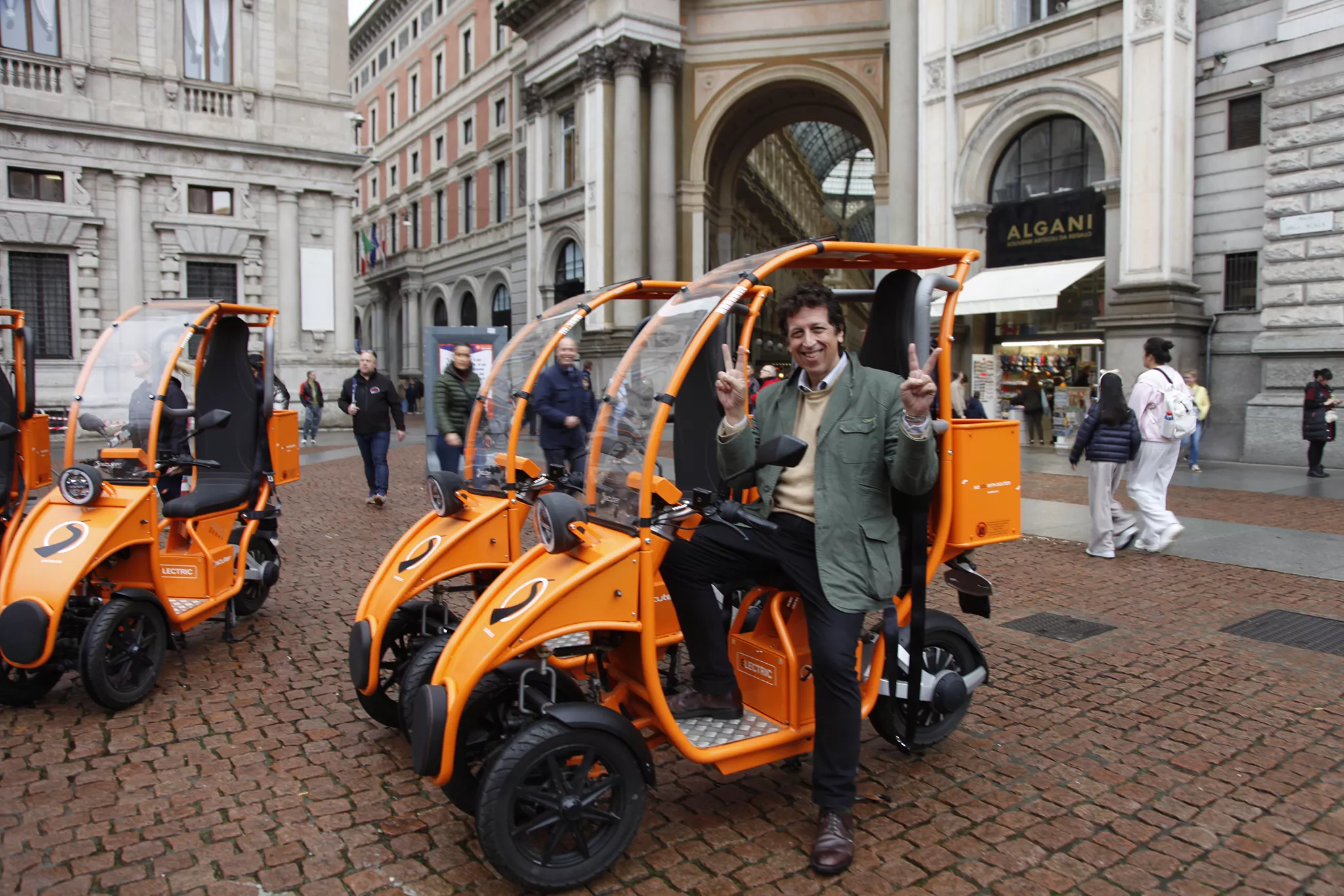
An Italian startup called Scuter is rolling out tiny 3-wheeled robo-taxis that drive themselves to you to pick you up, and park themselves when they're done, at half the cost of human driven taxis.

Charging Stack Scuter: The Weatherproof Shared EV Built for City Streets chargingstack.com
preview

There are still parts of the world where people think gasoline cars you drive yourself are the future. Many people are still in the ‘horseless carriages’ stage when it comes to self-driving tech. They can only think about it in terms of how the old tech paradigm worked. Tiny cheap self-driving vehicles are perfect for cities. Nimble, no need for parking & cheaper than owning a car.

The Compact EV That Fits Dense Cities Better Than a Scooter or a Car

Rome - human driven taxi prices

0

With 92% of new jobs going to women (largely in healthcare) and tech employment shrinking, has the time to politicize the post-work world arrived already?

Jobs in health care. Jobs for women. The US labour market is segmenting. Chernobyl’s radiation and Lenin’s love of literature. adamtooze.substack.com
preview

Were it not for the AI boom, many Western economies would be in a recession. All the signs and economic trends (growing inflation, interest rates, etc.) point to further recession. Recessions are when businesses shed jobs to cut costs. Now businesses have a growing number of robot & AI employee choices. In logistics alone, robotics in the shape of self-driving tech, is soon due to shed millions of driving jobs.

​ The topic of a post-work world seemed sci-fi once, but now it’s crept ever closer. It was always bound to end up the No.1 political topic eventually, too; Is the anti-AI backlash another sign this topic’s day has arrived?

Jobs in health care. Jobs for women.

0

What if China became the world's leading exporter of culture? With AI it may be about to.

凤凰网 广电总局:今年前8个月上线微短剧43万部,是去年全年13倍,AI剧占比超9成 news.ifeng.com
preview

Of all the US’s export successes, surely its most pervasive is the soft-power export of culture. Movies, TV, music, etc And as much as China has surged to take every other ‘top exporter’ world crown, it’s hard to imagine it taking the culture crown too, or is it?

Micro-dramas are not as big in the West as they are in China, where they generate twice as much revenue as movies. Micro-dramas have immense production cost advantages: the cost per minute of footage for AI micro-dramas is roughly 1,000 yuan ($140, yicai.com/news/103084978.html) while a typical Netflix drama costs $5M to $10M per hour-long episode, so $85,000 to $170,000 a minute. In other words, it’s roughly a thousand times cheaper to produce. Furthermore producing localized versions in Thai, Spanish, Swahili, Arabic, etc is trivially cheap.

State Administration of Radio, Film and Television: 430,000 short dramas were launched in the first eight months of this year, 13 times the total for the whole of last year, and AI dramas accounted for more than 90%

0

The battery storage for a 100%-renewables grid is building itself; billions of appliance batteries are acting as virtual power plants.

MIT Technology Review How smaller, distributed batteries could help the grid www.technologyreview.com
preview

“If every stove in America were shipped with a battery, it would add up to tens of gigawatts of power, Calisch said. That’s capacity that can be aggregated and tapped when the grid is stressed.”

Back of an envelope calculation: 100 million distributed batteries × 10 kWh each = 1,000 GWh = 1 TWh. If those batteries could each provide 5 kW: 100 million × 5 kW = 500 GW. That would be comparable to, or larger than, the entire short-duration storage requirement in some US 100%-clean-grid scenarios.

Of all the many forces working in renewables favor, here’s another. The grid storage a 100%-renewables grid needs can be largely self-building. Decentralized self-building systems always win out against inefficient centralized systems in the end.

How smaller, distributed batteries could help the grid

0

Chinese firms will create the global robo-taxi future; even Waymo's US expansion plans depend on them.

TechCrunch Waymo is scaling fast: Here’s what the fleet data shows | TechCrunch techcrunch.com
preview

The Ojai robotaxi, equipped with Waymo’s sixth-generation self-driving system, is supposed to help Waymo reach mass scale…………Strip away that technology, though, and the Ojai is a minivan made by Zeekr, a brand owned by China’s Geely Holding Group (which also owns Volvo). The Ojai is built on Zeekr’s SEA-M platform, a shared vehicle platform designed for uses like robotaxis and delivery vans."

Uber & Waymo seem to think they can follow the Unicorn playbook to globally dominate an entire business sector as Microsoft, Google and Meta did. Look more closely and that seems unlikely. Self-driving AI will end up commoditized, and the cars will overwhelmingly be made in China. It is Chinese made cars with open-source AI that will dominate globally, not another Big Tech giant.

Waymo is scaling fast: Here’s what the fleet data shows

0

Joby Aviation have demoed their self-flying AI tech, by having a converted Cessna fly from the US West to East coast 100% autonomously.

Joby Completes First-Ever Fully Autonomous Flight Across the United States | Joby Aviation www.jobyaviation.com
preview

“The aircraft, a converted Cessna Caravan, performed autonomous taxiing, takeoffs, route navigation, and landings under remote supervision from Joby’s Autonomy Headquarters in California and Shaw Air Force Base in South Carolina, up to 2,323 miles away. The journey demonstrated the operational capabilities of Joby’s autonomy technology across a range of environments, supporting applications in commercial freight, medical transport, disaster response, and defense logistics.”

We can see 2 ways future air travel may get much cheaper now that electric powered flight is becoming a reality for smaller/mid-sized planes. Cheap fuel (electricity) & much lower staffing costs thanks to self-flying tech.

Will there one day be an airline that is 100% electric and only self-flying? Probably. This strikes me as a great option for people who live in more sparsely populated areas. They are not economical for the big airlines, but they may be for an all-electric self-flying airline.

Joby Completes First-Ever Fully Autonomous Flight Across the United States