


0

DSA, Teamsters, Amazon workers fight to pass the Delivery Protection Act

MR Online DSA, Teamsters, Amazon workers fight to pass the Delivery Protection Act - MR Online mronline.org
preview

cross-posted from: news.abolish.capital/post/88117

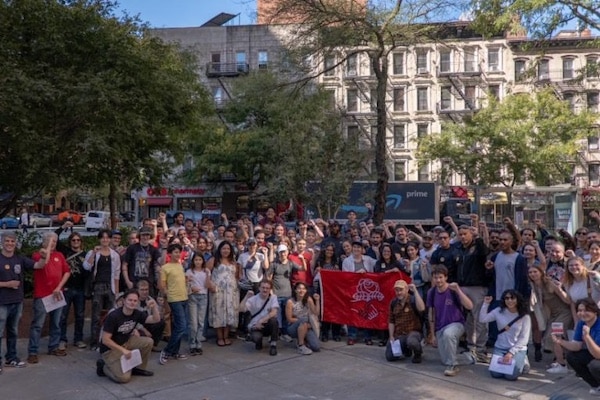
Members of the New York City Labor Working Group and Teamsters Local 804 joined Amazon delivery drivers on October 3 for a mass canvas in the Upper East Side district of City Council Speaker Julie Menin. (Photo credit:

The Delivery Protection Act would curb Amazon outsourcing hiring delivery drivers through contractors, and increase worker protections for these drivers.

Over the past few months, the International Brotherhood of Teamsters Local 804 and Amazon delivery drivers, along with the NYC-Democratic Socialists of America Labor Working Group, have knocked on more than 11,000 New Yorkers’ doors, asking them to support the Delivery Protection Act, which would hold Amazon accountable for the working conditions and safety of its delivery drivers, and to pressure their Councilmembers to sponsor it. Now they are directing their efforts at Speaker Menin’s district.The Delivery Protection Act was introduced by democratic-socialist Councilmember Tiffany Cabán (D-Queens) in February. It would require the “delivery service providers” (DSPs), the ostensibly independent companies that Amazon and others hire to do “last-mile” deliveries between warehouses and individual customers, to be licensed by the city. It also states that all workers providing “core delivery services” or “core warehouse services” must be “directly employed by the facility operator,” and would prohibit hiring them through third parties.

The post DSA, Teamsters, Amazon workers fight to pass the Delivery Protection Act appeared first on MR Online.


From MR Online via This RSS Feed.

0

Liquid Assets: How the Maquiladora System Built the World’s Most Profitable Blood Business | Long-Haul Mag

Long-Haul Mag Liquid Assets: How the Maquiladora System Built the World’s Most Profitable Blood Business | Long-Haul Mag longhaulmag.com
preview

To say these Mexican nationals are “donating” their plasma is a bit of a misnomer. For each hour-long session, “donors” receive a gift card of around USD 50. At most, they can earn around USD 400 monthly, that is, if they wait in line to donate the maximum of two times each week. (Though, if you’re “feeling lucky,” Grifols recently began offering scratchcards with a potential “instant $30 BONUS” for visiting donors.) It would be more accurate to term this plasma selling. But legally, plasma companies classify their payments as “gifts” for those volunteering their time, skirting the law that bars visitor-visa holders from working in the United States. These “gifts” are essential to what has become a multibillion-dollar industry. Driven largely by the growing numbers of aging nonworkers in Western countries, demand for “longevity” medicine has surged, fueling interest in stretching plasma’s already extensive therapeutic capabilities.

To say these Mexican nationals are “donating” their plasma is a bit of a misnomer. For each hour-long session, “donors” receive a gift card of around USD 50. At most, they can earn around USD 400 monthly, that is, if they wait in line to donate the maximum of two times each week. (Though, if you’re “feeling lucky,” Grifols recently began offering scratchcards with a potential “instant $30 BONUS” for visiting donors.) It would be more accurate to term this plasma selling. But legally, plasma companies classify their payments as “gifts” for those volunteering their time, skirting the law that bars visitor-visa holders from working in the United States. These “gifts” are essential to what has become a multibillion-dollar industry. Driven largely by the growing numbers of aging nonworkers in Western countries, demand for “longevity” medicine has surged, fueling interest in stretching plasma’s already extensive therapeutic capabilities.

0

AutoZone workers won a union. Then the company fired them.

The Real News Network AutoZone workers won a union. Then the company fired them. therealnews.com
preview

cross-posted from: news.abolish.capital/post/85855

Jacobin logo

This story originally appeared in Jacobin on Oct. 12, 2026. It is shared here with permission.

Speaking with members of the newly formed AutoZone Workers Union, you would never guess that one of them had just been fired — and that another would be the next morning. That’s what happened to Nathan DuCongé and then David Valencia after they won their union election. On a Zoom call with Jacobin, though, their joy was contagious. DuCongé and his coworkers were all smiles and banter as they talked about their union campaign, how it feels to win, and the unexpected boost they received from filmmaker Boots Riley.

On Friday, September 25, an AutoZone store in White Plains, New York, became the first of the company’s nearly seven thousand American retail locations to unionize. DuCongé and his coworkers, now members of United Auto Workers (UAW) Local 259, said they hadn’t been sure which way the vote would go.

“The deck was really stacked against these workers trying to organize here,” said Brian Murray, an experienced organizer brought on in August by UAW Local 259 Vice President Mike DiGuiseppe. “It was because of their sticking together, the amount of fun they have, and their camaraderie, their solidarity for each other, [that] they were able to overcome a lot of union busting.” He added, “I would have expected [them] to not have succeeded in winning that vote, but they did.”

“We Were Already a Union”

DuCongé moved to New York City two years ago and soon started working for AutoZone as a part-time employee. A year later, he became a parts sales manager. He said he decided to start organizing his store after he was removed from the schedule one Saturday in April, and instead went to a joint meeting of the Emergency Workplace Organizing Committee (EWOC) and the New York City Democratic Socialists of America (NYC-DSA). There he was connected with UAW members who encouraged him to unionize.

By then, DuCongé and Valencia, who was hired several months after him, had already discussed the possibility of a union. Valencia’s turning point came in 2025, when he worked a Fourth of July shift and found out from his paycheck that he wasn’t getting holiday pay. “I went in and I told my manager that day . . . I’m going to make a union.”

““I know this isn’t always the case, but for us, it was already there,’ said Valencia. ‘We were already a union.”“

Valencia said he already knew DuCongé’s political orientation when he approached him about unionizing. “We got to talking about it, and it took a long time because we didn’t have the institutional knowledge on where to even begin, until by chance Nate met someone at a DSA meeting. They hooked us up with the UAW, and the rest is history.”

Given the store’s small size, the workers’ specific grievances, and the tight-knit relationships among several key employees, DuCongé and Valencia felt it would be a good place to test whether AutoZone could be organized.

“I know this isn’t always the case, but for us, it was already there,” said Valencia. “We were already a union.”

Do the Job Right

Juan Accostupa, a full-time sales associate who has worked at AutoZone for ten years and trained many of the organizers, described the extra responsibilities workers take on. “We’re not just a retail place. We do a lot of work,” he said. “We unload the trucks, we do installations — batteries, headlights, brake lights, wiper blades, whatever the case might be — and we’re just not getting paid properly.”

“You’re expected to do a lot for so little,” said DuCongé. “These are the kind of things that mechanics are paid to do, right?”

Accostupa said he has made minimum wage throughout his tenure at the store. “Some people think this is, like, a revolution thing. It’s not. We’re just asking for what should be done: better pay and better benefits. That’s it.”

Jess Omelia, a part-time commercial driver who previously worked for a Pepperidge Farm warehouse in Florida with “really great benefits,” said working for minimum wage with little to no benefits was a huge adjustment. “It was a job that I needed at the time, so I took it.”

““Some people think this is, like, a revolution thing. It’s not. We’re just asking for what should be done: better pay and better benefits.”“

Omelia said the lack of holiday pay for part-time employees came as a shock. She recalled being put on the schedule for Mother’s Day even though she was the only one among her coworkers with a toddler. “I was the only one there working on Mother’s Day,” she said. “It was only my store manager there. He had given everyone the day off or people had called out to be with their families.”

Workers also cited other reasons for unionizing: inconsistent and last-minute scheduling, inadequate equipment, no say in how they handle their routine responsibilities or in disciplinary procedures, and a push to upsell customers known as “WITTDTJR” — short for the AutoZone slogan “What It Takes To Do the Job Right.”

“We would literally come in and underneath the [sales] numbers every day, there would be a threatening note underneath that you need to get these numbers up,” said Omelia. “You would be punished and your hours would be taken away if you weren’t upselling.”

What Makes a Supervisor?

Workers said their card drive proceeded with little incident until July, when corporate got wind of it. After the workers sent their demand letter and submitted their cards in late July, AutoZone promptly rejected them, saying DuCongé’s involvement as a parts sales manager — a position the company says is supervisory — nullified them.

DuCongé disputes that categorization. Under the National Labor Relations Act, a supervisor must have the authority, using independent judgment, to make or effectively recommend decisions like hiring, firing, disciplining, or promoting other workers — authority DuCongé said he did not have. Rather than fight the issue, which could have delayed an election, the workers resubmitted the cards without him.

“I just felt like it would be selfish if I tried to fight for my eligibility,” said DuCongé. “I never wanted to stand in the way of these people. They’re my friends, my coworkers. It was a good feeling to be able to just help.” He added, “As a member of DSA as well, I felt that as a responsibility. It was kind of like, hey, look, I’m in this organization, I might as well do something that lives up to the organization and the reason why I’m in it.”

Workers said that at a prehearing meeting in late August, AutoZone made clear that it intended to challenge the election not before the National Labor Relations Board but in federal court in Tennessee, where the company is based. At the same meeting, the workers and AutoZone signed an agreement that locked in the list of eligible voters to prevent challenges to votes on election day.

Yet other employees who hold the same position as DuCongé were allowed to vote. Two workers who were transferred to the store in mid-August were also deemed eligible.

“We Will Accept Your Invitation to Fire You”

In the lead-up to the vote, workers reported being subjected to heavy surveillance, multiple antiunion meetings per week, and threats of disciplinary action against the organizers.

“We were having three meetings a week. It was constant . . . and they were really just reading off of a script every time,” said Omelia. “It was just all anti-union. They were extremely against it, said that they would do everything in their power to fight it. If we didn’t like the conditions, [they said] that we could quit and go to another store.”

Valencia said the anti-union messaging relied on half-truths and accusations, including misleading claims about union dues and employees’ ability to communicate with their manager. Organizers, he said, were accused of misleading or threatening workers into voting yes, and were portrayed as using the campaign to land union jobs paid for by workers’ dues.

Workers said AutoZone brought in managers from locations around the country to surveil the store. “There were up to eight, nine people in the store a day, and even the customers were like, ‘What’s going on?’” said Omelia. “There would be times where they’re literally just standing at the back of the store with their arms crossed, just watching us.”

DuCongé said that after the workers submitted their demand letter on July 24, an account under the name of AutoZone CEO Philip Daniele showed up among the viewers of one of his Instagram stories.

In a September 4 recording shared with Jacobin, management threatened to fire DuCongé for union activity on the grounds that he was a supervisor: “If you continue to involve [yourself] in unionization activity, we will accept your invitation to fire you.”

LaborLab, a workers’ rights watchdog group, estimates that AutoZone spent around $200,000 trying to defeat the union. “They do everything except pay you more,” said Murray.

AutoZone in Six

Despite the onslaught of anti-union activity, the workers said the solidarity they felt with one another kept them moving forward. When Omelia’s mother died, her coworkers took up a collection. “I came into work, and they had a little envelope, and they all pitched in to help with my mom’s funeral costs. That’s how close we are.” Accostupa was quick to point out that every manager declined to contribute.

Support also came from outside the store. DuCongé, a filmmaker himself, had posted on social media about how inspiring he found Boots Riley’s new film, I Love Boosters. To his surprise, Riley started reposting updates on their organizing efforts. His first feature, Sorry to Bother You, follows a group of telemarketers who organize and go on strike.

“Boots has been massively influential on my personal life, my filmmaking efforts, but also really, really influential for this campaign,” he told Jacobin. “The solidarity is going beyond the movies and TV shows that he makes.” He added, “I just can’t thank him enough, truly, for helping us out.”

Workers said management kept talking to employees about the election in the twenty-four hours before the vote — and even during it. “On the day of voting, during voting happening, managers were pulling some of those people out of the store, and trying to sway those votes,” said Omelia.

Barred from voting and, he said, from entering the store, DuCongé stayed nearby. He recounted the moment:

I didn’t know what to do with myself, so I just stand on this hill that’s looking down at the store . . . I felt locked onto the ground, and there’s this groundhog sitting right next to me, just also looking out there too. I’m looking at the groundhog, and then eventually it just looks at me, like, “What are you looking at?” It turns out we’re both just looking down at the store. There’s this beautiful sunset and all these crows and everything, and that’s when Mike [DiGuiseppe] texted us the news, and said, “You won.” I just collapsed.

The final tally was 6–4 in favor of the union. Despite the prehearing agreement, and despite his serving as the union’s election observer, Valencia’s vote was challenged during voting, but, in the end, every eligible vote was counted.

After the Win

The day after the vote, AutoZone fired DuCongé. In a recording provided to Jacobin, management tells him: “Effective immediately, AutoZone is terminating your employment as a result of the failure to act appropriately as a manager by engaging in and/or facilitating union activity.”

The following day, another worker was fired for, in DuCongé and Valencia’s words, “not stopping the union.”

Valencia says he was fired too, on October 3, the morning after the Zoom call. Asked on the call whether he was worried about his job, he had said, “If I get fired, I get fired. They’re going to have to come up with a good reason, because I’m in the bargaining unit. It won’t be so easy.”

““If I get fired, I get fired. They’re going to have to come up with a good reason, because I’m in the bargaining unit.”“

That same day, AutoZone filed three objections to the election with the National Labor Relations Board, a move the union sees as a delay tactic. The workers seem undeterred.

“We fought for this and we did it. It’s funny, I was telling the staff and everybody else, we were like the Knicks. Knicks in six,” said Accostupa. “The thing about it was we won six and four, 6–4. That was the key.”

Next they intend to help workers at other AutoZone stores organize. “I deliver to other stores, so I see the things that they go through,” said Omelia. “They were watching this election and waiting to see what happened with us to see if they could move forward.”

Valencia says AutoZone runs on the work of people like him and his coworkers. “People come into AutoZone frantic,” he says. “You help them out, you send them on their way with a smile on their face. It’s a good thing. We’re not saving the world, but one person at a time, we’re making their day better.”

“The workers on the ground are really providing all the value to the companies that eat up all the value,” Valencia says, “and all the people at the top that take all the profits that we create. And we just want some kind of compensation that looks closer to the value that we provide.”


From The Real News Network via This RSS Feed.

0

Hurting people with graphic design is my passion

A shitty AI poster warning school bus drivers to only call out of work if they're "TOO" sick to work.
preview

Nothing could go wrong if you spread an illness to dozens of kids who then interact with hundreds of kids who then interact with thousands of family members at home. Go to work and touch all the same surfaces as the other drivers before driving your very heavy bus.

Nothing could go wrong if you spread an illness to dozens of kids who then interact with hundreds of kids who then interact with thousands of family members at home. Go to work and touch all the same surfaces as the other drivers before driving your very heavy bus.

0

Spanish unions announce general strike over housing - BT News

BT News Spanish unions announce general strike over housing - BT News breakthroughnews.org
preview

cross-posted from: news.abolish.capital/post/84547

Spanish trade unions representing millions of workers have announced a general strike for November 11. The announcement comes amid nationwide mobilizations for the right to housing and only days after Prime Minister Pedro Sánchez called early elections for November 29.

Read more: Housing crisis leads to snap election in Spain

The strike was announced by the two largest union organizations, the General Union of Workers (UGT) and the Workers’ Commissions (Comisiones Obreras, CCOO), alongside the General Confederation of Labor (CGT), Basque unions ELA and LAB, and the Galician confederation CIG.

It will be the country’s first general strike in 14 years, excluding the feminist strike of March 8, 2018.

Housing and wages are the same struggle

“A key demand of this strike is to vindicate decent salaries to afford housing,” the Madrid Tenants Union wrote.

In their strike call, unions emphasized several demands that have been on their agenda for months. These include reductions in working hours, wage increases, health and safety measures in the workplace, eradicating precarious employment and progress in collective bargaining – a process that has been obstructed by employers for almost a year.

Yet, echoing the sentiment voiced on the streets, where hundreds of thousands have protested and erected encampments against a predatory housing system, the trade union call links all these demands to the right to housing.

“This is a strike with very clear foundations and labor demands,” CCOO’s Carlos Gutiérrez said. “Is it being called because working families cannot access affordable housing? Yes. But we cannot separate the inability to access affordable housing from the wage situation in our country and what is happening in the workplace.”

Maricarmen Abascal during a protest in June 2026. Source Sindicato de Inquilinas e Inquilinos de Madrid/Facebook

The general strike builds on a protest wave triggered by the eviction of 87-year-old Maricarmen Abascal in late September. After years of battle to keep the home she had been living in for 70 years, Abascal was carried out of the apartment on a stretcher. She remained hospitalized until Wednesday, October 7, when the Madrid Tenants Union announced her death.

“Although a historic agreement was reached that would have allowed her to return to her home, this solution came too late,” the organization wrote. “An absolutely avoidable situation, following an agonizing process.”

A strike against all who “do nothing to solve the housing crisis”

Many of those participating in the protests recognized that Sánchez’s administration failed to implement policies that would truly address the housing crisis. Yet union and civil society statements emphasize the problem goes much further than the behavior of a specific political option.

“It’s important to make clear that this is not a strike against any particular government, but against those who do nothing to solve the housing crisis, and also against the employers, who have kept the Agreement for Employment and Collective Bargaining (AENC) blocked for nearly a year,” Patricia Ruiz from UGT was quoted as saying in Público.

Political parties from the center-left to the left have largely expressed support for the strike. Even PSOE figures who share the responsibility for not addressing the housing crisis signaled support for concerns outlined by trade unions.

While a general strike held only a couple of weeks ahead of an election would usually spell trouble for the incumbent administration, local political analysts say this is a peculiar situation that could swing both ways.

Read more: Far right exploits Ceuta incident to call for border crackdown

Right-wing options are polling high, but ongoing housing mobilizations could steer the electoral campaign away from scapegoating migrants toward issues of social justice – topics they are generally keen to avoid.


From BT News via This RSS Feed.

0

Dungeons & Dragons and Studio X Join United Wizards of the Coast - CWA Union

United Wizards of the Coast Dungeons & Dragons and Studio X Join United Wizards of the Coast - CWA unitedwizardsofthecoast.com
preview

cross-posted from: mtgzone.com/post/4728476

Today, October 6, 2026, the designers, artists, writers, producers, and workers behind Dungeons & Dragons, Magic: The Gathering, Duel Masters, D&D Beyond, and countless other games are uniting in solidarity to form a union with the Communications Workers of America (CWA)!

As of this morning, both the Dungeons & Dragons team (which includes the workers behind Dungeons & Dragons and D&D Beyond) and Studio X (which includes the tabletop Magic: The Gathering and Duel Masters teams) informed Wizards of the Coast leadership of our intent to unionize, and called on the company to voluntarily recognize our union. We’re calling leadership to voluntarily recognize our union by October 13th, and you can sign our petition to show your support for our efforts.

We’re proud to follow in the footsteps of MTG Arena’s own union, who recently won their union election, and have worked with the MTG Arena union in preparation for today. Now, we get to share it with you all!

We are stewards of our games who deserve to be treated with all the respect and dignity that entails. And as the teams responsible for so much of Hasbro and Wizards of the Coast’s profits, we deserve the following:

  • Wages that reflect our work and defined career progression,
  • Job security against mounting industry instability,
  • Reliable and easily accessible healthcare for us and our families,
  • Sustainable workloads and practices, including remote and hybrid working,
  • Protection against the encroachment of AI,
  • Full ownership of the work we create outside of the office,
  • And additional needs outlined in our individual units’ goals.

While today’s announcement is certainly exciting, it’s just the start. To the fans of D&D, Magic, and more, we ask that you sign our petition asking for Wizards of the Coast to voluntarily recognize our union and engage in good-faith bargaining. The community support for MTG Arena’s union was vital to their monumental victory, and we hope that you show the same support for our mission here today. You can also show your support on social media and share this statement with your communities. The more eyes on our campaign, the better!

There is so much excitement from our internal teams for this union, not just for the protections it offers us, but for the chance to make our lives and the games we create even better. In preserving our rights and establishing long-awaited protections for our workers, we hope to make all worlds—both the ones we create and the one we live in—better places. Once recognized, we will begin our bargaining and share additional details with you all as they develop.

The games we create are foundations of the gaming industry. Just as D&D has inspired countless TTRPGs and Magic sparked the TCG revolution, we hope to catalyze real change within our industry and build upon the groundwork laid by other gaming unions, creating a space where all workers are protected and treated fairly.

The workers of Wizards of the Coast have shown time and time again that we change the game. This is one of those times, where we get to redefine what is possible and what can be created—and this time, we’re inviting you to join us! Sign our petition, share it with your communities, and ask Wizards of the Coast and Hasbro to voluntarily recognize our union. Let’s change the gaming world together!

From,

The Dungeons & Dragons team and Studio X

cross-posted from: mtgzone.com/post/4728476

Today, October 6, 2026, the designers, artists, writers, producers, and workers behind Dungeons & Dragons, Magic: The Gathering, Duel Masters, D&D Beyond, and countless other games are uniting in solidarity to form a union with the Communications Workers of America (CWA)!

As of this morning, both the Dungeons & Dragons team (which includes the workers behind Dungeons & Dragons and D&D Beyond) and Studio X (which includes the tabletop Magic: The Gathering and Duel Masters teams) informed Wizards of the Coast leadership of our intent to unionize, and called on the company to voluntarily recognize our union. We’re calling leadership to voluntarily recognize our union by October 13th, and you can sign our petition to show your support for our efforts.

We’re proud to follow in the footsteps of MTG Arena’s own union, who recently won their union election, and have worked with the MTG Arena union in preparation for today. Now, we get to share it with you all!

We are stewards of our games who deserve to be treated with all the respect and dignity that entails. And as the teams responsible for so much of Hasbro and Wizards of the Coast’s profits, we deserve the following:

  • Wages that reflect our work and defined career progression,
  • Job security against mounting industry instability,
  • Reliable and easily accessible healthcare for us and our families,
  • Sustainable workloads and practices, including remote and hybrid working,
  • Protection against the encroachment of AI,
  • Full ownership of the work we create outside of the office,
  • And additional needs outlined in our individual units’ goals.

While today’s announcement is certainly exciting, it’s just the start. To the fans of D&D, Magic, and more, we ask that you sign our petition asking for Wizards of the Coast to voluntarily recognize our union and engage in good-faith bargaining. The community support for MTG Arena’s union was vital to their monumental victory, and we hope that you show the same support for our mission here today. You can also show your support on social media and share this statement with your communities. The more eyes on our campaign, the better!

There is so much excitement from our internal teams for this union, not just for the protections it offers us, but for the chance to make our lives and the games we create even better. In preserving our rights and establishing long-awaited protections for our workers, we hope to make all worlds—both the ones we create and the one we live in—better places. Once recognized, we will begin our bargaining and share additional details with you all as they develop.

The games we create are foundations of the gaming industry. Just as D&D has inspired countless TTRPGs and Magic sparked the TCG revolution, we hope to catalyze real change within our industry and build upon the groundwork laid by other gaming unions, creating a space where all workers are protected and treated fairly.

The workers of Wizards of the Coast have shown time and time again that we change the game. This is one of those times, where we get to redefine what is possible and what can be created—and this time, we’re inviting you to join us! Sign our petition, share it with your communities, and ask Wizards of the Coast and Hasbro to voluntarily recognize our union. Let’s change the gaming world together!

From,

The Dungeons & Dragons team and Studio X
0

Arrests, injuries reported at C&H Sugar refinery strike line in Crockett

ABC7 San Francisco Arrests, injuries reported at C&H Sugar refinery strike line in Crockett abc7news.com
preview

A strike at the C&H Sugar refinery in Crockett turned tense Tuesday as deputies declared an unlawful assembly, detained several striking workers and responded to reports of injuries on the picket line.

Authorities warned workers they could be arrested if they did not leave the area. By late afternoon, 10 striking workers had been taken away in handcuffs and detained, according to witnesses at the scene.

Earlier in the day, at least one picketer was taken to a hospital. Union leaders said two workers were injured after motorists drove through the picket line.

0

World Cup Workers Strike in Seattle -- UAW Divests from Israel Bonds -- Minnesota Indictment Raises Signal Questions

Payday Report World Cup Workers Strike in Seattle -- UAW Divests from Israel Bonds -- Minnesota Indictment Raises Signal Questions paydayreport.com
preview

cross-posted from: news.abolish.capital/post/58004

World Cup Workers Strike in Seattle – UAW Divests from Israel Bonds – Minnesota Indictment Raises Signal Questions

Folks,

Greetings from the Burgh, where Payday is finding some fundraising success and very grateful to everyone who donated in the last few days. It took a lot of pressure off of us and gave us some breathing room.

Donate to Help Us Build a Sustainable Funding Model

We got a lot of exciting stuff planned. Partnerships with local immigration rights groups, a veteran union organizer coming on board to help with fundraising, and media trainings for community groups.

(See our 5-page media and newsletter building training curriculum)

For the last three years, we relied heavily on foundation money for a large part of our budget.  We are working to build a sustainable model that won’t be hurt if a major foundation leaves us like we suffered this year. So please give money if you can and help us build because we are entering a new era of Payday Report.

Donate Now

Seattle Hotel Workers Strike as World Cup Visitors Arrive

Last week, Payday Report released an interactive map showing how unions are fighting back against ICE raids. (Check out our map about this growing trend across the country)

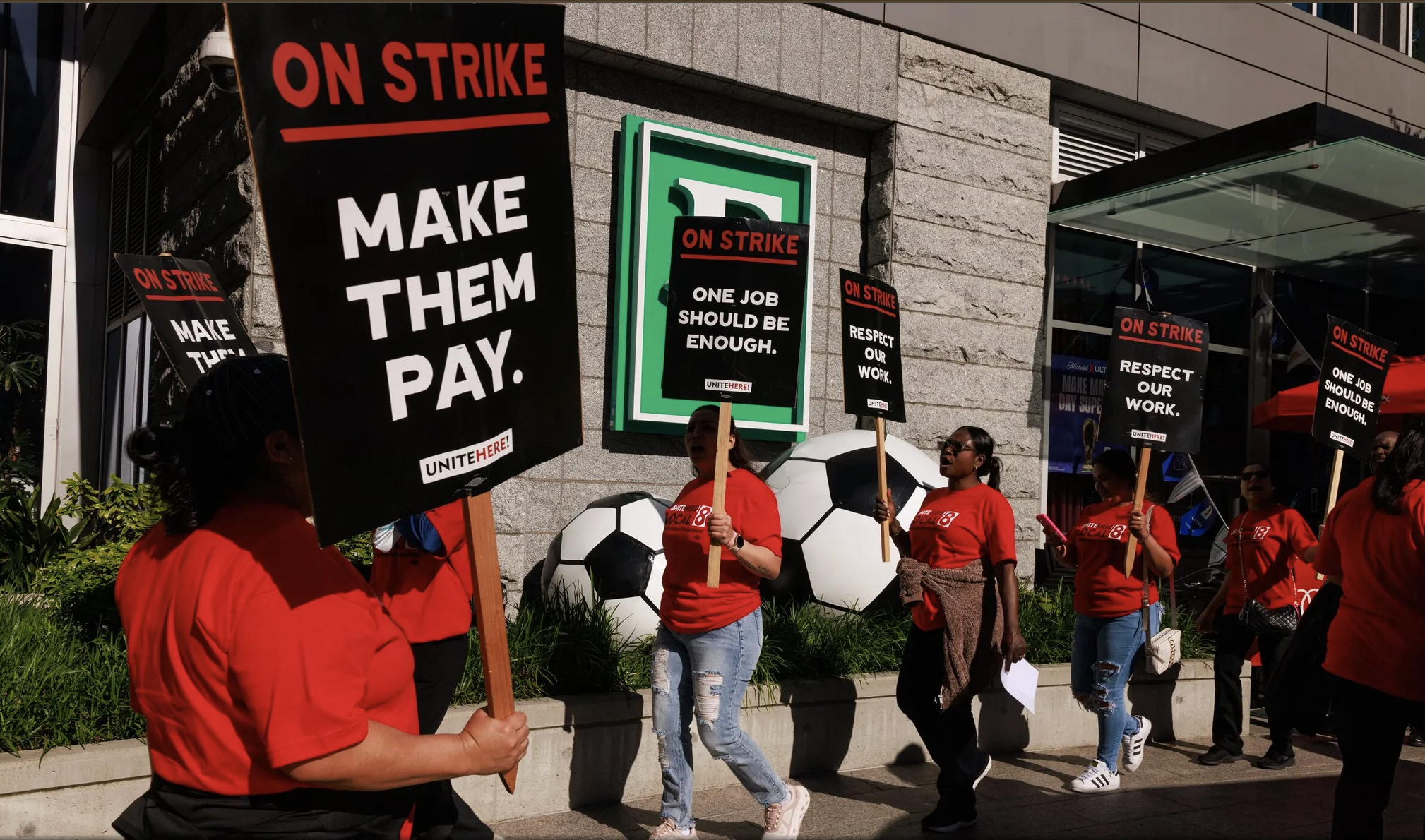
At the Embassy Suites in Seattle across the street from Lumin Field, where World Cup games are being played, UNITE HERE members decided to go on strike. They are striking around, both having their hours cut and the refusal of their hotel to refuse entry to ICE.

“Hotel workers who are welcoming visitors from around the world to Seattle shouldn’t have to work second and third jobs to support their families or worry about whether they will have healthcare over the slow months in winter,” said UNITE HERE Local 8 President Anita Seth. “And, as a majority immigrant workforce, they deserve the peace of mind of notification from their employer if ICE or DHS is on property.”

For more, check out our friends at The Stand.

Feds Likely to Indict More Labor Leaders in Minnesota

Earlier this week, the Trump Administration announced that they were indicting 15 activists, including labor leaders, on a variety of charges. Many labor leaders suspected that the 15 were charged so that the prosecutors could gain access to their signal chats.

Now, a new expose from The Intercept shows that ICE was able to obtain messages from Signal that many previously thought were encrypted and protected. From the Intercept:

The bulk of the indictment consists of transcripts of group messages; at various points it also makes mention of voicemails, text messages, Signal direct messages, and Signal calls. For instance, the indictment in one spot mentions that two of the indictees “exchanged approximately 20 connected Signal calls.” This hints that authorities were able to access not just group chat messages, but likely had wholesale access to the devices of at least some of those indicted.

The Signal app provides end-to-end encryption, protecting communications in transit, so that anyone monitoring your internet or cellular data connection cannot see the contents of your messages. Signal also minimizes the amount of metadata collected, so if the organization behind the app, the Signal Foundation, was served with a compulsory legal process to reveal user information, it wouldn’t even know with whom you spoke or chatted.

But all that falls apart if your device gets into the wrong hands. In order to safeguard your Signal data from someone who obtains access to your device, it’s necessary to manually harden Signal by modifying some of its default settings.

Perhaps Signal’s most well-touted security and privacy feature is its ability to set disappearing messages. Messages can be set to expire in periods ranging from seconds to weeks. A default expiration time for all messages can be selected, and specific groups and conversations can be set to custom retention times. To minimize risk, set retention times to the shortest feasible duration — minutes or hours — rather than days or weeks.

For more safety tips, check out the Intercept.

UAW Votes to Divest from Israel Bonds

At the UAW’s convention this weekend, they voted to become the largest union to date to divest from Israel Bonds. The UAW owned approximately $400,000 worth of Israeli bonds.

“It felt so overwhelming and amazing, but it also was so reaffirming that the United Auto Workers is actually a union that stands for progressive, militant, rank-and-file action and protecting the most vulnerable among us,” Olga Karounos, 33, a public defender in Brooklyn, New York, from  UAW Local 3235, who sponsored the resolution, told the Detroit News.

Karounous’ family is Greek Orthodox, and she said that the Israeli attack on Church of Saint Porphyrius in Gaza City in 2023 had a strong effect on her, deepening her commitment to divest her union from Israeli bonds.

"We vote with our dollars, and we just voted not to support our dollars going to genocide,” Karounus told the Detroit News.

For more, check out the Detroit News.

Amazon Workers Under Investigation for Speaking about Data Centers

Finally, Wired has a look at how three Amazon workers say they are under investigation for speaking out about data centers:

Earlier this month, five current Amazon employees publicly urged Seattle City Council to regulate data centers. It was an unprecedented act of advocacy by tech workers, and now, three of the staffers say they are now under internal investigation for what they understand to be allegedly representing themselves as spokespeople for the company without prior approval. “It’s a totally ridiculous claim,” says one of the affected employees, Patrick Schloesser. “It’s patently absurd.”

The three software engineers, who work in different divisions of Amazon and all live in Seattle, believe they are being unfairly targeted for expressing their political beliefs. They filed a joint complaint on Thursday to Seattle’s Office for Civil Rights, according to the employees and a filing seen by WIRED. They accused Amazon of illegally attempting to intimidate and retaliate against them for expressing their personal opinion outside of work about the need to regulate the environmental and social impacts of data centers.

“Seattle is one of just a few jurisdictions in the country that prohibits private employers from discriminating against their employees based on the political beliefs they hold and the organizations they belong to,” says Abby Lawlor, an attorney at Barnard Iglitzin & Lavitt who is advising the employees. “Here, we have legal tools to fight back and ensure that tech workers can be full democratic participants in these important local discussions. We hope the city of Seattle will do its part to ensure that this vital Seattle law is enforced.”

For more, check out WIRED.

News & Headlines Elsewhere

Alright folks, that’s all for today. Keep sending tips, comments, and complaints to melk@paydayreport.com

Donate to Help Us Cover Labor in News Deserts


From Payday Report via This RSS Feed.

0

Unions Condemn Executive Order Allowing Trump to Replace Federal Workers With 'Political Loyalists' | Common Dreams

Common Dreams Unions Condemn Executive Order Allowing Trump to Replace Federal Workers With 'Political Loyalists' | Common Dreams www.commondreams.org
preview

cross-posted from: news.abolish.capital/post/54788

Labor unions are warning that an executive order signed this week by President Donald Trump will allow his administration to replace thousands of career civil servants with “political loyalists.”

The order, signed on Wednesday, converts around 8,000 federal workers—most of whom are at senior levels in the civil service with major influence over policy decisions—to Schedule Policy/Career (P/C) status, formerly known as Schedule F, effectively making them “at-will” employees whom the president can fire at his discretion.

While a small number, around 4,000, of the roughly 2 million federal workers are considered political appointees, most federal employees cannot be removed purely for failing to serve the agenda of the president and can usually only be fired for issues like inadequate performance or misconduct, which involves an appeal process.

But as part of the Trump administration’s effort to dismantle what it’s described as a “deep state” of disloyal bureaucrats, a major objective of the Heritage Foundation’s right-wing manifesto Project 2025, those 8,000 employees may now be fired for “subversion of presidential directives.”

According to the US Office of Personnel Management, this could be just the beginning—with as many as 50,000 employees potentially in consideration to be rescheduled.

A fact sheet released by the White House said that despite the reclassification, “these remain ‘career’ positions and the non-partisan hiring processes, competitive status, and other aspects of these roles will not change,” while “removal decisions will also be made without respect to political affiliation.”

But Trump-loyal department heads—everywhere from the Department of Justice to the Pentagon—have systematically purged employees across executive departments that are perceived as Trump’s political enemies.

AFL-CIO president Liz Shuler said on Thursday that “Schedule P/C is the next phase in Trump’s anti-worker agenda to replace government workers with political loyalists who answer only to him.”

“As we’ve seen from his first day in office, the president is determined to tear down the architecture of our federal government and replace it with a system of corruption to benefit powerful CEOs and billionaire union-busters,” she said.

It’s part of a broader attack on the federal workforce in Trump’s second term. Through a combination of firings, layoffs, and forced resignations, he has reduced the number of government employees by nearly 300,000, causing chaos and understaffing at many agencies. He’s also stripped more than 1 million unionized federal workers of their right to collective bargaining, though courts have blocked the implementation for some workers.

Everett Kelley, the president of the American Federation of Government Employees (AFGE), which represents more than 800,000 federal workers, said Wednesday’s order was “a blatant attempt to corrupt the federal government by eliminating employees’ due process rights so they can be fired for political reasons.”

“The practical implications of this action are clear. Workers who once felt comfortable reporting waste, fraud, abuse, and mismanagement at their place of employment because they were protected from retaliation will now be afraid for their jobs if they speak out,” he said. “That is a disservice to them and to the millions of Americans who rely on the federal government every day.”

William Shackelford, president of the National Active and Retired Federal Employees Association, added that the order “threatens expanded political cronyism, increasing the risk that executive actions will be decided by the size of political contributions rather than the faithful execution of the law.”

“That increases the risk of politically motivated enforcement of laws, threatening individual liberty; politically determined tariff exceptions and contract and grant awards, threatening greater corruption and waste of taxpayer dollars; and politically selective provision of services, threatening failure of government operations for disfavored groups or localities,” he said.

The legal watchdog Democracy Forward has filed a lawsuit against Trump’s rebranding of Schedule F as Schedule P/C at the start of his second term, which the group argued allowed several positions in the traditional nonpartisan civil service to be effectively recast as political appointees.

“For generations, our country has relied on a professional, nonpartisan civil service,” said Skye Perryman, the group’s president and CEO on Wednesday. “The people responsible for protecting our public health, safeguarding our environment, delivering our mail, managing our airports, protecting our public lands, and enforcing our laws should be allowed to do their jobs, not targeted by the same government they serve.”

“When government experts can be fired without cause,” she added, “it’s not just federal workers who are harmed—it’s the people across the country who rely on these essential services every day.”


From Common Dreams via This RSS Feed.

0

Samsung memory chip staff in line for £310,000 bonuses after AI profit-sharing deal

the Guardian Samsung memory chip staff in line for £310,000 bonuses after AI profit-sharing deal www.theguardian.com
preview

The agreement, mediated by South Korea’s government, means Samsung will set aside 10.5% of operating profits at its semiconductor division to pay special bonuses to its chip workers. It should end a bitter five-month dispute.

Reuters reported last week that a memory chip worker with a ​base salary ⁠of 80m won ($53,400 or £39,700), for example, was expected to receive a bonus of about 626m won ($416,000 or £310,000) this year, mostly paid in stock, according to a union source.

forgot to follow through on strike news, seems they gotten kinda sweet deal, the only issue is management part

0

What are Samsung union workers demanding and how might a strike play out?

the Guardian What are Samsung union workers demanding and how might a strike play out? www.theguardian.com
preview

Samsung’s union has asked the company to abolish a cap that limits bonuses to 50% of annual salaries and to allocate 15% of annual operating profit to a bonus pool that would be distributed to workers. It also wants Samsung to make the changes binding beyond this year.

prolemode activated

Jeff Kim, a KB Securities analyst, has estimated that an 18-day strike could disrupt global supplies of DRAM memory by 3% to 4% and NAND memory by 2% to 3%, which would likely fuel further price increases.

South Korean government officials have also warned about the impact of a strike as Samsung accounts for nearly a quarter of Korea’s exports.

An official at South Korea’s central bank has said that a strike could, in a worst-case scenario, shave 0.5 percentage points off a forecast 2.0% expansion in the South Korean economy this year.

0

What’s Behind the LIRR Strike?

Left Voice What's Behind the LIRR Strike? - Left Voice www.leftvoice.org
preview

cross-posted from: news.abolish.capital/post/50438

This Article was Originally Published on the Substack The Labor Movement is a Mess… and What We Can Do About It

***

I’m sure you know that five unions of Long Island Rail Road workers are on strike for the first time since 1994. The workers on strike include locomotive engineers, electrical and mechanical maintenance (repair) workers, signal workers, train dispatchers, and some clerical workers. (Much of the information below comes from the linked March 16, 2026 Presidential Emergency Board report). Here’s a link to picketing sites.

The LIRR Unions Have a Right to Strike – Sort Of

Unlike NYC transit workers, who are prohibited to strike under the NYS Taylor Law, LIRR workers are covered by the Railway Labor Act, which allows strikes after lengthy mandated mediation and “cooling off” periods. As a result, these workers have not had a raise since their previous contracts expired in 2023. Between August 2025 and early May, the MTA and the five unions had ONLY ONE bargaining session.

The MTA negotiators are headed by Gary Dellaverson, one of my least favorite people, who handled NYC Transit — TWU Local 100 negotiations from 1991-2008 (and precipitated the 2005 strike with demands for pension concessions) and (as a private labor consultant) CUNY — Professional Staff Congress negotiations in 2023-24, where he won concessions from the union on Adjunct faculty job security.

Competing Offers

Dellaverson, the MTA, and Governor Hochul seem to have been caught off guard by that March PEB report, which triggered a final 60-day period before a strike could begin. The Board (and the unions themselves) recognized a previous “pattern” for three years of raises set by the MTA’s 2023 contract with TWU Local 100 contract, which represents subway and bus workers: 3, 3, and 3.5%, and a $3000 one-time signing bonus. The dispute that triggered the strike centers on the (final) fourth year of the contract. The MTA proposed a 3% raise for a 13.5 month “year” to the Board, with an additional 1.5% contingent on a host of work rule “productivity” concessions, eliminations of penalty payments, and contracting-out provisions that would, for example, have resulted in a loss of 4% in wages for engineers. (see PEB, pp. 4-5; 14-16; 36-41) Later (after the Board’s report), it demanded health benefit cost concessions similar to those it won from Local 100 back in 2023. (I discussed penalty payments in my articles on the nurses strike. The idea behind them is not so much to win those payments as to limit or prevent hurtful management behavior.)

The unions originally asked for a 6.5% raise in the fourth year, and pointed to comparable raises at other railroads. (PEB, pp. 25-26) Later it modified its fourth-year demand.

Ultimately, the Board recommended a 4.5% raise, and no changes in work rules: “the Carrier’s insistence on all of its work rule changes, in our view, makes its Final Offer the less reasonable of the two,” (PEB, p. 31) it wrote, and “It is not reasonable for the Carrier to expect [engineers] to accept such a decrease in exchange for a 1.5% wage increase.” (PEB, p. 42)

Will the Strike Set a “Pattern”?

What particularly worries the MTA and Hochul, and has prevented them from striking a deal, is that a 4.5% raise for 2026-27 might set the “pattern” for Local 100, whose contract expired this weekend, and then for DC37, whose contract expires in November (and other unions after that). “The Carrier expressed its concern that the upcoming negotiations with the organizations that historically have set the pattern for economic bargaining within the MTA family — TWU Local 100 and SMART-TD — would be influenced by the fourth-year increase agreed to by these Parties.” (PEB, p. 20)

This weekend, Hochul and Trump engaged in a little tit-for-tat, with Hochul writing that the strike was a “direct result of reckless actions by the Trump Administration to cut mediation short and push these negotiations toward a strike,” and Trump responding, “Kathy, it’s your fault… if you can’t solve it, let me know, and I’ll show you how to properly get things done,” and promoting her Republican opponent (conveniently from Long Island) in this year’s gubernatorial race.

Even “Sort of” Is So Important!

While it’s unclear whether Trump meddled in the Board’s findings in order to make trouble for Hochul, what is clear is the value of being able to strike even when, as with these unions, they had to jump through hoops (and forego raises) for years to gain that right.

Even before that, the MTA and Dellaverson had to testify before the Board about the cost value of the concessions they sought (PEB, pp. 31-44) in order to claim that its demands were “reasonable.” That created a specific record the unions were able to rebut – to show that the value of the concessions demanded was far more than the “productivity raise” offered. Compare that with traditional municipal bargaining where no such official record exists. In PSC bargaining, Dellaverson never had to quantify the value to CUNY of limiting Adjunct job security rights — let alone “pay” for it.

Then, rather than management simply being able to wait out the unions — take our proposal or tick, tick, tick, we’ll see you next year — these unions had a recourse. That’s why, as the great labor academic Stanley Aronowitz said at the first PSC union meeting I ever attended in 2015, a union that surrenders its right to strike does not deserve to call itself a union.

The post What’s Behind the LIRR Strike? appeared first on Left Voice.


From Left Voice via This RSS Feed.

0

On Nakba anniversary, health workers call for boycott of Israeli Medical Association

Peoples Dispatch On Nakba anniversary, health workers call for boycott of Israeli Medical Association : Peoples Dispatch peoplesdispatch.org
preview

cross-posted from: news.abolish.capital/post/49976

Seventy-eight years after the Nakba, Palestinians continue to resist occupation, displacement, and the systematic destruction of their health system. In this context, health workers are advancing the struggle with a campaign to boycott the Israeli Medical Association (IMA). The new campaign initiated by Doctors for Gaza (Netherlands), Global Health BDS (UK), Health Workers for Palestine (Spain) and the People’s Health Movement (PHM) is fighting to hold the IMA accountable for neglecting medical ethics, including violations of the World Medical Association (WMA) Declarations of Geneva and Tokyo.

The motivation

Health is weaponized against Palestinians by the intentional physical destruction of medical institutions, the targeted murders and detaining of Palestinian healthcare workers, the strategized maiming of Palestinians, the deliberate reproduction of infectious and non-communicable diseases, the closing of the humanitarian corridors and the blockading of medical and humanitarian aid.  These are systematic genocidal acts aimed at destroying the conditions necessary for Palestinian life. Health itself has become a battlefield in Israel’s assault on Palestinians.

Read more: Researchers warn of “de-healthification” in Palestine as infections spread in Gaza

The IMA is complicit in all of these actions – amounting to blatant and grave violations of medical ethics. The IMA’s abuses of medical ethics have been well documented and include:

Despite this inexhaustive record of severe medical ethics violations, the IMA continues to portray itself as a defender of humanitarian principles.

Read more: The Nakba has two narratives, one based on facts, the other on lies

On this 78th anniversary of the Nakba, doctors around the world are organizing to boycott the IMA in response to the organization’s gross neglect of medical ethics. The boycott is also motivated by the Palestinian people’s call to boycott all Israeli institutions complicit in the genocide.

The South African Medical Association (SAMA) and the British Medical Association (BMA) have formally severed ties with the IMA due to its role in the genocide. The Turkish Medical Association (TMA) and BMA, later joined by nine other national medical associations, issued a statement calling for action on the humanitarian crisis in Gaza at the 2025 WMA General Assembly held in Porto, Portugal.

Health workers during protests actions against medical associations’ complicity in Gaza genocide. Source: PHM

The first phase of the new campaign is focused on this year’s WMA Congress in Rotterdam, Netherlands, in October 2026. In preparation for the congress, the coordinators of the campaign are collecting signatures from healthcare workers and organizing physicians to petition their national medical associations to call for the suspension of IMA from the WMA and cut all ties with the IMA.

Over 500 physicians have already signed the petition, including Dr. Ghassan Abu-Sittah, Dr. Hanne Bosselaers and Prof. Shabir Moosa, and multiple national medical associations have been contacted. A webinar featuring doctors from SAMA, BMA, TMA and Palestine will be held on May 30 to officially launch the campaign. “This campaign is not only about the IMA’s silence and inaction, but, also, about the IMA’s brazen participation in the genocide,” PHM organizers stated. “Join us and boycott the IMA!”

More information about the campaign can be found at: https://phmovement.org/end-medical-complicity

People’s Health Dispatch is a fortnightly bulletin published by the People’s Health Movement and Peoples Dispatch*. For more articles and subscription to People’s Health Dispatch, click* here.

The post On Nakba anniversary, health workers call for boycott of Israeli Medical Association appeared first on Peoples Dispatch.


From Peoples Dispatch via This RSS Feed.

0

AFL-CIO to FIFA: 'Keep ICE Out of World Cup Host Cities' to Protect Workers

Common Dreams AFL-CIO to FIFA: 'Keep ICE Out of World Cup Host Cities' to Protect Workers | Common Dreams www.commondreams.org
preview

cross-posted from: news.abolish.capital/post/49011

AFL-CIO president Liz Shuler on Monday urged leaders of world soccer’s governing body to protect workers by keeping federalw immigration enforcement agents away from cities and venues hosting the upcoming International Federation of Association Football Men’s World Cup tournament.

“As we approach the final preparations for the World Cup and workers begin readying stadiums and communities for an influx of visitors, several of our affiliate unions have raised grave concerns over FIFA’s engagement with the Department of Homeland Security (DHS),” Shuler wrote in a letter to FIFA president Gianni Infantino and 2026 World Cup chief strategy and planning officer Amy Hopfinger.

“Chief among those concerns is the potential for Immigration and Customs Enforcement (ICE) and other DHS agents to be present at and around the World Cup matches,” Shuler continued. “As the AFL-CIO is a founding member of Dignity 2026, a national coalition of labor and grassroots community groups, we know concerns around the possibility of immigration enforcement are wide-reaching.”

America’s unions are calling on FIFA leadership to keep ICE out of World Cup host cities during the games.The Trump administration’s immigration enforcement poses a serious risk to the thousands of World Cup workers. bit.ly/3Pb9lI2

[image or embed]
— AFL-CIO (@aflcio.org) May 11, 2026 at 10:52 AM

Noting that acting ICE Director Todd Lyons has called his agency—and specifically its Homeland Security Investigations (HSI) division—“a key part of the overall security apparatus for the World Cup,” Shuler lamented that “FIFA has largely remained silent about the role ICE will play in the games.”

“Given the racial profiling, warrantless arrests, and other unconstitutional tactics the Trump administration is using to detain and deport people with no regard for due process, our affiliate unions are deeply concerned about ICE being engaged for any purpose during the World Cup,” she said. “Indeed, some unions have signaled that this would create an unsafe work environment that may require them to take collective action to ensure that no members are put at risk.”

Shuler continued:

The tactics of discrimination, violence, and intimidation used by immigration agencies to target working people across the country cause fear and chaos in our communities, and directly affect workers, business operations, and local economies. Consequently, ICE presence in host cities during the games could cause severe disruptions and negatively affect the success of the tournament. We urge FIFA to consider the financial and human impact that collaborating with DHS could have on the working people who make these games possible, not to mention on local businesses, host cities and communities, and FIFA itself. The games should be a welcoming and celebratory event for spectators, workers, and soccer enthusiasts of all backgrounds.

The AFL-CIO president is calling on FIFA leaders to:

  • Publicly call on the Trump administration to commit to keeping immigration enforcement agents, particularly ICE, out of host cities;
  • Clarify what role DHS will play, with the expectation that any DHS presence at FIFA events be strictly limited to providing operational security; and
  • Confirm that the administration will not launch immigration enforcement operations targeting workers, spectators, or the general public anywhere in the host cities.

“Additionally, unions have raised concerns over the accreditation and background check process that FIFA will be using to credential workers during the games,” Shuler wrote. “It is our understanding that FIFA will be submitting worker information through an FBI database. We call on FIFA to ensure that unions representing members at World Cup stadiums receive clear answers and open dialogue to all questions about this process.”

“Given the ways in which federal agencies are violating workers’ privacy rights to build datasets to support unconstitutional immigration enforcement activity, and FIFA’s relative silence on the scope and implications of these checks, we are asking you to commit to working with unions so that they can fully understand the process to which their members will be subjected and ensure that workers’ privacy and safety are respected,” she continued. “Specifically, we seek assurances from FIFA that no information reported in these checks will be shared with any constituent part of DHS that engages in immigration enforcement or used for immigration enforcement purposes.”

“Union members working in stadiums, hotels, event production, transportation, and many other industries will be critical to the success of these games. They deserve respect, dignity, and safety on the job so they in turn can provide a safe and welcoming environment for all players and fans,” Shuler concluded. “FIFA must be transparent about its plans for engaging with DHS and the administration so that workers can do their jobs without fear and provide the best possible World Cup experience for neighbors and visitors alike.”

The US, Canada, and Mexico are jointly hosting the tournament—the first time three nations are doing so—which is set to kick off with group stage matches in Mexico City and Guadalajara on June 11 and Los Angeles and Toronto the following day.

A coalition of more than 120 US-based civil society groups last month issued a travel advisory ahead the tournament over what the ACLU called the “deteriorating human rights situation” in the United States amid the Trump administration’s deadly anti-immigrant crackdown, suppression of free speech, and more.

Citing the “absence of meaningful action and concrete guarantees from FIFA”—world soccer’s governing body—“host cities, or the US government,” the coalition urged “fans, players, journalists, and other visitors traveling to and within the United States” for the tournament to “have an emergency contingency plan.”

The presence of HSI agents, who provided security services for US diplomats during February’s Winter Olympics in Milano-Cortina Italy, sparked multiple protests in which thousands of people took to the streets of the Lombardian capital to denounce what Milano Mayor Giuseppe Sala called “a militia that kills.”

As the tournament kickoff nears, there are also multiple unresolved labor disputes that could lead to strikes. In Inglewood, California, roughly 2,000 UNITE HERE Local 11 food service and hospitality workers at SoFi Stadium are threatening to strike before or during the tournament unless FIFA and venue operators address concerns about working conditions and the ICE threat.

Sheraton Hotel workers in Center City Philadelphia are ready to strike during the World Cup for a fair contract.The hotel is completely booked and workers have been without a contract for over two years now.

[image or embed]
— Sean Kitchen (@seankitchen.bsky.social) May 2, 2026 at 3:55 PM

In Mexico City, transport unions are pushing for improved worker protections ahead of the tournament. Using their leverage ahead of one of the world’s premier sporting events, workers have recently secured commitments from the city to raise overtime pay, negotiate permanent contracts, enact anti-harassment protections, and boost workplace safety.

In addition to concerns about workers, some capitalists have warned that the Trump administration’s draconian immigration policies and generally unwelcoming vibes could affect their bottom line.

“When you have visitors asking legitimate questions about what their experience will be coming through customs and immigration… those are big impediments to optimizing what should be a home run opportunity for the lodging industry," Marriott CEO Anthony Capuano said earlier this year.

There has also been considerable controversy surrounding FIFA’s much-ridiculed awarding of its inaugural Peace Prize to President Donald Trump amid his administration’s illegal high-seas boat-bombing spree, and just ahead of his Christmas bombing of Nigeria, kidnapping of Venezuelan President Nicolás Maduro, launch of the US-Israeli war of choice against tournament qualifier Iran, and threats to attack several other countries.


From Common Dreams via This RSS Feed.

0

The Mental Cost of 10,000 Emergency Calls

play · youtube.com
YouTube The Mental Cost of 10,000 Emergency Calls | Bryan’s Story | WHEN THE SHIFT ENDS www.youtube.com
preview

For 32 years, Bryan served as both a land and helicopter paramedic — racing toward the worst days of other people’s lives. Cardiac arrests. Fatal crashes. Airlifts. The sounds. The smells. The faces. And then… they started following him home. Nightmares. PTSD. Emotional shutdown. A growing loss of empathy and connection — not just at work, but with the people he loved most. The job that once defined him slowly began to erase him.

Eventually, Bryan faced the hardest call of his career: stepping away. In this episode of WHEN THE SHIFT ENDS, Bryan speaks openly about the cumulative trauma paramedics carry, the identity crisis that comes with leaving the profession, and what recovery looks like when you’ve spent decades putting everyone else first.

0

Workers and left parties in South Asia mark May Day, preparing for bigger fights

Peoples Dispatch Workers and left parties in South Asia mark May Day, preparing for bigger fights : Peoples Dispatch peoplesdispatch.org
preview

cross-posted from: news.abolish.capital/post/46614

Hundreds of thousands of workers from all corners of South Asia took to the streets on Friday, May 1, to celebrate International Workers’ Day or May Day, renewing their commitment to confront the accelerating onslaught of attacks on workers’ rights and the intensifying cost of living crisis.

Trade unions and left parties held rallies and meetings where they paid tribute to the workers of the 1886 Chicago Haymarket affair, some of whom paid with their lives to ignite a global movement for better working conditions and the 40 hour week.

The hundreds of thousands of workers who were on the streets also resolved to continue the legacy of Chicago and advance their collective fight against the exploitative practices of capitalism to create a better and egalitarian world.

India

In India, several rallies and meetings were organized in different parts of the country, including in major cities such as Mumbai, Kolkata, Bangalore, Hyderabad and states such as Kerala, Tamil Nadu, Rajasthan, Haryana and Himachal, among others, to mark the day.

One major joint rally was held in the national capital, New Delhi, which passed through the old city and concluded at the town hall.

Speakers in most of this years’ rallies highlighted the growing labor mobilizations in mostly unorganized sectors in Noida and other parts of the National Capital Region.

The Centre for Indian Trade Unions (CITU) organized a protest meeting in Noida, in defiance of police orders, to highlight the opposition to the ongoing repression of the movement for better minimum wages in the city and to express solidarity with the striking workers.

It was noted that these movements, which often appear sporadic and spontaneous, are a result of the growing awareness among workers in the country and the need for greater organization among them.

Speakers highlighted how the introduction of the four new labor codes by the ultra-right-wing government, under Narendra Modi’s leadership, has exposed the pro-corporate nature of the government, even to sections of society which have been reluctant to acknowledge it.

This May Day, the workers resolved to sharpen their fight against these draconian labor codes and preserve the rights which were secured after centuries of struggle, beginning with the Chicago Haymarket.

Pakistan

A 23 kilometer rickshaw rally was organized in Lahore by the Mazdoor Kisan Party (MKP) and Punjab Rickshaw Union (PRU) to mark the day.

Thousands of rickshaw drivers participated in the rally which passed through the major centers of Pakistan’s largest city.

The rally was addressed by MKP leader Taimur Rahman and Baba Najmi, a revolutionary Punjabi poet who raised the pertinent issues of the working classes in the country such as a decent minimum wage, better implementation of the labor rights laws and protection against capitalist exploitation.

Haqooq-e-Khalq (HKP) organized another rally in Faisalabad and Lahore to mark the day.

Our members from Faisalabad had just took out a rally on way to Lahore to participate in the main rally pic.twitter.com/CfStBGMl1S

— Farooq Tariq (@FarooqTariq3) May 1, 2026 

Sri Lanka

The ruling National People’s Power (NPP) and several other parties held large-scale rallies to mark May Day in different parts of the country, including in the capital, Colombo.

President Anura Kumara Dissanayake attended one of these rallies in Talawakelle, where he extended the May Day greeting and underlined his government’s policies to bring the country out of its prolonged economic crisis.

President Dissanayake also posted a May Day message online, inviting greater public participation to help build a “collective effort” to improve the conditions of the working population in the country.

Bangladesh

In Dhaka, the Workers’ Party of Bangladesh (WPB) held a rally to commemorate May Day. The rally, which passed through crucial parts of the capital, was attended by most of the senior leaders of the party.

Noting how in Bangladesh, “labor exploitation persists across sectors-from informal work to industrial production. Minimum wages are not ensured, and the ruling bourgeoisie class consistently fails to protect workers’ interests,” the WPB, in a press release on the occasion, vowed to continue its struggle for a better and just world.

Workers in Bangladesh raise red flags with the hammer and sickle

May Day rally in Bangladesh

The post Workers and left parties in South Asia mark May Day, preparing for bigger fights appeared first on Peoples Dispatch.


From Peoples Dispatch via This RSS Feed.

0

'Death on the Job' Report Details Workplace Safety Decline Under Trump | Common Dreams

Common Dreams 'Death on the Job' Report Details Workplace Safety Decline Under Trump | Common Dreams www.commondreams.org
preview

cross-posted from: news.abolish.capital/post/45410

Since returning to the White House last year, President Donald Trump has revived his war on workers and their labor unions, including by making US workplaces less safe, according to an annual report released Monday by the AFL-CIO.

The AFL-CIO published its 35th annual “Death on the Job: The Toll of Neglect” report on the eve of Workers Memorial Day on Tuesday, and in the lead-up to International Workers’ Day, or May Day, on Friday—for which organizers have already planned more than 3,000 events demanding an economy that serves “workers over billionaires” across the United States.

“Over the last 35 years of this report, job safety agencies’ resources have diminished dramatically, even as their responsibilities have grown immensely,” the publication notes. “For instance, the Occupational Safety and Health Administration (OSHA) is now in charge of 85% more establishments, 44% more workers, and new hazards and technologies, yet Congress has reduced its budget by 10% and staffing by 26%, including a 16% reduction in inspectors.”

“These percentages have massive impacts on such a tiny agency and very real personal effects on workers and their families,” the report continues. “Agencies now have a paltry number of staff to write standards, analyze data, conduct inspections, perform oversight on states, orchestrate needed research on important hazards, and respond to emerging threats. The number of OSHA inspectors has now hit a new low, and the Mine Safety and Health Administration (MSHA) does not have enough inspectors to meet its statutory requirement to inspect each mine multiple times a year.”

While “more than 735,000 workers now can say their lives have been saved since the passage” of the Occupational Safety
and Health (OSH) Act, “too many workers remain at serious risk of injury, illness, or death as chemical plant explosions, major fires, construction collapses, infectious disease outbreaks, workplace assaults, toxic chemical exposures, and other preventable tragedies continue to permeate the workplace,” the document stresses.

“Workplace hazards still kill approximately 140,000 workers each year in the United States—including 5,070 from traumatic injuries in 2024 and an estimated 135,000 from occupational diseases each year,” the report states. “That is more than 380 workers each day. Job injury and illness numbers continue to be severe undercounts of the real problem.”

The publication points out that “Black and Latino workers are more likely to die on the job,” while older workers and minors are also “at serious risk.” According to the data, the deadliest industries in the United States are: agriculture, forestry, and fishing and hunting; mining, quarrying, and oil and gas extraction; transportation and warehousing; construction; and wholesale trade.

“It is a disgrace that in 2026, being Black, Latino, or an immigrant can still be a death sentence on the jobsite,” declared AFL-CIO secretary-treasurer Fred Redmond, in a statement. He specifically called out the president’s attacks on diversity, equity, and inclusion (DEI), as well as those on immigrant communities.

“Our new report makes it terrifyingly clear that the Trump administration’s anti-DEI, mass deportation agenda will only make this crisis worse,” Redmond said. “When workers are afraid that reporting threats to their safety could result in their work permits being revoked and their families being ripped apart, and when employers fear that reporting workplace data will hurt their bottom line, we are all less safe: workers of color and white workers, immigrant workers and US-born workers. We must fight the Trump administration’s attacks on communities of color like our fellow workers’ lives are on the line—because they are.”

Faced with these “preventable” deaths, as AFL-CIO put it, the second Trump administration has taken an ax to job safety oversight and enforcement. Specifically, the report details, the administration has:

  • Pushed out so many staff that job safety agency staffing is at new lows, leaving fewer inspectors than ever to cover a growing workforce;
  • Instructed its OSHA and MSHA inspectors to focus on employer outreach and assistance, taking time and resources away from inspections with citations;
  • Expanded OSHA penalty reductions for employers when they violate the law;
  • Proposed twice to eliminate worker safety and health training grants, even though Congress has rejected these cuts so far;
  • Proposed to eliminate the Chemical Safety and Hazard Investigation Board, in charge of independent, nonregulatory investigations after an industrial explosion, leak, or other major incident;
  • Stopped conducting MSHA impact inspections, a critical enforcement tool for focusing on mines with a poor history of compliance with MSHA standards, high numbers of injuries, illnesses or fatalities, or other indicators of unsafe mines;
  • Issued zero criminal referrals for violations of the OSH Act;
  • Indefinitely halted the enforcement of the silica standard in coal and metal/nonmetal mining;
  • Extended deadlines for companies to comply with important Environmental Protection Agency (EPA) chemical regulations that specifically protect workers, such as methylene chloride; and
  • Proposed to remove dozens of OSHA and MSHA standards from the books and supported efforts to dismantle the regulatory process.

“Every worker should be able to go home safe and healthy at the end of their shift—but 55 years after the founding of the Occupational Safety and Health Administration, that fundamental right is in danger,” warned AFL-CIO president Liz Shuler.

“From the dismantling of critical federal agencies and laws to the expansion of unregulated, untested AI technology, the protections that workers fought and died for are under serious threat,” Shuler said, as the Trump administration lobbies against legislation that would regulate artificial intelligence in Republican-led states.

“The labor movement refuses to go backward,” she added. “More than five decades after a Republican signed the landmark Occupational Safety and Health Act into law, we urge all members of Congress—from both sides of the aisle—to join us in this fight.”

Both chambers of Congress are currently controlled by Trump’s Republican Party, and recent votes on various war powers resolutions have demonstrated how most GOP lawmakers are unwilling to stand up to the president, even when he defies the US Constitution.


From Common Dreams via This RSS Feed.

0

America's job market is collapsing

play · youtube.com
YouTube America's job market is collapsing www.youtube.com
preview

The US economy is booming, yet jobs are the scarcest they’ve been in many years. But what starts as a simple question – where did the jobs go? – leads to some big and surprising discoveries about the bizarre and upside-down nature of today’s economy.

The US economy is booming, yet jobs are the scarcest they’ve been in many years. But what starts as a simple question – where did the jobs go? – leads to some big and surprising discoveries about the bizarre and upside-down nature of today’s economy.

0

A Mobile Clinic Delivers Critical Care for Texas Shrimpers

Civil Eats A Mobile Clinic Delivers Critical Care for Texas Shrimpers civileats.com
preview

cross-posted from: news.abolish.capital/post/39290

Photographs by Joseph Bui

Article Summary

• Texas is a major producer of shrimp in the U.S., thanks in large part to Vietnamese immigrant fishermen.
• Fishing—and shrimping in particular—is very dangerous work, with a fatality rate 40 times the national average. The Trump administration has deregulated the industry and cut safety funding, creating an even more dangerous environment.
•Meanwhile, this community has long lacked access to medical care.
• The Docside Clinic, which started in 2021 and operates monthly, provides primary medical care, food, clothing, and social and legal services at no charge.
• Clinic practitioners are planning to expand to other locations in Texas, Louisiana, and Puerto Rico.

It’s a cool February morning in Galveston, Texas. Seagulls circle overhead, and dozens of docked shrimping boats bob in the water. Next to a wooden pier, nurse Martha Díaz crouches down to examine open sores on a shrimper’s heel.

He carefully rolls the cuff of his jeans to his knee and raises his foot so she can see it more clearly. Through a medical student translating her English to Vietnamese, Díaz asks about the cluster of yellow and pinkish-red sores and his history of diabetes as she wipes his foot with gauze and a cleansing solution.

The shrimper is one of a handful of men who’ve come out for UTHealth Houston School of Public Health’s Docside Clinic, monthly pop-up events where local commercial shrimp fishermen—many of them Vietnamese immigrants—can get primary medical care, food, clothing, and social and legal services at no charge. The clinics connect shrimpers to care they would not be able to otherwise access, given many are uninsured, unhoused, and have limited English proficiency and varying immigration statuses.

Traumatic work-related injuries make commercial fishing one of the most dangerous occupations in the U.S.

“It felt like it was a population that was quite literally invisible,” said Shannon Guillot-Wright, an associate professor in the department of environmental and occupational health sciences at the school. She launched the clinics in 2021 with a one-off event to research how to reduce “slips, trips and falls,” but after the shrimpers revealed deeper health disparities, the clinics turned into a monthly commitment.

“When we went out there, everyone basically was like, ‘You’ve got the wrong story,’” Guillot-Wright said. “Many of them would talk about, ‘I haven’t had access to a physician in 10 years. I don’t have access to food; I don’t have access to housing.’” Guillot-Wright changed her approach from specifically focusing on traumatic injuries to seeing them as part of a much bigger picture, one that centered on the fishermen’s basic needs.

Now, patrons gather for a few hours each month under a pop-up canopy to seek care—for everything from work-related injuries to chronic conditions like diabetes and hypertension—from a nurse, two community health workers, a volunteer lawyer, a handful of medical and MPH students, and researcher Guillot-Wright.

Shannon Guillot-Wright, an associate professor in environmental and occupational health sciences at UTHealth Houston, poses for a portrait in Galveston, on Tuesday, Feb. 3, 2026. Shannon Guillot-Wright launched the Docside Clinics in 2020.

Shannon Guillot-Wright, an associate professor in environmental and occupational health sciences at UTHealth Houston. Guillot-Wright launched the Docside Clinics in 2020. (Photo credit: Joseph Bui)

Traumatic work-related injuries make commercial fishing one of the most dangerous occupations in the U.S., with a fatality rate over 40 times the national average, according to the National Institute for Occupational Safety and Health (NIOSH). Out in the open water, fishermen labor for long hours in all kinds of weather as they handle heavy equipment and pull in catches on wet surfaces, which can lead to falls overboard, slips, and severe injuries from machinery. On the docks, fishermen can fall or be struck by fishing gear at boatyards.

Shrimping has proven to be particularly dangerous. Compared with other commercial fishing fleets in the Gulf of Mexico, the shrimping fleet experienced the highest number of fatalities—about half the region’s total—from 2010 to 2014, according to a NIOSH report.

Despite this, the Trump administration has been working to deregulate commercial fishing and cut safety funding and resources for fishermen, creating an even more dangerous work environment—and making the work of the clinic even more vital. Additionally, healthcare costs are skyrocketing; Affordable Care Act (ACA) marketplace premiums are expected to more than double on average this year after Congress failed to extend the ACA’s enhanced premium tax credit.

Amidst this increased instability and need, the Docside Clinic is trying to fill the gap for fishermen who often risk their lives to put food on tables across the U.S. The clinic continues to care for its patrons while also figuring out how to ensure its long-term financial stability and expand the model to fishing communities elsewhere in the country.

The clinic pops up on the docks once a month. (Photo credit: Joseph Bui)

The clinic pops up on the docks once a month. (Photo credit: Joseph Bui)

Establishing Care for a Marginalized Community

Since the 1950s, Texas has had one of the top-producing shrimping industries in the country, with catches of white, brown, and pink shrimp. However, in recent years, the industry has steeply declined due to a drop in prices spurred by imported shrimp, high gas prices, and other disruptions, including the COVID-19 pandemic.

Vietnamese fishermen arrived in Texas following the Vietnam War, in the 1970s and 80s, when many people fled Vietnam as refugees. They settled in Galveston and the Texas Gulf Coast, where they could use their fishing skills in a coastal environment similar to that of their home country. Many came with their families, establishing close-knit communities of Vietnamese immigrants here.

They faced intense discrimination from white fishermen, however. In 1981, after the Ku Klux Klan intimidated and harassed them by holding rallies, burning a boat, and hanging an effigy of a Vietnamese fisherman, the Vietnamese Fishermen’s Association successfully filed a lawsuit against the hate group that stopped their intimidation and dismantled their paramilitary militia.

Today, many of the shrimpers are Vietnamese men in their 60s accustomed to the grueling labor of shrimping. They are used to being at sea for four to six weeks at a time, trawling the water with thick green shrimping nets and hauling in 75-pound loads of shrimp—and only sporadically returning to shore.

Before the shrimpers had access to the clinic, many avoided seeking medical care. Guillot-Wright said her research revealed most deckhands reported that they hadn’t seen a primary healthcare provider for years—even decades—due to many barriers, such as the length of time they spent at sea, their tendency to lose important documents in the water or from boat accidents, and financial and language barriers.

A shrimper drags his nets down the dock, flanked by shrimp boats. (Photo credit: Joseph Bui)

A shrimper drags his nets down the dock, flanked by shrimp boats. (Photo credit: Joseph Bui)

To cope with aches and pains, fishermen are also especially prone to self-medicating with alcohol, cigarettes, and substances. Across the fishing industry, substance abuse—including a surge in opioid addiction—is a widely known issue that is intertwined with the high rate of fatal injuries.

One shrimper, who has been in the industry for 40 years, has become accustomed to hearing about and experiencing accidents. He describes his work with a dismissive wave: “No, no—it’s easy.” Yet the broken pinky finger of his leathery, tanned left hand juts out at a  90-degree angle from an accident years ago. While he initially went to the hospital, he missed followup appointments, so his finger didn’t heal properly. He also recalls slipping on the deck and hurting his ribcage, which he didn’t seek medical care for.

Still, he’s used to hearing about far worse. Offhandedly, he mentions a fatal accident that once happened on a nearby boat, when a cable came loose and hit a fisherman. “Somebody there, he [died] in the boat,” he said, pointing into the distance.

That’s why the Docside Clinic is so vital: It makes it easier for fishermen to address injuries and health issues they would otherwise be prone to brush off. “This is definitely a good opportunity to make sure that we’re trying to meet people where they are,” said Díaz, who’s worked at the clinics for over four years.

Kait Guild is the assistant director of Harvard Medical School’s Mobile Health Map, a network of mobile health clinics focused on health equity. She said the flexibility of mobile health can help rebuild trust with people the traditional healthcare system hasn’t been able to reach. “It’s providing care in accessible spaces, places where underserved and marginalized community members and patients of all backgrounds feel safe,” she said.

Sisters CucHuyen

Sisters CucHuyen “Cecile” Roberts (left) and CucHoa Trieu, community health workers and translators at the clinic. (Photo credit: Joseph Bui)

Respecting Culture, Building Trust

The February clinic fell within Tết, the Vietnamese Lunar New Year, and the clinicians celebrated with a special themed clinic. While the fishermen take turns consulting with nurse Díaz, shrimpers lounge on camping chairs, chatting in Vietnamese as they munch on chả giò, fried eggrolls. Many hold lì xì, red envelopes stuffed with lucky $2 bills, given to them by the clinic team.

Though the dock is an unconventional spot for a health clinic, it’s where the fishermen feel most at home. Their presence permeates the space, from a note written in Vietnamese taped to a door window to a white marble Buddhist statue looking out on the water.

Given the long history of discrimination they have experienced, many of Galveston’s Vietnamese fishermen are wary of strangers, including reporters, and building trust can be complicated.

CucHuyen “Cecile” Roberts and her sister Cuc Hoa Trieu, who migrated from Vietnam to the U.S. in 1986, have worked for more than 20 years as community health workers and translators in Houston, which has the third-largest Vietnamese population in the U.S. The sisters have been pivotal in building trust with the shrimpers since the clinics launched over four years ago.

Their shared heritage with the shrimpers helps them understand the cultural stigma other health workers might miss, like the fishermen’s difficulty asking for help. “That’s culture because it’s embarrassing, it’s shameful, to say you need something. Like, ‘Oh you can’t take care of yourself,’ ” Roberts explains.

At just 4 feet 11 inches, Roberts is a ball of energy, with a magnetism that has helped her become one of the fishermen’s closest confidantes. During the February clinic, she boisterously greets a shrimper while waving him over to come closer. “I hug them. I don’t care if they’re dirty or stinky or whatever,” she said. Gesturing to images on her phone, she said, “You see we take pictures [with them] and stuff like that. Make them very welcome. Make them happy.”

Roberts said she knows how to speak with the fishermen because it’s like talking to people back home in Vietnam. “I know how to make them feel comfortable, because I’m like one of them,” she said.

While it took her and Trieu years to gain their trust, the fishermen now tell them nearly everything—and they reciprocate by picking up the phone and offering help at a moment’s notice. During a previous year’s winter freeze, for instance, Roberts helped the fishermen get blankets after they called in the middle of the night to say they were cold. “They trust us now because they know that we’re here to help them, not to hurt them,” she said.

In the last year or so, they’ve even been able to convince a few of the shrimpers to accept care at a traditional hospital. Roberts sees it as a stride forward: “These guys, they don’t go to the hospital—even [if their] skull splits open, they won’t go!”

Last year, the team noticed over many months that a fisherman in his 60s was  in declining health, sweating during cold weather and experiencing high blood pressure. The Docside Clinic, along with its partners, helped the fisherman access medication and housing.

A small grant program at the free health clinic St. Vincent’s Hope Clinic, which covers the cost of Uber rides to and from the hospital, has made it even more possible for fishermen without cars to seek care if the Docside Clinic team notices they’re at risk.

At the February clinic, Díaz advises a fisherman whose blood pressure is abnormally high to get checked out at the hospital. Around 6:30 p.m., hours after the clinic ended, the sisters hop on a call to translate for the fisherman as he tries to arrange an Uber ride.

For Guillot-Wright, it’s been rewarding to see the fishermen access followup care or testing because of their familiarity with the clinics. “That continuity of care exists in a totally different way than it would have if we hadn’t just come out to the docks, plopped down our Academy chairs, and just started meeting people where they are,” she said.

A shrimper rests for a moment on the docks. (Photo credit: Joseph Bui)

A shrimper rests for a moment on the docks. (Photo credit: Joseph Bui)

The Quest for Long-Term Sustainability

Currently, about half of the clinic’s funding comes from NIOSH, which has faced policy whiplash over the last year. In April 2025, the Trump administration made extensive budget and staffing cuts to the federal agency only for all the fired employees to be reinstated earlier this year after public outcry.

While there was some back and forth with NIOSH, Guillot-Wright said, so far they’ve been able to keep their funding for the Docside Clinic. Still, she’s looking to grow their funding sources to ensure the viability of the Galveston location, as well as maintain a second Texas location in Port Arthur and expand to Louisiana and Puerto Rico.

“We’ve started to diversify and work with foundations, state funding, and think about other sustainable ways that we can keep the work going,” she said.

One way Guillot-Wright has tried to sustain the clinics is by partnering with local nonprofits, as evidenced by a table of free supplies available to the fishermen: cans of sliced pears and tomatoes from the local food bank, packets of Tylenol and Ibuprofen, portable ice packs, hygiene kits—even some mini Old Spice deodorants from the local Seafarers Center.

The clinic has also partnered with lawyer Bill Rankin, who’s provided the fishermen with free legal services for the last two years. One shrimper, through a Vietnamese translator, spoke with Rankin at the February clinic about how to apply for a new green card after losing his.

The card is vital for the fisherman to remain safely in the U.S., and he needs it to return home to Vietnam, which he hasn’t done since leaving in 1977. As he talks about visiting the graves of his parents and grandmother and reuniting with his younger sister, his eyes moisten slightly and his face flushes a soft red. “I [want to] come back to my country,” he said in English.

“We don’t always do the work of thinking about where our food comes from, and I think doing that work as consumers goes a really long way.”

Because of the transient nature of the shrimpers’ lives, Rankin explains documents often go missing, falling overboard or getting lost as shrimpers move from place to place. “They’re here legally generally,” he said of the fishermen, “but they might have, in the course of their employment, lost a particular kind of documentation that they need to get a copy of, or they’re looking to take the next step from being a legal resident to a citizen.”

Given the current political climate in the U.S. and surge of deportations, Rankin worries for the shrimpers. Even for immigrants who are legal residents applying for citizenship or passports, he said “the risk level has increased.”

Ultimately, Guillot-Wright said she sees the clinics as an effort to care for the people who feed us but are often forgotten. “We don’t always do the work of thinking about where our food comes from,” she said, “and I think doing that work as consumers goes a really long way.”

At the clinic, nurse Martha Díaz carefully finishes wrapping the fisherman’s foot to cover his sores. “It may be better to clean your whole entire foot, not just the wound, every day because bacteria can get stuck on your skin,” she explains.

After an interpreter translates Díaz’s instructions, the fisherman nods in understanding—he can clean his foot daily. He rests his newly bandaged foot on the concrete floor as Díaz pulls off her latex gloves and starts to gather the supplies he’ll need when miles out at sea. Perhaps next month, he’ll be back.

The post A Mobile Clinic Delivers Critical Care for Texas Shrimpers appeared first on Civil Eats.


From Civil Eats via This RSS Feed.

0

Firefighting departments close in some US states amid lack of volunteers

the Guardian Firefighting departments close in some US states amid lack of volunteers www.theguardian.com
preview

cross-posted from: ibbit.at/post/208008

spoiler

Officials have warned of serious consequences after the number of volunteer firefighters, the bedrock of firefighting in the US, plunged, leading to entire departments to close in some states. About 65% of American firefighters are volunteers, serving in their free-time alongside regular jobs. In 2008 there were 827,000 volunteers nationwide, but that figure dropped to 635,000 in 2023, the last year data is available. Some states have been hit particularly hard, including New York, where fire officials said the number of volunteers has fallen to its lowest level in 40 years, creating a “public safety crisis” in areas around the state. “It’s quite serious, to be perfectly honest with you,” said Ralph Raymond, second vice-president of the Association of Fire Districts of New York and a volunteer firefighter in Massapequa, 20 miles east of New York City. Raymond said volunteers provide 93% of “fire protection” across the state, but dwindling numbers forced six fire departments to close in New York communities 2025 alone. “It means that residents [in those areas] now have to wait for a fire truck to come from a neighboring fire department that’s further from the one that just closed. They’re still going to get the fire protection, but they’re not going to get it as quick,” Raymond said. Volunteer firefighters have served as a backbone of US fire protection in cities and towns for centuries: initially doing little more than throwing buckets of water at blazes before adopting more sophisticated methods. Until the 1850s all firefighters were volunteers – although the free labor was offset by the social status the role provided – but in 1853 Cincinnati, Ohio, established the first professional and paid fire department in the US. Volunteers have remained the dominant force, however, particularly in rural communities and small towns and villages. The modern day volunteer starts their shift at home, Raymond said. The men and women, who have to undergo weeks of training before they are entrusted to tackle blazes, start their shifts at home: if a call comes in they have to scramble to the local firehouse, get their gear on, and jump in the fire truck. People used to flock to the role, but Raymond and other officials blame the cost of living for preventing people from becoming involved. With some people already working two jobs, it is difficult for them to find time to also serve as a fireperson. In New York, fire officials are lobbying the state government to amend laws to allow them to provide “nominal compensation” to volunteers, of about $100 per shift. “It really would mean a lot to the individuals who are poor who are standing by. Because it takes that person, that guy or that girl who’s volunteering that time, who works two jobs to put food on their table. Now it takes that person and they say: ‘Hey, you know what? I don’t have to work that second job. I can volunteer my time down at the firehouse.’” Raymond, 63, has been a volunteer for 40 years, inspired by his father, who was a professional fireman. He said that for those able to do it, being a volunteer firefighter is more than worth their time. “I love helping people,” he said. “I love giving back to my community. It’s a sense of community pride, when you’re out on the truck, and you’re actually providing a service to the community, and you’re able to help somebody it’s a feeling like no other. It’s really just a sense of community pride. As long as I’m physically able to do it, I’m going to continue to do it.”

0

Chicago Teachers Union Backs May Day General Strike - MN Unions Back Rent Strike - Kaiser Workers to Strike over AI

Payday Report Chicago Teachers Union Backs May Day General Strike - MN Unions Back Rent Strike - Kaiser Workers to Strike over AI paydayreport.com
preview

cross-posted from: news.abolish.capital/post/34900

Chicago Teachers Union Backs May Day General Strike - MN Unions Back Rent Strike - Kaiser Workers to Strike over AI

Folks,

Greetings from Rio de Janeiro, where I am wrapping up my last week of reporting and getting caught up on labor news from back in the U.S.

Donate to help us wrap up our last week in Brasil.

Brazilian Supreme Court Won’t Allow Trump Envoy to Visit Bolsonaro

Yesterday, Payday published a report on how the Trump Administration is planning to interfere in the Brazilian Presidential election this year. Trump has requested that Lula label two groups as “terrorists,” which Lula has resisted.

We also reported that the Brazilian Supreme Court was allowing top Trump envoy Dennis Beattie to be allowed to visit Jair Bolsonaro in prison. Now, the Brazilian Supreme Court has decided to revoke Beattie’s visit to Bolsonaro.

Beattie was granted a visa to Brasil to participate in a conference about rare earth minerals and Brazilian Supreme Court Justice Alexandre de Moraes said his visa request did not include asking to visit Bolsonaro.

"The visit of Darren Beattie, requested in these proceedings by Jair Messias Bolsonaro’s defense, is not part of the diplomatic context that authorized the granting of the visa and his entry into Brazilian territory, and was not communicated previously, to the Brazilian diplomatic authorities, which could even lead to a re-evaluation of the visa granted,” wrote De Moraes.

Currently, the Brazilian government opposes Beattie being allowed to visit Bolsonaro in prison. It would be a publicity stunt that could give international recognition to Bolsonaro, who is serving 27 years in prison for attempting to assassinate Lula and overthrow the democratically elected government of Brasil.

“A visit by a foreign state official to a former President of the Republic during an election year could constitute undue interference in the internal affairs of the Brazilian state” said Brazilian foreign minister Mauro Viera in a statement.

For more, check out our story “Trump Interferes in Brazilian Presidential Election by Labeling Groups ‘Terrorist.’”

Chicago Teachers Union Backs General Strike

Earlier this year, Payday reported that unions were warming to the idea of backing a general strike on May Day. Now, the 30,000-member Chicago Teachers Union has become the largest union to date to back a general strike on May Day.

“If we still want to have democracy in the midterms this November, public schools that provide our students with quality education, and unions to defend workers’ rights, then it is up to every Chicagoan to stand up for what we believe in and show the authoritarian billionaire in Washington that when he breaks every rule, we will not go along with business as usual,” said CTU Vice President Jackson Potter in a statement.

For more, read the full statement here.

Donate to Help Us Track May Day General Strike

To build support for the General Strike, it’s crucial that we begin to track unions supporting it. If you hear of a labor group supporting it, email us melk@paydayreport.com

Payday has a long track record of tracking strikes and helping to build momentum for them. For example, in January, we tracked over 300 solidarity actions during the Minnesota General Strike, last year we tracked “Days Without Immigrants” Strikes in 120 cities, and we tracked 3,000 strikes during the pandemic.

Donate Now

Terrorized by ICE & Unable to Pay Rent, Minnesotans Organize Rent Strike

In Minnesota, thousands of immigrants were unable to work due to ICE raids in the region. As a result, many are now unable to pay rent. Now, tenants, both immigrants and non-immigrants, are organizing a rent strike to force landlords to reduce rents for affected communities. From Shelterforce:

Labor unions may be key to building that buffer. While Minnesota’s labor and housing movements have a history of working together, unions’ willingness to back a rent strike represents a new height of coordination.

To help make the rent strike a reality, UNITE HERE Local 17 plans to phone-bank members and recruit potential leaders, according to Geof Paquette, the union’s lead internal organizer. A majority of UNITE HERE Local 17’s members are immigrants and/​or people of color who have already been deeply affected by the Trump administration’s deployment of thousands of armed, masked federal agents to the state.

In January, the union launched a massive food distribution program to deliver weekly groceries to hundreds of members hiding in their homes, and it’s even been possible to provide some members with rental assistance. ​“But if 100 workers need their rent paid for one month, that’s going to wipe out the hardship fund,” Paquette says.

For more, check out Shelterforce.

Kaiser Therapists to Strike Over AI

Finally, In California, next week, Kaiser mental health therapists plan to strike over the use of AI to evaluate patients.

“Kaiser’s overhauling of its mental health triage system shows that it is moving away from human-centered care,” Sophia Mendoza, president of the NUHW told Capital & Main. “Patients seeking care through Kaiser’s website are asked to fill out questionnaires, so artificial intelligence — not human therapists — can determine whether patients need urgent appointments or should be sent outside Kaiser for therapy.”

For more, check out Capital & Main

Alright folks, that’s all for today. We will be back with regular newsletter updates next week when I return to the United States. Keep sending tips, comments, and complaints to melk@paydayreport.com

Donate to Help Us Cover the General Strike Wave


From Payday Report via This RSS Feed.

0

Muskegon manufacturing plant set to permanently close, 145 workers to lose jobs

preview

janet-wink “Restructuring.”

paceind.com/about/

Today Pace is the 5th largest general industrial castings company in North America and the #1 independent die casting company in North America with expertise in aluminum, magnesium and zinc.  

MUSKEGON, Mich. — A Muskegon manufacturing company is set to permanently close its doors this spring, putting 145 workers out of a job.

Pace Industries, LLC filed a Worker Adjustment and Retraining Notification, known as a WARN notice, with the Michigan Department of Labor and Economic Opportunity on Feb. 24, citing a company restructuring as the reason for the closure.

The company’s two Muskegon facilities, located at 2121 Latimer Drive and 2350 Black Creek Road, are expected to close on April 25, 2026.

The affected positions span across nearly every level of the operation, from floor workers like die cast operators and general operators, to supervisors, engineers, HR staff and plant management.

Pace Industries is headquartered in Fayetteville, Arkansas.

Michigan law requires employers to file WARN notices at least 60 days before a mass layoff or facility closure affecting 25 or more workers.

FEB 27, 2026 - Pace Industries closing Tennessee facility, affecting 59 workers

Pace Industries plant in Harrison, Ark., to close by end of April, affecting up to 178 workers

0

'This Is Trump's America': Scandals Engulf Labor Secretary as She Guts Worker Protections | Common Dreams

Common Dreams 'This Is Trump's America': Scandals Engulf Labor Secretary as She Guts Worker Protections | Common Dreams www.commondreams.org
preview

cross-posted from: news.abolish.capital/post/29751

Lori Chavez-DeRemer’s tenure as head of the US Department of Labor was further embroiled in scandal on Thursday after bombshell New York Times reporting revealed that her husband has been banned from the agency’s headquarters over sexual assault allegations leveled by at least two staffers.

The reporting landed on the same day that a group of Senate Democrats launched an investigation into Chavez-DeRemer’s policy moves at the Labor Department, accusing her agency of showing “disregard for workers’ lives” by “rolling back protections that keep workers safe and hobbling the agency that is tasked with overseeing worker safety.”

The sexual assault allegations against the labor secretary’s husband, Shawn DeRemer, were made by two women “as part of an internal investigation by the department’s inspector general into alleged misconduct by Ms. Chavez-DeRemer and her senior staff,” the Times reported Thursday, citing unnamed sources familiar with the matter and a police report.

“The widening misconduct scandal at the Labor Department has forced several aides and members of the security staff in Ms. Chavez-DeRemer’s inner circle onto administrative and investigative leave,” the newspaper continued. “The inspector general’s office is investigating a formal complaint that Ms. Chavez-DeRemer was having an inappropriate sexual relationship with a subordinate—a member of her security detail—and abusing her office by taking staff to strip clubs, drinking alcohol on the job, and taking personal trips at taxpayer expense. Her lawyer has denied the allegations.”

“This is Trump’s America,” retired US diplomat Ken Fairfax wrote in response to the reporting.

Meanwhile, Chavez-DeRemer has been playing a central role in what six Senate Democrats characterized as the Trump administration’s “attack on workers from all sides.”

In a Thursday letter to Chavez-DeRemer and David Keeling, the assistant secretary of labor for Occupational Safety and Health, Sen. Elizabeth Warren (D-Mass.) and other Democrats expressed alarm over the Labor Department’s “ambitious deregulatory agenda that includes many of the regulations that OSHA has promulgated to keep American workers safe.”

The lawmakers pointed specifically to Labor Department efforts to eliminate more than a third of the Mine Safety and Health Administration’s offices, roll back “a requirement for employers to provide adequate lighting at construction sites,” and loosen “respirator requirements for workers exposed to dangerous materials like lead, asbestos, and formaldehyde, as well as chemicals known to be carcinogens.”

“But you are not only rolling back rules that protect workers—OSHA also appears to be taking a lighter hand in enforcing even the rules that still exist,” the senators wrote. “According to OSHA statistics comparing the months of April through September 2025 with the same period in 2024, the agency reduced workplace inspections by 20%. Those statistics also show a 42% decrease in the number of ‘willful violations’ found during inspections by OSHA during the months of April-September of 2025 as compared to the same period in 2024.”

Chavez-DeRemer was confirmed as labor secretary last year with bipartisan support and a boost from the Teamsters union given some of her past pro-worker stances, such as support for the PRO Act—which she quickly distanced herself from during the confirmation process.

“Chavez-DeRemer refused to commit to supporting a minimum-wage increase, or paid leave for workers,” The Nation’s John Nichols wrote following her confirmation hearing last February. “And, of course, she unapologetically declared, ‘The right to work is a fundamental tenet of labor laws, where states have a right to choose if they want to be a right-to-work state, and that should be protected.’”

“She has made it abundantly clear that she is not interested in serving as an ally of America’s workers or the unions that represent them,” Nichols added. “In the great struggle between the working class and the billionaire class, Chavez-DeRemer has chosen to side with Donald Trump, Elon Musk, and the oligarchs.”


From Common Dreams via This RSS Feed.

0

'War by Another Means': Union Movement Condemns Trump Economic Siege of Cuba | Common Dreams

Common Dreams 'War by Another Means': Union Movement Condemns Trump Economic Siege of Cuba | Common Dreams www.commondreams.org
preview

cross-posted from: news.abolish.capital/post/26513

The inter-American branch of a global labor federation representing tens of millions of workers issued a statement Monday condemning the Trump administration’s intensifying economic assault on Cuba and threats of regime change, calling such actions “war by other means” and violations of international law.

“They are incompatible with peace, the human right to dignity, and the principle of national sovereignty,” said Public Services International (PSI) Inter-America as the Trump administration’s blockade of oil imports fueled a worsening humanitarian crisis for the island nation, bringing rolling blackouts, straining hospitals, and causing shortages of food and other necessities.

The labor federation said Monday that the Trump administration’s policies are an extension of the catastrophic, decades-long economic US blockade on Cuba, “which constitutes a violation of the United Nations Charter and has been condemned year after year by the overwhelming majority of the international community.”

“Recent actions by the Trump administration have further exacerbated an already US-manufactured humanitarian crisis,” PSI Inter-America said, pointing to the White House’s blockade of Venezuelan oil shipments to Cuba and threats of economic retaliation against any country that provides the island nation with fuel.

“These measures deliberately deepen suffering and place lives in danger,” the union federation said. “The blockade itself causes avoidable hardship, illness, and death among the Cuban people every year. Its intensification follows months of sanctions, seizures, and interference targeting Venezuelan oil shipments, further depriving Cuba of essential energy supplies.”

The federation called on all of its affiliates worldwide and trade unions in the Americas to:

  • Stand in active solidarity with the people of Cuba and publicly oppose the US blockade by raising their voices in protest, in every possible arena, to condemn this arbitrary and immoral measure;
  • Demand that their governments take immediate and concrete action to defend international law, continue trade relations with Cuba, and ensure the delivery of all contractual and humanitarian goods;
  • Advocate in all multilateral bodies for continued support for Cuba in the face of this ongoing economic aggression.
  • Mobilize members to contact elected representatives through coordinated phone calls, emails, and letters demanding an end to the blockade;
  • Press national labor centers to carry these demands forward on behalf of the entire labor movement;
  • Organize and collect humanitarian and solidarity aid for Cuba; and
  • Where possible, organize delegations to Cuba, including participation in the May 1 demonstrations in Havana and the Solidarity Conference on May 2, and consider earlier solidarity visits.

During a news conference on Monday, Mexican President Claudia Sheinbaum condemned the Trump administration’s escalating economic warfare against Cuba as “deeply unjust” and vowed to “continue supporting Cuba”—even as her government halted oil shipments to its ally amid the US president’s threats.

“You cannot strangle a people in this way,” said Sheinbaum, who this past weekend authorized a shipment of more than 800 tons of humanitarian aid to Cuba, including food and other necessities.

“No one can ignore the situation that the Cuban people are currently experiencing because of the sanctions that the United States is imposing in a very unfair manner,” the Mexican president added.


From Common Dreams via This RSS Feed.

0

Despite Federal Immigrant Crackdown, Food Workers Sue Over Workplace Abuses

Civil Eats Despite Federal Immigrant Crackdown, Food Workers Sue Over Workplace Abuses civileats.com
preview

cross-posted from: news.abolish.capital/post/26103

Article summary

• Three Haitian workers are suing the meatpacking giant JBS for discrimination, on behalf of hundreds of Haitians who worked alongside them, adding to a number of food worker cases now in the courts.
• In January, a federal court in Michigan ruled to move forward a human trafficking lawsuit brought by Mexican farmworkers who came to the U.S. through the H-2A program. That case followed another in Michigan in 2025, where a jury awarded six Guatemalan farmworkers more than half a million dollars for abuses they suffered within the H-2A program.
• Worker rights advocates say some immigrants are now looking toward the courts, rather than federal channels, like the Occupational Safety and Health Administration or agency offices dedicated to civil rights and liberties.

In 2023 Carlos Saint Aubin, an immigrant from Haiti who was living in Maryland, came across a TikTok video urging him to travel to Greeley, Colorado, to work in a meatpacking plant.

The man in the video spoke Saint Aubin’s native language, Haitian Creole, and said you didn’t need to speak English to work in JBS’s Swift Beef Co. packing plant, where wages were high. He suggested that upon arrival, your housing and other needs would be taken care of. Convinced, Saint Aubin traveled across the country and landed at the foothills of the Rocky Mountains, to start a new job.

However, according to a lawsuit filed in December, for Saint Aubin and two other Haitian men, the job was not as advertised.

Saint Aubin, Nesly Pierre, and Louise Jean-Louis say they were crammed into freezing motel rooms that offered one bed and one bathroom for up to 11 strangers. They allege they were charged for lodging and for transportation to their jobs at the beef plant. And, they claim, they were poorly trained, in two languages they did not understand, which they say left them inadequately prepared for what they describe as grueling, dangerous tasks that eventually led to injuries.

“This lawsuit is about a vulnerable group of Haitian immigrants who were recruited in order for JBS to have a class of people who would be working without fully knowing their rights.”

Because their treatment was distinct from what workers at the plant from other racial and ethnic groups experienced, they allege, they’re suing JBS for discrimination, on behalf of hundreds of Haitians who worked alongside them.

“This lawsuit is about a vulnerable group of Haitian immigrants who were recruited in order for JBS to have a class of people who would be working without fully knowing their rights,” said Amal Bouhabib, a senior staff attorney at FarmSTAND, a legal advocacy organization taking on industrial animal agriculture, where she is representing the three workers. “JBS was doing that to increase its bottom line, to churn out more meat at more dangerous speeds at the expense of these workers’ health and safety.”

In response to a request for an interview, JBS spokesperson Hailey Fishel sent Civil Eats an emailed statement that said the company strongly disagrees with the claims in the suit.

“At JBS, treating our employees with dignity and respect is a core value of our company, regardless of nationality or background,” she said. “We follow all employment and labor laws and take our responsibilities to our workforce seriously. Our employees choose to work with us, understand the terms of their employment, and are free to leave at any time.”

The December suit, filed by immigrant food workers against the world’s biggest meatpacker, comes as the Trump administration’s aggressive campaign to rid the country of both undocumented and legally authorized immigrants has pushed many workers further into the shadows.

And despite the fear pervading communities, this is not the only case.

“It’s incredible that we have people who wanted to come forward, because there are no guarantees right now.”

In early January, a federal court in Michigan ruled a human trafficking lawsuit brought by Mexican farmworkers who came to the U.S. through the H-2A program could move forward. That case followed another in the same state last year, in which a jury awarded six Guatemalan farmworkers more than half a million dollars as compensation for abuses they suffered within the H-2A program.

Bouhabib said that while her immigrant clients have long feared speaking up, the stakes at this moment have never been higher, as even workers with legal authorization to work in the U.S. are unsure whether their status will be recognized or honored.

“It’s incredible that we have people who wanted to come forward, because there are no guarantees right now,” she said. “I think the named plaintiffs are being incredibly brave to have their names out there, but that’s how strongly they feel about their experiences.

Allegations of Abuse

According to the lawsuit, JBS began recruiting Haitians in late 2023, and some 1,200 eventually made their way to Greeley to claim the jobs. At the peak of the recruitment, more than 100 Haitian workers were staying at the 17-room motel. After it became too crowded, Saint Aubin and about 40 other workers were moved into a 5-bedroom house, which lacked furniture. They bought blankets to sleep on the floor.

The workers say they paid their own way to Colorado and were charged recruitment fees. Then, they allege, they were charged for housing at the hotel and at the house and for rides to work. When he first arrived, Saint Aubin didn’t eat for two days because he had no money for food.

The workers brought their concerns about the housing situation to the union that represents workers at the Swift Beef plant, UFCW Local 7. Subsequently, the suit says, JBS launched an investigation that led to two supervisors getting fired. But the situation didn’t change.

According to the suit, Saint Aubin, Pierre, and Jean-Louis were asked at the plant to sign employment paperwork written in English, which they did not understand. They were trained in English or Spanish, which they also didn’t understand, before being put to work on the beef processing lines.

Most Haitian workers were assigned to one of the plant’s two line shifts, and the lawsuit alleges that soon after they arrived, JBS increased the line speed only on the shift that was majority Haitian. During the shift staffed primarily by non-Haitian workers, the line speed averaged 300 cattle per hour; during the shift staffed by Haitians, it averaged 370 and reached as high as 440.

Most Haitian workers were assigned to one of the plant’s two line shifts, and the lawsuit alleges that soon after they arrived, JBS increased the line speed only on the shift that was majority Haitian.

Faster work speeds on meatpacking lines are associated with higher risk of injury. The suit alleges that the repetitive work at those speeds—pulling intestines from carcasses and trimming fat—sometimes left Pierre and Jean-Louis unable to close their fingers long after a shift.

After Saint Aubin was injured during one of his shifts, according to the suit, he returned from a hospital visit and was told, in Spanish, that he had to take eight weeks of unpaid leave. If the human resources representative did inform him of his ability to access workers’ compensation, he wasn’t aware, because he doesn’t understand the language.

Based on these and other patterns, the workers are suing JBS for discrimination and for wage violations, alleging that the fees they were forced to pay for recruitment, transportation, and housing resulted in pay that was below what is required by law.

At the end of January, JBS filed a motion to dismiss the case and a motion to strike, which asks the court to remove several parts of the complaint from the record, including sections on the overall dangers of meatpacking work and the company’s past recruitment efforts.

In the Michigan farmworker case, two Mexican immigrants are suing First Pick Farms for human trafficking and violations of the Agricultural Worker Protection Act. Despite their differences, the cases each underscore the systemic issues immigrant workers often face on farms and in food processing.

According to their legal complaint, Feliciano Velasco Rojas and Luis Guzman Rojas left Mexico in 2017 to work on a North Carolina farm. Because they were admitted to the U.S. under the H-2A guest worker program, they were promised specific wages and guaranteed housing.

However, after working on the farm for a few weeks, they allege a man named Antonio Sanchez showed up and told them and 28 other workers they would be taken to a different farm in Michigan to work there. They allege that they were forced to board buses, were photographed, and were given false identities, and told that if they complained, immigration authorities would be called.

When they arrived in Michigan, the 30 workers were placed in a three-bedroom, one-bathroom house with no beds, according to the complaint, and they were allegedly forced to work long hours every day, often without breaks.

First Pick Farms’ attorney did not respond to requests for comment on the case. In a January legal filing, the farm denies nearly all the allegations and says it denies it ever employed the workers.

“These kind of brutal conditions were ongoing throughout the entirety of the blueberry season,” said Gonzalo Peralta, an attorney with the Michigan Immigrant Rights Center who is representing the workers. Workers at First Pick Farms initially called the center’s hotline to ask for help, Peralta said, and in addition to the other allegations, they said they hadn’t been informed of their rights under the law.

“This is a more extreme case than some others, but in no way is it an exception,” said Abigail Kerfoot, another attorney on the case and the deputy legal director for Centro de los Derechos del Migrante (CDM). “Fraud in general is incredibly common in the temporary work visa programs, including H-2A. Workers are often promised a particular job and a particular set of working conditions and then when they arrive to work in the U.S. through this program, they find that the job that they were promised doesn’t exist.”

“This is a more extreme case than some others, but in no way is it an exception.”

While there are plenty of farmers who use the H-2A program, follow the rules, and treat workers well, CDM has found that abuses including labor trafficking, discrimination, and wage violations happen at high rates because the program is structured in a way that gives workers little to no agency.

First Pick also denies it had any relationship with a recruiter in the suit, as an “employee or agent.”

But companies often rely on such recruiters, including those like the man who made the TikTok video that led to Pierre, Jean-Louis, and Saint Aubin’s employment at JBS, Peralta said, and then distance themselves from abuses that occur.

“They don’t want to be seen as the employer, so they outsource the employment status to staffing agencies, recruitment firms, that kind of thing, so that they can say, ‘Well, that company or person did all the employment violations,’” Peralta said.

However, the law is clear in that especially when it comes to human trafficking, the companies are responsible, Kerfoot said.

In September 2024, UFCW Local 7, the union that represents workers at JBS’s Swift Beef plant in Greeley, put out a statement detailing “potential illegal tactics and labor human trafficking violations” its union representatives uncovered at the plant, specifically related to the plant’s treatment of the growing population of Haitian workers.

Many of the abuses alleged in the statement mirror the claims now included in the lawsuit, including the fact that the company sped up the line to dangerous speeds after the workers arrived.

“What has happened to these workers, who came to our country legally in search of a better life for themselves and their families, is completely unacceptable,” union president Kim Cordova said in the statement. “We call on all relevant law enforcement and regulatory agencies to conduct a thorough investigation into the treatment of our members, and we will continue to do everything we can to bring full accountability.”

Winning in Court—and Beyond

Advocates say some immigrants will now rely more on courts, as they turn away from reporting workplaces abuses or seeking recourse through federal channels, like the Occupational Safety and Health Administration or agency offices dedicated to civil rights and liberties.

“This government has turned every arm of its federal agencies into an enforcement machine,” said Efrén Olivares, VP of litigation and legal strategy at the National Immigrant Law Center (NILC). “The only thing that’s left is the independent judiciary.”

Those channels didn’t always provide timely relief for workers in the past, either. Jean-Louis filed a discrimination complaint with the Equal Employment Opportunity Commission on behalf of all Haitian workers at the Swift Beef plant in October 2024. Ultimately, Bouhabib said, they decided to head to court.

It just so happened that the case is moving forward at this moment, amid the broader immigration crackdown. While Bouhabib declined to share the specific legal status of the three plaintiffs, many of the workers employed by JBS were working under a humanitarian visa called Temporary Protected Status (TPS).

Last year, the Trump administration moved to end TPS for immigrants from at least six countries. Haitians’ protected status was set to expire on Feb. 3, and some meatpacking companies had already started laying workers off in anticipation. On Feb. 2, a judge prevented that expiration while a lawsuit challenging the administration’s decision proceeds. But if the court battles and efforts in Congress ultimately fail, Haitians who lose their status will have to leave the country or decide to remain here undocumented.

The situation could complicate the case, said Bouhabib. And in her mind, the fact that JBS has not spoken out on behalf of its Haitian workers also speaks to the larger issues at play in the case—the expendability of workers.

“The animal agricultural industry relies on immigrant labor, and yet none of [the companies] are at least outwardly coming to the rescue of these people,” she said.

“The animal agricultural industry relies on immigrant labor, and yet none of [the companies] are at least outwardly coming to the rescue of these people.”

Whatever happens with TPS, though, won’t affect the immigrants’ ability to sue. Regardless of work authorization, all individuals have the right to bring a lawsuit for violation of their rights. It’s a point that Olivares at NILC emphasized.

“All of the employment standards based on laws that Congress has put into place, those are the employers’ responsibility under the law,” he said. “The immigration status of the worker is not relevant.”

Still, farmworkers in particular have long lacked the same legal rights as other workers, and workers in the H-2A program have even fewer. As farms face increasing labor shortages due to Trump’s deportation efforts, the administration and Republicans in Congress have repeatedly presented expanding the H-2A program as a solution.

In June, the administration rolled back new protections intended to curb abuses within the H-2A program. Then, in October, agencies changed the application process to make it easier for farms to bring in those guestworkers, while also lowering wages for workers.

“These moves to expand the number of visas available to employers without strengthening protections for workers and without guaranteeing oversight of the protections that already exist are really irresponsible and unconscionable,” said Kerfoot. “They would endanger workers and any hopes we might have for durable, real change to the United States immigration laws.”

What CDM and other groups propose, instead, is an entirely new model for labor migration. Their approach would cut out the recruiters altogether, giving workers the ability to apply directly for seasonal jobs through a government database. Guestworkers would also be able to change employers and petition for citizenship.

At the moment, however, it’s a model that reads as a pipe dream. Instead, Kerfoot and Peralta are focused on seeking justice for Feliciano and Luiz while fear continues to rise.

The immigration crackdown is “not altering our tactics to try to ensure that our clients are vindicated,” Peralta said, “but we also are very cognizant and recognize that it will become much more difficult for individuals to muster the courage to bring these suits. The small numbers that we were seeing initially may decrease because of the federal government’s efforts with regards to immigration enforcement.”

In Bouhabib’s mind, that growing fear works to the benefit of food and agriculture corporations like JBS, as many workers choose to stay quiet. Still, she said, “some of these workers still believe in the justice system of America.”

The post Despite Federal Immigrant Crackdown, Food Workers Sue Over Workplace Abuses appeared first on Civil Eats.


From Civil Eats via This RSS Feed.

0

Mediterranean dockworkers shut down over 20 ports in solidarity with Palestine

thecradle.co Mediterranean dockworkers shut down over 20 ports in solidarity with Palestine thecradle.co
preview

cross-posted from: news.abolish.capital/post/25923

Strikers stated that this mobilization is just the start, cautioning that ‘today it’s the ports, tomorrow it will be the entire logistics sector’

Dockworkers across the Mediterranean Sea staged a massive coordinated strike on 6 February, halting activity in more than 20 ports to protest the Israeli genocide of Palestinians in Gaza and the privatization and militarization of port infrastructure.

Union organizers described the action as the result of long-standing dockworker solidarity with Palestine and their own fight for dignified working conditions at home.

Ahead of the strike, ships that “regularly transport military cargo to Israel” altered their itineraries.

Demonstrations began in ports across Greece, Turkiye, and the Basque Country, where the Liman-İş Sendikası rallied hundreds of members to deliver a message “against genocide and in solidarity with Palestine.”

In Greece, dockworkers highlighted a contradiction between substantial European investment in rearmament and the austerity measures that cut public services, which they argued has compromised safety conditions.


From thecradle.co via This RSS Feed.

0

JBS union workers vote to strike at meat packing facility in Greeley [Colorado]

preview
spoiler

DENVER (KDVR) — Union workers at JBS, a meatpacking facility in Greeley, voted to authorize a strike after stating ongoing illegal conduct during bargaining and inside the facility. On Wednesday, United Food & Commercial Workers Local 7, a local labor union, announced that 99% of JBS union workers voted to authorize an unfair labor practice strike. This comes after the union said JBS violated federal labor laws and prevented workers from securing a fair contract.- “This strike authorization is the direct result of JBS’s unlawful and bad-faith conduct,” said Kim Cordova, President of UFCW Local 7. “Over the course of bargaining for a new contract, the union has filed multiple Unfair Labor Practice charges against JBS. These range from regressive bargaining, to threats to withhold a proposed bonus and lump sum pension payment if workers exercise their democratic right to strike, to illegal intimidation and retaliation against workers and bargaining committee members.” A union worker at JBS said they have been bargaining for eight months, and JBS is continuing to increase chain speeds and creating dangerous work conditions. The union said it’s reducing the hours of workers and is paying them through improper wage deductions. “This vote reflects the seriousness of this moment,” said Cordova. “JBS can either return to the bargaining table prepared to negotiate in good faith and immediately cease its Unfair Labor Practices, or it can face the consequences of its own decisions. JBS is the world’s largest protein producer. JBS has their corporate offices here, and the Greeley plant is their flagship location and largest feed-beef plant in the United States. It can afford to follow the law, respect its workforce, and negotiate fairly. If it chooses not to, our members are prepared to take lawful, protected action to defend themselves. Our members are united, organized, and ready.” However, JBS said that it presented an office with wage increases and pension plans that workers at other facilities have already agreed to. >After months of good-faith negotiations with UFCW Local 7 in Greeley, JBS USA has presented a comprehensive offer that reflects the national agreement reached with UFCW International and accepted at our other large processing facilities throughout the U.S. >This agreement includes meaningful wage increases and a pension plan, providing both near-term and long-term financial security for team members, in addition to other strong benefits. Workers at our other locations have already agreed to these terms and are benefiting from these improvements today. >Our priority has always been to reach a fair and consistent agreement that recognizes the important role our team members play while also supporting the long-term stability of our operations and the Greeley community. >We respect the collective bargaining process and remain hopeful that the local union will choose to move forward with this agreement so we can continue focusing on providing good-paying jobs, partnering with cattle producers in the region and serving our customers with high-quality food. JBS USA The union workers have authorized a strike, but the union said the timing of the strike will come at a later date. In total, Local 7 said there are about 3,800 union workers employed at JBS.

0

US Labor Independence and Solidarity with Venezuela

Venezuelanalysis US Labor Independence and Solidarity with Venezuela - Venezuelanalysis venezuelanalysis.com
preview

cross-posted from: news.abolish.capital/post/24977

Illegal US military strikes on January 3, 2026, against Venezuela have elicited a flood of resolutions from labor unions. Some of these have focused solely on the US aggression and solidarity with the Venezuelan people. Others have gone further to condemn the kidnapping and arrest of President Nicolás Maduro and his wife, Cilia Flores. In at least one case, a resolution by the Tucson chapter of the National Writers Union has called for systemic changes to how the AFL-CIO, the US’ largest labor confederation, and its Solidarity Center (formerly the American Center for International Labor Solidarity), conducts its international relations. In each case, union members are undertaking important steps towards peace and solidarity as well as opening up possibilities for the emergence of a truly independent US labor movement.

These resolutions are the latest in a series of cases where labor has broken with US foreign policies, including military strikes and acts of war. Beginning with the AFL-CIO’s 2005 passage of the USLAW Resolution 53: “The War in Iraq”, the federation and both affiliated and unaffiliated unions have gone on to speak out against coups in Honduras and Bolivia, repressive immigration policies, neoliberal trade agreements, and other global wars and threats of war.

In contrast, the Solidarity Center, the AFL-CIO’s primary channel for international activities, has continued to collaborate with US policies of regime change. The AFL-CIO’s Solidarity Center is historically 90 to 96% funded by the US government, and its policies are set in consultation with the White House rather than with representatives from its member unions. The Solidarity Center is one of the core institutes of the National Endowment for Democracy (NED), along with the International Republican Institute (IRI), the Center for International Private Enterprise (US Chamber of Commerce), and the National Democratic Institute (NDI). The NED was created by the US Congress in 1983 in large part to “…do today [what] was done covertly 25 years ago by the CIA.”

The Solidarity Center has played support roles in coups and coup attempts as well as invasions and occupations in Haiti, Venezuela, and Iraq, to name a few examples. In Haiti, the Solidarity Center withheld support for the largest union during the IRI orchestrated coup and instead funded a small labor organization that refused to oppose the coup. In Iraq, the Solidarity Center ignored unions and workers organizations protesting the US occupation in order to support union organizing that would avoid such direct challenges.

In Venezuela, the Solidarity Center funneled hundreds of thousands of dollars to plotters of the failed coup of 2002. Since then, the Solidarity Center has provided a black box worth millions in funding for activities in Venezuela. However, it has provided no details about how those funds are being used or to whom they are being distributed.

The recent freeze in funding for the NED and the Solidarity Center by the Trump Administration is being treated as a crisis. It has resulted in lawsuits by both institutions to recover funding. However, orphaned by the White House, there is another way forward for the AFL-CIO and the Solidarity Center. The Tucson NWU resolution calls for the Solidarity Center to open its books on its activities and to wean itself off government funding. The recent experiences of unions declaring their solidarity with both Palestine and Venezuela have shown many the profound need for a new era of labor independence.

Labor unionists in solidarity with Venezuela should study and learn from experiences regarding Palestine. Labor mobilizations against the genocide in Gaza represented a break not only with international US policies but, specifically, with the leadership of the AFL-CIO which has long supported Zionism and even to this day, acted to stifle solidarity with Palestine. In an article for Left Voice, Jason Koslowski informs us that,

“By October 18, a little fewer than 2,000 were dead in Gaza. That’s when one of the AFL-CIO’s organs in Washington State — the Thurston-Lewis-Mason Central Labor Council, or TMLCLC — met and passed a resolution demanding a ceasefire.

The TMLCLC’s resolution ‘opposes in principle any union involvement in the production or transportation of weapons destined for Israel.’ And it challenges the AFL-CIO leadership, too:

‘[W]hile the TLMCLC agrees with the AFL-CIO’s statement calling for a ‘just and lasting peace,’ we would ask our parent federation to also publicly support an immediate ceasefire and equal rights for Palestinians and Israelis.

The AFL-CIO leadership caught wind of this dissent. That’s when it stepped in.

A representative of the AFL-CIO leaders contacted the labor council to declare the dissenting statement void. Under pressure, the Washington labor council deleted the statement from its Twitter account.”

Jeff Shurke is the author of the must-read book No Neutrals There: US Labor, Zionism, and the Struggle for Palestine. Shurke, in an article for Jacobin, adds that,

“…an AFL-CIO senior field representative informed the council’s board members that their resolution was null and void because it did not conform to the national federation’s official policy…. About a week later, AFL-CIO president Liz Shuler sent a memorandum to all local labor councils and state labor federations across the United States telling them that ‘the national AFL-CIO is the only body that can render an official public position or action on national or international issues.’ Without explicitly referencing the unfolding carnage in Gaza, she was all but telling the federation’s local and statewide bodies they were not allowed to stand in solidarity with Palestine.

Still, the AFL-CIO’s individual member unions — which, unlike central labor councils, operate as autonomous affiliates of the federation — were free to take their own positions. Beginning with the American Postal Workers Union and United Auto Workers (UAW), over the following weeks and months several of them formally joined the growing chorus of international voices demanding a ceasefire in Gaza… culminating in the establishment of a new union coalition dubbed the National Labor Network for Ceasefire.

The AFL-CIO itself eventually came out in favor of a “negotiated cease-fire” in early February 2024, after at least twenty-five thousand Palestinians had already been killed. Despite these positive developments, the AFL-CIO and its affiliated unions at the national level still failed to answer the explicit Palestinian call to refrain from building or shipping weapons for Israel.”

In the case of the Tucson NWU’s resolution, rather than going through labor federations, the resolution has been sent to the national NWU for passage and forwarding to the AFL-CIO for consideration in the next convention. Other unions are debating similar resolutions. There also is discussion of bringing resolutions before labor counsels and federations despite the AFL-CIO’s admonishments.

Right now, three kinds of resolutions have emerged from labor in response to the January 3rd attack on Venezuela. They are all good.

•  The first kind is to condemn the attacks without further elaboration. That is positive, but by leaving out reference to the kidnapping of President Maduro and Cilia Flores, the resolutions sidestep the issue of regime change itself. 
•  The second kind adds a demand for the release of Maduro and Flores. This is better and implicitly breaks with the AFL-CIO’s and the Solidarity Center’s support for regime change. 
•  The Tucson NWU resolution is an example of the third approach. It takes worker-to-worker solidarity to its logical conclusion, calling for systemic change so that the AFL-CIO will never again support US coups and invasions but, instead, plot an independent course. That is the most meaningful kind of change, one that lasts beyond just the current moment and conflict.

The opportunity to achieve that kind of change is here. Abandoned by the White House, pressured by its own rank and file, the time has come for the AFL-CIO to choose a new path. What will be its response?

James Patrick Jordan is National Co-Coordinator for the Alliance for Global Justice and is responsible for its Colombia, labor, and ecological solidarity programs.

The views expressed in this article are the author’s own and do not necessarily reflect those of the Venezuelanalysis editorial staff.

Source: Orinoco Tribune

The post US Labor Independence and Solidarity with Venezuela appeared first on Venezuelanalysis.


From Venezuelanalysis via This RSS Feed.

0

Why Aren't the Largest U.S. Labor Unions Calling a General Strike Against ICE? - Left Voice

Left Voice Why Aren't the Largest U.S. Labor Unions Calling a General Strike Against ICE? - Left Voice www.leftvoice.org
preview

cross-posted from: news.abolish.capital/post/24038

A heroic mass uprising is underway in Minneapolis and is now expanding to other parts of the country. For weeks, communities have organized relentless neighborhood mobilizations against Immigration and Customs Enforcement (ICE) terror. This struggle reached a new peak on January 23, when over 50,000 workers, students, and community members brought the city to a standstill, while thousands of others around the country mobilized in solidarity. Schools were transformed into sanctuaries, and the collective power of a city shutting down sent a message: No business as usual while ICE murders and kidnaps immigrants with impunity.

The demand to Abolish ICE is no longer just a slogan. It’s a living fight in the streets, and the question of a general strike to fight back against capitalist state violence is in the air and in people’s consciousness.

But to actually kick ICE out of Minneapolis, and abolish the Department of Homeland Security (DHS), we need even stronger and broader actions, scaling the fight up toward a national offensive against the state-sanctioned killers that roam our streets. Key to this escalation is mobilizing in our workplaces. Unions, with their millions of members and strategic power to halt business as usual, must enter the fight.

The Rank and File Is Showing the Way

The community mobilization against ICE in Minnesota has truly been inspiring. Communities have organized everything from neighborhood ICE watches and response networks to reclaim city blocks, to grocery distribution systems, to teacher networks to escort children to school. Local diners have opened their doors to act as makeshift medic hubs. It’s clear that, learning from 2020, folks will not allow armed government militias to occupy their city and terrorize their neighbors with impunity.

Communities, recognizing under capitalism one of our strongest tools comes from withholding our labor, brought the city to a standstill on January 23, including transit workers, teachers, nurses, and service workers. As we’ve noted, “In one CWA local, 86 percent of workers refused to work on Friday. Starbucks workers across six stores — four unionized and two not — walked off the job, forcing their stores to close.” These actions spread around the country with tens of thousands joining Minnesota’s call to mobilize.

Meanwhile, we have seen small glimpses of actions on a local union level around the country. For example, the International Longshore and Warehouse Union (ILWU) local 23 has extended solidarity to the struggle in Minneapolis. In California UAW local 4811, who held the statewide strike for Palestine in 2024, has now endorsed Friday’s call for a strike. Unions are a key way the working class organizes its power. And as part of this fight against ICE, we need to demand our unions take action.

Unions around the country should follow the lead of those in Minnesota, organizing strikes and mobilizing their members in the streets building toward a national general strike. Unions could also play a vital role in community self defense. They could help with distributions of food and supplies, and organizing pickets to prevent ICE from entering workplaces.

Fighting inside our labor organizations is a key way to organize the working class, not only to fight for bread-and-butter improvements in our workplaces, but to fight against the ongoing violence the capitalist system inflicts on our communities.

We have seen examples of this globally in the fight against the ongoing genocide in Palestine. Workers in Belgium, Barcelona, and the US have refused to load arm shipments for Israel. Dockworkers shut down ports in Italy and brought the country to a standstill with strikes and blockades. As we see imperialist violence abroad and repression at home, our unions are key places for us to organize ourselves to fight back, and we will need this type of militancy to win.

The Union Leaderships Are Missing

Yet as the anger of the rank and file grows, the response of the largest union leaderships has been disappointing, to put it mildly. The United Automobile, Aerospace and Agricultural Implement Workers of America (UAW) president Shawn Fain recently put out a statement saying in moments like these “the labor movement must not be silent” and that “killing of peaceful protesters like Alex Pretti threatens our rights and our Constitution.” But the call was surprisingly reserved in light of the current state of affairs.

Strikingly, Fain’s statement contained no mention of immigrants, ICE, or Trump at all. It also contained no call to action, even in light of growing calls for a national call for a strike, including another one-day strike this Friday. This statement comes from the same man who has floated the idea of pushing for a general strike in 2028. It raises the question: what are we waiting for?

The Communications Workers of America (CWA) President Claude Cummings Jr. also released a statement after Pretti’s killing. While it at least ended with “get ICE out of Minnesota,” it made no mention of immigrants or Trump whatsoever. Further, in recent discussions, CWA leadership has been publicly preoccupied with the “legality” of calling a strike. This fixation on legalistic procedure over the mortal danger facing members is a clear example of the union bureaucracy’s role within the Integral State: prioritizing the maintenance of “order” and bourgeois legality over the urgent, militant defense of the working class.

The response from Pretti’s own union, the American Federation of Government Employees (AFGE), shows similar efforts of bureaucratic containment. Their initial statement was stunningly tepid, urging “restraint” and “peace and calm,” and basically saying “our silence right now doesn’t mean we don’t care.” After sustained public outcry, the AFGE did release a stronger statement demanding the resignations of DHS Secretary Kristi Noem and Stephen Miller.

While this shift is notable, it remains within the framework of appealing to other state actors for accountability through an “independent investigation,” “bipartisan congressional oversight,” etc. It does not translate into a call for the independent, mass action that the moment demands. Union leaderships should have been organizing their members and building toward a general strike from the moment their member was murdered in the street.

The Labor Bureaucracy Wants Stability

These responses show how the actions of some of our union leaderships help maintain the status quo and bourgeois hegemony. Drawing on Antonio Gramsci’s analysis of the “Integral State,” Matías Maiello explains that the ruling class maintains power through both force (dictatorship) and ideological control (hegemony). The union bureaucracy is a critical agent in this project:

The statization of mass organizations and the expansion of bureaucracies within them is one of the fundamental elements, with its double function of ‘integration’ to the state and fragmentation of the working class. … The workers’ bureaucracy has been (and is) the advance detachment to ‘organize’ bourgeois hegemony within the organizations of the proletariat.

In practice, the bureaucracy’s role is containment. Their material position — negotiating with bosses and the state — aligns their interests with “stability.” They issue statements to channel rage, but refuse to mobilize the members’ real power in a way that could escape their control and fundamentally challenge the system.

This is similar to the role of the Democratic Party, which is also attempting to manage the explosive demand to abolish ICE. As this movement grows, Democrats at all levels are calling for arresting lawless ICE agents. Some, like Senator Ed Markey, go as far as to call for abolishing ICE. This rhetoric is an attempt to co-opt the militant movement, taking on the demands of the rank and file to present the Democratic Party as a more progressive option. The Democrats are hoping that statements and critiques are enough to channel the anger of the masses back into the Democratic Party.

It should not be lost on us that Democrats have voted for billions in ICE funding again and again. President Obama himself is known as the “Deporter and Chief” for holding the record for deportations under his administration. The double-speak so many Democrats must now navigate lays bare the contradiction in trying to fight ICE as part of a capitalist party that helped create ICE, along with the entire deportation apparatus.

Take Back Our Unions, Build Independent Power

We cannot wait for the bureaucracy to take the lead. We must take back our unions to make them fighting organizations of the working class. This means democratizing them through the creation of militant rank-and-file assemblies that can recall union officials and set a fighting agenda for the union.

It also means expelling cops and ICE agents from our unions — no unity with the armed agents of our class enemy. At the same time, we must mobilize our independent working-class power by putting our collective weight behind the call for a national strike to drive ICE out of our communities. This means organizing meetings and assemblies in every workplace to spread the action. We should push our unions to follow the lead of those organizing in Minneapolis to fight back against ICE, DHS and the entire repressive state regime.

Finally, we need to break with the politics of containment. The Democratic Party and the union bureaucracy are two sides of the same strategy of management and fragmentation. A party of capital will never be on our side, regardless of what progressive language it tries to disguise itself in. Our strength is our independent political organization as the working class.

The fighting example of nurses, dockworkers, and the mobilized communities of Minneapolis shows us the only way out: militant, democratic, class-struggle unionism that connects the struggle against ICE at home with the struggle against imperialism abroad.

The post Why Aren’t the Largest U.S. Labor Unions Calling a General Strike Against ICE? appeared first on Left Voice.


From Left Voice via This RSS Feed.

0

Dockworkers in Mediterranean ports announce coordinated action against war : Peoples Dispatch

Peoples Dispatch Dockworkers in Mediterranean ports announce coordinated action against war : Peoples Dispatch peoplesdispatch.org
preview

cross-posted from: news.abolish.capital/post/23913

Workers in more than 20 Mediterranean ports are preparing for an international day of action on February 6 to oppose the growing militarization of transport infrastructure, as well as port management’s and governments’ complicity in the genocide in Gaza. “If we don’t take this step, all our other demands will be crushed under war,” Francesco Staccioli of the Italian union Unione Sindacale di Base (USB) warned during a launch event on Tuesday.

The mobilization aims to prevent arms shipments, reject rearmament, and oppose the impact of a war economy on workers’ rights and social security systems. Notably, the day of action is being launched to “ensure that European and Mediterranean ports are places of peace, free from any involvement in war,” according to an earlier announcement.

Read more: Italian city says no to warships and weapons for Israel

The process leading up to the day of action began years ago and gained momentum since 2023, when a growing number of dockworkers started taking action against arms shipments to the Israeli occupation. Next week, many of the workers involved in those earlier initiatives will join coordinated mobilizations in ports across Greece, the Basque Country, Morocco, Turkey, and Italy. At least ten Italian ports have already confirmed their participation, reflecting both last year’s hugely successful general strikes for Palestine and organized resistance to Prime Minister Giorgia Meloni’s rearmament agenda – but also the workers’ local demands.

Representatives from USB’s Sea and Ports chapter emphasized that the ongoing – and overlapping – mobilizations against genocide, militarization, and US imperialism are inseparable from labor struggles. In this context, they spoke of an “internal war” as well as an external one, pointing to increasingly repressive measures adopted by European governments against workers who participate in acts of solidarity. They cited, in particular, Italian firefighters who have faced reprisals for participating in demonstrations against genocide.

Read more: Europe’s Palestine solidarity movement strengthens call to boycott Israeli pharmaceutical company Teva

The link between the militarization of society and the deterioration of living conditions for the working class was a recurring theme throughout the launch event. Dockworkers from Mersin in Turkey and Piraeus in Greece stressed that the situation is worsening by the day and can only be challenged through coordinated, internationalist resistance. If port workers stand together, trade unionists from Piraeus said, “ports can become a barrier to war, not corridors for weapons deliveries.”

Workers from two German ports, along with trade unionists from Brazil, Palestine, the United States, and Venezuela, have already sent messages of support and solidarity to those organizing the February 6 action. Acknowledging the global rise of “repression and fascism” – with the US administration at the forefront – they appealed not only to the global labor movement, but also to groups engaged in other struggles, to join the mobilizations and spread the message: “Dockers don’t work for war.”

The post Dockworkers in Mediterranean ports announce coordinated action against war appeared first on Peoples Dispatch.


From Peoples Dispatch via This RSS Feed.

0

ICE Out of Hospitals! Striking NYSNA Nurses Connect Their Struggle to the Fight to Abolish ICE - Left Voice

Left Voice ICE Out of Hospitals! Striking NYSNA Nurses Connect Their Struggle to the Fight to Abolish ICE - Left Voice www.leftvoice.org
preview

cross-posted from: news.abolish.capital/post/23946

On Tuesday, January 27, NYSNA held a picket outside of Mount Sinai Hospital, holding space for speeches against the bosses and Immigration and Customs Enforcement (ICE). Following the public execution of Alex Pretti, a 37-year-old ICU nurse in Minneapolis, National Nurses United (NNU) — the largest union of registered nurses representing 225,000 members — put out a statement calling for the abolition of ICE.

The statement reads in part:

ICE and all related immigration enforcement agencies have repeatedly shown through their violence, terror, and lawlessness that they pose a dire public health threat to the entire country and all our communities. ICE agents have been kidnapping hard working people – mothers, fathers, and children – and now murdered a registered nurse, one of the most trusted professions in the country. Nurses demand the immediate abolition of ICE.

In New York City, nurses are already on strike for a fair contract and better patient care. They see how the healthcare system focuses on profit above all else and see ICE as a force that makes it harder for patients to get the care needed. These struggles are all connected.

Left Voice member Dr. Mike Pappas spoke, explaining how ICE directly impacts healthcare workers. “ICE violence affects our ability to care for our patients, the ability for our patients to seek the treatment they need, and we are the ones that will deal with the after-effects of their forces’ violent attacks on the streets against the community,” Pappas told the crowd. “I think every healthcare union must now join the fight against capitalist state violence demanding an immediate abolition of ICE.”

He then called for a general strike, organized by rank-and-file workers, to abolish ICE and protect our communities:

Really no work should be getting done while ICE murders people with impunity. No procedures, no clinic visits, no billing — except for emergency, lifesaving care. We shouldnt be making money so our bosses can go buy their next yacht while kids are screaming in fear in cages and our fellow healthcare workers are being executed in cold fucking blood!

There can be no business as usual when we are being murdered in the streets. It’s time to block everything and shut it all down to demand for ICE and DHS to get out of our hospitals, schools, and communities and for them to be abolished altogether.

The post ICE Out of Hospitals! Striking NYSNA Nurses Connect Their Struggle to the Fight to Abolish ICE appeared first on Left Voice.


From Left Voice via This RSS Feed.

0

‘Pretti’s Death Will Not Be in Vain’: Nurses Plan Nationwide Week of Action Against ICE Terror | Common Dreams

Common Dreams ‘Pretti’s Death Will Not Be in Vain’: Nurses Plan Nationwide Week of Action Against ICE Terror | Common Dreams www.commondreams.org
preview

cross-posted from: news.abolish.capital/post/23156

The largest union of nurses in the United States is holding protests across the country this week to protest the killing of one of their own, Alex Pretti, by federal officers in Minneapolis and to demand the abolition of Immigration and Customs Enforcement, whose agents are terrorizing communities nationwide.

Demonstrations organized by National Nurses United (NNU) have been planned in more than a dozen states—from California to Florida to New York—as grassroots backlash against the Trump administration’s lawless mass deportation efforts, detentions, and violent crackdowns on dissent continue to mount.

“Pretti’s death will not be in vain. ICE messed with the wrong profession,” NNU said in a statement. “We nurses will fight to abolish ICE and bring about a vision for a healthy society based on nurses’ values of caring, compassion, and community.”

NNU, which represents more than 225,000 nurses in the US, said in the hours after Pretti’s killing that federal agents “have executed one of our fellow nurses, Alex Pretti, who saved veterans’ lives as an intensive care unit RN for the Veterans Health Administration.”

“He not only advocated for his patients inside the VA as a member of American Federation of Government Employees (AFGE), but also took his advocacy to the streets to stand up for his community as nurses do,” the union said. “We demand justice and accountability for his murder.”

While demanding ICE’s elimination as a federal agency, the nurses’ union is also pushing senators to oppose any government funding legislation that includes money for the Department of Homeland Security (DHS), which oversees ICE.

“Call your senators and tell them to oppose any appropriations package that includes the Homeland Security Appropriations bill,” NNU wrote in a social media post on Tuesday. “Congress must not give a penny to ICE. Our taxpayer dollars must not be used to murder and terrorize our communities!”

URGENT: Call your senators and tell them to oppose any appropriations package that includes the Homeland Security Appropriations bill.

Congress must not give a penny to ICE. Our taxpayer dollars must not be used to murder and terrorize our communities!

☎️ 202-998-6094 ☎️ pic.twitter.com/h3i7iMvZPD
— National Nurses United (@NationalNurses) January 27, 2026

Ahead of a possible government shutdown at the end of the week, the US Senate is set to consider a legislative package that includes six appropriations bills, including a $64.4 billion DHS funding bill that contains $10 billion for ICE. Senate Minority Leader Chuck Schumer (D-NY) has said Democrats won’t provide the votes Republicans need to advance the appropriations package if the DHS bill is included.

Members of the Senate Democratic caucus are demanding that the DHS funding be stripped from the broader appropriations package and considered on its own, along with concrete reforms to ICE.

Sen. Bernie Sanders (I-Vt.), a close ally of union nurses, put forward a series of demands on Monday, including repeal of the $75 billion ICE funding that Republicans and President Donald Trump approved last summer, unmasking of ICE agents, and immediate removal of federal immigration agents from Minnesota and Maine.

“ICE is out of control, ignoring the law and our Constitution,” said Sanders. “Congress must vote NO on any additional funding for DHS.”


From Common Dreams via This RSS Feed.

0

"It is Venezuela today. It will be South Africa tomorrow," warns its largest trade union : Peoples Dispatch

Peoples Dispatch "It is Venezuela today. It will be South Africa tomorrow," warns its largest trade union : Peoples Dispatch peoplesdispatch.org
preview

cross-posted from: news.abolish.capital/post/22886

Demanding the release of Venezuela’s President Nicolás Maduro and First Lady Cilia Flores, South Africa’s largest trade union marched to the US consulate in Johannesburg on Saturday, January 24.

“In defending Venezuela, we defend the sovereignty of all nations,” concluded the memorandum read aloud outside the consulate by Irvin Jim, general secretary of the over 460,000 members-strong National Union of Metalworkers of South Africa (NUMSA).

“It is Venezuela today … It will be South Africa tomorrow,” Jim warned in his address to the demonstration. US President Donald Trump, who has bombed parts of Nigeria after concocting a false story about a “Christian Genocide” in the country, has also been spinning tales about a “White Genocide” underway in South Africa.

“This is not a joke,” NUMSA warned in a statement. “Donald Trump can easily use the lie of a White genocide in South Africa to invade South Africa, capture South Africa’s president and transport him to a jail in the US, and declare that he is now in charge of our country and all its natural wealth, whilst controlling all trade and natural wealth … After the US criminal military invasion of Venezuela, it is foolish to ignore” this threat to South Africa.

Read more: The empire laid bare: US terror in Venezuela

“There is a madman in the White House”

“There is a madman in the White House. There is a fascist in the White House,” NUMSA’s president, Andrew Chirwa, said in his opening address to the demonstration. “Today, it is Venezuela that was attacked by this international criminal. Tomorrow it is” Cuba, Iran, Nigeria,  South Africa. “All over the world this man” is baying “for blood.”

In parallel, the Trump administration is also attempting to strangle South Africa’s economy, threatening to exclude it from the African Growth and Opportunity Act (AGOA), which provides tariff-free access to the US market, on which the country’s automotive sector is heavily dependent.

“Our members and workers across various sectors are losing jobs” because “he has imposed 30% tariffs against South Africa,” Jim added in his speech.

Stressing the need for “an anti-imperialist front to mobilize the workers” across party and union affiliations, Jim said that NUMSA “will soon be convening a political colloquium”, inviting all progressive political parties. “It is about time to unite the working class … behind a  revolutionary agenda,” as South Africa faces increasing US aggression.  

South Africa punished for taking the genocidal state of Israel to the ICJ

South Africa, the union maintains, “is being punished by Trump for taking the genocidal state of Israel to the International Court of Justice (ICJ).” Reaffirming that “this was the correct position … in defense of the people of Palestine,” NUMSA called on the South African government not to cave in to the pressure by Leo Brent Bozell III, Trump’s new ambassador to South Africa.

At his Senate confirmation hearing, he had stated that if appointed, “I would press South Africa to end proceedings against Israel,” and the ICJ itself to stop what he deemed a “lawfare” against Israel.

“If he continues to insult our national sovereignty … by demanding that South Africa must withdraw its case in the ICJ against Israel,” NUMSA insists, “the South African government must act swiftly, and ensure that he packs his bags and leaves the country.”

The South African government must also “continue to demand the release of Venezuela’s President Nicolás Maduro and Comrade Cilia Flores in all international forums,” added the memorandum, which was also copied to the Minister of International Relations.

Demanding that the football governing body “cancel all World Cup matches in the US this year,” a copy of the memorandum was also sent to the FIFA President.

It further called on the African Union (AU) and the BRICS to urgently convene and formulate a coordinated and collective response to the US imperialist aggression.

“No country is safe from America’s greedy appetite”

Recalling the European leaders defending unipolarity under the cover of “rules-based order” at last year’s G20 summit in South Africa, the US had boycotted Alex Mashilo, spokesperson of the South African Communist Party (SACP) said in his address to the protest: “Little did they know that just after a few weeks, that unipolar power will turn against them and demand Greenland.”

Under “the mad Trump administration”, NUMSA emphasized in its statement, “no country is safe from America’s greedy appetite”.

​The US is a danger to itself

​The US has now even “become extremely dangerous to itself” and “its citizens”, with Trump “brutalizing the American people daily” using “his personal ‘Gestapo’ police commonly known as ICE.”  ​

Read more: Killing of Alex Pretti in Minneapolis a day after general strike ignites community outrage

Expressing “solidarity with American citizens who are being brutalized by ICE,” NUMSA insisted, “This is a moment when all people of the world, including well-meaning US citizens and all South Africans, must unite” against imperialism.

The post “It is Venezuela today. It will be South Africa tomorrow,” warns its largest trade union appeared first on Peoples Dispatch.


From Peoples Dispatch via This RSS Feed.

0

US’s Largest Nurses’ Union Demands Abolition of ICE After Alex Pretti Killing

Truthout US’s Largest Nurses’ Union Demands Abolition of ICE After Alex Pretti Killing truthout.org
preview

cross-posted from: news.abolish.capital/post/22915

The largest nurses’ union in the U.S. has demanded the abolition of Immigration and Customs Enforcement (ICE) after a federal agent shot and killed nurse Alex Pretti on Saturday, joining a rapidly growing chorus calling for Congress to do away with the rogue agency.

In a statement, National Nurses United (NNU) strongly condemned the killing of Pretti, saying the shooting demonstrates the “violence, terror, and lawlessness” and “dire public health threat” that federal immigration agencies pose to communities nationwide.

“The nation’s nurses, who make it their mission to care for and save human lives, are horrified and outraged that immigration agents have once again committed cold-blooded murder of a public observer who posed no threat to them,” NNU said. “ICE agents have been kidnapping hard working people — mothers, fathers, and children — and now murdered a registered nurse, one of the most trusted professions in the country.”

“Nurses demand the immediate abolition of ICE,” the group said. “Abolish ICE now.”

Pretti, 37, was an intensive care nurse at a Department of Veterans Affairs hospital. He was shot and killed by a Customs and Border Patrol (CBP) agent on Saturday as he was filming immigration agents conducting a raid on a Minneapolis street. Videos from bystanders showed multiple agents tackling him, taking his gun, and then shooting at him at least 10 times, killing him.

In their statement, NNU called on the Senate to block the funding package for the Department of Homeland Security (DHS) slated to come to a vote this week. Senate Democrats have said that they are going to block the vote, but Senate Minority Leader Chuck Schumer reportedly told his caucus in a call on Sunday not to back calls to abolish the agency; instead, he said, the message must be to “restrain, reform and restrict ICE.”

On the date of the general strike in Minneapolis on Friday, just a day before Pretti’s killing, NNU had put out a statement condemning the House for its passage of the DHS appropriations bill.

The union, which has 225,000 members, has pledged to do “everything in our power” to get any members of Congress who vote to pass funding for ICE voted out of office.

Source


From Truthout via This RSS Feed.

0

Irish health workers think patients have been conditioned to accept “unacceptably low standard” of care

Peoples Dispatch Irish health workers think patients have been conditioned to accept “unacceptably low standard” of care : Peoples Dispatch peoplesdispatch.org
preview

cross-posted from: news.abolish.capital/post/22685

Workers in Ireland’s health and social services are experiencing high levels of stress and low morale due to inadequate workforce policies, according to a report delivered by the labor union Fórsa and the Think-tank for Action on Social Change (TASC). The findings suggest the situation is so severe that a majority of workers are actively considering leaving the sector.

“Understaffing is leading to longer waiting lists, reduced access to local services, and an increased reliance on private providers,” Fórsa pointed out. “Workers reported that these delays undermine preventative care, worsen outcomes, and demoralize staff who feel they are delivering care far below acceptable standards.”

Read more: 15,000 New York nurses strike for safe staffing and quality care

The research identifies high rates of understaffing and resulting pressure on workers, top-down communication, and faltering quality of care as some of the key problems. “Stress from understaffing and poor retention in the health and social sector contribute to a vicious circle that is draining the service, particularly of more senior, experienced workers,” the report states. “More than three quarters of survey respondents reported that they often think about leaving their current role.”

These challenges continued taking shape as health authorities pursue the Sláintecare reform, which formally aims to improve access to care by strengthening primary and community-based services and ultimately achieving universal healthcare provision  “with a strong emphasis on prevention and improved public health.”

In practice, however, the reform has faced significant obstacles. These include the fact that workforce investments have failed to align with officially projected requirements, let alone the concrete needs identified by frontline staff. This gap has led to multiple grievances. On the one hand, Fórsa and TASC report that many workers feel their observations and proposals are routinely ignored by management, preventing services from benefiting from experience from the ground. On the other hand, the combined effects of heavy workloads and lack of recognition are adding to physical strain, frustration, and already high levels of burnout.

Read more: A health system for all of Ireland

Efforts to reorganize services without sufficient funding or staffing capacity may have even worsened public perceptions of the sector. “A common view was that the public had come to accept an unacceptably low standard of health and social care provision,” the report notes. Workers themselves are no better off, Fórsa representatives insist. “The lived reality for our health and welfare members is long waiting lists, reduced access to community services, and local networks closing or shrinking,” said Ashley Connolly, Fórsa’s head of health and welfare.

The report concludes by calling for a decisive shift in how workforce policy is designed and implemented. This includes giving greater importance to input from health workers and ensuring fair pay across the sector. Crucially, the report’s overall findings indicate that meaningful change will not happen without a true commitment to properly funding health and social care services. “The current situation [in Ireland’s healthcare system overall] is a result of Ireland’s long-term failure to invest properly in public health and social care,” the report notes at one point, pointing both to the strain brought by the COVID-19 pandemic and the lingering effects of decades of austerity policies.

People’s Health Dispatch is a fortnightly bulletin published by the People’s Health Movement and Peoples Dispatch*. For more articles and subscription to People’s Health Dispatch, click* here.

The post Irish health workers think patients have been conditioned to accept “unacceptably low standard” of care appeared first on Peoples Dispatch.


From Peoples Dispatch via This RSS Feed.

0

Alex Pretti Was a Union Member - Another General Strike Now Likely - NBA Game Cancellation Could Spur Player Walkout Again

Payday Report Alex Pretti Was a Union Member - Another General Strike Now Likely - NBA Game Cancellation Could Spur Player Walkout Again paydayreport.com
preview

Alex Pretti Was Unarmed & Immobilized When Shot Repeatedly in the Back

​>This morning, Alex J. Pretti, a 37-year-old immigrant rights activist, was shot repeatedly in the back while unarmed and immobilized by multiple agents of ICE and the Border Patrol. The killing is the second time this month that an immigration rights activist has been killed by Trump’s immigration agents in Minneapolis.

​>According to multiple videos analyzed by The New York Times and other websites, Pretti had attempted to intervene to protect a woman who was being beaten by federal agents. In the process, federal agents then sprayed Pretti in the face with bear spray. Several then jumped on him and beat him while he lay on the ground.

​>One ICE agent discovered that Pretti, who was a licensed firearm owner, had a gun on him in his pants. However, the video clearly shows that at no time did Pretti ever touch or attempt to brandish the gun. Indeed, he was completely immobilized with two federal agents holding him down, while another federal agent beat him in the face, and a fourth federal agent disarmed him.

After being disarmed, a fifth federal agent arrived and shot Pretti repeatedly in the back while two agents still restrained him.

Watch this video analysis, which shows that Pretti was unarmed and immobilized when killed. (Warning: graphic content)

Pretti was an AFGE Union Member & ICU Nurse at the Local VA

Alex Pretti was an ICUnurse at the Minneapolis VA and, according to AFGE, a union member of AFGE Local 3669.

“A member of our union lost their life today, and that alone is devastating. Our hearts are heavy, and we are deeply stricken by this tragedy that has befallen one of our own,” his union said in a statement released on Facebook.

One of his co-workers at the hospital said that he was a good guy who looked out for other people.

“He wanted to be helpful, to help humanity, and have a career that was a force of good in the world,” co-worker Ruth Anway told The New York Times.

His parents told NBC News that they had warned him about safety risks.

“We had this discussion with him two weeks ago or so, you know, that, go ahead and protest, but do not engage, do not do anything stupid, basically,” his father, Michael Pretti, told NBC News. “And he said he knows that. He knew that.”

Murder of Union Member Likely to Increase Calls for General Strike

Yesterday, Minneapolis was shut down as more than 700 businesses closed to support the General Strike. More than 300 solidarity actions with the General Strike were also held, according to an analysis by Payday Report.

​>Already, many are calling for another General Strike in Minneapolis and elsewhere. The killing of a union member is only likely to increase the calls for another General Strike. As they say in the labor movement, “an injury to one is an injury to all.”

​>The National Guard has been deployed by Minnesota Governor Tim Walz to restore order in the city, likely leading to schools in Minneapolis once again canceling classes as they have when massive protests erupted following the killing of Renee Good.

​>NBA Game Cancellation Could Spark Another Players’ Walkout

​>The NBA has also canceled its game there tonight between the Minnesota Timberwolves and the Golden State Warriors. The game will be played tomorrow.

​>However, it’s unclear if the players, whose union has gone on strike against police brutality in the past, will want to play the game.

​>In August of 2020, NBA players refused to partake in playoff games following the games being cancelled across the league following the shooting of Jacob Blake by Kenosha police in Wisconsin. The action inspired athletes in baseball, football, hockey, and other sports to also refuse to play for several days.

​>If NBA players refuse to play tomorrow, it could create even more momentum for those advocating for a general strike.