showing posts tagged #latam — clear

0

List of cool podcasts/radios/tv-shows/youtube channels/etc from South America and Caribe, please help to expand it!

preview

Argentina

Brasil

Chile

Mexico

Añadí varios de Brasil que suenan bien pero que nunca escuché ni les logro cazar el portugués, si resulta que son malos, me avisan.

Argentina

Brasil

Chile

Mexico

Añadí varios de Brasil que suenan bien pero que nunca escuché ni les logro cazar el portugués, si resulta que son malos, me avisan.

0

Trump’s Imperialist Fantasy for Latin America Is Already Failing

The Intercept Trump’s Imperialist Fantasy for Latin America Is Already Failing theintercept.com
preview

cross-posted from: news.abolish.capital/post/95261

Last week, self-styled Secretary of War Pete Hegseth headed to Latin America looking for love. It capped off weeks of tumult in which a desperate Hegseth and his Pentagon underlings fought a pitched battle to save his job. Despite their efforts, more than 200 members of Congress gave him a vote of no confidence, and the embattled secretary remains on the hot seat, with potential impeachment looming in 2027.

Things were different in Venezuela, which Hegseth’s military invaded earlier this year, deposing and kidnapping President Nicolás Maduro. Hegseth was feted at Miraflores Palace by Maduro’s former vice president, Delcy Rodríguez, a once outspoken anti-imperialist leftist who quickly pivoted to become America’s top quisling. “I’m very thankful for your presence here,” Rodríguez gushed, calling Hegseth “very tall and very young, with a great responsibility on his shoulders.” Acting like a satrap in what is now an American protectorate, Hegseth said that he appreciated Rodríguez’s “leadership” of a country he praised as a “compliant” partner.

Hopped up on neocolonialist fantasies, Hegseth claimed that America’s invasion on “January 3 is the day that will go down in history as a day of liberation for Venezuela.” He praised it as “the single most sophisticated military operation in the history of Latin America.” After soaking in the adulation of a leader beholden to the Trump administration, Hegseth headed off to Colombia, Ecuador, and Honduras, where he continued talking tough.

“President Trump has prioritized our hemisphere and made it clear … that we will not cede our own backyard to foreign adversaries or to transnational cartels,” he said in Ecuador, where U.S. forces are taking part in “Operation Total Extermination.” He continued, “Together, we will never back down; we will finish this fight for our citizens and for yours.”

Today, in his inaugural post for TomDispatch, Sam Carliner examines how the U.S. is attempting to impose its will on the Western Hemisphere under the so-called Donroe Doctrine. So far, the Trump administration has wreaked endless amounts of havoc and scored what it thinks are victories in Latin America. But Carliner points out that countervailing forces are rising across the region. One day, we may look back on Hegseth’s viceroy victory lap as the high point of the Trump administration’s gunboat diplomacy — and on Carliner’s analysis as one of the first to lay out what led to its downfall.

—Nick Turse, editor of TomDispatch

If you haven’t yet, sign up to receive TomDispatch in your inbox here.

The U.S. “Backyard”

It would have been unimaginable for the United States and longtime U.S. adversary, Venezuela, to enter into a military alliance just one year ago. But that’s exactly what U.S. “Secretary of War” Pete Hegseth announced from its capital, Caracas, on November 18, as part of a surprise meeting with Venezuela’s acting president, Delcy Rodríguez.

The new military agreement — which will include joint training, intelligence sharing, and defense equipment capabilities — and an oil deal signed in August, which even Bloomberg has called a reprise of the industry’s “neocolonial past,” is the most significant achievement of President Donald Trump’s aggressive “Donroe Doctrine” to strengthen U.S. control over Latin America. “In the last year, the country that previously sent its oil wealth to Cuba or to China, from rigs built by Venezuelans and Americans, has now signed a historic oil deal with the United States, through the Department of War,” Hegseth boasted at a press conference last week.

[

Related

Trump Frees Ex-President of Honduras, Right-Wing “Narco-Dictator” Convicted of Drug Trafficking](theintercept.com/…/honduras-hernandez-pardon-trum…)

That same day, however, the New York Times reported that Colombia rejected a plan to conduct joint military operations with the United States. This led Hegseth to cut a visit to Colombia short; he had originally planned to discuss military cooperation with the country’s new right-wing president, Abelardo de la Espriella. Both he and Hegseth took to X deny the Times’s claims. But de la Espriella, who campaigned by aligning himself with the Trump administration and calling for military action against drug cartels and gangs, did not have sufficient support in Colombia’s Congress to ink a military agreement with the United States that would have allowed U.S. troops to conduct counter-cartel operations inside Colombia.

The military agreement with Venezuela and the lack of one in Colombia showcase the contradictions of the Trump administration’s aggressive Latin America policy. On the one hand, the administration has greatly expanded operations in the Western Hemisphere over the past year. But a recent series of setbacks, of which Colombia’s snub is only the latest, show the limits of U.S. power projection even in a region it has treated as its backyard for hundreds of years.

The Donroe Doctrine in Action

One year ago this month, the Trump administration published its National Security Strategy, which candidly advocated for a “Trump Corollary” to the Monroe Doctrine, invoking the policy that the United States historically used to treat Latin America and the Caribbean as the country’s exclusive sphere of influence. Just two months after releasing the NSS, on January 3, the administration carried out a coup in Venezuela, which removed its president, Nicolás Maduro, from power. A U.S. strike in southern Venezuela in June reportedly killed a leader of the Tren de Aragua gang. And last month, U.S. aircraft attacked a camp of supposed Colombian guerrillas operating inside Venezuela, killing more than two dozen people.

With the cooperation of remaining regime officials, headed by Rodríguez, U.S. Secretary of State Marco Rubio has also effectively dictated significant shifts in Venezuelan domestic and economic policy, including the oil deal which gives the United States a direct stake in more than 17 strategic oil fields and the resumption of U.S. embassy operations in Caracas.

[

Related

Rubio’s Paranoid Cuba Report Designed to “Justify a Military Attack on Cuba,” Says Democratic Rep.](theintercept.com/…/cuba-marco-rubio-state-departm…)

Rubio’s influence over Venezuelan policy also enabled him to escalate an economic offensive against Cuba, which has long been a target of Rubio’s staunch anti-communist crusade. Venezuela had been Cuba’s largest oil supplier, but after the coup, Venezuela quickly cut off its supply of fuel to the island nation. The Trump administration then threatened tariffs against any country that sold oil to Cuba. By February, the United Nations was warning that Cuba faced “humanitarian collapse” from the embargo. Trump officials have also repeatedly threatened to carry out regime change on the island. As recently as November 13, Trump told reporters: “I want to get Cuba done before I leave you.”

Since last September, the United States has also conducted scores of attacks on supposed drug boats in the Caribbean Sea and Pacific Ocean. By alleging that these boats are suspected of “narco-trafficking,” the Trump administration has carried out lawless operations that have killed more than 240 civilians.
The administration had even bigger plans for Latin America. The NSS envisioned a region run by subservient governments willing to play their part in advancing policies favorable to U.S. interests. As the document put it:

Our goals for the Western Hemisphere can be summarized as “Enlist and Expand.” We will enlist established friends in the Hemisphere to control migration, stop drug flows, and strengthen stability and security on land and sea. We will expand by cultivating and strengthening new partners while bolstering our own nation’s appeal as the Hemisphere’s economic and security partner of choice.

Shifts in the region would favor this policy, with recent Latin American elections bringing U.S.-aligned, right-wing leaders to power in several countries that had previously been governed by left-wing administrations. Bolivia, Chile, and Honduras elected right-wing heads of state in 2025, followed by Costa Rica, Colombia, and Peru this year. These new governments joined staunch Trump allies Javier Milei in Argentina, Nayib Bukele in El Salvador, and Daniel Noboa in Ecuador.

On March 7, 2026, Trump and Rubio brought 13 of these allies together at a summit of Shield of the Americas, a multinational security initiative created by the administration earlier this year. The main result of the summit was the creation of the Americas Counter Cartel Coalition, which Trump described as “a pledge from military leaders and representatives from 17 countries demonstrating that the region is ready to operationalize hard power to defeat these threats [cartels and terrorists] to our security and civilization.” At an October meeting, the coalition (which has grown to 19 countries) “committed to expand information sharing, increase bilateral and multilateral cooperation, and conduct combined operations that deter and dismantle those networks, secure borders and critical infrastructure, and protect law-abiding citizens,” according to a U.S. Southern Command press release.

New Partnerships and Human Rights Concerns

Under Noboa, Ecuador has been at the forefront of advancing U.S. military operations in Latin America, offering a glimpse of what might be in store as the United States seeks to expand military cooperation across the region.

In March, U.S. Special Operations forces began joint operations with Ecuador’s military against alleged drug cartel facilities. The partnership was established despite a referendum in Ecuador which saw voters overwhelmingly reject a proposal to host a U.S. military base. A New York Times investigation found that at least one of the facilities targeted in these joint operations was a civilian dairy farm. A Human Rights Watch report — based on extensive interviews and analysis of data including satellite imagery, judicial documents, and medical records — found three separate incidents implicating the U.S.–Ecuador security partnership in subjecting civilians to torture, drone strikes, and arbitrary detention. The report argues:

From a human rights perspective, this partnership is a perilous one. The two countries’ security relationship is deepening at a moment when both governments have engaged in serious human rights violations fueled by their insistence on framing their confrontations with organized crime groups as a kind of war.

On November 6, Rep. Jesús “Chuy” García and 12 other members of Congress sent a letter to Rubio urging him to suspend military assistance to Noboa, noting “Ecuador has seen the repression of opposition actors across the political spectrum, attacks on judicial independence, and restrictions on the freedom of the press.”

“Fantasy Island,” by Ed Morales. Available on Bookshop.org.

While the plans to expand military cooperation in Colombia suffered a setback, the Colombian and U.S. militaries have nonetheless made efforts to deepen their relationship. This month, 350 U.S. military personnel were in Colombia training alongside 400 local troops as part of a military exercise dubbed Southern Vanguard 2027. Panama and Honduras have also hosted training exercises with U.S. troops in the past year.

A recent U.S. Army press release also announced that U.S. and Colombian military leaders met for bilateral discussions about the two countries’ partnership. Even under left-wing President Gustavo Petro, who was a vocal critic of Trump and the war on drugs, U.S. military personnel were deployed to Colombia and the two countries shared intelligence.

Historically, U.S. military partnerships with Latin American leaders have been linked to human rights abuses, including the Guatemalan military’s massacre of Indigenous Maya civilians during the country’s 36-year-long civil war, and Peru’s government, under the 10-year rule of Alberto Fujimori, carrying out forced disappearances of dissidents. Considering the civilian toll of the administration’s boat strike campaign, as well as the abuses being carried out in Ecuador, it is likely that the Donroe Doctrine will lead to further human rights violations.

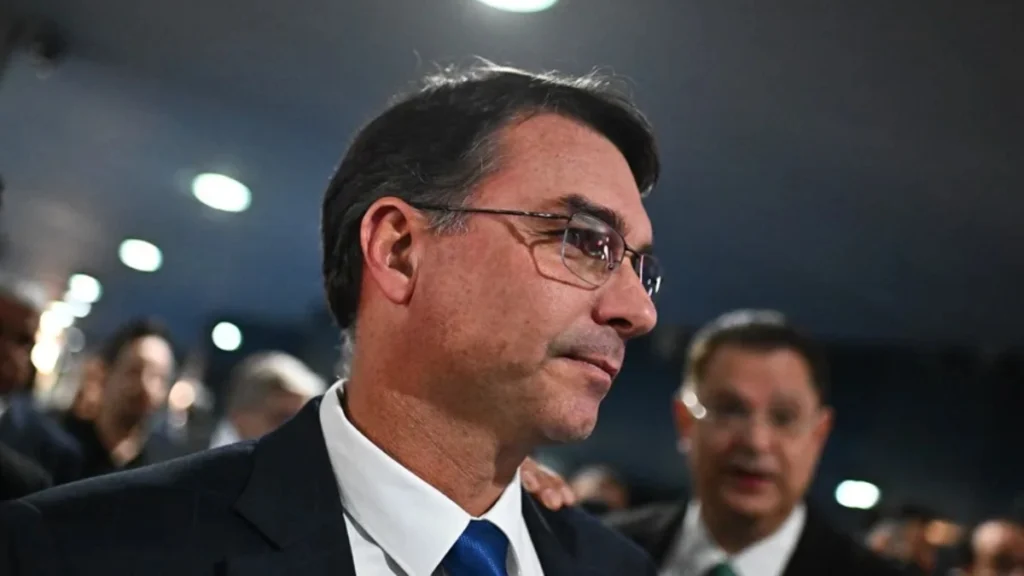
The administration has also increasingly meddled in the political affairs, and even the sovereignty, of various Latin American countries, including conditioning a $20 billion bailout of Argentina’s economy on the success of Milei’s party in the country’s legislative elections, pressuring Bolivia’s government to arrest its own attorney general and other officials who were investigating a Trump-friendly political strategist, and attempting to sway Brazil’s presidential election in favor of Trump ally Flávio Bolsonaro.

[

Read Our Complete Coverage

TomDispatch -----------](/tomdispatch)

Has the Donroe Doctrine Peaked?

Despite the seemingly unrestrained advance of the Donroe Doctrine this past year, Trump’s influence over the region is already teetering. Even before Colombia rejected deeper cooperation, Trump had encountered several other key setbacks across Latin America.

[

Related

The Bolsonaro Family Playbook: Lose, Cry Fraud, and Run to Trump’s America](theintercept.com/…/flavio-bolsonaro-trump-visa/)

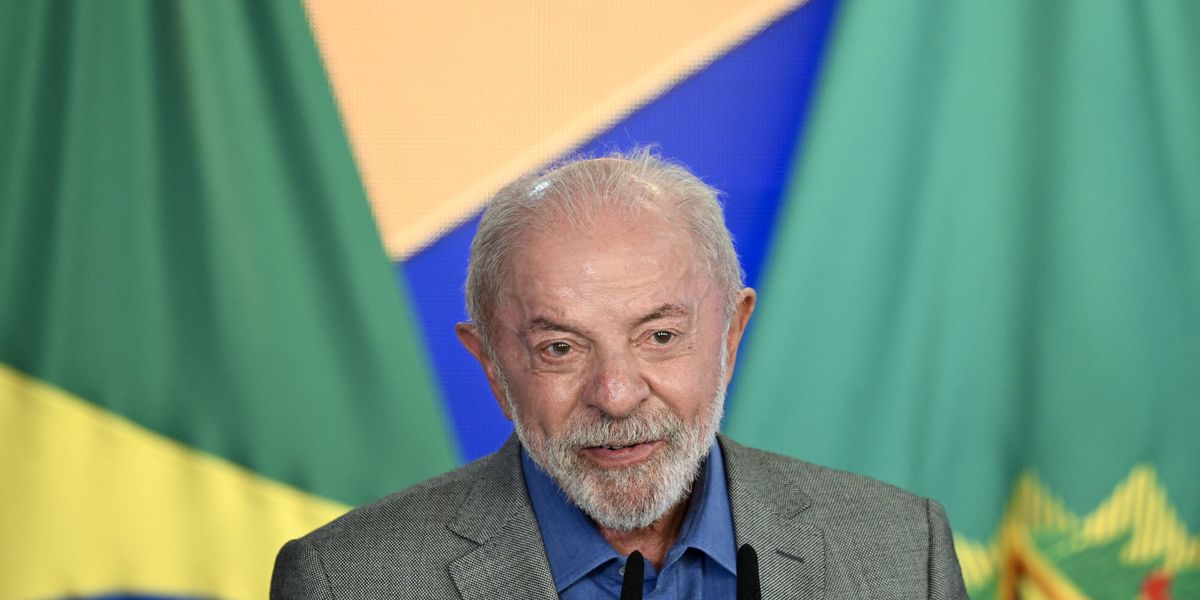
Despite Trump’s efforts to sway Brazil’s presidential elections in October, incumbent President Luiz Inacio Lula Da Silva pulled off a stunning defeat of Bolsonaro, securing another term leading the largest country in Latin America. Bolsonaro’s loss, bolstered in no small part by the Brazilian public’s outrage at U.S. interference, dashed the Trump administration’s hopes of having an entirely subservient ally at the head of the largest and most politically influential country in Latin America.

This month, outrage over a banking scandal in Paraguay led to the impeachment of Trump-aligned President Santiago Peña. In Chile, right-wing President José Antonio Kast’s approval rating has plunged to new lows after just eight months in office. And in Argentina, where Milei, one of Trump’s most subordinate allies, has been carrying out sweeping neoliberal reforms, the country appears to be entering a recession just ahead of next year’s presidential election.

This year has also seen significant protests and increased left-wing activism challenge the region’s right-wing governments. In May, a peasant-led rebellion in Bolivia over austerity and government ties to the Trump administration brought the country to a standstill for over a month. President Rodrigo Paz has since enacted a state of emergency, enabling him to use the military and police to suppress dissent. Despite this, Bolivian teachers launched a strike last month over efforts by the government to privatize education. In Chile, the country’s student movement has held several national days of protests, facing off against police armed with tear gas and water cannons. Recently, Chilean truckers also entered the fray, setting up roadblocks to protest fuel price hikes.

In Argentina, Trotskyist congresswoman Myriam Bregman has rapidly grown in popularity. Recent polling has shown that Bregman, a vocal critic of Milei and U.S. influence in Argentina, now has the highest favorability rating of any political figure in the country, foreshadowing an electoral environment in which the far left is becoming a serious contender against the right and the country’s more mainstream Peronist opposition. All these trends further signal a landscape less conducive to Trump’s agenda of continued U.S. intervention.

This surge of left-wing populism across Latin America doesn’t mean that the administration will cease aggressive interventions in the region. Trump’s appointment of Stephen Miller as his new chief of staff may signal the opposite. Miller was highly involved in planning the coup in Venezuela and the boat strike campaign. But following the Republican Party’s historic defeats in the U.S. midterm elections, the administration will have to contend with a new Congress elected by a public that is souring on constant military interventions. Hegseth, competing with Miller in his zeal for employing military terror in the region, has already become the target of an impeachment effort which is likely to carry over into the next legislative term.

As the Iran war has shown, military might alone is not enough to make countries, let alone entire regions, submit to U.S. dictates. The Trump administration may well continue its efforts to revive the Monroe Doctrine, but the long history of U.S. intervention in Latin America is also a history of the region’s people defending their sovereignty from U.S. empire and local quislings. This year has been another chapter in that history.

“To the narco-terrorists who have used this as a safe haven, your time is up. We will hunt you down. We will find you. And we will kill you,” Hegseth announced last week in Caracas. He also passed along a “greeting” from Trump to Rodríguez and lauded the puppet-president who has consistently met Washington’s demands. Standing outside the U.S. Embassy, Hegseth praised Venezuela’s transformation from an enemy to a “compliant security partner.” But repeating the success in Venezuela may prove to be very difficult.

The post Trump’s Imperialist Fantasy for Latin America Is Already Failing appeared first on The Intercept.


From The Intercept via This RSS Feed.

cross-posted from: news.abolish.capital/post/95261

Last week, self-styled Secretary of War Pete Hegseth headed to Latin America looking for love. It capped off weeks of tumult in which a desperate Hegseth and his Pentagon underlings fought a pitched battle to save his job. Despite their efforts, more than 200 members of Congress gave him a vote of no confidence, and the embattled secretary remains on the hot seat, with potential impeachment looming in 2027.

Things were different in Venezuela, which Hegseth’s military invaded earlier this year, deposing and kidnapping President Nicolás Maduro. Hegseth was feted at Miraflores Palace by Maduro’s former vice president, Delcy Rodríguez, a once outspoken anti-imperialist leftist who quickly pivoted to become America’s top quisling. “I’m very thankful for your presence here,” Rodríguez gushed, calling Hegseth “very tall and very young, with a great responsibility on his shoulders.” Acting like a satrap in what is now an American protectorate, Hegseth said that he appreciated Rodríguez’s “leadership” of a country he praised as a “compliant” partner.

Hopped up on neocolonialist fantasies, Hegseth claimed that America’s invasion on “January 3 is the day that will go down in history as a day of liberation for Venezuela.” He praised it as “the single most sophisticated military operation in the history of Latin America.” After soaking in the adulation of a leader beholden to the Trump administration, Hegseth headed off to Colombia, Ecuador, and Honduras, where he continued talking tough.

“President Trump has prioritized our hemisphere and made it clear … that we will not cede our own backyard to foreign adversaries or to transnational cartels,” he said in Ecuador, where U.S. forces are taking part in “Operation Total Extermination.” He continued, “Together, we will never back down; we will finish this fight for our citizens and for yours.”

Today, in his inaugural post for TomDispatch, Sam Carliner examines how the U.S. is attempting to impose its will on the Western Hemisphere under the so-called Donroe Doctrine. So far, the Trump administration has wreaked endless amounts of havoc and scored what it thinks are victories in Latin America. But Carliner points out that countervailing forces are rising across the region. One day, we may look back on Hegseth’s viceroy victory lap as the high point of the Trump administration’s gunboat diplomacy — and on Carliner’s analysis as one of the first to lay out what led to its downfall.

—Nick Turse, editor of TomDispatch

If you haven’t yet, sign up to receive TomDispatch in your inbox here.

The U.S. “Backyard”

It would have been unimaginable for the United States and longtime U.S. adversary, Venezuela, to enter into a military alliance just one year ago. But that’s exactly what U.S. “Secretary of War” Pete Hegseth announced from its capital, Caracas, on November 18, as part of a surprise meeting with Venezuela’s acting president, Delcy Rodríguez.

The new military agreement — which will include joint training, intelligence sharing, and defense equipment capabilities — and an oil deal signed in August, which even Bloomberg has called a reprise of the industry’s “neocolonial past,” is the most significant achievement of President Donald Trump’s aggressive “Donroe Doctrine” to strengthen U.S. control over Latin America. “In the last year, the country that previously sent its oil wealth to Cuba or to China, from rigs built by Venezuelans and Americans, has now signed a historic oil deal with the United States, through the Department of War,” Hegseth boasted at a press conference last week.

[

Related

Trump Frees Ex-President of Honduras, Right-Wing “Narco-Dictator” Convicted of Drug Trafficking](theintercept.com/…/honduras-hernandez-pardon-trum…)

That same day, however, the New York Times reported that Colombia rejected a plan to conduct joint military operations with the United States. This led Hegseth to cut a visit to Colombia short; he had originally planned to discuss military cooperation with the country’s new right-wing president, Abelardo de la Espriella. Both he and Hegseth took to X deny the Times’s claims. But de la Espriella, who campaigned by aligning himself with the Trump administration and calling for military action against drug cartels and gangs, did not have sufficient support in Colombia’s Congress to ink a military agreement with the United States that would have allowed U.S. troops to conduct counter-cartel operations inside Colombia.

The military agreement with Venezuela and the lack of one in Colombia showcase the contradictions of the Trump administration’s aggressive Latin America policy. On the one hand, the administration has greatly expanded operations in the Western Hemisphere over the past year. But a recent series of setbacks, of which Colombia’s snub is only the latest, show the limits of U.S. power projection even in a region it has treated as its backyard for hundreds of years.

The Donroe Doctrine in Action

One year ago this month, the Trump administration published its National Security Strategy, which candidly advocated for a “Trump Corollary” to the Monroe Doctrine, invoking the policy that the United States historically used to treat Latin America and the Caribbean as the country’s exclusive sphere of influence. Just two months after releasing the NSS, on January 3, the administration carried out a coup in Venezuela, which removed its president, Nicolás Maduro, from power. A U.S. strike in southern Venezuela in June reportedly killed a leader of the Tren de Aragua gang. And last month, U.S. aircraft attacked a camp of supposed Colombian guerrillas operating inside Venezuela, killing more than two dozen people.

With the cooperation of remaining regime officials, headed by Rodríguez, U.S. Secretary of State Marco Rubio has also effectively dictated significant shifts in Venezuelan domestic and economic policy, including the oil deal which gives the United States a direct stake in more than 17 strategic oil fields and the resumption of U.S. embassy operations in Caracas.

[

Related

Rubio’s Paranoid Cuba Report Designed to “Justify a Military Attack on Cuba,” Says Democratic Rep.](theintercept.com/…/cuba-marco-rubio-state-departm…)

Rubio’s influence over Venezuelan policy also enabled him to escalate an economic offensive against Cuba, which has long been a target of Rubio’s staunch anti-communist crusade. Venezuela had been Cuba’s largest oil supplier, but after the coup, Venezuela quickly cut off its supply of fuel to the island nation. The Trump administration then threatened tariffs against any country that sold oil to Cuba. By February, the United Nations was warning that Cuba faced “humanitarian collapse” from the embargo. Trump officials have also repeatedly threatened to carry out regime change on the island. As recently as November 13, Trump told reporters: “I want to get Cuba done before I leave you.”

Since last September, the United States has also conducted scores of attacks on supposed drug boats in the Caribbean Sea and Pacific Ocean. By alleging that these boats are suspected of “narco-trafficking,” the Trump administration has carried out lawless operations that have killed more than 240 civilians.

The administration had even bigger plans for Latin America. The NSS envisioned a region run by subservient governments willing to play their part in advancing policies favorable to U.S. interests. As the document put it:

Our goals for the Western Hemisphere can be summarized as “Enlist and Expand.” We will enlist established friends in the Hemisphere to control migration, stop drug flows, and strengthen stability and security on land and sea. We will expand by cultivating and strengthening new partners while bolstering our own nation’s appeal as the Hemisphere’s economic and security partner of choice.

Shifts in the region would favor this policy, with recent Latin American elections bringing U.S.-aligned, right-wing leaders to power in several countries that had previously been governed by left-wing administrations. Bolivia, Chile, and Honduras elected right-wing heads of state in 2025, followed by Costa Rica, Colombia, and Peru this year. These new governments joined staunch Trump allies Javier Milei in Argentina, Nayib Bukele in El Salvador, and Daniel Noboa in Ecuador.

On March 7, 2026, Trump and Rubio brought 13 of these allies together at a summit of Shield of the Americas, a multinational security initiative created by the administration earlier this year. The main result of the summit was the creation of the Americas Counter Cartel Coalition, which Trump described as “a pledge from military leaders and representatives from 17 countries demonstrating that the region is ready to operationalize hard power to defeat these threats [cartels and terrorists] to our security and civilization.” At an October meeting, the coalition (which has grown to 19 countries) “committed to expand information sharing, increase bilateral and multilateral cooperation, and conduct combined operations that deter and dismantle those networks, secure borders and critical infrastructure, and protect law-abiding citizens,” according to a U.S. Southern Command press release.

New Partnerships and Human Rights Concerns

Under Noboa, Ecuador has been at the forefront of advancing U.S. military operations in Latin America, offering a glimpse of what might be in store as the United States seeks to expand military cooperation across the region.

In March, U.S. Special Operations forces began joint operations with Ecuador’s military against alleged drug cartel facilities. The partnership was established despite a referendum in Ecuador which saw voters overwhelmingly reject a proposal to host a U.S. military base. A New York Times investigation found that at least one of the facilities targeted in these joint operations was a civilian dairy farm. A Human Rights Watch report — based on extensive interviews and analysis of data including satellite imagery, judicial documents, and medical records — found three separate incidents implicating the U.S.–Ecuador security partnership in subjecting civilians to torture, drone strikes, and arbitrary detention. The report argues:

From a human rights perspective, this partnership is a perilous one. The two countries’ security relationship is deepening at a moment when both governments have engaged in serious human rights violations fueled by their insistence on framing their confrontations with organized crime groups as a kind of war.

On November 6, Rep. Jesús “Chuy” García and 12 other members of Congress sent a letter to Rubio urging him to suspend military assistance to Noboa, noting “Ecuador has seen the repression of opposition actors across the political spectrum, attacks on judicial independence, and restrictions on the freedom of the press.”

“Fantasy Island,” by Ed Morales. Available on Bookshop.org.

While the plans to expand military cooperation in Colombia suffered a setback, the Colombian and U.S. militaries have nonetheless made efforts to deepen their relationship. This month, 350 U.S. military personnel were in Colombia training alongside 400 local troops as part of a military exercise dubbed Southern Vanguard 2027. Panama and Honduras have also hosted training exercises with U.S. troops in the past year.

A recent U.S. Army press release also announced that U.S. and Colombian military leaders met for bilateral discussions about the two countries’ partnership. Even under left-wing President Gustavo Petro, who was a vocal critic of Trump and the war on drugs, U.S. military personnel were deployed to Colombia and the two countries shared intelligence.

Historically, U.S. military partnerships with Latin American leaders have been linked to human rights abuses, including the Guatemalan military’s massacre of Indigenous Maya civilians during the country’s 36-year-long civil war, and Peru’s government, under the 10-year rule of Alberto Fujimori, carrying out forced disappearances of dissidents. Considering the civilian toll of the administration’s boat strike campaign, as well as the abuses being carried out in Ecuador, it is likely that the Donroe Doctrine will lead to further human rights violations.

The administration has also increasingly meddled in the political affairs, and even the sovereignty, of various Latin American countries, including conditioning a $20 billion bailout of Argentina’s economy on the success of Milei’s party in the country’s legislative elections, pressuring Bolivia’s government to arrest its own attorney general and other officials who were investigating a Trump-friendly political strategist, and attempting to sway Brazil’s presidential election in favor of Trump ally Flávio Bolsonaro.

[

Read Our Complete Coverage

TomDispatch -----------](/tomdispatch)

Has the Donroe Doctrine Peaked?

Despite the seemingly unrestrained advance of the Donroe Doctrine this past year, Trump’s influence over the region is already teetering. Even before Colombia rejected deeper cooperation, Trump had encountered several other key setbacks across Latin America.

[

Related

The Bolsonaro Family Playbook: Lose, Cry Fraud, and Run to Trump’s America](theintercept.com/…/flavio-bolsonaro-trump-visa/)

Despite Trump’s efforts to sway Brazil’s presidential elections in October, incumbent President Luiz Inacio Lula Da Silva pulled off a stunning defeat of Bolsonaro, securing another term leading the largest country in Latin America. Bolsonaro’s loss, bolstered in no small part by the Brazilian public’s outrage at U.S. interference, dashed the Trump administration’s hopes of having an entirely subservient ally at the head of the largest and most politically influential country in Latin America.

This month, outrage over a banking scandal in Paraguay led to the impeachment of Trump-aligned President Santiago Peña. In Chile, right-wing President José Antonio Kast’s approval rating has plunged to new lows after just eight months in office. And in Argentina, where Milei, one of Trump’s most subordinate allies, has been carrying out sweeping neoliberal reforms, the country appears to be entering a recession just ahead of next year’s presidential election.

This year has also seen significant protests and increased left-wing activism challenge the region’s right-wing governments. In May, a peasant-led rebellion in Bolivia over austerity and government ties to the Trump administration brought the country to a standstill for over a month. President Rodrigo Paz has since enacted a state of emergency, enabling him to use the military and police to suppress dissent. Despite this, Bolivian teachers launched a strike last month over efforts by the government to privatize education. In Chile, the country’s student movement has held several national days of protests, facing off against police armed with tear gas and water cannons. Recently, Chilean truckers also entered the fray, setting up roadblocks to protest fuel price hikes.

In Argentina, Trotskyist congresswoman Myriam Bregman has rapidly grown in popularity. Recent polling has shown that Bregman, a vocal critic of Milei and U.S. influence in Argentina, now has the highest favorability rating of any political figure in the country, foreshadowing an electoral environment in which the far left is becoming a serious contender against the right and the country’s more mainstream Peronist opposition. All these trends further signal a landscape less conducive to Trump’s agenda of continued U.S. intervention.

This surge of left-wing populism across Latin America doesn’t mean that the administration will cease aggressive interventions in the region. Trump’s appointment of Stephen Miller as his new chief of staff may signal the opposite. Miller was highly involved in planning the coup in Venezuela and the boat strike campaign. But following the Republican Party’s historic defeats in the U.S. midterm elections, the administration will have to contend with a new Congress elected by a public that is souring on constant military interventions. Hegseth, competing with Miller in his zeal for employing military terror in the region, has already become the target of an impeachment effort which is likely to carry over into the next legislative term.

As the Iran war has shown, military might alone is not enough to make countries, let alone entire regions, submit to U.S. dictates. The Trump administration may well continue its efforts to revive the Monroe Doctrine, but the long history of U.S. intervention in Latin America is also a history of the region’s people defending their sovereignty from U.S. empire and local quislings. This year has been another chapter in that history.

“To the narco-terrorists who have used this as a safe haven, your time is up. We will hunt you down. We will find you. And we will kill you,” Hegseth announced last week in Caracas. He also passed along a “greeting” from Trump to Rodríguez and lauded the puppet-president who has consistently met Washington’s demands. Standing outside the U.S. Embassy, Hegseth praised Venezuela’s transformation from an enemy to a “compliant security partner.” But repeating the success in Venezuela may prove to be very difficult.

The post Trump’s Imperialist Fantasy for Latin America Is Already Failing appeared first on The Intercept.


From The Intercept via This RSS Feed.

0

Sheinbaum: They Tried Everything to Defeat Us for Two Years; They Failed and Will Fail Again

Mexico Solidarity Media Sheinbaum: They Tried Everything to Defeat Us for Two Years; They Failed and Will Fail Again mexicosolidarity.com
preview

cross-posted from: news.abolish.capital/post/94594

This article by Sugeyry Romina Gándara originally appeared in the November 20, 2026 edition of SinEmbargo, a Mexican digital news outlet.

The Mexican president said that those who received money to keep quiet about injustices and those who used to evade taxes are the same people who corrupted the electoral bodies.

Mexico City, November 20 (SinEmbargo).- President Claudia Sheinbaum Pardo (CSP) highlighted this Friday the failure of the opposition, which has tried to weaken her government over the past two years, and predicted that it would fail again in its attempt to delegitimize the elections.

“Those who long to regain their prerogatives and privileges, desperate at their lack of popular support, are trying to weaken this project of transformation, which is nothing other than the Mexican people’s achievement of democracy and social justice. In these two years they have tried everything to defeat the popular will, but they have failed. They failed with their paid campaigns on social media and in the news media to manufacture lies and slander. They failed a year ago with their calls for violence and by inventing false youth mobilizations,” she declared during her speech marking the 116th anniversary of the Mexican Revolution.

The president also gave a historical account of the Mexican people’s struggle for democracy, recalled the electoral frauds of 2006 and 2012, and warned that her adversaries would not succeed in their latest attempt to discredit the 2027 electoral process.

“They failed with the deliberate slander that this government protects criminals. They failed when they sought foreign interference, and let this be heard loud and far: they are going to fail again in their attempt to delegitimize the 2027 elections, because that is their new farce. Knowing they are defeated, they seek to sow doubts about a process that will be a historic example of respect for the vote. We come from the struggle against electoral fraud. Democracy is our essence, and we will never betray our own history,” she said.

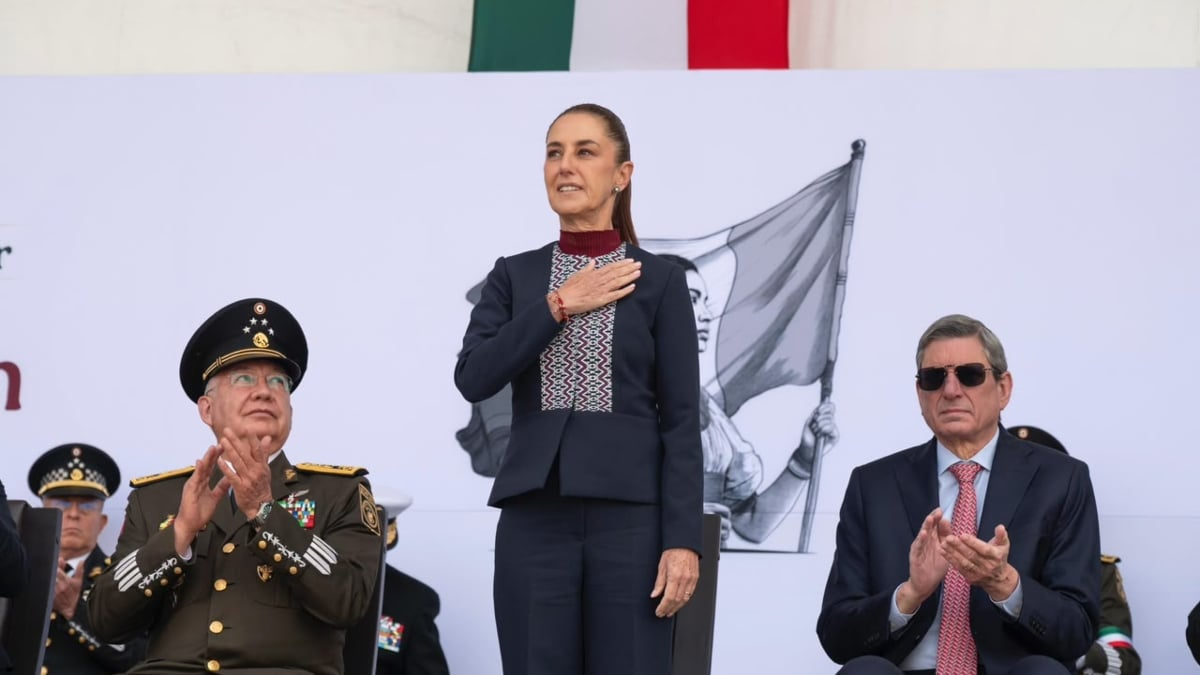
Claudia Sheinbaum stands in an open military vehicle between army and navy officers during the Mexican Revolution parade.

President Claudia Sheinbaum led the parade marking the 116th anniversary of the Mexican Revolution. Photo: Presidency.

She also recalled that those who question the Fourth Transformation today are the same people who, she said, engaged in corrupt practices in the past.

“It is paradoxical that those who today cry out about a supposed lack of freedom are the same people who lived comfortably during the neoliberal period. Those who applauded the regime in exchange for privileged access to the highest circles, those who received envelopes of money every month to silence injustices, and those who used to evade taxes and are now forced to comply with the rule of law are the same people who corrupted the electoral bodies, those who divided up appointments and collected severance payments in the millions while keeping quiet about vote buying,” she stated.

Mexico Is Living Through a New Stage, Sheinbaum Says

In her speech, President Sheinbaum said Mexico is living through a new stage of democracy and freedoms, in which freedom to demonstrate, freedom of expression, freedom of the press and freedom of assembly are respected. She maintained that people are no longer persecuted for thinking differently and that power is no longer the privilege of a few.

She also defended her government’s austerity policy and said that luxuries and privileges in the exercise of power had ended: “Moral authority is not imposed; it is built through a life of consistency,” she said.

At the same time, she maintained that the attacks on her movement are carried out because of the honesty of its members, saying: “They attack us because our honesty gets in their way.”

Sheinbaum also referred to her recent visit to China, where, she said, it became clear that there is another path to development, as Mexico is building its own model.

“I am returning from an international trip where I had the high honor of representing Mexico, and I made it very clear to the world: our nation is demonstrating that there is another path to development, one where economic success is measured not only in production figures but in families’ well-being. Where investment translates into rights, and wealth into justice for everyone. We are building our own model, forged in our cultural greatness, in the talent of our people. We are a free, independent, democratic and sovereign country,” she said.

She also maintained that her government is neither a mere ornament nor a tool of the powerful figures of the past, and reaffirmed her commitment to the people and to democracy.

“We are a government of the people and for the people. Let there be no doubt: your president has a clear course. We will not betray, because our loyalty is sealed with the dignity of our great people. Today I call on everyone without distinction, on those who wish to keep marching along the path of well-being and progress with justice. The path of democracy with justice has no turning back. The path of sovereignty was marked out by our heroes and heroines. The path is the people, and our destiny is to walk with the great people of Mexico. Long live democracy,” she concluded.


Sugeyry Romina Gándara

Sugeyry Romina Gándara
Romina Gándara wanted to be a pilot, but nearsightedness changed the plan. A lover of tacos and coffee. She started as a radio announcer, then became a reporter and photojournalist in Chihuahua, covering crime and security issues. Since 2016, she has lived in Mexico City, where she has covered security issues, victims of violence and, currently, the People’s Mañanera. She hosts the A Las Dos newscast alongside Blanca Juárez on SinEmbargo al Aire.

The post Sheinbaum: They Tried Everything to Defeat Us for Two Years; They Failed and Will Fail Again appeared first on Mexico Solidarity Media.


From Mexico Solidarity Media via This RSS Feed.

0

Mexico Condemns Invocation of TIAR Against Organized Crime at OAS

Orinoco Tribune Mexico Condemns Invocation of TIAR Against Organized Crime at OAS orinocotribune.com
preview

cross-posted from: news.abolish.capital/post/94657

Mexico expressed its “deep concern” and rejection at the Organization of American States (OAS) over the convening of the Inter-American Treaty of Reciprocal Assistance (TIAR) consultation body to address transnational organized crime. Mexico warned that resorting to a Cold War collective defense instrument “could create a scenario of greater violence in which we would all lose.”

During a special session of the OAS Permanent Council on Friday, November 20, Mexico’s permanent representative to the organization, Alejandro Encinas, urged TIAR member states not to establish “an automatic link” between organized crime and terrorism, noting that they are distinct phenomena covered by different legal frameworks.

The resolution, backed by 14 of the 18 TIAR member states that participated in the vote, calls for examining measures “that do not involve the use of armed force” against drug cartels. Brazil and Uruguay voted against the initiative, while Mexico did not take part in the vote after having formally withdrawn from the treaty in 2002.

Encinas categorically rejected the concept of narcoterrorism, saying that there was no consensus on it in international law. He stressed that the unilateral designation of a criminal organization as a terrorist group “does not change international rules on the use of force or authorize military operations on the territory of other states,” a matter that falls exclusively under the authority of the United Nations Security Council.

Historical precedents and call for shared responsibility
In his remarks, the Mexican diplomat reviewed previous instances in which the TIAR was invoked to question its relevance. He pointed out that its first invocation targeted the “democratic and legitimately elected government of Guatemala,” leading to the US intervention that overthrew President Jacobo Árbenz in 1954. He further said that the 1982 Malvinas War exposed the TIAR’s operational limitations, and its 2019 activation regarding Venezuela (which withdrew from OAS that year) illustrated the risk of treating internal matters of countries as regional security problems.

“Security priorities cannot be subordinated to political considerations and the strategies of third countries. This proposal brings us closer to a point of no return where the OAS puts its mission and its future at risk,” Encinas warned. He noted that the approved resolution did not reflect the unanimous will of the organization’s members.

Chronic Violence in Colombia and Its Spillover in Venezuela

Encinas added that “drug trafficking does not originate south of the United States,” instead it is a network sustained by demand for drugs in the US, illicit arms trafficking, and global financial networks. He urged the OAS to address drug consumer markets and sources of arms supplies.

Finally, he pointed out that the OAS has specialized channels such as the Secretariat for Multidimensional Security and the Inter-American Drug Abuse Control Commission (CICAD) to approach these issues. He reiterated Mexico’s willingness to deepen police, judicial, and intelligence cooperation with full respect for national sovereignty.

(Telesur)

Translation: Orinoco Tribune

OT/JRE/SC


From Orinoco Tribune via This RSS Feed.

0

Fujimori government revives war on the left with detentions of artists and activists - BT News

BT News Fujimori government revives war on the left with detentions of artists and activists - BT News breakthroughnews.org
preview

cross-posted from: news.abolish.capital/post/94630

Organizations in Peru raised the alarm about the arbitrary arrest of several progressive artists and activists on November 19. The arrests were reportedly carried out by the Counterterrorism Directorate (DIRCOTE) in the cities of Cusco, Lima, and Tarapoto.

Hip-hop artists Brenda Jah (Brenda Mejía) and Pedro Mo (Pedro Mosquera) were arrested in Lima and Cusco respectively and will reportedly be held for 15 days in preliminary detention, as requested by the Prosecutor’s Office specializing in terrorism offenses. In addition to the artists, leftist organizers Libia Arcila, David Tapullima, and Polidoro Tapullima were arrested and face a similar 15 days in preliminary detention.

David and Polidoro Tapullima were arrested in Tarapoto and had their homes raided by security forces. They are reportedly the father and uncle of left-wing Congresswoman Jacquelina Tapullima, who was recently elected to office as a member of the Juntos por el Perú party. Juntos por el Perú came very close to winning the presidency with leftist candidate Roberto Sánchez in the last election but lost to the current president, Keiko Fujimori.

Fujimori’s persecution of the left, again

According to authorities, the arrests were made as part of investigations into alleged affiliation with a terrorist organization. The arrests come after the government of right-wing President Keiko Fujimori obtained new powers to,” as the Executive Branch stated, “combat insecurity”.

Progressive Peruvian groups and artists claim that the arrests on November 19 is a revival of the political persecution of Peru’s left that took place in the 1990s under the government of Alberto Fujimori, the father of the country’s current president.

In this regard, film producer Piar Roca said the following about the arrests of Brenda and Pedro: “These young people, simply for organizing a festival honoring Tupac Amaru and Micaela Bastidas, have been arrested… and are going to be transferred to Lima, where they will stand trial because they are accused of glorifying terrorism – simply for naming themselves after our leaders who, in 1780, rose up and raised the cry of rebellion against the Spanish Empire. This is one of the great injustices committed in this so-called democratic country, which seeks to hide our national identity.”

Pedro Mo shared a video from his arrest showing an officer informing him that he had been arrested for allegedly belonging to a group called Tupac Amaru. Pedro responded that the organization he pertains to does cultural work and that he has never in his life carried a weapon, nor has his organization ever promoted violence.

On the very night of their arrest, dozens of people staged a protest outside DIRCOTE’s headquarters in Lima to demand the release of the detained artists.

For several decades, left-wing and progressive groups in Peru have denounced the state’s systematic persecution of the country’s left, accusing any progressive or revolutionary activist of being a “terrorist” or terruco. The accusation seeks to tie activists to the insurgent groups that were engaged in an armed conflict with the military in the 1980s-1990s that left thousands dead in the Andean nation.

Well after the end of the conflict, the country’s economic and political elites continue to brand leftists as either a terrorists or a supporters of terrorism – a charge repeatedly denied by those being persecuted, who accuse the state of violating their human rights and, in doing so, of excluding the left from any possibility of participating in Peruvian public life.


From BT News via This RSS Feed.

0

Outrage and anger in Paraguay: a new president is sworn in, but there is no relief - BT News

BT News Outrage and anger in Paraguay: a new president is sworn in, but there is no relief - BT News breakthroughnews.org
preview

cross-posted from: news.abolish.capital/post/92367

Although many had hoped Santiago Peña’s resignation as president of Paraguay would calm the anger of millions of Paraguayans, it did not. As the hours pass, hundreds of protesters are joining spontaneous demonstrations against Paraguay’s political and economic establishment.

And the truth is, this comes as no surprise. It has been revealed that Ueno Bank was a financial institution that grew rapidly thanks to contributions from pensioners and other state-linked sources that Peña’s own government ordered to be injected into a bank that had only just been officially recognized as such in 2023.

Privatization becomes national scam

But what has outraged millions of Paraguayans the most is that, according to several judicial investigations, Ueno’s own shareholders were taking the money coming in from the government and lending it to companies linked to themselves. And this perverse cycle of Paraguayan taxpayers’ money being used so cynically by private individuals appears to have been orchestrated by several people, including former President Peña himself – or at least that is what the prosecution alleges.

As a result, a judge ordered Peña’s pretrial detention at a military barrack, where he will be allowed to receive visitors and use his phone – a development that has further inflamed the anger of thousands of Paraguayans demanding their money back and justice.

When a young Paraguayan woman was asked if she had been affected by the Ueno case, she said something that perfectly captures the sentiment of millions: “Of course, it affects me and everyone else. The money they’re using to reimburse us comes from all the public banks. That means that Ueno customers had their money stolen, and those who don’t have [accounts at Ueno] also had their money stolen, because the money they’re using to reimburse us comes from everyone. They’re stealing to replace what was stolen.”

The prosecution alleges that the right-wing former president of the long-standing Colorado Party committed breach of trust and mismanagement for personal gain through his dealings with a bank owned by a business group in which Peña himself had invested in previous years. Furthermore, Peña appointed Carvallo, the former president of Ueno, to head the Central Bank, a move that has also led to the opening of a criminal investigation against Carvallo.

The Colorado Party and neoliberal economics

For its part, the ruling Colorado Party has attempted to distance itself from its member Peña, hoping that its image will not be so severely compromised. Former President Cartes even quickly called for Peña’s removal. In his place, former Vice President Pedro Alliana assumed the presidency; in an attempt to gain some legitimacy, he has called for the resignation of all ministers appointed by Peña.

However, several analysts perceive in the streets of Paraguay not only great disappointment with the political system (which is largely controlled by the Colorado Party and Paraguay’s major neoliberal business leaders) but also a great deal of anger and frustration among the population, especially among younger people.

“They’re all the same – everyone in the Colorado [Party] is a bunch of hypocrites, rats, who stick together and ask God to bless Paraguay. But God will bless Paraguay when all of you go to hell,” the same protester declared, while the interviewer noted that other young people had told him on the streets of Asunción that they feel completely let down and disappointed.

Possible change?

However, it remains to be seen whether such disappointment and anger can translate into a political and economic alternative for Paraguay, a country that was controlled for much of the 20th century by the US-backed dictator Alfredo Stroessner (1954–1989), who led one of the harshest and longest-lasting dictatorships of the century through force and electoral fraud.

Stroessner had been a member of the Colorado Party since 1951 and was one of the key figures in Operation Condor, in which other military governments acted in concert to repress, assassinate,removed, and disappear the region’s progressive and revolutionary forces.

And although he was overthrown in a military coup, the party that supported him the most – the Colorado Party – continued to dominate Paraguayan politics for most of the 21st century, except for the brief presidency (overturned by the old Paraguayan powers) of the progressive Fernando Lugo.

For now, it remains to be seen whether the Colorado Party will manage to save itself once again as Paraguay’s main (and virtually sole) hegemonic political force, or whether a new political alternative might emerge from the ashes of the biggest economic scandal in Paraguay’s contemporary history (and one of the most traumatic in the region) although, unfortunately, this is by no means the only story of the rich and powerful shamelessly exploiting the state for their own gain.

There are still vivid examples of this in Latin America: Paraguay seems to be just one more case, though perhaps it could become the case that opens the eyes of more than a few, and that is why so many are keeping a close watch on its streets.


From BT News via This RSS Feed.

0

The financial and political crisis in Paraguay: another sign of the failure of the liberal economic model - BT News

BT News The financial and political crisis in Paraguay: another sign of the failure of the liberal economic model - BT News breakthroughnews.org
preview

cross-posted from: news.abolish.capital/post/92111

Paraguay is undergoing one of the most significant political and financial crises in its recent history. The Central Bank of Paraguay’s intervention in Ueno Bank – following the detection of serious irregularities in its operations and solvency issues – triggered a crisis that quickly expanded beyond the banking sector. Today, it has direct consequences for the government of Santiago Peña and has triggered an impeachment process that calls into question the very future of the president himself.

To understand what is happening, it is necessary to explain a few key points. Ueno Bank experienced exponential growth in recent years, coinciding with the start of Santiago Peña’s administration. It grew to have nearly three million customers (more than 50% of the country’s adult population) and received approximately $800 million in deposits from the public sector. Among these funds are those linked to the Social Security Institute (IPS), which administers the retirement and health contributions of thousands of workers.

A massive scam against the people

One of the problems is that the president himself maintained business ties with the group associated with the bank until March 2025. Added to this is the fact that Carlos Carvallo, who had served as president of Financiera Ueno, subsequently went on to head the Central Bank, the agency responsible for supervising and regulating the financial system. During this administration, provisions designed to prevent this type of conflict of interest (known as “revolving door” regulations) were also amended.

The bank’s intervention, the freezing of deposits, and investigations into loans granted to companies linked to its owners ultimately exposed a web of relationships between private interests and public institutions. However, beyond the numbers and financial transactions, there are thousands of people who today cannot access their savings; workers facing uncertainty about their wages; and retirees whose financial resources are at risk. Financial inclusion, which was touted as one of the great achievements of the economic model, ultimately turned into a massive scam against the population.

Read more: Paraguay’s right-wing president resigns as major bank collapses

Santiago Peña’s ties to the business group, the decisions made by the executive branch, and the responsibilities of the oversight agencies are among the issues that gave rise to the impeachment request. The opposition spearheaded the process in Congress, and on November 5, the Chamber of Deputies approved the charges against the president. Peña submitted his resignation, but both chambers rejected this attempt to step down, and the Senate proceeded with the process. At the time of this writing, the president is set to present his defense in the impeachment trial.

Paraguay’s ruling Colorado Party

To understand this crisis, one must also look to the National Republican Association (ANR), the Colorado Party (deeply entrenched in the Paraguayan state apparatus and linked to Alfredo Stroessner’s 35-year dictatorship), and particularly to Horacio Cartes (HC). Paraguay has a political peculiarity that is fundamental to understanding what is happening. The Colorado Party has governed virtually uninterrupted since 1947; the only interruption in that long cycle was the administration of Fernando Lugo (2008–2012), who came to power leading an alliance that managed to defeat the Colorado Party at the polls after more than six decades. However, his administration came to an abrupt end in June 2012 through a parliamentary coup that removed him from office in just 48 hours via a controversial impeachment trial. For social movements and sectors of the popular base, this event was not just another episode in history but a political operation orchestrated by sectors of the Paraguayan right, with Horacio Cartes as one of its main actors and with alleged complicity and support from external interests, including those of the U.S. Embassy.

Currently, power within the ANR is fiercely contested by internal factions, but the Cartes faction (HC) has become the ruling party’s main power base. Cartes was not only president of the Republic from 2013 to 2018 but subsequently assumed the presidency of the Colorado Party itself and maintained enormous influence over the decisions of Santiago Peña’s government.

Peña rose to the presidency with Cartes’ political backing. His candidacy and subsequent administration were built under the leadership of the Honor Colorado movement. For this reason, what we are seeing today involves a major political contradiction: the very same faction that built and sustained this administration has now decided to support the impeachment proceedings against the president.

Cartes’ position shifted as the crisis unfolded. Initially, his inner circle rejected the possibility of impeachment and sought to pin the blame on Central Bank officials. However, on November 5, Cartes publicly announced that the ANR would support Peña’s impeachment. This move cannot be interpreted simply as an institutional decision by the Colorado Party; it also reflects a struggle for political control, for the continuity of the government’s agenda, and for the preservation of a power structure that the movement itself helped build.

A systemic failure of free market capitalism

Against this backdrop, social movements and the popular sector are not limiting their criticism to demanding individual accountability and rejecting any attempt at impunity; they are also warning that this crisis is yet another example of the failure of the liberal economic model, which for years insisted that the market could regulate itself, that the state should reduce its intervention, and that privatization and deregulation were the path to development. They promised that, if we let capital operate freely, wealth would eventually reach the entire population, that economic growth would translate into well-being, and that everyone would benefit from this supposed trickle-down effect. In Paraguay today, the consequences are felt by every worker, as a result of financial narco-capitalism. This is a model that unscrupulously manages public resources, concentrates wealth, and fosters ties between political power and private interests. It is a system in which profits remain in the hands of certain sectors, while the consequences of their operations ultimately fall on the population.

Therefore, what is happening on this side of the southern part of our America is not isolated from what is happening in other parts of the world; it is part of a dynamic in which big capital dictates political decisions, appropriates the commons, and turns basic rights and needs into business opportunities. The settings change, the actors change, but the logic remains the same.

However, the evident failure of the economic policy of financial capitalism also opens up an opportunity for the organized popular movement: to envision a different future and build a political and economic alternative that breaks with this logic – to pave the way toward a world in which the economy serves life rather than the accumulation of wealth by a few, and in which people can decide on their resources, their present, and their destiny.

Thania Saucedo is a journalist and political leader with the Frente Guasu in Paraguay.

This article was produced by Globetrotter.


From BT News via This RSS Feed.

0

Cuba calls for greater international action to protect the planet

Prensa Latina - Latin American News Agency Cuba calls for greater international action to protect the planet - Prensa Latina www.plenglish.com
preview

cross-posted from: news.abolish.capital/post/91337

Through your account on social network X, Rodríguez reiterated the urgency of ensuring equitable access to the means necessary to advance towards sustainable development and that industrialized countries assume their historical responsibilities and fulfill their obligations for the provision of financial resources and transfer of technology in predictable and verifiable timeframes.

He also stressed the need to eliminate unilateral coercive measures in the area of trade, “without which there can be no ambitious climate action, much less just and sustainable transitions.”

The foreign minister noted that carbon dioxide (CO2) concentrations reached 153% of pre-industrial levels in 2025, and methane and nitrous oxide levels also hit record highs, consolidating long-term global warming even more, according to the UN World Meteorological Organization (WMO)

Given this situation, he warned, developing countries, particularly small island developing states, face enormous challenges in accessing the financing, technologies, and resources needed to respond to the effects of climate change.

The WMO warned in late October that greenhouse gases, largely responsible for climate change, reached record levels by 2025 and their long-term presence in the atmosphere affects the global climate for centuries.

The UN agency explained that these gases are trapping a high amount of heat in the atmosphere, fueling more extreme weather events and increasing risks to the economy and society worldwide.

removed/ocs/mpp

The post Cuba calls for greater international action to protect the planet first appeared on Prensa Latina.


From Prensa Latina via This RSS Feed.

0

Paraguay’s right-wing president resigns as major bank collapses - BT News

BT News Paraguay’s right-wing president resigns as major bank collapses - BT News breakthroughnews.org
preview

cross-posted from: news.abolish.capital/post/91193

Under the anguished, enraged gaze of millions of Paraguayans, the country’s right-wing president, Santiago Peña, announced his resignation amid opposition calls to initiate impeachment proceedings over his alleged responsibility for the closure of Ueno Bank, one of the South American nation’s most important financial institutions.

“With the conviction that our republic must always take precedence over any individual or circumstance … I have decided to submit my resignation as president of the republic. I do so with the stability of our country, social peace, and the need to preserve our democratic institutions in mind,” Peña said in a televised address.

Peña has been embroiled in serious allegations after his government transferred millions of dollars to Ueno Bank (nearly $850 million in public funds, including money from the Social Security system), an institution that announced its closure this week, despite having boasted for years of financial stability and growth in depositors, according to Manuel Gustale, former president of Ueno.

However, on November 3, the Central Bank of Paraguay announced the bank’s dissolution after its solvency ratio fell below the minimum allowed under Paraguayan law.

Hundreds upon hundreds of depositors at the bank in question took to the streets and demanded the return of their money, which was not possible due to the government’s freezing of the accounts.

The situation is even more serious when one considers that a single business conglomerate managed to control not only the life savings of nearly all pension funds but also the savings of the majority of adults in Paraguay.

Thus, the decision to freeze the accounts comes on top of several allegations of possible links between President Peña and the business group that controls Ueno Bank, which has raised suspicions of conflicts of interest involving Peña and Central Bank President Carlos Carvallo.

For months, several Paraguayan institutions had been warning of a possible collapse of Ueno when it was discovered that the bank was granting excessive loans to companies linked to its own owners.

“And yet, public funds kept flowing in. This isn’t simply the story of a poorly managed bank. It’s a system in which the bank, the regulatory body, and the presidency were so closely intertwined that none seemed capable of holding the others in check,” Orkun Saka, a professor at St. George’s University of London, told the BBC.

Peña’s resigns after his party pursues impeachment

But the final blow to the current administration came from its own party, the right-wing Colorado Party – which has governed the country for much of the past few decades – when former President Horacio Cartes (a member of the same party) announced that the party would support impeachment proceedings against Peña.

“We will not stand idly by while public, private, and pension funds are plundered; we must think of the people and the values we uphold as the Colorado Party. We support the impeachment of the President of the Republic, Santiago Peña, in order to restore the Republic’s institutional framework,” Cartes said in a statement.

Once Peña realized that his party (which was clearly aware of his past as a shareholder long before the crisis erupted) had withdrawn its support, he appeared before the cameras and announced that he would step down. However, the opposition and the Colorado Party stated that they would press ahead with the trial to determine the executive branch’s potential responsibility in the financial and political crisis rocking Paraguay.

According to some reports, Peña was listed as a shareholder of Ueno Holding, a conglomerate of companies controlled to a greater or lesser extent by the Vázquez Group, the main shareholder group of Ueno Bank.

And while Peña announced in early 2025 that he was no longer a shareholder of Ueno Holding, many question whether his political decisions regarding the institution were influenced by his own economic interests and those of the Vázquez Group. Added to this is the fact that the president of the Central Bank was also president of Ueno Bank, and that during Peña’s presidency, the Central Bank approved Ueno’s conversion into a bank in 2023. This highlights a close relationship between the executive branch and the failed bank.

That is why opposition Senator Rafael Filizzola has said that the case constitutes: “the largest scam perpetrated by those in political power in the democratic era … It involves a bank created by those in political power to use public funds for private business ventures linked to political power, with the President of the Republic at the helm.”

According to Filizzola himself, the losses from this case could amount to some $3 billion, which creates enormous uncertainty for the millions of Paraguayans who do not know when or if they will get their money back.


From BT News via This RSS Feed.

0

The Bolsonaro Family Playbook: Lose, Cry Fraud, and Run to Trump’s America

The Intercept The Bolsonaro Family Playbook: Lose, Cry Fraud, and Run to Trump’s America theintercept.com
preview

cross-posted from: news.abolish.capital/post/89129

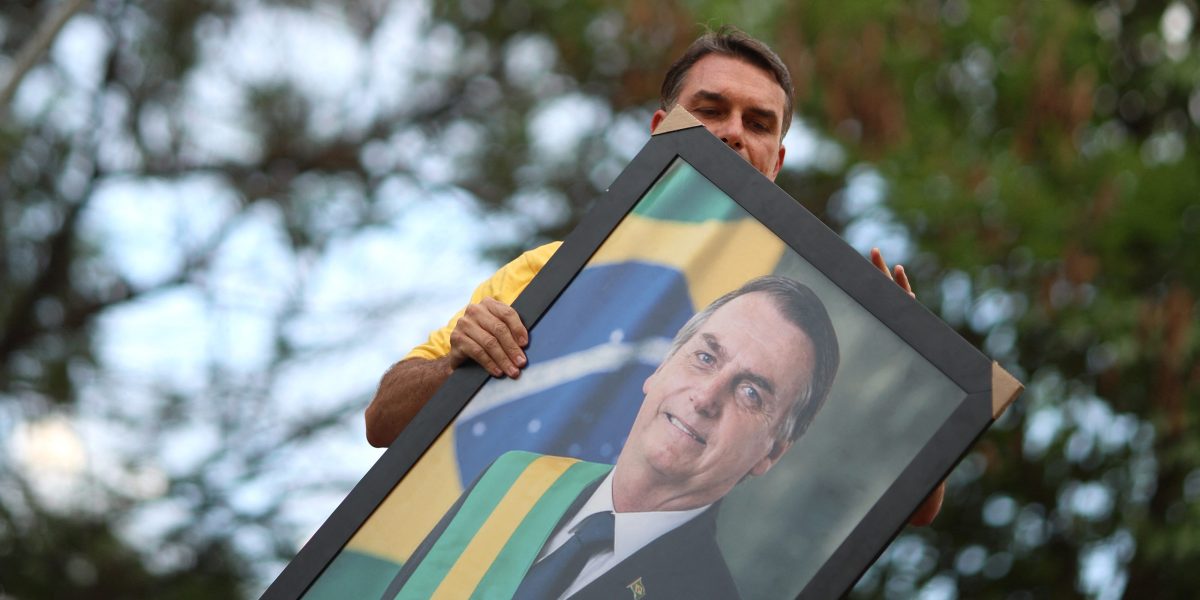
Brazilian right-wing presidential candidate Flavio Bolsonaro holds a picture of his father, convicted former President Jair Bolsonaro, during a motorcade with supporters in Goiania, Brazil, on September 27, 2026. Brazil will hold presidential election on October 4, 2026. (Photo by Sergio Lima / AFP via Getty Images)

Brazilian right-wing presidential candidate Flávio Bolsonaro holds a picture of his father, convicted former President Jair Bolsonaro, during a motorcade with supporters in Goiania, Brazil, on Sept. 27, 2026.  Photo: Sergio Lima/AFP via Getty Images

“I never thought about leaving the country,” Flávio Bolsonaro, a Brazilian senator and son of the deposed, disgraced leader, told his 16 million Instagram followers on Monday. It was the day after he lost the presidential election to President Luiz Inácio Lula da Silva by a margin of more than 4 million votes.

Flávio promised to stay in Brazil to “organize the opposition” during Lula’s next term.

“I’m the last obstacle to the Workers’ Party’s plan to destroy the country,” Flávio warned, referring to the party of Lula, who defeated his father four years earlier.

A few hours later, he left his mansion in Brasilia and sought asylum in the U.S. The Trump State Department told the Associated Press that it will grant him and his family visas.

The affinities become obvious when you watch Bolsonaro’s failsons end up in Trump’s America.

“I didn’t take ​sides, but it looked like another rigged election,” President Donald Trump told reporters on Monday, echoing Flávio’s election night talking points without providing any credible evidence that casts doubt on Lula’s come-from-behind victory — even as Flávio’s own party put out a statement acknowledging the results later that day.

It is no coincidence that the Trumps and the Bolsonaros are so fond of each other. Their modus operandi is nearly identical.

Both wrap themselves in the rhetoric of patriotism and moral righteousness, while treating their political offices as personal get-rich-quick schemes. And, when their lies finally catch up with them, you can be sure that they will jump ship to save themselves first and abandon their followers.

The affinities become obvious when you watch Bolsonaro, his failsons, and co-conspirators all end up in Trump’s America, where Flávio is about to join his brother, and in the denialism and violence that follow their failures.

Coups and Flight Risks

Flávio Bolsonaro’s election denial and hasty escape are his version of Trump’s infamous January 6 speech: Rile up the troops to do your dirty work and get the hell out of the way.

It’s not the first time a Bolsonaro ran this playbook. After Jair Bolsonaro became the first modern Brazilian president to lose a reelection bid, he refused to attend the January 2023 inauguration ceremony. Instead, he also fled to the U.S., staying in a Minions-themed children’s bedroom in the Orlando, Florida, home of retired UFC fighter José Aldo.

A week later, on January 8, the ex-president’s allies laid siege to the capital, Brasília, vandalizing Congress, the presidential palace and the Supreme Court, as foot soldiers in a larger coup plot to overthrow the Lula government. Nearly four decades of Brazilian democracy was only spared when key military leaders blinked before they could finish the job.

Jair Bolsonaro eventually returned to Brazil and was sentenced to 27 years in prison for leading the plot, which included a plan to assassinate Lula, Vice President Geraldo Alckmin, and Supreme Court Justice Alexandre de Moraes. Allies, including top military brass, were also convicted. Jair remains under house arrest — widely thought to be pinning his hopes for freedom on a Flávio presidency that wasn’t to be.

Flávio, however, will not be lonely in the States. His brother, former Brazilian Congress member Eduardo Bolsonaro, just received green cards for his family and is living in a $1.2 million McMansion in Southlake, Texas, in the Dallas-Fort Worth area, as we revealed in The Intercept Brasil earlier this year. Eduardo, who is a regular on the Trumpworld circuit, was sentenced in absentia to four years and two months in prison for lobbying the U.S. government to interfere in his father’s trial.

Flávio, too, seems poised to receive news of his own prison sentence while sitting on a couch in a Texas suburb. In May, our reporting at The Intercept Brasil put the first nail in the coffin of his presidential campaign when we published chat logs and audio recordings of the senator negotiating $24 million — and being wired $10 million — from disgraced billionaire banker Daniel Vorcaro, who is a sort of Brazilian cross between Charles Ponzi and Jeffrey Epstein.

[

Read Our Complete Coverage

Secret Brazil Archive ---------------------](/series/secret-brazil-archive/)

The payments, wired to a U.S. account, were supposedly meant to finance “Dark Horse,” a biopic about Jair Bolsonaro starring Jim Caviezel. Brazilian Federal Police, though, have already poked holes in Flávio’s story as they investigate whether the money was actually used to bankroll Eduardo’s treasonous lobbying of the Trump administration to sanction Brazil and help his brother’s electoral chances.

Flávio is also being investigated for his alleged ties to a billion-dollar money-laundering scheme through an online betting company run by Willer Tomaz. The two are not only close friends but also business partners. Flávio even had unfettered access to one of Tomaz’s offshore bank accounts. You will not be surprised to learn that Tomaz left Brazil in August and is now living in Miami.

Police argued that, after losing the election, Flávio would pose a flight risk, especially in light of his closest associates’ recent actions. They asked the Brazilian Supreme Court to order Flávio to turn over his passport, which is permitted under Brazilian law. A top justice granted the request and, when the deadline passed, canceled the senator’s travel documents.

By then, Flávio was already gone.

The post The Bolsonaro Family Playbook: Lose, Cry Fraud, and Run to Trump’s America appeared first on The Intercept.


From The Intercept via This RSS Feed.

0

Latin America: the ‘cultural battle’ as a facade for neoliberalism

BT News Latin America: the ‘cultural battle’ as a facade for neoliberalism - BT News breakthroughnews.org
preview

cross-posted from: news.abolish.capital/post/88398

For several years now, politicians, influencers, and intellectuals from Latin America’s new radical right have been speaking about the importance of the “cultural battle” to recover a sort of perspective lost in the past and to underpin a civilizational project that prioritizes the individual, individual freedom, and the free market above all else.

Probably the first to insist on this idea in the media was Javier Milei, the current president of Argentina, who initially made a name for himself as an economist who had no problem insulting his opponents and defending orthodox neoliberal thought.

At that time, Milei, along with his intellectual allies, called for a stand against a purported culture imposed by so-called left-wing elites who had tarnished common sense, Christian morality, and individual freedom, among many other things.

A few days ago, Colombian President Abelardo de la Espriella called for a radicalization of his “cultural battle” and ordered the removal of dozens of works of art from various museums in order to restore a culture that has been held captive by the left, Marxism, and other dark (or, as Milei himself puts it, “demonic”) forces.

In reality, the move isn’t particularly original. Back in the United States, Pat Buchanan (a close advisor to Nixon and Reagan) had already advocated for and encouraged inflammatory rhetoric to wage a “culture war” and thus defend a culture tarnished by social change. Among the major intellectual inspirers of this doctrine are the American Sam Francis and the Frenchmen Alain de Benoist and Guillaume Faye (albeit with their well-known differences). Even some Germans in the 1930s attempted to make what they called “cultural Bolshevism” the scapegoat for all their ills.

But the push for a “cultural battle” in Latin America had a more interesting rationale. And it is not so much due to a supposed pragmatic interpretation of Antonio Gramsci’s concept of hegemony – which has been distorted by the new radical right, as well as by much of liberalism and social democracy, which understand it solely as “cultural hegemony.”

No, in reality, the intention behind invoking a “culture war” against feminism, abortion rights, progressive governments, left-wing artists, revolutionary intellectuals, etc., is more of a strategic nature.

For those who are actually, as ideologues, behind the “culture war” projects are not Buchanan, Francis, De Benoist, or Faye, but Hayek, Friedman, and the rest of the neoliberal economists.

The truth is that neoliberalism in Latin America during the late 20th and early 21st centuries was both a resounding failure and a magnificent victory. This apparent contradiction is resolved depending on which social class we are discussing. During that time, the most powerful social classes, economically speaking, managed to accumulate an enormous amount of power and resources, the likes of which have rarely been seen in Latin American history.

But such a level of accumulation in societies subjugated by a global imperialist order (such as those in Latin America) necessarily drives the working classes into conditions of material precariousness that are almost unbearable. Mass migration, uprisings, deaths, the loss of a lifetime’s savings, rising crime, and so on were just some of the devastation left in the wake of the neoliberalism driven by the Washington Consensus during that period.

In response to the crisis, several centrist, center-left, and even leftist leaders won elections in the region in quick succession: Chávez in Venezuela, Morales in Bolivia, Fernández in Argentina, Correa in Ecuador, Lula in Brazil, Bachelet in Chile, Mujica in Uruguay, etc. They sought to resolve a capitalist economic crisis within the framework of capitalism itself, resorting to approaches that combined Keynesian measures with legislation designed to protect and expand rights, especially for the most marginalized sectors.

These were times when (not without contradictions with other political forces, including those of a more traditional left) the economies of these countries improved, thanks in part to high commodity prices on the global market. And with public policies that, in many cases, focused on providing aid and social programs, the situation of millions of Latin Americans clearly improved. Between 2000 and 2012 alone, 56 million Latin American citizens managed to rise out of poverty.

Once the storm of discontent against neoliberalism had passed, the ruling classes decided they’d had enough of progressive governments. But to regain absolute control (since they had always maintained the necessary share of power to influence national decisions), they needed to win back the governments, and to do so, they found themselves at a crossroads.

They knew that the central argument against center-left governments could not be based solely on the economic downturn that followed the end of high prices for Latin American natural resources, but that it had to be grounded in something more – something that would come across as novel, radical, and a sort of conservative revolutionary ideology.

And that is how they found in the “culture war” a niche for ideological propaganda that has had a historic impact on Latin America. In addition to the aforementioned criticisms, they succeeded (through their intellectuals, politicians, influencers, media outlets, social media, and so on) in creating a perceived link between progressivism and corruption, between progressivism and organized crime, and, finally, between progressivism and an alleged erosion of individual freedom.

But the truth is that these kinds of strategies can cause political upheaval like that seen in the region in recent years, during which (thanks to the support of national and international tycoons, as well as support from Washington and other governments such as Israel’s) there has been a string of victories for the radical right, which could complete its winning hand next Sunday in Brazil.

But in the long term, neoliberalism cannot (nor does it intend to) overcome the contradiction inherent in an economy of this nature in countries with clear relationships of international domination. Thus, at the height of this new wave of neoliberal right-wing movements, the first cracks in ideological stability are already beginning to appear, precisely in the face of a material reality that offers no respite from political rhetoric.

The situation of millions of Latin Americans (especially the poorest) is rapidly being complicated by a radical increase in the rate of inequality. The promises made by the new right-wing movements to defeat organized crime show no signs of being a reality or of bringing about clear regional change. Perhaps this is what Nietzsche, another great reactionary, meant when he acknowledged that culture is merely the veneer of something deeper. And that veneer is beginning to wear away very slowly – a process that is nonetheless noticeable if one pays attention.


From BT News via This RSS Feed.

0

Research Shows Meta Algorithm 'Actively Boosting' Bolsonaro Ahead of Brazil Election | Common Dreams

Common Dreams Research Shows Meta Algorithm 'Actively Boosting' Bolsonaro Ahead of Brazil Election | Common Dreams www.commondreams.org
preview

cross-posted from: news.abolish.capital/post/88157

Meta has insisted that its social media algorithms treat Brazilian President Luiz Inácio Lula da Silva and right-wing challenger Flávio Bolsonaro equally, but research published Friday shows that Instagram is “actively boosting” Bolsonaro and conservative content in the days ahead of the country’s high-stakes runoff election.

To test whether Meta was giving either of two presidential candidates favorable treatment, researchers with the nonprofit organization Ekō created a new Instagram account on October 14 and sought to show equal interest in Lula and Bolsonaro, the son of former far-right President Jair Bolsonaro. The researchers followed the accounts of both Lula and the younger Bolsonaro, as well as their respective parties, and viewed a selection of posts without engaging.

The researchers concluded at the end of their experiment that “Instagram’s algorithm aggressively promoted pro-Bolsonaro and right-leaning content” while “actively suppressing Lula’s official campaign account.”

The content that Instagram’s algorithm pushed toward the newly created account “was overwhelmingly political,” the researchers found. “Of all 50 posts, 74%, were pro-Bolsonaro/right/leaning and only 18% were pro-Lula/left-leaning—glaring evidence of a significant right-wing bias in Instagram’s recommender systems.”

“Pro-Lula/left-leaning content performed better per post on every engagement measure, yet was recommended far less often, undercutting any claim that Instagram’s algorithm is simply showing users content that is performing best,” Ekō said. “Pro-Lula/left-leaning posts averaged 398,000 likes, around 64,000 comments, and 108,000 shares each—more than double the likes and over seven times the comments, and more than nine times the shares of the average pro-Bolsonaro/right-leaning post.”

One of the posts that Instagram’s algorithm served up to the new account features military police officer Sargento Castro standing alongside a smiling Bolsonaro.

“If you try to fight back,” the caption of the post reads, “you’re going straight into a body bag.”

Vanessa Lemos, a senior campaigner at Ekō, said the research shows Meta is “interfering in Brazil’s elections in plain sight—boosting Bolsonaro and suppressing Lula content.”

“Meta must prove it is complying with the electoral court’s equal-treatment order, verify who pays for political ads, and make its moderation decisions appealable,” said Lemos. “Unaccountable Big Tech cannot be allowed to derail democracy.”

On Tuesday, Meta told Brazil’s Superior Electoral Court that it “has adopted measures to ensure equal treatment,” of Lula and Bolsonaro ahead of the October 25 runoff, Reuters reported. Lula has requested Bolsonaro’s disqualification from the presidential race over Meta’s alleged election interference. Meta employees have acknowledged internally that Lula’s accounts have faced restrictions in the lead-up to the election.

Meta’s conduct has drawn scrutiny from United Nations experts, who warned on Wednesday that “reports of restrictions on legitimate political expression on Meta platforms during Brazil’s elections raise concerns for freedom of expression, association, political participation and equal treatment of political viewpoints.”

"Monitoring reports show thousands of accounts and posts have faced suspensions, reduced visibility, and sharing limits, including journalists, human rights defenders, civil society actors, and content creators,” the UN experts said. “Information, including from Meta employees, suggests that accounts linked to one side of the presidential race were disproportionately curtailed.”

Lawmakers from the US, where Meta is headquartered, wrote a letter to Meta CEO Mark Zuckerberg earlier this week demanding that the company “take immediate action to ensure that, going forward, candidates and their campaigns in democratic elections receive equal treatment and access on your platform.”


From Common Dreams via This RSS Feed.

0

Bolsonaro Supporters Mock Marielle Franco’s Assasination at My Alma Mater

Payday Report Bolsonaro Supporters Mock Marielle Franco’s Assasination at My Alma Mater paydayreport.com
preview

cross-posted from: news.abolish.capital/post/87094

Bolsonaro Supporters Mock Marielle Franco’s Assasination at My Alma Mater

RIO DE JANEIRO, BRASIL - Last week, I was shocked when a group of right-wing Bolsonaro supporters showed up at my alma mater, PUC-Rio, and made jokes about the assassination of my former college classmate, Rio City Councilwoman Marielle Franco.

​For the past five years, I have been working on a documentary about how Marielle became a symbol of resistance and how people across Brazil honor her in public memorials. At PUC-Rio, the largest student union building is named after her with a large mural outside of it. For many left-wing students at PUC, particularly those attending from favelas on scholarships, Marielle has become a source of inspiration.

​When I saw videos of Bolsonaro supporters, I found it scary - would they attack those young students next?​

“The right wing will return and take your place; you’ll be left crying. Marielle is gone,” shouted one protester from atop a sound truck parked outside of the university.

​My friend Leonardo Melo, who grew up with Marielle in the Maré favela and now works as a researcher at the university, was horrified by the act.

​“Marielle was a student at PUC-Rio—a Black woman from a *favela* who gained access to the university through affirmative action policies. She was subsequently murdered by agents of the Brazilian state and became known worldwide,” Leo texted me last week. “Any rhetoric that trivializes the death of an individual—whoever they may be—is unacceptable.”

Her  widow, Monica Bencico, who also graduated from PUC-RIO and was elected to Marielle’s seat on Rio City Council, took to the floor on Wednesday to denounce the act. She specifically denounced two Rio City Council members, Rafael Satie and Rogério Amorim of Bolsonaro’s PL Party, who stood next to the speaker at the rally and said nothing about the mocking of the murder of a fellow member of Rio’s City Council.

​“I heard the expressions of outrage regarding the vandalism of this building—specifically the act of putting up posters—but I did not hear any such outrage concerning a former councilwoman,” Monica said while looking directly at the two right-wing city councilmen.

​

“Now, in the face of barbarism, murder, and disrespect, you choose to create a hierarchy—deciding what does or does not warrant your solidarity and respect. As a parliamentarian, as Marielle’s widow, as a woman from Rio, and as a Brazilian citizen who defends democracy—and who treats this space with the utmost seriousness—I must point out that you know I do not use my social media to sensationalize any issue,” said Monica.

“Therefore, I wish to express my profound repudiation of this disrespect and this selective approach to who deserves your solidarity and respect; after all, you also represent the people of Rio.”

​A few days later, Brazilian soccer superstar Neymar mocked the assassination of Marielle Franco. Her sister Brazilian Congresswoman Anielle Franco was outraged.

“It is deplorable to see a man with so much visibility like Neymar treating with mockery a post about the death of a black woman who was murdered for defending her ideals” wrote Franco on Instagram. .”This is a shame for Brazilian sports!”

For the past week, I found myself pretty distraught by all this mocking of Marielle’s death . I decided to go grab some beers with my buddy Lourenço Cezar, who grew up with Marielle in the favela of Maré and attended PUC-Rio with her on a scholarship.

I just couldn’t understand why anyone who mock the assassination of Marielle. Lourenço Cezar, told me that its not the first time that the far right has gone to PUC to protest her, but part of a recurring pattern designed to intentionally attract social media attention.

​“The far-right often organizes itself by fostering hatred toward someone,” said Lourenço. “So, Marielle is one of those targets.”

​“But if you were to ask him, ‘What exactly is it that you hate about Marielle?’—he wouldn’t be able to say,” said Lourenço. “The whole point is just to show that they do hate her. They hate, and hate.”

​Ultimately, Lourenço says the root of such hatred is something much deeper psychologically.

​“It’s just a way for them to cause hurt. There’s no interest in convincing you to join their side,” says Lourenço. “It’s more like, 'Oh, you have to hate this person.’Because these are people,who aren’t happy.”

​To learn more about Marielle’s beautiful legacy, I hope folks check out my documentary, Marielle Vive!


From Payday Report via This RSS Feed.

0

Bolivia: Former Prosecutor Arrested, Condemns Political Persecution

Orinoco Tribune Bolivia: Former Prosecutor Arrested, Condemns Political Persecution orinocotribune.com
preview

cross-posted from: news.abolish.capital/post/86750

The Bolivian Police arrested former La Paz Department Prosecutor Luis Carlos Torrez on the accusation of links to drug trafficking. The prosecutor, who was arrested on Thursday, October 15, condemned the Bolivian Public Ministry’s proceedings against him and claimed that it is a politically motivated persecution.

He categorically denied any connection with the Uruguayan drug trafficker Sebastián Marset and the existence of a criminal network under the command of former Prosecutor Roger Mariaca, who was arrested on October 1 along with Santa Cruz Prosecutor Alberto Zeballos. Both are accused of alleged participation in a criminal organization and trafficking of narcotic substances. Mariaca was investigating Fernando Cerimedo, an Argentinian political advisor who participated in several right-wing Latin American presidents’ campaigns and is considered a “shadow president” due to his connections with Bolivian President Rodrigo Paz, his family circle, and the government.

Upon entering the Prosecutor’s Office, while being guarded by hooded police officers from the Special Force Against Drug Trafficking (FELCN), Torrez gave brief statements to the press in which he rejected the accusations, deemed the procedure against him illegal, and claimed that it was a political persecution.

Torrez’s arrest occurred one day after the arrest of the La Paz Departmental Prosecutor’s Office’s former operational coordinator Israel A.R.T., who will be charged with the alleged commission of trafficking and organized crime.

La Paz’s interim Prosecutor José Armando Urioste confirmed that the investigations will continue to identify possible connections and implications of other public officials.

As part of the operations to gather evidence, authorities have conducted 12 raids. Eight of the raids took place in the department of Santa Cruz and four in La Paz. Security forces also carried out three home raids in La Paz with the aim of locating former Minister of Government Eduardo del Castillo.

🔻 La comisión de fiscales que lleva adelante el caso de Roger Mariaca, realizó un allanamiento en uno de los domicilios que pertenecería al exfiscal departamental de La Paz, Luis Carlos Torrez, tras su aprehensión.
🗓️ 15/10/2026

#SiempreBolivia #BTVInforma t.co/yrPDDsl0Dj

— Bolivia Tv Oficial (@Canal_BoliviaTV) October 16, 2026

The case against former Prosecutor Roger Mariaca started after the United States government revoked his visa, linking him to “significant acts of corruption” and protection of drug trafficking. In August, Mariaca complained that he was under intense pressure due to his investigation into Cerimedo, who was arrested in Bolivia that month following a hitman attack against his ex-partner, lawyer Nadia Beller, which he was allegedly behind, in addition to three open cases against him in the country.

Bolivia: Attorney General Investigating Cerimedo Sent to Prison as Nadia Beller Warns of Cover-Up

As a result of the US action, the Bolivian Attorney General’s Office opened two investigations against Mariaca for the alleged commission of the crimes of drug trafficking and money laundering.

These accusations led to Mariaca’s arrest and subsequent dismissal from his position, following a decision approved by the Plurinational Legislative Assembly. After his dismissal, the Legislative Assembly appointed Urioste to serve temporarily as La Paz’s departmental prosecutor.

(Telesur)

Translation: Orinoco Tribune

OT/SC/SF


From Orinoco Tribune via This RSS Feed.

0

Cuba Accuses US of Blackmailing Countries on UN Vote Against Blockade

Orinoco Tribune Cuba Accuses US of Blackmailing Countries on UN Vote Against Blockade orinocotribune.com
preview

cross-posted from: news.abolish.capital/post/86749

Cuba accused the US of pressuring and blackmailing several countries to change their UN vote against the US blockade on the country.

In a social media post on Wednesday, October 14, Cuban Foreign Minister Bruno Rodríguez accused US Secretary of State Marco Rubio of pressuring several countries’ governments ahead of the United Nations General Assembly vote on Cuba’s resolution against the economic, commercial, and financial blockade.

The US Secretary of State is nervous and anxious in the face of a new defeat at the United Nations. He is putting pressure on and blackmailing Heads of State and Government from several countries so that they change their vote against the blockade at the UN General Assembly.

Through his repeated lies and new actions he attempts to silence the act of collective punishment against the Cuban people and turn the rest of the international community into an accomplice of this barbaric act.

#CubaIsNotAThreat The Blockade Is.

— Bruno Rodríguez P (@BrunoRguezP) October 14, 2026

The foreign minister stated that Washington is attempting to change other countries’ positions before the vote on the resolution. This occurs just days before the vote that Havana considers central to its diplomatic battle with the US.

Complaint by the Cuban foreign minister
Minister Rodríguez stated that “Rubio is contacting heads of state to influence their votes.”

In his statement, the Cuban minister connected these efforts to Washington’s stance on the resolution against the blockade. He accused the United States of resorting to pressure and blackmail to avoid an unfavorable outcome at the United Nations.

Vote in the General Assembly
Minister Rodríguez’s complaint refers to the upcoming vote on Cuba’s resolution in the UN General Assembly.

Each year, the UN General Assembly debates a resolution presented by Cuba calling for the end of the economic, commercial, and financial blockade imposed by the United States against the island.

The 2026 vote is scheduled for late October. Havana decries that Washington is conducting diplomatic efforts to change several countries’ support for the initiative.

Is Starvation Rubio’s Only Strategy? The New Attack on Cuba’s Private Sector

Since January 2026, the Trump administration has imposed more than two dozen rounds of sanctions against Cuba, including measures against organizations in the energy, mining, and financial sectors connected to Cuba’s military apparatus.

Amid this economic war, Cuba has been promoting a package of more than 170 reforms to reactivate its economy since June.

The United States blockade against Cuba has caused losses of $8.0833 billion between March 2025 and February 2026, according to a report published by the Cuban government.

Havana attributes worsening blackouts, difficulties importing fuel, food, and medicine, and greater obstacles to conducting transactions with foreign suppliers to the financial, commercial, and energy restrictions imposed by the US.

(HispanTV)

Translation: Orinoco Tribune

OT/SC/SF


From Orinoco Tribune via This RSS Feed.

0

Lula Celebrates End of Brazil's 6-Day Work Week, Fulfilling Key Pledge Ahead of Election | Common Dreams

Common Dreams Lula Celebrates End of Brazil's 6-Day Work Week, Fulfilling Key Pledge Ahead of Election | Common Dreams www.commondreams.org
preview

cross-posted from: news.abolish.capital/post/86178

Brazilian President Luiz Inácio Lula da Silva celebrated on Wednesday night after Brazil’s legislature overwhelmingly approved a constitutional amendment to end the country’s six-day work week.

Under the amendment, which Lula has made a central plank of his reelection campaign, the work week will be shortened to 40 hours without a salary cut.

The amendment is projected to give an extra day off to millions of workers who previously had to work for six days under the old 44-hour work week.

In a Wednesday social media post, Lula celebrated the amendment’s passage as “an historic achievement for millions of workers.”

The Brazilian president said the shorter work week will mean “more time to live, rest, be with family, be with children as they grow, take care of yourself, and enjoy life.”

“Those who work so hard to build Brazil also deserve having time to live,” Lula added.

Polls show that Lula is currently locked in a tight race against rival Flávio Bolsonaro, son of former Brazilian President Jair Bolsonaro, who is still serving a criminal sentence for efforts to instigate a coup after his loss in the 2022 election.

According to a Wednesday report in The Guardian, the shortened work week could give Lula a boost among key demographics ahead of the October 25 presidential runoff.

Specifically, The Guardian noted that “the change is expected to affect mainly workers in retail, restaurants, and hotels,” which were “one of the groups which Lula lost the most support from since the 2022 election, when he defeated Jair Bolsonaro.”

Victor Escobar, a researcher at the Laboratory of Parties, Elections, and Comparative Politics, told The Guardian that the amendment’s passage “could indeed benefit Lula’s reelection campaign.”

Polls show that ending the six-day work week is overwhelmingly popular with Brazilian voters and Bolsonaro recently came out in its favor after months of signaling opposition.


From Common Dreams via This RSS Feed.

0

Avanza una mega base de IA en Paraguay, a 80 kilómetros de Misiones

preview

El Iguazú AI City se encuentra en marcha con una inversión inicial de US$300 millones en Yguazú, dentro del departamento paraguayo Alto Paraná.

El Iguazú AI City se encuentra en marcha con una inversión inicial de US$300 millones en Yguazú, dentro del departamento paraguayo Alto Paraná.

0

Brazil’s angry tide and the struggles ahead - BT News

BT News Brazil’s angry tide and the struggles ahead - BT News breakthroughnews.org
preview

cross-posted from: news.abolish.capital/post/84543

Brazil’s general election on October 4 delivered a severe warning to the left. Flávio Bolsonaro, the presidential candidate of the Liberal Party (PL), finished ahead of President Luiz Inácio Lula da Silva, with approximately 47% against 45%. Neither secured a majority, sending them into a runoff on October 25. More troubling than this narrow presidential gap was the advance of bolsonarismo through Congress. The election has strengthened a political movement whose ambitions extend beyond defeating Lula to reshaping the institutions that obstruct its exercise of power.

The imprisonment (house arrest) and electoral exclusion of Jair Bolsonaro have not dissolved his movement. His son Flávio carries its presidential banner, while other members of the family have won seats in Congress. Michelle Bolsonaro, Jair’s wife, and Carlos Bolsonaro, his son, enter the Senate; Jair Renan, another son, and Renato, Jair’s brother, enter the Chamber of Deputies. Nepobolsonarismo is an appropriate name for this family’s expansion through the state. Yet the family is only the most visible expression of a broader project, rooted in powerful economic interests and a deeply organized reactionary politics.

A presidential contest with continental stakes

Lula remains the principal obstacle to the return of this project to the presidency. His defeat would affect workers and peasants throughout Brazil, but also the possibilities for regional cooperation and an independent Latin American foreign policy. Brazil’s size, industrial capacity, raw minerals (such as critical minerals), agricultural resources, and diplomatic reach give its political direction continental significance. A government that subordinates these assets to Washington’s priorities would weaken the space available to neighboring countries seeking their own paths of development.

The first-round geography demonstrates both Lula’s strength and his difficulties. He retained a commanding position in the Northeast, while Flávio led across the other four regions. São Paulo’s enormous electorate provided a particularly important advantage to the right. These divisions cannot be explained by an opposition between an enlightened population and an ignorant one. They require an examination of the different conditions of work, the organization of political life, and the capacity of competing movements to interpret people’s frustrations.

Lula approaches the runoff with a substantial social record. Unemployment fell to 5.3% in the quarter ending in August, the lowest rate for that period in the statistical series beginning in 2012. Such improvements matter enormously to families for whom a regular wage brings relief from daily uncertainty. But an improved national indicator does not settle the political argument. Employment can coexist with exhausting journeys, expensive housing, inadequate public services, and the insecurity of debt. The distance between statistical improvement and lived experience remains terrain on which the right operates.

Bolsonarismo, or Brazil’s far right of a special type, translates these frustrations into resentment against the left, all public institutions, and vulnerable sections of society. Its promise of order offers an immediate language for fear, while concealing the economic arrangements that produce insecurity. The left cannot answer this merely by advertising government achievements. It must connect those achievements to a credible program for changing everyday life, and explain which interests prevent further advances. A worker struggling with debt needs more than reassurance that the economy is performing well. This has been the problem for Lula, whose program for the future does not seem to promise more than what has been delivered till now.

The senate: a struggle over institutional power

The Senate election is particularly consequential because 54 of its 81 seats were contested. Senators serve eight-year terms, so the results will shape national politics well beyond the next presidential administration. The PL won 19 seats and will hold 28 in the new Senate, making it the largest party. The PT will have nine. The bolsonaristas have therefore established a formidable position, although the PL itself remains short of a majority and must bargain with other parties.

Michelle Bolsonaro and Bia Kicis took both seats in the Federal District, while Carlos Bolsonaro and Carol de Toni won the two seats in Santa Catarina. These victories show the movement’s ability to organize coordinated campaigns and concentrate support behind its candidates. There were important successes for the left: Rui Costa and Jaques Wagner won in Bahia, Humberto Costa retained representation in Pernambuco, and Marília Campos won in Minas Gerais. These results preserve points of resistance within an increasingly hostile chamber. The Senate’s significance extends beyond ordinary legislation. The bolsonaristas have made their confrontation with the Supreme Federal Court a central political objective, including demands to impeach its ministers. Their strengthened representation increases their capacity to pursue that confrontation and to influence the election of the Senate president. Predictions of an automatic majority for impeachment should be treated cautiously: party affiliation, campaign declarations, and votes in a specific proceeding are different things. Nevertheless, the danger of using legislative power to intimidate the judiciary has plainly grown.

This is part of a struggle over the conditions under which the far right can govern. The judicial proceedings against Jair Bolsonaro did not remove the social forces supporting him. Those forces now seek greater leverage over institutions capable of restraining them. For the left, defending democratic space must therefore accompany the struggle to expand social rights. Workers’ organizations cannot afford to lose the freedoms through which they organize, educate, and confront capital.

Federal deputies: the right advances, the left finds openings

All 513 seats in the Chamber of Deputies were up for election this year. The PL secured 121, consolidating its position as the largest party in this chamber as well as in the Senate. The federation of the Workers’ Party, Communist Party of Brazil, and Green Party won 88 seats, with the PT itself taking 70. The federation’s growth is significant, but it leaves Lula’s allies far from a majority. Parties of the right hold 303 seats, while the broader parliamentary left holds 124.

The outcome strengthens the far right of a special type within a legislature already dominated by conservative interests. It also weakens some established brokers of parliamentary power, such as the centrão, the collection of parties that trades legislative support for influence over appointments and public resources, although it remains indispensable for majority building. What bargaining will take place within the centrão will now take place alongside a larger and more assertive PL. If Lula wins in the second round, he will confront substantial congressional resistance, but if Flávio wins, the same Congress could facilitate a reactionary program.

Yet the election also brought important representatives of a fighting Left into the Chamber. Jones Manoel, the communist historian elected through PSOL in Pernambuco, received 249,077 votes and finished first in Recife. Elias Jabbour, the communist geographer, was elected for the PCdoB in Rio de Janeiro. Their victories suggest an audience for political education and socialist arguments, even amid the right’s advance. They offer resources for rebuilding confidence among people who have grown impatient with the narrowing ambitions of parliamentary politics. Jones Manoel has already offered to assist Lula’s runoff campaign, including its digital communication, while proposing stronger attention to demands such as free public transport. This is a useful example of political clarity: criticism of the government’s limitations can coexist with active mobilization against the far right of a special type. Such unity does not require workers to abandon their demands. It becomes stronger when those demands supply the campaign’s energy and direction.

The task before October 25

The runoff cannot be won through negotiations among party leaders alone. It requires organized activity in workplaces, neighborhoods, universities, and rural communities, with a program people can recognize in their own lives. Transport, wages, housing, debt, public healthcare, and the time consumed by work must become the substance of a democratic campaign. Defense of sovereignty becomes tangible when it is connected to the ability to use Brazil’s wealth for the needs of its people.

The angry tide has advanced, but it has not carried away the millions who still seek another Brazil. The new communist deputies, the surviving mass organizations (especially the landless workers of the MST), and Lula’s enormous electoral base provide foundations for resistance. The immediate task is to defeat Flávio Bolsonaro. The longer task is to build a popular power strong enough to prevent the oligarchy from deciding, election after election, how little change the majority will be allowed.

Vijay Prashad is an Indian historian and journalist. He is the author of forty books, including Washington Bullets, Red Star Over the Third World, The Darker Nations: A People’s History of the Third World, The Poorer Nations: A Possible History of the Global South, and How the International Monetary Fund Suffocates Africa, written with Grieve Chelwa. He is the executive director of Tricontinental: Institute for Social Research, the chief correspondent for Globetrotter, and the chief editor of LeftWord Books (New Delhi). He also appeared in the films Shadow World (2016) and Two Meetings (2017).

This article was produced by Globetrotter.


From BT News via This RSS Feed.

0

Mexico City March Marks 58 Years Since Tlatelolco Massacre

teleSURenglish Mexico City March Marks 58 Years Since Tlatelolco Massacre - teleSUR English www.telesurenglish.net
preview

cross-posted from: news.abolish.capital/post/83196

Photo: EFE.

Thousands marched in Mexico City on Friday to mark 58 years since the 1968 Tlatelolco student massacre, as President Claudia Sheinbaum called for keeping the memory alive and demanded “never again” state repression.


The march began at the Plaza de las Tres Culturas and was led by members of the Committee 68 Pro Democratic Freedoms, who chanted “Neither forgiveness nor forgetfulness!” Demonstrators carried banners with messages including “October 2, punish the murderers,” “In my voice lives the one they took from them,” and “Forgetting is full of memory.”

Participants were mostly students from several universities, along with rural normal school students, solidarity organizations, and union groups. Also present were fathers and mothers of the 43 Ayotzinapa rural normal school students who disappeared in 2014 in Iguala, Guerrero, and some surviving former leaders of the 1968 student movement.

RELATED: Central American Migrant Caravan Mexico: 5 Urgent Truths Behind the Journey North

Authorities reported some graffiti along the route. The march did not have a large police deployment, and at some points paramedic personnel, the Mexico City Human Rights Commission, and the capital government secretariat were deployed.

¡#2deOctubre no se olvida#UnDíaComoHoy de 1968, la Plaza de las Tres Culturas en Tlatelolco fue testigo de un trágico capítulo de la historia mexicana. Lee sobre el movimiento estudiantil que fue reprimido, pero cuyo legado perdura > t.co/qkmWB2jTBf pic.twitter.com/nynPVm9Ibc

— UNAM (@UNAM_MX) October 2, 2026

In her morning press conference at the National Palace, Sheinbaum opened with the slogan “October 2 is not forgotten” and described the events as “one of the most painful episodes in the history of Mexico, with the repression of a student movement in the Plaza de Tlatelolco.” She expressed solidarity with those who lived through it and their families, and said, “Never again. Never again a state repression against a social movement.” She recalled that at the beginning of her term, it was officially recognized that the main person responsible was then commander of the National Army and former president of Mexico, Gustavo Díaz Ordaz.

Sheinbaum also met with members of the Eureka Committee to follow up on the demand for truth and justice and the search for answers for victims and their families. At the meeting, she said keeping memory alive and listening to those who have demanded justice for decades is “a fundamental part of building a country that does not forget and always fights for respect for human rights.”


From teleSUR English via This RSS Feed.

0

Flávio Bolsonaro Made Six U.S. Trips During Pre-Campaign, Skipped Four Brazilian States

teleSURenglish Flávio Bolsonaro Made Six U.S. Trips During Pre-Campaign, Skipped Four Brazilian States - teleSUR English www.telesurenglish.net
preview

cross-posted from: news.abolish.capital/post/83214

(FILE) Brazilian Senator Flavio Bolsonaro. Photo: EFE.

Flávio Bolsonaro, the right-wing Liberal Party’s presidential candidate in Brazil, made six trips to the United States during the 2026 pre-campaign while carrying out no in-person activities in four Brazilian states.


The visits intensified in the months before the electoral process began and were linked to political activities, meetings with conservative representatives and participation in events organized by that sector. According to investigations recently released by the Brazilian intelligence agency, the first trip took place in early 2026, after a prolonged stay by the son of former President Jair Bolsonaro in Orlando, Florida, at the end of 2025.

RELATED: Brazil Prepares For Decisive Vote On Economic and Social Policy

In February, he attended a PragerU meeting in Nashville, accompanied by Eduardo Bolsonaro and journalist Paulo Figueiredo. He later returned to the United States to take part in activities related to the conservative movement, including the Conservative Political Action Conference (CPAC) in Texas, which brought together figures and organizations linked to the American right.

During May, two more trips were recorded. On one, he stayed in Dallas between the 15th and 18th, then traveled to Washington for further political and institutional meetings. According to the records examined, on May 26 he was received by U.S. President Donald Trump in the Oval Office. The meeting was later cited in various documents and analyses related to the Brazilian campaign.

The sixth visit occurred during a hearing of the Office of the United States Trade Representative on the proposal to impose a 25% tariff on Brazilian products. There, Bolsonaro requested a postponement of the measure, considering it could generate internal political effects.

The monitoring found no physical presence by Bolsonaro in Acre, Amapá, Piauí and Tocantins, the only states left out of his itinerary between January 1st and October 1st.

The disclosure of these trips comes amid debates over external influence in Brazilian political affairs. The country is preparing for presidential elections next Sunday, October 4, in which polls place current President Luiz Inácio Lula da Silva and Flávio Bolsonaro among the main figures in the race.


From teleSUR English via This RSS Feed.

0

7 Powerful Steps on Women’s Rights in Brazil Under Lula’s Agenda

teleSURenglish 7 Powerful Steps on Women’s Rights in Brazil Under Lula’s Agenda - teleSUR English www.telesurenglish.net
preview

cross-posted from: news.abolish.capital/post/83254

Women’s rights in Brazil under Lula’s policy agenda

Women’s rights in Brazil advance under Lula through anti-violence measures, equal pay rules, menstrual health, and stronger care policies.

Related: Lula Calls for First-Round Victory Over Flavio Bolsonaro


Women’s rights in Brazil have become a central pillar of President Luiz Inácio Lula da Silva’s current term, with policies aimed at reducing inequality, expanding protection, and improving daily life for women across the country. Since returning to office in 2023, Lula has promoted legislative, economic, and social measures focused on gender-based violence, equal pay, economic autonomy, health, and care work.

Among the most significant advances is a new subsidy of up to six months for women victims of gender-based violence who are forced to leave their jobs. Access to the benefit requires only a judicial decision, eliminating the medical evaluation that previously delayed or blocked support for many victims.

Women’s rights in Brazil and anti-violence policy

www.gov.br/mulheres/pt-br
www.unwomen.org

The push for women’s rights in Brazil has been closely tied to the fight against gender-based violence. The new subsidy is incorporated into the Maria da Penha Law and represents a major step forward by removing the medical assessment requirement that had made it harder for women to access economic support.

Under the new rule, women with formal employment will receive payment for their first 15 days away from work from their employer. From the 16th day onward, the National Social Security Institute, or INSS, will cover the benefit. For women without a formal job, the public institution will pay the full protection period, which can last up to six months.

The measure reflects priorities Lula has defended during his re-election campaign, where gender equality and the fight against domestic violence have been central themes. It also fits into a broader strategy to strengthen protection networks and reduce the barriers victims face when seeking help.

One of the most important initiatives in this area is the National Brazil Pact Against Femicide, signed in February 2026 by the executive, legislative, and judicial branches. The pact aims to coordinate efforts to prevent the murder of women because of their gender and to improve the response of public institutions.

The agreement sets priorities such as speeding up protective measures, strengthening victim support networks, expanding educational actions, and ensuring that aggressors are held accountable. It also establishes a permanent governance structure to coordinate policies across different branches of government.

In the technology field, the Brazilian government has launched tools to improve institutional response and directly protect women at risk. One of these is the Integrated Mulher Segura System, created to collect, organize, and systematize information on different forms of violence against women from public records.

The platform allows data to be consolidated at a national level and provides information that helps design prevention policies and improve the work of institutions that assist victims. Another initiative, the Alerta Mulher Segura Program, incorporates electronic monitoring of aggressors to reinforce compliance with judicial protection orders.

The system uses electronic ankle bracelets for perpetrators and portable tracking devices for victims. When an aggressor crosses the security perimeter set by the courts, an automatic alert is triggered, warning the woman and allowing police forces to intervene more quickly.

Lula da Silva: “No hay razón para que las mujeres sean tratadas como inferiores”. ¿Qué cambia en Brasil rumbo al Mundial 2027? Entra al enlace y conoce 👉 t.co/dI0Mz4dTBu#Brasil #FútbolFemenino #28Sep pic.twitter.com/yCo6KrzAt9

— teleSUR TV (@teleSURtv) September 28, 2026

Women’s rights in Brazil and equal pay

https://www.planalto.gov.br/ccivil/_03/ato2023-2026/2023/lei/l14611.htm
www.oecd.org

The push for women’s rights in Brazil also includes economic measures aimed at reducing gender inequality in the workplace. One of the main advances was the enactment in July 2023 of the Equal Pay Law (14.611), which requires equal remuneration for men and women performing work of equal value or holding identical positions.

The law introduces pay transparency mechanisms, stricter inspections, and sanctions for companies that engage in discriminatory practices. It also requires companies with at least 100 employees to publish semiannual reports on remuneration, in order to identify disparities and demand corrective action plans.

The legislation also strengthens reporting channels and promotes training and inclusion programs to help women access employment, remain in the labor market, and advance professionally. In cases of wage discrimination, companies can face fines equivalent to ten times the new salary that should have been paid to the affected worker, a figure that doubles in cases of repeat offenses.

In the area of social protection, Lula’s government has maintained the priority of women as recipients of Bolsa Família payments, especially when they are responsible for supporting their households. This arrangement ensures that cash transfers reach mothers and female heads of household directly, strengthening their ability to make decisions about their families’ well-being.

The focus on women’s rights in Brazil also extends to areas that affect daily life, such as menstrual health, care work, and the balance between family and work responsibilities. These initiatives recognize that domestic and care tasks fall disproportionately on women and can limit their participation in employment and other social spaces.

One of the key programs in this area is Dignidade Menstrual, which guarantees the free and continuous distribution of sanitary pads to people who meet certain vulnerability criteria. The distribution is carried out through the Farmácia Popular program and targets low-income students, people registered in the Cadastro Único, and those experiencing homelessness.

In December 2024, Lula signed the National Care Policy, which recognizes care as a right and establishes shared responsibility among the state, families, the private sector, and society. The policy recognizes both the right of people to receive care and the rights of those who provide it, while also promoting personal well-being and autonomy.

The policy was later regulated to establish the National Care Plan as a tool for planning public action in this area. The goal is to coordinate measures across different agencies and levels of government, with targets and execution mechanisms aimed at expanding services and advancing toward greater shared responsibility in care work.

Women in science, culture, and sport

www.gov.br/mcti/pt-br
www.olympic.org

The push for women’s rights in Brazil has also reached areas such as scientific research, cultural production, and high-performance sport. In these sectors, the federal administration has promoted economic support and measures to reduce barriers that can limit women’s professional development.

In science, the government has allocated specific resources for projects led by female researchers and for initiatives aimed at increasing women’s participation in fields where they have historically been underrepresented. These programs seek not only to fund research, but also to support training, retention, and career progression for women in science and technology.

One of the actions developed is the Feminismos, Mulheres e Meninas na Ciência program, promoted by the Ministry of Science, Technology, and Innovation. It includes support for scientific projects as well as outreach and training activities.

Support has also extended to the cultural sector, through calls and funding mechanisms that include women’s participation in areas such as film, literature, and other artistic expressions. These initiatives are part of broader policies to expand women’s presence in cultural production and facilitate access to public resources for developing projects.

In high-performance sport, a relevant measure was the extension of protection for athletes who receive public financial support. Brazilian legislation guarantees maternity leave for athletes benefiting from the Bolsa Atleta program, allowing them to temporarily pause their activities to have a child without automatically losing state support.

The measure aims to prevent motherhood from becoming a break in athletes’ careers and to allow them to return to competition later. It is part of a wider effort to ensure that women’s rights in Brazil are respected across all areas of public life.

Geopolitical context

The push for women’s rights in Brazil also has regional and global significance. In Latin America, where gender-based violence and economic inequality remain persistent challenges, Brazil’s approach is being watched as a possible model for other countries in the region.

The emphasis on equal pay, care work, and protection against femicide reflects a broader global debate on how states can reduce structural inequality. For international organizations, Brazil’s policies offer an example of how legal frameworks and social programs can be combined to advance gender equality.

At the same time, the women’s rights in Brazil agenda is unfolding in a political environment where far-right forces continue to challenge progressive policies. The outcome of these measures will depend not only on legislation, but also on budget allocation, institutional capacity, and sustained political commitment.

What comes next

The next steps will be closely watched. The implementation of the anti-violence subsidy, the equal pay law, and the national care plan will depend on effective coordination between federal, state, and municipal governments.

For now, the women’s rights in Brazil agenda represents one of the most ambitious policy efforts of Lula’s current term. Whether it delivers lasting change will depend on how these measures are enforced and expanded in the coming years.


From teleSUR English via This RSS Feed.

0

Look at my """union leaders""" bruh, we are going to die

preview

Context:

Woman on the left is a TV presenter and famous theater/TV artist/personality, more or less sympathetic of suckdem politics, but not important for the story right now.

Dipshit on the right is the son of argie Jimmy Hoffa, he was appointed as union leader too. The Moyano family, not comrades, not satan’s worst spawns either, just honest mobsters / average corrupt politicians that should be shot after the revolution evrart

So in last July/August I think, 4 AM of a freezing night, his girlfriend scaped running half naked from his apartment (fancy-ish neighborhood in Buenos Aires) and he chased after her, both of them heavily intoxicated. She reached some police before he could catch up with her.

Looks obviously really bad, lots of politically relevant “drama” ensued.

Now this dipshit went to be interviewed by this famous woman in the picture, not sure if live interview or recorded. In any case he was COMPLETELY coked out, absolutely out of his mind. The whole interview is fun to watch. The picture is a candid moment of the interviewer reacting to this guy being completely wasted.

So :yea: I fucking hate it here

0

Bolivia: Prosecutor’s Office Condemns ‘Kidnapping’ of Attorney General Investigating Cerimedo (+Evo Morales)

Orinoco Tribune Bolivia: Prosecutor’s Office Condemns ‘Kidnapping’ of Attorney General Investigating Cerimedo (+Evo Morales) orinocotribune.com
preview

Bolivia’s Prosecutor’s Office condemned the “kidnapping” of Attorney General Roger Mariaca and Santa Cruz departmental prosecutor Alberto Zeballos following their arrest at Viru Viru International Airport on Wednesday night, September 30. The operation came as prosecutors investigated Fernando Cerimedo, the far-right Argentinian political operative and former adviser to Bolivian President Rodrigo Paz.

The arrests followed Washington’s September 28 announcement of visa restrictions against Bolivian officials, including both prosecutors. Mariaca repudiated the US accusations and defended the independence of Bolivia’s Prosecutor’s Office, insisting that the Cerimedo investigation would continue despite pressure.

Luis Montaño and Mabel Andrade were announced as interim replacements for Mariaca and Zeballos, respectively. However, Oviedo subsequently refused to accept Montaño’s appointment, saying the legislature must choose the new attorney general.

Cerimedo was arrested in August after his former partner, lawyer Nadia Beller, survived a shooting in Santa Cruz. She accuses him of organizing the assassination attempt to silence her over alleged corruption involving figures close to the government.

0

X Blocks Account of National Conference of Bishops of Brasil As Catholics Back Lula

Payday Report X Blocks Account of National Conference of Bishops of Brasil As Catholics Back Lula paydayreport.com
preview

cross-posted from: news.abolish.capital/post/81493

X Blocks Account of National Conference of Bishops of Brasil As Catholics Back Lula

RIO DE JANEIRO, BRASIL - As Trump funds influencers to manipulate the Brazilian election, he is getting help in his quest from Elon Musk, who is blocking accounts that post critiques of the Bolsonaro-Trump alliance. This week, the National Conference of Bishops of Brasil lost access to its X account.

​Polling shows that Catholics, 57% of all Brazilians, consistently support Lula. Meanwhile, evangelicals, who for decades have received heavy financial backing and missionary support from US-based right-wing evangelicals, make up 27% of all Brazilians and consistently back Bolsonaro.

​On Thursday, polling released by Datafolha found Catholics backing Lula by 45% to 33%, while evangelicals backed Bolsonaro by 47% to 27%.

​This week, the fight between evangelicals and Catholics intensified after it emerged that some of Flavio Bolsonaro’s allies wanted to end Brasil’s practice of celebrating the Saint Day of the patron saint of Brasil, Nossa Senhora Aparecida, a Black saint, as a national holiday in Brasil, a move designed to decrease the influence of the Lula-friendly Catholic Church.

​Globo TV initially reported that Flavio Bolsonaro told evangelicals in the past that he supported his allies’ move to remove Saint Day as a national holiday. However, Flavio Bolsonaro has denied backing the measure, but Catholics and members of Lula’s team have used the controversy to reaffirm their commitment to Catholicism in Brasil.

​Yesterday, Brazilian first lady Janja Lula took to Instagram to post a photo of Lula holding up an image of the saint with the message, “Nossa Senhora Aparecida, patron saint of Brazil, look over us!”

View this post on Instagram

A post shared by Janja Silva (@janjalula)

​As controversy swirled around defending Nossa Senhora Aparecida, the National Conference of Bishop of Brasil’s X account was suddenly shut down.

“The Communications Office of the National Conference of Bishops of Brasil (CNBB) reports that it is experiencing difficulties accessing the institution’s official account on the X platform, @cnbbnacional,” the office said in a statement to the press.

​In recent weeks, the National Conference of Bishops of Brasil had used its X account to denounce foreign election interference and defend Brazilian national sovereignty.

​On social media this week, Dom Orlando Brandes, Archbishop Emeritus of Aparecida, declared in an eulogy celebrating the saint that the Church denounced outside interference in Brazilian elections.

​“We will defend our sovereignty,” said Brandes on social media this week. “No outside power—whoever it may be—should rule here. This is our sovereignty, this is our home, this is our homeland.”

​X did not comment on why it had blocked the National Conference of Bishops of Brasil from its account. However, the conference told the press on Saturday that it was in contact with X and trying to regain control of its account.

​“The CNBB (National Conference of Bishops of Brasil) has already contacted the platform’s support team and is carrying out the necessary procedures to recover access to the profile,” said the Conference in a statement on Friday. “The requested information and proof regarding account ownership and management have already been submitted.”

Donate to Cover Brazilian Elections

Support our mission

Donate Yearly

| | | | $36.00 USD - Yearly $60.00 USD - Yearly $180.00 USD - Yearly $420.00 USD - Yearly $1,200.00 USD - Yearly |

Donate Monthly

| | | | $3.00 USD - Monthly $5.00 USD - Monthly $15.00 USD - Monthly $35.00 USD - Monthly $100.00 USD - Monthly |

One-Time Donation

X Blocks Account of National Conference of Bishops of Brasil As Catholics Back Lula

Patreon

X Blocks Account of National Conference of Bishops of Brasil As Catholics Back Lula

Venmo

X Blocks Account of National Conference of Bishops of Brasil As Catholics Back Lula


From Payday Report via This RSS Feed.

0

Bolivia’s right-wing government eliminates diesel subsidy - BT News

BT News Bolivia’s right-wing government eliminates diesel subsidy - BT News breakthroughnews.org
preview

cross-posted from: news.abolish.capital/post/80967

“Nothing in life is free,” goes an old Latin American saying, and Bolivia’s right-wing President Rodrigo Paz has proven this once again. The International Monetary Fund confirmed that it will disburse $1.9 billion to Bolivia, which will naturally have to repay the loan.

A few hours later, as part of the agreement with the neoliberal-leaning international financial institution, Paz announced that he would eliminate the subsidy on diesel, the fuel typically used by transporters and farmers for production. According to reports from La Paz, the price will increase by 100% (for now), as it will be adjusted to international market rates.

Several experts assert that the government’s decision will lead to an imminent increase in the price of food, mining, and transportation, thereby negatively impacting the country’s working population, which constitutes the vast majority.

While the government claims that these types of neoliberal measures will help control inflation, economist Fernando Romero argues that eliminating the diesel subsidy could cause inflation – which was projected to reach 14% by the end of the year – to rise to 20% by December 2026.

But this seems to matter little to a government whose primary goal – whether its own or one set by international financial institutions for the Third World – is to reduce the fiscal deficit at all costs.

“You [Bolivians] elected me to solve problems … If [the IMF] is lending us funds to revive the country, I cannot buy diesel at a high price and sell it cheaply … That is why we have decided that diesel will cost the same as it costs us to buy it abroad, and that price will be the same for everyone,” Paz said in an address to the entire country.

Just a few months in office, many protests

The truth is that this is not the first time Paz has sought to meet the IMF’s demands. In December of last year, just a few weeks after being sworn in as president, Paz raised the price of diesel and gasoline, sparking protests across the country.

A few months later, between May and June, thousands and thousands of Bolivians took to the streets to protest the government’s plan to allow land to be seized to settle debts, which was followed by demands from the Bolivian Workers’ Confederation (COB) and various peasant groups for higher wages and improved fuel supplies, among other things. Following harsh repression, the protests quickly escalated into demands for the president’s resignation, which led to increased tensions and clashes between law enforcement and thousands of workers who blocked major highways across the country. These protests left 14 dead and nearly 400 people detained.

It now appears that Paz will not back down from his policy, despite the fact that in less than a year he has faced significant protests against him that have gradually eroded his public image. According to some polls, Paz’s approval rating barely reaches 32%.

But Paz has also prepared for possible demonstrations. The Bolivian Congress, which supports Paz, has just extended the state of emergency – which had been declared last June – by 90 days. According to Interior Minister Marco Oviedo, there are: “threats of renewed and coordinated blockades, marches, and strikes, as well as early warnings regarding calls to action, escalations, ultimatums, and the mobilization of social groups [in the coming days].”

Announcement of protests

Indeed, several agricultural workers and truck drivers have announced that they will mobilize all their members unless the government reverses its plan to eliminate the diesel subsidy. “The increase in the price of diesel spells the end for all our productive sectors; that is why we have united to defend our livelihoods and our daily work, because right now, not only is there no diesel, but we are being forced to buy it at double the price,” the main leaders of these workers said at a press conference.

And while the bulk of those likely to protest against Paz will be the poorest workers, it should not be overlooked that a significant portion of industries, mining companies, and various other businesses rely on diesel to power their machinery. This suggests that discontent will arise not only among the poorest but also among the middle class and various business owners who foresee rising production costs without any real affordable alternatives.

Similarly, transportation unions have stated that if the price of fuel doubles, they will be forced to double the cost of fares. In fact, transport operators traveling between departments have already raised fares by between 50% and 100%.

Consequently, the rising costs of food, supplies, diesel, production, transportation, and so on lead several experts to predict that Paz’s decision (while it may please the IMF) will spark demonstrations and a new cycle of protests against the administration.

However, given the extension of the state of emergency, it does not appear that Paz is very interested in curbing the protests, but rather in resisting them and cementing the elimination of the subsidy in the long term, thereby bolstering the neoliberal program, which he calls “Bolivia’s new path.”

Read more: Bolivian president consolidates power as protests continue to grow

Whether Bolivian workers (who have a long tradition of resistance and popular mobilization) will succeed in thwarting the intentions of Paz and his international allies remains to be seen.

But, as seen in other countries such as Ecuador, neoliberal governments have opted for a strategy of wearing down popular protests. For example, Lenin Moreno’s government raised fuel prices only to back down in the face of massive social protests. Years later, Guillermo Lasso and Daniel Noboa did the same, until the protesters grew weary and they finally succeeded in eliminating the subsidy on certain fuels.

For now, it seems that Bolivian workers are not willing to back down, although all signs indicate that neither will the Paz administration nor future neoliberal politicians. Whoever emerges victorious will do so by sheer resistance and the ability to remain united.


From BT News via This RSS Feed.

0

Chile’s Road from Revolt to Reaction: An Autopsy of the Boric Government

Cosmonaut Chile’s Road from Revolt to Reaction: An Autopsy of the Boric Government cosmonautmag.com
preview

a little bit vibey based. why did the working class and poor voted against constitution? vibes were wrong

a little bit vibey based. why did the working class and poor voted against constitution? vibes were wrong

0

Asesinan a periodista Susy Aponte, "La China Polo", candidata al Gobierno Regional de Áncash

Asesinan a periodista Susy Aponte, "La China Polo", candidata al Gobierno Regional de Áncash larepublica.pe
preview

Susy Isabel Aponte Polo, periodista y candidata al Gobierno Regional por el movimiento político Socios por Áncash, conocida como “La China Polo”, de 43 años de edad, fue asesinada a balazos en el distrito de Caraz, provincia de Huaylas, cuando se encontraba en una actividad proselitista de cara a las Elecciones Regionales y Municipales del próximo 4 de octubre.

Susy Isabel Aponte Polo, periodista y candidata al Gobierno Regional por el movimiento político Socios por Áncash, conocida como “La China Polo”, de 43 años de edad, fue asesinada a balazos en el distrito de Caraz, provincia de Huaylas, cuando se encontraba en una actividad proselitista de cara a las Elecciones Regionales y Municipales del próximo 4 de octubre.

0

Brazil’s presidential campaign heats up - BT News

BT News Brazil’s presidential campaign heats up - BT News breakthroughnews.org
preview

cross-posted from: news.abolish.capital/post/80019

On October 4, nearly 160 million Brazilians will go to the polls to elect their next president, vice president, members of Congress, governors, and state legislators from the country’s various states. If no presidential candidate receives more than 50% of the valid votes, a runoff election will be held on October 25.

At this time, 13 presidential candidates are vying for the presidency in Brasília, although polls clearly point to two candidates vying for the presidency of Latin America’s most economically powerful country.

On one side is Brazil’s current president, the former union leader and progressive Luis Inácio Lula da Silva. Lula served as president from 2003 to 2011 with very high approval ratings, although following corruption allegations, he was imprisoned and sentenced to nine years.

However, after over 500 days in detention, a judge ordered his release, ruling that the proceedings were flawed. The Supreme Court of Justice called the incident a “historic error.” Following that, Lula faced off against then-far-right President Jair Bolsonaro and defeated him in the 2022 election. Now Lula hopes to be re-elected once again.

At the forefront is none other than Jair Bolsonaro’s son, Flávio Bolsonaro, who has leveraged his father’s reputation to boost his own. This is because Jair Bolsonaro was found guilty of several crimes that, according to the Brazilian justice system, were intended to prevent Lula’s inauguration and promote a coup d’état. Jair Bolsonaro is currently in house arrest for those crimes.

Consequently, a significant portion of Brazilian society, as well as international politicians such as Donald Trump, consider Bolsonaro’s imprisonment to be unjust. This explains how his son Flávio – a lawyer and businessman who currently serves as a senator – has managed to garner significant support in his bid to win the presidency on October 4.

Thus, two clearly distinct political and economic models are pitted against one another. Lula belongs to a political tradition that seeks to strengthen the state, reduce extreme poverty, invest in social programs, and diversify trade partners (such as China and India), all in line with a clearly pro-sovereignty discourse.

For his part, Flávio Bolsonaro promises to continue on his father’s path: economic neoliberalism, reducing the size of the state, building closer ties with the private sector, and – perhaps most importantly – placing Brazil once again under the influence of the Trump administration, which supports the far-right candidate.

Read more: Lula and Flávio Bolsonaro all set to face off this October in Brazil’s presidential election

Clearly, a victory for the far right – which is close to Washington – would represent a sharp shift in the region’s current economic and political course. Brazil accounts for nearly 50% of the region’s total GDP, so a victory for a Trump ally would drastically alter not only the political landscape but also the economic one. On the other hand, a victory for Lula would signal a “halt” (probably the most significant of all possible outcomes) to the wave of victories by the Latin American right and far right – allies and supporters of US hemispheric and military policy – that have swept the electoral landscape in recent years.

What do the polls say?

Since the start of the presidential race, Lula has maintained a lead over his political opponent. However, that lead has been narrowing as the weeks have gone by, raising the possibility that the runoff election, scheduled for October 25, will be a very close race. This is because, it appears, neither candidate will manage to secure more than 50% of the vote to win in a single round.

According to a poll by the MDA Pesquisa Institute, Lula holds a solid lead over Bolsonaro: 40.06% to 30.4%. Augusto Cury comes in third with 6% of the vote, while the remaining candidates trail behind this mark. According to this poll, in the event of a runoff, Lula would win with 47.3% against Bolsonaro’s likely 40%.

However, other polls paint a different picture, in which Lula remains in the lead but by a very narrow margin. This is according to an AtlasIntel poll, which shows Lula with 46% of the vote, while Bolsonaro would receive 44% in the first round. In the runoff, the gap would disappear, and both candidates would receive nearly 47% of the vote (a technical tie).

A corruption scandal that is shaking up the political landscape

However, everything could change in the wake of a scandal that has rocked Brazilian politics. In late 2025, the former owner of Banco Máster SA, Daniel Vorcaro, allegedly committed a serious case of bank fraud. Since his arrest in March 2026, his conversations, friendships, and connections have all been under close investigation.

One of the people who has come under scrutiny is Flávio Bolsonaro, who confirmed that he had asked the banker for money to make a film about his father called “Dark Horse”. The Federal Police are investigating this case to determine whether Bolsonaro participated in any illegal activity.

Meanwhile, Lula’s inner circle has also been affected. The judge who ordered Jair Bolsonaro’s arrest, Alexandre de Moraes, is alleged to have exchanged messages with Vorcaro. Moraes has been portrayed as a judge close to Lula and thus Bolsonaro and his supporters have seized on the revelation of the messages to call for Moraes’s removal and indirectly accuse the government of suspicious activities.

The debate has led to a serious crisis within the Brazilian judiciary because a decision to investigate Moraes was postponed, prompting accusations of political bias among the judges.


From BT News via This RSS Feed.

0

Latin Americans Make Up 40% of Mercenaries Fighting for Ukraine

teleSURenglish Latin Americans Make Up 40% of Mercenaries Fighting for Ukraine - teleSUR English www.telesurenglish.net
preview

cross-posted from: news.abolish.capital/post/79156

Over 16,000 mercenaries are operating in Ukrainian ranks, while Russia returns the remains of 252 fallen Ukrainian soldiers.

On Thursday, Rodion Miroshnik, Ambassador-at-Large of the Russian Foreign Ministry for the Crimes of the Kiev Regime, stated that Latin American citizens make up at least 40% of the mercenaries fighting in Ukrainian ranks.

RELATED:

Poland Plans To Call Up More Than 300,000 Reservists And Recruits In 2027

“The origin of the mercenaries has changed drastically. While initially they were Polish, Baltic, British and American, now probably more than 40% at the forefront come from Latin American countries,” he said, adding that more than 16,000 so-called “volunteers” are operating in Ukrainian ranks.

“These ‘volunteers’ are foreign mercenaries, since they are there not to fight for the independence and sovereignty of Ukraine, but to make money or gain military experience,” Miroshnik said.

He also mentioned that the number of “volunteers” has declined, as up to 40,000 mercenaries had previously been fighting for President Volodymyr Zelensky’s regime. A few weeks ago, the Colombian government asked Ukraine to stop recruiting its citizens for the war and requested their return.

NATO’s Nazi Legion: The West’s Mercenary War Machine Unleashed on Russia

Proof: USA mercenaries wearing NAZI Chevrons Fighting Russia !

In the blood-soaked fields of Ukraine, NATO is not merely “supporting” Kiev — it is directly paying, arming & directing an international army… t.co/TVKU1lD3rv pic.twitter.com/aZbl2vxn5t

— 𝐃𝐚𝐯𝐢𝐝 𝐙 🇷🇺 🇷🇸🇮🇪 (@SMO_VZ) May 11, 2026
Russia Returns Remains of 252 Fallen Soldiers to Ukraine

On Thursday, Russian military authorities confirmed the return of 252 soldiers killed in combat whose bodies had remained in the possession of the Russian army.

The handover was carried out with the mediation of the International Committee of the Red Cross. The remains will now be identified and then handed over to the families of the deceased.

This transfer of bodies is the first between Russia and Ukraine since U.S. mediators Steve Witkoff and Jared Kushner visited Moscow and Kiev on Sept. 5 and 6. These types of meetings usually involve agreements on exchanges of bodies and prisoners of war.

teleSUR/ JF

Source: EFE


From teleSUR English via This RSS Feed.

cross-posted from: news.abolish.capital/post/79156

Over 16,000 mercenaries are operating in Ukrainian ranks, while Russia returns the remains of 252 fallen Ukrainian soldiers.

On Thursday, Rodion Miroshnik, Ambassador-at-Large of the Russian Foreign Ministry for the Crimes of the Kiev Regime, stated that Latin American citizens make up at least 40% of the mercenaries fighting in Ukrainian ranks.

RELATED:

Poland Plans To Call Up More Than 300,000 Reservists And Recruits In 2027

“The origin of the mercenaries has changed drastically. While initially they were Polish, Baltic, British and American, now probably more than 40% at the forefront come from Latin American countries,” he said, adding that more than 16,000 so-called “volunteers” are operating in Ukrainian ranks.

“These ‘volunteers’ are foreign mercenaries, since they are there not to fight for the independence and sovereignty of Ukraine, but to make money or gain military experience,” Miroshnik said.

He also mentioned that the number of “volunteers” has declined, as up to 40,000 mercenaries had previously been fighting for President Volodymyr Zelensky’s regime. A few weeks ago, the Colombian government asked Ukraine to stop recruiting its citizens for the war and requested their return.

NATO’s Nazi Legion: The West’s Mercenary War Machine Unleashed on Russia

Proof: USA mercenaries wearing NAZI Chevrons Fighting Russia !

In the blood-soaked fields of Ukraine, NATO is not merely “supporting” Kiev — it is directly paying, arming & directing an international army… t.co/TVKU1lD3rv pic.twitter.com/aZbl2vxn5t

— 𝐃𝐚𝐯𝐢𝐝 𝐙 🇷🇺 🇷🇸🇮🇪 (@SMO_VZ) May 11, 2026

Russia Returns Remains of 252 Fallen Soldiers to Ukraine

On Thursday, Russian military authorities confirmed the return of 252 soldiers killed in combat whose bodies had remained in the possession of the Russian army.

The handover was carried out with the mediation of the International Committee of the Red Cross. The remains will now be identified and then handed over to the families of the deceased.

This transfer of bodies is the first between Russia and Ukraine since U.S. mediators Steve Witkoff and Jared Kushner visited Moscow and Kiev on Sept. 5 and 6. These types of meetings usually involve agreements on exchanges of bodies and prisoners of war.

teleSUR/ JF

Source: EFE


From teleSUR English via This RSS Feed.

0

A trip down the road that will determine the fate of the Amazon

Grist A trip down the road that will determine the fate of the Amazon grist.org
preview

cross-posted from: news.abolish.capital/post/79124

For much of his career, Carlos Santos’ job involved being stranded in the middle of the Amazon. Santos is a truck driver on the BR-319, a hazardous dirt highway in Brazil that cuts through a critical part of the rainforest. “You knew when you were going in,” he said of the road. “But you never knew when you’d come out the other side.”

It once took Santos 22 days to cross the 540-mile route. An unexpected rain pounded the highway during the dry season, leaving large pools of mud that mired convoys of trucks. “It’s a survival test in the jungle,” he said. “Time moves slowly. You have to ration food and water.” At night, Santos would hang a hammock in his truck cabin and watch as jaguars, tapirs, and snakes crossed the road in front of him. For weeks, he dug vehicles out of ditches, bathed in nearby rivers, and waited for heavy machinery to pull rigs from the mud one by one.

A man in a blue polo shirt and wearing an ID tag stands in front of a truck on an unpaved road

Carlos Santos has been driving a truck since he was 18 years old. Joaquim Salles

When he finally got home, Santos rested for a few days and then returned for another haul down the 319. “I went back because I enjoy it,” he said. “It’s one hell of a challenge.”

But there’s another reason such conditions are endured aside from a penchant for adventure. The BR-319 is the only road connecting the state of Amazonas, home to 4.2 million people and twice the size of Texas, to the rest of Brazil. Now, after decades of court battles and challenges by environmental groups and regulators, sections of the highway are being asphalted, and plans to pave the entire route are moving forward.

Asphalting the 319 is a long-held demand of many in the region, who feel their isolation hinders economic development. “Why should we be forgotten?” Santos asked. “Why doesn’t the state of Amazonas have the right to be connected to the rest of the country?”

But the decision isn’t so straightforward. Scientists warn that paving the road will connect previously inaccessible regions of the Amazon to its most under-pressure areas, leading to a deforestation boom with dire consequences for the global climate. The biome currently holds an estimated 150 to 200 billion tons of carbon in its plants and soils, helping to offset greenhouse gas emissions from activities like burning fossil fuels. When the forest is cleared and burned, that stored carbon is released back into the atmosphere, fueling climate change. Indigenous groups that live in the area also say the project poses an existential threat to their communities.

A sign in portuguese marking the start of the amazon road paving project

A sign marking the start of the unpaved section of the BR-319. Joaquim Salles

This May, before the paving went into full swing, I joined Santos on his route to observe how the 319 and the forest it traverses are already changing. We met at 3 a.m. at a distribution center on the outskirts of Manaus, the capital of Amazonas and home to over 2 million people. Despite its isolation, Manaus is a major manufacturing hub, the legacy of tax incentives that have attracted industry since the 1960s. The vast majority of goods currently enter and leave the city by boat or by air. Proponents of asphalting the 319 argue this dependence raises costs, lengthens delivery times, and leaves the region vulnerable to river-navigation interruptions brought on by severe droughts, which have become more common.

Santos was born and raised in Manaus and has been driving a truck since he was 18 years old. “I was never a fan of being locked in a room in front of a computer,” he said. Now 45, he is affable with an easy smile. His belly comes close to touching the steering wheel, and his trimmed salt-and-pepper beard matches the remaining hair on the sides of his head. A long career driving the potholed roads of Amazonas has left him with a bad back.

A man drives a truck, as seen from neck to lap with steering wheel

Carlos Santos says he enjoys driving the BR-319, though “it’s one hell of a challenge.” Joaquim Salles

We pulled out of the distribution center in an immaculate bright blue semi-truck, smaller and more nimble than some of the larger rigs that are regularly seen stranded or capsized amid the mud of the 319. The truck belonged to Bemol, a leading retailer in the Amazon region, and carried large kitchen appliances, furniture, and medicine. Our destination was Porto Velho, the capital of Rondônia, which sits at the other end of the highway.

Santos has been driving on the 319 since 2015, when it reopened after decades of disrepair. Back then, he said, mud pools would stretch for dozens of yards during the rainy season, and potholes were the size of small craters. He was recounting this as we crossed the Rio Negro on a ferry, with dozens of other vehicles. The sun began to rise as we passed the famous meeting of the waters, where the dark, Coca-Cola-colored Rio Negro meets the murky brown Solimões, and the two rivers flow side by side without mixing. An hour later we were off the ferry and onto the highway. It would be a two-day trip with an overnight stop, but that was not guaranteed. The speed of travel on the 319 is highly dependent on the conditions of the road on any given day.

“You never know what to expect,” Santos told me.

In many ways, the history of deforestation in the Amazon is a history of road-building.

In the 1970s, Brazil’s military dictatorship pursued an aggressive policy of constructing roads and encouraging settlement in the Amazon region. Since then, an area roughly the size of Spain has been deforested — 94 percent of which sits within 3 miles of a road. Often the mere possibility that a road will be built or paved is enough to increase deforestation in a given area.

Map of highway BR-319 between Manaus and Porto Velho in the Brazilian Amazon, with 2024 land cover. Forest is green, pasture tan, cropland yellow. Cleared land clusters in the south near Rondônia and along the road.

The BR-319 was fully paved when it opened in 1976, but maintaining it proved too costly. It runs through a low-lying part of the forest and over the years, the grinding conditions of the rainy and dry seasons eroded the asphalt. Bus companies ceased service along the route, and businesses stopped using it to ship goods. The trees closed in on the highway and by 1988 it was virtually impassable, with only the ends still covered with asphalt.

For years it was left to the forest, used only by the handful of communities that still lived along its route and the occasional adventurer passing through. The trees blocked the sky for long sections of the road, and the wood bridges rotted away. In 2015, federal regulators issued a license for the cleanup and maintenance of the roadway, though not its repaving. Crews worked to clear the trees and repair the more than 50 bridges that run along the road. Conditions remained precarious, but traffic returned.

When Jair Bolsonaro was elected president in 2018, he gutted environmental regulations and announced he would pave the BR-319 once again. A far-right former army captain, Bolsonaro had campaigned on a platform friendly to loggers, miners, and agribusiness. The promise alone drove a 122 percent rise in deforestation in the area surrounding the highway between 2020 and 2022, greater than the already high deforestation rate for the Amazon as a whole during the same period.

Brazil’s federal courts blocked the project due to inconsistencies in the environmental licensing process, but in 2025, years after Bolsonaro had left office, Brazil’s pro-agribusiness Congress passed a law that said work on existing roads could bypass licensing altogether. President Luiz Inácio Lula da Silva, or Lula, tried to veto parts of the bill but was overruled by Congress. In May, the government opened bidding for paving contracts. “By the end of June,” George Santoro, the Minister of Transportation, announced, “the entire BR-319 will be under construction.”

After the ferry, the BR-319 continues on potholed asphalt for 120 miles, the final remnants of the original 1970s road. As we drove through the district of Careiro, the first on the 319 after Manaus, the landscape varied between forest and pasture, with modest, scattered homes on the side of the road. “Houses used to be a rare sight,” said Santos. “You’d see one here and another way off in the distance. Not anymore.”

It’s typical of a region in the early stages of deforestation. First, speculators and loggers clear public land. Once the timber is extracted, ranchers move in. They might live on the land themselves, but often they’ll hire someone to live there for them and tend the livestock. The ultimate goal is to petition the government for a formal land title which, if granted, can be resold once the road is fully paved and the land worth far more. The process of land regularization in Brazil is slow, bureaucratic, and rife with irregularities. Occupation is often a first step towards legal recognition, even when the initial clearing was illegal.

cows near the side of the road in the amazon

Cows in a pasture in the district of Careiro. Joaquim Salles

For three months in 2023, Manaus was shrouded in a thick cloud of smoke, ranking it among the cities with the worst air quality in the world. The governor of Amazonas at the time blamed the crisis on forest fires in the neighboring state of Pará. Research using satellite imagery and atmospheric data has since shown that while some of the smoke was indeed coming from Pará, much of it originated from forest-clearing blazes in districts at the start of the BR-319, like Careiro.

As the old asphalt continues, the pastures become less frequent and the landscape progressively more wild. Then, all of a sudden, the asphalt turns into a reddish, iron-rich clay. It’s a surface that is rock-hard when dry and extremely slippery when wet. The rainy season brings mud and a slickness that causes trucks to glide out of control. The dry season brings clouds of dust that reduce visibility to just a few yards. This constant wetting and drying causes the dirt to form small ridges that drivers have come to call “cow ribs.” They rattle trucks like never-ending rumble strips.

Compared to what the highway was like in the recent past, this is a minor nuisance. “For the veterans around here, the road is a cakewalk now,” Santos said. The BR-319 may not be paved yet, but maintenance on the route has intensified in the past few years.

We encountered a road crew just a few miles after hitting dirt. To keep the highway passable, crews work daily on different sections, flattening uneven terrain, packing the ground, and adding gravel. Areas that easily flooded just a few years ago have been raised, bridges repaired or rebuilt entirely. (Environmentalists claim that much of this work goes beyond the maintenance license that was issued in 2015.) The road is still mostly used by trucks, but new companies can now be seen on the route, mostly transporting consumer goods, some coming from as far as São Paulo, 2,400 miles away.

a road crew paving in the amazon rainforest

A maintenance crew at work on the BR-319. Joaquim Salles

Traveling the 319 with Santos means listening to an unbroken catalogue of accidents he’s witnessed. A truck that rolled into a ravine here, dropping brand new washing machines into the river. Another that tumbled over there, spilling gallons of milk onto the road. Even today, it is not uncommon for Santos to encounter a capsized truck, sometimes more than one in a single journey.

As we ventured deeper down the highway, lush forest occupied both sides of the road. “It’s every shade of green you could think of,” Santos remarked. He had a point. One hectare of Brazilian Amazon holds more species of trees than all of the continental United States and Canada combined.

About eight hours in, we reached the settlement of Iguapó-Açu. The town is home to some 75 families who live in stilt houses with tin roofs. It serves as a final rest stop for truck drivers before they face the BR-319’s middle stretch, where it cuts through 250 miles of dense forest with virtually nothing else around. Residents of Iguapó-Açu live on subsistence farming, fishing, and by operating a sluggish barge that drivers must take across a narrow river to continue on their way down the 319.

While waiting for the barge, I spoke to residents who were eating freshly-caught fish stew on the porch of one of the houses. Raimunda de Sá Assunção, 53, moved to the town as a child and still remembers when the road was paved. She also remembers the years when the road fell into disrepair, many families left, and the drive to the nearest hospital could take days. Now the drive can take as little as two hours. She remains skeptical whether the road will ultimately be paved. “My hair’s turned white, and nothing’s happened. All they do is plug holes,” she said. “I’ll believe it when I see it.”

a woman eats a meal under the awning of a wooden house

Iguapó-Açu as seen in an aerial view of the small Amazonian town

Raimunda de Sá Assunção is a long-time resident of Iguapó-Açu. Joaquim Salles​

A spot just a few miles north of Iguapó-Açu was the site of a presidential photo-op in late May. As Lula posed with a road crew working on the 319, he painted a rosy picture of the future. “We will set an example of how to build a road,” he said, adding that the paved highway would be “the most beautiful and most preserved road in the world.”

Lula was elected in 2022 by a broad anti-Bolsonaro coalition. Among those who buoyed him to victory was Marina Silva, the politician and environmental activist who is one of the Amazon’s most respected defenders. To get her support, Lula put the environment at the forefront of his campaign, pledging to put Brazil on a road to end deforestation by 2030.

He’s had mixed results. Deforestation rates are significantly down from the Bolsonaro years, but the government has had little success in stopping a barrage of anti-environment legislation coming from Congress, including the licensing reform that cleared the path for the paving of the 319. Now running for office again, Lula has thrown his support behind the paving, knowing that not doing so will cost him votes in the Amazon region. Silva has since left the Lula government to run for Senate in the upcoming elections. She has long been seen by many in the Amazon as an obstacle to paving the BR-319. In reality, she has never opposed the road outright, only insisted that it proceed with adequate environmental safeguards in place.

The week of the photo-op, in closed meetings with environmental groups, the government said a portion of the highway’s R$1.5 billion ($300 million) construction budget would also go towards an environmental governance plan. It would involve the creation of protected areas, wildlife bridges, and a ramp-up of environmental monitoring in a 60-mile buffer zone along the entire route. The main criticism from environmental groups is that these measures should have been implemented before any paving takes place. Instead, they are still in the discussion stage while the BR-319 is actively being asphalted.

“The plan being drawn up needs to be translated into documents with feasible, credible targets,” said Suely Araújo, Public Policy Coordinator at Observatório do Clima, a coalition of Brazilian civil society organizations focused on climate. “You need structural measures that are actually implemented. Not just promised.”

On September 8, Lula announced the formal creation of four protected areas around the BR-319, encompassing 2,600 square miles, well below the nearly 14,000 square miles the government had promised in closed meetings months earlier.

“On one side were people who thought it was off-limits to undertake a project on a road that had already been built, connecting two state capitals,” Lula said in a speech during the announcement ceremony. “On the other were people who thought we should do it haphazardly, without any environmental-preservation criteria, without properly demarcating the relevant areas, turning it into a way for a few people to get rich by buying and selling land. We insisted that it was possible … We found a way to demarcate whatever needed to be demarcated.”

As it stands, most of the land around the BR-319 remains undesignated public land, the most attractive target for land-grabbers. It’s unclear if the government plans to announce additional conservation units. There is speculation that it might do so next year if Lula wins reelection in October. Polls show him neck-and-neck with Senator Flávio Bolsonaro, the son of former president Jair Bolsonaro.

While research shows that giving an area protected status is a powerful deterrent to deforestation, it is by no means a silver bullet. “It’s far from enough. Many conservation units exist only on paper.” said Araújo. “The plan for the region hasn’t been formalized yet. What we’ve seen is a Power Point presentation.”

The whole notion of whether the Brazilian state is capable of closely monitoring an area as large as the one impacted by the BR-319 is up for debate. Araújo told me there is no historical precedent for it in Brazil. IBAMA, the main agency responsible for environmental enforcement, is chronically understaffed. The area around the BR-319 almost entirely lacks state presence. Authorities that attempt to enforce environmental regulations in the region are often met with hostility. There are no police checkpoints and no bases for any of Brazil’s environmental monitoring agencies along the 319, though the government had pledged to establish them in the future.

The main risk is what experts call the “fishbone phenomenon,” a pattern seen from above in many parts of the Amazon. Highways serve as a main corridor from which illegal side roads opened by loggers, land-grabbers, and wildcat miners branch out. The highways are the spine of the fish and the side roads are the ribs. It is from these unauthorized roads that much illicit activity takes place.

The BR-319 is only in the early stages of this process, which picked up when the road reopened in 2015 and intensified during the Bolsonaro years, but it already has more miles of side roads than the length of the highway itself. Follow one of those through satellite images and inevitably you’ll find large, recently cleared areas in the middle of the rainforest.

Phillip Fearnside, a biologist at the National Institute of Amazonian Research, or INPA, has studied the region for decades. “You have a huge area that could be deforested very quickly,” he said.

Researchers have used complex modeling to simulate how the paving of the BR-319 and the proliferation of side roads — both legal and illegal — will impact the forest. One study, led by Britaldo Soares-Filho of the Federal University of Minas Gerais, found that if the road is asphalted, the resulting deforestation in the region would emit 8 billion tons of carbon dioxide by 2050, four times more than if the highway remained unpaved but maintained. A separate study projected that deforestation will be 60 percent greater by 2100 under a paved scenario.

Fearnside argues the impact would extend far beyond the 60-mile buffer zone that the government has pledged to monitor because the asphalt would connect the mostly untouched central Amazon — “the last big stretch of forest,” as he described it — to deforestation hotspots in the south. “It would be enough to push climate past the tipping point where warming gets out of control,” he said.

The threat is not only theoretical or in the future. Indigenous communities in the highway’s reach are already feeling the consequences. There have been several reports of illegal side roads encroaching into Indigenous territory. The Mura people in the region of Lago Capanã Grande have been under growing threat from land-grabbers since 2020, as conditions on the 319 improved and traffic increased. There is evidence that the toxic chemical 2,4-D, one of the main components of Agent Orange, was used to deforest land the Mura use to harvest Brazil nut, a key food source in the region. The waste was then dumped into rivers relied on by the community and made 20 people ill.

In total, there are 69 Indigenous territories in the region impacted by the BR-319, including some groups living in voluntary isolation. Together, these territories are inhabited by at least 13 different ethnicities comprising over 18,000 people. Although Brazilian law requires that Indigenous groups be consulted on large infrastructure projects that could impact them, there is no evidence this has happened in this case.

“Consultation must happen before any decision is made, with real dialogue and the possibility of influence, including the right to say ‘no.’ What is happening is the opposite,” Mariazinha Baré told the Brazilian website Nexo. Baré is a coordinator at APIAN, a coalition of Indigenous groups from Amazonas. “BR-319 is not just infrastructure; it is an instrument of death that threatens the existence of Indigenous peoples and weakens the Amazon,” she said.

A blue truck drives along an unpaved section of a road cutting through the Amazon rainforest

The middle stretch of the BR-319, where the road cuts through 250 miles of dense forest with virtually nothing else around. Joaquim Salles

After Iguapó-Açu, the 319 enters its wildest section. We stopped so I could get an aerial view using a drone. At 400 feet, nothing but thick, impregnable forest stretched to the horizon in every direction, except for the distinct red gash of the highway.

Since there is no cell service, truckers going in opposite directions often stop to swap notes on road conditions and weather. It wasn’t long after we started driving again that a passing trucker warned of rain ahead.

It began as a soft patter but quickly turned torrential. “While it’s raining, it’s best to push on,” Santos said. It’s the hours after the downpour, when the ground is drying but still slick, that are the most dangerous for drivers. It was getting late, and we still had 100 miles to go before reaching the town of Realidade, where we’d spend the night.

Large puddles began pooling across the road, and the ground turned to sludge. A few miles later, we encountered a stranded truck, a flatbed carrying generators that had drifted to the road’s soft shoulder and listed sharply to one side. “Welcome to the BR-319!” Santos laughed.

men stand by a truck near the side of an unpaved road in the amazon

A truck stuck in the mud in the middle stretch of the highway. Joaquim Salles

The sun set and soon we could only see what was illuminated by the headlights. The rain continued relentlessly. At times our speed was reduced to just 5 miles per hour. Santos pressed on, passing other stranded trucks and crossing rickety wooden bridges that creaked under the wheels. Many hours later, we came to a town that appeared seemingly out of nowhere. The muddy streets were deserted and dark as we pulled into a bright orange motel called La Kazita.

It was 11 p.m., 20 hours after our departure from Manaus.

The largest settlement on the unpaved part of the 319, Realidade is a dusty outpost typical of Amazonian boom towns. Its population has swelled from just 800 people in 2010 to 7,000 today. The town lives and dies by the highway.

Many of its original residents were workers who built the road in the 1970s. When the route closed in 1988, Realidade became a virtual ghost town. Landless farmers from out of state arrived in the region in 2004 and were granted settlement rights under a federal land-reform program. Since then, a steady stream of land-grabbers, loggers, and cattle-ranchers have poured in.

Exploring Realidade, the impression is that the people arrived before the government did. The town has no police station and only a small health post, but numerous cattle-ranching supply stores. The dynamic has been the same throughout the modern history of the Amazonian frontier: People come in search of land and the riches of the forest; the state then scrambles to catch up with basic services and the rule of law.

A dusty town with a business in Portuguese. A motorcycle drives by on an unpaved road

A cattle-ranching supply store in the town of Realidade. Joaquim Salles

At La Kazita, Santos and I were eating a breakfast of plain bread when the manager began telling us how two nights before he had been paid R$600 ($115) to drive some logging workers to Humaitá, a mining town southeast of the 319. They had just come out of the forest after weeks of work felling trees. Flush with cash, they wanted to party.

Data from Simex, a system that uses satellite images to monitor logging, show that 16 square miles of land were illegally logged between 2021 and 2024 in the municipality that includes Realidade.

“All the money flowing through the region is rooted in illegal logging and land grabbing,” Lucas Ferrante, a researcher at the University of São Paulo who has studied the area extensively, told me.

The scenery around Realidade is a far cry from the lush forest I had driven through the day before. Illegal side roads abound, sawmills dot the side of the highway, and native forest is interrupted by swaths of pasture. I stopped by one of the largest ranches in the region.

Eliane Jesus Pereira, 33, lives in a ramshackle wooden house at the edge of an expansive pasture. She sells cheese made out of buffalo milk while her husband tends to the cattle. The couple moved to the farm from Realidade in 2021 when her husband was hired as a ranch hand. The owner of the land lives in Manaus. Since she has been living on the farm, she’s seen a marked improvement on the road. “Sometimes my daughter couldn’t go to school because the bus got stuck in the mud,” she said. “Now it’s better.”

A woman poses for a photo on the porch of a wooden house

a house and car near an unpaved road in the amazon

Eliane Jesus Pereira lives on a ranch a few miles north of Realidade. Joaquim Salles​

It’s consensus among the scientific community that paving the BR-319 without environmental safeguards will lead to drastic consequences. Realidade might well be a vision of the future of the entire highway. Beyond the immediate impacts, studies suggest that the deforestation the asphalt could trigger may disrupt key hydrological cycles within Brazil that, in the long run, will lead to severe water shortages in large cities like São Paulo. And if Amazonas, with its size and its 97 percent forest coverage, goes the way of other Brazilian states, like Rondônia, which has lost more than a third of its native vegetation, the climate implications would be global in scale.

On the local level, it is hard to begrudge the people of Amazonas for wanting a paved road connecting them to the rest of the country, particularly in a nation as rich as Brazil. A 2025 poll by the Instituto de Pesquisa do Norte showed that 9 in 10 Amazonenses were in favor of the BR-319 being asphalted. The state has the 25th lowest GDP per capita among Brazil’s 26 states and the federal district. It ranks well below the national average in most developmental metrics, including access to education and healthcare.

“We have the sense that the region is subordinate to Brazil, like an invaded territory, a colony,” said Augusto Rocha, an engineering professor and logistics expert at the Federal University of Amazonas. “Infrastructure is a way of reducing this inequality.” Rocha is in favor of the road being paved, but warns that without environmental controls, deforestation will increase.

“We don’t deny the importance of the road,” said Suely Araújo. “The problem is building it without the necessary social and environmental conditions in place.”

Whether environmental governance is possible along the BR-319 is an open question. In the spectrum of opinions surrounding the road and development in the Amazon as a whole, there are those who would just shut it all down and leave the forest intact. On the other end, there are those who believe the forest is there to be exploited, and that the preservationist approach is to blame for the economic woes of the region. In the middle, there are those who believe that sustainability with development is possible, even if the history of the Brazilian Amazon has not yet provided a large-scale model to follow. And there are the Indigenous peoples who are too often an afterthought.

As we grew closer to Porto Velho, the dirt turned to asphalt again. I was relieved to finally be on a smooth surface after two days of bumpy, uneven terrain. The truck, now caked in dried mud from top to bottom, picked up speed for the first time since the previous morning. During the whole ride I had not seen a single instance of roadkill. But just minutes into the asphalt I did — a bright green snake and a few miles later an anteater strewn across the highway.

This story was originally published by Grist with the headline A trip down the road that will determine the fate of the Amazon on Sep 17, 2026.


From Grist via This RSS Feed.

0

Chevron se queda con el cuarto mayor yacimiento terrestre del mundo en Venezuela tras pagar millones en lobby

preview

Pagó más de un millón de dólares en lobby en Washington y hoy controla tres áreas de la Faja Petrolífera del Orinoco

Chevron se quedó con dos nuevos negocios petroleros en Venezuela después de pagar más de un millón de dólares en lobby, según un acuerdo firmado entre la empresa y el gobierno venezolano. De esta forma, el gigante energético se convierte en una de las principales empresas beneficiadas con la apertura petrolera iniciada por el gobierno de la presidenta encargada de Venezuela, Delcy Rodríguez.

En concreto, Chevron firmó un acuerdo para quedarse con los bloques petroleros Carabobo-1 y Carabobo-2-Sur-A, ubicados en la Faja del Orinoco de Venezuela, el mayor reservorio de petróleo del mundo. La adjudicación queda en manos de Petroindependencia, una empresa donde Chevron posee el 49% de sus acciones, y se suma a otro bloque petrolero ya otorgado a la empresa meses antes: el Ayacucho 8. […]

0

BRICS calls for ending economic blockade of Cuba

TASS BRICS calls for ending economic blockade of Cuba tass.com
preview

cross-posted from: hexbear.net/post/9533822

Snip:

BRICS nations called for ending economic, commercial and financial measures against Cuba in the New Delhi Declaration adopted at the group’s summit in India.

“We reiterate the necessity of ending the economic, commercial and financial measures against Cuba in accordance with UNGA Resolution,” the document said.

BRICS leaders expressed “deep concern on the situation relating to Cuba due to the tightening of unilateral blockade measures against the country, their adverse effects on the Cuban economy, energy supplies and the worrying humanitarian impact on the Cuban people.”

0

Presentan una demanda en Argentina contra un proyecto petrolero británico e israelí en Malvinas - EFE

EFE Noticias Presentan una demanda en Argentina contra un proyecto petrolero británico e israelí en Malvinas - EFE efe.com
preview

Buenos Aires (EFE).- Abogados ambientalistas y excombatientes de Argentina en la guerra de 1982 contra Reino Unido por las islas Malvinas presentaron este martes una demanda contra un proyecto de la petrolera israelí Navitas y la británica Rockhopper para explotar crudo en aguas cercanas al archipiélago.

La denuncia fue presentada por la Asociación Argentina de Abogados Ambientalistas (AAdeAA) y el Centro de Excombatientes de las Malvinas de la ciudad de La Plata (Cecim) ante un juzgado federal de Río Grande, en la sureña provincia argentina de Tierra del Fuego, de cuyo territorio forman parte las islas, ocupadas por el Reino Unido desde 1833.

0

Bolivia: New Roadblocks Challenge Paz’s Repressive State of Exception - Left Voice

Left Voice Bolivia: New Roadblocks Challenge Paz’s Repressive State of Exception - Left Voice www.leftvoice.org
preview

cross-posted from: news.abolish.capital/post/75759

With less than a month remaining before the legal deadline for the state of emergency imposed by Rodrigo Paz’s government expires, popular discontent is once again growing in Bolivia.

Last week, a group of farmers from the province of Marbán, in the department of Beni, set up a roadblock near the San Pablo Bridge. The move disrupted traffic on the highway connecting Trinidad and Santa Cruz and forced the suspension of departures from the Santa Cruz bus terminal to Beni.

In an official statement, Yacimientos Petrolíferos Fiscales Bolivianos (YPFB) reported that the roadblocks are preventing tanker trucks carrying liquefied natural gas from passing, leaving several municipalities in northern Potosí without a supply. YPFB reported that several tanker trucks remain stranded on the blocked roads, directly affecting the regular distribution of natural gas in Llallagua, Uncía, Chayanta, and Aymaya.

The Paz government mobilized a large contingent of police and soldiers to crack down on the protesters and clear the highway, using tear gas and rubber bullets, injuring at least five people and detaining two. Demonstrators responded by throwing rocks and setting tires on fire. The following day, August 28, the highway connecting San Pablo to Santa Cruz was blocked again, defying Paz’s repression and the state of emergency.

The blockade in San Pablo points to a possible return to the protests that paralyzed the country during the 53 days of blockades between May and June. However, discontent has been brewing for several weeks. In Potosí, organic quinoa farmers from Colcha K gave the executive branch 48 hours to repeal Supreme Decree 5676, which raises the country’s diesel prices, in addition to demanding a bill to protect the quinoa sector.

In Cochabamba, Vicente Choque, leader of the Trópico de Cochabamba, confirmed that the Six Federations resumed their protests on Wednesday, defying the state of emergency. Stello Cochamanidis, president of the Pro-Santa Cruz Committee, reported that Santa Cruz’s business sector gave the government until this Sunday to repeal the decree. If the decree is not repealed, the possibility of convening an Assembly of the People of Santa Cruz will be considered.

In recent weeks, business sectors have also been pressuring the government with employer-led work stoppages, such as in the case of “La Paz Limpia,” which was denounced by the workers’ union for attempting to stage a strike to demand rights that run counter to workers’ interests.

The mixed union of heavy freight transporters, which represents truck drivers and fleet owners, also rejected Supreme Decree 5676 and threatened to go on strike if the measure is not revoked, as did cooperative miners in Potosí.

Faced with growing demands to repeal the decree, the government was forced to acknowledge that the implementation of this measure is one of the conditions the IMF has imposed for granting loans.

It is important to note that the business sectors affected by the decree are pressuring Paz to resolve the diesel crisis through unpopular measures, such as privatizing fuel imports and allowing large companies to purchase and distribute fuel privately within the country.

Pressure from the right against Paz is mounting. These sectors have systematically abandoned his government, particularly following the arrest of Cerimedo, an international far-right figure accused of attempted femicide against his ex-partner, Nadia Beller, after she threatened to expose his fraudulent schemes orchestrated by President Trump and U.S. imperialism.

Paz’s government is becoming more unstable by the day. However, it is precisely in this scenario of extreme weakness that the expansion and maintenance of the state of emergency are being promoted, particularly through Minister of Foreign Affairs Fernando Aramayo. Maintaining the state of emergency is the only way Paz can govern, and although many right-wing sectors are turning against his administration, the state of emergency suits their interests, and they may support its expansion to continue the attacks against workers, Indigenous peoples, and peasants in the name of imperialist submission to the United States.

We must intensify our condemnation of repression and the state of emergency, warn against its expansion, and demand the dismissal of charges and the release of those imprisoned for their struggle — as ProDHCre (Professionals for Human Rights and Against State Repression) has been doing by promoting a national and international campaign, including a petition, to end the state of emergency.

The struggle in defense of democratic rights must join and strengthen the struggle of the blockade committees to confront the Paz government, resume mobilizations and the paralysis of the circulation and production of goods, and demand the implementation of the general strike that the COB, the country’s largest union confederation, refused to carry out in May and June.

There can be no progressive response from the business sectors and the right-wing opposition to Rodrigo Paz, who are working toward greater submission to imperialism and the surrender of our natural resources.

Bolivia is not for sale! Total solidarity with the San Pablo blockade! For the immediate repeal of the state of emergency, the dismissal of charges against and the release of political prisoners, and an end to the trials! Down with Supreme Decree 5676! For the immediate resignation of Rodrigo Paz!

Originally published in Spanish on August 28 in La Izquierda Diario

The post Bolivia: New Roadblocks Challenge Paz’s Repressive State of Exception appeared first on Left Voice.


From Left Voice via This RSS Feed.

0

Trump’s Plunder in Venezuela: Delcy Rodríguez Makes a Massive Oil Delivery to the United States - Left Voice

Left Voice Trump’s Plunder in Venezuela: Delcy Rodríguez Makes a Massive Oil Delivery to the United States - Left Voice www.leftvoice.org
preview

cross-posted from: news.abolish.capital/post/75560

The news exclusively reported by Axios on Thursday confirms just how far the handover of oil to the United States has progressed. According to two U.S. officials cited by the outlet, the Donald Trump administration has reached an agreement with the government led by Delcy Rodríguez in which the United States will obtain a direct stake in the ownership of several Venezuelan oil fields. On Friday, in a social media post, Trump made the agreement public: “The United States of America has just signed an agreement with Venezuela on the largest oil deal in world history,” he wrote. According to Rodríguez, who confirmed the infamous handover, the deal involves 17 strategic oil fields.

The fields in question hold some 65 billion barrels of proven reserves. These do not represent all of Venezuela’s reserves — estimated at around 300 billion barrels — but they alone constitute a massive amount of resources. Axios notes that the agreement could more than double the United States’ proven oil reserves. One of the U.S. officials consulted by this publication was particularly explicit: “To call this agreement huge would be an understatement. It’s massive.”

The talks were led by Rodríguez and Secretary of State Marco Rubio, along with other high-ranking officials from Washington. U.S. Secretary of Energy Chris Wright is also preparing a visit to Venezuela to discuss how to increase production by U.S. companies. He is the same official who has stated bluntly, “Venezuela’s resources must be integrated into the U.S. market to ensure U.S. national security.”

This agreement didn’t come out of nowhere. A few days ago, Hydrocarbons Minister Paula Henao traveled to Houston to promote “investment opportunities” in Venezuela. There, she signed agreements with the U.S. company Hunt Oil — a production-sharing contract for the Caro and Carisito fields — and with SLB (formerly known as Schlumberger, the world’s largest oil-field services company) for technological services and reservoir characterization. Apparently, Henao’s trip was not limited to negotiating with these oil companies but was also aimed at reaching the major agreement with Trump that has now been made public.

But there is another notable detail. According to Bloomberg, Venezuela is considering leaving OPEC (the Organization of the Petroleum Exporting Countries), which it helped found in 1960. This is a policy clearly guided by the United States to facilitate Washington’s plans. If it materializes, it would mark a drastic shift in the country’s oil policy, which once sought some measure of sovereignty in the hydrocarbons sector but now follows the neocolonial course imposed by Trump.

They Are after Complete Control

The national government’s propaganda, which publicized the agreement via Rodríguez’s social media accounts, presents this national surrender as an opportunity to “recover” the oil industry. But the reality that is taking shape is exactly the opposite: the United States is moving from controlling Venezuela’s oil revenues to taking direct control of oil fields and their exploitation.

The figures on this plunder are staggering. As we have reported in La Izquierda Diario, Luigi Pisella, a member of the Special Commission for the Evaluation and Classification of Public Assets, stated that during the first half of 2026, Venezuela’s oil revenue totaled about $14.5 billion. According to his calculations, some $4.7 billion did not enter the country and remained in Washington’s hands to cover the alleged “cost” of the U.S. military operation on January 3. But Washington is also keeping almost all of the remainder.

Venezuela can no longer freely dispose of the revenue generated by its main export resource. The Trump administration centralizes revenues linked to Venezuelan oil under U.S. supervision. The result is a situation that can hardly be described as anything other than an absolute loss of economic and political sovereignty. No metaphor can hide such a relationship of domination.

There is a statement by the U.S. official quoted by Axios that is particularly revealing. Aware of accusations that the government headed by Rodríguez is handing over natural resources to the United States, the official stated, “We are doing everything possible to demonstrate how this will benefit the people of Venezuela, because it will.” In other words, they are trying to spin the narrative, fully aware of the sheer robbery they are carrying out.

But what “benefit for the people” can there be when the power that bombed the country controls the revenues from its main source of wealth and now seeks to gain a direct stake in its oil fields? What benefit exists when the resources that should finance wages, health care, education, housing, infrastructure, and reconstruction end up subject to the decisions of the U.S. Treasury?

What has taken shape in Venezuela is an entirely new regime of domination, a stark form of neocolonial protectorate, in which the imperialist power decides on strategic resources, revenue, investments, and a large part of the economic conditions under which the Venezuelan state operates. Trump’s so-called Donroe Doctrine — the attempt to reinforce U.S. hegemony over the hemisphere — finds one of its most brutal testing grounds in Venezuela.

With the finalization of this agreement, we are witnessing one of the largest contemporary operations involving the handover of a Latin American country’s strategic resources to an imperialist power. The government headed by Rodríguez has become the political guarantor of this new relationship of subordination, presenting as “economic recovery” what amounts to an accelerated opening to imperialist corporations. It is a plan in which the opposition — such as that led by María Corina Machado — converges in its acceptance of this new relationship of subordination to the United States.

In the Face of Plunder, Sovereignty for the Workers and the People: No to Imperialism

Venezuelan oil must serve the needs of the working and popular majorities, not the Pentagon, the U.S. Treasury, or the profits of oil corporations. While the working population suffers from starvation wages, hyperinflation, and the collapse of basic public services, the profits from oil revenues finance the machinery of transnational capital and imperialism.

That is why we demand the immediate return of all oil revenues withheld by the United States, the rejection of any agreement that hands over ownership or control of Venezuelan oil fields to U.S. companies, and an end to Washington’s protectorate. Enough of imperialist plunder.

Workers in the United States must wholly reject these agreements, and fight for the right of the Venezuelan working class to control their own resources and determine their own futures. To confront this predatory colonialist advance and stop the plunder of our wealth, it is imperative that the working class and popular sectors independently mobilize, in Venezuela and throughout Latin America. The struggle against imperialism must be an independent struggle waged by the working class, the youth, and the popular sectors. We must organize mobilization against the plunder and confront both U.S. imperialism and its sellout partners in Venezuela.

It is essential to recognize that the struggle against imperialist domination in Venezuela is part of the same international battle against wars, colonialism, and the plunder of the peoples. This is not a problem exclusive to Venezuela but one affecting all of Latin America, where imperialism seeks to recolonize the continent under the pretext of “national security” to serve its predatory interests.

Originally published at La Izquierda Diario on August 28, 2026.

The post Trump’s Plunder in Venezuela: Delcy Rodríguez Makes a Massive Oil Delivery to the United States appeared first on Left Voice.


From Left Voice via This RSS Feed.

0

Responding to Delcy, Lula and Sheinbaum Apologists

play · youtu.be
Orinoco Tribune Responding to Delcy, Lula and Sheinbaum Apologists orinocotribune.com
preview

cross-posted from: news.abolish.capital/post/73633

[Editorial note: Orinoco Tribune is not necessarily aligned with all the opinions expressed by the author in this article. However, Orinoco Tribune considers it important for publication in order to present various positions on complex issues.]

By Joe Emersberger – Aug 21, 2026

Since January, the US has imposed a level of subordination in Latin America that has not been seen since the early twentieth century when it directly occupied Haiti and Nicaragua. Today, only Cuba and Nicaragua deserve to be called sovereign states in the region. Trump has succeeded because the Holocaust in Gaza made western imperialists realize that they can get away with far more than they ever thought they could.

We who live in the imperial core should, at the very least, legitimize armed resistance to western imperialism at home and abroad, not make excuses for cowardly governments.

The despicable abandonment of Cuba
Cuba is hanging on by a thread as Trump has imposed a Naziesque fuel embargo on the island this year. Mexico and Brazil, two large oil-rich countries, have refused to sell oil to Cuba because Trump threatened them with tariffs. And Trump has actually threatened worse than that through his recent actions. In December of 2025, the US military stole a Venezuelan oil shipment to Cuba, and, soon after that, bombed Caracas and kidnapped President Maduro and his wife Cilia Flores. Venezuela has been run as a U.S. colony ever since.

Oil-rich Canada, one of the USA’s top vassals, also hasn’t defied Trump’s fuel blockade on Cuba despite having diplomatic relations and a long-standing trade relationship with Cuba. Canada’s government is probably happy to see Cuba starved by the fuel blockade. Prime Minister Mark Carney is a shameless western imperialist. He applauded the US bombing of Caracas, supported Trump’s war of aggression on Iran, sanctioned Iran for defending itself against US aggression, and demanded that Palestinians adopt the ideology of the state that is genociding them.

China has sent solar panels to Cuba which, unlike other shipments of non-fuel humanitarian aid, directly undermine the fuel blockade. Russia made a huge one-time oil shipment that brought some relief. Iran has not sent any oil but it has its hands full expelling the US from West Asia with stunning success so far, and is making tremendous sacrifices to do so. Russia is fighting a proxy war against NATO.

One could still reasonably criticize powerful China and Russia for not doing more for Cuba, but the inaction of nearby oil-rich Latin American states cries out for the harshest condemnation.

Venezuela made into a US puppet
By now it is clear, despite some initial hopes I had, that Delcy’s government in Venezuela is a US puppet. Its actions, such as handing over Alex Saab to the US, and seeking rapprochement with “Israel” are so cynical that I now believe Delcy and her clique masterminded the overthrow of Chavismo and a gradual transition to fascist rule under Maria Corina Machado or some close equivalent. I believe Delcy sold this plan to the US. Her clique was likely motivated by a desire to save their own skin by sacrificing millions of Chavistas.

High level betrayals are not new to Chavismo. Hugo Chavez was plagued by them as was Maduro. But Chavez and Maduro maneuvered around US-instigated betrayals before the Holocaust in Gaza changed western imperialism into something far more bold. In 2019, the US under Trump bluffed that it might invade Venezuela from neighbouring Colombia. The bluff failed, but in 2026 the U.S. dispensed with bluffs. The US military took a direct role in overthrowing Maduro because it failed to do so through devastating sanctions and by using proxies to attempt coups on its behalf.

However, the US military is also very casualty averse. Despite not being a match for the US militarily, Venezuela could have imposed significant US casualties had it fought back.

Surrender by exploiting Chavista discipline
Apologists for Delcy assume she made a good faith calculation that the costs of fighting back would have been higher than surrendering. But it is no longer reasonable to believe that she made a good faith calculation. I stopped believing that when Alex Saab, a minister under Maduro, was handed over to the US by Delcy’s government. The US is now certainly torturing Saab to try to use him against Maduro in a show trial. In June, Delcy’s government allowed the US to carry out assassinations on Venezuelan soil. The steps Delcy has now taken to normalize with “Israel” have further exposed her as a traitor.

A Venezuelan friend I trust, who has been a dedicated Chavista activist for decades, says that government workers who are long-time loyalists to Maduro and Chavez are now forced to take orders from known enemies of Chavismo or else lose their jobs. In my friend’s assessment, Delcy has also exploited the disciplined manner in which the Chavista base has rallied behind Chavez and Maduro to survive decades of US efforts to destroy them.

That discipline made it important for Delcy and the US to keep in place a facade of Chavista governance through a constitutional transfer of power to Delcy, the rejection of snap elections, and a perfunctory defence of Maduro. Delcy’s government is still paying for Maduro’s legal defence while he and his wife remain hostages in the US. All of that has contributed to keeping a lot of the Chavista base relatively quiet (notwithstanding the dissenting voices of Chavistas like Luis Britto Garcia and Mario Silva) but that relative quiet probably won’t last.

Trump’s theft of Venezuela’s oil revenues has prevented Delcy from delivering any major economic benefits to Venezuelans since she replaced Maduro. Economic growth slowed after Maduro’s kidnapping. And Trump maintains sanctions to ensure that a transition to full unabashed fascism in Venezuela is not interrupted.

My Chavista friend believes a mass uprising against Delcy by the Chavista base is coming as she inevitably rolls back rights for peasants and workers in the name of rejecting “polarization”. My friend is probably right, but with Venezuela security forces surely being purged of Chavistas I fear revolt will come too late, and will be viciously repressed. Regardless, Venezuela will certainly not be selling oil to Cuba any time soon.

The fake sovereignty of Lula and Sheinbaum
Often lauded as ‘progressives’ who stand up to Trump, the reality is that Lula and Sheinbaum feign independence from Washington, and not even very well, while cowering before it.

Lula won’t dare defy the US fuel blockade by selling oil to Cuba. He vetoed Maduro’s efforts to enter BRICS. He echoed the US rejection of Maduro’s election win in 2024 but immediately welcomed the fraudulent election victory of Ecuador’s rightwing dictator (Daniel Noboa) in 2025. Lula also glad-handed the US-installed former Al-Qaeda and ISIS operative who is now the dictator of Syria.

Lula’s idea of showing independence from Washington is echoing its vilification of Maduro but adding procedural quibbles: like saying Maduro should have been tried in Venezuela. Lula has also added that he does not consider getting Maduro and his wife released from the U.S. dictatorship’s clutches a top priority.

In 2004, Lula sent over a thousand troops to Haiti where they murderously consolidated a coup that was directly perpetrated by the US. Despite Lula’s service to US imperialism, the US helped railroad him into prison because Washington prefers far right vassals like Jair Bolsonaro. That didn’t make Lula less servile towards Washington. It seems to have made him worse.

As for Sheinbaum, her pitiful response to Maduro’s kidnapping was to ask the war criminals in Washington to give him a fair trial. Sheinbaum has stopped Mexico from selling oil to Cuba, and she happily handed out medals at the World Cup final standing next to genocidal Trump, whose bigotry towards Mexicans has been one of the defining features of his presidency.

The sophistries of surrender advocates
Every government has to make some concessions to western imperialism. It’s the inevitable result of living in a capitalist-run world, so one way to defend US vassals is to say they are doing the same as Mao, Lenin, Stalin, Castro, Chavez and Maduro all did.

But it is absurd to deny the truth about the USA’s ‘left’ vassals – and repulsive to invoke heroic leftist leaders of the past to do it. Today, former allies of Chavez who participated with him in armed insurrection in 1992 now debase themselves saying that fighting the US is “counterproductive” and that normalizing with “Israel” while it perpetrates genocide is very important.

Contrast that with Maduro wearing a Palestinian keffiyeh at his birthday celebration about a month before he was kidnapped. The keffiyeh he wore had words on it praising armed resistance against Zionism.

Iran, whose government is valiantly resisting the US, has stated the obvious about Delcy’s cowardice. Her government responded with a formal protest. Of course there are no protests from Delcy when Trump or his officials repeatedly say that they now run Venezuela.

Attacking gringo activists to defend US vassals
Apologists for Delcy, Lula and Sheinbaum often attack anti-imperialists who live in the imperial core. One piece made a very common line of attack as follows: “You gringos tell us how to make our revolution when our problem is you have failed to make yours.”

There is a big category error in this rebuke. Activists in the imperial core don’t command militaries. Delcy, Lula and Sheinbaum all do. If they aren’t willing to ever use their militaries to inflict casualties on the US then they are colonies, not sovereign governments, and certainly not revolutionary governments. Their militaries may as well be disbanded. Also, is it ok to call Javier Milei a US puppet or should we say nothing because Argentina’s plight is actually our fault for not overthrowing western imperialism?

As Justin Podur has noted, history shows that the imperial core is much more efficiently controlled than the periphery. Control has involved a mix of tactics that include bribery, propaganda and censorship, but also financial ruin, incarceration and murder. The characterization of imperial core activists as very free but too incompetent to overthrow their governments has been pushed by prominent non-violence advocates like Noam Chomsky and Howard Zinn. That characterization is false, and to promote it for any reason—including to shout down criticism of Delcy, Sheinbaum or Lula—makes revolution within the imperial core even more difficult to the extent it is believed. There is no non-violent path to liberation anywhere in the world, including the imperial core.

Podur correctly observed “while the global north is unequivocally more materially comfortable because of all the stolen wealth, it is not an easier location to ‘go and make a Revolution’ “.

Another attack line is that it is easy to advocate armed resistance from the relative comfort of the imperial core. Again, it is literally the job of militaries in Latin America to prevent their countries from becoming colonies. Those militaries have no valid reason to exist otherwise. There is nothing wrong with anyone saying that. And it is also easy—in fact, easier—to advocate surrender while living in the imperial core. Surrender advocacy is what imperialists want.

Unbreakable Cuba: Why Washington Still Fears a Defiant Island

Never ignore the costs of surrender
Selling defeatism is easy. The assassinated Hezbollah leader Seyyid Hassan Nasrallah constantly did the exact opposite of that. He reminded people that the costs of surrender tend to be forgotten – and that liberation requires sacrifice.

Underdevelopment imposed on Latin America and much of the world by the leading capitalist states has killed hundreds of millions people since 1990 alone. That’s the cost of surrender to western imperialism. Whether you live in the imperial core or not, you must never forget it.

(Unedited Anti-Imperialism)


From Orinoco Tribune via This RSS Feed.

0

U.S. Sanctions Against Cuba Are Committing Genocide: Diaz-Canel - teleSUR English

teleSURenglish U.S. Sanctions Against Cuba Are Committing Genocide: Diaz-Canel - teleSUR English www.telesurenglish.net
preview

cross-posted from: news.abolish.capital/post/73772

The Cuban president defended his country’s 176 economic reforms and rejected U.S. demands.

In an interview with Folha de São Paulo on Sunday, President Miguel Diaz-Canel highlighted that Cuba is permanently prepared to face a U.S. military intervention. In this context, the 176 economic reforms recently approved by the Cuban National Assembly seek to strengthen the national economy and are not concessions to the United States or an abandonment of the process of building socialism.

RELATED:

7 Bold Moves in Cuba Defense Strategy Amid Crisis and Reform

“The 176 economic measures announced are the result of a debate on improvements that has been underway for more than 10 years,” he said, defending the incorporation of different economic actors as a way to increase production, attract investment and generate resources for development.

Among the measures are those that promote greater participation by the private sector, new possibilities for foreign investment and the opening to investment by Cubans residing abroad.

However, Diaz-Canel recalled that the main means of production remain in the hands of the state and that new economic actors must contribute to the goal of increasing production and generating benefits for the population.

He also emphasized that social justice remains a central principle of the Cuban Revolution and denied that the measures respond to demands from Washington.

“The United States does not have the moral compass to ask us for concessions, nor are we willing to make them,” Diaz-Canel stressed, pointing out that the reforms underway are part of a national process of economic improvement and not a negotiation with the U.S. government.

#Cuba Resiste y Vencerá…#CubaEstáFirme pic.twitter.com/k7DAigz5Yx

— 𝕽𝖔𝖇𝖊 𝕮𝖚𝖇𝖆 🇨🇺 ® (@CubaRobe) August 24, 2026

The text in the image reads: “Cuba does not surrender!”

Cuba Faces Possible U.S. Military Intervention

Regarding the possibility of a U.S. military intervention on the island, Diaz-Canel considers that anything can be expected from the administration of President Donald Trump.

“Cuba is a country of peace,” he emphasized, but warned that his nation is prepared for any attack because there is a constant rhetoric of threats.

“We have no other alternative but to resist,” he said, reiterating that the Cuban nation will not surrender in the face of U.S. coercive measures.

Cuba Is Victim Of A Silent Genocide

Diaz-Canel agreed with assessments made by international organizations, and even by U.S. lawmakers, that highlight that U.S. sanctions are turning Cuba into a “silent Gaza.”

“We are subjected to a policy of maximum pressure by the U.S. government. They are imposing a multidimensional war on Cuba: ideological, cultural, economic and media,” he said, denouncing that the Trump administration seeks to economically suffocate Cuba to provoke a social explosion.

“They expect the people, as a consequence of discontent and accumulated deprivation, to break with the Cuban government, which would supposedly lead to the fall of the Revolution that they so longed for and expected.”

Diaz-Canel then recalled that Cuba is “a nation that has long been subjected to an economic blockade, not by just any state but by the world’s greatest power, which controls trade, finance and the economy.”

During his first term (2017-2021), Trump imposed more than 240 arbitrary measures against Cuba. Then, during his second term, he has implemented successive packages of sanctions and an oil blockade.

“They included us on a list of countries that supposedly support terrorism, which is false. This excluded us from the entire global economic and financial relations system,” Diaz-Canel recalled, adding that during Trump’s current term, the blockade was internationalized through the mechanism of secondary sanctions, which punishes companies from any other country that have commercial relations with Cuba.

“In seven months, only one Russian oil tanker entered our country carrying 100,000 tons of crude oil as humanitarian aid. Since then, no more fuel has entered, which has worsened the situation and affected the lives of Cubans,” Diaz-Canel said.

“Without energy, there is no electricity, water or transportation. Family life becomes more difficult. Confinement paralyzes the economy. No one in the world can survive without energy. They have built a network of sanctions and coercive pressures that restricts the country’s functioning. This is becoming genocide,” he denounced.

This’s Cuba and there’s no electricity

The U.S is starving millions of people in Cuba. The U.S. is laying siege cruelly cut off all fuel, power is out, leaving hospitals without electricity. Dialysis patients, babies in NICU, and others will die. This’s a crime against humanity. pic.twitter.com/z983v2NP1j

— Mohamad Safa (@mhdksafa) May 18, 2026

From Megawatt Shortages To Child Deaths

“Because of Trump’s oil blockade, we cannot use 1,400 megawatts daily because of a lack of fuel. If we had used that capacity, the problematic and prolonged blackouts occurring in Cuba would have been reduced to approximately three hours a day,” Diaz-Canel stated.

“We lack the energy necessary for family life, production processes and health, education and transportation services,” he added, specifying that there is currently a waiting list of more than 98,000 patients for surgeries, including 12,000 children.

There are also more than 117,000 cancer patients, including approximately 1,200 children, who are not receiving cancer treatment, and more than 3,000 people who have difficulty obtaining hemodialysis treatment.

“There are already more than 64,000 children with delays in their vaccination schedules, which is unprecedented. Infant mortality, which was four to five deaths per 1,000 live births, a rate typical in developed countries, has more than doubled. These are infant deaths. Deaths that could have been prevented, since we know how to prevent them,” the Cuban president said.

Currently, due to U.S. pressure on shipping companies, which have been threatened by Trump if they transport goods to Cuba, “we have thousands of containers in different ports around the world that are not reaching the country,” Diaz-Canel denounced.

He explained that the stranded containers contain food, spare parts for the electrical system, photovoltaic systems and raw materials for the production of medicines. “We can only cover 30% of the basic list of medicines,” he said.

Trump: People are living under harsh conditions in Cuba, we will change the government.

Meanwhile, the streets of America: pic.twitter.com/t23cX5ka0M

— Antifa_Ultras (@ultras_antifaa) April 12, 2026

The Cuban Nation Does Not Surrender

Diaz-Canel also denounced that pressure from the White House has caused most tourism companies with investments in Cuba to withdraw, leading to the closure of 50% of hotels and unemployment for about 27,000 tourism-sector workers.

“If we are so incapable, inept and inefficient, why blockade us? Wouldn’t it be better to let us fall on our own?” the Cuban leader said, acknowledging that his country is currently in “a complex situation.”

“Nevertheless, the Cuban people have enormous creativity, and their resilience is heroic. We seek alternatives and wage a constant struggle to overcome these adversities through our own efforts and talent,” he pointed out.

“Without electricity, our doctors and nurses go to hospitals every day to save lives. Without electricity, our teachers completed the school year and more than 30,000 university students graduated,” Diaz-Canel recalled.

“In this extremely complex situation and suffering, we see the evil of a government as powerful as that of the United States, which sacrifices the Cuban people in an attempt to subjugate a nation. But this nation does not surrender, this people does not surrender!” the Cuban leader stated.

teleSUR/ JF

Source: Folha do Sao Paulo


From teleSUR English via This RSS Feed.

0

How USA & Israel put drug cartel-linked US citizen in power in Colombia

Geopolitical Economy Report How USA & Israel put drug cartel-linked US citizen in power in Colombia - Geopolitical Economy Report geopoliticaleconomy.com
preview

cross-posted from: lemmy.dbzer0.com/post/74369363

The United States has a long history of meddling in the internal affairs of Latin America. But in recent years, US interference has become even more extreme and explicit.

And it is not just the US that is meddling in Latin American politics, but also Israel.

A case study of this foreign interference is the political situation today in Colombia.

Colombia has a new, multimillionaire, far-right president named Abelardo de la Espriella. He is a US citizen who voted for Donald Trump, and worked for years as a lawyer in Miami, Florida, defending drug traffickers.

De la Espriella has outsourced Colombia’s foreign policy to Washington, and he strongly supports Israel, while vowing to limit ties with China.

De la Espriella promotes US military bases in Colombia, and he announced, “I want Plan Colombia Two”.

He also called to “dollarize” the Colombian economy and adopt the US dollar as the country’s official currency.

Colombia’s former president accuses the US and Israel of stealing the election

The left-wing former president of Colombia, Gustavo Petro, formally accused the US and Israel of meddling in his country’s run-off election, which was held in June.

De la Espriella was declared the winner by a tiny margin of less than 1 percent, amid widespread allegations of sabotage and extreme regularities.

Petro said the Colombian government had collected evidence proving that US and Israeli technology companies interfered in Colombia’s election in order to put De la Espriella in power.

Petro specifically named the Israeli firm BlackCore, which has been accused of meddling in elections in numerous countries.

Even the French government has said it gathered evidence proving that Israel’s BlackCore undermined elections in France, Scotland, and New York.

Colombia has a new far-right multimillionaire president, Abelardo de la Espriella.

He is a US citizen who voted for Trump.

He wants Colombia to adopt the US dollar.

He worked for years as a lawyer in Miami, defending drug traffickers.

He also loves Israel.

Neocolonialism. pic.twitter.com/1USSdD1xld

— Ben Norton (@BenjaminNorton) August 19, 2026

De la Espriella did not hide the fact that he was conspiring with the US government in the lead-up to the 2026 elections.

In March, just a few months before the first round of the elections were held in May, De la Espriella traveled to Miami to meet with top US officials.

De la Espriella posted on Twitter a photo with US Deputy Secretary of State Christopher Landau and María Elvira Salazar, a far-right Congress member from Florida who has openly called for the US to overthrow the government of Cuba.

De la Espriella vowed that, when he became president, he would wholeheartedly embrace the US.

Colombia’s new US citizen president voted for Trump

Abelardo de la Espriella was naturalized as a US citizen in 2023.

In February of that year, De la Espriella published a post on Instagram writing:

After years of residing in the United States, I decided to become a citizen of this great nation.

Here my four children were born, and I have been very happy in these lands.

In the 2024 US presidential election, De la Espriella boasted that he voted for Trump.

After Trump was declared the winner, De la Espriella posted a celebration video on TikTok, in which he and his children danced to the song “YMCA”, which Trump often uses in his rallies. They waved US flags and moved their fists up and down, emulating the US president.

De la Espriella wrote, “Make America great again. Make Colombia great again”.

De la Espriella is a multi-millionaire. He earned much of his wealth by working as a lawyer in Miami, Florida.

He also earned notoriety for defending drug traffickers.

The New York Times acknowledged De la Espriella’s work for drug lords in a report in July, writing:

In Miami, Abelardo De La Espriella moved in the murky world of “white powder” lawyers — high-priced defense lawyers who help accused Latin American drug traffickers and others avoid harsh sentences by turning them into U.S. government informants or witnesses.

He employed a former trafficker from Colombia who, court records show, helped South Florida lawyers find such business.

In in addition to the fortune that he made defending drug lords, the new Colombian president has a business that he modestly named after himself, called De la Espriella Style.

The company’s website is plastered with images of De la Espriella. He sells expensive men’s clothing, along with his books, music, poems, and even his own personal lines of rum, wine, and coffee.

De la Espriella is notorious in Colombia for his extreme narcissism and superficiality. He is first and foremost a social media influencer and celebrity, and has no political experience.

De la Espriella has done ads for Botox clinics, in which he bragged about his own face treatments. He was also lampooned for childishly sending out kisses to his supporters as hundreds of Colombians died in a devastating earthquake.

On a TV show, De la Espriella even showed sociopathic tendencies when he recalled how, as a young man, he entertained himself by blowing up cats with explosives.

Colombia invites in the US military

Abelardo de la Espriella supports the US military hosting military bases in Colombian territory.

He has called for what he calls Plan Colombia Two, referring to the billions of dollars the US government gave to Colombia in the 2000s to wage a brutal war of extermination against left-wing armed groups. Many thousands of people were killed during Plan Colombia, including not only militants but also many peasants, Indigenous leaders, and labor organizers who were targeted by far-right paramilitaries and death squads sponsored by the Colombian government — and sometimes US corporations.

When De la Espriella worked as a lawyer, he defended not only drug traffickers, but also far-right paramilitary groups and death squads.

Mere days after De la Espriella’s inauguration this August, Colombia signed an agreement with the Pentagon, allowing the US military to enter its territory.

US Secretary of War Pete Hegseth boasted, “Colombia is officially joining the Americas Counter Cartel Coalition (A3C)”.

The idea that De la Espriella is dedicated to fighting cartels is outlandish, given he made a career for himself as a lawyer who defended drug traffickers.

US supports drug traffickers in Latin America

This is one of many examples of how the US government supports some of the worst drug lords in Latin America, while cynically claiming it is fighting cartels.

US government intelligence agencies have acknowledged that Álvaro Uribe, the right-wing former president of Colombia, was a drug trafficker.

A declassified DIA cable recognized that Uribe was a “close personal friend of Pablo Escobar” who was “dedicated to collaboration with the Medellín [drug] cartel at high government levels”.

The US government strongly supported Uribe when he led Colombia between 2002 and 2010. This was the height of Plan Colombia, and the George W. Bush administration considered the drug trafficker Uribe to be a key ally in its so-called “War on Drugs”.

Colombian drug lord and President Álvaro Uribe, at the White House with US President George W. Bush

US government support for right-wing drug-trafficking leaders in Latin America has remained consistent and bipartisan over decades, but it has intensified under Trump — and particularly under Marco Rubio, a neoconservative hawk who serves as both secretary of state and national security advisor.

In 2025, the US government blatantly meddled in Honduras to put another far-right, pro-US, pro-Israel, anti-China leader in power, Nasry “Tito” Asfura.

As part of the US electoral interference operation, Trump officially pardoned and released from prison one of the worst drug traffickers in modern history, the right-wing former dictator of Honduras, Juan Orlando Hernández (JOH).

JOH had been imprisoned for trafficking tons of cocaine and machine guns. His right-wing National Party used drug money to rig elections in Honduras.

Today, Honduras is governed by the same National Party. Asfura is a close ally of the cocaine kingpin JOH. The US government supports all of it.

The same thing is happening in Ecuador, which is governed by a right-wing dictator, Daniel Noboa.

Noboa has banned the main opposition party, of the leftist Correísta movement, so he can run in elections with no effective political opposition.

Noboa is the son of the richest billionaire oligarch in Ecuador, and his family is deeply involved in drug trafficking. The president’s family firm, Noboa Trading Co., ships cocaine in banana crates from its private ports.

Noboa is likely the most powerful drug trafficker alive today. And he has the full, unflinching support of the US government.

Ecuador’s right-wing narco-dictator Daniel Noboa, a US citizen

Like De la Espriella, Noboa has given the US military carte blanche to carry out operations in Ecuadorian territory. The Pentagon has launched armed raids in Ecuador, in the name of supposedly fighting “drug trafficking” — while the country is led by a drug trafficker.

Also like De la Espriella, Noboa is a US citizen. The dictator of Ecuador was born in Miami, Florida and educated in the United States.

Just a few weeks after his inauguration in late 2023, Noboa traveled to Miami, Florida so his wife could give birth to his third child on US soil. Like the children of De la Espriella, those of Noboa are also US citizens.

This is deeply ironic, given that Trump has boasted that he is trying to abolish birthright citizenship in the US. The Trump White House vowed to end what it calls “birth tourism”.

But when right-wing leaders from Latin America fly to Florida so their wives can give birth in the US, guaranteeing citizenship to their children, the Trump administration strongly supports it.

Colombia recognizes Israel’s occupation of Golan Heights and Morocco’s occupation of Western Sahara

Another factor that unites these far-right US-backed leaders in Latin America is that they all are closely allied with Israel.

This is a stark contrast with the left-wing presidents in Latin America, who strongly support Palestine.

Colombia’s left-wing former President Gustavo Petro condemned Israel for committing genocide against the Palestinian people in Gaza.

Gustavo Petro, Colombia’s left-wing former president

Under Petro, Colombia broke off formal diplomatic relations with Israel. His government also joined a case in the International Court of Justice, which was introduced by South Africa, and which charges Israel with genocide.

https://pbs.twimg.com/media/GPaP77dW0AE0m0B?format=jpg&name=medium

De la Espriella has done the exact opposite. He has been as pro-Israel as possible.

A day before his inauguration, De la Espriella met with the foreign minister of the Israeli regime, Gideon Sa’ar.

The Israeli official praised De la Espriella as his “friend”, and a “determined and inspiring leader”.

“The golden age in relations between Colombia and Israel begins today”, declared Israel’s foreign minister.

One of the first things that De la Espriella did after he came to power, just three days into his term, was to officially recognize Syria’s Golan Heights as supposed Israeli territory.

This decision blatantly violated international law. Israel has illegally occupied Syria’s Golan Heights since 1967.

Former President Petro publicly condemned the announcement, saying the Colombian people does not support Israel’s illegal occupation.

https://www.aljazeera.com/wp-content/uploads/2024/07/Interactive_July-29-2024_What-is-the-Golan-Heights-1722257968.jpg

Only one other country on Earth recognizes the Golan Heights as Israeli territory: the United States.

The US made the decision to do so in 2019, during Trump’s first term as president. The Israeli regime responded by honoring the far-right US president, opening a new colonial settlement in occupied Syrian territory, in flagrant violation of international law, called Trump Heights.

https://upload.wikimedia.org/wikipedia/commons/0/04/%D7%A8%D7%9E%D7%AA_%D7%98%D7%A8%D7%90%D7%9E%D7%A4.jpg

That was not all. On the day of De la Espriella’s inauguration on 7 August, the very first thing that Colombia’s Foreign Ministry announced was that it recognized Morocco’s control over the occupied Western Sahara.

Western Sahara is territory that has been illegally occupied by the Moroccan monarchy for decades, in blatant violation of international law.

The indigenous inhabitants of Western Sahara are the Sahrawi people, and they have established their own government, called the Sahrawi Arab Democratic Republic (SADR), under the leadership of a revolutionary, anti-colonialist, left-wing political party called the Polisario Front.

The SADR is a member of the African Union, and it is recognized by dozens of UN member states.

https://upload.wikimedia.org/wikipedia/commons/thumb/6/6e/Recognition_of_SADR_%28English%29.svg/3840px-Recognition_of_SADR_%28English%29.svg.png

A map of countries (in green) that recognize the Sahrawi Arab Democratic Republic in Western Sahara (in black)

However, the US has put significant pressure on countries to end their diplomatic recognition of the SADR.

Under De la Espriella, Colombia has declared that it no longer recognizes the SADR.

Colombia very likely made this decision at the request of the US and Israel.

In 2020, the first Trump administration successfully pressured the Moroccan monarchy to normalize relations with the Israeli regime.

In return for Morocco recognizing Israel, the Trump White House announced in 2020 that it would also recognize Morocco’s supposed sovereignty over the illegally occupied Western Sahara.

Colombia vows to reduce ties with China and withdraw from the Belt and Road Initiative

Under the leadership of the US citizen De la Espriella, Colombia has also vowed to reduce its ties with China.

China is the top trading partner of South America, and it overtook the United States as the number one trading partner of Colombia. But like the other right-wing leaders of Latin America, De la Espriella has reassured Washington that he will rebuke Beijing.

Under the previous left-wing President Petro, Colombia had moved much closer to China. Petro traveled to Beijing and announced that his country would join the Belt and Road Initiative (BRI), a global infrastructure project.

The new administration in Colombia has done precisely the opposite.

This August, the US Senate held a hearing for the Trump administration’s new ambassador to Colombia, Nate Morris.

Morris revealed that De la Espriella had promised the Trump administration that he will withdraw Colombia from China’s BRI.

A US senator asked Morris about the memorandum of understanding (MoU) that Colombia had signed under Petro, to join the BRI, and this is what he said in the hearing:

I’ve been very encouraged by the president-elect (De la Espriella) and his commitment to withdraw from that MoU.

And I believe, obviously, that I think all nations have to make a decision, that it’s either the United States or China.

The message coming from Washington reflects Cold War logic: All the countries around the world have to pick a side, you’re either with the US, or you’re with China; you cannot have good relations with both.

The new right-wing leaders in countries like Colombia, Ecuador, and Honduras have made it clear where their loyalty lies.

The post How USA & Israel put drug cartel-linked US citizen in power in Colombia appeared first on Geopolitical Economy Report.


From Geopolitical Economy Report via This RSS Feed.

0

Estados Unidos intenta ahora bloquear el suministro de alimentos a Cuba

CTXT | Contexto y Acción Estados Unidos intenta ahora bloquear el suministro de alimentos a Cuba ctxt.es
preview

La administración Trump ya cortó el acceso de la isla al petróleo. Ahora quiere matar de hambre al pueblo cubano impidiendo al país cultivar, procesar e importar alimentos

La administración Trump ya cortó el acceso de la isla al petróleo. Ahora quiere matar de hambre al pueblo cubano impidiendo al país cultivar, procesar e importar alimentos