showing posts tagged #marxism — clear

0

Stalin and Antisemitism: Rethinking Late Stalinist Repression

preview

Article link

Painting: Stalin as a Jew, 1986–1987 - Alexander Kosolapov

Was Stalin antisemitic? The answer may seem obvious, given the Soviet leader’s role in directing the campaign against the so-called “Doctors’ Plot.” Between 1952 and 1953, Stalin unleashed a flurry of repression in which a group of prominent Moscow doctors—most of them Jewish—were falsely accused of conspiring to assassinate senior Soviet officials through intentional medical malpractice.1 This case was part of a larger repressive campaign that targeted intellectuals and professionals accused of harbouring foreign loyalties, particularly linked to Zionism and the newly established state of Israel in Palestine. Many citizens were dismissed from their jobs, imprisoned, and tortured into false confessions after being accused of “cosmopolitanism.”2 After Stalin’s death in March 1953, the charges were declared baseless, and the surviving doctors were released.

Stalin’s orchestration of this campaign is usually assumed to have been motivated by antisemitic tendencies. While at first glance this appears to be a clear case of bigotry against Jews, this view has been challenged by a number of historians who emphasize instead Stalin’s primarily political motivations. For instance, Geoffrey Roberts, a leading specialist on Stalin, writes that Stalin was not so much “anti-Semitic as he was politically hostile to Zionism and Jewish nationalism.”3 This view is echoed by one of Stalin’s biographers, Christopher Read, who notes that newly available evidence “should make observers hesitate to argue, as is widely done, that a general anti-Semitic campaign was under way [under Stalin].”4 The scholars Yu Xiao and Ji Zeng write that Stalin’s decision-making during this period can be better explained by his “paranoiac political worldview than by antisemitic tendencies.”5 Additionally, the British historian Robert Service describes these events as emerging from “realpolitik rather than visceral prejudice.”6

The fundamentally political nature of Stalin’s anti-Zionist campaign is why, Christopher Read observes, non-Jews also came to be targeted while, at the same time, many Jews remained untouched. Indeed, there were prominent Soviet Jews who enthusiastically participated in the campaign against Zionism, such as “the philosopher and member of the Academy of Sciences, Mark Mitin; the journalist, David Zaslavsky, and the orientalist, V. Lutsky.”7 Benjamin Pinkus, a historian of Soviet Jewry, writes that “the chief victims” of the anti-cosmopolitan campaign were “two non-jews” and that there no “explicit or implicit anti-Jewish tone in the campaign,” [emphasis mine] a notion that is consistent with Stalin’s own worldview, as historian and anti-Soviet dissident Zhores Medvedev writes:8

Stalin was neither an anti-Semite nor a Judeophobe. Judeophobia can be understood as an intense hatred toward any member of the Jewish people — something Stalin did not exhibit. Nowhere in his official speeches or archival documents is there a statement that can be fairly described as anti-Semitic.9

If, in the words of Geoffrey Roberts, Stalin “was not anti-Semitic in any meaningful sense,” what explains the cause of these events?10 This episode of repression can be better explained by taking a closer look at Stalin’s almost obsessive suspicion of “bourgeois nationalism.”

Prior to this, Stalin carried out a number of repressions against perceived anti-Soviet nationalisms, and while the anti-cosmopolitan campaign had distinctive elements given its Cold War context, it generally adhered to the same Stalinist logic, violent repression against any perceived support of bourgeois nationalism. Kazakh, Armenian, Latvian, Ukrainian, Estonian, and other groups, at various times faced accusations of anti-Soviet bourgeois nationalism. The term specifically denoted those nationalist tendencies that were perceived as attempting to restore bourgeois class dominance and capitalist exploitation. According to Stalin:

the bourgeoisie of the oppressed nation, repressed on every hand, is naturally stirred into movement. It appeals to its “native folk” and begins to shout about the "fatherland,'; claiming that its own cause is the cause of the nation as a whole. It recruits itself an army from among its “countrymen” in the interests of … the “fatherland.” Nor do the “folk” always remain unresponsive to its appeals; they rally around its banner: the repression from above affects them too and provokes their discontent.”11

Any ties to a pre-Soviet or non-Soviet national identity were seen as a liability exploitable by foreign intervention; thus, national expression was to be expressed within the acceptable parameters of Soviet identity. Notably, this did not mean Russification, but that minority national expression had to be compatible with the overarching ideals and values of a universal socialist identity as understood by the Soviet state.12 One was to be a Soviet Kazakh or Soviet Armenian, for instance.

Terry Martin writes that the USSR took deliberate efforts to promote “distinctive national identities,” efforts which “actually intensified after December 1932,” during the Stalin era.13 For Stalin, the supranational multiethnic community of the “Friendship of Peoples” was a fundamental component of a universal Soviet identity. Martin observes that while the Soviets eventually accorded Russia a symbolic leading role in this multinational system, state support for non-Russian culture, historical education, and language instruction within each socialist republic remained strong, writing that “with respect to policy toward most non-Russians, then, the affirmative action empire continued with limited corrections throughout Stalin’s rule.” 14

There was no Stalinist attempt to replace minority identity with a Russian one, contrary to popular belief. Elissa Bemporad’s excellent case study on Jewish community in Minsk describes how early Soviet equity policies fostered the formation of a distinct Soviet-Jewish identity in which Jewish and Yiddish culture were actively promoted and celebrated within the framework of socialist nationality policy.15 These policies stood in stark contrast to the popular attitudes towards Jews in European nations. Bemporad describes how “local Jews, acutely aware of the governmental and popular anti-Semitism faced by friends and relatives in Poland, still felt pride in their Soviet identity” despite living in a climate of repression during the height of Soviet terror in the 1930s.16 What has been perceived as state-endorsed antisemitism should be situated within the historical context of Stalin’s mounting hostility and paranoia toward Zionism, which took shape in the aftermath of the war.

While the USSR had a long-standing ideological opposition to Zionism, it initially supported the creation of the State of Israel in 1947–1948. This cynical maneuver marked a departure from the prior policy and was justified on strategic grounds: by backing the end of the British Mandate in Palestine and arming Jewish paramilitary groups through Czechoslovakia, the Soviet leadership aimed to weaken British influence in the Middle East and potentially bring a new socialist-leaning ally into the Soviet sphere. However, this hope quickly dissipated. The new Israeli state aligned itself with the United States, signalling to Soviet leaders that Zionism was more likely to serve as a vehicle for Western influence than socialist solidarity. Those who suffered the most from the Soviet reversal were the indigenous population of Palestine, who faced brutal atrocities and displacement, often at the barrels of Soviet-funded weapons.

Because of Israel’s favourable positioning towards the USSR’s enemies, domestic opposition to Jewish nationalism became a matter of paramount importance for Soviet leadership. Concerned about foreign influence and political loyalty within their borders, Stalin’s government took increasingly repressive measures to counter what it viewed as possible conduits of anti-Soviet bourgeois nationalism. Stalin’s anti-cosmopolitan campaign was aimed at rooting out individuals deemed insufficiently loyal to Soviet values and overly influenced by foreign ideas.17

The campaign promoted Soviet patriotism and cultural conformity while condemning so-called rootless intellectuals who were accused of undermining national unity and socialist patriotism. This insular worldview was a Cold War backlash against the perceived encroachment and intrigue of the capitalist world, signalling a new socialist defense of the motherland and its national character. Although “rootless cosmopolitanism” is often read retroactively as a coded antisemitic slur, in its original Soviet usage it functioned as a broader ideological critique rather than targeting Jews or Zionists specifically. The ideological basis of the term, argues Van Ree, fundamentally “rested on patriotic etatism and militant anti-capitalism” rather than traditional Russian antisemitism.18 It was primarily deployed to denounce individuals perceived as lacking loyalty to the Soviet state and espousing cultural servility to the capitalist West, and was used against many non-Jewish intellectuals and artists who engaged with Western ideas.19 Tellingly, Van Ree writes that Stalin conceptualized the Russian tsarist tradition as the main source of cosmopolitanism, a tradition which was virulently antisemitic itself and was often criticized on this basis by Stalin and the Soviets (in a speech Stalin had once remarked that “the Hitlerites suppress … the rights of nations as readily as the tsarist regime suppressed them, and that they organize mediæval Jewish pogroms as readily as the tsarist regime organized them.)20 21

The exceptional ferocity of Stalin’s anti-nationalist campaign against Zionism is tied to the heated Cold War tensions of the period. Stalin was alarmed by the enthusiastic response Soviet Jews gave to the establishment of Israel, particularly the outpouring of support following the visit of a Golda Meir envoy in 1948, which saw thousands of Soviet Jews publicly celebrate her arrival and express deep emotional attachment to the new Jewish state.22 Letters poured in from across the USSR proclaiming Israel as “our” country, a sentiment that deeply unsettled Stalin, who viewed such displays of transnational loyalty as absolutely antithetical to the kind of Soviet patriotism that was expected of all Soviet citizens.23

These factors primed Stalin’s cataclysmic response to all and any perceived Jewish nationalism, however tenuous.

Bourgeois Nationalism

There is a tendency to characterize the anti-Zionist campaign as a manifestation of classic Russian antisemitism, in continuity with tsarist pogroms and state-sanctioned violence against Jews. Van Ree points out that this seems intuitive, but there is no archival evidence that directly substantiates any connection.24 Rather, Stalinist anti-Zionism was part of a broader pattern of distinctly Soviet political repression, in which numerous groups had been targeted at different times under the charge of bourgeois nationalism.25 In one example, repression during the 1930s targeted a wide range of Ukrainian intellectuals and political figures accused of promoting Ukrainian nationalism.26 In one example, repression during the 1930s targeted a wide range of Ukrainian intellectuals and political figures accused of promoting Ukrainian nationalism.26 Among them were members of the so-called Executed Renaissance, a generation of writers, artists, and cultural leaders who were arrested, imprisoned, or executed. One major factor fueling these repressions was official suspicion of ideological links between Soviet Ukrainian writers and émigré nationalist figures abroad.

Notably, in the 1920s, the prominent Soviet Ukrainian writer Mykola Khvylovy engaged with the ideas of Dmytro Dontsov, a proponent of integral nationalism—a radical, fascist ideology. Although Khvylovy remained a committed communist, incorporating these ideas within his ideologically communist framework, he was drawn to Dontsov’s vision of cultural revival and national assertiveness, ideas that would influence the fascist Organization of Ukrainian Nationalists (OUN).27 For Soviet authorities, any flirtation with émigré ideologues like Dontsov was seen as a dangerous, potential threat.

We do not have the space to review every Stalinist repression of bourgeois nationalism, but there were many. Robert Service writes: “Stalin moved aggressively against every people in the USSR sharing nationhood with peoples of foreign states.”28 Similarly, Lindemann, a scholar of antisemitism, writes that Stalin’s “hatreds and suspicions knew no limits; even party members from his native Georgia were not exempt.”29 Indeed, Stalin grew concerned over Mingrelians—a Georgian ethnic subgroup—“dominating others in the political hierarchy” and forming ethnic patronage cliques.30 Stalin grew particularly wary of Lavrentiy Beria, a Mingrelian whose growing influence he perceived as the major beneficiary of these developments in Georgian politics, and hence a potential threat. What began as accusations of bribery and corruption soon morphed into paranoid allegations of involvement in a so-called “Mingrelian nationalist ring” and collaboration with Western imperialists.31

While there is little evidence that Stalin harbored explicit ethnic or racial hatreds, there is ample documentation of his deep suspicion toward political nationalism, which he viewed as a potential threat to Soviet unity and a possible conduit for foreign infiltration and collaboration. As a result, Stalin was acutely concerned with the “loyalty” of various nationalities and their susceptibility to international intrigue. A useful framework for understanding this mindset is what Terry Martin terms “Soviet xenophobia”—defined as “the exaggerated Soviet fear of foreign influence and foreign contamination.”32 Importantly, Martin clarifies: “I absolutely do not mean traditional Russian xenophobia. Soviet xenophobia was ideological, not ethnic. It was spurred by an ideological hatred and suspicion of foreign capitalist governments, not the national hatred of non-Russians.”33 This distinction becomes especially evident in cases such as NKVD Order No. 00593, which targeted an ethnic Russian diaspora group for their perceived transnational affiliations and threatening territorial proximities:

National Operation, initiated by NKVD Order n° 00593 on September 20, 1937 … targeted the so-called “Kharbintsy”. These were former personnel (engineers, employees, railway workers) of the Chinese-Manchurian railway whose headquarters were based in Kharbin, in Manchuria. After the sale, by the Soviet government, of this railway to Japan in 1935, many returned to the Soviet Union. For Stalin and his team, although most of the Kharbintsy were ethnic Russians, their cross-border ties to the Kharbintsy remaining in China turned them into the functional equivalent of a diaspora nationality. And so, despite their “Russianness”, they too became an “enemy group” targeted as part of the National Operations during the Great Terror34

This episode of repression exemplifies the distinctly ideological and political nature of these kinds of repressions, which were primarily concerned with security issues tied to primarily politico-territorial conceptions of identity rather than ethnic ones. Here, a Soviet state led by an ethnic Georgian was carrying acts of repression against a group of ethnic Russians. What made individual(s) vulnerable to Stalin’s ire was not a deep-seated prejudice based on racial doctrines or cultural stereotypes, but perceived ideological contamination of nationalities through territorial proximity, suspect geopolitical connections or international contact with hostile capitalist entities, which, nonetheless, invariably entailed forms of collective punishment. Stalin’s anti-Zionist campaign should be situated within this context.

To exceptionalize the Soviet repression of Jewish nationalism as an entirely unique and separate form of violence in comparison to other anti-nationalist campaigns is to risk retrofitting post-Holocaust frameworks onto a Stalinist logic of repression predicated on political and ideological motivations, rather than ethnic ones. Just as various other “nationalist deviations” were subjected to suspicion and repression due to their perceived geopolitical associations, so too was Jewish nationalism targeted in the context of growing Soviet hostility toward Zionism and the Western bloc. What also distinguishes Stalin’s anti-Zionism from traditional European antisemitism was Stalin self-professed strident opposition to antisemitism. Not only did Stalin not have any documented antisemitic remarks or directives, he condemned antisemitism in the harshest of terms:

in 1927 [Stalin] explicitly mentions that any traces of anti-Semitism, even among workers and in the party is an “evil” that “must be combated, comrades, with all ruthlessness.” And in 1931, in response to a question from the Jewish News Agency in the United States, he describes anti-Semitism as an “an extreme form of racial chauvinism” that is a convenient tool used by exploiters to divert workers from the struggle with capitalism. Communists, therefore, “cannot but be irreconcilable, sworn enemies of anti-semitism.” Indeed, in the U.S.S.R. “anti-semitism is punishable with the utmost severity of the law as a phenomenon deeply hostile to the Soviet system.” Active “anti-semites are liable to the death penalty”35

Some have interpreted Stalin’s public condemnation of antisemitism as a progressive facade, suggesting it served to obscure the more insidious motivations of an authoritarian regime.36 According to this view, Stalin’s egalitarian ideology functioned largely as window-dressing, designed to deflect attention from what they see as the regime’s “real” animating impulses. This interpretation rests on the assumption that Stalin was consistently operating in a cynical and calculated manner—an assumption that, like any historical claim, requires supporting evidence. In this case, that would mean demonstrating a clear discrepancy between Stalin’s private writings or internal government correspondence and his public pronouncements. As historian Zhores Medvedev has noted, no such evidence has been uncovered. Indeed, the WWII specialist, Mark Edele, also cautions against this assumption, writing that the Soviet critique of antisemitism “should be taken more seriously” and that it complicates this history more than scholars have traditionally been willing to admit.37

However this lack of direct evidence does not rule out the possibility of antisemitic motives. One could argue that Stalin still harboured deeply seated antisemitic views, shaped by pre-revolutionary cultural norms, which he never acknowledged, perhaps in order to preserve the coherence of his professed egalitarian and internationalist worldview. From this perspective, Stalin’s alleged hatred of Jews can be inferred not from professed attitudes or ideology evidenced in archival documents but from patterns of behaviour and the concrete effects of his policies on Soviet Jews.

Anti-Antisemitism

This interpretation is complicated by two key factors: first, as previously mentioned, the chief targets of the so-called antisemitic campaigns were not Jewish, and many prominent Jews remained untouched. As historian Albert Lindemann observes, Stalin’s personal relationships and political appointments challenge the notion that he harboured a hatred of Jews:

Not only did [Stalin] repeatedly speak out against anti-Semitism but both his son and daughter married Jews, and several of his closest and most devoted lieutenants from the late 1920s through the 1930s were of Jewish origin—for example, Lazar Moiseyevich Kaganovich, Maxim Litvinov, and the notorious head of the secret police, Genrikh Yagoda … The importance of men like Kaganovich, Litvinov, and Yagoda makes it hard to believe that Stalin harbored a categorical hatred of all Jews, as a race.38

While Stalin may not have been personally antisemitic, antisemitism nonetheless existed within Soviet society, which undoubtedly included officials and party functionaries. These views often persisted despite the formal anti-antisemitic laws and ideology of the regime. As Van Ree notes, Stalin was at times directly confronted with such behaviour and pushed back against it:

In 1947, [Stalin] told Romanian party leader Gheorghiu-Dej that it was unacceptable to remove his colleague Pauker from high positions in the party merely because she was Jewish…Stalin also rejected Suslov’s proposal according to which “nationality” might be used as the official reason for dismissal from one’s work place.39

Stalin reprimanded his Romanian counterpart with a striking comment: “[One] must remember that, if their party will be class-based, social, then it will grow; if it will be racial, then it will perish, for racism leads to fascism.”40 This brings us to the second major factor complicating any straightforward narrative of Soviet antisemitism. Stalin’s line of reasoning in this interaction echoed the USSR’s project of promoting social equity among minority groups, including Jews. One key example of this was the korenizatsiya (indigenization) policy of the 1920s, which actively supported minority languages and cultures as part of the larger socialist nation-building effort. For Soviet Jews, this included the establishment of Yiddish-language schools, theatres, publications, and the creation of the Yevsektsiya, the Jewish sections of the Communist Party. 41

Elements of the indigenization policies wound down by the mid-1930s, and some have interpreted this as evidence that Stalin’s regime took a full conservative turn, abandoning its commitment to minority equity and moving toward a form of traditional Russian chauvinism, with antisemitism never far beneath the surface. There is no denying the stark shift that occurred by the late 1940s and early 1950s amidst the anti-Zionist campaign, when the Soviet state shuttered many Jewish cultural institutions due to growing fears around their extensive ties to religious and cultural organizations abroad, especially those based in the United States, which were increasingly seen as potential sources of ideological contamination.

This view of a chauvinistic, Russifying USSR is complicated by the fact that pro-minority policies continued for Jews at the height of an allegedly antisemitic campaign. Following the USSR’s territorial expansion during and after the Second World War, the Soviet state reintroduced aggressive affirmative action–style measures in what scholars have termed a period of “neo-indigenization,” once again working to aggressively remove social barriers through employment equity and popular education.42 This revival sheds light on how the Soviet leadership understood its minority equity policies—not as a continuous process, but as a distinct initial stage in the development of nations. Importantly, this renewed indigenization extended to Jewish communities in the newly annexed territories. These initiatives reflected a genuine effort to integrate and empower minorities within the Soviet system, complicating claims that antisemitism was a defining or consistent feature of Stalinist policy.

As historian Diana Dumitru has shown in her study of Soviet Moldavia, Jewish representation in civil and cultural institutions remained significant after 1948 in this region, and in some cases, even grew, precisely during the period often cited as the onset of official Soviet antisemitism:

The Jewish presence in Soviet Moldavia’s leading cultural institutions was also significant throughout the entire period, even if it showed some fluctuation. In 1945, 33 percent of the membership of the MSSR’s Union of Writers were of Jewish origin, and by 1949 this proportion increased to 43 percent; although it decreased back to 33 percent by 1953. Jews were a significant group in the Union of Composers of the MSSR: in 1948 the Union’s 18 members included eight Jews. Even more surprising, if one takes into account the climax of anti-Jewish sentiments in Moscow in the early 1950s, the proportion of Jewish members in the Union of Composers in the MSSR had increased further by 1953.18 members included eight Jews. Even more surprising, if one takes into account the climax of anti-Jewish sentiments in Moscow in the early 1950s, the proportion of Jewish members in the Union of Composers in the MSSR had increased further by 1953.18 Among the members of the MSSR’s Union of Artists, Jews comprised 16.6 percent for three consecutive years (1944–1946); their share dropped to 10.6 percent in 1948, yet grew again to 14–15 percent in the following years, and jumped to 20 percent by 1953. [43]

Dumitru describes how the new Soviet culture in Moldavia was a stark contrast to the previous antisemitic government, encouraging “the professional advancement of ethnic Jews to positions of power and prestige previously unmatched in this region.”44 The rapid facilitation of Jews into positions of power and their overrepresentation in professional areas “relative to their share of the population” in the region was enabled by the USSR’s broad decrees against antisemitism and the inclusive nature of its social policy.45 Likewise, Smilovitsky’s text on Jewish life in Belarus describes how “Jews rose to form a significant and disproportionately-sized group in leading managerial positions in Belorussia’s economic, educational, scientific, and cultural institutions between 1945 and 1950.”46 These anti-antisemitism policies had significant implications during WWII, saving countless lives.

In Dumitru’s comparative study of civilians’ attitudes and behaviour toward the Jewish population in Romania and the occupied Soviet Union, she demonstrates that even brief periods of Soviet control significantly transformed local attitudes by actively combating antisemitism through state-led campaigns, education, and the promotion of internationalist socialist ideology.47 In one informative example, Dumitru describes how the state used social satire and theatre as forms of popular education against antisemitism:

Satire and public shaming were then highly regarded in the Soviet Union as educational tools. In their spirit, mock trials of antisemites were staged for the public, boldly taking on the particular preconceptions of the era. An American journalist who visited Kiev in 1932 attended such a play, which featured a clerk named Raznochintseva, who was accused of saying, “the Jews have already forgotten what a pogrom is like, but soon there will be another war and we shall remind them what it means to capture Russia’s government, land, factories, and everything else.” Influenced by her ideas, a peasant begins to complain that the Soviet government is giving land, seed, and credit to Jews, while only taking from the Russian peasants. The trial associated antisemitism with counterrevolution and the bourgeoisie, as well as with ignorance:

Raznochintseva: Don’t you know that [the Jews] have always been after easy money?

Attorney for the Defense: How well do you know any Jews?

Raznochintseva: Personally I know very few of them. I always avoid them.

Prosecutor: Did you ever read any literature about Jews?

Raznochintseva: I was not interested enough.

The play suggested that such individuals could easily corrupt those who do not read the Soviet press; Raznochintseva and several other witnesses all confirmed that their own antisemitic ideas were not backed up by any empirical knowledge. Even Raznochintseva’s boss, a Jew named Kantorovich, ends up on trial, for hearing antisemitic statements by his workers but doing nothing to stop them. In the end Raznochintseva is fired from her job and sentenced to two years for the “counterrevolutionary activity of inciting antisemitism.48

These policies were historically unprecedented both within the region and in the broader context of wartime Europe, fostering greater awareness among local populations of the dangers posed by Nazi racial doctrines. As a result, Transnistrian Moldova, under Soviet rule, witnessed far less collaboration than did Bessarabian Moldova, under Romanian rule.49 Dumitru’s findings highlight how the Soviet state’s ideological commitment to combating ethnic hatred and fascism shaped a material difference on the ground and undermine any straightforward characterization of the Stalinist state as inherently antisemitic. The apparent paradox between what some scholars have described as Stalinist antisemitism and the simultaneous promotion of Soviet-Jewish identity and anti-antisemitism was not truly a paradox at all. For the Soviets, it reflected two distinct but non-contradictory processes: the promotion of multicultural equity inclusive of Jews, alongside the repression of Zionism that, like all forms of bourgeois nationalism, was viewed as a threat to the Soviet state.

Indeed, Christopher Read, drawing on Medvedev’s research, writes that Stalin died just before the publication of a letter he had approved, written by Soviet Jews, which outlined the difference between Soviet Jews and cosmopolitans—likely as a means of correcting those on the ground who, contrary to Stalin’s intentions, interpreted the campaign as an antisemitic assault on all Soviet Jews.50 Read notes that Stalin sought to terminate the campaign at the end of his life but died before giving final approval, contradicting the common assumption that Stalin would have expanded his suppression of Jewish institutions had he not died when he did.

0

Does Capital Volume 2 ever pick up?

preview

Volume 1 was dope but Vol 2 is technical and boring and shit. I’ve read the first 2 chapters. It was very difficult, much more difficult than the first 2 chapters of Vol 1.

Does this book ever pick up or is the whole thing like the beginning?

Is Vol 3 the same or is it more like Vol 1 (fun, sexy, exciting)?

0

Is there any way I can study Marxism easily without losing focus, losing memory and not caring?

preview

I’m basically center-left and a market socialist who supports multi-party politics and democracy, and I wish to broaden my horizons on Marx. Sometimes I tell myself “I gotta study Marx”, but I can’t.

I also need help internalizing what I’ve studied about Marxism and incorporate in my political views.

Any answer is appreciated. Thank you!

0

Marxism wasn’t exported to the Caribbean it was proven there

MR Online Marxism wasn’t exported to the Caribbean it was proven there - MR Online mronline.org
preview

cross-posted from: news.abolish.capital/post/72754

Marxism Wasn’t Exported to the Caribbean

One of the most persistent and recycled claims in anti-communist “left” discourse is the way Black radical scholarship is selectively invoked to discredit Marxism itself.

The post Marxism wasn’t exported to the Caribbean it was proven there appeared first on MR Online.


From MR Online via This RSS Feed.

0

Marxism-Leninism Study Guide: Basic Course

preview

The following is a guided study plan for Marxism-Leninism. This is not a comprehensive guide, and is instead meant to build solid fundamentals that you can carry on to the advanced course if you wish to extend the depth of your knowledge. This guide is also meant to help you in your real life organizing work, and encourage you to get involved. This is not a history or evaluation of actually existing socialism (AES), nor will it cover advanced topics. For those, see the advanced course (currently under construction).

Everything is made to be readable on a smartphone, with .epubs and audiobooks provided when available. The entire basic course is targetting ~25 hours (I find Red Sails has higher estimates of reading times than is realistic), so it can be completed in 1-2 months of consistent self-study, reading 30 minutes to an hour a day so as to maintain focus and attention. Forming a study circle is also highly recommended, as is following this guide in the order it is presented, without skipping anything. At the bottom of this page, there are links to resources you can use while you go through this course, and an FAQ. Feedback is welcome!

Let’s get started!


1. Introduction [~1.5 hr]

Before beginning your studies, it’s important to learn how to best economize our time, and why we should study Marxism-Leninism in the first place. 1. Why Socialism? - A. Einstein (1949) Webpage | Audiobook [~10 min / 22 min] Wanting to persuade his contemporaries to pursue a path of intentional development in order to avoid nuclear war and escape the profit motive, Einstein argues the case for moving onto a planned and collectivized economy over the chaos of markets and the profit motive. 2. Why Marxism? - R. Day (2020) Webpage | Audiobook [~15 min / 21 min] Roderic Day makes his case for why now, in the 21st century, Marxism-Leninism remains the strongest tool for working-class liberation, and why we should defend the achievements of actually existing socialism despite their real flaws. 3. Why do we Have to Study Theory? - Ho Chi Minh (1957) Webpage | Audiobook [~10 min / 11 min] As a hugely successful revolutionary, Ho Chi Minh explains why it is not enough to have good intentions, we must do our best to study revolutionary theory to guide revolutionary practice. 4. General Rules for Independent Study - N. Krupskaya (1934) Webpage [~5 min] Written by one of the founding Bolsheviks for students in the early USSR, this is a concise guide on how to best absorb the information to come as efficiently as possible by Nadezhda Krupskaya. 5. “Tankies” - N. Frome (2020) Webpage | Audiobook [~5 min / 11 min] Marxist-Leninists do not believe Stalin, Mao, etc. did no wrong, nor do we believe actually existing socialist states (AES) to be perfect and free from criticism. Proper appraisal of the genuine achievements and genuine shortcomings of socialism in real life requires brushing away capitalist mythologizing. Once the fact is separated from fiction, only then can we hope to build on the successes of our predecessors while avoiding repeating mistakes. 6. US Interventionism, the Third World, and the USSR - M. Parenti (1986) Webpage Transcription of Speech | Original Speech [~1 hr / 1 hr 33 min] Dr. Michael Parenti delivers perhaps his most famous speech, discussing the predatory role of the US Empire and the progressive role played by socialist countries, including the necessary mechanisms of protection they develop against western imperialism. #### Checkpoint - Why do you want to study Marxism-Leninism? - How can it be helpful in your present life? - Why should we establish a socialist society?


2. Fundamentals [~2.5 hr]

To start off your studies, a clear understanding of basic terminology, as well as the historical context that gave rise to Marxism, is necessary. 1. Principles of Communism - F. Engels (1847) Webpage/.epub | Audiobook [~30 min /48 min] A glossary of terms and background information, in an FAQ format. 2. Karl Marx: A Brief Biographical Sketch with an Exposition of Marxism - V.I. Lenin (1914) Webpage | Audiobook [~1 hr / 1hr 28 min] Lenin, as a part of his rigorous studies of Marx and his writings for application in the conditions particular to his contemporary conditions, came to know and understand Marx and his ideology at a deeper level. 3. The Three Sources and Three Component Parts of Marxism - V.I. Lenin (1913) Webpage | Audiobook [~5 min / 18 min] Outlaying the 3 major components of Marxism, and a short history of how they came to be. 4. Manifesto of the Communist Party - K. Marx & F. Engels (1848) Webpage | Audiobook [~1hr / 1 hr 35 min] Marx & Engels call the international proletariat to action using the in this overview of the aims of the communists. #### Checkpoint - What historical context gave rise to Marxism? - What are the 3 major components of Marxism? - In your country, what does the class makeup of society look like? Which can be aligned with the proletariat? Which cannot?


3. Philosophy [~4.5 hr]

In order to better understand the later sections, we must understand Marx’s materialist outlook and dialectical method. 1. Materialism and the Dialectical Method - M. Cornforth Webpage/.epub | Audiobook [~4.25 hr] We best understand the significance of dialectical materialism by understanding how it came to be, what preceded it, and its fundamental laws. 2. Preface to A Contribution to the Critique of Political Economy - K. Marx Webpage | Audiobook [15 min] Applying dialectical materialism to society is the basis of historical materialism, the cornerstone of Marxist analysis. #### Checkpoint - What are some examples of idealist explanations, and what would the materialist explanation be? - What are some examples of metaphysical thinking, and how does the dialectical method improve upon it? - How can you apply dialectical and historical materialism in your daily life?


4. Political Economy [~3 hr]

Using your newfound tool of dialectical materialism, let’s explore capitalism, it’s contradictions, and the class struggle between laborers and exploiters. 1. Wage Labor and Capital - K. Marx (1849) Webpage | Audiobook [~1hr / 1 hr 37 min] Delivered as a speech to workers, Marx explains the fundamental struggle between labor and capital under capitalism. 2. Value, Price, and Profit - K. Marx (1865) Webpage | Audiobook [~1.5hr / 2 hr 48 min] More mature in his development of the critique of capitalism, Marx dives further into the nature of surplus value extraction, what forms prices, and how this impacts the class struggle. 3. An Extremely Condensed Summary of Capital - N. Frome (2020) Webpage [~20 min] Nia Frome, taking inspiration from Marx’s Inferno, summarizes the key points of Capital Volume 1. #### Checkpoint - What are the qualitative aspects of value? What are the quantitative aspects? - How can the contradiction of class struggle be negated for good? - What is the difference between price and value?


5. Scientific Socialism [~5.5 hr]

We must now move on to socialism, not as it exists purely in our heads, but as it comes into being as a consequence of human development and progression via contradictions in capitalism and the class struggle. 1. Socialism: Utopian and Scientific - F. Engels (1880) Webpage/.epub | Audiobook [~1.5 hr / 1 hr 48 min] Engels shows how the creation of dialectical materialism, and its application to social development, turned socialism from a practice of “utopia building” into a rigorous science. 2. The State and Revolution - V.I. Lenin (1917) Webpage | Audiobook [~3 hr / 4 hr] Lenin concretely explains the Marxist theory of the state, revolution, and how the state is to wither away. 3. On the Three Stages in the Development of Socialism - Cheng Enfu (2022) PDF [~1 hr] It’s not enough to sieze power, we must study the findings of those building socialism today to best predict the course of our own socialist construction. Cheng Enfu describes the process of building socialism in China today. #### Checkpoint - Why is utopianism ineffective? How does scientific socialism help our movement? - What are some examples of current utopian socialist movements? - What makes a country socialist?


6. Imperialism [~3.5 hr]

Marxism lives on beyond Marx, but conditions have changed. Marxists have been carrying forward his work to use dialectical materialism in a new context, as capitalism transforms into its imperialist stage. 1. Imperialism, the Current Highest Stage of Capitalism - V.I. Lenin (1916) Webpage | Audiobook [~3 hr / 4 hr 20 min] The clearest explanation of imperialism, its origins, and its behavior today. As the principle contradiction the world over, understanding imperialism, how it works, and how we can end it forever is at the core of organizing work today. 2. The Imperialist Partition of Africa - W. Rodney (1970) Webpage | Audiobook [~20 min / 25 min] Absent from Lenin’s analysis of imperialism is the specific role played by the partitioning of Africa among the imperialist powers. Rodney extends the analysis of imperialism, and further elaborates on how suffering in the core is exported to the periphery. 3. Five Characteristics of Neoimperialism - Cheng Enfu (2021) Webpage [~30 min] Lenin did not live to see the consolidation of imperialism into a single international dictatorship of the bourgeoisie, helmed by the US Empire. Cheng Enfu carries Lenin’s analysis forward, to the modern era of moribund neoimperialism. #### Checkpoint - In the modern era of the US Empire’s decay, how does this impact the global struggle for socialism? - Why is it important that we understand imperialism in this level of depth? - Is your country in the imperial core, periphery, or semi-periphery? How does this impact your local class struggle, and position within the international class struggle?


7. Leninism [~5.5 hr]

Leninism is where Lenin carried forward Marx’s analysis to the age of imperialism, as well as the strategies and tactics of the Marxist-Leninist party and organization. 1. Understanding Lenin - R. Day (2021) Webpage [5 min] Putting Lenin in his proper context, and not simply trying to find ready-made solutions in Lenin’s works, is how to properly apply his method to our present conditions. 2. Foundations of Leninism - J.V. Stalin (1924) Webpage | Audiobook [~3.5 hr / 4 hr 53 min] Leninism, it’s historical origins, and its strategy and tactics, stance on nationalism vs internationalism, the role of the peasantry, and more. 3. What is to be Done? (Abridged) - V.I. Lenin (1902) Webpage | Audiobook [~1hr / 43 min] (Note: audiobook is a summary from Red Pen, not the same as the text) The abridged version was chosen for its clarity, and for bringing its most relevant bits to the modern day. The full original is much longer, and requires much more historical context, but a summary is linked in audiobook form. Lenin outlines the most pressing stances for the communists to take, and contrasts them with incorrect positions such as “economism” and “adventurism.” Useful for avoiding pitfalls in organizing work to this day. 4. Freedom to Criticize and Unity of Action - V.I. Lenin (1906) Webpage [~5 min] Diversity in discussion, unity once the decision has been made. Lenin lays out the fundamentals of democratic centralism, the basis of communist organization. 5. The Correct Handling of a Revolution - H. P. Newton (1967) Webpage [~10 min] The revolutionary party must earn the respect of the people, and show them the way to carry out revolution, so as to gain the support of the people and integrate itself within the people. 6. Left-Wing Childishness - V.I. Lenin (1918) Webpage | Audiobook [~1 hr / 1 hr 5 min] One of the important pitfalls of organization is putting ideals ahead of material conditions, which can lead to disastrous mistakes. #### Checkpoint - What are the most important immediate tasks in your nation? - Is nationalism in countries dominated by imperialism reactionary, or progressive? - How can adopting Leninist organizational principles, such as democratic centralism, aid the working class movement in your area?


8. Cultural Hegemony [~1.5 hr]

The bourgeoisie do not simply maintain control through holding onto the means of production. They also put forth their own culture, ideas, and intellectuals to propogate ideas that license complacency. 1. The Intellectual, the State, and the Political Party - A. Gramsci (1932) Webpage [~20 min] Are intellectuals a class in themselves, or does each class produce their own intellectuals? How does this relate to the character of the state, and the process of party formation? Gramsci answers these questions in this excerpt from the Prison Notebooks. 2. Western Marxism Loves Purity and Martyrdom, but not Real Revolution - J. Manoel (2020) Webpage | Audiobook [~15 min / 22 min] Western Marxism is held back by cultural ties to purity and sacrifice, preferring the perfect socialism in our heads to real, existing and thus imperfect socialism. This is an example of how cultural hegemony in the superstructure of society reinforces the base mode of production. 3. Masses, Elites, and Rebels: The Theory of “Brainwashing” - R. Day (2022) Webpage | Audiobook [~1 hr / 1 hr 22 min] If you want to change the world we live in, you must rejext the idea that the masses are simply too uneducated or too propagandized, and recognize instead the wisdom and rational self-interest expressed in their actions, no matter how abhorent this manifests as. People don’t support imperialism because they are too stupid to realize that it’s holding back progress, but because they believe they benefit from supporting it. #### Checkpoint - How do we fight bourgeois cultural hegemony? - What do we gain by refusing to use “brainwashing” as an explanation for human behavior? - Reflecting on the topic of intellectuals, what are some other examples of “subclasses” that do not form a class-in-itself, but are typically subsections of broader classes?


9. Social Liberation [~1.75 hr]

This is a grand struggle, for the liberation of all oppressed people. 1. Functional Definition of Politics - H.P. Newton (1969) Webpage [~10 min] The police are a special tool of state violence, and in capitalism in general and the US Empire in particular, are brutally murdering black people. It is the right of the oppressed to defend themselves from their oppressors. 2. Combahee River Collective Statement - CRC (1977) Webpage | Audiobook [~20 min / 24 min] Released by a collective of black feminists, the Combahee River Collective Statement stresses the importance of intersectionality. 3. The Social Basis of the Woman Question - A. Kollontai (1909) Webpage | Audiobook [~30 min / 42 min] As one of the leading Bolsheviks, Kollontai had a deep understanding of Marxism-Leninism as she applied it to the struggle for women’s liberation. 4. Transgender Liberation: A Marxist View - L. Feinberg (1992) Webpage [~ 45 min] Leslie Feinberg struggled for queer rights as a Marxist for decades, elaborating in this work on the importance of extending social recognition and support to gender-queer struggles. #### Checkpoint - Why is it important to have an intersectional outlook? - How do aspects like queer identity, disability, ethnicity, gender, sexuality, and more impact the class struggle between capitalists and proletarians? - Why are organizations that exclude marginalized groups weaker than ones that fight for marginalized groups?


Conclusion

Congratulations on completing the course! For further reading, see the advanced course. With the fundamentals and core under your belt, you can skip around the advanced course and use it more modularly, or you can go through the full advanced course from the beginning to advance to a higher level of understanding. Make sure to get organized, as well. It is not enough to merely read theory, you must put it to practice. Serve the people! Build up your community! Educate, agitate, and organize! You’re more than ready to do so at this point, so try to develop yourself and apply your unique skills and talents to the broader class struggle. We will win!


FAQ

### Q: When should I read? A: I recommend reading at the same time daily, consistently, making it a part of your routine. It works even better if you can gather some like-minded comrades and form a study-circle, so that you can speak your thoughts and criticisms aloud. This isn’t strictly necessary, though, and reading on your own when your mind is fresh will get you great results. The audiobooks in particular are great for commutes or working out, though do remember to take notes when you can. ### Q: Where should I read? A: In a comfortable, well-lit area. Try to make it free from distractions. Ideally, with reference books and other learning tools. In a pinch, earbuds or headphones and instrumental music can help drown out noise, if you prefer reading on a commute or on break. ### Q: What if I don’t understand a text? A: Asking online or consulting with a reading group are both great options for most people. If studying alone, try looking up background information on the author and subjects being brought up, to help contextualize.


Resources

a. Theory - ProleWiki - A robust library and wiki for Marxism-Leninism. - Red Sails - “Woke ML-MZT Criterion Collection with home videos thrown in” - Comrade’s Library - Excellent source for .epubs - Qiao Collective - Connecting western diaspora with Chinese political commentary - Liberation School- PSL’s education platform b. Podcasts - Blowback - Anti-imperialist podcast about the crimes of the US Empire. - Rev Left Radio - Marxist-Leninist podcast centering theory, history, and current events - The Deprogram - Marxist-Leninist variety podcast c. News - Liberation News - PSL’s newsletter - Breakthrough News - Anti-Imperialist news - Dessalines’ Audiobooks - More leftist audiobooks - Naked Capitalism - Economic newsletter centering capitalism’s decay

0

Dialectical Materialism - Crash Course

preview

Thumbnail is Marx’s manuscript for The German Ideology. Summary below is a compilation of my notes I wrote when reading Materialism and the Dialectical Method by Maurice Cornforth, along with general knowledge from reading various Marxist authors.

Often times, Marxists use the term “material conditions,” and “dialectics.” What does this mean? Why do Marxists care so much about material conditions? The answer is that Marxists seek materialist explanations for observed processes as opposed to idealist, and do so dialectically, as opposed to metaphysically. In other words, Marxists apply dialectical analysis to find materialist explanations for phenomena. Dialectical materialism is the world outlook of the proletariat as a class, and serves as the most vital ideological tool for overthrowing capitalism.

In order to understand dialectical materialism, we need to understand its component parts, materialism and dialectics, and their historical predecessors, idealism and metaphysics.


Idealism

Idealism is, in short, to put ideas prior to matter. Idealism has been used by feudal lords to justify their position above the serfs, forming the ideological basis for feudalism. The 3 major assertions of idealism are as follows:

  1. Idealism asserts that the material world is dependent on the spiritual

  2. Idealism asserts that spirit, or mind, or idea, can and does exist in separation from matter. (The most extreme form of this assertion is subjective idealism, which asserts that matter does not exist at all but is pure illusion.)

  3. Idealism asserts that there exists a realm of the mysterious and unknowable, “above,” or “beyond,” or “behind” what can be ascertained and known by perception, experience, and science.


Early Materialism

Common idealist arguments are appealing to a supernatural “human nature,” or “good vs. evil” explanations for processes. Materialism arose over time, as people grew to understand the world more deeply, and especially as a tool to overthrow the feudal aristocracy that justified its existence via the church. In other words, materialism rose to help the bourgeoisie. The 3 basic teachings of materialism as counterposed to idealism are:

  1. Materialism teaches that the world is by its very nature material, that everything which exists comes into being on the basis of material causes, arises and develops in accordance with the laws of motion of matter.

  2. Materialism teaches that matter is objective reality existing outside and independent of the mind; and that far from the mental existing in separation from the material, everything mental or spiritual is a product of material processes.

  3. Materialism teaches that the world and its laws are fully knowable, and that while much may not be known there is nothing which is by nature unknowable.


Shortcomings of Metaphysical Materialism

The type of materialism that overthrew the feudal lords was still underdeveloped, and metaphysical. The bourgeoisie needed an explanation for why the feudal lords were illegitimate, but still needed to support their own static, permanent rule. This was called mechanistic materialism, for the bourgeois scientists saw the world as a grand machine repeating simple motions forever. Mechanistic materialism, therefore, makes certain dogmatic assumptions:

  1. That the world consists of permanent and stable things or particles, with definite, fixed properties;

  2. That the particles of matter are by nature inert and no change ever happens except by the action of some external cause;

  3. That all motion, all change can be reduced to the mechanical interaction of the separate particles of matter;

  4. That each particle has its own fixed nature independent of everything else, and that the relationships between separate things are merely external relationships.


Moving from Metaphysics to Dialectics

This, of course, has proven false. History did not end with the dissolution of the USSR, despite what modern mechanistic materialists claim. Mechanistic materialism relies on metaphysics, seeing everything as a static abstraction, devoid of its context. It has no explanation for how new qualities emerge, and ultimately fell to idealism to explain the “first mover,” ie “God.” Dialectical materialism holds instead:

  1. The world is not a complex of things but of processes;

  2. That matter is inseperable from motion;

  3. That the motion of matter comprehends an infinite diversity of forms which arise one from another and pass into one another;

  4. That things exist not as separate individual units but in essential relation and interconnection.


Dialectical Materialism

This became remarkable for the proletariat, as it sees nothing as static, and therefore marks the eventual downfall of the bourgeoisie. Putting it all together, we get the following:

  1. Dialectical materialism understands the world, not as a complex of ready-made things, but as a complex of processes, in which all things go through an uninterrupted change of coming into being and passing away.

In other words, when analyzing events and contextualizing them, we must always viee them as a struggle between the rising and the falling, the old and the new, for example the concentration of capital in markets and the rise in socialize labor.

  1. Dialectical materialism considers that matter is always in motion, that motion is the mode of existence of matter, so that there can no more be matter without motion than motion without matter. Motion does not have to be impressed upon matter by some outside force, but above all it is necessary to look for the inner impulses of development, the self-motion, inherent in all processes.

In other words, all movement is a result of contradiction. Your foot presses on the Earth, and the Earth presses back on you.

  1. Dialectical materialism understands the motion of matter as comprehending all changes and processes in the universe, from mere changes of place right to thinking. It recognizes, therefore, the infinite diversity of the forms of motion of matter from the simple to the complex, from the lower to the higher.

In other words, dialectical materialism recognizes that development exists as a change of quantity into quality. Addition or subtraction gives way to qualitative change. A balloon is filled with air, until at a given point it pops due to pressure buildup. Water goes from liquid to gas at its boiling point, and back into liquid when cooling down to said point.

  1. Dialectical materialism considers that, in the manifold processes taking place in the universe, things come into being, change and pass out of being, not as separate individual units, but in essential relation and interconnection, so that they cannot be understood each separately and by itself but only in their relation and interconnection.

In other words, everything is connected, and must be analyzed in context to truly understand it. A worker isn’t just an individual, but instead part of a social class of many workers. Wages are not something invented brand new every time, but instead are set by societal standards, controlled by the ruling capitalist class.


Conclusion

Karl Marx created dialectical materialism by turning Hegel’s idealist dialectic into a materialist one. Then, he applied it to the progression of society, creating historical materialism. By analyzing social structures and progress as a dialectical process based in materialism, we can learn from history and analyze where it’s going. This is scientific socialism in progress. Human thought is shaped by our social experience, forming class consciousness and ideology. How we produce and distribute determines our ways of thinking.

Socialism and communism also have their own contradictions as well, and just because we progress on to socialism does not mean we cannot fall back to capitalism. The dialectical materialist world outlook understands that nothing is static, and there is always new contradiction and new movement from that.

If you keep these in mind, you can do your own dialectical materialist analysis. Always seek explanations based on the material, not the ideal, and always do so by contextualizing the processes, analyzing their contradictions, the unity and struggle of opposing tendencies. Quantitative changes lead to qualitative development, and progresses as a result of the conflict or struggle of opposite tendencies. There’s much more to dialectical materialism, but this should help serve as a simple overview!

0

[Video] Why Socialists Must Understand Metabolic Rifts

MR Online Why Socialists Must Understand Metabolic Rifts - MR Online mronline.org
preview

cross-posted from: news.abolish.capital/post/63712

At the Marxism 2026 conference in Toronto last month, Ian Angus spoke at a release event for his new book, Metabolic Rifts: Capitalism’s Assault on the Earth System, out now from Monthly Review Press.


From MR Online via This RSS Feed.

cross-posted from: news.abolish.capital/post/63712

At the Marxism 2026 conference in Toronto last month, Ian Angus spoke at a release event for his new book, Metabolic Rifts: Capitalism’s Assault on the Earth System, out now from Monthly Review Press.


From MR Online via This RSS Feed.

0

Monthly Review response to Jacobin libbing the fuck out

preview

The Jacobin article: Contemporary Capitalism Is Brutally Competitive by Stephen Maher, Scott Aquanno
jacobin.com/…/brenner-foster-rent-monopoly-capita…

The Monthly Review response: monthlyreview.org/articles/mr-078-02-2026-06_0/

Two articles by Stephen Maher and Scott Aquanno challenging the notion of monopoly capitalism, and in particular the tradition of thought associated with Paul A. Baran and Paul M. Sweezy’s Monopoly Capital, were published early this year in Jacobin and the Review of Radical Political Economics, in February and March, respectively. Reappraising a debate that goes back a half century or more, Maher and Aquanno argue that the United States and other industrialized economies are highly competitive and that the concept of monopoly capital does not apply to present-day conditions. More specifically, they contend that Amazon, along with today’s high-tech firms, such as Meta, Alphabet (Google), and Microsoft, do not have monopoly power, but are engaged in intense competition, and that the entire theory of imperfect competition that arose out of mainstream economics in the 1930s and ’40s is no longer relevant. The idea of monopoly capitalism, we are told, is a “gesture toward social democratic politics of class compromise” and far from revolutionary in its political implications—charges that they direct specifically at “the Monthly Review school of Marxian economics” (Stephen Maher and Scott Aquanno, “Under Capitalism Democracy Stops at the Economy,” Jacobin, February 9, 2026; Stephen Maher and Scott Aquanno, “Monopoly or Competition?: Unraveling the Amazon Paradox,” Review of Radical Political Economics [March 2026]. Note: all references to Maher and Aquanno’s work below are from these two articles).

The key to Maher and Aquanno’s argument is Marxist economist Anwar Shaikh’s concept of “real competition,” as opposed to the concepts of “perfect” and “pure” competition of neoclassical economics. Maher and Aquanno suggest that “real competition”—as opposed to Karl Marx’s theory of accumulation itself—is the basis of what they call the “classical Marxian school” (often also referred to as “fundamentalist” Marxist political economy). This is associated, in their view, with the classical notion of the tendential law of the rate of profit to fall, something they mention but do not analyze. To be clear, no Marxist economic theorist would ever accept the neoclassical concepts of perfect and pure competition as anything but a fiction. But Maher and Aquanno try to suggest such a thing, by arguing that for Marx, unlike neoclassical theory and unlike monopoly capital theory, competition was not affected by the number of firms in an industry, a view that they criticize as “the quantity theory of competition” (a term that originated with John Weeks). According to this perspective, to refer to the quantity (number and size) of firms is to go against Marx’s own conception of real competition. But in this they contradict Marx himself, who in discussing the concentration and centralization of capital wrote: “The smaller capitals…crowd into spheres of production which large-scale industry has taken control of only sporadically or incompletely. Here competition rages in direct proportion to the number, and in inverse proportion to the magnitude of the rival capitals. It always ends in the ruin of many small capitalists, whose capitals partly pass into the hands of their conquerors, and partly vanish completely.” Here Marx indicates that the larger the number of firms in an industry, the more intense the competition; the greater the magnitude or scale of the firms (and thus smaller numbers), the less intense the competition. The number and size of firms matter (Anwar Shaikh, Capitalism: Competition, Conflict, Crises [Oxford: Oxford University Press, 2016], 259–71; Karl Marx, Capital, vol. 1 [London: Penguin, 1976], 777; John Weeks, Capital, Exploitation and Economic Crisis [London: Routledge, 2010], 105).

Having taken their stand on the basis of “real competition” in contrast to neoclassical economics—while suggesting, wrongly, that monopoly capital theory with its “quantity theory of competition” conforms to neoclassical notions of “perfect” and “pure competition”—Maher and Aquanno then take an additional step of arguing that the theory of monopoly capitalism is entirely rooted in the narrow neoclassical theory of “imperfect competition.” We are then told that Amazon and the other big-tech firms are not monopolistic in the terms of neoclassical imperfect competition theory, so the monopoly capital perspective is wrong. The fact that Marxian monopoly capital theory never limited itself to the narrow confines of neoclassical imperfect competition theory but rather advanced a notion of what could be called real monopoly seems to pass by these authors completely. For example, monopoly capital theorists, while not denying competition in general, rest their case heavily on the effective banning of price competition in oligopolistic mature industries. In the nineteenth century, price competition was fierce, with the result that in the U.S. economy prices in general, measured by the wholesale price index, trended downward for most of the century (outside the U.S. Civil War and its immediate aftermath). In the twentieth and twenty-first centuries, the general price level has risen nearly every year (outside the Great Depression). This is because, due to indirect price collusion by giant corporations, the general price level goes only one way: up. Nevertheless, while monopolistic/oligopolistic corporations generally avoid serious price competition (which they refer to as “price warfare”), since this would threaten profit margins across the board, they still compete in other ways, most significantly in the struggle for low-cost position, but also in the sales effort.* Sweezy, in his landmark essay on “Competition and Monopoly” in 1981, spelled out a theory of real monopoly in exactly these terms. Maher and Aquanno ignore this. Denying that monopoly capital theory is concerned with real monopoly as well as real competition, they fault Lina Khan, the determined antitrust fighter under the Biden administration, for using a real-monopoly analysis (not just traditional imperfect competition theory) in taking on Amazon, Meta, and other corporations, as if this is somehow illegitimate—an issue that should not be confused with questions about Khan’s political position (she is now Zohran Mamdani’s economic adviser). For Maher and Aquanno, while there is plenty of room for realism in relation to competition, realism with respect to the exercise of monopoly power is out of bounds—a view that parallels that of conservative neoliberal economists opposed to antitrust actions (Paul M. Sweezy, Four Lectures on Marxism [Monthly Review Press, 1981], 55–70; Harry Magdoff and Paul M. Sweezy, The End of Prosperity [Monthly Review Press, 1977], 15–20; Lina M. Khan, “Amazon’s Antitrust Paradox,” Yale Law Journal, 126 [2017]: 710–805; Federal Trade Commission, “FTC Sues Amazon for Illegally Maintaining Monopoly Power,” September 26, 2023; Cory Doctorow, “Amazon Is the Apex Predator of Our Platform Era,” New York Times, September 27, 2023).

This brings us to Maher and Aquanno’s extraordinary—at least for socialists—argument that Amazon lacks monopoly power and is in a desperate competitive struggle for mere survival. Here we are told, somewhat ahistorically, that Amazon is just a “merchant capitalist firm” and one which has not been characterized by a high rate of profit. Amazon Web Services, it is noted, has considerable monopoly power, including network effects, but this is played down and treated as a separate entity in order to present Amazon as merely a merchant firm alongside other large retail businesses. Amazon’s manipulation of costs and prices (it uses its monopoly power at the apex of the system to prevent other online firms from undercutting its prices) is not seriously considered. Maher and Aquanno mistakenly refer to “Amazon’s control of 80 percent of the US e-commerce marketplace market” (the real number is about half that) while claiming this is simply a manifestation of competition and gives Amazon no monopoly power. Yet where online purchases are concerned, Amazon, as everyone knows, is the market. Amazon’s use of its monopolistic power to impose robots and surveillance on workers receives almost no mention in Maher and Aquanno’s analysis, as if Harry Braverman’s classic Labor and Monopoly Capital was never written. The fact that 200 million individuals are now enrolled in Amazon Prime and seeing their payments inexorably increase is presented by Maher and Aquanno as simply a case of “competitive success” (Harry Braverman, Labor and Monopoly Capital [Monthly Review Press, 1974, 1988]).

0

“I am a communist.” - Uncle Man | Monthly Review

preview

Why did Yakou Village decide to hold on to the commune system? Longtime village leader Uncle Man responded to our question with a determined voice. “I am a communist,” he said. Uncle Man, whose full name is Lu Hanman, was the CPC village secretary in Yakou Village for thirty-seven years—until 2011, when he retired at the age of 73. Called the “barefoot village secretary” because he always worked in the fields with bare feet, he has insisted on protecting farming for food, and managed to obtain permission from the authorities to reclaim 40,000 mu of delta land in 2002 for agriculture. He argues that collectivized farming protects “the weak” and guarantees local food security.

When the pressure to implement the Household Responsibility System came to the village in 1979, the villagers under Uncle Man’s leadership reached a consensus not to divide up the land use among individual households. The reason was practical. From the early 1980s to 2006 (when the agricultural tariffs were formally abolished), each laborer was required to pay agricultural tax in the form of more than 600 kilograms of grain per year, as well as meat, egg products, and edible oil. The practical problem was that there was a serious labor shortage in the village. As Yakou Village is close to Hong Kong and Macao, many young people have left the village or migrated to work, do business, or run factories. Most of the people left behind are the elderly, women, and children. That meant that if Yakou Village had adopted the Household Responsibility System, it would have been difficult for households without young and strong members to pay the agricultural tariffs. In 1979, after discussions, they decided to continue with collective agricultural production through the work-point system. This not only solved the tax issue but also maintained the village’s self-sufficiency through collective grain production. To this day, Yakou calls itself the Yakou Village Commune.

The solution was to implement “One village, two systems”: those who are young and strong can go to the city to work, while those who stay behind participate in agricultural production. The village committee organizes them into thirteen production teams, collectively growing rice and distributing it according to their work. They are able to maintain the dignity of laborers with a decent income. In 2010, for example, the net income from rice cultivation was RMB 2.51 million, and the total income from land leasing business was RMB 15 million, while the total income distributed to agricultural laborers amounted to RMB 6 million, or RMB 17,000 per capita per year.

monthlyreview.org/…/communal-governance-and-produ…

0

What is at Stake in the "Western Marxism" Debate?

Cosmonaut What is at Stake in the Western Marxism Debate? cosmonautmag.com
preview

cross-posted from: news.abolish.capital/post/58586

Reviewing the fallout over Gabriel Rockhill’s critiques of Western Marxism, Donald Parkinson argues the controversy is ultimately a battle over what kind of intellectual culture the left needs.


From Cosmonaut - From the fields to the stars! via This RSS Feed.

0

Thoughts on: “Mankind thus inevitably sets itself only such tasks as it is able to solve, since […] the problem itself arises only when the material conditions for its solution are already present”

preview

Fuller quote due to title limit: source

Mankind thus inevitably sets itself only such tasks as it is able to solve, since closer examination will always show that the problem itself arises only when the material conditions for its solution are already present or at least in the course of formation.

I think about this one quite often from the positive side. However: there is another, negative side of the medal that I will briefly discuss.

The positive aspect is that socialism becomes reality in proportion as capitalism establishes the conditions for socialism. For example, the capitalist tendency to centralize and monopolize production makes revolution easier because when production is owned by fewer capitalists, who of course have a purely nominal entitlement to swathes of the entire social product — when it becomes commonsense to even the least radical person that one or two billionaires are all that separates society from progress — that is when revolution becomes inevitable. It requires barely a spark or education because reality is the educator.

Now for the negative aspect. This tendency, which draws from the psychology of the masses, is fraught with all forms of automatic, intuitive, or “commonsense” knowledge. Compared with revolutionary socialist ideas, reactionary and vulgar ideas are equally ripe for deployment in pivotal historical moments when the old society has reached its limits.

An obvious example of this negative tendency is imperialism. Starting practically in its infancy, capitalism in Europe began to exceed the political-economic and ecological limits of the continent; colonialism presented itself as an immediate solution, not only for the ruling capitalists, but for a population in which racism is an accepted social fact. In the Americas the concepts of Manifest Destiny, et many ceteras, take root in the common population because, already in the prejudiced minds of even the White working population, the nonwhite indigenous peoples and Black slaves are not on the same social stratum. Imperialism was and is a collective effort to genocide and displace millions of people as a remedy for the contradictions of capitalism.

0

Today is Victory over Fascism Day.

play · youtube.com
YouTube Victory Day / День Победы [Soviet Song] youtu.be
preview

(first of all shush I know time zones make this seem funky)

Eighty years ago to this day, the People’s flag was staked into the heart of most grievous reaction and the world celebrated victory over German fascism.

Eighty years later, we stand on the shoulders of those heroes. We stand in the world of their victory, as dark as it may be yet in contrast of what could have been, it is a world in which we can and must fight for a better tomorrow.

Let us not just spend the day honoring the sacrifice of the millions of men and women who have passed on the torch of humanity through nostalgic remembrance, but take onto us the legacy of their work to build the foundations of a better world and continue in their place so when the time comes for us to pass on the torch of humanity to the new generation we can say that out of the ruins of the old barbarism we have delivered to them a better future of peace and freedom and continue the great work towards the emancipation of the human race.

Forwards ever, backwards never.

0

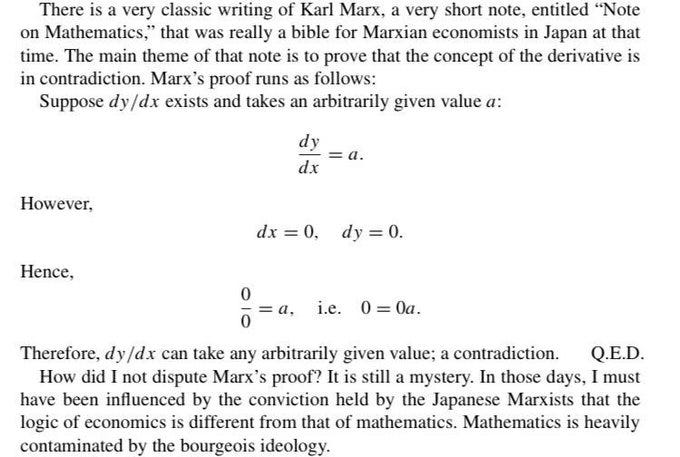
Marx is mostly right about derivatives

Marx is mostly right about derivatives substack.com
preview

I didn’t know Marx was into math, apparently he taught himself quite a bit just as a hobby, including working out some higher algebra. Neat!

I didn’t know Marx was into math, apparently he taught himself quite a bit just as a hobby, including working out some higher algebra. Neat!

0

Only workers in power will liberate humanity from exploitation, oppression, war

preview

cross-posted from: news.abolish.capital/post/46557

International Conference of Marxist-Leninist Parties and Organizations (CIPOML) Coordinating Committee | Apr. 27, 2026–

In May 1886, the blood of workers spilled in Chicago ignited a struggle that still burns throughout the world: the fight against capitalist exploitation and the unwavering path toward life and the emancipation of workers. And this May Day, in every corner of the planet, the working class will commemorate their martyrdom not as an act of faith or resignation, but as a battle cry that resounds against the exploitation of capital.

Today, the workers of the world have more than enough reasons to rise up: countless demands are emerging from factories, fields, and cities, wherever exploitation deepens and life becomes increasingly precarious. Among these sentiments, the condemnation of the resurgence of US imperialism’s aggression resonates strongly. Together with Israeli Zionism, US imperialism has brought war to the Middle East, with attacks and military intervention against Iran and Lebanon in a conflict that has escalated with bombings and troop deployments. They are perpetrating a genocide against the Palestinian people, while simultaneously maintaining policies of pressure and aggression against nations like Venezuela and Cuba.

The aggression of US imperialism is not an isolated event, but rather a symptom of a decline it has been experiencing for years; a desperate response to preserve its global hegemony against what it identifies as its main rival, imperialist China, which today is challenging its economic and geopolitical power. In this struggle between powers, where alliances are being reconfigured and conflicts intensifying –as so often in history– it is the workers, the youth, and the people who bear the brunt of the crisis, the war, and the exploitation.

Faced with this reality, the workers and the people cannot and must not take sides with one power or another; Imperialism, by its very nature, is rapacious and an enemy of the people, regardless of the guise it adopts. Amidst the intensification of inter-imperialist contradictions, our position is clear: we do not align ourselves with one power or another, but with those who resist and fight.

We stand with the peoples who struggle for their emancipation, for their right to exist with dignity and sovereignty. We raise our banners of solidarity with Iran, Lebanon, the heroic Palestinian people, and with all those who, in every corner of the world, confront capitalist exploitation, oppression, and violence. Their struggles are our struggles, because in each one lies the possibility of a different future, a world without classes or exploitation.

In the current context, we call for the unity of all anti-imperialist and anti-fascist forces to confront the enemies of the people. It is necessary to block their path with a firm and powerful unity, one that is not merely a slogan, but organized and conscious action.

Let our strength be expressed in daily action, in every space where workers resist, in every country where voices rise up against exploitation and injustice. Let us build a front that acts globally, nourished by the concrete battles we wage in our territories, capable of striking at imperialism and paving the way for emancipation.

The capitalist system faces a critical moment today that exposes its inability to guarantee life. While we witness a greater concentration of wealth in the hands of a few, the living conditions of the working class and the popular sectors are deteriorating alarmingly.

The economic adjustment policies, implemented by governments in the service of capital, have only led to increased poverty rates, higher unemployment, and greater levels of exploitation. Capitalism is not –and never was– a path to well-being for the people.

To achieve true emancipation, it is a historical imperative to overthrow the capitalist-imperialist system. Instead, let us build a new society, founded on the expropriation of the expropriators, justice, and free and dignified work: the workers’ society, socialism.

Haymarket Martyrs’ Monument, Chicago, IL. (The Red Phoenix)

Long live May Day, the International Day of Unity, Struggle, and Solidarity of the Working Class!

Long live the workers’ struggle!

Death to criminal imperialism and Zionism!


From The Red Phoenix via This RSS Feed.

0

[Chapman - Empire of Normality] has some neat ideas about capitalism.and neurodivergence and disability

preview

finished reading this book last night, was pretty interesting. Tries to create an “autistic marxism”. Imo it lacks engagement with 1)bipoc, 2) global south and 3) exploitation (though Chapman at least acknowledges the gaps), but otherwise great analysis of the connections between disability and capitalism particularly in the global north over the last 80ish yearz. I also do like how he draws on the connections between disability and surplus population

finished reading this book last night, was pretty interesting. Tries to create an “autistic marxism”. Imo it lacks engagement with 1)bipoc, 2) global south and 3) exploitation (though Chapman at least acknowledges the gaps), but otherwise great analysis of the connections between disability and capitalism particularly in the global north over the last 80ish yearz. I also do like how he draws on the connections between disability and surplus population

0

By putting Marxism in the service of doctrinal warfare, intellectuals convinced by Theory wereconvinced to vilify Marxism and accommodate capitalism

Western Marxism Through the Looking Glass www.damagemag.com
preview

I’m not sure what I think about this but just throwing it out there.

I’m not sure what I think about this but just throwing it out there.

0

Can dialectics explain the world? - MR Online

MR Online Can dialectics explain the world? - MR Online mronline.org
preview

CAN dialectics explain the world? The answer’s No. Dialectics, of itself can’t “explain” anything.

That’s the job of scientists, engineers, historians, investigative journalists, of people working on specific problems, researching or bringing knowledge together to provide an overview of how particular aspects of the universe function.

But forensic analysis–whether of the workings of the economy, of a particular problem in history, or the origins and spread of the Covid-19 virus–invariably reveals that dialectical principles are at work and a dialectical approach can be a vital aid in trying to understand ourselves and the universe around us. Dialectics can help us ask the right questions. It can also help us question and challenge answers which have already been given–about human society and about nature.

Marxist dialectics is an approach to understanding the way the material world (both human and “natural”) works. At its simplest, it starts from the perception that nothing is eternally fixed or static. Even things that might appear to be motionless are, at another level (as with the atoms in a piece of metal or the individuals in society) in a constant state of flux or change.

The way that things change is not just due to external forces but also to the often opposing (or “contradictory”) consequence of internal processes.

Dialectics originated as a way of thinking and of debating in ancient Greece, although the Chinese also developed a form of dialectics. The idea of dialectics was taken up by the German philosopher Hegel and further developed by Marx and Engels in the form of materialist dialectics. The “materialist” bit is important. Materialism holds that the world, the universe, “nature,” actually exists and that all phenomena–including consciousness–are ultimately the outcome of (though not reducible to) material processes.

It holds, also, that humans can, in principle, understand that world–often incorrectly and never completely (every advance in knowledge raises new questions which require answers) but that over time we can collectively work towards a better knowledge of what reality is and how it functions. This is in contrast to ready-made religious “explanations” of the world in terms of some literally “supernatural” being, and to philosophical idealism which holds that all we can know is what is “inside our heads”–our sensations–and that if any “real” world does exist, it is essentially unknowable.

Dialectical ideas had already begun to be firmly embedded in science well before Marx–in physics (especially electro-magnetism and thermodynamics), in geology and Earth processes, and in evolutionary theory.

The significant contribution of Marx and Engels was to recognise them as general principles which could be seen operating also in human affairs.

For example, dialectical processes can be seen in the interplay of economic, technological and social change which led to the emergence of capitalism from feudalism.

Within capitalism, the search for profit involves the development of new technologies, which on the one hand displace jobs but may also create new products and markets.

At a more general level, capitalism itself is based on the exploitation by capitalists of a working class whose consciousness enables them to challenge the power of capital and, potentially, transform society into something new.

Throughout their work, both Marx and Engels were concerned with understanding not just the internal dynamics of human society but the relations of humans to the world as a whole.

In Capital, Marx emphasised that humans are both part of nature and at the same time transform it, often with detrimental effects.

After Marx’s death, Engels developed a dialectical approach to the analysis of pre-capitalist societies with The Origin of the Family, Private Property and the State.

He also extended dialectics from human society to the non-human world in fragmentary essays which were published well after his death as Dialectics of Nature.

These included a ground-breaking (and unfinished) essay entitled The Part Played by Labour in the Transition from Ape to Man, building on Charles Darwin’s own observations on human evolution.

Just as materialism is an important antidote to philosophical idealism, so dialectics is counterposed to mechanical materialism.

Mechanical materialism–including the notion that all changes are primarily the consequence of external influences–can be a useful approach in science, especially in physics.

Newton’s laws of motion are an example.

But mechanical materialism, especially in biology and in human affairs, can lead to reductionism–the attempt to explain all phenomena in terms of processes at a “lower” level of organisation or seeing biological organisms (including human beings) as machines.

Reductionism “explains” society as the sum of the actions of individuals (think Margaret Thatcher “there is no such thing as society”); individuals by the functioning of their constituent organs which are in turn understandable only in terms of their cells, then metabolic pathways, chemical processes, and ultimately by the behaviour of molecules, atoms and subatomic particles.

This can be a powerful, but never more than a partial approach in science, which also needs to have regard to the behaviour of complex systems, emergent properties and the interactions between different levels of analysis.

More sinisterly, reductionism (the Marxist philosopher John Lewis calls this “nothing-buttery”) is also used (as in sociobiology and evolutionary psychology) to justify inequality, racism and women’s subordination on the basis of supposed inherited biological traits.

Dialectical materialism (sometimes abbreviated to “diamat”) also has its own controversies.

Neither Marx nor Engels themselves ever used the term, which was coined by Joseph Dietzgen and developed by Georgi Plekhanov and developed subsequently by Lenin (and Stalin).

For a period it was articulated–both in the Soviet Union and by Marxists elsewhere–as a series of codified “laws” (first put forward by Engels) that became a kind of catechism; the transformation of quantity into quality; the unity and interpenetration of opposites; and the negation of the negation.

In the young Soviet Union, for example, together with the pressing need to increase agricultural productivity, this led to the rejection of “Western” genetics as both idealist (because nobody had ever “seen” a gene; their existence was merely assumed) and mechanical (because geneticists then held that genes determined individual and group characteristics by being passed on unchanged from generation to generation–a theory used by the Nazis to justify racial superiority, “ethnic cleansing” and the elimination of the “unfit”).Debate continues among Marxists in particular with regard to the “dialectical” parts of the diamat.

Most Marxists today would regard Engels’s “laws” as an overly mechanical formalisation–at best a retrospective generalisation about how the universe seems to function.

Within the Soviet Union under Stalin dialectics became formulaic, repetitive; a barrier rather than an aid to creative and critical thinking.

Some, however, still claim that these “laws” provide a powerful predictive tool to investigating the world.

Dialectical materialism is best seen as a valuable heuristic–a practical approach to problem solving, analysis and investigation, not guaranteed to be perfect but a useful rule of thumb, to be continually tested against experience.

There’s nothing particularly difficult about dialectics. To quote Engels, people “thought dialectically long before they knew what dialectics was, just as they spoke prose long before the term prose existed.”

A number of prominent scientists today assert the value of a dialectical approach in their professional work, for example in mathematics and systems theory, in the relationship between consciousness and the brain, in genetics and human evolution, and in ecology.

And dialectics underpins revolutionary theory and practice. Dialectical materialism isn’t a magic key to provide the right answer to any question.

It is, rather, a powerful approach to asking the right questions (and to questioning and challenging answers which have already been given by others)–about human society and about nature. It’s arguably central both to interpreting the world, and to changing it.

0

People Of The World, Unite And Defeat The U.S. Aggressors And All Their Running Dogs

preview

A new upsurge in the struggle against U.S. imperialism is now emerging throughout the world. Ever since the Second World War, U.S. imperialism and its followers have been continuously launching wars of aggression and the people in various countries have been continuously waging revolutionary wars to defeat the aggressors. The danger of a new world war still exists, and the people of all countries must get prepared. But revolution is the main trend in the world today.

Unable to win in Vietnam and Laos, the U.S. aggressors treacherously engineered the reactionary coup d’etat by the Lon Nol Sirik Matak clique, brazenly dispatched their troops to invade Cambodia and resumed the bombing of North Vietnam, and this has aroused the furious resistance of the three Indo Chinese peoples. I warmly support the fighting spirit of Samdech Norodom Sihanouk, Head of State of Cambodia, in opposing U.S. imperialism and its lackeys. I warmly support the Joint Declaration of the Summit Conference of the Indo Chinese Peoples. I warmly support the establishment of the Royal Government of National Union under the Leadership of the National United Front of Kampuchea. Strengthening their unity, supporting each other and persevering in a protracted people’s war, the three Indo-Chinese peoples will certainly overcome all difficulties and win complete victory.

While massacring the people in other countries, U.S. imperialism is slaughtering the white and black people in its own country. Nixon’s fascist atrocities have kindled the raging flames of the revolutionary mass movement in the United States. The Chinese people firmly support the revolutionary struggle of the American people. I am convinced that the American people who are fighting valiantly will ultimately win victory and that the fascist rule in the United States will inevitably be defeated.

The Nixon government is beset with troubles internally and externally, with utter chaos at home and extreme isolation abroad. The mass movement of protest against U.S. aggression in Cambodia has swept the globe. Less than ten days after its establishment, the Royal Government of National Union of Cambodia was recognized by nearly twenty countries. The situation is getting better and better in the war of resistance against U.S. aggression and for national salvation waged by the people of Vietnam, Laos and Cambodia. The revolutionary armed struggles of the people of the South-east Asian countries, the struggles of the people of Korea, Japan and other Asian countries against the revival of Japanese militarism by the U.S. and Japanese reactionaries, the struggles of the Palestinian and other Arab peoples against the U.S.-Israeli aggressors, the national-liberation struggles of the Asian, African and Latin American peoples, and the revolutionary struggles of the peoples of North America, Europe and Oceania are all developing vigorously. The Chinese people firmly support the people of the three Indo-Chinese countries and of other countries of the world in their revolutionary struggles against U.S. imperialism and its lackeys.

U.S. imperialism, which looks like a huge monster, is in essence a paper tiger, now in the throes of its deathbed struggle. In the world of today, who actually fears whom? It is not the Vietnamese people, the Laotian people, the Cambodian people, the Palestinian people, the Arab people or the people of other countries who fear U.S. imperialism; it is U.S. imperialism which fears the people of the world. It becomes panic-stricken at the mere rustle of leaves in the wind. Innumerable facts prove that a just cause enjoys abundant support while an unjust cause finds little support. A weak nation can defeat a strong, a small nation can defeat a big. The people of a small country can certainly defeat aggression by a big country, if only they dare to rise in struggle, dare to take up arms and grasp in their own hands the destiny of their country. This is a law of history.

People of the world, unite and defeat the U.S. aggressors and all their running dogs!

0

Figured out how much surplus labor my coworkers and I are losing

preview

I work in a blue collar field related to fossil fuels (sorry, I’m just another totally innocent death star worker). At a recent meeting one of our bosses mentioned that our “market” (i.e., the county we work in) has 20,000 customers paying the company. I guessed that each customer is paying somewhere around $100/month when you factor in fossil fuel deliveries + service to their dogshit fossil fuel burners (there is no such thing as a good fossil fuel burner).

So 20,000 x 100 = $2,000,000 per month.

Divide by roughly 50 employees (generous estimate) = $40,000 per employee per month, assuming each employee does roughly the same amount of necessary labor.

I heard long ago that good capitalists devote one third of “earnings,” i.e, gross surplus labor, to profit, one third to overhead, and the last third to labor. I know this isn’t always necessarily true, but let’s just assume that one third of that $40,000 per month is going toward buying supplies / paying taxes / doing upkeep on vehicles / anything else that can be considered overhead.

$40,000 / 3 = $13,333

$40,000 - $13,333 = $26,667 for profit and labor per employee per month.

I work about 20 days per month. $26667 / 20 = $1333 per day, nearly $200 per hour of labor. This is what I would presumably be making if the business were a worker co-op, all other things being equal. They currently pay me $25/hr, which is the median salary in the USA and only enough to tread water at best without my spouse’s income. (My spouse has a union and makes two or three times as much money as I do, and her union sucks, but a shitty union is way better than none at all.) So basically, the company owners are stealing about 90% of my earnings from me.

I have mentioned unionizing to many of my coworkers. (White males do delivery and service, while about eight white women and about five white guys work in the office.) Maybe one coworker expressed interest in unionizing, and that was after I had been working alongside him and propagandizing the fuck out of him for like a month. The rest were pretty much not interested. Isn’t this great?

The company also spans multiple states and many counties within these states, so the owners are stealing something like tens of millions of dollars from their workers per month, and that’s not counting the cost of environmental destruction and the fact that they’re probably pumping a lot of this money into the genocide industry.

0

Posting my answers to Marxist Internet Archive's Capital vol. 1 study questions: Chapter 1 Section 1

preview

I’m working through my second reading of Capital vol. 1 right now. This time around, I wanted to take copious notes and work through the study questions that Marxist Internet Archive provides.

I figured I’d post the questions and my responses here, for two reasons. The first is in case my responses might help provide insight to someone out there. But also, I’m interested to hear any critiques or follow-up questions regarding my responses.

Chapter 1, § 1 - The Two Factors of a Commodity: Use-Value and Value

1. Which of the following industries produce commodities: the movies, prostitution, the public education system, the private schools, public transport, the military, “housewives”, domestic servants?

The movies

The movie industry creates films made by human labor for the purpose of exchange (audiences exchanging money to for the experience of seeing a film in a theater), so it is a commodity. The movies themselves are created by the effort of producers, actors, directors, the filming crew, and others. The final commodity of the industry could be a physical product or a service. Selling DVDs or film rolls to theaters would be a physical commodity, and tickets to a movie or streaming would be a service.

Prostitution

Prostitution involves providing a service that someone values, through human labor; thus it is a commodity. The fact that this industry is often illegal or operates underground does not impact whether or not it is a commodity.

The public education system

While public education is something that is the product of teachers’ labor, it is not a commodity because it is not produced for exchange. Public education is provided to all children, and they don’t have to pay anything for it. The purpose is to provide education without any exchange being involved. Teachers are paid through taxes, but that is not the type of exchange we’re talking about here as it is not mediating two commodities.

The private schools

Unlike public schools, private education is a commodity. Similar to pubic schools, private education is the product of human labor. However, unlike public education, private education is a commodity since it is produced for exchange. It would be a commodity even in the absence of public education from a society. Private education is provided not as a means of educating children, but as a service sold for money. If you do not pay your bill the school, your child is removed. Even if we say the purpose is to provide education to specific children and not the broader population, it’s still a commodity as the purpose is ultimately to provide education in exchange for money.

Public transport

Public transport seems similar to public education in that it’s a service provided to the public. However, unlike public education there is often (but not always) monetary exchange involved. So at first glance, I can see an argument to be made that public transportation – at least when you have to pay to ride – is a commodity because the ride is exchanged for money. However, I do not believe public transportation is a commodity. Note that the exchange for money is often the case, but not always. This points to exchange not necessarily being an essential component. But more importantly, the ultimate reason why public transportation is provided isn’t for exchange. The purpose of public transportation is to provide a service to society. Money is exchanged, but this is usually done in order to help defray costs so that the entire cost of transportation does not fall on the government. The exchange of commodities is not the reason that public transportation is provided, it’s secondary to the purpose thus it is not a commodity

The military

While there are some aspects of the broader military industry that involve commodities in certain circumstances (a private contractor building bombs to sell to the military involves a commodity – the bomb), the broader “military” is not a commodity. A military exists to protect the people of a country from outside threats. Militaries are funded by taxes, which is not exchange; nor is there any exchange involved in the purpose of the military. Thus it’s not a commodity in itself.

Housewives

While housework (cooking, cleaning, child care, etc.) is necessary for life and involves a significant component of a society’s overall labor, it is not a commodity. Housework is not exchanged for anything, it’s done as a part of living life.

Domestic servants

While domestic servants may do the same housework as housewives/husbands, unlike them the work of domestic servants is a commodity. It is performing housework labor in exchange for money. This exchange is the entire reason why the work of domestic servants is performed.

2. Why is a ton of gold worth more than a ton of sugar? And is gold dug from a thousand metres underground worth more than gold found on the ground?*

A ton of gold is worth more than a ton of sugar because (significantly) more abstract human labor is involved in producing the gold versus sugar. A ton of sugar can be produced on a relatively small plot of land with a handful of laborers working for a few hours. A ton of gold, however, requires a tremendous amount of labor, orders of magnitude more laborers and labor hours involved to mine that much gold (NOTE: I could talk about how much more capital intensive it is to mine and refine gold versus sugar, and how the labor used to build that equipment must be included in the calculation, but Marx hasn’t gotten to that point yet, so I’m leaving it just with physical human labor.

Gold has the same worth (value) whether it’s mined deep underground versus picked up off the surface (the former requiring much more human labor). This is because worth/value is based on abstract human labor and not actual labor incurred. This means, worth/value is determined by the average and/or prevailing conditions of production. An ounce of gold has one measure of worth/value, and that is determined by the overall societal conditions for how gold in general is mined. In other words, it’s the socially necessary labor that determines the value, not the specific labor conditions of each ounce.

3. Does advertising add value to the products it advertises?

Advertising does not add value to the products it advertises. Human labor creates advertising, but it does not add to the use-value of the commodity it is selling. When someone purchases a product, the advertising component is not something that person would consider a useful part of the product. (NOTE: I find it hard to answer this question without jumping ahead to volume 2 of Capital, where Marx outlines how it’s only in the sphere of production where value is created. How some activities like transportation and storage might be value-creating because they are absolutely necessary to bring the product to be exchanged, but advertising is an example of an activity that is not production and not necessary for the value of production to be realized, so in itself it doesn’t create value).

0

"In fact, one can get a doctoral degree...without learning about, much less reading, Paulo Freire. This is tantamount to getting a doctoral degree in Linguistics without ever reading Noam Chomsky."

preview

Donaldo Macedo, introduction to the 30th Anniversary Edition of Pedagogy of the Oppressed by Paulo Freire

Donaldo Macedo, introduction to the 30th Anniversary Edition of Pedagogy of the Oppressed by Paulo Freire

0

Solidarity, bitches. It's time for Engels-meisters's marxism lessons. You're gunna' learn how to understand and navigate fucking capitalism from this FUCKING video series. Freut mich, BITCH.

preview

Now, first thing you need to know: You need 3 FUCKING THINGS to learn this fucking economic system. Pull out your notebook and WRITE THIS DOWN, you FUCK. This is the circuit of Money Capital. You NEED TO KNOW THIS to understand anything about this FUCKING shitty-ass economy SYSTEM.

  1. C, This is the FUCKING COMMODITY. The things all around us. The capitalist first appears as a buyer of a commodity. Where did he get this money – I don’t fucking know, just think about it, YOU STUPID fuck.

  2. P, This is the second stage of the capitalist circuit. P STANDS for Production or Productive. Their capital passes through the process of production. The result is a commodity of MORE VALUE – you better be writing this fucking down – More Value than that of the elements that entered into production.

  3. M, This is the GOD DAMN MONEY, YOU KNOW, THAT YOU EARN and SPEND?! This is the 3rd and final stage of the primary circuit of capital. The capitalist returns to the market as a seller, with his past money now converted into commodities.

So the formula is formally written down as M - C … P … C’ - M’. In the next lesson I’ll explain what this all fucking means. Now write this formula, in your fucking notebook, 50 TIMES.

0

Fascism & The Popular Front: The Comintern’s 7th Congress

Mexico Solidarity Media Fascism & The Popular Front: The Comintern's 7th Congress mexicosolidarity.com
preview

cross-posted from: ibbit.at/post/76799

This article by Jaime Ortega originally appeared in the October 8, 2025 edition of La Jornada, Mexico’s premier left wing daily newspaper.

In the summer of 1935, hundreds of people from around the world participated in the Seventh Congress of the Communist International (CI) at the House of Trade Unions in Moscow. This organization was born in 1919 in the heat of the Russian Revolution, with the mission of establishing socialism on a global scale. Beyond that imperative, characteristic of an era in which everything was possible, it soon transformed into an instrument for managing geopolitics within the communist orbit. After the establishment of Soviet raison d’état, the CI experienced the paradox of being an organization designed to spread the revolution and at the same time a disciplined and hierarchical structure that depended, to a large extent, on the survival of a state.

By 1935, the CI was a powerful organization, coexisting and merging with other structures, such as the Peasant International, the Trade Union International, and the International Red Aid. The well-oiled apparatus, however, still depended on the political directives discussed at its famous congresses. Reaching Moscow in 1935 was not easy, but the CI’s organizational capacity allowed it to effectively constitute a global representation that could convene to decide the fate of the communist movement.

Dimitrov bust, Coyoacán Photo: Jay Watts

The context of that congress was overwhelming, as war was looming and fascism’s growing power grab was manifest throughout Europe, posing a threat to the socialist political order. The Seventh Congress witnessed the leading role of the Bulgarian communist culture hero, George Dimitrov, whose report outlined the politics of the following decade, and much of what was established there was transformed into a political culture that transcended time.

In his speech, Dimitrov pointed out that fascism was not a government, among others, of the bourgeoisie, since fascists had often come to power fighting against fractions of the capitalist ruling class. He pointed out the error of considering this political form as the expression of sectors of the lumpenproletariat and the petite bourgeoisie, something that Zetkin and Trotsky maintained. For Dimitrov, fascism was above all the political and power capacity of finance capital, which, while taking various forms, was distinguished by establishing a type of political monopoly, particularly “terrorist,” over the worker and peasant organizations.

After this initial characterization, he expressed concern about the phenomenon’s assessment as an “ordinary situation” of capitalism. Fascism, he argued, brought about a radical substitution of the state form typical of bourgeois society. Before this occurred, it was necessary to identify the preparatory stages of its rise in order to combat it effectively.

Nine decades after that Comintern meeting, it is worth returning to its documents, as they enrich the heritage of past anti-fascist struggles and reveal the paths, assessments, and concerns that can contribute to fine-tuning the compass for our times.

He also pointed out the urgent challenges facing fascism, especially the fact that fascism appealed to the deepest sentiments of society and even exploited pre-existing revolutionary traditions, resorting to “skillful anti-capitalist demagoguery.” In response to the “unacceptable” dismissal of the fascist danger by those who considered it to be just another routine expression of the domination of capital, Dimitrov warned of the need for a change of strategy.

This entailed an insistent critique of the lukewarm social democratic stance of the time, as well as a self-criticism of the communists’ position. Thus was born the Popular Front policy, which required the promotion of far-reaching political alliances. This called for a united front tactic between organizations, labor movements, and peasant and petty-bourgeois parties, with the goal of defending the everyday interests of the working classes.

All of this was radicalized in the “colonial countries,” where the anti-imperialist framework was to be the heart of the Popular Front. Rereading Dimitrov’s report today is thought-provoking, as it demonstrates a complex understanding of the fascist phenomenon and legitimately articulates a political and democratic response, such as the Popular Front. From that moment on, the need for the national sections to more effectively value local political traditions, especially those that could be appropriated in a revolutionary context, was established.

A tension also arose between the Soviet example, with all its aura of success, and the need to consider the necessity of democratic achievements in each national space. Under these premises, the very existence of the organization was questioned, as it was ultimately in national circles that political action was decided. Nine decades after that meeting, it is worth returning to its documents, as they enrich the heritage of past anti-fascist struggles and reveal the paths, assessments, and concerns that, even in very distant circumstances, can contribute, if read with the necessary historical caution, to fine-tuning the compass for our times.

Jaime Ortega is a researcher at UAM, and author of En el medio día de la revolución.

Fascism & The Popular Front: The Comintern’s 7th Congress Analysis | Historical | Uncategorized

Fascism & The Popular Front: The Comintern’s 7th Congress

October 8, 2025

Rereading Dimitrov today is thought-provoking, as it demonstrates a complex understanding of the fascist phenomenon and legitimately articulates a political and democratic response, such as the Popular Front.

Soberanía 79: Onshoring Sadism Soberanía

Soberanía 79: Onshoring Sadism

October 8, 2025October 8, 2025

The US’ War on Terror comes to Latin America, Mexican foreign policy & the Global Sumud Flotilla, USMCA bullying, national polling, and media spin from the LA & NY Times.

Time for a Tune-Up: Morena Turns Eleven Analysis | Interviews

Time for a Tune-Up: Morena Turns Eleven

October 8, 2025October 8, 2025

“Morena must not turn into just a brand. Its strength must be its social movements, women leaders and the ethics and commitment of its membership,” says Alejandro Torres in this interview.

The post Fascism & The Popular Front: The Comintern’s 7th Congress appeared first on Mexico Solidarity Media.


From Mexico Solidarity Media via this RSS feed

0

Red Reviews: “Some Questions Concerning Methods of Leadership”

Fight Back! News Red Reviews: “Some Questions Concerning Methods of Leadership” fightbacknews.org
preview

cross-posted from: ibbit.at/post/76066

One of the major problems of revolutionary organizing has always been the contradiction between building movements of the broad masses, and those movements being led by a relatively small, disciplined and unified vanguard. How does a revolutionary organization, based on democratic centralism and united around a Marxist-Leninist program, mobilize the masses far beyond its own membership? The answer to the question is a method of leadership used by all communists from the Bolsheviks onward, called the mass line. Mao Zedong’s short essay, “Some Questions Concerning Methods of Leadership” is a key, systematic explanation of the mass line in Marxist-Leninist theory.

After the Yan’an Rectification Movement launched in 1942, cadre education was given special attention. As a result, many of Mao’s articles from the period in Yan’an are particularly clear and concise. “Methods of Leadership,” from June 1943, is no exception. Along the lines set out by the 1942 Rectification Movement, Mao’s aim is “To combat subjectivist and bureaucratic methods of leadership,” by promoting “scientific, Marxist methods of leadership.” The lessons distilled in this short essay are drawn from Mao’s experience leading the Autumn Harvest Uprising, the Chinese Soviet Republic, and the Long March.

Mao’s argument

“There are two methods which we Communists must employ in whatever work we do,” Mao explains. “One is to combine the general with the particular; the other is to combine the leadership with the masses.” This is Mao’s first point.

Elaborating, Mao goes on to say, “In any task, if no general and widespread call is issued, the broad masses cannot be mobilized for action. But if persons in leading positions confine themselves to a general call – if they do not personally, in some of the organizations, go deeply and concretely into the work called for, make a break-through at some single point, gain experience and use this experience for guiding other units – then they will have no way of testing the correctness or of enriching the content of their general call, and there is the danger that nothing may come of it.”

Too often those who claim to be revolutionaries stop short at the general call, but don’t go to the masses to organize and mobilize them. They broadly proclaim, “We need socialism!” but fail to link the call for socialism with the masses’ felt needs and day-to-day struggles in a practical way. Then they fall into pessimism and blame the masses when they fail to take up their ideas. Mao, instead, suggests that we use the mass line.

Mao says that “However active the leading group may be, its activity will amount to fruitless effort by a handful of people unless combined with the activity of the masses.” In other words, the broad masses have to be drawn into the struggle. “On the other hand,” Mao explains, “if the masses alone are active without a strong leading group to organize their activity properly, such activity cannot be sustained for long, or carried forward in the right direction, or raised to a high level.” This is the problem we see with spontaneous uprisings and rebellions. They burn bright and hot and are a clear demonstration of the people’s righteous anger, but, without revolutionary leadership, they aren’t sustainable and eventually they burn out.

“The masses in any given place are generally composed of three parts, the relatively active, the intermediate and the relatively backward. The leaders must therefore be skilled in uniting the small number of active elements around the leadership and must rely on them to raise the level of the intermediate element and to win over the backward elements.” This is an essential point. The relatively active, or advanced, are the people who want to fight back against their exploitation and oppression. They may not yet be Marxist-Leninists, but they see that things have to change and that the route to change is through struggle. These are the people that communists must find and organize with, shoulder to shoulder. By fighting together with the advanced and summing up our experiences, we can work to win them over to Marxism-Leninism.

By relying on these advanced fighters, the broad, intermediate elements can be pulled into the struggle, and many of them can be raised to the level of the advanced. The intermediate are a much larger section of the masses, not active, but generally aware that things are bad and shouldn’t be like this. The advanced fighters show them the power of active struggle, and can draw them into those struggles.

Finally, there are the backwards elements. These are the people who carry water for the class enemy among the people. They have all kinds of backwards ideas, and promote those ideas among the people. Some of them may be won over while others must be isolated.

The important point to take away from this breakdown of “advanced, intermediate and backwards” is that revolutionaries should focus their attention and energy on the advanced, active fighters. By doing that, the effects of their work will ripple outwards to the broad masses like waves from a pebble tossed into a pond.

Finally, Mao links the mass line to the Marxist theory of knowledge, explaining how we learn through practice, moving from a lower to a higher level, together with the masses.

“In all the practical work of our Party, all correct leadership is necessarily ‘from the masses, to the masses’. This means: take the ideas of the masses (scattered and unsystematic ideas) and concentrate them (through study turn them into concentrated and systematic ideas), then go to the masses and propagate and explain these ideas until the masses embrace them as their own, hold fast to them and translate them into action, and test the correctness of these ideas in such action. Then once again concentrate ideas from the masses and once again go to the masses so that the ideas are persevered in and carried through. And so on, over and over again in an endless spiral, with the ideas becoming more correct, more vital and richer each time. Such is the Marxist theory of knowledge.”

People learn through struggle, and we have to start from where people are at and advance them step by step. Through the course of struggle, we have to sum up our successes and failures, subject ourselves and our comrades to criticism and self-criticism, learn from and fix our shortcomings, and carry forward that which is proved correct through practice. Then we apply these lessons to our mass work as we move forward.

What does Mao mean by “concentrate” the ideas of the masses? This is an important point. A key ingredient to Mao’s mass line slogan of “from the masses, to the masses,” is Marxist-Leninist theory. It means using Marxism-Leninism to transform those ideas from “scattered and unsystematic ideas” into a focused strategy that can be implemented on the ground. It means taking the felt needs and demands of the masses, applying the science of Marxism-Leninism to understand the contradictions at work, and steering those felt needs and demands in a direction that brings the greatest number of people possible into conflict with the enemy.

Mao’s “Methods of Leadership” today

Today, we find ourselves in the particular position of having no true communist party in the United States. There is no organized and advanced detachment of the entire working class, whose cadre are what Stalin called “the generals of the proletarian army.” We are therefore faced with the central task of building just such a party. But as Mao tells us, “A leading group that is genuinely united and linked with the masses can be formed only gradually in the process of mass struggle, and not in isolation from it.” In other words, party building is impossible to accomplish apart from serious mass work.

This means we must understand and utilize the mass line every single day. Whether we are working in the trade unions, struggling for Black and Chicano national liberation, or fighting for a free Palestine, among many other important struggles, we are working to accomplish three objectives. As the Political Program of the Freedom Road Socialist Organization puts it, “Our party building work should be placed in the context of our three objectives: To win all that can be won while weakening our enemies; Raise the general level of consciousness, struggle, and organization in our immediate battles; and Win the advanced to Marxism-Leninism, thus building revolutionary organization.”

The only way to build an organization comprised of the “generals of the proletarian army” is to recruit the best and most dedicated fighters in the people’s struggles, learn together with them through the crucible of day-to-day battles against the class enemy, and through the summation of those experiences, demonstrate in practice the power of Marxism-Leninism.

#RevolutionaryTheory #RedReviews #Mao


From Fight Back! News via this RSS feed

0

Contra Capital as Abstract Domination

Contra Capital as Abstract Domination nicolasdvillarreal.substack.com
preview

i think this is very debatable defense of orthodoxy tbh:

  1. surplus population doesn’t wind up in imperial core, as they do bullshit jobs of reselling dropshipped vacuums and toys

  2. norway capital intensity is also rather curious addition, one would think norway presents a unique case, rather comparable to saudi arabia or brunei on gdp number basis (the capital intensity aside)

0

Cosmonaut Magazine Article: Artisanal Politics, Bolshevism, and the Path to a Marxist Proto-Party

Cosmonaut Artisanal Politics, Bolshevism, and the Path to a Marxist Proto-Party cosmonautmag.com
preview

I encourage reading this on the original site thanks to working footnote links (there quite a few interesting footnotes) and other hyperlinks, but I’m copying the article text here to mitigate people commenting solely based on the article title.

Stephen Thompson draws on the history of the Russian Social Democratic Labour Party (RSDLP) to critique the “artisanal” character of the contemporary US Marxist Left, analyzing the recent activity of Socialist Alternative as a case study in “artisanal politics.”

1) Building the Foundations For a Mass Socialist Party in the US

The past ten years have been an interesting time for Marxists in the US. DSA became the largest socialist organization in generations, Black Lives Matter became the largest protest movement in US history, and in the labor movement there was a substantial uptick in the number of large strikes. At the same time, various polls have shown that the public wants things that neither major party will deliver but would fit well within a socialist platform.[1] A significant minority even say they have a favorable view of Marxism and want to get rid of capitalism altogether.[2]

These points speak to the potential for a mass socialist party to eventually emerge in the US. And although it will probably take decades to build a truly mass party, we should be thinking now about how we can move that process forward. Ideally, Marxists will contribute, in part, by offering answers to key political questions like: What should the party actually try to accomplish? What will be its strategy? And what will it look like to begin implementing that strategy in the US today?

If we want to actually influence the development of a future mass party, we need to provide compelling answers to these questions, and we must be able to articulate those answers to substantial numbers of people. In other words, to build the foundations for the mass socialist party of the future, we should be working now to organize a critical mass of activists into a cohesive proto-party organization with a solid Marxist program.

How do we build this Marxist proto-party? This is the key question I want to address in this essay. It will require a frank discussion about what the existing Marxist Left in the US is getting wrong. I will focus on the leaders of one particular group, Socialist Alternative, to provide some illustrative examples. As I will argue below, although Socialist Alternative’s leadership claims a Bolshevik political heritage, they are actually doing the opposite of that which made the Bolshevik Party possible in the first place. These leaders have insisted on an approach that makes little sense and is in serious need of critical reassessment. Instead of Bolshevism, their approach is something I call artisanal politics.

Artisanal politics is what happens when, instead of fighting to lead the socialist Left on the basis of a clear program, a Marxist organization tries to maintain a niche for itself within the wider ecosystem of progressive-left activism. Like the vendors who sell artisanal items at farmers markets, artisanal Marxist groups work on a small scale to carry out their own idiosyncratic projects. Although this might be a good way to create quirky products to meet varied consumer tastes, it is a terrible way to organize a socialist movement. Instead of having a unified proto-party working to win mass public support for a socialist program, we get an alphabet soup of different organizations all trying to build their own issue-based campaigns, media projects, and front groups, most of which exist on a scale that is too small to matter. To move forward, Marxists need to break decisively with artisanal politics. In this essay I explore what it could mean to do this.

I begin my argument in Section 2 with a general discussion of the contemporary political terrain in the US. Marxists need to be sober about the enormous power of our enemies and the formidable tools they have at their disposal. But I also argue that, in the coming decades, there will likely be important openings to fight back and begin charting a path to socialism. The question is: how do we build an organization that can effectively navigate these openings?

In Sections 3 and 4, I provide some historical perspective for thinking about this question. Specifically, I look at how Russian Social Democrats, beginning all the way back in the 1880s, built the foundations for what became the Bolshevik Party. This meant having a clear set of ideas for how the masses could win political power, developing a program based on those ideas, and finding ways to fight for the program even when society was not on the brink of revolution. At the same time, to create an organization that could carry out those ideas on a meaningful scale, it was necessary for Russian Social Democrats to establish a baseline level of programmatic agreement among themselves, and in the beginning, this required an enormous amount of public debate among the members of various small political groups. These debates took years, but over time they made it possible to build unity around fundamental principles without having to enforce strict conformity around secondary issues. This is how dozens of small groups transformed themselves into a unified organization from which the Bolshevik Party ultimately emerged.

Next, in Sections 5 and 6, I discuss problems of the contemporary socialist Left, looking specifically at groups like Socialist Alternative. The leaders of these groups such as these have, effectively, turned Bolshevism on its head. They seem to lack a clear idea of what it would look like for the working class to run society, and they fail to convey any real conception of how to get from here to there. Rather than working to build principled unity around a Marxist program, they separate themselves into various tiny groups which largely ignore each other, with each group distinguishing itself by its unique positions on secondary issues. This is artisanal politics, and it produces a socialist Left that is unable to build a non-negligible base of support for Marxist politics in the working class.

Finally, in Sections 7 and 8, I propose an answer to the central question of this article: how can we begin building a viable Marxist proto-party in the US today? There is already a substantial number of smart, capable, sincere Marxist activists in the US, and if a critical mass of them were united together on the basis of a compelling program, then they would be well positioned to have a noticeable impact in society and begin building an organized base of support for Marxist politics. But to a significant degree, these activists are separated by bureaucratic internal structures that inhibit frank and open political discussion among the members of different groups; this is a major obstacle to the sorts of debates that will be necessary for reaching agreement on a compelling program. I conclude that the members of these groups should fight for the right of open (public) discussion, and we should find ways to organize debate across the Marxist Left, with the aim of ultimately creating a unified proto-party organization built on a shared commitment to socialist revolution.

**2) The US State, Mass Movements, and Socialist Politics**

In the US, the existing state is a clear obstacle to what the Left wants to achieve. There is a long history of the military being used to break strikes, and governors deployed National Guard troops against the BLM protests in 2015 and 2020. If socialists gained a majority in Congress and held the Presidency, the political role of the military would become an even more pressing issue, because the people who run the military are firmly integrated with the ruling class and have a strong interest in maintaining the status quo.[3] The existing state, particularly including the military, has long imposed a check on what mass movements can achieve in the US. Any president trying to implement socialism in the US today would have to contend with the possibility of a Pinochet-style coup. But mass movements in the US have not only come into confrontation with the power of the state; they have also found ways to successfully fight back. In the 1930s, workers were able to build a powerful industrial labor movement because they combated strikebreaking by National Guard troops, including by persuading the troops to stand down. As Art Pries wrote in his history of the CIO: > But strikers and their thousands of supporters did more than shame the young National Guardsmen. They educated them and tried to win them over. Speakers stood on boxes in front of the troops and explained what the strike was about and the role the troops were playing as strikebreakers. World War I veterans put on their medals and spoke to the boys in uniform like “Dutch uncles.” The women explained what the strike meant to their families. The press reported that some of the guardsmen just quit and went home.[4] Similarly, in 1970, when Nixon deployed National Guard troops in an attempt to break a wildcat strike of postal workers, many soldiers expressed support for the strike, and some even helped to prevent the resumption of mail service by deliberately missorting items; if the National Guard troops had been more loyal to the state authority, Nixon may have been able to crush the strike, but instead the strike continued and became one of the biggest victories for public sector workers in US history.[5] There were also glimmers of this during the George Floyd uprising five years ago, when protesters persuaded members of the National Guard to lay down their shields and take a knee in solidarity with the movement.[6] This raises the question: how could these efforts ultimately be systematized, scaled up, and escalated by a mass revolutionary movement? That will only be possible if a substantial layer of the public is willing to support attacks on the existing order, but here I think there is actually some room for optimism. In the early 1960s, for example, nearly 80% of Americans said they trusted the government to do the right thing at least most of the time, but during the decades since then, the percentage has dropped substantially, and for the past ten years it has fluctuated around 20%.[7] Another recent poll found that 58% of Americans believe the US political system needs major changes but are not confident that it can be reformed.[8] These general anti-establishment sentiments are frequently intertwined with a variety of ideas, including conservative ones. But there is evidently a deep dissatisfaction with the existing system, and an openness to other possibilities. All this underscores the need for a socialist party that can patiently argue for a clear, concise program which directly challenges the legitimacy of the system as a whole, lays out a path for replacing it with a socialist one, and begins working right now to organize the already existing public hostility toward the state. It is easy to imagine the sorts of events—like overreach by the Trump administration, new climate-induced disasters, or deep cuts in public services when the dollar finally loses its international reserve currency status—that could spark massive new social crises in the coming years and decades. When these things happen, it is likely that new mass movements will emerge, and soldiers will again be called upon to restore order. To navigate those situations and be more than just spectators, Marxists will need to already have a sizable organization with some clarity about what to do. How do we get from here to there? This is exactly the type of question I think the history of Bolshevism can shed light on. A good starting place is the Bolshevik Party program, since the program specified the key positions a person had to accept to be a member and thus created a basis for shared clarity about the aims of the party.[9] As part of this, it is useful to understand the development and origins of the Bolshevik program in the early Russian Social Democratic movement, because this history shows how Marxists laid the basis for the October Revolution through their work over a three-decade period, beginning at a time when they were a small force in society. To demonstrate these ideas, in the next section I am going to emphasize the way Russian Social Democrats navigated issues related to the military; I do this because I think it provides a useful example, and because I think these issues have an underappreciated relevance for Marxists today, but similar points could also be made about various other demands and tactics that the Social Democrats raised.

**3) The Bolshevik Minimum Program: Origins, Implementation, and Some Lessons for Today**

The precursor to the original Bolshevik program was the Social-Democratic Emancipation of Labor Group’s program from 1884, which had a standard minimum/maximum structure.[10] The maximum section spoke to the socialist transformation of society that would become possible once the working class won state power. The minimum section, or “minimum program”, described the things to be fought for before the working class rose to power, and included political demands that laid out what it would mean to replace the tsarist autocracy with a democratic republic. The logic of this program reflected the understanding that working-class political rule could only be exercised through a democratic system. As Marx and Engels wrote in the Communist Manifesto: “the first step in the revolution by the working class is to raise the proletariat to the position of ruling class, to win the battle of democracy.”[11] As part of the call for a democratic republic, the minimum program included an important point related to the military: it demanded “the replacement of the standing army by general arming of the people.”[12] Demands like this were important because they clarified what it would mean to overthrow the existing autocracy and what the autocracy would be replaced with. Since the existing military was a cornerstone of the autocracy’s power, building a democratic republic would have to mean replacing the existing military with something else, and to the extent that they were serious, Russian Social Democrats needed to have some idea of what that “something else” would be. At its party congress in 1903, the Russian Social-Democratic Labor Party (RSDLP) adopted a program that was largely inspired by the Emancipation of Labor group’s ideas. The RSDLP program’s minimum section called for a democratic republic and the “replacement of the standing army by universal arming of the people.” Although the program did not provide details about this—for example, it did not explain if or how the armed population would be organized into a militia—it did bring clarity to a fundamental issue: the new state power was supposed to be rooted in the armed masses, rather than the existing bureaucratic-military machine. The 1903 congress also passed a “Resolution on Demonstrations” that gives a sense of how the party intended to deal with the military in its day-to-day work: > In view of the fact that regular troops are increasingly being used against the people in demonstrations, steps should be taken to acquaint the soldiers with the character and purpose of the demonstrations, and they should be invited to fraternize with the people; the demonstrators should not be allowed to antagonize them unduly.[13] When a revolutionary situation developed in Russia during 1905, the Russian Social Democrats gave agitational speeches to win the military rank and file over to their side; this was powerfully portrayed in the movie Battleship Potemkin. When the Potemkin sailors took over their ship and put it under the control of an elected committee, they demonstrated what it would mean to dismantle the existing military and transfer that power to the working class through the “arming of the people.” In 1912, when the Bolshevik faction of the RSDLP formed what we now know as the “Bolshevik Party,” the RSDLP program became the Bolshevik Party program. The political demands in the minimum program continued to be central to the party’s agitational work.[14] When World War I began, the main party newspaper published a statement by the Bolshevik Central Committee which called for a revolutionary struggle against the war, and held up the Paris Commune—in which the communards built a workers’ state by suppressing the standing army and arming the people—as the example to follow.[15] Similarly, rank-and-file party members agitated for a revolutionary struggle against the war and for a democratic republic—although many apparently ignored some of the Bolshevik Central Committee’s more radical directives regarding “revolutionary defeatism.”[16] This is because, as I will discuss in more detail below, the Bolshevik Party was held together by a shared commitment to an overarching political project, not by top-down micromanagement of members or monolithic agreement about secondary issues. In 1917, Lenin (and some other leading Bolsheviks) became convinced that the conditions had arrived for an international socialist revolution.[17] He argued for a revised and more radical minimum program, which described the conditions under which a revolutionary socialist government of workers and peasants could take power: > The party fights for a more democratic workers’ and peasants’ republic, in which the police and the standing army will be abolished and replaced by the universally armed people, by a people’s militia; all officials will be not only elective, but also subject to recall at any time upon the demand of a majority of the electors; all officials, without exception, will be paid at a rate not exceeding the average wage of a competent worker; parliamentary representative institutions will be gradually replaced by Soviets of people’s representatives (from various classes and professions, or from various localities), functioning as both legislative and executive bodies.[18] Despite important changes, there was a certain continuity with the old minimum program, in the sense that it described the new political system to be created through a revolution, and clarified what it would actually mean to break the power of the existing regime.[19] In essence, Lenin’s draft program kept the old RSDLP demand regarding the military, but situated it within a more radical vision of mass participatory democracy. Delegates representing the party’s hundred thousand members met to discuss these issues at the Bolsheviks’ April 1917 Conference, where the core positions in Lenin’s revised minimum program were adopted.[20] The subsequent events of 1917 showed what it would mean to implement this minimum program in the real world. Over the course of the year, Bolshevik agitators played a key role in winning over the military rank and file to the revolution.[21] The major turning point came in August, when soldiers and sailors helped to defeat Kornilov’s coup attempt by arresting their commanding officers and setting up committees to democratically run their units themselves.[22] Once the military and the factories were under the control of the working class, it became relatively straightforward to assume state power with a brief insurrection. Although the revolution itself was clearly the product of larger historical forces, it was possible in part because Russian Marxists were finally able to persuade the public, after three decades of trying, that the standing army should be replaced by the arming of the people; only then was it possible to build the system of radical socialist democracy that the Bolsheviks advocated. After the October Revolution in Russia, the expected international revolutions failed to materialize. In early 1918 the Soviet government was forced to sign a peace treaty with Germany under highly punitive terms, with calamitous effects for Russia’s economy, which was already devastated by years of war.[23] Ultimately, much of the country’s industrial capacity was destroyed, a significant percentage of workers had to become peasants, and millions faced starvation; the combined effect of these things was to eliminate any material basis in Russia for the creation of a stable proletarian democracy.[24] But none of this should obscure the radically democratic vision upon which the Bolshevik revolution was based. And it is even more important to keep in mind that, because of the enormous degree of economic and technological development that has taken place over the past 108 years, there is a much stronger material foundation on which to build a system of radical socialist democracy today.[25] We need a program that clearly articulates what it would mean to create this system, drawing on the positive and negative lessons from the October Revolution, as well as the experiences of other parties across the world.[26] What would this program actually look like? As a starting place, I recommend reading the fourth section of the Communist Party of Great Britain’s (CPGP) program, which describes the system of working-class political rule the party seeks to create: a state in which supreme power is held by a single popular assembly of elected delegates, who are recallable at any time and paid a workers’ wage; replacement of the standing army and police by a people’s militia; unrestricted freedom of speech; openness (transparency) in all state affairs; the radical democratization of various aspects of the economy.[27] A program for the US would need to include these sorts of points. In putting forward a vision for a democratic workers’ state, a US program would have to grapple with the specificities of racial oppression in this country and the need to complete the unfinished work of post-Civil War Reconstruction, as the Marxist Unity Group argues.[28] More generally, a Marxist program has to explain the need to fight for the international unity of working and oppressed people, and the need to fight against the ruling class, including by fighting for various immediate demands. Finally, a Marxist program should discuss the gradual transition to stateless communism that will become possible once the working class wins power (as in the fifth section of the CPGB program). These are the sorts of fundamental ideas I believe should be in a Marxist program today. At the same time, a party program should not take a position on everything, because the program specifies the political positions that new recruits have to accept before joining, and the party will condemn itself to irrelevance if it defines its political identity too narrowly. Again, the history of Bolshevism is instructive here. At various points between 1903 and 1912, it was necessary for the Bolsheviks to form a unified party with the Mensheviks, because many workers—even the “advanced” workers the Bolsheviks wanted to recruit—needed a chance to “test” certain ideas before they could see whether those ideas were correct.[29] Lenin made similar points in 1919, when he opposed a decision by the German Communist Party to expel ultra-leftists from its ranks; although he was adamantly opposed to the “semi-syndicalist” tactics that the ultra-leftists advocated, he argued that unity in a single party was “both possible and necessary” as long as there was “agreement on the basic issue (for Soviet rule, against bourgeois parliamentarism).”[30] All of this boils down to a simple idea: if people have the same fundamental aims, then an effort should be made to find agreement on a way to achieve those aims; if at all possible, tactical disagreements should be resolved through persuasion and debate, rather than by splitting into distinct organizations. Although we need a program that takes a clear position on fundamental issues, the program should not try to settle every tactical question at the outset.[31] These things also need to be considered in relation to the consciousness in society as a whole. For example, in 1912, when the Bolsheviks believed that their positions were sufficiently understood by the wider working class in Russia, they became willing to build a party based on a higher level of internal agreement.[32] By the same token, because the working class in the US knows relatively little about the issues that divide the socialist Left today, Marxists should work to build a party around a relatively small number of fundamental programmatic commitments, which I discussed above, but can be summarized as follows: proletarian internationalism, socialist revolution, and the establishment of a democratic socialist state rooted in the armed working class. Relative to these fundamental aims, virtually all tactical questions—for example, questions about the usefulness of mutual aid, or the degree to which Marxists should work within the structures of existing unions—should be considered secondary. As long as we have a shared understanding of our fundamental aims, Marxists should be able to debate secondary questions in a unified (proto-)party, and carry out whatever the majority position ends up being, while still retaining the right to argue for a different position. This can be contrasted with artisanal politics, in which Marxist organizations define their identities by taking hardened positions on secondary issues, and draw rigid organizational boundaries between themselves on that basis, rather than working toward principled unity on fundamental issues.[33] In summary, Bolshevism was based on a program which clearly laid out what it would mean for ordinary people to collectively run society. This was a radically democratic vision, in which the basis of state power was the armed working class, rather than a bureaucratic-military machine. Bolshevism remains a crucial reference point for thinking about how to develop a program for a socialist party today.

**4) Building the Bolshevik Party**

In addition to having the right program, socialists need to have enough social weight to actually carry their program out. A useful analogy can be made here with a union organizing drive. It is impossible to organize a union simply by giving speeches and writing articles; there must also be organizers who can have one-on-one conversations with workers and build the union on the shop floor. That’s why, in successful union drives, there is generally at least one dedicated organizer for every hundred workers.[34] Similarly, to organize a mass political strike or an insurrection, a socialist party must have a sufficiently large base of members in relation to the broader public, so that these members can conduct the type of “patient, systematic, and persistent explanation” famously described by Lenin in the April Theses. Even in Russia, where the working class was relatively small, the Bolshevik Party had around a quarter million members by July 1917.[35] In short, a revolutionary socialist party must ultimately also be a mass workers’ party. Although Russian Social-Democratic organizations first developed in the 1880s, there was nothing in Russia that could truly be called a workers’ party prior to 1903. In fact, before 1905, because of the political repression that existed in Russia and the absence of a legal, institutionalized labor movement, it was difficult to even hold meetings with more than a few people at once.[36] Thus, at the beginning of the twentieth century, Russian Marxists occupied themselves with organizing Social-Democratic “circles” or “groups,” which focused on intensive study of Marxist ideas with small numbers of workers (i.e., propaganda), although they also did things like distributing leaflets at strikes and demonstrations.[37] During that time, Social-Democratic groups in Russia tended to last a matter of months before being destroyed by police arrests, so issues related to secrecy and security had an overwhelming importance.[38] The situation we face today is obviously somewhat different, and this serves as a reminder to not overgeneralize from the things that Marxists did in a specific historical context. Still, there is a useful analogy to be made between the small Marxist organizations that exist now and the Social-Democratic circles in pre-revolutionary Russia. The Revolutionary Communists of America (RCA) allude to this in their manifesto, when they discuss the current state of the Left and mention the “myriad of sectarian groupings” involved in “small-circle politics.”[39] Based on this, RCA seems to have drawn the conclusion that they can simply dismiss the rest of the Marxist left and declare themselves “the party.” I draw a very different conclusion, but I do believe the era of “small-circle politics” in Russia involved problems relevant to Marxists today. In fact, at the beginning of the twentieth century, Russia’s Social-Democratic groups faced problems that I suspect some readers will find eerily familiar. For example, various groups tried to produce their own newspapers, but it was a huge challenge for any of them to find the resources to do this in a sustainable way.[40] They lacked the economies of scale that could exist in a unified movement, which meant that, as Lenin argued, the Russian Social-Democrats were organizing their work in an inefficient and “artisanal” way, roughly resembling the system of individualized craft production that was predominant when capitalism was in its infancy.[41] At the same time, because they were too marginal to have a significant impact on the world around them, some groups instead tended to tail existing consciousness, jumping from one idea to another depending on whatever was happening in the rest of society.[42] Thus there was a need to replace these disparate groups with a party unified around a clear Marxist program. One conceivable way forward might have been for a single group to simply declare itself “the party” and dismiss the others for their “small-circle politics.” But this is not how the RSDLP was built, and, as Mike MacNair has persuasively argued, the declare-yourself-the-party strategy is unlikely to ever succeed because it does not address the underlying reasons why socialist movements tend to be weak and divided in the first place.[43] To transcend the artisanal phase of the Russian Social-Democratic movement, it was necessary to persuade the members of the existing groups to collectively adopt a compelling Marxist program, which only became possible after a years-long period of fierce debate. It was also noteworthy that these debates happened out in the open, in the form of public polemics; as Lenin would later argue, this type of transparency is important because it creates an incentive for leaders to behave responsibly and focus attention on issues that actually matter.[44] The early debates in the Russian Social-Democratic movement did not involve very many people—in all the years leading up to the RSDLP’s 1903 Congress, the total number who joined Russian Social-Democratic groups was only around 3,500.[45] Lenin himself appears to have devoted significant time and energy to polemics against Rabocheye Dyelo, a Social-Democratic group that published twelve issues of a newspaper from 1899 to 1902 and then faded from history.[46] Despite the relative obscurity of this group, if one searches Marxists.org for writings by Lenin that mention Rabocheye Dyelo, over a hundred hits will appear. Although the Russian Social-Democratic movement was small, Marxists had no choice but to engage with the movement that actually existed. Russian Social Democrats finally adopted a shared program and created the infrastructure for a genuine party at the 1903 Congress of the RSDLP. Fittingly, at the congress itself, there was so much debate that delegates had to continue meeting for almost a month.[47] But Marxists were willing to accept these seemingly interminable discussions because they understood the need to develop shared political clarity. Lenin summarized the significance of all this in the following way: > For the first time, a secret revolutionary party succeeded in emerging from the darkness of underground life into broad daylight, showing everyone the whole course and outcome of our internal Party struggle, the whole character of our Party and of each of its more or less noticeable components in matters of programme, tactics, and organisation. For the first time, we succeeded in throwing off the traditions of circle looseness and revolutionary philistinism, in bringing together dozens of very different groups, many of which had been fiercely warring among themselves and had been linked solely by the force of an idea, and which were now prepared (in principle, that is) to sacrifice all their group aloofness and group independence for the sake of the great whole which we were for the first time actually creating—the Party. But in politics, sacrifices are not obtained gratis, they have to be won in battle. The battle over the slaughter of organisations necessarily proved terribly fierce.[48] Thus to build a genuine workers’ party, it was necessary to “slaughter” the existing groups and unite their members in a single organization with a shared program. And this required a battle, particularly because for some leaders, maintaining control over a small group was more appealing than submitting to the discipline of a unified party. These issues became central to the differences between the Bolshevik and Menshevik factions of the party, as the Menshevik leaders proved unwilling to carry out the decisions of the party congress.[49] By 1912, after multiple temporary reunifications, it became clear that the majority of the Mensheviks were unwilling to carry out the party’s program, and instead wanted to “liquidate” the RSDLP into a broad-based reformist organization.[50] At the same time, it appeared that the vast majority of militant, class-conscious workers had been won over to the side of the Bolsheviks—in fact, at that point, the Bolsheviks even dominated the leadership of the major unions.[51] For these reasons, there was a clear political rationale for a final split, and the organization we now know as the “Bolshevik Party” was formed at the Prague Conference in 1912.[52] But the diversity of opinion in the party, and the culture of public debate that went along with that, continued, and remained an essential element of the party’s political identity.[53] For example, the positions in Lenin’s April Theses were initially opposed by the majority of the Bolshevik Central Committee, but they were still published in the party newspaper, and the next day a response from Kamenev was published, entitled “Our Disagreements.”[54] The key thing to understand is not simply that there was significant space to fight for minority ideas; the more important point is that this process was actually central to the production of majority opinion in the party: many of Lenin’s key theoretical contributions in 1916–17 drew on previous work by Bukharin that Lenin had initially dismissed as ultraleft.[55] Thus, there is a sense in which “Leninism” only exists as we know it today because there was so much room in the Bolshevik Party for members to argue against the views that Lenin actually held during much of his life. Along with this diversity of opinion, the party also had to live with a diversity of political action, as when leaders of the Bolshevik Military Organization helped to instigate the premature “July Days” uprising in 1917 but faced little or no discipline afterward.[56] Even Lenin, who certainly did not shy away from advocating expulsion in other situations, argued against discipline for the Bolshevik Military Organization after the July Days fiasco: “It is necessary to help them, but there should be no pressure and no reprimands. To the contrary, they should be supported: those who don’t take risks never win; without defeats there are no victories.”[57] In summary, the party that led the October Revolution was in many ways a rowdy, wild, messy organization, in which a variety of political currents existed. But the party was able to maintain a certain degree of cohesion because members had a shared commitment to a set of fundamental aims.

**5) What Are You Talking About?!**

In a sense, the Marxist Left in the US today is the opposite of the Bolshevik Party: rather than united around a program that takes clear and compelling positions on fundamental issues, Marxists in the US are organized into an alphabet soup of tiny groups which distinguish themselves with hardened positions on secondary issues. At the same time, in many cases, the leaders of these organizations do not appear to have any idea what it would mean for the working class to win state power, or any idea of what it would look like to get from here to there. I will now illustrate these problems by looking at Socialist Alternative (SA), an organization that I have been a member of for the past three years. I should clarify that, in the past, I have certainly made mistakes like the ones I describe below, and so my aim here is not to pontificate. Instead, my intention is to draw attention to some political problems in the Marxist Left that need to be addressed at a collective level. In this section, I am going to focus on some interrelated issues of program and organization. At SA’s national convention last year, one of the decisions was to hold discussions throughout the organization as part of a process to eventually draft and vote on a program. In addition to this proposal, the convention also adopted a “building document,” which recognized the need for “refounding” our international organization, the International Socialist Alternative, “on a clear programmatic basis.” Thus there seemed to be widespread agreement that Socialist Alternative’s lack of a program was a problem we would need to rectify through collective discussion at all levels. The convention also elected SA’s main national leadership body, the National Committee (NC), which I became a member of, and which is supposed to be accountable to the convention’s decisions. Unfortunately, although the convention identified the need for SA’s members to collectively discuss programmatic questions, so far the NC has declined to include space for these discussions in the priorities they set for the organization. Instead, at a meeting in February, the majority of the NC chose to adopt an updated “What We Stand For” document.[58] Despite the fact that the vast majority of members were not given a chance to weigh in on (or even see) this document before it was adopted, the document is now being treated as a program for the whole organization; the Executive Committee (EC), which is elected by the NC to oversee the day-to-day work of the organization, refers to the document as a “distilled version” of SA’s “program.” In effect, SA’s national leadership has claimed for itself the right to settle key programmatic questions on its own. This is a recipe for building a weak organization. One reason is that, if a socialist organization is not firmly rooted in a set of shared principles established through democratic discussion and debate, there is a danger that leadership, without a firm political anchor, will erratically change positions in response to the prevailing winds in the rest of society. To see that this is more than just a hypothetical concern, consider SA’s constantly shifting position on the Democratic Party. In Spring 2022, around the time I joined the organization, the national leadership created a petition with a “never voting for a Democrat again” pledge to be used at Socialist Alternative tables, and also published an article on this theme.[59] Then, a few months later, they chose to endorse two Democrats for the Seattle City Council.[60] More recently, the NC voted to adopt the above-mentioned EC “program,” which takes an unequivocal stand against “votes or donations to any Democrats or Republicans.” But then, just five months later, the EC decided that Socialist Alternative would call upon New Yorkers to vote for Zohran Mamdani, the Democratic Party’s candidate for mayor.[61] These zigzags are a violation of the SA constitution, specifically the part that states “all major policy and organizational decisions of the organization will be taken after full discussion at every level of the organization.” The above examples also illustrate the tendency for lower bodies in SA to cavalierly disregard decisions by the higher bodies that elected them (as when the Executive Committee disregards a decision by the National Committee). At the same time, the national leadership has shown a willingness to engage in bureaucratic practices, like responding to legitimate criticism with threats of disciplinary action, and using a kangaroo court to remove a political opponent from an elected body. I could easily give more examples to illustrate this, but the basic point is that, although members’ activities are often micromanaged by the national leadership, the leaders themselves are not meaningfully accountable to anyone. Thus, although SA describes itself as a “democratic centralist” organization, it is actually the opposite. To understand what is at stake here, it is useful to pause for a moment and think about some of the reasons why Marxists go through the trouble to build a party in the first place, rather than working within, say, the Democratic Party. One reason is that the Democratic Party is run in an undemocratic way: the organization’s administrative staff might consult with various “stakeholders,” or even allow people to participate in the party’s nominally democratic internal processes, but at the end of the day it is the party functionaries who have their hands on the levers of power. This is why, when DSA members in Nevada were formally elected to lead their local Democratic Party, the party’s staff were able to quickly sabotage them, paving the way for the old guard to return to power shortly afterward. If our aim is to adopt a Marxist program and collectively carry it out, then we need to build a very different type of organization, which is under the collective control of its members. Unfortunately, most of Socialist Alternative’s national leadership appears committed to an undemocratic approach in which they settle the key political questions on their own, switch positions whenever it feels convenient, and expect the rest of the members to simply parrot whatever ideas are handed down to them. Since SA’s national leadership is unable or unwilling to build a socialist organization under the control of its members, it should come as no surprise that they are unable to articulate a clear vision for a political system under the control of the working class. Just consider the EC’s “program” that I mentioned earlier. As I discussed in Section 3, during the decades before the October Revolution, Russian Marxists understood that the military was a cornerstone of the existing regime’s power, and an obstacle to the establishment of working-class political rule; this was why it was necessary to develop a program that clearly dealt with these issues, and argue for that program in society. In contrast, the EC’s program talks about the need to “drastically cut the bloated U.S. military budget” and redirect that money to other uses. In effect, rather than describing what it would look like for society to be run by the working class, the EC’s program merely raises a standard progressive demand for redistributing resources within the existing capitalist state. This is in keeping with a political vision for Socialist Alternative in which, although classical Marxist texts are sometimes discussed internally, the outward-facing work of the organization is largely confined to campaigning for progressive-left ideas while trying to build public support for socialism in the abstract. This is a problem because a socialist society will not emerge spontaneously from workers’ fights for progressive-left demands. Instead, millions of people will have to consciously work to overthrow the existing system, and they will have to construct a new system by doing specific things. And someone, somewhere, will have to convince these people to do these things. This means that Marxists have to do more than just build movements, or try to build support for “socialism” or “revolution” as concepts. They will have to explain what socialist revolution actually means, and provide some reasonable ideas for how to get from here to there. The EC’s “program” does not do anything like this. Even if our revolution is still a long way off, this should not stop us from thinking about how to connect a Marxist program to things happening around us today. Here it is useful to again think about the George Floyd uprising in 2020, when millions of demonstrators took to the streets and state governors called out National Guard troops to quash the protests. There were several reports of soldiers objecting to the role that they were being ordered to play.[62] Moreover, this took place in a context of more general discontent among National Guard troops, which ultimately led them to organize unions in Texas and Connecticut.[63] So, it is unsurprising that, in some cases, as I discussed in Section 2, BLM activists were able to persuade members of the National Guard to openly support the protests. What might a Marxist party have been able to accomplish in that atmosphere if it had made a concerted effort to organize and scale up these efforts on a nationwide basis? Such a party might have connected this work with a programmatic demand for replacing the existing military with a militia controlled by the working class, as part of a longer-term effort to build majority support for socialist revolution. Instead, during the George Floyd uprising, Socialist Alternative’s main focus was on fighting for more progressive tax policies. It is also worth noting that these issues are not unique to one organization. Consider the program of the Revolutionary Communists of America (RCA).[64] Although it includes more exclamation points, their program is similar in substance to the EC’s “distilled” program. In particular, the RCA program states that a workers’ government would “slash the military budget and invest in social needs,” but completely evades the question of whether the existing military should be left in place at all.[65] In other words, the RCA program, like the EC’s program, does not provide any coherent vision for what it would actually mean for the working class to win state power. The leaders of SA and RCA like to use the word “revolution,” but when they use that word, what are they actually talking about? Without a minimum program that describes the conditions under which it would be possible for the working class to assume power, and without a plan to make those conditions a reality, the concept of “revolution” becomes a meaningless abstraction. This underscores the need for more discussion among Marxists to establish a shared understanding of our fundamental aims.

Article continued in comments

0

Can the petite bourgeoisie be revolutionary?

preview

In certain situations this seems to be the case. Lenin considered this class to be very flimsy and would often go where the wind takes them. Wonder if yall have read anything interesting on this from AES states.

In certain situations this seems to be the case. Lenin considered this class to be very flimsy and would often go where the wind takes them. Wonder if yall have read anything interesting on this from AES states.