0

China's UBTECH Opens Plant Making a Humanoid Robot Every 10 Minutes

Seoul Economic Daily China's UBTECH Opens Plant Making a Humanoid Robot Every 10 Minutes en.sedaily.com
preview

A plant capable of producing more than 10,000 industrial humanoid robots a year — one every 10 minutes — has begun operating in China, the first of its kind in the world. The facility makes heavy use of humanoid robots and driverless vehicles to create an environment in which robots build robots.

Chinese humanoid robot developer UBTECH said on the 13th that it had started operations at a smart manufacturing plant for humanoid robots in Liuzhou, in China’s Guangxi Zhuang Autonomous Region, with annual capacity of 10,000 units, according to a report on the 15th by Global Times, the Chinese state-run English-language newspaper.

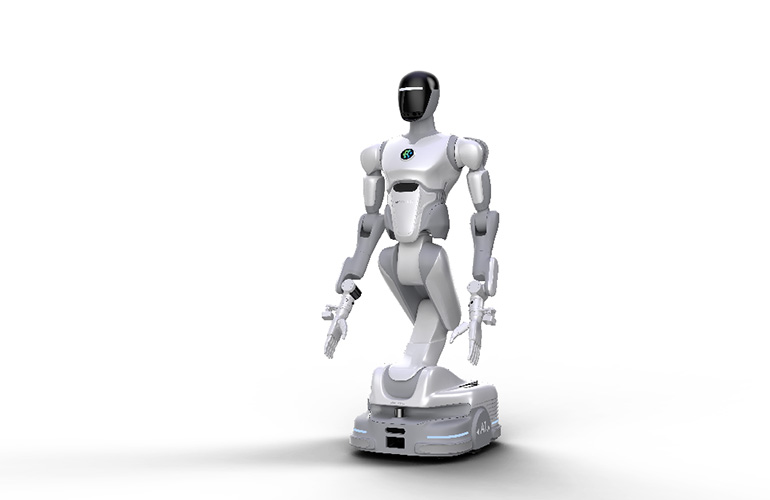
The plant mainly produces UBTECH’s Walker S and Cruzr robot series. Siemens Digital Industries Software also took part in building the smart factory.

The facility covers 14,000 square meters and stands 13.8 meters tall, with robots serving as both the products and the tools of production. On the production floor, smart industrial humanoid robots such as the Cruzr Y1 and Cruzr S2 handle unloading, stacking, loading and transport of materials. The final assembly stage uses collaborative robots that operate in step with human movement and needs, along with remote manipulators, automated guided vehicles (AGVs) and 360-degree rotating workbenches, allowing precise assembly from multiple angles in a single position. In quality inspection, each finished robot undergoes more than four hours of full-unit testing and must pass through an automotive-grade inspection tunnel for 360-degree exterior screening with no blind spots.

The company also independently developed what it says is the industry’s first fully automated three-dimensional warehouse, holding 112 robots in 65 square meters. That raises space utilization by more than 50% for the same floor area. Smart logistics made up of automated guided vehicles, unmanned forklifts and freight vehicles support the annual capacity of 10,000 units.

By realizing a manufacturing model in which robots build robots, the plant has moved beyond small-batch and pilot production of humanoid robots into a new stage of large-scale smart manufacturing, the company said. UBTECH pointed to China’s robust component supply chain as the reason it was able to build a large humanoid production line. Fang Jianxin, a UBTECH vice president, said in a recent interview with Global Times that “Chinese robots have already entered the global first tier. This foundation is rooted in the many engineers, scientists and application scenarios China has accumulated over the past 10 to 20 years, which has formed a very strong supply chain base, manufacturing capability and research and development capacity. In industrial applications, China also stands at the forefront because it has the richest range of scenarios.” The vice president added that “mass production cannot be separated from the support of China’s supply chain,” stressing that “without China’s supply chain, mass-producing complex components would be extremely difficult unless you completely gave up your cost advantage.”

China’s output of industrial robots is rising sharply. According to the National Bureau of Statistics of China, output reached 98,677 units in July, up 30.2% from a year earlier. Production from January through July totaled 635,056 units, up 28.5% year-on-year.

Beyond production, the buildout of data infrastructure for training robots is also accelerating. Global Times reported that RoboMIND, an open-source dataset released last December by the Beijing Innovation Center for Humanoid Robotics, had surpassed 20 million cumulative downloads worldwide as of the 2nd. RoboMIND includes more than 300,000 motion trajectories of robots manipulating objects with both arms and data from more than 700 tasks performed in real-world settings.

The Beijing center also runs a large training facility of about 6,000 square meters for this purpose. It reproduces more than 30 real-world environments, including homes, retail stores, industrial sites and medical settings, and collects data using more than 150 robots and 40 robot configurations. The center said it has supplied about 30,000 hours of high-quality data to outside companies and research institutions so far.

0

Inside China’s robot-filled ‘dark factories’

preview

Great short vid on the future of manufacturing. Some parts of this factory are almost entirely automated. In one section of the plant, automation replaced 500 workers.

Vid also talks about how China is rapidly expanding the use of robotics and automation in manufacturing. If that continues, it’ll make it even harder for American manufacturers and workers to compete on cost, speed, and production capacity.

Great short vid on the future of manufacturing. Some parts of this factory are almost entirely automated. In one section of the plant, automation replaced 500 workers.

Vid also talks about how China is rapidly expanding the use of robotics and automation in manufacturing. If that continues, it’ll make it even harder for American manufacturers and workers to compete on cost, speed, and production capacity.

0

Tate deploys 58 Hirebotics robot welders across multiple facilities

The Robot Report Tate deploys 58 Hirebotics cobot welders across multiple facilities - The Robot Report www.therobotreport.com
preview

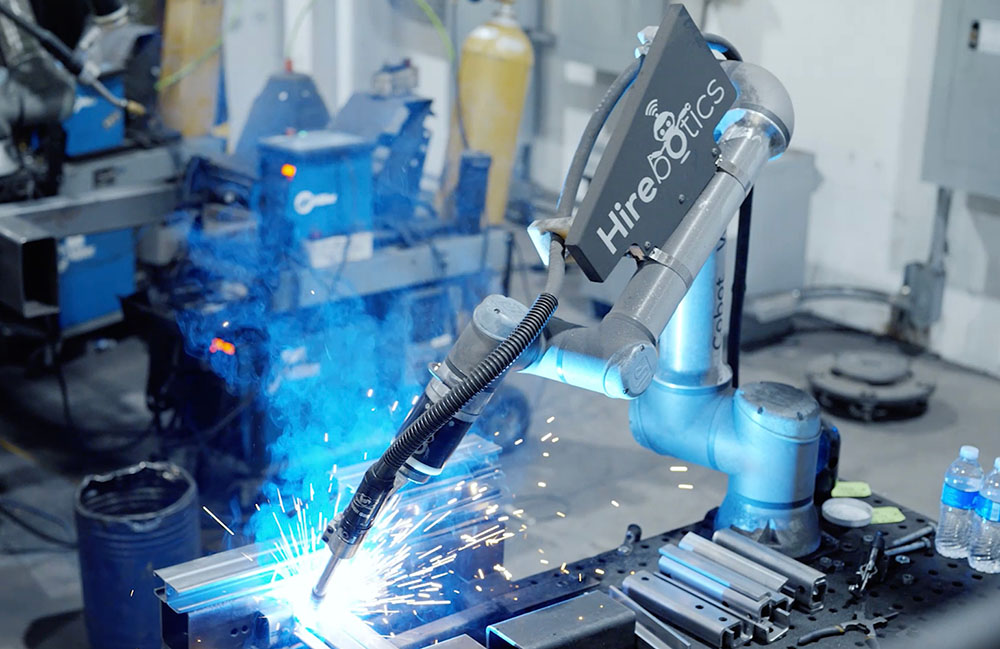
Hirebotics LLC last week announced that Tate Inc. has deployed 58 of its robotic welding systems. The data center infrastructure developer has deployed them across its manufacturing facilities in Arkansas, Virginia, and Kentucky.

For 120 years, Tate has supplied structural ceilings, containment systems, and airflow management products. The Columbia, Md.-based company now faces intense demand for large data centers and tight project timelines with zero tolerance for manufacturing errors.

Tate wanted to scale, but it didn’t want to lose out on precision. So, in 2024, it decided to transition from manual welding to an agile, cloud-connected automation network powered by Hirebotics and its cloud-based, no-code Beacon Pro control platform. Beacon Pro enables the company to program, run, and monitor the Cobot Welders from any smartphone or tablet.

Tate looked at about nine automation providers, according to Daniel Adams, director of sales at Hirebotics. He said a few factors contributed to Tate’s decision. First, when Tate brought specific parts to Hirebotics, the Nashville, Tenn.-based company‘s team was able to perform welds on the parts within 30 minutes of Tate’s arrival.

Next, ease of use was a top priority for Tate, said Abrams. The construction provider was able to program the robots while the Hirebotics team was still on site.

Finally, Hirebotics was willing to collaborate. Adams said the company worked closely with Tate to figure out how its process would change when it automated welding with force- and power-limited robot arms.

Hirebotics shipped Tate’s first two robots in September 2023. “Tate had pretty quick adoption,” Adams told The Robot Report. “They had a bunch of people on staff who had been welding by hand for their entire careers, but they were able to see the benefits to both the company and themselves.”

To train Tate’s employees, Hirebotics used a combination of self-training with tutorial videos and Hirebotics employees providing hands-on training onsite. It typically only took only 10 to 20 minutes to train the employees to use the robots, Adams said.

“The majority of users are surprised at how quickly they can become operational with the robot,” he recalled.

“It was a fantastic process to learn to manipulate not only the movements of the welder themselves, but [also] to control the amperage, the heat, and travel speed,” said Jonathon Cook, a cobot welding programmer at Tate. “We can manipulate and curate every single weld that we make here for Tate to be exactly how it’s supposed to be as by spec every single time. And that truly is a marvel within itself.”

In addition to traditional welding projects within all three facilities, Tate has pioneered a unique workflow in its Arkansas plant, where the cobot systems handle the upstream precision step of tacking and pre-assembling parts to feed downstream industrial robots. This helps to keep production moving at a steady pace.

Since implementing Hirebotics’ robots, Tate has reported a 12x increase in per-welder throughput on critical structural assemblies while simultaneously expanding its team of certified welders.

Tate also said the cobots eliminated costly rework caused by manual welder-to-welder variability. The team also encoded precision discipline directly into the Beacon Pro software. Certified programmers dial in exact torch angles and travel speeds, which enables floor operators to execute perfect welds with confidence.

With automation, Tate said its facilities operate as a single, unified ecosystem, sharing weld programs, parameters and enhanced playlists across company facilities in real time. This guarantees consistent production standards nationwide, Tate said.

“No production components are hand-welded anymore,” Adams said. “The consistency, quality, and speed improved significantly after installing the cobots. Previously, they had some quality issues with hand welding that led them to require automation. The flexibility of the cobots allows them to automate all their welding and get consistent parts.”

Having worked with the Cobot Welder for two years across these three facilities, Tate also has become one of the first operations to deploy Hirebotics’ new Cobot Painter. This system uses the same platform, role-based access, and operators with a new cobot also powered by the Beacon Pro platform.