showing posts tagged #roguelikedev — clear

0

FAQ Fridays #2: Development Tools

preview

Welcome to the revival of RoguelikeDev’s FAQ Friday, now on the Fediverse!

The purpose for this event is for traditional roguelike developers to discuss design philosophy and share their technical insights and methods as well as field questions related to the topic.


Development Tools

Last week we already covered languages and libraries, but before we move into discussing details like programming and design there is another important “meta” element of roguelike development to cover: Tools.

Any type of game development will involve using multiple types of software. Beyond the compiler, at the very least you’ll have a text editor, and possibly an IDE. On top of those you could have any number of other tools depending on your features, assets, workflow, etc.

Using the right tools is crucial to staying productive and efficiently creating something as complex as a game. Sometimes you even have to build your own custom tool for a specific task, because using what’s available just isn’t efficient enough.

What kind of publicly available tools do you use to develop your roguelike(s)? What for? Have you built any of your own tools? And if so, what do they do?

Don’t forget to mention anything that you use in a particularly interesting or unusual way!


Original FAQ’s on Reddit

0

FAQ Fridays #1: Languages and Libraries

preview

Welcome to the revival of RoguelikeDev’s FAQ Friday, now on the Fediverse!

The purpose for this event is for traditional roguelike developers to discuss design philosophy and share their technical insights and methods as well as field questions related to the topic.

This was a popular event on Reddit and with the current state of things I thought it would be a good idea to bring it here in order to better preserve these discussions.


Languages and Libraries

We’ll naturally start with one of the first and most basic questions you have to consider:

What languages and libraries are you using to build your current roguelike? Why did you choose them? How have they been particularly useful, or not so useful?

Python still has some of the best onboarding for developing a roguelike from scratch, especially when combined with libtcod’s standard set of tools. After 9 years since the last time this was asked there have been more modern languages becoming mature and new game engines to work with.


Original FAQ’s on Reddit

0

Golem: A Self-Made Person! Alpha 1 out now!

preview

Golem: A Self-Made Person! is a traditional roguelike with a twist. In it, you slay enemies and incorporate their parts to your own body.

Golem is made with Python, using pygame and Pygcurse. I’m not following any tutorial or using any premade roguelike library, so it’s mostly made from scratch.

Try the alpha version now.

0

A modern C++ and (somewhat) generic roguelike

GitHub GitHub - SuperFola/pataro: A generic and modular Roguelike game on top of libtcod - I'll be back soon, just need a break! github.com
preview

Two years ago I started to follow RogueBasin’s roguelike C++ tutorial, a somewhat outdated tutorial in term of good practices and C++ version, but very on point in term of roguelikes.

My goal when I started Pataro what quite ambitious: I wanted to make a modern C++ roguelike from the tutorial, and write an updated version of said tutorial to help the community! Even better (or worse, in term of choosing your goals) I thought I could make a modern C++ roguelike library for people to use.

I got the first 9 parts of the tutorial working pretty smoothly, having set up an architecture inspired by Bob Nystrom about game architecture with roguelikes in mind (great talk by the way: www.youtube.com/watch?v=JxI3Eu5DPwE). Then I got to a big hurdle: saving and loading. Having used a lot of polymorphism, it makes quite hard to load correctly things and I stopped there.

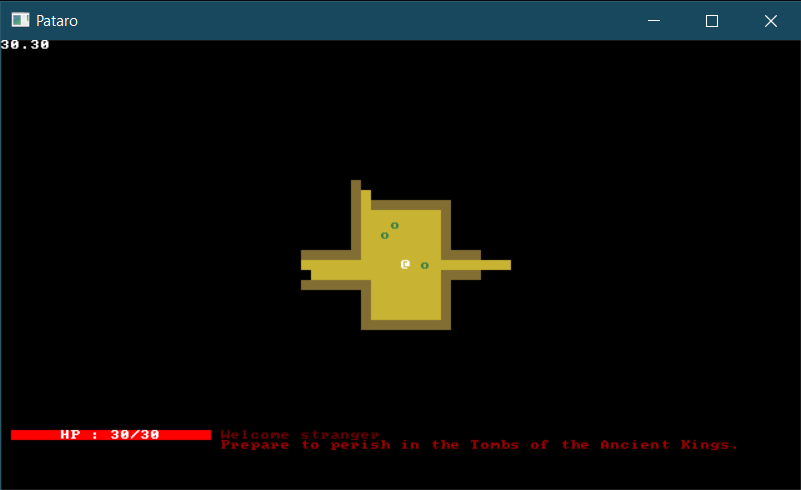
progress as of june 2021

Then a few weeks ago, I picked up the project again, with a much lower set of goals in mind:

  • finishing to implement the tutorial from RogueBasin
  • ease the configuration of the project, so that people can pick parts of it or just make a roguelike from it
  • fix a bunch of problems related to the map and how it is used to be able to extend it and modify it (imagine being able to have spells that could alter the map)
  • rearchitecture a few more things because it’s still very rough on the edges
  • modernize the C++ code (again)

Progress as of july 2023

0

Roguelike Celebration Call for Proposals Extended to July 15!

Roguelike Celebration Call for Proposals Extended to July 15! buttondown.email
preview

Calls for talk submissions are open for two more weeks for October’s event.

Recommend diving through previous year’s events for some really interesting talks and presentations. www.roguelike.club

Calls for talk submissions are open for two more weeks for October’s event.

Recommend diving through previous year’s events for some really interesting talks and presentations. www.roguelike.club

0

Welcome to /c/roguelikedev!

preview

Welcome to the roguelikedev community on programming.dev. I’m still figuring things out.

Feel free to share progress on current projects, ask technical questions, and talk about your expectations of this community.

Welcome to the roguelikedev community on programming.dev. I’m still figuring things out.

Feel free to share progress on current projects, ask technical questions, and talk about your expectations of this community.