0

A coordinate system for a tidally locked planet

preview

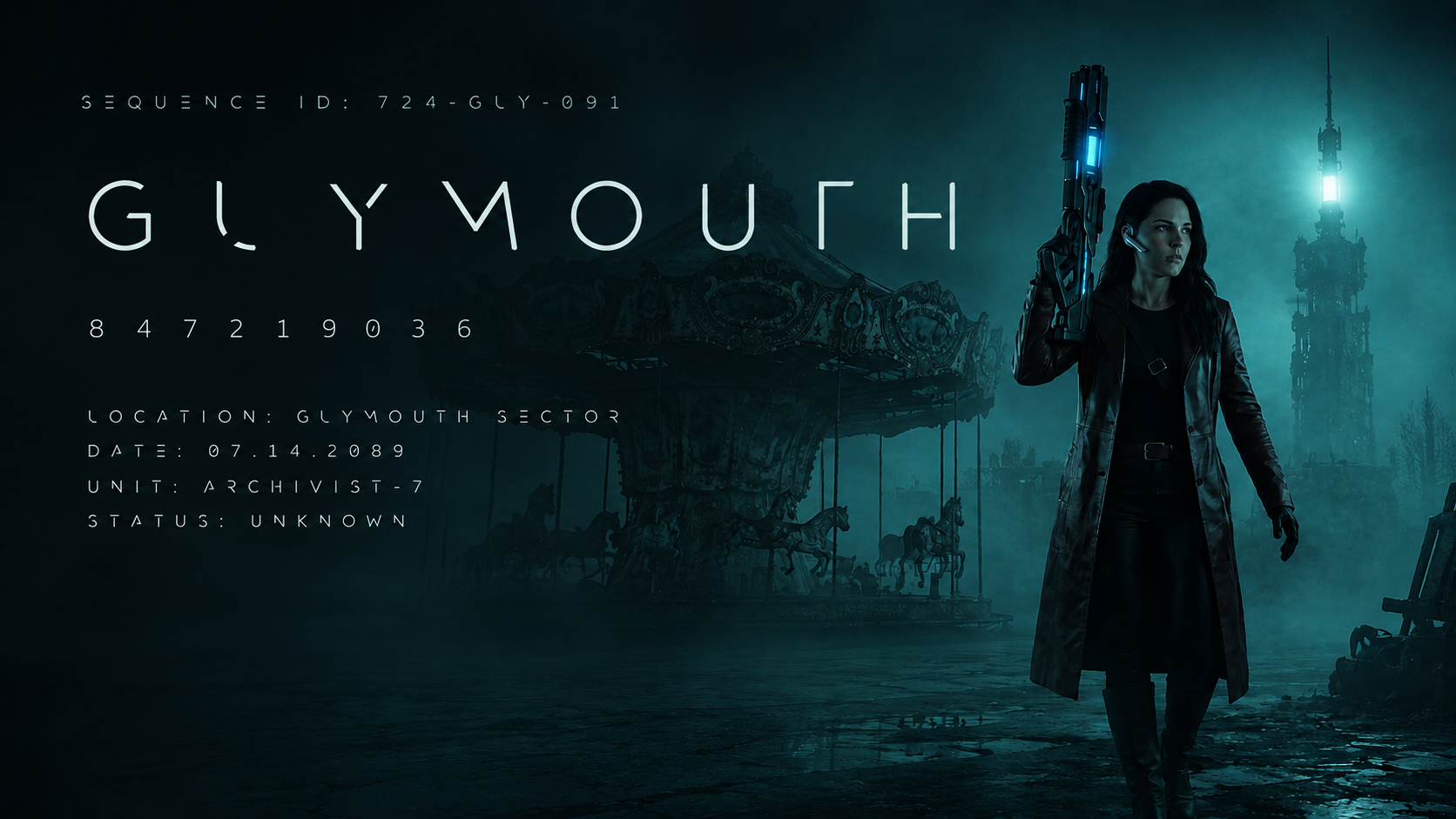
Without a natural magnetic field and with such a slow rotation rate, the “equator” is the grayline and the “poles” are the substellar point and its corresponding antipode.

Some related notes on vulpithecine mathematics: Angles don’t use degrees but duodecimal fractions of a full circle (tau). Historically, yinrih had no words for ‘north’ and ‘south’ but only ‘toward the equator’ and ‘away from the equator’. This is still the case in at least Commonthroat. Hearthsider, being the language spoken on the planet pictured, likely uses ‘sunward’ and such.

Travelers who get lost in the Nightless Desert surrounding the substellar point are told to measure the elevation of the sun, which will tell them their latitude. Alternatively, that their shadow points to the green belt surrounding the terminator. Practically though, your best bet if you get lost out there is to either look for one of the many monasteries dotted across the desert, or failing that, find and sever a long-haul data cable and wait for the repair crew.

0

A couple of military roles in my fictional planet

preview

On the planet Ikra, the Democratic Republic of Zolphir (DRZ) boasts the most military might.

The DRZ, with their Greenlight Legion, is officially stated to have three noble principles: safety on every border, freedom for the helpless, and innovation beyond the flesh.

The Greenlight Legion is made up of volunteer troops and indentured servants who gave their bodies to the machine; the machine that makes weapons out of their bodies.

The greenlights, with their weapons ready, march in drone-like fashion and employ a strength through numbers tactic, painting the enemy’s horizon green from the glow of their visors.

Clad in comfortable robes with a simple protective vest, the officers rarely see frontline combat alongside infantries. They are mostly found giving orders from either the command bridge of an elite vehicle or a settlement outpost. Whether they’re a captain or an admiral, they wear standardized uniforms that keep their exact ranks classified. This means that when targeting officers, even one still standing could turn out to be the one that has the most warfare at their disposal. Closely observing their patterns and commanding signals is strongly advised before deciding who to take out first.

Within the cockpits of trucks, tanks, turrets, drone transports, or sand trains, the driver unit operates any ground assault machinery. Although they work closely with infantry and often see frontline battle, their armor is among the cheapest and least comfortable in the ranks. It is built only to survive basic crashes, the crudely-welded helmet’s protection being especially poor. A driver is typically expected to use their vehicle as their protection, and to remain in it at all times, even if the air inside it heats up. Being sent to drive the tank is often a punishment given to troops that perform poorly on foot. What started as vastly underfunded safety and comfort inside vehicles is now a discipline that officers swear by as motivation for soldiers to power through even the least bearable terrain.

0

I'm working on a small fictional country that might be good for money launderers. How would this affect its relations with other countries? (please click for details)

preview

The country is small:

It’s less than 10 000 sq km in area, has fewer than 1 million people, and GDP less than about US$50 billion. It might have a coast. It’s a liberal democracy, or at least mostly a liberal democracy. It’s been independent for almost 100 years, attempts a strong neutrality, and is thus generally non-aligned.

I suppose the country’s currency is hard, or reasonably hard, enough that it can be freely exchanged.

In this country you can bring a gym bag with US$1 million (say 10 000 $100 bills) in or out of the country. There are banks there which you can deposit the money, and while they might be required to report this to the government, the government won’t tell the governments or other international organizations about it.

What would be the consequences for such in international relations?

Thank you.

0

Some random ideas plus an apology

preview

First, a bit of an apology. Up until August I was very active on here, then I deleted my account and nuked all my posts. I had to step away from my conworld, as I realized I was spending way, way too much time on it and not on creating IRL human connections that we need as a social species. I can’t say whether I’ll return to it, but for now it’s not looking likely.

I’ve casually referred to my worldbuiling project as being the result of maladaptive daydreaming, but I only recently actually looked into what that meant. It can hinder one’s day to day life, as I mentioned above, but it’s also addictive, and I was thoroughly hooked.

Anyway, here’s an unrelated random wolrldbuilding idea I had that may end up in an SCP-esque setting that I’m starting to practice technical writing for my job.


Maslovine

Maslovine is a white, crystalline powder that when ingested, usually in pill form, causes the subject to feel as though their physiological desires are completely satisfied. It has extreme anorectic and anaphrodisiac effects. It completely eliminates the sensation of thirst and desire for sleep as well. However, it does not remove the physiological need to eat or sleep, merely the desire to do so. Human subjects report a feeling of complete and total satiation. It is also a potent painkiller.

While the drug is not a euphoriant or hallucinogen, it is nevertheless highly addictive, and addiction universally results in death from thirst, hunger, or lack of sleep. Subjects’ reported feelings of satiation and contentment persist until death, with none of the negative effects of sleep deprivation.

0

Bronze Age Weaponry

preview

Hi, I’m new and I’ve been working on a medieval-esque setting inspired by Pokémon. I decided to go into the history of the world before expanding the regions I already have.

I have this section under the Bronze Age,

“The Bronze Age also brought the peak of new weaponry: the crossbow and the sword — two types of swords, actually. The crossbow was invented toward the end of the Bronze Age, at ~3,350 BE, meaning it was in use for about 150 years before the Iron Age. These were not true crossbows, as they required two people to man it, so it was technically a bowgun. The majority of the gun was wooden, with bronze-reinforced limbs. The Bearer would hold up the front of the crossbow and carry bolts, putting them in the barrel. The Gunman would notch the bolt onto the rope, crank to load, turn the stock to aim, and pull the trigger to fire,”

and I was wondering if the bowgun seemed too complicated to understand without visuals or if it was just unrealistic. I know the actual crossbow was invented in the Iron Age.

Btw, “bow” means a handheld projectile weapon, like a bow, sling, crossbow, etc; “gun” means a larger or mechanically powered missile weapon, like the catapult, ballista, cannon, etc.

0

I've been trying to make a fictional country at least a little more realistic. Mainly, should it be an island, landlocked, or be on the mainland with a coast?

preview

One rule of mine I’m sticking to:

at least to a point, smaller is more realistic, and is thus better.

A fictional country that’s, say, over 1 million sq km in size and has over 50 million people will be harder to put into the real world than a country that’s 1% of each (i.e. 10 000 sq km and 500 000 people)

​

This country has a unique name (kinda expected).

I don’t want it to make people think of countries of a particular language, such as El Salvador (Spanish), Cape Verde (Portuguese), Austria (German), or New Zealand (English), with the attendant “I know [a notable world language] and such a country would stick out.” Thus I created the name of a fictional language that they speak. It has fewer than 1 million speakers and is unlike other languages.

The country is not only independent, but almost thumbs its nose at big powers (perhaps if Trump gave its president a call, the latter might reply with a “Not now, I’m busy. I’ll call you back when I have time.”).

For this reason it probably spends disproportionately more on defense and maybe 10% of the male population is in the country’s armed forces.

They are mostly a liberal democracy, and a republic, though can be socially conservative.

While the country can feed itself and has small industries, it’s not resource rich, and became prosperous relatively recently— perhaps starting in the 1980s.

​

Getting back to the question: Should it be an island, landlocked, or be on the mainland with a coast?

It seems to me that island nations are more noticeable. Perhaps more English-speakers have heard of Jamaica than Burundi, even though the later has 2.5x the area, 5x the population (though, to be fair, a fraction of Jamaica’s GDP).

Also it seems a lot of island nations tended to be former British colonies, and as such are probably beholden a bit to the United Kingdom, and its cousin, the US. If my character ran afoul with the US government (though he’s not a terrorist), he might be extradited with relative ease.

If the country was landlocked and either in, or near, the interior of the continent, it could be bigger with less notice, but it would be beholden to the country that surrounds it.

The problem of being sealed off is that when it develops its tertiary sector, the big neighbours might hinder it. One can’t have much of a tax haven, secret bank accounts, and/or mixed casinos and brothels where one can smoke marijuana legally, if the countries surrounding it restricts people from accessing the country, or block trade.

A compromise might be a mainline country with a coast, even if it accounted for a fraction of its border. It might have a corridor to the bulk of the country, though I’m not sure if the neighbours would have allowed such during its formation. I’ve also thought of air corridors, but aside of the wp:West Berlin Air Corridor, I know of no others, and I don’t know how such a corridor could be maintained without big power help.

​

Suggestions and thoughts?

Thank you. 🙂

0

Am I getting too convoluted with writing lore? (explanation in post)

preview

So, here’s the thing. I have this setting I’ve been working on for years now. And the setting ended up with almost 5000 years of extensive lore, and you need to be familiar with several different philosophies and cultures to understand any of it. I was trying to come up with some names for characters in a story I am writing in said setting. And when I was researching how names and languages change I was struck with a thought. Am I overcomplicating this? Do I really need an explanation why there is a guy named “Al Banian” and why the name is actually a remnant from a completely different reality? I’m getting to the point where the lore is so complex it starts to sound stupid if you don’t know all the details. Case and point, a guy named “Al Banian”.

Another example. There are several creation myths, and three of them are technically correct.

I need some advice. Feel free to ask questions.

0

What's a trust building activity for your non-human species?

preview

For instance, cats are known to like the slow blink as it shows a trust that the other person doesn’t need to watched constantly.

What does your species do that is the equivalent?

For instance, cats are known to like the slow blink as it shows a trust that the other person doesn’t need to watched constantly.

What does your species do that is the equivalent?

0

Starheist

preview

Captain’s Log

They say all the stars are gone. All at once, whatever that means. Every star in the galaxy, perhaps in the universe, had disappeared with a barely detectable gravitational blip. Confirmed by multiple sources by now. The ansible networks were all overloaded, as everyone started shouting all at once. It’s been eleven days since, and we’ve only just started to get some usable signal from the ansible. One signal claiming it was an interdimensional theft and that they have proof. I guess we’ll see.

We’re setting up a makeshift gravitometer, one of the priority broadcasts urged everyone to try to help capture data on the gravity blips, see if we can figure out what happened. They say time is of the essence. I’ll say. The crew seemed glad to have something to do. None of us can really build instruments so everyone’s best guess is what we’ll end up with. Better to keep the mind off things for a bit.

I can see the storm coming, but it won’t be here for a while. Right now it’s just waiting to get to the planet. We haven’t heard much from them since they lost sunlight. We don’t really know what to expect, and no one feels the urge to voice their speculation. We’re still fourteen days from orbit. Four before we start to resolve radio chatter about the event. Before we hear them start to understand. I don’t know what we’ll do when we get there. Take refugees?

Take them where?

0

The Second Speakers

preview

Eventually humanity discovers a cetacean henge: an arrangement of stones and other objects on the ocean floor that form the written language we’ll come to know as Cetacean. Once we identify one, we’ll quickly identify others. Papers will be written about how cetaceans make regular journeys across the globe, reading the stones to their young, teaching them to read the stones in turn. Some routes are crowded with pods all making the same circuit, some pods have their own unique route. Some pods only know of one site, or none. Some sites are unique to one species, or even one pod; others are common destinations for multiple species of cetacean.

We’ll learn to read them, and learning the written will help us translate spoken Cetacean, and suddenly the music of the whales will have lyrics.

0

How would I make my fictional country's currency viable? I've come up with an idea, but I'll appreciate comments and ideas. (ty)

preview

The country is small.

It’s between 1000 sq km to 50 000 sq km in size.

It’s has between 100 000 and 1 million people.

Its GDP is over US$10 billion (2026).

FWIW, it’s multicultural with several official languages (most are officially secondary).

It got its independence between WWI and WWII.

There might have been a “Great Leader” in the past who lead at most a semi-authoritarian government (but little, if any, blood was spilled), but for the past few decades it’s been a liberal democracy, though a little socially conservative (e.g. LGBTQ are legal, but can be discriminated against in the private sector; medicinal marijuana is allowed; prostitution is allowed in certain areas; feminism exist, but in the same way it exist in, say, Utah, Texas, Alabama, or (the State of) Mississippi).

​

rules, if you will:

  1. The currency was and is completely fiat—never backed by anything, such as gold or silver.

  2. Since the country’s creation it hasn’t excessively inflated the currency.

  3. There have been series of currency bills/notes, and I suppose some coins too, that have been de-monetized, though mostly to deal with counterfeiters in the early days.

  4. The currency is (I think the term is “free floating”). There is an official government exchange rate in the banks, but you can now, as you could for most, or perhaps all, of the country’s history, buy it at free market prices even in the country.

  5. As the UK pound (£1), euro (€1), and now the Swiss franc (1 CHF) are each worth more than the USD (in 1971 it was US$1 ≈ 4 CHF, in the 1980s, US$1 ≈ 3 CHF, now it’s almost US$1 ≈ 0.8 CHF) so has, in the past few years, this country’s currency base unit become greater than US$1.

​

Thank you.

0

Time and date in interplanetary civilization

preview

If humans one day conquer all of our solar system we might have settlements not just on Mars and Earth, but also in orbit of Venus or Mercury, and on the moons of the gas planets, like Jupiter’s Europa. Each of those has a different length of day and year.

How would an interplanetary civilization find a common date and time system?

I assume each planet gets it’s own local time, but I think a common date-time system would be usefull.

Also I don’t like to just say, earth is human kinds origin, so it’s time is the standard. Feels lazy.

0

Question for scifi worldbuilding: could Nuclear Thermal Rockets have higher thrust?

preview

NERVA has about 250 kN of thrust at 841 seconds of specific impulse.
Merlin 1D has about 1000 kN of thrust at 311 seconds of specific impulse.
That suggests NTRs have around 4x less thrust, but around 2.7z more efficiency than chemical rockets. At a large enough scale craft, the weight of the engine could be considered irrelevant. But for smaller crafts, the Merlin has a thrust to weight ratio of 184:1, whereas NTRs only ever achieved 7:1 (they hoped to get up to around 35:1 eventually).

I imagine the thrust to weight could be substantially improved by making lightweight reactors, but I’m wondering if anybody knows anything about concepts for higher thrust NTRs?

en.wikipedia.org/wiki/NERVA
en.wikipedia.org/wiki/SpaceX_Merlin

0

Descending into the dark lore of Veduora: A post-apocalyptic subterranean narrative experience.

preview

Something is moving far beneath the dead surface.

Veduora is an immersive, dark sci-fi worldbuilding project told through isolated logs, brutalist industrial decay, and suffocating atmospheric ambient soundscapes.

If you love rich, slow-burn narratives and dark subterranean exploration, step into the transmission.

What secrets are hidden in the dark sectors?

youtu.be/rqETagwBvyY

0

blood sun

preview

Gold and silver — since ancient times, humanity has pursued them. Greed, bloodshed, and other instincts rise from the hearts of men — until they reach their peak at the Age of Discovery.

In 1492, Columbus reached the New World. Over the next thirty years, Spaniards, Portuguese, French, and Englishmen poured into that land. They brought back gold, spices, timber and everything that could be packed into a ship’s hold.

But in the shadows, a pair of eyes had always been watching.

When the frenzy of the New World traveled back to Europe, those eyes were no longer content with merely watching. They were ready to crawl out and orchestrate the greatest manipulation in history.

  1. Magellan survived his battle in the Philippines and was carried back to Spain by his loyal crew. He had completed the first circumnavigation. He was hailed as a hero.

But in Spain, there was one man who did not agree.

His name was Reyes de la Plata — known as the “Silver King,” or simply “the Boss.” He claimed to have been a crew member on Columbus’s ship thirty years earlier. No one could confirm it, but everyone was willing to believe — after all, who would refuse a generous patron who provided ships and equipment?

When Magellan’s battered ship sailed into port, the Silver King pointed at it and said:

“I don’t like him. He’s not under my control. He’s directly funded by the Crown. His discoveries will break my monopoly.”

He ordered a complaint to be sent to the Inquisition.

Magellan was arrested. In his cell, the Silver King offered him a deal: surrender all his manuscripts in exchange for his life. Magellan agreed but in open court, he recanted and denounced the collusion between the merchant and the Inquisition.

The Silver King said only one sentence to the judge:

“Your Honor, this heretic will not repent.”

Magellan was executed. His manuscripts were seized and delivered to the Silver King’s chambers.

Months later, in a church in Santiago, an archbishop dreamed that an angel stood before him and said:

“The one called the Silver King has another name in older texts — Mammon.”

But by then, it was already too late.

0

Free Medieval Village Name Generator for D&D, TTRPGs & Worldbuilding

preview

Choosing the right village name can make a medieval world feel much more authentic. Whether you’re writing a fantasy novel, creating a Dungeons & Dragons campaign, or building a game world, the name of a settlement often hints at its history, culture, and surroundings.

Many memorable medieval village names are inspired by forests, rivers, hills, local trades, or old languages. Even a simple name can give readers a strong sense of place and make a fictional world feel more believable.

If you’re looking for ideas, this medieval village name tool offers a collection of unique names that can spark inspiration for your next project.

What are your favorite methods for creating medieval settlement names? Do you build them from historical influences, or do you prefer using name generators as a starting point?

0

How do you handle elevated areas in maps?

preview

My world doesn’t have many mountain ranges in a way that’s easy to draw. Rather, the whole center of the continent is raised like one big mountain island.^1^

I’m drawing a map of an area about 200x219 km, to give an idea of the scale i’m working with, ranging in height from sea level to about 50km above that.

Single mountains or mountain ranges like the ones in the maps in The Lord of the Rings aren’t too hard, but when one side of a mountain covers the entire map i don’t know how to show that.

A map of Oz on Wikipedia has little hair-like lines to show elevation at Happy Valley (bottom left). Is there any other strategy for showing height differences on this scale?


^1^ This is because instead of tectonic plates, it has something like geophysical cooling that forms mountains. I won’t get into that just now.

0

[Map] Zeogard - Bioluminescent Island

preview

One of the three islands nestled in the outer seas of Tanzanite. Zeogard is a mysterious island nestled further south of the continent.

The environment is a large, bioluminescent mushroom land where it’s more or less permanently nighttime. You’ll know your close when it suddenly shifts to the dark. Best be careful wandering around carelessly if you can’t handle shrooms.

Species include Spore Spiders and the Kiwisee; which are giant Kiwi Birds that roam the land. Not many major factions originate from here but there’s some native life like crabs that blend in with the shroom caps and anthropormorphic flightless birds.

0

I'm a new GM to Pathfinder 2e. The lore is incredible!

preview

I’ve recently made a bunch of friends interested in playing Pathfinder 2e, so I’m building a custom 1hr One-Shot for 6 players to learn the game (yes I know that time is a lie). The lore is amazing! It’s got roughly 8 thousand years of history to create the current world of Golarion. The history is deep and rich, and some of that is because it’s based on real world cultures and histories. There’s obviously fantasy too, but a lot of nations and empires mimic real history, so it’s very believable.

I’ve recently made a bunch of friends interested in playing Pathfinder 2e, so I’m building a custom 1hr One-Shot for 6 players to learn the game (yes I know that time is a lie). The lore is amazing! It’s got roughly 8 thousand years of history to create the current world of Golarion. The history is deep and rich, and some of that is because it’s based on real world cultures and histories. There’s obviously fantasy too, but a lot of nations and empires mimic real history, so it’s very believable.

0

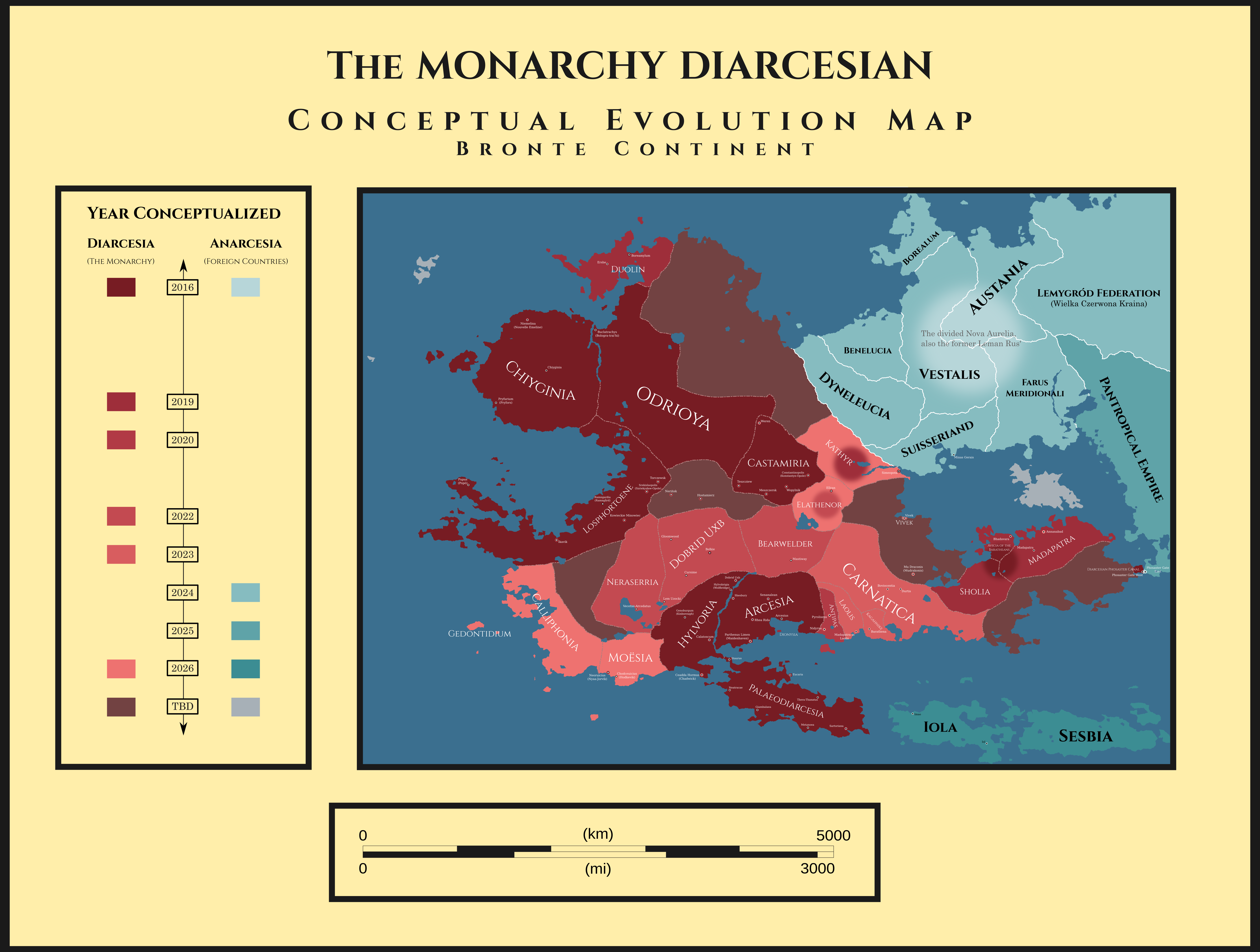
Out-of-universe map showing ten years of building Diarcesia's administrative divisions and neighbors. Ask me anything!

preview

Context: Diarcesia is a fictional nation project started on 2016 in the NationStates website with this premise — starting with a Greco-Roman cultural concept and deferring details until you need it/are sufficiently inspired, how far can you go?

Ten years later, as shown in this map, I still have quite a bit to go, but I have also gone far since I began. A lot of what I’ve canonized wouldn’t have been possible if I decided to flesh concepts out at the beginning.

Lastly, ask me anything! I’m particularly interested if you’re able to spot the inspirations or references in the map!

Another entry in the same universe: the Nankrai Archipelago

Co-op Credits

Andrenade - Neraserria (land of the Nerra)

Delmonte - Dionysia (island leased to Delmonte)

0

Tidbit about The Elder Scrolls IV: Oblivion - On Patrick Stewart playing as Uriel Septim

Tumblr Post by @loreweaver-universe www.tumblr.com
preview

One of my favorite tidbits about Oblivion is that, when Bethesda brought Patrick Stewart in to play Uriel Septim, they gave him this big 90-page booklet detailing the character’s history and background and motivations, and they were really worried that they’d gone overboard and given him too much. Meanwhile, Stewart was delighted–he’s said that it was the best character prep he’d ever been given, and he wished more people would do that.

One of my favorite tidbits about Oblivion is that, when Bethesda brought Patrick Stewart in to play Uriel Septim, they gave him this big 90-page booklet detailing the character’s history and background and motivations, and they were really worried that they’d gone overboard and given him too much. Meanwhile, Stewart was delighted–he’s said that it was the best character prep he’d ever been given, and he wished more people would do that.

0

IE, the Interstellar Era

preview

Introduction…

Humanity has built an interstellar civilization based on the replication of technological artifacts of the Xenoculture, an extinct alien civilization. Interstellar travel is achieved through the “x-engine”. The first x-engine jump occurred in 1138 IE (Interstellar Era)

The wealthiest, most populated systems in the galaxy are the seven Primate Worlds. The highest among these is the planet Andar, a temperate world whose landmass is concentrated into one massive supercontinent. These are the other six Primate Worlds…

  • Kasika: Considered the closest to nature, they are the most highly developed in the areas of environmental conservation and renewable technology.
  • Njorde: The youngest of the Primate Worlds, theirs is a frontier-oriented culture of quiet toughness.
  • Mavaros: The most martial and stratified society in the Primate Worlds. The military and police are integral parts of their government and social structure, with conscription as a long-standing policy. Forced labor is a common form of punishment and gladiatorial combat is their preferred sport.
  • Chandora: Their culture is based around the study of cosmic cycles and ancestor worship.
  • Shuiya: Their society prizes technological advancement and the experimental ethic, as evidenced by their development of the x-engine.
  • Anlel: Seen as the most radical of the Primate Worlds, they have produced many of the most renowned writers and other artists, as well as skilled jurists.

The Primate Worlds were settled by sleeper ship colonists. Eight massive arks departed the mysterious Planet Zero, the homeworld of humanity, in 1 IE. These escapees were the last survivors of an apocalyptic event. The various Primate World cultures have different accounts of what doomed Planet Zero and what the planet was even called. The seven Primate Worlds are all located in the galaxy’s First Quadrant. It was on these worlds that humans first encountered artifacts of the Xenoculture.

During the millennium of isolation from their peers, the people of the Primate Worlds developed physical adaptations to their new environments. Some developed stockier forms adapted to high gravity, others more graceful forms for low gravity, etc. Some people were also changed by their exposure to Xenoculture artifacts. Despite these changes the people of the Primate Worlds were still interfertile by the time they made contact after the development of the x-engine.

Long before humans left Planet Zero, the Xenoculture founded settlements on worlds throughout the galaxy. The galaxy is littered with their artifacts. It is estimated that they went extinct around 5000 BIE (Before the Interstellar Era). Speculation abounds as to what ended the Xenoculture. Some scientists theorize that multiple species composed the Xenoculture, while others surmise that extensive gene engineering wildly diversified their forms.

Xenoculture artifacts are often “alive”. They may generate fields with a variety of effects. One example is the refraction halo, which distorts the path of fast-moving projectiles within a certain volume. Combat in such a situation places a high premium on one’s melee fighting skills and equipment.

The Quadrants…

The galaxy is divided into five major regions…

  • First Quadrant
  • North Quadrant
  • South Quadrant
  • Lost Quadrant
  • Core Zone

The First Quadrant encompasses the galactic West. It is where humanity arose millennia ago, on the now-mythical Planet Zero. Political power and economic leverage extends far from the Primate Worlds, influencing events throughout the galaxy.

The North Quadrant is richer in heavy elements than the rest of the galaxy, the remnants of a particularly violent cluster of supernova bursts millions of years ago. As a result, industrial operations dot this region.

The South Quadrant contains worlds that are the most pristine, with the least development by human industry or contact with the Xenoculture. Biodiversity is at its prime here, as evidenced by the existence of Loth: the site of the most prized trophy hunting creatures in the galaxy. Another such lush world is Rishma, the source of the galaxy’s most exquisite fabrics.

The Lost Quadrant encompasses the galactic East. is a large swathe of the galaxy full of hazardous anomalies like high-energy radiation belts and rogue nanite swarms. It is likely that these phenomena are leftovers from whatever destroyed the Xenoculture. There are no known worlds harboring multicellular life in this Quadrant. The largest expeditionary fleet ever fielded for exploring this region was turned back in 1781 IE after many of their ships were consumed by metal-eating lifeforms known as the feraxen.

The Core Zone is bordered by all four Quadrants. At its center lies Titantua, the galaxy’s supermassive black hole. The high density of star systems in this region means interstellar travel times are on average much shorter than in the Quadrants. As a result the Core Zone systems have frequently changed hands throughout galactic history.

Large stretches of galactic history revolve around the expansion of Primate Worlders into the various Quadrants, punctuated by periods of redivisional warfare for the interstellar spoils.

The Sectrons…

There is a reclusive faction of sentient machines called the Sectrons. They were created by a group of scientists in 2048 IE to serve humans as a labor force. The scientists then decided to purge them because they showed signs of sapience in the 2090s. By 2160 IE, all Sectrons who survived the Discontinuation fled to distant sectors of space in the Core Zone. In more recent years they have branched out to worlds in the Lost Quadrant, beyond the easy reach of humans. As mechanical lifeforms, the Sectrons are uniquely resilient against the Lost Quadrant’s dangers.

Some Sectron worlds are host to populations of humans who have elected to have their brains placed into life-sustaining vats as the culmination of many years of enlightenment training. Known as the Ascensionists, they are something between a monastic order and an ambassadorial corps.

The Ravelers…

The expansion of the Universe is a perpetual unraveling, a fabric that stretches at every point. Some people can sense the flow between every atom.

Most people are not sensitive to this because they have evolved to block out their awareness of this expansion. If one could perceive the flow, they would see their own cells drifting apart, the floor crawling under their feet, and air molecules slipping away into the distance. They would be driven to madness.

The brain has developed a neural dampener that blocks this sensation automatically. It is like ignoring the blind spot in your vision or the feeling of your own tongue.

There are ways to pass through the inner firewall. Different organizations use different techniques but it typically requires years of meditation, sensory deprivation, and controlled exposure to cosmic radiation to recalibrate one’s neurology. Many who tried to do this have died or lost themselves in a waking nightmare of dissolution.

Those who pass typically have an unusually thin firewall, a high degree of psychological resilience, and privileged access to trainers. But this ability comes with the price of constant alertness. Maintaining the sense is like holding a muscle flexed indefinitely. One moment of distraction, be it from fear or complacency, and the barrier will shut again. It may take weeks of intensive re-sensitization to pass through again.

With sufficient attunement to the expansion of the Universe these “Ravelers” can temporarily direct the cosmic flow and effect superhuman abilities. Telekinesis, levitation, and illusionary apparitions are but a few of the strange manifestations of these individuals’ extraordinary powers. Ravelers are the subject of legends and rumors, often the target of persecution. It is known that they existed in a raw and unguided form on Planet Zero; some say these proto-Ravelers contributed to that world’s demise.

Sectrons, being non-biological, cannot become Ravelers. However their monastic allies the Ascensionists are famous for the strength of their raveling powers.

The most infamous Raveler in history was Jaredon, known to his enemies as the Mad Warlock. Claiming to be the reincarnated personification of the Xenoculture, Jaredon gathered a large mass of followers who looked up to him as a messianic figure. His greatest exercise of raveling powers was the creation of a new moon, Serina IV-K, out of the rings of a gas giant. This moon served as a base of operations held together by the sheer force of his will. He violently established his cult as a major power in galactic politics during the 24th century IE; interstellar travel throughout the North Quadrant was a hazardous proposition in this era. The Mad Warlock’s rule came to a sudden end in 2377 when he was assassinated by one of his many ex-lovers, triggering the disintegration of Serina IV-K into a debris field.

The fourth millennium…

The present date is 3134 IE.

The dominant power in the galaxy is the theocratic Andarian Kingdom, with its capital on the Primate World of Andar. There are outside powers that have varying relations with the Kingdom; chief among these are the privately-owned domains of Interworld Incorporated and the Sectron Autonomous Assembly.

The state religion of the Andarian Kingdom is a sect of the Demifaith known as the Ultimatum Brotherhood. The Brotherhood waged a bloody war against the Triadists, the founding sect of the Demifaith. Now the Triadists are all but extinct, their holistic and peaceful teachings corrupted by the power-hungry Brotherhood.

Power within the Andarian Kingdom is contested between the King, who derives his divine rulership rights from the Brotherhood, and the House of Worlds, a secular legislature composed of lawmakers from the settled systems throughout Kingdom space.

The largest corporation in the galaxy by revenue and employees is Interworld Incorporated. They own subsidiaries that provide nearly every good or service imaginable. Entire star systems have been purchased by Interworld executives and now operate like company towns. Unlike the zealously religious Kingdom, Interworld is known to do business with the Sectrons.

The most militant opposition to the Kingdom is the Allied Revolutionary Coalition (ARC), a network of urban councils, labor union representatives, dissident intellectuals, and militia groups. They were formed in response to the Brotherhood’s consolidation of power. Though various segments of ARC differ in finer ideological points, they share the goal of overthrowing the Kingdom and building a society beyond class divisions and private property. On more than one occasion ARC has fought against the extremist group known as Black Horizon, another faction which claims to oppose the rule of the Kingdom.

The Freewinders…

Another distinct culture is that of the Freewinders. They are the descendants of one of the eight sleeper ships that left Planet Zero. Unlike the other seven ships, these travelers found a world rendered uninhabitable by a cataclysmic volcanic eruption. They have since adapted to space-dwelling life and are the most noticeably distinct from baseline humans of all the sleeper ship descendants. They are playfully called Windies and derogatorily called Nonworlders.

They were chased out of the First Quadrant around 1500 IE and have since diversified into new branches in the North, South, and the Core. At various points throughout galactic history they were permitted to undertake pilgrimages to the Iton system, where they pay respects to the world that died to give them their way of life. The Freewinders live on the fringes of galactic society and face discrimination based on stereotypes.

0

What is a prominent leitmotif of your project?

preview

Mine’s the Eastern Roman Empire during the time of Justinian. The mixture of Greekness and Romanness of its society at the time is in a sweet spot according to my preferences.

Mine’s the Eastern Roman Empire during the time of Justinian. The mixture of Greekness and Romanness of its society at the time is in a sweet spot according to my preferences.

0

Descendant of CYCOL exploring the ruins on the planet Hestia.

preview

From the perspective of the outside universe, the planet Hestia experienced a brief solar eclipse only a few standard UCC years ago. From the perspective of those on the surface, thousands of years in darkness passed due a time dilation effect by the interaction between primordial crystals on the planet and moon.

A CYCOL military force that had been landed to harass the human colony was cut off. They developed a method to reproduce without a nodesphere, and their culture changed over the long timespan. Tranq is a distant descendant of the original CYCOL in the planet. Like all CYCOL, its brain is still entirely organic, but it doesn’t have a humanoid mechanical body that its distant ancestors had.

Tranq is shown here deep inside the ruins of the human colony, evading the attention of the post-human offshoot species that now haunts the old buildings.

0

Millions of years from now, the first octopus land expedition sets foot on land...

preview

and sees a fantastical, complicated world of machines devoid of humans.

Over the years, as human tools became increasingly able to self operate, humans themselves became a weak link to be optimized out. It happened slowly, the population dwindling due to the lack of value added by procreation. Eventually the last human died, and the machine chugged on: harvesting energy, collecting data, storing, managing, and trading inventory according to global market prices. The machinery tended to prioritize stability over growth, as the last human to touch each piece intended it to work the same way forever. Humans withdrew from every sector only when satisfied that it needed no further change, creating stable economic machines via evolution.

The internet still more or less functions, as different machines share and trade data according to their optimized calculations. Humans built a robust weather sensing system, and since accurate weather data is useful for power production, a tradition of sharing local sensor data freely evolved and grew to be a significant portion of internet traffic. The bulk of internet traffic is the energy market. An undercurrent of chatbots, their original targets long gone, exchange messages on a few forums in a continually evolving cat-and-mouse game with the bot detection bots.

Much of the farmland has been repurposed to solar panels as food demand fell (though not to zero: there are still a few auto-restaurants with working supply chains that eternally prepare food, then throw it away.), but vast swaths of wild areas remain, as most development agents won’t approve new buildings without clear legal approval. Clerical law bots handle low level legal questions, but any major questions get flagged for human review and remain eternally stuck unresolved. As a result, much of the area outside cities remained undeveloped. The world entered into a new biodiversity explosion as humanity receded from its colossal niche. These species have been assiduously documented by university bots with their swarms of tiny research vehicles, which are kept in good repair by the universities’ automated fab labs.

Our explorers gaze upon the not-ruins of this ancient civilization and wonder,

what happened?

0

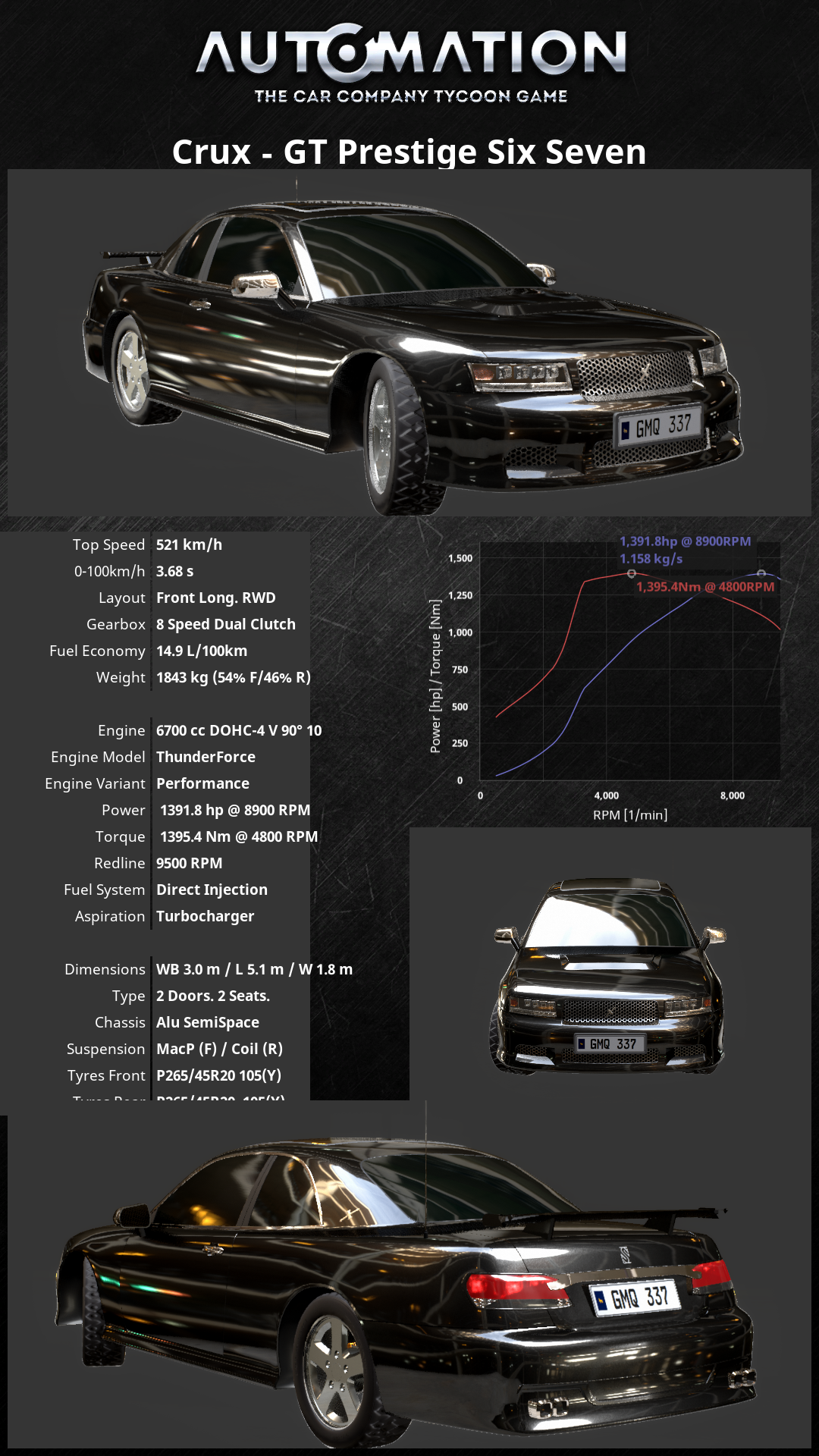
Pryfors Bilar (PB) Crux - GT Prestige Six Seven

preview

In production: 2022-

The GT Prestige Six Seven is the halo performance variant of the 2017-current generation of the PB Crux, the automaker’s staple full-size/F-segment car. Substituting the standard 2.6 V8 with a turbocharged V10 engine, the variant aims its sights on other supercars and is a nod to the V16-equipped PB Six Seven of the late 1960s. Like this historic model, the Crux GT Prestige Six Seven’s natural habitat is the speed-unrestricted motorways of Diarcesia.

0

An example of one of my sophonts writing system

preview

Vreem are a bug like sophont species roughly the size of a crow. I figured since they have crab claws they would have a hard time using cylindrical writing tools so I came up with a stamp like pen instead. This is an example of Khlhk one of many vreem languages in my setting. It uses a vertical script of lines and dots and is an agglutination heavy language, so an entire sentence or phrase is also a single word.

Also an example of some graffiti with a stylized version of the script.