#antiwork

posts tagged #antiwork

0

Wikipedia Turned on its Volunteers. Now it’s Coming for its Workers.

Youssuff Quips Wikipedia Turned on its Volunteers. Now it’s Coming for its Workers. www.quippd.com
preview

Crossposted from https://fedia.io/m/wikipedia@lemmy.world/t/4218790

TL;DR: In the last year, the Wikimedia Foundation has fired several union organizers, including those that worked on the Community Tech team - a team dedicated to building features for the volunteer community that edits Wikipedia.

As the Wiki Workers Union tries to get the Wikimedia Foundation to recognize their union, it is worth remembering that this is not the first time that the Foundation has worked against the community.

Wikimedia Enterprise is a betrayal of the volunteer movement community of Wikipedia editors, as the Wikimedia Foundation is providing privileged access to big tech AI companies to the Wikipedia corpus - a body of work that the Foundation does not own.

Movement volunteer communities contributed to Wikipedia under copyleft licenses - licenses that work to ensure that the work remains free (as in speech). The big tech AI companies do not license derivative works under copyleft licenses and often do not even attribute where the works came from.

This means that volunteers are working for big tech for free, and the Wikimedia Foundation is selling privileged access to that free labor.

It is against that backdrop that the current unionization struggle unfolds.

0

The state of the world is not okay.

preview

Add “being forced to find a job that doesn’t suit or fulfil you, because the employment system is flawed and a capitalist economy means people don’t get a choice.” Life itself is beautiful. But right now, everything claimed and monetised by beaurocrats and corporations, people having to indenture themselves in order to (pay money to a bunch of official bodies that demand they deserve it) to live, let alone live comfortably, is fucking wrong.

Side note, this meme should really say “someone else’s boss” or something because it’s against having one

0

Corporate profits, stock market spending, and your salary

preview

yourfairshare.info has data on 1,700+ publicly traded companies. Search your employer, or any US employer, and see how much profit they made per employee last year, and what your share would be if it were split evenly. There is also data on buybacks and dividends so you can see what employees could have gotten if the profits they worked to make went to them instead of the stock market (yeah yeah I’m aware many employees have some stock yeah yeah I’m aware most American households have at least some stock holdings, but the numbers are big dudes).

Some examples (profit per employee / buyback+dividend spend per employee):

  • Walmart: $10,425 / $7,428
  • Starbucks: $3,925 / $7,487
  • McDonald’s: $57,853 / $47,866
  • Target: $8,313 / $6,085
  • Home Depot: $29,653 / $19,372
  • FedEx: $8,792 / $5,216

Huh? Starbucks sent more to Wall St. than it made in profit? Yup, that’s legal in our system!

0

Corporate profits, stock market spending, and your salary

preview

yourfairshare.info has data on 1,700+ publicly traded companies. Search your employer, or any US employer, and see how much profit they made per employee last year, and what your share would be if it were split evenly. There is also data on buybacks and dividends so you can see what employees could have gotten if the profits they worked to make went to them instead of the stock market (yeah yeah I’m aware many employees have some stock yeah yeah I’m aware most American households have at least some stock holdings, but the numbers are big dudes).

Some examples (profit per employee / buyback+dividend spend per employee):

  • Walmart: $10,425 / $7,428
  • Starbucks: $3,925 / $7,487
  • Target: $8,313 / $6,085
  • Home Depot: $29,653 / $19,372
  • FedEx: $8,792 / $5,216

Huh? Starbucks sent more to Wall St. than it made in profit? Yup, that’s legal in our system!

0

On AI Usage

preview

cross-posted from: lemmy.zip/post/64009036

cross-posted from: lemmy.zip/post/64009035

cross-posted from: lemmy.zip/post/64007684

Introduction

The current socio-political discourse is dominated by a new divisive issue concerning “AI” - so called Artificial Intelligence. While some are vehemently opposed to the idea of AI infiltrating newer and newer aspects of life, some are convinced of its revolutionary transformative power. The question of AI usage in our project of The Brotherhood, has also been put into question and this essay will attempt to put my^[not everyone working on the project, just my own] perspective on it.


What even is “AI”

What is typically referred to as “AI”, is in the more technical corners, known as, LLMs, or Large Language Models. They are a new innovation^[still, pretty old, around 2017-18] in a long line of automation technology, going back to the mid-20th century, not long after the computer itself was starting to become a thing of utmost usefulness.

The long journey of automation

Actually, the computer itself can be seen as the first innovation in this automation technology. After all, the computer is a literal automatic computation^[and much more, of course!] machine, that uses some carefully arranged silicon and phosphorus to manipulate electron flows and deterministically execute some rigorously defined steps.
The idea to take this further and further, was always an ambition of early computer scientists. And as speed and size started getting accessible, effort was made for closer integration with humans. This was not a trivial task as the computer and the human spoke two different languages that might as well be from different universes. From punching cards, where programmers painstakingly “wrote” binary in a literal card to Fortran to programming languages to OS to GUIs and applications, we have made tools, for our tools, for our tools, in a seemingly endless recursion.
One biggest aspect that programmers got interested in, in the very late 20th century, was natural language processing, to further bridge the “language gap”. This is what enabled the early internet, through search engines. Now, this fundamentally differs in structure to previous tools. This is not deterministic, as language itself was not deterministic. So these tools relied on various statistical tools like N-grams, Markov Models, Bayesian inference etc.

The parallel research on Neural Networks

Around the same time, with the advent of neuroscience^[that replaced the previous psychological models of Freud, Jung and Lacan, which were indeed not suited for STEM fields], another curious line of research began with the perceptron.
Very much influenced from early neuroscience, it slowly split from its initial inspiration and drifted towards statistical science, rather than trying to follow the exact structure of brains. This too, went through its own series of innovations with neural networks, backpropagation, Hopfield networks, CNNs, LSTMs etc.
But two innovations were critical for the explosion of interest in this very niche field -

  1. Deep neural networks, that made use of the newly popular GPUs, back in the early 2010s
  2. Transformers, which was the topic of a now, legendary 2017 paper, titled, "Attention is All You Need.

In the early 2020s, it was realised, that these two can be combined and scaled up massively^[and I mean massively] to gain a general semantic understanding of general language. This is where the two paths collided. What started as experimental cognitive research at the intersection of neuroscience and computation, turned into a statistical method to give the computers an understanding of semantic language! Thus began the era of LLMs.

An LLM is simply a statistical model trained to have a general understanding of semantics!


So What’s All the Hype

What is True

The innovation, especially of GPUs and transformers are legit groundbreaking innovations that have broken a very long stall in their respective fields. And their combination to create LLMs are indeed a great engineering feat, even if not that innovative from a purely academic standpoint^[the massive scaling needed, is another level of brute-forcing. Think of the pyramids of Egypt - not as clever as it is awe-inspiring, simply due to scale].
And it is also true that this has opened up the pathway to some commercial usage in a way that was just not possible earlier. In a certain sense, it is an upgradation of the search engines with a powerful fuzzy semantic translator.
It is indeed a great addition to the coding landscape. Programming used to be 80% manual intellectual labour, where you had to go search for that one silly bug, or implement a very simple system for the 100th time. Now, a lot of this can be automated. However, to think, that this makes programming itself obsolete, is very naive. For most serious project, you still need to have great knowledge of computer science, but the entry to programming has been indeed lowered^[which is either very good news, or very disappointing, depending on how much you like to gatekeep your nerdy interests!]. Most serious programmers have simply become a senior software developer and have delegated the manual repetitive tasks to the “AI”, which can understand natural language and turn them into code it has seen before^[if it has been trained in it].

What is the “Bubble”

What remains in heavy doubt is the “efficiency” problem. It is yet very unclear as to whether Moore’s Law will come into play here and decrease costs as time passes by, or whether the architecture itself, despite its genuine innovations, is fundamentally limited. The big corporations are betting on the former.
Meanwhile some “tech-enthusiasts” have become a little too enthusiastic about the range of its applicability. The LLMs, like any sophisticated statistical model, requires massive amounts of structured data. In certain areas like day-to-day coding, or summaries, this is not that hard. However, in areas like robotics, it is still not a “done” job^[just getting structured data itself].
The more laughable matter is that some have put into esoteric questions of consciousness^[philosophical exploration of consciousness, is indeed possible, but requires a level of rigor and seriousness, that is missing from most such discussions] in this new light. This is in part, due to the specific ancestry it has, and mostly just due to human nature of “jumping the bandwagon”.


What About the Political Issues

Now we come to the most important point of this discourse. I will break it down into specific points that are frequently put to question.

The Environmental Hazards

As it now stands, the development and deployment of LLMs remain highly inefficient. But technology and development always comes at the expense of natural resources and equilibrium. The question is not of, whether it is ethical, but who controls/decides how much is sustainable^[moreover, the current climate crisis has already put adequate strain on these resources in a lot of places].
At this point, however, it stops being a environmental concern and starts being a political one. The neoliberals would indeed argue that the market would balance itself when resource scarcity starts being critical, whereas opponents might argue that state intervention is needed to prevent a calamity at all. But whatever the arguments remain about their ideal states, what is true, is that, the real world is none of those “ideal world” situations.
The neoliberal free market does not exist in its full glory, as most of the technological market is monopolised by a few corporations. The current global climate crisis, is a failure of the free-markets of the industrial and the post-industrial era. Whereas state intervention, remains, at best, ineffectual, and at worst, prone to lobbying by the same monopolised corporations.

The conclusion is that the control of such critical decisions, remain concentrated in the hands of a few oligarchs who are prone to taking risky decisions and making mistakes.

The Data “Theft”

It is not unknown that the data that the LLMs are trained on, are public data. However, the access to such LLMs remain out of the hands of the people whose data made it come to fruition. It is also clear that the current copyright laws are not built to handle such cases.
Close-sourced LLMs represent a new kind of injustice with no easy solutions. On one hand, making LLMs accessible to all, would exasperate the “hype-train” and worsen the environmental impact. Whereas, stopping research on such lucrative frontiers would be catastrophically conservative. And again, this comes down to control - control of how and where to gather source data and how to commercialise it. But as long as the monopolies exists, especially on the production of cutting-edge of LLMs, control remains firmly on the hands of the select-few.

The Unemployment Issues

The layoffs have been quite eye-catching, since it happened on high-class educated employees. But this is a constant byproduct of changing times and advancing technology, especially in automation. This can not be avoided without an aversion to technology itself^[which is hard to sell in the modern world!].
However, this never leads to humans not having “any work left to do” at all. No, jobs come and jobs go! But as the current landscape stands, it is indeed the case that many millions of people will get trampled under the changing times - people who have long pursued a high-profile job, only to lose their long-expected market volume or high-end salary.
This represents an utter failure of our social contract. The fact that technological progress comes at the cost of social cohesion, is a reflection of our embarrassing societal technology in comparison to our other feats^[such as engineering, or research, or industrialisation]. An automation, theoretically, should be a boon to the labour force, taking away manual labour, in place of far more interesting jobs and more time for recreation! But alas, instead it represents an existential threat to a substantial section of the population!

No society can last which has a structural opposition to technological progress. The societal technology needs to keep up!


So Where Is The Brotherhood’s Position on This

Now, The Brotherhood is NOT a monolithic entity. The different people in here, has significantly different positions on this^[the division is one of the reasons of this long essay]. However, I have been a significant part of this project from the start, and I can say what my position is, on this.
My philosophy is of pragmatism. One must keep the danger, very very close. The one who lives by the sword, dies by the sword. But one who forsakes the sword, lives under the sword! Currently, as it stands, “AI” is the brand new weapon, in this long warfare of control, of ideology, of dominance, as it always has been. But if the disenfranchised people needs to win, they can not afford to forsake the game. They can only win by playing the same game.
I have used AI IDEs very substantially to build the project - because I am not such a good programmer, and even if I were, I could not have done the entire project, alone, in such a short time. Now I know that this is not a replacement for actual skilled people, and in the best-case scenario, I never would have needed to use it too much. But unfortunately, reality is never perfect, and we had to do get by on what we could!
And that is my philosophy on AI usage. The rules of the game are no different, only the goals of the players and as long as we are working for a noble goal^[actually, we directly respond to that political problem of unemployment], we cannot compromise on not taking the best shot at victory!

The End Justifies The Means 🔥

cross-posted from: lemmy.zip/post/64009036

cross-posted from: lemmy.zip/post/64009035

cross-posted from: lemmy.zip/post/64007684

Introduction

The current socio-political discourse is dominated by a new divisive issue concerning “AI” - so called Artificial Intelligence. While some are vehemently opposed to the idea of AI infiltrating newer and newer aspects of life, some are convinced of its revolutionary transformative power. The question of AI usage in our project of The Brotherhood, has also been put into question and this essay will attempt to put my^[not everyone working on the project, just my own] perspective on it.


What even is “AI”

What is typically referred to as “AI”, is in the more technical corners, known as, LLMs, or Large Language Models. They are a new innovation^[still, pretty old, around 2017-18] in a long line of automation technology, going back to the mid-20th century, not long after the computer itself was starting to become a thing of utmost usefulness.

The long journey of automation

Actually, the computer itself can be seen as the first innovation in this automation technology. After all, the computer is a literal automatic computation^[and much more, of course!] machine, that uses some carefully arranged silicon and phosphorus to manipulate electron flows and deterministically execute some rigorously defined steps.
The idea to take this further and further, was always an ambition of early computer scientists. And as speed and size started getting accessible, effort was made for closer integration with humans. This was not a trivial task as the computer and the human spoke two different languages that might as well be from different universes. From punching cards, where programmers painstakingly “wrote” binary in a literal card to Fortran to programming languages to OS to GUIs and applications, we have made tools, for our tools, for our tools, in a seemingly endless recursion.
One biggest aspect that programmers got interested in, in the very late 20th century, was natural language processing, to further bridge the “language gap”. This is what enabled the early internet, through search engines. Now, this fundamentally differs in structure to previous tools. This is not deterministic, as language itself was not deterministic. So these tools relied on various statistical tools like N-grams, Markov Models, Bayesian inference etc.

The parallel research on Neural Networks

Around the same time, with the advent of neuroscience^[that replaced the previous psychological models of Freud, Jung and Lacan, which were indeed not suited for STEM fields], another curious line of research began with the perceptron.
Very much influenced from early neuroscience, it slowly split from its initial inspiration and drifted towards statistical science, rather than trying to follow the exact structure of brains. This too, went through its own series of innovations with neural networks, backpropagation, Hopfield networks, CNNs, LSTMs etc.
But two innovations were critical for the explosion of interest in this very niche field -

  1. Deep neural networks, that made use of the newly popular GPUs, back in the early 2010s
  2. Transformers, which was the topic of a now, legendary 2017 paper, titled, "Attention is All You Need.

In the early 2020s, it was realised, that these two can be combined and scaled up massively^[and I mean massively] to gain a general semantic understanding of general language. This is where the two paths collided. What started as experimental cognitive research at the intersection of neuroscience and computation, turned into a statistical method to give the computers an understanding of semantic language! Thus began the era of LLMs.

An LLM is simply a statistical model trained to have a general understanding of semantics!


So What’s All the Hype

What is True

The innovation, especially of GPUs and transformers are legit groundbreaking innovations that have broken a very long stall in their respective fields. And their combination to create LLMs are indeed a great engineering feat, even if not that innovative from a purely academic standpoint^[the massive scaling needed, is another level of brute-forcing. Think of the pyramids of Egypt - not as clever as it is awe-inspiring, simply due to scale].
And it is also true that this has opened up the pathway to some commercial usage in a way that was just not possible earlier. In a certain sense, it is an upgradation of the search engines with a powerful fuzzy semantic translator.
It is indeed a great addition to the coding landscape. Programming used to be 80% manual intellectual labour, where you had to go search for that one silly bug, or implement a very simple system for the 100th time. Now, a lot of this can be automated. However, to think, that this makes programming itself obsolete, is very naive. For most serious project, you still need to have great knowledge of computer science, but the entry to programming has been indeed lowered^[which is either very good news, or very disappointing, depending on how much you like to gatekeep your nerdy interests!]. Most serious programmers have simply become a senior software developer and have delegated the manual repetitive tasks to the “AI”, which can understand natural language and turn them into code it has seen before^[if it has been trained in it].

What is the “Bubble”

What remains in heavy doubt is the “efficiency” problem. It is yet very unclear as to whether Moore’s Law will come into play here and decrease costs as time passes by, or whether the architecture itself, despite its genuine innovations, is fundamentally limited. The big corporations are betting on the former.
Meanwhile some “tech-enthusiasts” have become a little too enthusiastic about the range of its applicability. The LLMs, like any sophisticated statistical model, requires massive amounts of structured data. In certain areas like day-to-day coding, or summaries, this is not that hard. However, in areas like robotics, it is still not a “done” job^[just getting structured data itself].
The more laughable matter is that some have put into esoteric questions of consciousness^[philosophical exploration of consciousness, is indeed possible, but requires a level of rigor and seriousness, that is missing from most such discussions] in this new light. This is in part, due to the specific ancestry it has, and mostly just due to human nature of “jumping the bandwagon”.


What About the Political Issues

Now we come to the most important point of this discourse. I will break it down into specific points that are frequently put to question.

The Environmental Hazards

As it now stands, the development and deployment of LLMs remain highly inefficient. But technology and development always comes at the expense of natural resources and equilibrium. The question is not of, whether it is ethical, but who controls/decides how much is sustainable^[moreover, the current climate crisis has already put adequate strain on these resources in a lot of places].
At this point, however, it stops being a environmental concern and starts being a political one. The neoliberals would indeed argue that the market would balance itself when resource scarcity starts being critical, whereas opponents might argue that state intervention is needed to prevent a calamity at all. But whatever the arguments remain about their ideal states, what is true, is that, the real world is none of those “ideal world” situations.
The neoliberal free market does not exist in its full glory, as most of the technological market is monopolised by a few corporations. The current global climate crisis, is a failure of the free-markets of the industrial and the post-industrial era. Whereas state intervention, remains, at best, ineffectual, and at worst, prone to lobbying by the same monopolised corporations.

The conclusion is that the control of such critical decisions, remain concentrated in the hands of a few oligarchs who are prone to taking risky decisions and making mistakes.

The Data “Theft”

It is not unknown that the data that the LLMs are trained on, are public data. However, the access to such LLMs remain out of the hands of the people whose data made it come to fruition. It is also clear that the current copyright laws are not built to handle such cases.
Close-sourced LLMs represent a new kind of injustice with no easy solutions. On one hand, making LLMs accessible to all, would exasperate the “hype-train” and worsen the environmental impact. Whereas, stopping research on such lucrative frontiers would be catastrophically conservative. And again, this comes down to control - control of how and where to gather source data and how to commercialise it. But as long as the monopolies exists, especially on the production of cutting-edge of LLMs, control remains firmly on the hands of the select-few.

The Unemployment Issues

The layoffs have been quite eye-catching, since it happened on high-class educated employees. But this is a constant byproduct of changing times and advancing technology, especially in automation. This can not be avoided without an aversion to technology itself^[which is hard to sell in the modern world!].
However, this never leads to humans not having “any work left to do” at all. No, jobs come and jobs go! But as the current landscape stands, it is indeed the case that many millions of people will get trampled under the changing times - people who have long pursued a high-profile job, only to lose their long-expected market volume or high-end salary.
This represents an utter failure of our social contract. The fact that technological progress comes at the cost of social cohesion, is a reflection of our embarrassing societal technology in comparison to our other feats^[such as engineering, or research, or industrialisation]. An automation, theoretically, should be a boon to the labour force, taking away manual labour, in place of far more interesting jobs and more time for recreation! But alas, instead it represents an existential threat to a substantial section of the population!

No society can last which has a structural opposition to technological progress. The societal technology needs to keep up!


So Where Is The Brotherhood’s Position on This

Now, The Brotherhood is NOT a monolithic entity. The different people in here, has significantly different positions on this^[the division is one of the reasons of this long essay]. However, I have been a significant part of this project from the start, and I can say what my position is, on this.
My philosophy is of pragmatism. One must keep the danger, very very close. The one who lives by the sword, dies by the sword. But one who forsakes the sword, lives under the sword! Currently, as it stands, “AI” is the brand new weapon, in this long warfare of control, of ideology, of dominance, as it always has been. But if the disenfranchised people needs to win, they can not afford to forsake the game. They can only win by playing the same game.
I have used AI IDEs very substantially to build the project - because I am not such a good programmer, and even if I were, I could not have done the entire project, alone, in such a short time. Now I know that this is not a replacement for actual skilled people, and in the best-case scenario, I never would have needed to use it too much. But unfortunately, reality is never perfect, and we had to do get by on what we could!
And that is my philosophy on AI usage. The rules of the game are no different, only the goals of the players and as long as we are working for a noble goal^[actually, we directly respond to that political problem of unemployment], we cannot compromise on not taking the best shot at victory!

The End Justifies The Means 🔥

0

On AI Usage

preview

cross-posted from: lemmy.zip/post/64007684

Introduction

The current socio-political discourse is dominated by a new divisive issue concerning “AI” - so called Artificial Intelligence. While some are vehemently opposed to the idea of AI infiltrating newer and newer aspects of life, some are convinced of its revolutionary transformative power. The question of AI usage in our project of The Brotherhood, has also been put into question and this essay will attempt to put my^[not everyone working on the project, just my own] perspective on it.


What even is “AI”

What is typically referred to as “AI”, is in the more technical corners, known as, LLMs, or Large Language Models. They are a new innovation^[still, pretty old, around 2017-18] in a long line of automation technology, going back to the mid-20th century, not long after the computer itself was starting to become a thing of utmost usefulness.

The long journey of automation

Actually, the computer itself can be seen as the first innovation in this automation technology. After all, the computer is a literal automatic computation^[and much more, of course!] machine, that uses some carefully arranged silicon and phosphorus to manipulate electron flows and deterministically execute some rigorously defined steps.
The idea to take this further and further, was always an ambition of early computer scientists. And as speed and size started getting accessible, effort was made for closer integration with humans. This was not a trivial task as the computer and the human spoke two different languages that might as well be from different universes. From punching cards, where programmers painstakingly “wrote” binary in a literal card to Fortran to programming languages to OS to GUIs and applications, we have made tools, for our tools, for our tools, in a seemingly endless recursion.
One biggest aspect that programmers got interested in, in the very late 20th century, was natural language processing, to further bridge the “language gap”. This is what enabled the early internet, through search engines. Now, this fundamentally differs in structure to previous tools. This is not deterministic, as language itself was not deterministic. So these tools relied on various statistical tools like N-grams, Markov Models, Bayesian inference etc.

The parallel research on Neural Networks

Around the same time, with the advent of neuroscience^[that replaced the previous psychological models of Freud, Jung and Lacan, which were indeed not suited for STEM fields], another curious line of research began with the perceptron.
Very much influenced from early neuroscience, it slowly split from its initial inspiration and drifted towards statistical science, rather than trying to follow the exact structure of brains. This too, went through its own series of innovations with neural networks, backpropagation, Hopfield networks, CNNs, LSTMs etc.
But two innovations were critical for the explosion of interest in this very niche field -

  1. Deep neural networks, that made use of the newly popular GPUs, back in the early 2010s
  2. Transformers, which was the topic of a now, legendary 2017 paper, titled, "Attention is All You Need.

In the early 2020s, it was realised, that these two can be combined and scaled up massively^[and I mean massively] to gain a general semantic understanding of general language. This is where the two paths collided. What started as experimental cognitive research at the intersection of neuroscience and computation, turned into a statistical method to give the computers an understanding of semantic language! Thus began the era of LLMs.

An LLM is simply a statistical model trained to have a general understanding of semantics!


So What’s All the Hype

What is True

The innovation, especially of GPUs and transformers are legit groundbreaking innovations that have broken a very long stall in their respective fields. And their combination to create LLMs are indeed a great engineering feat, even if not that innovative from a purely academic standpoint^[the massive scaling needed, is another level of brute-forcing. Think of the pyramids of Egypt - not as clever as it is awe-inspiring, simply due to scale].
And it is also true that this has opened up the pathway to some commercial usage in a way that was just not possible earlier. In a certain sense, it is an upgradation of the search engines with a powerful fuzzy semantic translator.
It is indeed a great addition to the coding landscape. Programming used to be 80% manual intellectual labour, where you had to go search for that one silly bug, or implement a very simple system for the 100th time. Now, a lot of this can be automated. However, to think, that this makes programming itself obsolete, is very naive. For most serious project, you still need to have great knowledge of computer science, but the entry to programming has been indeed lowered^[which is either very good news, or very disappointing, depending on how much you like to gatekeep your nerdy interests!]. Most serious programmers have simply become a senior software developer and have delegated the manual repetitive tasks to the “AI”, which can understand natural language and turn them into code it has seen before^[if it has been trained in it].

What is the “Bubble”

What remains in heavy doubt is the “efficiency” problem. It is yet very unclear as to whether Moore’s Law will come into play here and decrease costs as time passes by, or whether the architecture itself, despite its genuine innovations, is fundamentally limited. The big corporations are betting on the former.
Meanwhile some “tech-enthusiasts” have become a little too enthusiastic about the range of its applicability. The LLMs, like any sophisticated statistical model, requires massive amounts of structured data. In certain areas like day-to-day coding, or summaries, this is not that hard. However, in areas like robotics, it is still not a “done” job^[just getting structured data itself].
The more laughable matter is that some have put into esoteric questions of consciousness^[philosophical exploration of consciousness, is indeed possible, but requires a level of rigor and seriousness, that is missing from most such discussions] in this new light. This is in part, due to the specific ancestry it has, and mostly just due to human nature of “jumping the bandwagon”.


What About the Political Issues

Now we come to the most important point of this discourse. I will break it down into specific points that are frequently put to question.

The Environmental Hazards

As it now stands, the development and deployment of LLMs remain highly inefficient. But technology and development always comes at the expense of natural resources and equilibrium. The question is not of, whether it is ethical, but who controls/decides how much is sustainable^[moreover, the current climate crisis has already put adequate strain on these resources in a lot of places].
At this point, however, it stops being a environmental concern and starts being a political one. The neoliberals would indeed argue that the market would balance itself when resource scarcity starts being critical, whereas opponents might argue that state intervention is needed to prevent a calamity at all. But whatever the arguments remain about their ideal states, what is true, is that, the real world is none of those “ideal world” situations.
The neoliberal free market does not exist in its full glory, as most of the technological market is monopolised by a few corporations. The current global climate crisis, is a failure of the free-markets of the industrial and the post-industrial era. Whereas state intervention, remains, at best, ineffectual, and at worst, prone to lobbying by the same monopolised corporations.

The conclusion is that the control of such critical decisions, remain concentrated in the hands of a few oligarchs who are prone to taking risky decisions and making mistakes.

The Data “Theft”

It is not unknown that the data that the LLMs are trained on, are public data. However, the access to such LLMs remain out of the hands of the people whose data made it come to fruition. It is also clear that the current copyright laws are not built to handle such cases.
Close-sourced LLMs represent a new kind of injustice with no easy solutions. On one hand, making LLMs accessible to all, would exasperate the “hype-train” and worsen the environmental impact. Whereas, stopping research on such lucrative frontiers would be catastrophically conservative. And again, this comes down to control - control of how and where to gather source data and how to commercialise it. But as long as the monopolies exists, especially on the production of cutting-edge of LLMs, control remains firmly on the hands of the select-few.

The Unemployment Issues

The layoffs have been quite eye-catching, since it happened on high-class educated employees. But this is a constant byproduct of changing times and advancing technology, especially in automation. This can not be avoided without an aversion to technology itself^[which is hard to sell in the modern world!].
However, this never leads to humans not having “any work left to do” at all. No, jobs come and jobs go! But as the current landscape stands, it is indeed the case that many millions of people will get trampled under the changing times - people who have long pursued a high-profile job, only to lose their long-expected market volume or high-end salary.
This represents an utter failure of our social contract. The fact that technological progress comes at the cost of social cohesion, is a reflection of our embarrassing societal technology in comparison to our other feats^[such as engineering, or research, or industrialisation]. An automation, theoretically, should be a boon to the labour force, taking away manual labour, in place of far more interesting jobs and more time for recreation! But alas, instead it represents an existential threat to a substantial section of the population!

No society can last which has a structural opposition to technological progress. The societal technology needs to keep up!


So Where Is The Brotherhood’s Position on This

Now, The Brotherhood is NOT a monolithic entity. The different people in here, has significantly different positions on this^[the division is one of the reasons of this long essay]. However, I have been a significant part of this project from the start, and I can say what my position is, on this.
My philosophy is of pragmatism. One must keep the danger, very very close. The one who lives by the sword, dies by the sword. But one who forsakes the sword, lives under the sword! Currently, as it stands, “AI” is the brand new weapon, in this long warfare of control, of ideology, of dominance, as it always has been. But if the disenfranchised people needs to win, they can not afford to forsake the game. They can only win by playing the same game.
I have used AI IDEs very substantially to build the project - because I am not such a good programmer, and even if I were, I could not have done the entire project, alone, in such a short time. Now I know that this is not a replacement for actual skilled people, and in the best-case scenario, I never would have needed to use it too much. But unfortunately, reality is never perfect, and we had to do get by on what we could!
And that is my philosophy on AI usage. The rules of the game are no different, only the goals of the players and as long as we are working for a noble goal^[actually, we directly respond to that political problem of unemployment], we cannot compromise on not taking the best shot at victory!

The End Justifies The Means 🔥
cross-posted from: lemmy.zip/post/64007684

Introduction

The current socio-political discourse is dominated by a new divisive issue concerning “AI” - so called Artificial Intelligence. While some are vehemently opposed to the idea of AI infiltrating newer and newer aspects of life, some are convinced of its revolutionary transformative power. The question of AI usage in our project of The Brotherhood, has also been put into question and this essay will attempt to put my^[not everyone working on the project, just my own] perspective on it.


What even is “AI”

What is typically referred to as “AI”, is in the more technical corners, known as, LLMs, or Large Language Models. They are a new innovation^[still, pretty old, around 2017-18] in a long line of automation technology, going back to the mid-20th century, not long after the computer itself was starting to become a thing of utmost usefulness.

The long journey of automation

Actually, the computer itself can be seen as the first innovation in this automation technology. After all, the computer is a literal automatic computation^[and much more, of course!] machine, that uses some carefully arranged silicon and phosphorus to manipulate electron flows and deterministically execute some rigorously defined steps.
The idea to take this further and further, was always an ambition of early computer scientists. And as speed and size started getting accessible, effort was made for closer integration with humans. This was not a trivial task as the computer and the human spoke two different languages that might as well be from different universes. From punching cards, where programmers painstakingly “wrote” binary in a literal card to Fortran to programming languages to OS to GUIs and applications, we have made tools, for our tools, for our tools, in a seemingly endless recursion.
One biggest aspect that programmers got interested in, in the very late 20th century, was natural language processing, to further bridge the “language gap”. This is what enabled the early internet, through search engines. Now, this fundamentally differs in structure to previous tools. This is not deterministic, as language itself was not deterministic. So these tools relied on various statistical tools like N-grams, Markov Models, Bayesian inference etc.

The parallel research on Neural Networks

Around the same time, with the advent of neuroscience^[that replaced the previous psychological models of Freud, Jung and Lacan, which were indeed not suited for STEM fields], another curious line of research began with the perceptron.
Very much influenced from early neuroscience, it slowly split from its initial inspiration and drifted towards statistical science, rather than trying to follow the exact structure of brains. This too, went through its own series of innovations with neural networks, backpropagation, Hopfield networks, CNNs, LSTMs etc.
But two innovations were critical for the explosion of interest in this very niche field -

  1. Deep neural networks, that made use of the newly popular GPUs, back in the early 2010s
  2. Transformers, which was the topic of a now, legendary 2017 paper, titled, "Attention is All You Need.

In the early 2020s, it was realised, that these two can be combined and scaled up massively^[and I mean massively] to gain a general semantic understanding of general language. This is where the two paths collided. What started as experimental cognitive research at the intersection of neuroscience and computation, turned into a statistical method to give the computers an understanding of semantic language! Thus began the era of LLMs.

An LLM is simply a statistical model trained to have a general understanding of semantics!


So What’s All the Hype

What is True

The innovation, especially of GPUs and transformers are legit groundbreaking innovations that have broken a very long stall in their respective fields. And their combination to create LLMs are indeed a great engineering feat, even if not that innovative from a purely academic standpoint^[the massive scaling needed, is another level of brute-forcing. Think of the pyramids of Egypt - not as clever as it is awe-inspiring, simply due to scale].
And it is also true that this has opened up the pathway to some commercial usage in a way that was just not possible earlier. In a certain sense, it is an upgradation of the search engines with a powerful fuzzy semantic translator.
It is indeed a great addition to the coding landscape. Programming used to be 80% manual intellectual labour, where you had to go search for that one silly bug, or implement a very simple system for the 100th time. Now, a lot of this can be automated. However, to think, that this makes programming itself obsolete, is very naive. For most serious project, you still need to have great knowledge of computer science, but the entry to programming has been indeed lowered^[which is either very good news, or very disappointing, depending on how much you like to gatekeep your nerdy interests!]. Most serious programmers have simply become a senior software developer and have delegated the manual repetitive tasks to the “AI”, which can understand natural language and turn them into code it has seen before^[if it has been trained in it].

What is the “Bubble”

What remains in heavy doubt is the “efficiency” problem. It is yet very unclear as to whether Moore’s Law will come into play here and decrease costs as time passes by, or whether the architecture itself, despite its genuine innovations, is fundamentally limited. The big corporations are betting on the former.
Meanwhile some “tech-enthusiasts” have become a little too enthusiastic about the range of its applicability. The LLMs, like any sophisticated statistical model, requires massive amounts of structured data. In certain areas like day-to-day coding, or summaries, this is not that hard. However, in areas like robotics, it is still not a “done” job^[just getting structured data itself].
The more laughable matter is that some have put into esoteric questions of consciousness^[philosophical exploration of consciousness, is indeed possible, but requires a level of rigor and seriousness, that is missing from most such discussions] in this new light. This is in part, due to the specific ancestry it has, and mostly just due to human nature of “jumping the bandwagon”.


What About the Political Issues

Now we come to the most important point of this discourse. I will break it down into specific points that are frequently put to question.

The Environmental Hazards

As it now stands, the development and deployment of LLMs remain highly inefficient. But technology and development always comes at the expense of natural resources and equilibrium. The question is not of, whether it is ethical, but who controls/decides how much is sustainable^[moreover, the current climate crisis has already put adequate strain on these resources in a lot of places].
At this point, however, it stops being a environmental concern and starts being a political one. The neoliberals would indeed argue that the market would balance itself when resource scarcity starts being critical, whereas opponents might argue that state intervention is needed to prevent a calamity at all. But whatever the arguments remain about their ideal states, what is true, is that, the real world is none of those “ideal world” situations.
The neoliberal free market does not exist in its full glory, as most of the technological market is monopolised by a few corporations. The current global climate crisis, is a failure of the free-markets of the industrial and the post-industrial era. Whereas state intervention, remains, at best, ineffectual, and at worst, prone to lobbying by the same monopolised corporations.

The conclusion is that the control of such critical decisions, remain concentrated in the hands of a few oligarchs who are prone to taking risky decisions and making mistakes.

The Data “Theft”

It is not unknown that the data that the LLMs are trained on, are public data. However, the access to such LLMs remain out of the hands of the people whose data made it come to fruition. It is also clear that the current copyright laws are not built to handle such cases.
Close-sourced LLMs represent a new kind of injustice with no easy solutions. On one hand, making LLMs accessible to all, would exasperate the “hype-train” and worsen the environmental impact. Whereas, stopping research on such lucrative frontiers would be catastrophically conservative. And again, this comes down to control - control of how and where to gather source data and how to commercialise it. But as long as the monopolies exists, especially on the production of cutting-edge of LLMs, control remains firmly on the hands of the select-few.

The Unemployment Issues

The layoffs have been quite eye-catching, since it happened on high-class educated employees. But this is a constant byproduct of changing times and advancing technology, especially in automation. This can not be avoided without an aversion to technology itself^[which is hard to sell in the modern world!].
However, this never leads to humans not having “any work left to do” at all. No, jobs come and jobs go! But as the current landscape stands, it is indeed the case that many millions of people will get trampled under the changing times - people who have long pursued a high-profile job, only to lose their long-expected market volume or high-end salary.
This represents an utter failure of our social contract. The fact that technological progress comes at the cost of social cohesion, is a reflection of our embarrassing societal technology in comparison to our other feats^[such as engineering, or research, or industrialisation]. An automation, theoretically, should be a boon to the labour force, taking away manual labour, in place of far more interesting jobs and more time for recreation! But alas, instead it represents an existential threat to a substantial section of the population!

No society can last which has a structural opposition to technological progress. The societal technology needs to keep up!


So Where Is The Brotherhood’s Position on This

Now, The Brotherhood is NOT a monolithic entity. The different people in here, has significantly different positions on this^[the division is one of the reasons of this long essay]. However, I have been a significant part of this project from the start, and I can say what my position is, on this.
My philosophy is of pragmatism. One must keep the danger, very very close. The one who lives by the sword, dies by the sword. But one who forsakes the sword, lives under the sword! Currently, as it stands, “AI” is the brand new weapon, in this long warfare of control, of ideology, of dominance, as it always has been. But if the disenfranchised people needs to win, they can not afford to forsake the game. They can only win by playing the same game.
I have used AI IDEs very substantially to build the project - because I am not such a good programmer, and even if I were, I could not have done the entire project, alone, in such a short time. Now I know that this is not a replacement for actual skilled people, and in the best-case scenario, I never would have needed to use it too much. But unfortunately, reality is never perfect, and we had to do get by on what we could!
And that is my philosophy on AI usage. The rules of the game are no different, only the goals of the players and as long as we are working for a noble goal^[actually, we directly respond to that political problem of unemployment], we cannot compromise on not taking the best shot at victory!

The End Justifies The Means 🔥

0

Sometimes I feel I'm burning out because "everything is critical"

preview

I work in my company’s internal PR division and one of our tasks is to prepare the daily newsletter that is sent to all of our employees. The slightest mistake this month is becoming reason for public, vocal complaints made by our chief, citing risks to our division’s reputation. It’s like working in a nuclear power plant’s control room and having a potential chernobyl incident every single day.

Also I feel that our area lacks some sort of manual or white book. Having to remember by heart several rules and exceptions is just too stressing. It’s like playing those platform games where out of nowhere a hole opens after you dodge some obstacle and you lose anyway.

Correct me if I’m just being cranky or lazy.

0

Work sent this out when 60 people called off due to the winter storm

preview

This is just funny at this point. Yes they send every text in multiple languages which gets annoying when my phone goes off 8 times cause they want to tell people when someone is here to discuss benefits.

This is just funny at this point. Yes they send every text in multiple languages which gets annoying when my phone goes off 8 times cause they want to tell people when someone is here to discuss benefits.

0

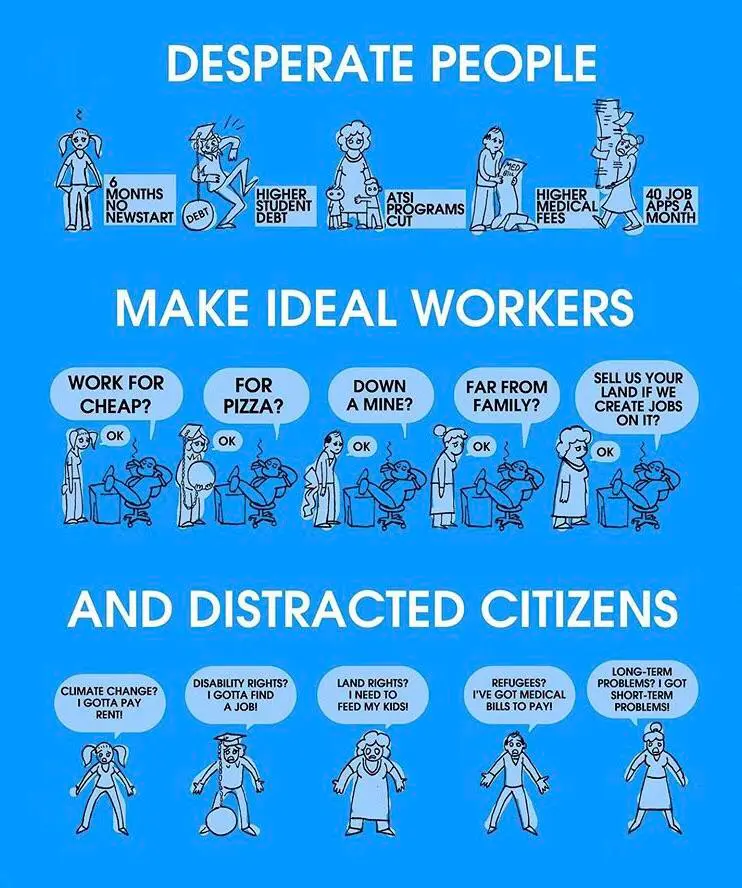
Reposting this explainer image about my fears for the future, with annotations added

An explainer thing about how the political "alignments" in the US right now seem to make survival very difficult. Annotations difficult to transcribe, pre-annotation image text can be found in the previous copy from last time I posted it
preview

I still don’t want to be dead or in prison for refusing to go out of my way to support bombing and and deliberate starvation of children.

I’m still trying to find others who share these concerns.

It should be easy enough to get rid of ICE, but I’m still trying to figure out what strategy could help with the next stages after that.

I also don’t understand how a community can call itself “antiwork” and completely give zero fucks about my fear of being killed or imprisoned for refusing to work for the military industrial complex. I’m not ready to give up yet on somehow making it click for you people, or at least finding some helpful people among you.

0

Staying in bed all day, refusing to work - China’s “Bed Rotting” Obsession

preview

Staying in bed all day, refusing to work - China’s “Bed Rotting” Obsession

Very interesting and in a way shocking response to late stage #capitalism × digitalization

https://www.youtube.com/watch?v=E1C%5C_4xLedBg

#AntiWork

@antiwork@lemmy.ca @antiwork@lemmy.ml @antiwork@lemmy.world @antiwork@slrpnk.net @antiwork@sh.itjust.works @antiwork@lemm.ee @antiwork@europe.pub

0

Thank you all for helping me with my new job earlier last month!

preview

cross-posted from: lemmygrad.ml/post/10230353

Okay, so the job is still sometimes a… real doozy. It’s still a demanding retail job, which is fine, but sometimes, it seems that “something” is happening every other day. Drama, interpersonal relationship issues between my co-workers (not with me, I get along with everyone, it seems), and confusion about the task at hand have all happened at some point or another.

That said, I love my job and am transferring to a location that’s much closer to me. As I may have said before, it’s a church nonprofit thrift store classified as “retail.” It’s like Goodwill and another Catholic service I know in Florida (this one isn’t Catholic, though). I also met another transfem, who seems to be transitioning or just started (relatively recently). She’s high up in the business too and well-respected.

Anyway

Thank you all for cheering me up in the lead-up to my new job (which took about 8 to 10 months for me to get after much searching). I want to be an assistant manager or switch to Goodwill BUT, in the meantime, I have this job that gives me a bigger paycheck than the ones I had before, at least.

Thanks to @EmDash and @zeca@lemmy.ml

Also, thank you to @PoY and @davel.

Oh, and @Onno as well as @Maeve and @Nondiegetic.

Anyway, that seems to be everyone that encouraged me in the previous thread and gave me advice.

I’m referring to this thread, by the way:

lemmygrad.ml/post/9782130

Not sure what else to say; I’ve had this job for almost two months so far and I’m halfway through my seventh week. Any other advice is much appreciated, of course. I think my first order of business is basically to just keep saving money, but budgeting is surprisingly difficult, at least so far. I don’t know what else I can do when it comes to budgeting and saving money beyond just having more in the bank every two weeks (biweekly payment through Direct Deposit).

Another thing I’m nervous about, however:

I’ll have to drive myself to the location that I’m transferring to from now on. I may use Uber or Lyft sometimes, but I need to drive myself there by myself. I can’t have someone take me 30 minutes in the direction of the current location I work at. Now that I’m transferring to a location that’s nearer by, I will likely drive myself, but it will take 15 minutes to get there, or around that much.

The reason I’m nervous is that, even though I have my driver’s license, I heard about an Autistic person from a friend of mine at work that said that one of his Autistic cousins got into a car crash (but had their driver’s license) and he couldn’t understand that and said that he “can’t take care of himself and shouldn’t.”

Maybe he’s not a good friend lol

The point is that it made me nervous; I’ve driven before. I’ve driven for about 30 minutes, tops.

I think since we share a car, I forego driving myself and just rely on others, but I have driven here and there.

I transfer to the new location early next week.

What do I do?

Anyway, again, thanks, everyone, this job went better than I thought it would.