
0
0
GitHub
GitHub - sebastien/git-kv: Key-value store attached to git commits using Git notes
github.com
posts tagged #everything_git




I’m quite a noob, when it comes to actually work with github, though I used to work with git to version my work since quite a while. So my approach / plan could be totally wrong.
I hope anybody out there could help me, give me the right idea.
What I have:
My Project is hosted on a self hosted forgejo instance on my lan. I have two branches, dev and main. Everytime I push to dev, a forgejo workflow I wrote builds a fresh docker-image and restarts the container. I can test the new Image right away, which is quite neat.
The project has reached a point, where
a) I’m not embarrassed anymore about my code
b) I think, this could be a nice docker image for others
c) I also think it would be cool if maybe others would contribute
Enter Github
I set up mirroring forgejo to github. But since my dev branch has my forgejo workflows workflow file (containing some details about my local server infrastructure) I decided to only mirror the main branch, which has that workflow excluded from the repo.
I also set up a github workflow (action) where, when my commit to main was properly tagged, it will create and register a ‘latest’-tagged docker-image for the public.
This can all be done just by using my IDE and has a low manual workflow footprint. (Develop on dev, push, test on local server. When happy, checkout main, merge dev to main, push: image is live)
This all works great.
The only flaw in all of this is, that, even if I’d allow to do PRs from the public main branch on github, forgejo would never see that, means: Nobody may be able to contribute.
I’m at the point, where I think, maybe my whole concept is wrong.
How could I set all this stuff up, to:
all of that without building something that requires a tedious amount of manual workflow steps.
Git is the industry standard for software development, but I thasn’t been fully adopted in Debian packaging yet. Debian development is still based on uploading tarballs via FTP.
I believe that git-based workflows could enhance collaboration, transparency, and productivity for one of the world’s most vital open source projects. Increasing the use of salsa.debian.org, Debian’s GitLab instance, would be a good step towards collaborative git usage.
cross-posted from: lemmy.world/post/32153610
I have just created my accounts for 3 days and Github flagged my account and now requires SMS verification. I haven’t posted or commented nothing on github.
Is there a solution for this without SMS verification? Has anyone succeeded with online temporary phone number for SMS verification?
Is there any other platform other than github for submitting issues? I reckon it is time to turn away from github like how we switch from reddit to lemmy
As far as I understand it, Forgejo is a soft-fork of Gitea, and, as far as I am aware, Gitea includes both the backend and frontend. But then I came across Codeberg, which appears to state:
Self-Hosting Forgejo, the software that powers Codeberg.
This makes it sound like Forgejo is the backend, and Codeberg is the frontend, but I’m not 100% sure. If so, did Forgejo separate Gitea’s UI, and just soft-fork the backend?
Can you not remove “Releases” and “Packages” section from your repository in GitHub?
There is a gear icon on the repository page “Edit repository details” and it seemingly allows you to remove those sections from the page but they don’t do anything. Is it just me / is this limited with a free account or just a bug?
Couldn’t find anything about this by googling. Any answers much appreciated!
My account was flagged because I forked and contributed to the project Eaglercraft, and that means my account is basically useless. I have had enough of Microsoft’s exploitation of power and want to switch to another alternative.
I tried GitLab, but I need to signup with a credit card and I am not comfortable giving my personal info out.
I tried Gitea and the experience is great, but I am limited to 5 repos.
I tried Source Forge, but I cannot verify my phone number when creating a repo. The prompt just returns an API error.
What other alternative should I try?
cross-posted from: programming.dev/post/223663
Hey folks!
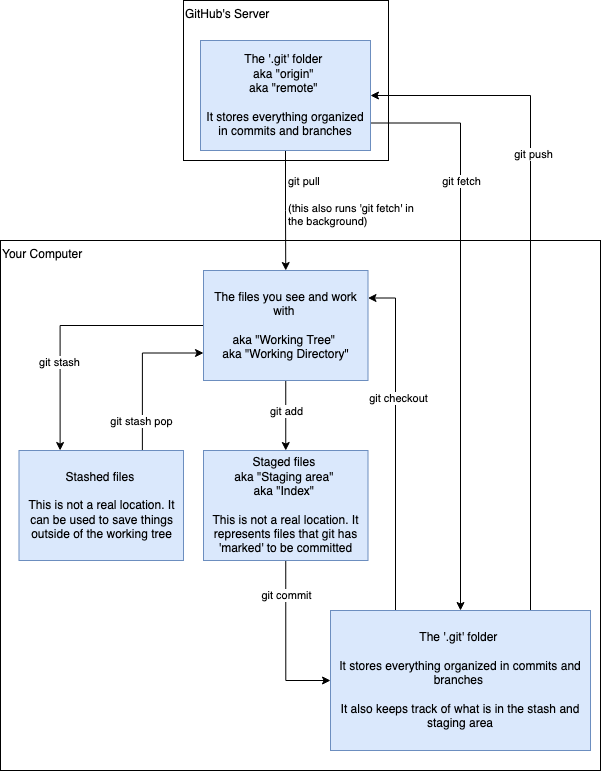
I’ve noticed that it’s often difficult for newcomers to
gitto understand what the heck is happening and how the commands work.Here’s a flowchart that has helped me explain things in the past, and (more than once) folks have asked me for a copy of it to use as a cheat sheet. Hope it’s helpful!

cross-posted from: lemmy.ml/post/568420
In reaction to the surprise announcement of the creation of Gitea Ltd and the transfer of domains and trademark to this company, worried members of the Community have written an Open Letter to the elected Owners of the project.
The request is to return the assets and manage them by a community-led non-profit organization and furthermore improve the community organization, so that the Trust and Health of the project is restored.
The Open Letter can be signed by sending a PR to the Codeberg repository.

So I have this exact need:
There is an upstream project doing their own thing over git and I want to build container images locally and commit them to my image repository all while following the same version system as upstream.
To be more precise (perhaps abstract) about my need, what is the best way to apply the same patch when upstream release a new version.
Any input and best practices or lessons learned are welcome.

I hate github with a passion. I have a slightly different name for it that I won’t use here because I’m a polite c**t.
They’ve sunk to a new low now though, in not displaying the URLs for git repos. Not if I allow their (non-free) Javascript to run, and certainly not if I don’t. Maybe I’m not using an “approved” browser.
Well at least MS’ reason for buying github are clear now - if people can’t get at the code then open-source dies.
cross-posted from: lemmy.ml/post/77351
Join the FedeProxy vidcall and help bring Gitea to the Fediverse
Whether you are technical or not, there’s many ways you can help. By doing so you’ll contribute to offering real and open alternatives to the dominant position that Github has on the open source movement. Decentralized FOSS development on the Fediverse, no less!
Agenda:
- Proofreading of grant proposal
- Dev bounty: Generate gitea private keys
- Find individuals & orgs to support grant application and/or federation in Gitea
- Facts / articles that demonstrate the popularity of Gitea
- Where to advertise the effort towards federation?
- First grant application must be sent before October 1st, 2021 for the @NGIZero Discovery call
Provide your availability for the vidcall here: framadate.org/jO19mi38nMKWNYbt
Read these other Lemmy posts and learn how you can earn money now:
- Opportunity: Bring Gitea to the Fediverse (funding available)
- Opportunity: Diversity audit for the open-source FedeProxy project
Additional information:
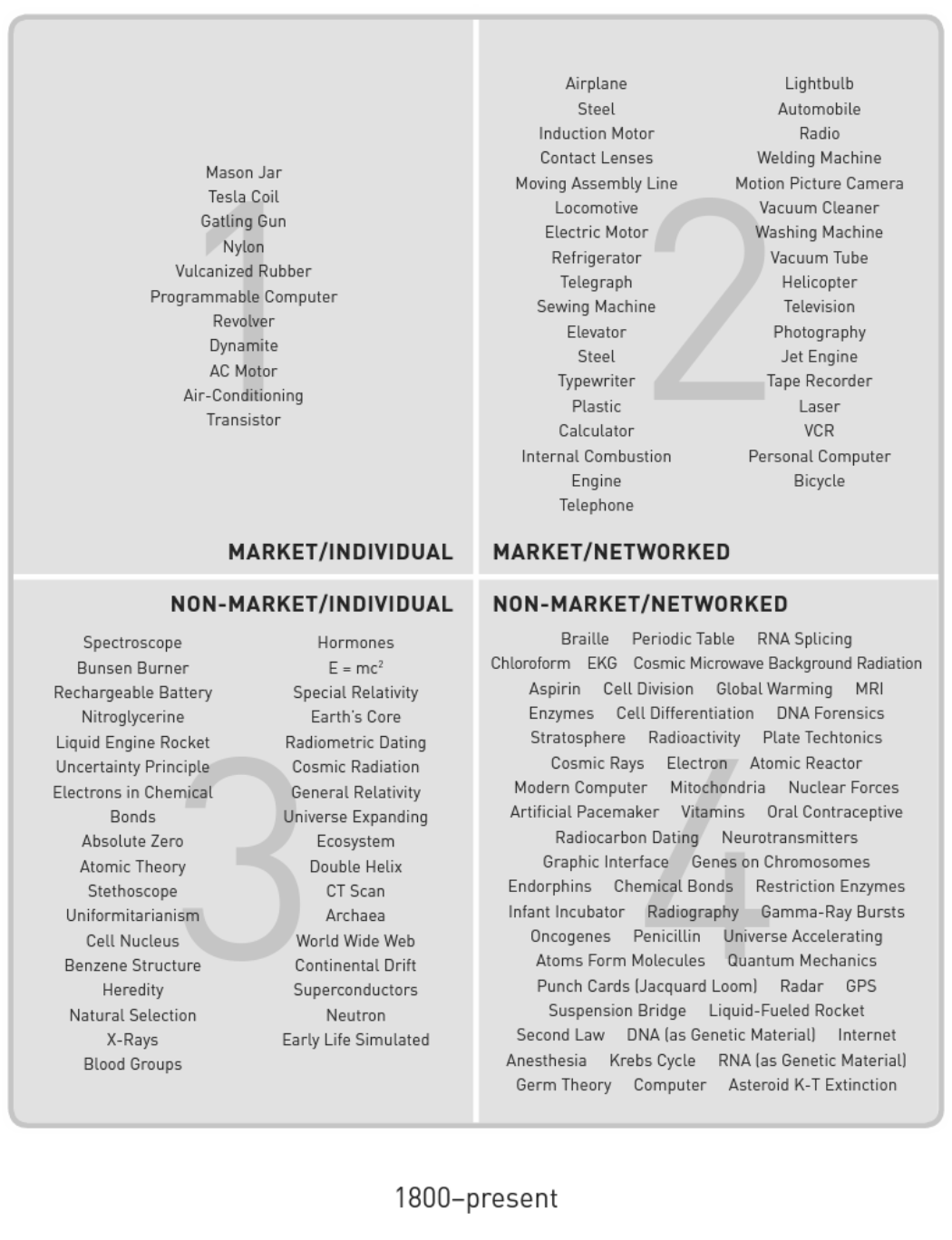
This photo is from Where Good Ideas Come From: A Natural History of Innovation. In it, there’s a chapter dedicated to studying ‘fluid networks’. Fluid networks are characterized by (1) high density and (2) malleability. These are the characteristics that make coral reefs, cities, universities, and the internet innovation machines.
Not only do innovations happen incredibly quickly in those fluid networks, but they are evidently much better at innovating than lonesome geniuses or groups who are innovating for profit, which is what the image I mentioned earlier points out.
These characteristics of the fluid networks are also present, I argue, in Git. Perhaps not in all of Git, but in projects dense enough, with enough users. Get enough users in a project, and to the extent that the code maintainers can make the repository malleable, you will get innovation at incredible speed.
Because of this, we can say that Git is indeed a version control system for projects without much activity, but with projects with many users and enough capacity to merge commits, Git is also an innovation machine. This is why Git has not only changed the world, but will continue doing it.
This is a front-end to a start of an app store I was thinking to create with a friend (that would do the back-end) but due to school we never advanced more than this. If anyone is interested to use my HTML and CSS feel free to, just please credit me and put the github link to it and/or my mastodon
This is a front-end to a start of an app store I was thinking to create with a friend (that would do the back-end) but due to school we never advanced more than this. If anyone is interested to use my HTML and CSS feel free to, just please credit me and put the github link to it and/or my mastodon