The Canadian Conservation Institute has a very comprehensive website with a variety of publications relevant to helping our straight razor collections endure for decades and centuries to come. Some in particular I’ve found helpful:
The Canadian Conservation Institute has a very comprehensive website with a variety of publications relevant to helping our straight razor collections endure for decades and centuries to come. Some in particular I’ve found helpful:
Was happy to find these razors and kinda like this repaired one the most as that clearly took quite some patience. Inspiring really. Did they poke these through before soldering/brazing them onto that thin plate I wonder? Must have been frustrating to do all that and have it crack anyway.
Definitely curious to see any interesting old repairs you’ve happened upon…
From a local online marketplace. Less than 91 euros shipped. I knew it was in less than optimal condition.
It is a near wedge advertised as 6/8 but it is 24 mm tall which is between 15/16 and 8/8. Quite heavy!
I cleaned it well with alcohol and with soap and water and qtips and I scrubbed the hell out of it with a brush. Managed to get most of the black residue off the pivot area.
It is quite dull but got a small cut while scrubbing it a bit too violently (after the alcohol step luckily). The blade closed on me, the pivot is a bit loose.
Logo side has some pitting on the edge. Also seems like some pitting on the blade but it is polished over?
The hone wear is very uneven and quite large. Seems like the middle and toe was given a lot more pressure in honing or the heel was off the stone 80% of the time.
I didn’t know what the non-logo side was like, there was no picture. Luckily its better than the logo side. The bevel is more even but the hone wear is the same story, bit worse.
The front has some black spots on it.
There was no info on the handle so god knows what it is made of. I checked the scale options on the website but they all look a bit different. The seller got the size wrong so I don’t think he knows himself. The blade, scales and box were quite dirty so it seems it came out of storage.
Just ran it over an Atoma 1200 for a bit and the rust on the edge is coming out already so that is good. In terms of geometry, only the tip doesn’t seem to hit the stone. Both the edge and the spine. Every time I see a Koraat online it is a new one in perfect condition so this is a bit different. I’ll see what I can do with it.
Stone was passed down to me. It’s a natural stone with a streak going through it on the sides. 15cm x 3cm in size. Light gray. Feels smooth to the touch. Doesn’t seem very hard to me (I’m not experienced) Lapped it with an Atoma 1200. Slurry is grey and very “muddy”. Seems to have some specks in it when look at through a loop. Has adhesive on the back (probably used to sit in one of these small wood boxes).
I can never seem to finish the edge on it. It either does nothing or takes the edge back. I think it is even chipping the edge some times. I tried it dry, with water, under running water, with soap, with oil. Light pressure to almost no pressure. A few laps doesn’t do anything and lots of laps seem to take the edge back.
I have some trouble getting a good edge in general, so maybe I’m at fault. I also made sure my razor geometry is straight.
Thank you.
Stone was passed down to me. It’s a natural stone with a streak going through it on the sides. 15cm x 3cm in size. Light gray. Feels smooth to the touch. Doesn’t seem very hard to me (I’m not experienced) Lapped it with an Atoma 1200. Slurry is grey and very “muddy”. Seems to have some specks in it when look at through a loop. Has adhesive on the back (probably used to sit in one of these small wood boxes).
I can never seem to finish the edge on it. It either does nothing or takes the edge back. I think it is even chipping the edge some times. I tried it dry, with water, under running water, with soap, with oil. Light pressure to almost no pressure. A few laps doesn’t do anything and lots of laps seem to take the edge back.
I have some trouble getting a good edge in general, so maybe I’m at fault. I also made sure my razor geometry is straight.
Thanks of the Society were voted to JR. Knight ,
Esq., for a Collection of Hone- Stones and Grind-
Stones , presented by him ; together with the following
Descriptive Catalogue of them
I stumbled upon this recently when looking through my old Reddit posts. That was years ago and I’m still left curious about “Cutler’s Green”.
I’ve lately sold a few of my razors and again find myself spending longer than I really intend sharing my subjective opinion on what new users ought to do with them. Of course there are guides out there (and plenty of videos but I’m happy to leave that part to others) but somehow I still feel compelled so I might end up writing one of my own. In order to combat this, I’m trying to gather a comprehensive list of contemporary guides and maybe pick a favourite.
I’ve tried to exclude any that are too superficial, just copied/summarised/LLM’d from elsewhere, or have outright bad advice. Did I miss any good ones? Did I include any I shoudn’t have? Let me know and I’ll try and keep this updated.
I was researching some razors to put up for sale and was reminded of a sad story I saw on James Bingham’s Hawley entry:
He was interviewed by a government commission on child labour, when he stated that when he was ‘first in the trade the average age of razor grinders at death was 34’. He said that exhaust fans had improved matters, so that ‘we have some men of good age. The effect of the work depends very much on the temperance of the workers’
…we really don’t fully appreciate the labour standards we have, wow.
This video demonstrates one of the best examples of technique I have seen to date. It is similar to my own technique.
A minor difference would be that this gentleman is using a Soft Suita and Hard Suita, where as I prefer a Soft Suita and Hard Kiita.
For those looking to start with jnats, or refine technique, I find this video a must watch. The techniques shown here are not just limited to Japanese naturals, and can be implemented on other naturals and synthetics, with minor changes in expectation.
Another key point touched on this, that is often overlooked and undervalued, is palm stropping. In my opinion and experience, palm stropping is a must when finishing.
I was chatting with someone about Ern razors and mentioned seeing that he’d invented a better way to do hollow grinds. Found the link I remembered (Carl Friedrich Ern & family introduced the “Hexe” machine in 1893) but learned something new when I thought to look for one on Youtube: a current artisan (Ertan Süer) has acquired such a machine and is using it for some of his current production.
I was chatting with someone about Ern razors and mentioned seeing that he’d invented a better way to do hollow grinds. Found the link I remembered (Carl Friedrich Ern & family introduced the “Hexe” machine in 1893) but learned something new when I thought to look for one on Youtube: a current artisan (Ertan Süer) has acquired such a machine and is using it for some of his current production.
A lot of the books on straight razors are well out of copyright. However, copyright does go back an absurdly long way and covers even the 1950s when they were still in relatively common use. The Internet Archive lends use of books based on how many they physically have in some warehousing arrangement and so you can borrow this one by the hour.
This seems like it was is in common use training barbers (and may still be – there seems to be an edition still in print) and being towards the tail end of when straights were prevalent offers a different perspective from the older works.
Ran into this by chance, pretty interesting: I was a little surprised both by the circles and the 1:1 ratio between omote/ura. Also interesting is how he uses a diamond pasted strop seemingly not to refine the edge but more just to deburr it.
Ran into this by chance, pretty interesting: I was a little surprised both by the circles and the 1:1 ratio between omote/ura. Also interesting is how he uses a diamond pasted strop seemingly not to refine the edge but more just to deburr it.
I have seen a few times on ebay what is called in French a Butterfly Straight Razor (coupe choux papillon). Basically, these are straight razors with two blades in a single unit of symmetrical scales. My attempts to find information on these razors ended up without any results (probably also because I don’t know what they are called in English, and because TTO DE razors in French are also called “rasoir papillon”.
Does anyone here have any info on these, and what they are designed for? This is what they look like.
I think two straights is quite justifiable, you might use up an edge and need to shave before you have time to hone. And two identical ones is a good way to compare hones–same razor, different edge. I have a pair I use like that.
More? Well, you’ll find there is quite a big difference in how a wedge shaves from how a hollow shaves. And there are many grinds in between. Plus there are framebacks! Some framebacks are thin like a hollow but don’t quite have the same flex, others shave pretty much like a wedge. Not to mention interestingly shaped tapered blades, lancets, monkey tails…
And maybe you have a 6/8 and wonder how an 4/8 or 8/8+ width would be? They’re certainly going to be different and it’s very subjective which is better! But then maybe you like a wide hollow and a narrow wedge? The reverse? Only one way to tell…
Perhaps you wonder how American, English, French, Swedish, German and Japanese razors differ? I sure did…
Maybe you were curious what they were like in the 1920s vs. the 1960s. Or the 1800s. Or the 1700s.
Or you’d like scales made from bone or ivory or tortoise or mother-of-pearl? Or something cool etched on the blade? Or a modern custom from Koraat or HG or Artrazor or Gipson or Ali’s Blade or any of hundreds of worthy artisans keeping this craft going?
I’ve always been a minimalist. I’ve never felt the appeal of collecting anything. It started out as trying to find which one works best for me so I could get a really good one of those, but I kinda liked them all. I …think I collect straight razors now? It just sorta happened 🤷♂️
So, typically, I try to hone through any pitting to get a clean edge. I might tolerate some on the bevel, but not right near the edge where the stresses of shaving and stropping might cause it to collapse and break that nice clean line.
However…
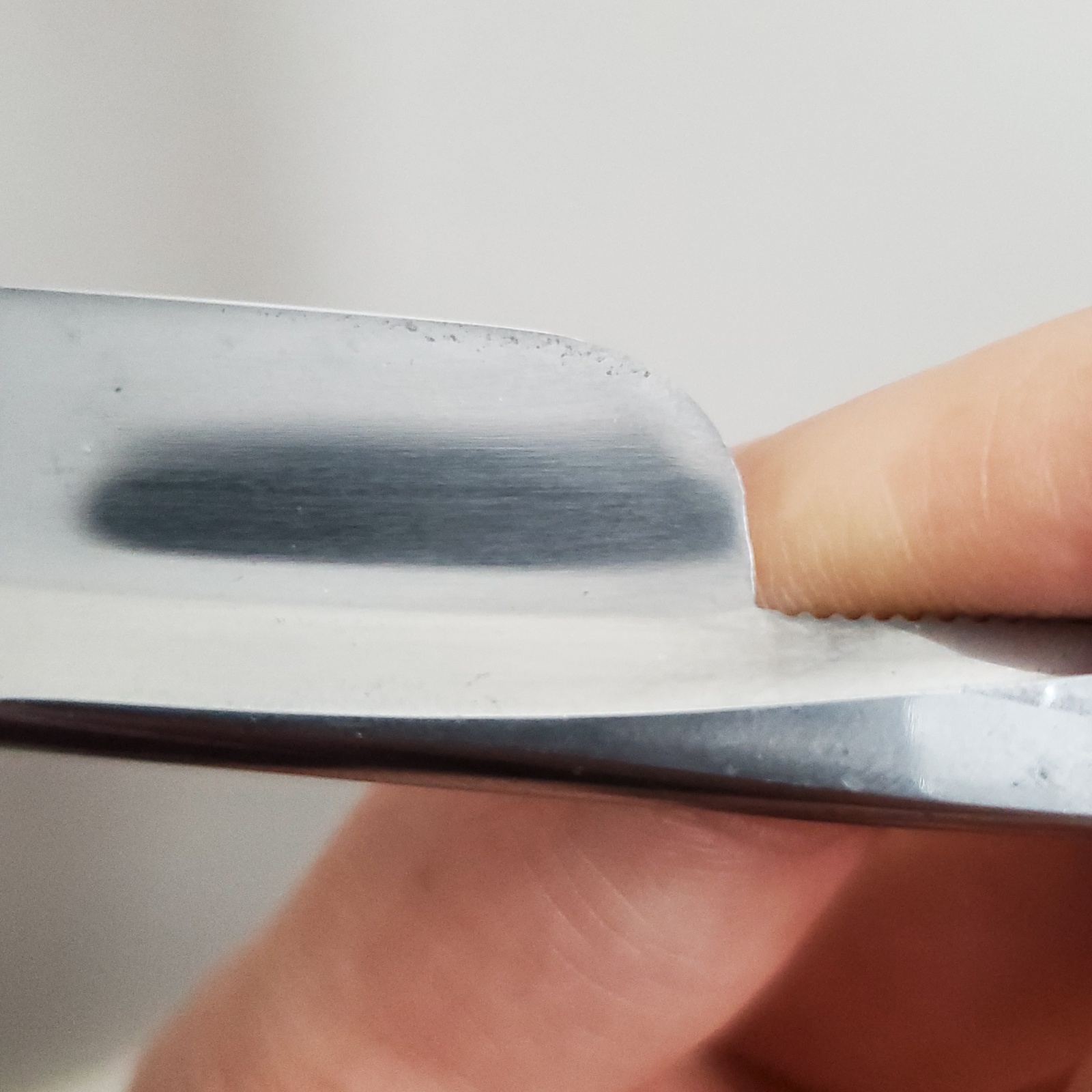
I have this one razor. I used it today. I quite like it: it has very little wear and was well ground so it has a very thin bevel. It shaves well and it holds an edge. Indeed, it’s one of the few edges I’ve put a dozen shaves on. But I have a confession: I left a tiny pit at the edge. Because there was probably going to be another and another and… well, usually I’d just take some metal off until we were in reasonable steel. I didn’t want to this time, so I left all this (which you can only see at all on one side):
…and while I had a mostly clean edge, it did have a small pit at the edge. But nothing major, it’s not a serrated knife or anything. So I went with it to see what happened. Every shave I made a point to see if the heel was giving me more irritation than elsewhere on the blade or anything like that and …nah. It’s fine.
Which reminded me of this post at Science of Sharp where you can see, based on the scale, how very much bigger a hair is than a razor edge. And I think my skin is at least as thick as a hair or I’d be bleeding way more often. A quick search confirms even the thinnest skin (eyelids apparently) has something like 50 microns of epidermis.
So maybe I shouldn’t be so surprised that I can’t notice a difference from some tiny pit on the edge? Maybe I should more often err on the side of leaving steel on a nice blade even if it’s not so great?