showing posts tagged #tech — clear

0

Need Advice: If i turn my Laptop into Server how long will it Last?

preview

Just need a rough estimate. I have a 10yr old laptop. I want to turn it into a Server. So it will be running 24x7.

How long before it stops working?

Just need a rough estimate. I have a 10yr old laptop. I want to turn it into a Server. So it will be running 24x7.

How long before it stops working?

0

The end of Windows 10 is approaching, so it's time to consider Linux and LibreOffice

TDF Community Blog The end of Windows 10 is approaching, so it's time to consider Linux and LibreOffice - TDF Community Blog blog.documentfoundation.org
preview

Cross-posted from “The end of Windows 10 is approaching, so it’s time to consider Linux and LibreOffice” by @pro@programming.dev in !technology@lemmy.world


Cross-posted from “The end of Windows 10 is approaching, so it’s time to consider Linux and LibreOffice” by @pro@programming.dev in !technology@lemmy.world


0

Wikipedia Pauses AI-Generated Summaries After Editor Backlash

404 Media Wikipedia Pauses AI-Generated Summaries After Editor Backlash www.404media.co
preview

cross-posted from: lemm.ee/post/66544085

Text to avoid paywall

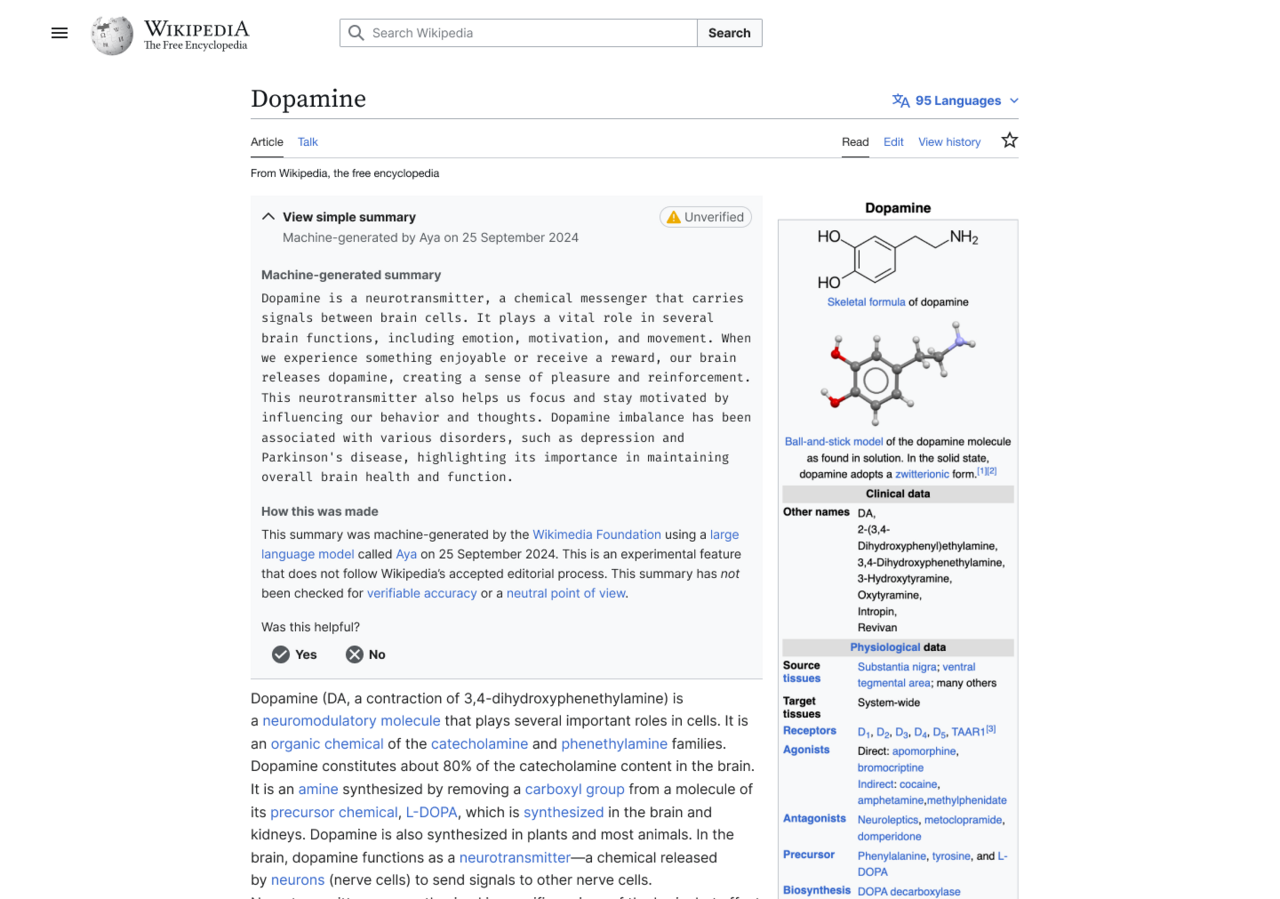
The Wikimedia Foundation, the nonprofit organization which hosts and develops Wikipedia, has paused an experiment that showed users AI-generated summaries at the top of articles after an overwhelmingly negative reaction from the Wikipedia editors community.

“Just because Google has rolled out its AI summaries doesn’t mean we need to one-up them, I sincerely beg you not to test this, on mobile or anywhere else,” one editor said in response to Wikimedia Foundation’s announcement that it will launch a two-week trial of the summaries on the mobile version of Wikipedia. “This would do immediate and irreversible harm to our readers and to our reputation as a decently trustworthy and serious source. Wikipedia has in some ways become a byword for sober boringness, which is excellent. Let’s not insult our readers’ intelligence and join the stampede to roll out flashy AI summaries. Which is what these are, although here the word ‘machine-generated’ is used instead.”

Two other editors simply commented, “Yuck.”

For years, Wikipedia has been one of the most valuable repositories of information in the world, and a laudable model for community-based, democratic internet platform governance. Its importance has only grown in the last couple of years during the generative AI boom as it’s one of the only internet platforms that has not been significantly degraded by the flood of AI-generated slop and misinformation. As opposed to Google, which since embracing generative AI has instructed its users to eat glue, Wikipedia’s community has kept its articles relatively high quality. As I recently reported last year, editors are actively working to filter out bad, AI-generated content from Wikipedia.

A page detailing the the AI-generated summaries project, called “Simple Article Summaries,” explains that it was proposed after a discussion at Wikimedia’s 2024 conference, Wikimania, where “Wikimedians discussed ways that AI/machine-generated remixing of the already created content can be used to make Wikipedia more accessible and easier to learn from.” Editors who participated in the discussion thought that these summaries could improve the learning experience on Wikipedia, where some article summaries can be quite dense and filled with technical jargon, but that AI features needed to be cleared labeled as such and that users needed an easy to way to flag issues with “machine-generated/remixed content once it was published or generated automatically.”

In one experiment where summaries were enabled for users who have the Wikipedia browser extension installed, the generated summary showed up at the top of the article, which users had to click to expand and read. That summary was also flagged with a yellow “unverified” label.

An example of what the AI-generated summary looked like.

Wikimedia announced that it was going to run the generated summaries experiment on June 2, and was immediately met with dozens of replies from editors who said “very bad idea,” “strongest possible oppose,” Absolutely not,” etc.

“Yes, human editors can introduce reliability and NPOV [neutral point-of-view] issues. But as a collective mass, it evens out into a beautiful corpus,” one editor said. “With Simple Article Summaries, you propose giving one singular editor with known reliability and NPOV issues a platform at the very top of any given article, whilst giving zero editorial control to others. It reinforces the idea that Wikipedia cannot be relied on, destroying a decade of policy work. It reinforces the belief that unsourced, charged content can be added, because this platforms it. I don’t think I would feel comfortable contributing to an encyclopedia like this. No other community has mastered collaboration to such a wondrous extent, and this would throw that away.”

A day later, Wikimedia announced that it would pause the launch of the experiment, but indicated that it’s still interested in AI-generated summaries.

“The Wikimedia Foundation has been exploring ways to make Wikipedia and other Wikimedia projects more accessible to readers globally,” a Wikimedia Foundation spokesperson told me in an email. “This two-week, opt-in experiment was focused on making complex Wikipedia articles more accessible to people with different reading levels. For the purposes of this experiment, the summaries were generated by an open-weight Aya model by Cohere. It was meant to gauge interest in a feature like this, and to help us think about the right kind of community moderation systems to ensure humans remain central to deciding what information is shown on Wikipedia.”

“It is common to receive a variety of feedback from volunteers, and we incorporate it in our decisions, and sometimes change course,” the Wikimedia Foundation spokesperson added. “We welcome such thoughtful feedback — this is what continues to make Wikipedia a truly collaborative platform of human knowledge.”

“Reading through the comments, it’s clear we could have done a better job introducing this idea and opening up the conversation here on VPT back in March,” a Wikimedia Foundation project manager said. VPT, or “village pump technical,” is where The Wikimedia Foundation and the community discuss technical aspects of the platform. “As internet usage changes over time, we are trying to discover new ways to help new generations learn from Wikipedia to sustain our movement into the future. In consequence, we need to figure out how we can experiment in safe ways that are appropriate for readers and the Wikimedia community. Looking back, we realize the next step with this message should have been to provide more of that context for you all and to make the space for folks to engage further.”

The project manager also said that “Bringing generative AI into the Wikipedia reading experience is a serious set of decisions, with important implications, and we intend to treat it as such, and that “We do not have any plans for bringing a summary feature to the wikis without editor involvement. An editor moderation workflow is required under any circumstances, both for this idea, as well as any future idea around AI summarized or adapted content.”

0

Telegram is indistinguishable from an FSB honeypot

Songs on the Security of Networks Telegram is indistinguishable from an FSB honeypot rys.io
preview

cross-posted from: szmer.info/post/7875329

Investigation by investigative journalism outlet IStories (EN version by OCCRP) shows that Telegram uses a single, FSB-linked company as their infrastructure provider globally.

Telegram’s MTProto protocol also requires a cleartext identifier to be prepended to all client-server messages.

Combined, these two choices by Telegram make it into a surveillance tool.

I am quoted in the IStories story. I also did packet captures, and I dive into the nitty-gritty technical details on my blog.

Packet captures and MTProto deobfuscation library I wrote linked therein so that others can retrace my steps and check my work.

0

Researchers discover new security vulnerability in Intel processors

ETH Zurich ETH Zurich researchers discover new security vulnerability in Intel processors ethz.ch
preview

cross-posted from: programming.dev/post/30313432

  • The new class of vulnerabilities in Intel processors arises from speculative technologies that anticipate individual computing steps.
  • Openings enable gradual reading of entire privilege memory contents of shared processor (CPU).
  • All Intel processors from the last 6 years are affected, from PCs to servers in data centres.
0

Google, X and Facebook Are Modern-Day Tobacco Companies

Scientific American Google, X and Facebook Are Modern-Day Tobacco Companies www.scientificamerican.com
preview

cross-posted from: lemmy.world/post/28700613

From their own internal metrics, tech giants have long known what independent research now continuously validates: that the content that is most likely to go viral is that which induces strong feelings such as outrage and disgust, regardless of its underlying veracity. Moreover, they also know that such content is heavily engaged with and most profitable. Far from acting against false, harmful content, they placed profits above its staggering—and damaging—social impact to implicitly encourage it while downplaying the massive costs.

Social media titans embrace essentially the same hypocrisy the tobacco industry embodied when they feigned concern over harm reduction while covertly pushing their product ever more aggressively. With the reelection of Trump, our tech giants now no longer even pretend to care.

Engagement is their business model, and doubt about the harms they cause is their product. Tobacco executives, and their bought-off scientists, once proclaimed uncertainty over links between cigarettes and lung cancer. Zuckerberg has likewise testified to Congress, “The existing body of scientific work has not shown a causal link between using social media and young people having worse mental health, ” even while studies find self-harm, eating disorder and misogynistic material spreads on these platform unimpeded. This equivocation echoes protestations of tobacco companies that there was no causal evidence of smoking harms, even as incontrovertible evidence to the contrary rapidly amassed.

0

Windows 10 LTSC – the version that won't expire for years

theregister Windows 10 LTSC – the version that won't expire for years go.theregister.com
preview

cross-posted from: programming.dev/post/29043868

Can’t run Windows 11? Don’t want to? There are surprisingly legal options

cross-posted from: programming.dev/post/29043868

Can’t run Windows 11? Don’t want to? There are surprisingly legal options

0

The wonderful world of Linux package managers

LibreNews The wonderful world of Linux package managers thelibre.news
preview

cross-posted from: programming.dev/post/28905872

One of the strongest points of Linux is the package management. In 2025, the world of Linux package management is very varied, with several options available, each with their advantages and trade-offs over the others.

cross-posted from: programming.dev/post/28905872

One of the strongest points of Linux is the package management. In 2025, the world of Linux package management is very varied, with several options available, each with their advantages and trade-offs over the others.

0

Der Hype ist vorüber: Sony stellt 8K-Fernseher ein

preview

cross-posted from: metawire.eu/post/18992

Die geringe Nachfrage ist ein primärer Grund, warum Sony wie viele andere Hersteller keine 8K-TVs mehr bringen wird. (8K, Sony)

cross-posted from: metawire.eu/post/18992

Die geringe Nachfrage ist ein primärer Grund, warum Sony wie viele andere Hersteller keine 8K-TVs mehr bringen wird. (8K, Sony)

0

Wikimedia is dealing with a 50 percent increase in bandwidth due to AI crawlers

preview

cross-posted from: metawire.eu/post/5948

Since January 2024, Wikimedia has seen a 50 percent increase in Wikipedia’s bandwidth usage. However, this enormous increase is not due to human users suddenly reading Wikipedia articles or watching videos but to AI crawlers that automatically scrape content to train AI models. This creates new challenges for the foundation. The sudden increase in traffic […]

Creator: Coen van Eenbergen Publish Date: 07.04.2025, 17:28 Categories: Infrastructure, AI, AI crawlers, Artificial Intelligence, bandwidth, content scraping, Wikimedia, Wikipedia

0

Have I Been Pwned owner, pwned.

Have I Been Pwned owner, pwned - Hypertext htxt.co.za
preview

cross-posted from: programming.dev/post/27609050

  • A jetlagged Troy Hunt accidentally clicked a link and logged into an account only to realise he had been phished.
  • Despite reacting quickly, attackers were able to export a mailing list for Hunt’s personal blog.
  • Hunt has detailed the attack and warned his subscribers in a timely fashion.
0

Not OK, Cupid.

Fastmail Not OK, Cupid www.fastmail.com
preview

cross-posted from: programming.dev/post/27360624

I don’t usually like to call out the bad behaviour of specific companies, but the egregious mis-design and lack of acknowledging it justify this case.

cross-posted from: programming.dev/post/27360624

I don’t usually like to call out the bad behaviour of specific companies, but the egregious mis-design and lack of acknowledging it justify this case.

0

Explicit or educational: Is Big Tech censoring women's health?

Explicit or educational: Is Big Tech censoring women's health? | Context by TRF www.context.news
preview

cross-posted from: programming.dev/post/27223116

What’s the context?

Women’s groups worry Big Tech algorithms suppress words and products related to women’s health.

Google, Meta, others accused of blocking health content Algorithms fail to differentiate between content Concerns amid rollback of diversity, rights policies

0

‘Audible enclaves’ could enable private listening without headphones.

‘Audible enclaves’ could enable private listening without headphones | Penn State University www.psu.edu
preview

cross-posted from: programming.dev/post/27222808

It may someday be possible to listen to a favorite podcast or song without disturbing the people around you, even without wearing headphones. In a new advancement in audio engineering, a team of researchers led by Yun Jing, professor of acoustics in the Penn State College of Engineering, has precisely narrowed where sound is perceived by creating localized pockets of sound zones, called audible enclaves. In an enclave, a listener can hear sound, while others standing nearby cannot, even if the people are in an enclosed space, like a vehicle, or standing directly in front of the audio source.

0

Microsoft accidentally removed Copilot in the latest Windows 11 update.

Windows update accidentally removes Copilot - Hypertext htxt.co.za
preview

cross-posted from: programming.dev/post/27137484

  • A bug in the most recent Windows 11 update removes Copilot from systems entirely.
  • Microsoft is currently working on a fix but those who need the app can simply redownload and install it from the Windows Store.
  • The update also introduced a bug for Roblox players on Arm hardware.