0
0

The Left Berlin
End times organizing
theleftberlin.com


Not on this instance? Enter your own instance's domain to go straight to following c/actualcommunism@lemmy.dbzer0.com there.

25 year old, Bogdan Syrotiuk is a Ukrainian revolutionary of the Young Guard of Bolshevik-Leninists, a Trotskyist youth group. Like many Trotskyists, Syrotiuk opposes Russian imperialism and the attempts of Moscow to conquer Ukraine. But unlike many western style democrats, Syrotiuk also rejects the Ukrainian government and state, which he denounces as capitalist and not in the service of the Ukrainian working class. Since 22 February 2022, Ukraine is under martial law. The capitalist government uses the martial law to imprison anybody they declared to be ”loyal to Moscow”. Last year, the Security Service of Ukraine (SBU) arrested Bogdan Syrotiuk. For 12 months now he is held in a SBU prison and his health has declined. Ukrainian prisons are bad and prisoners are not getting proper treatment.
25 year old, Bogdan Syrotiuk is a Ukrainian revolutionary of the Young Guard of Bolshevik-Leninists, a Trotskyist youth group. Like many Trotskyists, Syrotiuk opposes Russian imperialism and the attempts of Moscow to conquer Ukraine. But unlike many western style democrats, Syrotiuk also rejects the Ukrainian government and state, which he denounces as capitalist and not in the service of the Ukrainian working class. Since 22 February 2022, Ukraine is under martial law. The capitalist government uses the martial law to imprison anybody they declared to be ”loyal to Moscow”. Last year, the Security Service of Ukraine (SBU) arrested Bogdan Syrotiuk. For 12 months now he is held in a SBU prison and his health has declined. Ukrainian prisons are bad and prisoners are not getting proper treatment.

cbsnews.com/…/nyc-mayor-zohran-mamdani-homeless-e…
Will leftists finally get the message that you can’t vote socialism in given the purpose of capitalist state, its material conditions and interests and that any idealistic campaign promises will be broken immediately upon contact with real world, or will the democratic belief in miracles prevail?

cross-posted from: midwest.social/post/30356079
Since June 2024, we have been building a communist encyclopedia, Revolupedia, to provide easily-understood explanations to Marxist theory and allow for further study.
Overtime, our project and community has expanded to maintain hundreds of articles, a library of texts from Marxist thinkers, and detailed quotations.
We welcome all communists to join our effort to build a revolutionary compendium, whether anti-revisionist Marxist–Leninist or Maoist!
cross-posted from: lemmy.dbzer0.com/post/26257075
Hiii there~ fellow revolutionary socialists! Ik, I have been putting this off for faaaar too long, but have finally got myself to open up mod applications!
Since the inception of this batch of communities, I haven’t rly had the capacity to proactively moderate them as I’d like to (and still don’t). My instance administrators took care of most of the reports and banning a few .world libs here and there usually did the job 😛 (luckily, Dengists and other such revisionists have thus far not rly invaded these communities as they did with Hexbear).
Thus, I’d like to request your help in taking over moderation and have come up with a vetting process to hand off virtually all day-to-day operations.
The “batch of communities” I keep referring to:
- !actualcommunism@lemmy.dbzer0.com
- !actualsocialism@lemmy.dbzer0.com
- !actualcommunism101@lemmy.dbzer0.com
- !actualsocialism101@lemmy.dbzer0.com
- !leftymemes@lemmy.dbzer0.com
- !anarchismvsmarxism@lemmy.dbzer0.com
Here are some criteria/expectations:
You MUST:
- be at least fluent in English (not proficient, doesn’t have to be your 1st language; it’s technically my 3rd language lol)
- be a revolutionary socialist falling into the spectrum defined in the rules of the specific community
- have a Matrix account
You SHOULD:
- be somewhat knowledgeable with revolutionary socialism and it’s concepts (again, relevant to the specific community
- have enough time and motivation available to reasonably and regularly check on your community(/ies) (ofc in the context of what makes sense in your timezone)
- have an account that is older than 3 months, with pre-existing history
Nice to have:
- familiarity with Lemmy moderation tools
- have a history of being active in the community(/ies) you’d like to mod
entirely optional:
- be willing to regularly post in/contribute to your community(/ies)
To apply please:
- send me your @matrixUsername:matrixHomeserver with a PM from the Lemmy acc with which you are applying
- answer the questionnaire
- subsequently contact me over on Matrix
- send me your “filled out” questionnaire that way in the following format:
- Question1?
your answer here- Question2
your 2nd answer here
…(just copy paste the questionnaire and append your answers to the questions)
If I think you’d fit, I’ll invite you into the Matrix space I’ve set up. I’d like to first pool some ppl there and then come up with a concept collectively, after which I’ll give out the mod rights on Lemmy.
After this initial group has been established, future applications will be overseen in the “Recruits” room of the mentioned Matrix space.Questionnaire:
- Which community(/ies) would you like to help moderate?
- Have you read the rules of said community(/ies) and do you agree to upkeep/enforce them proactively?
- Would you want humanity to evolve past capitalism towards a stage of a class-, money- and stateless society (ie. communism)?
- Do you think there should be a socialist world republic?
- Would you classify the Russian Federation and the Peoples’ Republic of China as imperialist?
- What is your take on the fraternal war between Russia and Ukraine, triggered by Russian aggression?
- What is your take on the Zionist occupation of Palestine?

cross-posted from: feddit.uk/post/13812624
JD.com founder Richard Liu warned employees against prioritizing work-life balance during a recent video conference, stating those who “put life first and work second” were not welcome at the company. This stance reflects a broader trend in China’s tech sector as executives face slowing growth and increased competition.
Major tech firms, including Alibaba and Tencent, have cut tens of thousands of jobs since 2021. Companies are now seeking younger, cheaper workers and demanding longer hours from existing staff. Pinduoduo, an e-commerce group known for its high productivity and grueling work culture, is seen as a model by some in the industry. In 2021, two Pinduoduo employees died in incidents linked to overwork by colleagues.
Older tech professionals, typically over 35, face the greatest risk of redundancy and struggle to find new positions. Employers often view them as expensive and less flexible due to family responsibilities. A 2023 survey of 2,200 professionals in China’s largest cities revealed widespread anxiety about career prospects and work-life balance. Many in the industry report experiencing depression and high stress levels.


cross-posted from: hexbear.net/post/2492720
The five books from the image that I got are:
In the Shadow of Liberty: The Invisible History of Immigrant Detention in the United States by Ana Raquel Minian
Third Worlds Within: Multiethnic Movements and Transnational Solidarity by Daniel Widener, Vijay Prashad (Foreword)
The States of the Earth: An Ecological and Racial History of Secularization by Mohamed Amer Meziane, Jonathan Adjemian (Translator)
Ron Carey and the Teamsters: How a UPS Driver Became the Greatest Union Reformer of the 20th Century by Putting Members First by Ken Reiman
Empire of Normality: Neurodiversity and Capitalism by Robert Chapman
These five books sit atop by vinyl record-player or gramophone or whatever you call it nowadays (I think people just say record-player). The very last one is the one I want to read the most, Empire of Normality. The third one, The States of the Earth, seems very interesting to me and I think everyone else should read it. The first two seemed like no-brainers to someone like me and the fourth one is just 'cause like labor unions and Monthly Review (I always read Monthly Review and Science & Society, the last two Marxist academic journals still standing).
Currently reading:
Das Kapital by Karl Marx
An Ideological History of the CPC by Huang Yibing (translated into English from Chinese)
A Dance with Dragons by George R. R. Martin
Das Kapital is what I’m reading for the second time. I plan to finish it this time. The second book is apart of a trilogy of books called An Ideological History of the CPC (Volumes 1 - 3), each written by a separate author, and translated from Chinese into English. It costs about $170 for the entire trilogy box-set, but you’ll frequently see it on sale on Amazon.com. A Dance with Dragons is the fifth book in the series A Song of Ice and Fire, right after the fourth book A Feast of Crows (which the bad TV show Game of Thrones is very loosely based off of).
And that’s about all I’m reading and all of which I will read. The rest I may get from my local library (everyone should patronize their local library; they’re currently being attacked by evangelicals, TERFs, and MAGAts).

cross-posted from: hexbear.net/post/2491327
Anyone else keeping up with this?
cross-posted from: hexbear.net/post/2491327
Anyone else keeping up with this?

cross-posted from: hexbear.net/post/2483233
Check it out.
A friend of mine wrote this.
cross-posted from: hexbear.net/post/2483233
Check it out.
A friend of mine wrote this.

cross-posted from: hexbear.net/post/2482605
From the article:
Mayor Brandon Johnson‘s office said they were informed of the University of Chicago Police Department’s intention to dismantle the encampment early Tuesday morning and reached out to “reiterate serious safety and operational concerns about this plan.”
In an updated statement released Tuesday afternoon, the mayor’s office said University police requested Chicago police’s assistance but CPD “expressed an unwillingness to participate.”
University police “ultimately decided to move forward with the removal independently,” according to the mayor’s office.
Damn, even Mayor Brandon Johnson can’t get them to stop and I like that guy.

cross-posted from: hexbear.net/post/2463555
Read the entire thing here:
Last week, Alabama Gov. Kay Ivey lambasted the United Auto Workers (UAW) in a social media post on X (formerly Twitter) ahead of a union vote at the Mercedes-Benz plant in Vance, Alabama, set for mid-May. Ivey has been campaigning for months against autoworker unionization in the state.
Ivey’s post referenced an anti-union op-ed by Nathaniel Ledbetter, speaker of the Alabama House of Representatives, to which Ivey added: “The UAW is NOT the good guy here. Thank you, Mr. Speaker, for calling out the UAW for what it is — corrupt, shifty and a dangerous leech.” Her post went semi-viral, garnering over 400,000 views, and it was reposted by her close political ally in resistance to autoworker unionization, the Business Council of Alabama (BCA).
While Ivey’s fierce opposition to the UAW is no secret, what was noteworthy about her post was the so-called media outlet she cited: Yellowhammer News.
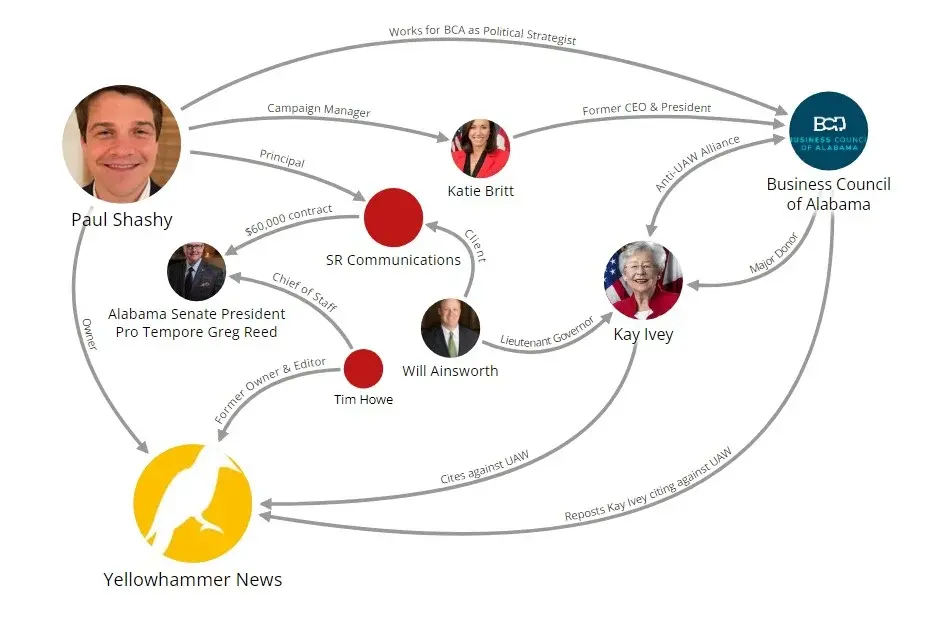
Yellowhammer is no ordinary “news” site. It is co-owned by a longtime political consultant, Paul Shashy, who has deep ties to the Alabama political and business establishment, which is driving the opposition to the UAW. Indeed, in March 2023, the Business Council of Alabama, which is coordinating a statewide anti-union campaign, announced its hiring of Shashy as a political strategist.
None of this appears to be disclosed in Yellowhammer’s day-to-day coverage of topics, like the autoworker union drive, despite the owner’s apparent conflict of interest. Moreover, while Shashy purchased Yellowhammer in late 2023, its past owners have been lobbyists and consultants for major state politicians and executive directors of the Alabama GOP.
All told, the relationships between Yellowhammer’s ownership and Alabama’s anti-union politicians and business groups shed more light on what unionizing autoworkers are up against. Essentially, Alabama’s anti-union corporate forces have at their service one of the state’s biggest “media” networks, which is owned by someone who directly works for the BCA. As it churns out coverage and op-eds hostile to the UAW, those same corporate forces and their political allies can then invoke all this as “news.”
“A Partisan Site”: The Rise of Yellowhammer
On its website, Yellowhammer News claims to be “Alabama’s second-largest media outlet.” It tells advertisers that its news site has 57 million annual pageviews, 35,000 email subscribers, 25 radio affiliates and TV broadcasting to over 800,000 households. It has 107,000 followers on Facebook.
Yellowhammer describes itself as “Alabama’s preeminent outlet for news, analysis and much more.” It says it is “committed to delivering the news in a manner that reflects the state of Alabama, its people and their values.” Its catchphrase is “We know Alabama.”
But Yellowhammer is far from a regular news site. It has a documented history as a conservative operation owned and run by GOP political consultants and lobbyists with deep ties to corporate interests in Alabama.
According to a 2019 Columbia Journalism Review (CJR) story, Yellowhammer was founded in 2011 by a political consultant named Cliff Sims, who also served as the site’s CEO. Later revelations showed that two extremely well-connected lobbyists, Tim Howe and John Ross, were co-owners of Yellowhammer.
In January 2011, Howe and Ross became principals of an influential new lobbying firm, Swatek, Azbell, Howe & Ross. At the time, Ross was the executive director of the Alabama Republican Party, a position Howe also previously held. Their firm disclosed numerous clients that included prominent Alabama corporations, trade associations and advocacy groups.
It wasn’t known until 2014 that Howe and Ross were — in the words of the CJR story — the “benefactors” of Yellowhammer. This revelation came after Eddie Curran, an Alabama-based independent investigative journalist, published a leaked email with Yellowhammer CEO Sims seeking guidance from lobbyist Howe — referred to by Sims in the email as “Ghost Writer” — around a video that Sims was working on.
Yellowhammer’s ties to corporate power and the GOP were documented in the CJR story, which reported that Yellowhammer had received over $185,000 from advertising and in-kind donations from Republican PACs and political campaigns. Later investigations from NPR and Floodlight suggested links between Alabama Power, the state’s powerful electric utility, and Yellowhammer.
Yellowhammer has long been conservative in its orientation, but Curran told Truthout the site’s politics is not its main driver. “The issue with Yellowhammer is not its ideology, agree with it or not,” said Curran. “Think of the conservative politics as the bait. Yellowhammer’s true raison d’etre, so to speak — and for that matter, its business model — is as a pay-for-play operation.”
New Yellowhammer Owner Is a Republican and Business Consultant
In 2017, Yellowhammer’s founder, Sims, stepped down as CEO to join the Trump administration as assistant communications director for White House message strategy. In 2018, Sims was reassigned as senior adviser to Secretary of State Mike Pompeo.
Yellowhammer changed ownership in 2017 — Allison Ross, the wife of John Ross, became a co-owner — and then, in August 2023, another important new ownership change was announced.
Paul Shashy, a prominent Alabama political consultant, purchased the Yellowhammer media network, along with Thomas Harris, the former president and CEO of Merchant Capital. They moved Yellowhammer’s outlets into a new umbrella entity, YHN Media Group LLC.
Shashy was the campaign manager for both of Alabama’s sitting U.S. senators, Katie Britt and Tommy Tuberville. A 2018 Yellowhammer profile noted that Shashy had the “trust” of “the state’s biggest businesses and top-tier Republican candidates” and stated that “Shashy is going to be shaping Alabama elections and influencing the entire political scene for the next half-century.”
Shashy is a principal of the consulting firm SR Communications, which counts the Alabama Senate Republican Caucus among its clients. Alabama public records, which list Shashy as an “LLC member” of the firm, show that SR Communications has a $60,000 contract through December 2024 to provide “communications services” for the Senate president pro tempore, who is currently Alabama State Sen. Greg Reed. In August 2023, Tim Howe, the former lobbyist who was Yellowhammer’s former owner and editor, was appointed as Reed’s chief of staff.
Public records reveal that numerous other Alabama Republican political candidates and judges have paid tens of thousands of dollars to SR Communications, Shashy’s firm, over the past year alone, and over $350,000 since 2021.
For example, 13 filings from December 2021 through January 2024 show Alabama Lt. Gov. Will Ainsworth paid SR Communications a total of $21,100. In March 2024, Twinkle Andress Cavanaugh, Republican president of the Alabama Public Service Commission, filed a $10,000 payment to SR Communications for polling services. In November 2023, ProgressPAC, the Business Council of Alabama’s PAC, reimbursed SR Communications for a total of $2,089 as an “Expense Paid For GOTV In-Kind Contribution for HD16 Bryan Brinyark,” who was running for the Alabama House.
Filings show payments to SR Communications from numerous other candidates, ranging from state school board candidates to judges to members of the Alabama House of Representatives.
Shashy’s Yellowhammer co-owner, Thomas Harris, is also no minor figure. While leading Merchant Capital, it long ranked as Alabama’s top investment bank, managing over a billion dollars’ worth of government bonds, and was among the top financial underwriters in the nation.
Shashy, Yellowhammer and the Business Council of Alabama
A few months before Shashy purchased Yellowhammer, he was hired by the Business Council of Alabama.
“The Business Council of Alabama (BCA) is proud to announce the hiring of… Paul Shashy with SR Communications as political strategist,” said a March 2023 statement. Yellowhammer also wrote up the news.
As Truthout previously reported, the BCA is a statewide business association whose core 15-member governing leadership is composed of some of Alabama’s most powerful corporations, including the state’s biggest bank, electric utility and health care company. The BCA’s larger 135-member board includes representatives from automakers Toyota, Honda and Mercedes.
The BCA is a key player coordinating the statewide campaign against the UAW and autoworker unionization in Alabama. It started an anti-UAW website and has published anti-union op-eds. The BCA is also closely allied with Governor Ivey in resisting autoworker unionization. The BCA is one of Ivey’s top donors, and key corporations within the BCA governing leadership are also top Ivey donors. Top staffers of the Ivey administration formerly worked for the BCA.
Alabama’s Katie Britt was the CEO and president of the BCA from 2019 to 2021, after which she successfully ran for the U.S. Senate in a campaign managed by Shashy.
Yellowhammer coverage of the UAW has been hostile, using language that frames the union as villainous. For example, a March 4 op-ed by Clay Scofield, who stepped down last year as the majority leader in the Alabama Senate to work for the BCA, was titled “Even a small dose of labor union snake oil could prove poisonous to Alabama’s economy.”
An April 3 story by a staff writer on UAW President Shawn Fain was titled “Union boss escalates attacks on Governor Kay Ivey in tirade at North Carolina rally,” and referred to Fain’s “assault” on “Alabama’s Mercedes-Benz leadership, Governor Kay Ivey and the Business Council of Alabama.”
An April 9 story uncritically recited Alabama House Majority Leader Scott Stadthagen’s message that the “UAW’s Alabama expansion is an attempt to hijack state’s success.” The April 25 op-ed by Speaker Nathaniel Ledbetter that Kay Ivey cited warned about “the UAW’s trail of destruction” and its “legacy of corruption, destruction and usury.”
The list could go on. None of these articles appear to disclose that they were published while Yellowhammer’s owner is, according to the most recent publicly available records, working for the BCA, the group that is coordinating the statewide campaign, in close alliance with Kay Ivey, against autoworker unionization in the state.
In contrast, Yellowhammer’s coverage of the BCA is much rosier, with uncritical staff write-ups on BCA events and initiatives that essentially parrot the subjects they cover, whether that be the BCA members or BCA-allied politicians.
Truthout reached out over email to Yellowhammer News, Paul Shashy and the Business Council for Alabama for comment but did not receive responses from them.
“Corrupt” and “Shifty”?
All this brings us back to Kay Ivey invoking Yellowhammer in her campaign against autoworker unionization and the BCA reposting Ivey’s quip about the UAW being “corrupt, shifty and a dangerous leech.”
What this Truthout analysis reveals is that this well-known Alabama “media” outlet publishing anti-union content referenced by politicians and business groups resisting the UAW is, in fact, owned by a prominent consultant who works for these same anti-union forces and who is deeply embedded within their wider political operation.
These conflicts surrounding Yellowhammer as a new source offer a window into the wider influence machine of Alabama conservatives and business groups. Nor should the irony be lost that Governor Ivey calls the UAW “corrupt” while invoking such news sources.
Copyright © Truthout. May not be reprinted without permission.
Read the entire article. It’s great and relevant.
Glad the UAW and several other unions are supporting the protests.

cross-posted from: hexbear.net/post/2436414
Fae’s also Autistic, like me.
Fae didn’t know it was technically an American holiday till I told faer today for our therapy session.
Fun fact: the wife of the person that was executed became a CPUSA member (the wife of one of the leaders of the group)!
Her house was burned down and the FBI took all her papers from the wreckage, her burnt memoirs and all that, and whatever else she was writing.
All that history… lost.

cross-posted from: hexbear.net/post/2435724
Check it out.
Only nine minutes long.
cross-posted from: hexbear.net/post/2435724
Check it out.
Only nine minutes long.

cross-posted from: hexbear.net/post/2435607
Check it out.
About 40 minutes long.
You can just listen to it while you’re doing other things.
cross-posted from: hexbear.net/post/2435607
Check it out.
About 40 minutes long.
You can just listen to it while you’re doing other things.

cross-posted from: hexbear.net/post/2426220
Your thoughts on the article?
cross-posted from: hexbear.net/post/2426220
Your thoughts on the article?

cross-posted from: hexbear.net/post/2426198
Read this article.
It’s great.
And not too long.
cross-posted from: hexbear.net/post/2426198
Read this article.
It’s great.
And not too long.
cross-posted from: hexbear.net/post/2425113
We have to stop Project 2025…
But I feel powerless at times.
cross-posted from: hexbear.net/post/2425113
We have to stop Project 2025…
But I feel powerless at times.

cross-posted from: hexbear.net/post/2263203
The article:
I love driving. I know driving is kind of evil. But I love it. I love my stupid little car—a 2015 Volkswagen Golf TDI. It’s diesel. It gets 45 miles per gallon. It’s a 6-speed stick shift. It was cheap (due to Volkswagen recalling every diesel they sold after being caught doing really evil stuff to cheat the emissions standards of the U.S., and then needing to offload all those cars) and it goes fast and is tiny and I love zipping around country corners and pretending I’m a racecar driver (while remaining at a reasonable speed, of course; I would never break the law). Vroom vroom.
But over the last few years, driving has become a much more miserable experience for me. I hope not to negate my own responsibility here, but, I think, it’s not that I’ve changed, it’s that everything else has: every car around me is suddenly humongous, all of their headlights seem designed to blind me and cause me to crash into a telephone poll, and, worst of all, the people behind the wheel of these humongous and bright cars seem to actively want to kill me, and, presumably, everyone else on the road too.
People seem to agree that drivers have gotten worse in the last few years, that headlights have gotten too bright, and that cars have gotten too big and dangerous. And yet, many, many people keep buying these huge, dumb cars, despite the fact that they cost way too much money. The average car price is now $47,000. That is, frankly, insane.
Perhaps the pandemic made people worse at driving and more prone to antisocial behavior; perhaps some people are affected by Long Covid and cannot think as clearly as they barrel down the road. Perhaps people are more stressed and depressed and taking that out on everyone.
All those things are probably true. But I think they’re also all related—they sit under the umbrella of a culture designed to atomize us into machines indifferent to (or even actively seeking pleasure in) death and destruction. Cars and driving are not the cause of this problem; rather they are the most effective tool to enact a purposeful societal violence. Which is what, in many ways, they’ve always been. We’ve simply made those tools much more effective at doing their jobs recently. If we have any hope of challenging our ever-more-insane car culture, we first must correctly identify the problem.
As the United States has grown ever-more reliant on cars, there’s been a growing counter-movement. Young people seem to want cars less these days; they prefer living in cities with public transit. Organizations that promote things like adding bike lanes and redesigning streets to make them less car-centric have sprouted up in nearly every midsize and large American city. And while these movements are commendable, they’re not very successful: America’s streets are more dangerous for pedestrians now than they’ve been in 40 years. The number of pedestrians killed by cars has increased by 77 percent (!!!) just since 2010.
How can it be that fewer people value cars and driving at the same time that our culture becomes more car-centric and less pedestrian friendly? It’s probably because we’ve mis-identified the source of the issue at hand. Saying cars are the root of America’s social rot is like saying missiles are the cause of war. Violence is the point of war, not an unintended consequence; and missiles are the tool through which that violence is carried out. And violence is the point of our transportation system in the United States; and cars are the tool through which that violence is carried out.
We often hear the story that the interstate highway system was constructed without regard for urban communities, especially Black communities—that the suburbs and their attendant roads were made for white people and that the destruction of cities and the wealth and culture they contained was an unnecessary and evil consequence of that creation. But that’s not really what happened. Our car culture was built by our government with the explicit intent to isolate people from one another; the objective was to destroy community.
As I wrote in my book How to Kill a City, the suburbs were envisioned as a way to break solidarity. In the 1940s, there were growing movements (gay, feminist, cross-racial, anti-capitalist, pro-union, etc.) in American cities. The suburbs helped solve that problem with a carrot and stick.
White people got the carrot (surprise surprise)—they were gifted very cheap land and mortgages and cars and the wealth that those things created in exchange for their politics and communities and identities. “No man who owns his house and lot can be a communist,” William J. Levitt, the creator of the prototypical suburb Levittown said. “He has too much to do.”
And People of Color got the stick—their communities and wealth and the brewing radicalism within those communities were all destroyed by the highways rammed through them. Which, again, was not an unintended consequence, but the exact point. Joseph Mccarthy (of the McCarthy era and many other bad things), actually got his start as a shithead by linking urbanism and multifamily housing to communism, and encouraging the destruction of all of those things to prevent the destruction of capitalism.
(As an aside, gentrification functions in a largely similar way to suburbanization in terms of reifying individualist politics and culture: once cities were hollowed out, white people were encouraged to move back into them, but now with suburbanized values, thus further entrenching the geography of individualism (for more on all this, read my book, as well as Sarah Schulman’s The Gentrification of the Mind).
But the question remains: if suburbanization and highways and cars were always tools to reinforce this system of individualism and stratification, then why has driving suddenly gotten so much worse? (And by most accounts it really has: 54 percent of Americans think driving is more miserable now than before the pandemic).
Well, if we can consider the car of the mid-1900s one of the most effective tools/weapons of industrial post-war capitalism, we might now consider the modern car an updated technology for our new-ish era of capitalism. Today it’s not so much the physical landscape that needs destroying, but the remaining social bonds that tie us together and the institutions that once fostered those bonds (schools, workplaces, unions, government agencies, etc.).
This is an era of constant competition—steady, full-time work replaced by the gig economy in which we are all fighting each other as independent entities for the same slice of the pie. And that competition can only occur through hyper-individualism. Cars (along with several other powerful technologies, such as, I’d argue, the DSM 😛) are the perfect tool to accomplish this task.
In a really great essay on cars and neoliberalism, Patrick McCarthur, building on the work of psychologist Zygmunt Bauman, argues that our age of capitalism is a “hunter’s utopia” in which a population’s collective ideals of progress are replaced by individualist ideals of survival. Any and all progress is now measured by how good we are at surviving the system in which we are now trapped (and then we call this state of survival mode “freedom”).
“…everyone must continue to hunt to survive, even if they are not really hunters,” McCarthur writes. “Thus, in a neoliberal framework, people have the freedom to be anyone, but the social system carries the assumption that everyone must have the same relative requirements and expectations.”
We’re all free to hunt as we please, but we all must hunt, and we’re all in competition for the same boar, or deer, or whatever (IDK I’ve never hunted). Which creates a kind of arms race—if we must fight each other to survive, we will begin an obsessive search for the perfect tools and strategies to outperform one another (this is starting to sound a lot like The Hunger Games).
And so it’s no surprise that cars have gotten bigger and more dangerous; it’s no coincidence that these bright-ass headlights are made without any regard for other people—because our age of capitalism requires us to be in a constant battle with each other. Who cares if your car kills kids and blinds drivers? That’s the point. Better I survive than you.
All the way back in the year 2000, when SUVs were first becoming popular, automakers essentially admitted this: they told the New York Times that people were no longer wanting to be “other-oriented”and thus no longer wanted to buy cars associated with others (think: families and minivans), and instead were becoming “self-oriented”—less social, and more fearful of crime and society itself. Big, dangerous cars like SUVs became the preferred tools of a completely self-focused era.
In a more recent Times article, citing an AAA survey, the paper pondered how a large percentage of drivers these days could admit to enacting aggressive and illegal behavior behind the wheel (speeding, running red lights, tailgating), while simultaneously disapproving of those behaviors in others. Given the context of the hunter’s utopia we live in, the answer becomes clear—people will do anything to make their driving more aggressive and effective at enacting violence, but don’t like the idea that others could too, not because there’s a moral problem with that, but because it threatens their dominance in the hunt.
In 2017, I was one of many people nearly killed by James Alex Fields as he rammed his Dodge Challenger into a crowd of protesters in Charlottesville. In addition to giving me terrible PTSD, it also gave me a hatred of Dodge Challengers. It’s no coincidence Fields drove this very American, very muscle-y car. It’s no coincidence that it, along with the Dodge Charger, are the cars most closely associated with the U.S. Military. And it’s no coincidence that fascists, ever the bleeding edge of capitalism, are increasingly using cars as weapons against protestors: cars have become tools of war, and fascists were the first to capitalize on this fact.
But now we’ve all been drafted into the battle, and we’ve all been forced to fight.
My car will be above 100k miles soon, and I’ll likely have to get a new one in the next year or so. Part of me wants another fun, zippy, small car, one that allows me to feel the road, the outside world. But, I don’t know. I might go with something safer and more practical—something that allows me to effectively compete.

cross-posted from: hexbear.net/post/2227549
I’m glad that we’re talking about the attack on libraries.
I’m trying to work on one to help defend them.
cross-posted from: hexbear.net/post/2227549
I’m glad that we’re talking about the attack on libraries.
I’m trying to work on one to help defend them.

cross-posted from: hexbear.net/post/2210352
White supremacy lost in Oklahoma tonight.
Honestly, this was a good thing and shows that people are waking up to the creeping fascist threat.
As communists, we must try to be a guiding force and helping hand in the fightback against fascism.
cross-posted from: hexbear.net/post/2210352
White supremacy lost in Oklahoma tonight.
Honestly, this was a good thing and shows that people are waking up to the creeping fascist threat.
As communists, we must try to be a guiding force and helping hand in the fightback against fascism.

cross-posted from: hexbear.net/post/2181655
Helping someone I know.
cross-posted from: hexbear.net/post/2181655
Helping someone I know.

cross-posted from: hexbear.net/post/2173758
Passage from the article:
It should also be stated: The times cry out for Communist candidates. The CPUSA simply cannot fulfill its role as a political party without running for office. The focus should be on standing for local office. Such campaigns should aim to build broad community-based electoral coalitions. In this regard, the standard should not be set so high that campaigns are never undertaken.
The times also cry out for building a mass Young Communist League. And here again the CPUSA cannot fulfill its mission without the militancy, stamina and energy of the young generation. The socialist moment of the last period is largely a youth-led-and-energized moment and for good reason. The young generation are most affected by the capitalist crisis – they are its first casualties but also the first to fight against it.
The 31st convention recommitted itself to the goal of refounding the YCL and that commitment remains. YCL clubs are continuing to spring up around the country in communities and on campuses. A few have multiple campus clubs. Consolidating a communist core in the youth movement remains the goal. Its achievement requires moral, political and ideological support. It also demands material assistance.
Overall, the party’s rebuilding process continues apace. Solid political, organizational, and ideological foundations are being laid. Weaknesses are being corrected and overcome. Throughout the party, collective practices are being adopted with the understanding that the CPUSA has one leadership united in its National Committee, one political program, The Road to Socialism, and one ideology, Marxism-Leninism.
In Virginia, we’re trying to run our own candidates.

cross-posted from: hexbear.net/post/2135396
The PatSoc got an award and is apparently moving up.
cross-posted from: hexbear.net/post/2135396
The PatSoc got an award and is apparently moving up.
cross-posted from: hexbear.net/post/2112135
What does everyone use?
I’m trying to show quoted text on, well, Twitter and want to use a highlighter on the Internet without using a highlighter in real life.
Then save the image and show everyone what I have.
It sucks because Adobe Acrobat is trash. I can’t believe I got desperate enough to pay for it today.
The OCR capabilities are horrible and Adobe Scan just doesn’t work for me, I feel, because I can’t keep the physical copy pages still…
So now I’m back to just wanting to take a picture and put high-lighter text on an image rather than the actual pages (I probably should get used to annotating and highlighting text physically but I’ll walk that bridge when I get there…)
What should I use?
I can’t Internet to save my life…
cross-posted from: hexbear.net/post/2106410
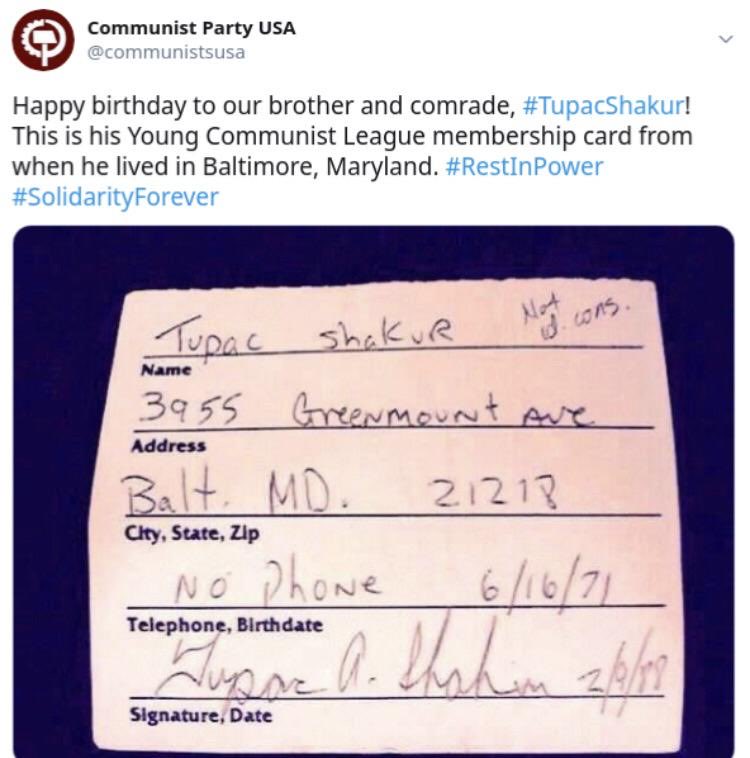
Bleh. He was literally a communist:
cross-posted from: hexbear.net/post/2106410
Bleh. He was literally a communist:

cross-posted from: hexbear.net/post/2105395
From the middle of the article:
The Fortune report claims that Kickstarter’s controversial plans to move theplatform onto the blockchain in 2022 - which were met with no shortage of backlash from creators and consumers alike, and triggered an exodus of creators to rival platforms - came in the wake of a secret $100 million round of investment led by a16z, the crypto fund of venture firm Andreessen Horowitz.
I can’t believe I’m going to ask this really dumb question here, but, err, umm…
…What’s blockchain?
Hides behind shield.

cross-posted from: hexbear.net/post/2080065
B-b-based NY Dems?! Critical support?!
Full support to Mao, of course.
cross-posted from: hexbear.net/post/2080065
B-b-based NY Dems?! Critical support?!
Full support to Mao, of course.
cross-posted from: hexbear.net/post/2066954
From the rest of the headline:
(…) (“Independence Restoration Day”). They chanted “Lithuania for Lithuanians only”, “Lithuania without Russians” etc.
Things are getting dire. I have a friend in Lithuania and he says they are, though this has been going on for a while…

cross-posted from: hexbear.net/post/2063506
Let’s bring it.
cross-posted from: hexbear.net/post/2063506
Let’s bring it.

cross-posted from: hexbear.net/post/2059933
Quote:
Kotick is also looking for partners, which could include OpenAI CEO Sam Altman
Oh God NO
cross-posted from: hexbear.net/post/2059933
Quote:
Kotick is also looking for partners, which could include OpenAI CEO Sam Altman
Oh God NO

cross-posted from: hexbear.net/post/2046445
Subscribe to this person.
Trying to help 'em out.
Also, comment and like (you know, for the algorithm).
Cheers!
cross-posted from: hexbear.net/post/2046445
Subscribe to this person.
Trying to help 'em out.
Also, comment and like (you know, for the algorithm).
Cheers!
cross-posted from: hexbear.net/post/2040520
I quite liked it!
It felt like I was watching a great biopic and I liked some of the cinematography as well and the way they shot certain things.
But also, it felt a bit like a Guy Ritchie film with the film constantly cutting back and forth between different eras… which I sort-of liked but I can understand why others didn’t like it and it has its limitations (not to mention: it’s hard to do effectively).
The problem is that, unless you’re a communist or a history buff, you won’t always understand the references. There’s a lot missing, even for a film that’s 3 hours long. I don’t mind the 3 hour duration. But people talked vaguely about shit or were kinda obscure with what they said. I will say that it captures the Cold War and Second Red Scare aspect well. But you won’t, say, care who Stimson is unless you already know who Stimson is, so to speak.
I’m surprised that the communists are described and shown to be, more or less, sympathetic. Oppie says something about “appeasing the Soviets” but that’s probably just fluff and we all know that he doesn’t mean it (plus, he was likely a Communist Party USA member at one point anyway so, in a way, it doesn’t matter what anti-communist thing he might say here and there because we know that it’s bullshit). Does the audience know that? They probably sort-of do. I say “sort-of” because no doubt it’ll go over other peoples’ heads.
It definitely feels like Christopher Nolan made it… for himself, so to speak, in the way it just glosses over things that the audience could’ve probably got a primer on to begin with. Like, I felt like the director and the people behind the film really liked the subject matter but they still had to dumb it down in the end. They still had to do it all fast within a 3 hour framework.
It’s amazing that none of the other characters besides, say, Teller (for example) have personalities. Well, certainly, Groves has a personality, Jean has a personality, but you can tell that, for example, Lomanwitz doesn’t have much of a personality to begin with. Whatever his historical significance, the movie will gloss over it at times, and you can tell that, even when the movie references things from an hour previously (it is a bit tightly written), it’s not… able to do so in a way that’s always significant. I see what Nolan was trying to do by revisiting certain scenes and seeing it from a different angle. I like it. But it doesn’t always work.
I understand that most MLs will hate this film. I’ve seen many that do.
But I went in not expecting that much in terms of accuracy and was pleasantly surprised by, well, other aspects of the film, including the Second Red Scare aspect.
Also, Kitty saying that she sees a difference between communism and Soviet communism was honestly a good answer. I liked it, but again, that’s a theoretical debate that MLs sometimes have all the time (I don’t believe that the Soviet model is the only model of socialism). I don’t know. I just liked it. You can glean things from the dialogue of the movie… if you fill in the dots with what you already know (and use sub-titles all the while).
On another note: I don’t mind “no-personality” characters per se (I’ve read A Song of Ice and Fire, for crying out loud, and I like it, but I’m doing a re-read and there are certainly third-party characters that come off as basically being there to enliven the scene, act as a go-between for certain characters, or expand the world). As bonkers as it might sound, I don’t think every character (not even a secondary character) has to have an expanded backstory and personality so long as they’re there to explain things and support the secondary characters or main characters… To give an A Song of Ice and Fire example, Robett Glover (a character from the books, not Game of Thrones) isn’t going to be on the same level as, say, Jon Snow or Davos Seaworth. And I get that. But sometimes, it seems that even the secondary characters in the film Oppenheimer could’ve used a bit more oomph, a bit more presence, a bit more of the it quality (and, hell, sometimes the main characters too).
Again, interesting ideas.
Interesting way of doing things with the film.
But obviously, the film can’t get a high score in all the things it’s trying to do.

cross-posted from: hexbear.net/post/2039938
It’s a long-form article so here’s an excerpt of the first part:
Baltimore is often maligned as a shrinking city beset by crime and intractable poverty. But take a walk down President Street just south of Little Italy on a Friday night, and you will enter a world that appears far removed from the idea of a city that is terminally in decay.
Past the empty pavilions of the Inner Harbor and east of the city’s increasingly troubled downtown business district, a cluster of towering high-rises emerges from the harbor like a defiant mountain range of concrete.
A cobblestone boulevard leads to a European-style thoroughfare dotted with a dazzling array of upscale restaurants and outdoor dining patios. Lines of traffic spill onto the side streets as eager tourists vie for hard-to-find parking spots.
The outdoor bars and retail shops thrum with activity while the upscale Four Seasons Hotel sits astride panoramic views of the tranquil harbor. Stories of luxury condominiums extend into a swanky dance club, which perches atop the building like a palatial penthouse. An express elevator operated by a top hat-wearing attendant delivers partygoers to an often-packed dance floor.
It’s a world unto itself, seemingly far removed from the David Simon-conjured Wire-fied landscape of a failed city beset by corruption, drug dealing, and over policing: An upscale bubble that offers a gleaming rebuke to the naysayers who deem Baltimore a dysfunctional city of a dwindling population and violent crime.
But it’s a success story that comes with a hefty, less obviously apparent, asterisk. Harbor East is, in some sense, a taxpayer-bolstered paradise.
Based on the findings of our nearly year-long investigation into how Harbor East came to be, this shining city within the city is a success story heavily dependent upon public subsidies to an extent that has not previously been reported. It is a waterfront oasis fueled by dozens of tax breaks and incentives, built and sustained by tens of millions of dollars in city money.
How these tax subsidies have both defined and transformed Harbor East is a story entangled in the city that surrounds it. As our ongoing investigation Tax Broke has revealed, it is a tale of how a community walled off from its affluent suburban neighbors turned to tax incentives to reverse years of decay and population loss. But it’s also an example of the secrecy that obscures the details of how much this policy costs and who it really benefits.
As this spreadsheet illustrates, records obtained by TRNN reveal that, between 2012 and 2022, Harbor East received roughly $115.8 million in tax relief from the city through various subsidies and incentives.
However, despite numerous Maryland Public Information Act requests, city officials would release only a limited range of data from 2013–2022 pertaining to Harbor East tax records. They also would not release separate tax bills regarding a series of PILOTs—payment in lieu of taxes—granted to buildings within the development, which led to additional tax savings for developers.
Still, what we were able to obtain paints a picture of a luxury development built upon a foundation of public subsidies.
The most lucrative of these incentives went to the Marriott Waterfront Hotel. To date, $57 million in property tax has been abated, part of a 25-year PILOT that requires a tax payment of $1 per year.
But the city has also granted tax relief to a variety of other buildings.
Roughly 75% of the additional Harbor East properties garnered subsidies worth approximately $58 million in just under a decade. The bulk of the tax breaks were PILOTs, given to at least seven properties comprising the waterfront development.
PILOTs offer fairly straightforward tax relief: Property taxes are phased in over time on a sliding scale, from a small percentage of the actual tax bill to a greater share of what would actually be owed. A ten-year PILOT, for example, might require the property to pay 5% of the entire tax bill for the first three years, then 20% for the next four, and, finally, 80% for the remaining two. But the city has been opaque about the tax savings from individual PILOTs, removing the data from online tax records and ignoring our requests for additional data.
But some properties were granted more than one tax break.
The pricey office tower built to house the Legg Mason investment firm benefited from both an Enterprise Zone credit and a PILOT. The subsidies were intended to maintain 600 jobs and keep the firm’s headquarters in the city.
Legg Mason was acquired by California-based investment firm Franklin Templeton in 2020. The name is currently off the building, but the subsidies remain. Records show the owners of the building have not been required to pay full city property tax since 2018.
In addition to the PILOTs, multiple other buildings within the same development also received Enterprise Zone tax credits and abatements under the Brownfields incentive program. Each forgives a percentage of property taxes ranging from 50% to 75% of the entire tax bill for five to ten years, depending on a variety of criteria.
The Enterprise Zone credit is designed to spur commercial development in poor neighborhoods but was expanded over time to include the entire city. The Brownfields credit incentivizes developers to remediate contaminated properties and offers a similarly generous 75% reduction in tax bills for five to ten years.
The Four Seasons Hotel and Private Residences used a Brownfield credit to save roughly $10.6 million in taxes over the past decade. This incentive included nearly $6 million for the luxury condos that sit atop the hotel.
The $115 million figure does not paint a full picture of the taxpayer tab for Harbor East. The scope of our calculations is limited by the fact that many of the tax credits granted to these developments were in effect prior to 2013—records that were not available, according to city finance officials.
The lack of transparency is, in part, due to how the city bills properties that receive tax subsidies.
Special credits like Brownfields and Enterprise Zones are not detailed online. Instead, we had to ask the city for copies of the separate paper bills it mails annually to developers, which list the value of the credit. From the paper bills, we calculated the 10-year figure for taxes abated through Brownfields and Enterprise Zone tax credits that contribute to the $115 million taxpayer tab.
Even the taxes abated via PILOTs were challenging to calculate. The city told us tax bills for PILOTs are mailed separately from ordinary tax bills, including special credits. We asked for copies of the separate PILOT bills, but the city would not release them, again without explanation or response to our request.
To work around the lack of data, we obtained two decades’ worth of property assessments for all the parcels that comprise Harbor East. We used the value of the buildings to calculate the property taxes owed in any given year. Then, we applied the formulas outlined in council legislation, which authorized several of the Harbor East PILOTs to estimate the tax savings for a given PILOT to arrive at the approximate figure.
Anyone else live in Baltimore or Maryland?
What do you think of all this?
cross-posted from: hexbear.net/post/1987995
An excerpt from the article:
Gone are the days when former Starbucks CEO Howard Schultz could argue that the company’s upstart barista network would be no more than a blip in the coffee behemoth’s history.
On Tuesday, Starbucks Workers United (SBWU)’s parent union and Starbucks announced that they had reached a “foundational framework” for substantive negotiations over a range of issues.
“The fight is worth fighting for. This victory alone proves that no workplace is out of reach for organizing,” fired former Starbucks barista Alicia Flores of Portland, Oregon told In These Times, speaking in a personal capacity.
The two sides hope the agreement will form the basis for contract talks at nearly 400 union shops, the resolution of ongoing litigation, and an agreement over rules governing future organizing at Starbucks locations. While the publicly announced details of the agreement include few specifics and even fewer guarantees, the barista network has won at least the potential for negotiations over a first master contract.
“This agreement…is a very, very big deal,” said Dave Kamper, Senior Strategist at the progressive think tank Economic Policy Institute. “Starbucks Workers United has shown that determined workers, willing to use all the tools of worker power at their disposal…can bring companies to the bargaining table.”
Starbucks also announced that, as a measure of good faith, it will provide credit card tipping and other benefits to union stores that it has provided to nonunion stores since May 2022.
Some SBWU members were reluctant to speak to In These Times about the framework. But those who did open up were enthusiastic.
“I’m excited for the gang at SBWU to bargain a fair contract and to hopefully get reinstated as a fired worker,” said Flores.
Similarly, barista James Greene of the Pittsburgh area, also speaking in a personal capacity, said that he is “encouraged by the company’s [message]” and hopes “we can negotiate in good faith soon.”
A milestone battle and victory for Starbucks Workers United!
Read the rest of the article through the link up top (which also talks about labor and the anti-Zionist movement in the USA).
cross-posted from: hexbear.net/post/1976670
Check it out. Also:
“George Bush doesn’t care about Black people.” These were the words of famed rapper Kanye West during the 2005 nationally televised telethon benefit for victims of Hurricane Katrina. In this notorious quote, Kanye expressed a popular conception of the Bush administration for a whole generation of people. How is it then, that less than 15 years later the same Kanye West — son of a Black Panther who had previously made commentary on racism in the U.S. — would go on a national tour professing his love for Hitler? Even more recently, beloved star in the Black community, Nicki Minaj, cozied up to Ben Shapiro after rapper Megan Thee Stallion blasted her for misogynoir. Both of these instances illustrate the right’s newfound investment in popular culture in response to young people, people of color and the LGBTQ community’s increasing acceptance of socialism.
Kanye was the son of a Black Panther?! Holy shit…
Anyway:
It’s only a few paragraphs long and is for a pre-convention discussion (since CPUSA is in discussion period for our democratic process).
cross-posted from: hexbear.net/post/1971306
Damn, this was a record for me.
It was a rally and march for Palestine at the city nearby.
@Othello@hexbear.net might know about it, but I don’t think they’re here now (I’m just tagging in case they are).
Ask me about it if you want, but right now I’m “venting” about something positive; I’m really proud of myself for keeping up the pressure regarding Gaza and helping to do that.
Definitely join an org or activist group if you can.
That’s all. Cheers!

cross-posted from: hexbear.net/post/1968230
Pretty expected, to be honest.
Especially now that Joe Sims is in and not John Bachtell.
cross-posted from: hexbear.net/post/1968230
Pretty expected, to be honest.
Especially now that Joe Sims is in and not John Bachtell.

cross-posted from: hexbear.net/post/1967643
20 minutes or so.
cross-posted from: hexbear.net/post/1967643
20 minutes or so.

cross-posted from: hexbear.net/post/1962122
Subscribe, comment, like, etc.
cross-posted from: hexbear.net/post/1962122
Subscribe, comment, like, etc.

cross-posted from: hexbear.net/post/1941627
Just found out about this an hour ago.
Holy shit, this is good, and it’s Marxist writers’ group too.
We need more stuff like this.
@muad_dibber@lemmygrad.ml Thought you might be interested in this, old friend (since you’re the only other person I know right now besides myself that knew BayArea415, at least online).
But anyway, on another note, I’m glad that the PatSoc infiltration attempts were sorted out, otherwise the content would just be a repeat of Haz’s trash ideas lol
Glad they’re experimenting with a writing and literature group; very early in its initial phase, from what I know.
It’s a pity that one of the people didn’t get a chance to finish his own fictional work and had to stop at the beginning before it got to the crux or point of it all.
Anyway, enjoy, y’all.

cross-posted from: hexbear.net/post/1904493
Good discussion and a long one too. Nearly an hour. I felt Ben was a good guest too. And of course, there’s Justine Medina as well.
cross-posted from: hexbear.net/post/1904493
Good discussion and a long one too. Nearly an hour. I felt Ben was a good guest too. And of course, there’s Justine Medina as well.

cross-posted from: hexbear.net/post/1863958
The book is this one:
cross-posted from: hexbear.net/post/1863958
The book is this one:
cross-posted from: hexbear.net/post/1856459
How to Be a Good Communist
Written/Published: July 1939
Source: Selected Works of Liu Shaoqi, Volume I
First Published: Foreign Languages Press
I’m reading this for the first time, btw, based on something I heard online. Someone also recommended it to me and said Liu Shaoqi was underrated.
Definitely giving this a go.

cross-posted from: hexbear.net/post/1852949
I talked about this video in this post here.
It really helped me. I mean, this was a godsend (except for the jump-scare near the beginning). I would heartily recommend it to people who struggle with productivity either way.
cross-posted from: hexbear.net/post/1852949
I talked about this video in this post here.
It really helped me. I mean, this was a godsend (except for the jump-scare near the beginning). I would heartily recommend it to people who struggle with productivity either way.

cross-posted from: hexbear.net/post/1849807
Love these!
I hope everyone else enjoys this episode.
I didn’t know about the recent call for more colonialism in Africa by Erik Prince till now.
If anyone has any more info on that, let me know.
Thanks!
cross-posted from: hexbear.net/post/1849807
Love these!
I hope everyone else enjoys this episode.
I didn’t know about the recent call for more colonialism in Africa by Erik Prince till now.
If anyone has any more info on that, let me know.
Thanks!