
showing posts tagged #anarchism — clear

0

Announcing Black Rose/Rosa Negra Locals in Austin, New York City, and Chicago

Black Rose/Rosa Negra Anarchist Federation Announcing Black Rose/Rosa Negra Locals in Austin, New York City, and Chicago www.blackrosefed.org
preview

cross-posted from: news.abolish.capital/post/92149

We’re thrilled to announce the formation of three new Locals of Black Rose/Rosa Negra Anarchist Federation (BRRN)! From the Texas Hill Country, to the Great Lakes, to the Northeast, our organization is growing deeper roots and expanding our capacity to organize, struggle, and build popular power in communities across the country.

As you will read below, each new local grows out of its members’ deep involvement in the popular struggles of their neighborhoods, workplaces, and broader communities. What follows are brief introductions in their members’ own words — including their contact info and social media handles.

Austin, TX

The Austin Local has officially re-formed! Our members are primarily focused on labor and tenant organizing, as well as rapid response to ICE. We are also making preparations for an open reading group to discuss BRRN’s Program.

We welcome those with interest to contact us.

Email: austin@blackrosefed.org
Instagram: @blackrose_atx

Chicago, IL

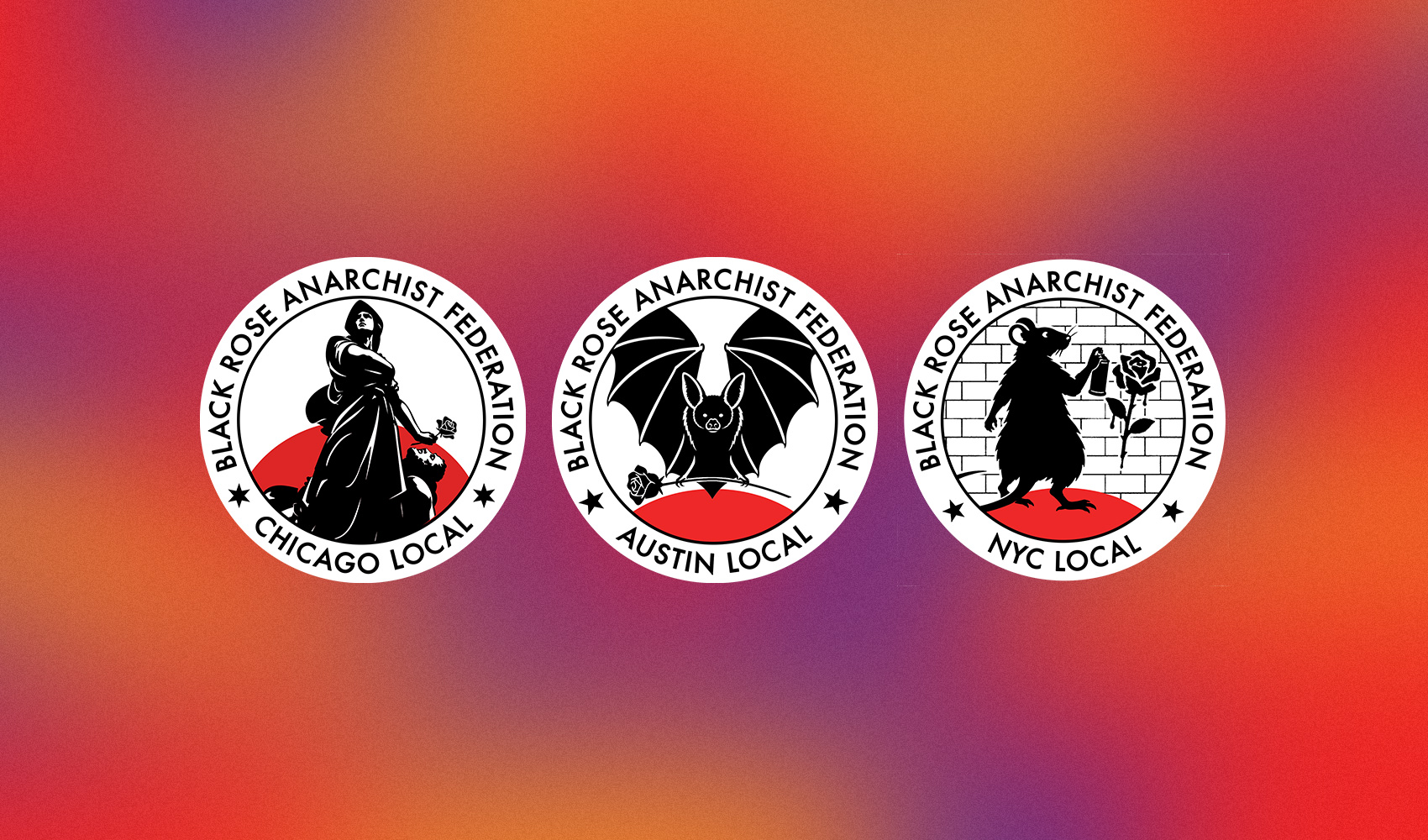
The Chicago local is back! Our logo honors the Haymarket Martyrs Memorial — a symbol of the organizers who made anarchism a powerful current in immigrant and women workers’ struggles of their time, as well as the place we gathered for our first event all together as a local.

We carry their memory with us alongside others as we work in the social movements where we are rooted. These include tenant struggles on the South and Northwest sides, as well as labor organizing in the Chicago Teachers Union. We look forward to deepening our connections with comrades in our movements and others through collective study and struggle.

Email: chicago@blackrosefed.org
Instagram: @blackrose_chicago

New York City, NY

Members of the New York City Local organize with tenants, neighbors, youth, coworkers, and parents to build Black, Brown, and working-class popular power throughout the city. Sites of social insertion include the Astoria Tenant Union in Queens, anticarceral youth and parent programs in Manhattan, immigrant defense coalitions in Brooklyn, the American Association of University Professors, and more. True to BRRN’s internationalist character, we also organize within the Palestinian and Sudanese solidarity movements.

From the Young Lords to Occupy Wall Street, we recognize the integral role that revolutionaries in NYC have played in past freedom struggles and look forward to reviving organized anarchism in the especifista tradition across the five boroughs. BRRN’s Program serves as a blueprint for renewed efforts to confront imperial and capitalist violence as anarchist militants living at the nexus of US empire and global capital .

Email: nyc@blackrosefed.org
Instagram: @blackrose_nyc


Are you organizing at your workplace, on your campus, or in your neighborhood? Looking for a political home in which you can strategize with others about how to build power, force concessions, and push our mass movements in a revolutionary direction?

Black Rose/Rosa Negra could be right for you.

Read our Join page and send us a membership inquiry!

The post Announcing Black Rose/Rosa Negra Locals in Austin, New York City, and Chicago appeared first on Black Rose/Rosa Negra Anarchist Federation.


From Black Rose/Rosa Negra Anarchist Federation via This RSS Feed.

0

Wow, we really gotta come up with a word for this sort of thing...

preview

Image description:

Headline reads: A leaderless revolution has swept Serbia. The world should be watching.

It’s fun watching reactionaries bend over backwards to avoid the word “anarchism”.

Image description:

Headline reads: A leaderless revolution has swept Serbia. The world should be watching.

It’s fun watching reactionaries bend over backwards to avoid the word “anarchism”.

0

So I watch Andrewism sometimes, though I am not an anarchist

preview

This post has nothing to do with his political positions so if you are expecting that I apologize.

I love Andrewism. There is a certain romance to his perspective and presentation. I am watching his video “Who Is Science For?” and his inclusion of birdsong in the backround of his speaking is quite possibly one of the most wholesome things I have ever experienced on youtube. There are just little tidbits of the way he expresses himself that makes me love him despite our disagreements. I apologize if this is a silly thing to post, I typically watch him when I have had a bit to drink because his videos are soothing(?)

idk why they would be soothing, the topics aren’t but they still feel that way. he brings me hope I think.

0

We are not welcome among the Epstein class

preview

Description:

Tumblr post by user lumpenmole.

Text reads: “The reason academia doesn’t treat anarchism as a real school of sociology is the same reason why they made an exception for Noam Chomsky. Anarchism is the philosophy of consent.”

Description:

Tumblr post by user lumpenmole.

Text reads: “The reason academia doesn’t treat anarchism as a real school of sociology is the same reason why they made an exception for Noam Chomsky. Anarchism is the philosophy of consent.”

0

23 Aug 1927 Nicola Sacco and Bartolomeo Vanzetti, anarchist workers and Italian immigrants, were executed in Boston, Massachusetts for a murder which neither committed.

preview

Vanzetti writing about coming to the US as an immigrant:

Arrived in America, I underwent all the sufferings, the delusions and the privations…Here I saw all the brutalities of life, all the injustice, the corruption in which humanity struggles tragically.

Vanzetti writing about coming to the US as an immigrant:

Arrived in America, I underwent all the sufferings, the delusions and the privations…Here I saw all the brutalities of life, all the injustice, the corruption in which humanity struggles tragically.

0

Authoritarian Leftism Only Achieves Capitalism: Anark Responds to @SocialismForAll and @BadEmpanada​

play · youtube.com
YouTube Authoritarian Leftism Only Achieves Capitalism: Anark Responds to @SocialismForAll and @GeorgeOfPatmos​ www.youtube.com
preview

Anark does (in my view) a well-cited and very polite refutation of Socialism4All’s response to one of his off-the-cuff videos, and a vastly more polite response to BadEmpanada than he deserves.

Anark does (in my view) a well-cited and very polite refutation of Socialism4All’s response to one of his off-the-cuff videos, and a vastly more polite response to BadEmpanada than he deserves.

0

A quote from David Graeber's Fragments of an Anarchist Anthropology

preview

TLDR: Statists measure success based on the state, so in order to convince them that anarchism us successful we would need to stop being anarchists.

“For anarchists who do know something about anthropology, the arguments are all too familiar. A typical exchange goes something like this:

Skeptic: Well, I might take this whole anarchism idea more seriously if you could give me some reason to think it would work. Can you name me a single viable example of a society which has existed without a government?

Anarchist: Sure. There have been thousands. I could name a dozen just off the top of my head: the Bororo, the Baining, the Onondaga, the Wintu, the Ema, the Tallensi, the Vezo…

Skeptic: But those are all a bunch of primitives! I’m talking about anarchism in a modern, technological society.

Anarchist: Okay, then. There have been all sorts of successful experiments: experiments with worker’s self-management, like Mondragon; economic projects based on the idea of the gift economy, like Linux; all sorts of political organizations based on consensus and direct democracy…

Skeptic: Sure, sure, but these are small, isolated examples. I’m talking about whole societies.

Anarchist: Well, it’s not like people haven’t tried. Look at the Paris Commune, the revolution in Republican Spain…

Skeptic: Yeah, and look what happened to those guys! They all got killed!

The dice are loaded. You can’t win. Because when the skeptic says “society,” what he really means is “state,” even “nation-state.” Since no one is going to produce an example of an anarchist state—that would be a contradiction in terms—what we’re really being asked for is an example of a modern nation-state with the government somehow plucked away: a situation in which the government of Canada, to take a random example, has been overthrown, or for some reason abolished itself, and no new one has taken its place but instead all former Canadian citizens begin to organize themselves into libertarian collectives. Obviously this would never be allowed to happen. In the past, whenever it even looked like it might—here, the Paris commune and Spanish civil war are excellent examples—the politicians running pretty much every state in the vicinity have been willing to put their differences on hold until those trying to bring such a situation about had been rounded up and shot.”

0

Black Rose/Rosa Negra Bay Area Local Raises Thousands for MN15 Defense Fund

Black Rose/Rosa Negra Anarchist Federation Black Rose/Rosa Negra Bay Area Local Raises Thousands for MN15 Defense Fund www.blackrosefed.org
preview

cross-posted from: news.abolish.capital/post/66801

On June 16th the federal government unsealed indictments targeting 15 organizers in Minnesota’s Twin Cities for their alleged involvement in anti-ICE organizing. On July 4th, the Bay Area Local of Black Rose/Rosa Negra held a party to raise money for these organizers’ legal defense fund.


On July 4th, 2026 Black Rose/Rosa Negra’s Bay Area Local hoisted the red-and-black flag over Oakland’s Tamarack social center to party in solidarity with the 15 organizers—now known as the MN15—who were indicted by the federal government for allegedly organizing to stop ICE’s campaign of terror during operation ‘Metro Surge‘. Sharing food, stiff drinks, conversation, and dancing to tunes provided by local DJ collective Left of the Dial, a couple hundred tenants, workers, students, movement elders, and comrades new and old raised over $2,000 for the MN15’s legal defense fund.

View this post on Instagram

A post shared by @blackrosebayarea

Part way through the night the music stopped to allow for two of the indicted organizers to call in and share words of encouragement. The call was piped through the social center’s PA system for all partygoers to hear. These indictments were a “naked attempt by the federal government to intimidate popular forms of resistance and by isolating its revolutionary wing”, the two said. It was this organized popular resistance that successfully led to the ouster of white supremacist Greg Bovino from his post at the head of Immigration and Customs Enforcement (ICE) and the retreat of ICE’s blitz on the Twin Cities. Rather than waver in the face of fascistic ascent, the indicted organizers urged those listening to “spread the spirit of Minneapolis all over the world.”

The same day we basked in solidarity on the west coast, the fascist ‘Patriot Front’ organization attempted to spread its American-as-apple-pie hatred on the east coast—it was July 4th after all. Marching to the US capitol and waving the flag of a defeated slave owning class, they speechified to no one. Videos later emerged of the khaki wearing boneheads suffering the effects of heatstroke.

Herein lies one of the defining features of our conjuncture. The organized far right is is on the offensive, blazing with contempt for immigrants, trans people, workers, and other segments of the dominated classes. But episodes like the tidal wave of popular mobilization in Minneapolis have shown that we have the power to extinguish the fires of reaction.

Labor organizers who develop plans with their coworkers to keep ICE out of their workplace, tenant unions who ready their buildings and neighborhoods to resist raids, immigrant detainees who hunger strike against inhumane conditions, students who coordinate ‘walking school buses‘ to safely get one another to class, and partygoers who show up to raise money for legal defense all form necessary elements of the movement. As we know, only loud, collective, organized, and visible solidarity will protect us.


Enjoyed this article? Follow our Bay Area Local on instagram for more.

The post Black Rose/Rosa Negra Bay Area Local Raises Thousands for MN15 Defense Fund appeared first on Black Rose/Rosa Negra Anarchist Federation.


From Black Rose/Rosa Negra Anarchist Federation via This RSS Feed.

0

You look amazing, btw

preview

Image description: lumpenmole … The right sees women as private property. Liberals see women as public property. Anarchists see women as personal property - congrats on your transition, dol! #this is based on a tiktok by remi I agoraphobia recovery #l added the anarchist part

Image description: lumpenmole … The right sees women as private property. Liberals see women as public property. Anarchists see women as personal property - congrats on your transition, dol! #this is based on a tiktok by remi I agoraphobia recovery #l added the anarchist part

0

The Black Scare and the Party of Anarchy

CrimethInc. The Black Scare and the Party of Anarchy crimethinc.com
preview

cross-posted from: slrpnk.net/post/39773301

The legitimacy of the party of order has its material basis in the smooth reproduction of normalcy: simple things like the logistics of food and medicine, keeping the lights on and the hospitals open, keeping homes and dignities safe from violation. Legalism flows from this, and tamang proseso from that. Experiencing the insecurity of rupture and insurrection, how else would one imagine engaging with the state other than through the legitimate processes? To break with the party of order, then, means to challenge the material basis of its legitimacy and legality—for the logic of the insurrection to answer the hard questions of how to overcome specific limits, communizing food, safety, and care.

0

Online Event: A Conversation With Anarchists in Sudan

Black Rose/Rosa Negra Anarchist Federation Online Event: A Conversation With Anarchists in Sudan www.blackrosefed.org
preview

cross-posted from: news.abolish.capital/post/58555

Hear directly from anarchist comrades in Sudan in this presentation plus Q&A hosted by Black Anarchist Resistance: Sudanese Solidarity (BARSS), a new coalition centering support for Sudan while raising the banner of Black liberation globally. William C. Anderson, author of Nation On No Map: Black Anarchism and Abolition, will share a political grounding linking the political work of the Anarchist Group in Sudan with our struggles locally.

BARSS is a coalition of: Black Autonomy Federation, Black Rose / Rosa Negra Anarchist Federation, and the Dugout Podcast.

When: Sunday, July 5th @ 12PM Pacific / 1PM Mountain / 2PM Central / 3PM Eastern / 21:00 UTC

Where: Online, registration required! Click the button below to register.

Click Here to Register

The post Online Event: A Conversation With Anarchists in Sudan appeared first on Black Rose/Rosa Negra Anarchist Federation.


From Black Rose/Rosa Negra Anarchist Federation via This RSS Feed.

0

Do we know if Fanon ever had meaningful interactions with anarchists?

preview

I’m reading through The Wretched of the Earth, by Frantz Fanon, and the points he’s making are great… but they’re also pretty bog standard anarchist theory. What’s more, he keeps using anarchist as a pejorative, but it seems inconsistent and vague…

In the industrialized countries the peasant masses are generally the least politically conscious, the least organized as well as the most anarchistic elements. They are characterized by a series of features —individualism, lack of discipline, the love of money, fits of rage, and deep depression — defining an objectively reactionary behavior.

At the first signs of a skirmish, the leaders are quick to call them juvenile hotheads. But because these demands are neither juvenile nor hotheaded, the revolutionary elements articulating them are rapidly isolated and removed. The leaders cloaked in their experience ruthlessly reject “these upstarts, these anarchists.”

There is a brutality and contempt for subtleties and individual cases which is typically revolutionary, but there is another type of brutality with surprising resemblances to the first one which is typically counterrevolutionary, adventurist, and anarchist. If this pure, total brutality is not immediately contained it will, without fail, bring down the movement within a few weeks.

I’m not the most familiar with anarchism in Africa at that time, is this because anarchism at that time and place meant something different? Is this another impact of black anarchists taking the mantle from the syndicalists after Catalonia? Is this reactionary? Or is it something else entirely?

0

May Day – A living legacy

preview

cross-posted from: news.abolish.capital/post/46627

May Day – A living legacy thecollective Fri, 05/01/2026 - 14:46


From anarchistnews.org - We create the anarchy we want in the world via This RSS Feed.

cross-posted from: news.abolish.capital/post/46627

May Day – A living legacy thecollective Fri, 05/01/2026 - 14:46


From anarchistnews.org - We create the anarchy we want in the world via This RSS Feed.

0

Tag yourself. I'm wife guy

preview

Image description:

Text which reads “Every squad got the following:”

two rows with pictures and a caption beneath them. from top left to bottom right read left to right:

Young Nestor Makhno: “The Militant”

Old Peter Kropotikin: “The Wife Guy”

Old Karl Marx: “The [twinkle emoji] Drama [twinkle emoji] [painting nails emoji]”

Young Mikhail Bakunin: “Fucks”

Someone in a ski mask with a pipe who appears to be gay in San Francisco, black in South Africa, an Asian in Europe, a Chicano in San Ysidro, an anarchist in Spain, a Palestinian in Israel, a Mayan Indian in the streets of San Cristobal, a Jew in Germany, a Gypsy in Poland, a Mohawk in Quebec, a pacifist in Bosnia, a single woman on the Metro at 10pm, a peasant without land, a gang member in the slums, an unemployed worker, an unhappy student and, of course, a Zapatista in the mountains, the exploited, marginalised, oppressed minorities resisting and saying `Enough’, every minority who is now beginning to speak and every majority that must shut up and listen, every untolerated group searching for a way to speak, Everything that makes power and the good consciences of those in power uncomfortable: “The Enby”

Emma Goldman: “The Fugitive”

Mao Tse-Tung (Zedong): “The Zoomer”

Old Lucy Parsons: “The One Who Actually Did The Assignment”

0

Do you ever meet those people who just exude praxis?

preview

I’m talking to my sister earlier, and find out she’s set up this entire mutual aid network in her neighborhood. I asked where she got the idea, or if she followed a guide – nope. She just vibed out something that I’ve struggled to make happen for a decade. In like a few months! And she does this stuff all the time, her entire life! But if you ask how she does it she just shrugs. She doesn’t even ask for help or think of it as some exceptional thing, she’ll casually drop that she teaches courses on recognizing child abuse for three years without telling anyone.

This isn’t like a condemnation or anything, like “oh, go read theory.” Like, she did it solely off vibes! If anything I’m jealous. I’m also not saying this invalidates theory, just confused as to how on earth someone can just do this on a whim! And where I can learn to do it too!

0

"Anti-Fascism" is the Leftism of Fools (bad title, see comments!)

play · youtube.com
YouTube "Anti-Fascism" is the Leftism of Fools www.youtube.com
preview

cross-posted from: anarchist.nexus/…/anti-fascism-is-the-leftism-of-…

It’s about how merely anti-fascist art and movements can be recuperated and made safe by capitalism. Blow it up 🏴🏴🏴🏴

cross-posted from: anarchist.nexus/…/anti-fascism-is-the-leftism-of-…

It’s about how merely anti-fascist art and movements can be recuperated and made safe by capitalism. Blow it up 🏴🏴🏴🏴

0

Any active anarchist discord servers?

preview

I’m having a hard time finding a discord server where I could engage in real-time discussions around anarchism. I have a lot of questions and I prefer to learn by asking people questions directly. I’ve read the anarchyfaqs (skimmed) and some more, but need a place to ask all my little and big questions.

Please let me know. Most servers I find seem dead, 2 of the 3 I was in kicked me for saying 9/11 was an inside job ;-;.

0

🎉genocide factory down🎉

“On 20th March 2026, the Earthquake Faction struck the epicenter of the Israeli weapons industry in Europe. In Pardubice, Czech Republic, Elbit Systems' "Centre of Excellence" was newly built in collaboration with LPP, to service the global expansion of Israel's biggest weapons producer.  Whilst the development, production and training center was empty, The Earthquake Faction intervened to destroy its equipment and set the factory ablaze. No one was harmed.  The site is used to develop weaponry used by the Zionist entity to massacre people daily in Palestine, Lebanon, Iran, and across West Asia.
preview

For our full communiqué and more videos/images which are free to distribute, see our website: earthquakefaction.net

Updates on Telegram at t.me/earthquake_faction”

linky to calla twitter source

(obviously don’t go to those websites without at least vpn or tor)

For our full communiqué and more videos/images which are free to distribute, see our website: earthquakefaction.net

Updates on Telegram at t.me/earthquake_faction”

linky to calla twitter source

(obviously don’t go to those websites without at least vpn or tor)

0

What do we do with the "broken steps"?

preview

Context: a broken step is someone or something within your community which only the locals know to avoid.

Suppose we have a confederation, and someone within the confederation is accused of being dangerous to others in some way. If we kick them out then what stops them from going somewhere else and repeating the pattern? Or coming back for revenge? Or, Stirner Forbid, they’re innocent? And even if they are dangerous, is that any reason to turn them away? We make considerations when it comes to wolves and cacti but draw the line at cousins? But they could hurt the community… you see my dilemma.

Edit: this is not a hypothetical, but I don’t want to get into details. We’re not going to beat anyone up because we can’t confirm anything actually happened.

0

Review of Their Wars - Our Dead: Anarchist Reflections on Anti-Militarism

preview

cross-posted from: news.abolish.capital/post/24355

Politics:

Anarchism

History:

2022: Russo-Ukrainian War

Facts:

Books, art and culture

Publications:

Revolutionary Perspectives

(Alex Alder and Bill Beech (eds.), Their Wars – Our Dead: Anarchist Reflections on Anti-Militarism (2025, PM Press), · Since the war in Ukraine, the anarchist movement in the UK and elsewhere has split on the question of internationalism. The authors of this book are in the internationalist camp and have published it in order to make their views known. As internationalists, we welcome this effort by our comrades. The authors state they do not wish to simply rehash the debates of the last three years but want “to reflect on the place of anarchism in anti-militarism historically, and at present moment” (p.6) and seek “to learn from the past in order to figure out a revolutionary yet realistic course of anarchist anti-militarism today”. (p.25)

The six authors are based in Ireland, Scotland, Wales, and England. They have been or continue to be members of organisations such as the Anarchist Communist Group (ACG), Solidarity Federation (SolFed), Organise!, or the AnarCom Network (ACN). Some of them are known to us and have participated in the No War but the Class War (NWBCW) initiative.(1)

The authors of the introduction, Alex Alder and Bill Beech, summarise how, following the war in Ukraine, anarchists in Great Britain caught war fever.(2) That so many anarchists succumbed to warmongering is due to the weakness of both the anarchist current and the workers’ movement in general. Some pro-war anarchists acknowledge this weakness and in fact use it as an argument in favour of compromising with the ruling class. Some anarchists’ enthusiasm for Corbynism is also seen as a precursor to the falling in line with warmongering.(3) It should be noted this is also found outside the UK, with anarchists backing Mélenchon’s party in France for example.


From Leftcom via This RSS Feed.

0

Autonomy in Practice: Permanent Vigil’s and Sacred Fires

We Will Free Us Autonomy in Practice: Permanent Vigil’s and Sacred Fires www.wewillfreeus.org
preview

cross-posted from: news.abolish.capital/post/23895

Autonomy in Practice: Permanent Vigil’s and Sacred Fires

On the same day community members gathered to grieve the killing of Renee Good at the hands of an ICE agent in Minneapolis, something shifted in downtown Portland, Oregon. What began as a vigil and flag burning across from the federal courthouse transformed, almost organically, into an autonomous zone that held space through the night and reignited a conversation many people have been having quietly for months: What if mourning isn’t enough? What if we actually hold ground?

“What started as a permanent vigil just… grew,” one participant said. “People had yarn in their pockets and wrapped it around a corner of the park, and that became the seeds for the first barricade. Then folks were like, fuck it, and started dragging street barricades over. It all snowballed from there.”

Autonomy in Practice: Permanent Vigil’s and Sacred Fires

Earlier that evening, a large rally had taken place at City Hall, organized by groups including DSA. Like many mass demonstrations, it drew a crowd, delivered speeches, and then… ended after an hour. People began to disperse. And as they did, frustration was audible.

“There were people literally walking away saying, ‘That’s it? That’s all we’re gonna fucking do?’” they recalled. “A lot of those same people ended up coming over where the flags were burning.”

Just a block away, others had already begun something different. A vigil was forming in Chapman Square, a park across the street from the federal courthouse. American flags were burned in protest. Candles and offerings appeared. Yarn was strung around a corner of the park, a small, almost symbolic boundary.

Then people who had just left the larger rally started walking over. They didn’t just watch. They joined.

More makeshift barriers appeared. Street materials were dragged into place. What had been described as a vigil quickly became a defended space. Not through a centralized call, but through a shared feeling: we can’t just march, go home, and wait for the next tragedy to listen to all the same speeches again.

Autonomy in Practice: Permanent Vigil’s and Sacred Fires

Autonomy in Practice: Permanent Vigil’s and Sacred Fires

Autonomy in Practice: Permanent Vigil’s and Sacred Fires

photos from the permanent vigil

“It was a rebellion,” they said. “Not just about Renee. It was about everything that led to her murder. It was people saying, we’re done responding passively.”

While Renee Good’s murder was the immediate spark, participants say the space was about more than a single event. It was about the cycle people are exhausted by… outrage, march, speeches, dispersal, repeat. All while the systems responsible for this violence remain untouched.

This time, instead of dispersing, people stayed.

Indigenous community members played a central role in establishing a sacred fire at the site, grounding the space in ceremony, remembrance, and resistance. People said this was also a way to honor earlier anti-ICE organizing that began in Portland in January 2025, when Indigenous community members held weekly sacred fires outside the ICE facility long before summer crowds grew.

That history often gets erased. This space made it visible again. “This was about honoring the people who paved the way.”

“It set an amazing tone,” the participant said. “You had Indigenous community members who don’t just show up when something’s trending. Their whole existence is resisting settler colonialism. Being in space with that guidance changed how people understood what we were doing.”

Autonomy in Practice: Permanent Vigil’s and Sacred Fires

Autonomy in Practice: Permanent Vigil’s and Sacred Fires

Autonomy in Practice: Permanent Vigil’s and Sacred Fires

Photos of barricades at the vigil

The fire burned from around 8:30 p.m. until roughly 10 a.m. the next morning, the sacred fire burned for about 14 hours before police moved in at a moment when many supporters had gone to provide court support elsewhere. Participants say the timing was deliberate.

But it didn’t end there.

On January 9th, a few days after Good was murdered by ICE, Border Patrol shot Luis David Nino-Moncada and Yorlenys Betzabeth Zambrano-Contreras, a Venezuelan couple in Portland, Oregon. The sacred fire returned, this time in a location chosen with sharper political symbolism. The new site sat within view of the county jail (often called the “(in)Justice Center”), the federal courthouse, and City Hall.

“These institutions claim to represent justice. The fire was there to say otherwise.”

The second gathering expanded beyond vigil into political education and open discussion. People spoke not only about grief, but about responsibility, naming City Hall’s role in permitting the ICE facility, the courts’ role in deportation pipelines, and the broader illusion that these institutions are neutral.

“This time it was way more intentional,” the participant said. “The sacred fire represents truth. And it was surrounded by institutions of lies.”

At one point late in the night, a small group of right-wing agitators drove by and attempted to provoke people at the fire. Those present faced a choice: extinguish the fire to prevent harassment, or hold their ground.

They chose to stay.

The agitators eventually left. The fire kept burning.

Autonomy in Practice: Permanent Vigil’s and Sacred Fires

For those there, the moment was symbolic of something larger: when people remain rooted together, especially under Indigenous guidance and ceremony, intimidation loses some of its power.

Participants drew connections between the autonomous zone and other forms of repression in Portland, especially police harassment of mutual aid groups and community resource distros. In those cases, simply feeding people or existing in shared public space has drawn heavy police presence and legal threats.

To many involved, the message from the state is clear:
Autonomy itself is what’s criminalized.

In that context, defending a vigil, holding a sacred fire, and refusing to disperse becomes more than symbolic. It becomes a direct challenge to who is allowed to occupy land, make decisions, and care for community outside state control.

Both nights of the autonomous space coincided with other actions happening across Portland, including large demonstrations at the ICE facility. With multiple events unfolding at once, police resources were stretched thin. Participants say that mattered.

It was a reminder of an old movement lesson: authorities can easily manage one large, predictable protest. They struggle when resistance becomes decentralized, simultaneous, and self-directed.

People came to mourn Renee Good. They stayed because mourning alone felt like surrender.

What emerged downtown wasn’t a perfectly planned occupation or a pre-announced autonomous zone. It was something messier and more alive: a community deciding, in real time, not to go home.

And in that decision, to hold a fire, to defend space, to gather under Indigenous guidance, to speak openly about the failures of local institutions, many participants say they glimpsed something that felt less like protest and more like practice.

Not just responding to violence.
But rehearsing a world beyond it.

Autonomy in Practice: Permanent Vigil’s and Sacred Fires

Autonomy in Practice: Permanent Vigil’s and Sacred Fires


From We Will Free Us via This RSS Feed.

0

Does anyone have experience or resources on setting up a food distro? Specifically a mobile food distro.

preview

I’ve thought about this for a while now. I was thinking of getting a food truck then just giving away food and taking donations. If the cops come and say move I can pull down the block. Disaster requires help I can show up and hand out stuff.

I’ve thought about this for a while now. I was thinking of getting a food truck then just giving away food and taking donations. If the cops come and say move I can pull down the block. Disaster requires help I can show up and hand out stuff.

0

TotW: Meaningful OpSec

preview

cross-posted from: news.abolish.capital/post/22689

TotW: Meaningful OpSec thecollective Sun, 01/25/2026 - 08:00

MEANINGFUL OPSEC; OR, NOW, YOU DON’T HAVE A PERSONAL FBI AGENT

I’ve been considering operational security and security culture a lot since the Turtle Island Liberation Front (TILF) case broke. For such a small group, about seven people, two were feds (well, one was a paid informant, the other was an FBI agent).

I am reminded of the joke myth of a CPUSA meeting that a federal infiltrator attends in order to arrest the attendees. Then all the other members are also feds. Cue the laugh track.

Despite the colossal fuck-up of being infiltrated, TILF had a plan that seemed based in strong Opsec. From The United States District Court For The Central District Of California: “The plan described multiple operational security measures the co-conspirators should take to conceal their identities, such as the use of a burner phone that would be disposed of after the bombings by ‘submerging it in a concrete brick after destroying the sim and then disposing of the brick in a body of water.’” and: the use of ‘BlacBloc’ overtop of a layer of ‘grey/casual bloc’ on top of normal street clothes, and noted to keep hair very tightly concealed and to wear gloves for the purpose of avoidance of leaving behind DNA” further: “participants should leave their personal devices at home and to make sure the devices were set up to stream a long movie during the time of the attacks, so as to craft an alibi.” Even a pebble in the show to alter their walking and material acquisition advice to avoid suspicion, were discussed.

A question I am stuck on is how can you have thought through these particular aspects of prep work and on the ground Opsec and allow yourself to be infiltrated by two Feds? As a friend said, “Because their security was missing the trees for the forest.”

From CrimethInc’s “What is Security Culture?” The difference between protocol and culture is that culture becomes unconscious, instinctive, and thus effortless; once the safest possible behavior has become habitual for everyone in the circles in which you travel, you can spend less time and energy emphasizing the need for it, or suffering the consequences of not having it, or worrying about how much danger you’re in, as you’ll know you’re already doing everything you can to be careful. It seems, from what is available, TILF had strong protocols for their “Operation Midnight Sun,” but not a real culture to develop secure, safe relationships to avoid infiltration. They posted calls for direct action and revolution on social media, one that was easily connected to a member of TILF (and thus, the radical section that sought to do the attack). They let relatively new people into the plan: the informant and later the FBI agent. The difference in attitudes about security by the same people is striking.

By having a strong focus (and in the case of TILF, reasonable ones in regards to the plan) on only some parts of Security Culture and not a whole picture, you leave gaps in the culture. For most people, this is “well, the feds are watching” and thus their security culture centers that primary concern, as opposed to it being part of a wider network of concerns. And let us be real: most of us do not have the feds particularly watching our actions or groupings, outside of the concerns of a general surveillance state. This all comes at the expense of, say, local cops, right-wing agitators, or the common person who may overhear or see something they shouldn’t.

So, while TILF did have personal FBI agents inside their network, it was because of a failure of their security culture leading up to that point. Had it been a stronger culture, maybe “Operation Midnight Sun” would have been another CNN news segment we’d forget by the next day.

Questions

What security concerns do you find are most overlooked in anarchist circles? What about overdone?

How are security concerns changing in light of the development of companies like Flock Safety, Oracle and Palantir?

What are ways security culture and protocols change between anarchist groupings, particularly those separated by geography? (Say, in different cities or countries)

From anarchistnews.org - We create the anarchy we want in the world via This RSS Feed.

0

Minneapolis Responds to the Murder of Alex Pretti

preview

cross-posted from: news.abolish.capital/post/22631

Minneapolis Responds to the Murder of Alex Pretti thecollective Sun, 01/25/2026 - 03:23


From anarchistnews.org - We create the anarchy we want in the world via This RSS Feed.

cross-posted from: news.abolish.capital/post/22631

Minneapolis Responds to the Murder of Alex Pretti thecollective Sun, 01/25/2026 - 03:23


From anarchistnews.org - We create the anarchy we want in the world via This RSS Feed.

0

Two Forgotten Historians of American Anarchism

preview

cross-posted from: news.abolish.capital/post/19473

Two Forgotten Historians of American Anarchism thecollective Tue, 01/13/2026 - 04:07


From anarchistnews.org - We create the anarchy we want in the world via This RSS Feed.

cross-posted from: news.abolish.capital/post/19473

Two Forgotten Historians of American Anarchism thecollective Tue, 01/13/2026 - 04:07


From anarchistnews.org - We create the anarchy we want in the world via This RSS Feed.

0

The Political Repression and Resistance of Eloxochitlán de Flores Magón, Oaxaca

preview

cross-posted from: news.abolish.capital/post/18869

The Political Repression and Resistance of Eloxochitlán de Flores Magón, Oaxaca thecollective Sat, 01/10/2026 - 06:50

This week, an interview we just conducted with Madeleine Wattenbarger and Axel Hernández of the Cooperativa de Periodismo in Mexico and Ambar Ruiz of Radio Zapote about the case of autonomous resistance and repression in the Mazateca community of Eloxochitlán de Flores Magón in Oaxaca, Mexico, so named for being the birthplace of the Cipriano Ricardo Flores Magón, revolutionary Mexican anarchist who was murdered by medical neglect by the US prison system in 1922 (check out our 2022 episode on the history).

We talk about the rise to economic and political power of the family of Manuel Zepeda and his daughter Elena, their weaponization of the judiciary against community defenders resisting a hijacking in 2014 of the traditional community assembly and the years of organizing by Mazateca women whose loved ones face long prison sentences. We also speak about the case of Miguel Peralta, a Mazateca anarchist challenging his 5 decade sentence related to this case, as well as the recent murder by medical neglect while in prison of militant anarcho-punk Yorch Esquivel at the hands of the Mexican state at the behest of UNAM.

From anarchistnews.org - We create the anarchy we want in the world via This RSS Feed.

0

Iranian anarchists: Uprising is “genuine self-organisation by ordinary people”

preview

cross-posted from: news.abolish.capital/post/18867

Iranian anarchists: Uprising is “genuine self-organisation by ordinary people” thecollective Sat, 01/10/2026 - 06:43


From anarchistnews.org - We create the anarchy we want in the world via This RSS Feed.

cross-posted from: news.abolish.capital/post/18867

Iranian anarchists: Uprising is “genuine self-organisation by ordinary people” thecollective Sat, 01/10/2026 - 06:43


From anarchistnews.org - We create the anarchy we want in the world via This RSS Feed.

0

There is Hope, But We Must Build It | Cooperation Tulsa 2025 Year in Review

play · youtube.com
YouTube Land, Food, and Freedom: Building Power Outside the State | Cooperation Tulsa 2025 www.youtube.com
preview

cross-posted from: lemmy.sdf.org/post/48741557

Finally some good fucking news 🏴🏴🏴

cross-posted from: lemmy.sdf.org/post/48741557

Finally some good fucking news 🏴🏴🏴

0

Article from 2022 by an Iranian Anarchist discussing some underlying issues which may be contributing to the stuff in Iran right now

preview

Edit: I updated the title per suggestions.

Edit: I apologize for snapping at people in the comments. I was arguing with someone earlier today and bad habits make preventable mistakes. I’ll do better.

I deliberately didn’t talk about the current events going on in Iran with the justification that a) I’m not from there b) I don’t know enough. But this article takes some concepts I thought I knew and spits them back at me.

I kept quiet about Israel for a long time because I was afraid of being called a bigot, and I will regret that until I die. So why am I suddenly willing to do this again when it comes to Iran? Because some of their interests align with mine? Because I’m afraid of pissing off reactionaries even within leftist spaces and then losing access to them?

What sort of Anarchist, leftist, or being capable of empathy would I be if I remain silent when I know something is wrong.

0

International Statement: We Denounce the Imperial Offensive on Venezuela

Black Rose/Rosa Negra Anarchist Federation International Statement: We Denounce the Imperial Offensive on Venezuela www.blackrosefed.org
preview

cross-posted from: news.abolish.capital/post/16418

This statement was prepared and signed by member organizations of the Latin American Anarchist Coordination – Coordinación Anarquista LatinoAmerica (CALA). Black Rose/Rosa Negra (BRRN) was invited to sign the statement as a sibling organization.


The Latin American Anarchist Coordination and sibling organizations condemn the threats of direct intervention in Venezuela by the US government, driven by the Trump administration.

These attempts and threats of intervention are not isolated incidents, nor are they a temporary response to alleged problems of “security,” “drug trafficking,” or “terrorism.” On the contrary, they are part of a long history of imperial interference in Latin America and the Caribbean, the effects of which have systematically fallen on the oppressed peoples and classes of the region.

The story is well known: every time the United States has invoked these pretexts, the result has been social devastation, loss of sovereignty, and violence. Panama in 1989, Iraq in 2003, and multiple interventions in our region show that this is not about “defending democracy,” but rather about political, military, and economic control. In the case of Venezuela, these threats come on top of more than a decade of economic blockade that has hit the daily lives of the people hard, deepening shortages, precariousness, and the deterioration of material conditions of existence.

In this respect, it is essential to emphasize that imperialist aggression does not punish ruling elites, but instead falls directly on the popular sectors. Blockades, sanctions, military intimidation, and financial suffocation are not “surgical” tools: they are mechanisms of economic warfare that seek to break the resistance of an entire people, discipline them, and force them to accept a subordinating order.

A recent and striking example of this logic is the act of piracy and blatant theft of a Venezuelan oil tanker by armed US military personnel, which was detained and appropriated under the protection of unilateral sanctions. Beyond the legal technicalities with which Washington attempts to justify these actions, what is evident is an exercise in modern piracy: the use of military, judicial, and financial power to appropriate resources. This is not only an attack on the Venezuelan state, but also a direct aggression against the people, because every shipment seized, every asset retained, and every property confiscated deepens the living conditions imposed by the blockade.

What’s more, their disregard for the lives of the people is evident in the absolute ease with which they launched explosives at fishing boats off the Venezuelan coast, taking away not only those people’s livelihoods, but also their lives and their right to defend themselves against unproven accusations. The massacre was televised and celebrated by those at the top.

These types of actions clearly reveal what the “international order” defended by the United States means today: a system in which major powers arrogate to themselves the right to decide who can trade, who can produce, and who deserves to be punished. International law is selective, flexible for allies, and brutally rigid for those who do not submit. In this context, the seizure of ships, the freezing of assets, and economic sanctions function as weapons of war, even though they are presented as administrative measures.

The recent awarding of the Nobel Peace Prize to María Corina Machado follows the same logic of cynicism and double standards. These types of awards do not express universal values, but rather geopolitical alignments. Far from representing a genuine defense of the rights of the Venezuelan people, this recognition operates as a political gesture by imperial powers toward a leader who has openly endorsed sanctions, economic blockades, and threats of intervention. The Venezuelan right wing, far from offering a way out for the working classes, thus presents itself as a necessary partner in a strategy that deepens social suffering and dependence.

The explicit reappearance of the Monroe Doctrine in recent US government documents and statements only confirms this course of action. The old slogan “America for Americans” — that is, for Washington’s interests — is once again being asserted without euphemisms, reinstating the idea of Latin America as a natural zone of domination. This threatens not only Venezuela, but all the peoples of the continent, by legitimizing interventions, economic pressure, coups d’état, and the forced alignment of governments that stray from imperial interests. A prime example of this has been the Trump administration’s unprecedented intervention in Argentina in recent months, specifically in domestic economic policy, the foreign exchange market, and even the electoral process, giving a sudden boost to Milei’s government.

In the current context, the United States is no longer an unchallenged power, but it remains a central player in a world order based on violence, plunder, and imposition. Its growing aggressiveness also reflects its own internal crises and its need to reaffirm its control over strategic territories rich in oil, minerals, water, and biodiversity. Latin America, once again, appears as the spoils and rear guard of an imperial project that remains deeply dangerous.

Defending people’s self-determination—dominated, exploited, and oppressed classes within so-called “national” contexts—does not imply idealizing governments or denying internal contradictions inherent in the Venezuelan process, of which we are critical, but rather rejecting foreign intervention outright and affirming the right of every dominated, exploited, and oppressed class to fight for the improvement of their destiny without threats, blockades, or occupations. In this sense, we affirm that organization in the face of this situation cannot come from above or be delegated to state structures, but can only be built from below, through popular organization and the direct participation of those who sustain daily life under conditions of siege.

The case of the looted ship, like the economic blockade as a whole, shows that imperialism does not seek to “correct” governments, but rather to subjugate entire peoples through hunger, isolation, and collective punishment.

In Venezuela, as in the rest of Latin America, even amid the difficulties caused by bureaucratization, limitations, and tensions with the state that tend to weaken grassroots organization; communes, territorial spaces, and forms of popular organization sustain daily material and social resistance in the face of the blockade, shortages, and imperialist aggression.

Our struggle goes beyond the borders imposed by states and unites us with all oppressed classes. The imperialist government of the North has taken a xenophobic, racist, and persecutory stance toward migrant communities within its territory. The attack on Venezuela is ideologically based on the racism that is inherent in the US state—as in other states—and that radiates internally and externally in favor of the dominant classes of that country.

In the face of this offensive, as anarchists we denounce the US government and maintain that the solution will not come from stronger states or disputes between powers, nor from the so-called international organizations created by and for states, but from the construction of a strong people, organized from below, with political independence and a real capacity to contest power.

The history of Latin America shows that every advance of imperialism has encountered resistance even in adverse conditions. This sustains dignity and the capacity for a collective response. It is the material basis of popular power from below.

In the face of imperialism neutrality is not possible. Either you are on the side of domination, plunder, and war, or you are on the side of the oppressed.

Our commitment is long-term but clear: to strengthen popular organization, deepen resistance, and build from below an emancipatory horizon for the oppressed classes of the world.

Imperialism will not pass!

Long live those who fight!

Coordinación Anarquista Latinoamerica (CALA)

  • Federación Anarquista Uruguaya (FAU) – Uruguay
  • Federación Anarquista Santiago (FAS) – Chile
  • Coordenação Anarquista Brasileira (CAB) – Brazil
  • Federación Anarquista Rosario (FAR) – Argentina
  • Organización Anarquista Resistencia (OAR) – Argentina
  • Organización Anarquista Tucumán (OAT) – Argentina
  • Organización Anarquista Cordoba (OAC) – Argentina
  • Organización Anarquista Santa Cruz (OASC) – Argentina
  • La Tordo Negro – Organización Anarquista Enterriana – Argentina
  • Organización Anarquista Impulso – Argentina

Sibling Organizations

  • Black Rose Anarchist Federation / Federación Anarquista Rosa Negra (BRRN) – USA

The post International Statement: We Denounce the Imperial Offensive on Venezuela appeared first on Black Rose/Rosa Negra Anarchist Federation.


From Black Rose/Rosa Negra Anarchist Federation via This RSS Feed.

0

Response to the Pro-War Left's "Petition"

preview

cross-posted from: news.abolish.capital/post/16177

Response to the Pro-War Left’s “Petition” thecollective Mon, 12/29/2025 - 08:13

from Some anarchists from Central Europe, Eastern Europe, and the Balkans via email

A statement in support of Solidarity Collectives and ABC-Belarus has been published on the internet, signed by a number of groups and individuals. solidaritycollectives.org/…/on-silencing-voices-f…

We are publishing our response, which is not, however, a dialogue with these open and covert supporters of militarism. We simply want to share our analysis publicly and strengthen the connection between people with an anti-militarist and revolutionary defeatist perspective.

The statement to which we are responding was written by supporters of the war, who reproduce a binary narrative for this purpose: empathetic and supportive Eastern European anarchists versus arrogant and unsupportive anarchists from Western Europe. This narrative is false and manipulative. Those who share this narrative refuse to acknowledge that criticism of pro-war projects such as Solidarity Collectives and ABC (Belarus) also exists within the anarchist milieu in Eastern Europe. The signatories of the statement ignore this anti-militarist tendency in their narrative or lie when they claim that these are Putinists or pro-Russian propagandists. They repeatedly claim that the “Eastern European voice” is overlooked in Western Europe, while they themselves overlook anti-militarist and anti-war voices from Eastern European regions. It should be added that these overlooked voices also come from a relatively large number of people directly from the war zone. By this we mean not only anarchist collectives, but also other working-class people who refuse to support the war efforts of “their” and neighboring states. Let’s look at how many people have deserted from the Russian and Ukrainian armies and how many people in both countries are avoiding mobilization(1). Hundreds of thousands of people are ignored by this “radical left” that tells us it represents the voices of Eastern Europe and fights against the arrogance of the West. Their binary narrative is hypocritical. The contradiction is not between anarchists from the West and those from the East. There is only a contradiction between the revolutionary and counterrevolutionary tendencies, which exist in all regions.

We quote from their statement: “They are writing various kinds of “statements” condemning work in support of Ukrainian resistance to the Russian invasion.”

We respond: We do not condemn resistance to the Russian invasion. We are not even opposed to armed struggle, as long as it does not replicate militaristic logic and is directed against states and their armies. However, we reject the strategy of conventional warfare and militaristic forms of struggle. From an anarchist perspective, resistance to the aggressive policies of one state (e.g., Russia) should not be a practical service in the defense of another state (e.g., Ukraine). We support autonomous resistance against Putinism and Russian imperialism, but also against the Zelensky regime and EU/NATO imperialism. This is anarchist resistance against war. From anarchistnews.org - We create the anarchy we want in the world via This RSS Feed.