0

Vote

preview

Even in a authoritarian regime any vote against the leader is a protest vote. So vote

Democrat, blank or maybe even a socialist.

Stay safe americans and good luck

Even in a authoritarian regime any vote against the leader is a protest vote. So vote

Democrat, blank or maybe even a socialist.

Stay safe americans and good luck

0

Never forget that this is what American liberals turn into every 4 years.

preview

2020 (Biden, Tara Reade)

rape apologia

2024 (Kamala, Gaza)

supporting genocide

supporting ICE

I have kept folders of these screenshots and my collection is like inexhaustible. This is just a taste.

2020 (Biden, Tara Reade)

rape apologia

2024 (Kamala, Gaza)

supporting genocide

supporting ICE

I have kept folders of these screenshots and my collection is like inexhaustible. This is just a taste.

0

United we stand

Picture from 2026 autumn french protests. Yellowshirt 2.

Caption "this could be us, but we're too busy fighting each other instead of the corrupt system"
preview

Gotta point out that the french protests, while they are in general for everyone that doesn’t mean it’s not extremely partisan and divided. It’s just we all know Macron is absolute trash 🤷

Gotta point out that the french protests, while they are in general for everyone that doesn’t mean it’s not extremely partisan and divided. It’s just we all know Macron is absolute trash 🤷

0

Norman Finkelstein

Norman Finklestein pictured with a caption from his talk at waterloo university 2003
"If you had any heart in you"
"You would be crying for the palestinians"
preview

vimeo.com/243330795 is about the most complete recording.

Norman is pretty good at respond to Israeli lies. And I’ll quote him to say that the “nation of child killers” is injustifyable.

vimeo.com/243330795 is about the most complete recording.

Norman is pretty good at respond to Israeli lies. And I’ll quote him to say that the “nation of child killers” is injustifyable.

0

Queerattack

preview

They reject us because we don’t into their systems, just exisiting queer is opposing systems of gender and family. Will you fight or integrate?

They reject us because we don’t into their systems, just exisiting queer is opposing systems of gender and family. Will you fight or integrate?

0

Lord of the Land

preview

Private property abuses the rights of personal property. It’s my home, yet someone else “owns” it.

Landlords barely contribute maintenance when required. Might as well hire a handy person to be intermediary to any professionals 🤷

Private property abuses the rights of personal property. It’s my home, yet someone else “owns” it.

Landlords barely contribute maintenance when required. Might as well hire a handy person to be intermediary to any professionals 🤷

0

Slavery was never abolished

preview

Prisons are profitable, great way to force people into armies and inhumane. Prisons don’t solve any underlying issues that cause violence, prisons are a cause of violence

Prisons are profitable, great way to force people into armies and inhumane. Prisons don’t solve any underlying issues that cause violence, prisons are a cause of violence

0

Transrights everywhere

preview

Authoritarian systems love attacking individuals right to free expression

People can do whatever the fuck they want without hurting others, that’s a concept the state cannot grasp or accept

Authoritarian systems love attacking individuals right to free expression

People can do whatever the fuck they want without hurting others, that’s a concept the state cannot grasp or accept

0

Controlled by money

A hierarcy drawing. Poor, middle class, army, wealthy, church, oligarcs and money on top
preview

Is crazy how morals and any thoughts can be tossed aside for money; the more ruthlessly you pursue money the more power you gain and the more power it gains over you

Is crazy how morals and any thoughts can be tossed aside for money; the more ruthlessly you pursue money the more power you gain and the more power it gains over you

0

Housing saves lives

preview

Criminalizing homelessness creates it. Giving housing to people wouls be good for even a capitalistic production economy.

The only economic sysstem it doesn’t benefit is the shareholder accumulation hellhole we live in.

Criminalizing homelessness creates it. Giving housing to people wouls be good for even a capitalistic production economy.

The only economic sysstem it doesn’t benefit is the shareholder accumulation hellhole we live in.

0

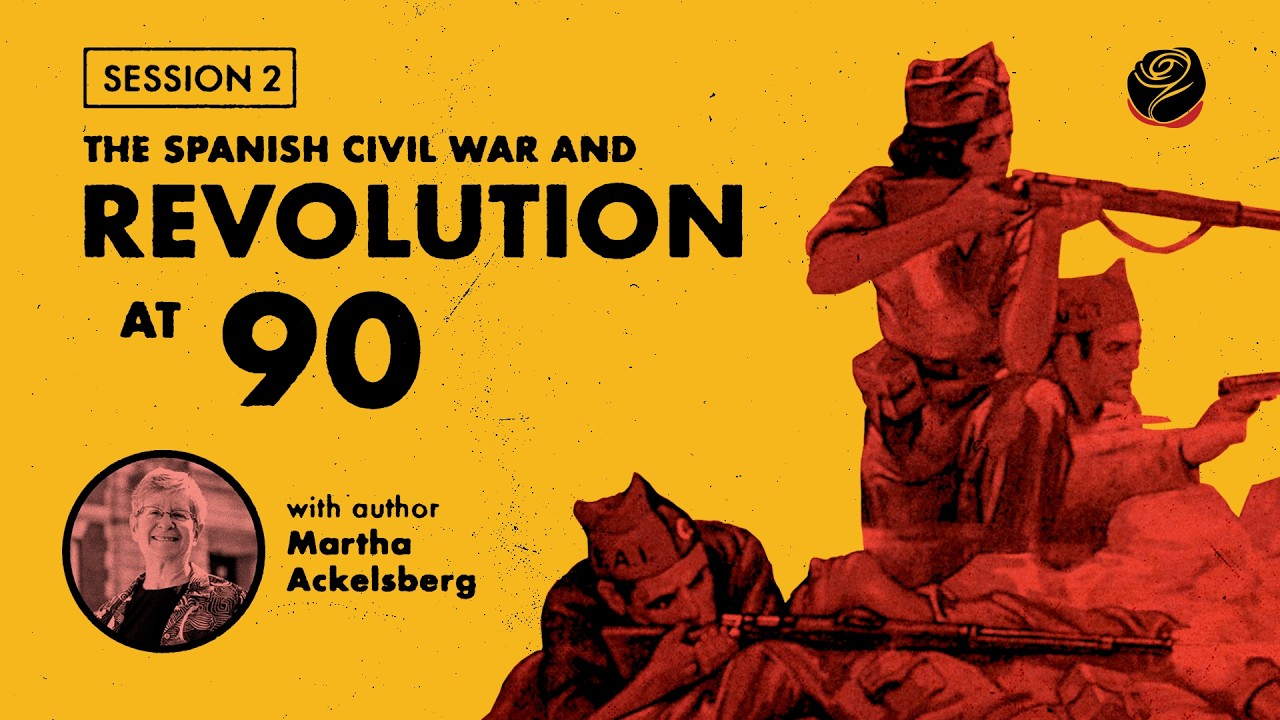
Martha Ackelsberg On Revolutionary Feminism and the Mujeres Libres in the Spanish Revolution and Civil War

play · youtube.com
YouTube Martha Ackelsberg | Spanish Revolution & Civil War Discussion Series m.youtube.com
preview

Author Martha Ackelsberg joins us for the second in our three part live discussion series commemorating the 90th anniversary of the Spanish Revolution and Civil War.

Martha Ackelsberg is the author of Free Women of Spain: Anarchism and the Emancipation of Women, available from AK Press. She is also a professor emerita at Smith College.

This event took place on July 19, 2026.

These events were organized by Black Rose/Rosa Negra Anarchist Federation and sponsored by AK Press.

www.blackrosefed.org

0

New banner/Logo for the sub?

preview

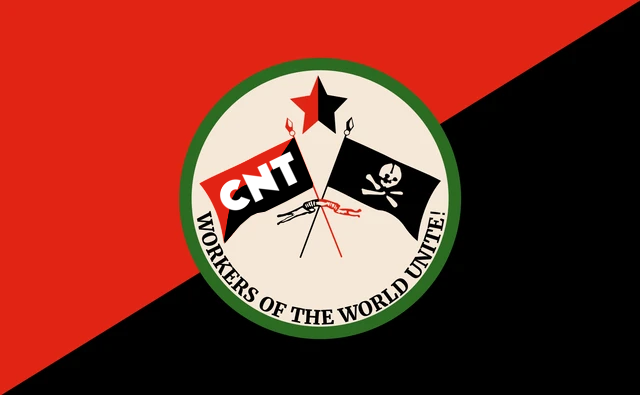
Thanks to ProdigalFrog@slrpnk.net We were given a few suggestions for very cool new banners/logos for libertyhub. To distance ourselves a little bit from the authoritarian connetations of the hammer and sickle.

CNTLogo IWWred IWWwhite Original Originalwithtext Tabby

Open discussion, which ones do you like and why?

0

A Spanish Revolution & Civil War 90th Anniversary Discussion Series | Danny Evans

play · youtube.com
YouTube Danny Evans | Spanish Revolution & Civil War Discussion Series www.youtube.com
preview

Author Danny Evans joins us for the first in our three part live discussion series commemorating the 90th anniversary of the Spanish Revolution and Civil War.

Danny Evans is the author of ‘Revolution and the State: Anarchism in the Spanish Civil War, 1936-39’ out from AK Press.

These events were organized by Black Rose/Rosa Negra Anarchist Federation and sponsored by AK Press.

0

Capture as Governance: A Revolutionary Intercommunal Mutualist reading of American mass incarceration

Capture as Governance: A Revolutionary Intercommunal Mutualist reading of American mass incarceration substack.com
preview

Posting a bit of theory from my own Anarcho-Pantherist tradition for you all today.


Capture as Governance: A Revolutionary Intercommunal Mutualist reading of American mass incarceration

Read distraction-free on Substack

A Revolutionary Intercommunal Mutualist reading of American mass incarceration

United Panther Party – U.S. | Ministry of Political Education

The United States holds roughly 1.97 million people in confinement and locks them up at about 580 per 100,000 residents, the highest rate of any independent democracy on Earth and among the highest of any nation on the planet. Only El Salvador, Cuba, and Turkmenistan cage more of their people per capita. The country carries a little over four percent of the world’s population and close to a sixth of the world’s counted prisoners. The whole apparatus runs on about 445 billion dollars a year.

Break the country into its parts and the picture sharpens. Two dozen states lock people up at rates that would top nearly every nation on Earth, and after El Salvador the nine highest incarceration rates on the planet belong to U.S. states, almost all of them in the South. The carceral core has a core, and it’s the ground Food Justice United organizes on. The growth engine has moved too. Immigration detention now drives almost all new confinement, with ICE detention up more than half in a single year, which puts the frontier of capture at the border rather than the drug corner.

It’s worth holding the country’s favorite line about itself up against that arithmetic. Land of the free, home of the brave. No nation that cages its people at this rate has any business calling itself free, and none that needs this many walls to feel safe has any business calling itself brave. By its own telling this is the freest place on Earth, and by the count it has built the most crowded prison system in the democratic world, then draped a flag over it and set the words to music. The anthem doesn’t describe a condition. It advertises one. And the advertising is paid for by the exact people the numbers just named: the freedom gets sung, and they get counted.

That’s where the numbers stand. What a Revolutionary Intercommunal Mutualist analysis asks isn’t whether the disproportion is real but what it’s for.

Dr. Huey Newton’s late theory argued that the nation-state had been overtaken by something larger: a single global order held together by the U.S. ruling class and its technologies of control, which he named reactionary intercommunalism. In that reading there aren’t really separate nations anymore so much as a network of communities administered from an imperial center. Revolutionary Intercommunalism was the answer, a world of liberated communities linked by mutual aid instead of domination. RIM inherits that map and adds the constructive economics the Panthers gestured at but didn’t finish: mutualism, the cooperative and anti-statist tradition, drawn through the Black radical tradition and Indigenous lifeways rather than borrowed whole from Proudhon.

Put mass incarceration on that map and it stops looking like a domestic policy problem. The prison isn’t the criminal legal system’s regrettable overreach. It’s one of the empire’s core instruments for managing the populations it has rendered surplus, dangerous, or in the way. Capture isn’t what the state does when governance fails. Capture is a form of governance. The cage is how the administrative center of reactionary intercommunalism handles the people it can neither fully employ nor openly kill: it holds them, moves them, rents them, and disappears them into a machine that runs on roughly 445 billion dollars a year.

There’s a familiar left explanation for all of this, and RIM treats it as half-right and therefore dangerous. The story goes like this: capitalism produces a surplus population it can’t employ, and prisons warehouse that surplus while extracting cheap labor from it. True as far as it goes. Prison labor is real, the profit is real, and the reserve-army logic is real. But if that were the whole story, the cage would fall on the poor at random, and it doesn’t. It falls along lines that class alone can’t draw.

RIM rejects class reductionism as a founding commitment, not a footnote. The carceral state is built at the intersection of forces that can’t be collapsed into one, and the doctrine reads it through four co-equal pillars: Anarcho-Pantherism and the Black radical tradition, the Black Feminisms, the anti-colonial tradition, and tribal and Indigenous traditions. Each names a dimension of capture the economic story leaves out. Together they explain the disproportion the pure political-economy account can only wave at.

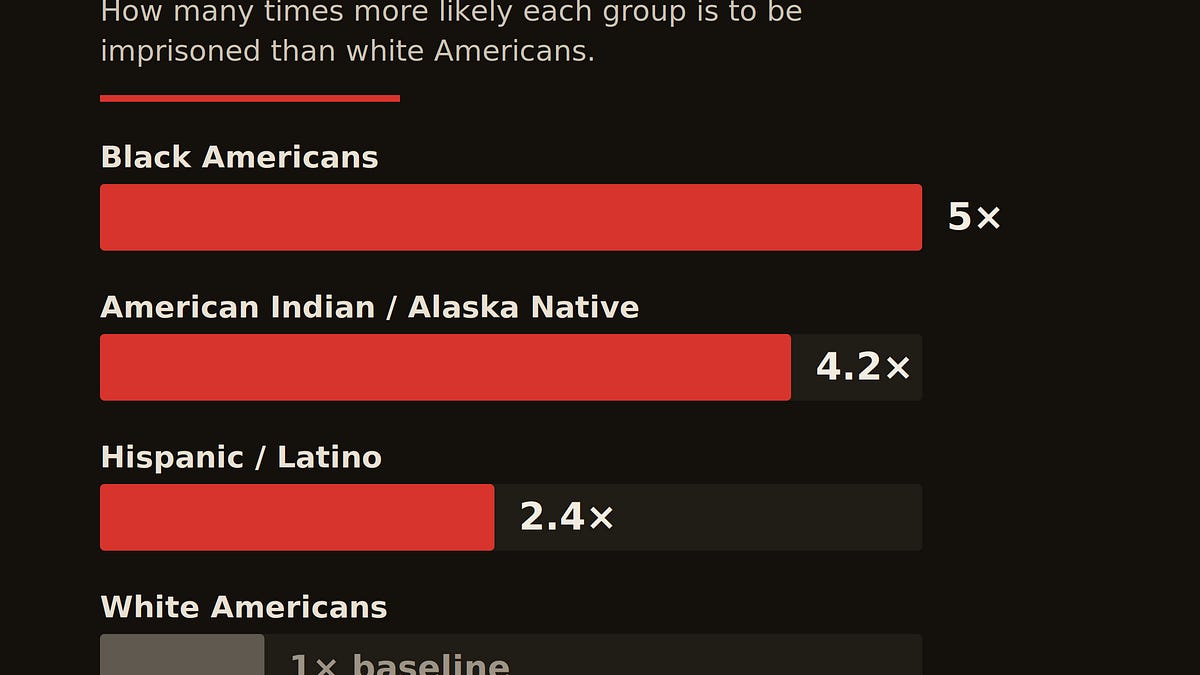
The clearest sign that this isn’t only about class is the color of the cages. Black Americans are about 13 percent of the country and roughly 37 percent of the people in its prisons and jails. Black adults are imprisoned at about five times the white rate. Among people serving life, life without parole, or sentences so long they amount to the same thing, nearly half are Black. One in 81 Black adults is in a state prison on any given day. No purely economic model produces those numbers.

The Black radical tradition supplies the through-line the numbers point at. The Thirteenth Amendment didn’t abolish slavery so much as relocate the exception, banning bondage “except as a punishment for crime.” Convict leasing filled the gap almost immediately, renting Black prisoners to the same industries that had bought Black slaves. The line runs unbroken from the plantation to the chain gang to the modern prison, and from the slave patrol to the police department that feeds it. Scholars in this tradition, Angela Davis, Ruth Wilson Gilmore, Michelle Alexander, Saidiya Hartman, have spent decades tracing it, and the shorthand they’ve handed us is exact: the prison is the afterlife of slavery. Gilmore’s definition of racism belongs here too, the production and exploitation of group-differentiated vulnerability to premature death, sanctioned by the state or permitted beside it. The cage is one of its primary engines.

The Anarcho-Panther reading adds the part liberals flinch from. The problem isn’t a broken system that better funding and better training will repair. The state’s claim to a monopoly on safety is the thing that manufactures the danger it then polices. An institution built to capture can’t be reformed into an institution that heals, any more than the slave patrol could have been sensitivity-trained into a mutual aid society. That’s why RIM’s horizon isn’t a kinder prison but the withering of the cage as a technology, replaced from below.

An analysis that stops at Black men misses half the machine and most of its cruelty. Women are among the fastest-growing groups behind bars, and Black women are imprisoned at over one and a half times the rate of white women. The Black Feminisms pillar reads the carceral state through what it does to survival itself: the woman who fights back against the man beating her and goes to prison for it, the mother whose poverty becomes a neglect charge, the survivor whose trauma becomes a drug case. Capture doesn’t just fall on the racialized poor. It criminalizes the things people do to stay alive inside conditions the same state created.

It also runs on family destruction, a form of social control the labor story can’t see. Every caged parent is a household torn open, children routed into foster systems that feed back into prisons, and the unpaid work of holding families together loaded onto the women left outside the walls. This is why RIM refuses carceral feminism, the belief that gender violence can be solved by adding police and prison cells. The state’s answer to harm against women has been to expand the very apparatus that cages their brothers, sons, and partners, and that same apparatus turns survivors themselves into defendants. Thinkers and organizers in this tradition, Beth Richie, Andrea Ritchie, Mariame Kaba, the Survived and Punished network, have shown that you can’t punish your way to safety for women, because the punishment system is itself a source of gendered violence. Safety for the most vulnerable has to be built, not sentenced.

The Panthers and the anti-colonial theorists they read, Fanon above all, described Black and colonized communities as internal colonies: territories inside the imperial state, policed like occupied ground, extracted from, and governed by force rather than consent. The carceral state is the occupying army’s logic turned inward. The war on drugs was never mainly about drugs. It was domestic counterinsurgency, a way to flood targeted neighborhoods with police, surveillance, and prison sentences under a public-health disguise. The tools move in a loop. Tactics, weapons, and training developed for imperial policing abroad come home to the reservation and the housing project, and what’s refined at home gets exported again.

Today the frontier of capture has moved to the literal border. Immigration detention is now the engine of nearly all growth in American confinement, with ICE detention rising by more than half in a single year. The racialized migrant is the newest population the empire captures to manage, held in a network of facilities that answers to no meaningful oversight. The prison and the detention center are two faces of one project: the administration of racialized populations the imperial core has decided it can neither absorb as equals nor leave alone. From an anti-colonial vantage the disproportion isn’t a scandal inside an otherwise sound republic. It’s what colonial administration looks like when the colony is domestic.

Native people are caged at rates that rival any group in the country: imprisoned at more than twice the national rate and over four times the white rate, jailed at nearly three times the white rate, held in dozens of jails scattered across Indian country under a jurisdictional maze designed in Washington. And the disproportion is the newest layer of the oldest capture on this continent. Before there were prisons here there was dispossession, the removal of nations from their land, and the two have always worked together: criminalize the people, clear the territory. The boarding school was a carceral institution in everything but name, built to confine Native children, sever them from family and language, and process them into something the settler order could use. “Kill the Indian, save the man” was a sentence in both meanings of the word.

But the Indigenous pillar in RIM isn’t only a record of harm, and this is where the analysis turns toward what comes next. Indigenous justice traditions across many nations never organized themselves around the cage at all. They oriented toward repair: restoring relationships, reintegrating the person who caused harm, making the injured whole, keeping the community intact rather than exiling its members. These aren’t theoretical alternatives waiting to be invented. They predate the prison by millennia and have survived every attempt to stamp them out. They’re proof, standing and breathing, that a people can meet harm without warehousing human beings, which is exactly what the carceral state insists is impossible.

Line the four pillars up and the disproportion resolves into a single picture. The cage manages the populations the empire has made: the descendants of the enslaved, the women criminalized for surviving, the internal colonies and the migrants at the frontier, the Indigenous nations it’s still dispossessing. Class is in there, woven through all of it, but class alone never drew these lines and never will. Capture is a mode of governance, and its targets aren’t random. They’re chosen. The disproportion isn’t the system malfunctioning. It’s the system doing precisely what it was built to do, which is why tinkering with sentencing guidelines and retraining the guards has never touched it and never will.

That’s the diagnosis. A Revolutionary Intercommunal Mutualist analysis doesn’t stop at diagnosis, because naming the machine is only worth doing if it clears the ground for building something in its place.

RIM’s strategy has a name for this, borrowed from an old labor slogan and taken seriously: rising inside the shell of the old. You don’t wait for permission to dismantle the cage, and you don’t expect the state to dismantle it for you. You build the community capacity to meet needs and harms directly, until the cage stands revealed as a choice rather than a necessity, and then as an obstacle to be removed. That’s dual power, growing the institutions of a liberated community alongside and against the ones that rule now.

The blueprint for it is the Community Infrastructure Stack, and it’s worth seeing that the whole thing is anti-carceral from the ground up. It runs in order. Food Sovereignty comes first, because a community that can feed itself has pulled the floor out from under a huge share of what gets criminalized as property and survival crime. Community Health and Harm Reduction comes next, and it’s the most direct daylight substitute for the cage there is: naloxone and overdose response in the hands of neighbors, care instead of arrest for the drug user, treating addiction and mental health crisis as health rather than as crime. This is ground Food Justice United already works, and every overdose reversed outside a jail cell is a small proof of the whole thesis. Climate Resilience follows, because a community that can hold together through disaster doesn’t have to be rescued and then policed by the state. Decolonized Technology comes after that, so the tools a community depends on aren’t the same surveillance systems that feed the cage. And the stack lands, deliberately, on Accountable Safety Systems, the fifth tier, the one that meets the carceral state head-on.

Accountable Safety Systems is where the abstract becomes concrete. It means community-based responses to harm that don’t route through capture: transformative justice and community accountability processes that address violence by changing the conditions that produce it and repairing the damage it does, rather than banishing a body to a cage and calling the matter closed. It’s the Indigenous repair tradition and the Black feminist insistence on real safety, built into working infrastructure. Nobody claims this is easy, and RIM doesn’t pretend the hardest cases have simple answers. The claim is narrower and firmer: the cage doesn’t answer them either. It only hides them. A community that has built the other four tiers has the standing and the capacity to take up the fifth, because safety turns out to be something you construct out of met needs, not something you sentence people into.

Come back to where this started. A country with a twentieth of the world’s people built the most extreme carceral apparatus in the democratic world, and it did so by narrowing, again and again, the circle of who counts as fully human and therefore worthy of freedom and safety. That narrowing is the deepest logic of the cage: some people are the public that safety protects, and others are the threat that safety is protected from. Every disproportion in the numbers is that line, drawn in flesh.

The answer isn’t a better-managed cage or a fairer line. It’s the refusal of the line itself. That refusal is the whole content of the phrase this movement organizes under, ALL Power to ALL People, said plainly so it can’t be narrowed to a chosen few. A world organized that way doesn’t need a fifth of anyone’s cages, because it doesn’t produce the surplus, the frontier, and the internal colony the cages exist to manage. Building that world, one tier of infrastructure at a time, inside the shell of this one, is the work.

ALL Power to ALL People.

Data and reporting:

Prison Policy Initiative, Mass Incarceration: The Whole Pie 2026 (national confined population near 1.97 million; rate of 580 per 100,000; roughly 445 billion dollars in annual system cost; immigration detention as the primary growth driver).

Institute for Crime and Justice Policy Research, World Prison Brief (global counted prison population above 11.5 million; comparative national rates; U.S. rate declining from a mid-2000s peak above 750 per 100,000).

The Sentencing Project, One in Five: Ending Racial Inequity in Incarceration and associated state data (Black imprisonment near five times the white rate; American Indian at 4.2 times and Latinx at 2.4 times the white rate; Black women at 1.6 times the white women’s rate).

Prison Policy Initiative, Racial and Ethnic Disparities research (Black share of population versus prison and jail population; Native prison rate of 763 versus 350 per 100,000 nationally; share of long-sentence populations).

Bureau of Justice Statistics, Prisoners in 2023, Statistical Tables (NCJ 310197, September 2025).

PolitiFact, “Webb says U.S. has 5 percent of world’s population, 25 percent of its ‘known’ prisoners” (December 2014), for the peak-era origin of the 5 percent and 25 percent figures.

Theory and tradition:

Huey P. Newton, writings and speeches on revolutionary intercommunalism.

Angela Y. Davis, Are Prisons Obsolete?

Ruth Wilson Gilmore, Golden Gulag: Prisons, Surplus, Crisis, and Opposition in Globalizing California.

Michelle Alexander, The New Jim Crow: Mass Incarceration in the Age of Colorblindness.

Saidiya Hartman, Lose Your Mother (the afterlife of slavery).

Beth E. Richie, Arrested Justice: Black Women, Violence, and America’s Prison Nation.

Andrea J. Ritchie, Invisible No More: Police Violence Against Black Women and Women of Color.

Mariame Kaba, We Do This ‘Til We Free Us, and the Survived and Punished organizing tradition.

Frantz Fanon, The Wretched of the Earth.

Posting a bit of theory from my own Anarcho-Pantherist tradition for you all today.


Capture as Governance: A Revolutionary Intercommunal Mutualist reading of American mass incarceration

Read distraction-free on Substack

A Revolutionary Intercommunal Mutualist reading of American mass incarceration

United Panther Party – U.S. | Ministry of Political Education

The United States holds roughly 1.97 million people in confinement and locks them up at about 580 per 100,000 residents, the highest rate of any independent democracy on Earth and among the highest of any nation on the planet. Only El Salvador, Cuba, and Turkmenistan cage more of their people per capita. The country carries a little over four percent of the world’s population and close to a sixth of the world’s counted prisoners. The whole apparatus runs on about 445 billion dollars a year.

Break the country into its parts and the picture sharpens. Two dozen states lock people up at rates that would top nearly every nation on Earth, and after El Salvador the nine highest incarceration rates on the planet belong to U.S. states, almost all of them in the South. The carceral core has a core, and it’s the ground Food Justice United organizes on. The growth engine has moved too. Immigration detention now drives almost all new confinement, with ICE detention up more than half in a single year, which puts the frontier of capture at the border rather than the drug corner.

It’s worth holding the country’s favorite line about itself up against that arithmetic. Land of the free, home of the brave. No nation that cages its people at this rate has any business calling itself free, and none that needs this many walls to feel safe has any business calling itself brave. By its own telling this is the freest place on Earth, and by the count it has built the most crowded prison system in the democratic world, then draped a flag over it and set the words to music. The anthem doesn’t describe a condition. It advertises one. And the advertising is paid for by the exact people the numbers just named: the freedom gets sung, and they get counted.

That’s where the numbers stand. What a Revolutionary Intercommunal Mutualist analysis asks isn’t whether the disproportion is real but what it’s for.

Dr. Huey Newton’s late theory argued that the nation-state had been overtaken by something larger: a single global order held together by the U.S. ruling class and its technologies of control, which he named reactionary intercommunalism. In that reading there aren’t really separate nations anymore so much as a network of communities administered from an imperial center. Revolutionary Intercommunalism was the answer, a world of liberated communities linked by mutual aid instead of domination. RIM inherits that map and adds the constructive economics the Panthers gestured at but didn’t finish: mutualism, the cooperative and anti-statist tradition, drawn through the Black radical tradition and Indigenous lifeways rather than borrowed whole from Proudhon.

Put mass incarceration on that map and it stops looking like a domestic policy problem. The prison isn’t the criminal legal system’s regrettable overreach. It’s one of the empire’s core instruments for managing the populations it has rendered surplus, dangerous, or in the way. Capture isn’t what the state does when governance fails. Capture is a form of governance. The cage is how the administrative center of reactionary intercommunalism handles the people it can neither fully employ nor openly kill: it holds them, moves them, rents them, and disappears them into a machine that runs on roughly 445 billion dollars a year.

There’s a familiar left explanation for all of this, and RIM treats it as half-right and therefore dangerous. The story goes like this: capitalism produces a surplus population it can’t employ, and prisons warehouse that surplus while extracting cheap labor from it. True as far as it goes. Prison labor is real, the profit is real, and the reserve-army logic is real. But if that were the whole story, the cage would fall on the poor at random, and it doesn’t. It falls along lines that class alone can’t draw.

RIM rejects class reductionism as a founding commitment, not a footnote. The carceral state is built at the intersection of forces that can’t be collapsed into one, and the doctrine reads it through four co-equal pillars: Anarcho-Pantherism and the Black radical tradition, the Black Feminisms, the anti-colonial tradition, and tribal and Indigenous traditions. Each names a dimension of capture the economic story leaves out. Together they explain the disproportion the pure political-economy account can only wave at.

The clearest sign that this isn’t only about class is the color of the cages. Black Americans are about 13 percent of the country and roughly 37 percent of the people in its prisons and jails. Black adults are imprisoned at about five times the white rate. Among people serving life, life without parole, or sentences so long they amount to the same thing, nearly half are Black. One in 81 Black adults is in a state prison on any given day. No purely economic model produces those numbers.

The Black radical tradition supplies the through-line the numbers point at. The Thirteenth Amendment didn’t abolish slavery so much as relocate the exception, banning bondage “except as a punishment for crime.” Convict leasing filled the gap almost immediately, renting Black prisoners to the same industries that had bought Black slaves. The line runs unbroken from the plantation to the chain gang to the modern prison, and from the slave patrol to the police department that feeds it. Scholars in this tradition, Angela Davis, Ruth Wilson Gilmore, Michelle Alexander, Saidiya Hartman, have spent decades tracing it, and the shorthand they’ve handed us is exact: the prison is the afterlife of slavery. Gilmore’s definition of racism belongs here too, the production and exploitation of group-differentiated vulnerability to premature death, sanctioned by the state or permitted beside it. The cage is one of its primary engines.

The Anarcho-Panther reading adds the part liberals flinch from. The problem isn’t a broken system that better funding and better training will repair. The state’s claim to a monopoly on safety is the thing that manufactures the danger it then polices. An institution built to capture can’t be reformed into an institution that heals, any more than the slave patrol could have been sensitivity-trained into a mutual aid society. That’s why RIM’s horizon isn’t a kinder prison but the withering of the cage as a technology, replaced from below.

An analysis that stops at Black men misses half the machine and most of its cruelty. Women are among the fastest-growing groups behind bars, and Black women are imprisoned at over one and a half times the rate of white women. The Black Feminisms pillar reads the carceral state through what it does to survival itself: the woman who fights back against the man beating her and goes to prison for it, the mother whose poverty becomes a neglect charge, the survivor whose trauma becomes a drug case. Capture doesn’t just fall on the racialized poor. It criminalizes the things people do to stay alive inside conditions the same state created.

It also runs on family destruction, a form of social control the labor story can’t see. Every caged parent is a household torn open, children routed into foster systems that feed back into prisons, and the unpaid work of holding families together loaded onto the women left outside the walls. This is why RIM refuses carceral feminism, the belief that gender violence can be solved by adding police and prison cells. The state’s answer to harm against women has been to expand the very apparatus that cages their brothers, sons, and partners, and that same apparatus turns survivors themselves into defendants. Thinkers and organizers in this tradition, Beth Richie, Andrea Ritchie, Mariame Kaba, the Survived and Punished network, have shown that you can’t punish your way to safety for women, because the punishment system is itself a source of gendered violence. Safety for the most vulnerable has to be built, not sentenced.

The Panthers and the anti-colonial theorists they read, Fanon above all, described Black and colonized communities as internal colonies: territories inside the imperial state, policed like occupied ground, extracted from, and governed by force rather than consent. The carceral state is the occupying army’s logic turned inward. The war on drugs was never mainly about drugs. It was domestic counterinsurgency, a way to flood targeted neighborhoods with police, surveillance, and prison sentences under a public-health disguise. The tools move in a loop. Tactics, weapons, and training developed for imperial policing abroad come home to the reservation and the housing project, and what’s refined at home gets exported again.

Today the frontier of capture has moved to the literal border. Immigration detention is now the engine of nearly all growth in American confinement, with ICE detention rising by more than half in a single year. The racialized migrant is the newest population the empire captures to manage, held in a network of facilities that answers to no meaningful oversight. The prison and the detention center are two faces of one project: the administration of racialized populations the imperial core has decided it can neither absorb as equals nor leave alone. From an anti-colonial vantage the disproportion isn’t a scandal inside an otherwise sound republic. It’s what colonial administration looks like when the colony is domestic.

Native people are caged at rates that rival any group in the country: imprisoned at more than twice the national rate and over four times the white rate, jailed at nearly three times the white rate, held in dozens of jails scattered across Indian country under a jurisdictional maze designed in Washington. And the disproportion is the newest layer of the oldest capture on this continent. Before there were prisons here there was dispossession, the removal of nations from their land, and the two have always worked together: criminalize the people, clear the territory. The boarding school was a carceral institution in everything but name, built to confine Native children, sever them from family and language, and process them into something the settler order could use. “Kill the Indian, save the man” was a sentence in both meanings of the word.

But the Indigenous pillar in RIM isn’t only a record of harm, and this is where the analysis turns toward what comes next. Indigenous justice traditions across many nations never organized themselves around the cage at all. They oriented toward repair: restoring relationships, reintegrating the person who caused harm, making the injured whole, keeping the community intact rather than exiling its members. These aren’t theoretical alternatives waiting to be invented. They predate the prison by millennia and have survived every attempt to stamp them out. They’re proof, standing and breathing, that a people can meet harm without warehousing human beings, which is exactly what the carceral state insists is impossible.

Line the four pillars up and the disproportion resolves into a single picture. The cage manages the populations the empire has made: the descendants of the enslaved, the women criminalized for surviving, the internal colonies and the migrants at the frontier, the Indigenous nations it’s still dispossessing. Class is in there, woven through all of it, but class alone never drew these lines and never will. Capture is a mode of governance, and its targets aren’t random. They’re chosen. The disproportion isn’t the system malfunctioning. It’s the system doing precisely what it was built to do, which is why tinkering with sentencing guidelines and retraining the guards has never touched it and never will.

That’s the diagnosis. A Revolutionary Intercommunal Mutualist analysis doesn’t stop at diagnosis, because naming the machine is only worth doing if it clears the ground for building something in its place.

RIM’s strategy has a name for this, borrowed from an old labor slogan and taken seriously: rising inside the shell of the old. You don’t wait for permission to dismantle the cage, and you don’t expect the state to dismantle it for you. You build the community capacity to meet needs and harms directly, until the cage stands revealed as a choice rather than a necessity, and then as an obstacle to be removed. That’s dual power, growing the institutions of a liberated community alongside and against the ones that rule now.

The blueprint for it is the Community Infrastructure Stack, and it’s worth seeing that the whole thing is anti-carceral from the ground up. It runs in order. Food Sovereignty comes first, because a community that can feed itself has pulled the floor out from under a huge share of what gets criminalized as property and survival crime. Community Health and Harm Reduction comes next, and it’s the most direct daylight substitute for the cage there is: naloxone and overdose response in the hands of neighbors, care instead of arrest for the drug user, treating addiction and mental health crisis as health rather than as crime. This is ground Food Justice United already works, and every overdose reversed outside a jail cell is a small proof of the whole thesis. Climate Resilience follows, because a community that can hold together through disaster doesn’t have to be rescued and then policed by the state. Decolonized Technology comes after that, so the tools a community depends on aren’t the same surveillance systems that feed the cage. And the stack lands, deliberately, on Accountable Safety Systems, the fifth tier, the one that meets the carceral state head-on.

Accountable Safety Systems is where the abstract becomes concrete. It means community-based responses to harm that don’t route through capture: transformative justice and community accountability processes that address violence by changing the conditions that produce it and repairing the damage it does, rather than banishing a body to a cage and calling the matter closed. It’s the Indigenous repair tradition and the Black feminist insistence on real safety, built into working infrastructure. Nobody claims this is easy, and RIM doesn’t pretend the hardest cases have simple answers. The claim is narrower and firmer: the cage doesn’t answer them either. It only hides them. A community that has built the other four tiers has the standing and the capacity to take up the fifth, because safety turns out to be something you construct out of met needs, not something you sentence people into.

Come back to where this started. A country with a twentieth of the world’s people built the most extreme carceral apparatus in the democratic world, and it did so by narrowing, again and again, the circle of who counts as fully human and therefore worthy of freedom and safety. That narrowing is the deepest logic of the cage: some people are the public that safety protects, and others are the threat that safety is protected from. Every disproportion in the numbers is that line, drawn in flesh.

The answer isn’t a better-managed cage or a fairer line. It’s the refusal of the line itself. That refusal is the whole content of the phrase this movement organizes under, ALL Power to ALL People, said plainly so it can’t be narrowed to a chosen few. A world organized that way doesn’t need a fifth of anyone’s cages, because it doesn’t produce the surplus, the frontier, and the internal colony the cages exist to manage. Building that world, one tier of infrastructure at a time, inside the shell of this one, is the work.

ALL Power to ALL People.

Data and reporting:

Prison Policy Initiative, Mass Incarceration: The Whole Pie 2026 (national confined population near 1.97 million; rate of 580 per 100,000; roughly 445 billion dollars in annual system cost; immigration detention as the primary growth driver).

Institute for Crime and Justice Policy Research, World Prison Brief (global counted prison population above 11.5 million; comparative national rates; U.S. rate declining from a mid-2000s peak above 750 per 100,000).

The Sentencing Project, One in Five: Ending Racial Inequity in Incarceration and associated state data (Black imprisonment near five times the white rate; American Indian at 4.2 times and Latinx at 2.4 times the white rate; Black women at 1.6 times the white women’s rate).

Prison Policy Initiative, Racial and Ethnic Disparities research (Black share of population versus prison and jail population; Native prison rate of 763 versus 350 per 100,000 nationally; share of long-sentence populations).

Bureau of Justice Statistics, Prisoners in 2023, Statistical Tables (NCJ 310197, September 2025).

PolitiFact, “Webb says U.S. has 5 percent of world’s population, 25 percent of its ‘known’ prisoners” (December 2014), for the peak-era origin of the 5 percent and 25 percent figures.

Theory and tradition:

Huey P. Newton, writings and speeches on revolutionary intercommunalism.

Angela Y. Davis, Are Prisons Obsolete?

Ruth Wilson Gilmore, Golden Gulag: Prisons, Surplus, Crisis, and Opposition in Globalizing California.

Michelle Alexander, The New Jim Crow: Mass Incarceration in the Age of Colorblindness.

Saidiya Hartman, Lose Your Mother (the afterlife of slavery).

Beth E. Richie, Arrested Justice: Black Women, Violence, and America’s Prison Nation.

Andrea J. Ritchie, Invisible No More: Police Violence Against Black Women and Women of Color.

Mariame Kaba, We Do This ‘Til We Free Us, and the Survived and Punished organizing tradition.

Frantz Fanon, The Wretched of the Earth.

0

When They Insist Upon the Torment Nexus

When They Insist Upon the Torment Nexus substack.com
preview

“If they invent self-driving cars, they’ll just drive people to jail. You know that, right?” My friend told me.

I didn’t have a response for him, because he was right. There was never any chance that a carceral society like the USA was going to develop self-driving cars as anything other than an extension of social control and punitive justice.

So I wrote a story about it, sold it to Vice, and tried not to think about it too much since.

Ten years later, that story came true.

I’ve become an avid reader of socialist and queer sci-fi, and Margaret Killjoy is one of my favorite modern authors. I haven’t read “One Star”, but I’ve read enough of her work to be wholely unsurprised that one of her stories has become another example of our oppressors building the Torment Nexus.

I feel like there’s something to be said for sci-fi/fantasy authors writing about what’s happening already as a counterpoint to the tech oligarchs necessarily taking inspiration from the most evil concepts in fiction. As she points out in this post, it doesn’t take prophetic vision to see that a new technology created under fascism will serve the interests of those in power over the interests of the people. The historical context goes back at least as far as the industrial revolution and the original Luddites. I see no reason to let any of that get in the way of a good meme, though.

0

Libertyhub is still here, other post is locked

preview

kittenzrulz123 has created another community in case anyone currently subscribed to libertyhub would like to follow her.

She created and did this without communicating with anyone else in libertyhub. Libertyhub is still here, and still a fairly quiet sub.

I banned her from libertyhub, but her post will not be deleted. So feel free to follow the link.

Libertyhub is anarchistic, therefore anti-authoritarian and anti-tankie. See the wiki site on tankies for explanation but tldr: tankies support sending tanks against civies to keep control.

Edit: correction for pronouns

0

We are moving to Dbzer0

preview

I have chosen to revive this community following recent events however I have determined that being on this instance will cause more issues over time. Therefore I am using this chance to completely start over from scratch.

The new community will be much stronger and greater than it ever was before and I hope to see you there.

lemmy.dbzer0.com/c/libertyhub

0

people arent things

preview

image comparing two cars. a person calls the first car brilliant captioned [no-one is illegal on stolen land]

in the second picture he points to the other car and says “but I like this this” captioned [no-one is illegal]

image comparing two cars. a person calls the first car brilliant captioned [no-one is illegal on stolen land]

in the second picture he points to the other car and says “but I like this this” captioned [no-one is illegal]

0

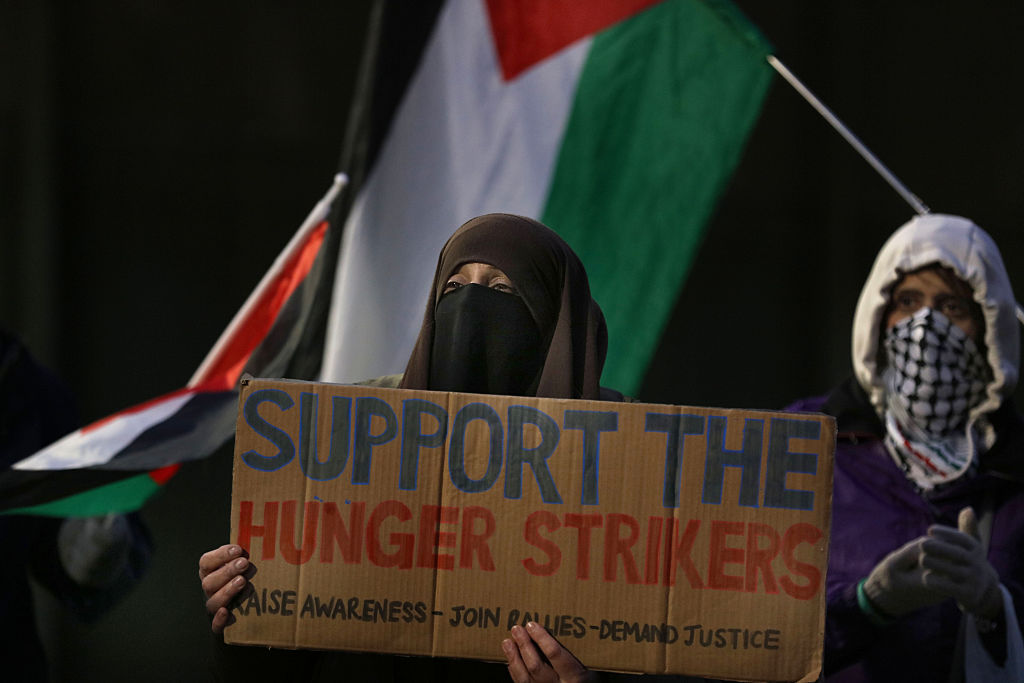
In Britain, Palestine Action Prisoners Starve for Freedom

In Britain, Palestine Action Prisoners Starve for Freedom jacobin.com
preview

Jailed Palestine Action activists in Britain have been on hunger strike for eight weeks already. They are being treated as terrorists, even though they have committed no violent crime.

Jailed Palestine Action activists in Britain have been on hunger strike for eight weeks already. They are being treated as terrorists, even though they have committed no violent crime.

0

Black Liberation Activist Assata Shakur, 78, Dies in Cuba After Decades in Exile

Democracy Now! Black Liberation Activist Assata Shakur, 78, Dies in Cuba After Decades in Exile www.democracynow.org
preview

The Cuban government has announced that Assata Shakur died in Havana on Thursday at the age of 78. Shakur was a legendary figure within the Black Panther Party and the Black Liberation Army.

Shakur was convicted in the May 2, 1973, killing of a New Jersey state trooper during a shootout that left one of her fellow activists dead. She was shot twice by police during the incident. In 1979, she managed to escape from jail and later fled to Cuba, where she received political asylum. She long proclaimed her innocence.

In her autobiography, Shakur wrote: “It is our duty to fight for our freedom. It is our duty to win. We must love each other and support each other. We have nothing to lose but our chains.”

0

In Memphis, Elon Musk Pilots a Corporate Takeover Strategy

In Memphis, Elon Musk Pilots a Corporate Takeover Strategy jacobin.com
preview

Keshaun Pearson wrote this excellent piece about Musk’s fuckery in Memphis. There isnt much new here to people that have kept up with the issue, but he does a good job of putting things in the wider context of class and racial stuggle inside and outside of Memphis. He’s directly involved in the community response, and it’s refreshing to see an article that doesnt dance around the wider implications for climate and social justice.

Keshaun Pearson wrote this excellent piece about Musk’s fuckery in Memphis. There isnt much new here to people that have kept up with the issue, but he does a good job of putting things in the wider context of class and racial stuggle inside and outside of Memphis. He’s directly involved in the community response, and it’s refreshing to see an article that doesnt dance around the wider implications for climate and social justice.

0

Referendum on potential political endorsements

preview

Following the recent Democratic primary where Democratic Socialist Zohran Mamdani won it has lead me to asking a major question, should we endorse Democratic Socialists?

First I want to make this absolutely clear, I do not support electoralism and quite frankly I dont think its possible to reform capitalism out of existence.

The goal of supporting of Democratic Socialists is to promote those who would weaken capitalism but more importantly they wake people up to the class war. I hope that with Democratic Socialists gaining popularity it will create the material conditions that promote revolutionary thought.

However I fully understand if many people will strongly disagree as promoting any candidate gives legitimacy to a system of tyranny (to a certain degree). Thats why im asking all of you, I will be reading every comment here and carefully considering all of them.