




0

NixOS Proposal to Prohibit Job Shaming of MIC Defense Contractors.

NixOS Discourse CoC proposal: prohibit job shaming discourse.nixos.org
preview

The OP in question is a queer clap defense clap smol bean defense contractor worker who is trying to make autonomous marine vehicles designed to make the US the superior military work safer. She feels so sad about being forced to justify over and over again why working her job is actually just a nothingburger and that calling her a traitor to the queer community is too much. i-love-killing-people

This is her proposed change in bold:

a harassment-free experience for everyone, regardless of age, body size, disability, ethnicity, sex characteristics, gender identity and expression, level of experience, education, socio-economic status, employer, nationality, personal appearance, race, religion, or sexual identity and orientation.

It is kinda weird how employer is listed next to things like race and sexual identity. i-love-not-thinking

The replies that weren’t already removed by their neo-nazi moderators (because all the previous moderators did a mass resignation) all tip-toe around her feelings as an open and out queer woman aiding genocide.

I work in defense (Saronic Technologies). Some people can’t handle this, and want to see me unemployed, renounce my employer as evil, and/or constantly feel ashamed about myself.

While I want to say I fundamentally do not care about what other people say, the fact is that I do, deeply, and every time someone implies to me that I’m a bad person for working in defense kinda emotionally destroys me and makes me want to engage with this community less and less. This is why I don’t collaborate with Lix anymore.

The same thing is happening within Nix community spaces. Someone will contact me for some reason or another, and talk with me until they learn I work in defense.

I do not care if someone does not want to interact with me because of this, but I care deeply when they try to argue with me and make me feel bad about it. I’m making this post to communicate that this is extremely unwelcome behavior, towards me and anyone who has a job you don’t personally like, and to please stop. Just disengage. Don’t try to get me to quit my job. Don’t try to make me feel bad. I didn’t ask.

Short edit because slow mode: thank you to everyone who has sent me kind and encouraging words. I am not morally conflicted about what I do, and I don’t mind briefly explaining my position when I can post in this thread again)

Explicitly call out shaming targeted at someone because of their employer as unacceptable. This is relevant right now because I regularly face shaming for working for a US defense contractor, and it makes me feel like shit every time it happens.

zionist-despair I feel like shit! Care about my feelings too-woke-2-alt


NixOS is an explicitly fascist operating system built on racism. The difference between it and Omarchy is the difference between a F-16 and a billionaire’s personal yacht, both are designed to recruit techno-fash to help assert white supremacy.

The OP in question is a queer clap defense clap smol bean defense contractor worker who is trying to make autonomous marine vehicles designed to make the US the superior military work safer. She feels so sad about being forced to justify over and over again why working her job is actually just a nothingburger and that calling her a traitor to the queer community is too much. i-love-killing-people

This is her proposed change in bold:

a harassment-free experience for everyone, regardless of age, body size, disability, ethnicity, sex characteristics, gender identity and expression, level of experience, education, socio-economic status, employer, nationality, personal appearance, race, religion, or sexual identity and orientation.

It is kinda weird how employer is listed next to things like race and sexual identity. i-love-not-thinking

The replies that weren’t already removed by their neo-nazi moderators (because all the previous moderators did a mass resignation) all tip-toe around her feelings as an open and out queer woman aiding genocide.

I work in defense (Saronic Technologies). Some people can’t handle this, and want to see me unemployed, renounce my employer as evil, and/or constantly feel ashamed about myself.

While I want to say I fundamentally do not care about what other people say, the fact is that I do, deeply, and every time someone implies to me that I’m a bad person for working in defense kinda emotionally destroys me and makes me want to engage with this community less and less. This is why I don’t collaborate with Lix anymore.

The same thing is happening within Nix community spaces. Someone will contact me for some reason or another, and talk with me until they learn I work in defense.

I do not care if someone does not want to interact with me because of this, but I care deeply when they try to argue with me and make me feel bad about it. I’m making this post to communicate that this is extremely unwelcome behavior, towards me and anyone who has a job you don’t personally like, and to please stop. Just disengage. Don’t try to get me to quit my job. Don’t try to make me feel bad. I didn’t ask.

Short edit because slow mode: thank you to everyone who has sent me kind and encouraging words. I am not morally conflicted about what I do, and I don’t mind briefly explaining my position when I can post in this thread again)

Explicitly call out shaming targeted at someone because of their employer as unacceptable. This is relevant right now because I regularly face shaming for working for a US defense contractor, and it makes me feel like shit every time it happens.

zionist-despair I feel like shit! Care about my feelings too-woke-2-alt


NixOS is an explicitly fascist operating system built on racism. The difference between it and Omarchy is the difference between a F-16 and a billionaire’s personal yacht, both are designed to recruit techno-fash to help assert white supremacy.

0

Artix Linux Drops XLibre Support Just Months After Making It Default

Linuxiac Artix Linux Drops XLibre Support Just Months After Making It Default linuxiac.com
preview

Lol. I do feel kinda bad for the dev who got harassed though. EDIT: Lol again


ⓘ Remember to enable JPEG-XL support in your browser, even on your phone!

Lol. I do feel kinda bad for the dev who got harassed though. EDIT: Lol again


ⓘ Remember to enable JPEG-XL support in your browser, even on your phone!

0

In which the lead maintainer of Emacs describes the role of the Free Software Movement vis. a vis. Human Liberation

preview

Pictured: deep-nesting in mailing list form.

Not pictured: This thread actually goes all the way back to mid-october.

In particular, quotes from this email have been making the rounds recently

as a hypothetical example: if i live in a territory that permits slavery, and by law i am granted sole ownership of the products of that forced labor, and then i use that to create contributions to gnu emacs, complete with copyright assignment, and it is technically correct, and, above all, you, the emacs maintainers are aware of how this was produced, would it be ethical to accept those contributions?

Our answer must be YES.

Any other answer is a first step towards splitting our community along the many lines of political and ideological divides that have nothing to do with software freedoms. Right now we have contributors from all over the world, despite the differences in their regimes and political systems, differences in ideologies, and even in the very interpretation of the notion of “freedom”. You are suggesting to subject the contributors to some examination of the principles they uphold, the ethics of their day-to-day activities, their views on matters of policies and important international events, etc. This will immediately fracture our community into many different enclaves. And that’s exactly my point, and the main reason why I must reject the “Human Emacs” initiative, as it is presented to us.

Dawg, the “splitting our community” ship has sailed. It’s fucking gone. The battle lines throughout the entire ecosystem of Free Software have been growing more and more entrenched for months. Dozens of projects have already been forked. Countless people have abandoned software that they are familiar with and have been using for decades to reduce their exposure to slop. A lot of maintainers have ditched projects they’ve contributed to for years to find another niche for themselves, or leave Free Software entirely. You have one of the most active channels on libera.chat discussing and preparing for a fork depending on the GNU project’s decision here. It is time to choose a side, or be swept into eternal irrelevance. Even the libertarian dweebs in Rush understood this.

it is my worry that the fsf and gnu’s apparent narrow focus on legality and technical correctness in the framing of llm contributions ignores the much larger issues with supporting human freedom, and, as such, becomes hypocritcal: free software is free in name only when it is used for subjugation or created from subjugation.

There’s no hypocrisy here, only the realization and understanding that we cannot fix everything in this world, even if we tried, not via developing and distributing software. So we limit ourselves to solving a few of the problems, and leave the rest to other communities. (Of course, people who contribute to Emacs can well be members of those other communities as well.)

this example is hypothetical and not intended to display any real or imagined link to how llms are created and operated. it is only intended as a philosophical point on how a narrow focus on license legality and technical correctness are, at times, inadequate in the pursuit of the larger goal of liberty for all humanity.

The Free Software movement doesn’t pursue the goal of “liberty for all humanity”. If you think it does, you are gravely mistaken. Our goals are different, and are well described elsewhere.

Well, maybe it fucking should!

As I wrote on Mastodon, you couldn’t ask for a more concise summary of why the movement has failed. Why the entire world is being crushed under the boot of surveillance tech, and its applications in marketing, propaganda, social manipulation, and weapons systems, while one percent of the computing public plays around with their linux distros like toy trains.

0

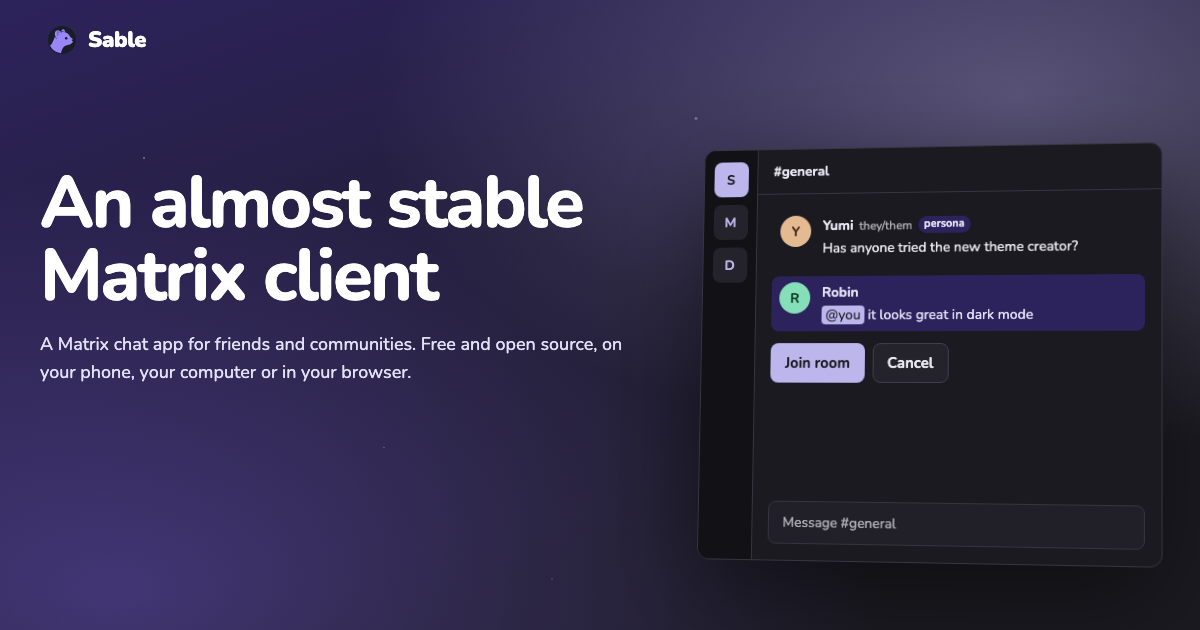
y'all are sleeping on Sable (an actually-good Discord alternative using Matrix)

Sable Sable: open source Matrix client for web, desktop and mobile sable.moe
preview

seriously, if you’re looking for a proper FOSS discord replacement i cannot stress enough how good the new Sable 2.x releases are.

to name a few things that make this really fucking cool, it has:

  • an actually working mobile client available in the play store and soon the iOS app store (if it isn’t already)
  • voice/video channels, forum channels, etc.
  • spaces set up as a feature-complete replacement for discord guilds with roles, categorization, permission syncing, etc.
  • detailed discord-like profiles with status (including per-space/channel personas)
  • cool features you would have expected to see in a golden age IM like custom fonts, colors, rich text editing, etc.
  • decentralization with federation via the matrix protocol
  • end-to-end encryption available for both DMs and guild channels (unlike a certain slop discord clone that’s been making the rounds lately)
  • awesome maintainers who actually listen to the users and aren’t chuds
  • a policy against vibecoded PRs
  • a cute animal mascot (including a trans flag variant)

if you’re new to matrix, try this. if you’re already using matrix, try this because it’s better than the other clients (especially element)

0

Help with Zirconium/DMS

preview

I saw a post about Zirconium a while back and decided to give it a try. I’ve never used a tiling window manager before so it was a bit of a learning curve but I’m well on my way now. I love the keyboard-heavy navigation and how pretty, polished, and opinionated everything is.

I only have two gripes so far… and to be fair these may be more DMS issues than anything. One is that left-handed mouse mode setting (swap left/right click) isn’t respected. I can use the included Input Remapper to fix this, and I have a preset built that works fine, but I have to load it manually every boot because the preset auto-load feature doesn’t work either.

Second, I’m coming from KDE and I miss KDE Connect something fierce. I installed the DMS Phone Connect plugin, and it complained that kdeconnect package was missing, but it found Valent and seemed to be satisfied with that. I don’t think Valent is running properly, though. When I activate the Phone Connect plugin within DMS settings, it seems to turn on, but it tells me it’s announcing with a blank name, like literally “announcing as ()” in the status line. The Valent GUI app that came preinstalled says it should be announcing as Zirconium. My phone’s KDE Connect app doesn’t see the PC and adding it manually via IP doesn’t work either. Is it even possible to install the kdeconnect package in Zirconium, and if so, how? I’m relatively new to immutable atomic distros and understand installing rpms directly isn’t the preferred approach. I ran into issues previously trying to install a package this way in Zirconium and it kept me from doing so. I found a workaround in that case but not sure what to do here.

I have not tried the official discord server for Zirconium for either of these issues bc I don’t have a discord acct and really don’t feel like making one… my internet searching skills haven’t brought me any leads so far, either… any tips? Hexbear got me turned onto Zirconium so now you’re all on the hook for my user experience! j/k love you all

0

Need some ebooks for a long flight. Want to be able to read them without internet access as I won't have any for a while so looking for where I can sail the seven seas for ebooks.

preview

EDIT: you guys are cool as hell. I’ve found what I needed but I’ll keep this up because other people might use it

EDIT: you guys are cool as hell. I’ve found what I needed but I’ll keep this up because other people might use it

0

Libreboot 26.10 “Ominous Olive” released! With full UEFI support.

Libreboot – Libreboot 26.10 “Ominous Olive” released! With full UEFI support. Libreboot – Libreboot 26.10 “Ominous Olive” released! With full UEFI support. libreboot.org
preview

Just signal boosting this project release. It’s led by a trans-femme developer (trapped in TERF island) and she has done a lot of work in supporting new boards. Libreboot is a distribution of coreboot that does things like neuter the Intel management engine spyware and provides a fully free UEFI interface.

With this release, libreboot boards can now boot with EFI/UEFI meaning there’s no need for grub and it has full compatibility with things like Open/FreeBSD.

I have two libreboot thinkpads and they’re the only x86_64 computers I personally own and I love using them doggirl-happy hexbear-trans the UEFI interface was the last thing on the my wishlist.

0

KDE: The Documentary — The Story of Free Software Underdogs

play · youtube.com
YouTube KDE: The Documentary — The Story of Free Software Underdogs youtu.be
preview

KDE: The Documentary tells the story of the pioneering open source community that gave computer users a free and open alternative to proprietary desktops like Windows.

The story starts in 1996, when Matthias Ettrich, a student at the University of Tübingen, posted to a Usenet group asking for programmers to help build a desktop for Linux. What followed became KDE, one of the largest free software communities in the world. KDE made Linux usable as a desktop for people who weren’t system administrators, giving it a complete, consistent graphical environment at a time when there was none.

The film covers the highs and lows of three decades of KDE: the Qt licensing fight and the rivalry with GNOME; the success of KHTML, the browser engine that became the basis of Apple’s WebKit and Google’s Chrome; and the contentious release of KDE 4 and the rebuild that followed.

Along the way, KDE invented much of how open source communities organise themselves. KDE e.V., the non-profit association that holds the project’s legal and financial responsibilities while leaving technical decisions to contributors, became a model for many other open source projects.

Today, KDE is the default desktop on major Linux distributions and on the Steam Deck, and the centre of a whole ecosystem of free and open software.

Above all, the film is about the people who built KDE, the friendships that formed, and why generations of developers have given their free time to it.


Even if my personality leans towards GNOME, the growth of KDE is one of the most amazing success stories in free software. I started using Linux in 2022 and KDE Plasma 5.27 was just about to release to some fanfare. Fast-forward to 2026 and now KDE has a position next to GNOME on Fedora’s website and is the official desktop interface of Valve’s Steam Deck and would probably be above GNOME if not for the inertia GNOME received by being the default choice.

Also this commemorates the release of KDE Plasma 6.8 and the 30th anniversary of the “Kool Desktop Environment” hat-kid-dance

Also goddamn we got a nice documentary about software communism catgirl-happy


Note: the attached link is a link to YouTube, a proprietary video streaming service. You can use programs such as Invidious/Freetube/yt-dlp/Newpipe to access it.

0

I want to love KDE, I really do

preview

but shit like this really grind my gears doggirl-tears

Like, the “start menu” -> type in name of program workflow is so awful. “ter” should become Terminal (Konsole)?? “settings” should return System Settings, not fucking KDebugSettings.

GNOME just works so much better, and literally the only reason I stopped using it is because I want my games to screentear. And the patch to enable that is taking forEVER to land.

0

Debian apparently rolls out a sponsored inference service

preview

It is odd that this is hosted at debian.net (Debian’s canonical domain is debian.org), but they have a support page on Salsa (which certainly is official project infrastructure).

yea

It is odd that this is hosted at debian.net (Debian’s canonical domain is debian.org), but they have a support page on Salsa (which certainly is official project infrastructure).

yea

0

how can i know how much LLM is used in a FLOSS project?

preview

If the author doesn’t specifically make a declaration in the readme, is there a way to guess how “vibe coded” a project is?

Like I want to know if there is anyone actually in charge… A human who knows at least how to program their own program.

If the author doesn’t specifically make a declaration in the readme, is there a way to guess how “vibe coded” a project is?

Like I want to know if there is anyone actually in charge… A human who knows at least how to program their own program.

0

KDE for People - KDE's mission is to be for everyone; So let's be pro-people instead of pro-AI.

preview

We are a community of KDE users and contributors, calling for the KDE Project to adopt a No-AI policy for the KDE Plasma Desktop and other related components.

Recently, there has been a lot of uproar within the KDE Community and within KDE Projects. KDE Eco has already declared that a policy which allows for AI use within KDE is incompatible with KDE Eco goals and values.

Similarly, we want to make ourselves heard.

0

Proposed KDE LLM Guidelines

GitLab Work items · Plasma / Plasma Workspace · GitLab invent.kde.org
preview

The discussion which was opened 2 days ago has become pretty intense. The issue has been locked for now.

These fuckers are trying to open the floodgates for LLM slop in KDE.

The discussion which was opened 2 days ago has become pretty intense. The issue has been locked for now.

These fuckers are trying to open the floodgates for LLM slop in KDE.

0

Power grab - (tante blog about Omarchy)

Smashing Frames Power grab tante.cc
preview

key quotes:

Omarchy should not matter. But sadly it does. As a power grab.

DHH is a racist and a fascist. He recently wrote articles on how there are [Content Warning: massive racism] too many brown people in London these days. In July he wrote an [Content Warning: Racism, anti-romanism] article comparing Roma communities (using a slur for them) to “wolves” that should be “shot”.

The Omarchy foundation will be where projects in desperate need of funding will be pointed. And will a project focused on human rights and social justice get funding from our fascist overlord? What kind of pressure can that exert on projects who have to decide to either die due to lack of funding or kill their code of conduct?

An open fascist is building one of the bigger sources of funding for open source fully under his individual control and sucks up a lot of money that otherwise might have gone to liberatory projects. Community projects. Antifascist projects.

0

Any email clients with robust tagging features?

preview

I have to use Outlook (web version) for my work, and I’ve recently got pretty good at managing my inbox by tagging my emails and shooting them straight to the Archive folder instead of trying to figure out precisely where they should live. It’s so much easier for my brain to handle, but I really think it only works for me because Outlook makes it so easy with default keyboard shortcuts. Highlight an email, press “c,” start typing the tag name, Outlook filters all my tags down as I type, I hit enter on the right one, “esc” to close the tag list, then “e” to Archive it. I never have to touch the mouse and I can just fly through all my bullshit while knowing I could easily find it later if need be. It’s awesome.

I want to start doing this for my personal email. I’m using Thunderbird right now. It does have a tagging feature but it’s soooo primitive and frustrating compared to Outlook. The only way to tag an email with a keyboard shortcut is to know the Number of the tag. That’d be no biggie except… there’s no ability to manually re-order the tags, so once you build your muscle memory, if you have to add a tag later, you get to re-learn the order, because Thunderbird always puts the most recently added tag at the top of the list. Gross.

I searched around the net for a while today and found a lot of people with the same complaints about Thunderbird. I saw a guide some enterprising soul wrote on how to hack the Thunderbird Config Editor to organize and sort tags in your preferred order, but it looks fuckin brutally painstaking and while I have the ability to do this, I have not the patience. Link for the curious: superuser.com/…/how-do-i-reorder-tags-in-thunderb…

If there’s some trick or extension that makes Thunderbird behave like I want, I stopped mining and turned around before I found it…

I turn now to the lovelies here at the bearsite for help. Are there any FOSS email clients out there with a tagging system like Outlook’s (i.e. based on text matching)? I wanna rock with keyboard shortcuts, I don’t wanna be a mouse toucher. I could settle for a system like Thunderbird’s where the keyboard shortcut relates to the number of the tag in the list, but only if it lets me manually order them without having to play Hackerman.

Much love,

decaptcha

0

Ok I know I said I was just inquiring about CatchyOS out of curiosity and not planning to distrohop but I did it anyway

preview

It’s actually slightly faster than Mint, nice.

I haven’t had any issues at all, even though my potato laptop has an nvidea I didn’t have to configure drivers, and unlike mint it actually knows when to automatically switch from the intergracted gpu.

Have had a couple of weird things happen with the bluetooth randomly disconnecting/reconnecting (but that also happened on Mint)

I’m scared of the more haphazard updates screwing the stability, buuut as far as I can tell there is a backup function that is automatic and can be accessed fine from the boot menu

KDE Plasma is pretty and I spent a whole day customizing that shit, it looks terrible now but it’s mine. I now have a crusty 3D geocities ass cursor. Please recommend anything cool I can do to customize this thing. Gimmie ugly widgets too.

Games run better, but I have encountered a graphical glitch in Baldurs Gate 3 where my characters helmet disappears but only when talking to Volo, which is weird. Tried three different protons and still it persists.

So far the terminal is easy but I’m not sure how I’ll go if I actually have to do more than basic things. Is there a good tutorial and learning terminal out there? I’d like to actually understand exactly what I’m doing with this thing.

Anyway expect me to come crying for help the moment I screw something up (I will)

0

Why Gentoo - Michał Górny (May 2026)

Michał Górny Why Gentoo? blogs.gentoo.org
preview

Lately I’ve been thinking about how #Gentoo is perceived by people. So often they’re stuck in the “ricer” mindset: Gentoo is being built from source, so it must be ZOMG fast. And if it isn’t, then what’s the point?

If I were to make four points for Gentoo (to stop myself from making more), they would be:

  1. Gentoo is independent.

There is no company behind Gentoo. There is no business plan. It’s made and maintained by volunteers. Driven by passion and not profit incentive. And we want to keep it that way.

  1. Gentoo aims to be secure.

We are maintaining our own infrastructure to reduce the risk of being hijacked. We’re securing our distribution channels and mirrors using OpenPGP. We’re only using Codeberg (which we really appreciate) and GitHub as mirrors (with OpenPGP commit signatures) and contribution channels. We have a dedicated security team, who works with the developers to keep packages free of vulnerabilities and our users informed.

  1. Gentoo is made by humans.

We banned LLM contributions two years ago, and never regretted it. We didn’t “wait and see”, we took decisive action, and if we got left behind, it’s only for the better. Unfortunately, in today’s LLM-ridden world we can’t stop slop software from being packaged in Gentoo without sacrificing our commitment to keep packages up to date, but we try to keep the worst offenders (like copywashed chardet) at bay.

  1. Gentoo supports sustainability.

This may sound ironic when so many of us build everything from source, but we’re actually trying to make computing sustainable. Gentoo’s source-first nature makes it inherently flexible. We try our best to support a plethora of older and less common hardware. We go against the flow and still try to provide a workable system on hardware that is not supported by Rust or V8. And on top of that, we do our best to provide binary packages for a variety of configurations.

Of course, that’s not all. I want Gentoo to be reliable and stable, to be oriented towards privacy by default, to be welcome and respectful.

And all these things ultimately depend on people working on Gentoo, and contributing to Gentoo. We always need more people that share these principles and want to help us achieve them.


We banned LLM contributions two years ago, and never regretted it. We didn’t “wait and see”, we took decisive action, and if we got left behind, it’s only for the better.

erm-this-you

0

Anyone here use CatchyOS? What's your experience with it?

preview

Stable? Good? Bad? Annoying? Is it beginner friendly? Should I try KDE or Gnome?

I’ve only used Mint and SteamOS and from what I understand KDE should be similar to SteamOS Desktop mode because that is KDE based, right?

I don’t plan to distro hop any time soon, but I’m just curious if I ever get a new laptop I might try it to take advantage of it supposedly being descent at performance optimisation

0

lem.el - Lemmy client for Emacs (link inside)

preview

Project page: codeberg.org/martianh/lem.el

I haven’t fully tested it yet, but seems to work reasonably well. It is not fully featured yet - for example, spoilers don’t seem to render (although that might be due to my using pandoc instead of markdown.el for my markdown-command variable)

I wish there were a way for images to be hidden by default, and to cap their initial size; currently, they display at full resolution by default. The news mega takes several seconds to load, presumably because it loads every comment and image.

Otherwise, all the benefits of emacs are at play here: text-based navigation, easy keybinds like n and p for next/previous, respectively. o sets the sort order, 0 goes to your profile, f folds comments, and more.

0

There is a nitter alternative still being maintained - amaanq/teapot

GitHub GitHub - amaanq/teapot: A privacy-focused Twitter/X frontend written in Rust github.com
preview

The about page (which seems to be copied from Nitter) teapot is a free and open source alternative Twitter front-end focused on privacy and performance. The source is available on GitHub at https://github.com/amaanq/teapot

unfortunately the only instance i can find is hosted by lunduKKKe

are there any other instances of this out there?

0

Could someone please link me to a guide for how to install a distro with the home folder in a different location?

preview

I have always kept my personal files on a separate drive, and then deleted the folders in ~/ (such as Documents, Downloads) and replaced them with links to their respective counterparts in my media drive. But this has not been robust – Firefox often recreates ~/Downloads, and other small problems. I recently saw a comment here about having a partition just for the home folder, and was interested.

I have always kept my personal files on a separate drive, and then deleted the folders in ~/ (such as Documents, Downloads) and replaced them with links to their respective counterparts in my media drive. But this has not been robust – Firefox often recreates ~/Downloads, and other small problems. I recently saw a comment here about having a partition just for the home folder, and was interested.

0

Update: Debian votes to allow 'responsible use of generative AI'

LWN.net Debian votes to allow 'responsible use of generative AI' lwn.net
preview

Update to hexbear.net/post/9402395

The results of the Debian general-resolution vote on the use of large language models have been posted; the winner is choice 5: Responsible Use of Generative AI.

Debian neither endorses nor prohibits the use of generative AI tools in the development, maintenance, or documentation of software, packaging, documentation, and other media published within the Debian Project. We recognize that such tools can substantially improve the productivity of contributors when used responsibly, allowing volunteers to spend more of their limited time on work that requires technical expertise, judgment, review, and collaboration.

The Debian Project nevertheless expects that all contributions submitted to Debian, regardless of how and with which tools they were produced, satisfy the same standards of quality, correctness, maintainability, and legal compliance. The use of a generative AI tool does not diminish the contributor’s responsibility for the work they submit. Contributors are expected to understand, review, test, and, where appropriate, modify AI-assisted output before incorporating it into Debian.

It seems like individual maintainers are allowed to make their own decisions based on allowing or disallowing LLM patches. So this seems like Debian is sticking to the status quo for now.

Disappointing, but not the absolute worst thing that could happen since it doesn’t enshrine any special rights to LLMs.

Centrism wins again!

0

Niri is pretty great, and Zirconium (fedora atomic niri spin) rules.

preview

If you haven’t tried niri yet, it’s pretty great. If you are interested in a tiling WM and don’t want to mess with the omarchy/hyprland fascists, I recommend checking it out. The tiling behavior makes sense and there aren’t several dozen shortcuts to learn before you can use it properly.

And if you want to play around with a distro where it’s set up my default, check out zirconium. One of the reasons that kept me away from trying a tiling window manager was because I didn’t want to mess with a bunch of config files before my laptop became not-annoying to use, and this has a decent set up from the start.

It’s a universal blue (fedora atomic) derivative built on niri and dankmaterialshell, and it’s great for older hardware. I installed on a 10 year old laptop, and it feels brand new. From what I can tell Niri+DMS uses about half the resources as a gnome or kde desktop. It’s extremely smooth, stable, and has very sensible and minimal default software installed. It’s focus is developers, but you can still game on it. It just won’t have all the bells and whistles of something like bazzite preinstalled.

Niri is also easy to set up with CachyOS from what I understand.

I rate it 9 out of 10 linuxes. halal

0

GNOME GUADEC 2026 talks are available online

preview

ATTENTION: that the attached link is to a Google YouTube playlist, if you want to access these videos without using YouTube, use an Invidious instance, yt-dlp, or Freetube

Example:


popuko-hammer GUADEC (GNOME conference) has finished uploading all their talks online. This is a great way to learn about what’s going on in the GNOME project from a diverse set of people.


Cool things include:

  • Flatpak portals (because the GNOME project is heavily involved/invested in flatpak).
  • New GNOME OS things.
  • GTK can now render SVGs in-toolkit meaning we can have animated icons (the rust-based librsvg/glycin is still necessary for untrusted svgs/images).
  • GNOME Boxes revival for building an accessible interface for virtual machines.
  • And a lot of other cool stuff. ground-pog

Highly recommend to watch these if you have free time and want to see nerdy cool things done by nerdy cool people.

ATTENTION: that the attached link is to a Google YouTube playlist, if you want to access these videos without using YouTube, use an Invidious instance, yt-dlp, or Freetube

Example:


popuko-hammer GUADEC (GNOME conference) has finished uploading all their talks online. This is a great way to learn about what’s going on in the GNOME project from a diverse set of people.

Cool things include:

  • Flatpak portals (because the GNOME project is heavily involved/invested in flatpak).
  • New GNOME OS things.
  • GTK can now render SVGs in-toolkit meaning we can have animated icons (the rust-based librsvg/glycin is still necessary for untrusted svgs/images).
  • GNOME Boxes revival for building an accessible interface for virtual machines.
  • And a lot of other cool stuff. ground-pog

Highly recommend to watch these if you have free time and want to see nerdy cool things done by nerdy cool people.

0

The Nixpkgs core team has disbanded

NixOS Discourse The Nixpkgs core team has disbanded discourse.nixos.org
preview

TL;DR: Two of the most nicest, most technically proficient people you know just got burnt out from contributing to their operating system and this is just another example of NixOS being poorly maintained.

A year since I divested from NixOS and nothing really has changed. The “flakes” design is still a garbage abstraction invented by a neo-nazi to sell to Peter Thiel and Co. The Nix language has not evolved in any meaningful way (nixpkgs is still the load bearing peg).

Nixpkgs has reached over 1 million commits and is pushing what Git can scale to and is now entirely dependent on a Microsoft GitHub enterprise subscription and a Amazon AWS S3 credits for petabytes of CI/CD.

The community still contains active MIC fascists in leadership roles alongside :votevote Europeans. empoc perspectives are treated as community fracturing.

The nix derivations abstractions has not truly caught on (due to it not even being better than containers resource wise) and flakes only makes this worse with unversioned commit hashes serving as “determinism” and “reproducibility” which have become buzzwords at this point.

I only expect this to get worse and worse as Determinate Systems (MIC ghoul company) takes over and nixpkgs collapses as an independent entity.

BTW they haven’t decided on a AI/LLM policy because the steering committee and the nixpkgs core team can’t agree or communicate on anything, which basically means NixOS is going to be a AI hype train project if you enjoy that.

TL;DR: Two of the most nicest, most technically proficient people you know just got burnt out from contributing to their operating system and this is just another example of NixOS being poorly maintained.

A year since I divested from NixOS and nothing really has changed. The “flakes” design is still a garbage abstraction invented by a neo-nazi to sell to Peter Thiel and Co. The Nix language has not evolved in any meaningful way (nixpkgs is still the load bearing peg).

Nixpkgs has reached over 1 million commits and is pushing what Git can scale to and is now entirely dependent on a Microsoft GitHub enterprise subscription and a Amazon AWS S3 credits for petabytes of CI/CD.

The community still contains active MIC fascists in leadership roles alongside :votevote Europeans. empoc perspectives are treated as community fracturing.

The nix derivations abstractions has not truly caught on (due to it not even being better than containers resource wise) and flakes only makes this worse with unversioned commit hashes serving as “determinism” and “reproducibility” which have become buzzwords at this point.

I only expect this to get worse and worse as Determinate Systems (MIC ghoul company) takes over and nixpkgs collapses as an independent entity.

BTW they haven’t decided on a AI/LLM policy because the steering committee and the nixpkgs core team can’t agree or communicate on anything, which basically means NixOS is going to be a AI hype train project if you enjoy that.

0

codeberg keeps it real: Protecting our FLOSS commons from LLMs

preview

in part:

Collaboration at danger

It is not purely the digital and civic infrastructures that are impacted by the use of LLMs. The free/libre software ecosystem, of which we consider Codeberg an important part of, is a social phenomenon centered on collaboration. Working in this way is only possible thanks to free sharing and mutual learning. This includes even very small tools that are shared and re-used and around which collaboration can start out. In contrast, by adopting LLMs people tend to code single-use software from scratch. While this leads to an increase in ‘shared’ code, it is mostly code that not only has not been ‘written’ by anyone but is also not maintained by anyone.

Losing trust in each other

The widespread use of LLMs in FLOSS is instead becoming a multidimensional attack on the trust between contributors and the very idea of convivial collaboration itself. Maintainers are under an increased work-load due to people submitting (often well-meaning) low-effort, LLM-generated contributions that require substantial amounts of time to review. At the same time it is becoming increasingly less clear which projects are maintained by experienced developers and which ones are LLM-generated without any meaningful human oversight and input. In the case of copyleft projects, LLMs additionally also lead to ‘license laundering’, where copyleft code is stripped of its reciprocity requirements by ‘generating’ it out of the training data.

We observe an increasing trend of mistrusting each other, up to the point where people who put in actual effort to analyze issues or share their suggestions are being accused of having used LLMs when they did not. At the same time, others instruct their LLMs to hide their traces and actively avoid common patterns, prompting others in reviewing contributions and communication more carefully for signs of machine generation.

Entering a vicious cycle

Together, these forces make collaboration not only harder but also less rewarding: With the transaction cost of collaboration increasing, people are becoming less likely to contribute to creating high-quality software projects and more likely to ‘vibecode’ a one-off software that is specific to your need, and won’t evolve beyond. We get a vicious cycle where collaboration is becoming less and less rewarding, while the amount of single-use software that’s unmaintained and never sees any improvements is going up.

Although often well intentioned, sharing the result of an prompt and calling it “libre software” does not make the world a better place. Codeberg is not and does not want to be a place to dump such generated single-use software that no one else will ever look at. We are a place for people to collaborate and improve software together. Within this context, the recent votes can be understood as a reconfirmation of those principles: As we want to center on human collaboration, we will not actively support or engage in the creation of LLMs and will not put our limited resources to use for storing single-use software that would pollute our FLOSS commons.

0

How far would hostile linux distributions go to hurt application developers?

TheEvilSkeleton How far would hostile distributions go to hurt application developers? tesk.page
preview

The GNOME Calendar maintainers bring up the fact that Linux Mint ships a nearly 2 year old version of GNOME Calendar to its users and still keep the GNOME branding and support links.

The Linux Mint team don’t see an issue with shipping old, unmaintained software and would rather ignore the issue and pretend it doesn’t exist. The recent releases of Linux Mint have downgraded several pieces of software to their older GNOME 3 versions which re-introduce fixed bugs and removes newer features. This was done to support their theming engine, despite the fact that their theming is already several releases too old for GNOME apps.

In addition, they utilize several old GNOME related system components that apps rely on such as GNOME Calendar so even installing a newer version of Calendar wouldn’t be enough.

This ties into a much larger issue of “Long Term Support” desktop operating systems where software can be pulled back for nearly 5 years (or even longer under a contract). Necessary fixes that are too complicated to be patched back in (or count as features) are then missed by users. Users end up using years-old flagship desktops (GNOME and KDE) and get their first impression of those projects from versions that none of the upstream maintainers support.

It’s a shitty situation all around: I personally think it’s incredibly important to use the latest release of software that’s supported by upstream. GNOME does not actively support older versions of its app and shell from more than a release ago and distributions shipping these older GNOME releases can only cause damage to GNOME’s reputation.

If this isn’t possible, then I don’t think it’s right to still keep the branding and trademark of the application, much less keep the original support links intact.

0

The Linux Kernel is not "Anti-AI" nor a "Social Warrior" project

preview

In the context of discussing the use of the “Sashiko” patch reviewing program which queries LLMs to provide a comprehensive review of a patchset. Torvalds is responding to a email thread on discourse surrounding interacting with Sashiko’s reviews.

Yes.

And no, that’s not the position of the Linux kernel.

I realize that some people really dislike AI, but this is an area where I’m willing to absolutely put my foot down as the top-level maintainer.

Linux is not one of those anti-AI projects, and if somebody has issues with that, they can do the open-source thing and fork it.

Or just walk away.

AI is a tool, just like other tools we use. And it’s clearly a useful one.

It may not have been that “clearly” even just a year ago, but it’s no longer in question today.

There are other questions around AI (like what the economy of it will actually look like in the end), but “is it useful” is no longer one of those questions. Anybody who doubts that clearly hasn’t actually used it.

Yes, it can also be a somewhat painful tool, both for maintainer workloads and just from a “it keeps finding embarrassing bugs” standpoint.

But the solution is not to put your head in the sand and sing “La La La, I can’t hear you” at the top of your voice like some people seem to do.

The solution is to make sure those LLM tools help maintainers instead of just causing them pain. There’s no question on that side.

We’re not forcing anybody to use it, but I will very loudly ignore people who try to argue against other people from using it.

And no, AI isn’t perfect. But Christ, anybody who points to the problems at AI had better be looking in the mirror and pointing at themselves at the same time.

Because it’s not like natural intelligence is always all that great either.

The kernel project has been and will continue to be about the technology.

Sure, the social angle of working on open source is important and often a very motivating part of the project, but in the end that’s a side benefit, not the point of the project.

This is NOT some kind of “social warrior” project, never has been, and never will be.

In the kernel community we do open source because it results in better technology, not because of religious reasons.

And so we make decisions primarily based on technical merit. Not fear of new tools.

Linus


monkey-typewriter Torvalds being a hair away from straight up calling LLM criticism “woke” now.

In the context of discussing the use of the “Sashiko” patch reviewing program which queries LLMs to provide a comprehensive review of a patchset. Torvalds is responding to a email thread on discourse surrounding interacting with Sashiko’s reviews.

Yes.

And no, that’s not the position of the Linux kernel.

I realize that some people really dislike AI, but this is an area where I’m willing to absolutely put my foot down as the top-level maintainer.

Linux is not one of those anti-AI projects, and if somebody has issues with that, they can do the open-source thing and fork it.

Or just walk away.

AI is a tool, just like other tools we use. And it’s clearly a useful one.

It may not have been that “clearly” even just a year ago, but it’s no longer in question today.

There are other questions around AI (like what the economy of it will actually look like in the end), but “is it useful” is no longer one of those questions. Anybody who doubts that clearly hasn’t actually used it.

Yes, it can also be a somewhat painful tool, both for maintainer workloads and just from a “it keeps finding embarrassing bugs” standpoint.

But the solution is not to put your head in the sand and sing “La La La, I can’t hear you” at the top of your voice like some people seem to do.

The solution is to make sure those LLM tools help maintainers instead of just causing them pain. There’s no question on that side.

We’re not forcing anybody to use it, but I will very loudly ignore people who try to argue against other people from using it.

And no, AI isn’t perfect. But Christ, anybody who points to the problems at AI had better be looking in the mirror and pointing at themselves at the same time.

Because it’s not like natural intelligence is always all that great either.

The kernel project has been and will continue to be about the technology.

Sure, the social angle of working on open source is important and often a very motivating part of the project, but in the end that’s a side benefit, not the point of the project.

This is NOT some kind of “social warrior” project, never has been, and never will be.

In the kernel community we do open source because it results in better technology, not because of religious reasons.

And so we make decisions primarily based on technical merit. Not fear of new tools.

Linus


monkey-typewriter Torvalds being a hair away from straight up calling LLM criticism “woke” now.

0

After Six Years Of Work and Over 360 Patches, Linux 7.2 Finally Removes Bug-Prone strncpy - Slashdot

After Six Years Of Work and Over 360 Patches, Linux 7.2 Finally Removes Bug-Prone strncpy - Slashdot slashdot.org
preview

cross-posted from: hexbear.net/post/8833716

In a win for memory safety in Linux, support for the C language “strncpy” function was finally removed from the Linux Kernel! This improves code readability in several hundred places and removes a constant source of error codes and even security vulnerabilities!

Full Tech Times article here, but I found the summary on slashdot easier to understand on first reading.

0

Arch Linux AUR Hit By Another Wave Of Now More Sophisticated Malware Attack

Arch Linux AUR Hit By Another Wave Of Now More Sophisticated Malware Attack www.phoronix.com
preview

Nearly 2000 packages affected now.

I’m starting to become sceptical of pacakge managers as a concept.

Nearly 2000 packages affected now.

I’m starting to become sceptical of pacakge managers as a concept.

0

Proton is funding the French far right on YouTube

preview

cross-posted from: hexbear.net/post/8767062

This information is 7 days old but I didn’t see any info posted here or in c/libre about it, so here we are.

Also, I don’t know who Vincent Lapierre is, so can someone here more in the know school us on this person?

cross-posted from: hexbear.net/post/8767062

This information is 7 days old but I didn’t see any info posted here or in c/libre about it, so here we are.

Also, I don’t know who Vincent Lapierre is, so can someone here more in the know school us on this person?

0

Active AUR malicious packages incident

preview

We are currently experiencing a high volume of malicious package adoptions and updates in the Arch User Repository.

We are actively working to track down existing malicious commits and attempting to prevent additional malicious commits from being pushed. While this is happening, and while we work to create a more permanent solution, users may see issues with the following:

  • Creating new accounts on the AUR
  • Pushing package updates
  • Adopting or creating new packages

We continue to encourage all users of AUR packages to review all PKGBUILD and install script changes when updating, especially during this time. If you notice suspicious commits to a package that you use, please reach out to Arch staff via the aur-general mailing list with more information.

0

KDE Plasma 6.8 (Fall 2026) will be Wayland only

preview

In Plasma 6.8, there will be no X11 session in the login screen. There will only be a Wayland session available to log into.

In 6.8, all X11-specific code paths in Plasma for Plasma Shell, System Settings, and device configuration will be gone.

This means that the next distribution releases (Fedora 45, Ubuntu 26.10, and Debian 14 in 2027) will ship KDE plasma with only Wayland.

Our internal metrics within KDE show that over 95% of users of Plasma 6.6 are on Wayland, with a gradual increase every release. The metrics also show that basically no one is testing or developing Plasma on X11 anymore. The platform was already, for all intents and purposes, abandoned by KDE contributors.

This number is most likely sampled by the opt-in telemetry and crash reporting diagnostics. So it could not include those on older plasma releases with X11 or have switched to another desktop for X11.


What do you think? GNOME has already removed X11 from GNOME 50 this year and now KDE is following not that far behind. hat-kid-dance