There are some transphobes and/or enbyphobes who will insist that bisexual means attraction to only two genders, and we all know why they’re doing that.
Others will say that bisexual means they based on the meaning of the prefix “bi-”. But that is the etymological fallacy. The current meaning of a word is not necessarily related to its etymological origin. Words change meaning literally all the time, and we should all be nonplussed about it by now [1].
In reality, words only mean what people generally understand them to mean [2]. Most dictionaries still retain, at least implicitly, a two definition, but most LGBT+ orgs and psychological associations and whatnot tend to define it as “more than one” gender, or similar.
Similarly, pansexual is generally defined as attraction to all genders or attraction being irrelevant of gender in the vast majority of places that care to declare a definition. But there are those who use it to mean the same thing as the latter definition of bisexual because they believe bisexual to mean the former definition of bisexual.
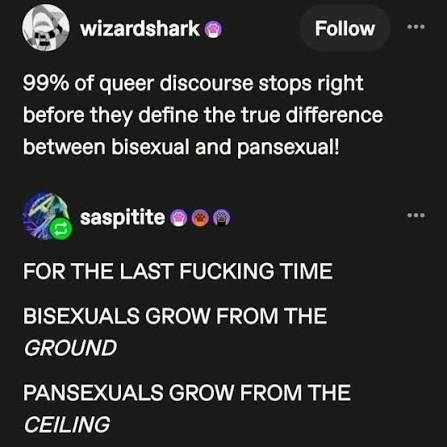
So what is the actual difference? It probably depends where you are and who you’re talking to. Womp womp.
There’s a joke/stereotype that many people who describe themselves as bi are attracted to one specific type of guy, and literally all women.
In my practical experience, people are more likely to identify as bisexual if they tend have a preference for certain gender presentations over others, and more likely to identify as pansexual if they are (closer to being) equally horny for all. Or if they have a preference for more pastel colours.
🤷♀️
[1] Even I believe, in my heart, that using the word nonplussed this way is wrong.
[2] Ha! I got the linguistic prescriptivists and the logicians with that one!
Both pan- and omni- mean all, but pan- is Greek and omni- is Latin.
Wiktionary’s definition of pansexual and omnisexual suggests that when people distinguish them, it is that pansexual implies everyone in a gender-blind way, and omnisexual implies everyone but differently for different genders.
pansexual, adjective: someone who is attracted to all types of people regardless of gender or sex
omnisexual, adjective: being attracted to all genders (sometimes distinguished from pansexual by saying omnisexual attraction may still take account of gender or prefer particular genders)
If we were going strictly by prefixes, then it would be:
bisexual - attracted two precisely two genders,
multisexual - attracted to two or more genders,
omnisexual - attracted to all genders (though possibly to varying degrees),
pansexual - mixes Greek and Latin and therefore doesn’t count as a real word. (/joke)

There are some transphobes and/or enbyphobes who will insist that bisexual means attraction to only two genders, and we all know why they’re doing that.
Others will say that bisexual means they based on the meaning of the prefix “bi-”. But that is the etymological fallacy. The current meaning of a word is not necessarily related to its etymological origin. Words change meaning literally all the time, and we should all be nonplussed about it by now [1].
In reality, words only mean what people generally understand them to mean [2]. Most dictionaries still retain, at least implicitly, a two definition, but most LGBT+ orgs and psychological associations and whatnot tend to define it as “more than one” gender, or similar.
Similarly, pansexual is generally defined as attraction to all genders or attraction being irrelevant of gender in the vast majority of places that care to declare a definition. But there are those who use it to mean the same thing as the latter definition of bisexual because they believe bisexual to mean the former definition of bisexual.
So what is the actual difference? It probably depends where you are and who you’re talking to. Womp womp.
There’s a joke/stereotype that many people who describe themselves as bi are attracted to one specific type of guy, and literally all women.
In my practical experience, people are more likely to identify as bisexual if they tend have a preference for certain gender presentations over others, and more likely to identify as pansexual if they are (closer to being) equally horny for all. Or if they have a preference for more pastel colours.
🤷♀️
[1] Even I believe, in my heart, that using the word nonplussed this way is wrong.
[2] Ha! I got the linguistic prescriptivists and the logicians with that one!
I always viewed it like bi- as in, one’s own gender + another (whatever group it may be).
Then there are pan- and omni-, and I thought pan- = one’s own + multiple but not all
while omni- = all of them
is that not the case then? til
Like the poster said that depends heavily on your communication circles.
Both pan- and omni- mean all, but pan- is Greek and omni- is Latin.
Wiktionary’s definition of pansexual and omnisexual suggests that when people distinguish them, it is that pansexual implies everyone in a gender-blind way, and omnisexual implies everyone but differently for different genders.
If we were going strictly by prefixes, then it would be:
So they’re synonymous?
Per my comment, it depends who you ask.
If you ask the Oxford English Dictionary, pansexuals are a subset of bisexuals.
If you ask Wiktionary, bisexuals and pansexuals are two non overlapping sets of people (though see the usage notes).
Well fair enough I’ll leave it at that seems like i get it wrong anytime i try to put it into my own words lol
I find the best thing to do when anyone uses either word is just nod politely and try not to wonder too much about precisely what they meant.