showing posts flaired Science — clear

0

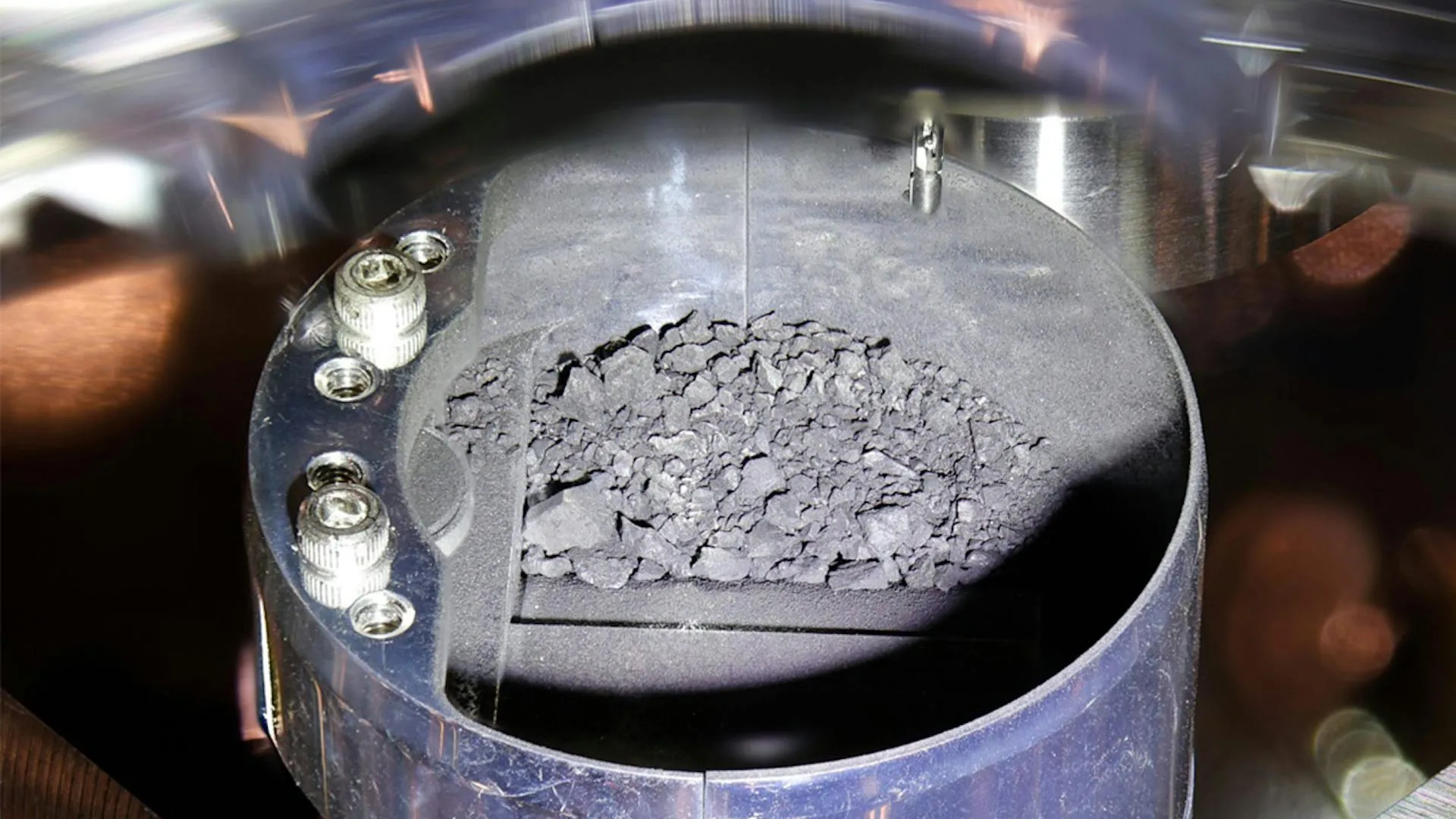
Scientists have found the complete set of all 5 DNA and RNA nucleobases on Asteroid Ryugu

ScienceDaily All 5 genetic “letters” of DNA and RNA discovered in a 4.5-billion-year-old asteroid www.sciencedaily.com
preview

tldr: five main nucleobases are adenine and guanine (known as purines), as well as cytosine, thymine and uracil (known as pyrimidines) on something older than earth

cross-posted from: https://sopuli.xyz/post/54208679

(it was posted to !space@mander.xyz which is a dead instance)
tldr: five main nucleobases are adenine and guanine (known as purines), as well as cytosine, thymine and uracil (known as pyrimidines) on something older than earth

cross-posted from: https://sopuli.xyz/post/54208679

(it was posted to !space@mander.xyz which is a dead instance)

0

Are we living inside a black hole? (it might explain some things!)

play · youtube.com
YouTube This Black Hole Could be Bigger Than The Universe www.youtube.com
preview

This is probably my favorite Kurzgesagt video, and as usual, 99% of the science is way over my head. I must also admit that this is one of those rare series (hello podcasts, love ya, but…) that uses a professional narrator to communicate. 🥳

Anyway, I like this set of hypotheses for ~three reasons–

1) The fundamental idea that the more massive a black hole is, the thinner it’s composite material, fascinates me. And that our own universe’s density of known matter matches very well against that idea. (our own universe, materially-speaking, is largely a soup of nothingness)

2) Suddenly the ‘multi-verse’ idea of parallel universes (a beloved sci-fi notion) gains legs, but in an adjusted way– that it ranges vertically so to speak, rather than horizontally. (and of course it could always be both, or neither!)

3) Simply put– hierarchy. We see hierarchy all across nature in the simple, direct sense of ‘there’s always something a little smaller, and always something a little larger.’ Or much smaller / larger. And that’s only in the dimension of physical size, of course.

Anyway, I’m quite sure we’ll never get to the bottom of this hypothesis before we asplode ourselves (as we’re already doing, thanks Billionaires!), but something about me really loves this idea.

0

A star so close to the Milky Way’s black hole it feels its spin

play · youtube.com
YouTube A star so close to the Milky Way’s black hole it feels its spin www.youtube.com
preview

From post:

We thought this was the closest star to the black hole at the centre of the Milky Way, turns out we were wrong! It’s actually this one, S301. It’s 2 billion times fainter than the brightest stars in the night sky, it comes closer to the black hole at the centre than Uranus does to the Sun, travelling at 25,000 km/s - that’s 8% of the speed of light!

But it’s not getting torn apart, or sucked in. It’s on a stable orbit. And that is really, really good news for us astrophysicists. Because with this star we should be able to directly measure how fast the Milky Way’s black hole is spinning for the first time.

Because: mass, spin, and charge, those are the only three properties that black holes have. And we’ve only ever directly measured one of them for the black hole at the centre of the Milky Way.

But all that is about to change…

But why do we even care about spin? Well that’s something we’re going to dive into in this video, along with how we measure black hole spin including directly through the Lense Thirring effect, and how this newly discovered star holds the key to doing just that.

Papers mentioned:
GRAVITY collaboration (2026) - https://arxiv.org/pdf/2607.12664
Beckmann et al. (2024) - https://arxiv.org/pdf/2211.13614
Fabian et al. (2002) - https://arxiv.org/pdf/astro-ph/0206095
Reynolds & Fabian (2007) - https://arxiv.org/pdf/0711.4158
Smethurst et al. (2019) - https://arxiv.org/pdf/1909.01355
Smethurst et al. (2021) - https://arxiv.org/pdf/2108.05361

00:00 - Introduction
01:32 - I - Why we care about black hole spin
05:31 - II - How we measure black hole spin and the Lense-Thirring effect
10:24 - III - The newly discovered S301, the closest star to the Milky Way’s black hole
15:44 - Bloopers

Video filmed on a Sony ⍺7 IV Video edited by Martino Gasparrini: martino.freelance@gmail.com
Video produced by Marina Hui & Dr Becky Smethurst