0

Potential project idea I want your feedback on: Fictional Lemmy threads that take place in my world?

preview

I have a science-fantasy world with intelligent non-anthro animals living in harmony, which I’ve posted some lore about this in the past. Think “communist non-anthro Zootopia with sci-fi technology.” This is something that I’ve been thinking about for a while and combines my interests in worldbuilding and software. I want to create a fictional social media platform for the animals in my world, and stage fictional threads in the typical Reddit/Lemmy format discussing news and politics taking place within the world. Then post screenshots here with context explaining what is happening. I just thought this might be a more fun way of sharing lore about my world than just the articles themselves, almost like an ARG. I’ll also be able to introduce some of my main narrative characters through their social media presence.

On the technical side of things, I don’t know if I want to compile and spin up a local Lemmy instance at home and actually stage accounts and posts on it. But actually logging in and out of different accounts sounds like way more work than necessary so I could also just take the Lemmy UI and add my own mock thread data to it. Or, I could write my own code for a completely fictional GUI, since I don’t want to just use the default Lemmy UI and break the illusion. The second and third options might be more important if I want to make this an actual ARG and host a website for it, since in that case I don’t actually want people to sign up and post.

I would love some feedback in general on this idea, and maybe gauge interest on if this is something people would like to see.

0

What is the worst dictatorship in your setting?

preview

Dictator-class Command Ship

The Dictator-class command ship is a unique and powerful vessel designed to serve as the flagship of the Diarcesian Mundana Forces naval fleet. Its trimaran hull design allows for greater stability and maneuverability, while its advanced technology and materials stakes its claim as one of the most formidable warships in the world.

The construction of each ship involves a complex process that utilizes cutting-edge materials such as carbon fiber composites and titanium alloys. The nature of these materials provides exceptional strength, durability, and resistance to damage from enemy attacks or harsh environmental conditions.

During trials, each new Dictator-class undergoes rigorous testing to ensure that all systems are functioning properly before being commissioned into active service. However, despite their advanced technology and superior construction quality compared with other classes in use by neighboring kingdoms’ navies like Sesbia’s Oceania-class and their steel alloy-based material, flaws may arise. For example, during operations, especially if battle damages are sustained, immediate repairs should be done once possible otherwise casualties will increase exponentially at sea battles between fleets since this class has no ability against heavy gun salvos.

This flaw was demonstrated with perhaps the worst Dictator (ship) in Diarcesia’s history. The DNS Tyrannus, which was involved in the Cutting of Kaisura during the opening stages of the North Ikuyo seccession crisis, suffered significant heavy gun damage from the secessionists who commandeered Gegonota cae Logica and also employed drones. The impact of this event brought shame and embarrassment to the Diarcesian Navy, as well as political consequences for those responsible for overseeing the ship’s design and construction.

Mervin, Monarch Diarcesian

Diarcesia’s worst dictator was Mervin, who ruled from 1857 to 1872. He was infamous for his brutal and oppressive rule, which led to the deaths of thousands of innocent people. His impact on Diarcesia was devastating, as he instilled fear and paranoia in the population while enriching himself at their expense in the form of expansionist wars in the name of spreading his Diarcesian Ideal (summarized as all the countries in the known world self-governing with the benevolent guidance and protection of the Diarcesian monarchy). His downfall started with his pyrrhic victory in the Siege of Puerto Rabo. The casualties incurred in that operation, in addition to the near-constant warfare for the greater part of the past century, pushed the war-weary Diarcesians to a tipping point.

In 1872, one of the largest protests in Arcesius’s history occurred demanding the Monarch to appear before them in person and address their grievances. Flanked by all of triarchs and separated from the protesters by soldiers, Monarch Diarcesian Mervin exited the Domus Arigotus. Instead of negotiating with the protesters, Mervin ordered the soldiers to have them dispersed by any means. Once the soldiers started shooting, two of the triarchs turned against Mervin and a 2 versus 2 fistfight started. This concluded when Triarchess Grere, an experienced pugilist, landed an uppercut on Mervin. Mervin toppled down the steps leading to the Domus’s entrance to his death. With Mervin dead and the other two triarchs barely conscious, Grere ordered the soldiers to cease fire and offered an olive branch to the Arcesian protesters. This lead to more democratic reforms that included the end of expansionist wars, many of the less-willing diereses—mostly overseas and a few in the mainland—seceding without incident, and converting the Fifth to Ninth nonarchs to elective positions.

One of the iconic moments of this event is the protesters’ mock salute of Mervin over his corpse.

0

Spaceships in an inside-out universe, and why it doesn't work (at least for me)

preview

First, a little background about my world. I like to think of it as an inside-out planet. A vast open space surrounded by earth on all sides, with a sun in the middle and everything interesting in the world on the inner surface. Much like Pryan from the Death Gate Cycle books, which inspired this shape.

The sun, Sore, is a while hole with a gravitational push. It generates light and heat, and stops the planet from collapsing in on itself.

Outside of the world is, as far as anyone knows, a lot of rock and not much else. But some time ago (no idea when, my notes aren’t dated) i wondered, if this place is an inside-out planet, could there be other planets? I don’t see why there couldn’t be.

Means of travel between these planets would have to be pretty different from normal space travel. Basic movement requires that you either break up the ground in front of you and move it behind your ship, or somehow lower the pressure around your ship enough to liquify rock without melting it to (or and) your ship, and let it slide past you (if i’m not totally misunderstanding phase transitions).

You can’t see through solid rock like you can through the vacuum of space, so you need snar (sonic navigation and ranging) to make sure you don’t hit another ship or something like the bottom of an ocean.

Gravity would grow weaker as you get further from a planet, then stronger from a different direction as you approach another. You need to be able to rotate the ship so the cabin isn’t suddenly upside-down, while keeping whatever digging implements are at the font of your ship facing the right way.

Ports for these ships would have to have snar beacons that ships could listen for, but these signals would have to be able to be heard over a long distance and not stop ships from hearing each other.

And of course, ships need to be able to move over land or in water, because the end and beginning of long trips won’t be through solid stone.

While writing this, i wondered for the first time why people would bother. I’m sure the planets are quite far apart, and you can only safely move so fast when your awareness of the things around your ship is so limited. Imagine trying to drive around at race car speeds at night with weak headlights. Space stations, underground areas big enough to seem like they’re above ground aside from the lack of sunlight, could exist, but you probably wouldn’t want people drilling tunnels around such a place. I certainly wouldn’t want to spend my life designing a small artificial world only to have the sky collapse on it and ruin everything. Trying to travel to another planet for the sake of finding other life sounds worthwhile to me, but i don’t see any way to detect these other planets at great range. You’d have to set off it an arbitrary direction and hope you hit something good soon.

So while my world could have space travel (for the closest thing to outer space it has), i’m not sure it realistically should. Maybe a similarly “inside-out” universe could have travel between worlds, but i don’t see it working for me.

0

Everything you need to know about catnip from the Feline Ministry of Health

preview

Context: This is a science-fantasy world with intelligent animals. I like to call it “communist non-anthro Zootopia.” Their governments are mostly divided by taxon, so you have the Feline Government, Rodent Government, Vulpine Government, Avian Government, etc. Even though specific taxa control different territories, like Feline Territory, Rodent Territory, etc, all taxa that have signed the peace treaty between predator and prey (an ideology called Unitism) can freely live in each other’s territories, where they’re still represented by their taxonomic government.

*Catnip is a really common recreational drug among Felines, and it is legal and regulated. A bottle of catnip oil (the most common form of the drug) would have a label like this:

WARNING: PRODUCT CONTAINS NEPETALACTONE (Catnip). HIGH CONCENTRATION: 60% nepetalactone by mass, sourced from cultivated herbs. Causes dissociation, euphoria, transient cognitive impairment in Felines. Do not use if underage, pregnant, nursing kittens, or with other psychoactive substances. It is illegal for Felines to operate hovercraft or other heavy machinery within three hours of consuming any catnip product. Consult a physician immediately if psychoactive effects last longer than one hour after discontinuation of usage, or if other side effects are experienced such as nausea and vomiting, convulsions, seizure, psychosis, or loss of consciousness. Regulated and licensed by the Feline Ministry of Health. Product license number: 100827615. For more information, visit health.feline.gov/catnip

If you go to the link listed on the label, you’ll get the following article:

Everything you need to know about Catnip, Silvervine, and Nepetalactone

Nepetalactone, the active chemical in the herbs Catnip and Silvervine, is the most common psychoactive drug among Felines, with a history that predates our evolution of sapience and long before recorded Feline history. The scent of Nepetalactone causes pleasurable dissociative effects in all Feline species, and is routinely used recreationally.

In colloquial language, the term “catnip” is broadly used to refer to any Nepetalactone product, including silvervine and synthetic Nepetalactone, but this article will refer to these substances separately.

Where does Nepetalactone come from?

There are three major sources of Nepetalactone: Wild herbs, cultivated herbs, and synthetic, all of which are regulated by the Feline Ministry of Health.

The pastime of sniffing out wild catnip and silvervine growing in the forest is theorized to be as old as the Feline taxon itself, and continues to this day. Occasionally, a cat who finds and rolls around in a wild catnip or silvervine patch will get seeds stuck to their pelt, and plays a role in propagating the species when the seeds fall off far away from the plant as the cat travels. Wild herbs are the mildest source of Nepetalactone, producing only a short high of moderate intensity. However, they are also the safest source, with the lowest risk of side effects, long term health complications, or overdose. Wild Nepetalactone herbs can be found throughout Feline Territory and the rest of the the world. In Feline Territory specifically, the propagation of catnip and silvervine was done mostly inadvertently by Felines consuming them recreationally, and genetic lineage analysis of these herbs have been used to track the migration of Feline populations and crosscheck our earliest written history.

As technology advanced, Felines began to cultivate catnip and silvervine, intentionally planting them where they live and selectively breeding them for Nepetalactone production and psychoactive effects. The boundary between wild and cultivated herbs are not well defined, as gene transfer regularly occurs between them, but in general, cultivated herbs produce a much higher concentration of Nepetalactone, as well as other chemicals that enhance or modify the psychoactive feeling they give. Catnip and silvervine seeds of many different lineages are sold commercially, each with slightly different psychoactive effects, and cultivation efforts range from a few plants in a garden or as potted plants in a den, to large scale vertical farms that grow herbs for industrial Nepetalactone oil production.

In the last decade, after the Feline Revolution and subsequent legalization of Nepetalactone, direct synthesis of the chemical from basic elements have been rising in popularity. As is the development of synthetic Neperalactoids, which are modifications to the natural chemical structure to produce artificial psychoactive compounds not found in nature. These sources of Nepetalactone and its artificial analogues have the highest risk compared to herbal sources (though the overall risk is still fairly low). They are typically the most concentrated products on the market, with many being nearly pure Nepetalactone, and not diluted by any of the side products typically found in herbal oils that can serve to balance or moderate the psychoactive effects. Additionally, artificial Nepetalactoids can interact with the body in unexpected ways and may cause serious health effects, especially if used long term. Or they might not have very significant health effects at all. These newly developed chemicals, by definition, have limited or nonexistant animal testing data, so a cat that consumes these products is implicitly participating in their long term health and safety testing. This is a risk that an adult cat has the right to choose to take, but the risks of damage to one’s health must be carefully considered and kept in mind.

Mechanism of Action

Nepetalactone targets a Feline’s pheromone receptors, organs typically used for scent communication between animals. The vast majority of animals produce pheromones, which are a combination of volatile organic chemicals unique to the individual animal. In terrestrial ecosystems, these chemicals evaporate from the animal’s body and are left behind when the animal makes contact with a surface, and are used to identify the animal. Pheramones give important information about who is nearby and who has been here in the past. Nepetalactone binds much more strongly to these pheromone receptors than natural pheromones, temporarily disabling regulatory mechanisms and feedback loops, which causes a massive overproduction of neurotransmitters that overstimulate the brain, which causes the characteristic “high” that it is known for. These effects last for as long as the Nepetalactone exposure persists, though the pheromone receptors will eventually run out of precursor chemicals for synthesizing neurotransmitters, at which point the psychoactive effects will subside while the receptors recover.

Even after discontinuing exposure to Nepetalactone, the psychoactive effects may last for up to an hour, as it takes some time for the existing Nepetalactone molecules to unbind from the receptors, and for the brain to clear the flood of neurotransmitters.

History of Nepetalactone legality in Feline Territory

For the vast majority of Feline history, Nepetalactone was completely unregulated by the law. It was an important cultural element, used during social gatherings, cultural ceremonies, and even some religious rituals.

It was only during the age of the Feline Empire that Nepetalactone was outlawed. During this time, cultivation, distribution, and use of the substance in any form, even naturally growing plants in the wild, was criminalized with mandatory prison time. Even so, Nepetalactone use continued to be very common in Feline Territory. This was also the time when the empire enforced hunting and predation as a way of life despite the vast majority of Felines having become heavily anti-predation, and all plant based alternative foods were banned. As such, Nepetalactone was frequently sold by the same underground networks that sold plant based foods, leading to Nepetalactone becoming one of the symbols of the Feline Revolution and the Unitist (anti-predation) movement in Feline Territory.

After the Feline Revolution, Nepetalactone was legalized by the newly formed Feline Democratic Republic, and has been regulated by the Feline Ministry of Health as a Class 1 (the lowest risk category) recreational drug ever since. Currently, the only legislation restricting Nepetalactone is a prohibition on sale of the substance to kittens, and a prohibition on operating heavy machinery or performing any safety critical task while under the influence of the substance.

There is no recorded evidence that other taxonomic territories and taxonomic governments have ever prohibited Nepetalactone, as it only causes psychoactive effects in Felines. Nepetalactone is regularly produced and sold in other territories, and we work closely with other Unitist ministries of health to ensure the safety of these products.

Can Nepetalactone cause loss of instinct control?

There is a myth that Nepetalactone can cause Felines to “revert” to our natural instincts and pose a danger to nearby small animals. This is not true, or at least, extremely unlikely to the point where we have never encountered a confirmed case of this occurring. Numerous studies have been done on the Feline brain under the influence of Nepetalactone, including live brain scans of Felines while using the substance, and there has never been evidence that the cat’s mind if at any risk of losing its conscious faculties.

Any Feline who has used Nepetalactone can also subjectively attest to this: While it can reduce your reaction time or make you forgetful, you are still in full control of your faculties. Additionally, Nepetalactone makes Felines less likely to want to engage in physical exertion, as while it is a stimulant at the neuron level, it overloads the brain and makes it less able to respond to external stimulus. A Feline under the influence of Nepetalactone is much more likely to idly stare at a mouse than try to chase them.

Finally, many Felines live in Rodent and Avian Territories, and Nepetalactone is sold there, regulated by their ministries of health. We consult with their ministries regularly and freely share medical data, and there has never been a concern raised about Felines under the influence of Nepetalactone being a hazard.

Nepetalactone-induced psychosis

At extremely high doses, particularly when consuming synthetic Nepetalactone, hallucinations of various forms may manifest, ranging from a blooming haze at the edges of one’s vision, to flashes of colour or bright dots racing across one’s field of view, to lifelike visual and auditory artifacts that are difficult to distinguish from reality. This is called Nepetalactone-induced psychosis, or NIP.

This is generally considered a negative side effect, and lifelike hallucinations are one of the symptoms of Nepetalactone overdose. However, some Felines, namely heavy Nepetalactone users, actively seek the psychedelic effects that Nepetalactone can cause, inducing what is often described as a lucid dream state, where one can mentally control the artifacts they see and hear. In most such cases, the Feline is in a state of partial sedation, and is generally not able to move or interact with the real world, though vital bodily functions like breathing and heartbeat are not affected. NIP typically resolves by itself once the pheromone receptors become saturated and stop responding to the Nepetalactone.

If NIP is encountered and is not desired, discontinuing exposure to Nepetalactone will quickly dissipate any visual and auditory artifacts. Physically moving oneself away from the source of Nepetalactone to a place with fresh air is recommended to help the effects subside more rapidly.

If you encounter a Feline under the influence of Nepetalactone and is non-responsive, remove the source of Nepetalactone and/or move them to fresh air. If they do not regain consciousness within a few minutes of the end of exposure, call emergency services.

Health and safety

The long term physical health effects of herbal Nepetalactone is generally low, even for heavy or frequent use. However, synthetic Nepetalactone, particularly Nepetalactoids not found in nature, have limited long term health data, and caution is strongly advised when using these products.

While Nepetalactone is generally considered low risk, the following conditions have been known to occur:

  • Nepetalactone-induced psychosis: see the previous section.

  • Scent blindness: Because Nepetalactone activates pheromone receptors much more strongly than natural pheromones, long term use can reduce the sensitivity of these receptors, making it difficult to detect pheromones and generally resulting in a reduced sense of smell.

  • Nepetalactone withdrawal syndrome: If a Feline who chronically uses high doses of Nepetalactone suddenly discontinues usage, there can be mild withdrawal symptoms, such as depression, boredom, loss of interest in daily activities, and a strong urge to continue using Nepetalactone. These effects usually subside after a few days of abstaining from Nepetalactone.

However, by far the biggest health and safety risk associated with Nepetalactone is when Felines operate heavy machinery like hovercrafts, or engage in other safety critical tasks that require their full attention, while under its influence. Nepetalactone reduces reaction time and short term memory, and makes one more easily distracted. This can endanger or kill other animals as well as the user themselves, and is explicitly illegal. Always wait a minimum of three hours after using Nepetalactone before doing anything safety critical.

Should I use (or keep using) Nepetalactone?

A Feline’s relationship with Nepetalactone is critical, and it is generally unhealthy to use it as a coping mechanism. If you find yourself using Nepetalactone habitually, try to discern why. Boredom is the most commonly stated reason for Nepetalactone use, but a more healthy way to deal with that is to find productive activities that are personally fulfulling to you, not try to eliminate the feeling of boredom with psychoactive substances. Additionally, it is not recommended to self-medicate with Nepetalactone to treat conditions like depression or anxiety. A doctor may prescribe Nepetalactone for some mental health conditions, but such substances can also make the condition worse, and the decision to use it to treat mental health issues must be in consultation with a professional for the best chance of success.

This is a complex issue and heavily depends on the individual. If you require advice on your relationship with Nepetalactone, or you need help breaking a Nepetalactone habit, the Feline Ministry of Health offers counselling and treatment as part of its universal healthcare plan.

0

DispatchToElsewhere: A security vulnerability in my world

preview

Context: This is a science-fantasy world with intelligent non-anthro animals living in harmony. Think Zootopia but with regular animal shaped animals that are also quite a bit more technologically advanced. One of their main forms of transportation is the hovercraft; which is used both for local urban transportation, hopping from point to point within their lush forest cities; as well as long haul and intercity transport. These hovercrafts employ a high degree of automation, and air traffic control is generally done not with radio calls back and fourth between the pilot and controller like in our aviation network, but by having the hovercraft connect directly to a dispatch server to receive instructions, which are then displayed to the pilot. This makes the aviation network more efficient as a central air traffic control node can precisely coordinate hovercraft movements to make the most use out of the infrastructure. However, due to their reliance on the computerized system, a security vulnerability in said system would be disastrous.

The following is an article from the Feline Ministry of Security, detailing a recently patched 0-day vulnerability found in an air traffic control protocol used the Feline hovercraft network. Imagine a bunch of developers who are literal cats scrambling to fix this issue the instant it was discovered before someone hacks their hovercraft network and starts remotely taking control of their hovercrafts to crash into trees that have buildings in them, crash into flocks of birds, and other woodland creature acts of terrorism.

CVE109-10028FL: DispatchToElsewhere, a memory corruption vulnerability in FDTMS resulting in remote code execution on Feline Ministry of Transportation hovercrafts

This article pertains to the public disclosure of a now patched security vulnerability in the aircraft-side implementation of Flight Dispatch and Traffic Management System (FDTMS) developed by the Feline Ministry of Transportation (FMT). This vulnerability affected all hovercrafts operated by the Feline Ministry of Transportation, and resulted in arbitrary code execution in the primary flight computers of FMT hovercrafts.

The Flight Dispatch and Traffic Management System is an air traffic control protocol that allows advanced coordination of hovercraft operations within Feline Territory. The codebase for the system is extensive, but for this article, we will only focus on the problem component: the buildDispatchTable function which is responsible for parsing a digital flight plan into a table of procedures that the onboard computer will follow during the flight.

When a flight plan is transmitted to the hovercraft, buildDispatchTable is invoked. As its name suggests, it parses the flight plan data to construct an Dispatch Table in the onboard computer’s memory, which contains navigation information that is to be followed during the flight. A typical dispatch table is shown below for a flight between Moonpeak Airport (MPK) in Feline Territory to Central Valley Airport (CVY) in the Unified Territories. The fact that this fight crosses a territorial boundary is relevant to the vulnerability.

EntryID EntryType Name SetAttributes Location EstimatedTime
0 DispatchStart FMT1002 flightID=FMT1002; radioID=FMT1002; origin=MPK; originLandingPadID=2; dest=CVY; startingTerritory=FelineTerritory; startingRegion=MoonDistrict; atcServerURL=fdtms://transportation.feline.gov/…/MoonDistrict; serviceType=Commuter (-130.993234, -47.997826) 12:00:00
1 FlightStart MPKL2 departureCorridorID=39; speed=100 (-130.993234, -47.997826) 12:00:00
2 WayPoint/DepartureCorridorExitPoint MPK927 heading=305.1; speed=300; alt=1000 (-131.017368, -47.997826) 12:02:00
3 RegionChange AlderDistrict atcServerURL=fdtms://…feline.gov/…/AlderDistrict (-130.994368, -47.997826) 12:19:13
4 WayPoint ALD103 heading=305.1; speed=1000; alt=1700 (-129.083812, -47.997826) 12:21:02
5 TerritoryChange UnifiedTerritories/FeatherDistrict atcServerURL=fdtms://transportation.ut.gov/…/FeatherDistrict (-131.001929, -48.725192) 12:45:51
6 WayPoint FET972 heading=307.9; speed=1000; alt=1700 (124.138493, -47.997826) 13:00:05
7 RegionChange CommonDistrict atcServerURL=fdtms://transportation.ut.gov/…/CommonDistrict (-122.904928, -46.203840) 13:37:19
8 Waypoint/ApproachCorridorEntryPoint CVY671 approachTo=CVY; requestApproachCorridorID=81; requestLandingPadID=9; defaultAction=HoverInPlace/Wait; triggerNextEntry=OnAtcAuthorization (-122.301937, -44.927394) 13:41:32
9 ApproachStart CVYL9 approachCorridor=81; targetLandingPad=9 (-122.904928, -46.203840) 13:45:00
10 ApproachEnd CVYL9 (-122.804221, -46.103840) 13:50:00
11 FlightEnd FMT1002 (-122.804221, -46.103840) 13:50:00
11 DispatchEnd FMT1002 clear all (-122.804221, -46.103840) 13:50:00

As shown in the table, when the hovercraft crosses an internal boundary within a given territory, a RegionChange entry is used. However, when the hovercraft crosses a territorial region, which also necessitates a region change, the standard prescribes that only the TerritoryChange entry is needed, and the region name included within it. However, it is also possible to omit the region name in the TerritoryChange entry, and separately issue a RegionChange.

The buildDispatchTable function did not take into account the possibility of a region change being separately supplied in the case of a territory change in the way it calculated the table size and therefore how much memory to allocate for the construction of the table. Therefore, a malicious dispatch message could be crafted to overflow the table and inject machine code into memory. An outside actor spoofing radio signals on government frequencies can send a malicious dispatch message to any hovercraft in range, and because the dispatch table is constructed before the cryptographic keys of the dispatch message is checked, remote code execution can be achieved by anyone, as the exploit is accessible before the authenticity of the message is verified. A pilot would only see a “Dispatch rejected due to key error” message, at which point the exploit has already gone through. Additionally, the onboard computer will simply discard the malicious dispatch table and reload the previous valid dispatch table upon failing to verify its authenticity, effectively deleting evidence of the exploit’s entry point.

The implications of this vulnerability is severe, as an attacker can gain remote control of the hovercraft and its flight control systems, and can issue malicious commands with fatal results. Moreover, the possibility of a Feline hovercraft being used to commit acts of terrorism in another territory significantly raises the urgency of this issue.

Exploit proof of concept

The Feline Ministry of Security is not aware of any live attacks using this vulnerability. However, we have verified that the following proof of concept could result in remote code execution. By hiding the payload in a malformed ATC server URL, we were able to send machine code to all the Feline hovercrafts we tested, running WhiskerOS versions 1.0 to 3.3 (the latest version) and FDTMS Client 5.1 or lower.

EntryID EntryType Name SetAttributes Location EstimatedTime
0 DispatchStart FMT1002 onError=LoadPreviousDispatch; atcServerURL=fdtms://null (-130.993234, -47.997826) 12:00:00
1 TerritoryChange UnifiedTerritories atcServerURL=fdtms://null (-131.001929, -48.725192) 12:00:00
2 RegionChange FeatherDistrict atcServerURL=fdtms://AAAAAAAAAAAAAAAAAAAAAAAAAAAAAAAAAAAAAAAAA…[Malicious Code Goes Here] (-131.001929, -48.725192) 12:00:00

Due to its need to directly interface with the hovercraft’s engines and flight controls protected by WhiskerOS Secure Mode, FDTMS executes in a privileged context, meaning any code execution in the software is able to bypass Secure Mode sandboxing and take direct control of the hardware. There is no way to secure the flight control computer once it has received a malicious dispatch message outside of turning it off and back on, which obviously cannot be done in flight. If the malicious payload includes a way to persist on the local storage device, the flight computer would need to be removed from the aircraft and have the entire system wiped and reinstalled in order to restore secure operation.

Response

All hovercrafts operated by the Feline Ministry of Transportation was grounded until their flight computer software was updated to fix the vulnerability. Hovercrafts already in flight were ordered to land immediately on the nearest available pad. The vulnerability has now been patched for the entire FMT fleet.

Root Cause Analysis:

The following issues were identified as contributors to the existence of this vulnerability:

  1. Attempting to parse received data before checking cryptographic keys. In the future, no operations on received data should be performed before its origin and integrity are verified.

  2. Failing silently on a malformed dispatch message. If a hovercraft receives an invalid dispatch message, it should not automatically revert to the last valid state and report as ready for dispatch. Pilot and/or ATC intervention should be required to clear the error and the hovercraft should be inhibited from dispatch until such an action is taken. This would give aviation staff a chance to detect the attack before the hovercraft takes off.

  3. The dispatch message parser being more tolerant of malformed dispatch tables than necessary. If the standard prescribes that a region change and territory change should be a single entry, the parser should not accept separate entries.

  4. Executing more code in a privileged context than necessary, bypassing WhiskerOS Secure Mode. Only the modules that require system/hardware access should be given such privileges, not the entire FDTMS software suite. For example, the dispatch message parser does not need to be privileged.

0

What are some terrible takes in your world?

preview

Are there people in your world that just don’t get it, and keep spouting opinions that make no sense given the context of your world or would be disastrous if actually implemented? What are some of the most common bad takes in your world and what makes them so bad?

Are there people in your world that just don’t get it, and keep spouting opinions that make no sense given the context of your world or would be disastrous if actually implemented? What are some of the most common bad takes in your world and what makes them so bad?

0

What is difference between monster and animal?

preview

Are monsters inherently malicious to humans? Are they “unnatural” in some way (undead, extradimensional etc)? Or are monsters just more dangerous and powerful animals?

Are monsters inherently malicious to humans? Are they “unnatural” in some way (undead, extradimensional etc)? Or are monsters just more dangerous and powerful animals?

0

Pros and Cons of AI in Worldbuilding

preview

In your opinion, what are the advantages and disadvantages of using it? Here’s mine:

Pro: Using a reasoning model, I can feed my notes and allow the LLM detect patterns I otherwise might have missed.

Con: Consistently using AI outputs as-is could make your project formulaic and generic—something you don’t want if you want a certain facet of your lore to stand out.

0

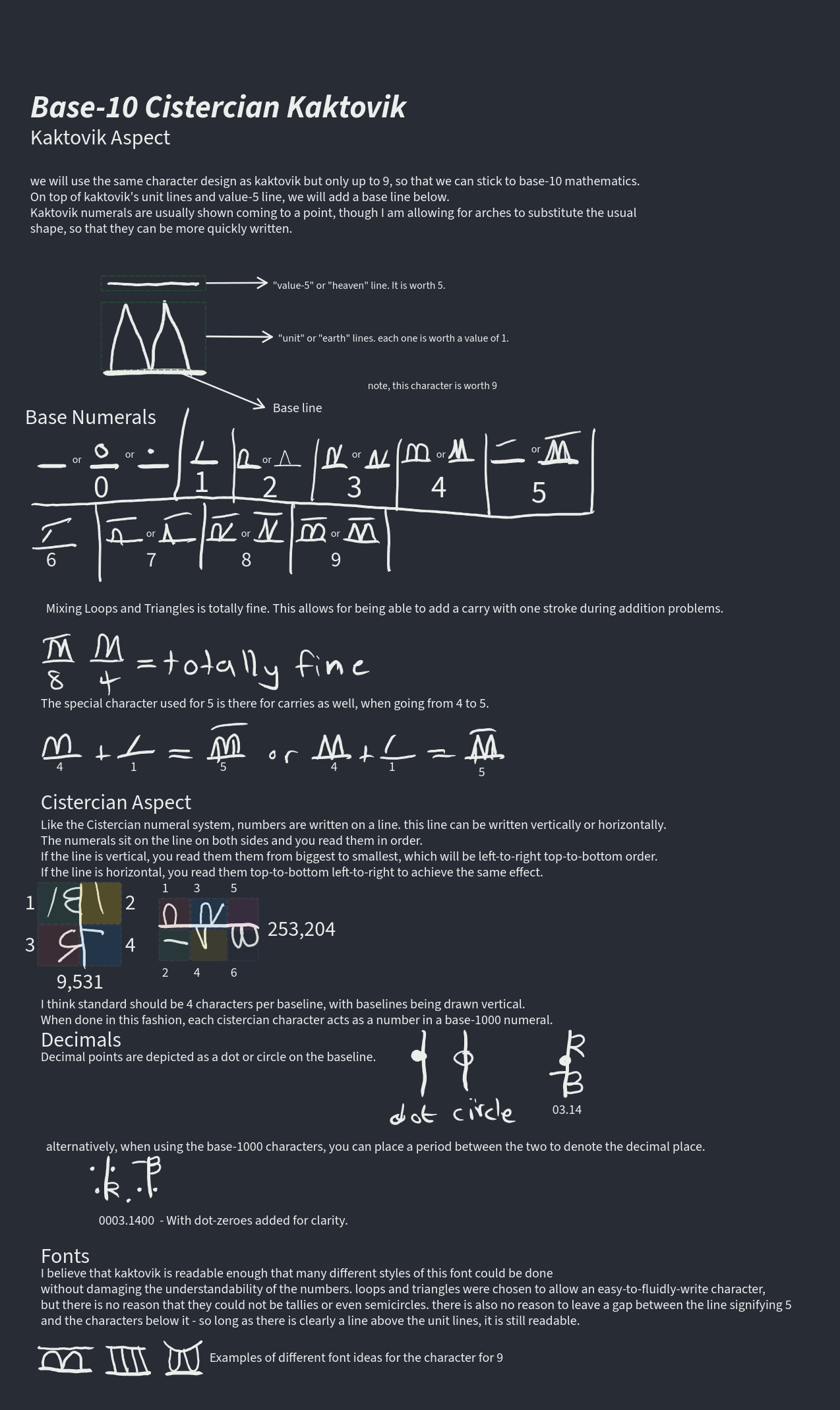
Thought up a fusion between Kaktovik and Cistercian Numerals, thought I'd share

preview

I kind of had this epiphany while talking with some friends about different interesting numeral systems and their various advantages and disadvantages. I ended up thinking this system up while I was in the shower, went back to my desk and knocked it out in an hour or so. It takes aspects of the Kaktovik numeral system invented by the Inupiaq tribe, and combines them with some aspects of the Cistercian numerals.

I think that this numeral system fusion can look very wizard-y, and be easy to write and do math with.

I’ve abbreviated it as b10CK, which I think is pretty clean.

0

MIKE DEAN Continues His Incredibly Trippy World Building With "424" LP & Short Film

HotNewHipHop MIKE DEAN Continues His Incredibly Trippy World Building With "424" LP & Short Film www.hotnewhiphop.com
preview

Context: For fictional worlds set in a present-day analogue, popular music songs and genres paint a picture on what your society values. Those facets bleed into the content of the lyrics, genres, and even the very beats themselves

Context: For fictional worlds set in a present-day analogue, popular music songs and genres paint a picture on what your society values. Those facets bleed into the content of the lyrics, genres, and even the very beats themselves

0

Twisted Gods - few concepts for an inspiration

preview

(This text was written with RPG in mind, but I hope it can be interesting outside of this context. I invite You to read and discuss. And if You have Your own “twisted gods”, feel free to share here).

In RPG and fantasy, we are often faced with a situation where the existence of gods is an empirically confirmed fact, rather than a matter of belief. Two extremes can be distinguished in the representation of these entities (note – I do not claim that all creation adopts one of these two extreme points of view). On the one hand – the trend adapted by e.g. most of the settings for D&D – gods are personification of certain values professed by people, not infrequently they are even „born” from the faith of mortals or at least derive power from it/are shaped by it – gods described as „good” are simply good in the conventional sense of the word, they sincerely care about their followers and you know what to expect from them. On the other side, we have motifs that can be considered taken from Lovecraft’s Cthulhu mythology – the gods are incomprehensible, distant beings, completely unconcerned with human worldviews and so-called „good and evil”, mostly indifferent to humanity (and if by chance their paths intersect with humanit’s ones, humanity is screwed) – at the same time, it is not uncommon for most mortals to be unaware of their existence, instead worshipping imaginary, more anthropomorphic deities tailored to their emotional needs.

In this article, I wanted to present deities standing somewhere in the middle – entities whose goals, yes, are not fully understood by mortals, but nevertheless close enough to human morality that worshippers can find some commonality (real or imaginary) with their patrons. These gods are usually directly interested in some way in the lives of their worshipers – although not necessarily in the way those worshipers would like. At the same time, I wanted each description to contain a hook, an important point where the devotees’ understanding of the deity diverges from its real nature – and whose discovery could be a significant twist.

Mother of Peace

The Religion of the Mother of Peace, or the Cult of Harmony, is a strictly pacifist religion. Strictly and absolutely. No violence is allowed, ever, anywhere, in any situation. If you see a psychopath murdering children with an axe, you have no right to use force to prevent him from doing so. You cannot stun him, disarm him, knock him over, or even grab his arm. At most, you can ask him to stop, try to distract him, or stand up to the blow to give the children a chance to escape. Why do people follow such religion? First, the philosophy appeals to some – in the real world, Gandhi said something like „applying the eye-for-an-eye principle will make everyone blind.” – Followers of Harmony believe that violence begets violence, while peace begets peace. If they consistently turn the other cheek and don’t resist evil, they will stop winding up the spiral of violence and constant revenge and eventually evil will disappear naturally. Second – following the path of Harmony brings concrete benefits. Holy priests, who have long been non-violent, receive healing powers from the Mother of Peace – but they only work on other followers, so the policy of „I do violence, and the pacifist priest of Harmony heals me” is impossible. To use healing, you need to sincerely renounce violence – which, on the one hand, reduces your chances of survival in an encounter with hostile beings, on the other – if you come out of it alive, all your wounds will be healed, plus you gain protection from natural diseases and other threats. Third – the priests of Harmony preach that those who live and die, observing the principle of non-violence, will be taken into the bosom of the Mother of Peace after death, who will give them happiness incomparable to earthly suffering – so it is „profitable” to trade your life in exchange for heavenly pleasures.

The religion of the Mother of Peace may be perceived differently in society. It is possible that the authorities are avtively against it – it makes the subjects unwilling to fight, which reflects on the combat power of the state. Or perhaps they support it, seeing it as a tool to pacify potential rebels? Ordinary people may regard the Children of Peace as annoying lunatics – or treat them with deep respect. Even if healing powers may not work on „infidels,” after all, the Children may be able to help them in other ways – such as using conventional medicine (while remarking „Join us and you’ll see real miracles!”).

Well, what is the catch? Yes, the Mother of Peace actually exists. But her goal is by no means to create a utopia where people can live in happiness and peace. Her goal is to weaken the population of a given world/planet/country. When a sufficient portion of the population is transformed into followers of Harmony, for whom the use of violence – even for defense – is unthinkable, and even if it were thinkable, they would became too weak to use it, the time for reaping comes. The True Children of the Mother, hordes of bloodthirsty, voracious creatures, come out to prey and consume the pacified people. The devoured people continue to make prayers to the Mother, who continues to appear from time to time, assuring her followers that this is the final test and whoever perseveres without putting up a fight against the monstrous invaders will be saved.

During the course of the game, players may encounter followers of Harmony. It would be good for the GM to present them as something more than detached hippies, to make the players start to wonder if they are right. Maybe they’ll come across a reformed bad guy – e.g., a psychopathic follower of the god of murder who massacred a village of Harmonious heretics, but their indomitable will and serenity in the face of death made him convert and join them? Or more life-like – a husband who stopped beating his wife and children and is now an exemplary head of the family? Players can act as defenders of persecuted Harmonists (although this will involve some ambiguity – „Harmonists are decent people, but without people like us, who are not afraid to get their hands dirty, thay would survive”). They can have discussions with the priests about the legitimacy of pacifism. Maybe one of the player characters will start thinking about becoming a Harmonist after his career as an adventurer ends? The more sympathetic players become to the cult of Harmony, the more shocked they will be to discover indications that the Mother of Peace may be a much darker entity than it appears. At first, they may trivialize rumors like „Harmonists are actually a fifth column preparing the world for an invasion by dark forces!” as typical denigration of the new religion by the old clerical establishment. But as time goes by, the evidence will become stronger and stronger… Until finally there will be an invasion of the True Children that the players will have to face. Or maybe they will have the chance to prevent it, and will face the dilemma „Whether to believe the critics of the Harmonists and obstruct the great ritual, which, according to the Harmonists, is supposed to help bring universal happiness, but in fact open the gates of the dark dimensions…. Given that in order to do so, we will have to massacre a crowd of unarmed civilians, including women and children?”

The Mother of Peace is portrayed by her followers as a goddess with, one can easily guess, maternal qualities. Perhaps even as a pregnant woman? This is a play on the ambiguous nature of this entity – the presumed spiritual mother-protector of the followers of Harmony, and the actual fecundator of the swarm that will consume them. Players may come across disturbing references to „the coming of the True Mother’s Children” in sermons and hymns – priests may (sincerely or not) explain that it’s such a metaphor, that it’s about the era when people truly dedicated to peace will come.

Enemy of Superstition, Destroyer of Magic, Defender of Normalcy

There are many arguments that are made against magic. It is source of obscurantism, superstition and charlatanism, a way to fool people. It violates the natural order of things. It is the work of demons, leading to possession or by destroying the veil of the worlds to demonic invasion. It is the theft of the power due to the gods, a manifestation of human pride. It distracts people from giving honor due to these gods. It brings madness, sucks the life out of the environment, causes the risk of explosions or other side effects. Leads to inequality, as mages can exalt themselves over ordinary people. Or something.

Depending on the setting, each of these accusations may or may not be true. But that doesn’t stop the Defender cult from preaching them. Inquisitors and witch hunters roam the world, collecting magical artifacts, books and even arresting anyone who manifests magical talents. No, they don’t burn them at the stake. All items and people associated with magic go to the Bottomless Wells located in temples – supposedly the only way to effectively annihilate them. Importantly, the hunters are ordered to take mages alive if possible and throw them into the wells – supposedly a mage eliminated in the wrong way turns into a wraith, or something like that. Inquisitors are aided in this work by the magic-blocking powers provided by the Defender.

Witch hunters can be treated by the people as terrifying villains – or as heroes. The reason for the latter attitude is not necessarily solely propaganda and „fear of otherness.” It is possible that the land has actually suffered a lot at the hands of mages – perhaps it has just liberated itself from the rule of an evil sorcerer and his disciples, or it is fighting a fierce battle against a nation that uses magic in a fierce way. It would be worthwhile for players to see some of the negative effects of magic use with their own eyes, so that at the very least they would develop doubts about whether the Defender’s followers are wrong.

What is the truth? It’s easy to guess that the Defender is not concerned with defending the innocent from witchcraft. But neither is he driven by any other selfish yet high-minded motivations along the lines of „magic takes the glory away from the gods.” The truth is that for the „Defender,” magic is just darn tasty. Bottomless Wells are portals leading directly to his insatiable maw. It’s possible that the founder of the Inquisition managed by some miracle to communicate with this entity and make a pact „I will provide you with food, you will lend me and my disciples your anti-magic powers, which you use to safely digest objects radiating magic – and we will use them to incapacitate mages.”

What will happen when the players reveal the truth about the Defender? Maybe the inquisitors will be furious that their holy crusade turned out to be nothing more than feeding an inter-dimensional monster, they will turn their backs on their god, to which he will react with rage (not because of his violated dignity or some other irrelevant value, but because of the vision of being cut off from a steady supply of grub), through one of the wells he will enter the world and the players, along with the inquisitors, will have to face him? Or maybe the inquisitors will react with a shrug of the shoulders and the statement „So what if the Defender is not a noble god, but a voracious monster. Magic is still a threat, and he is the best means to eliminate it.” Perhaps, using the method of the cobbler Skuba (Polish legend), players will toss a special object emanating „toxic”‚ magic into one of the Wells, which will poison the Defender?

Truthsayer

God of the truth, the whole truth and nothing but the truth. People swear by his name. He is also worshipped as the god of justice and knowledge, so judges and scholars worship him. Lying brings his curse.

The Truthsayer doesn’t lie about himself – in fact, he wouldn’t be able to even if he wanted to (and he definitely doesn’t want to). The problem is that the people themselves have sung too much about him. As I pointed out above – he is the god of truth and ONLY truth. Justice does not matter to him, it is a totally foreign concept to him…. If he helps the investigators uncover the machinations of the villains, it is only so that the truth will come out, but he does not care whether the result will be the administration of justice. He might as well help the villains discover the heroes’ forays and subterfuges. As for acquiring knowledge – yes, he assists scholars in their research, in order to reveal the truth. However, if a scholar spins unsubstantiated speculations and hypotheses (which happen to be contrary to the truth), even in good faith – he draws the wrath of the Truthsayer. Simply put, untruths make the Truthsayer suffer. This applies to any untruth. Also fantasy. If the Truthsayer’s followers perform a ritual to increase his presence in the material world, they will bring a terrible calamity. From now on, the curse will fall on actors and poets, on anyone who utters a harmless lie like „You don’t look fat in that clothes,” „I’m not mad at you,” or „I’m on my way out,” as well as anyone who uses deception (no, the Truthsayer doesn’t care about the nobility of the cause – if you put on camouflage to sneak under the headquarters of the bad guys and rescue their innocent hostages, you are a hideous LIAR and deserve to be punished). Bah, people in ordinary conversations must be careful not to use metaphors and phraseological compounds. A Truthsayer may even go so far as to seek to eliminate words like „nice,” „tasty” or „good” – after all, they are subjective, and what is not objective truth, is a LIE.

Good player characters can help prepare a ritual to summon the avatar of the Truthsayer – after all, „God of Truth” sounds like a decidedly good dude, right? At some stage, they may realize that the world of absolute truth will be something terrible (maybe some conversation with a philosopher?) and try to torpedo the ritual. Maybe they will be able to accomplish this in advance… Or maybe the avatar will already begin to pass into our world? Then they will succeed in playing him off by pointing out the paradox – people summoned him because they believed he was the avatar of goodness, justice and knowledge – if he exploits this ignorance of theirs, he will benefit from lying, and this would be unacceptable. Or a character with an exceptionally high bluffing skill or the like might try to spew a tale so full of lies and absurdities that the avatar of Truth will go berserk just from listening – but a half-hearted success will only enrage him!

For the Truthsayer, as an antithesis, I would see a god of lies and fantasy – not the typical sinister „Prince of Lies” in the style of the Christian Satan, or some malicious trickster, but a deity whose motto is „Such is the world! A wicked world! Why is there no other world?” (B. Lesmian) or „Be guided in life by such foma (harmless lying) as will give you courage, goodness, health and happiness” (K. Vonnegut), who lies not for some selfish purposes, but because he firmly believes that lying IS GOOD. The real world is cruel and unfair, lying helps to endure it and achieve at least a little happiness – through escapist fantasies, small daily lies „From tomorrow I will take charge of myself and achieve something!” „You look nice”, „Don’t worry, you’re not a failure at all” through big lies like „Good is always rewarded and evil is punished”. In this arrangement, both the god of lies and the god of truth would be morally neutral in practice (both can assist followers in certain situations, but at the same time pose a danger – the god of truth mercilessly punishes anything that is not the absolute truth, the god of lies can entangle you in a web of delusion) – but in theory, it is the liar who is driven by more altruistic motivations and loves mortals.

Prince of Blades, Lord of Sharp Angles and Edges

Centuries ago, the Prince of Blades was worshipped as a deity of war, or even slaughter. Legends say that he made the claws of his worshippers – and even their teeth and nails – exceptionally sharp and dangerous to enemies. And the legend is true – albeit the Prince was never a god of war. He is the personification – or perhaps the source? – of all sharpness. He doesn’t care about crippling anyone, although that’s mostly a side effect, he just wants things to be sharp. Or rather – in passing, by his very existence, he makes them so?

Let’s say there is a place where strange phenomena occur. Babies are born with long and exceptionally sharp claws and fangs. Swords and axes made by local blacksmiths are famous for their exceptional sharpness (maybe the player characters just came here to get their hands on them?). Why go. There is a temple of the Prince underground, and its influence radiates to the surface. Cultists come to the town to unearth it – they believe in the Prince in his aspect of the god of war and believe that this will help them triumph over their enemies. When they realize their goal, they are met with a surprise. The cultists are transformed into living avatars of sharpness. Invisible blades cut them so as to eliminate all contortions (a head clipped to a cube is not a pleasant sight), their hands turn into scythes, and in their brains all thought of their own is replaced by a single imperative – cut! What’s more, the Prince’s influence is more and more visible in the neighborhood – everything becomes sharper. The most visible effect from a mechanical point of view is that all weapons (edged weapons to a slightly lesser extent, but also) deal more damage. But as the influence increases, even rubbing clothes against skin starts to be painful, then every touch hurts, until finally the very movements of air cut the skin. If players don’t close the temple, the effects can be really nasty. It is possible that earlier players encountered a strange artifact – a sponge ball. If they didn’t get rid of it, it will turn out to be a „statue” of Our Soft and Oblique Lady, the opposite of the Prince, which what him will mitigate the effects of opening the temple. The battle will take place not between good and evil, order and chaos, or other abstract constructs, but between Sharpness and Softness.

Mistress of Natural Instinct

A goddess of wildlife, her followers preach the need to return to a life in harmony with nature and reject the defiling influence of civilization. Oh, it would seem – another „mother Gaia” with a pseudo-ecological cult. The thing is, the Lady is not at all measured by the fact that people are poisoning rivers and cutting down forests, as her followers believe. What she doesn’t like is that they are rational. Reason, consciousness, morality, are evolutionary dead ends. They only multiply pain and suffering. Do animals – much less plants – waste time and resources on some foolishness like art? Do they risk their lives and the lives of others for abstracts like honor? Do they suffer from offended dignity, boredom or lack of meaning in life? People simply combine too much to be happy. The return to nature is not primarily about rejecting technology (although that will probably be a side effect of it), but liberating people from the unnecessary baggage of excess thoughts. Let them become like animals – free, innocent and amoral. This is the purpose of the Lady, which is not grasped (possibly except by the high priests) by her followers. Yes, during ecstatic rituals some of them fall into a trance, during which they walk on all fours, howl and growl. And the priests are able to bring this trance on their enemies… But are the followers ready to accept the truth that, according to the will of their mistress, this is how life should be, forever?

The rest of the text is avalaible here, for free: adeptus7.itch.io/twisted-gods

0

Isekai Anime That Have The Best Worldbuilding

CBR 15 Isekai Anime With the Best Worldbuilding www.cbr.com
preview
  1. The Faraway Paladin
  2. The Eminence in Shadow
  3. Overlord
  4. Mushoku Tensei
  5. That Time I Got Reincarnated as a Slime
  6. Ascendance of a Bookworm
  7. Sword Art Online
  8. The Twelve Kingdoms
  9. Grimgar
  10. Log Horizon
  1. The Faraway Paladin
  2. The Eminence in Shadow
  3. Overlord
  4. Mushoku Tensei
  5. That Time I Got Reincarnated as a Slime
  6. Ascendance of a Bookworm
  7. Sword Art Online
  8. The Twelve Kingdoms
  9. Grimgar
  10. Log Horizon
0

On what circumstances would you use AI for worldbuilding?

preview

For me, if I want to go for breadth (quantity), AI is fine. For depth (quality), I have to come up with it or commission someone really skilled at their work.

I take Elder Scrolls II: Daggerfall as an example. The massive scale of its world map was ultimately procedurally-generated (i.e. AI). The locations important to the main quest was hand-crafted and generally of better quality.