#africa

posts tagged #africa

0

Russia’s Deceptive War Recruitment Scheme Ensnares Thousands of Young Africans

Africa Center Russia’s Deceptive War Recruitment Scheme Ensnares Thousands of Young Africans africacenter.org
preview

Through a shadowy network of online recruiters, Russia has quietly assembled a pipeline funneling thousands of Africans from nearly every country on the continent into the front lines and factories supporting Moscow’s war effort in Ukraine. These were not the destinations the young Africans thought they had signed up for. Many were looking for jobs, training, or opportunities abroad. Drawn by promises of life-changing salaries, they instead found themselves trapped in a war far from their home countries.

…

Ukrainian officials estimate that nearly 30,000 foreign nationals are currently fighting for Russia. With the full extent of these deceptive recruitment networks still unknown, African governments and families of victims are demanding more expansive investigations, an immediate end to these schemes, and accountability for those responsible. Following is a synthesis of what has been uncovered thus far.

…

Web Archive link

Through a shadowy network of online recruiters, Russia has quietly assembled a pipeline funneling thousands of Africans from nearly every country on the continent into the front lines and factories supporting Moscow’s war effort in Ukraine. These were not the destinations the young Africans thought they had signed up for. Many were looking for jobs, training, or opportunities abroad. Drawn by promises of life-changing salaries, they instead found themselves trapped in a war far from their home countries.

…

Ukrainian officials estimate that nearly 30,000 foreign nationals are currently fighting for Russia. With the full extent of these deceptive recruitment networks still unknown, African governments and families of victims are demanding more expansive investigations, an immediate end to these schemes, and accountability for those responsible. Following is a synthesis of what has been uncovered thus far.

…
Web Archive link

0

Kenya battles rising recruitment networks luring young men into Russia’s war against Ukraine

The Star Kenya battles rising recruitment networks sending young men to Russia-Ukraine war www.the-star.co.ke
preview

cross-posted from: mander.xyz/post/52278249

Kenyan authorities are facing mounting pressure to dismantle recruitment networks accused of luring young men into Russia’s war against Ukraine through false promises of jobs, money and migration opportunities.

A new international investigation has identified Kenya as one of the African countries most affected by the expanding recruitment drive feeding foreign fighters into Russian military ranks.

The report, produced by the International Federation for Human Rights (FIDH), Truth Hounds and the Kazakhstan International Bureau for Human Rights and Rule of Law, says Russia’s foreign fighter programme increasingly targets economically vulnerable populations across Africa, including in Kenya.

Researchers estimate that between 1,700 and 4,000 Africans have joined Russian forces since the beginning of Moscow’s full-scale invasion of Ukraine in 2022.

…

The report says Russia’s recruitment campaign accelerated sharply after heavy battlefield losses in Ukraine and resistance to domestic mobilisation inside Russia.

Instead of relying solely on Russian citizens, Moscow allegedly expanded recruitment into poorer regions of Africa, Asia and Latin America.

…

Web Archive link

0

Call for nominations for 2026 African School on Internet Governance now open

Association for Progressive Communications Call for nominations for 2026 African School on Internet Governance now open www.apc.org
preview

The Association for Progressive Communications (APC), the Information Society Division of the African Union Commission (AUC) and Research ICT Africa (RIA) are pleased to open the call for nominations for the 14th annual African School on Internet Governance (AfriSIG 2026). This year’s edition will take place in the last quarter of 2026 immediately prior to the Africa Internet Governance Forum (IGF), happening in Accra, Ghana.

…

Participation in AfriSIG costs USD 2,000, which covers accommodation and tuition. Participants are responsible for their own travel costs, unless they are a beneficiary of a travel fellowship.

The 2026 call for nominations is now open and more information can be found here (also available in French and Portuguese). The deadline is 31 May 2026 at 23:59 UTC.

0

Taiwan President Lai thanks Japan for its support of Eswatini visit

Lai thanks Japan for its support of Eswatini visit - Taipei Times www.taipeitimes.com
preview

cross-posted from: mander.xyz/post/51663754

President William Lai (賴清德) on Wednesday thanked the Japanese government and lawmakers for their vocal support of Taiwan after Beijing’s pressure forced him to temporarily delay his state visit to the Kingdom of Eswatini last month.

Meeting with Japan-Taiwan Exchange Association (JTEA) Chairman Shuzo Sumi at the Presidential Office in Taipei, Lai said that Japan’s firm stance demonstrates its steadfast commitment to regional peace and stability.

Lai praised Japanese Prime Minister Sanae Takaichi for introducing an upgraded “Free and Open Indo-Pacific” strategy during her visit to Vietnam last week, adding that strengthening supply chain resilience, developing artificial intelligence and expanding security cooperation are crucial for the region’s prosperity.

…

0

Africa: Chinese Initiative Normalizes ‘Techno-Authoritarianism’

Africa Defense Forum Chinese Initiative Normalizes ‘Techno-Authoritarianism’ - Africa Defense Forum adf-magazine.com
preview

Experts are warning that China’s recently launched Global Governance Initiative (GGI) represents a threat to developing nations by promoting authoritarianism through digital surveillance and repression.

The adoption of “techno-authoritarianism,” defined as the use of digital information technology by governments to surveil, repress, and manipulate populations, poses significant risks to African nations, primarily by undermining democratic processes, human rights and long-term political stability.

Retired Col. DCS Mayal, a former intelligence officer in the Indian Army, noted a severe lack of transparency that pervades China’s governance model, saying that the initiative transforms soft power into “invisible sharp edges.”

“GGI strategies cultivate Global South dependencies, implant pervasive intelligence networks, and normalise Chinese norms,” he wrote in an April 13 brief for the New Delhi-based Observer Research Foundation.

He added: “Beijing promotes norms that legitimise state-level surveillance infrastructure, while positioning Chinese technological standards as globally accepted models.”

…

As a policy framework, China’s new initiative seeks to restructure international affairs in its favor by attempting to change multilateral international institutions like the United Nations. However, experts say its goal is to replace global structures with a China-centric model that prioritizes the ruling regime’s power over established African democratic norms.

…

China has provided significant infrastructure funding on the [African] continent in recent years, but many African nations are struggling with enormous loan repayments. Politicians in some countries, such as Kenya and Angola, have expressed concern that China has created financial dependency and potentially could seize strategic assets in their countries. The security governance models that China pushes also have raised concerns that they undermine the principle of an apolitical military and seek to empowerauthoritarian-leaning ruling parties on the continent.

“By using the military to decimate the opposition, ruling parties in some sub-Saharan African countries have effectively created one-party states,” Africa-China blogger Amodani Gariba told The Africa Center for Strategic Studies in 2025. “Though the economic cooperation China has with Africa has had a tremendous impact on Africans, China’s ambitions to extend its ties into military cooperation could worsen the already bad governance situation on the continent.”

…

Web Archive link

0

Zambia: Last-minute postponement of RightsCon appears a brazen act of Chinese transnational repression which must be resisted | Amnesty International

Amnesty International Zambia: Last-minute postponement of RightsCon appears a brazen act of Chinese transnational repression which must be resisted www.amnesty.org
preview

Amnesty International strongly condemns the Zambian government for open-endedly “postponing” RightsCon – the largest global tech and human rights conference, which was due to start today in Lusaka and online – after allegedly being pressured by Chinese diplomats.

,

“The apparent coercive pressure behind the de-facto cancellation of RightsCon is a clear sign of a growing and dangerous pattern of Chinese authorities abusing their power and influence over other governments to silence dissent and restrict fundamental rights, in particular those of individuals the Chinese state deems as a threat", says Sarah Brooks, the China Director at Amnesty International.

“We strongly condemn these acts, which constitute transnational repression. There must be serious consequences for this kind of state-driven intimidation and political bullying.”

…

Over 5000 people from 150 countries and 750 organizations and institutions, were expected to attend the event in Lusaka, Zambia and online to discuss pressing issues at the intersection of technology and human rights.

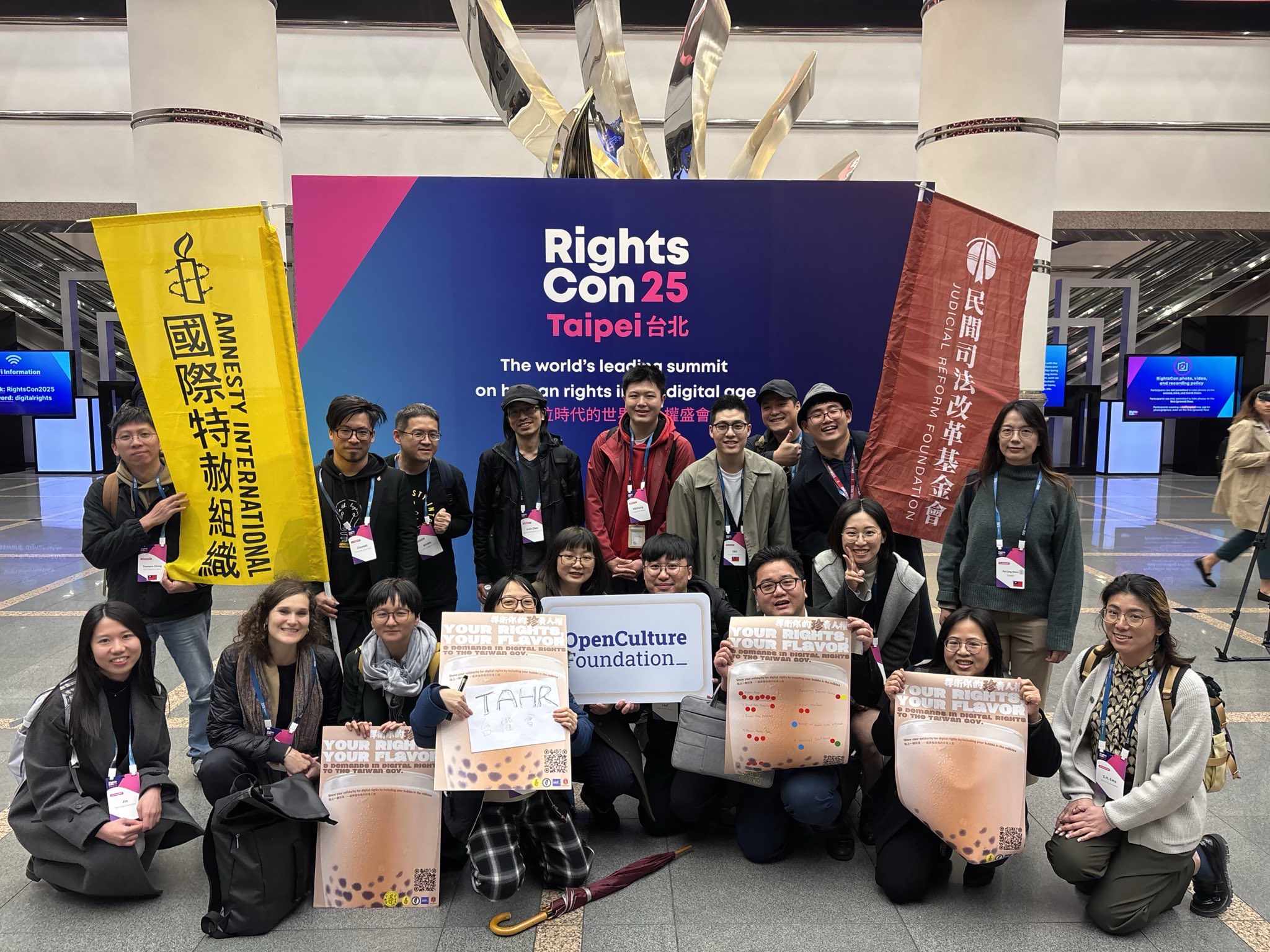
Last year RightsCon was held in Taipei, Taiwan, and co-hosted by the Taiwanese civil society group Open Culture Foundation. Other members of Taiwanese civil society, including E-Ling Chiu, the director of Amnesty International Taiwan, have attended and made presentations at this and prior iterations of RightsCon.

…

“We urge all states to step up and support RightsCon by working with Access Now and the global civil society to secure an alternative venue and ensure the conference takes place this year. This is a critical test of political courage. Standing aside is not neutral, it abandons the thousands of civil society actors and the millions of people worldwide whose rights they serve and protect," says Damini Satija, Amnesty Tech Director at Amnesty International.

…

Web Archive link