#no_stupid_questions

posts tagged #no_stupid_questions

0

How do programmers work 9-to-5 (or longer) sitting behind a computer without getting health issues?

preview

cross-posted from: quokk.au/…/how-do-programmers-work-9-to-5-or-long…

My career started as a programmer after I studied software engineering but I quickly realized that spending the entire day in front of a computer made me feel headaches and shoulder and neck pain continuously.

A lot of my hobbies were also computer related though, like gaming and programming things for myself. So I’m wondering how other people deal with this?

It got to the point where I just had to quit my job because I just couldn’t concentrate anymore on doing my job.

cross-posted from: quokk.au/…/how-do-programmers-work-9-to-5-or-long…

My career started as a programmer after I studied software engineering but I quickly realized that spending the entire day in front of a computer made me feel headaches and shoulder and neck pain continuously.

A lot of my hobbies were also computer related though, like gaming and programming things for myself. So I’m wondering how other people deal with this?

It got to the point where I just had to quit my job because I just couldn’t concentrate anymore on doing my job.
0

Is this a BE dev role now or am I delusional?

preview

I apologize if this is a stupid question. I’m a statistician by education, and in an analyst role at a private company. For the past 9 months I’ve spent 95% of my time building things in Python. First it was a big automation task that, strictly speaking, was outside the scope of my role, think “we need to start doing this new thing that would take two new full time roles if done manually, with lots of options and settings that we can change if we need it later. Btw we need it by yesterday.”.

I agreed to take on the project on the terms that I get to solve it in any way I saw fit, which was automating it in Python rather than turning it into an Excel monster.

Then, since that went well I guess, that somehow turned into a part of this HUGE project to create something that will give us Power BI-like functionality but without some of the drawbacks of Power BI. Several data sources, hundreds of values, 20 different types of dynamic time windows, 20 different grouping levels for groups that get assigned differently depending on the type of time window… All getting fed into 100 different reports in different formats that will each need to look pretty with dynamic formatting etc, and will need to be available on our internal systems as well as sent to 50 different people or combinations of those people somewhere between once a month and every day. I’m starting to realize that we need to set up proper databases for all this data, which I will also have to figure out how to do in the most optimal way and implement.

And before you say “that sounds easy enough”, I hadn’t touched Python in the past 10 years before this, and even then only used it for one course during my Master’s. I don’t have a senior to ask when I run into trouble - I’m the only person in my department so I guess I’m the senior. My manager has zero technical knowledge and zero time for me, we have maybe two meetings a year. These tasks come directly from the CEO at our international HQ, who I can’t exactly call up to ask programming questions.

I’m not saying this to complain, apart from the stress and pressure this has been so much fun. But it doesn’t feel like any analyst role I’ve had in the past, so what would be an appropriate title for someone doing this sort of work?

I apologize if this is a stupid question. I’m a statistician by education, and in an analyst role at a private company. For the past 9 months I’ve spent 95% of my time building things in Python. First it was a big automation task that, strictly speaking, was outside the scope of my role, think “we need to start doing this new thing that would take two new full time roles if done manually, with lots of options and settings that we can change if we need it later. Btw we need it by yesterday.”.

I agreed to take on the project on the terms that I get to solve it in any way I saw fit, which was automating it in Python rather than turning it into an Excel monster.

Then, since that went well I guess, that somehow turned into a part of this HUGE project to create something that will give us Power BI-like functionality but without some of the drawbacks of Power BI. Several data sources, hundreds of values, 20 different types of dynamic time windows, 20 different grouping levels for groups that get assigned differently depending on the type of time window… All getting fed into 100 different reports in different formats that will each need to look pretty with dynamic formatting etc, and will need to be available on our internal systems as well as sent to 50 different people or combinations of those people somewhere between once a month and every day. I’m starting to realize that we need to set up proper databases for all this data, which I will also have to figure out how to do in the most optimal way and implement.

And before you say “that sounds easy enough”, I hadn’t touched Python in the past 10 years before this, and even then only used it for one course during my Master’s. I don’t have a senior to ask when I run into trouble - I’m the only person in my department so I guess I’m the senior. My manager has zero technical knowledge and zero time for me, we have maybe two meetings a year. These tasks come directly from the CEO at our international HQ, who I can’t exactly call up to ask programming questions.

I’m not saying this to complain, apart from the stress and pressure this has been so much fun. But it doesn’t feel like any analyst role I’ve had in the past, so what would be an appropriate title for someone doing this sort of work?

0

The Joy (and Pain) of Debugging Microservices in a Fediverse World

preview

Hey, so… you won’t believe this, but I just spent hours chasing one of those bugs that makes you question your life choices

Everything looked fine at first. You know that feeling, right? Pods running, services up, nothing obviously broken. But then… random failures. Logs screaming “connection refused,” traces looking like total nonsense.

So I’m sitting there like, “Okay… what is even happening?”

Well, after digging way too deep, I finally found it. Turns out it was a race condition. Yeah, one of those. It was happening between federation hooks and Redis cache invalidation. Basically, things were happening slightly out of order… just enough to break stuff randomly.

And the worst part? It didn’t fail every time. Only sometimes. Can you imagine that?

So yeah, I kept going back and forth, thinking I fixed it… then boom, same issue again.

Here’s what I ended up doing. Nothing fancy at all. Just added exponential backoff to the retry logic:

async fn retry_federation(activity: Activity, max_retries: u32) -> Result<()> { let mut delay = Duration::from_millis(100); for attempt in 0…max_retries { match send_to_relays(&activity).await { Ok(_) => return Ok(()), Err(e) if attempt < max_retries - 1 => { tokio::time::sleep(delay).await; delay *= 2; } Err(e) => return Err(e), } } Err(anyhow!(“Federation failed after {} retries”, max_retries)) }

And yeah… that actually fixed it.

Not some big architectural change. Just… “wait a bit and try again” 😄

So yeah, lesson learned, timing issues in distributed systems are sneaky. Especially with federation stuff. Cold starts, retries, cache timing… all of it can mess with you.

Anyway, that was my day. What do you think? Ever had a bug like this where everything looked fine but totally wasn’t?

Hey, so… you won’t believe this, but I just spent hours chasing one of those bugs that makes you question your life choices

Everything looked fine at first. You know that feeling, right? Pods running, services up, nothing obviously broken. But then… random failures. Logs screaming “connection refused,” traces looking like total nonsense.

So I’m sitting there like, “Okay… what is even happening?”

Well, after digging way too deep, I finally found it. Turns out it was a race condition. Yeah, one of those. It was happening between federation hooks and Redis cache invalidation. Basically, things were happening slightly out of order… just enough to break stuff randomly.

And the worst part? It didn’t fail every time. Only sometimes. Can you imagine that?

So yeah, I kept going back and forth, thinking I fixed it… then boom, same issue again.

Here’s what I ended up doing. Nothing fancy at all. Just added exponential backoff to the retry logic:

async fn retry_federation(activity: Activity, max_retries: u32) -> Result<()> { let mut delay = Duration::from_millis(100); for attempt in 0…max_retries { match send_to_relays(&activity).await { Ok(_) => return Ok(()), Err(e) if attempt < max_retries - 1 => { tokio::time::sleep(delay).await; delay *= 2; } Err(e) => return Err(e), } } Err(anyhow!(“Federation failed after {} retries”, max_retries)) }

And yeah… that actually fixed it.

Not some big architectural change. Just… “wait a bit and try again” 😄

So yeah, lesson learned, timing issues in distributed systems are sneaky. Especially with federation stuff. Cold starts, retries, cache timing… all of it can mess with you.

Anyway, that was my day. What do you think? Ever had a bug like this where everything looked fine but totally wasn’t?

0

Income stream from developer sideblog?

preview

cross-posted from: lemmy.ml/post/44422946

Just curious if any people make steady income from a side devblog? I know there are dedicated youtubers, but I’m not into that…

I’ve been blogging over 4 years but the reach is still poor, just wanna rethink my strategy…

Thanks!

cross-posted from: lemmy.ml/post/44422946

Just curious if any people make steady income from a side devblog? I know there are dedicated youtubers, but I’m not into that…

I’ve been blogging over 4 years but the reach is still poor, just wanna rethink my strategy…

Thanks!

0

Prototyping of frontends (sort of)

preview

Hello everyone,

I’m having a hard time formulating the question and it can be a bit confuse to me too at times, but here it is. For the context, so that you can have an idea of the shenanigans I’m used to program, I’m a PhD in compilation and did stuff related to security and performance. I have essentially worked in projects that are relatively low-level and system-oriented (compared to webdev, desktop application dev etc).

I usually code CLI tools, usually system-oriented libraries, and stuff like that. And sometimes I would like to hack simple yet cool frontends, typically a webapp to either visualize my processes/data or to manipulate the inputs or whatever. I’m not looking for a big solid webapp. What I would like to do is to write frontends that would be the equivalent of quick ugly glue Perl scripts for interprocess communication.

Typically, I could have a program I wrote doing stuff, I may add a little HTTP server feature to it as an entrypoint to its internal and then have a cute webapp to connect to it to visualize what is going on, idk.

As I said, I’m not trying to transform my applications into actual servers or microservices in order to build an entire web application on top. It is more like using a proper user interface (typically web) as a better pretty-printing/logging system/whatever.

I guess there must be frameworks, tools, architectures or whatever to suite my needs, but since I have never really done frontend projects, I’m in the dark right now.

If someone has any recommandation, it would be very nice. Thank you so much in advance!

Hello everyone,

I’m having a hard time formulating the question and it can be a bit confuse to me too at times, but here it is. For the context, so that you can have an idea of the shenanigans I’m used to program, I’m a PhD in compilation and did stuff related to security and performance. I have essentially worked in projects that are relatively low-level and system-oriented (compared to webdev, desktop application dev etc).

I usually code CLI tools, usually system-oriented libraries, and stuff like that. And sometimes I would like to hack simple yet cool frontends, typically a webapp to either visualize my processes/data or to manipulate the inputs or whatever. I’m not looking for a big solid webapp. What I would like to do is to write frontends that would be the equivalent of quick ugly glue Perl scripts for interprocess communication.

Typically, I could have a program I wrote doing stuff, I may add a little HTTP server feature to it as an entrypoint to its internal and then have a cute webapp to connect to it to visualize what is going on, idk.

As I said, I’m not trying to transform my applications into actual servers or microservices in order to build an entire web application on top. It is more like using a proper user interface (typically web) as a better pretty-printing/logging system/whatever.

I guess there must be frameworks, tools, architectures or whatever to suite my needs, but since I have never really done frontend projects, I’m in the dark right now.

If someone has any recommandation, it would be very nice. Thank you so much in advance!

0

Music and SFX tools?

preview

When it comes to game development, the two areas that I see discussed the most extensively are coding and/or engines, and artwork (pixel art etc.). But I don’t think I’ve ever come across a conversation in the wild about the audio side of things.

So I’m wondering, are there any recommended tools or software for use in game development specifically? Or is this something that is more or less up to the creator? I’m sure recording real instruments is more or less the same as recording anything else in the music industry, so I’m talking specifically about software for creating electronic music. Think retro style games. Which I’m guessing would be MIDI?

Which brings me to another question. I believe that MIDI makes use of something called ‘soundfonts’, which is basically the sound and personality of all of the instruments. How does this work out as far as licensing and shit goes? Do indie devs frequently make use of free soundfonts or is creating your own soundfont commonplace? Or am I getting ahead of myself here?

Basically, or TL;DR, are there any tutorials or guides floating around that suggest recommended software and perhaps offer more information in general on this side of game dev? Music theory is another story altogether, so that’s not what I’m asking here. I’m asking specifically about creating music in relation to game dev.

When it comes to game development, the two areas that I see discussed the most extensively are coding and/or engines, and artwork (pixel art etc.). But I don’t think I’ve ever come across a conversation in the wild about the audio side of things.

So I’m wondering, are there any recommended tools or software for use in game development specifically? Or is this something that is more or less up to the creator? I’m sure recording real instruments is more or less the same as recording anything else in the music industry, so I’m talking specifically about software for creating electronic music. Think retro style games. Which I’m guessing would be MIDI?

Which brings me to another question. I believe that MIDI makes use of something called ‘soundfonts’, which is basically the sound and personality of all of the instruments. How does this work out as far as licensing and shit goes? Do indie devs frequently make use of free soundfonts or is creating your own soundfont commonplace? Or am I getting ahead of myself here?

Basically, or TL;DR, are there any tutorials or guides floating around that suggest recommended software and perhaps offer more information in general on this side of game dev? Music theory is another story altogether, so that’s not what I’m asking here. I’m asking specifically about creating music in relation to game dev.

0

How do I start a project?

preview

Sorry, I know this isn’t exactly a dev question, but how do I make a project without a tutorial? I know how to make functional code that does simple things, or to solve a problem/question. But nw I want to try to make some projects to add to my portfolio. I’ve found websites with different ideas, and I can find some tutorials, but what if I don’t have a tutorial? Like, what do I do if I want to make something from scratch myself?

Sorry, I know this isn’t exactly a dev question, but how do I make a project without a tutorial? I know how to make functional code that does simple things, or to solve a problem/question. But nw I want to try to make some projects to add to my portfolio. I’ve found websites with different ideas, and I can find some tutorials, but what if I don’t have a tutorial? Like, what do I do if I want to make something from scratch myself?

0

[Shaders, Godot] Is there a simple way to get an unshaded-but-lit look?

A scene with vertex colors. 3 low-poly badgers are on screen, each with different brightness levels due to their placement in the scene.
preview

This is for models that use vertex colors. I want all faces with the max brightness of the object. So in daytime lighting it should look unshaded, but in a dark environment it should darken (like the thumbnail).

What I’ve tried:

  • using vertex_lighting* and then setting the normal directly (eg NORMAL = vec3(0.0, 1.0, 0.0);)
    • this works, but only if the lighting is perfectly overhead… a slightly wrong angle or even too far into the middle of an omnilight will create a shadow
  • attempting to save the original color value, change the normal, and then bring it the old brightness back via max() if the new value is dimmer
    • lots of moving parts/assumptions on my part here
  • other math stuff with NORMAL/VERTEX, abs() and normalize() etc
    • on top of the direction failure, there’s also failure to keep consistent brightness (with a spinning animation), and darkening across a TextMesh

I also know I could do this with unshaded and just multiply/mix it in the shader, but I don’t really like the idea of making a custom lighting/detection system (rather than using actual lights, that is).

I am not totally against diffuse shading, something like a vertex toon shader (2-3 brightness bands) could be interesting aesthetically. If that’s even possible, it seems like the vertex light calculation is hardcoded (though it’s also possible I just don’t understand it).

* this is a relatively re-added feature (4.4)

This is for models that use vertex colors. I want all faces with the max brightness of the object. So in daytime lighting it should look unshaded, but in a dark environment it should darken (like the thumbnail).

What I’ve tried:

  • using vertex_lighting* and then setting the normal directly (eg NORMAL = vec3(0.0, 1.0, 0.0);)
    • this works, but only if the lighting is perfectly overhead… a slightly wrong angle or even too far into the middle of an omnilight will create a shadow
  • attempting to save the original color value, change the normal, and then bring it the old brightness back via max() if the new value is dimmer
    • lots of moving parts/assumptions on my part here
  • other math stuff with NORMAL/VERTEX, abs() and normalize() etc
    • on top of the direction failure, there’s also failure to keep consistent brightness (with a spinning animation), and darkening across a TextMesh

I also know I could do this with unshaded and just multiply/mix it in the shader, but I don’t really like the idea of making a custom lighting/detection system (rather than using actual lights, that is).

I am not totally against diffuse shading, something like a vertex toon shader (2-3 brightness bands) could be interesting aesthetically. If that’s even possible, it seems like the vertex light calculation is hardcoded (though it’s also possible I just don’t understand it).

* this is a relatively re-added feature (4.4)

0

Sharing AI-Aided Knowledge Beyond Corporate Platforms

preview

Seeking Direction: Sharing AI-Aided Knowledge Beyond Corporate Platforms

As a Reddit (and RIF) refugee, I’m searching for a space to share various useful information where it can be easily found later. The challenge is that the definition of “useful” varies among individuals, and I suspect that Reddit and other “for -profit” moderators are overly influenced by corporate interests.

In the past, I spent considerable time figuring out how to accomplish tasks unrelated to my primary goals—tasks I usually only needed to do once. Now, I tend to ask AI tools like ChatGPT, Perplexity, Deepseek, or other available models to assist with the task at hand. I’ve learned that by doing so, I can condense days or even weeks of effort into just a few hours, if not less.

However, a significant issue is that these AIs don’t currently learn from my questions, and the knowledge they provide isn’t propagated beyond the AI itself, unlike traditional sources. The AI models offering this information are essentially static, and the context of the current session is typically lost quickly.

The solution I envision is to take the results of successful chat sessions and post them somewhere on the internet where both humans and AIs can access and incorporate the information into their knowledge and training. The problem is that this approach doesn’t align with the posting models of conventional for-profit services like Reddit or Facebook. I tested Reddit again this morning and immediately had a post rejected for “low effort,” even though it would have taken me a long time to develop the content myself.

I’m looking for direction on:

Where to share this AI-generated knowledge so it's accessible and beneficial to others.

How to structure these posts to fit within the guidelines of non-commercial platforms like Lemmy.

What communities or instances would be receptive to such content.

Any suggestions or guidance would be greatly appreciated!

Seeking Direction: Sharing AI-Aided Knowledge Beyond Corporate Platforms

As a Reddit (and RIF) refugee, I’m searching for a space to share various useful information where it can be easily found later. The challenge is that the definition of “useful” varies among individuals, and I suspect that Reddit and other “for -profit” moderators are overly influenced by corporate interests.

In the past, I spent considerable time figuring out how to accomplish tasks unrelated to my primary goals—tasks I usually only needed to do once. Now, I tend to ask AI tools like ChatGPT, Perplexity, Deepseek, or other available models to assist with the task at hand. I’ve learned that by doing so, I can condense days or even weeks of effort into just a few hours, if not less.

However, a significant issue is that these AIs don’t currently learn from my questions, and the knowledge they provide isn’t propagated beyond the AI itself, unlike traditional sources. The AI models offering this information are essentially static, and the context of the current session is typically lost quickly.

The solution I envision is to take the results of successful chat sessions and post them somewhere on the internet where both humans and AIs can access and incorporate the information into their knowledge and training. The problem is that this approach doesn’t align with the posting models of conventional for-profit services like Reddit or Facebook. I tested Reddit again this morning and immediately had a post rejected for “low effort,” even though it would have taken me a long time to develop the content myself.

I’m looking for direction on:

Where to share this AI-generated knowledge so it's accessible and beneficial to others.

How to structure these posts to fit within the guidelines of non-commercial platforms like Lemmy.

What communities or instances would be receptive to such content.

Any suggestions or guidance would be greatly appreciated!

0

Is it okay to leave tests in your code?

preview

Like if I’m using print statements to test my code. Is it okay to leave stuff like that in there when “publishing” the app/program?

Edit: So I meant logging. Not “tests”. Using console.log to see if the code is flowing properly. I’ll study up on debugging. Also, based on what I managed to grasp from your very helpful comments, it is not okay to do, but the severity of how much of an issue it is depends on the context? Either that or it’s completely avoidable in the first place if I just use “automated testing” or “loggers”.

Like if I’m using print statements to test my code. Is it okay to leave stuff like that in there when “publishing” the app/program?

Edit: So I meant logging. Not “tests”. Using console.log to see if the code is flowing properly. I’ll study up on debugging. Also, based on what I managed to grasp from your very helpful comments, it is not okay to do, but the severity of how much of an issue it is depends on the context? Either that or it’s completely avoidable in the first place if I just use “automated testing” or “loggers”.

0

Graphene OS Devs or users, Play Integrity updates -> Aurora DOA? or just need a few more workarounds/alternatives?

preview

To what extent will these changes, and potential future changes along the same trajectory, affect the use of un-substitutable apps on Graphene OS?

Play Integrity API - 2024 Dec

The transition to the new verdicts will reduce the device signals that need to be collected and evaluated on Google servers by ~90% and our testing indicates verdict latency can improve by up to ~80%.

the huge ratio of reduction suggests to me that the attestation is being offloaded from Google servers to on-device AI, but maybe i assume wrong. my instinct tells me Google would always make this impossible for 3rd party OS to implement anyway.

Hypothetically, If implementing that AI in Graphene could allow most attestation-requiring apps to install and run normally, is that something the Graphene devs would do? i know it would have to be secure and private, so assuming there was a way…

I’m not pro AI, not the surveillance big data capitalism kind at least. just wondering about the scenarios and what prep or extra work i would have to do.

To what extent will these changes, and potential future changes along the same trajectory, affect the use of un-substitutable apps on Graphene OS?

Play Integrity API - 2024 Dec

The transition to the new verdicts will reduce the device signals that need to be collected and evaluated on Google servers by ~90% and our testing indicates verdict latency can improve by up to ~80%.

the huge ratio of reduction suggests to me that the attestation is being offloaded from Google servers to on-device AI, but maybe i assume wrong. my instinct tells me Google would always make this impossible for 3rd party OS to implement anyway.

Hypothetically, If implementing that AI in Graphene could allow most attestation-requiring apps to install and run normally, is that something the Graphene devs would do? i know it would have to be secure and private, so assuming there was a way…

I’m not pro AI, not the surveillance big data capitalism kind at least. just wondering about the scenarios and what prep or extra work i would have to do.

0

is there anything like an app/script for .tar files that automates configure-make-makeinstall into a single step for the end user? (after onetime manual config)

preview

In my understanding, the options need to be customized for each machine, as well as the fact that making packages for tons of distros can be a lot of work for solo or small team devs, and that’s why some software is provided as .tar only.

but it seems like the install process on the user side could be automated to a single command or drag-drop, as long as the script would throw informative alerts for any errors and the user is prepared to take over manually.

does something like this exist in a standalone form that’s not bundled like snaps or flatpaks?

if not, is there a broadly-applicable reason (security, damaging OS, etc) that makes it a terrible idea? or simply that no one has gotten to it?

In my understanding, the options need to be customized for each machine, as well as the fact that making packages for tons of distros can be a lot of work for solo or small team devs, and that’s why some software is provided as .tar only.

but it seems like the install process on the user side could be automated to a single command or drag-drop, as long as the script would throw informative alerts for any errors and the user is prepared to take over manually.

does something like this exist in a standalone form that’s not bundled like snaps or flatpaks?

if not, is there a broadly-applicable reason (security, damaging OS, etc) that makes it a terrible idea? or simply that no one has gotten to it?

0

Good sources and examples to deploy a bittorrent tracker that depends on JSON as a database?

preview

The idea is making deployment so simple even a 13 year old could republish the website in cloudflare or github pages.

Any other tactics are welcome

The idea is making deployment so simple even a 13 year old could republish the website in cloudflare or github pages.

Any other tactics are welcome

0

Is a terminal with multiple cell sizes possible?

preview

To my understanding:

Many terminals are capable of displaying multiple fonts at the same time, say latin unicode characters in font foo and japanese unicode characters in font baz. In urxvt at least, it is also possible to have one font in a certain size and the next font in another size. However, no font can have a size bigger than the base size, the size of a terminal cell.

Why is it not possible to have multiple terminal cell sizes? For exampleso one line has terminal size 8 and the next line has terminal size 12.

To my understanding:

Many terminals are capable of displaying multiple fonts at the same time, say latin unicode characters in font foo and japanese unicode characters in font baz. In urxvt at least, it is also possible to have one font in a certain size and the next font in another size. However, no font can have a size bigger than the base size, the size of a terminal cell.

Why is it not possible to have multiple terminal cell sizes? For exampleso one line has terminal size 8 and the next line has terminal size 12.

0

What are algebraic data types and why are they named as such?

preview

The wikipedia articles are terribly written (for math loves or people who just need to refresh their knowledge).

What is a “sum” of types? What is a product of types? Is it possible to Cat x Dog or Cat + Dog? What does that even mean?

The wikipedia articles are terribly written (for math loves or people who just need to refresh their knowledge).

What is a “sum” of types? What is a product of types? Is it possible to Cat x Dog or Cat + Dog? What does that even mean?

0

Limitation of using drag and drop Images in GitHub readme. md?

preview

Limitation of using drag and drop Images in readme.md?

One I am aware of is the size limit that no image size should be >10 MB. Are there any other limitations when using this (for example: retention period, storage capacity, etc)? I want to link those images outside Github.

I am aware of uploading images to the repository and linking by

[image](./path/to/image/image.png)

Limitation of using drag and drop Images in readme.md?

One I am aware of is the size limit that no image size should be >10 MB. Are there any other limitations when using this (for example: retention period, storage capacity, etc)? I want to link those images outside Github.

I am aware of uploading images to the repository and linking by

[image](./path/to/image/image.png)
0

Is it safe to move unallocated partition past Windows Recovery Image?

preview

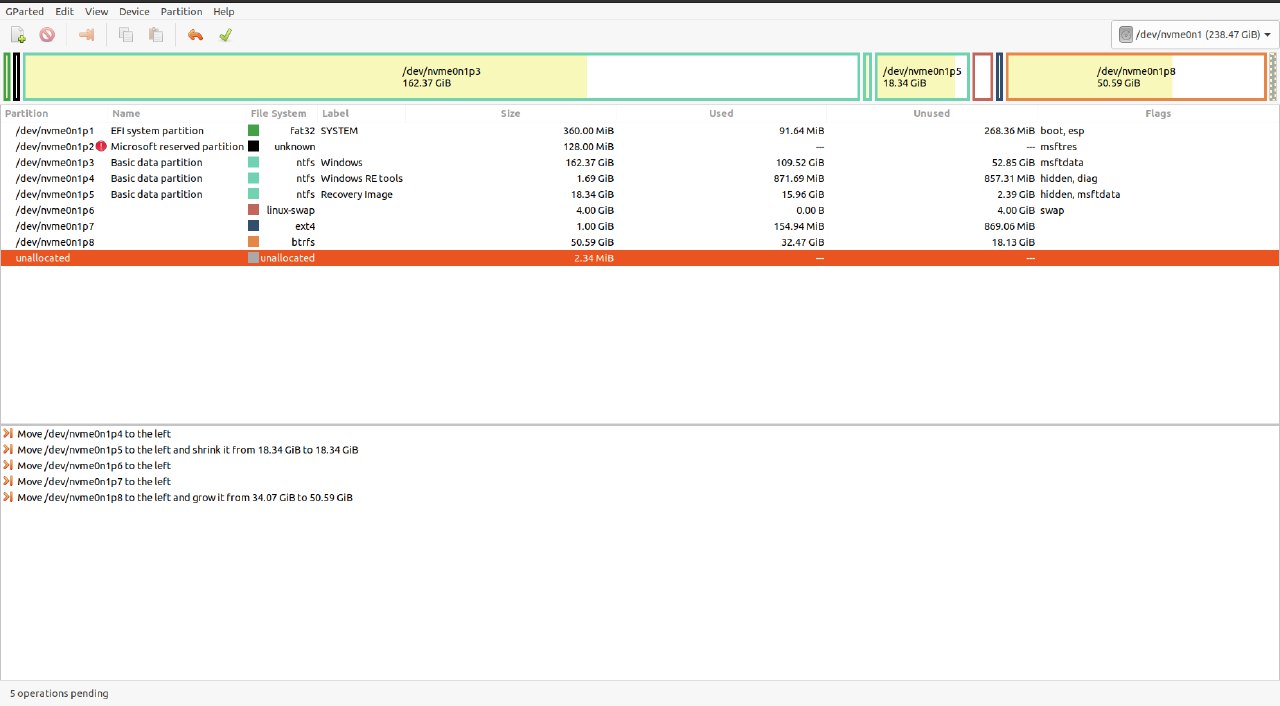
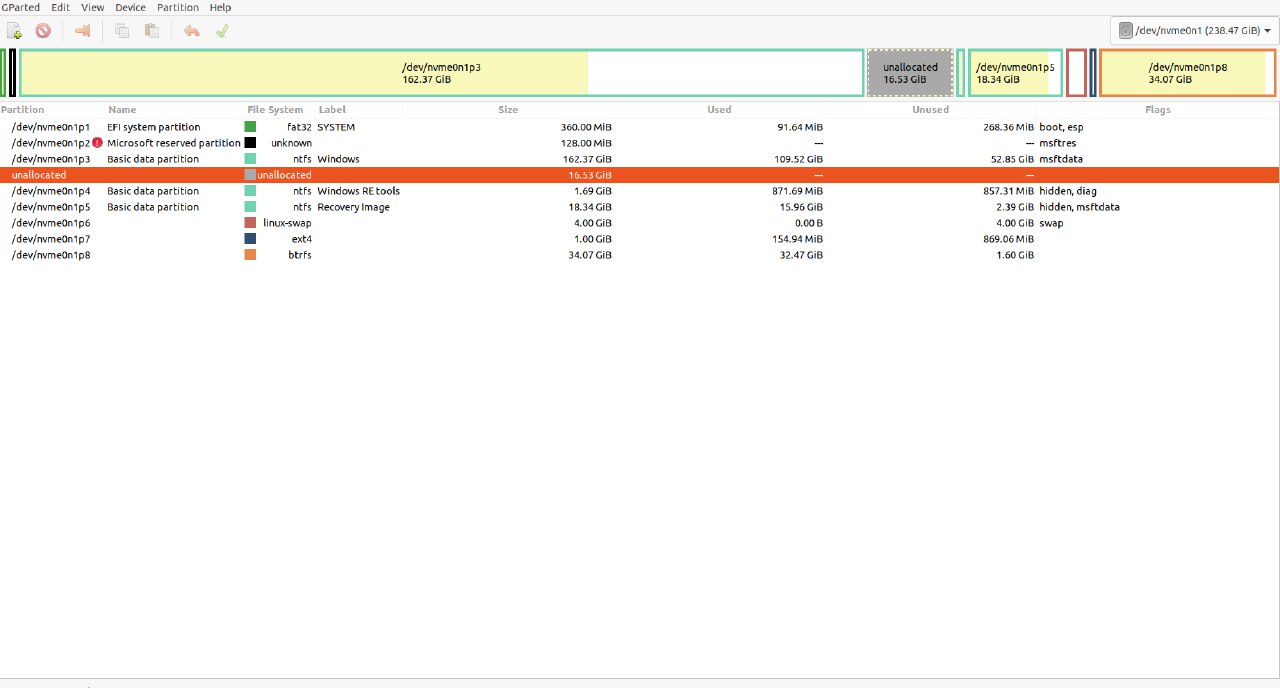
Hello. I have Windows - Ubuntu dual boot and I’m trying to move space from Windows to Ubuntu. I’ve already freed space from the Windows side

I’m pretty sure that I’ve read online that it can be dangerous to move the unallocated partition, because next boot to windows can corrupt my Ubuntu system. Is it true? Also, when I’m trying to move the unallocated partition, there’s no option to “move/resize”, so I swap them with the next following partition one by one. Is it the right way to do it?

Hello. I have Windows - Ubuntu dual boot and I’m trying to move space from Windows to Ubuntu. I’ve already freed space from the Windows side

I’m pretty sure that I’ve read online that it can be dangerous to move the unallocated partition, because next boot to windows can corrupt my Ubuntu system. Is it true? Also, when I’m trying to move the unallocated partition, there’s no option to “move/resize”, so I swap them with the next following partition one by one. Is it the right way to do it?

0

How do you secure your home network/pc?

preview

So I’m a baby dev, still in Uni and they don’t allow internships in 4th year due to some issues with it so not even that exp wise.

I don’t know enough, and I’m trying to learn but there’s so much! My Uni degree doesn’t cover security at all. Which is shit, bc I think I want to work in that? Mostly I’m just spooked and want to understand everything I can 'cause I love the internet and want to feel safer wandering about it.

I’m scared of clicking on links. Even ones here, like there was a post about a book list earlier and I was just there like “Cmoon… someone please have posted the lissssst.”

Would anyone be willing to share what they do for their own security? Especially if it’s ridiculously over the top. Included reasonings and details would be adored!

Also, if anyone has any books or references that might be good for learning sec from a programmatic view rather than a IT view I’d really love that! Anything at all.

Regardless, hope anyone reading this has an absolutely wonderful day and best of luck with everything you’re up to!

So I’m a baby dev, still in Uni and they don’t allow internships in 4th year due to some issues with it so not even that exp wise.

I don’t know enough, and I’m trying to learn but there’s so much! My Uni degree doesn’t cover security at all. Which is shit, bc I think I want to work in that? Mostly I’m just spooked and want to understand everything I can 'cause I love the internet and want to feel safer wandering about it.

I’m scared of clicking on links. Even ones here, like there was a post about a book list earlier and I was just there like “Cmoon… someone please have posted the lissssst.”

Would anyone be willing to share what they do for their own security? Especially if it’s ridiculously over the top. Included reasonings and details would be adored!

Also, if anyone has any books or references that might be good for learning sec from a programmatic view rather than a IT view I’d really love that! Anything at all.

Regardless, hope anyone reading this has an absolutely wonderful day and best of luck with everything you’re up to!

0

How to fix GitHub actions error?

preview

Can’t locally download 41 GB loaded image which is provided to replicate GitHub action locally but don’t want to commit and check every time too, is there any third option?

Can’t locally download 41 GB loaded image which is provided to replicate GitHub action locally but don’t want to commit and check every time too, is there any third option?

0

Is preloading/caching data before the actual method call an (anti)pattern?

preview

cross-posted from: programming.dev/post/6513133

Short explanation of the title: imagine you have a legacy mudball codebase in which most service methods are usually querying the database (through EF), modifying some data and then saving it in at the end of the method.

This code is hard to debug, impossible to write unit tests for and generally performs badly because developers often make unoptimized or redundant db hits in these methods.

What I’ve started doing is to often make all the data loads before the method call, put it in a generic cache class (it’s mostly dictionaries internally), and then use that as a parameter or a member variable for the method - everything in the method then gets or saves the data to that cache, its not allowed to do db hits on its own anymore.

I can now also unit test this code as long as I manually fill the cache with test data beforehand. I just need to make sure that i actually preload everything in advance (which is not always possible) so I have it ready when I need it in the method.

Is this good practice? Is there a name for it, whether it’s a pattern or an anti-pattern? I’m tempted to say that this is just a janky repository pattern but it seems different since it’s more about how you time and cache data loads for that method individually, rather than overall implementation of data access across the app.

In either case, I’d like to learn either how to improve it, or how to replace it.

cross-posted from: programming.dev/post/6513133

Short explanation of the title: imagine you have a legacy mudball codebase in which most service methods are usually querying the database (through EF), modifying some data and then saving it in at the end of the method.

This code is hard to debug, impossible to write unit tests for and generally performs badly because developers often make unoptimized or redundant db hits in these methods.

What I’ve started doing is to often make all the data loads before the method call, put it in a generic cache class (it’s mostly dictionaries internally), and then use that as a parameter or a member variable for the method - everything in the method then gets or saves the data to that cache, its not allowed to do db hits on its own anymore.

I can now also unit test this code as long as I manually fill the cache with test data beforehand. I just need to make sure that i actually preload everything in advance (which is not always possible) so I have it ready when I need it in the method.

Is this good practice? Is there a name for it, whether it’s a pattern or an anti-pattern? I’m tempted to say that this is just a janky repository pattern but it seems different since it’s more about how you time and cache data loads for that method individually, rather than overall implementation of data access across the app.

In either case, I’d like to learn either how to improve it, or how to replace it.

0

Instagram equivalent to Nitter or Invidious (tool to browse it)?

preview

What are some alternatives to browsing instagram “outside” of the proper app?

I put nitter.net and invidious as examples, as they allow you to browse Twitter and Youtube “outside” the official site/app and without being tracked. Instagram hates me trying to look at anything from the computer.

What are some alternatives to browsing instagram “outside” of the proper app?

I put nitter.net and invidious as examples, as they allow you to browse Twitter and Youtube “outside” the official site/app and without being tracked. Instagram hates me trying to look at anything from the computer.

0

Looking for TypingMind alternative. Prefer free and open-source solution.

preview

I need an open-source AI front-end (use with openai api key) with following option:

  • Do web search
  • Chat with document as context
  • More Plugin

Please suggest me some open-source project that work.

I need an open-source AI front-end (use with openai api key) with following option:

  • Do web search
  • Chat with document as context
  • More Plugin

Please suggest me some open-source project that work.

0

How to start on freelancer while also keeping a full-time job ?

preview

I have 5 years experience as full time job.

However I never do freelancer job before.

How do I start on finding freelancer job ?

I have 5 years experience as full time job.

However I never do freelancer job before.

How do I start on finding freelancer job ?

0

So what is actually the issue with (npm) dependency management?

preview

It is a common sentiment that managing dependencies is always a big issue in software development and the reason why so many apps come pre-bundled with all the requirements so it reliably works on every machine.

However, I don’t actually understand why is that an issue and why people generally bash npm and the way it’s done there. Isn’t it the simplest and most practical solution to a problem - you have a file which defines which other libraries you need, which version, and then with one command you can install them and run the program?

Furthermore, those libraries and their specific versions can be stored elsewhere and shared across all apps on a system so you can easily reuse them instead of having to redownload for each program individually.

I must be missing something since if it were that easy, people would have solved it years ago and agreed on a standardized best way, so I’m wondering what is the actual issue and a cause of so many headaches.

It is a common sentiment that managing dependencies is always a big issue in software development and the reason why so many apps come pre-bundled with all the requirements so it reliably works on every machine.

However, I don’t actually understand why is that an issue and why people generally bash npm and the way it’s done there. Isn’t it the simplest and most practical solution to a problem - you have a file which defines which other libraries you need, which version, and then with one command you can install them and run the program?

Furthermore, those libraries and their specific versions can be stored elsewhere and shared across all apps on a system so you can easily reuse them instead of having to redownload for each program individually.

I must be missing something since if it were that easy, people would have solved it years ago and agreed on a standardized best way, so I’m wondering what is the actual issue and a cause of so many headaches.

0

CSS question: I don't understand image sizes! Maybe not as stupid a question as it initially appears?

preview

In CSS, let’s talk about srcset or image-set. In that context, you can define which image the browser loads using 1x, 2x, 3x, etc. These refer to pixel density. (In the case of srcset, you can use pixel dimensions too, which sidesteps the issue I’m going to talk about, but it still occurs in image-set, and also is still weird to me in srcset, even if you can side step it.)

So, assuming, say, a 20" monitor with 1080p resolution is 1x, then a 10" screen with 1080p would be, technically, 2x - though, in the real world, it’s more like a 6" screen has a 1000x2500 resolution - so, I don’t care about math, that’s somewhere between 2x and 3x.

Let’s imagine a set of images presented like this:

srcset(image_1000x666.webp 1x,
image_1500x1000.webp 2x,
image_3000x2000.webp 3x)

then an iphone 14 max (a 6"-ish screen with a 1000x2500-ish resolution, for a 2-3x pixel density), would load the 3000x2000 image, but my 27", 1440p monitor would load the 1000x666px image.

It seems intuitively backwards - but I’ve confirmed it - according to MDN, 1x = smaller image, 3x = larger image.

But as I understand it, an iphone 14 acts as if its a 300x800 screen - using the concept of “points” instead of pixels - which, in the context of “1x” image size makes a lot of sense - but the browser isn’t reading that, all it seems to care about is how many pixels are in an inch.

I made a little page to demonstrate the issue, tho I acknowledge it’s not hugely helpful, since, other than using your actual eyeballs, it’s hard to tell which image is loaded in the scrset example, but take a look if you want.

germyparker.github.io/image-srcset-example/

In CSS, let’s talk about srcset or image-set. In that context, you can define which image the browser loads using 1x, 2x, 3x, etc. These refer to pixel density. (In the case of srcset, you can use pixel dimensions too, which sidesteps the issue I’m going to talk about, but it still occurs in image-set, and also is still weird to me in srcset, even if you can side step it.)

So, assuming, say, a 20" monitor with 1080p resolution is 1x, then a 10" screen with 1080p would be, technically, 2x - though, in the real world, it’s more like a 6" screen has a 1000x2500 resolution - so, I don’t care about math, that’s somewhere between 2x and 3x.

Let’s imagine a set of images presented like this:

srcset(image_1000x666.webp 1x,
image_1500x1000.webp 2x,
image_3000x2000.webp 3x)

then an iphone 14 max (a 6"-ish screen with a 1000x2500-ish resolution, for a 2-3x pixel density), would load the 3000x2000 image, but my 27", 1440p monitor would load the 1000x666px image.

It seems intuitively backwards - but I’ve confirmed it - according to MDN, 1x = smaller image, 3x = larger image.

But as I understand it, an iphone 14 acts as if its a 300x800 screen - using the concept of “points” instead of pixels - which, in the context of “1x” image size makes a lot of sense - but the browser isn’t reading that, all it seems to care about is how many pixels are in an inch.

I made a little page to demonstrate the issue, tho I acknowledge it’s not hugely helpful, since, other than using your actual eyeballs, it’s hard to tell which image is loaded in the scrset example, but take a look if you want.

germyparker.github.io/image-srcset-example/

0

PyQt vs Kivy, which one has better syntax for someone learning a framework from 0?

preview

After some time of practicing PyQt I found out about Kivy, as a beginner which one can be considered with an “easier” syntax to learn? After several days of practicing PyQt I feel I would be throwing away my learning for Kivy.

PyQt is not that complex really but what I hate with all my heart is using Qt Designer and then exporting that to a .py file, I really don’t like the way it formats the text, but that’s just a personal detail. I know I can perfectly do it manually but all the tutorials and I mean ALL of them always do it in that way.

I want to clarify that I’m interested in Android application development, that’s really a strong point for me of Kivy.

After some time of practicing PyQt I found out about Kivy, as a beginner which one can be considered with an “easier” syntax to learn? After several days of practicing PyQt I feel I would be throwing away my learning for Kivy.

PyQt is not that complex really but what I hate with all my heart is using Qt Designer and then exporting that to a .py file, I really don’t like the way it formats the text, but that’s just a personal detail. I know I can perfectly do it manually but all the tutorials and I mean ALL of them always do it in that way.

I want to clarify that I’m interested in Android application development, that’s really a strong point for me of Kivy.

0

Why do I feel that no matter how much I practice programming I will never be a programmer?

preview

I’ve been learning Python by myself for about 3 years now and I can say that I know quite a lot but I don’t really feel confident in my own programming skills and always after a while of practicing or reviewing I end up quitting because I feel exactly this.

I don’t know how to explain it, but I really feel like I’m in a cycle repeating the same noob exercises over and over again.

For example, lately I have been practicing a lot PyQt but I really feel that I am wasting time when I don’t learn a new concept or I don’t memorize something and I need to look at my notes to remember how to do it, and also that practicing with online courses, especially with Youtube is often a challenge because the authors do things differently and I get confused by that. And when I want to learn something new the amount of information overwhelms me and I feel tired because of that.

As a Linux user I know that what I just said is stupid, because for example it is impossible to learn all the commands in the world, you just really learn the ones you use most regularly but in programming I feel that for example asking ChatGPT (or any ChatBot) counts as cheating for some reason, I don’t know how to explain it.

I really consider this probably a mentality problem more than a skill problem because honestly even though I know I can I don’t feel sure how to program, many times I even doubt the name of my variables or my functions.

Thanks for reading my silly post!

I’ve been learning Python by myself for about 3 years now and I can say that I know quite a lot but I don’t really feel confident in my own programming skills and always after a while of practicing or reviewing I end up quitting because I feel exactly this.

I don’t know how to explain it, but I really feel like I’m in a cycle repeating the same noob exercises over and over again.

For example, lately I have been practicing a lot PyQt but I really feel that I am wasting time when I don’t learn a new concept or I don’t memorize something and I need to look at my notes to remember how to do it, and also that practicing with online courses, especially with Youtube is often a challenge because the authors do things differently and I get confused by that. And when I want to learn something new the amount of information overwhelms me and I feel tired because of that.

As a Linux user I know that what I just said is stupid, because for example it is impossible to learn all the commands in the world, you just really learn the ones you use most regularly but in programming I feel that for example asking ChatGPT (or any ChatBot) counts as cheating for some reason, I don’t know how to explain it.

I really consider this probably a mentality problem more than a skill problem because honestly even though I know I can I don’t feel sure how to program, many times I even doubt the name of my variables or my functions.

Thanks for reading my silly post!

0

In autohotkey, can you daisy chain together hotstrings from different scripts?

preview

Note that I’m using autohotkey v2, not v1.

I want to run two different autohotkey scripts. I want to trigger a hotstring in the first script, the output of which ends up being part of the hotstring trigger for the second script. Is this possible?

Here’s a simplified version of my intended workflow.

Script 1:

#Hotstring EndChars \
#Hotstring o
#Hotstring ?
::iv::ǐ
::av::ǎ

Script 2:

#Hotstring EndChars \
#Hotstring o
#Hotstring ?
::nǐ::你
::hǎo::好

So the idea is that I can type niv\ and the first script will convert it to nǐ - then I can immediately type \ and the second script will convert it to 你. So I type niv\\ and my text goes from niv to nǐ to 你. I can then type hav\o\ and have my text go: h, ha, hav, hǎ, hǎo, 好. So I can do niv\ hav\o and get nǐ hǎo, or I can do niv\\ hav\o\ and get 你 好. Both writing systems in a reasonably simple format.

There are reasons I want to set it up like this. The first script has dozens of functions beyond writing in pinyin/chinese, and I share it with another person - so I don’t want to add potentially hundreds of random Chinese hotstrings to it, just the special pinyin characters. That’s why I’m using two scripts.

But I also realize I could just make “niv” and “havo” their own hotstrings which go directly to 你 and 好 without the intermediate nǐ and hǎo. I don’t want to do this mostly because I think the system I have in mind is prettier - type it correctly in pinyin first, then have it correctly convert to Chinese.

All of that aside: I’ve gathered that this is probably possible using some combination of SendLevel and #InputLevel - but I’ve tried a bunch of different combinations and ideas with it, and haven’t successfully had one script trigger another yet. Even in simplified toy scripts, which is a little discouraging. Ideally I’d be able to do this with as few changes to the main script I share with another person as possible - the script that handles the Chinese can be as complicated as it needs to be though. Anyone know how to make this work?

Note that I’m using autohotkey v2, not v1.

I want to run two different autohotkey scripts. I want to trigger a hotstring in the first script, the output of which ends up being part of the hotstring trigger for the second script. Is this possible?

Here’s a simplified version of my intended workflow.

Script 1:

#Hotstring EndChars \
#Hotstring o
#Hotstring ?
::iv::ǐ
::av::ǎ

Script 2:

#Hotstring EndChars \
#Hotstring o
#Hotstring ?
::nǐ::你
::hǎo::好

So the idea is that I can type niv\ and the first script will convert it to nǐ - then I can immediately type \ and the second script will convert it to 你. So I type niv\\ and my text goes from niv to nǐ to 你. I can then type hav\o\ and have my text go: h, ha, hav, hǎ, hǎo, 好. So I can do niv\ hav\o and get nǐ hǎo, or I can do niv\\ hav\o\ and get 你 好. Both writing systems in a reasonably simple format.

There are reasons I want to set it up like this. The first script has dozens of functions beyond writing in pinyin/chinese, and I share it with another person - so I don’t want to add potentially hundreds of random Chinese hotstrings to it, just the special pinyin characters. That’s why I’m using two scripts.

But I also realize I could just make “niv” and “havo” their own hotstrings which go directly to 你 and 好 without the intermediate nǐ and hǎo. I don’t want to do this mostly because I think the system I have in mind is prettier - type it correctly in pinyin first, then have it correctly convert to Chinese.

All of that aside: I’ve gathered that this is probably possible using some combination of SendLevel and #InputLevel - but I’ve tried a bunch of different combinations and ideas with it, and haven’t successfully had one script trigger another yet. Even in simplified toy scripts, which is a little discouraging. Ideally I’d be able to do this with as few changes to the main script I share with another person as possible - the script that handles the Chinese can be as complicated as it needs to be though. Anyone know how to make this work?

0

Anyone know a good guide on how to read Malwarebytes logs or... something?

preview

Know this isn’t technically Dev, sorry in advance.

I keep getting outbound malware alerts when I browse global. Today it’s lemmy.today, last week it was another instance etc.

I’m interested in learning more about sec, and while I’ve looked at the JSON logs and tried googling “What does threat id -1 mean” etc., I can’t seem to find anything.

I’m kind of just curious about what, specifically, the threat was and what it was trying to do - but the logs seem pretty blank. As mentioned above, the id is -1 and the name is blank.

Anyone know a good guide, or something, to read up or… better questions to ask?

Thank you for your time and hav a wonderful day. :)

Know this isn’t technically Dev, sorry in advance.

I keep getting outbound malware alerts when I browse global. Today it’s lemmy.today, last week it was another instance etc.

I’m interested in learning more about sec, and while I’ve looked at the JSON logs and tried googling “What does threat id -1 mean” etc., I can’t seem to find anything.

I’m kind of just curious about what, specifically, the threat was and what it was trying to do - but the logs seem pretty blank. As mentioned above, the id is -1 and the name is blank.

Anyone know a good guide, or something, to read up or… better questions to ask?

Thank you for your time and hav a wonderful day. :)

0

What should I do in this situation? git best practices.

preview

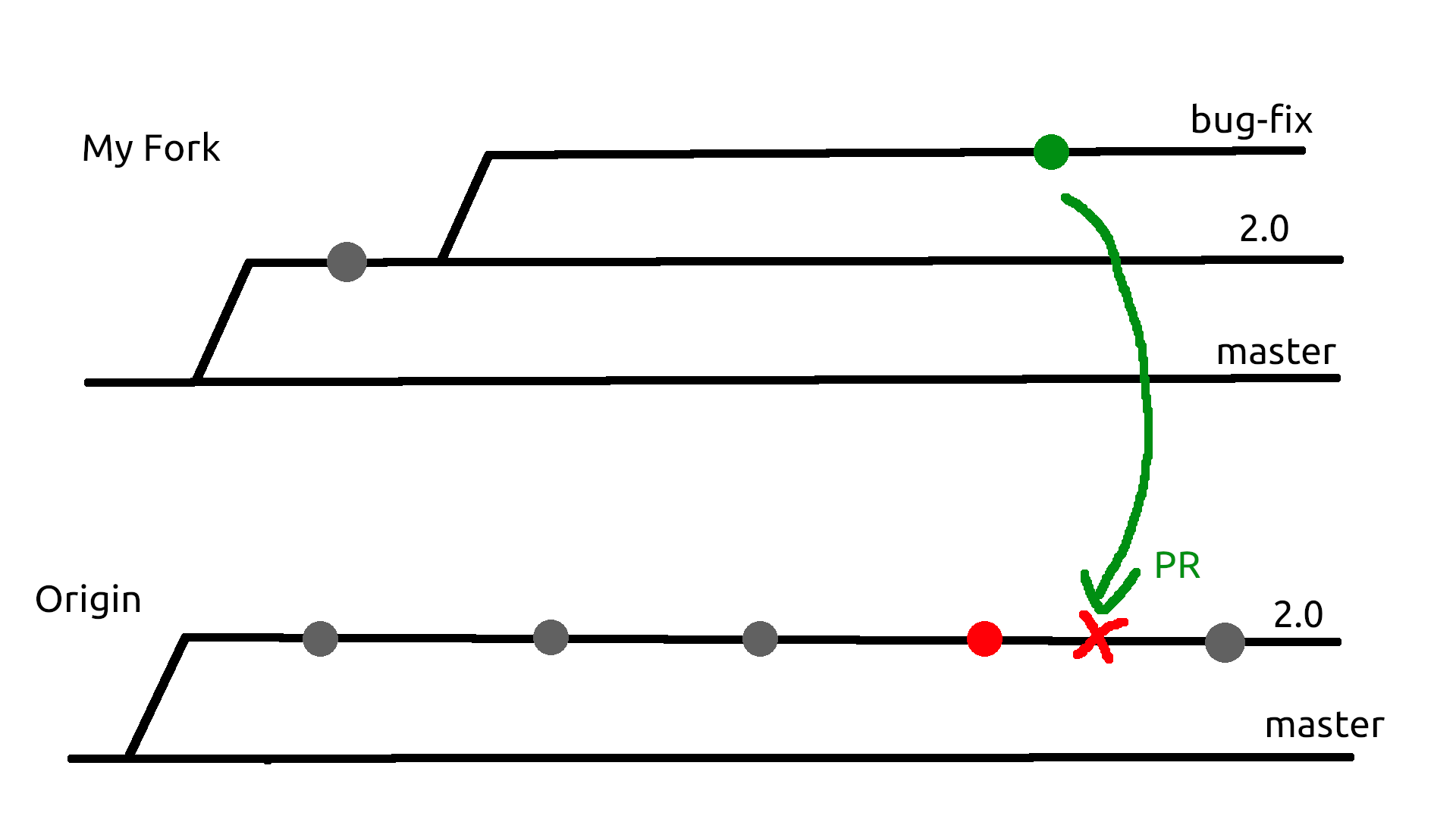
drawing showing git history made in gimp

So I have a bug fix (green) and owner also made a bug fix (red) but I would like to rework both of them due to discussion we had. I have opened a PR and there is merge conflict that can’t be resolved. Should I open a new branch in my fork and close PR or should I google some rebase magic to apply commits to my bug-fix branch.

drawing showing git history made in gimp

So I have a bug fix (green) and owner also made a bug fix (red) but I would like to rework both of them due to discussion we had. I have opened a PR and there is merge conflict that can’t be resolved. Should I open a new branch in my fork and close PR or should I google some rebase magic to apply commits to my bug-fix branch.

0

Why does Windows makes changing executable's icons so damn hard?

preview

I’m aware this has been the case since Windows 3.x, you always need an external program to ensure the executable is created with the icon you want. Why?

Please no mentions of Linux and other OSs, I know it’s trivial to do so for them.

I’m aware this has been the case since Windows 3.x, you always need an external program to ensure the executable is created with the icon you want. Why?

Please no mentions of Linux and other OSs, I know it’s trivial to do so for them.

0

Why UTM VMs so slow compared to Parallel Desktop on my Intel MacBook

preview

Hi, I’m using a MacBook Pro 2018, and I’m dipping my toes into virtual machine, tried VirtualBox and then moved to QEMU with UTM after some recommendation on YouTube saying KVM is just better.

However, my Windows 10 virtual machine created with UTM is so slow and laggy. Then I tried the Parallel Desktop, which is propriety and the performance is so much better. Why is that?

I don’t want to use a propriety paid program for VM, so I want to ask how to improve performance on UTM or any open-source alternative that gives the performance on par with one on parallel desktop.

Thanks for your help!

Hi, I’m using a MacBook Pro 2018, and I’m dipping my toes into virtual machine, tried VirtualBox and then moved to QEMU with UTM after some recommendation on YouTube saying KVM is just better.

However, my Windows 10 virtual machine created with UTM is so slow and laggy. Then I tried the Parallel Desktop, which is propriety and the performance is so much better. Why is that?

I don’t want to use a propriety paid program for VM, so I want to ask how to improve performance on UTM or any open-source alternative that gives the performance on par with one on parallel desktop.

Thanks for your help!

0

What specific things are wrong with my installed copy of Brave

preview

cross-posted from: programming.dev/post/993501

I use manjaro linux and I installed brave using the AUR repo. I keep hearing stories about how Brave is just another ad tracking software like Chrome. What I don’t understand is why, like specifically.

Because I downloaded Brave from here. The code for Brave is here. I can build and install Brave and it will be the same as from AUR right?

Ok let me list my questions:

  1. If the sourcecode for Brave is open and is all I need to compile and run the software then where’s the tracker. The code base is honestly to big and high level for me and my professional abilities but I’m not that great of a programmer, I’m just really good. If there are ad trackers or adblock-blockers then I should beable to see it in the code right? I just need help actually seeing these lines of code.
  2. I’ve used wireshark to monitor Brave in isolation and I couldn’t see traffic that I would disapprove of. It is also very realistic that I just don’t know how to recognize.
  3. Just because Google maintains chromium doesn’t mean that chromium browsers have to track you. Chromium is opensource and it shouldn’t cost much to comment out trackers. So wasn’t this already done? And if not can we actually see the lines of code that track us?

Really what I’m looking for is help coming to the conclusion that these browsers are that bad for me myself.

cross-posted from: programming.dev/post/993501

I use manjaro linux and I installed brave using the AUR repo. I keep hearing stories about how Brave is just another ad tracking software like Chrome. What I don’t understand is why, like specifically.

Because I downloaded Brave from here. The code for Brave is here. I can build and install Brave and it will be the same as from AUR right?

Ok let me list my questions:

  1. If the sourcecode for Brave is open and is all I need to compile and run the software then where’s the tracker. The code base is honestly to big and high level for me and my professional abilities but I’m not that great of a programmer, I’m just really good. If there are ad trackers or adblock-blockers then I should beable to see it in the code right? I just need help actually seeing these lines of code.
  2. I’ve used wireshark to monitor Brave in isolation and I couldn’t see traffic that I would disapprove of. It is also very realistic that I just don’t know how to recognize.
  3. Just because Google maintains chromium doesn’t mean that chromium browsers have to track you. Chromium is opensource and it shouldn’t cost much to comment out trackers. So wasn’t this already done? And if not can we actually see the lines of code that track us?

Really what I’m looking for is help coming to the conclusion that these browsers are that bad for me myself.

0

How feasible is a browser that uses something like Lua, Python or Ruby as its scripting language instead of JS? Also, how stupid is this idea (ignoring any "incompatibility with JS pages" situations)?

preview

Or, put it another way, a html renderer that can open most web pages, but has a different programming/scripting language that it can interpret during runtime or on page loads, instead of the javascript engine.

I suppose that java applets, flash and activeX were attempts in these directions, but they were things you had to install on top of the browsers, so not quite the same thing? I’m imagining something like web pages using Lua, since it’s lightweight, to make them dynamic.

Or, put it another way, a html renderer that can open most web pages, but has a different programming/scripting language that it can interpret during runtime or on page loads, instead of the javascript engine.

I suppose that java applets, flash and activeX were attempts in these directions, but they were things you had to install on top of the browsers, so not quite the same thing? I’m imagining something like web pages using Lua, since it’s lightweight, to make them dynamic.

0

What C++ standard/version am I using?

preview

I just started learning c++. I installed visual studio with “Desktop Development with C++”. CPlusPlus.com shows info for different c++ versions. How can I check which one I am using?

I just started learning c++. I installed visual studio with “Desktop Development with C++”. CPlusPlus.com shows info for different c++ versions. How can I check which one I am using?

0

what is the meaning of posts with "via programming.dev" ?

preview

I’m still getting the hang of Lemmy and federated services.

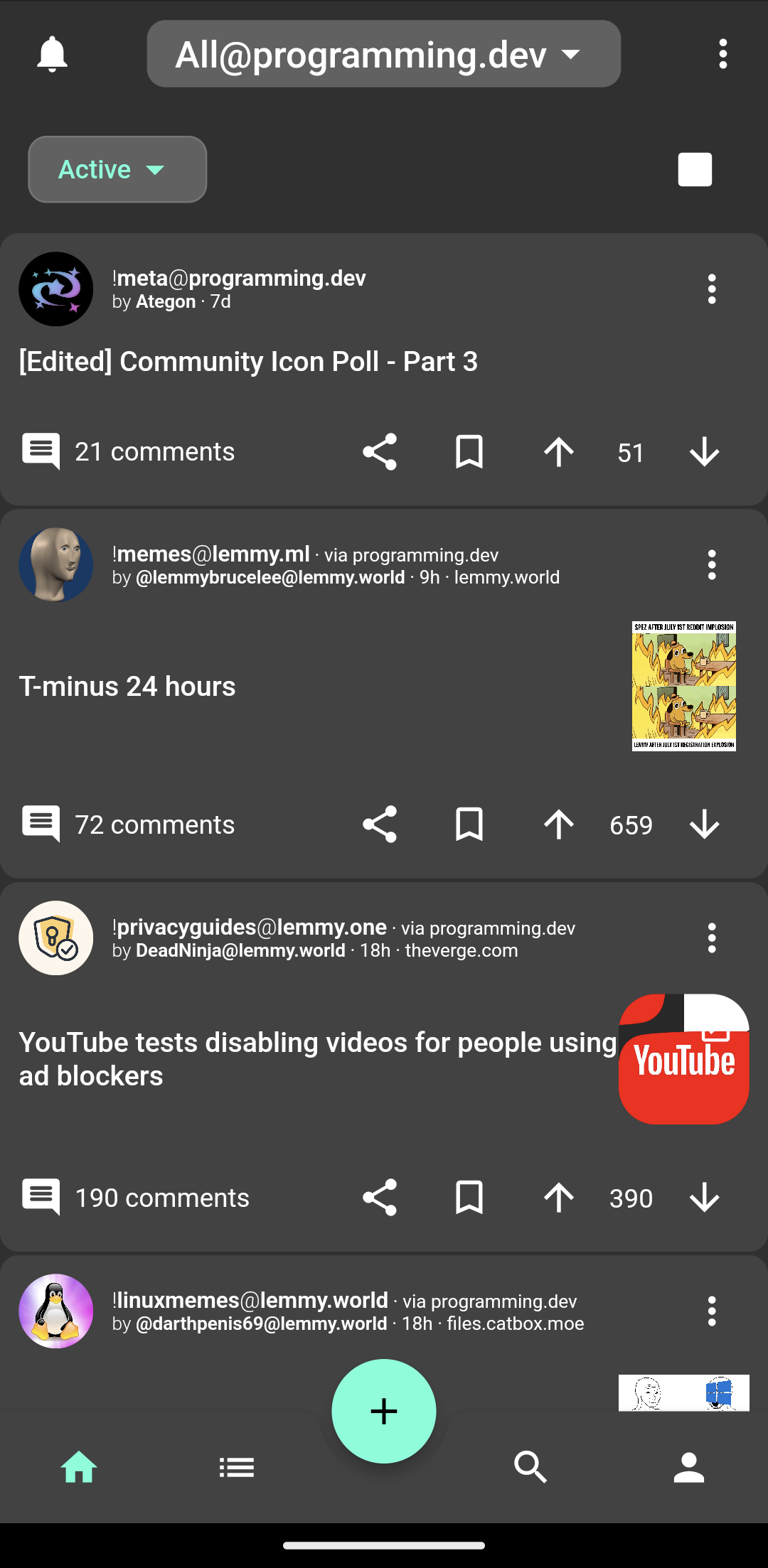
I’m browsing the programming.dev instandce in the Liftoff app and I can choose to view:

  1. my subscribed communities on the server (currently none)
  2. Local communities on the server
  3. All (?)

I know All is not “all communities on Lemmy” but what perplexes me is I can see posts from another community that is hosted on a different server and it appears because it is “via programming.dev”.

At first I thought it was because a user registered on " programming.dev " posted on another instance but I opened my eyes and saw the user’s origin is no way related.

Any ideas?

EDIT:

After reading all the comments I’m pretty sure “via programming.dev” should read in the context of the post as !community@instance is known via programming.dev instance. I guess it makes it explicit which “all” I am browsing if I pick up browsing where I left off and forget I am not in the “all local”.

At this point I have only seen this on the Liftoff App for Lemmy but still trying other. Must be in the metadata and Liftoff decided to display it.

I’m still getting the hang of Lemmy and federated services.

I’m browsing the programming.dev instandce in the Liftoff app and I can choose to view:

  1. my subscribed communities on the server (currently none)
  2. Local communities on the server
  3. All (?)

I know All is not “all communities on Lemmy” but what perplexes me is I can see posts from another community that is hosted on a different server and it appears because it is “via programming.dev”.

At first I thought it was because a user registered on " programming.dev " posted on another instance but I opened my eyes and saw the user’s origin is no way related.

Any ideas?

EDIT:

After reading all the comments I’m pretty sure “via programming.dev” should read in the context of the post as !community@instance is known via programming.dev instance. I guess it makes it explicit which “all” I am browsing if I pick up browsing where I left off and forget I am not in the “all local”.

At this point I have only seen this on the Liftoff App for Lemmy but still trying other. Must be in the metadata and Liftoff decided to display it.

0

I made a Lemmy instance. How do I get it to federate?

preview

I created a Lemmy instance. Making posts, comments, all that jazz seems to be good. Sign up works. Other functions work. What doesn’t work is federation. The instance is been alive about about 24hours and I don’t see anything in the all tab. Directly going to communities via a url like “my.lemmy.instance/c/sub@other.instance” shows the external community’s sidebar, bur not the posts I know exist.

I haven’t added anything to the allow or block list and federation is turned on. Have I missed something or is it just a matter of waiting a little more?

I created a Lemmy instance. Making posts, comments, all that jazz seems to be good. Sign up works. Other functions work. What doesn’t work is federation. The instance is been alive about about 24hours and I don’t see anything in the all tab. Directly going to communities via a url like “my.lemmy.instance/c/sub@other.instance” shows the external community’s sidebar, bur not the posts I know exist.

I haven’t added anything to the allow or block list and federation is turned on. Have I missed something or is it just a matter of waiting a little more?

0

Would it benefit my software dev job in the future if I learned Java?

preview

Because I’m in my very early 20s I missed out on the huge Java craze. Everything was Python when I started getting a more formal education and before then all my work was in C++. Knowing more languages would obviously look better on a CV but I mean if I would benefit in a practical sense? I have two friends who are long time Java devs. And recently another friend who generally works with legacy C++ based systems from the early 2000s late 90s period had to work on a bunch of stuff in Java. Java is clearly still in large scale use among older systems. So would it be likely that eventually I would need to work on Java systems myself when my job is mostly JavaScript currently?

Because I’m in my very early 20s I missed out on the huge Java craze. Everything was Python when I started getting a more formal education and before then all my work was in C++. Knowing more languages would obviously look better on a CV but I mean if I would benefit in a practical sense? I have two friends who are long time Java devs. And recently another friend who generally works with legacy C++ based systems from the early 2000s late 90s period had to work on a bunch of stuff in Java. Java is clearly still in large scale use among older systems. So would it be likely that eventually I would need to work on Java systems myself when my job is mostly JavaScript currently?

0

A good tutorial on learning a javascript framework?

preview

Hello, I currently have just a little experience with asp.net and rest api’s, but most of my development is windows desktop apps. I’d like to learn a javascript framework (angular, react, vue, or next.js are some I’ve looked at) and I was wondering if anyone knows of a good tutorial for using one.

Hello, I currently have just a little experience with asp.net and rest api’s, but most of my development is windows desktop apps. I’d like to learn a javascript framework (angular, react, vue, or next.js are some I’ve looked at) and I was wondering if anyone knows of a good tutorial for using one.

0

Welcome to No Stupid Questions

preview

This is a place where you can ask any programming related questions you want!

For a more general version of this concept check out !nostupidquestions@lemmy.world

This is a place where you can ask any programming related questions you want!

For a more general version of this concept check out !nostupidquestions@lemmy.world