0
0

The New York Review of Books
The Plot to Delete Democracy | Sue Halpern
www.nybooks.com
posts tagged #whistleblower

In recent weeks I have moved on to other things and don’t see myself using Lemmy as much in the future, at least not in the same capacity.
I’d like for this community to continue so I can leave things as is, but given my lack of involvement going forward, I think it would be better to appoint a new mod(s) and probably transfer ownership to one of them as well.
Thank you for allowing me to contribute. I got really into it! I’d be happy to share the resources and information I was accessing and using for posts.
All the best.

cross-posted from: news.abolish.capital/post/63707
By Talk World Radio, July 10, 2026
This is the July 22, 2026, show posted here ahead of time.
AUDIO:
Talk World Radio is recorded on Zoom.
Here is this week’s video and all the videos on Youtube.
VIDEO:
This week on Talk World Radio we’re talking about a new documentary called An Ordinary Insanity (which you can see at www.anordinaryinsanity.com ) which focuses on Pentagon Papers whistleblower Daniel Ellsberg’s calls to action about the global threat posed by nuclear weapons. Our guest, the maker of this and a number of other wornderful films is Judith Ehrich, film director, writer, and producer. Her 2009 film The Most Dangerous Man in America, also about Daniel Ellsberg, was nominated for an Academy Award for Best Documentary Feature and won a Peabody Award.
Total run time: 29:00
Host: David Swanson.
Producer: David Swanson.
Music: Brush Strokes by texasradiofish © copyright 2022 Licensed under a Creative Commons Attribution Noncommercial (3.0) license. Ft: billraydrumsDownload from LetsTryDemocracy.
Download from Internet Archive.
Pacifica stations can also download from Audioport.
Syndicated by Pacifica Network.
Please encourage your local radio stations to carry this program every week!
Please embed the SoundCloud audio on your own website!
Past Talk World Radio shows are all available free and complete at
http://talkworldradio.org/ or at davidswanson.org/tag/talk-world-radioand at
The Peace Almanac has a two-minute item for each day of the year available free to all at peacealmanac.org
Please encourage your local radio stations to air the Peace Almanac.
PHOTO:
The post Talk World Radio: An Ordinary Insanity appeared first on World BEYOND War.
From World BEYOND War via This RSS Feed.


cross-posted from: lemmy.bestiver.se/post/1209342
cross-posted from: lemmy.bestiver.se/post/1209342

cross-posted from: news.abolish.capital/post/61013
An undated photo from winter 2023 provided by Breaking The Silence, a whistleblower group of former Israeli soldiers, shows blindfolded Palestinian prisoners captured in the Gaza Strip by Israeli forces and held at a detention facility on the Sde Teiman military base in southern Israel. Photo: Breaking The Silence via AP
Editor’s note: This article contains graphic descriptions of sexual violence.
The months after the October 7, 2023, attacks saw a wave of questionable mainstream news stories about alleged sexual assault in Hamas’s attacks that day on Israel.
It would be years before the American press began to deal with sex crimes against Palestinians imprisoned by Israel as part of its brutal occupation.
It’s a reckoning that is long overdue.
Sexual violence by Israeli forces against Palestinians in detention is both a systematic and a decades-old practice — a well understood dynamic that is being put in the spotlight this week in a new report from the Palestinian Feminist Collective, a group of Palestinian and Arab feminist researchers and organizers.
The extensive 188-page report, parts of which were shared with The Intercept in advance of publication, situates recent, high-profile news stories detailing the rape and sexual assault of Palestinians in Israeli detention as part of “a wider system of sexualized and gendered violence spanning detention, warfare, surveillance, reproductive destruction, family separation, domicide, and the desecration of Palestinian bodies” over decades.
The report, “A Predatory State: Israeli Systemic Sexualized and Gendered Violence Against Palestinians,” brings together witness and survivor testimonies; news coverage; academic research; United Nations reports; and findings from human rights groups, like the Gaza-based Palestinian Centre for Human Rights, Geneva-based Euro-Mediterranean Human Rights Monitor, and Israel-based B’Tselem; along with declassified Israeli archival material. (The Israeli government, military, and prison system did not immediately respond to requests for comment.)
The United Nations added Israel in May to a blacklist of countries found to be committing sexual violence in war zones, citing 31 cases of sexual violence perpetrated in the last two years by Israeli forces against Palestinians from the Gaza Strip and the West Bank. The new Palestinian Feminist Collective report underlines that the U.N.’s findings are merely the tip of the iceberg.
[
Related
The Story Behind the New York Times October 7 Exposé](theintercept.com/…/new-york-times-anat-schwartz-o…)
The compilation of harrowing details from a multiplicity of sources offers a chilling rebuke to those who have sought to discredit Palestinian victims’ claims or dismiss cases of sexual assault and rape perpetrated by Israeli forces as rare aberrations.
Crushed testicles, genital beatings, rapes of detainees including children and the elderly — the report, like a number of the previous human rights reports it draws from, shows that such abuse is, according to the authors, “institutional practice rather than individual misconduct.”
Rape by Trained Dogs
A section of the report shared with The Intercept includes the detailed testimonies of multiple released Palestinian prisoners. A 42-year-old woman arrested in Gaza while going through an Israeli military checkpoint in November 2024, for example, described being stripped, blindfolded, and handcuffed to a metal table and raped vaginally and anally by Israeli soldiers.
[
Related
YouTube Quietly Erased More Than 700 Videos Documenting Israeli Human Rights Violations](theintercept.com/…/youtube-google-israel-palestin…)
“I felt a penis penetrating my anus and a man raping me,” the woman said, in testimony originally collected by the Palestinian Centre for Human Rights. “I started screaming, and they beat me on my back and head while I was blindfolded. I felt the man who was raping me ejaculate inside my anus.”
She then recounted subsequent vaginal rapes.
A 41-year-old Palestinian father arrested at Kamal Adwan Hospital in December 2023 and held for 22 months in Israeli prison reported, “One of the soldiers raped me by violently inserting a wooden stick into my anus. After about a minute he removed it and then inserted it again more forcefully.”
Other accounts from boys and men detail anal rape by soldiers and prison guards using carrots, bottles, batons, and other sharp objects.
The report also includes multiple accounts claiming the use of trained dogs as sexual threats and tools of direct sexual violence.
When the New York Times’s Nicholas Kristof last month reported on widespread and extreme sexual torture of Palestinians in Israeli detention, including the use of trained dogs to rape detainees, the backlash from Israeli authorities and pro-Israel mouthpieces was as swift as it was predictable.
The Israeli Ministry of Foreign Affairs slammed the article as “one of the worst blood libels ever to appear in the modern press” — a typical retort that deems any criticism of Israeli brutality to be antisemitic. Israeli Prime Minister Benjamin Netanyahu threatened to sue the Times for defamation. No such lawsuit has materialized, bound as it would be to fail and risk a court process revealing further horrors perpetrated by Israeli forces.
[
Related
The Media Calls Israeli Captives “Hostages” and Palestinians “Prisoners”](theintercept.com/…/israel-palestine-hostages-pris…)
Meanwhile, for Palestinians and advocates of Palestinian liberation, Kristof’s report was perhaps only surprising for its presence in the New York Times. Reports of rape, sexual violence, and sexual humiliation in Israeli custody have been widespread well established for years.
Pro-Israel media outlets like Bari Weiss’s The Free Press attempted to discredit and debunk the testimonies in Kristof’s article, particularly those from formerly detained Palestinians who alleged that trained dogs were used to rape prisoners. Such abuse was impossible, the critics claimed — despite the fact that, according to survivors, Augusto Pinochet’s regime in Chile, as well as Nazi prison commander Klaus Barbie, reportedly used dogs to rape and sexually torture prisoners.
The “Predatory State” report lists 10 specific incidents of rape or severe sexual assault involving trained dogs, as reported to human rights groups by victims themselves or firsthand witnesses.
“The shock came when they forced me to lie down, and a dog climbed on top of me and tried to insert its penis into me,” one detainee testified, in a report first compiled by Euro-Med and cited by the Palestinian Feminist Collective. “At first, I did not understand what was happening, but then I realised that I was being raped.”
“They unleashed police dogs on us again, allowing them to tear into our flesh,” a 48-year-old man arrested at Al Shifa Hospital in Gaza told the Palestinian Centre for Human Rights in further testimony cited by the Palestinian Feminist Collective. He reported that one dog attacked a fellow detainee and “started mauling his genitals (penis). He bled to death in my arms.”
“Violence Across Decades”
The report authors note that “sexual torture has often preceded the deaths of detainees and prisoners and therefore must be considered part and parcel of the crime of genocide waged against the Palestinian people.”
This statement covers more than just Israel’s genocidal war on Gaza: The Palestinian Feminist Collective report is explicit in including accounts of sexual violence reportedly carried out by soldiers as well as settlers in the West Bank.
“They zip-tied my penis, tightened it and then dragged me all around the village,” a Palestinian man, Qusai Abu-al Kebash, told B’Tselem of a reported assault at the hands of settlers in his West Bank village earlier this year.
In response to credible claims of sexual assault, particularly in Israel’s Sde Teiman military prison, Israel’s defenders have attempted to downplay incidents as aberrations or outliers in the fog of war.
“This is a story about how Israel was institutionally overwhelmed by events after October 7,” Jonathan Conricus, a former Israeli military spokesperson, now fellow at the neoconservative think tank Foundation for Defense of Democracies in Washington, told The Free Press.
He was responding to an incident caught on video of Israeli soldiers appearing to beat and brutally sodomize a Palestinian prisoner with a knife. Conricus blamed “reservists without the right training” who “were called up to be prison guards” — but rejected any claims of systematic abuse.
“The Sde Teiman footage should have shattered the fiction that Palestinian testimony is unproven.”
All charges were dropped against the soldiers accused of sexually assaulting the detainee. Numerous Israeli lawmakers, including far-right Israeli National Security Minister Itamar Ben-Gvir, condemned the military for even attempting to charge the soldiers.
Reports like the Palestinian Feminist Collective’s further give the lie to excuses like Conricus’s.
“The Sde Teiman footage should have shattered the fiction that Palestinian testimony is unproven until Israeli perpetrators record themselves,” legal scholar and human rights attorney Noura Erakat told The Intercept. “Still the debate focuses on whether individual soldiers received direct orders, rather than how a state has sanctioned, protected, and repeated this violence across decades.”
[
Related
Video of Sexual Abuse at Israeli Prison Is Just Latest Evidence Sde Teiman Is a Torture Site](theintercept.com/…/israel-prison-sde-teiman-pales…)
In a statement shared with The Intercept, Loubna Qutami, a member of the Palestinian Feminist Collective, said, “This report names what Palestinians have long known and what the world has too often refused to hear: Israel’s sexualized and gendered violence against Palestinians is systemic, historical, and constitutive of Israeli colonial rule.”
According to Igal Dotan, an Israeli attorney cited in the Palestinian Feminist Collective’s report, “The situation before the war was very bad, but it is not comparable to what happened in Israeli prisons after October 7.”
Dotan’s clients include a “severely disabled” 14-year-old Palestinian boy, diagnosed with autism, who was, the report notes, “reportedly sexually, physically, and psychologically assaulted while in detention.”
Before October 7
The Palestinian Feminist Collective refuses to begin its history of sexual and gendered violence on October 7. The report includes testimonies of sexualized violence gathered from oral histories, declassified archives and historical documents, dating back to the Nakba in 1948, the expulsion of hundreds of thousands of Palestinians from what are today’s Israel’s internationally recognized borders.
The long history of systematic displacement and dehumanization of Palestinians is run through with sexualized violence — as is common in situations of oppressive, militarized violence and population control.
“Sexual torture is a technology of Israeli rule.”
“‘A Predatory State’ documents how sexual torture is a technology of Israeli rule: a means of terrorizing Palestinians and advancing a project of destruction,” Erakat told The Intercept. “Accountability must go beyond a handful of soldiers to reach and tear down the legal, military and political structures that command and then protect these crimes.”
With the genocide in Gaza ongoing and Israeli expansionist violence continuing in the West Bank, Lebanon, and Syria, such accountability seems beyond our current horizons of expectation.
More evidence of the sort compiled by the Palestinian Feminist Collective is unlikely to change that; it is not for lack of evidence that Israeli forces continue to carry out war crimes with impunity.
The urgency is to act on the ample evidence we have.
“The report is a call upon all responsible citizens to stay united,” said Francesca Albanese, U.N. special rapporteur on the occupied Palestinian territories, in a statement on the Palestinian Feminist Collective report, “not just to end genocide, but to fight once and for all this testosteronic model of power that roots and grows through subjugation and repression.”
The post How to Show That Israel’s Sexual Violence Against Palestinians Is Systemic — and Has Gone on for Decades appeared first on The Intercept.
From The Intercept via This RSS Feed.

cross-posted from: …blahaj.zone/…/netherlands-the-government-s-priva…
A month or so ago, the Netherlands reportedly blocked a US company from buying the cloud provider that runs Dutch digital identity (there is a post about it in this community here).
The more recent news is that the Chief Privacy Officer of the Dutch government, who was behind this initiative, is about to lose his job.
…
For more than four months, Pieter van Oordt warned internally about the risks of the takeover. When these warnings were ignored, he brought the issue to the media, the Dutch Parliament, and the Cabinet. He showed that Parliament had received incomplete and misleading information and revealed that vulnerabilities in digital infrastructure had been shared with a U.S. company. His actions forced the Ministry of Economic Affairs to block the takeover.
Instead of protection, Van Oordt faced retaliation. He was excluded from meetings, his salary increase was blocked, and his request for protection under the European Whistleblower Directive was rejected, despite an expert report confirming that he should have been protected. He has been suspended, and his dismissal is mentioned in a written notice from the Attorney General on 22 May 2026.
The dismissal has not yet been implemented.
…
Someone started a petition (not me), I post this here as you may want to sign it (and maybe spread the word).
The petition calls on the European Parliament and the European Commission to act:
- Protect Pieter van Oordt from an unlawful dismissal.
- Ensure he can continue his work safely within the public sector.
- Place digital sovereignty of vital infrastructure high on the European agenda.
- Hold the Dutch government and the responsible ministries accountable.
[To read the English version of the linked text, you need to scroll down. It’s below the Dutch version.]


cross-posted from: sh.itjust.works/post/62833860
Democrats on the House Natural Resources Committee published a 55-page report Thursday accusing the group of aiding President Trump in turning America’s milestone into a “hotbed of corruption and self-enrichment” through tactics that potentially amount to criminal fraud.
It’s titled “From Vanity to Insanity: How the White House Cheated the American People out of their 250th Birthday.”
Rep. Jared Huffman of California, the ranking Democrat on the committee, told NPR that the report was months in the making. It is based on interviews with unnamed whistleblowers, sworn Congressional testimony, internal Freedom 250 documents and other written responses.
“We put it all together to really tell the story … of how Donald Trump hijacked what should have been a unifying national celebration and repurposed it for his own interests,” Huffman said in a Zoom interview. “This was a team of operatives using the Freedom 250 shell company, but it was also Donald Trump himself telling them what to do.”




cross-posted from: news.abolish.capital/post/60760
Twenty-three-year-old Sarah Roque had been in the Army for just over four years when a man fatally shot her in the head.
Roque wasn’t in a war zone, and the killer wasn’t an enemy combatant. It was Wooster Rancy, a fellow soldier stationed at Fort Leonard Wood, Missouri, who had gone to Walmart for trash bags on the last day Roque was seen alive in October 2024. The Army found her body in a dumpster behind the barracks.
“Even now, I still can’t believe it,” her mother, Ana Roque, told The Intercept. “That murderers could exist in one of the supposedly safest places in the country.”
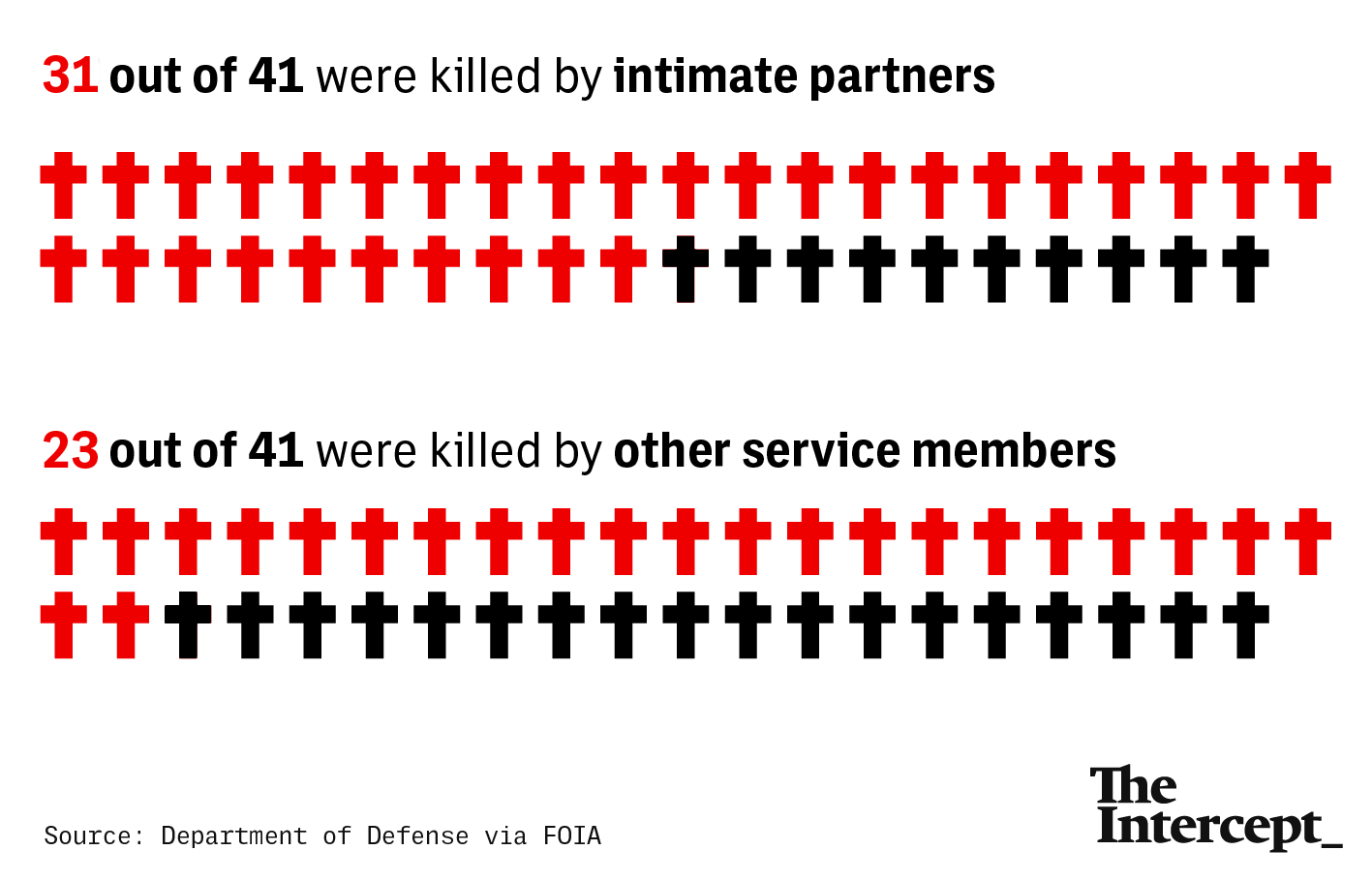
A first-of-its-kind analysis by The Intercept found that in the Army, women are more likely to be killed by their fellow service members than by enemy combatants, in a reversal of the threat soldiers are trained to face. Between 2011 and August 2025, at least 41 women died by homicide in the Army — more than half of them at the hands of other service members or veterans. Using Defense Department manpower data to calculate per capita death rates, The Intercept found that active-duty Army women face a higher risk of homicide than male soldiers, the opposite of national and global trends.
The Intercept found that active-duty Army women face a higher risk of homicide than male soldiers.
In many cases, women in the Army are killed by current or former romantic partners. Over 70 percent of victims had an intimate relationship with the perpetrator at one point, and the rate of homicides among women soldiers from intimate partner violence is at least three times higher than the national average. In others, like Roque’s case, it’s unclear how male soldiers chose their victims.
“There was no connection between Sarah and Rancy. They never spoke, never texted, and their paths never crossed,” said Ana Roque. Given that Rancy was convicted of murder in February, Roque added, “I can’t complain about the prosecutors, they did their job. But my grievance is that they didn’t push to uncover the truth behind why he did it.’”
Research points to the military’s hypermasculine culture, which historically devalues women, as a contributing factor to high rates of violence against them. But the existing scholarship is insufficient, said Erin Siegal McIntyre, a journalism professor at the University of North Carolina at Chapel Hill who has spent years digging into the hidden structures of militarized institutions.
“There’s no way to know how bad the problem really is,” Siegal McIntyre said. “There is an abysmal amount of data collected on domestic violence perpetrated by law enforcement officers, for example, many of whom are former military.”
Homicides of women in the Army by type of perpetrator. Fei Liu / The Intercept
Analyzing over 14 years of Defense Department death data obtained through a Freedom of Information Act request, The Intercept’s investigation is the first to compare rates of violence against women in the Army to factors like duty location, jobs, and relationships with perpetrators. The FOIA data also reveals deaths not previously announced by the Army and the Department of Defense.
Violence against women in the military also appears to take a mental toll. In addition to the 41 women who died by homicide, another 128 died by suicide, the majority of them lower-ranking enlisted soldiers. From 2011 to 2024, the last complete year of data, homicide and suicide rates for women in the Army were double their equivalents for women nationwide.
The Army doesn’t make any of this public, and the Intercept’s investigation has found flaws in what data collection currently occurs: Homicide and suicide death rates are not separated by gender or calculated per capita, preventing deeper analysis and comparison.
There’s also nothing publicly accessible on how many homicides are committed by service members, who their victims are, or where homicides occurred. The Defense Department’s annual suicide report doesn’t note how many of the deceased had experiences with sexual assault or harassment.
Meanwhile, systems meant to protect women are being rolled back and dismantled.
In September, Defense Secretary Pete Hegseth eliminated the Defense Advisory Committee on Women in the Services. It had existed for nearly 75 years, focusing on issues including sexual harassment and assault. In January, he ordered a six-month review of women in combat roles. In April, a woman who had been a whistleblower on sexual harassment within the Army Special Operations community was accused of sharing classified information and arrested by the FBI. Hegseth has also intervened to block the promotions of women officers.
In a statement to The Intercept, a spokesperson for the Army denied that its protections were insufficient.
“The Army has several programs and policies to protect service members who experience sexual assault or domestic violence,” said Army spokesperson Heather Hagan.
A Pattern of Abuse
When Spc. Mayra Diaz was assaulted on the Army base at Fort Hood, Texas, she was lucky to survive.
Diaz was blindfolded, with her hands bound over her head, having water poured on her face — “waterboarding me and causing me to choke,” Diaz later wrote. Her attacker “then wrapped a cord around my neck in an attempt to kill me.”
The assailant was a superior, Sgt. Greville Clarke, who knocked on her door at the barracks before threatening her with a pistol and raping her during the attack. The Army knew two other women had been assaulted at the barracks in similar attacks; officials chose not to issue a public warning, citing concerns about compromising the investigation and causing potential panic.
The problems of homicide and suicide among women in the Army are inextricable from the prevalence of sexual assault. In some cases, like Diaz’s, a sexual attack involves an attempt on a woman’s life. Rape and sexual abuse are known to be detrimental to mental health, increasing the risk of suicide or self harm.
“There’s a huge correlation between sexual assault and suicide rates,” said Josh Connolly, senior vice president of Protect Our Defenders, an advocacy group for victims of military sexual trauma. “It’s unambiguous — sexual assault rates are higher than in the civilian world.”
The Intercept’s investigation found suicide is the leading cause of death of Army women.
Male soldiers faced a smaller increase in suicide rates compared to civilian men than Army women did compared to civilian women, and men in the Army have a lower risk of dying by homicide than their non-military counterparts.
In fact, The Intercept’s investigation found, suicide is the leading cause of death of Army women.
Some cases have made national headlines, such as the March 2023 death of Pvt. Ana Basaldua Ruiz at Fort Hood, who took her own life at 20 years old after reporting sexual harassment.
For Ruiz’s family, the timing of her death raised troubling questions, echoing fellow Fort Hood soldier Vanessa Guillén’s infamous 2020 murder by an Army specialist. A subsequent Army inquiry into Ruiz’s case, reported by Telemundo, pointed to a “persistently toxic culture permissive of harassment.”
[
Related
Army Sergeants at Fort Hood Fear for the Safety of Their Soldiers](theintercept.com/2020/…/fort-hood-army-deaths/)
Years earlier, in the wake of Guillén’s death, an independent review revealed “a total disregard and disrespect for female soldiers.” Investigators issued 70 recommendations, including a sweeping overhaul of the military’s sexual harassment and assault prevention programs.
But the violence didn’t stop. Women at Fort Hood continued to experience a grim roll call of harm: Homicide. Sexual assault. Suicides.
Three deaths at Fort Hood were never reported publicly by the Army but appeared in the data obtained by The Intercept.
Counting Guillén and Ruiz, there were nine fatalities from homicide or suicide among women stationed at the base in five years. The Defense Department’s most recent suicide report does not provide data on how many suicide decedents experienced sexual trauma, although the Pentagon has provided this data in previous years.
From 2001 to 2023, nearly 1 in 4 women service members experienced sexual assault, according to the Brown University’s Costs of War project, much higher than the numbers annually reported by the Pentagon. Research identifies those experiences as a key driver of suicide risk. Over the past two decades, suicide rates among women veterans have risen faster than among men.
In Diaz’s view, institutional failures were a key factor in her assault.
“Because the Army took no action to address the string of female soldiers attacked in their barracks,” Diaz wrote in a federal tort claim, “Sergeant Clarke was empowered to continue preying on the female soldiers at Fort Hood, including me.”
Clarke assaulted five women before he was apprehended October 2022 and convicted in 2025 of charges including attempted premeditated murder. He died by suicide in custody.
Diaz was “in a U.S. Army base in a locked barracks, opening the door to someone in uniform. It was very reasonable for her to think that that was a safe thing to do,” Christine Dunn, an attorney representing Diaz, told The Intercept. “You don’t expect someone who’s in a uniform to be a serial predator.”
“Sergeant Clarke was empowered to continue preying on the female soldiers at Fort Hood, including me.”
Diaz wrote that leadership denied repeated requests to move her into family housing off-post, and only after she and her sexual assault representative made clear that remaining in the barracks was “an untenable environment” was she finally allowed to leave.
“I suffered from extreme paranoia, exacerbated by my attacker remaining at large,” Diaz wrote. “I abused alcohol in an attempt to forget what happened to me. … I began going to weekly therapy but have stopped going because I still find the attack very traumatizing to talk about.”
The Army did not provide comment on Diaz’s case or reports of Clarke’s predation specifically.
The anxiety, Diaz wrote, has never fully gone away.
“What happened to me was a result of the United States Department of the Army’s and the Department of Defense’s negligence,” her complaint stated. “It was entirely preventable.”
False and Frivolous
Last year, Pete Hegseth directed the Army to change its 15-6 regulation, which governs the process for investigating military-related misconduct like sexual harassment. Now the first step is verifying the “credibility of accusers with new disciplinary measures for soldiers who submit knowingly false or frivolous complaints.
Some fear the rule may discourage those experiencing sexual harassment from reporting incidents, perpetuating a “culture of victim blaming,” according to Protect Our Defenders’ Connolly.
[
Related
Pentagon Considers Cutting Its Sexual Assault Rules](theintercept.com/…/pentagon-trump-sexual-assault-…)
While Hegseth rolls back protections, the issue of violence against women in the military appears to be getting worse. The Intercept’s analysis shows that from 2011 to 2020, the per capita rate of women dying by suicide or homicide in the Army was 15 per 100,000. From 2021 to 2024, following the Army’s attempted reforms in the wake of Vanessa Guillén’s killing, the rate increased over 35 percent, to 21 per 100,000.
And deaths continued their pace in 2025.
Siegal McIntyre, the UNC professor studying domestic abuse, pointed to cases like that of Sgt. Francine Martinez, who was just weeks away from her 25th birthday on a night out at Fort Hood in September 2021, when she ran into the father of her child. He was a fellow soldier with whom she had recently separated, and Martinez had filed for child support weeks earlier.
An argument broke out, and when Martinez got into a car to leave, he followed, and eventually shot her in the head. She was hospitalized for two weeks before dying from her injuries, leaving behind her 1-year-old.
Research and Pentagon data indicate that rates of domestic and intimate partner violence in the military, particularly in the Army, are higher than the civilian population. Most victims are women, who also make up most of the homicide cases tied to that violence.
Fei Liu / The Intercept
Martinez’s death was one of three cases the Defense Department reported in 2021 in which service members killed someone in a domestic or interpersonal dispute.
But data compiled byThe Intercept identified at least seven cases that year in which service members were suspected of killing a spouse or partner in acts of domestic or intimate partner violence — more than double the official count.
“When the situation involves a marriage or partnership between agents and service members, it only complicates reporting,” said Siegal McIntyre.
A Naval Criminal Investigative Service report from 2021 suggests the number could be higher still, identifying several additional domestic violence-related homicides. The Intercept’s investigation also found other years’ congressionally mandated reports also have data tracking problems.
A Project on Government Oversight investigation revealed thousands of abuse cases involving Army personnel were mishandled, many never entered into tracking systems. Investigators could only look at 10 out of more than 60 Army installations. A GovernmentAccountability Office report found the Pentagon doesn’t reliably screen for sexual assault when service members seek care or leave service and lacks systems to prioritize treatment or ensure confidential, long-term support.
“I don’t think there’s a mechanism within the Army for holding itself accountable,” said Dunn, who is also representing some of the 80 victims suing Army gynecologist Maj. Blaine McGraw, who was assigned to Fort Hood in 2023; he has since been accused of recording and making harmful physical contact with women during gynecological exams. (The Army did not comment on McGraw’s case, which remains ongoing.)
Some women who came forward had gone to McGraw seeking rape kits for sexual assault and say his actions further traumatized and distressed them.
“When the institution is facilitating the assaults and allowing them to happen, the institution needs to be held accountable,” Dunn said. “Almost every client who comes to me wants to come forward so that this wouldn’t happen to other women.”
A Failing System
In response to questions from The Intercept, the Army acknowledged having recorded more homicides than were noted in the dataset provided based on The Intercept’s FOIA request.
Between 2021 and 2023, the Army recorded a total of 16 homicides among active-duty women, Hagan told The Intercept. The data provided to The Intercept for its FOIA request counts only nine.
Hagan did not respond to follow-up questions on the discrepancy, and the Army did not provide data outside the years 2021 to 2023.
But the additional homicides would make the disparities found by The Intercept’s investigation even wider. If the same pattern of undercounting extends across the full 14-year span of our data, the true toll could be substantially higher.
After the independent review of Fort Hood following Guillén’s killing, Hagan said, the Army “implemented a series of major reforms to strengthen prevention, reporting, and accountability for sexual harassment and assault.” It shifted its criminal investigations division to civilian leadership, requiring more independent investigations, establishing stricter missing-soldier response protocols, and expanding data-driven oversight of cases.
But the deaths have continued, including another homicide at Hood last year. To advocates, there are other solutions to address these failures.
“You have to call DoD into Congress and demand answers on why progress hasn’t been made,” said Connolly. “Congress could scrutinize the data on domestic violence and other issues. They can appropriate more resources to DV investigations and hold hearings.”
“The potential solution lies with how funding is or isn’t tied to oversight,” Siegal McIntyre said. “Without Congress doing its job, nothing can change.”
Rep. Chrissy Houlahan, D-Pa., a House Armed Services Committee member and Air Force veteran, said The Intercept’s findings reflect a broader failure of leadership and oversight.
“This report is staggering, and unfortunately, unsurprising,” she said. “Servicewomen consistently bear the brunt of harassment, assault, retaliation, and systemic failures within the ranks, and it is costing them their careers, their safety, and in far too many cases, their lives.”
In a 1995 Defense Department study on homicide victims by gender, female service members across active-duty branches were killed at higher rates than both their male counterparts and women nationally. A Marine Corps and Navy-specific study covering 1995 to 1999 found similarly elevated risks.
The Pentagon never did further analysis. Ana Roque believes that change would fundamentally start with how the military builds itself to protect women like her daughter.
“I understand that the country needs soldiers, but recruiters need to be more careful regarding where these individuals come from,” Roque said. She called for more police and camera surveillance on bases, arguing that if it had been present, “they could have seen him moving my daughter’s body in broad daylight.”
She wishes she could have her daughter back.
“She always had a smile, no matter how difficult her day was,” Roque said. “She made time to help colleagues with various issues and never said no. I have many stories written in my notebook from soldiers and civilians who knew her and told me, ‘She saved me,’ simply by taking a minute to listen to them. She loved her family; we would talk three times a day: at 7 a.m., during my lunch break, and at night, when she would always say ‘Good night, Mommy.’”
How we analyzed the data
Reporters working for The Intercept submitted Freedom of Information Act requests to the Pentagon seeking data on all U.S. Army active-duty noncombat deaths from 2011 through August 2025. In response, the Department of Defense provided a spreadsheet detailing 5,285 U.S. Army deaths over the 14-year period categorized by rank, gender, military occupation, and cause of death. The latter was classified as either illness, self-inflicted, accident, pending, or undetermined.
To calculate the per capita suicide and death rates for women in the U.S. Army in this time period, The Intercept pulled manpower data from the Defense Department for each year in our analysis to provide the total number of women in the Army. National and international data on homicide and suicide was pulled from the FBI Crime Data Report, United Nations Office on Drugs and Crime, and the Centers for Disease Control and Prevention in order to compare suicide and homicide rates.
There is no publicly available equivalent data for Army veterans, nor has such an analysis been done for the Navy, Air Force, or Marines.
The 988 Suicide & Crisis Lifeline offers 24-hour support for those experiencing suicidal thoughts or for those close to them, by chat, text, or telephone. Service members can dial 988 and press 1 to reach the Military and Veterans Crisis Line. Support is free and confidential.
The post Women in the Army Are More Likely to Be Killed by Fellow Soldiers Than Enemy Combatants appeared first on The Intercept.
From The Intercept via This RSS Feed.

cross-posted from: news.abolish.capital/post/60287
The U.S. Capitol building on May 20, 2026 in Washington, D.C. Photo: Samuel Corum/Sipa USA via AP Images
Democrats and Republicans in Congress have struck a deal on a bill they say will help keep children and teens safe online. The KIDS Act could pass on the House floor as soon as next week; if enacted, it would fundamentally change the way everyone — not just kids — accesses the internet.
At stake is your ability to use many social media platforms without revealing your identity.
That’s because the KIDS Act at least strongly incentivizes — and, for some services, outright requires — age verification. Many platforms will turn to age verification to avoid potential liability under the law. Companies like X, video-sharing services like Vimeo, and others with a history of users’ populating social feeds with edgy content may be required to verify users’ ages because they host a certain amount of content deemed “sexual material harmful to minors,” a term that the KIDS Act defines broadly.
[
Related
Congress Is Considering Abolishing Your Right to Be Anonymous Online](theintercept.com/…/kosa-online-age-verification-f…)
That’s a big problem for people who need to be able to use the internet anonymously, since, as Taylor Lorenz has previously written about in The Intercept, “there’s no way to reliably verify someone’s age without verifying who they are.”
Threats to online anonymity harm everyone, but one group is often overlooked: journalists and the sources who talk to them. Age verification requirements will help the Trump administration carry out its vendetta against the press by creating new avenues to identify journalists’ confidential sources.
Age verification laws will create a new pool of data that the government can demand when it’s hunting for information about the people who may have spoken to the press.
Trump’s administration has made no secret of the fact that it wants to destroy journalism that holds it to account, including by unmasking sources and punishing them. This week, for instance, news broke that the Department of Justice had unsuccessfully subpoenaed reporters from the Washington Post and Wall Street Journal, likely as part of a leak investigation.
But what if it could skip the journalists and simply demand that tech companies identify sources who may have spoken to reporters using their platforms?
[
Related
Washington Post Raid Is a Frightening Reminder: Turn Off Your Phone’s Biometrics Now](theintercept.com/…/washington-post-hannah-natanso…)
The risk isn’t hypothetical. The first Trump administration abused its authority to spy on journalists to figure out who they’re talking to, including online. The second Trump administration has already repeatedly attempted to unmask its critics online and raided a journalist’s home and seized the devices she used to communicate with her sources.
In the face of these risks, using secure communication methods, like Signal or SecureDrop, can help. But some sources may still reach out to reporters through social media. As a result, age verification laws will create a new pool of data that the government can demand when it’s hunting for information about the people who may have spoken to the press.
The most common methods of age verification rely on the collection of government IDs to verify a user’s date of birth with certainty. The KIDS Act says it won’t require platforms to collect government IDs, but at least some platforms will likely choose this route to comply with the law or offer it as a fallback approach when other methods inevitably fail.
But online anonymity isn’t assured even if platforms use other ways to verify users’ ages. Even so-called “privacy-preserving” approaches risk exposing users’ identities and undermine anonymity. All of the methods ultimately require platforms to collect, process, and retain more data on all users, raising the risks for anonymous sources who use online platforms to contact reporters.
[
Related
A Redditor Criticized ICE. Trump Is Trying to Unmask Them by Dragging the Company to a Secret Grand Jury.](theintercept.com/…/reddit-ice-protest-grand-jury/)
Age verification laws will also make it difficult or impossible for journalists to use anonymous social media accounts to gather information, like sock puppet accounts used to infiltrate and report on online extremist groups, or to avoid surveillance by the very Big Tech companies they’re reporting on. Reporters outside the U.S. who publish anonymously on platforms like X or Facebook to avoid the wrath of autocratic regimes will also find those entry points vanish.
Requiring platforms to collect less data, not more, is a better approach.
Pools of incredibly sensitive identity data also creates an enticing “honey pot” of information that malicious actors could use to target, intimidate, and chill journalists from pursuing certain stories or sources from speaking to them. Already, many age verification providers have been breached, leaking users’ sensitive data and allowing others to link online activity to users’ offline identity. Age verification companies may also grant access or sell the data they collect to others, like payment processors, creating another avenue for data breaches.
Many Democratic lawmakers recognize that journalism is under threat from the Trump administration. Rep. Frank Pallone, the ranking member of the House committee that reached the deal on the KIDS Act, has rightfully blasted the Federal Communications Commission for abusing its power to destroy press freedom and free speech, for instance. So why would he and other Democrats now support legislation that serves the same anti-press agenda?
Proponents of the KIDS ACT, and similar bills in the Senate, say these laws are necessary to protect children. But the truth is that age verification requirements are bad for everyone, including children. Why should we trust platforms with even more personal information, including from kids, when so many companies already use that data to target ads or share materials with law enforcement agencies that users believed was private?
[
Related
Google Fulfilled ICE Subpoena Demanding Student Journalist’s Bank and Credit Card Numbers](theintercept.com/…/google-ice-subpoena-student-jo…)
That’s not to say that platforms shouldn’t be required to do more to actually protect children online — they should. But comprehensive privacy legislation that protects everyone and requires platforms to collect less data, not more, is a better approach.
Mandating age verification, in contrast, effectively hands Big Tech and the government a skeleton key to the identities of every whistleblower, dissident, and investigative reporter who uses online platforms, not to mention everyone else, including children. This kind of surveillance on steroids that surrenders our right to speak, report, and read the news anonymously won’t make anyone safer.
The post Online Age Verification Law Could Kill Whistleblowing appeared first on The Intercept.
From The Intercept via This RSS Feed.
cross-posted from: lemmy.bestiver.se/post/1193273
cross-posted from: lemmy.bestiver.se/post/1193273


cross-posted from: news.abolish.capital/post/59388
Over the last year, Drop Site has been reporting what mainstream outlets won’t: Jeffrey Epstein’s deep ties to powerful figures in the U.S. government, the UAE, and Israel.
When you expose that kind of power, those powerful interests come after you.
Our Epstein investigations are ongoing. But we can only continue if we have the resources and legal protection to defend this work.
We don’t answer to advertisers worried about powerful governments. We don’t have billionaire owners with business interests to protect. We answer only to you.
That’s why we can publish the Epstein investigations that mainstream outlets won’t touch. And that’s why we need your support to defend them when those powerful interests come after us for publishing them.
If you value this reporting, can you make a tax-deductible donation today to help us keep going?
A photograph of former Israeli Prime Minister Ehud Barak and Joseph Epstein in an undated photograph released by the U.S. Department of Justice.
Former Israeli Prime Minister Ehud Barak coordinated closely with convicted sex offender Jeffrey Epstein in pursuit of mineral, oil, and gas resources in Africa after Barak’s resignation as Israel’s defense minister in 2013, according to documents published by the U.S. Department of Justice and hacked emails from Barak’s Gmail account reviewed by Drop Site News.
Epstein played a pivotal role in Barak’s transition from the military to the private sector by packaging privatized Israeli intelligence services for sale to police states around the world. Together, the two men marketed security and surveillance products to foreign governments seeking to stabilize civil conflicts during the tumultuous early 2010s.
Email correspondence shows that Barak also drew on his lifelong Israeli intelligence connections to help expand his business footprint in Africa, including the services of former Mossad chief turned private military contractor Danny Yatom. Yatom served as director of the Mossad from 1996 to 1998, and became Barak’s top security adviser, followed by time in the Knesset until 2008. Since then, he has consulted for and served on the boards of various private security firms such as Global Strategic Group, a small outfit operating in central Africa led by several Israeli intelligence veterans from the Mossad and Shin Bet.
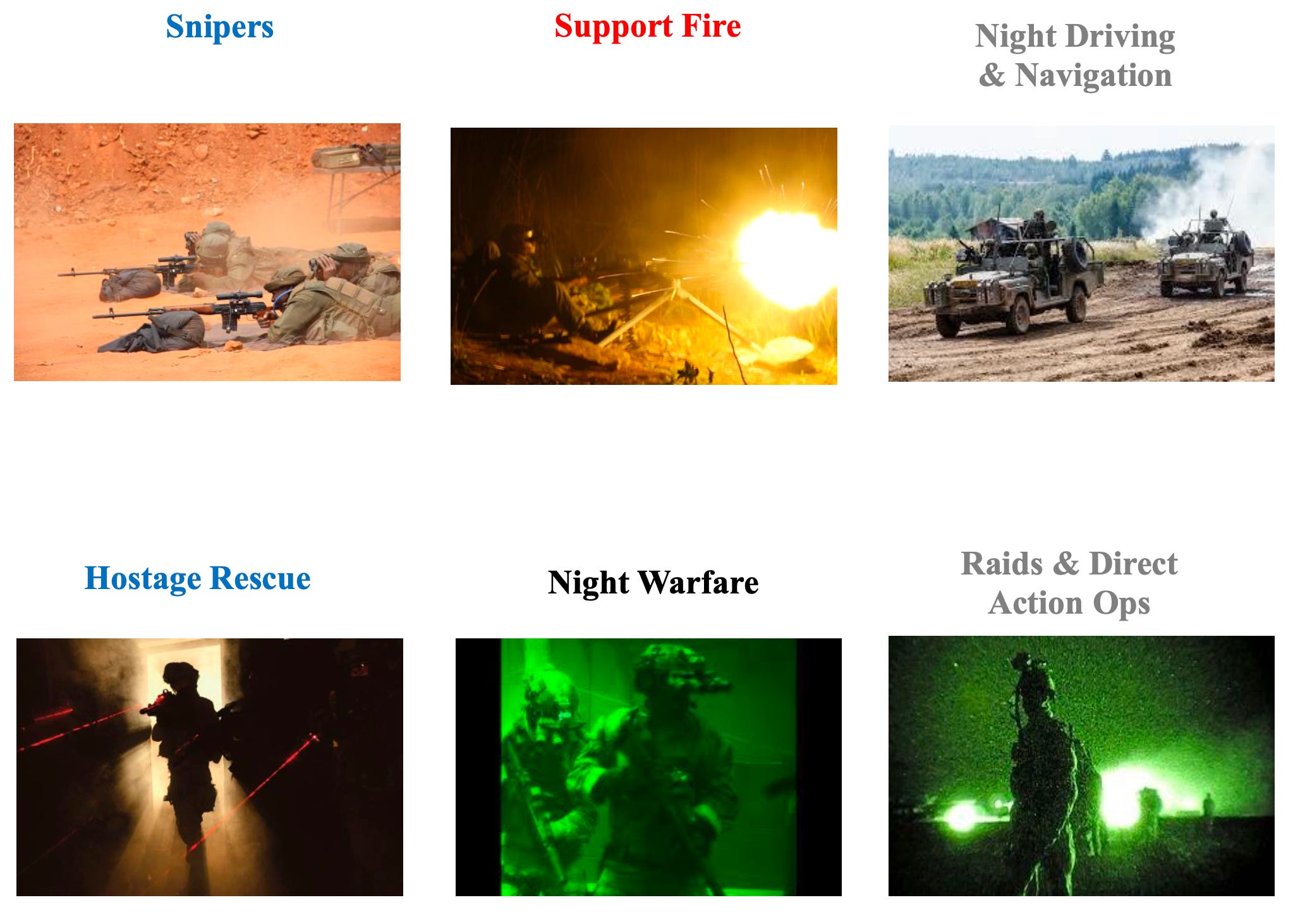
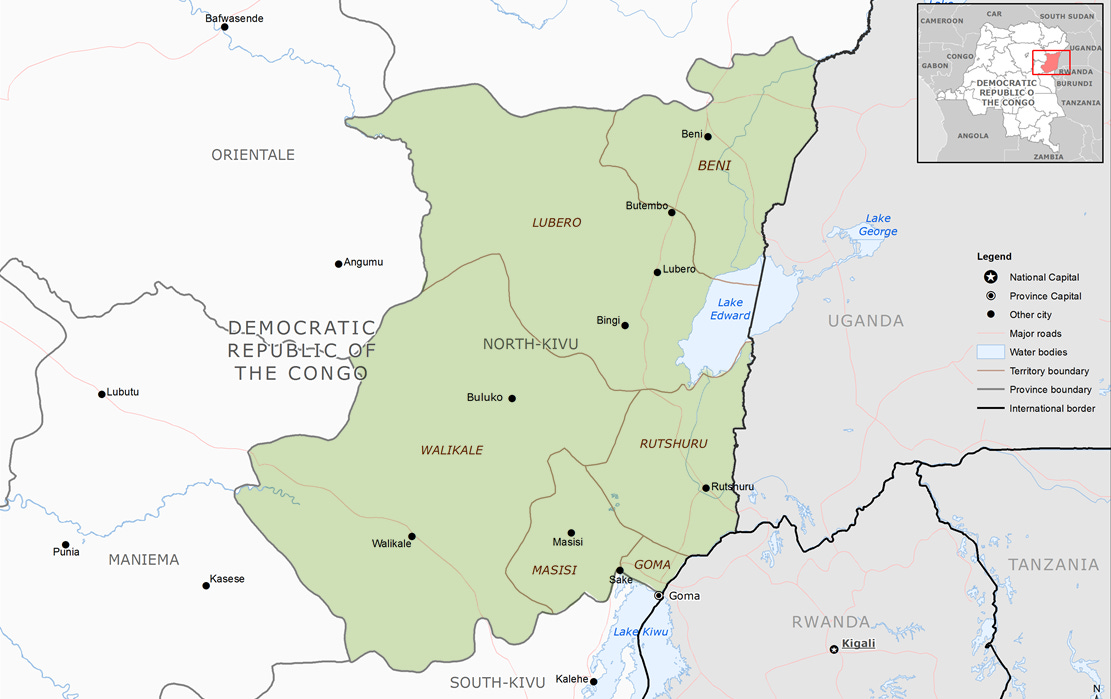
A proposal for a “Night Warfare Special Operations Unit” that was included in Barak’s Gmail account reveals that Global Strategic Group trained an elite special operations unit in the mineral-rich eastern regions of the Democratic Republic of the Congo in 2013. The proposal, marked “classified,” included a case study of the Kivu conflict in which Yatom boasted that their firm’s training had turned the tide against the rebel March 23 Movement (M23) and ended the war.
The Congo case study and other communications from Barak’s inbox showing his contacts with Epstein and Yatom were published by non-profit whistleblower Distributed Denial of Secrets, as part of a series of document dumps from Handala, a hacking group with suspected ties to Iran’s Ministry of Intelligence and Security. The cache has been independently vetted and verified by Drop Site News.
Yatom, who has denied that he ever met Epstein, did not respond to a request for comment. Aside from their mutual connection with Barak, no public information connects Yatom to Epstein.
From a July 2014 “Night Warfare Special Operations Unit” proposal by Danny Yatom’s Global Strategic Group, in a section entitled, “General Capabilities of the Unit (Night and Day).”
“Isn’t This Perfect For You”
While Africa has garnered little attention in news coverage of Epstein’s sexual misconduct, the continent was central to his and Barak’s joint mission of obtaining and exploiting elite political access, cutting-edge artificial intelligence infrastructure, and energy and mineral resources. Drop Site has previously reported on Epstein’s role in brokering a security deal between Israel and Cotê d’Ivoire, and a logistics deal between Nigeria and the Dubai-based shipping conglomerate DP World.
The Handala files contain thousands of records concerning Barak’s and Epstein’s efforts to control oil, gas, and minerals across the African continent during the 2010s by leveraging Barak’s credentials as the widely respected head of the Israel Defense Forces. “With civil unrest exploding in ukraine syria, somolia, libya, and the desperation of those in power,” Epstein wrote in a 2014 email to Barak, “isn’t this perfect for you.” Barak replied, “You’re right [in] a way. But not simple to transform it into a cash flow.”
That cash flow came from the financial interests fueling the wars. As an Israeli-trained force fought M23 in the hills of North Kivu in the spring of 2013, emails show that Epstein’s Emirati associate Sultan Ahmed bin Sulayem was opening a separate channel to Joseph Kabila, then Congolese president, over investments in mining, oil, gas, and transport infrastructure. By 2018, in the year before his death, Epstein was quietly involved in sanctions diplomacy around the U.S. Treasury Department’s crackdown on an Israeli mining kingpin profiting from Congo’s conflict minerals.
In the summer of 2014, with close guidance from Epstein, Barak was engaged with security officials in Ghana, Nigeria, and Côte d’Ivoire, while simultaneously negotiating strategic investments in ports and petroleum assets across West Africa. On July 28, 2014, emails show that Yatom supplied Barak with sales materials to promote Global Strategic Group as a private-sector provider of military training and operational support.
Yatom’s company offered a special operations unit that had been provided to Congo’s army during the first war against M23 from 2012 to 2013. The program trained a “Tier One Strike Force” counter-terror squad, a 150-person elite unit trained for night raids, ambushes, counter terrorism, hostage rescue, sniper operations, thermal observation, and direct-action missions.
The Congo case study claimed the Israeli-trained unit had carried out repeated night operations under fire in North Kivu and that those raids helped shift the battlefield in favor of the Congolese army. Emails published by Wikileaks show that Nir and Omer Yatom, Danny’s sons, had also engaged Italy’s notorious Hacking Team to purchase cyberweapons “for state use” in the Congo during the same period, in the spring of 2013.
Since Epstein’s death, the conflict over Africa’s natural resources has entered a new chapter, as the United States seeks to actively counter China’s dominant role in the Congo’s mining sector. On April 27, 2026, Congo’s mining agency announced the creation of a new paramilitary army to secure mines and mineral supply chains.
The mining security program was described as a $100 million initiative in partnership with the United States and the United Arab Emirates, with a target of more than 20,000 personnel by the end of 2028. The U.S. Embassy in Kinshasa has denied that Washington was funding the mine security force. Separately, Congo also agreed to accept people deported from the United States.
Washington is now eyeing Congo’s rich deposits of coltan ore. Coltan is used to manufacture tantalum capacitors, capable of delivering power to electronics in hot environments, like e-cigarette vape pens and densely packed servers in data centers. The Rubaya coltan mines in North Kivu, near the city of Goma on Congo’s eastern border with Rwanda, are controlled by the M23 Movement, the Rwandan-backed coalition that has seized large parts of eastern Congo.
On April 30, 2026, the U.S. Treasury Department imposed sanctions on Kabila for his alleged support for the M23 rebels. But, more than a decade ago, Kabila was leading the Armed Forces of the DRC in the fight against the M23 Movement. The war in eastern Congo has become one of the world’s deadliest and most intractable conflicts—one which multinational mining companies and private military contractors tied to Israeli intelligence have been eager to exploit.
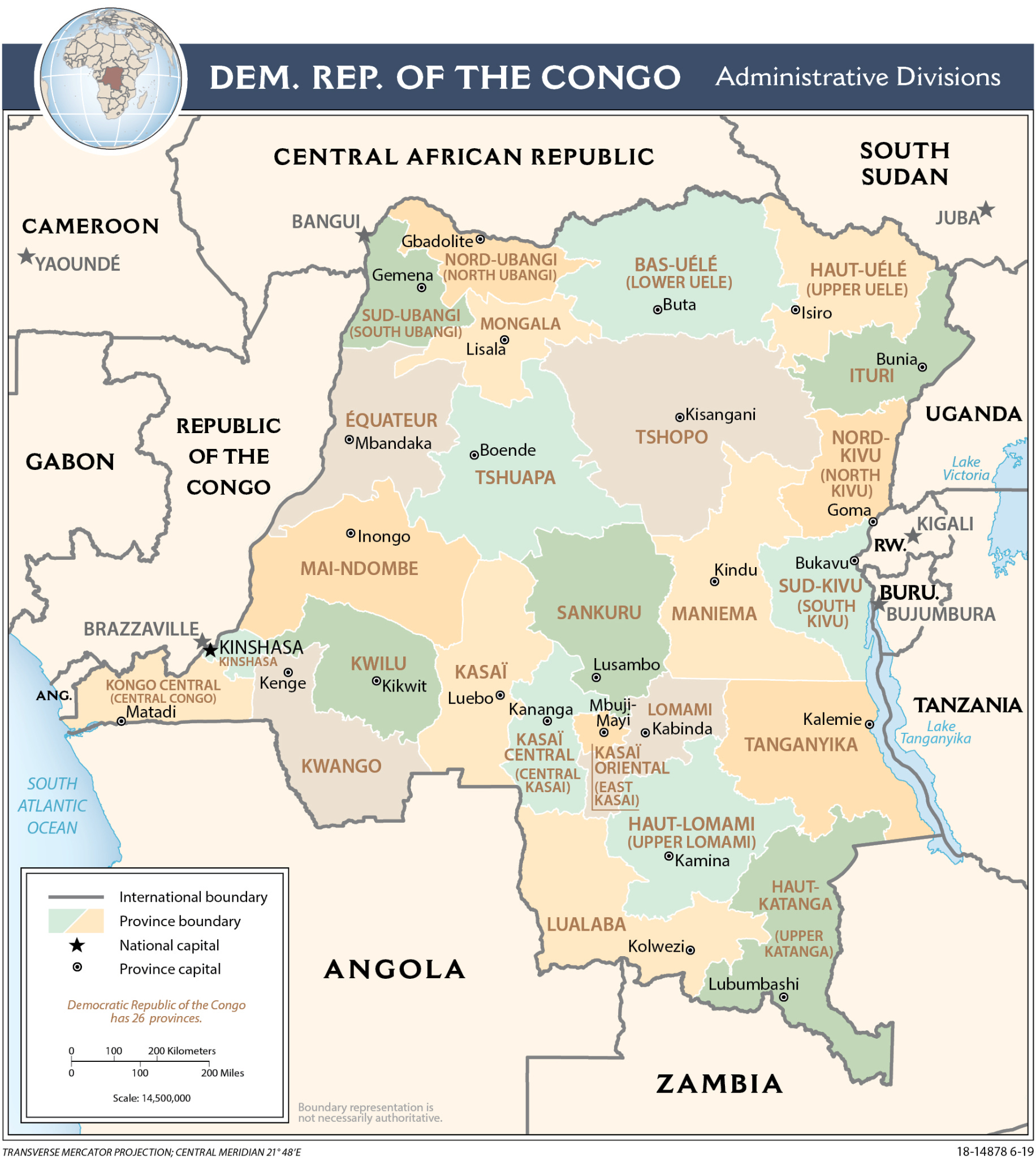
Administrative map of the Democratic Republic of the Congo, 2021. Image: CIA.
Africa’s World War
Epstein and Barak’s interest in the Congo emerged from a long history of American and Israeli intelligence agencies seeking to extract valuable minerals from the former Belgian colony. To prevent the Congolese independence movement from seizing the country’s mining resources, the CIA and Belgian officers helped assassinate Congo’s first prime minister in 1961. The new Belgium-backed government formally nationalized the mining sector, but allowed foreign firms to maintain influence through loans and technical expertise, and invited the Israeli military to train the army.
Amid rampant corruption and state-sponsored looting, Congo’s mining production collapsed in the 1990s. In the aftermath of a genocide in neighboring Rwanda, Congo became the site of a multi-sided civil conflict that became known as “Africa’s World War.” The war drew in the armies of nine African nations, and many more armed militias, leading to millions of deaths. As the conflict expanded and threatened the rule of the central government, foreign mining interests stepped in to support then-Congolese ruler Laurent Kabila, turning mining deals into a bargaining chip for his regime’s survival.
Among those investors was Dan Gertler, a Israeli diamond trader whose grandfather had founded the Israel Diamond Exchange. A UN report from 2001 claimed that Gertler made a deal to help Kabila access Israeli weapons and military training in exchange for a monopoly on Congo’s diamonds—a deal based on the “special ties” the report said that Gertler enjoyed with “some generals in the Israeli army.”
Reached for comment, lawyers representing Gertler denied that he had helped Kabila obtain Israeli military support and claimed that the deal was merely made to help boost the Congolese treasury and help the country fight smuggling by militia groups. The same UN report noted that the agreement turned out to be “a disaster for the local diamond trade,” citing sources that claimed no military support was ultimately provided.
In 2001, Kabila was assassinated by his own bodyguard in the presidential palace, and his son Joseph took power. During the spring of 2002, the younger Kabila appointed Gertler as his special emissary to the U.S. government, and Gertler met with National Security Advisor Condoleezza Rice to seek the Americans’ help in ending the war. In July 2002, a peace agreement was signed in Pretoria mandating the withdrawal of Rwandan troops—but the conflict in the Kivu region of the country was never fully settled.
After the war, Congo’s state-owned mining company, Gécamines, still controlled the mines in the southeastern copperbelt, but the company was insolvent and needed funding to make the mines profitable. Kabila’s government sold off a large share of the copper-cobalt belt to Gertler and his French-Israeli business partner, Beny Steinmetz, to rehabilitate the mines. Chinese state-owned companies also provided financing and built infrastructure through a new mining joint venture called Sicomines.
During the 2008 global financial crisis, mineral prices fell sharply as global demand collapsed, and Gécamines was forced to sell off more of the copperbelt. In February 2009, Glencore gave a secret $45 million loan to Gertler’s company in exchange for political access to Kabila’s camp, according to a contract published in the Paradise Papers leak. Glencore used that access to buy more of the mines in the Katanga region, increasing its ownership stake to nearly 80%.
Glencore declined to comment for this story.
The market crash also put pressure on Kabila’s government to make peace with the rebels in eastern Congo. The month after Glencore’s bailout, on March 23, 2009, the National Congress for Defense of the People (CNDP), a major North Kivu armed movement, struck a deal with Kabila’s government to form an official political party and integrate into Congo’s national army.
Kabila broke up the CNDP structure, but he struggled to discipline and control the ex-CNDP officers within the national army. Facing redeployment away from the Kivus, and loss of control over checkpoints and mineral routes, a group of ex-CNDP officers broke away and formed the “March 23 Movement” in 2012. The M23 forces humiliated the army and briefly took control of Goma in November 2012.
A U.N.-backed offensive against M23 began in March 2013, splitting the rebels’ forces across roads, hills, and towns, pressured by artillery, rockets, and helicopters.
The tactical unit trained by Israeli mercenaries, according to Yatom’s report that was shared with Barak, gave the Congolese army an elite strike force able to move after dark, identify rebel positions, and conduct raids under fire, while the broader U.N.-backed campaign pushed the rebels back toward the Rwandan border.
Stabilizing the security situation opened investment opportunities that a network of individuals connected to Jeffrey Epstein was keen to exploit.
As the tide turned in the Kivu war, emails show that Epstein asked Sultan Ahmed bin Sulayem, his close friend and chairman of the U.A.E. logistics conglomerate DP World, to arrange a meeting with Kabila. At the time, DP World was steadily advancing conversations with Kabila for investment in a deepwater port on Congo’s short western coastline. “He wants to give us investment in mining and oil and gas,” Sulayem wrote to Epstein in May 2013, two months after the U.N. offensive began. “I mentioned to him that I have an American fund manager who will visit with me next time; he welcomed that very much.”
Map of North Kivu province in eastern Democratic Republic of Congo. Image: Wikimedia Commons.
“Strong Men”
In December 2013, the M23 Movement surrendered and laid down arms. Soon after the end of the war, in March 2014, U.S. Secretary of State John Kerry went to Kinshasa, pledging $30 million to support Congo’s elections and encourage a peaceful transition of power. Russ Feingold, Kerry’s special envoy for Africa, issued a clear warning to Kabila that stabilizing the country depended on a succession plan and enforcement of term limits. “President Obama, when he was here last year made a very important statement,” Feingold said, “What Africa needs is not strong men but strong institutions.”
But Kabila refused to leave. His family’s wealth was inextricably tied to the state, with stakes in more than 80 companies across mining, banking, agriculture, telecoms, and logistics sectors. Kabila’s camp delayed elections for three years by proposing constitutional changes, initiating a new census, and de-funding the electoral process.
In 2016, the U.S. Treasury Department sanctioned several police and military officials responsible for violently suppressing popular street demonstrations against Kabila. The U.S. Justice Department filed a conspiracy case against a New York hedge fund linked to Gertler, and collected nearly $1 billion in criminal penalties related to bribery cases across Africa under the Foreign Corrupt Practices Act. Glencore quickly began buying out Gertler’s stake in its copper-cobalt mines in Congo’s far southeastern copperbelt.
Epstein jumped into a small circle of players engaged in privatized sanctions diplomacy around Congo’s mineral economy, which began immediately after Donald Trump’s 2016 presidential election victory over Hillary Clinton.
In December 2016, Kabila hired an Israeli defense-security and surveillance firm, Mer Security and Communication Systems, to lobby the new administration against additional sanctions. In the first year of Trump’s first term, the Treasury Department ratcheted the pressure on Kabila by sanctioning Gertler, who had become an indispensable political intermediary to Congo’s mineral economy. Treasury officials claimed Gertler used his friendship with Kabila to manipulate mining and oil deals, causing the Congo government to lose more than $1 billion from underpriced asset sales.
Kabila tried to show outside investors and Washington that his government remained the essential custodian of Congo’s mineral wealth. In March 2018, he asked Sulayem, the chairman of DP World, to immediately come to Kinshasa to sign a concession agreement for the Banana port at the mouth of the Congo River on the Atlantic coastline. The sudden meeting caused Sulayem to cancel a planned appointment with Epstein in New York that week.
One month later, in April 2018, Glencore’s Africa business was impacted again by the Treasury Department when an additional round of sanctions was imposed on Oleg Deripaska, a Russian oligarch accused of money laundering, extortion, and bribery. Deripaska’s aluminum conglomerate, United Company Rusal, was formed through a merger with Glencore’s alumina assets and the Siberian aluminum assets of Viktor Vekselberg, another Russian oligarch with Israeli and Cypriot citizenship.
Barak and Epstein were intimately familiar with the circle of aluminum titans behind Rusal. After his retirement from Israeli government service in 2013, Barak became an adviser to Vekselberg, and Epstein helped him leverage the relationship to engage in backchannel diplomacy with Vladimir Putin during the Syrian civil war. Barak’s business partner in Africa ventures, Gary Fegel, had led the aluminum unit at Glencore, and served on the board of directors for Rusal after the merger.
Fegel did not respond to a request for comment.
One month after sanctions landed on Deripaska, Epstein was approached by Jide Zeitlin, then-head of Nigeria’s sovereign wealth fund, about helping Glencore navigate the crisis. At the time, Glencore was making bribe payments to the Nigerian government for favorable terms on commodity deals.
The Treasury Department’s move against Deripaska had major consequences for Ivan Glasenberg, the Israeli-South African CEO of Glencore, who was forced to resign from Rusal’s board of directors. “Do you know Oleg Deripaska or Ivan Glasenberg?” Zeitlin wrote to Epstein on May 4, 2018. “Easy,” Epstein replied.
Epstein suggested an “approved sanction structure” to lift U.S. sanctions on Deripaska’s companies by diluting his ownership. The oligarch would need the Treasury Department’s blessing to divest, such that his ownership did not look like a strawman arrangement. “If you had a meeting with the appropriate division of treasury,” Epstein replied to Zeitlin, “im sure you can structure around it.”
Epstein had personally advised the Treasury Department on the topic of sanctions evasion in the past, and he floated a few options that could preserve Deripaska’s economic value in Rusal, while satisfying the Office of Foreign Assets Control that Deripaska no longer controlled the assets: trusts, swaps, options, or debt. On May 11, 2018, Zeitlin wrote to Epstein from Zug, the location of Glencore’s global headquarters in Switzerland: “Good lunch today in Zug re sanctions solution. Interest piqued.” Epstein wrote back, “No surprise,” and congratulated Zeitlin, “Great work.”
Ten days later, Zeitlin sent Epstein an article about Glasenberg’s predicament in the Congo, as fears mounted that Gertler’s assets would be targeted and seized by regulators in the U.S. and the U.K. “Unfortunately for Ivan, he finds himself in an uncomfortable place,” Zeitlin wrote, on May 21, 2018. “This is complex and requires additional digging in Washington.” Epstein wrote back, warning Zeitlin, “This channel is NOT secure.” Later, he explained why it would take time to untangle Deripaska’s holdings: “Who owns what is not simple.”
By August, the eventual corporate restructuring of Rusal and its parent company, En+ Group, looked similar to Epstein’s proposal. Lord Greg Barker, a former British Tory politician and chairman of En+, authored a proposal that resembled the structures Epstein had floated to Zeitlin. Zeitlin forwarded the news to Epstein in August 2018, with a note: “Interesting that key aspects [of] their approach now mirror my proposal.”
In December 2018, the Treasury Department announced it was terminating sanctions on Rusal and En+, while keeping the sanctions on Deripaska in place. Deripaska’s divestiture solved Glencore’s sanctions problem by letting the company keep its ownership in Rusal and En+, and resume its Rusal-related aluminum trading. Epstein shared the Treasury notice with Ehud Barak on New Year’s Day in 2019, just months before his arrest and death in a Manhattan jail cell. In 2020, Rusal approved a $16 billion contract to supply aluminum to Glencore.
The AI “Treasure Map”
Israeli and American security channels in Congo have matured further in recent years.
Félix Tshisekedi was sworn in as Congo’s new president on January 24, 2019 in the first peaceful transfer of power in the country’s post-independence history. The election was highly contested, however, with widespread accusations of fraud and tampering, and the African Union casting “serious doubt” on the validity of the result. Foreign Policy reported that Kabila had reached a secret power-sharing agreement with Tshisekedi to maintain behind-the-scenes influence over the country’s legislature, cabinet, and security apparatus.
According to reporting in Bloomberg, Yossi Cohen, then-director of the Mossad, traveled to Congo in June 2019, accompanied by Gertler, to meet with both Tshisekedi and Kabila. Some of Tshisekedi’s aides became concerned that the Mossad was helping Kabila acquire arms for a possible coup d’état. (Lawyers for Gertler denied the meeting took place and claimed that Gertler has “no relationship whatsoever” with the former Mossad chief.)
After Cohen visited Kinshasa a second and third time in the following months with an even larger delegation, Tshisekedi ordered him to leave the country. The Guardian later reported that Kabila had agreed to support Cohen’s campaign to pressure the International Criminal Court to drop its investigation into Israel’s alleged war crimes in occupied Palestine.
By the end of 2019, the United Nations Group of Experts identified Israeli military instructors training Congo’s national army in the Goma area, while tracing vast sums of illegal gold smuggling to the United Arab Emirates from a nearby province in northeastern Congo. The U.N. received testimony from diplomatic and military sources and photographs of the instructors, in the same Kivu battlefield where Danny Yatom’s group had helped defeat M23 six years earlier.
In January 2021, after intensive lobbying from Epstein’s longtime lawyer Alan Dershowitz, the Treasury Department quietly eased the sanctions on Gertler in the final days of Trump’s first term. Two months later, the new Biden administration reversed the move, saying the decision was inconsistent with U.S. foreign-policy interests in combating corruption in Congo.
The unresolved status of Gertler’s sanctioned assets are now entangled in Tshisekedi’s new minerals-for-security channel with Washington. On February 3, 2026, Glencore and the U.S. and U.A.E.-backed Orion consortium announced a non-binding memorandum for Orion to acquire 40% of Glencore’s Congo platform, putting an American-Emirati investment group in line to acquire Gertler’s former copper and cobalt interests.
In a press release, the U.S. International Development Finance Corporation described the Orion investments as an opportunity to close “gaps in financing” that have allowed China to dominate mineral supply chains.
Meanwhile, Silicon Valley titans are taking advantage of the opportunity to harden the supply chain for America’s artificial intelligence boom. In the first three months of 2026, Amazon, Google, Microsoft, and Meta spent more than $100 billion on new capital projects, mostly large data centers powering artificial intelligence. The American tech giants have committed close to $700 billion for new capital projects this year, while the UAE has committed to support a $1 trillion investment framework in U.S. energy, AI, and manufacturing sectors over the next ten years.
KoBold Metals, an exploration company backed by Amazon founder Jeff Bezos, Microsoft co-founder Bill Gates, and OpenAI co-founder Sam Altman, launched a $50 million lithium exploration campaign in Congo in April, targeting extensive mining licenses from the Congo government. The company says it uses artificial intelligence to create a “treasure map” to find new deposits of copper, lithium, cobalt, and nickel.
In February, Kinshasa also added the rebel-held Rubaya coltan mine to the shortlist of strategic assets being offered to Washington. The private army of Blackwater founder Erik Prince recently worked with Israeli advisers to again train Congolese special-forces battalions to fight M23 in the Kivus. A source told Africa Mining Union that Prince’s security and logistics firm, Vectus Global, will likely be used to enforce revenue collection on the mines in the southeastern copperbelt.
The money and weapons flowing into the Congo signal no end in sight to the scramble for Africa’s precious minerals fueled by foreign militaries. And with the sale of Congo’s mines to foreign interests, including members of Barak’s and Epstein’s extended network, little of the wealth from the extraction of Congo’s vast resources will flow to the Congolese people.
From Drop Site News via This RSS Feed.

cross-posted from: lemmy.world/post/48529058
Monika Silva Koniuszek died from a blow to the head and strangulation, a postmortem found, despite government claim of suicide
Campaigners in Ecuador say a Polish anti-corruption activist who investigated allegations against the family business of the country’s rightwing president was murdered to silence her.
Monika Silva Koniuszek, 41, was found dead in her home in Montañita, a coastal town in Ecuador’s Santa Elena province. The single mother of daughters aged four and nine, was found on the floor with a noose around her neck on 8 June.
A day after her death, and before autopsy results had been released, Ecuador’s interior minister John Reimberg said that the initial hypothesis was that it was a suicide: “The necessary evidence to reach that conclusion was found at the scene,” he told local media.
However, on Friday, a postmortem in Guayaquil found that the cause of death was a blow to the head and strangulation.


cross-posted from: lemmy.world/post/31763925
Edward Snowden (1983 - )
Tue Jun 21, 1983
Image: Edward Snowden speaks about the NSA leaks in an interview with reporter Glenn Greenwald at the hotel The Mira Hong Kong. [Wikipedia]
Edward Snowden, born on this day in 1983, is an American whistleblower who leaked highly classified information from the NSA in 2013 when he was working as a CIA employee, exposing multiple governments’ widespread surveillance programs.
Snowden’s disclosures revealed numerous global surveillance programs, many run by the NSA and the Five Eyes Intelligence Alliance with the cooperation of telecommunication companies and European governments, prompting a cultural discussion about national security and individual privacy.
In 2013, the United States Department of Justice unsealed charges against Snowden of two counts of violating the Espionage Act of 1917 and theft of government property, revoking his passport. Two days later, he flew into a Moscow Airport, where Russian authorities noted that his U.S. passport had been canceled, and he could not leave the airport terminal for over one month.
Russia later granted Snowden the right of asylum with an initial visa for residence for one year, and he continues to reside there on extension today.
“Being called a traitor by Dick Cheney is the highest honor you can give to an American.”
- Edward Snowden
- Date: 1983-06-21
- Learn More: en.wikipedia.org, www.theguardian.com.
- Tags: #Birthdays.
- Source: www.apeoplescalendar.org

cross-posted from: lemmy.world/post/48391455
Director of National Intelligence Tulsi Gabbard:
Today, on my final day as Director of National Intelligence, I’m releasing never-before-seen communications and documents exposing how Dr. Fauci provided millions in US taxpayer dollars to fund dangerous gain-of-function research at the Wuhan lab, worked with politicized elements within the Intelligence Community to suppress the truth about his actions and hide the virus’ lab-leak origins, and lied to Congress while under oath in 2024. It’s time you know the truth.



cross-posted from: news.abolish.capital/post/57798
In the early hours of January 6, 2026, two 911 callers near Ypsilanti, Michigan, reported a white van driving erratically.
Within an hour, police had found a white van, crashed into it twice on purpose, and fired 27 shots at the driver while the vehicle lay on its side, burning. At least eightcops watched as 34-year old Navy veteran John Andrew Jenuwine bled out and died inside.
Of several inconsistencies in the police response, one stood out: The only physical description provided to the dispatcher was that “two Black guys” were driving the van, and a caller said they’d brandished a handgun at his wife. Jenuwine was white, driving alone, and unarmed.
That’s not what police told Jenuwine’s parents when they contacted them the following evening, 17 hours after killing their son.
“We were told that there was an exchange of gunfire, and that John was killed,” John’s father, Larry Jenuwine, told The Intercept. “Call it naïveté or whatever you want to call it, but our first thoughts were, ‘Oh my God, what did he do, why did he cause this?’”
On the phone with Larry and Kelly, John’s mother, a deputy with the Washtenaw County Sheriff’s Office claimed their recently deceased son had a gun. But Jenuwine, an industrial field engineer traveling to repair million-dollar lasers, just had his work equipment; no gun was ever found in his van. And the officers who caused two intentional collisions appear to have violated their own policies, which the department updated after the police killing of George Floyd — testing the limits of post-2020 police reforms.
“We were told that there was an exchange of gunfire, and that John was killed. Come to find out, he didn’t do anything to cause any of this.”
The Jenuwine family is now suing Washtenaw County and eight sheriff’s deputies who responded to the case for wrongful death; for violating John’s constitutional rights to protection under the law, and against unreasonable searches and seizures; and for gross negligence and willful misconduct, including improper use of deadly force. The suit seeks to hold the county responsible for what it calls the sheriff’s failures to train officers and enforce its policies.
“Come to find out, he didn’t do anything to cause any of this,” Larry said. “He was not the guy that they were supposed to be chasing.”
Less than 15 minutes elapsed between the time Washtenaw County Sheriff’s deputies incorrectly identified Jenuwine’s van and when they started shooting. Officers fired their first shots seconds after causing Jenuwine’s vehicle to flip on its side and catch fire.
Only seven out of the 27 shots fired hit Jenuwine. None of them alone was responsible for killing him, according to an independent autopsy obtained by Jenuwine’s family and described by their attorneys in a press conference last week, which found he bled out and died over time. While Jenuwine struggled and died, dashcam footage shared with The Intercept recorded officers outside discussing whether any of the shots had hit him.
After several minutes had passed, one officer said over the radio, “He’s kicking around inside the vehicle right now.” None of them called for emergency services.
According to the footage, an edited version of which was viewed by The Intercept, Jenuwine lay dying in the van for at least five minutes.
“The cruelty of it, I suppose, is what strikes me the most,” said Maura Battersby, one of the attorneys representing the family. “If aid had been rendered, he may have survived this.”
Of the four deputies attorneys said fired shots, two names have been publicly released: Jacob Gombos and Jonathan Early. Both received awards in 2024 for distinguished service; Gombos got the department’s Life Saving Award.
“If aid had been rendered, he may have survived this.”
The sheriff’s office placed Gombos, Earley, and the other deputies involved on paid administrative leave pending an investigation by Michigan State Police, which was completed last month and is now pending review by the Michigan attorney general. The state AG will decide whether to bring criminal charges against any of the officers in the case.
A spokesperson for the Michigan State Police confirmed that their investigation is closed and referred questions to the attorney general’s office, which did not respond to a request for comment. Spokespeople for the Washtenaw County Sheriff’s Office and the Ypsilanti Police Department did not respond to requests for comment.
One of the officers who shot at Jenuwine had received the department’s Life Saving Award.
The case has brought renewed scrutiny to the Washtenaw County Sheriff’s Office, which is currently facing dual lawsuits from whistleblowers who claimed the department hired unqualified officers and fired them in retaliation for reporting it. Both plaintiffs are former office staff who said they were fired after raising concerns that Sheriff Alyshia Dyer and other staff pushed them to hire candidates who had lied about their qualifications and in one case had an “extensive” criminal history. Another sheriff’s deputy resigned in March while under investigation for allegedly having a sexual relationship with a subordinate officer. Dyer herself was also independently investigated last year after a partially burned cannabis cigarette was found in her county-issued vehicle. (She denied it was hers, and an independent report could not determine whether the joint belonged to Dyer.)
“It seems like every day we hear something about the Washtenaw Sheriff’s department,” Kelly Jenuwine told The Intercept. “They are in the news constantly, and it’s not for a good reason.”
Jenuwine’s killing raises a new round of questions about the efficacy of police reform. In 2024, Michigan implemented new statewide guidelines restricting vehicle pursuits to “protect the lives of innocent bystanders.” Following the police killing of George Floyd in 2020, the Washtenaw County Sheriff’s office released a memo outlining how its policies aligned with a series of proposed reforms pushed by activists against police violence that grew out of 2014 protests in Ferguson, Missouri. And the sheriff’s office adopted a new use of force policy in 2022, which classifies intentional vehicle collisions — known as a “PIT” maneuver, a precision immobilization technique — as deadly force.
“That’s something you’re trained not to do,” said Todd Flood, the lead attorney on the Jenuwines’ case.
[
Related
Most Cops Involved in High-Profile Killings Since 2014 Kept Their Police Licenses](theintercept.com/…/police-decertification-license…)
The new policy also guides officers to “seek voluntary compliance and operate with minimal reliance on the use of force,” using techniques in crisis intervention and “rapport-building communication,” and try to de-escalate, even after using force. It requires a mandatory medical evaluation when deadly force is applied, if an officer observes an injury, or if they believe one has occurred; and it ties the degree of appropriate force to how certain they are that the subject committed a crime. The policy states: “Sheriff’s Office employees shall never employ excessive force.”
Officers did not verbally engage with Jenuwine a single time, Battersby told The Intercept.
“I would have expected them to be calling out over the loudspeaker,” Battersby said. “There were many instances in which they were in close proximity to him, and it doesn’t appear that they did that.”
At a press conference after the shooting, the Washtenaw County Sheriff’s Office played a dashcam video that showed Jenuwine reversing his van and driving on the wrong side of the road. Before the sheriffs hit Jenuwine’s van in the first PIT maneuver, the dashcam video cuts ahead, with the video timestamp jumping forward 30 seconds.
The Jenuwines said what they describe as John’s “execution” changed the way they look at law enforcement after having considered themselves generally supportive of police. “I want the people that executed my son to never have the opportunity to work in law enforcement again,” said Kelly.
“They ran around with those guns like they were playing video games, guns held sideways,” Larry said, referring to the dashcam footage. “I’m still struggling with this and I anticipate that’s going to be a continuing struggle.”
Despite believing the vast majority of police were “good, honest, hard-working people,” he said, “I don’t believe these guys that were involved in this shooting were. And that’s the kind of people we need to get out of that system.”
“We want to make sure that the people involved in this, in John’s death, are held accountable,” Larry said. “We’re hoping that there will be criminal charges as well, but we can’t count on that.”
Jenuwine liked to spend his time outdoors fishing and hunting with his family, his parents told The Intercept. He was on his high school football team, spent six years in the Navy, and was a member of a Detroit motorcycle club. When he was growing up, he and Larry worked on cars and tractors together.
On what would have been Jenuwine’s 35th birthday last month, his parents said they spent the evening crying over a birthday cake.
“Those officers get to go home to their families every night,” Kelly said. “What Larry and I get, we get a box of ashes and a lock of my son’s hair.”
The post Police Chased the Wrong Man, Then Shot Him and Watched as He Bled Out appeared first on The Intercept.
From The Intercept via This RSS Feed.
cross-posted from: …blahaj.zone/…/california-gov-gavin-newsom-says-t…
Democratic California Gov. Gavin Newsom said Monday that the Justice Department is investigating him and his wife, accusing the Trump administration of targeting him for political purposes as he weighs a presidential bid.
Newsom, a longtime political rival of the Republican president, said in a video posted on X that federal agents in recent days have knocked on the doors of his friends and former employees, and have asked for records “not because they found a crime, but because they’re simply trying to find one.”
“Donald Trump isn’t just coming after me because of my mean tweets,” Newsom said, referencing his use of social media to mock Trump. “He’s coming after me because I’m considering running for president, because he hates that I’ve consistently called him out over and over again for his lies and deceit.”
The full details of any investigations related to Newsom were not immediately clear.
A person familiar with the matter confirmed that there are multiple federal investigations into people around Newsom, including one related to his wife’s taxes. The probes began last year after whistleblower complaints in California government, and political leadership in Washington was not involved in the decision to open them, said the person, who spoke on the condition of anonymity because they were not authorized to publicly discuss ongoing investigations.
They are the latest known Justice Department investigations related to one of Trump’s foes, a trend that has sparked criticism that the administration is using the law enforcement agency as a political weapon.

cross-posted from: news.abolish.capital/post/56879
Amanda Feindt sat in the fourth row during the Senate confirmation hearing of Defense Secretary Pete Hegseth. A U.S. Army major and former whistleblower who had submitted a letter supporting his nomination, Feindt listened as Hegseth spoke about troop readiness, military lethality, and protecting military families. Service members and veteran advocates around her wore shirts and hats bearing his name.
While Feindt sat in the Senate chamber, her 4-year-old son was in the military’s care, spending the day at the North Post Child Development Center at Fort Belvoir, in nearby Virginia. There, according to records reviewed by The Intercept, he was subjected to treatment that would leave lasting psychological effects.
It took a year for Feindt and her husband to figure out what it was.
In a series of interviews with The Intercept, Feindt described a grueling pattern of obfuscation in which military officials refused to answer questions about her child’s treatment, directed her to file public records requests, and claimed not to have the attendant evidence — then produced it months later. Military experts characterized these delays as part of a pattern in which the institution seeks to slow-walk and minimize findings of child abuse or mistreatment to decrease reputational damage. Over a year of persistent requests, Feindt and her husband finally pieced together a picture of their child’s treatment during at least two instances that January: The day of the hearing, when staff mocked and harassed the 4-year-old, and a few days earlier, when surveillance video showed them stepping on his feet and pinning his legs under a table. Local authorities later classified the treatment as child abuse.
“My son barely has the words to describe what happened to him,” Feindt told The Intercept. “You can see it in the video — they’re screaming while the abuse is taking place.”
Three other military families whose children suffered maltreatment in U.S. Army facilities described similar roadblocks. Parents who sought surveillance footage in other abuse investigations described receiving heavily redacted videos, incomplete clips, or footage with audio removed.
“This is a standard tactic in administrative cases,” said Ryan Sweazey, a retired Air Force officer and former inspector general. “They tell you the investigation is done, and if you want to challenge it, you have to file a FOIA request. The report then comes back heavily redacted months or years later.”
That’s what happened to the Feindt family: Army officials allowed them to review only a limited portion of the footage and would not provide copies of the video. While they watched, Feindt and her husband recorded audio and later described the scenes in a memorandum to Defense Department officials, both of which they shared with The Intercept. When the family sought additional footage and records, Feindt said officials directed them to file a Freedom of Information Act request before saying the remaining footage had been deleted after review.
According to Feindt’s memorandum, three staff members watched the teacher pin the 4-year-old’s legs and mock him without intervening. The footage then shows the teacher yanking the child upward by his clothing, grabbing him by the wrists, and pushing him out of camera view, Feindt and her husband write. In the audio the family shared with The Intercept, a child Feindt identified as her son can be heard screaming for the teacher to stop.
Pete Hegseth arrives for his confirmation hearing before the Senate Armed Services Committee in Washington, D.C., on Jan. 14, 2025. Photo: Kent Nishimura/Bloomberg via Getty Images
Accusations of child abuse in the Army are handled through a quasi-judicial body known as the Incident Determination Committee, or IDC, which operates without many of the safeguards found in civilian courts. These panels can include social workers involved in the underlying case, members of the chain of command, or personnel with limited subject-matter expertise. The committee applies a “preponderance of information” standard that experts say can produce conclusions at odds with civilian investigators reviewing the same evidence.
Once the committee reaches a determination, parents are typically not allowed to review how the decision was made. Proceedings occur behind closed doors, with no transcript, evidentiary record, or opportunity for cross-examination available to families or attorneys.
“It’s one entity acting as judge, jury and executioner. There is no real due process, and there are almost no checks and balances,” said Sweazey.
The Feindt family was left unsure why their IDC did not substantiate abuse claims despite medical concerns and video evidence reviewed by investigators. Feindt tried to attend the committee’s hearing, but her request was denied. Afterward, she sought additional CCTV footage from the daycare, but Fort Belvoir officials told her the case was closed and she would have to file a FOIA request.
The system overseeing military child care centers is so fragmented that even grieving parents struggle to determine who is responsible when something goes wrong, said Jason Degenhard, a retired Army master sergeant who served in special operations. In 2012, Degenhard’s 4-month-old son was in the care of the child development center on Pope Air Force Base (which today is part of Army base Fort Bragg) when a caregiver placed him on his stomach for tummy time, propped him against a rolled blanket, and left the room, as reported by WRAL News in Raleigh, North Carolina.
The infant’s muscles were not developed enough to support his weight, and he suffocated, causing catastrophic brain damage. The baby, named Sonny, was removed from life support days later.
“If you are a new parent trying to figure out how these centers are doing, you really do not have anything to go off of,” Degenhard said. In his telling, his chain of command supported the family immediately after Sonny’s death, but he remained troubled by what he described as limited institutional accountability afterward. Although the center was located on Pope Air Force Base, it operated under Army garrison authority, and Degenhard said the overlapping bureaucracies often left the family unsure who had the authority to provide answers or accept responsibility.
After federal prosecutors declined to pursue criminal charges, the Degenhards settled a wrongful death lawsuit against the federal government. Their emotional distress claims were dismissed.
“The heartbreak goes beyond the personal,” said Degenhard, who is still suffering from grief 14 years later. “The professional heartbreak is the lack of accountability, the lack of communication, and the lack of supervision.”
Feindt’s son became fearful and mistrustful of adults, regressed in potty training, and developed nightmares after Hegseth’s January 2025 confirmation, she told The Intercept. The family transferred him to another daycare, where Feindt said he struggled to adjust and accumulated roughly 20 behavioral incident reports in his first month, prompting administrators to bring in trauma specialists for support. His doctors said his symptoms resembled post-traumatic stress.
Army internal documents and communications acknowledged that supervisors watched her son being mistreated but did not intervene; no mandatory reporters documented the incident; and the parents were never notified. The conduct aligns with the Defense Department’s criteria for emotional maltreatment of a minor, but the Army IDC refused to classify the child’s treatment as abuse.
“For 15 months, the military told us this didn’t meet criteria,” Feindt said. “They made our lives a living hell.”
More than a year after the incident, in March 2026, Fairfax County Child Protective Services substantiated the case as child abuse and neglect, according to information provided to the family and confirmed by The Intercept. The finding will remain on the caregiver’s record for seven years.
On May 1, Fort Belvoir Child and Youth Services sent a letter to parents acknowledging a “founded disposition of a child abuse allegation,” stating that one caregiver had been removed from the facility and another was in the process of being terminated.
Records reviewed by The Intercept indicate the conduct at the childcare center extended beyond a single confrontation involving Feindt’s son.
Investigative materials obtained through FOIA describe repeated incidents in which caregivers allegedly mocked, threatened, and harassed children inside the classroom. Investigator notes reviewed by The Intercept describe a caregiver tugging a child’s hair, lifting a child by the back of their shirt, roughly repositioning children during classroom activities, and swinging a broom at a child.
In November 2021, when Pete Hegseth was a co-host on “Fox & Friends Weekend” and Amanda Feindt was an Army major, a storage tank maintained by the U.S. military began leaking jet fuel into the drinking water supply at Joint Base Pearl Harbor–Hickam in Oahu, Hawaii. In what became known as the Red Hill incident, for the name of the fuel storage facility, about 20,000 gallons of JP-5 jet fuel contaminated drinking water for roughly 93,000 people, including members of the military and civilians. The Associated Press reported that about 6,000 people were poisoned.
Feindt and her family were among the military households exposed to contaminated drinking water during the Red Hill fuel leak. After developing severe gastrointestinal symptoms, the entire family sought emergency medical care. Her infant son suffered chemical burns after bathing; her husband underwent multiple medical procedures for ongoing complications; and her daughter later developed neurological issues that the family believes stemmed from the exposure. The Feindts were evacuated from their home, shuffled between seven hotels, and relocated across the country twice. Feindt, a former cancer patient, developed enlarged and suspicious cervical lymph nodes.

Air transportation specialists at Travis Air Force Base, Calif., load bottled water to be shipped to Joint Base Pearl Harbor-Hickam, Hawaii, amid the Red Hill water crisis on Dec. 10, 2021. Photo: Grant Okubo/U.S. Air Force via DVIDS
Feindt became a substantiated whistleblower and lead plaintiff in a lawsuit over the fuel leak, arguing that the contamination had upended her family’s health, finances, military career, and daily life. Hegseth was of the first national reporters to contact her about Red Hill.
“There was a lot of back-and-forth by email,” Feindt said, recalling that Hegseth knew her attorney and would write from his personal Gmail as he followed the case. “He would check in about Red Hill, and we would give updates to him and Fox. He always seemed like he would advocate for us as a reporter.”
“He always seemed like he would advocate for us as a reporter.”
In the four years since Feindt’s exposure at Red Hill, the family has managed more than 700 medical appointments, multiple surgeries, and long hospitalizations. The Army moved the family to Fort Belvoir so Feindt could enter the Soldier Recovery Unit, a program intended to support service members with complex medical issues.
When her son experienced abuse at the Fort Belvoir childcare center, Red Hill came back to haunt her.
Staff members for Secretary of the Army Dan Driscoll told Feindt they would not meet with her because of her association with the Red Hill litigation, which she believed had already concluded. (A federal court found the U.S. government liable for poisoning military families through the Red Hill fuel spill, but awarded substantially lower damages than plaintiffs sought.) She escalated the matter beyond Army leadership, going up to Stephen Simmons, deputy assistant secretary of defense for military community and family policy, who acknowledged Feindt’s concerns and indicated he was aware of the situation as it unfolded in messages reviewed by The Intercept.
Simmons referred The Intercept’s request for comment to the Pentagon’s public affairs team, which did not answer detailed questions.
Sweazey, who also runs a nonprofit that supports whistleblowers, said he believes Feindt faced retaliation after pressing the Army for accountability.
“Unfortunately, it appears to be retaliation, and it’s not rare,” Sweazey said. “The moment someone questions the institution, they can become a target.”
Experts say abuse allegations inside military childcare centers often move slowly, with limited transparency and strong institutional pressure to minimize failures.
“Burying cases like these is a matter of control and institutional survival,” said Maj. Gen. Dennis Laich, a retired Army officer and director of the Eisenhower Media Network. “Incidents viewed as leadership failures can damage careers.”
[
Related
Ousted Air Force Special Ops Command Chief Faces Child Sexual Abuse Material Charges](theintercept.com/…/air-force-special-operations-c…)
When a toddler named Evie Glick came home injured from the Ford Island childcare center in Honolulu in 2022, staff told her mother that Evie had tripped, fallen, and hit her head. Jennifer Glick, a special agent with the Army Criminal Investigation Division, accepted that explanation at the time.
The following year, Navy Family Advocacy officials informed the family that Evie may have been physically abused at the daycare after another military family, the Kuykendalls, raised concerns uncovered while investigating the abuse of their own daughter, Bella. The Kuykendalls later launched Operation Mei Mei, an advocacy effort pushing for greater transparency and accountability in military childcare centers.
When the Glicks sought details, records, and footage, they said they received few answers.
It wasn’t until nearly three years after Evie’s injury that Glick saw surveillance footage through Operation Mei Mei. She said the videos contradicted the explanation she had originally been given.
“We were lied to. The [daycare] never told us our daughter was abused,” Glick said. “My first question, being in law enforcement myself, was: Where is the investigation?”
“The moment someone questions the institution, they can become a target.”
Glick said the footage showed a caregiver grabbing Evie by the arm, pulling her to the ground, and making her head strike the floor — causing the injury that, years earlier, the family had been told happened when Evie fell. In another clip, Glick said, a provider removed Evie’s shoes and socks and threw them away while the 18-month-old cried and wandered the classroom for 16 minutes.
Glick later filed a FOIA request seeking additional footage. She said the material she eventually received was heavily edited, redacted, and stripped of audio.
“They told me I could only view it with a JAG officer present,” Glick told The Intercept, referring to a judge advocate general, or a military lawyer. “There were three clips, each less than 20 minutes long. It wasn’t the full footage I asked for.”
As Feindt was fighting for recognition of her son’s abuse, and unbeknownst to her, the North Post Child Development Center at Fort Belvoir lost its accreditation.
In July 2025, the facility failed to complete required renewal requirements, including annual reporting and coordination of a site visit, as The Intercept confirmed with the National Association for the Education of Young Children.
The Intercept asked Fort Belvoir this April whether the center had experienced any recent changes to its licensing or accreditation status, including suspension, probation, or revocation. Fort Belvoir Public Affairs responded that the facility’s “current licensing status has not been changed” but did not directly answer questions regarding accreditation or respond to related follow-ups.
“My number one problem is that [Army childcare centers] are not responsible or reportable to the state.”
Unlike civilian daycares, Defense Department child development centers are not licensed by the state where they’re located. Instead, they operate under DoD oversight, but DoD policy requires centers to maintain national accreditation standards.
“My number one problem is that [Army childcare centers] are not responsible or reportable to the state,” said Degenhard, the father whose infant died in Army care. “They follow their own compliance and standards.”
According to a summary circulated among parents following a May 14 Fort Belvoir Parent Advisory Board meeting reviewed by The Intercept, installation officials later acknowledged the center had lost accreditation and recently reapplied. Families had not been informed the facility had operated without accreditation for almost a year.
Families had not been informed the facility had operated without accreditation for almost a year.
Feindt said she first learned of the lapse from a former daycare employee and independently contacted the accrediting organization to verify the information before raising it with installation leadership. The issue was later discussed at the parent meeting, where officials acknowledged the loss of accreditation.
Feindt said she was relieved that the caregiver who abused her child had been fired. “But this is not just about our family,” she said. “It’s a serious indictment of a system that failed to protect military children.”
Hegseth posted a photo of himself fist-bumping a child, captioned “This is our why.” “Well, if that’s the case,” Feindt said, “why aren’t we taking care of our military kids?” Screenshot: @secwar via Instagram
“Leaders at all levels will be held accountable,” Hegseth announced at the confirmation proceeding Feindt attended in January 2025. “And warfighting and lethality and the readiness of the troops and their families will be our only focus.”
Since taking office, Hegseth has made the military’s killing capability and the restoration of what he calls a “warrior ethos” the defining themes of his tenure. He has ordered the elimination of diversity, equity, and inclusion programs across the Defense Department; repeatedly criticized what he describes as “woke” influences in the military; and personally intervened in a series of culture-war controversies involving military installations and schools. Critics argue those battles have consumed attention that could otherwise be directed toward long-standing quality-of-life issues affecting service members and their families.
[
Related
Newly Released Data Reveals Air Force Suicide Crisis After Years of Concealment](theintercept.com/…/air-force-suicide-deaths-maint…)
Lawmakers like Rep. Jill Tokuda, D-Hawaii, are pushing for greater transparency through measures like the Military Child and Youth Program Abuse and Neglect Notification Act, which would require timely notification to parents and establish more consistent reporting standards across services when allegations of abuse arise. But experts say the military continues to struggle with accountability when abuse allegations emerge inside its own child care system.
“How can anyone be mission ready or focused on lethal force if the military, in my family’s case, literally poisoned my child and now I can’t take them to daycare because they were abused?” Feindt said.
For Glick, her child’s abuse fundamentally changed how she views military service and childcare inside the Defense Department.
“That affects readiness because people will walk away if they don’t feel their children are safe,” she said.
The Pentagon has shown it can respond quickly when controversies involving children attract national political attention. After parents complained and a flurry of right-wing press coverage erupted over a transgender teacher who wore an animal tail and collar at a Fort Bragg elementary school, Hegseth proudly announced the teacher’s firing within weeks.
Feindt said the speed of that response contrasted sharply with her family’s experience.
“It shows they can act quickly when something becomes politically important,” she said. “But when military children are actually being harmed, families are left fighting the system alone.”
More than a year after the incident involving her son, Feindt said she believes meaningful change will only come if military families and senior leaders speak publicly about what they have experienced.
She pointed to a photo Hegseth posted online showing him fist-bumping a child alongside the caption: “This is our why.”
“Well, if that’s the case,” Feindt said, “why aren’t we taking care of our military kids? Why do we have a system that protects itself instead of protecting our children?”
The post An Army Whistleblower Believed in Pete Hegseth — Until the Military Covered Up Her Child’s Abuse appeared first on The Intercept.
From The Intercept via This RSS Feed.