
0
0

WIRED
The Strange Case of the Woman Who Can't Remember Her Past
www.wired.com
@BlueSerendipity8@programming.dev





Dr Russell Hurlburt is a psychologist, researcher, and one of the leading experts in the study of inner experience.
We all assume we know what’s happening inside our own minds. But what if the way you describe your inner thoughts—your inner monologue, mental images, emotions—isn’t accurate? What if you’ve spent your entire life mischaracterizing your own experience? Russell’s research suggests that most people don’t truly understand how their minds work.
Expect to learn why you might not actually have an inner monologue, the five core phenomena of inner experience, why most psychological self-reports are unreliable, the surprising differences in how people experience thought, how experience sampling can reveal the hidden structure of your mind, whether meditation really increases self-awareness, and the astonishing story of a woman whose perception of reality was forever altered by this method.
This episode will make you question everything you thought you knew about your own mind.





Mentionned study: www.sciencedirect.com/…/S096098222401652X
Mentionned study: www.sciencedirect.com/…/S096098222401652X
Found here: reddit.com/…/study_ability_to_voluntarily_visuali…
Coment of the original author:
I am a student at Dublin Business School and I am doing a Higher National Diploma in Psychology. For my research project/thesis I am investigating the link between the ability to voluntarily visualise and the impact on body image.
Studies in body image show that part of the problem can be how you view yourself and some of the treatments are visualisation based. So I am wondering if visualisers or us are more or less at risk. I am not hypothesising either way.
The survey contains the VVIQ (which we can help complete pretty quickly) and then some questions related to body image.
I need to get roughly 70 people in my aphantasia group so would really appreciate your time!
Survey Link: forms.office.com/e/VHQiD1Rnx5

In this episode, we are very excited and fortunate to have a discussion with Adam Zeman. Adam tells us his story about how he was involved in coining the term “aphantasia” and how his research and articles got picked up by the media, resulting in the large interest in this phenomenon that we see today. He shares with us where he falls in all of this including all of his inner senses. We ask him about many things that we have been curious about as well as questions from a number of people from an aphantasia facebook group. These topics include, the VVIQ, early imagery research, aphantasia percentages, SDAM, pupil response, wakeful imagery vs dreaming, links to trauma, and unconscious imagery or “seeing without seeing”. He also explains to us an interesting study surrounding “Blind Sight”.
In this episode, we are very excited and fortunate to have a discussion with Adam Zeman. Adam tells us his story about how he was involved in coining the term “aphantasia” and how his research and articles got picked up by the media, resulting in the large interest in this phenomenon that we see today. He shares with us where he falls in all of this including all of his inner senses. We ask him about many things that we have been curious about as well as questions from a number of people from an aphantasia facebook group. These topics include, the VVIQ, early imagery research, aphantasia percentages, SDAM, pupil response, wakeful imagery vs dreaming, links to trauma, and unconscious imagery or “seeing without seeing”. He also explains to us an interesting study surrounding “Blind Sight”.


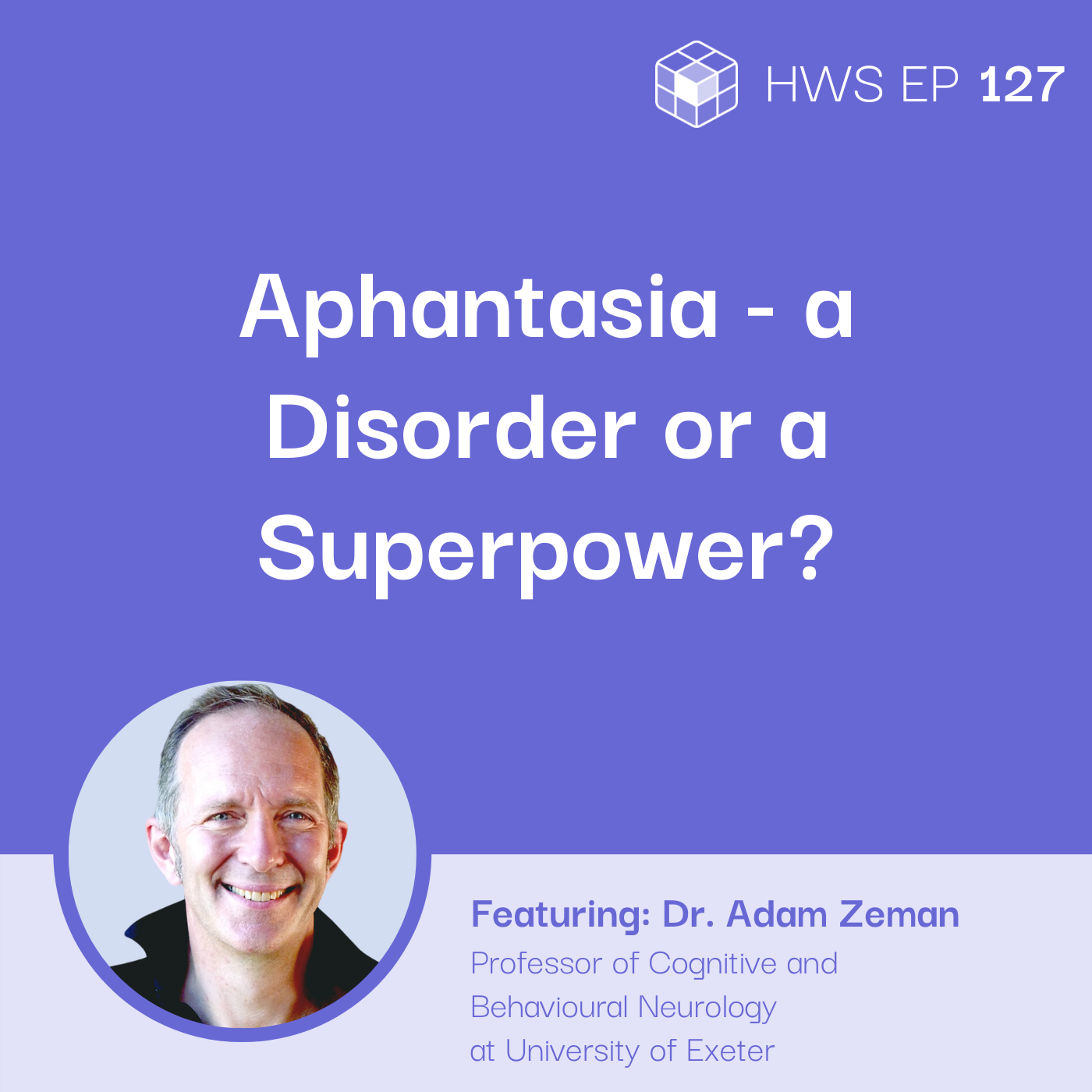

The realtes study: www.sciencedirect.com/…/S0010945224003083
The realtes study: www.sciencedirect.com/…/S0010945224003083