

0
0

@Fried_out_Kombi@lemmy.world
embedded machine learning research engineer - georgist - urbanist - environmentalist

cross-posted from: lemmy.world/post/16703609
cross-posted from: lemmy.world/post/16703609

Non-paywall link: archive.is/fc2ci
Non-paywall link: archive.is/fc2ci

Ottawa recently announced they’re considering removing their mandatory parking minimums. For context, parking minimums are extremely arbitrary, based on pseudoscience, and are a key barrier to housing development.
Ottawa recently announced they’re considering removing their mandatory parking minimums. For context, parking minimums are extremely arbitrary, based on pseudoscience, and are a key barrier to housing development.

Non-paywall link: archive.is/J2cSo
Turns out the housing crisis is awful for the economy at large.
Non-paywall link: archive.is/J2cSo
Turns out the housing crisis is awful for the economy at large.


I’ve seen this in Canada waaaay too much. Instead of rightfully directing their anger at screwed-up land use restrictions and a draconian zoning code, people who are normally pro-immigration are rapidly turning anti-immigrant because of the housing crisis.
I’ve seen this in Canada waaaay too much. Instead of rightfully directing their anger at screwed-up land use restrictions and a draconian zoning code, people who are normally pro-immigration are rapidly turning anti-immigrant because of the housing crisis.

New analysis from RMI finds that by encouraging better-located, less car-dependent communities, we can solve the nationwide housing shortage while dramatically cutting pollution.
New analysis from RMI finds that by encouraging better-located, less car-dependent communities, we can solve the nationwide housing shortage while dramatically cutting pollution.


For reference, Pointe-Claire is right next to a new automated light metro station, so blocking housing there is doubly harmful, as it sabotages the potential ridership of a brand new rapid transit system.
For reference, Pointe-Claire is right next to a new automated light metro station, so blocking housing there is doubly harmful, as it sabotages the potential ridership of a brand new rapid transit system.

The Georgists advocated shifting the tax burden from buildings to land. Today that would face major political hurdles, but there might be variations on the concept that could spur housing development and discourage land speculators.
The Georgists advocated shifting the tax burden from buildings to land. Today that would face major political hurdles, but there might be variations on the concept that could spur housing development and discourage land speculators.

Non-paywall link: archive.is/l991o
Non-paywall link: archive.is/l991o


Housing affordability drives supercommuting
Housing affordability drives supercommuting

cross-posted from: lemmy.world/post/8967868
This op-ed details how housing has gotten faaaar more expensive over the past several decades but without corresponding wage growth, leaving it increasingly unaffordable. The author (correctly) argues that this is due to the rising land values, which does not represent true wealth creation and is rather simply a vehicle for wealth redistribution from the younger and working class to the older and landed.
This op-ed details how housing has gotten faaaar more expensive over the past several decades but without corresponding wage growth, leaving it increasingly unaffordable. The author (correctly) argues that this is due to the rising land values, which does not represent true wealth creation and is rather simply a vehicle for wealth redistribution from the younger and working class to the older and landed.
This op-ed details how housing has gotten faaaar more expensive over the past several decades but without corresponding wage growth, leaving it increasingly unaffordable. The author (correctly) argues that this is due to the rising land values, which does not represent true wealth creation and is rather simply a vehicle for wealth redistribution from the younger and working class to the older and landed.

Non-paywall link: archive.is/umP8D
This article explains the recent re-emergence of Georgism, its origins, and the rising popularity of the land value tax as a solution to the housing crisis.
Non-paywall link: archive.is/umP8D
This article explains the recent re-emergence of Georgism, its origins, and the rising popularity of the land value tax as a solution to the housing crisis.

In urbanist and YIMBY circles, we often talk a lot about missing middle housing, but this is actually a very broad category. This video gives more in-depth information about the kinds of missing middle housing and how prevalent they are in the five biggest Canadian cities.
In urbanist and YIMBY circles, we often talk a lot about missing middle housing, but this is actually a very broad category. This video gives more in-depth information about the kinds of missing middle housing and how prevalent they are in the five biggest Canadian cities.
YIMBYism works, y’all.
Non-paywall link: archive.ph/HLM7s
YIMBYism works, y’all.
Non-paywall link: archive.ph/HLM7s

cross-posted from: lemmy.world/post/7639583
This video by BritMonkey gives an introduction to Georgism and the importance of land value taxation.
cross-posted from: lemmy.world/post/7639583
This video by BritMonkey gives an introduction to Georgism and the importance of land value taxation.
This video by BritMonkey gives an introduction to Georgism and the importance of land value taxation.
This video by BritMonkey gives an introduction to Georgism and the importance of land value taxation.

This video explains zoning and how these often obscure codes tremendously influence our built environment.
This video explains zoning and how these often obscure codes tremendously influence our built environment.

I was watching this talk while rebuilding a big docker container at work, and it gave a surprise shout-out to Henry George’s Progress and Poverty, in the context of how Google and other tech “platforms” have turned themselves into digital landlords.
I was watching this talk while rebuilding a big docker container at work, and it gave a surprise shout-out to Henry George’s Progress and Poverty, in the context of how Google and other tech “platforms” have turned themselves into digital landlords.
Property owners in Edmonton will be able to build three-storey apartment buildings, townhouses, rowhouses or duplexes with up to eight units in any residential area citywide starting next year.
Edmonton city council voted 11-2 Monday morning to pass the revised zoning bylaw, which ends so-called “exclusionary” zoning that limited many residential zones to only single-family homes plus garden or backyard suites. Councillors Jennifer Rice and Karen Principe were opposed. The law comes into effect Jan. 1.

“A lot of people don’t realize, one of the reasons that certain communities in this country don’t have enough homes is because it’s literally illegal to build the kinds of homes that people could live in,” Fraser said on Friday.
In much of the country, zoning restrictions mean developers are only allowed to build either single-family homes or condo towers in residential areas. There is a huge chunk of housing options, often referred to as “missing middle housing,” that does not get built.
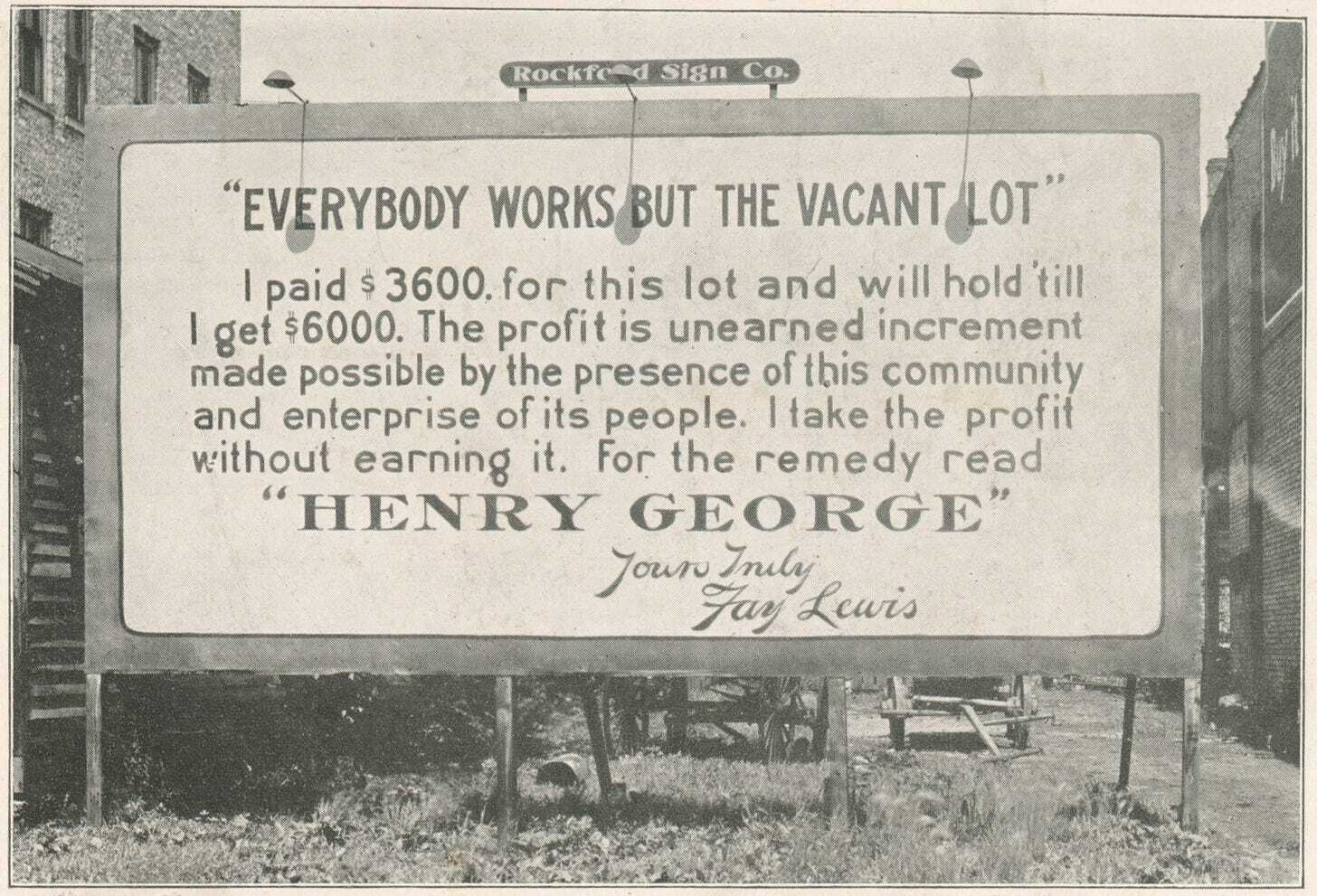
Image transcript:
An old sepia photograph of a billboard on a piece of vacant land. The sign reads:
“EVERYBODY WORKS BUT THE VACANT LOT”
I paid $3600 for this lot and will hold 'till I get $6000. The profit is unearned increment made possible by the presence of this community and enterprise of its people. I take the profit without earning it. For the remedy read “HENRY GEORGE”.
Yours Truly, Fay Lewis
cross-posted from: kbin.social/m/Neoliberal/t/524431
If you tax blight, will you get less of it?
cross-posted from: kbin.social/m/Neoliberal/t/524431
If you tax blight, will you get less of it?

Fifteen unique kit-set timber homes have sprung up in the forest outside Watson Lake, Yukon, created by — and for — members of the Liard First Nation (LFN).
The project, run by the First Nation’s economic development corporation First Kaska, is being billed as a game changer.
The frame parts are cut on-site at a brand new production plant, with three different floor plans available.
It takes five days to prepare the frame for each house and just one day to piece the numbered frame parts together on the building site.
Watson Lake is grappling with a housing crisis, and LFN Chief Stephen Charlie said the project is “a paradigm shift.”
Tthe project eliminates the supply chain issues that make it difficult to build new homes, he said.
Charlie said it’s created about 50 jobs and will go a long way toward ensuring the well-being and long-term security of his people.
“It’s a complete cycle. It’s a benefit for our whole community and people and nation in the process. My vision is that we become the first First Nation north of 60 without a housing crisis. Just think of the legacy that’s going to be established for future generations — that we don’t have to worry about housing,” he said.
“We’re taking control of our own destiny … and it’s not just the First Nation that it’s moving forward, it’s the whole community as well.”
Liard First Nation member Mike Gagnon said the chance to train and work as a carpenter on the project turned his son’s life around. Gagnon said his son had gone from a battle with leukemia and heavy use of alcohol to a good job and savings.
“He’s just taken it and run with it. I’m really proud of him,” he said.
A former builder himself, Gagnon said the houses were among the warmest and toughest he’d seen.
They feature 20 centimetres of insulation in the walls and almost 23 in the roof.
“I’ve never seen it. And these are well-built homes. As you can see, these are well-constructed. They’re well-organized. You look at the floor plans and these are unreal. These homes — you ain’t ever going to get a better one. And this is all because of Stephen [Charlie].”
First Kaska hopes to complete the first 15 homes by the end of the year and six more after that.
They will be given to members of the Liard First Nation who most need them, including young families and people living in crowded situations.
“That’s 21 homes. That’s probably like 60 people that can be alleviated from bad situations,” Charlie said.
Eventually, Charlie said, the goal would be to demolish and replace other mouldy or derelict homes that members are living in.
First Kaska plans to scale up its production plant, allowing it to produce frames in just one day.
That would create a surplus of supply, Charlie said, meaning First Kaska could begin to supply the frames to other communities across the North.
Charlie said some other First Nations have already expressed interest.

TL;DW: This video goes into how a broken property tax assessment system has resulted in systemic over-assessment and over-taxing of properties in poor neighborhoods and under-assessment and under-taxing of properties in wealthy neighborhoods.
TL;DW: This video goes into how a broken property tax assessment system has resulted in systemic over-assessment and over-taxing of properties in poor neighborhoods and under-assessment and under-taxing of properties in wealthy neighborhoods.

cross-posted from: lemmy.world/post/3982249
The housing market is a prime example of poor management and a huge driver of Canadians’ inability to get rewarded for their work, he said.
Yan said in Canada, social mobility is becoming stagnant due to these factors, and that’s making the country a less desirable place to live.
Many experts agree, saying Canada is in a full-on housing affordability crisis. A recent Rental Housing Index report found that 18 per cent of renters in Vancouver and Toronto are spending at least half their income on rent and utilities, while about 40 per cent are spending more than 30 per cent of their income on it.
Canada has now surpassed the U.S. with higher levels of household debt to GDP, with the figures dropping south of the border over the last decade. But as housing unaffordability continues its march in Canada, and as the country already has the worst household debt load in the G7, such debt levels are expected to continue to climb further and income inequality to further increase.