@SocialistVibes01@lemmy.ml

member since 30 Apr 2026 02:09

posts

EU Commission proposes under-13s social media ban

www.reuters.com
preview

STRASBOURG, France, Sept 17 (Reuters) - European Commission President Ursula von der Leyen set out a ‌sweeping plan to keep children safe from online dangers on Thursday, proposing to ban under-13s from social media and require online services to design safe children’s accounts.

The move follows similar initiatives in Australia, Britain, China, India, Turkey and several European Union countries over concerns about the impact Meta’s (META.O), opens new tab Facebook and Instagram, TikTok, Google’s (GOOGL.O), opens new tab YouTube and ChatGPT have on children’s mental health and safety.

The Misinformation Monitor newsletter rounds up international misinformation narratives, with a “Real or Fake?” quiz in every edition. Sign up here.

Australia’s challenges in enforcing its world-first social media ban for ⁠children under 16 could see Europe facing an uphill battle as well.

“Today, our children are engaging with some of the most sophisticated technology ever created, and it was not created with children’s well-being and development in mind,” von der Leyen told a press conference.

She said the proposed EU Kids Act “will set clear boundaries in the digital world just as we do it on a daily basis in the real world”.

PARENTAL CONTROL

Under the proposal, which must be negotiated with EU countries and the European Parliament in the coming months before it can become law, accounts for children aged between 13 and 15 will be under parental control.

Social media and video-sharing services, online video ‌games, AI ⁠companions and chatbots for children below 18 will be subject to a list of dos and don’ts.

These include a ban on addictive features, profiling-based recommender feeds, infinite scroll, reward tricks and unsolicited contact from strangers. AI companions and chatbots must be turned off by default.

Online platforms must design algorithms safe for children and provide easy-to-use parental controls and tools to block ⁠and mute users. The companies, which must verify users’ age when they open an account via age assurance tools, risk fines as much as 6% of their global annual sales for non-compliance. They will also have to pay a supervisory fee to fund ⁠regulators’ supervision.

Tech lobbying group CCIA Europe, whose members include Google and Meta, warned of the privacy risks arising from the proposal and conflicting requirements under other EU laws. “Collecting age information, identity credentials, and data linking children with ⁠parents or guardians at this scale would undoubtedly create an attractive target for cybercriminals,” CCIA head Daniel Friedlaender said.

“The Kids Act creates legal overlap and duplication that ultimately weaken protections for children and consumers,” he said.


Australia considers banning the use of smart glasses in government buildings

www.reuters.com
preview

SYDNEY, Sept 17 (Reuters) - Australia is considering barring the use of camera-equipped smart glasses in government workplaces due to privacy and security concerns, in what it said could be the first ban of ‌its kind.

The government will separately convene a roundtable of the country’s biggest employers, including Microsoft (MSFT.O), opens new tab, Commonwealth Bank (CBA.AX), opens new tab, telecoms firm Telstra (TLS.AX), opens new tab and energy company AGL (AGL.AX), opens new tab as it consults on a set of guidelines for AI in the workplace.

Prime Minister Anthony Albanese said it was important that Australia, which ⁠last year became the first place in the world to ban social media for teens, put the “right protections in place as technology evolves”.

“I am proud that Australia is setting the world standard for digital safety,” he said in a statement on Thursday.

While smart glasses have been lauded by some sections of the community such as the visually impaired, there have been growing concerns globally that the devices can be used to covertly record and photograph people without their ‌consent.

Norway’s ⁠capital Oslo banned the glasses in schools last month, and the federal government is considering regulating their use. England and Wales have prohibited the use of Meta (META.O), opens new tab smart glasses in courts.

Katy Gallagher, Australia’s minister for public service, said she had asked the public ⁠service commission for advice on whether smart glasses capable of recording should be prohibited in government workplaces.

“Smart glasses can raise legitimate privacy and security concerns, particularly because of their ⁠ability to record and capture information, and we need clear and consistent guidance for public servants,” she said.

Companies selling smart glasses are also facing ⁠legal challenges from the private sector. A German advocacy group has filed a criminal complaint against Meta and others involved in selling the Meta devices, citing privacy laws.

Microsoft Office 365 on Linux, Mint develops their own apps, Steam Frame is here

TILvids Microsoft Office 365 on Linux, Mint develops their own apps, Steam Frame is here
preview

Timestamps:

00:00 Intro

00:42 Sponsor: Internxt

02:26 Microsoft 365 runs on Linux through Wine now

04:44 Mint will ship more of their own application

07:07 Ubuntu completes its move to Rust coreutils

09:37 Steam Frame revealed, up for signups

13:04 GNOME 51 released

14:54 GNOME Shell Mobile seems in a weird place

17:44 Flatpak working on app services

19:47 Improvements for the Linux kernel

21:52 AMDv3 images provide a nice boost to low end hardware

23:48 OpenAI discloses worrying cheating behavior in its models

26:37 A few gaming things

29:15 Sponsor: Tuxedo Computers

GrapheneOS Isn't Happy With Google Over Pixel's Widening Head Start

It's FOSS GrapheneOS Isn't Happy With Google Over Pixel's Widening Head Start
preview

Google’s September 2026 Pixel Update Bulletin contains patches beyond what’s in that month’s regular Android Security Bulletin. According to GrapheneOS, some of those extra patches touch standard Android platform code, the kind that runs on non-Pixel devices, not just Pixel-branded hardware.

None of that platform-level code has reached the regular monthly bulletin or the private preview patches other manufacturers typically draw from to get their own patches ready.

And at this rate, these won’t reach non-Pixel OEMs at all until Android 17 QPR2 ships later this year in December.

The project is characterizing this as Google “gatekeeping security patches to the standard Android platform code from Android OEMs.” The complaints

GrapheneOS says Android 17 QPR1 shipped new developer APIs that never made it into AOSP. This is something they claim hasn’t happened since Android’s Honeycomb days.

Google’s API diff report backs this up. Comparing Android 17 to QPR1 shows one new package, android.hardware.hid, plus changes across sixteen others, including android.media, android.os, android.provider, android.telecom, and android.view.

GrapheneOS has ported its code to QPR1 before Google even released it, but still doesn’t have permission to ship that work. For now, the project is backporting Pixel firmware, kernel drivers, userspace drivers, and HALs from QPR1 onto Android 17 instead.

On top of all that, there’s a compliance issue that seems to be recurring.

Google was slow to comply with a GPL source request. GrapheneOS requested sources for a build (CD1A.260905.001.A1) on September 1, and access only came through more than two weeks later.

Why this is worrying

None of these three issues is catastrophic by itself. A three-month patch delay, a paused API rollout, a two-week wait on source code—each is the kind of thing that could pass as a one-off.

Taken together, however, they point to a recurring theme. Google is holding security fixes back from the wider Android ecosystem, withholding new APIs from AOSP for the first time in over a decade, and slow-walking GPL compliance it’s required to meet.

Don’t even get me started on what they are doing to the Android app ecosystem.

Google is on track to require every Android app developer, whether on the Play Store, F-Droid, or anywhere else, to register with them. Come 2027, that means handing over legal identification and signing key evidence before an app can run on any certified device.

Sideloading an unverified app following this would mean enabling developer settings, waiting through a mandatory 24-hour cooldown, and clicking past several warning screens (classic scare tactics, btw).

GrapheneOS is one of dozens of organizations that signed onto the Keep Android Open campaign opposing this, alongside F-Droid, the Electronic Frontier Foundation, and the Free Software Foundation.

If you ask me, this Big Tech company is doing what’s regrettably natural for it, clamping down open access to things so that its competition cannot benefit.

Android 17 QPR1 is the first release since Android Honeycomb (3.x) adding new APIs for app developers without a release to the Android Open Source Project.

GrapheneOS Mastodon GrapheneOS (@GrapheneOS@grapheneos.social)
preview

Android 17 QPR1 is the first release since Android Honeycomb (3.x) adding new APIs for app developers without a release to the Android Open Source Project. The new APIs are currently exclusive to the Pixel OS and aren’t available to other Android OEMs.

developer.android.com/sdk/api_diff/37.1/changes

Non-Google Android OEMs and AOSP-based projects can ship yearly and QPR2 releases. There are also security backports to those releases. Security preview access is needed to ship patches without months of delay. We’ve had that since before our Motorola partnership via another OEM.

We already ported our code to Android 17 QPR1 since before it was released on September 15th but don’t have permission to release it yet. We’re working on backporting Pixel firmware, kernel drivers, userspace drivers and HALs from Android 17 QPR1 to Android 17 for now instead.

Pixel Update Bulletin for September 2026 has additional patches to standard Android platform components used by non-Pixel devices. These patches are relevant to non-Pixel devices but haven’t been made available via the September 2026 Android Security Bulletin or preview patches.

Google should not be gatekeeping security patches to the standard Android platform code from Android OEMs but that’s what they’ve started doing. Other OEMs will get these patches in December 2026 via Android 17 QPR2. We can ship them early by reverse engineering the code instead.

It would be interesting to know if Google’s legal team is aware they’re giving Pixels months of early access to new Android features and bug fixes including certain important security patches. Pixels being given this competitive edge over Google’s OEM partners is very dubious.

Google is also once again failing to comply with our GPL source requests for weeks. We requested CD1A.260905.001.A1 sources on September 1st and were only provided access today. The kernel build IDs are the same for 17 QPR1 Beta 9 and 17 QPR1 so we have that already at least.

We could have shipped an Android 17 QPR1 update already since our port was completed. Instead, we have to deal with ongoing pain until Android 17 QPR2 is released in December 2026. This will not be an issue for Motorola since we’ll have official firmware and driver code provided.

It will be far easier for us to support upcoming Motorola devices than Pixels. Qualcomm will hopefully expand MTE support beyond the highest end flagship SoC soon so we can expand to more than flagships. Pixel 11 didn’t remove it from hardware, only firmware, so that’s good news.

Calibre v9.15 adds an AI-powered interactive fiction game

OMG! Ubuntu Calibre v9.15 adds an AI-powered interactive fiction game
preview

The latest update to Calibre, the popular open-source ebook manager, features an AI-powered writing game.

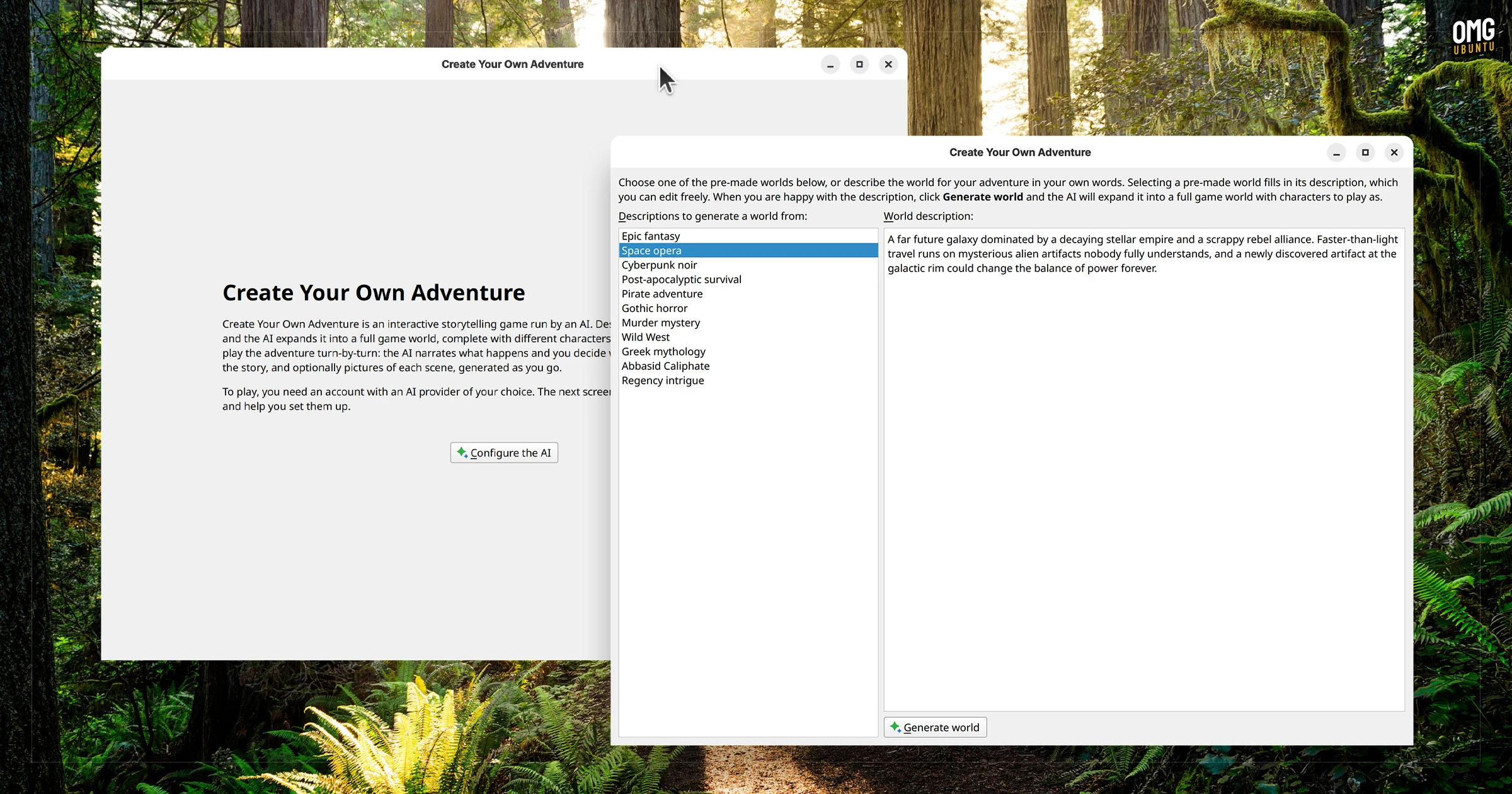
Calibre v9.15’s “Create Your Own Adventure” mode, per the release notes, lets you build a fictional world and hand control of it to an AI who will manage it in real time based on your responses. A bit like old text-based RPGs, I guess.

The changelog notes, with obvious understatement, that the feature is “a little different” from Calibre’s usual fare, adding it began as a way for developers to test the tool’s AI backend before developing into “something fun to use”. Calibre Create your own adventure AI feature wizard Setting up your AI world in Calibre v9.15

Like all AI features in Calibre, it’s completely optional as it relies on you use adding an API key for a compatible LLM. To try it, go to Preferences > Toolbars and add the “Create your own Adventure” button to a toolbar. Click this to open a setup wizard.

This isn’t the first puzzling AI feature the Calibre has gained. Last month it added hooks to generate ebook covers using AI prompts and preset styles (a noir Wuthering Heights; a pulp sci-fi Barbara Cartland novel, and so on).

Calibre users are, largely, people who like reading books – most with a long backlog of titles they’re not getting through1. Folks who like using LLMs to generate fiction likely have no need for an ebook manager, and vice versa.

I do wonder if Calibre ought to focus on adding AI features that help, rather than distract: letting users sort ebooks, fix metadata or generate “playlists” of what read next based on a users’ library and tastes.

Generating slop covers, summarising books and, now, generating fiction feels2 at odds with its role. Other changes in Calibre 9.15

This update also ships with improvements that don’t cause a collective head scratch.

The Highlights panel in the ebook viewer lets you select multiple highlights and right-click them to change the style, and if a highlight has notes, you can see that note in a hover tooltip when you mouse over it (this behaviour can be disabled).

More customisations are present. A button can be added to the sidebar to change between saved window sizes, and in the cover grid you can now choose which corner of book emblems appear via Preferences > Look & Feel > Cover grid > Layout.

Plenty of bugs were fixed, including issues with Read Aloud stopping at large images, a spellcheck quirk that overlooked words with a single apostrophe and Calibre not starting for users in Alberta Canada after its recent timezone change. Where to get Calibre

Calibre is free, open-source software for Windows, macOS and Linux.

Download Calibre from the official website – on Linux, Calibre is installed and updated via a command-line script that will download a binary, unpack it to a system folder and create the various .desktop shortcuts needed to find and open it in app menus, etc.

Alternatively, you can get Calibre on Flathub, although it is an unverified build.

Nextcloud adds desktop app for Euro-Office productivity suite

Computerworld Nextcloud adds desktop app for Euro-Office productivity suite
preview

Beware the Computerworld’s article 🙄 that’s about NATO Office 🙄🙄

Nextcloud wants to close the gap with Microsoft Office with the introduction of a new Euro-Office desktop client for Windows, macOS, and Linux — one of numerous updates to its Nextcloud Hub suite.

Nextcloud has developed a desktop app for its Euro-Office-based productivity applications, filling a gap in the software suite that it pitches as a sovereign alternative to Microsoft Office.

Nextcloud, one of the backers of the Euro-Office initiative, integrated the software into its Nextcloud Office suite in June. Until now, it’s been accessible via a web browser or mobile app.

The new desktop client lets users edit documents, spreadsheets, and presentations locally, and sync files online for collaborative editing. It will be available for Linux, macOS, and Windows in the coming weeks.

“For organizations and individuals who prefer a traditional desktop experience, this closes one of the last gaps between Euro-Office and Microsoft Office, without handing control of their data to a non-European vendor,” Nextcloud said in a press release.

Rather than a standalone application suite, Euro-Office is designed as an integration component that’s embedded into productivity applications, such as Nextcloud Hub. Euro-Office handles document editing, while other elements such as storage and permissions managed by the wider platform.

The open-source project, which is built on OnlyOffice’s codebase, is backed by Nextcloud as well as Eurostack, Ionos, Office.eu, Proton, XWiki, and others. More than 40 individuals have contributed code to Euro-Office, according to Nextcloud, with around 15% of contributions from outside of the organizations directly involved in project.

Euro-Office supports OOXML file formats for compatibility with Microsoft Office, as well as OpenDocument Format (ODF) files, including ODT, ODS and ODP. The Document Foundation, which is responsible for development of LibreOffice, another open-source productivity suite, has previously questioned the Euro-Office initiative’s preference for Microsoft file formats over ODF.

Organizations using Euro-Office include Germany’s Deutsche Telekom Security and Destek, a Turkish IT consultancy, according to Nextcloud. Other customers in countries such as France, Switzerland, and Philippines are currently evaluating the software.

But it’s still early days for Euro-Office. Open-source software initiatives often face a challenge in gaining traction among a broad enterprise audience, said Martha Bennett, VP and principal analyst at Forrester.

“Euro-Office hasn’t really proven itself at the kind of scale that large enterprises are looking for. That’s of course not unique to Euro-Office; all potential open-source alternatives face the same issue,” she said.

“Obviously, it’s a bit of a chicken-and-egg situation — without somebody taking the leap, it’s not possible to provide that proof.” Nextcloud Hub Summer 26 updates

Among the other announcements with the Summer 26 updates are changes to management of teams within Nextcloud Hub. An updated Nextcloud Teams app, which is now available in the app menu, provides users with an overview of the teams they belong to. Each team features a folder with shared resources such as files and tasks, which Nextcloud notes is similar to Microsoft’s approach with Teams and SharePoint.

Nextcloud now also enables the creation of team-owned files, starting with Nextcloud Collectives and Deck, with additional apps in future. The aim is to ensure that all team members can access a file, even if the creator leaves the team workspace. For admins, there are new tools to view and manage team folders, including configuring storage quotas.

Among the other announcements are updates to Nextcloud Text — a lightweight text editor available across several apps — with version comparisons, footnotes, and references available throughout a document, and inline comments. Nextcloud Tables, a database app, now has relational columns that link data in cells across multiple tables, and the ability to import and export table structure — such as columns, views, and table-based apps — without changing data.

With Nextcloud’s AI Assistant, users can now upload an image and ask questions about it or translate text, while the chatbot will also recall information across conversations.

UI improvements include a revamped search experience that displays results from across Nextcloud Hub files, messages, and events, with filter options such as date range and people. App menu icons have been updated to make apps easier to recognize, and new animations throughout the interface make navigation and interactions “feel more fluid and easier to follow,” said Nextcloud.

Firefox 156 Available With Its Built-In PDF Viewer Starting Up To 45% Faster

Firefox 156 Available With Its Built-In PDF Viewer Starting Up To 45% Faster
preview

Mozilla today published their Firefox 156.0 release binaries ahead of the official Tuesday announcement.

With Firefox 156 they are promoting their built-in PDF viewer as now starting up to 45% faster. Also on the performance side is improved memory and CPU usage when Firefox is displaying large JPEG images that in turn are scaled down to fit on a web page.

There are also a number of fixes in Firefox 156 like for high-sample-rate FLAC audio in MP4 failing on some websites, fixing various platform-specific issues, and other minor adjustments.

Within the Firefox 156 nightly builds was also enabling Vulkan Video decoding for newer NVIDIA GPUs on recent versions of the NVIDIA driver, but sadly that didn’t make it for the Firefox 156 release with it still being gated to nightly builds.

This isn’t the most exciting Firefox update for Linux users in recent history, but if wanting this latest update you can grab Firefox 156 right now via ftp.mozilla.org.

LG responds to TV spying allegations

The Verge LG responds to TV spying allegations
preview

Earlier this week, Gamers Nexus, Level1Techs, and independent security researchers detailed some alarming findings about how LG’s TVs are logging and uploading data on its users. Now the company is pushing back against those allegations, saying that “Some recent media coverage may have contributed to misconceptions about how LG smart TVs work.”

LG released a statement in which it claims that its “TVs do not continuously record or transmit users’ conversations,” and that wake-word detection is all processed locally. However, the word “continuously” is doing a lot of heavy lifting here as Gamers Nexus demonstrated an LG TV keeping extensive logs of ambient conversations long after one would assume its AI assistant had stopped listening.

LG also said that its features like “Automatic Content Recognition (ACR), voice recognition, and interest-based advertising are optional,” and “not enabled by default.” The company says that:

ACR uses audio fingerprinting technology using the TV’s internal audio processor (not a speaker) to identify content and does not collect screenshots, screen recordings, video recordings, voice recordings, or other audio recordings from the TV.

The company did not address broader concerns about how much data it collects, who it shares it with, the potential for bad actors to exploit its features, or the misleading way in which its privacy options are presented.

comments