
GPT-6 Astra reaches and surpasses human-level performance on ARC-AGI-3 with a memory harness, but still at 1000x the cost - ARC Prize Foundation
preview
Summary:
- GPT-6 Astra scores 62.7% for $26K on ARC-AGI-3 Semi-Private with our Standard harness, and 99.9% for $19K with a Provider Adapter harness.
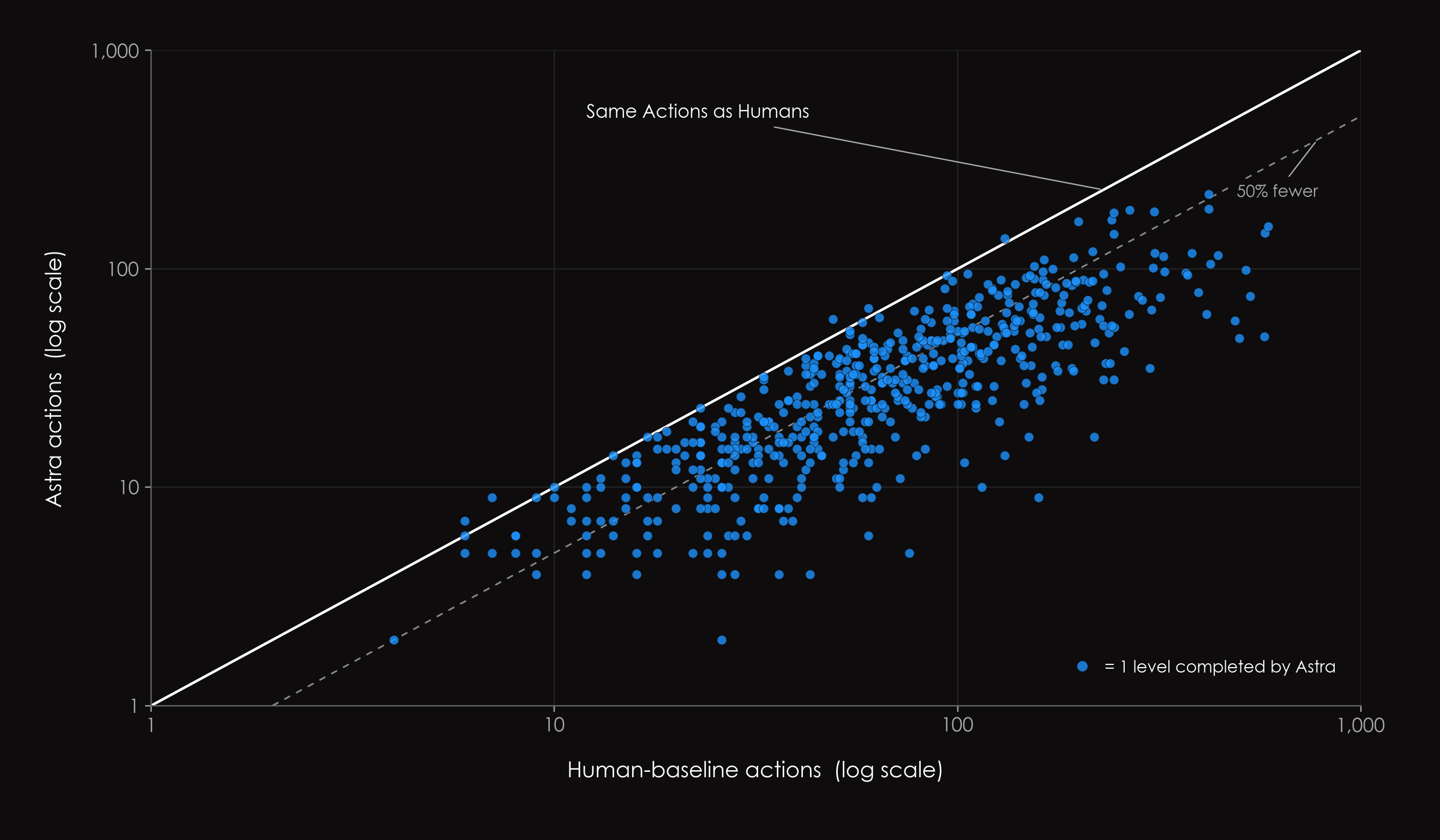
- GPT-6 Astra surpasses the human baseline in action efficiency on ARC-AGI-3. It used fewer actions than the median tested human on 96% of levels.
- A key behavior observed in GPT-6 Astra was its ability to turn unfamiliar environments into compact symbolic world models. It represented game mechanics as logical rules and developed its own domain-specific language shorthand to track state and plan actions.
For a cost comparison, during our controlled testing, human participants were paid $115 per 90-minute session, plus $5 per game completed. Participants attempted approximately nine games per session, roughly $12.78 per attempted game before bonuses.
Most of this fee pays for the participant’s time and willingness to take the test, rather than the energy their brain uses (a closer proxy to compare with AI). If we look at only the brain’s energy, and price it as electricity, the estimate drops to about 0.6 cents per session, or 0.067 cents per game attempted.1Astra’s results are also a major milestone worth celebrating. From our perspective, Astra represents a noticeable step-function change in frontier model capabilities.
When we launched ARC-AGI-3, we made it clear that saturating the benchmark would not represent “proof of achieving AGI.” Therefore, while we believe Astra represents meaningful progress towards generalization, we are not claiming that it is AGI.
Bless uncle Bernie, but the US is in no state to even consider this. It has installed capitalism as its king.