0

Why Fast-Tracking Your Sleeping-Emperor Portfolio Leads to Catastrophic Realm Restructuring

LinkedIn Why Fast-Tracking Your Sleeping-Emperor Portfolio Leads to Catastrophic Realm Restructuring https://lnkd.in/gBZ4Ff34 In Q3 1631, facing a grueling 13-year operational drag during the Thirty Years’… | RPGnet www.linkedin.com
preview

I would like to point out that I only wrote the initial RPGNet post and did not create this summary, so I am only partially to blame.

I would like to point out that I only wrote the initial RPGNet post and did not create this summary, so I am only partially to blame.

0

Setting Originality vs. Complexity?

An excerpt from the Mandelbrot set, showing a spiral with ever-smaller spirals.
preview

Many of us are enthusiastic worldbuilders. And many of us worldbuilders also try to make our RPG settings “original”.

Yet there is a danger to making a setting that has too many unique elements. After all, the setting isn’t just for the game master, but also for the players. They need to understand the setting enough to play convincing characters that exist in that world, and act accordingly. And the more setting information they have to absorb to do so, the more difficult it will be to get buy-in from your gaming group.

Personally, I think settings work best when there are a few strong, central unique elements that support strong themes on what the setting - and the campaign - are supposed to be all about, scaffolded by numerous familiar, common tropes from the intended genre (such as science fiction or fantasy). This should help convey the information the players need most effectively.

But I am curious how you see this issue. Do you regard this as a problem at all, and if so how do you approach it?

0

Show me your BookWyrm RPG lists!

A preview image for "Jürgen Hubert's RPG Books".
preview

Since I am already a heavy BookWyrm user, I have decided to create my own BookWyrm list for my RPG books. This is incomplete, and focuses mainly on my physical books - I have bought several thousands of digital RPG books over the years.

Has anyone created similar lists, and if so where are they?

Since I am already a heavy BookWyrm user, I have decided to create my own BookWyrm list for my RPG books. This is incomplete, and focuses mainly on my physical books - I have bought several thousands of digital RPG books over the years.

Has anyone created similar lists, and if so where are they?

0

Folk Tale Metafiction for Fantasy TTRPG settings?

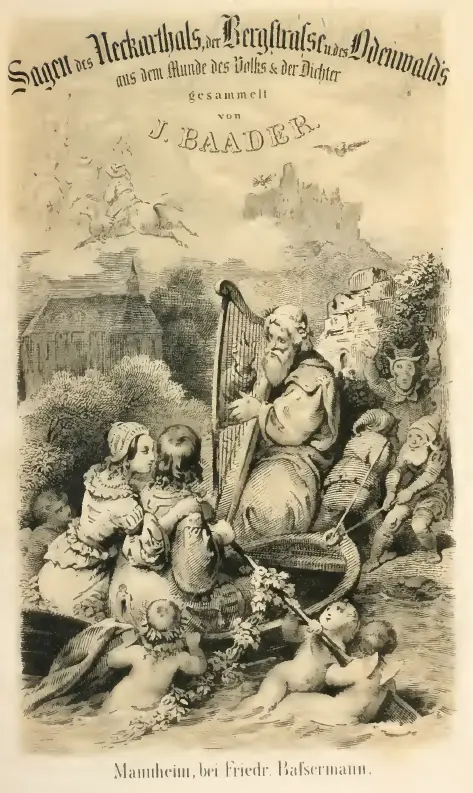
Cover of the 19th century folk tale collection "Sagen des Neckarthals, der Bergstraße und des Odenwalds", featuring a musician surrounded by assorted dodgy spirit folk.
preview

Hello! My name is Jürgen, and I translate German folk tales.

Folk tales are, essentially, another oral storytelling tradition like tabletop role-playing games, where stories are told by amateur storytellers for their audiences. There are some important differences, of course - tabletop role-playing games emphasize group storytelling, as well as (usually) serial storytelling involving the same protagonists, which are largely absent in traditional folk tales. Nevertheless, I’ve often noted that they share the same overall “chaotic energy” of more formal story structures in art and literature, and indeed both folk tale storytellers and role-players often have similar ideas.

In the 19th century, German folk tales received a lot of scholarly attention. Numerous early folklorists inspired by the Brothers Grimm collected folk tales from specific regions and published them together with added commentary elabroating on the historical, cultural, and folkloric context of the tales.

I’ve been reading through a lot of these collection in recent years, and this has given me an idea for a new type of metafiction:

Imagine that you are a folklorist, and have researched folk tales featuring specific supernatural creatures. Then you publish them as a collection, adding your own scholarly commentary to the basic tales you have collected from the locals.

Only both the folklorist and the folk tales aren’t from Earth, but from a fictional, D&D-type fantasy setting, and the supernatural creatures in question really do exist in that world.

So the folklorist in question could not only write about the folk tales themselves, but also compare and contrast the perception of the “common folk” (as shared in those tales) with what is known by other scholars and the latest “scientific knowledge” about these creatures.

A good example of this kind of metafiction can be found in assorted Elder Scrolls lore books - my favorite being “Ancient Tales of the Dwemer” where the editor constantly snarks about the shoddy scholarship of the original author - and this kind of snarking absolutely shows up in 19th century folk tale collections as well.

What do you think of this concept? Do you think this might sell?

And do you have any suggestions for improving this concept?

0

Timeline of Call of Cthulhu scenarios?

The movie poster for "Once Upon A Time In America"
preview

Does a timeline of Call of Cthulhu scenarios exist? That is to say, a timeline with scenarios about when they took place, not when they were published.

I have this fantasy of a grand “Once Upon A Time in America” Call of Cthulhu campaign spanning multiple generations, starting early in the 20th century and running a scenario for each subsequent year - which eventually gets to the “Raid on Innsmouth” scenario, the creation of P Division and Delta Green, running throughout the rest of the 20th century using the rich history of Delta Green (and possibly even into the 21st century).

But while it is always possible to create your own scenarios, it would be very useful to have a list of premade scenarios I could use for any given year.

0

The Fluting Thing in the Owls' Gable

Sunken Castles, Evil Poodles Wiki The Fluting Thing in the Owls' Gable wiki.sunkencastles.com
preview

Here is another German folklore with some rather Lovecraftian elements. It’s a brief one, so I will quote it in its entirety, but it’s so very juicy.

“The legend is widespread in the Holstein region that a rooster who has lived for seven years in the exact same house will then lay an egg. A strange animal will come out of this egg which people call by different names: Dragon, crocodile, and so forth.

A man named Swatkopf lived in the parish of Wewelsfleth. This man had a rooster which, since it had already lived within his house for seven years, laid an egg into the crib for his horses. But a strange thing crawled out of this egg. During the day, it always stayed in the crib for the horses. However, as soon as it became dark, it flew up to the owls’ gable in the house and made fluting noises. Now Swatkopf would have liked to sell his house, but he could not get rid of it. Then he had it torn down and built a different building on the same spot. The animal now moved away from him and to his neighbor Kasten Tumann, and in the evening sat in his chimney as a clump of fire. If Tumann was home, then the fluting thing always looked inside through the window, and caused him no little terror. In the end, Tumann took this so hard that he went to the sea and never returned home. But then the animal was also gone, and no one has seen it again.”

While it is lacking in proper Lovecraftian words and phrases such as “squamous”, it makes up for being very bizarre. The “Fluting Thing” has no clear appearance, but it drives the locals to madness and exile, and nobody knows what it wants. The notion that a bizarre creature can hatch from a rooster’s egg is part of basilisk narratives, but the actual description of the creature is rather different.

(Note: I took the picture myself when I passed through Wewelsfleth last year.)

0

AI and (Cthulhu) Mythos

CNET Anthropic's Claude Fable 5 Is the First Mythos-Level AI Model You Can Actually Use - CNET www.cnet.com
preview

I just had an idea for a #CallOfCthulhu / #DeltaGreen scenario:

In a desperate gambit to gain a positive Return on Investment before their IPO, a multi-billion AI company turns to a Mythos source to power their latest AI model. Hilarity ensues.

So what precisely did they attempt, and how does it go horribly wrong? What are your thoughts?

0

Is "Pass without Trace" overpowered?

A Khajiit (cat person) in the Skyrim video game sneaking through a corridor.
preview

Is it just me, or is the “Pass without Trace” spell widely overpowered?

I mean, D&D 5E is generally constructed in a way that even small bonuses to rolls make a huge difference. Proficiency bonuses start with +2 and rise to a maximum of +6, while magical weapons give a maximum of +3.

So what in Avernus possessed the designers to allow a second-level spell to give a whooping +10 to Dexterity (Stealth) checks? For a group, no less (as long as they stick close to each other)? This is going to be extremely hard for guards and lookouts to match.

0

Help me detail a Thieves' Guild hideout!

A large chamber within a sewer system, taken from the "Cistern" location in Skyrim.
preview

The PCs are likely are going to try to get into a safehouse of the local thieves’ guild in the next two sessions. The setting is Ptolus, using the D&D 5E rules.

The safehouse in question is in a lower middle class region on the surface, but it has another entrance to the vast dungeon systems beneath the city. This, in itself, is not unusual - the bedrock on which the city stands is filled with tunnels and long-forgotten vaults. But while most house owners just try to brick those passages over, the thieves’ guild actually uses these passages for their business dealings.

And I need some ideas on both what might be inside the premises, and what kinds of systems they use to secure the safehouse. The PCs will likely be coming from the “dungeon” side, and this is the kind of city where criminals expect inconvenient adventurers to pop up in all sorts of places.

I’ve already determined that the location includes:

  • a vampire ally of the guild
  • some cells for prisoners who get interrogated for information
  • a bunch of drugs for resale

Any other ideas? The party consists of four 8th level characters, if this helps.

0

Stuff you find within a Mad Artificer's Lair

The "Barksian Modulator" from the DuckTales (2017) show, a "voice box" designed to be swallowed which then translates the speech of an otherwise unintelligible person (i.e. Donald Duck).
preview

In the next session, the player characters will enter the lair of a group of Nothics who have holed up in the old temple of a God of Magic.

And I need some ideas for absolutely unhinged magical items that should give even player characters second thoughts about using them. Any ideas?

In the next session, the player characters will enter the lair of a group of Nothics who have holed up in the old temple of a God of Magic.

And I need some ideas for absolutely unhinged magical items that should give even player characters second thoughts about using them. Any ideas?

0

Give me ideas for Nothics!

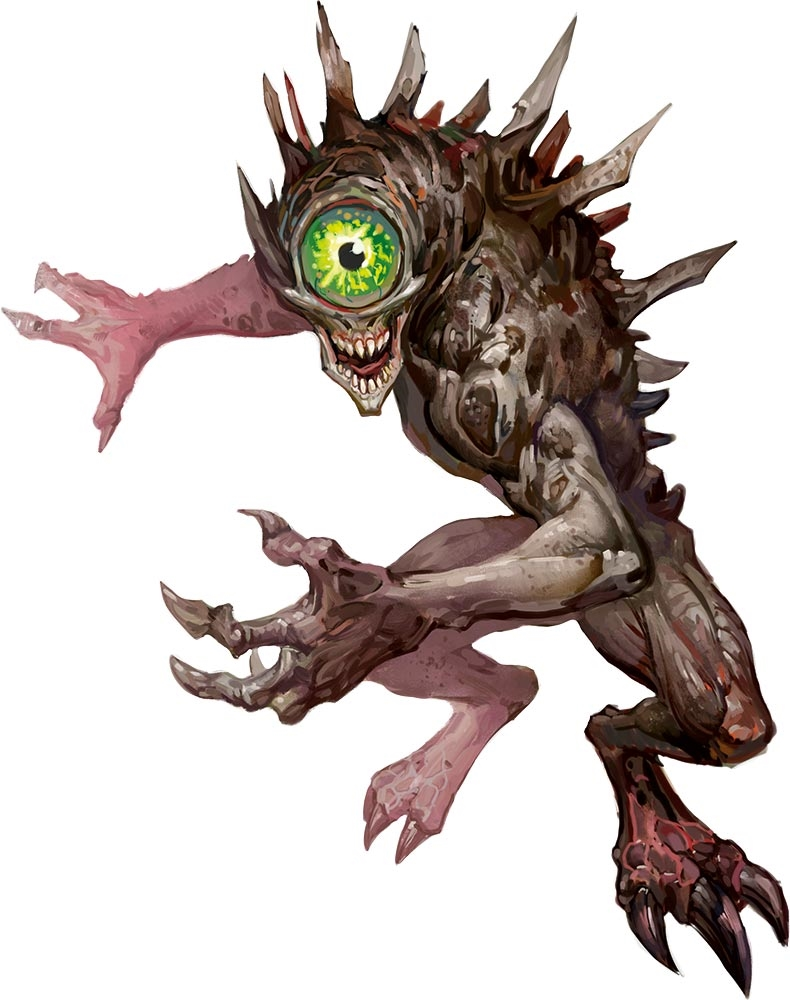
A spiked, clawed humanoid with one huge eye
preview

My players characters are currently exploring some truly ancient underground ruins of a sunken city (the setting is Ptolus, if it matters), and the PCs are trying to find the sites of some temples of various gods to explore.

Next up on the list are temples of ancient gods of knowledge and magic, and when I searched for thematically appropriate monsters to populate them, I came across Nothics. They have a pretty good base concept, but I need some more ideas to make exploring a ruin filled with them interesting. Things I am looking for in particular include:

  • D&D lore about the Nothics (this doesn’t have to be from 5E)
  • Ways of personalizing them and their environment, emphasizing how weird and creepy they are
  • Variant stat blocks that might make encounters with them more interesting
  • Creatures that might co-exist with them

But feel free to throw any ideas you have out here - I am still in an early brainstorming phase!

0

Possible Insects of Shaggai infestation in 15h century Thuringia

Sunken Castles, Evil Poodles Wiki Strange Swarms wiki.sunkencastles.com
preview

I translate German folk tales, and here is one that definitely made me wonder about possible connections to the Cthulhu Mythos:

In the year 1454, a curious heresy spread in Thuringia, particularly in the Sangerhausen region as well as the domains of the Schwarzburger Unterherrschaft. According to legend, the men and women who adhered to this heresy secretly came together in cellars and dark chambers where they worshiped the Devil. The Devil appeared in the form of a bumblebee and flew in front of the mouth of each of them. Once the devotions were over, the lights were quenched, and everyone grabbed around them. And when they grabbed someone of the opposite sex, they sinned with them in a brazen manner, even if they were mother, sister, or daughter.(*) A smith revealed this to the lord of the realm, and led him to such a congregation in disguise so that he could witness this outrage for himself. After this, most of these sectarians were apprehended and burned, but many of them went joyfully to their deaths.