0

Leipzig's masterpiece - How a new district for tens of thousands was created under socialism and what remains of it now

Unsere Zeit Leipzigs Meisterstück www.unsere-zeit.de
preview

When the first families moved to Leipzig-Grünau at the end of the 1970s, it was a huge step forward for many. Those who previously had to live with a coal stove and an outside toilet were given a modern apartment with a bathroom, central heating and often even a balcony. Within a few years, a new district for tens of thousands of people was created.

Fifty years after the foundation stone was laid, rents in Leipzig are rising, affordable apartments are becoming increasingly scarce and the number of homeless people is growing. How was it possible to create housing on this scale back then, and what can we learn from these experiences for our struggles for better housing today?

These questions were the focus of a well-attended event on October 28th by DKP Leipzig and the International Research Center for the GDR (IFDDR). On the occasion of the 50th anniversary of the laying of the foundation stone, Martin Küpper presented the study “Housing for all, building according to plan”. Long-time people from Grünau and those involved in the construction also brought their experiences into the discussion.

Socialist property relations

In order to understand how a residential area the size of Grünau could be created, it is worth taking a look at the historical initial conditions of the GDR. After the war, many cities lay in ruins. Homes, factories and transport routes were damaged, and millions of refugees and displaced people needed accommodation. For 1950, a shortage of around 1.3 million apartments was determined in the GDR. Almost a million of the existing apartments dated from before 1860 and many of them were poorly equipped and in need of renovation.

At the same time, the economic conditions were difficult. War damage, dismantling and reparations weakened the economy. The division tore up supply relationships, and Western export restrictions made access to modern technology more difficult. Under these conditions, the GDR had to develop an efficient construction industry.

The basis for this was the changed ownership structure. Large construction companies became state-owned and housing construction was increasingly organized by the state. The Reconstruction Act of 1950 made it possible to use land in designated development areas for reconstruction and to transfer it to public ownership. In June 1951, the Leipzig center was also declared a development area. Since 1968, the right to housing was enshrined in Article 37 of the GDR constitution, depending on economic possibilities.

On this basis, construction capacities, material supplies and investments could be aligned towards common goals. Residential areas, traffic and supplies could be planned together. Land policy, state planning, industrialized construction, low rents and public housing all intertwined.

Serving all of life

On July 27, 1950, the GDR government passed the “16 Principles of Urban Development”. They saw the city as a place to work, live, learn and relax. Public facilities, green spaces and cultural life should be taken into account during planning. This idea continued in the later construction of large residential areas, even if the architecture and construction methods changed fundamentally.

As early as 1972, after comparing various locations, it was decided to first develop Grünau and later Paunsdorf. A year later, the city of Leipzig announced an urban planning ideas competition for Grünau. At the same time, a new phase of housing construction in the GDR began with the housing construction program approved in 1973. By 1990, 2.8 to three million apartments were to be built or modernized.

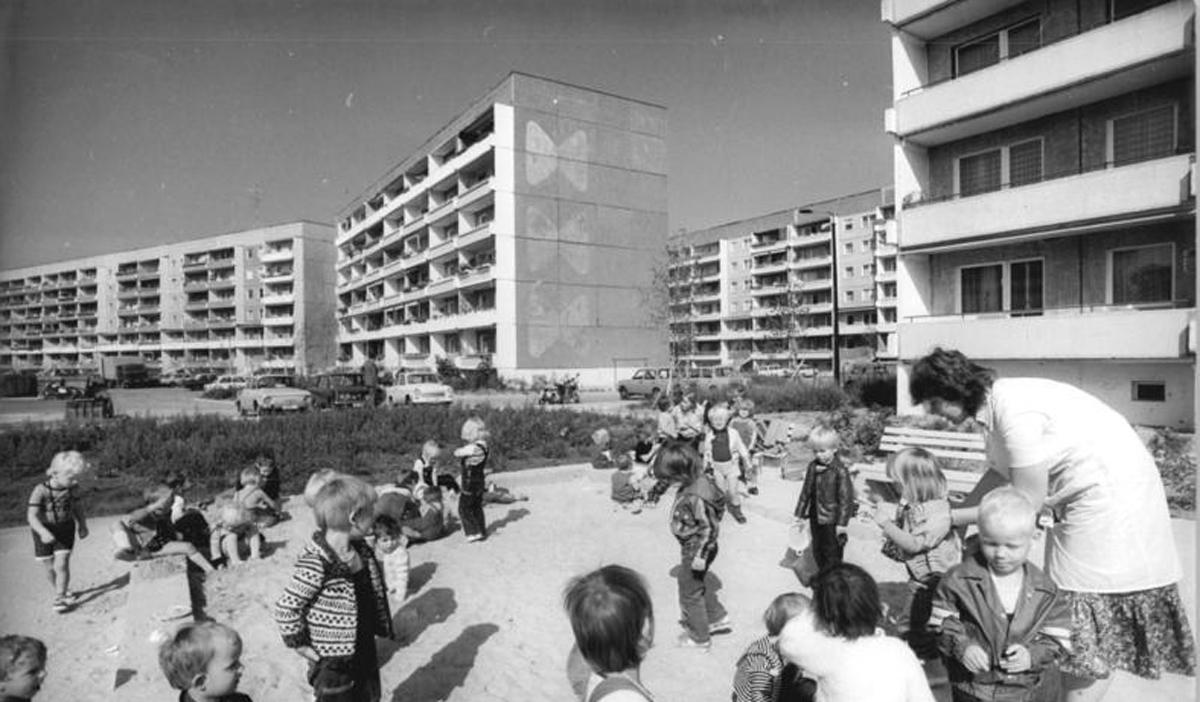
The foundation stone was laid in Grünau on June 1, 1976, and the first residents moved in in November 1977. By the end of the 1980s, around 36,000 apartments had been built, in which around 85,000 people lived. In addition to the residential buildings, schools, kindergartens, polyclinics, department stores, playgrounds and transport connections were planned. The design of the living environment with green spaces, murals and sculptures was also part of the planning.

This pace of construction was made possible by the industrial construction method and the efficiency of the panel factories and housing complexes. In 1985, 83 percent of housing construction across the GDR was already carried out industrially. The standardized production made it possible to build large residential areas in a comparatively short time and to combine the planning of apartments and public facilities.

The construction site and its residents

For the Leipzig builders, Schönefeld was the “journeyman’s piece”, Grünau was supposed to be their “masterpiece”. But the high pace of construction brought difficulties. Siegfried Schlegel, who also spoke at the event about the planning and technical decisions of the time, describes in the book “Building in Leipzig 1945 – 1990” the disproportion between high-rise and open-space construction: At times around 2,000 people worked on building construction, but only around 30 on the design of the outdoor facilities.

While new apartment blocks were already being built, there were still no paved streets and paths in front of houses that had already been occupied. Grünau was therefore nicknamed “mud town”. Temporary power lines also caused difficulties. An on-call service had to rectify problems.

The residents helped. Schlegel reports on an initiative in which tenants of municipal apartments were asked to spend one hundred hours per household designing green spaces. This partially compensated for the lack of capacity and offered the opportunity to get to know neighbors and help shape the living environment.

Neighborhood instead of separation

Grünau was not a neighborhood for just one income group. Workers lived next to engineers, teachers next to employees. Newly built apartments in the GDR in the 1980s usually cost 0.80 to 1.25 marks per square meter. The rents were set by the state and did not cover the actual costs. Anyone who got an apartment did not have to fear being pushed out by rising market rents.

Housing allocation followed social and political priorities. Young families and single parents with children had better opportunities; Employees of important companies and state institutions were also taken into account. What was crucial was not the tenants’ ability to pay, but rather a politically organized distribution of living space according to social needs. But living space remained scarce, some groups were privileged, and many people waited years for a new apartment.

Because numerous young families moved in at about the same time, a residential area with many children was created. Shared schools, farms and house parties offered opportunities to make contacts across professional boundaries. This is how neighborhoods emerged in which people with different professions and walks of life shared their everyday lives with one another.

Having a say, working together, living together

Residents should not just be tenants, but should also participate in their living environment. In workers’ housing cooperatives (AWG), members contributed shares and construction hours. Companies and the state helped with land, workers and cheap loans. At general meetings, the cooperative members were able to decide on construction, financial and maintenance plans, elect board members and form commissions.

There was also co-management in communal houses. According to Section 114 of the GDR Civil Code, the housing authorities concluded contracts with tenant communities for care, repairs and administration. House communities participated in maintenance plans and were able to receive funding for smaller jobs. Repair bases provided equipment and materials.

The fundamental decisions about housing construction and the development of the district were integrated into state planning. Nevertheless, the residents were able to help shape their immediate living environment and take on communal tasks. Youth clubs and the “Völkerfreundschaft” cultural center, which opened in 1983, also offered space for cultural and community life.

Economic Limits

While Grünau grew, many of Leipzig’s old buildings fell into disrepair. The new building had priority. The repair of old roofs, facades and pipes required craftsmen and materials that were often lacking. The repair backlog grew.

One problem was that the GDR had fewer and fewer resources available to renew and expand its economic foundations. According to information from “Building in Leipzig 1945 – 1990”, the proportion of national income that was used for such investments fell from 29 percent in 1970 to 22 percent in 1989. This made it more difficult to modernize companies, renew machines and increase the performance of the economy.e

There were also international pressures. Cooperation with the Soviet Union and the other CMEA states had made long-term supplies of raw materials possible. However, after the global oil price shocks, transfer prices in trade with the Soviet Union also rose. In 1981 it also announced that it would reduce annual oil deliveries from around 19 to 17 million tons. The GDR had to rely more on brown coal and change production processes. Credit problems and restrictions on technology imports also weighed on the economy.

Nevertheless, the GDR leadership stuck to the housing construction program and low rents. This priority improved the living conditions of millions of people, but required resources that were not available for the renovation of old buildings or industrial renewal.

From new building to “Plattenbau”

After 1990, many industrial companies in Leipzig collapsed, jobs were lost and younger families moved away. Grünau lost almost half of its residents by the 2000s. Apartments were empty and facilities closed. At the same time, the public image of the new development areas changed: the sought-after apartment became the derogatory term “Platte”.

The sociologist Alice Kahl, who has studied Grünau since 1979, described the interests behind this image change. Real estate companies and investors were able to market renovated old buildings and homes better if prefabricated buildings were considered unattractive. In their 2000 survey, 55 percent saw improvements in the living environment, but only 22 percent saw an improvement in Grünau’s reputation. There was a clear gap between his own experience in his own neighborhood and his public reputation.

The resident survey “Grünau 2025” by the Helmholtz Center for Environmental Research (UFZ) also shows what has remained of the quality of living. Of the almost 700 Grünau residents surveyed, 68 percent feel very comfortable in their own apartment. In contrast, only 49 percent feel completely comfortable in the district, while another 48 percent feel comfortable with restrictions.

The ownership structure also changed. Municipal and cooperative housing companies sold parts of their holdings. The Old Debt Relief Act of 1993 linked debt relief with privatization and sales obligations. Between 2001 and 2010, around 6,800 apartments were demolished in Grünau. The vacancy rate was high; Funding programs and economic interests decided on the future of the buildings. Familiar neighborhoods disappeared along with the houses.

The housing question is back

In Leipzig, asking rents rose by around a quarter between 2022 and 2025. It is becoming increasingly difficult for many households to find affordable housing. Need alone does not automatically lead to construction. Private investors must have the prospect of sufficient returns.

Grünau reminds us that the housing issue was once approached with a different social standard. The GDR leadership declared it a central task, built up an efficient construction industry and invested large amounts of resources. Within just a few years, living space was created for tens of thousands, with schools, kindergartens, utilities and places for community living. The fact that difficulties arose in a construction project of this magnitude and not all plans could be realized does not detract from this development achievement. Anyone who wants to understand the socialist new development areas must look at their achievements as well as the material conditions under which they were created and the unresolved contradictions. The work of the IFDDR makes a contribution to this. In view of today’s housing shortage, the question once again arises as to who owns the land and apartments, to what standards they are built and who makes the decisions.

When the first families moved to Leipzig-Grünau at the end of the 1970s, it was a huge step forward for many. Those who previously had to live with a coal stove and an outside toilet were given a modern apartment with a bathroom, central heating and often even a balcony. Within a few years, a new district for tens of thousands of people was created.

Fifty years after the foundation stone was laid, rents in Leipzig are rising, affordable apartments are becoming increasingly scarce and the number of homeless people is growing. How was it possible to create housing on this scale back then, and what can we learn from these experiences for our struggles for better housing today?

These questions were the focus of a well-attended event on October 28th by DKP Leipzig and the International Research Center for the GDR (IFDDR). On the occasion of the 50th anniversary of the laying of the foundation stone, Martin Küpper presented the study “Housing for all, building according to plan”. Long-time people from Grünau and those involved in the construction also brought their experiences into the discussion.

Socialist property relations

In order to understand how a residential area the size of Grünau could be created, it is worth taking a look at the historical initial conditions of the GDR. After the war, many cities lay in ruins. Homes, factories and transport routes were damaged, and millions of refugees and displaced people needed accommodation. For 1950, a shortage of around 1.3 million apartments was determined in the GDR. Almost a million of the existing apartments dated from before 1860 and many of them were poorly equipped and in need of renovation.

At the same time, the economic conditions were difficult. War damage, dismantling and reparations weakened the economy. The division tore up supply relationships, and Western export restrictions made access to modern technology more difficult. Under these conditions, the GDR had to develop an efficient construction industry.

The basis for this was the changed ownership structure. Large construction companies became state-owned and housing construction was increasingly organized by the state. The Reconstruction Act of 1950 made it possible to use land in designated development areas for reconstruction and to transfer it to public ownership. In June 1951, the Leipzig center was also declared a development area. Since 1968, the right to housing was enshrined in Article 37 of the GDR constitution, depending on economic possibilities.

On this basis, construction capacities, material supplies and investments could be aligned towards common goals. Residential areas, traffic and supplies could be planned together. Land policy, state planning, industrialized construction, low rents and public housing all intertwined.

Serving all of life

On July 27, 1950, the GDR government passed the “16 Principles of Urban Development”. They saw the city as a place to work, live, learn and relax. Public facilities, green spaces and cultural life should be taken into account during planning. This idea continued in the later construction of large residential areas, even if the architecture and construction methods changed fundamentally.

As early as 1972, after comparing various locations, it was decided to first develop Grünau and later Paunsdorf. A year later, the city of Leipzig announced an urban planning ideas competition for Grünau. At the same time, a new phase of housing construction in the GDR began with the housing construction program approved in 1973. By 1990, 2.8 to three million apartments were to be built or modernized.

The foundation stone was laid in Grünau on June 1, 1976, and the first residents moved in in November 1977. By the end of the 1980s, around 36,000 apartments had been built, in which around 85,000 people lived. In addition to the residential buildings, schools, kindergartens, polyclinics, department stores, playgrounds and transport connections were planned. The design of the living environment with green spaces, murals and sculptures was also part of the planning.

This pace of construction was made possible by the industrial construction method and the efficiency of the panel factories and housing complexes. In 1985, 83 percent of housing construction across the GDR was already carried out industrially. The standardized production made it possible to build large residential areas in a comparatively short time and to combine the planning of apartments and public facilities.

The construction site and its residents

For the Leipzig builders, Schönefeld was the “journeyman’s piece”, Grünau was supposed to be their “masterpiece”. But the high pace of construction brought difficulties. Siegfried Schlegel, who also spoke at the event about the planning and technical decisions of the time, describes in the book “Building in Leipzig 1945 – 1990” the disproportion between high-rise and open-space construction: At times around 2,000 people worked on building construction, but only around 30 on the design of the outdoor facilities.

While new apartment blocks were already being built, there were still no paved streets and paths in front of houses that had already been occupied. Grünau was therefore nicknamed “mud town”. Temporary power lines also caused difficulties. An on-call service had to rectify problems.

The residents helped. Schlegel reports on an initiative in which tenants of municipal apartments were asked to spend one hundred hours per household designing green spaces. This partially compensated for the lack of capacity and offered the opportunity to get to know neighbors and help shape the living environment.

Neighborhood instead of separation

Grünau was not a neighborhood for just one income group. Workers lived next to engineers, teachers next to employees. Newly built apartments in the GDR in the 1980s usually cost 0.80 to 1.25 marks per square meter. The rents were set by the state and did not cover the actual costs. Anyone who got an apartment did not have to fear being pushed out by rising market rents.

Housing allocation followed social and political priorities. Young families and single parents with children had better opportunities; Employees of important companies and state institutions were also taken into account. What was crucial was not the tenants’ ability to pay, but rather a politically organized distribution of living space according to social needs. But living space remained scarce, some groups were privileged, and many people waited years for a new apartment.

Because numerous young families moved in at about the same time, a residential area with many children was created. Shared schools, farms and house parties offered opportunities to make contacts across professional boundaries. This is how neighborhoods emerged in which people with different professions and walks of life shared their everyday lives with one another.

Having a say, working together, living together

Residents should not just be tenants, but should also participate in their living environment. In workers’ housing cooperatives (AWG), members contributed shares and construction hours. Companies and the state helped with land, workers and cheap loans. At general meetings, the cooperative members were able to decide on construction, financial and maintenance plans, elect board members and form commissions.

There was also co-management in communal houses. According to Section 114 of the GDR Civil Code, the housing authorities concluded contracts with tenant communities for care, repairs and administration. House communities participated in maintenance plans and were able to receive funding for smaller jobs. Repair bases provided equipment and materials.

The fundamental decisions about housing construction and the development of the district were integrated into state planning. Nevertheless, the residents were able to help shape their immediate living environment and take on communal tasks. Youth clubs and the “Völkerfreundschaft” cultural center, which opened in 1983, also offered space for cultural and community life.

Economic Limits

While Grünau grew, many of Leipzig’s old buildings fell into disrepair. The new building had priority. The repair of old roofs, facades and pipes required craftsmen and materials that were often lacking. The repair backlog grew.

One problem was that the GDR had fewer and fewer resources available to renew and expand its economic foundations. According to information from “Building in Leipzig 1945 – 1990”, the proportion of national income that was used for such investments fell from 29 percent in 1970 to 22 percent in 1989. This made it more difficult to modernize companies, renew machines and increase the performance of the economy.e

There were also international pressures. Cooperation with the Soviet Union and the other CMEA states had made long-term supplies of raw materials possible. However, after the global oil price shocks, transfer prices in trade with the Soviet Union also rose. In 1981 it also announced that it would reduce annual oil deliveries from around 19 to 17 million tons. The GDR had to rely more on brown coal and change production processes. Credit problems and restrictions on technology imports also weighed on the economy.

Nevertheless, the GDR leadership stuck to the housing construction program and low rents. This priority improved the living conditions of millions of people, but required resources that were not available for the renovation of old buildings or industrial renewal.

From new building to “Plattenbau”

After 1990, many industrial companies in Leipzig collapsed, jobs were lost and younger families moved away. Grünau lost almost half of its residents by the 2000s. Apartments were empty and facilities closed. At the same time, the public image of the new development areas changed: the sought-after apartment became the derogatory term “Platte”.

The sociologist Alice Kahl, who has studied Grünau since 1979, described the interests behind this image change. Real estate companies and investors were able to market renovated old buildings and homes better if prefabricated buildings were considered unattractive. In their 2000 survey, 55 percent saw improvements in the living environment, but only 22 percent saw an improvement in Grünau’s reputation. There was a clear gap between his own experience in his own neighborhood and his public reputation.

The resident survey “Grünau 2025” by the Helmholtz Center for Environmental Research (UFZ) also shows what has remained of the quality of living. Of the almost 700 Grünau residents surveyed, 68 percent feel very comfortable in their own apartment. In contrast, only 49 percent feel completely comfortable in the district, while another 48 percent feel comfortable with restrictions.

The ownership structure also changed. Municipal and cooperative housing companies sold parts of their holdings. The Old Debt Relief Act of 1993 linked debt relief with privatization and sales obligations. Between 2001 and 2010, around 6,800 apartments were demolished in Grünau. The vacancy rate was high; Funding programs and economic interests decided on the future of the buildings. Familiar neighborhoods disappeared along with the houses.

The housing question is back

In Leipzig, asking rents rose by around a quarter between 2022 and 2025. It is becoming increasingly difficult for many households to find affordable housing. Need alone does not automatically lead to construction. Private investors must have the prospect of sufficient returns.

Grünau reminds us that the housing issue was once approached with a different social standard. The GDR leadership declared it a central task, built up an efficient construction industry and invested large amounts of resources. Within just a few years, living space was created for tens of thousands, with schools, kindergartens, utilities and places for community living. The fact that difficulties arose in a construction project of this magnitude and not all plans could be realized does not detract from this development achievement. Anyone who wants to understand the socialist new development areas must look at their achievements as well as the material conditions under which they were created and the unresolved contradictions. The work of the IFDDR makes a contribution to this. In view of today’s housing shortage, the question once again arises as to who owns the land and apartments, to what standards they are built and who makes the decisions.
0

HSR should not be seen as the "be all and end all" of rail transport!

Diesel locomotive TU6MB-2494 with a freight train, Braslav peat enterprise railway
preview

~Photo~ ~by~ ~user~ ~“Valdemar”~ ~on~ ~parovoz~ ~IS~

i’ve observed that many on the left tend to be overly enthusiastic about high-speed rail, perhaps due to misunderstanding the success of china’s network.

high-speed rail is indeed impressive and serves as an important element of transport infrastructure, but it cannot fulfil every transport requirement, nor was it intended to do so! a rail system’s usefulness depends on the network supporting it, which should mainly include regional trains, and freight services, perhaps also narrow-gauge lines, where appropriate, not solely the headline-grabbing high-speed corridors. while speed is important, factors such as coverage, access, capacity, and the types of services the network can provide are much more significant.

regional rail is what makes a passanger network practical on a daily basis. most journeys are not made between distant megacities; people require reliable connections between towns, suburbs, smaller cities and regional centres. a train station that is difficult to access except by car, or that serves only a limited number of major destinations, is of limited value. strong links between high-speed rail and commuter or regional services allow more communities to benefit from faster intercity travel.

freight rail is essential, despite being seen as less glamorous than passenger services. freight requires capacity, reliable paths, and infrastructure suited to heavy loads, rather than top speeds. dedicated high-speed lines often have steeper gradients and more costly alignments, which can be unsuitable for freight operations. focusing rail strategy solely on passenger speed overlooks one of rail’s key economic functions: moving goods efficiently at scale.

also, narrow-gauge rail is criminally overlooked and warrants investment based on its own merits. track gauge is a matter of engineering rather than a measure of a railway’s quality. narrow-gauge lines can provide services in areas where terrain, existing infrastructure, or low demand make a new, high-speed standard-gauge line impractical. while they may not support high speeds, they still offer reliable passenger connections and freight movement. insisting that every line emulate high-speed rail risks disregarding useful existing routes or serving communities unable to justify the expense of a new corridor.

also, china’s system is by no means perfect, with its CRH200J trainsets actually being a fairly good example of the image of hsr being used to make rail service worse, not better:

from january 5, 2019, CRH200J trains were introduced into passenger service and replaced some conventional trains (“green trains”). however, while the regular trains were categorized as “k”, “t” or “z”, their replacements are in the higher fare category “d”, which belongs to the high-speed group. however, the train itself does not fit category d in terms of speed, as it moves much slower, only 130 km/h! (not to mention that service reportedly got considerably worse.) the only reasons for the fare-increase was thus only the missaplied “hsr” marque. the same trainsets are used on the much-lauded china-laos “hsr”, btw, which seemed to have caused much envy among western leftists, despite moving slower than the american acela.

0

China sets out railway technology roadmap to 2030

preview

China: In October, China’s National Railway Administration (NRA) published its railway science and technology innovation plan for the 15th Five-Year Plan period (2026–2030). The plan covers the development of high-speed and heavy-haul operations, intelligent control systems, alternative traction and digital technologies.

A key objective is to strengthen China’s own research and engineering base. The document acknowledges that, despite its achievements, the industry still lacks fundamental research, in-house development capability and qualified specialists, and continues to face difficulties in bringing new technologies into use. ROLLINGSTOCK has previously reported that CRRC’s declared R&D spending is three times that of Europe’s largest player, Alstom.

Under the new plan, China intends to set up around 30 industry research centres and complete at least 20 pilot projects by 2030. These include engineering systems to support operation at up to 400 km/h and technologies for building railways in high-altitude areas.

For passenger rolling stock, the plan calls for CRRC’s CR450 high-speed train, with a commercial speed of 400 km/h, to complete the process of entering commercial service. Testing of the train was completed in the summer. Once in service, it will be used for further research into wheel and rail wear at 400 km/h, pantograph–catenary interaction, and the effects of infrastructure condition, the environment and signalling systems on train performance.

The plan also provides for a new generation of trains with distributed or concentrated traction for speeds of 200 to 250 km/h, as well as new passenger coaches and tourist trains. China also intends to continue research and testing of maglev trains, targeting speeds of up to 600 km/h.

Another priority is automated control for heavy-haul freight trains, which the plan says will improve safety and increase capacity. China carried out its first tests of a driverless freight train on open infrastructure in 2024. The plan also includes preliminary research into the use of 6G communications on the railway and the development of potential use cases.

For traffic management, China plans to develop satellite-based train control systems, including solutions based on its BeiDou navigation system. In particular, the plan provides for further development of moving-block signalling. Unlike fixed-block systems, moving block sets the safe separation between trains according to their actual position and movement. At the end of last year, China tested virtual coupling on a main line, running seven freight trains as a single group.

The plan also covers continued development of hybrid locomotives with hydrogen and battery traction, together with the refuelling infrastructure they require. CRRC already offers a modular shunting locomotive platform with a range of traction options. However, hybrid mainline locomotives remain one-off projects, such as the hydrogen locomotive for Chile.