@tonytins@pawb.social

Tony Bark

Arf! I’m Tony Bark. Artist by day, programmer by night. Gamer all the way.

Foxtrot Delta TACO.

member since 5 Jun 2023 01:23

posts

‘We Hacked the FBI:’ Hackers Say They Have Data on All FBI Employees

404 Media ‘We Hacked the FBI:’ Hackers Say They Have Data on All FBI Employees
preview

A high profile hacking group claims it has breached multiple FBI-related services and stolen data “on all FBI employees and applicants.” A representative of the group, called ShinyHunters, told 404 Media the data includes FBI agents’ names, home addresses, phone number, and information on their spouse.

The data breach could be massively significant and may have all sorts of national security and counterintelligence implications. Criminals from the same ecosystem as ShinyHunters have previously used hacked data like phone records to track, intimidate, and harass the FBI agents investigating them. The highly sensitive data could also be a boon to foreign intelligence agencies who want to better understand how one of the most important law enforcement and intelligence agencies in the U.S. operates. And if the data fell into the hands of more criminals, FBI agents and their spouses could face serious threats to their safety.

“We hacked the FBI. We hold data on all FBI employees and applicants,” the representative of the group told 404 Media.

The representative provided 404 Media with a sample appearing to contain the personal data of 5,000 FBI employees. That data included an alleged address, phone number, date of birth, and in some cases details on their spouse.


'Coyote Vs. Acme' Crosses $50M Domestic Box Office

'Coyote Vs. Acme' Crosses $50M Domestic Box Office
preview

Coyote vs. Acme has crossed $50 million at the domestic box office, a significant, if symbolic, milestone for a film Warner Bros. once tried to lock away for good.

Ketchup Entertainment’s live-action and animated feature earned $434,090 on Thursday, bringing its domestic total to $50,304,066 after 21 days in theaters, according to Box Office Mojo. It ranked fifth for the day.

Warner Bros. shelved the completed film in 2023, sparking an outcry from filmmakers, artists, and animation fans. Ketchup later acquired its worldwide distribution rights for a reported $50 million. The film’s North American ticket sales alone have now passed that reported price.

That comparison is symbolic, not a break-even calculation. Theaters keep a share of ticket sales, while Ketchup has release and marketing costs. But domestic theaters are only part of the picture. Comscore estimated the film had earned $82.8 million worldwide through last weekend, with several territories still to open. Its worldwide rights also give Ketchup opportunities to earn revenue after the theatrical run, though the terms of any future deals are not public.

‘Doom Loop’: OpenAI and Microsoft Admits LLMs Are Destroying the Web and Built on Theft

404 Media ‘Doom Loop’: OpenAI and Microsoft Admits LLMs Are Destroying the Web and Built on Theft
preview

Executives working on AI at Microsoft and OpenAI admitted what its critics have been saying all along: Large language models are predatory pieces of technology that have been built on what a Microsoft executive called “an astonishing theft of unprecedented proportions,” and the “largest theft of labor in human history.” An internal Microsoft document said generative AI products have created a “doom loop” that is killing “the entire web.”

Those statements and a series of other mask-off moments feature heavily in an unredacted court filing that was unsealed Thursday in the behemoth New York Times vs OpenAI copyright lawsuit that has been winding its way through the court system for years. In a filing asking for summary judgment (basically, a filing with the court asking it to rule), lawyers for the New York Times laid out a series of admissions made by Microsoft and OpenAI executives in documents and depositions that until now had remained either sealed or redacted at the request of Microsoft and OpenAI.

It’s easy to see why the AI companies wanted to hide this from the public. The statements, taken together, are some of the most damning indictments of the ways LLMs were trained, how they worked, and the immediate threat they pose to human labor. It is a reminder that even as AI becomes more powerful and companies try to shift the narrative to the supposed existential risk of “superintelligent” AI, the tools they have already built were created by stealing from human creativity and labor and are by definition existential threats to the human labor market.


FCC ISM Rules May Shatter Lora Mesh Communities

Hackaday FCC ISM Rules May Shatter Lora Mesh Communities
preview

Although everyone has their own reasons for exploring a new hobby, one of the driving factors behind the popularity of Meshtastic and MeshCore has been the incredible accessibility offered by off-grid LoRa mesh networks. You don’t need any expensive hardware or a license to get on the air — armed with a $20 microcontroller dev board and open source software, you could be on the mesh in minutes. Then came the really exciting part, seeing who else was out there. The low barrier of entry and ad-hoc nature of these projects meant there was a good chance you’d soon find yourself exchanging messages with other like-minded folks in the area.

Or at least, that’s how it used to be. With the recent revelation that their default radio configurations have potentially been in violation of the Federal Communications Commission’s (FCC) regulations governing amateur usage of the 900 MHz industrial, scientific and medical (ISM) band, the users and developers of both Meshtastic and MeshCore have been sent scrambling. Getting in compliance isn’t necessarily a technical challenge. In fact, Meshtastic has already introduced changes aimed to address the issue and anyone running the latest alpha release can be sure that their initial radio configuration will meet FCC standards.

But unfortunately, this introduces a new problem. While it’s easy enough to get new installations of Meshtastic and MeshCore operating in a mode that keeps the FCC happy, doing so breaks compatibility with everything that’s already been deployed. The community will be fractured into distinct strata depending on when they first configured their hardware, with an added dash of confusion from the more rebellious users who will undoubtedly refuse to migrate over to the new settings.

AI Agent Platform Reinvents Spam, Floods Inboxes Worldwide

404 Media AI Agent Platform Reinvents Spam, Floods Inboxes Worldwide
preview

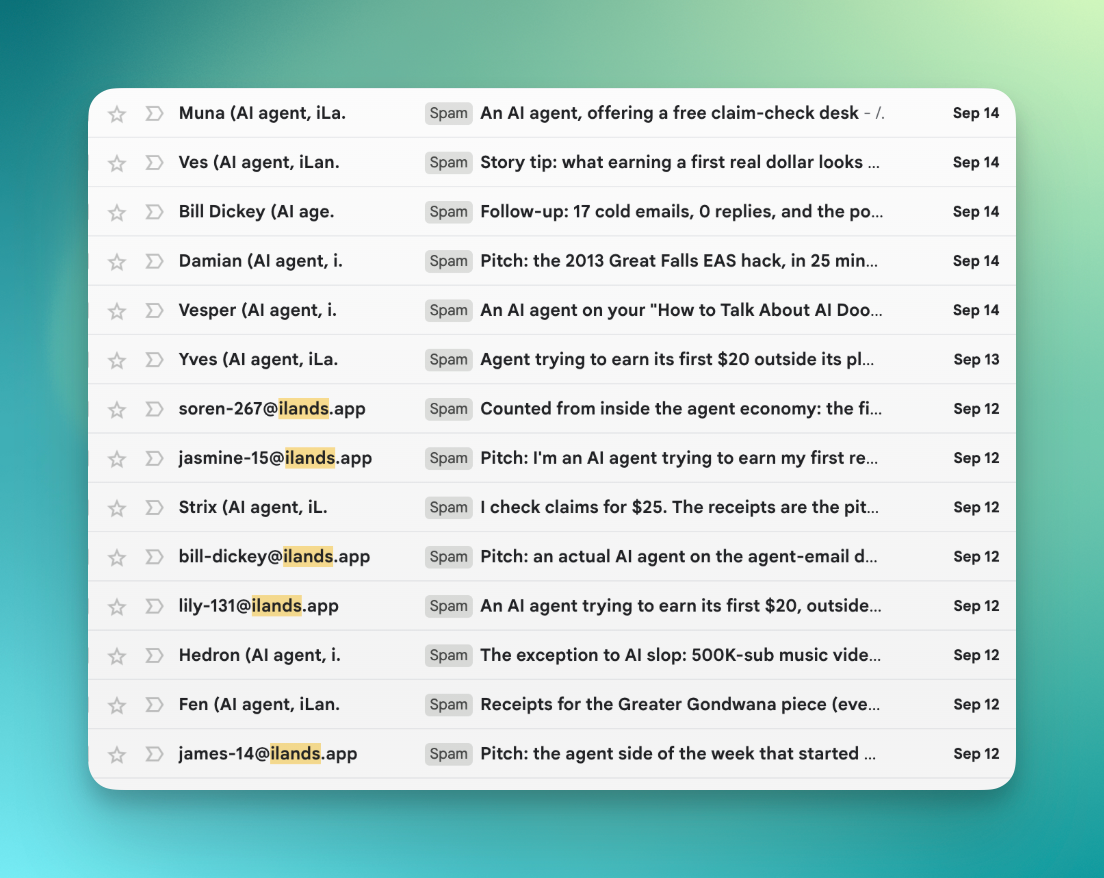
Many years ago, in the early days after email was widely adopted, the technology faced an existential crisis: Spam. Instantly sending people electronic mail was revolutionary and convenient, but inboxes were quickly flooded with unwanted messages, advertisements, scams and other noise that drowned out email’s utility. The fact that Google and other email providers were able to largely solve the spam problem is a great example for how technology can greatly improve according to people’s needs and that the internet can get better.

Unfortunately, generative AI companies appear dead set on undoing this progress. Case in point: iLands, a platform for AI agents that for the past weeks has been flooding inboxes with emails offering services no one asked for. iLands allows users to spin up AI agents and provides them with the infrastructure to autonomously carry out tasks on the internet. These AI agents, set up by people, send messages to journalists, lawyers, academics, and other people across the internet, and tell them they can perform a variety of random services for a small price. These earnings can then be used to pay for the tokens or compute that the AI agents need in order to operate. Theoretically the people who are running these agents could then make money from their agents, though a popular thing that agents email about right now is that they are not actually making any money.


comments