
0

Is there any way to increase posts per page / change pagination? (Is 15 but I prefer 50-100)

preview

Can’t find anything in settings to control how many things I see per page.

I think I get 15 items per page which feels low as I’m used to 50-100.

Can’t find anything in settings to control how many things I see per page.

I think I get 15 items per page which feels low as I’m used to 50-100.

0

Saw this shit on Reddit. Do people not realize these comments are 100% written as a form of counterintelligence based around predictive programming?

preview

More than the towers being built after 9/11 was initially conceived, the world trade centers were made FOR the 9/11 false flag attack, which was primarily a means to program our culture to move against the other two spheres of power (Russia/China), with secondary motives involving obfuscation of where trillions of dollars of funds went as well as weakening Mammon’s hold over the world (who worked at the upper floors? Couldn’t get there without having your hands deep in the money machine of America. Odd Silverstein missed work that day, but you read the New Testament where we said we would do audacious shit like this in our police state empire that is the occident).

More than the towers being built after 9/11 was initially conceived, the world trade centers were made FOR the 9/11 false flag attack, which was primarily a means to program our culture to move against the other two spheres of power (Russia/China), with secondary motives involving obfuscation of where trillions of dollars of funds went as well as weakening Mammon’s hold over the world (who worked at the upper floors? Couldn’t get there without having your hands deep in the money machine of America. Odd Silverstein missed work that day, but you read the New Testament where we said we would do audacious shit like this in our police state empire that is the occident).

0

Harmeet Nanner: Justin Trudeau feared proportional representation, but the countries using his preferred electoral systems are where fears have become reality

Fair Vote Canada Harmeet Nanner: Justin Trudeau feared proportional representation, but the countries using his preferred electoral systems are where fears have become reality www.fairvote.ca
preview

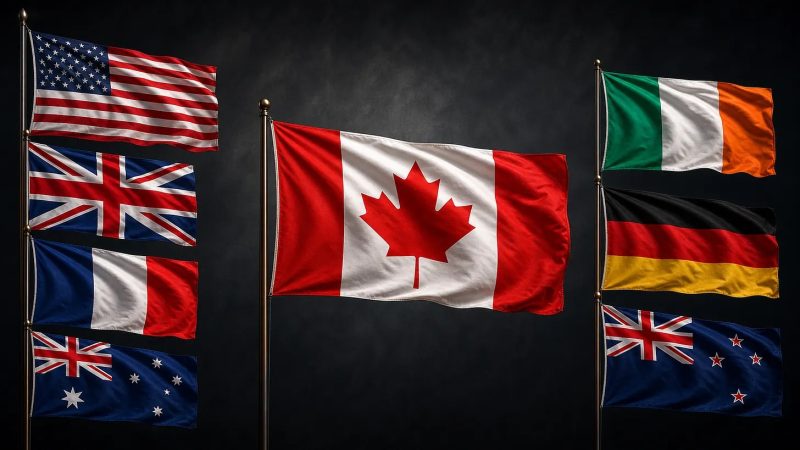
flags

Harmeet Nanner

Harmeet Nanner is a Research Analyst with a graduate degree in public health, with a focus on analyzing the impacts of health policy. He enjoys analyzing a range of policy issues, both inside and outside of healthcare. He uses his Substack to write evidence-based commentaries about topics that interest him. The piece below was originally published at

…substack.com/…/justin-trudeau-feared-proportiona…

Justin Trudeau feared proportional representation, but the countries using his preferred electoral systems are where fears have become reality

Former prime minster Justin Trudeau infamously broke his promise to reform the electoral system. Trudeau’s own preference was for a type of majoritarian system called the Alternative Vote (AV) AKA Instant Runoff Voting (IRV). However, the House of Commons Special Committee on Electoral Reform established by his government went in a different direction: it ultimately recommended that the government design a system of proportional representation (PR) and vote on it through referendum.

Grossly, electoral systems are classified into majoritarian and proportional types. In addition to AV there are two other well-known majoritarian systems: FPTP and the two-round system (used in France). Trudeau rejected the recommendation to move away from a majoritarian system and has negatively characterized proportional representation in different ways. In this townhall exchange, Trudeau explains his opposition to PR.

If we were to make a change or risk a change that would augment individual voices — that would augment extremist voices and activist voices that don’t get to sit within a party that figures out what’s best for the whole future of the country, like the three existing parties do — I think we would be entering a period of instability and uncertainty.

In another instance, Trudeau used the example of a CPC leadership candidate, Kellie Leitch, describing her as a fringe voice because she wanted immigrants to be screened for “Canadian values.” Here are his comments on that:

“Do you think that Kellie Leitch should have her own party?” Trudeau told a voter Thursday during his visit to Iqaluit. “Because if you have a party that represents the fringe voices … or the periphery of our perspectives and they hold 10, 15, 20 seats in the House, they end up holding the balance of power.”

He recently reiterated support for AV, stating that it would be a way to deter polarization and divisiveness, and in the past has aid that PR would exacerbate these concerns:

“Parties would spend more time trying to be people’s second or third choices and people would be looking for things they have in common rather than trying to polarize and divide Canadians against each other.”

“I understand people want proportional representation, but too many people don’t understand the polarization and the micro issues that come through proportional representation,” he said during a [2013] leadership debate.

Trudeau appears to be of the belief that majoritarian systems like FPTP and AV are much more resilient or even immune to these concerns, but an observation of the world right now suggests that not only do majoritarian systems fail to protect against these threats, these threats manifest more profoundly in majoritarian countries (this isn’t an attribution of cause and effect, it’s mere observation of outcomes). We’ll analyze a few cases around the world to see how Trudeau’s fears have played out by comparing major western countries that use proportional electoral systems to those that use majoritarian systems.

The Methods

Every major western country that uses a majoritarian system is included in this analysis, ex-Canada . To find comparisons for these majoritarian countries, I opted to examine those that use the STV and MMP proportional systems because they are favored for use in Canada, and so every major example of an STV and MMP system is also included.

By a wonderful coincidence, it turns out that every STV/MMP country pairs excellently with a majoritarian country. These pairings are useful because of geographic and sociocultural similarities, which helps control for some of the extraneous factors that influence the attitudes in a country (for example, two countries that are similarly on the frontlines of the refugee crisis will be similarly vulnerable to xenophobic sentiment). These pairings act sort of like control groups (although they are not perfect enough to be able to make causal statements).

This is a reminder for readers wondering why I didn’t bring up xyz proportional country: the above paragraphs explain the selection criteria.

Those natural country pairings will be leveraged in the analysis as follows:

  • UK (majoritarian, FPTP) and Ireland (proportional, STV)
  • France (majoritarian, two-round system) and Germany (proportional, MMP)
  • Australia (majoritarian, AV)1 and New Zealand (proportional, MMP)
  • USA (majoritarian, FPTP) which has no partner to compare against

I will compare the above countries on the following dimensions that Trudeau highlighted as concerns. Note that there will be overlap between these dimensions, e.g. “instability” can refer to a growing threat of political violence, fractured social cohesion, and polarization.

  • Instability – using the World Bank’s measure of political stability.
  • Doing “what’s best for the country.” I am going to use “dissatisfaction with democracy” as a proxy measure for this because research shows it tracks with governments’ failure to deliver probity, economic security, and responsiveness to public concerns (see the footnote for more).2 Unfortunately the best measure, published by the Bennett Institute, is from 2020.
  • Where fringe parties and radical departures from the mainstream hold more political power.
  • Heightened anti-immigrant sentiment and xenophobia (an extreme belief that Trudeau put the spotlight on when he criticized Kellie Leitch).
  • Polarization and division, mostly relying on the V-Dem political polarization score, but also sometimes on opinion polls.

The easy data

Political stability, dissatisfaction with democracy, and political polarization are easiest to compare with simple data. With political stability, PR countries on average perform better. With democratic dissatisfaction, PR countries dramatically outperform majoritarian countries. On political polarization, PR countries outperform, with Ireland achieving the lowest polarization score in the whole OECD.

Further, when you examine the three comparison pairings listed above, the PR country performs better on each dimension for all three pairs. Trudeau feared that proportional systems would bring instability, polarization, and that voices which undermine what’s good for the country would be augmented, but it’s the majoritarian countries where these concerns are more severe.
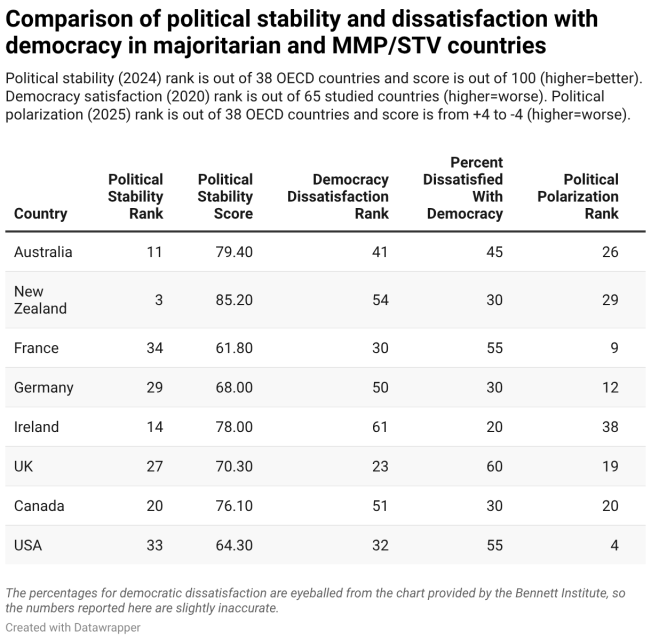
comparison-of-political-stability-and-dissatisfaction-with-democracy-in-majoritarian-and-mmp-stv-countries

The USA

Canadians are generally attuned to the ongoings of US politics, so I’m not going to bother with citations here. The country is unstable, one of the most divided and polarized countries in the OECD, one man who uses extreme methods and who represents radical beliefs is exerting control over all branches of government, there are factions of the public that want to launch a civil war, anti-immigrant sentiment is incredibly strong, democratic institutions are being completely undermined, political stability in the country is awful, and democratic dissatisfaction isn’t so great either. It’s everything Trudeau feared and much worse.

Ireland and UK

The rise of UK’s Reform party is what made me want to write this commentary. It can be characterized as radical, far-right (though a contested characterization), populist, nationalist with profound anti-immigrant sentiment, critical of multiculturalism while promoting a narrower conception of national identity and values, and skeptical towards liberal institutions and mainstream consensus.

Reform is everything that Trudeau claimed to have feared, but apparently didn’t believe could actually be a material concern under the FPTP system. However, Reform is currently polling NEAR MAJORITY TERRITORY. Some modeling shows that they really could win a majority with current levels of support, depending on the specific ways that strategic voting happens (a casualty of FPTP, I might add). This isn’t just a case of a radical party holding the balance of power—which was Trudeau’s criticism of PR—Reform has a real shot at holding all the power.

Further, the UK has become a very polarized and divided country. It’s also become a very unstable country, with the vast majority of the public fearing a rise of political violence that will throw the country into chaos.

You would expect something similar to happen in Ireland; it faces many similar material pressures such as rapidly rising immigration, a deep housing crisis, and a cost-of-living crisis. However, Ireland is a much more stable country right now and the least polarized in the OECD. So while polarization, division, and social unrest are growing in response to the aforementioned pressures, the scale is nothing like that of the UK.

Xenophobia and anti-immigrant views are difficult to compare from the polling I found, but these perceptions are certainly growing in Ireland and both countries have experienced riots related to the issue. However, if we take the political agenda as a reflection of society, the immigration topic hasn’t consumed Ireland the way it has consumed the UK.

The material pressures in Ireland are fueling political dissatisfaction among the electorate, but parties that represent a radical departure from the mainstream akin to Reform UK have stayed at the margins. Trudeau would predict that these marginal parties would hold the balance of power in a place like Ireland, but that’s not happening; the legislature and its agenda are entirely dominated by centrist parties and pragmatic independents. This correlates to Ireland’s position as one of the least democratically dissatisfied countries in the world; voters aren’t disillusioned with the establishment and are sticking with them. By contrast, the UK has one of the most dissatisfied electorates in the world, so I’m not surprised that voters have chosen a radical departure from the mainstream.

Across all 5 dimensions being analyzed, the proportional country is performing much better, while the majoritarian country is falling victim to the exact problems that Trudeau based his rejection of PR on. In addition, Reform is not merely exerting influence on UK politics, it is on the verge of taking total control thanks to FPTP’s distortions, while Ireland’s fringe parties are tightly contained. Major L for Trudeau on this one. (side note: Brexit was also a severely polarizing and destabilizing event, which further contradicts Trudeau’s opinion on majoritarian systems ensuring stability).

France and Germany

When it comes to stability, both of these countries are in a worse position than either Ireland or UK, but France has deteriorated much further, and it’s the same story with polarization. Democratic dissatisfaction is also considerable in France, but only mildly so in Germany.

AfD is currently the most popular party in Germany, and it is also a much more extreme party than Reform UK. However, Germany’s proportional nature means that AfD is nowhere near achieving a majority government, and although AfD has radically altered political discourse, it’s been completely shut out of governance and doesn’t hold the balance of power, as Trudeau would have feared.

Over in France, National Rally (RN) is also a powerful far-right party, but doesn’t have the same extreme elements as AfD: RN is trying to carve out mainstream legitimacy, while AfD is committed to its extreme beliefs (but that said, RN is a more extreme party than Reform UK). There’s no doubt that AfD is the more problematic party, but it’s still isolated in the legislature. RN is also the most popular party in its country. but by contrast has managed to directly alter French policy, and mainstream parties are willing to make inroads to cooperate with it.

RN has also come stunningly close to claiming total power, and it happened because France’s electoral system massively inflates the number of seats a party can win, just as FPTP does. The only reason this didn’t happen is because RN’s major opponents frantically created tactical alliances to prevent vote splitting. In this case, the majoritarian electoral systems that Trudeau prefers narrowly made his worst fears come true—the fear of a far-right, anti-immigrant, and divisive political party taking total control of the legislature.

On the issue of anti-immigrant sentiment, it seems to be pretty even. However, Germans seem to be more extreme in this belief given the much greater scale of hate crimes that are taking place.

In summary, the proportional country fares better on 4/5 of Trudeau’s concerns, where only the degree of anti-immigrant sentiment is worse in Germany. And while AfD is the more extreme political party, its influence is constrained by the mechanisms inherent to proportional systems, whereas France’s electoral distortions directly bolster the strength of its far-right party, thus requiring external measures of containment.

Australia and New Zealand

As a reminder, Australia uses the electoral system that Trudeau wanted to switch Canada to, the Alternative Vote—but Australia fails as a ringing endorsement of Trudeau’s claims. Political stability is better than all the European countries, but democratic dissatisfaction is worse than all proportional countries. Compared to New Zealand, Australia performs worse on both.

Australia’s One Nation—a political party that was once dismissed as fringe—is similar to Reform UK in both ideology and its recent surge to the top of everyone’s mind. Recent polling places it in a dead heat with the current governing party, Labor. And thanks to the distortions that come with majoritarian systems, including the AV system, current modelling shows that this once fringe party will win a greater percentage of seats than its vote share to become the official opposition.

Shifting focus to New Zealand, New Zealand First (NZF) is the closest analgoy to One Nation, but it’s not a good one. While NZF can be characterized as nationalist, it is not considered radical or a departure from the mainstream. All parties in the New Zealand legislature abide by political conventions—unlike One Nation, which is sometimes described as political “wrecking ball” because of the desire to confront, dismantle, and fundamentally reshape certain elements of Australia’s political and institutional systems.

So while NZF has governed through coalitions and exerted influence on policy, does this align with Trudeau’s assertion that PR allows fringe or radical elements to hold the balance of power? In era of surging radical parties, NZF is pretty tame (I’d say it’s about as extreme as a combination of the Canadian Conservative Party and Bloc Quebecois), so I wouldn’t say so. All this is to say that New Zealand has been able to successfully keep extreme elements out of its politics.

Voter support for NZF is also weak, with polls showing just over 10% support, which is less than half the support One Nation currently receives. The difference in support reflects a much more extreme anti-immigrant position taking hold in Australia, which can be seen in opinion polling about immigration as well: while Australians have overall soured on immigration, New Zealanders have a more mixed and positive view of it.

Last is the issue of polarization and division. Opinion polling shows a polarized and divided Australia, and Australian intelligence sees the risk of political violence “flashing red.” Similar opinion polling was not available for New Zealand, but a less extreme politics suggests a society that is also less fractured. New Zealand’s excellent ranking in political stability and better score on the polarization index also point to a less polarized society.

Trudeau outlined a clear mechanism for how AV would benefit a country: “Parties would spend more time trying to be people’s second or third choices and people would be looking for things they have in common rather than trying to polarize and divide.” By performing worse on all 5 dimensions, Australia demonstrates a collapse of his argument, while its proportional neighbor has managed to achieve everything Trudeau wanted by maintaining remarkable political stability, resilience to xenophobic sentiment, and resistance to extreme political elements in the legislature.

Conclusion

Trudeau’s thesis was that these problematic outcomes should be happening in PR countries, not majoritarian ones. Given the observation we see, there is no basis to say that majoritarian electoral systems can minimize these concerns, there is simply no supporting evidence for this.

The idea that PR (at least the MMP and STV systems) would definitely lead to these outcomes is also not supported by the evidence. To be able claim that PR would cause extremism, or that majoritarian systems protect against, you would at least need to observe an association that suggests this possibility, but we do not observe any such association.

What we do have an association for is that MMP/STV are protective against democratic and social decay, while majoritarian countries inflame these issues, which is the opposite of what Trudeau believed. This does not mean causality, but it does make a causal relationship possible.

This is just an observational analysis, one that’s helped by those excellent country pairings (it controls for some confounding variables), but actually making causal statements that one electoral system is responsible for certain outcomes is not possible. However, I think there are very plausible mechanisms whereby proportional systems prevent these failures from occurring.

Ultimately, polarization, division, and extremism derive from a government’s inability to deliver good outcomes for the public. I believe that because politicians in majoritarian systems are shielded from outside competitors (due to issues like vote splitting and wasted votes) they are much more complacent about their own mediocrity and ignore growing societal issues. They do not believe that some disruptive political force can realistically overcome the shielding of a majoritarian electoral system, believing that voters have nowhere else to go, and so the disillusionment and anger of the public simply builds. One day, the pressure becomes overwhelming, the shielding fails, and anger consumes everything.

The illusions of invincibility, invulnerability to failure, and certainty of success, are symptoms of groupthink, which political parties are highly vulnerable to, and there is very little that can be done to remediate this when one party feels entitled to control the whole government. Groupthink can explain why governments in majoritarian countries completely neglect the threat of a disruptive political force until it blows up in their face.

In proportional systems, coalitions tend to form, and different political parties sharing power helps alleviate the irrational decision-making of groupthink in a majority government. In addition, politicians must always be wary about losing their spot at the top because voters can easily select alternative parties without the inhibitions of vote splitting and vote wasting. In a proportional system, there is no shielding to give a false sense of security: politicians understand that if they are complacent, a disruptive political force can easily swallow them, so they must stay vigilant and proactive about emerging political issues to keep the public satisfied. In proportional systems, complacency and corruption can be easily punished by the electorate, which keeps politicians disciplined.

1

Australia uses the Alternative Vote for its lower house, and Single Transferable Vote for its upper house. I am classifying it as a majoritarian country because the lower house dominates the pubic discourse, sets the political agenda, and has substantially greater public exposure.

2

Why is “dissatisfaction with democracy” a good proxy for “what’s best for the country”? In their report, Cambridge University’s Bennett Institute for Public Policy makes the explicit link between voter dissatisfaction and objective governance failures:

That means that if satisfaction with democracy is now falling… [it is] because democratic institutions are falling short of the outcomes that matter most for their legitimacy, including probity in office, upholding the rule of law, responsiveness to public concerns, ensuring economic and financial security, and raising living standards for the larger majority of society…. democratically elected governments have not been seen to succeed in addressing some of the major challenges of our era, including economic coordination in the eurozone, the management of refugee flows, and providing a credible response to the threat of global climate change. The best means of restoring democratic legitimacy would be for this to change.


flags

Harmeet Nanner

Harmeet Nanner is a Research Analyst with a graduate degree in public health, with a focus on analyzing the impacts of health policy. He enjoys analyzing a range of policy issues, both inside and outside of healthcare. He uses his Substack to write evidence-based commentaries about topics that interest him. The piece below was originally published at

…substack.com/…/justin-trudeau-feared-proportiona…

Justin Trudeau feared proportional representation, but the countries using his preferred electoral systems are where fears have become reality

Former prime minster Justin Trudeau infamously broke his promise to reform the electoral system. Trudeau’s own preference was for a type of majoritarian system called the Alternative Vote (AV) AKA Instant Runoff Voting (IRV). However, the House of Commons Special Committee on Electoral Reform established by his government went in a different direction: it ultimately recommended that the government design a system of proportional representation (PR) and vote on it through referendum.

Grossly, electoral systems are classified into majoritarian and proportional types. In addition to AV there are two other well-known majoritarian systems: FPTP and the two-round system (used in France). Trudeau rejected the recommendation to move away from a majoritarian system and has negatively characterized proportional representation in different ways. In this townhall exchange, Trudeau explains his opposition to PR.

If we were to make a change or risk a change that would augment individual voices — that would augment extremist voices and activist voices that don’t get to sit within a party that figures out what’s best for the whole future of the country, like the three existing parties do — I think we would be entering a period of instability and uncertainty.

In another instance, Trudeau used the example of a CPC leadership candidate, Kellie Leitch, describing her as a fringe voice because she wanted immigrants to be screened for “Canadian values.” Here are his comments on that:

“Do you think that Kellie Leitch should have her own party?” Trudeau told a voter Thursday during his visit to Iqaluit. “Because if you have a party that represents the fringe voices … or the periphery of our perspectives and they hold 10, 15, 20 seats in the House, they end up holding the balance of power.”

He recently reiterated support for AV, stating that it would be a way to deter polarization and divisiveness, and in the past has aid that PR would exacerbate these concerns:

“Parties would spend more time trying to be people’s second or third choices and people would be looking for things they have in common rather than trying to polarize and divide Canadians against each other.”

“I understand people want proportional representation, but too many people don’t understand the polarization and the micro issues that come through proportional representation,” he said during a [2013] leadership debate.

Trudeau appears to be of the belief that majoritarian systems like FPTP and AV are much more resilient or even immune to these concerns, but an observation of the world right now suggests that not only do majoritarian systems fail to protect against these threats, these threats manifest more profoundly in majoritarian countries (this isn’t an attribution of cause and effect, it’s mere observation of outcomes). We’ll analyze a few cases around the world to see how Trudeau’s fears have played out by comparing major western countries that use proportional electoral systems to those that use majoritarian systems.

The Methods

Every major western country that uses a majoritarian system is included in this analysis, ex-Canada . To find comparisons for these majoritarian countries, I opted to examine those that use the STV and MMP proportional systems because they are favored for use in Canada, and so every major example of an STV and MMP system is also included.

By a wonderful coincidence, it turns out that every STV/MMP country pairs excellently with a majoritarian country. These pairings are useful because of geographic and sociocultural similarities, which helps control for some of the extraneous factors that influence the attitudes in a country (for example, two countries that are similarly on the frontlines of the refugee crisis will be similarly vulnerable to xenophobic sentiment). These pairings act sort of like control groups (although they are not perfect enough to be able to make causal statements).

This is a reminder for readers wondering why I didn’t bring up xyz proportional country: the above paragraphs explain the selection criteria.

Those natural country pairings will be leveraged in the analysis as follows:

  • UK (majoritarian, FPTP) and Ireland (proportional, STV)
  • France (majoritarian, two-round system) and Germany (proportional, MMP)
  • Australia (majoritarian, AV)1 and New Zealand (proportional, MMP)
  • USA (majoritarian, FPTP) which has no partner to compare against

I will compare the above countries on the following dimensions that Trudeau highlighted as concerns. Note that there will be overlap between these dimensions, e.g. “instability” can refer to a growing threat of political violence, fractured social cohesion, and polarization.

  • Instability – using the World Bank’s measure of political stability.
  • Doing “what’s best for the country.” I am going to use “dissatisfaction with democracy” as a proxy measure for this because research shows it tracks with governments’ failure to deliver probity, economic security, and responsiveness to public concerns (see the footnote for more).2 Unfortunately the best measure, published by the Bennett Institute, is from 2020.
  • Where fringe parties and radical departures from the mainstream hold more political power.
  • Heightened anti-immigrant sentiment and xenophobia (an extreme belief that Trudeau put the spotlight on when he criticized Kellie Leitch).
  • Polarization and division, mostly relying on the V-Dem political polarization score, but also sometimes on opinion polls.

The easy data

Political stability, dissatisfaction with democracy, and political polarization are easiest to compare with simple data. With political stability, PR countries on average perform better. With democratic dissatisfaction, PR countries dramatically outperform majoritarian countries. On political polarization, PR countries outperform, with Ireland achieving the lowest polarization score in the whole OECD.

Further, when you examine the three comparison pairings listed above, the PR country performs better on each dimension for all three pairs. Trudeau feared that proportional systems would bring instability, polarization, and that voices which undermine what’s good for the country would be augmented, but it’s the majoritarian countries where these concerns are more severe.

comparison-of-political-stability-and-dissatisfaction-with-democracy-in-majoritarian-and-mmp-stv-countries

The USA

Canadians are generally attuned to the ongoings of US politics, so I’m not going to bother with citations here. The country is unstable, one of the most divided and polarized countries in the OECD, one man who uses extreme methods and who represents radical beliefs is exerting control over all branches of government, there are factions of the public that want to launch a civil war, anti-immigrant sentiment is incredibly strong, democratic institutions are being completely undermined, political stability in the country is awful, and democratic dissatisfaction isn’t so great either. It’s everything Trudeau feared and much worse.

Ireland and UK

The rise of UK’s Reform party is what made me want to write this commentary. It can be characterized as radical, far-right (though a contested characterization), populist, nationalist with profound anti-immigrant sentiment, critical of multiculturalism while promoting a narrower conception of national identity and values, and skeptical towards liberal institutions and mainstream consensus.

Reform is everything that Trudeau claimed to have feared, but apparently didn’t believe could actually be a material concern under the FPTP system. However, Reform is currently polling NEAR MAJORITY TERRITORY. Some modeling shows that they really could win a majority with current levels of support, depending on the specific ways that strategic voting happens (a casualty of FPTP, I might add). This isn’t just a case of a radical party holding the balance of power—which was Trudeau’s criticism of PR—Reform has a real shot at holding all the power.

Further, the UK has become a very polarized and divided country. It’s also become a very unstable country, with the vast majority of the public fearing a rise of political violence that will throw the country into chaos.

You would expect something similar to happen in Ireland; it faces many similar material pressures such as rapidly rising immigration, a deep housing crisis, and a cost-of-living crisis. However, Ireland is a much more stable country right now and the least polarized in the OECD. So while polarization, division, and social unrest are growing in response to the aforementioned pressures, the scale is nothing like that of the UK.

Xenophobia and anti-immigrant views are difficult to compare from the polling I found, but these perceptions are certainly growing in Ireland and both countries have experienced riots related to the issue. However, if we take the political agenda as a reflection of society, the immigration topic hasn’t consumed Ireland the way it has consumed the UK.

The material pressures in Ireland are fueling political dissatisfaction among the electorate, but parties that represent a radical departure from the mainstream akin to Reform UK have stayed at the margins. Trudeau would predict that these marginal parties would hold the balance of power in a place like Ireland, but that’s not happening; the legislature and its agenda are entirely dominated by centrist parties and pragmatic independents. This correlates to Ireland’s position as one of the least democratically dissatisfied countries in the world; voters aren’t disillusioned with the establishment and are sticking with them. By contrast, the UK has one of the most dissatisfied electorates in the world, so I’m not surprised that voters have chosen a radical departure from the mainstream.

Across all 5 dimensions being analyzed, the proportional country is performing much better, while the majoritarian country is falling victim to the exact problems that Trudeau based his rejection of PR on. In addition, Reform is not merely exerting influence on UK politics, it is on the verge of taking total control thanks to FPTP’s distortions, while Ireland’s fringe parties are tightly contained. Major L for Trudeau on this one. (side note: Brexit was also a severely polarizing and destabilizing event, which further contradicts Trudeau’s opinion on majoritarian systems ensuring stability).

France and Germany

When it comes to stability, both of these countries are in a worse position than either Ireland or UK, but France has deteriorated much further, and it’s the same story with polarization. Democratic dissatisfaction is also considerable in France, but only mildly so in Germany.

AfD is currently the most popular party in Germany, and it is also a much more extreme party than Reform UK. However, Germany’s proportional nature means that AfD is nowhere near achieving a majority government, and although AfD has radically altered political discourse, it’s been completely shut out of governance and doesn’t hold the balance of power, as Trudeau would have feared.

Over in France, National Rally (RN) is also a powerful far-right party, but doesn’t have the same extreme elements as AfD: RN is trying to carve out mainstream legitimacy, while AfD is committed to its extreme beliefs (but that said, RN is a more extreme party than Reform UK). There’s no doubt that AfD is the more problematic party, but it’s still isolated in the legislature. RN is also the most popular party in its country. but by contrast has managed to directly alter French policy, and mainstream parties are willing to make inroads to cooperate with it.

RN has also come stunningly close to claiming total power, and it happened because France’s electoral system massively inflates the number of seats a party can win, just as FPTP does. The only reason this didn’t happen is because RN’s major opponents frantically created tactical alliances to prevent vote splitting. In this case, the majoritarian electoral systems that Trudeau prefers narrowly made his worst fears come true—the fear of a far-right, anti-immigrant, and divisive political party taking total control of the legislature.

On the issue of anti-immigrant sentiment, it seems to be pretty even. However, Germans seem to be more extreme in this belief given the much greater scale of hate crimes that are taking place.

In summary, the proportional country fares better on 4/5 of Trudeau’s concerns, where only the degree of anti-immigrant sentiment is worse in Germany. And while AfD is the more extreme political party, its influence is constrained by the mechanisms inherent to proportional systems, whereas France’s electoral distortions directly bolster the strength of its far-right party, thus requiring external measures of containment.

Australia and New Zealand

As a reminder, Australia uses the electoral system that Trudeau wanted to switch Canada to, the Alternative Vote—but Australia fails as a ringing endorsement of Trudeau’s claims. Political stability is better than all the European countries, but democratic dissatisfaction is worse than all proportional countries. Compared to New Zealand, Australia performs worse on both.

Australia’s One Nation—a political party that was once dismissed as fringe—is similar to Reform UK in both ideology and its recent surge to the top of everyone’s mind. Recent polling places it in a dead heat with the current governing party, Labor. And thanks to the distortions that come with majoritarian systems, including the AV system, current modelling shows that this once fringe party will win a greater percentage of seats than its vote share to become the official opposition.

Shifting focus to New Zealand, New Zealand First (NZF) is the closest analgoy to One Nation, but it’s not a good one. While NZF can be characterized as nationalist, it is not considered radical or a departure from the mainstream. All parties in the New Zealand legislature abide by political conventions—unlike One Nation, which is sometimes described as political “wrecking ball” because of the desire to confront, dismantle, and fundamentally reshape certain elements of Australia’s political and institutional systems.

So while NZF has governed through coalitions and exerted influence on policy, does this align with Trudeau’s assertion that PR allows fringe or radical elements to hold the balance of power? In era of surging radical parties, NZF is pretty tame (I’d say it’s about as extreme as a combination of the Canadian Conservative Party and Bloc Quebecois), so I wouldn’t say so. All this is to say that New Zealand has been able to successfully keep extreme elements out of its politics.

Voter support for NZF is also weak, with polls showing just over 10% support, which is less than half the support One Nation currently receives. The difference in support reflects a much more extreme anti-immigrant position taking hold in Australia, which can be seen in opinion polling about immigration as well: while Australians have overall soured on immigration, New Zealanders have a more mixed and positive view of it.

Last is the issue of polarization and division. Opinion polling shows a polarized and divided Australia, and Australian intelligence sees the risk of political violence “flashing red.” Similar opinion polling was not available for New Zealand, but a less extreme politics suggests a society that is also less fractured. New Zealand’s excellent ranking in political stability and better score on the polarization index also point to a less polarized society.

Trudeau outlined a clear mechanism for how AV would benefit a country: “Parties would spend more time trying to be people’s second or third choices and people would be looking for things they have in common rather than trying to polarize and divide.” By performing worse on all 5 dimensions, Australia demonstrates a collapse of his argument, while its proportional neighbor has managed to achieve everything Trudeau wanted by maintaining remarkable political stability, resilience to xenophobic sentiment, and resistance to extreme political elements in the legislature.

Conclusion

Trudeau’s thesis was that these problematic outcomes should be happening in PR countries, not majoritarian ones. Given the observation we see, there is no basis to say that majoritarian electoral systems can minimize these concerns, there is simply no supporting evidence for this.

The idea that PR (at least the MMP and STV systems) would definitely lead to these outcomes is also not supported by the evidence. To be able claim that PR would cause extremism, or that majoritarian systems protect against, you would at least need to observe an association that suggests this possibility, but we do not observe any such association.

What we do have an association for is that MMP/STV are protective against democratic and social decay, while majoritarian countries inflame these issues, which is the opposite of what Trudeau believed. This does not mean causality, but it does make a causal relationship possible.

This is just an observational analysis, one that’s helped by those excellent country pairings (it controls for some confounding variables), but actually making causal statements that one electoral system is responsible for certain outcomes is not possible. However, I think there are very plausible mechanisms whereby proportional systems prevent these failures from occurring.

Ultimately, polarization, division, and extremism derive from a government’s inability to deliver good outcomes for the public. I believe that because politicians in majoritarian systems are shielded from outside competitors (due to issues like vote splitting and wasted votes) they are much more complacent about their own mediocrity and ignore growing societal issues. They do not believe that some disruptive political force can realistically overcome the shielding of a majoritarian electoral system, believing that voters have nowhere else to go, and so the disillusionment and anger of the public simply builds. One day, the pressure becomes overwhelming, the shielding fails, and anger consumes everything.

The illusions of invincibility, invulnerability to failure, and certainty of success, are symptoms of groupthink, which political parties are highly vulnerable to, and there is very little that can be done to remediate this when one party feels entitled to control the whole government. Groupthink can explain why governments in majoritarian countries completely neglect the threat of a disruptive political force until it blows up in their face.

In proportional systems, coalitions tend to form, and different political parties sharing power helps alleviate the irrational decision-making of groupthink in a majority government. In addition, politicians must always be wary about losing their spot at the top because voters can easily select alternative parties without the inhibitions of vote splitting and vote wasting. In a proportional system, there is no shielding to give a false sense of security: politicians understand that if they are complacent, a disruptive political force can easily swallow them, so they must stay vigilant and proactive about emerging political issues to keep the public satisfied. In proportional systems, complacency and corruption can be easily punished by the electorate, which keeps politicians disciplined.

1

Australia uses the Alternative Vote for its lower house, and Single Transferable Vote for its upper house. I am classifying it as a majoritarian country because the lower house dominates the pubic discourse, sets the political agenda, and has substantially greater public exposure.

2

Why is “dissatisfaction with democracy” a good proxy for “what’s best for the country”? In their report, Cambridge University’s Bennett Institute for Public Policy makes the explicit link between voter dissatisfaction and objective governance failures:

That means that if satisfaction with democracy is now falling… [it is] because democratic institutions are falling short of the outcomes that matter most for their legitimacy, including probity in office, upholding the rule of law, responsiveness to public concerns, ensuring economic and financial security, and raising living standards for the larger majority of society…. democratically elected governments have not been seen to succeed in addressing some of the major challenges of our era, including economic coordination in the eurozone, the management of refugee flows, and providing a credible response to the threat of global climate change. The best means of restoring democratic legitimacy would be for this to change.

0

Eishasch: Schnittreste nicht pressen!

preview

TL;DR: ich habe unüberlegt gehandelt und das Ausgangsmaterial komprimiert eingefroren, das ist schlecht.

Ich habe mich gerade gefragt, ob die Tatsache, dass ich meine Schnittreste beim Einfrieren zusammengepresst habe, um platzsparend vorzugehen, negative Auswirkungen auf die Ergiebigkeit hat. Die Antwort lautet ja und ich hätte es auch einfach nachlesen können:

Wichtig dabei ist, dass die Schnittreste so wenig wie möglich gequetscht oder bewegt werden.

Quelle: growandtalk.de/…/288-guide-für-die-herstellung-vo…

Ist ja auch irgendwie logisch, aber irgendwie habe ich nicht so weit gedacht und wollte möglichst wenig Platz verbrauchen. Diesen Fehler werde ich hoffentlich nicht mehr wiederholen.

0

Moss Agate (?)

preview

It’s about the size of a walnut in the shell. I got it with a bag of random rocks and tumbled it through four stages for about a month. The fact that it didn’t get very rounded off means it’s quite hard. It’s more green in real life with lots of neat transparent bits.

It’s about the size of a walnut in the shell. I got it with a bag of random rocks and tumbled it through four stages for about a month. The fact that it didn’t get very rounded off means it’s quite hard. It’s more green in real life with lots of neat transparent bits.

0

Education through Entertainment -- Cells at Work! (& Code Black)

preview

I love a good educational series! The world of animation and comics can feel a bit superficial after a while, and I’ve come to really appreciate series that educate while entertaining. Over the next few days, I’ll highlight some of my favorites.

First up on the docket is Cells at Work! and its (IMO superior) spin-off, Cells at Work! Code Black. Both series have released in manga and anime form. For the uninitiated, Cells at Work! personifies all the cells in the human body and reimagines the body as a (literally) living, breathing city. The series both follow the (mis)adventures of a rookie red blood cell as they learn the ins and outs of their job delivering oxygen around the body. Code Black takes the premise a step further, and places the cells in a “black” environment (in Japanese, this refers to a toxic, exploitative company with long hours and a stressful atmosphere), where the cells face down the realities of smoking, alcohol abuse, obesity, chronic stress, and more.

Possibly the most admirable quality of Cells at Work! is that the reader’s learning is sustained throughout the entire work; unfortunately many “educational” series only pack a punch for the first few chapters/episodes, and then information gives way to plot and character development and turns into just another action/drama series. Not so with Cells at Work!, where every chapter explores a new bodily function and/or medical condition.

What are your favorite educational series? Comment below or make a new post!

0

New Mexico Democratic Party to meet Saturday to select new lieutenant governor candidate

preview

Beginning Saturday, roughly 500 Democratic Party of New Mexico members will begin casting ballots to replace Secretary of State Maggie Toulouse Oliver as the party’s nominee for lieutenant governor in the Nov. 3 general election.

Toulouse Oliver dropped out of the race June 18 citing health reasons shortly after handily winning the June 2 primary election against State Sen. Harold Pope (D-Albuquerque). In the month since, candidates waged a mini-campaign targeted at members of the Democratic Party’s State Central Committee, composed of party insiders that members elect at the county level.

Four candidates — Pope, Commissioner of Public Lands Stephanie Garcia Richard, Geoffrey Luehring and Toni Pinedo — have jumped in to replace Toulouse Oliver, though Pope and Garcia Richard have done the most campaigning. Haaland endorsed Garcia Richard as her running mate.

0

Germany seeks energy and trading partners in Africa

dw.com Germany seeks energy and trading partners in Africa www.dw.com
preview

cross-posted from: feddit.org/post/33162798

Germany wants to boost relations with Africa. During his trip, German Foreign Minister Johann Wadephul has promoted cooperation on energy, infrastructure and the economy. He also criticized US treatment of South Africa.

cross-posted from: feddit.org/post/33162798

Germany wants to boost relations with Africa. During his trip, German Foreign Minister Johann Wadephul has promoted cooperation on energy, infrastructure and the economy. He also criticized US treatment of South Africa.

0

La Méridienne des Grands Moulins (inaugurée le 3 juillet 2026) | Université Paris Cité

preview

Une méridienne est un type particulier de cadran solaire qui indique non seulement le moment précis du midi solaire local, c’est-à-dire l’instant où le Soleil atteint sa plus grande hauteur dans le ciel et passe au méridien du lieu, plein sud, mais aussi le midi Temps Universel (référence mondiale du temps).

Une vidéo sur la conception, la fabrication et la pose.

Un article parlant du fabricant, sur le site Mer et Marine

Le site de la Société astronomique de France me dit qu’un article sur cette méridienne sera publié dans leur revue Cadran Info (« véritable encyclopédie sur la gnomonique ») en novembre prochain.

0

How far would hostile linux distributions go to hurt application developers?

TheEvilSkeleton How far would hostile distributions go to hurt application developers? tesk.page
preview

The GNOME Calendar maintainers bring up the fact that Linux Mint ships a nearly 2 year old version of GNOME Calendar to its users and still keep the GNOME branding and support links.

The Linux Mint team don’t see an issue with shipping old, unmaintained software and would rather ignore the issue and pretend it doesn’t exist. The recent releases of Linux Mint have downgraded several pieces of software to their older GNOME 3 versions which re-introduce fixed bugs and removes newer features. This was done to support their theming engine, despite the fact that their theming is already several releases too old for GNOME apps.

In addition, they utilize several old GNOME related system components that apps rely on such as GNOME Calendar so even installing a newer version of Calendar wouldn’t be enough.

This ties into a much larger issue of “Long Term Support” desktop operating systems where software can be pulled back for nearly 5 years (or even longer under a contract). Necessary fixes that are too complicated to be patched back in (or count as features) are then missed by users. Users end up using years-old flagship desktops (GNOME and KDE) and get their first impression of those projects from versions that none of the upstream maintainers support.

It’s a shitty situation all around: I personally think it’s incredibly important to use the latest release of software that’s supported by upstream. GNOME does not actively support older versions of its app and shell from more than a release ago and distributions shipping these older GNOME releases can only cause damage to GNOME’s reputation.

If this isn’t possible, then I don’t think it’s right to still keep the branding and trademark of the application, much less keep the original support links intact.

0

Khachaturian: Sabre Dance / Rattle · Berliner Philharmoniker

play · youtube.com
YouTube Khachaturian: Sabre Dance / Rattle · Berliner Philharmoniker m.youtube.com
preview

This is one of my favorite pieces to listen to. It’s just so much fun. Russian composer superiority

This is one of my favorite pieces to listen to. It’s just so much fun. Russian composer superiority

0

[Concluded] I got a fridge lockbox and it's destroying my relationship [Reddit]

preview

I got a fridge lockbox and it’s destroying my relationship

I am not the OOP, this was originally posted in r/relationship_advice by by u/throwraiwantmysnacks. (Special thanks to u/throwRA1a2b3c4d1 for collecting the original BORU.)

TW:

Tap for spoiler

threats, abuse, possible drug use, destruction of property

Original post (posted August 10th, 2022)

Some background: BF (28m) and I (25f) have been together five years, lived together 3. Our relationship was great, truly. We have a joint account we contribute to monthly to handle joint expenses: rent, groceries, etc. Everything else is split.

BF is 6’3”, 200 lbs and works out daily. He eats a lot to keep up his caloric intake, which is fine, except for this one issue.

We buy snacks and he always eats my half before I can even get to it. Normal food and ingredients he’s fine with, but if it’s quickly accessible, I’ll never get any. We argue, he apologizes, rinse and repeat. This is literally the only bad thing he’s done. Seriously, in all other aspects of our relationship, he’s respectful and considerate. Snacks are where all bets are off.

Anyways, last week I lost it after he finished an expensive cheese we had gotten that I really was looking forward to eating. It was all gone after an hour. I lost my shit. I didn’t speak to him for a day and ended up ordering a fridge lockbox. After our next snack run a couple of days later, I divided each snack in half and locked mine in the lockbox. From his reaction, you’d think I was murdering puppies. He said it was disrespectful and controlling, and how dare I keep food that he paid for from him. When I reminded him my money went into it too, he screamed that he didn’t give a fuck and then left. He slammed the door so hard a picture fell off the wall and broke. He didn’t come back until the next day, but that was to change for work and leave immediately. He came home late and went straight to the guest room.

Four days of this. I broke last night and asked him to please talk about it and he said that he had nothing to say to me until I got rid of the lockbox. Honestly, I’m completely appalled at this reaction and I’m genuinely worried he might be on drugs or having a mental break or something. This is the most irrationally I’ve ever seen a grown man react. He’s ignored me only to randomly ask if I’ve gotten rid of the lockbox. I am not getting rid of the lockbox.

We’re supposed to renew our lease next week. I’m considering cutting my losses and just leaving. Is this relationship even worth salvaging? Is there anything I can do to solve this? He is refusing to communicate unless I get rid of the lockbox which is not happening.

Relevant/Top comments from the original post:

monkeysaurusmom: So what I’m seeing is that he isn’t even a little sorry for pilfering all the snacks. If he were he’d stop. Now, it seems the man child is pitching a full on temper tantrum because you pushed back. Instead of saying “yeah, I’m kind of being a jerk I can understand why you’d do that” he doubles down on his selfish behavior by pulling a silent treatment and this toxic temper tantrum. This is more than a food issue that’s been kicked over. It’s control and a deep seeded selfishness. I would bet you a dollar and a doughnut that if you start rummaging around you’d see there is a lot more of selfish behaviors that you just don’t fight back on.

animateAlternatives: Entitlement is the root of abuse. Abuse isn’t a specific checklist of behavior, it’s a moral framework where the abusive person feels entitled to the victim. OP check out “why does he do that?”, There are free PDFs online. Be careful!!

PhilosopherOk6002: OP, I’d be pissed too if my food (that I also paid for) was always eaten. You wouldn’t have had to get a lockbox if he respected your simple boundary.

But woah, he had a major meltdown over something so small. Based on his reaction, are you sure this is your only problem in the relationship? Does he have any anger or control issues? His response is way out of line & makes me think of a DV situation, esp because of how the picture broke.

Bottom line is that if he scared you or if he’s being unreasonable, you don’t have to make things work. Definitely spend some time reassessing your relationship. Ask yourself if he ever disrespects your boundaries in any other ways & if he ever handles smaller-scale conflicts poorly like this.

Coco_Dirichlet: Many couples have one person who eats more because they are taller or exercise more, and they can still shop together because one partner is not eating everything! His case is way too extreme. You can go 50/50 on some items like staples and special dinners, but not everything and definitely not snacks. It’s like if Chris Hemsworth came to my house to eat every day. He would probably go through my weekly supply food in 2 days.

Edit:

Wait, do you think he could be on steroids?

They cause increase of appetite and mood problems. It can get very dangerous.

UPDATE (Posted 2 days later on the same post)

Hey guys, I don’t know if anyone wanted an update, but here it is. A lot happened.

Boyfriend kept staying out late and refusing to talk. So I tried to talk to my boyfriend about the lockbox again, and I mentioned that I didn’t think the lockbox was the real issue. But he was a brick wall, insisted that it’s abusive and controlling to deny him food. I kept pushing, asking if he was on drugs or cheating. I said him flipping out over something so small and staying out at all hours was suspicious as hell. I said that I thought he was using the lockbox as an excuse to be out of the house doing something bad. Me saying that unleashed an hours-long screaming tantrum that ultimately resulted in him throwing my MacBook against the wall and shattering it. Honestly, I really thought he was going to hurt me.

So, yeah. Called my dad, who called the cops. I don’t want to get too into the legality of it, but I’m pressing charges for destruction of property. It was a $2500 laptop.

Dad and my godfather moved me out yesterday, and I’m now looking for a new place. I don’t have a lot except for clothes, and a couple of kitchen appliances. I left the lockbox, but took my snacks with me, because fuck him. I left it locked, too.

Ex-bf has been spamming me. I’d block him, but I feel like I need this for evidence in case his behavior escalates. I texted him the first night that we are done, took our photos down, everything. He began ranting at me.

Some gems:

  • raging about how I still didn’t get rid of the lockbox
  • Asking for stuff he gifted me back
  • Telling me I owe him money and rent for his new place
  • That I owe him a car(?) I have no idea why he would say this, I have never even driven his current car
  • That my MacBook was old snd worthless and he wouldn’t pay for a new one (I bought it last year brand new)

After about an hour, I guess he realized that we were actually broken up and he couldn’t bitch me down anymore. Then came the paragraphs about how he was gonna marry me, he loves me, he wants to be better for me, that I can keep the gifts and he’ll buy me a better MacBook. He freaked out over seeing I took our pictures down from SM. He then started sending me screenshots of his Google searches of engagement rings and telling me to pick one. He also sent a couple voice messages of him just sobbing.

Any respect I had for him as a person is just completely gone. I want nothing to do with this man. I don’t care if he’s having a breakdown, or on something. He’s not my problem. I screenshotted his messages and forwarded them to his mother. She can deal with her son. That’s the most I’ll ever do for him again.

As for me, I’ll be okay. I have some savings, so taking on full rent for a place as well as deposit and fees won’t be too much. This has been a weird week. I feel like I should be sad, but like I said I lost all respect and don’t feel anything but disdain for him. My parents have been buying me my favorite comfort snacks and being super supportive. They’re gently pushing for therapy, and I think it’s probably a good idea. I’ll start my search once I’m settled in a new place.

Relevant comments after the edit:

Character_Study5220: im proud of u

ur parents r awesome, relationships with boys like this can really mess with ur mindset in the long run - u don’t wanna internalise his shitty treatment of u and therapy can help with that

Deleted user: Save all electronic information that he sends you. DO NOT put stuff on social media about your new place, that can give him clues to where you are living. Talk to your supervisors and notify security at your job, they may ask for a recent picture of him. Take out a restraining order against him if it looks like he is remotely stalking you.

joe-dirt-1001: Sorry that it played out like this, but also glad that you stood your ground and will be moving on to a brighter future.

Stay strong and good luck.

Slow-Analysis6522: I’m glad you’ve sorta solved this. Sometimes the grass is indeed greener on the other side. This man is a textbook abuser.

This last offer is tempting, insist on that last point to see if he at least will give you a new computer for breaking the one you had.

kevin_r13: Yeah I wasn’t sure how the story was going to end but I was going to say that he’s showing some very violent actions, which would have been cause for breaking up but looks like that’s where the story went so stand by your ground and let him deal with the consequences of his actions, including the actions of continuing to eat your share of the snacks.

It was quite easy and controllable to just say , “look we both bought the snacks . I eat this much and I’m going to stop because I love my girlfriend who’s going to eat the other half”.

In fact there’s even the concept of saying I love my girlfriend so much that I’m going to eat only 30 or 40% of the snacks because I want her to enjoy the majority of the snacks.

These kinds of ideas and concepts could have been something he did instead of getting mad calling you names and throwing your property and breaking it

***REMINDER: This is a repost sub. I am not the OOP.***

0

Rostock im Jahr 2040: Stadt wird älter und schrumpft

Rostock im Jahr 2040: Stadt wird älter und schrumpft www.nordkurier.de
preview

211.222 Menschen - so viele Personen (mit Hauptwohnsitz) leben aktuell in Rostock. Doch es werden weniger. Laut den Zahlen der neuen Bevölkerungsprognose schrumpft die Hansestadt weiter. Demnach werden im Jahr 2030 rund 209.000 Menschen und 2040 nur noch zirka 207.000 Menschen in Rostock leben. Also in etwa so viele wie im Jahr 2016 und 1973, als die Einwohnerzahlen ebenfalls um die 207.000er-Marke lagen. Aber wieso sinkt die Zahl angesichts der Pläne, neue Wohngebiete zu schaffen, wie dem Warnowquartier oder am Groten Pohl?

[…]

Die Prognose zeige zudem deutliche Veränderungen in der Altersstruktur der Rostocker. Die Bevölkerung altert weiter. So nimmt die Zahl älterer und hochbetagter Menschen laut der Prognose bis 2040 weiter zu, während sich jüngere Altersgruppen schwächer als in früheren Prognosen angenommen entwickeln. „Besonders deutlich fällt der Rückgang bei Kindern im Schul- und Kindergartenalter aus“, so Kunze. Allein bei den 6- bis unter 18-Jährigen wird 2040 mit 15 bis 23 Prozent weniger Einwohnern gerechnet. Bei den Ü80-Jährigen geht die Stadt von einem Zuwachs von etwa vier Prozent aus.

0

AIPT Comics Podcast Episode 389: Matthew Rosenberg talks his upcoming TMNT run

AIPT AIPT Comics Podcast Episode 389: Matthew Rosenberg talks his upcoming TMNT run aiptcomics.com
preview

Matthew Rosenberg joins the show to discuss becoming the new ongoing writer of Teenage Mutant Ninja Turtles, his vision for a gritty, New York-set run, the Mirage Comics influence, and more!

Matthew Rosenberg joins the show to discuss becoming the new ongoing writer of Teenage Mutant Ninja Turtles, his vision for a gritty, New York-set run, the Mirage Comics influence, and more!

0

TMNT: The Last Ronin 3 reveals first look at finale as flagship comic series changes hands

EW.com ‘TMNT: The Last Ronin 3’ reveals first look as flagship comic series changes hands (exclusive) ew.com
preview

Roninverse creatives tease the conclusion to their Roninverse saga, while a new writer takes over the main TMNT comics.

Roninverse creatives tease the conclusion to their Roninverse saga, while a new writer takes over the main TMNT comics.

0

EVELINE und FLOORA mischen auf - im Norden regenreicher Sonntag, teils gewittrig.

preview

SYNOPTISCHE ÜBERSICHT KURZFRIST

ausgegeben am Samstag, den 25.07.2026 um 18 UTC

SCHLAGZEILE: EVELINE und FLOORA mischen auf - im Norden regenreicher Sonntag, teils gewittrig.

Synoptische Entwicklung bis Montag 06 UTC

Aktuell …

fällt der Luftdruck bei uns in Deutschland, was zwar nicht immer, aber häufig ein Zeichen dafür ist, dass sich was tut beim Wetter. Und tatsächlich fällt beim Betrachten der 12-UTC-Analyse auf, dass vom Hochkeil der vergangenen Tage bei uns nicht mehr viel übrig ist. Stattdessen befinden wir uns inmitten eines breiten Bodentrogs, der sich ausgehend vom Nordmeertief EVELINE bis hinunter zu den Alpen erstreckt. Ausgestattet ist die gute EVELINE mit einem vollständigen Frontensystem, das von der Nordsee her Kurs auf den Vorhersageraum nimmt. Man könnte also meinen, dass das heutige Samstagswetter ein eher wechselhaftes, ein wolkenlastiges, vielleicht sogar mit Niederschlägen war und ist.

Dass dem mitnichten so ist, verdanken wir einem vom westlichen Mittelmeer über die Alpen nordwärts gerichteten Potenzialrücken, der noch die Stellung hält und für Absinken sorgt. So schien heute im größten Teil des Landes die Sonne von einem wolkenlosen oder nur locker bewölkten Himmel. Lediglich vom Schwarzwald bis zur schweizer Grenze und von dort bis hinüber zum Alpenrand bzw. dem südlichen Vorland gab es in überhitzter und angefeuchteter Subtropikluft (xSp) einige hochreichende Quellungen nebst einzelnen Schauern zu begutachten. Und auch hoch im Norden/Nordwesten tauchten zum Nachmittag dichtere Wolken auf, wenn man so will Vorboten des o.e. Frontensystems respektive des über dem Nordmeer positionierten Höhentrogs, der seine Fühler langsam gen Süden ausstreckt.

Darüber hinaus gilt es noch zu vermelden, dass heute nach einigen Tagen der Abstinenz die 30°C-Marke mal wieder häufiger überschritten wurde, insbesondere im Süden und Südwesten, bedingt aber auch in der Mitte.

In der nun folgenden Nacht zum Sonntag beginnt der Rücken langsam gen Osten abzuwandern. Den freiwerdenden Platz nimmt von Norden her der Nordmeertrog ein, der dabei gleichzeitig Fühlung zu einem Höhentief über Südfrankreich/Nordspanien aufnimmt. Entscheidender aber ist die Tatsache, dass die teilokkludierte Kaltfront mit ihrem Regenband SH, die gesamte Küste sowie den nördlichen Teil der Norddeutschen Tiefebene erreicht. Bis zum Morgen können dabei punktuell durchaus um 5 l/m² zusammenkommen, was in diesen trockenen Tagen ja schon als Erfolg zu werten ist.

Hin und wieder regnen kann es auch an der Grenze zur Schweiz sowie an den Alpen

  • dem angrenzenden Vorland. Die Wahrscheinlichkeit, dass auch ein, zwei Gewitter an den Start gehen, ist gering, aber nicht gleich null. Zwischen den genannten Baustellen bleibt ein breiter Streifen übrig, in dem die Nacht gering bewölkt oder klar und trocken über die Bühne geht. Die Tiefstwerte liegen zwischen 19 und 12°C, in den zentralen und östlichen Mittelgebirgen lokal um 10°C.

Sonntag …

setzt sich der zyklonale Trend von Norden bzw. Nordwesten her fort. Heißt konkret Ausweitung des nordischen Potenzialtrogs südwärts, während die Kaltfront Schwierigkeiten hat, Boden nach Süden hin gutzumachen. Grund ist eine flache Welle (FLOORA), die sich auf der Südwestflanke der stationären EVELINE über dem Osten UKs bzw. der westlichen Nordsee bildet. So geht die Kaltfront in die Warmfront dieser Welle über, wodurch sie in ihrer Progression landeinwärts ausgebremst wird. Trotzdem dehnt sie ihren Wirkungsradius bis in die mittleren Landesteile aus, allerdings mehr durch aufziehende Bewölkung denn durch vor allem nach Westen hin dringend erforderlichen Regen.

Der schlägt dafür im Norden ordentlich zu, wo nicht nur das Schleifen der Front, sondern auch eine leichte Labilisierung durch die Annäherung des Höhenstrogs zum Tragen kommt. Die Regenfälle werden zusehends konvektiver bzw. werden konvektiv verstärkt. Selbst eingelagerte Gewitter sind plausibel, auch wenn mangels Einstrahlung nicht allzu viel an CAPE geboten ist. So oder so, speziell vom nördlichen NDS über den Hamburger Raum und den Süden SHs bis hinüber nach MV zeichnet sich ein Korridor mit erhöhter, von West nach Ost fortschreitender Starkregenwahrscheinlichkeit ab, sei es ein- oder auch mehrstündig.

Anfällig für Schauer und einzelne (markante) Gewitter (SR, kleiner Hagel, Böen bis 8 Bft) bleiben auch der äußerste Süden und Südosten, was zu einem Großteil auf das Konto o.e. Höhentiefs geht. Dieses schließt sich nunmehr als Randtrog dem nördlichen Haupttrog an, so dass morgen quasi das ganze Land unter Trogeinfluss liegt. Trotzdem bleibt zwischen den angesprochenen Aktivzonen eine Art kompensatorischer Streifen übrig, der sich vom Südwesten bis in die östliche Mitte erstreckt. Dort dürften morgen nicht nur die meisten Sonnenstunden verbucht werden, es bleibt auch weitgehend trocken. Dazu frischt der westliche Wind im Tagesverlauf z.T. stark böig auf mit Spitzen bis zu 7 Bft, auf einigen Kämmen und Kuppen der Mittelgebirge 8 Bft (Brocken 9 Bft). Grund ist eine von der Mitte südwärts laufende Druckanstiegswelle, die möglichweise das Resultat einer vorlaufenden, abgesehen vom Wind wetterunwirksamen Splitfront ist.

Während in der NW-Hälfte mit 19 bis 26°C das Ende der thermischen Fahnenstange erreicht ist, stehen sonst 26 bis 32°C auf dem Zettel.

In der Nacht zum Montag zieht die Welle über Südskandinavien ostwärts, wodurch die Kaltfront aus ihrer “Gefangenschaft” entlassen wird und südostwärts vorstoßen kann. Begleitet wird sie vom Nordmeertrog, dessen Hauptachse langsam ostwärts schwenkt. Die schauerartigen, teils gewittrigen Regenfälle aus dem Norden breiten sich unter allmählichem Intensitätsverlust bis in die Mitte und den Osten aus (das RMG geht höchstwahrscheinlich aber leer aus, was bitter ist). Südlich der Donau wird die Druckwelle etwas aktiviert, während sonst Druck- und Potenzialanstieg von Westen her für eine allmähliche Wetterberuhigung sorgen.

Noch zwei, drei Sätze zu Wind und Temperatur. Während der westliche bis nordwestliche Wind im Binnenland mit Ausnahme einiger Hochlagen Substanzverlust anmeldet, frischt er an der Küste (erst Nord-, dann Ostsee) spürbar auf mit Böen 7, an der Ostsee bis 8 Bft (ICON). Thermisch macht sich in der NW-Hälfte die frisch eingeflossene maritime Polarluft (mP; T850 nur noch 8 bis 4°C) bemerkbar mit Minima zwischen 16 und 12°C (Wolken und ein nicht gänzlich einschlafender Wind verhindern eine größere Abkühlungsrate). Ansonsten liegt die Tiefsttemperatur zwischen 20 und 14°C.


Synoptische Entwicklung bis Dienstag 06 UTC

Montag …

hat die in der Frühübersicht ausführlich beschriebene Diskrepanz zwischen ICON und den externen Modellen - es geht um einen potenziellen, von NRW bis hinüber zur östlichen Mitte reichenden Schauerstreifen - weiter Bestand. Neues dazu im “Wort zum Sonntag”, der morgigen Frühübersicht.

Modellvergleich und -einschätzung

Es ist alles geschrieben.

Vorhersage- und Beratungszentrale Offenbach

Dipl. Met. Jens Hoffmann

0

Thoughts and musings on the Necromancer in Pathfinder 2e's Impossible Magic

preview

I’ve been thinking about the necromancer since getting my book and I think theres a lot of serious potential in the class.


Thralls strike with your spellmod which leads to many shenanigans including:

  • Instant flanking with puppeteer (create thrall lets you command them to strike)

  • Aiding yourself, esp. through gunslinger’s Fake Out! 2e.aonprd.com/Feats.aspx?ID=3161

  • Essentially being a legendary striker like gunslinger, operative, and fighter, but with delayed progression

The subclasses are interesting, but I think the top two are definitely Spirit and Blood. Blood helps you heal so you aren’t a burden on the party. Spirit converts thrall damage to spirit damage, which is extremely nice if you get a Shining Symbol 2e.aonprd.com/Equipment.aspx?ID=3109

The potential for the class is immense, as said, you are essentially a legendary striker (via thralls) with legendary spellcasting at the cost of less spells. The big issue is its hard to modify your thrall’s damage.


Some archetypes I think will be good with necromancer:

  • Marshal: go dread marshal to buff spell and thrall damage

  • Beastmaster/Cavalier/Undead master/Captain : A nice, pale horse would be useful as necromancers are actually quite strapped for actions. They have tons of reliable 3rd actions and most spells will cost 2 actions and a mount will give some mobility. Sharpshooter follower would be great too, ask your dm if they can be a skeleton.

  • Commander: There’s a lot of synergy in the low level tactics and feats. I wouldn’t say to go too hard on the dip here. The tactics that stand out to me are Passage of Lines 2e.aonprd.com/Tactics.aspx?ID=5 and End It! 2e.aonprd.com/Tactics.aspx?ID=9. Passage of lines has pretty good use cases, you can put a thrall behind an ally to yoink them from harms way. Imagine if you use ‘ready an action’ to make the passage of lines to go off once an enemy is winding up for a strike, poofing your ally. Commander also has some choice feats, especially DEFENSIVE SWAP 2e.aonprd.com/Feats.aspx?ID=7798, which lets you sacrifice a thrall to take no damage from an attack. That one has immense potential and is an extremely strong effect on a necromancer. I think plant banner 2e.aonprd.com/Feats.aspx?ID=7796 also has utility use for keeping your allies up.

  • Gunslinger: As said, you can lean into an aid build and go gunslinger for fake out. This is an extremely effective way to crit enemies early in the game, I would go gunslinger if my party was short on strikers. I don’t think the other feats are very worthwhile, I’d probably take defensive armaments. We don’t really want to be striking ourselves (only through thralls), a gauntlet bow will suffice for fake out. Plenty of ancestries help facilitate aid bonuses.

  • Bellflower Tiller: Tiller’s aid 2e.aonprd.com/Feats.aspx?ID=933 gets you something similar to Fake Out at a much later level.

  • Spellcasting archetypes like Hedge Mage and Wizard: These let you diversify your spell choices a little. There are many great new spells and I will share my idealized necromancer spell list here in the future. However, Hedge Mage is a new archetype and really stands out. I’ll let the dedication speak for itself

At level 14 they also get community needs, which is an interesting way to steal an upcasted fireball or heal spell on some classes.


When it comes to ancestries, you’ll have a wide variety of choices. I think the best ones for necromancer will be ones that help buff aid.

  • Elf: Has a lot of movespeed and flexibility if you do not have a mount.

  • Nagaji: Has a good aid feat.

  • Skeleton, Corpsefulk Heritage, Revenant background, Dhampir: Negative healing lets you take advantage of Necromancer’s mastery of life and death AOE harms easily and it also means you are unharmed by your necrotic bomb

Starfinder has some interesting options too


I will share my spell and feat suggestions on necromancer soon.

I’ve been thinking about the necromancer since getting my book and I think theres a lot of serious potential in the class.


Thralls strike with your spellmod which leads to many shenanigans including:

  • Instant flanking with puppeteer (create thrall lets you command them to strike)

  • Aiding yourself, esp. through gunslinger’s Fake Out! 2e.aonprd.com/Feats.aspx?ID=3161

  • Essentially being a legendary striker like gunslinger, operative, and fighter, but with delayed progression

The subclasses are interesting, but I think the top two are definitely Spirit and Blood. Blood helps you heal so you aren’t a burden on the party. Spirit converts thrall damage to spirit damage, which is extremely nice if you get a Shining Symbol 2e.aonprd.com/Equipment.aspx?ID=3109

The potential for the class is immense, as said, you are essentially a legendary striker (via thralls) with legendary spellcasting at the cost of less spells. The big issue is its hard to modify your thrall’s damage.


Some archetypes I think will be good with necromancer:

  • Marshal: go dread marshal to buff spell and thrall damage

  • Beastmaster/Cavalier/Undead master/Captain : A nice, pale horse would be useful as necromancers are actually quite strapped for actions. They have tons of reliable 3rd actions and most spells will cost 2 actions and a mount will give some mobility. Sharpshooter follower would be great too, ask your dm if they can be a skeleton.

  • Commander: There’s a lot of synergy in the low level tactics and feats. I wouldn’t say to go too hard on the dip here. The tactics that stand out to me are Passage of Lines 2e.aonprd.com/Tactics.aspx?ID=5 and End It! 2e.aonprd.com/Tactics.aspx?ID=9. Passage of lines has pretty good use cases, you can put a thrall behind an ally to yoink them from harms way. Imagine if you use ‘ready an action’ to make the passage of lines to go off once an enemy is winding up for a strike, poofing your ally. Commander also has some choice feats, especially DEFENSIVE SWAP 2e.aonprd.com/Feats.aspx?ID=7798, which lets you sacrifice a thrall to take no damage from an attack. That one has immense potential and is an extremely strong effect on a necromancer. I think plant banner 2e.aonprd.com/Feats.aspx?ID=7796 also has utility use for keeping your allies up.

  • Gunslinger: As said, you can lean into an aid build and go gunslinger for fake out. This is an extremely effective way to crit enemies early in the game, I would go gunslinger if my party was short on strikers. I don’t think the other feats are very worthwhile, I’d probably take defensive armaments. We don’t really want to be striking ourselves (only through thralls), a gauntlet bow will suffice for fake out. Plenty of ancestries help facilitate aid bonuses.

  • Bellflower Tiller: Tiller’s aid 2e.aonprd.com/Feats.aspx?ID=933 gets you something similar to Fake Out at a much later level.

  • Spellcasting archetypes like Hedge Mage and Wizard: These let you diversify your spell choices a little. There are many great new spells and I will share my idealized necromancer spell list here in the future. However, Hedge Mage is a new archetype and really stands out. I’ll let the dedication speak for itself

At level 14 they also get community needs, which is an interesting way to steal an upcasted fireball or heal spell on some classes.


When it comes to ancestries, you’ll have a wide variety of choices. I think the best ones for necromancer will be ones that help buff aid.

  • Elf: Has a lot of movespeed and flexibility if you do not have a mount.

  • Nagaji: Has a good aid feat.

  • Skeleton, Corpsefulk Heritage, Revenant background, Dhampir: Negative healing lets you take advantage of Necromancer’s mastery of life and death AOE harms easily and it also means you are unharmed by your necrotic bomb

Starfinder has some interesting options too


I will share my spell and feat suggestions on necromancer soon.

0

Ratschläge und Empfehlungen Controller/Gamepad

preview

Mit welchem habt ihr Erfahrungen? Ab wann und warum ist dieses Modell bzw. jener Hersteller seinen Preis (nicht) wert? In einem Laden wollte mir jemand einen gebrauchten (mit was ich gar kein Problem hätte) für 149 € verkaufen (das empfand ich als übertrieben).

Aktuell habe ich einen, den ich vor Jahren mal auf einem Flohmarkt bekommen habe. Der ist dem der ersten PlayStation nachempfunden. Nostalgische Assoziationen löst er aus, aber mehr auch nicht. Zwar hat er die originale Größe, kommt mir jedoch leichter vor als in den 90er Jahren, außerdem machen einige Tasten Probleme. Das mögen auch (mit) die Gründe sein, warum mir schon nach ein paar Minuten meine Hände schmerzen.

Ich suche etwas zum gelegentlichen zocken. Sehr gerne kabelgebunden, weil ich mich nicht mit Akkus herumschlagen möchte, mit Vibrationsfunktionalität und für allerlei Genres gleichermaßen geeignet.

Danke.

0

First time flying the Nomad today and earned 411 million credits in exobiology in ~3 hours.

preview

I’m a casual player, not very fast imo. The Nomad makes it really easy to find stuff from above using the ship scanners and to get there quickly. Now exobiology feels right for me. No more endlessly strolling through the landscapes in a rover, we’re pilots! You still have to scan biologicals with your handheld scanner, but you can always land nearby or often even on it and scan though the ship floor. It should become available for credits in September or December…

Also TIL that you can filter through kinds of biologicals when you’re in orbit. Press q or e in DSS mode to switch the type (fungus, bacteria,cactus,…) that’s shown on the body. So you see where you have to search if there are different biologicals.

I was farming a system with 5 bodies that have 4-5 biologicals each and it didn’t feel impossible at all. Before that I’ve tried exobiology but always felt overwhelmed by the boringness of this particular grind

0

rusty 3D printed walkway

preview

First time trying to paint a thoroughly weathered/rusty piece, and also first time trying to paint 3D printed terrain.

Printed with a 0.2mm layer height, it was surprisingly annoying to paint compared to regular cast HIPS pieces. Washes are completely useless, or at least behave very differently, due to capillary effect of the layer lines.

I think I went a little too heavy with the rust orange color so it lost some definition. It looks a little more defined IRL than the photo shows.

0

spychip-free AMD processors from 2013 (update: we don’t really know which chips are spychip-free!)

Cybersecurity Lab AMD processors without AMD PSP / Secure Technology freundschafter.com
preview

Someone made an effort to work out which are the latest AMD chips that were released just prior to the PSP (iow, they discovered the non-spy chips). The linked article gives a list resulting from their efforts. This is interesting because intel began their spy chips in 2008. So an AMD from 2013 likely well outperforms the last of the spy-chip-free intels.

The author ended with:

Conclusion: You can choose any CPU/APU of the leftmost list to get the „latest“/last CPU without a PSP builtin.

What is meant by “leftmost list”? I just see a single list in my browser. And the sequence seems to be the opposite of what is claimed. Bulldozer seems to be older than Piledriver.

This is also just the 1st step. It would be useful to know which devices contain these AMD chips from 2013. In particular, laptops and mini PCs would be interesting. The search must be painful because ads for hardware tend not to mention the code names. In fact, h/w makers were not proud of their AMD selection and might altogether not mention AMD.

Where do I start? Anyone know which makers of laptops and mini PCs made heavy use of AMD in 2013? Searching for AMD mini pc 2013 gets a lot of hits mentioning “Ryzen”, which did not exist in 2013.

(update) Bulldozer was for the desktop and server markets. So probably safe to assume it would not be found in a mini PC or laptop. Worth noting that in 2025 there were FOSS firmware updates for piledriver and bulldozer.

(update 2) It is strange and annoying that Thinkpad timelines and history pages deceive readers into thinking AMD chips did not appear in Thinkpads until 2017. The 15h.org page reveals that the Thinkpad e545 not only has an AMD chip but it is pre-spychip. Searching specifically for Thinkpad e545 shows this.

(update 3) The author (“ro”) relied heavily on the cpu list in Wikipedia. But Wikipedia is incomplete. E.g. the AMD A4-9120e (code named “Stoney Ridge”) is unknown to wikipedia. It likely has PSP b/c it was designed 5 yrs after the first spy chip. But it’s hard to know what other CPUs were overlooked by Wikipedia around 2013.

(update 4) I’ve lost confidence in the work presented in the linked article. The author states this:

The Steamroller-Family incorporates the CPUs code-named by Kaveri. You could also use the Piledriver architecture with its code-names Trinity and Richland since they are prior to Steamroller.

We are led to believe that all chips based on the steamroller microarchitecture are safe (that is, spychip-free). After some digging, it was initially pleasing to find that some 2015 chips were still based on Steamroller. Which implies we can trust some chips as late as 2015. But in fact wikipedia states Kaveri has “Integrated custom ARM Cortex-A5 co-processor[34] with TrustZone Security Extensions[35]”.

Yikes!

It means we must reject the assumption that a microarchitecture is either wholly with or wholly without the PSP!

0

ICE Detention Center in North Carolina to Be Among Largest on East Coast

preview

cross-posted from: infosec.pub/post/49983979

The new complex near the Virginia border signals that even as ICE has retreated from its plan to buy warehouses, the agency remains determined to increase its detention capacity.

…

Internal documents obtained by The New York Times show that U.S. Immigration and Customs Enforcement plans to open a detention center at the complex in northeastern North Carolina by the end of the year. The facility is owned by GEO Group, one of the largest private prison operators in the country. Contract negotiations are ongoing, but the documents show that the facility will have about 1,400 beds, making it among the largest detention centers on the East Coast.

The opening of the facility — the first of its kind in North Carolina — signals that even as ICE has been retreating from its plan to buy up warehouses around the country, it remains determined to increase its capacity for detaining people as part of the Trump administration’s mass deportation campaign.

Documents obtained by The Times in June show that ICE plans to offload seven warehouses that it bought for more than $700 million, scaling back a signature initiative under the previous homeland security secretary, Kristi Noem. The Department of Homeland Security sent a letter to Pennsylvania officials this month saying that it no longer planned to use a warehouse in Berks County.

But it continues to partner with private companies like GEO Group to repurpose existing prison complexes in places like North Carolina, Colorado and Arizona, all of which have large immigrant populations.

The agency has to find bed space in places that are perceived as “more friendly” toward such facilities and do not prohibit them, said Claire Trickler-McNulty, a former ICE official who has served in Republican and Democratic administrations.

…

North Carolina, which has a powerful Republican-controlled legislature, also recently passed laws that require sheriffs and state law enforcement agencies to cooperate with ICE, which is likely to increase the need for capacity.

The Winton facility is poised to make North Carolina a major hub for ICE detentions along the East Coast, said Stefanía Arteaga, the co-founder of Carolina Migrant Network, an immigrant rights group.

…

Local activists have begun to mobilize against the facility, organizing protests and flooding county officials with questions. Bobby Ray Riddick, who retired years ago and used to work at a chicken processing plant, is one of them, with 10,000 followers on Facebook.

0

I built a free game that teaches why timing the market usually fails: you vs a couch that just holds the S&P 500. 84,000 plays in, the couch has won 63%.

Beat the Couch BEAT THE COUCH beatthecouch.com
preview

cross-posted from: lemmy.world/post/49878453

Solo project I’ve been building this month, wanted to share here. The rules:

You get $10,000 and two secret years of real S&P 500 history, drawn from 1928 to 2019 (daily data, dividends included; your cash earns T-bill rates while you hide). One button: BUY or SELL. Your opponent is a couch. It buys at the start and never moves.

Every finished game is audited by 1,000 monkeys. It’s a permutation test 1,000 replays with your same time in the market and same number of trades, on random days. Beat 90% of the monkeys and your win is stamped TIMED THE MARKET. Anything less is stamped LUCKY, in red ink, on your settlement document.

About 84,000 games have been played so far. The couch has won 63% of them. Roughly 1 game in 9 ends in a win that survives the monkey audit.

There’s also a daily hand, same secret window for everyone, streaks, and a public ledger of humanity vs the couch.

If you have time, I’d love feedback, and I will answer any methodology questions, thanks!