
preview
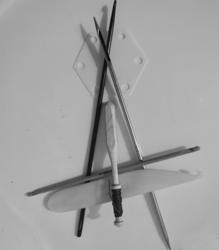
First, for anybody unfamiliar with it, the basic idea is to create knitted fabric with a crochet hook, thus knit-hooking, or knooking. Anybody familiar with both knitting and crochet will know one of the major differences is that knitting keeps a whole bunch of live stitches open the whole time, while crochet keeps just one. Where crochet stitches are dependent on just the stitches at their sides, knit stitches are also dependent on the stitches above and below them. To achieve knitting via crochet, the basic steps are:
- Use what looks like a basic crochet hook, except at the back end there's a eye-hole, like in a sewing needle.
- Attach a length of yarn/cable/thread/etc to the eye-hole.
- Do all your picking up and transferring of stitches with one hook instead of two needles.
- Keep all the live stitches on the length of yarn at the back, which can be reached by the hook since it's flexible.
It's a relatively new invention, and still very niche, as one can tell from the fact that it doesn't even have it's own Wikipedia page. It only gets a brief mention on the wiki pages for crochet hooks and for knitting in general.
Now, the topic for discussion in this post is whether knooking is capable of, and suitable for, making it's very own structures. Is there a way, using what can generally be thought of as "knooking", to make a fabric that is not identical to either knitting or crochet? I've asked this question in the past, and one person took it upon themself to investigate further. They suggested:
...a knitting type stitch (by that I mean it should not close the stitch as in regular crochet but leave a loop on the hook/cord) but with some loop through loop drawing that requires the hooked end to make. What I'm thinking is something like a knit stitch through which you draw a loop (or more than one) like you were making a crochet chain.

Internet sleuthing hasn't turned up many results on this topic, it seems like not many people have really looked into it. If anyone has any thoughts, or has given it a try, or would like to give it a try, let us know!
First, for anybody unfamiliar with it, the basic idea is to create knitted fabric with a crochet hook, thus knit-hooking, or knooking. Anybody familiar with both knitting and crochet will know one of the major differences is that knitting keeps a whole bunch of live stitches open the whole time, while crochet keeps just one. Where crochet stitches are dependent on just the stitches at their sides, knit stitches are also dependent on the stitches above and below them. To achieve knitting via crochet, the basic steps are:
- Use what looks like a basic crochet hook, except at the back end there's a eye-hole, like in a sewing needle.
- Attach a length of yarn/cable/thread/etc to the eye-hole.
- Do all your picking up and transferring of stitches with one hook instead of two needles.
- Keep all the live stitches on the length of yarn at the back, which can be reached by the hook since it's flexible.
It's a relatively new invention, and still very niche, as one can tell from the fact that it doesn't even have it's own Wikipedia page. It only gets a brief mention on the wiki pages for crochet hooks and for knitting in general.
Now, the topic for discussion in this post is whether knooking is capable of, and suitable for, making it's very own structures. Is there a way, using what can generally be thought of as "knooking", to make a fabric that is not identical to either knitting or crochet? I've asked this question in the past, and one person took it upon themself to investigate further. They suggested:
...a knitting type stitch (by that I mean it should not close the stitch as in regular crochet but leave a loop on the hook/cord) but with some loop through loop drawing that requires the hooked end to make. What I'm thinking is something like a knit stitch through which you draw a loop (or more than one) like you were making a crochet chain.
Internet sleuthing hasn't turned up many results on this topic, it seems like not many people have really looked into it. If anyone has any thoughts, or has given it a try, or would like to give it a try, let us know!


