
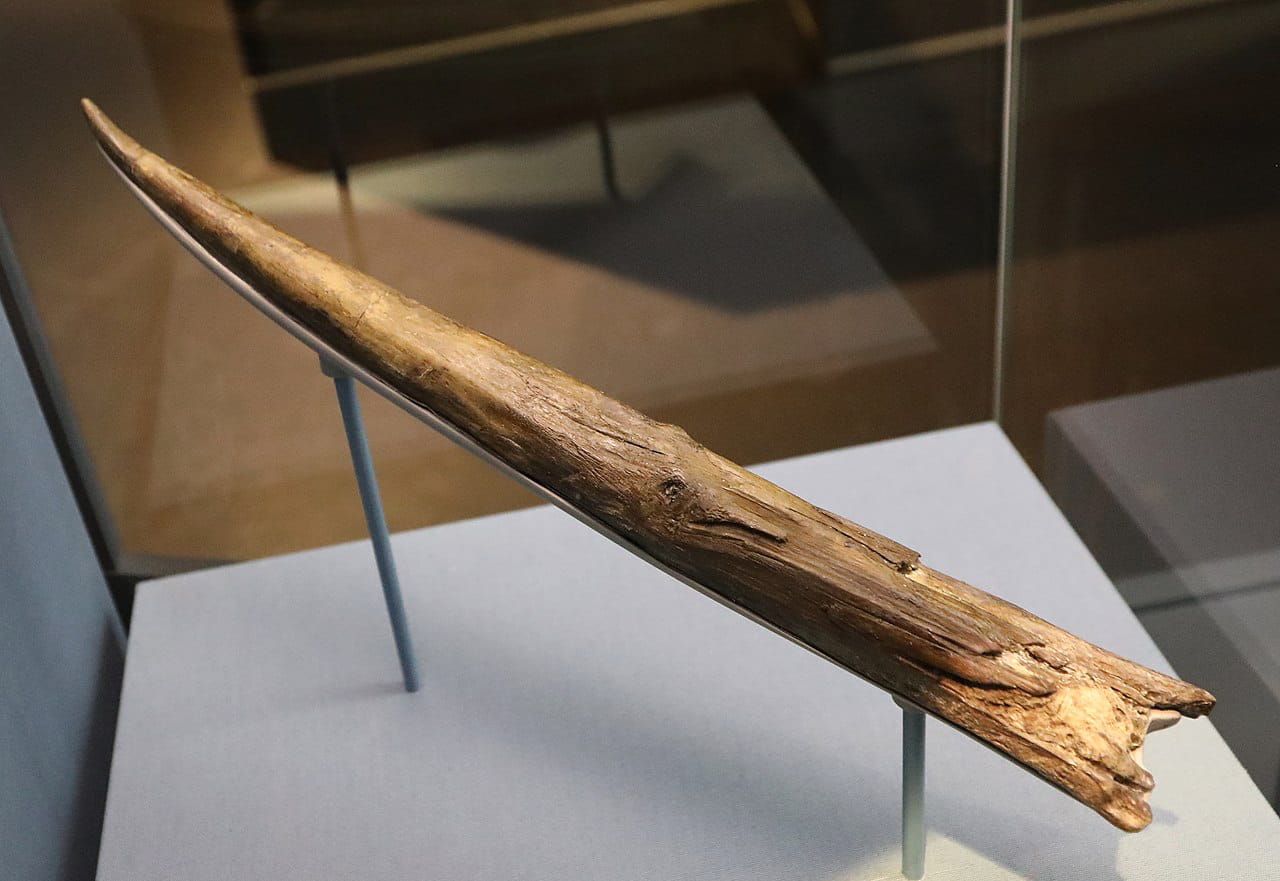
In 1911, an extraordinary archaeological discovery was made in the small coastal town of Clacton-on-Sea (Essex, England). Samuel Hazzledine Warren, an amateur prehistorian who had been searching for simple stone tools in a Paleolithic sediment, discovered what he initially thought was a piece of animal antler.
But he soon realized it was a fragmented wooden spear tip, and he presented it to the Geological Society of London. For a long time, scholars doubted its authenticity, believing early hominids lacked the skills necessary to make a spear and relied on scavenging to obtain food. Warren’s discovery was even considered by some to be a snow probe used to find frozen carcasses.
However, the discovery of a circular hole in a horse scapula excavated in Boxgrove changed these views, as it was thought to have been made by a spear tip and is 100,000 years older than the Clacton spear.
The spear consists of a sharpened tip made from a yew branch. It was found broken into two main pieces, but when reconstructed, it was identified as a finely crafted wooden spear dating back over 400,000 years. This makes it the oldest known worked wooden tool.
…
The Clacton spear sparked a wave of research on ancient wooden artifacts across Europe. But it wasn’t until 1994 that another example as ancient of wooden tool-making was discovered at a major site in Germany called Schöningen. There, a treasure trove of wooden spears was found dating back 300,000-400,000 years, along with various animal bones from the slaughter of horses and other large game animals.
0
The Clacton Spear is the oldest known wooden tool
La Brújula Verde
The Clacton Spear is the Oldest Known Wooden Tool
In 1911, an extraordinary archaeological discovery was made in the small coastal town of Clacton-on-Sea (Essex, England). Samuel Hazzledine Warren, an amateur prehistorian who had been searching for simple stone tools in a Paleolithic sediment, discovered what he initially thought was a piece of ani
www.labrujulaverde.com
0 comments
log in to comment.