
0

Bite marks on York skeleton reveal first evidence of ‘gladiators’ fighting lions

the Guardian Bite marks on York skeleton reveal first evidence of ‘gladiators’ fighting lions www.theguardian.com
preview

Bite marks from a lion on a man’s skeleton, excavated from a 1,800-year-old cemetery on the outskirts of York, provide the first physical evidence of human-animal combat in the Roman empire, new research claims.

While clashes between combatants, big cats and bears are described and depicted in ancient texts and mosaics, there had previously been no convincing proof from human remains to confirm that these skirmishes formed part of Roman entertainment.

Prof Tim Thompson, an anthropologist and first author on the study at Maynooth University in Ireland, said: “This is the first time we have physical evidence for gladiators fighting, or being involved in a spectacle, with big cats like lions in the Roman empire.”

Excavations at the Driffield Terrace burial site, near York city centre, began more than 20 years ago and uncovered about 80 decapitated skeletons. Most belonged to well-built young men and bore signs of brutal violence, leading experts to suspect they had uncovered a gladiator graveyard.

…

Dr John Pearce, an archaeologist from King’s College London and co-author of the study published in Plos One, said York doubled as a Roman town and legionary fortress at the time, making it the second largest population centre in Britain after Londinium.

He said: “These may be gladiators who trained in a gladiatorial school at York linked to the Roman legion based there, and their comrades from the arena or training ground took responsibility for burying them.”

If the researchers are right, their discovery raises questions about where gladiators fought their battles.

An arena probably exists beneath the city of York, but uncovering it will not be easy. “One of challenges with York is that so many old buildings are preserved, you can’t do the excavations underneath them,” Thompson said.

It is not the only mystery that remains. “This shifts the conversation,” Thompson added. “We now know that these events happened in the provinces of the Roman empire, but it raises other questions. How, for example, do you get a lion from Africa to York?”

0

Mystery of Welsh medieval cemetery deepens

Mystery of Welsh medieval cemetery deepens www.bbc.com
preview

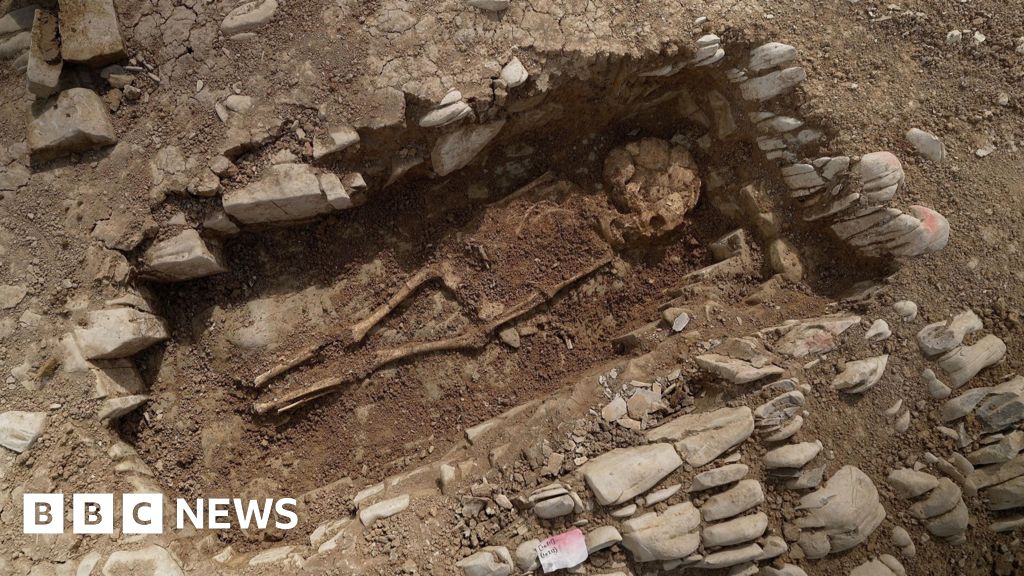
A medieval cemetery unearthed near Cardiff Airport is continuing to confound archaeologists, as the mysteries surrounding it are multiplying.

The discovery of the site, dating to the 6th or 7th Century, was announced last year, with dozens of skeletons found lying in unusual positions with unexpected artefacts.

Now researchers have learned nearly all of those buried in the cemetery are women, and while their bones show signs of wear and tear - indicating they carried out heavy manual work - there are also surprising signs of wealth and luxury.

Another unexpected find has been a woman tossed in a ditch, in stark contrast to all the other people who were buried with great care.

“Every time we think we understand something, something else crops up and the picture gets more intriguing,” said Andy Seaman from Cardiff University, who is leading the project.

0

Treasures found in the UK indicate Thetford was Pagan until the fifth century

Phys.org Treasures found in the UK indicate Thetford was Pagan until the fifth century phys.org
preview

Jewelry in a Roman treasure hoard found in Thetford Forest, East Anglia, indicates that Thetford was Pagan until the fifth century, which is longer than previously believed, reveals a new paper in the Journal of Roman Archaeology.

The Thetford treasure was first found by a metal detectorist trespassing on a construction site at Fison’s Way on Gallows Hill, Thetford in 1979. It consisted of 81 objects, including 22 gold finger-rings, other gold jewelry, and 36 silver spoons or strainers. It is now in the collections of the British Museum and can be seen on display there.

The author of the research, Professor Ellen Swift of the University of Kent, argues that there is compelling evidence that the treasure was buried in the fifth century rather than the late fourth.

Swift says, “Since wider evidence found at the site confirms the religious context previously established by inscriptions on the spoons within the hoard, this means, remarkably, that the re-dating of the Thetford hoard suggests a Pagan cult center survived there into the fifth century. The site’s economic assets, indicated by the value and variety of the hoard, also show that it may have wielded significant power and authority locally.”

…

The paper also shows that Britain was less isolated than previously believed, with the items in the treasure originating from across the Roman empire.

0

Archaeology wonder on Scottish isle is a treasure trove of human bones and artefacts

preview

Perched high above the cliffs of South Ronaldsay, one of Scotland’s most remarkable ancient sites offers a window into life and death thousands of years ago.

Known as the Tomb of the Eagles, the Neolithic chambered cairn has fascinated visitors since its discovery in the 1950s, and is now set to reopen after a major funding boost.

Discovered by local farmer Ronnie Simison, the 5,000-year-old tomb revealed a treasure trove of human bones and artefacts, with the remains of some 300 individuals found buried alongside sea eagles. The striking find gave the site its dramatic name and cemented its place as one of Orkney’s most important archaeological landmarks.

…

And now, thanks to almost £358,000 in fresh funding, a community trust on the island is set to become the first in Scotland to purchase an ancient monument. The move will secure the Tomb of the Eagles’ long-term future as a key piece of local and national history.

The Tomb of the Eagles, a protected site that has long attracted visitors, has been closed since the pandemic after the family who managed it decided to retire.

Located on their land, the tomb was temporarily shut to the public, leaving the community of South Ronaldsay and Burray to find a way forward.

After much consideration, Orkney Isles Council determined that the best path for preserving the site was for the local community to purchase it.

0

Secrets of Britain’s connection with the world’s least known ancient civilizations

preview

New archaeological research is revealing that, more than a thousand years before Britain became part of the Roman Empire, it was part of an extraordinary Mediterranean-based trading network.

Investigations being carried out by archaeologists from five European countries suggest that around 3,300 years ago, the western Mediterranean island of Sardinia started to become a powerful trading centre, eventually linking Britain, Scandinavia, Spain and Portugal in the West to what are now Turkey, Syria, Israel, Cyprus and Crete in the east.

A series of ground-breaking discoveries are revealing, for the first time, the remarkable role played by the island - one of the world’s least known ancient civilizations, known to archaeologists as the Nuragic culture.

And it is showing the remarkable way in which Britain seems to have contributed to that civilization’s development.

…

The island (a series of chiefdoms) was rich in copper ore - which helped turn it into a Bronze Age mercantile and economic superpower (because copper was one of the two key ingredients needed to make high quality bronze, which was far stronger than copper on its own).

But the second key ingredient, needed to make high quality bronze, was tin - and one of the best sources of tin in the ancient world was Cornwall. Tin played a crucial role in human history - because it enabled the production of really strong manufactured goods and its acquisition usually necessitated and promoted long distance trade.

Recent scientific research has revealed that Cornish tin was being delivered, probably by Sardinian or Sardinian-connected merchants, to what are now Israel and Turkey.

What’s more, a study of a shipwreck off the Devon coast has revealed that a Bronze Age ship, carrying Cornish tin ingot exports, were also carrying items from Sardinia or Spain. The English Channel appears to have been a Bronze Age highway for delivering Mediterranean copper ingots and Cornish tin ingots to Scandinavia and for transporting Danish amber to Britain, Ireland, Spain and the Mediterranean.

And a growing body of evidence now suggests that, at the heart of this Bronze Age international trade, lay Sardinia’s mysterious Nuragic civilization.

All parts of the network prospered as a result of that trade - and recent archaeological excavations have found a Bronze Age settlement at one of the most likely ports used at the Cornish end of the maritime route, St. Michael’s Mount near Penzance

…

All the new research suggests that Sardinia itself acted as the major trading hub - with British, Scandinavian and Iberian raw materials and products (including tin, copper and amber) being shipped to Sardinia for transhipment to points further east like Crete, Cyprus, Syria, Lebanon and Israel. In the other direction Sardinian and perhaps other ships are now thought to have carried Middle Eastern glass beads, Egyptian faience, Cypriot copper ingots, precious gemstones and other products to customers in the West.

In Britain, archaeologists have found Iranian and Egyptian beads, Scandinavian amber items, Aegean metalwork, Cypriot and Spanish copper ingots and Sicilian razors, all of which would have had to have been imported by sea.

…

But there is one tantalising piece of evidence that ancient Sardinians themselves may have visited Britain - for there is an enigmatic and mysterious rock-cut tomb (the only one of its sort ever found in Britain) in northern Scotland, on the island of Hoy in Orkney, the nearest rock-cut parallel for which is in Sardinia.

0

Secrets of Britain’s ancient elites revealed by remarkable find in Yorkshire field

preview

A remarkable Iron Age hoard, unearthed in a Yorkshire field, is prompting archaeologists to reassess the wealth and power dynamics of northern Britain two millennia ago.

The discovery, dubbed the Melsonby Hoard, contains more than 800 items, including remnants of wagons, ceremonial spears, and pony harnesses, offering a glimpse into the lives of the elite in the 1st century AD.

Unearthed in 2021 near the village of Melsonby, North Yorkshire, by metal detectorist Peter Heads, the hoard lay undisturbed in two ditches.

Its sheer scale and the nature of the artefacts suggest a deliberate disposal, a practice laden with symbolic meaning for the people of that era.

Experts believe the Melsonby Hoard could be one of the UK’s most significant archaeological finds, requiring years of meticulous study.

The discovery challenges previous assumptions about the distribution of wealth and power in pre-Roman Britain. While some believed such opulence was confined to the south, the Melsonby Hoard’s richness indicates a more complex reality.

…

Melsonby is around a mile from Stanwick, the powerbase of the Brigantes tribe who in pre-Roman times controlled a large part of what is now Yorkshire.

“The Melsonby Hoard is of a scale and size that is exceptional for Britain and probably even Europe,” Professor Moore said.

“Unusually it includes lots of pieces of vehicles and items such as the wine mixing bowl which is decorated in both Mediterranean and Iron Age styles.

“Whoever originally owned the material in this hoard was probably a part of a network of elites across Britain, into Europe and even the Roman world.

“The destruction of so many high-status objects, evident in this hoard, is also of a scale rarely seen in Iron Age Britain and demonstrates that the elites of northern Britain were just as powerful as their southern counterparts.”

0

Anti-plague amulets and IOUs: the excavation that brings Roman London thundering back to life

the Guardian Anti-plague amulets and IOUs: the excavation that brings Roman London thundering back to life www.theguardian.com
preview

Geography mattered on the Bloomberg site in the heart of the City, close to the Bank of England. The Walbrook, a lost river of London, had carved a deep valley into the landscape and the Romans constantly tried to reclaim the banks as the city grew and prospered. They did this by packing the ground with rubbish, building on it, then packing it again, three more times, so there is a stratigraphical layer cake of Roman trash going almost all the way back to London’s creation, in AD47 or 48. The river also waterlogged the ground, protecting the material from oxygen: leather, brooches, shoes, writing tablets, wood, animal bones and ceramics were all phenomenally well preserved. There are sandals that look fresher than last year’s Birkenstocks.

Site B2Y10 – to give it its academic name – was previously occupied by Legal and General, which dug deep in the 1950s, to create the biggest post-blitz rebuild in the City. Excavating archaeologists found the third-century Temple of Mithras, and oral histories from Londoners who witnessed the find in 1954 recall a magical atmosphere, when the secrets of the ancient past met the regeneration of the postwar present to create a sense of enormous hope and renewal. People queued for hours to see the temple. One woman who was pregnant at the time called her baby Mithra. As significant as that archaeological yield was, it was pretty haphazard – workers on the site were just picking things up and handing them in.

The Legal and General building had huge double basements, except on one side, where they had had to stay shallow for fear of jeopardising a Christopher Wren church on the opposite corner. “We were so excited by that single basement,” Jackson says. “We knew that in the layer underneath, that they hadn’t dug into, a lot of material would have survived.” Across 150 years of previous Roman recoveries in London, 19 writing tablets were found in total. In this one find, there were 400, of which 80 have already been deciphered. These are wooden frames, with an inset writing area about “the size of a Ryvita”, which would be filled with black wax, then written on.

…

Then there are anomalies that tell us something about the limits of Roman understanding. Jackson shows me a black, pebble-like object with three indentations on it, in which someone has tried to make a hole, to turn it into a pendant. Finding the material unnaturally unyielding, the Romans decided these were “solidified thunderbolts”, she says. “It’s so interesting to think of Romans doing archaeology themselves.” Not very well, mind; it wasn’t a solidified thunderbolt, it was a neolithic hand-axe made of obsidian.

It’s a reminder that we modern humans are also capable of misreading the signs. In the 1954 excavation, for example, they found beads that were assumed to have been worn by a woman, but here, those same beads and amulets were found still on their original strings, alongside other material that indicates they were worn by a horse. “It might have been a lady horse,” Marshall allows. Horses wore amulets covered in sexual imagery – such as fist-and-phallus amulets, with a clenched fist gesture at one end and an unmetaphorical phallus at the other, which was thought to ward off the evil eye. Children also wore amulets to ward off plague.

0

Archaeologists uncover Bronze Age stone circle in Farley Wood

BBC News Archaeologists uncover Bronze Age stone circle in Farley Wood www.bbc.co.uk
preview

Archaeologists have discovered that what was thought to be a single standing stone in a forest is part of a larger ceremonial site dating back 3,700 years to the Bronze Age.

The discovery in Farley Wood, near Matlock in Derbyshire, was made after excavations by Forestry England in partnership with archaeology series Time Team.

At 2m (6.6ft) tall, the Farley Moor standing stone was previously believed to be an isolated monument.

But Forestry England said excavations uncovered evidence of a ceremonial platform beside it and identified that five other nearby stones would once have been standing, creating a circle.

Dr Lawrence Shaw, Forestry England’s lead historic environment adviser, said the discovery, which will feature in an episode aired on Time Team’s YouTube channel on Saturday, was “hugely significant and transforms our understanding” of the site.

According to Forestry England, the main stone was intentionally placed above a natural spring.

“What we’ve uncovered is evidence of a much more complex ceremonial landscape, which the original standing stone is part of,” Dr Shaw explained.

“The stone platform predates the standing stone itself, suggesting continuous ritual use of this site over hundreds of years, strongly linked to the water and the importance it held for Bronze Age communities.”

0

Roman brooch found in Ayrshire during archaeological dig

Roman brooch found in Ayrshire during archaeological dig www.bbc.com
preview

Experts are investigating the discovery of a mysterious Roman artefact uncovered in an Iron Age settlement under an Ayrshire distillery.

Archaeologists believe the enamelled bronze brooch may have been placed in the foundations of the fortified roundhouse as a sacrifice during its construction to grant “protection” to the household.

The item, thought to have dated from about the second century AD, was found during an excavation at the William Grant and Sons Girvan Distillery at the Curragh in South Ayrshire in 2020.

…

The brooch was thought to be a popular design among Roman military personnel, but examples of the artefacts have been more commonly discovered in present-day central Europe, the Rhineland and Switzerland.

It would have arrived in Scotland at about the time the Roman Empire was losing its grip on the south of the country.

…

Jordan Barbour, who co-authored a report into the find, said it was unclear how the brooch passed from Roman hands to those of the Britons.

But he said it was a possible the artefact was a “trophy won in battle”.

He said: "It’s the only Roman artefact recovered from the site. If the inhabitants had established regular trade with Roman Britain, we might expect to find a greater variety of Roman objects, but this is a solidly native context.

0

Ancient Dorset burial site raises questions over age of Stonehenge

the Guardian Ancient Dorset burial site raises questions over age of Stonehenge www.theguardian.com
preview

A prehistoric burial site in Dorset is now thought to be the earliest known large circular enclosure in Britain prompting researchers to question whether current dating of Stonehenge may need revising.

The Flagstones monument, near Dorchester in Dorset, has been re-dated to about 3200BC, approximately two centuries earlier than previously thought, following analysis by the University of Exeter and Historic England.

The archaeologists used advanced radiocarbon analysis to examine some of the finds, including human remains, red deer antlers and charcoal.

Dr Susan Greaney, archaeologist from the University of Exeter and author of the study published in the Antiquity journal, said: “The chronology of Flagstones is essential for understanding the changing sequence of ceremonial and funeral monuments in Britain.

“The ‘sister’ monument to Flagstones is Stonehenge, whose first phase is almost identical, but it dates to around 2900BC.

“Could Stonehenge have been a copy of Flagstones? Or do these findings suggest our current dating of Stonehenge might need revision?”

0

2,000-year-old bronze divination spoon discovered on the Isle of Man

Archaeology News Online Magazine 2,000-year-old bronze divination spoon discovered on the Isle of Man | Archaeology News Online Magazine archaeologymag.com
preview

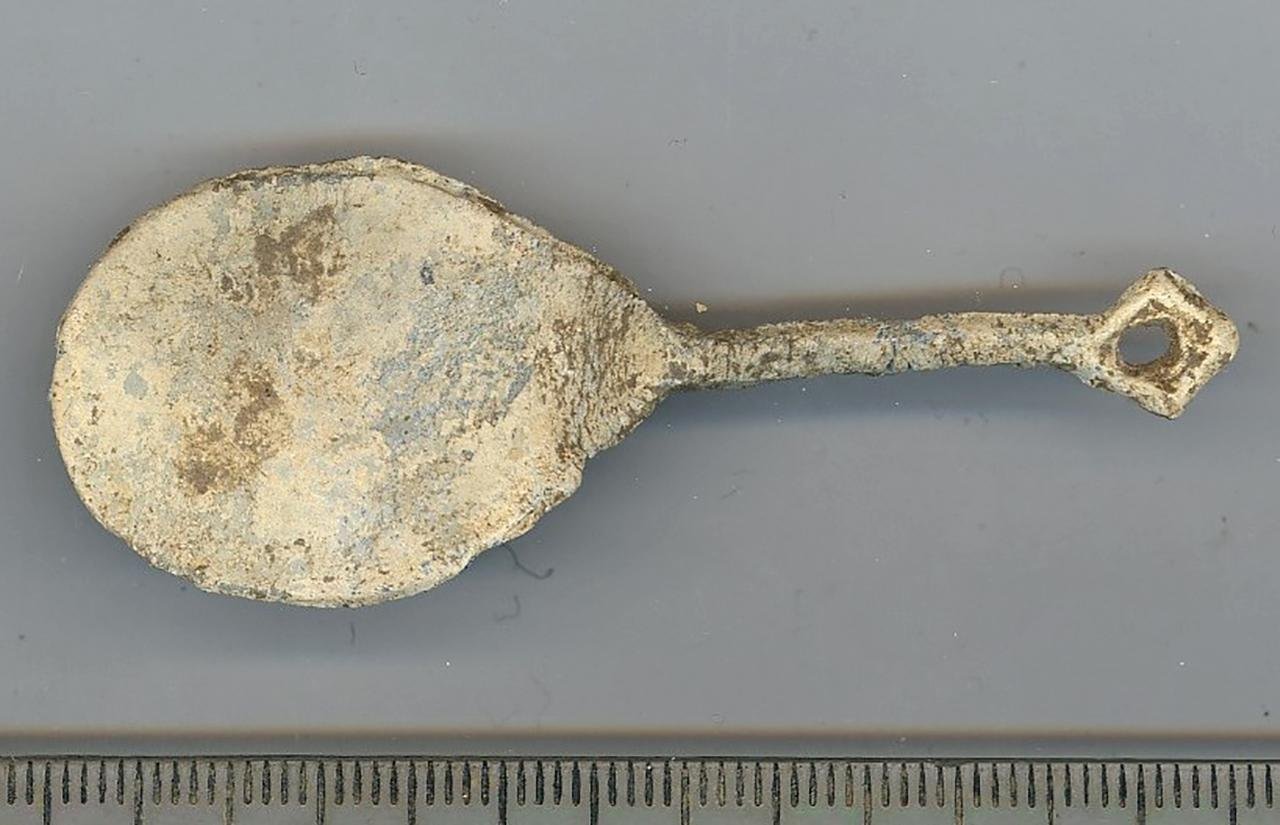
A unique bronze spoon from 2,000 years ago, thought to have played a role in divination rituals, has been uncovered on the Isle of Man. Rob Middleton, a metal detectorist, found this object on David Anderson’s farm in Patrick. This spoon stands out as the first of its type to surface on the island. While similar items have been found in Britain, Ireland, and France, only 28 such spoons exist in the world.

Allison Fox, the Curator for Archaeology at Manx National Heritage, called the discovery “one of the most intriguing objects ever discovered on the island.” She also stated that Iron Age finds are relatively scarce in the region. This rarity makes the spoon an especially valuable piece of evidence for prehistoric activity on the Isle of Man.

The spoon has a broad, strawberry-shaped bowl with a circular handle decorated with spiral patterns. Two finely engraved lines create a cross at the bottom of the bowl, dividing it into four quadrants. While its function remains unclear, researchers think it might have played a role in ritual ceremonies to predict future events. “It has been suggested that liquid of some form would have been poured into the spoon marked with the cross, and whatever quarter it landed in would tell something about the future,” Fox explained.

This find matches earlier discoveries of similar spoons, often found in pairs—one with an incised cross and the other with a small hole. Experts think someone might have dripped a liquid, maybe water, beer, or even blood, from the spoon with the hole into the one marked with a cross, creating an ancient form of fortune-telling or divination.

0

Decapitated woman found in Irish bog is 2,000-year-old ritual sacrifice

Live Science Decapitated woman found in Irish bog is 2,000-year-old ritual sacrifice www.livescience.com
preview

Ancient human remains discovered in an Irish bog in October 2023 don’t belong to a teenage boy as originally assumed but rather a young woman, making them an exceptionally rare find.

Over the past year, several museums and universities have collaborated to reveal new information about the individual, now known as the Ballymacombs More Woman, including her sex, age, height and manner of death.

“As is the case for so many Iron Age bog bodies, the young woman suffered a highly violent death which involved the flow of blood from her throat followed by decapitation,” Eileen Murphy, an archaeologist at Queen’s University Belfast who studied the body, said in a statement on Thursday (Feb. 20).

The body first came to light when police were alerted to human remains on the surface of a peat bog in the village of Bellaghy in Northern Ireland. Initial examination of the body showed that it was at least 2,000 years old, and a forensic anthropologist suggested the person was male and between 13 and 17 years old at the time of his death.

…

“Ballymacombs More Woman is certainly one of the most important archaeological discoveries on the island of Ireland,” Niamh Baker, curator of archaeology at National Museums Northern Ireland, said in the statement, particularly because the majority of bog bodies discovered in the British Isles from this time period are male.

0

Metal detectorists unearth 15th Century coin hoard in the Borders

Metal detectorists unearth 15th Century coin hoard in the Borders www.bbc.com
preview

Two metal detectorists have unearthed a hoard of 15th Century coins in the Scottish Borders.

Keith Young and Lisa Stephenson discovered 30 gold and silver coins in close proximity in the Cappercleuch area which is near St Mary’s Loch.

The coins are a mix of Scottish and English coins, comprising English silver groats minted by Henry V (1413-1422) to Edward IV (1461-1483), and Scottish gold demy and half-demys of James I (1406-1437) and James II (1437-1460).

Lisa described the discovery - likely deposited at the site in the early to mid-1460s - as the “find of a lifetime”.

…

The discovery has been reported to the Treasure Trove Unit, which assesses all Scottish archaeological finds.

It will then be referred to the Scottish Archaeological Finds Allocation Panel (SAFAP), an independent panel, where it will be assigned a monetary value to be paid to the finders in the form of an ex-gratia reward.

Accredited museums who wish to acquire the find can apply to SAFAP and will be required to raise the funds for the ex-gratia award.

…

Antony Lee from the Treasure Trove Unit said coin hoards containing a mix of both English and Scottish coins were not unusual.

However, he said they did not find many from this period in Scotland which made it a “fascinating find”.

0

Ancient Egyptian mummies smell "spicy" and "sweet", study finds

BBC News Ancient Egyptian mummies smell "spicy" and "sweet", study finds www.bbc.co.uk
preview

Even after 5,000 years in a sarcophagus, mummified bodies from ancient Egypt still smell quite nice, scientists have discovered.

Researchers who examined nine mummies found that though there was some difference in the intensity of their odours, all could be described as “woody”, “spicy” and “sweet”.

They say recreating the composition of the smells chemically will allow others to experience a mummy’s whiff - and help to tell when the bodies inside may be starting to rot.

“We want to share the experience we had smelling the mummified bodies, so we’re reconstructing the smell to be presented in the Egyptian Museum in Cairo,” Cecilia Bembibre, one of the researchers, told BBC Radio 4’s Today programme.

…

“In films and books, terrible things happen to those who smell mummified bodies,” said Dr Bembibre said.

“We were surprised at the pleasantness of them.”

0

Cumbria archaeologists find 'significant' Viking-age building

Cumbria archaeologists find 'significant' Viking-age building www.bbc.com
preview

Archaeologists have unearthed what they believe to be a Viking-age building in a recent dig.

Teams of volunteers dug up High Tarns Farm in Silloth, Cumbria, in July after crop marks indicated a structure had previously been on the land.

Carbon dating of a timber building they discovered suggested it was a “large hall of the late-Viking age”, archaeologist Mark Graham of Grampus Heritage told volunteers.

Mr Graham added the significance of the discovery in shedding light on the early medieval period and social structure in rural Cumbria was “hard to overstate”.

…

“It seems most likely that the hall is the focus of an early medieval manor farm,” Mr Graham said.

He explained the site appeared similar to high status Viking age farms in Denmark, because it encompassed not only the hall but also the social structure and broader agricultural activity associated with them.

Mr Graham said it was a remarkable discovery.

“You really do not find much archaeology from that period [the Viking age] in our county,” he said.

“It’s a big gap in our knowledge.”

0

London’s first Roman basilica found under office basement

London’s first Roman basilica found under office basement www.bbc.com
preview

A discovery underneath the basement of an office block has been described as one of the most important pieces of Roman history unearthed in the city of London.

Archaeologists have found a substantial piece of the ancient city’s first basilica - a 2,000 year old public building where major political, economic and administrative decisions were made.

The excavation has so far revealed sections of stone wall that formed the base of the basilica, which would have been two-and-a-half storeys high.

The site, which will eventually be opened to the public, sheds light on the city’s beginnings.

“This is so significant - this is the heart of Roman London,” said Sophie Jackson, from the Museum of London Archaeology (Mola), who revealed the new find exclusively to BBC News.

“This building will tell us so much about the origins of London, why London grew and why it was chosen as the capital of Britain. It’s just amazing.”

0

Women led early British society 2,000 years ago, archaeologists find

preview

Women were at the centre of early Iron Age British communities, a new analysis of 2,000-year-old DNA reveals.

The research, published in the journal Nature on Wednesday, found that British Celtic societies were matrilocal with married women staying in their ancestral communities.

Human societies have often been shaped by where married couples choose to reside culturally.

For instance, in patrilocal communities partners mainly reside with or near the families of the male, whereas in matrilocal societies, couples live near the female’s parents.

Previous studies confirm that patrilocality was widely followed in the European Neolithic, Copper and Bronze ages.

However, earlier research hinted that in the case of Celtic societies, women had higher status.

Romans documented their astonishment at finding women occupying positions of power, writing about queens – Boudica and Cartimandua – who commanded armies and finding the empowerment of Celtic women remarkable.

…

Scientists analysed the genomes of 57 individuals buried in Iron Age cemeteries associated with Durotrigian communities in southern Britain.

They found that most individuals were related through the maternal line.

Unrelated individuals found in the cemetery were also found to be predominantly male, indicating they migrated to the area after marriage.

“This tells us that husbands moved to join their wives’ communities upon marriage, with land potentially passed down through the female line,” study co-author Lara Cassidy said.

“This is the first time this type of system has been documented in European prehistory and it predicts female social and political empowerment,” Dr Cassidy said.

0

Gold mourning ring found on Dorset farm dated to 17th Century

Gold mourning ring found on Dorset farm dated to 17th Century www.bbc.com
preview

A 17th Century mourning ring discovered by a metal detectorist in Dorset is to go under the hammer.

Anthony Woolmington, who has been metal detecting for eight years, found the ring on a farm near Shillingstone in 2021.

Unaware of its significance, he handed it to the farmer, whose son began looking in to its origins.

Research by Dorset History Centre, British Museum and Hansons Auctioneers revealed the ring commemorated a death more than 300 years ago.

…

The inside of the band bears a maker’s mark - a Gothic capital “B” - which dates it to 1692, along with the initials “ML” and date of death “23rd April 1692”.

Helen Smith, head of jewellery at Hansons, described the discovery as “truly remarkable”.

"Mourning rings were often crafted to commemorate significant losses, particularly during times of turmoil such as the English Civil War, the execution of Charles I, and the subsequent political upheaval.

“This ring is an extraordinary example of both craftsmanship and the deeply personal nature of jewellery in that era.”

The 3.7g ring is expected to fetch between £600 and £800 when it is sold on 27 February.

0

Scottish archaeologists up for top award for Merlin myth discovery

The National Scottish archaeologists in line for top award after key Merlin myth discovery www.thenational.scot
preview

Two community archaeology projects in Scotland have been nominated for an award for their work helping to discover a key detail towards the myth of Merlin and for shedding new light on whisky production in the Highlands.

The two projects have been nominated for the Archaeological Research Project of the Year Award for involving local communities in helping to link traditional tales and myths with physical sites across Scotland.

The Drumelzier’s Hidden Heritage project led by the Arthur Trail Association and GUARD Archaeology, with help from volunteers and local heritage groups, investigated the archaeological roots of Drumelzier’s Merlin legend and has been nominated for the award by Current Archaeology.

The Pioneering Spirit Project, led by the National Trust for Scotland and The Glenlivet, revealed the story of the industrialisation of whisky production in the Highlands during the nineteenth century and was also nominated for an award.

The village of Drumelzier in the Scottish Borders has long been associated with the myth of Merlin.

According to Vita Merlini Sylvestris (the Life of Merlin of the Forest), a medieval manuscript held by the British Library, Merlin was reportedly imprisoned there and buried on the banks of the Tweed in the seventh century.

In 2022, a team of volunteers across Scotland led by GUARD Archaeology set out to investigate the archaeological roots of the legend with the results from the work published last year revealing there may indeed be some truth to the reports of Merlin’s death in Scotland.

A geophysics survey revealed that there is an archaeological feature resembling a grave near the believed location of Merlin’s Grave at Drumelzier.

Previously:

0

Roman-era dog penis bone painted red discovered in ancient quarry shaft

Phys.org Roman-era dog penis bone painted red discovered in ancient quarry shaft phys.org
preview

A bio-archaeologist with the University of Reading, in the U.K., has found an ancient dog’s red-painted penis bone along with a trove of other bones, in an ancient Roman era quarry shaft. In her paper published in the Oxford Journal of Archaeology, Ellen Green describes where the bone was found, its condition, and possible reasons for it being painted red.

In her paper, Green notes that in 2015, a group of archaeologists digging at a site called Nescot, located near the modern town of Ewell, came upon a 4-meter-deep shaft that had been dug into the rock. Subsequent work revealed that the shaft had been used as a grave of sorts; it held hundreds of human and animal bones. In this new effort, Green focuses her efforts on one particular bone—a canine baculum (penis bone) that had been painted using red ochre.

Green notes that the remains of more than 280 domestic animals had been found in the shaft, 70% of which were dogs. None showed signs of butchering, disease or burning, which suggested they had been pets or working animals that had died and were buried. Just one of the canine baculum had been painted, making it stand out.

Green states that during Roman times, the penis, or depictions of it, were used in many contexts, many of which involved hoping for good luck. She suspects that the bone from the shaft likely played a role in a ritual of some sort, either before being tossed into the quarry shaft, or during its internment. She notes that other objects found in the shaft support the idea that the bone could have played a role in a larger ritual—perhaps one related to fertility.

0

Exquisite hoard of silver coins unearthed at Sizewell C site

East Anglian Daily Times Silver coin hoard nicknamed 'the pasty' is discovered at Sizewell C site www.eadt.co.uk
preview

A “significant” collection of silver coins dating back to the 11th century have been discovered at the site of the new Sizewell C nuclear power station taking shape on the Suffolk coast.

An archaeologist involved in a pre-construction dig saw the sliver of a coin edge peeping out and started shaking as he realised the importance of his discovery.

It was a “perfect archaeological time capsule” said Andrew Pegg of Oxford Cotswold Archaeology (OCA) which was tasked with carrying out the dig.

…

The discovery of the 321 mint-condition silver coins feature on BBC2’s Digging for Britain today (Tuesday, January 7) at 8pm and on BBC iplayer.

Historians think that the hoard - wrapped in a lead and cloth bundle about the size of a pasty - was probably a savings pot for a local figure worried about political instability following the coronation of Edward the Confessor in 1042.

…

Experts think that it would have belonged to someone of middling status and of local influence as it was worth about the value of a small herd of cows.

0

Fields of gold: Understanding the Snettisham Hoards

The Past Fields of gold: Understanding the Snettisham Hoards – The Past the-past.com
preview

Ken Hill, near the village of Snettisham in north-west Norfolk, is a special place. This promontory overlooking the Wash is a conspicuous feature in an otherwise flat and marshy coastal landscape, commanding views across the North Sea. It sits close to the Crown’s estates at Sandringham, and over the last few hundred years the land has been used for grazing, arable farming, and shooting. Some 2,000 years ago, however, the slopes of this hill saw the deposition of some of the most ornate ancient metalwork found in Britain: a series of gold hoards that lay largely undisturbed as the world moved on around them, until a chance discovery in the mid-20th century.

On a cold November day in 1948, a young tractor driver, Raymond Williamson, was working on the slopes of Ken Hill when his plough struck something hard. After climbing down to investigate, he retrieved what looked like the remains of an old brass bedstead, threw it to the side of the field, got back on his tractor, and continued with his task. The following day, though, he found more old metal, this time a ‘lot of twisted wire’. Again, no one thought much of the finds, and Williamson probably forgot all about them until a local company owner became interested, and they eventually came to the attention of Roy Rainbird Clarke, the Curator of Archaeology at Norwich Castle Museum. Clarke rushed to investigate – fighting transport delays and road closures because of a freezing fog that had descended over much of eastern Britain – and soon realised that Williamson’s discarded find was no bedstead. The ‘brass bed fittings’ were actually more than 2,000 years old, and they were made not of brass, but gold. In fact, they were neck- rings that would have been worn by people during the later Iron Age – unknown to him at the time, Raymond Williamson had stumbled on one of the most important archaeological sites in Britain.

Despite its significance, Williamson’s find was just one of a series made at Snettisham over the next 70 years. The first came just two years later in 1950, when another ploughman, Tom Rout, unearthed a beautiful golden torc (now known as the ‘Great Torc’) with intricately decorated terminals. Legend has it that George VI was staying at the nearby Sandringham estate at the time, and the artefact was taken by the landowner to be admired by the king.

There were only infrequent finds through the 1960s and 1970s, and it was thought there were no more treasures to be found at the site, but in August 1990 a metal-detectorist named Cecil ‘Charles’ Hodder once again struck gold. This time, it wasn’t the finely wrought torc that Hodder had perhaps been hoping for when he gained permission to detect at the site; rather, he recovered more than 500 fragmentary objects in alloys of gold, silver, and bronze, a group that we now know had originally been buried in an upturned bronze helmet (of which, more below). Hodder reported his discovery to the Norfolk Archaeological Unit and, soon after, in December that year, a second archaeologist and his team returned to investigate. Dr Ian Stead, then Deputy Keeper of the Department of Prehistoric and Romano-British Antiquities at the British Museum, began a large-scale excavation that lasted for three successive seasons between 1990 and 1992, uncovering several more hoards, as well as evidence about the longer history of the site.

Subsequent excavations and surveys in the 2000s and 2010s have added to this picture, and, in all, more than 1,200 metal artefacts have been found from this single field – which perhaps inevitably became known as the ‘gold field’, owing to the material from which many of the objects had been made.

…

Let’s start with the most impressive objects from Snettisham, the finds that make the site so exceptional: the torcs. These are metal neck-rings, sometimes with decorated terminals at the front. Similar objects were worn across much of Europe, but the number found at Snettisham is unprecedented. There are more than 60 complete or near-complete torcs from the site, with hundreds more represented by fragments. This compares to 85 or so examples known from the whole of the rest of Britain. Taking all 14 hoards together, it is the largest assemblage of ancient gold jewellery from anywhere in Europe.

…

Further reading:
Julia Farley and Jody Joy (eds) (2024) The Snettisham Hoards (British Museum Research Publication 225; British Museum Press, ISBN 978 0861592258, £40).

0

Newly uncovered sites reveal true power of great Viking army in Britain

the Guardian Newly uncovered sites reveal true power of great Viking army in Britain www.theguardian.com
preview

Dozens of sites linked to the Viking great army as it ravaged Anglo-Saxon England more than 1,000 years ago have been discovered. Leading experts from York University have traced the archaeological footprint of the Scandinavian invaders, identifying previously unknown sites and routes.

The study, conducted by Dawn M Hadley, professor of medieval archaeology, and fellow archaeology professor Julian D Richards, found that the significance of many of the ingots, gaming pieces and other artefacts unearthed by metal detectorists over the years had been overlooked until now. They also discovered about 50 new sites that they believe were visited by the Viking great army.

The Anglo-Saxon Chronicles, the collection of annals in Old English, recorded that the “great heathen army” arrived in 865. Over 15 years, battles were fought in the kingdoms of East Anglia, Northumbria, Mercia and Wessex, kings were overthrown, monasteries were looted and society was transformed as Viking leaders adopted Anglo-­Saxon styles of kingship, converted to Christianity and engaged in political diplomacy.

Richards and Hadley have identified Viking sites and routes by comparing artefacts unearthed across the country with those discovered at two of their main camps, Torksey in Lincolnshire and Aldwark in North Yorkshire.

Richards said that gaming pieces thought to have been first manufactured at Torksey, for example, were identified on main routes or transhipment points more than 100 miles away. These were pieces from a strategic board game similar to chess.

The artefacts studied include dress fittings, such as strap ends, and exchanged bullion – notably silver, gold, and copper-alloy ingots, weights and Islamic dirhams – among objects acquired by the Vikings from as far afield as Ireland and the Islamic world.

One site in Yorkshire has been identified through various metal detector finds, including a cross-shaped mount whose matching other half was, remarkably, unearthed miles away in Lincolnshire. The discoveries show how members of the Viking army cut up pieces of loot and each took their share, according to Hadley.

…

The academics will include their findings in their forthcoming book, Life in the Viking Great Army: Raiders, Traders, and Settlers, to be published by Oxford University Press in January. It will feature discoveries such as a fragment of scrap lead from Aldwark depicting Fenrir, the monstrous wolf of Norse mythology, and fittings from harnesses and sword belts.

Many of the previously unseen finds will be unveiled at the Yorkshire Museum’s new Vikings display, which opens in July.

0

Roman villa discovered in Wiltshire’s Chalke Valley

HeritageDaily - Archaeology News Roman villa discovered in Wiltshire’s Chalke Valley www.heritagedaily.com
preview

Archaeologists have discovered a high status Roman villa in the Chalke Valley, located in Wiltshire, England.

The site was initially identified by detectorists, who reported finding Roman artefacts to the Portable Antiquities Scheme at Salisbury Museum.

This led to excavations over a two-week period which are part of a community project managed by Teffont Archaeology and supported by Cardiff University.

…

According to a recent press statement, the project uncovered a villa complex over 35 metres in length, serving as the centre of a large agricultural estate during the late Roman period.

Alongside the main structure, the archaeologists found a bathhouse, a multi-story barn, and a concrete-floored building that might have served as an outdoor pool.

…

Within the main villa building, excavations also revealed high status furnishings, such as high-quality mosaics with intricate geometric designs, and painted wall plaster and columns.

According to the archaeologists, these finds highlight the wealth and influence of the villa’s inhabitant, in an area thought to be scarce of major Roman development. The archaeological team will now work on analysing the finds from the site, and next year will give a range of talks locally about the results.

0

The Clacton Spear is the oldest known wooden tool

La Brújula Verde The Clacton Spear is the Oldest Known Wooden Tool www.labrujulaverde.com
preview

In 1911, an extraordinary archaeological discovery was made in the small coastal town of Clacton-on-Sea (Essex, England). Samuel Hazzledine Warren, an amateur prehistorian who had been searching for simple stone tools in a Paleolithic sediment, discovered what he initially thought was a piece of animal antler.

But he soon realized it was a fragmented wooden spear tip, and he presented it to the Geological Society of London. For a long time, scholars doubted its authenticity, believing early hominids lacked the skills necessary to make a spear and relied on scavenging to obtain food. Warren’s discovery was even considered by some to be a snow probe used to find frozen carcasses.

However, the discovery of a circular hole in a horse scapula excavated in Boxgrove changed these views, as it was thought to have been made by a spear tip and is 100,000 years older than the Clacton spear.

The spear consists of a sharpened tip made from a yew branch. It was found broken into two main pieces, but when reconstructed, it was identified as a finely crafted wooden spear dating back over 400,000 years. This makes it the oldest known worked wooden tool.

…

The Clacton spear sparked a wave of research on ancient wooden artifacts across Europe. But it wasn’t until 1994 that another example as ancient of wooden tool-making was discovered at a major site in Germany called Schöningen. There, a treasure trove of wooden spears was found dating back 300,000-400,000 years, along with various animal bones from the slaughter of horses and other large game animals.

0

Mystery surrounds 800-year-old Leicester burial pit containing 123 bodies

the Guardian Mystery surrounds 800-year-old Leicester burial pit containing 123 bodies www.theguardian.com
preview

In gardens a few metres from Leicester Cathedral, archaeologists have made a disturbing discovery. Their excavations have revealed a narrow vertical shaft filled with the remains of 123 men, women and children.

It is one of the largest pit burials ever excavated in the UK, with subsequent research suggesting the bodies were dumped there more than 800 years ago, early in the 12th century.

However, the reasons for putting the corpses in this tiny, ancient shaft remain a mystery.

“Their bones show no signs of violence – which leaves us with two alternative reasons for these deaths: starvation or pestilence,” said Mathew Morris, project officer at Leicester University’s archaeological services. “At the moment, the latter is our main working hypothesis.”

The excavations by Morris and his colleagues suggest the bodies were put into the shaft in three deposits, in rapid succession. “It looks as if successive cartloads of bodies were brought to the shaft and then dropped into it, one load on top of another in a very short space of time,” he said. “In terms of numbers, the people put in there probably represented about 5% of the town’s population.”

…

The Anglo-Saxon Chronicles repeatedly mention great pestilences and fevers, severe mortality, and miserable deaths from hunger and famine in England from the mid-10th century through to the mid-12th century, said Morris. “This mass burial fits within this timeframe and provides physical proof of what was then occurring across the nation.”

0

Gladiator knife handle found in Tyne ‘reflects spread of Roman celebrity culture’

the Guardian Gladiator knife handle found in Tyne ‘reflects spread of Roman celebrity culture’ www.theguardian.com
preview

A rare and pristine example of gladiator memorabilia found in the River Tyne is to go on display, shining light on a 2,000-year-old culture of celebrity and sex appeal.

English Heritage said the copper alloy figurine would have been a decorative handle on a folding knife. Found near Corbridge, Northumberland, it provides proof that the superstar status of gladiators extended to the far edges of the Roman empire.

“It is amazing, it’s absolutely pristine,” said Frances McIntosh, English Heritage’s collections curator for Hadrian’s Wall. It is rare to find any example of gladiator memorabilia in Britain but “to find such a well-preserved and interesting piece is remarkable”.

“This beautifully made knife handle is a testament to how pervasive this celebrity culture was, reaching all the way to Hadrian’s Wall at the very edge of the Roman empire.”

McIntosh said successful gladiators became celebrities and had sex appeal. “There are lots of rumours that you see of high society women falling in love with gladiators,” she said. “Often a slur on somebody was that they had been fathered by a gladiator, that they were the son of a gladiator because their mother was … you know.”

0

Two newly discovered stone circles on Dartmoor boost ‘sacred arc’ theory

the Guardian Two newly discovered stone circles on Dartmoor boost ‘sacred arc’ theory www.theguardian.com
preview

Two neolithic stone circles have been discovered on Dartmoor, adding credibility to the theory that a “sacred arc” of monuments was built in the heart of the wild Devon uplands.

One of the circles appears to have similar features to Stonehenge, while the second sits slightly outside the sweep of the arc and could have served as a gateway used by pilgrims travelling to the area.

The discovery of the two rings is a result of a lifetime of work by Alan Endacott, a Devon archaeologist and stained glass artist who in 2007 unearthed the presence of the highest stone circle in southern England, Sittaford on Dartmoor

It was the first stone circle to be discovered on the moor for more than a century and reinforced the sacred arc theory. Rather than resting on his laurels, Endacott has kept on searching for more circles and been rewarded with two further finds.

…

Endacott believes a sacred arc was intended to ring the high ground in the centre of the moor. “Dartmoor would have been very different then, there would have been a lot more forest cover. So possibly they were markers in the landscape, they recognised the higher ground and wanted to kind of enclose it for some reason.”

0

Cornish monument is 4,000 years older than was thought and ‘without parallel’

the Guardian Cornish monument is 4,000 years older than was thought and ‘without parallel’ www.theguardian.com
preview

An enigmatic stone and turf structure on Bodmin Moor that was previously thought to be a medieval animal pen has been found to be 4,000 years older – and unique in Europe.

The rectangular monument was built not in the early medieval period to corral livestock, as recorded by Historic England, but rather in the middle Neolithic, between 5,000 and 5,500 years ago, archaeologists have discovered.

Nothing like it is known in Britain or farther afield, according to experts, meaning that the original purpose of the monument known as King Arthur’s Hall is a mystery.

“There isn’t another one of these anywhere,” said the lead archaeologist, James Gossip. “There is nothing built at that time or subsequently in prehistory that is a rectangular earth and stone bank with a setting of stone orthostats around the interior. There is no other parallel.”

The so-called “hall”, which sits on the western side of Bodmin Moor near Helstone in Cornwall, consists of a banked enclosure measuring 49 metres by 21 metres, lined on the inside with 56 standing stones up to 1.8 metres tall.

0

Remembering the discovery of the Lindow Man in Cheshire

Knutsford Guardian The archaeological discovery in Cheshire that made global headlines www.knutsfordguardian.co.uk
preview

‘In amongst the shattered peat was a perfectly preserved human foot – brown and complete with toenails.

Wilmslow in 1984 was a medium-sized, old-fashioned town with its fair share of furrier and celebrities, plus a couple of pharmaceutical companies to keep it rooted in the 20th century – not the kind of place where anyone would have guessed the UK’s most significant archaeological discovery of the century would be made.

It was there, in the rickety offices of the Wilmslow World on Water Lane one hot August day I received the call that would lead to the town being assured a place in the annals of ancient history, through the discovery of the UK’s first bog body to be removed intact from the peat.

…

Andy Mould and Eddie Slack had been watching the peat coming down a huge conveyor belt when one of them had spotted a lump of peat: ‘like a rugby-ball,’ they told me. One picked it up to lob at the other, who dropped it. In amongst the shattered peat was a perfectly preserved human foot – brown and complete with toenails.

According to the peat diggers, the foot had been cut – as if by a blade. I wondered if there was a body out there missing a foot.

I was soon riding out, on a miniature train with temporary rails, onto the centre of the Moss to find out.

…

On the way back to the sheds, I told the peat workers to stop the diggers for 24 hours, while I brought ‘an expert’ to look at the peat facer we’d just visited. With the arrogance of youth, I told them I would square it with their employers.

Naturally had no idea who I would summon, but I’d been on a dig during my university vacation (for social rather than academic interest) and had heard the term ‘County Archaeologist’ bandied about. Without the internet to assist, it took a few phone calls to locate a certain Richard (Rick) Turner, in his first week in the job.

…

When Rick rang again, two days later (Friday, August 3), I could tell from his voice that this academic was excited. He told me he’d walked as directed up to the peat face, had simply stuck in his trowel and a bone had fallen out, which he immediately identified as human. He was convinced the foot belonged to a body buried there, he’d reported his discovery to the police in Wilmslow, and had been given the weekend to assemble a team of archaeologists to remove the body intact from Lindow Moss.

Then Rick said these unforgettable words: “I’m not going on the record with this, but I think this is a very important find, and will prove to be ancient.’ He was guessing at 2,000 years ancient.

0

Unique Bronze Age hoard from Peebles saved for the nation

Unique Bronze Age hoard from Peebles saved for the nation www.bbc.com
preview

A hoard of Bronze Age artefacts unearthed by a metal detectorist in the Borders has been saved for the nation by National Museums Scotland.

It has acquired the Peebles Hoard, which had lain undisturbed for 3,000 years before it was discovered in 2020.

Efforts have now started to secure funding for continued research and conservation of the collection, which includes more than 500 pieces.

National Museums Scotland (NMS) said the man who found it had received a five-figure sum.

Senior curator Dr Matthew Knight said it shed new light on Bronze Age communities in Scotland.

The hoard has been described as one of the most significant ever found in the country.

…

NMS said it represented a “complex set of material, some of which has no archaeological parallel anywhere in western Europe”.

“This includes many unique artefacts, the use of which is yet to be discovered and could transform our understanding of life in Bronze Age Scotland,” it added.

…

The hoard was found in 2020 by metal-detectorist Mariusz Stepien, who alerted the Treasure Trove Unit.

That allowed experts to coordinate a complex retrieval process which involved removing the hoard from the ground in a single block which was then CT scanned.

0

Archaeologists reveal how ‘exceptionally rare’ Bronze Age tool was so well preserved

preview

Archaeologists have unearthed an exceptionally rare wooden spade dating back approximately 3,500 years.

Experts from Wessex Archaeology discovered the treasure during a project aimed at creating coastal habitats in Poole Harbour, Dorset.

The find is considered one of the oldest and most complete wooden tools found in the UK, with preliminary analysis confirming its Bronze Age origins.

Experts believe the waterlogged conditions of the excavation site contributed to the spade’s preservation, providing insights into how ancient communities interacted with the environment.

The spade’s preservation is unusual, as organic materials like wood typically do not survive for millennia.

Only one other Bronze Age wooden tool, the Brynlow Shovel, found in an ancient mine in Cheshire, has been discovered in the UK, the team said.

0

More than 4,500 bodies discovered in unmarked mass grave in Bristol

Bristol Live More than 4,500 bodies discovered in unmarked mass grave in Bristol www.gloucestershirelive.co.uk
preview

The graves of more than 4,500 people have been discovered in the grounds of a historic building on the edge of Bristol, which archaeologists say reflects a ‘dark chapter’ in the city’s history.

The remains were unearthed over five years in a dig at the site of the former Blackberry Hill Hospital in Stapleton in Bristol, and revealed in a report released this week by the archaeologists.

Cotswold Archaeology were commissioned by developers Vistry, who are developing the site for housing, to investigate the historic site, which has had many roles in the city’s history.

And now, having completed the first part of the archeological excavation, and analysed the findings, Cotswold Archaeology have now reported back to Vistry what they found - and the results are stunning.

The site was first developed in the late 1700s, when Stapleton Prison was built there. Over the next few decades, it housed prisoners of war from Britain’s conflicts with France, Spain, Holland and the US, but as Bristol grew and the conflicts ended, a new need was more pressing - as a hospital. Its location on the edge of the city meant it was converted into a hospital during the 1832 cholera outbreak, but within five years had been converted again into the Stapleton Workhouse.

From then until the early 20th century, the workhouse was where the poor, destitute, sick and anyone who couldn’t look after themselves were sent, and very often they died there, and were buried in unmarked graves - which have now been discovered, more than 100 years later.

“One of the most striking elements of the excavation is the discovery of more than 4,500 graves,” said Rosanna Price, Cotswold Archaeology’s engagement manager. “These primarily date from the workhouse period, from 1837 to the late 19th century. Some burials may even date back to the site’s earlier function as a prisoner-of-war camp.

0

West Deeping archaeological dig unearths 6,000 years of history

West Deeping archaeological dig unearths 6,000 years of history www.bbc.com
preview

An archaeological dig of a quarry in Lincolnshire has uncovered evidence of settlements and agriculture spanning 6,000 years.

Excavations of the West Deeping quarry revealed a Roman settlement as well as Neolithic and Bronze Age finds.

The oldest artefacts included pottery used for cooking and eating.

A free exhibition of some of the finds will be on display in West Deeping village hall on Saturday, from 13:00 to 17:00 BST.

Hannah Barrett, a project officer with the Cambridge Archaeological Unit, said: "This site isn’t just Neolithic, Bronze Age or Roman, we have all of the periods right through to Saxon in the 6th Century.

“All of these periods are represented and every single one has a good story to tell,” she said.

“I think that’s what’s so fascinating about.”

She added evidence dating back to the later Neolithic period included “the largest assemblage” of pottery ever found in East Anglia or the East Midlands.

0

Roman-Era settlement and Medieval longhouse unearthed in Wales

Sci.News: Breaking Science News Roman-Era Settlement and Medieval Longhouse Unearthed in Wales | Sci.News www.sci.news
preview

The archaeologists unearthed structural features and materials dating to the Roman era and the early Medieval period during an excavation at a site near the Holt Roman tile and pottery works in Wrexham, North East Wales.

They also found the structure of an early Medieval longhouse — a long, narrow, building for communal dwelling.

“We were very hopeful of finding evidence of Roman life due to previous discoveries and geophysical surveys in the area, not to mention the presence of the legionary tileworks a few fields away, but did not expect our excavations to uncover what is believed to be an early Medieval longhouse,” said Dr. Caroline Pudney, senior lecturer in archaeology at the University of Chester.

“The discovery of a Roman settlement is extremely important in building a bigger picture of Roman Wrexham and although early Medieval longhouses have been found in other parts of Wales, to unearth evidence of such a building in North East Wales is extremely rare.”

0

Remains of Roman town discovered in Cambridgeshire given protected status

the Guardian Remains of Roman town discovered in Cambridgeshire given protected status www.theguardian.com
preview

cross-posted from: lemmy.world/post/20367335

Evidence of highly organised urban settlement found during survey work for solar farm near Great Staughton

The well-preserved remains of a Roman town discovered during survey work for a solar farm in Cambridgeshire have been given heritage protection status as a scheduled monument.

The buried archaeological features of the settlement near Great Staughton extend across 31 hectares (77 acres) and include ditches, pits, post holes, and gravel surfaces that represent roads or yard areas.

The remains show the extensive streets and buildings of a highly organised Roman settlement of an urban character, Historic England said.

Recovered artefacts include pottery, animal bone, glass, copper alloy objects, iron objects, coins and shells. Evidence also suggests there may have been pottery kilns and blacksmith forges.

0

Dorset ‘Stonehenge’ under Thomas Hardy’s home given protected status

the Guardian Dorset ‘Stonehenge’ under Thomas Hardy’s home given protected status www.theguardian.com
preview

When the author Thomas Hardy was writing Tess of the D’Urbervilles in 1891, he chose to set the novel’s dramatic conclusion at Stonehenge, where Tess sleeps on one of the stones the night before she is arrested for murder.

What the author did not know, as he wrote in the study of his home, Max Gate in Dorchester, was that he was sitting right in the heart of a large henge-like enclosure that was even older than the famous monument on Salisbury Plain.

Though invisible at ground level after millennia of ploughing, the enclosure still survives under Hardy’s garden. It has now been given protection by the government as a scheduled monument, recognising its status as a nationally important site…

0

'Significant' Anglo-Saxon Dogger Bank finds to go on display

'Significant' Anglo-Saxon Dogger Bank finds to go on display www.bbc.com
preview

Archaeologists have uncovered “significant” Anglo-Saxon finds across Holderness as cables are laid for the Dogger Bank offshore wind farm.

The discoveries include remnants of an Anglo-Saxon long hall structure between Beeford and Skipsea, as well as artefacts from a site in Ulrome.

The findings indicate Anglo-Saxons probably lived and farmed in this landscape over multiple phases between the 5th and 11th centuries.

Community engagement manager for Dogger Bank Wind Farm, Rachel Lawrence, said: “Safeguarding historical evidence has been a critical part of our preparation work on Dogger Bank Wind Farm.”

She added: “We’re delighted we’re now able to share these exciting findings with the people who live in the towns and villages where this work was undertaken.”

…

The early medieval discoveries were unearthed by archaeologists working on a 30km corridor that houses the underground cables transmitting energy from Dogger Bank Wind Farm in the North Sea to the wind farm’s two onshore stations near Beverley.

Archaeologists described the finds as a “regionally-significant discovery”.

Project manager for AOC Archaeology, Rebecca Jarosz- Blackburn, said the most “surprising and rewarding discovery” was the Anglo-Saxon long hall and associated field systems recorded near Beeford, which she said “represents some of the most extensive evidence from the period in the Holderness region”.

0

Stonehenge tale gets ‘weirder’ as Orkney is ruled out as altar stone origin

the Guardian Stonehenge tale gets ‘weirder’ as Orkney is ruled out as altar stone origin www.theguardian.com
preview

“The plot has thickened on the mystery of the altar stone of Stonehenge, weeks after geologists sensationally revealed that the huge neolithic rock had been transported hundreds of miles to Wiltshire from the very north of Scotland.

That discovery, described as “jaw-dropping” by one of the scientists involved, established definitively that the six-tonne megalith had not been brought from Wales, as had long been believed, but came from sandstone deposits in an area encompassing the isles of Orkney and Shetland and a coastal strip on the north-east Scottish mainland.

Many experts assumed that the most likely place of origin was Orkney, based on the islands’ rich neolithic culture and tradition of monument building.

But a separate academic study has now found that Orkney is not, in fact, the source of the altar stone, meaning the tantalising hunt for its place of origin goes on…”

0

‘Remarkable’ Pictish ring discovered by volunteer

‘Remarkable’ Pictish ring discovered by volunteer www.bbc.com
preview

A “remarkable” Pictish ring thought to be at least 1,000 years old has been discovered by a volunteer on a dig in Moray.

The find was made by John Ralph at the site of a fort in Burghead.

It is thought the settlement was a significant seat of power within the Pictish kingdom between AD500 and AD1000.

Delighted Mr Ralph - who described himself as an “enthusiastic volunteer” - was on a dig being led by the University of Aberdeen. He felt like a “striker scoring a goal” with the find.

0

Archaeologists uncover new evidence of Merlin legend in Scotland

The National Archaeologists uncover 'dark' new evidence of Merlin legend in Scotland www.thenational.scot
preview

The village of Drumelzier in the Borders has long been associated with Merlin.

According to Vita Merlini Sylvestris (the Life of Merlin of the Forest) — a medieval manuscript held by the British Library — Merlin was reportedly imprisoned there and buried on the banks of the Tweed in the 7th century.

In 2022, a team of volunteers drawn from across Scotland and led by GUARD Archaeology set out to investigate the archaeological roots of this local legend.

Now, the results of the work have been published with experts revealing that there may indeed be some truth to the reports of Merlin’s death in Scotland.

A geophysics survey revealed that there is an archaeological feature resembling a grave near to the reputed location of Merlin’s Grave at Drumelzier.

An excavation of Tinnis Fort, which overlooks Merlin’s Grave, also found that this prominent hillfort was occupied around the late 6th and early 7th centuries AD, precisely when the story was set.

Archaeologists said the fort has the hallmarks of a lordly stronghold of the time.

“The Drumelzier legend contains pre-Christian customs, ancient Cumbric names and was associated with local sites where archaeology now shows could credibly have given rise to the story,” said GUARD Archaeology CEO Ronan Toolis, who led the project.

…

"Unlike the classic depiction of Merlin as the wise and respected adviser to King Arthur, the Drumelzier legend paints a much darker picture.

“That of a rather pitiful fellow prone to uttering nonsensical riddles and bewildering prophecies, and kept prisoner by an obscure petty tyrant of a forgotten kingdom, before dying a gruesome death, the victim of royal intrigue.”

Archive

0

‘Amazing’ Viking-age treasure travelled half the world to Scotland, analysis finds

the Guardian ‘Amazing’ Viking-age treasure travelled half the world to Scotland, analysis finds www.theguardian.com
preview

It is a star object of the Galloway Hoard, the richest collection of Viking-age objects ever found in Britain or Ireland, buried in AD900 and unearthed in a field in Scotland. Now a lidded silver vessel has been identified as being of west Asian origin, transported halfway around the world more than 1,000 years ago.

When it emerged from the ground a decade ago, the vessel was still wrapped in its ancient textiles, whose survival is extremely rare. Its surface could be seen only through X-ray scans. Since then, the textiles have been partially removed and preserved and the vessel has had laser cleaning to remove green corrosion over much of its silver surface. It has also undergone scientific analysis.

Details of a “remarkable” design that includes crowns, fire altars and creatures including leopards and tigers can be seen for the first time.

The imagery is linked to the iconography of Zoroastrianism, the state religion of the Sasanian empire, the last Persian empire before the early Muslim conquests from AD632. Scientific analysis shows that the silver from which it was made came from a mine in modern-day Iran.

The hoard was discovered in 2014 by a metal-detecting enthusiast on what is now Church of Scotland land at Balmaghie, Kirkcudbrightshire. Described as one of the century’s most important UK archaeological finds, it contained more than 5kg of silver, gold and other materials, with objects ranging from a Christian pectoral cross to brooches.

0

Archaeologists uncover the real story of how England became England

preview

Since the Renaissance, scholars have been engaged in a curious and feverish debate over where the people who populate England came from. Did they arrive as conquerors, as Gildas would have it? Or by a more gradual and peaceful migration? The answer matters because it provides an explanation for a perplexing reality: In a remarkably short three centuries after the Roman occupation, Britain was transformed into a dramatically different kind of place.

Under Roman administration, Britain was largely urban. People lived in tile-roofed stone buildings in towns connected by roads; they boasted a standing army and a coinage system. Native Britons spoke an indigenous Celtic language and probably some Latin. By the 700s, things had changed entirely: Inhabitants lived mostly in country hamlets in wood-and-thatch homes resembling Grubenhäuser, those partly sunken houses typical of northern Germany and southwest Denmark. With the empire gone, many workers, from builders to vintners to smiths to perfumers, simply no longer had a market for their products or services, so the only way to survive was subsistence farming. In this way, the Britons produced what they needed, and they bartered for the rest. The things they made, jewelry or pots, drew on both continental and indigenous traditions but were uniquely theirs. Most striking, they had created a new national identity and were speaking a new language, the earliest form of English.

But exactly how was the Roman Britain of 400 transfigured into the radically different country we now call England—all in less than 300 years? Recent scholarship presents an intriguing, and persuasive, case for the migration hypothesis. Analyzing DNA from hundreds of Anglo-Saxon-era bones in England and in northwest Europe, a paper in the journal Nature has concluded that as much as 76 percent of ancestry in eastern medieval England came from what is now Germany and Scandinavia. Meanwhile, archaeologists continue to uncover artifacts in Anglo-Saxon cemeteries that arguably weigh heavily against the theory of origin-by-conquest; indeed, no graves suggesting wealth have been linked to any purely Germanic settlers. The findings suggest something rather remarkable: that some of the most precipitous shifts in social and material culture can come not from war but from peace.

…

If there had been a conquest and a resulting upper class of Germanic warriors, you’d expect to see two distinct genetic pools. Not so. “This paper is paradigm-shifting,” says Oxford archaeologist Helena Hamerow, who reviewed the group’s work for Nature. “Clearly the native Britons were not nearly exterminated and/or driven out,” she adds, “but many must have intermarried with and lived amongst immigrants and their descendants.”

0

Boy finds Roman-era gold military bracelet while walking dog in UK

Live Science Boy finds Roman-era gold military bracelet while walking dog in UK www.livescience.com
preview

While walking his dog with his mom, a 12-year-old boy in the U.K. made an unexpected discovery in a field — not a stick for his dog or an interesting rock, but a first-century gold bracelet from Roman Britain.

Unlike most other jewelry from the Roman era, the lustrous bracelet probably wasn’t worn by a woman, researchers later surmised. Instead, it likely belonged to a man who had received the accessory as a military honor, likely an “award for bravery,” according to a statement from the local Chichester District Council.

The cuff bracelet has been described as “exceptional” and “relatively rare in Roman Britain,” especially because it’s crafted from gold, according to the statement.

…

A newly announced analysis of the bracelet revealed that it was made from sheet gold with raised moldings, and it dates to the first century A.D., not too long after Roman emperor Claudius invaded Britain in A.D. 43.

0

Bronze Age burial chamber unearthed on Dartmoor

BBC News Bronze Age burial chamber unearthed on Dartmoor www.bbc.co.uk
preview

“Archaeologists have unearthed a “stunning” Bronze Age burial chamber on one of Dartmoor’s most isolated hills.

Experts discovered a stone-built box, sometimes known as a cist, at Cut Hill during a three-day dig earlier this month.

Radiocarbon dating of charcoal found inside suggests the chamber, used to bury the dead during prehistoric times, is about 3,900 years old.

Dartmoor National Park Authority (DNPA), which led the project, said the discovery had been prompted by reports of a feature being visible in the peat…”

0

Excavation unearths a thousand years of history

Nation.Cymru Excavation unearths a thousand years of history nation.cymru
preview

A piece of the jigsaw puzzle that could unlock 1,000 years of history at a north Wales heritage site has been unearthed – suggesting that local Britons may have lived ‘in harmony’ with the Romans.

An excavation has led to the discovery of a horse bridle mount dating back to the late Iron Age at the Greenfield Valley Heritage Park in Flintshire.

The artefact, which is up to 2,000 years old, was found within the remains of a newly discovered settlement that likely belonged to the Iron Age Deceangli tribe but appears to have continued into the early Roman period.

The region occupied by the Celtic clan, which spread as far west as the River Conwy and included Denbighshire, Flintshire, and Wrexham, was rich in lead and silver, materials highly prised by the Romans.