showing posts tagged #history — clear

0

Landship McKing

preview

Context: Developed by the UK’s Landship Committee to break the western front trenches, early tanks from the Mark I to Mark V evolved rapidly. Powered by low-horsepower engines, early models required four crew members just to steer and reached top speeds of only 6-9 km/ph. Mechanical failures, unsprung track rollers, and engine overheating under heavy load caused frequent breakdowns on the battlefield,.

Context: Developed by the UK’s Landship Committee to break the western front trenches, early tanks from the Mark I to Mark V evolved rapidly. Powered by low-horsepower engines, early models required four crew members just to steer and reached top speeds of only 6-9 km/ph. Mechanical failures, unsprung track rollers, and engine overheating under heavy load caused frequent breakdowns on the battlefield,.

0

War Always Changes

preview

Context (From Reddit): Sakamoto Ryōma (aka The Cowboy Samurai) was an influential politician and samurai during the Edo Period who advocated for the westernization of Japan. As an extension of his beliefs, Ryōma’s typical outfit consisted of a traditional kimono and his katana along with leather cowboy boots and a Smith & Wesson Model 2 revolver.

On March 9, 1866, several assassins were sent to silence Ryōma for his opposition to the Tokugawa Shogunate. Ryōma was warned by an employee of the inn he was staying (who would later become his wife), and managed to grab his revolver just as the assassins arrived. Unprepared for a gunfight, one assassin was killed and the rest driven off or wounded by Ryōma, who escaped. Unfortunately, he would be successfully assassinated a year later, just a few months before the overthrow of the shogunate.

0

Code Switching

preview

Context: During WW2 Alan Turing was essential to the efforts to break the Nazi Enigma code. In 1952 the British government chemically castrated him for being gay, in 1954 he took his life.

Context: During WW2 Alan Turing was essential to the efforts to break the Nazi Enigma code. In 1952 the British government chemically castrated him for being gay, in 1954 he took his life.

0

$95

preview

Context: Martin Luther had issues with the papacy and their ways. Writing a list of ninety-five theses which he posted on the door of a church starting the reformation and leading to around 17 million Europeans dying in religious wars over the following centuries.

Context: Martin Luther had issues with the papacy and their ways. Writing a list of ninety-five theses which he posted on the door of a church starting the reformation and leading to around 17 million Europeans dying in religious wars over the following centuries.

0

Victorian Salad

preview

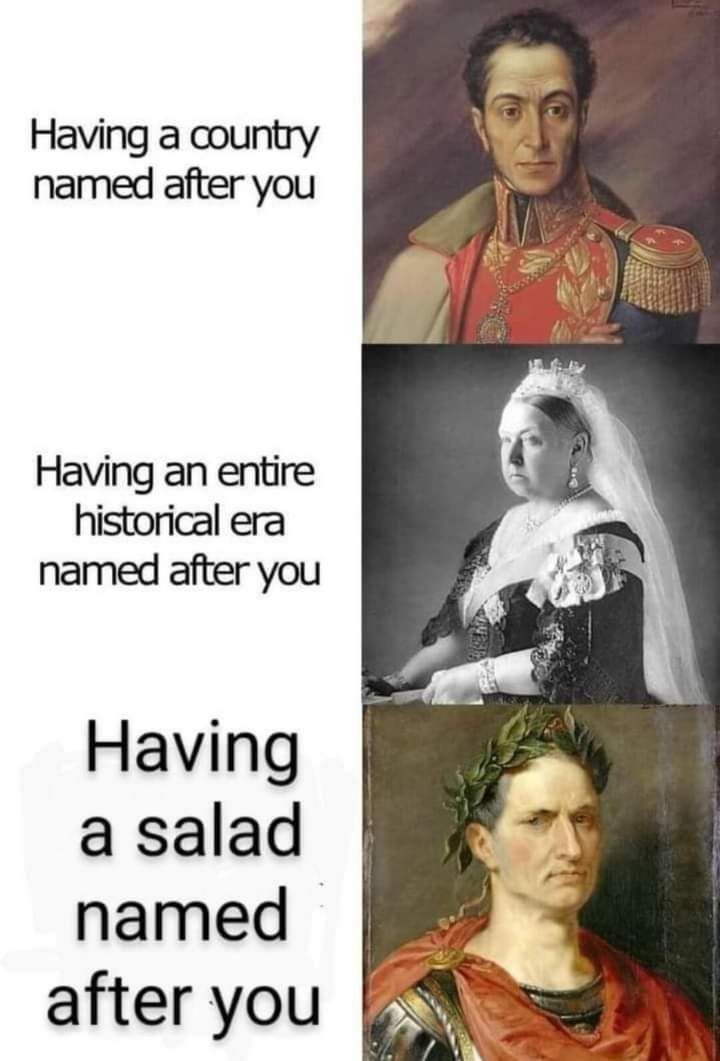
Context: Simón José Antonio de la Santísima Trinidad Bolívar Ponte y Palacios Blanco also known as Simón Bolívar was a revolutionary figure and namesake for the country of Bolivia.

The Victorian Era is named after Queen Victoria and her depressing clothing choices.

Caesar Salad is named after a Mexican Italian chef, Caesar Cardini. Who is well known for overseeing the Roman Republics collapse into an empire.

0

I'm Cleopatra the VII, I Am

preview

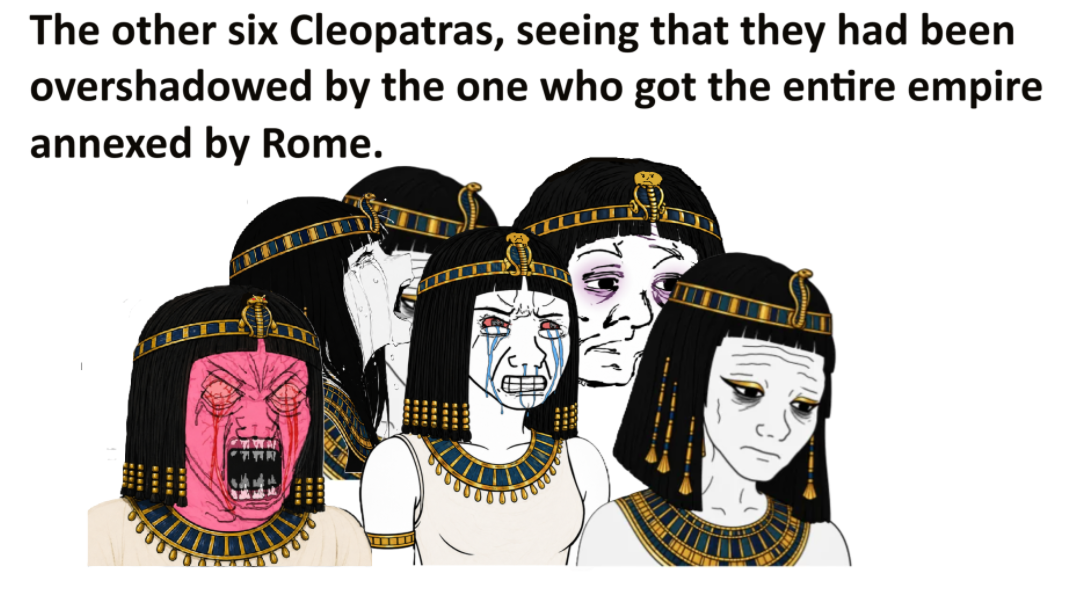
Context: The famous Cleopatra is just Cleopatra VII i.e the 7th Cleopatra of the Ptolemaic dynasty.

The other ones are

Cleopatra I Syra: A Seleucid princess who married Ptolemy V. After her husband’s death, she became regent of Egypt for their young son, Ptolemy VI.

Cleopatra II: Daughter of Cleopatra I and Ptolemy V. She became queen alongside her brother and husband, Ptolemy VI, and later married their younger brother, Ptolemy VIII. She became one of the central figures in the dynasty’s long and extremely violent family conflicts.

Cleopatra III: Daughter of Cleopatra II and Ptolemy VI. She became queen alongside her uncle and stepfather, Ptolemy VIII, and later ruled with her own sons. Her rivalry with her mother, Cleopatra II, contributed to another civil war within the Ptolemaic family.

Cleopatra IV: Daughter of Cleopatra III and Ptolemy VIII. She briefly became queen of Egypt after marrying her brother, Ptolemy IX , but was soon pushed aside when her mother arranged for Ptolemy IX to marry her sister Cleopatra Selene. She later went to Syria and became queen there.

Cleopatra V Tryphaena: A later Ptolemaic queen who married Ptolemy XII. She was probably the mother of Cleopatra VII, although the exact details of Cleopatra VII’s parentage are debated. She disappeared from the historical record around 69/68 BCE from what I understand she was posioned.

Cleopatra VI Tryphaena: This Cleopatra is the most uncertain of the others (and kinda a rabbit hole in itself lol). Ancient sources and later historians have disagreed about exactly who she was and even whether she was a separate person from Cleopatra V. She is generally associated with the political crisis that led to her daughter Berenice IV temporarily taking the throne from Ptolemy XII.

0

Rumbellion

preview

Context: During Australia’s early colonial period the colony ran on a barter system with rum as the main commodity traded. Governor William Bligh (of Bounty fame) was sent to the colony with instructions to clamp down on the rum trade. This along with other issues led to Australia’s only military coup - against the governor by the New South Wales Corps who were becoming rich off the trade.

Wiki: The Rum Rebellion

0

Long Term Planting

preview

Context: In the early 18 hundreds the Napoleonic was on going. Denmark was at the time a naval force to be reckoned with. Although not exactly a threat to the British fleet, the British were worried that Denmark would be occupied by the French, which could potentially boost the size of the French fleet. This would in turn give the French a fleet that would allow them to take the British fleet head on. As a preemptive measure the British asked Denmark to hand over the majority of they vessels. However Denmark wanted to remain neutral in the war, and giving a large chunk of ships to one side would definitely have made the French upset. Thus they denied the British request. Following this the British decided to destroy the potential threat. This ended with the 1807 bombardment of Copenhagen. The Danish fought back, but in the end handed over a bunch of ships, after they had also lost a handful.

Oak trees are the common tree for construction of large ships, in the age of sails. Oak trees are however only harvested after around 120 years of growing and maintenance. And the Danes had no were near the amount of forest or trees at hand to rebuild the navy. That’s why they planted the trees that a now known as “flåde eg” or “the fleets oak”

0

Purrvitin

preview

Context: In 1938 Nazi Germany, Pervitin was developed a methamphetamine drug for civilian usage. Nazi military doctor Otto Friedrich Ranke tested the drug on 90 university students to study its effects, which led him to conclude that Pervitin could help Nazi Germany win the war.

Methamphetamine use is believed to have played a role in the speed of Nazi Germany’s initial blitzkrieg operations. At the request of Vice-Admiral Hellmuth Heye for a stronger pill that would “keep soldiers ready for battle when they are asked to continue fighting beyond a period considered normal,” a pharmacologist produced a pill dubbed D-IX. The new drug contained cocaine, whose effects substantially overlap with those of amphetamine but feature greater euphoria, and a morphine-based painkiller in addition to Pervitin.

0

Parting Shot

preview

Context: A classic tactic, the Parthian Shot involves feigning a retreat and firing at those foolish enough to break ranks and follow your forces. Famously used by the Parthians and Mongols. This became a staple for many steppe nomads.

Context: A classic tactic, the Parthian Shot involves feigning a retreat and firing at those foolish enough to break ranks and follow your forces. Famously used by the Parthians and Mongols. This became a staple for many steppe nomads.

0

Yeet

preview

Context: During the Siege of Caffa, Jani Beg of the Golden Horde allegedly catapulted the corpses of troops who had died from the siege over the walls of the Genoese held city of Caffa.

This claim comes from Gabriele de’ Mussi, a writer who was not actually at the siege.

Context: During the Siege of Caffa, Jani Beg of the Golden Horde allegedly catapulted the corpses of troops who had died from the siege over the walls of the Genoese held city of Caffa.

This claim comes from Gabriele de’ Mussi, a writer who was not actually at the siege.