
0

If you're able, cancel your sub to Proton, cite Andy as the reason

preview

cross-posted from: sh.itjust.works/post/69146381

Andy Yen’s values are incompatible with Proton’s mission. He advocates for poor security practices, supports fascists, and he verbally abuses his subordinates. As such, I can no longer in good conscience continue to financially support a company with such terrible leadership.

Unfortunately for me, my subscription just renewed last month on a multi year plan, but it does give me time to browse for and experiment with alternatives.

If you’re able, I encourage you to do the same and cite Andy Yen as the driving factor for your decision. We can’t let these tech bro fascists destroy what little semblance of privacy we have left.

0

How do I leave this country without getting accosted or apprehended by ICE? Or TSA? Or any other authorities? (Any suggestions welcome) (For trans Latina leaving to Europe)

preview

cross-posted from: lemmygrad.ml/post/12376741

I will be leaving next month.

I see TSA-approved locks.

I don’t want to alert trigger-happy guards or whatever.

I will delete all my third-party apps too.

I will also probably just reboot my tablet completely.

Same with my laptop.

Probably my phone too.

Saving my passwords somewhere else too.

I have some other ways to be private that I won’t reveal openly unless you want to DM, idk

But honestly, with this new cyclospora going around, I just want to survive the next three or four weeks.

What do you suggest?

0

Finally we are safe! (/s)

preview

Thank goodness we’re finally safe, everyone! I feel so incredibly safe I can barely sleep at night — partly from relief, partly from the faint red glow of the dashboard camera evaluating my facial expressions for signs of independent thought. Remember when driving was about getting somewhere? Now the car watches you, the road watches you, the toll booth photographs you, and somewhere an algorithm decides whether your blinker-to-lane-change ratio indicates sufficient loyalty to remain a licensed citizen. And those anti-distraction cameras! You’re no longer trusted to glance at a road sign without the system assuming you’re filming a TikTok. The camera knows. The camera always knows. And the camera, unlike you, never had a stressful Tuesday.

I also adore the financial supervision. Every coffee I buy with my card is lovingly noted and stored in case someone - anyone - someday needs to review my caffeine patterns for national security purposes. Two espressos before 9 AM? Possible instability. Four beers Saturday? Risk factor. Thirteen emergency Toblerones during tax season? Irrefutable character assessment.

My phone tracks my location so faithfully I couldn’t match its dedication if I tried. It knows I went to the pharmacy Thursday. It knows I took the scenic route Friday. It probably knows I stood outside the bakery six minutes deciding whether to treat myself and walked away empty-handed - proving to whichever algorithm monitors such things that I possess both self-discipline and poor decision-making skills simultaneously.

Facial recognition cameras mean I no longer suffer the indignity of walking through a city anonymously like some 2003 peasant. I’m identified, timestamped, and filed - because a free citizen moving through public space unnoticed is clearly a missed opportunity for database enrichment.

But here’s my absolute favorite part. All this magnificent safety infrastructure - every camera, every log, every database, every tracking system - it’s all in the hands of whoever happens to be in government this season. And governments change. Today’s well-meaning bureaucrat administering your data with careful oversight is tomorrow’s populist demagogue who noticed you donated to the wrong cause, attended the wrong protest, and Googled the wrong thing on a Tuesday afternoon. Maybe you were researching a school project. Maybe you were just curious. Doesn’t matter — the search history doesn’t care about context, and neither will they.

And the beauty of the pitch? Nobody ever said “we’d like to watch everything you do forever.” They said “safety”. One word, carrying all the weight, answering all questions, and conveniently foreclosing further discussion. Safety from what? Don’t worry about it. Who controls it? Interesting. Can you influence it? Adorable that you’d ask. The safest person alive is someone in a padded cell under constant supervision. Magnificent safety record. Very low satisfaction. But completely safe - until the warden changes.

Thank goodness we’re finally safe, everyone! I feel so incredibly safe I can barely sleep at night — partly from relief, partly from the faint red glow of the dashboard camera evaluating my facial expressions for signs of independent thought. Remember when driving was about getting somewhere? Now the car watches you, the road watches you, the toll booth photographs you, and somewhere an algorithm decides whether your blinker-to-lane-change ratio indicates sufficient loyalty to remain a licensed citizen. And those anti-distraction cameras! You’re no longer trusted to glance at a road sign without the system assuming you’re filming a TikTok. The camera knows. The camera always knows. And the camera, unlike you, never had a stressful Tuesday.

I also adore the financial supervision. Every coffee I buy with my card is lovingly noted and stored in case someone - anyone - someday needs to review my caffeine patterns for national security purposes. Two espressos before 9 AM? Possible instability. Four beers Saturday? Risk factor. Thirteen emergency Toblerones during tax season? Irrefutable character assessment.

My phone tracks my location so faithfully I couldn’t match its dedication if I tried. It knows I went to the pharmacy Thursday. It knows I took the scenic route Friday. It probably knows I stood outside the bakery six minutes deciding whether to treat myself and walked away empty-handed - proving to whichever algorithm monitors such things that I possess both self-discipline and poor decision-making skills simultaneously.

Facial recognition cameras mean I no longer suffer the indignity of walking through a city anonymously like some 2003 peasant. I’m identified, timestamped, and filed - because a free citizen moving through public space unnoticed is clearly a missed opportunity for database enrichment.

But here’s my absolute favorite part. All this magnificent safety infrastructure - every camera, every log, every database, every tracking system - it’s all in the hands of whoever happens to be in government this season. And governments change. Today’s well-meaning bureaucrat administering your data with careful oversight is tomorrow’s populist demagogue who noticed you donated to the wrong cause, attended the wrong protest, and Googled the wrong thing on a Tuesday afternoon. Maybe you were researching a school project. Maybe you were just curious. Doesn’t matter — the search history doesn’t care about context, and neither will they.

And the beauty of the pitch? Nobody ever said “we’d like to watch everything you do forever.” They said “safety”. One word, carrying all the weight, answering all questions, and conveniently foreclosing further discussion. Safety from what? Don’t worry about it. Who controls it? Interesting. Can you influence it? Adorable that you’d ask. The safest person alive is someone in a padded cell under constant supervision. Magnificent safety record. Very low satisfaction. But completely safe - until the warden changes.

0

Socially excluded ! ( Cyberspace, email question.. )

preview

cross-posted from: programming.dev/post/50697138

Hi,

I wanted to contact the owner/administrator of a website. Unfortunately, they didn’t provide any means of contact ( email, phone number, online form, simpleX whatsoever).

So the only alternative that I had thought was to create a Mastodon account and publish an open communication with them tagged. ( who know with a bit of luck. )

Unfortunately, to create a Mastodon account, you have to provide an email 📧 address 😞 The problem with email address is that it can be correlated to track you down and more… there are so many examples online, I will not cover this here.

So the workaround is to create a new email address dedicated just for that usage or service. But it’s becoming merely impossible to create a free email account somewhere without giving up your identity. (phone number, ISP[^1] email address, paying online with Fiat[^2] , Cloudflare or whatever trick )

I’ve seen already few posts about this subject on lemmy and other platforms

some quote from those links

Like it or not, email is a critical part of our digital lives. It’s how we sign up for accounts, get notifications, and communicate with a wide range of entities online. Critics of email rightfully point out that email suffers from a significant number of flaws that make it less than ideal, but that doesn’t change the current reality. In light of that reality, I believe that an encrypted email provider is a must-have for everyone in today’s age of rampant data breaches, insider threats, warrantless police access, and targeted advertising.

All the providers listed around the WWW are wrong ! Either they ask to identify yourself, or if you use Tor, you are blocked, or you cannot use it to register to any service online (third party).

See the table below \

Do not hesitate to propose any other, or maybe you have another solution ? Like self hosting email service ? I already dig up a little bit, but I found this and it looks scary. Thank you GAFAM…

So maybe it doesn’t look like much? But actually, it’s blocking me more and more. I cannot move/interact on internet or in real life ! because I get often “You have to register online” and that registration come with mandatory email…

Where I live, you better stay anonymous. Because what you say can definitely strike back to you. There is no freedom of speech. Please help to make internet free again.

Because we need it in our daily life and social interactions…

Thanks


mailbox•org 🤔

  • not free, only accept Fiat
  • last check: 2026-05-21

Which payment methods can I use?

Cash by post (By letter and EURO banknotes only - no cheques)

Cash deposit into our bank account


disroot•com ❌

  • Require a identification email address


gmx•com ❌

  • various blocking methods ( depending on IP )

  • last check: 2026-05-20


inleed•com ❌

  • Require a identification email address

  • last check: 2026-05-21


mailo•com ❌

  • Do not accept 3th-party registration email for an unknown period

  • currently down

  • last check: 2026-05-20


mailfence•com ❌

  • Need to provide another e-mail address XD

  • last check: 2026-05-21

proton•me ❌

  • Do not accept 3th-party registration email
  • last check: 2026-05-20


tuta•com ❌

  • IP blocking

  • TOR forbidden

  • last check: 2026-05-20

[^1]: Internet Service Provider [^2]: en.wikipedia.org/wiki/Fiat_money

0

Privacy focused home-lab project!

preview

Hello everyone! I’m quite new to the LemmyWorld and to the world of open-source computing in general. I recently started my journey into the field of computer science, and immediately felt compelled to join this massive movement against big tech, and against the corporate takeover of the internet.

I’m working on this homelab in order to get some practice. So far I’m only self-hosting a website, which as you can see, revolves around privacy and anonymity. The site is really new and I’m planning on adding more sections and features in future…

So far it offers:

e2e encrypted messaging webapp, which allows you to send encrypted messages to an email address, without using any account or identifier on your part.

point of sale for British SIM card. In Britain we can buy SIM cards without providing any ID or KYC. Shipped worldwide

Tools: in this section I plan to uploaded any piece of software related to anti/counter-surveillance that I will develop in the future, so far it hosts a timezone-sync toolthat synchronizes your system timezone with your VPN’s IP geolocation.

(It’s not a trap!). This page allows you to see all the code that composes the frontend of the website, including all .js files. Considering safe ways to publish the backend code too safely.

I am planning on adding two more pages, one for privacy and cybersecurity related news, and one for educational content.

My main problem is that I’m not getting any traffic so far, so I haven’t had the chance to test it properly, don’t even know if the current setup can handle multiple requests so I was hoping to get some traffic and feedback if the post gets approved.

Please let me know what you think about it and what there is to be fixed!

privacy-hut.com

Some technicalities about the website:

There are no cookies or trackers, I don’t collect any telemetry data.

The server holds the ciphertext of the message only until the recipient opens it and reads it, it gets automatically deleted afterwards.

I don’t self host my own email server, I’m using an SMTP relay server, Brevo. This doesn’t break the 0-trust architecture because they simply only get the ciphertext, and recipient address just like myself, and I’ve set up the brevo profile to delete logs every day. The emails will appear as them have been sent by my server, not you. This choice has been made to ensure messages actually get delivered without ending up in spam folders.

0

Bounty Available (>$2,000) for QubesOS BusKill package

BusKill QubesOS Bounty (Contrib Package) - BusKill www.buskill.in
preview

Friends,

We’re happy to announce that we have funding available to package BusKill in QubesOS as a contrib package.

Bounty Now Available for BusKill Contrib Package in QubesOS

Thanks to a generous donation from NovaCustom, we’re offering a bounty to anyone (including you!) who packages BusKill as an official contrib package for QubesOS.

About BusKill

BusKill is a laptop kill-cord. It’s a USB cable with a magnetic breakaway that you attach to your body and connect to your computer.

What is BusKill? (Explainer Video)
Watch the BusKill Explainer Video for more info youtube.com/v/qPwyoD_cQR4

If the connection between you to your computer is severed, then your device will lock, shutdown, or shred its encryption keys — thus keeping your encrypted data safe from thieves that steal your device.

About NovaCustom

In Mar 2015, Wessel klein Snakenborg (founder of NovaCustom) started selling highly-customizable Linux laptops from Europe.

In Aug 2021, NovaCustom released their first laptop (NV40) with coreboot pre-installed with Dasharo.

Photo of a screw thats been covered with a unique pattern of (multi-color) glitter nail polish
NovaCustom offers anti-tamper options, including <a href=“www.buskill.in/qubes-package-bounty/”>glitter nail polish applied to the chassis screws</a> (photos sent to you via Proton Mail before shipment — specify PGP key at checkout for e2ee)

Since 2023, NovaCustom has been a leader in hardware security:

And now, in Apr 2026, NovaCustom is further working to increase the accessibility of BusKill to QubesOS users, by sponsoring the submission of an official QubesOS contrib package.

Funding Available

If you’d like to claim this bounty for yourself, please

  1. Read the details of the bounty, and then
  2. Submit a proposal by commenting on this GitHub issue

Claim Bounty

opencollective.com/buskill/projects/qubes-package

Moreover, if you’re a QubesOS user and you’d like to donate additional funds in support of this bounty, you can do so here.

Stay safe,

The BusKill Team
www.buskill.in
buskillvampfih2iucxhit3qp36i2zzql3u6pmkeafvlxs3tl…

0

BusKill (Dead Man Switch) now available in apt

BusKill Install BusKill with apt (Debian, Linux Mint, Ubuntu, Kali, TAILS) - BusKill www.buskill.in
preview

We’re happy to announce that BusKill can be installed on Linux directly with apt

BusKill Now available in Debian apt Repos

What is BusKill?

BusKill is a laptop kill-cord. It’s a USB cable with a magnetic breakaway that you attach to your body and connect to your computer.

What is BusKill? (Explainer Video)
Watch the BusKill Explainer Video for more info youtube.com/v/qPwyoD_cQR4

If the connection between you to your computer is severed, then your device will lock, shutdown, or shred its encryption keys – thus keeping your encrypted data safe from thieves that steal your device.

Debian

BusKill can be installed on Debian with apt.

Screenshot of Debian, showing the command to install BusKill)
To install BusKill in Debian, execute su - and then apt install buskill

To install BusKill on Debian, execute the command

su -
apt install buskill

Read the full article here:

Support BusKill

We’re looking forward to continuing to improve the BusKill software and looking for other avenues to distribute our hardware BusKill cable to make it more accessible this year.

If you want to help, please consider purchasing a BusKill cable for yourself or a loved one. It helps us fund further development, and you get your own BusKill cable to keep you or your loved ones safe.

Buy a BusKill Cable
https://buskill.in/buy

You can also buy a BusKill cable with bitcoin, monero, and other altcoins from our BusKill Store’s .onion site.

Bitcoin Accepted Here

Monero Accepted Here

Stay safe,
The BusKill Team
www.buskill.in
buskillvampfih2iucxhit3qp36i2zzql3u6pmkeafvlxs3tl…

0

The Banality of AI (Hallucination → Bomb School?)

Michael Altfield&#039;s Tech Blog The Banality of Artificial Intelligence - Michael Altfield&#039;s Tech Blog tech.michaelaltfield.net
preview

The Banality of Artificial Intelligence

What happens when an AI hallucination leads to bombing an elementary school?

By Michael Altfield
License: CC BY-SA 4.0
tech.michaelaltfield.net

It appears likely that the US government is using Anthropic, OpenAI, Google and/or xAI data models for processing signals intelligence (SIGINT), for AI-generated “kill lists” to determine where to drop their bombs.

Image shows a nazi german chemical war factory on the left in black-and-white (with logos of companies Bayer and BASF overlaying it) and an image of a new AI datacenter on the right (with logos of companies OpenAI and Anthropic overlaying it). In the middle of the two industrial sites is an equal sign. On the right is a question mark.
[right] This AI datacenter is a machinery of war. Its LLM hallucinations decide which children to assassinate [left] This IG Farben (Bayer/BASF) factory in Auschwitz produced Zyklon B for the Nazis, who murdered over a million children

In Apr 2024, +972 (an Israeli news outlet) published a >9,000 word article describing how the Israeli military had been using Artificial Intelligence to decide which (residential) buildings, hospitals, and schools to bomb in Gaza.

In Feb 2026, the US (and Israel) bombed Iran – killing over 100 schoolchildren (and Ali Khamenei).

In Mar 2026, it appears that the US has likely built a similar system, leveraging US AI companies’ tech to decide which (school) buildings to bomb, false-positive hallucinations be damned.

Who targeted the Shajareh Tayyiba girls’ elementary school in Minab, Iran? Could it have been an AI hallucination? A false-positive?
…


Read the full article here:

0

Encrypted email provider alternatives to ProtonMail

preview

I’ve been a ProtonMail user for 6 years already but must admit that I’m one of those that is not liking the direction the company is taking and find it worrying, specially now that they plan to launch an office suite that I don’t need or want.

I run most of my cloud services self-hosted except email but I’m not fully ready (hardware & software - wise) to admin my own encrypted email server although I don’t discard I’ll do so in the future. I already know Tuta and it’s defo another option but my ideal one should be one that could be used directly with email clients like Thunderbird (I don’t mind managing my own GPG keys) so I see Tuta as the retreat option.

So, any ideas for a reliable encrypted email provider other than self-hosting?

0

How to check if Tor Onion Service is alive?

preview

How can I check to see if a given Onion Service is still in-use?

To be clear: I’m not asking about just Onion Services bound to port 80. Of course I can just curl it, but that won’t tell me if the Onion Service is running something on another port.

I’m trying to find an XMPP server that uses an Onion Service. I found several lists of XMPP servers and their .onion names, but I expect most of these services are offline.

2n3tvihf4n27pqyqdtcqywl33kbjuv2kj3eeq6qvbtud57jwiaextmid.onion
32qywqnlnqzbry42nmotr47ebts3k6lhiwfob6xniosmepz2tsnsx7ad.onion
4colmnerbjz3xtsjmqogehtpbt5upjzef57huilibbq3wfgpsylub7yd.onion
6voaf7iamjpufgwoulypzwwecsm2nu7j5jpgadav2rfqixmpl4d65kid.onion
6w5iasklrbr2kw53zqrsjktgjapvjebxodoki3gjnmvb4dvcbmz7n3qd.onion
7drfpncjeom3svqkyjitif26ezb3xvmtgyhgplcvqa7wwbb4qdbsjead.onion
ae3w7fkzr3elfwsk6mhittjj7e7whme2tumdrhw3dfumy2hsiwomc3yd.onion
chillingguw3yu2rmrkqsog4554egiry6fmy264l5wblyadds3c2lnyd.onion
fzdx522fvinbaqgwxdet45wryluchpplrkkzkry33um5tufkjd3wdaqd.onion
gku6irp4e65ikfkbrdx576zz6biapv37vv2cmklo2qyrtobugwz5iaad.onion
gois4b6fahhrlsieupl56xd6ya226m33abzuv26vgfpuvv44wf6vbdad.onion
j4dhkkxfcsvzvh3p5djkmuehhgd6t6l7wmzih6b4ss744hegwkiae7ad.onion
jabjabdea2eewo3gzfurscj2sjqgddptwumlxi3wur57rzf5itje2rid.onion
jaswtrycaot3jzkr7znje4ebazzvbxtzkyyox67frgvgemwfbzzi6uqd.onion
jeirlvruhz22jqduzixi6li4xyoweytqglwjons4mbuif76fgslg5uad.onion
jukrlvyhgguiedqswc5lehrag2fjunfktouuhi4wozxhb6heyzvshuyd.onion
mrbenqxl345o4u7yaln25ayzz5ut6ab3kteulzqusinjdx6oh7obdlad.onion
nixnet54icmeh25qsmcsereuoareofzevjqjnw3kki6oxxey3jonwwyd.onion
qawb5xl3mxiixobjsw2d45dffngyyacp4yd3wjpmhdrazwvt4ytxvayd.onion
qwikoouqore6hxczat3gwbe2ixjpllh3yuhaecixyenprbn6r54mglqd.onion
qwikxxeiw4kgmml6vjw2bsxtviuwjce735dunai2djhu6q7qbacq73id.onion
razpihro3mgydaiykvxwa44l57opvktqeqfrsg3vvwtmvr2srbkcihyd.onion
rurcblzhmdk22kttfkel2zduhyu3r6to7knyc7wiorzrx5gw4c3lftad.onion
szd7r26dbcrrrn4jthercrdypxfdmzzrysusyjohn4mpv2zbwcgmeqqd.onion
xdkriz6cn2avvcr2vks5lvvtmfojz2ohjzj4fhyuka55mvljeso2ztqd.onion
xiynxwxxpw7olq76uhrbvx2ts3i7jagqnqix7arfbknmleuoiwsmt5yd.onion
xmppccwrohw3lmfap6e3quep2yzx3thewkfhw4vptb5gwgnkttlq2vyd.onion
ynnuxkbbiy5gicdydekpihmpbqd4frruax2mqhpc35xqjxp5ayvrjuqd.onion
yxkc2uu3rlwzzhxf2thtnzd7obsdd76vtv7n34zwald76g5ogbvjbbqd.onion

I don’t want to eliminate them just for not running an HTTP server (eg port 80, 443, 8080, etc). Nor do I want to eliminate them for not running on a common XMPP port (5222, 5223, 5269, 5298, 8010). I’m trying to find something that checks if an Onion Service has been used in the past days/weeks without requiring me to test a connection on a given port.

My understanding is that Onion Services will (by default) generate and publish hidden service descriptors (HSDir).

Is there some way I can query the Tor directory of HSDirs to see if a given Onion Service is still active?

0

(FI, or EU-wide?) Banks are becoming like Britney Spears’ dad

preview

cross-posted from: slrpnk.net/post/29618613

cross-posted from: slrpnk.net/post/29617623

The linked fedi comment is a bit alarming. In a GDPR region, a prospective mortgage borrower was denied a home loan because the bank knew how much he spent on wine.

The post gets errors (as if it were censored?), but I can reach it only within a slrpnk.net cache of the comment. I will quote it here in case others also cannot reach the comment:

Anonymity is very important.

Here’s a example why, that recently happened to a workmate:

He applied for a mortgage to buy a house. The application was denied 3 times, despite his having been employed at the same place for 20 years, paid all his bills on time and never received so much as a parking ticket. Finally, after insisting heavily and threatening to sue, his bank provided the reason why: his purchasing habits included too much alcohol.

Or said another way: the bank watched what he purchased when doing his groceries for years and quietly classified him as a wino and potential deadbeat.

I can tell you, when I do my groceries, and back when I still smoked, I never paid for alcohol or tobacco with anything other than cash, for that very reason. The only things I pay for with plastic paint the portrait of a boring working stiff with no habits out of the ordinary. For the rest, it’s cash-only.

And if you want another example of why anonymity is important: a few years ago, I sought the help of an underground surgeon to perform a certain type of surgery on me that my stupid doctors here refused to perform, despite my quality of life going to shit (it’s a long story…)

Guess what: underground surgeons don’t take credit cards. The man changed my life for the better but I certainly don’t want my local health insurance to know about it. Was it illegal? Hell yes. Was it justified? Hell yes. Legal and right are two different things.

And similarly, I expected many women post Roe v. Wade would like to have the opportunity to get an abortion out of state anonymously without going to jail.

That’s why anonymous payments are essential: they are the last rampart between you and unjust laws and prejudice.

This story should really get some serious press. I tried searching the enshitified web for stories similar to this and got no hits. WTF.

How are banks getting such detail as to know what people are buying?

My expectation: the bank should only know the total amount of the grocery store transaction, not an itemised list of what someone buys. WTF is going on here? It’s a data minimisation failure on the part of the grocery store and also on the part of the bank who over-collected data. And most importantly, the payment processor. What possible grounds does the payment processor have to put that data in the protocol and pass it along?

And a transparency failure. On what scale is this happening in the EU?

I hope, at least, that the 3 denials were from the applicants own bank.

0

Danish EU Council presidency drops chat control: It's dead for now 🎉

Berlingske Dansk forslag om digital børnebeskyttelse droppet efter tysk kritik www.berlingske.dk
preview

cross-posted from: piefed.social/…/danish-eu-council-presidency-drop…

The Danish government will no longer push for chat control!

Here’s a machine translation of what the Danish newspaper Berlingske has to say about it.

Fair warning: The journalists in Berlingske don’t seem to have the slightest idea what they are talking about, and are enthusiastically gobbling up the Kool-Aid served to them by Danish Minister of Justice Peter Hummelgaard, a man who is on the record claiming that privacy is not a human right (it is). Don’t expect to gain any worthwhile neural connections in your brain by reading the below.


Danish proposal on digital child protection dropped after German criticism

Danish EU presidency could not create support for proposals to scan messages for abuse material.

The government will no longer force tech giants to scan citizens’ messages for imagery of sexual abuse of children.

The Danish EU Presidency is thus withdrawing its proposal after Germany and later the ruling Moderates have opposed it. This is stated in a written comment.

“This will mean that the injunction will not be part of the EU Presidency’s new compromise proposal and that it should continue to be voluntary for tech giants to track down material with child sexual abuse,” Justice Minister Peter Hummelgaard said.

He sits at the table end in the work to get the CSA regulation adopted under the Danish EU Presidency, which lasts until the New Year.

The regulation was originally proposed by the European Commission in 2022. It will be able to force tech companies to scan the contents of private citizens’ images and videos on encrypted services.

But both Germany and since the Moderates withdrew their support for the proposal because it was too intrusive.

Hummelgaard, however, believes that Denmark’s proposal was less intrusive than the EU Commission’s original proposal. And he highlights that Save the Children, Unicef, Children’s Terms and Digital Responsibility gave their clear backing.

However, the risk of losing an important tool is highly weighted.

“Right now, we are in a situation where we risk completely losing a central tool in the fight against sexual assault against children, because the current scheme that allows for voluntary scanning expires in April 2026,” he said.

That’s why we have to act no matter what. We owe it to all the children who are subjected to monstrous abuses, says Peter Hummelgaard.

The government’s original proposal will break with fundamental freedoms and will potentially result in mass surveillance of citizens in the EU, the critics said. Among other things, they count hundreds of scientists and experts, the Dataetian Council and the tech giants themselves.

Germany has directly called it “mass surveillance” in the past.

“The mass surveillance of private messages must be taboo in a rule of law,” the German Ministry of Justice wrote at X.

Save the Children calls the previous volunteer tracing via scanning a “huge success” and is frustrated that there was no backing for a compromise.

“We are deeply concerned and frustrated that there has been no European support for a compromise where tech companies may be required to track down and remove photos and videos with sexual assaults on children,” senior adviser at digital child protection Tashi Andersen said in a written commentary.

0

BusKill wins $1,031 microgrant from FUTO

BusKill FUTO Microgrant Recipient (Feb 2025) - BusKill www.buskill.in
preview

We’re thrilled to announce that BusKill was the recipient of a $1,031 microgrant from FUTO!

Announcing our February Microgrants - Tauri, Earthstar, Katzenpost, and Buskill
Can’t see video above? Watch it on PeerTube or on YouTube at youtu.be/Qr0VusrG1jE

We’re elated to see BusKill join the ranks next to CryptPad, ExifTool, KeePassXC, Whonix, Wireshark, Tor Project, Calyx, and numerous other awesome projects that have received grants from FUTO.

Iterate with us!

Want to print your own BusKill cable? We’ll cover your expenses for filament, magnets, and pogo pins.

We plan to use these funds to document our 3D-Printable BusKill Dead Man Switch. And we need your help!

The BusKill project is looking for a volunteer to write the documentation describing how to print and build your own BusKill cable. The documentation will be written for our Sphinx Documentation Site in reStructuredText and pushed in git.

If you have access to a 3D-Printer, please contact us to receive funds to buy the components needed to document the build of a 3D-Printed BusKill.

What is BusKill?

BusKill is a laptop kill-cord. It’s a USB cable with a magnetic breakaway that you attach to your body and connect to your computer.

What is BusKill? (Explainer Video)
Watch the BusKill Explainer Video for more info on PeerTube or youtube.com/v/qPwyoD_cQR4

If the connection between you to your computer is severed, then your device will lock, shutdown, or shred its encryption keys – thus keeping your encrypted data safe from thieves that steal your device.

Support BusKill

We’re looking forward to continuing to improve the BusKill software and looking for other avenues to distribute our hardware BusKill cable to make it more accessible this year.

If you want to help, please consider purchasing a BusKill cable for yourself or a loved one. It helps us fund further development, and you get your own BusKill cable to keep you or your loved ones safe.

Buy a BusKill Cable
https://buskill.in/buy

You can also buy a BusKill cable with bitcoin, monero, and other altcoins from our BusKill Store’s .onion site.

Bitcoin Accepted Here

Monero Accepted Here

Stay safe,
The BusKill Team
www.buskill.in
buskillvampfih2iucxhit3qp36i2zzql3u6pmkeafvlxs3tl…

0

Feds in Catalonia, Spain think everyone using a Google Pixel must be a drug dealer

Android Authority Cops in this country think everyone using a Google Pixel must be a drug dealer (Updated) www.androidauthority.com
preview

cross-posted from: lemy.lol/post/48506189

TLDR: Drug dealers in Catalonia have started to adopt GrapheneOS en masse leading to Catalan police suspecting anyone with a Google Pixel is a drug dealer

cross-posted from: lemy.lol/post/48506189

TLDR: Drug dealers in Catalonia have started to adopt GrapheneOS en masse leading to Catalan police suspecting anyone with a Google Pixel is a drug dealer

0

EU opens new probe into TikTok data transfer of European users' personal data to servers in China

France 24 EU opens new probe into TikTok data transfer to China www.france24.com
preview

cross-posted from: lemmy.sdf.org/post/38321143

TikTok was fined 530 million euros ($620 million) in May by the Data Protection Commission over European data transfers to China, though the Chinese social media giant had insisted this data was only accessed remotely.

The DPC on Thursday said it had been informed by TikTok in April that “limited EEA user data had in fact been stored on servers in China,” contrary to evidence presented by the company.

The regulator said it had expressed “deep concern” in its previous investigation that “TikTok had submitted inaccurate information”.

[…]

0

Your devices feed AI assistants and harvest personal data even if they’re asleep

Live Science Your devices feed AI assistants and harvest personal data even if they’re asleep. Here's how to know what you're sharing. www.livescience.com
preview

cross-posted from: piefed.zip/post/131103

Like it or not, artificial intelligence has become part of daily life. Many devices — including electric razors and toothbrushes — have become AI-powered," using machine learning algorithms to track how a person uses the device, how the device is working in real time, and provide feedback. From asking questions to an AI assistant like ChatGPT or Microsoft Copilot to monitoring a daily fitness routine with a smartwatch, many people use an AI system or tool every day.

While AI tools and technologies can make life easier, they also raise important questions about data privacy. These systems often collect large amounts of data, sometimes without people even realizing their data is being collected. The information can then be used to identify personal habits and preferences, and even predict future behaviors by drawing inferences from the aggregated data.

An assistant professor of cybersecurity at West Virginia University, studies how emerging technologies and different types of AI systems manage personal data and how we can build more secure and privacy-preserving systems for the future.

0

An analysis of X(Twitter)'s new XChat features shows that X can probably decrypt users' messages, as it holds users' private keys on its servers

A Few Thoughts on Cryptographic Engineering A bit more on Twitter/X&#8217;s new encrypted messaging blog.cryptographyengineering.com
preview

cross-posted from: programming.dev/post/31946686

cross-posted from: programming.dev/post/31946686

0

Google pushing Gmail users to transition to passkeys using biometric data

preview

cross-posted from: lemmy.nz/post/23935860

Google warns “passwords are not only painful to maintain, but are also more prone to phishing and often leaked through data breaches.” And that’s the real issue. “It’s important to use tools that automatically secure your account and protect you from scams,” Google tells users, and that means upgrading account security now.

Google says “we want to move beyond passwords altogether, while keeping sign-ins as easy as possible.” That includes social sign ins, but mainly it means passkeys. “Passkeys are phishing-resistant and can log you in simply with the method you use to unlock your device (like your fingerprint or face ID) — no password required.”

This is just one of their excuses, to keep their users inside google’s walled-garden

0

Samsung teams up with Glance to use your face in AI-generated lock screen ads

Ars Technica Samsung teams up with Glance to use your face in AI-generated lock screen ads arstechnica.com
preview

cross-posted from: lemmy.zip/post/40314191

Just a little bit more privacy invasion. C’mon, juuuust a little… 'till you no longer notice.

cross-posted from: lemmy.zip/post/40314191

Just a little bit more privacy invasion. C’mon, juuuust a little… 'till you no longer notice.

0

Google's AI now listens to your English language phone conversations

Google New AI-Powered Scam Detection Features to Help Protect You on Android security.googleblog.com
preview

cross-posted from: lemmy.world/post/29777938

More than half of Americans reported receiving at least one scam call per day in 2024. To combat the rise of sophisticated conversational scams that deceive victims over the course of a phone call, we introduced Scam Detection late last year to U.S.-based English-speaking Phone by Google public beta users on Pixel phones.

We use AI models processed on-device to analyze conversations in real-time and warn users of potential scams. If a caller, for example, tries to get you to provide payment via gift cards to complete a delivery, Scam Detection will alert you through audio and haptic notifications and display a warning on your phone that the call may be a scam.

0

EU ruling: tracking-based advertising by Google, Microsoft, Amazon, X, across Europe has no legal basis

Irish Council for Civil Liberties EU ruling: tracking-based advertising by Google, Microsoft, Amazon, X, across Europe has no legal basis - Irish Council for Civil Liberties www.iccl.ie
preview

cross-posted from: feddit.org/post/12486187

cross-posted from: feddit.org/post/12486187

0

Free movement of personal data

preview

Article 1(3) of the General Data Protection Regulation (GDPR) ensures that the free movement of personal data within the European Union (EU) is neither restricted nor prohibited on grounds related to the protection of personal data. This provision primarily targets Member States, which might otherwise be inclined to enact data localisation laws that could impede the free flow of data.

The scope of this free movement is confined to the European Economic Area (EEA), which encompasses all EU Member States along with Iceland, Liechtenstein, and Norway. It is important to note that the status of various special territories associated with EU Member States requires careful consideration, as some are included within the EEA while others are not.

Countries outside the EU/EEA do not enjoy the benefits of the free flow of personal data. The Court of Justice of the European Union (CJEU) has established stringent standards for international data transfers. The free flow of personal data is explicitly limited to the EEA, with rules governing transfers to non-EU/EEA countries, referred to as ‘third countries,’ detailed in Chapter V of the GDPR.

For instance, when a data controller based in Italy stores personal data with a cloud service provider in Norway, there are no concerns regarding international data flows because the GDPR prohibits restrictions on such flows within the EEA. Conversely, if the Italian data controller utilises a service provider in the UK, an additional legal basis is required to legitimise these data flows.

There is an ongoing debate regarding whether the free flow of personal data solely applies to data transfers between systems located within the EEA or if it also extends to systems outside the EEA that are under the effective control of an EEA-based controller or processor. The European Commission has recently adopted an entity-based approach, focusing on whether the controlling entity falls within the territorial scope outlined in Article 3 of the GDPR, rather than a data-based approach, which would consider whether the data remains physically within the EEA. However, the wording of the GDPR does not appear to support this entity-based approach. Nevertheless, the definition of the GDPR’s territorial scope of application is explicitly decoupled from the question of whether the data processing occurs within the Union or not, as stated in Article 3(1).

0

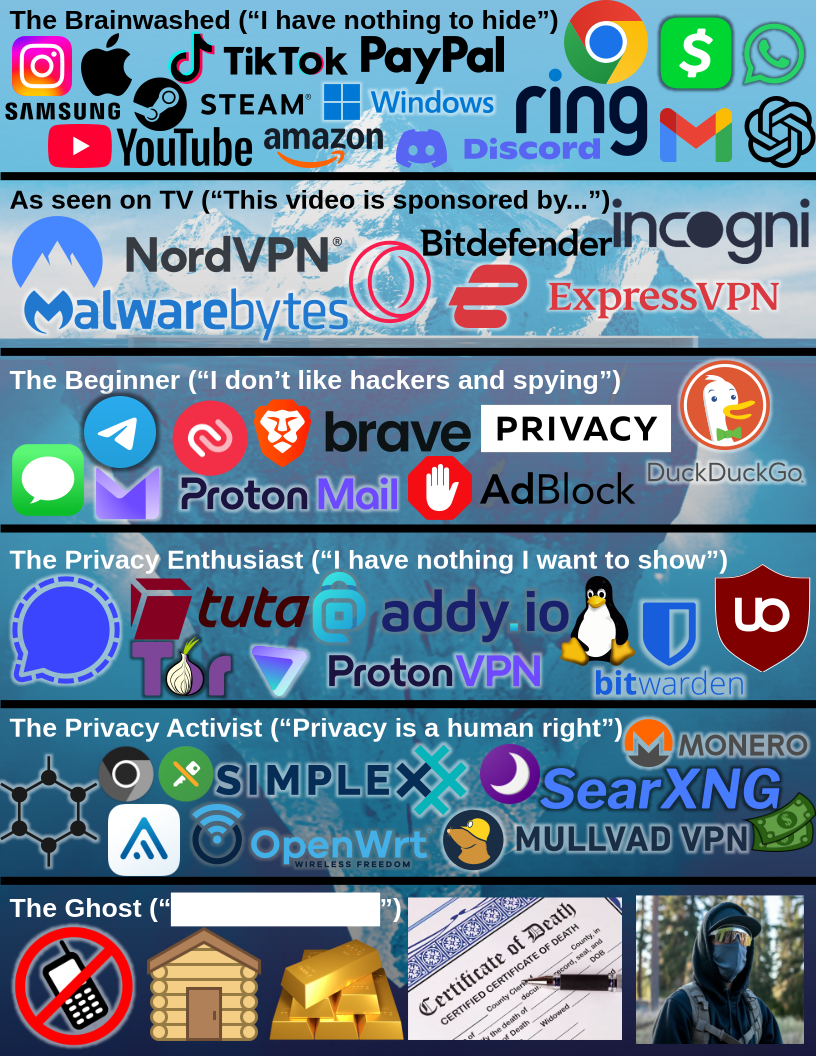
The Privacy Iceberg

preview

cross-posted from: lemmy.ml/post/29712598

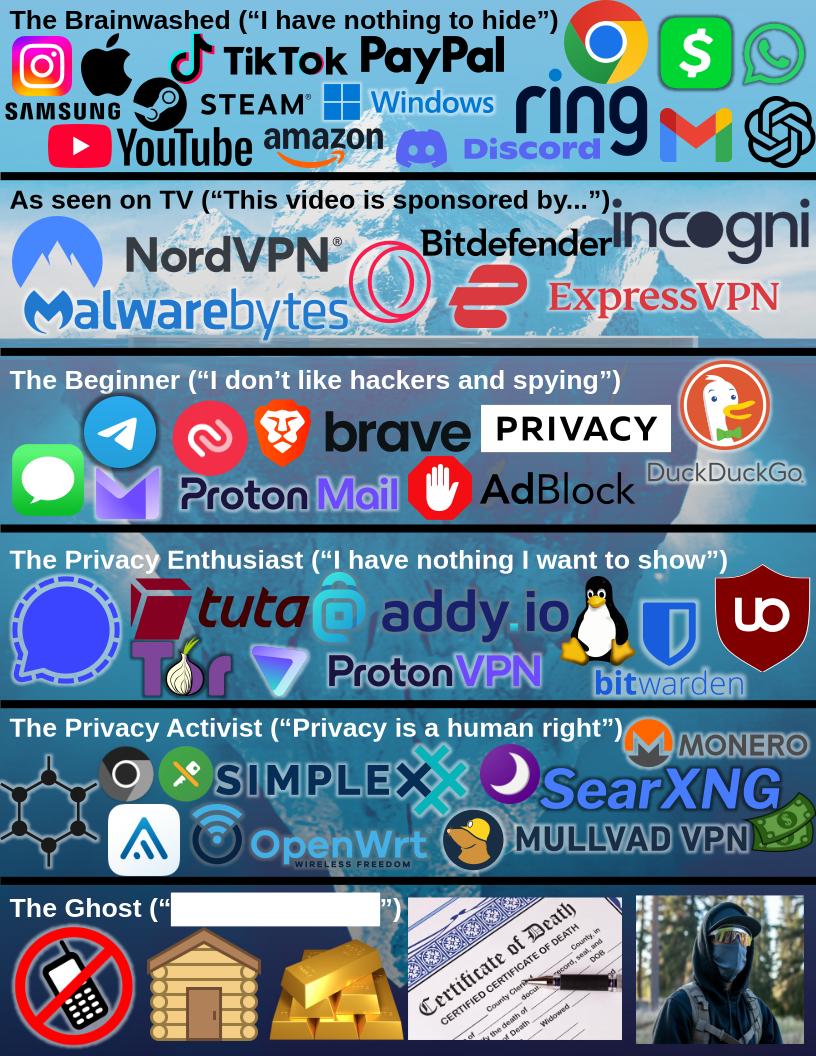
The Privacy Iceberg

This is original content. AI was not used anywhere except for the bottom right image, simply because I could not find one similar enough to what I needed. This took around 6 hours to make.

Transcription (for the visually impaired)

(I tried my best)

The background is an iceberg with 6 levels, denoting 6 different levels of privacy.

The tip of the iceberg is titled “The Brainwashed” with a quote beside it that says “I have nothing to hide”. The logos depicted in this section are:

The surface section of the iceberg is titled “As seen on TV” with a quote beside it that says “This video is sponsored by…”. The logos depicted in this section are:

An underwater section of the iceberg is titled “The Beginner” with a quote beside it that says “I don’t like hackers and spying”. The logos depicted in this section are:

A lower section of the iceberg is titled “The Privacy Enthusiast” with a quote beside it that says “I have nothing I want to show”. The logos depicted in this section are:

An even lower section of the iceberg is titled “The Privacy Activist” with a quote beside it that says “Privacy is a human right”. The logos depicted in this section are:

The lowest portion of the iceberg is titled “The Ghost”. There is a quote beside it that has been intentionally redacted. The images depicted in this section are:

  • A cancel sign over a mobile phone, symbolizing "no electronics"
  • An illustration of a log cabin, symbolizing "living in a log cabin in the woods"
  • A picture of gold bars, symbolizing "paying only in gold"
  • A picture of a death certificate, symbolizing "faking your own death"
  • An AI generated picture of a person wearing a black hoodie, a baseball cap, a face mask, and reflective sunglasses, symbolizing “hiding ones identity in public”

End of transcription.