



0

Barbarella (1968) - Dir. Roger Vadim

preview

cross-posted from Cult Cinema
“In a psychedelic future, space adventurer Barbarella is sent to find evil scientist Durand Durand and prevent him from using his deadly weapon. Her journey through the strange city of Sogo is full of bizarre encounters and overtly sexual situations.”

Very entertaining hippy space-age kitsch.

IMDb.com || letterboxd.com

Is this !raygungothic@piefed.social ? I thought about this comm when I saw the poster. But the time bracket is a bit different

0

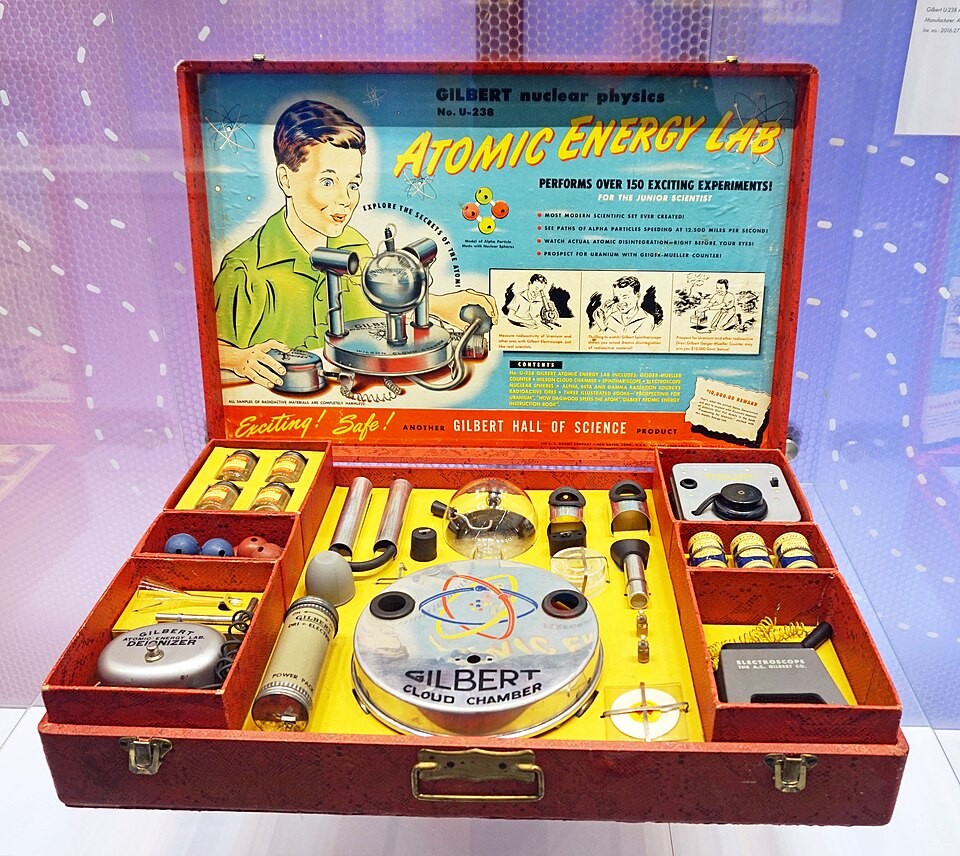
Atomic Energy Lab (for kids!)

preview

The Gilbert U-238 Atomic Energy Lab is a toy lab set designed to allow children to create and watch nuclear and chemical reactions using radioactive material. The Atomic Energy Lab was released by the A. C. Gilbert Company in 1950.

https://en.wikipedia.org/wiki/Gilbert_U-238_Atomic_Energy_Laboratory

Video with more info:

https://www.youtube.com/watch?v=zeyoJGqKbOQ

0

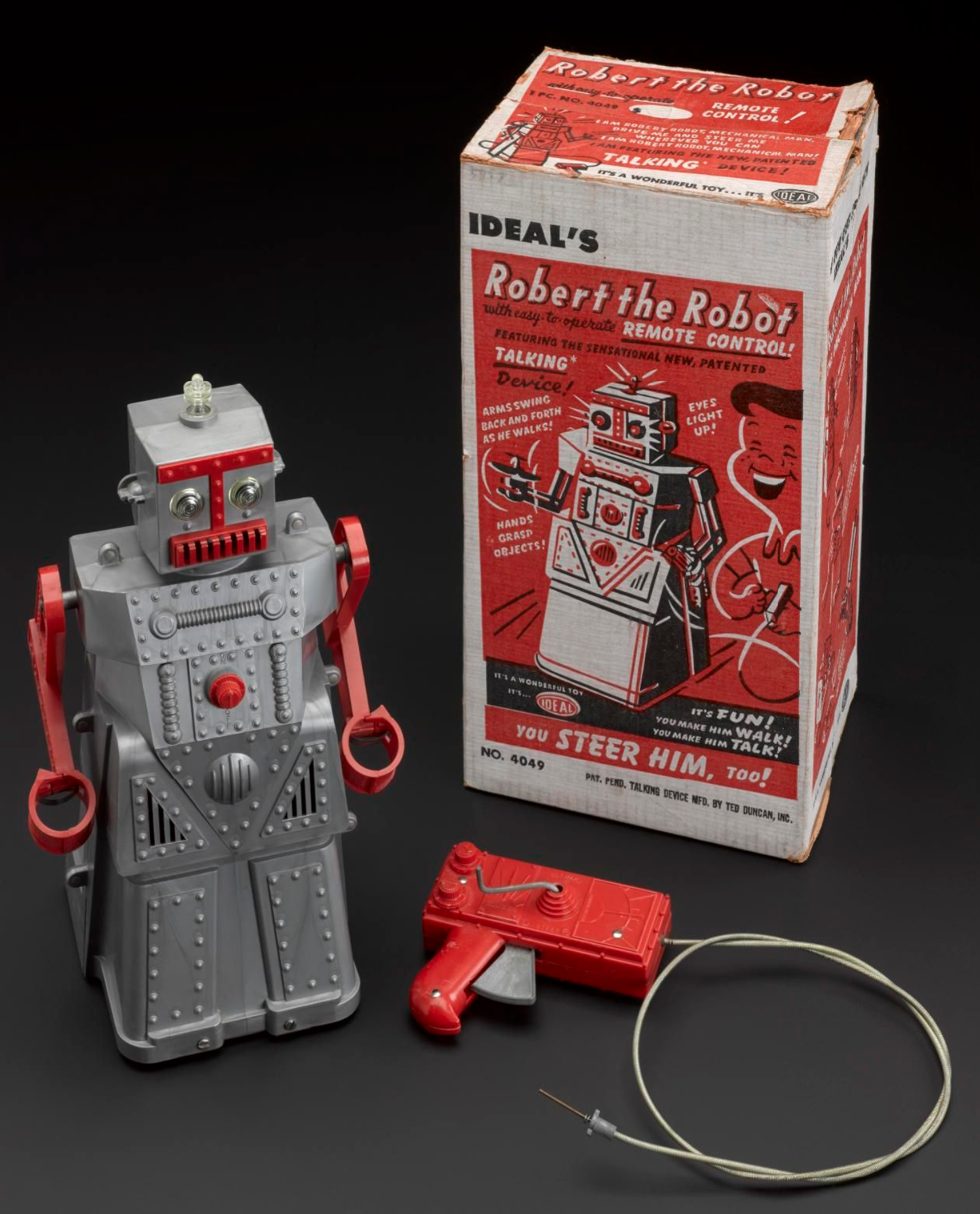
Robert the Robot (USA, 1955)

preview

Picture source:

https://collection.sciencemuseumgroup.org.uk/objects/co8538827/robert-the-robot-with-box-packaging-and-gun-shaped-controller

Robert the Robot was the first plastic toy robot to be manufactured in the USA. It was made using injection moulding, making it cheaper than earlier metal robots, and produced in large quantities/ the robot was extremely popular, with a remote control that allowed it to speak, and battery-powered lights in the eyes. Robert was being marketed in advance of the application of robots to manufacturing applications, demonstrating the capability of science fiction to pre-empt developments in the real world of science and technology - a recurring tenet of the history of robots.

0

Ziggy Stardust

David Bowie dressed as Ziggy Stardust
preview

Keep your ‘lectric eye on me, babe
Put your ray gun to my head
Press your space face close to mine, love
Freak out in a moonage daydream, oh yeah

Keep your ‘lectric eye on me, babe
Put your ray gun to my head
Press your space face close to mine, love
Freak out in a moonage daydream, oh yeah

0

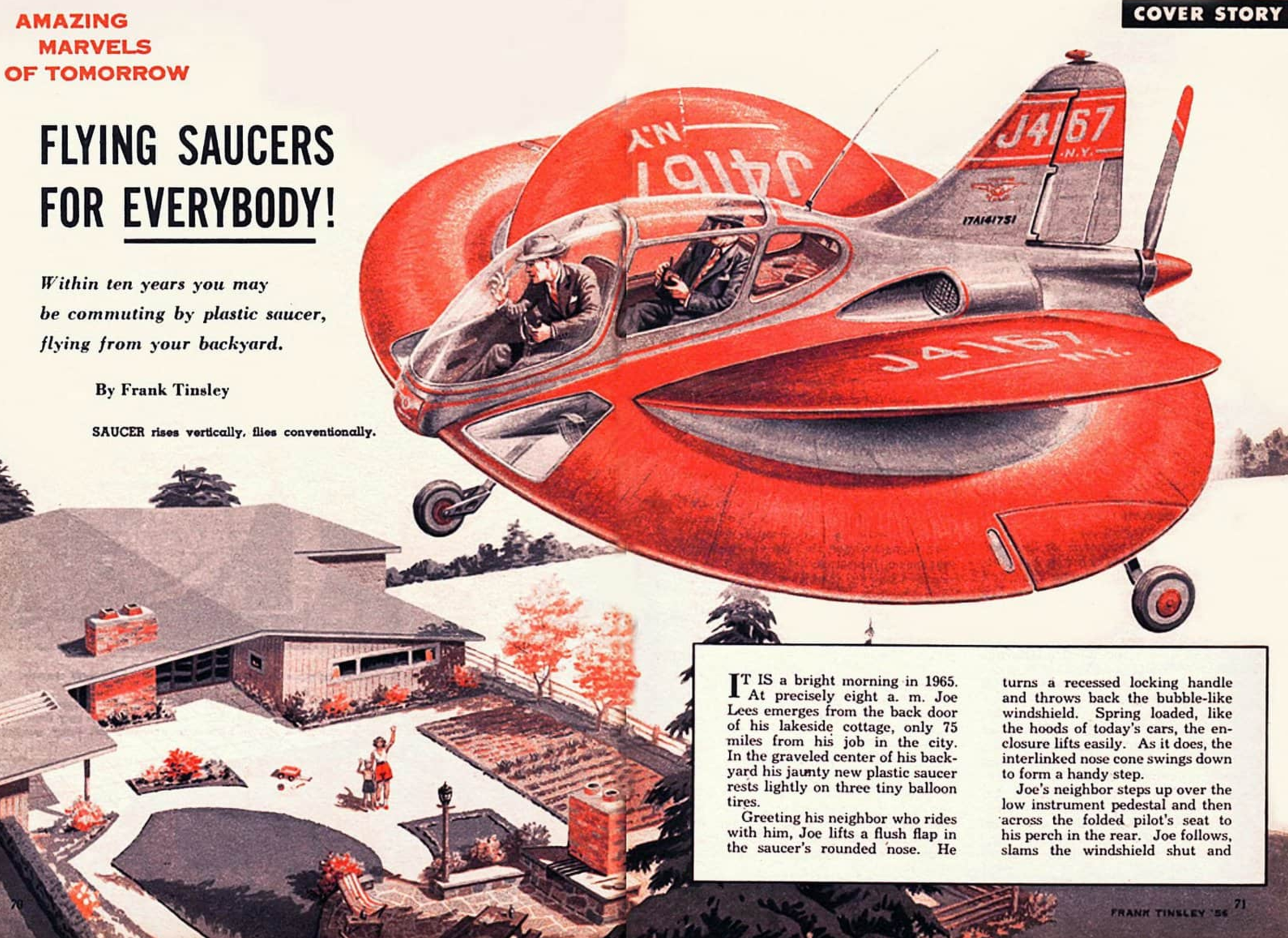
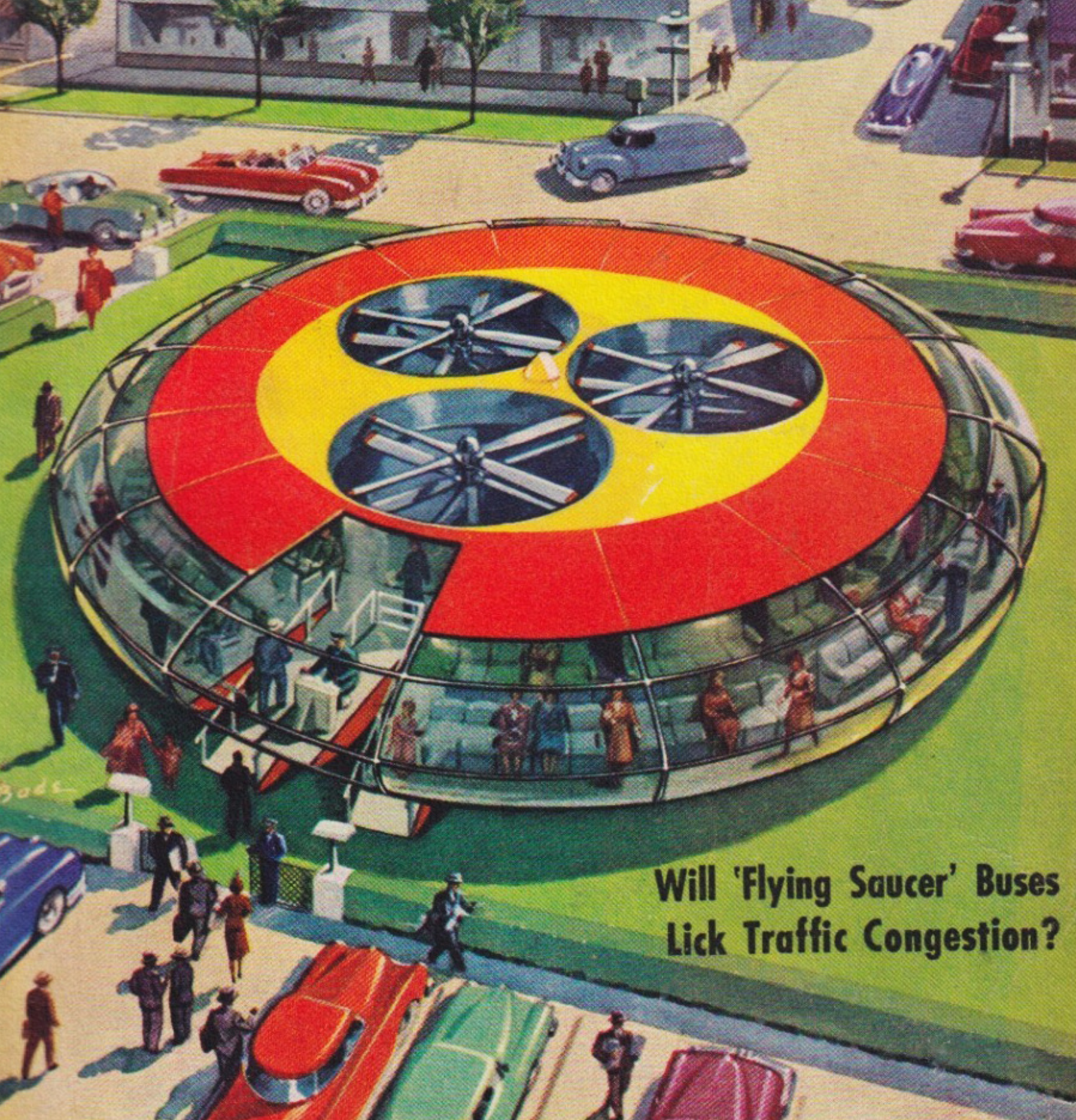
Flying saucers for everybody!

A two-page spread from a 1954 magazine shows a red flying saucer with two men inside, being flown near a home as a car replacement.
preview

Quoting:

The saucer was conceived by Peter Nofi, an officer in the Merchant Marine. Nofi, a dedicated student of aerodynamics, has combined the downward jet thrust of the ducted-fan with the proven principle of the high-lift air-foil. We know that the fan will work because using it, men and machines have been lifted bodily into the air by the modest power of outboard engines […]

In line with his low cost philosophy, Nofi plans to have the top and bottom surfaces of his saucer stamped out on a press, using a plastic material reinforced by glass “flock.” This technique, now successfully employed by small boat builders, will also be used on the servo-flaps, fuselage and other components. Cemented together with the internal gas tank spar, plumbing, etc., in place, the hollow wing will then be filled with a foamed plastic compound which cures into a rigid, air-filled sponge. This replaces expensive interior structure and converts the wing into an unsinkable life-ring for emergency water landings.

Mass produced, the plastic saucer should cost no more than today’s medium-priced cars. Could be that by 1965 you’ll have one flying out of your backyard, too!


https://gizmodo.com/hilariously-optimistic-1954-magazine-article-proclaimed-5850833

0

Mars Attacks (trading cards)

preview

I just now realized the 1996 Tim Burton Mars Attacks! movie was based on a set of trading cards originally from 1962.
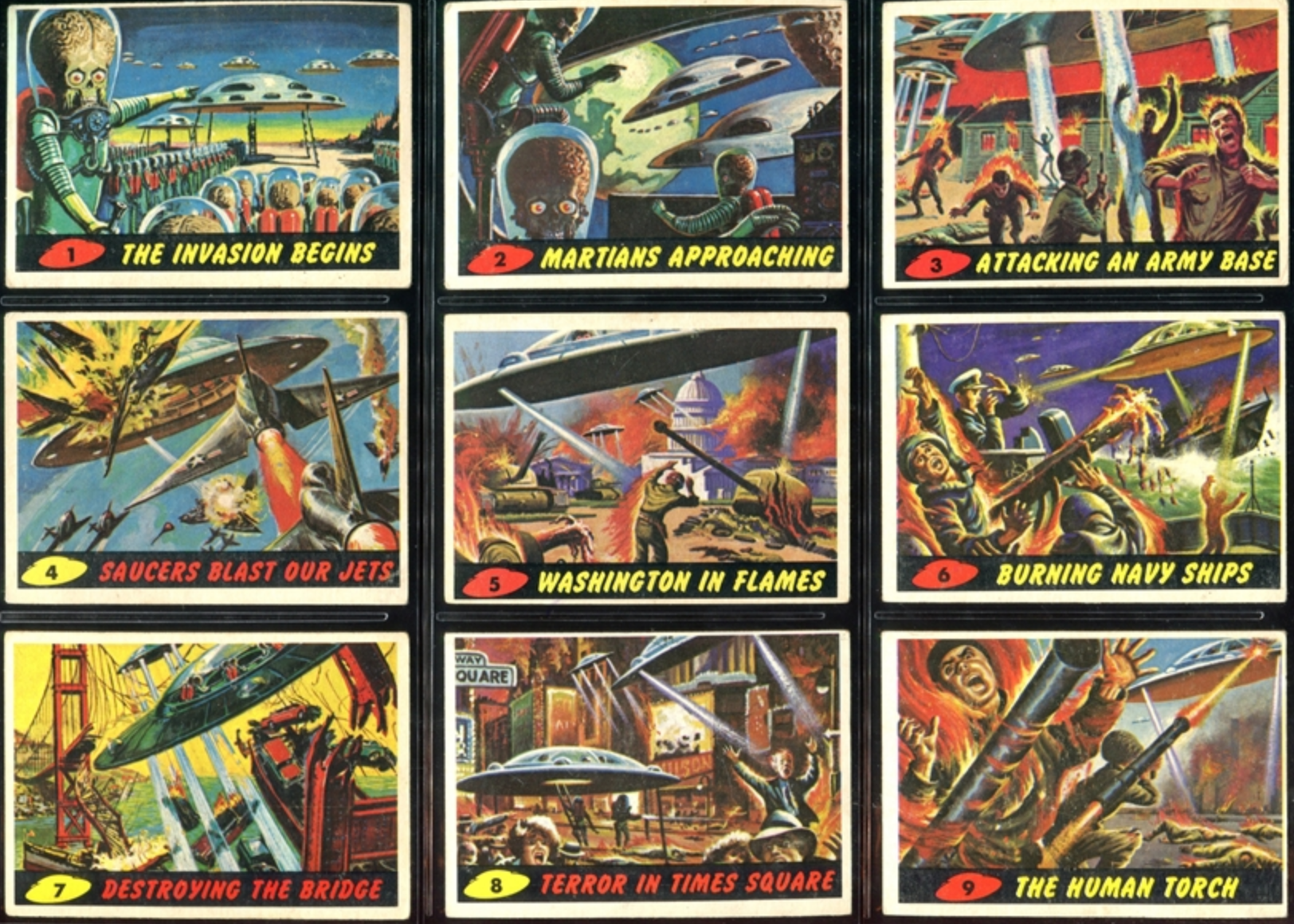
image

They were made by Topps and there were 55 cards in the original set. It’s been reissued a few times now over the years since then, in 1994, and later.

This is the original wrapper art for the card packs:

the original wrapper art for the card packs

This product was somewhat controversial at the time for its violent and somewhat suggestive imagery.

More info: https://www.oldsportscards.com/mars-attacks-cards/

So cool!

I just now realized the 1996 Tim Burton Mars Attacks! movie was based on a set of trading cards originally from 1962.

image

They were made by Topps and there were 55 cards in the original set. It’s been reissued a few times now over the years since then, in 1994, and later.

This is the original wrapper art for the card packs:

the original wrapper art for the card packs

This product was somewhat controversial at the time for its violent and somewhat suggestive imagery.

More info: https://www.oldsportscards.com/mars-attacks-cards/

So cool!

0

Zombies of the Stratosphere (12 chapter serial)

play · youtube.com
YouTube Leonard Nimoy’s Classic Sci-Fi Debut! | Zombies of the Stratosphere (1952) FULL MOVIE HD www.youtube.com
preview

Zombies of the Stratosphere is a 1952 black and white Republic Studios serial directed by Fred C. Brannon, with a screenplay by Ronald Davidson, and special effects by Republic’s Lydecker brothers. It was intended to be Republic’s second serial featuring “new hero” Commando Cody and the third 12-chapter serial featuring the rocket-powered flying jacket and helmet introduced in King of the Rocket Men (1949). Instead, for reasons unknown, the hero was renamed “Larry Martin”, who must prevent Martian invaders from using a hydrogen bomb to blow Earth out of its orbit, so that the Martians can move a dying Mars into a much closer orbital position to the Sun.

https://en.wikipedia.org/wiki/Zombies_of_the_Stratosphere

The freaking poster is amazing:

the poster

0

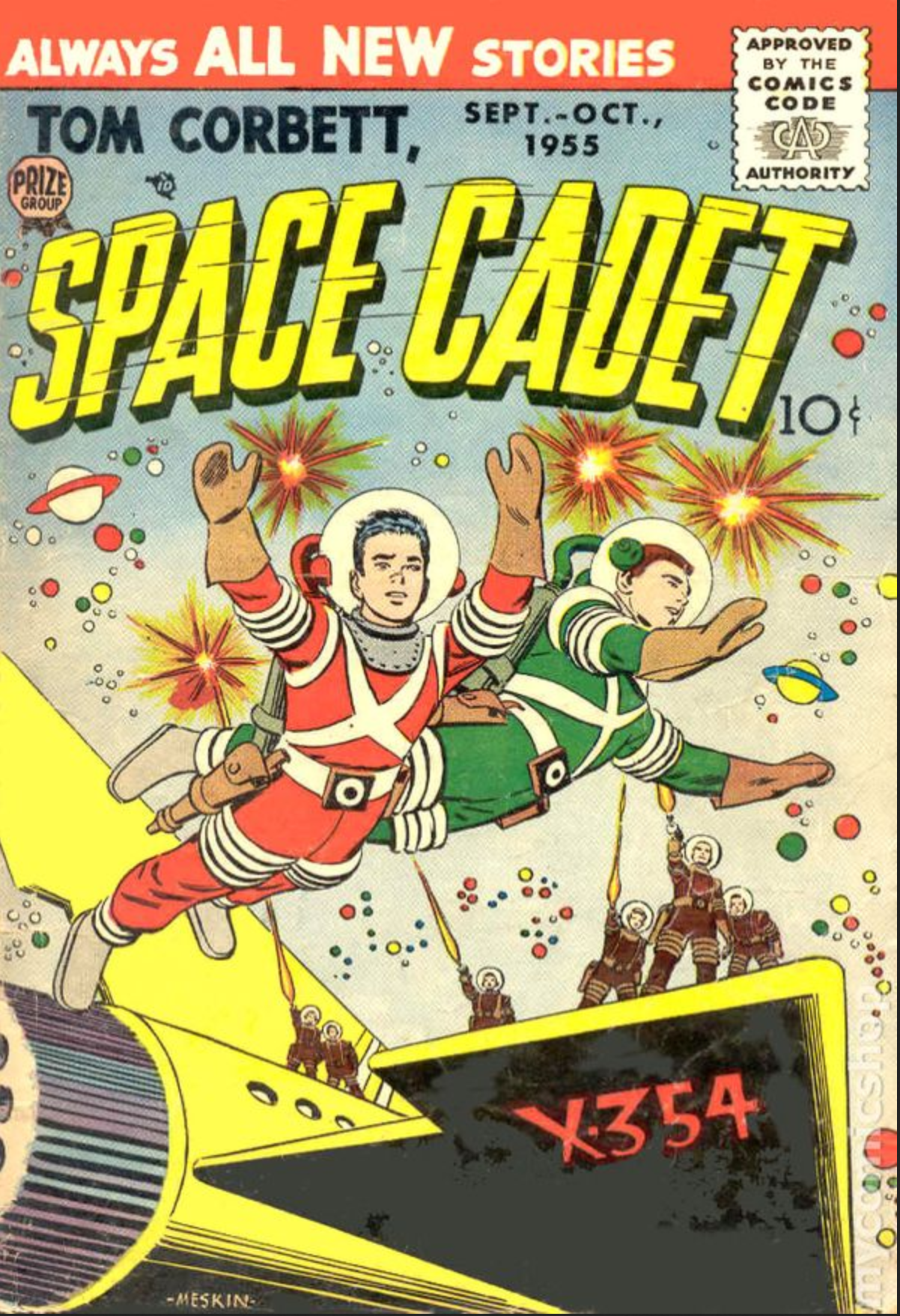
Tom Corbett, Space Cadet (Sept 1955)

preview

Tom Corbett is the main character in a series of Tom Corbett—Space Cadet stories that were depicted in television, radio, books, comic books, comic strips, and other media in the 1950s.

https://en.wikipedia.org/wiki/Tom_Corbett,_Space_Cadet

Full comic: https://archive.org/details/TomCorbettSpaceCadetV02n0319550910

0

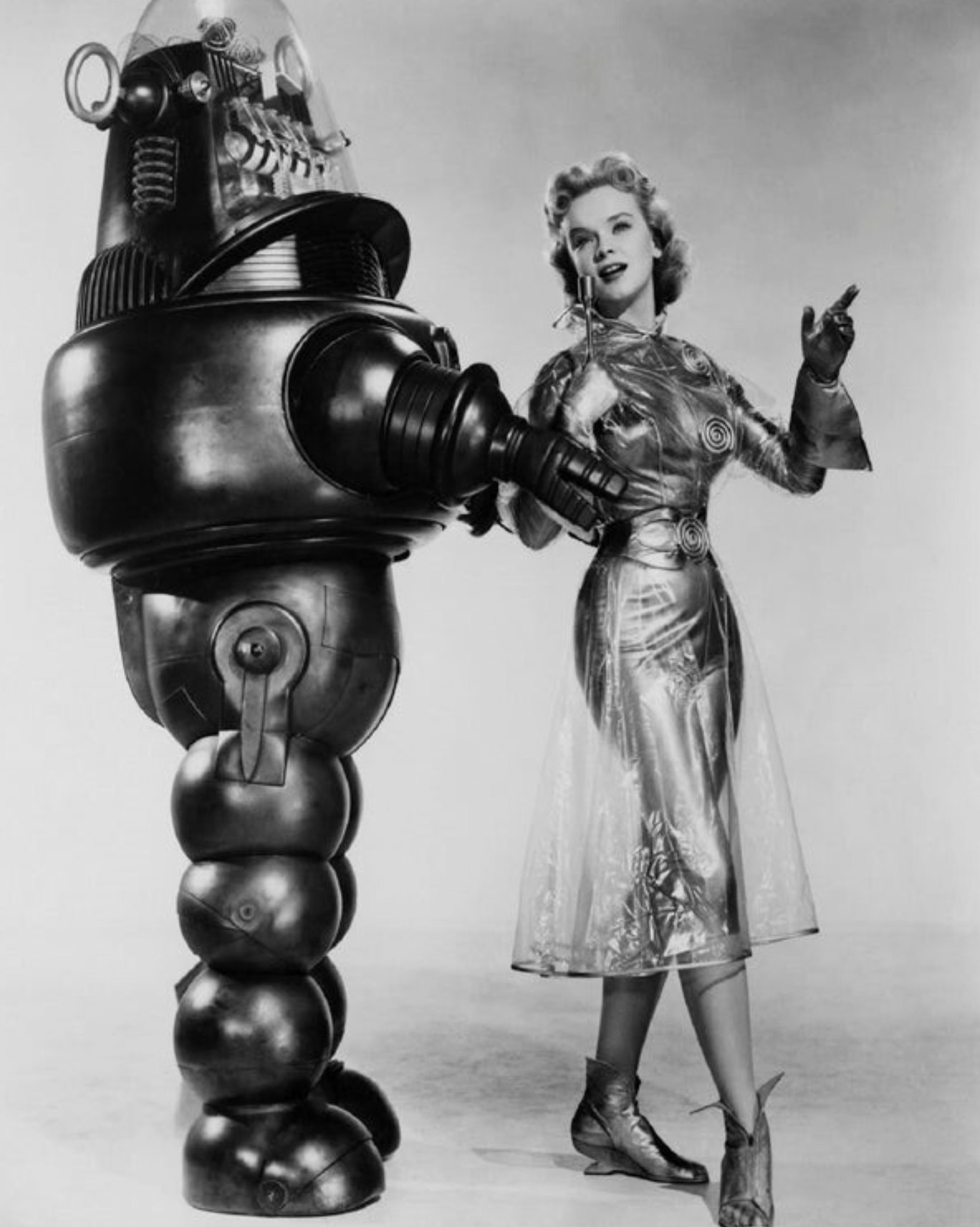
Robby the Robot vs The Robot from Lost in Space

preview

Robby is on the left.

They battled it out in Lost in Space episode #20, “War of the Robots”, and in episode #60, “Condemned of Space”.

https://en.wikipedia.org/wiki/Robot_(Lost_in_Space)

https://en.wikipedia.org/wiki/Robby_the_Robot

Robby is on the left.

They battled it out in Lost in Space episode #20, “War of the Robots”, and in episode #60, “Condemned of Space”.

https://en.wikipedia.org/wiki/Robot_(Lost_in_Space)

https://en.wikipedia.org/wiki/Robby_the_Robot

0

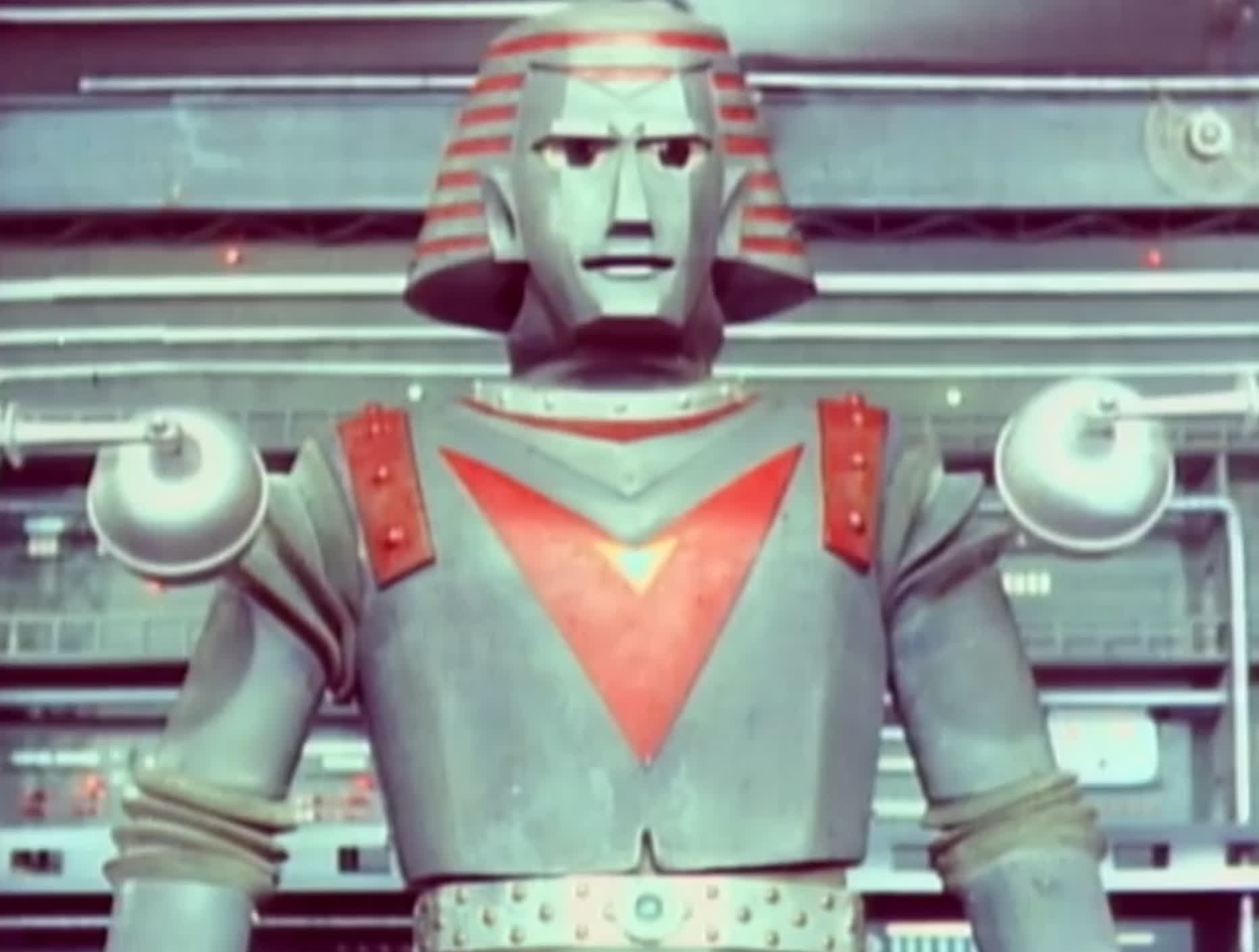
地球防衛軍 (The Mysterians, 1957), UK lobby card

In green countryside, a glowing pink dome shoots energy rays at a fighter jet that explodes. At bottom left, film title "THE MYSTERIANS" & other film details.
preview

Aliens from a dying world & their giant robot demand a patch of our world & the right to marry Earth women!

From the Wikizilla gallery for The Mysterians, which has a lot of other materials: posters, stills, theatrical programs etc

The Mysterians is the film this Sunday (26 July, 7pm GMT, 9pm Central Europe, 3pm US Eastern) in the #ReMonsterdon watch party.

Watch party info & film stream/download link

0

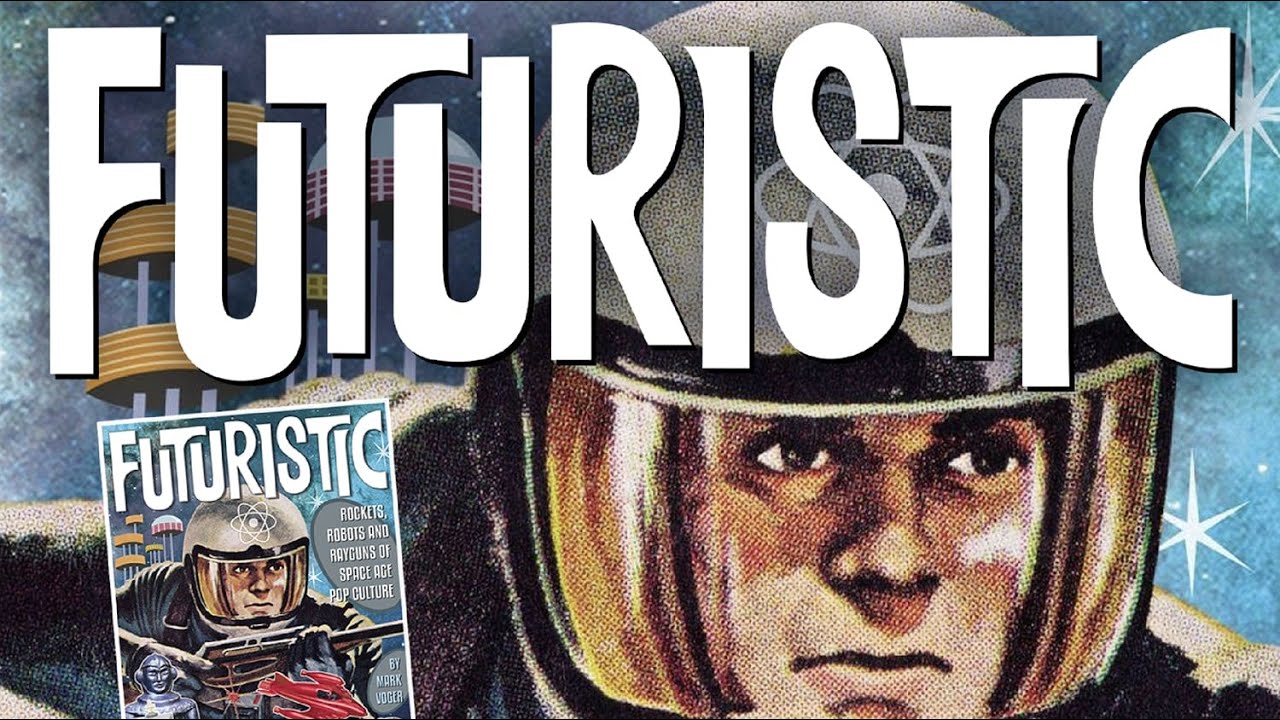
Futuristic: Rockets, Robots and Rayguns of Space Age Pop Culture

play · youtube.com
YouTube FUTURISTIC - Rockets, Robots and Rayguns of Space Age Pop Culture by Mark Voger www.youtube.com
preview

Blast off to the Space Age, when the future was always bright! Futuristic is a full-color hardcover about a time of limitless possibilities… and anxieties. It covers all aspects of 1950s and ‘60s pop culture from the “duck and cover” era of the Cold War, the Space Race, the UFO Craze, and the 1969 moon landing.

Blast off to the Space Age, when the future was always bright! Futuristic is a full-color hardcover about a time of limitless possibilities… and anxieties. It covers all aspects of 1950s and ‘60s pop culture from the “duck and cover” era of the Cold War, the Space Race, the UFO Craze, and the 1969 moon landing.

0

The "Dan Dare" Dream

Astronauts are shown outside a spacecraft in this fictional illustration from the 1950s.
preview

Astronauts are shown outside a spacecraft in this fictional illustration from the 1950s. This was made by Boeing as a promotional piece.

Taken from the book, “The Art of NASA” by Piers Bizony (2020).

https://books.google.com/books?id=-osAEAAAQBAJ&printsec=frontcover&source=gbs_ge_summary_r&cad=0#v=onepage&q&f=false

0

"We all live in the Yellow Sub-Sedan..." (notes in post)

preview

cross-posted from: https://piefed.social/c/cassettefuturism/p/2135486/we-all-live-in-the-yellow-sub-sedan-notes-in-post

This piece is called “HobbyPop RoadShop” by Bruce McCall, from ~1957, from the book The Last Dream-o-Rama. Or so my research suggests. And of course, this post certainly doubles as a ‘retro-futurism’ posting, as well.

Another view:
https://static.boredpanda.com/blog/wp-content/uploads/2020/08/Draft-5f307c0c16ab2__880.jpg

(unfortunately, that double-underscore ("__") in the URL seems incompatible with PF’s image-insertion mode, or maybe I’m doing it wrong?)

Anyway, here’s a fun mini-article going in to more detail:
https://paleofuture.com/blog/2007/11/26/cars-detroit-forgot-to-build-1950-1960.html

Drive safe out there!

0

Gog (1954) movie poster

preview

Gog is a 1954 independently made American science fiction horror film directed by Herbert L. Strock, and starring Richard Egan, Constance Dowling (in her final big-screen role), and Herbert Marshall.

Gog is a 1954 independently made American science fiction horror film directed by Herbert L. Strock, and starring Richard Egan, Constance Dowling (in her final big-screen role), and Herbert Marshall.

0

Riders to the Stars (1954)

Poster for the sci-fi movie featuring a rocket and a human astronaut in a space suit
preview

Riders to the Stars is a 1954 independently made American science fiction film produced by Ivan Tors Productions and released by United Artists. The film was directed by Richard Carlson and Herbert L. Strock and also stars William Lundigan, Martha Hyer, and Herbert Marshall.

Riders to the Stars is a 1954 independently made American science fiction film produced by Ivan Tors Productions and released by United Artists. The film was directed by Richard Carlson and Herbert L. Strock and also stars William Lundigan, Martha Hyer, and Herbert Marshall.

0

Spaceship House (1973, Tennessee USA)

preview

The Spaceship House (also known as the Space House) is a flying saucer–shaped modernist house on Signal Mountain in Chattanooga, Tennessee, United States. Designed and built by Chattanooga builder Curtis W. King as a bachelor pad for his sons, the circular house has since become a local landmark on U.S. Route 127.

https://en.wikipedia.org/wiki/Spaceship_House

0

1953 Hubley Atomic Disintegrator cap gun

preview

This substantial - and heavy - metal toy gun produced by Hubley Manufacturing Company in 1953 combined the theme of atomic power with the excitement of a cap gun. Fictional space heroes often carried space-themed versions of the Western’s ever-present six-shooter or rifle. As a result, for several generations, pretend gun play with ray gun toys formed a central part of many children’s imagined space adventures. In the late 1940s, “atomic” guns proliferated. “Laser” guns followed the creation of the practical laser in 1960.

This substantial - and heavy - metal toy gun produced by Hubley Manufacturing Company in 1953 combined the theme of atomic power with the excitement of a cap gun. Fictional space heroes often carried space-themed versions of the Western’s ever-present six-shooter or rifle. As a result, for several generations, pretend gun play with ray gun toys formed a central part of many children’s imagined space adventures. In the late 1940s, “atomic” guns proliferated. “Laser” guns followed the creation of the practical laser in 1960.

0

1959 Chevrolet El Camino

Picture of a 1959 Chevy El Camino - a two-door car up front, with a pick up's bed in the back. Low and sleek, this car has the typical rocket styling of many GM cars from the late 1950s.
preview

The El Camino was introduced for the 1959 model year two years after the Ford Ranchero. According to Chevrolet stylist Chuck Jordan, GM Harley Earl had suggested a coupé pickup in 1952. Like the Ranchero, it was based on an existing and modified platform, the new-for-1959 Brookwood two-door station wagon, itself based on the redesigned full-sized Chevrolet of that year.

https://en.wikipedia.org/wiki/Chevrolet_El_Camino#First_generation_(1959%E2%80%931960)

0

General Motors Firebird III

Picture of a GM Firebird III concept car from 1958, with a man in the driver's seat and a woman in a blue dress standing nearby.
preview

In 1959, General Motors (GM) unveiled the Firebird III, the third iteration in its series of concept cars, at theGM Motorama event. Boasting a futuristic and aerodynamic design, the Firebird III featured seven short wings and tail fins, along with a distinctive double-bubble canopy.

https://amazingclassiccars.com/weird-car-of-the-day-1958-general-motors-firebird-iii/

0

Whitney Wolverine

preview

The Whitney Wolverine is a semi-automatic .22 LR caliber pistol created in 1956. Notable for its advanced, “space-aged” looks and then-new aluminum construction, it has a 10-round magazine, a barrel 4.625 inches (117.5 mm) long and a weight of only 23 ounces (650 g).

https://en.wikipedia.org/wiki/Whitney_Wolverine

0

The Robot from Lost in Space (1965 - 68)

Pictured are the Robot and Dr. Smith characters from the 1960s TV show, Lost in Space
preview

Although a machine endowed with superhuman strength and futuristic weaponry, he often displayed human characteristics, such as laughter, sadness, and mockery, as well as singing and playing the guitar. With his major role often being to protect the youngest member of the crew, the Robot’s catchphrases were “That does not compute” and “Danger, Will Robinson!”, accompanied by flailing his arms.

https://en.wikipedia.org/wiki/Robot_(Lost_in_Space)

0

Northrop YB-49 "Flying Wing" (1947)

preview

The Northrop YB-49 was an American prototype jet-powered heavy bomber developed by Northrop Corporation shortly after World War II for service with the United States Air Force.[1] The YB-49 featured a flying wing design and was a turbojet-powered development of the earlier, piston-engined Northrop XB-35 and YB-35. The two YB-49s built were both converted YB-35 test aircraft.

https://en.wikipedia.org/wiki/Northrop_YB-49

0

1956 American Motors Astra-Gnome

preview

The Astra-Gnome is a concept car by industrial designer Richard Arbib using a 1955 Nash Metropolitan chassis. It was described as a “Time and Space Car”. It features themes influenced by the space travel forms that were popular during the 1950s. The vehicle represented Arbib’s vision of what an automobile would look like in the year 2000.

Snazzy interior shot:

the Astra-Gnome's snazzy interior

0

Rocketship X-M: Expedition Moon

Movie poster for the film Rocketship X-M, featuring pictures of the main cast and a rocket flying into space.
preview

Rocketship X-M (also known as Expedition Moon and originally Rocketship Expedition Moon) is a 1950 American black-and-white science-fiction film from Lippert Pictures, the first outer-space adventure of the post-World War II era. The film was produced and directed by Kurt Neumann and stars Lloyd Bridges, Osa Massen, John Emery, Noah Beery Jr., Hugh O’Brian and Morris Ankrum.

https://en.wikipedia.org/wiki/Rocketship_X-M

0

Review of "Turn Loose Our Death Rays And Kill Them All!: The Complete Works Of Fletcher Hanks"

preview

To say Fletcher Hanks was a unique comic book creator is putting it mildly.

Hanks is very definitely in a category by himself. Until the Internet made old, public domain comic books readily available to savor without having to pay thousands of dollars each, it’s a safe bet that few, if any, fans, no matter how old, even remembered the work of Fletcher Hanks.

Review:
- https://forcesofgeek.com/turn-loose-our-death-rays-and-kill-them-all-the-complete-works-of-fletcher-hanks-tpb-review/

Wikipedia on golden age comics auteur Fletcher Hanks:
- https://en.wikipedia.org/wiki/Fletcher_Hanks

Scans of Space Smith:
- https://comicbookplus.com/?dlid=97005

0

Mysterious Doctor Satan

preview

https://en.wikipedia.org/wiki/Mysterious_Doctor_Satan

Mysterious Doctor Satan (also known as Doctor Satan’s Robot) is a 1940 American film serial directed by William Witney and John English. The title of the serial is derived from that of its chief villain.

https://en.wikipedia.org/wiki/Mysterious_Doctor_Satan

Mysterious Doctor Satan (also known as Doctor Satan’s Robot) is a 1940 American film serial directed by William Witney and John English. The title of the serial is derived from that of its chief villain.

0

Psionics

Psionics - Wikipedia en.wikipedia.org
preview

In American science fiction of the 1950s and ‘60s, psionics was a proposed discipline that applied principles of engineering (especially electronics) to the study (and employment) of paranormal or psychic phenomena, such as extrasensory perception, telepathy and psychokinesis. The term is a blend word of psi (in the sense of “psychic phenomena") and the -onics from electronics.

In American science fiction of the 1950s and ‘60s, psionics was a proposed discipline that applied principles of engineering (especially electronics) to the study (and employment) of paranormal or psychic phenomena, such as extrasensory perception, telepathy and psychokinesis. The term is a blend word of psi (in the sense of “psychic phenomena") and the -onics from electronics.