0

Introducing the new UBC Wiki

preview

Link: ubcwiki.ca

As we head into the new school year, we are finally excited to announce the launch of the new UBC Wiki! This wiki was started years ago by the /r/UBC moderation team, and it just never got to a point where it was ready to be shared with the community. We are now ready to get it going again, and we hope that it will become a useful resource for everyone.

Over the next few days, we will be swapping out outdated links and content to this new wiki website. We hope that this new wiki will be easier to navigate and more accessible to all students. Having the wiki off site also means that we can make changes more quickly and easily, and that it isn’t affected by the limitations of one platform.

Over the next while, we will be adding more content to the wiki, and updating content that was written for the old wiki. We will also periodically post a thread for one particular topic to crowdsource information from the community. This should help us keep the wiki up to date and detailed.


The UBC Wiki is intended to be a community project, and we welcome contributions from all UBC community members. If you would like to contribute, you can see the instructions on this page, or see below:

If you are familiar with GitHub, you can also create an issue, or implement the changes yourself and submit a pull request into the STAGING branch. New ideas submitted by other means will be added as issues.


Technical details about the wiki can be found on the ⚙️UBCWiki Project page.


We hope that you find this wiki useful, and we look forward to seeing it grow and improve over time. Welcome to the new school year, and good luck with your studies!


Link: ubcwiki.ca

As we head into the new school year, we are finally excited to announce the launch of the new UBC Wiki! This wiki was started years ago by the /r/UBC moderation team, and it just never got to a point where it was ready to be shared with the community. We are now ready to get it going again, and we hope that it will become a useful resource for everyone.

Over the next few days, we will be swapping out outdated links and content to this new wiki website. We hope that this new wiki will be easier to navigate and more accessible to all students. Having the wiki off site also means that we can make changes more quickly and easily, and that it isn’t affected by the limitations of one platform.

Over the next while, we will be adding more content to the wiki, and updating content that was written for the old wiki. We will also periodically post a thread for one particular topic to crowdsource information from the community. This should help us keep the wiki up to date and detailed.


The UBC Wiki is intended to be a community project, and we welcome contributions from all UBC community members. If you would like to contribute, you can see the instructions on this page, or see below:

If you are familiar with GitHub, you can also create an issue, or implement the changes yourself and submit a pull request into the STAGING branch. New ideas submitted by other means will be added as issues.


Technical details about the wiki can be found on the ⚙️UBCWiki Project page.


We hope that you find this wiki useful, and we look forward to seeing it grow and improve over time. Welcome to the new school year, and good luck with your studies!

0

TODAY: On the eve of #MLKDay, a vintage episode with John, Ken, and Kmberley Brownlee from (then of @manchesteruniv), author of "Conscience and Conviction: The Case for Civil Disobedience."

preview

TODAY: On the eve of #MLKDay, a vintage episode with John, Ken, and Kmberley Brownlee from @ubc (then of @manchesteruniv), author of “Conscience and Conviction: The Case for Civil Disobedience.”

🎧 11 am on KALW 91.7 FM in San Francisco & https://www.kalw.org/show/philosophy-talk/2026-01-16/civil-disobedience.

0

Martin Luther King Jr. was born on this date in 1929, so tune in on the eve of #MLKDay for another vintage episode as John & Ken question Civil Disobedience with Kimberley Brownlee from (then of

preview

Martin Luther King Jr. was born on this date in 1929, so tune in on the eve of #MLKDay for another vintage episode as John & Ken question Civil Disobedience with Kimberley Brownlee from @ubc (then of @manchesteruniv), author of “Conscience and Conviction: The Case for Civil Disobedience.”

🎧 Sunday 1/18 at 11 am on @kalw 91.7 FM in San Francisco & https://www.kalw.org/show/philosophy-talk/2026-01-16/civil-disobedience.

0

Canadian universities must do more to ensure their branded clothing isn’t made in sweatshops

The Conversation Canadian universities must do more to ensure their branded clothing isn’t made in sweatshops theconversation.com
preview

Colleges and universities earn revenue each year by licensing their trademarks to major apparel companies, including Lululemon and Fanatics. These companies, in turn, rely on vast supplier networks located primarily in countries with weak labour protections and regulations.

Colleges and universities earn revenue each year by licensing their trademarks to major apparel companies, including Lululemon and Fanatics. These companies, in turn, rely on vast supplier networks located primarily in countries with weak labour protections and regulations.

0

Investigation found UBC researcher fabricated data, gave spinal patients 'false hope.' The public was not told

CBC False hope, fabricated data: No public notice after UBC uncovered serious misconduct in medical study | CBC News www.cbc.ca
preview

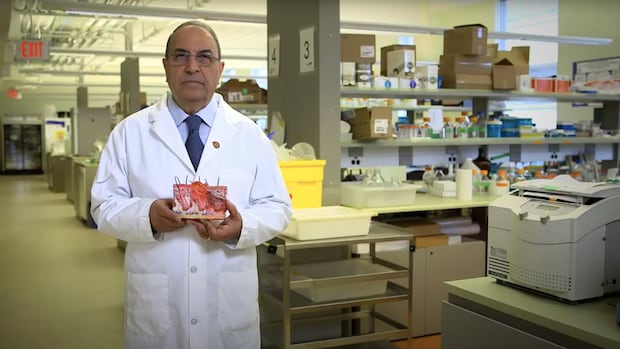
A celebrated Vancouver researcher used fabricated data and hid evidence of infected wounds to falsely claim his patented skin treatment could heal years-old bed sores in a matter of weeks, according to a leaked report.

If these results had been real, a product known as Meshfill would have been “close to miraculous” for people with spinal cord injuries, according to one expert. But investigators say they weren’t real, and the public was never informed about an investigation that uncovered numerous examples of misconduct during a clinical trial for the liquid skin substitute.

The Investigative Journalism Foundation (IJF) and CBC News have obtained a 64-page report about University of British Columbia (UBC) plastic surgery professor Aziz Ghahary’s actions during a pilot study for Meshfill. It lays out how he presented falsified results to the public on several occasions, violated conflict of interest guidelines and was even accused of bullying by another researcher.

The March 2021 document, which was written by a UBC-appointed investigative committee of three outside experts, says Ghahary “abandoned his scholarly integrity in his pursuit of his attempt to establish that Meshfill should be used as a treatment for chronic pressure ulcer wounds” — also known as bed sores. Despite his public claims of success, none of the pressure wounds in the pilot study had healed and some became infected.

“These false claims gave patients and funders false hope by falsely claiming that Meshfill had quickly healed chronic pressure ulcer wounds. He also potentially endangered the health of future human trial subjects when Dr. Ghahary falsely claimed that there had been no adverse effects during the pilot study,” reads the report.

Ghahary left his job at UBC shortly after the investigation was completed in 2021. He’d worked there since 2005.

The lack of public notice about the findings raises some questions for Leigh Turner, director of the Centre for Health Ethics at the University of California, Irvine.

“I think the findings of the report are extremely serious,” Turner said. “I would hope that this is a really relatively extreme example of violation of scholarly integrity. But there presumably are other cases and there presumably are other investigative reports that are not seeing the light of day. That’s a problem.”

UBC spokesperson Matthew Ramsey said he could only confirm that Ghahary’s employment at the university ended in 2021.

“Privacy law prevents UBC from commenting on allegations of scholarly integrity you’ve raised related to Dr. Ghahary’s research at UBC,” Ramsey wrote in an email.

“Scholarly integrity investigation reports contain personal information that UBC, as a public body, is required to protect from disclosure under FIPPA [the Freedom of Information and Protection of Privacy Act]. UBC does not have the legal authority to publish/share this type of personal information.”

[Tarek Elneweihi, a lawyer who represents Ghahary] noted that Ghahary is now 83 years old and is completely retired from research work.

Meshfill never reached the market in Canada and should not be confused with the cosmetic procedure advertised online.

0

UBC enzyme technology clears first human test toward universal donor organs for transplantation

preview

I thought this one was really cool!

TLDR:

Blood-type antigens act like nametags on cells, and the UBC enzymes act as molecular scissors, snipping off the ‘nametag’ that marks type A and revealing type O beneath.

Summary:

Published today in Nature Biomedical Engineering, the achievement marks a major step toward helping thousands of patients get kidney transplants sooner.

In a first-in-human experiment, the enzyme-converted kidney was transplanted into a brain-dead recipient with consent from the family, allowing researchers to observe the immune response without risking a life.

For two days, the kidney functioned without signs of hyperacute rejection, the rapid immune reaction that can destroy an incompatible organ within minutes. By the third day, some blood-type markers reappeared, triggering a mild reaction, but the damage was far less severe than in a typical mismatch, and researchers saw signs that the body was beginning to tolerate the organ.

Older History:

The breakthrough is the result of more than a decade of work. In the early 2010s, Dr. Withers and colleague Dr. Jayachandran Kizhakkedathu, a UBC professor in the department of pathology and laboratory medicine and the Centre for Blood Research, were focused on making universal donor blood by stripping away the sugars that define blood types.

Those same sugars, or antigens, coat organ blood vessels. If a recipient’s immune system detects the wrong antigen, it attacks. Type-O patients—more than half of kidney waitlists—can only receive type-O organs, yet type-O kidneys are often given to others because they’re universally compatible. As a result, type-O patients typically wait two to four years longer, and many die waiting.

Traditional methods for overcoming blood-type incompatibility in transplants require days of intensive treatment to strip antibodies and suppress a recipient’s immune system—and require organs from living donors. This new approach changes the organ rather than the patient, meaning transplants could be performed faster, with fewer complications, and for the first time could unlock the use of blood-type mismatched organs from deceased donors—when every hour can determine whether a patient lives or dies.

The chain of discoveries that led up to this:

The key to this approach is the 2019 discovery by the UBC team of two highly efficient enzymes that remove the sugar that defines type-A blood, effectively converting it to type O.

The next challenge was applying this to whole organs, achieved in 2022 when a Toronto team showed lungs could be converted. After successful tests on blood, then lungs and kidneys (with the University of Cambridge) outside the body, the question remained: Could an enzyme-converted organ survive inside a human immune system?

The answer came in late 2023 on an overseas trip for Dr. Kizhakkedathu. “Our collaborators showed me their data where, using our enzymes, they had converted a human kidney and transplanted it into a brain-dead recipient. It was working beautifully.” He stayed up late to call Dr. Withers first thing in the B.C. morning. “I was so thrilled. It was a dream moment.”

Future:

Regulatory approval for clinical trials is the next hurdle, and the partner UBC spin-off company Avivo Biomedical will lead development of these enzymes for transplant application and to enable the creation of universal donor blood on demand for transfusion medicine.

0

B.C. scientists discover new virus in farmed Pacific oysters during mass die-off

Global News B.C. scientists discover new virus in farmed Pacific oysters during mass die-off | Globalnews.ca globalnews.ca
preview

Scientists at the University of British Columbia have discovered a previously unknown virus in farmed Pacific oysters during a mass die-off in B.C. in 2020.

The paper, published on Monday in the Proceedings of the National Academy of Sciences, said that while mass die-offs have been attributed to various factors, including viruses, in many cases, there is no definitive cause.

“We’ve recently seen annual mass die-offs in B.C. and elsewhere of Pacific oysters, the most widely farmed shellfish worldwide,” said first author Dr. Kevin Zhong, research associate in the UBC Department of earth, ocean and atmospheric sciences (EOAS).

The researchers collected 33 oysters from two farms in B.C. during a mass die-off in 2020, as well as 26 wild oysters from 10 nearby sites.

RNA analysis revealed the presence of a previously unknown virus, Pacific Oyster Nidovirus 1 (PONV1), in 20 of the dead and dying farmed oysters, according to the research. However, the virus was not found in healthy wild oysters, which suggested the virus was killing the oysters.

“This discovery highlights how little we know about viruses infecting invertebrates in general and oysters in particular,” said senior author Dr. Curtis Suttle, professor of earth, ocean and atmospheric sciences, botany, microbiology and immunology, at the Institute for the Oceans and Fisheries.

The virus, which has one of the largest RNA genomes on record, according to the research, is so genetically different from other nidoviruses that the research team has proposed a new family, Megarnaviridae, or ‘large RNA viruses’ PONV1, which the team is proposing to name Megarnavirus gigas, or ‘large RNA virus giant.’

Suttle said these large RNA viruses appear to be specific to oysters, so humans are not at risk of contracting the virus.

However, the team said this discovery is a reminder that oyster farmers should use an abundance of caution when moving juvenile oysters as little is known about what causes disease in the bivalve molluscs.

“This research is not a cause for alarm,” Suttle added. “Rather, this is a meaningful step forward in advancing our understanding of oyster health and supporting the long-term sustainability of shellfish aquaculture.”

0

🤔🧑‍💻 How much training on computing skills should a new lab member get? How do we centralize data analysis from all group members? Defining code management for Dr. Stringhini's new lab at the School

preview

🤔🧑‍💻 How much training on computing skills should a new lab member get? How do we centralize data analysis from all group members? Defining code management for Dr. Stringhini’s new lab at the School of Population and Public Health
@ubcmedicine
@ubc

https://stringhinilab.github.io/GitHubProceduresLab/ ✅

#openscience #reproducibility #github #rstats

0

UBC faculty members speak out in support of instructor who says he was let go for pro-Palestine activism

PressProgress UBC faculty members speak out in support of instructor who says he was let go for pro-Palestine activism pressprogress.ca
preview

“We were shocked to learn that Professor Tucker was recently abruptly removed from this teaching assignment and are deeply concerned that the decision for the removal relates largely to his advocacy for more learning and discussion about Palestine and Israel. We are aware that the university is being lobbied intensely to silence discussion of what is happening in Gaza, and we strongly suspect that the decision regarding Professor Tucker is linked to his activities in this regard.”

Months after Tucker’s event, the School adopted a new bulletin board policy, stating that posters that contributed to an “uncomfortable environment” would be restricted.

“This Palestine exceptionalism is just not acceptable. To me, the attitude of the school is itself anti-semitic because it implies that to talk about what’s going on in Gaza offends Jews,” another member said.

“There should be a recognition that there’s a diversity of opinion. Don’t stereotype Jews as people who are all expected to have values that are supremacist and racist and who don’t care about the suffering of Palestinians. We find that offensive.”

0

Wednesday, November 27 | Ocean Literacy, Aquatic VR, and Captain Nemo

Eventbrite Ocean Literacy, Aquatic VR, and Captain Nemo www.eventbrite.ca
preview

EML is thrilled to welcome Pierre Friquet, artist and award-winning digital experience designer. Tested at the Paris 2024 Olympics, his latest project, Captain Nemo, aims to use VR to increase ocean literacy, using stunning visuals, immersive soundscapes, and captivating interaction mechanics to illustrate the interdependence of our environment.

Join us in the Pena Room (IKB 301) on November 27th, from 3-4:30, to learn more about this incredible educational resource, as well as Pierre’s internationally recognized artistic work!

0

You can download videos from Panopto and watch them locally

GitHub GitHub - Panopto-Video-DL/Panopto-Video-DL-browser: Userscripts to get the stream download URL from Panopto github.com
preview

Link: github.com/…/Panopto-Video-DL-browser?tab=readme-…

Instructions:

  1. Install the TamperMonkey browser extension if you don’t have it already

  2. Install this script from GreasyFork

  3. Open a lecture on Panopto, look for this button in the bottom right:

  1. A video will open. Download it with ctrl+S

  2. watch the lecture offline without having to deal with panopto’s bs

Use the videos for yourself, don’t upload them anywhere else. UBC will get yo ass if you do

0

How to meet new friends on campus (UBCV)

Google Docs Matcha Sign Up forms.gle
preview

Hey! This is Matcha, the easiest way to meet someone new at UBCV.

Sign up and get matched with another student in your year group across faculties by text every Friday.

Bring your match to Great Dane for a free pastry! :)

Sign up: forms.gle/AfFWdUSqqMi9rWBx5

Hey! This is Matcha, the easiest way to meet someone new at UBCV.

Sign up and get matched with another student in your year group across faculties by text every Friday.

Bring your match to Great Dane for a free pastry! :)

Sign up: forms.gle/AfFWdUSqqMi9rWBx5

0

Information for UBC students planning to vote in the BC election

preview

This post was originally written by u/KareemHassib, who gave the ok to share it here!


The writ has dropped and BC’s provincial election is fully underway!

For students living in Vancouver or on-campus but are originally from other regions of BC, you can vote in either your hometown’s riding or in your campus/living residence’s riding.

For students who are from outside of BC (but still from Canada), as long as you’ve been a resident of BC for more than 6 months, you can vote!

And because I’ve seen some confusion about this, although the age of majority in BC is 19, the voting age is 18 for all elections (municipal, provincial, federal).

For those of you voting in Vancouver-Point Grey (which includes UBC, Point Grey, and most of Kitsilano), here’s where we can vote on/near campus:

Early voting:

The Nest (Oct 15-16)

University Golf Club (Oct 10-13, 15-16)

Voting Day (Oct 19):

The Nest

UHill Secondary School

To register to vote go to: eregister.electionsbc.gov.bc.ca/ovr/welcome.aspx#

For a full list of voting locations across BC: elections.bc.ca/…/where-to-vote/

Cheers!

0

PSA: Add/drop deadline is tonight!

preview

students.ubc.ca/enrolment/…/course-change-dates

Check your course list within the next 2 hours if you haven’t already.

Don’t get stuck with the course you were planning to toss

Steps:

  1. Login to workday
  2. Menu > Academics > Registration & Courses > View my courses
  3. Drop what you need to
0

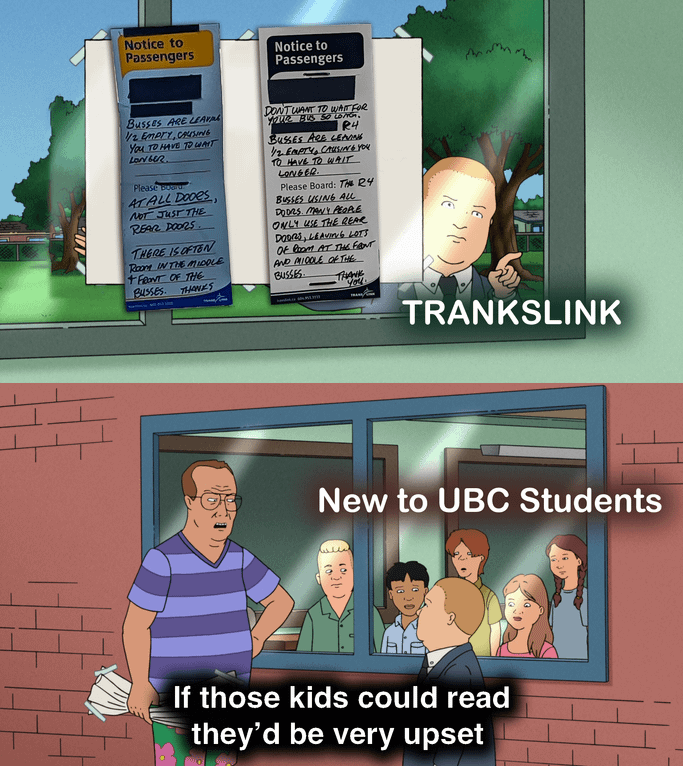
New year, same meme (first time on the fediverse). Stop standing around and forcing buses to leave half empty

preview

Some busses load on all 3 doors

  • Make 3 lines
  • Enter on all 3 doors
  • Don’t stand in the long line if the other lines are clearing up, move to those doors and enter

Some busses load on all 3 doors

  • Make 3 lines
  • Enter on all 3 doors
  • Don’t stand in the long line if the other lines are clearing up, move to those doors and enter
0

Uytae Lee became a filmmaker by accident. Now he teaches you about your city

The Ubyssey Uytae Lee became a filmmaker by accident. Now he teaches you about your city www.ubyssey.ca
preview

When STEM tutorial YouTube channels were “popping off” in the early 2010s, Uytae Lee wondered how he could address the lack of comprehensive videos dedicated to teaching people about their cities.

“If people can make physics so compelling and interesting, surely we can make transit policy interesting,” said Lee, now a UBC journalism adjunct professor.

If you’re a connoisseur of all things local policy, — finding the solution to gentrification, bringing back front yard businesses, considering a non-capitalist approach to housing shortages — you may well have already run into Lee’s work before. He’s the mind behind the YouTube channel About Here. In his corner of the internet, Lee taps into virtually any issue that public buzz is attending to at a given moment.

0

New gravitational wave signal helps fill the ‘mass gap’ between neutron stars and black holes

UBC Science New gravitational wave signal helps fill the ‘mass gap’ between neutron stars and black holes science.ubc.ca
preview

A collaboration of researchers including UBC scientists have observed gravitational waves from the collision of what is most likely a neutron star and an object likely to be a light black hole, 650 million light-years from Earth.

A collaboration of researchers including UBC scientists have observed gravitational waves from the collision of what is most likely a neutron star and an object likely to be a light black hole, 650 million light-years from Earth.

0

UBC CS Public Lecture: Regulation in the Age of Cloud Computing & Generative AI

preview

Location: UBC Robson Sq. C680 HSBC Hall

Join the CS department in a public lecture to learn more about the societal effects and implications for regulations in the development of Generative AI systems from the advancements of machine learning and cloud computing! The panel will include Prof. Lilian Edwards (Newcastle University), Prof. Christopher Millard (Queen Mary University of London), and Prof. Vered Shwartz from UBC Computer Science. For more info on the event and panel keynotes or to register, please visit myCS.

0

~~c/UBC is now UBC Confessions~~ Event is over, thanks for participating

preview

cross-post from parallel community: www.reddit.com/r/UBC/comments/1bsx1jv

After years of reading the really weird stuff you all do in your free time, we have come to the conclusion that deep down, you are all flawed, generally terrible (but sometimes wonderful) Canada geese.

For this reason, we’ve decided to rename the subreddit UBC Confessions, and embrace chaos. Get whatever it is off your chest. Just don’t be terrible and don’t post admissions questions.

Oh, and if you don’t like it, go post in r/SFU.

In loving memory of UBC Confessions, I guess.

Sincerely,

🧹Broom Admin

0

UBC Best of 2023 Nominations thread

preview

We didn’t forget this year! Presenting: the Best of 2023 nominations thread.

Categories up for nomination:

Best comment

Best text post

Best image or video post

Most wholesome post/comment

Best meme


Prizes are:

  • A sense of pride and accomplishment
  • The admiration of UBC students and community members for centuries to come
  • Being listed on ubcwiki.ca/meta/community
  • anything else the community might offer…

Here are the rules:

Nominations

  • You may only nominate submissions made in 2023
  • Submissions must be in the Reddit or Lemmy communities (the latter doesn’t have much content this year, but it will be included moving forwards)
    • Nomination post on REDDIT: reddit.com/r/UBC/comments/18fx4wo
    • Nomination post on LEMMY: lemmy.ca/post/11110616
  • You can nominate anyone but yourself
  • You must nominate underneath the mod comment for that category
  • You must link directly to your nomination
  • Each nomination must be for one piece of content only

Some helpful links


Winning

  • A single post or comment can only win once, even if nominated in multiple categories
  • The winner will be the entry in each category with the most upvotes
  • Mods can be nominated, but if they win any of the categories, the prizes will go to the next eligible nominees

Other Details

Reddit:

  • All top-level comments and non-link comments will be removed.
  • Please do not downvote
  • This thread will be in contest mode, so nobody will know who is winning until we announce it.

Lemmy:

  • This is the first year with our Lemmy community on the Fediverse. If you don’t have a Reddit account anymore and would like to vote there, feel free to copy a nomination into the Lemmy thread, or to get in touch with us to on Lemmy to discuss.
  • Lemmy does not have all the same features as Reddit yet, and so the experience will be a little different. Please reach out to us or make a separate post to talk about how we can do things differently next year.

Now, go forth and nominate your favourite content from the past year, and don’t forget to upvote other nominations you think should win!

0

Mental Health Resources - New section added to the UBC Community Wiki!

preview

You can find it here: ubcwiki.ca/general/mental-health

Hi everyone, congratulations on making it to the end of the term! We’re excited to have added a new section on ubcwiki.ca, which includes an extensive list of mental health resources available to UBC students and community members.

A big thank you to u/blacknwhitelife02 for assembling this guide. She rightfully pointed out that there are a lot of resources that people don’t know about, and we hope this resource can address that gap.

As always, if you have ideas for new pages or wish to update existing content, you can contribute in various ways!

From the UBC Reddit/Lemmy mod team, congratulations and best of luck with finals!

You got this.

0

Open application for volunteer opportunity: Help develop a learning platform for incarcerated / formerly incarcerated people transitioning back into society

preview

Update for this post: lemmy.ca/post/5548011

I heard back and got some more details about the position. It’s not restricted to CS, or students for that matter. If you are interested in applying, send me a message (link), and I’ll give you the email address to apply 😄 I just didn’t want to post the email address publicly.

If you are in UBC CS, you can also go here: my.cs.ubc.ca/…/volunteers-art-justice-project


Student Volunteer Opportunity- A.R.T. & Justice Project

Are you passionate about social impact work?

A.R.T. & Justice is looking for volunteers who are interested in a pilot project in collaboration with the UBC Learning Exchange. We are currently developing a technology learning program for people who have lived/living experience of incarceration. We are hoping to develop a program where we can provide support for those leaving carceral institutions who do not have a grasp of basic technological tools; such as cyber security, file sharing, calendars, file storage, etc. Our work is peer-led and we plan on co-developing a step by step guide that can be shared with those who are transitioning back into society. This volunteer work will both be in-person and online. We are currently meeting 30min-1 hour a week to go over our progress work. Work is expected to be done independently and as a team.

Qualifications:

  • Previous experience volunteering (with marginalized or vulnerable populations an asset)
  • An attitude of curiosity, caring and flexibility when working with our peers and knowing that all are welcomed
  • A comfort, openness and respect for working with people as they are, including life experiences, culture, identity, beliefs, and values
  • Strong interpersonal communications skills, specifically in the areas of empathy, listening, attentiveness and checking for understanding
  • Intermediate knowledge of technological tools (such as google drive, outlook, etc)

Duties:

  • Assist in-person work sessions
  • Help with set-up and take-down of in-person sessions
  • Work on co-developing a step-by-step guide for the project
  • Attend project zoom meetings in regards to guide development updates
  • Report to the Project Coordinator

Training:

  • There is no formal training, there will be a welcome meeting to introduce you to the project and orient you to the tasks.

Time commitment:

  • Volunteer screening: 15 min interview
  • Zoom call: 30min- 1 hr weekly until project completion (Goal is January 2024)
  • Independent work: TBD, based on project goals
  • 3-hour test workshop to implement program and see if changes need to be made (Date TBD in November/December)

To apply:

Send an email sharing your previous experiences and why you are interested in working with us! We are happy to work with students on a one-time or re-occurring basis and will schedule meetings to work around student schedules.

SEE TOP OF POST FOR EMAIL