0
Windows 11 vs. Ubuntu 26.10 Linux Performance On AMD Ryzen AI Max+
www.phoronix.com

Not on this instance? Enter your own instance's domain to go straight to following c/ubuntu@discuss.tchncs.de there.

As of 3 November, patched kernels for CVE-2026-98432 are in testing for Ubuntu 22.04, 24.04 and 26.04 LTS, but are yet to hit the stable updates pocket. Canonical hasn’t given a date for when it expects them to.
…
The CVE involved a type of bug known as a use-after-free. It affects the part of the Linux kernel that handles incoming network connections, specifically the TCP handshake over IPv4.
…
A lackadaisical approach to security is uncharacteristic of Canonical, a company that makes it money selling support to enterprises, businesses and cloud on the basis of “timely security updates” via Ubuntu Pro, ESM and other packages.
Canonical says it tests kernels on thousands of certified servers and devices before it releases anything, and says that admins can, if they wish, enable and install the -proposed update pocket to be patched sooner.
It also dismissed disabling MPTCP as a workaround, saying security updates are “the only appropriate mitigation” since the bug isn’t specific to that feature.
Oddly, it’s may company’s new kernel security cadence, introduced to get security fixes out to users, faster, that appears to be the cause of the delay. With kernel goes through a fixed testing period, the fixes come as fast as they can.
But not, it may seem, fast enough.

cross-posted from: programming.dev/post/58633410
Ubuntu Core Desktop is Canonical’s (currently unreleased) immutable and attestable Linux desktop. It represents the most fundamental shift in Ubuntu’s desktop architecture to date, and will mature into the default experience for Ubuntu Desktop over time.
…
With this transition comes the promise of greater resilience, better security, more composability, but also more engineering complexity. In this post I’ll outline the vision, roadmap, and some of the complexities we hope to tackle.
…
We want to build a modular desktop architecture that defines clear interfaces between components. Components such as the display manager, desktop environment, multimedia servers, networking and other core capabilities should adhere to well-defined interfaces and remain implementation agnostic.
The result will be a desktop whose constituent parts can evolve independently, without forcing the rebuild of the entire operating system image every time something changes - one of the key differentiators from other immutable operating system implementations.
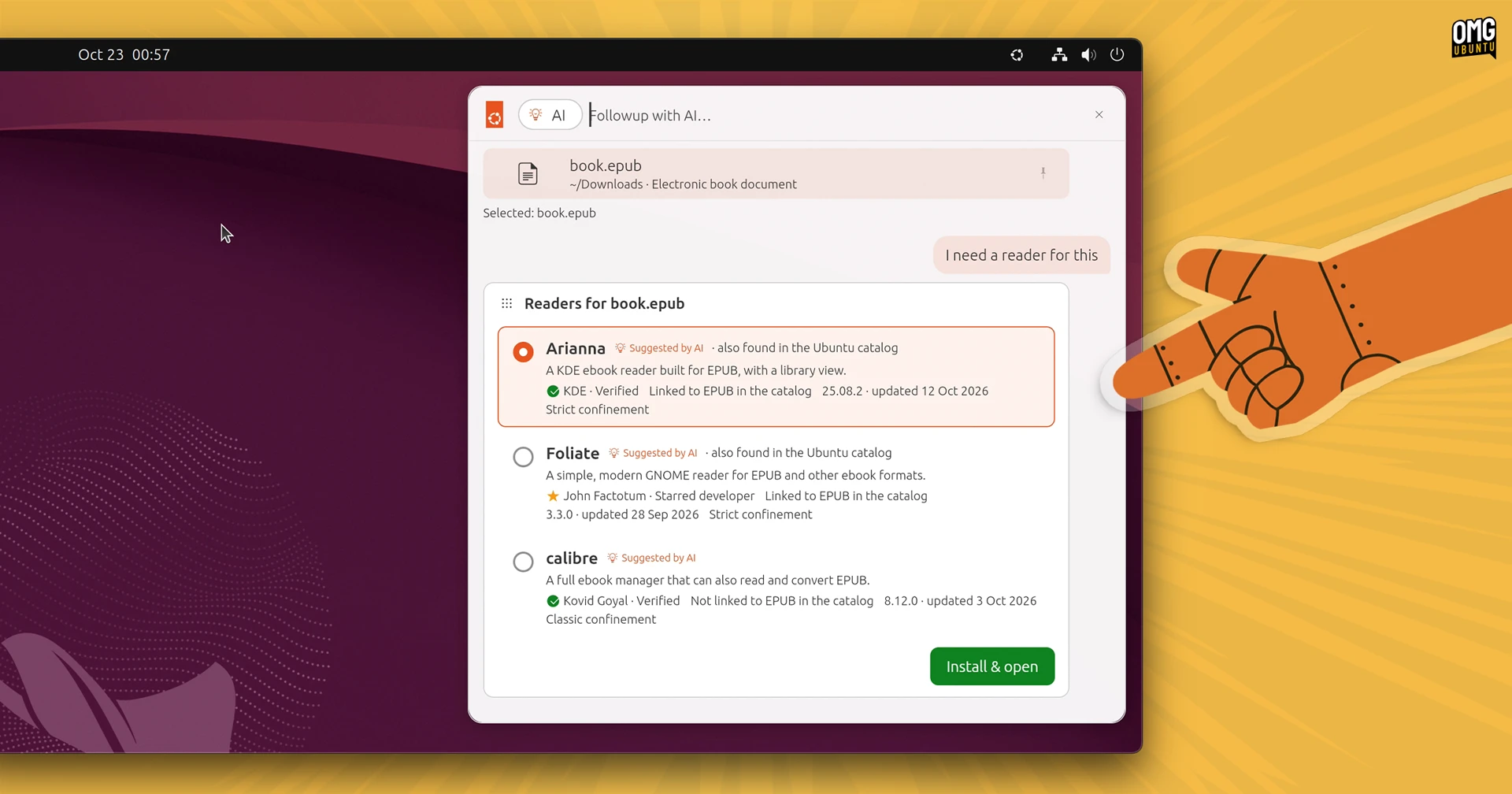
A Canonical engineer has published a prototype launcher that simulates how on-device AI could be used to enhance and aid users of the Ubuntu desktop.
But the warty-prototype1 snap by Didier Roche-Tolomelli (aka didrocks) is not a real launcher. It’s a semi-interactive, automated mockup. It simulates things a user could do, and that includes interacting with a (theoretical) on-device AI model to complete tasks.
Those trying to access the Ubuntu website, ISO downloads, and similar Ubuntu resources today are finding the site inoperable amid what’s now confirmed as an ongoing distributed denial of service attack
Those trying to access the Ubuntu website, ISO downloads, and similar Ubuntu resources today are finding the site inoperable amid what’s now confirmed as an ongoing distributed denial of service attack

Fixes are available for 3 vulnerabilities reported in snapd, each with assigned CVE IDs and CVSS scores.
- CVE-2026-8933, discovered by Qualys, allows local attackers to escalate privileges. It impacts default installations of Ubuntu 22.04 LTS, Ubuntu 24.04 LTS and Ubuntu 26.04 LTS. The CVSS 3.1 score assigned to the vulnerability is 7.8 (high).
- CVE-2026-15226, discovered by Zygmunt Krynicki, Canonical team member, allows local attackers to escape snap confinement from confined root to unconfined root. The CVSS 3.1 score assigned to the vulnerability is 8.4 (high).
- CVE-2024-5300 discovered by James Henstridge, Canonical team member, allows a sandboxed application to access hashed user passwords. This vulnerability impacts installations of Ubuntu 16.04 LTS, Ubuntu 18.04 LTS, Ubuntu 20.04 LTS Ubuntu, 22.04 LTS, Ubuntu 24.04 LTS and Ubuntu 26.04 LTS where systemd-userdbd is available. The CVSS 3.1 score assigned to the vulnerability is 5.6 (medium).
Affected releases
The following table lists the affected snaps. Revisions with patches will be updated as they are released.
Snap name Channel Remediation status snapd latest/stable pending (2.76.1) publication snapd fips-updates/stable not planned core latest/stable pending The snapd package distributed via the Ubuntu archive is also affected in the following releases. Fixes have been released as security updates.
Release Package Name Fixed Version Xenial (16.04) snapd 2.61.4ubuntu0.16.04.1+esm4 Bionic (18.04) snapd 2.61.4ubuntu0.18.04.1+esm4 Focal (20.04) snapd 2.67.1+20.04ubuntu1~esm3 Jammy (22.04) snapd 2.76+ubuntu22.04.1 Noble (24.04) snapd 2.76+ubuntu24.04.1 Resolute (26.04) snapd 2.76+ubuntu26.04.3