0
preview
I hate cooking and I get to eat so much food (FOR FREE!!)
I hate cooking and I get to eat so much food (FOR FREE!!)

Not on this instance? Enter your own instance's domain to go straight to following c/vegan@hexbear.net there.
I hate cooking and I get to eat so much food (FOR FREE!!)
I hate cooking and I get to eat so much food (FOR FREE!!)

Not complex at all but honestly satisfying and tasty
Spices are freshly ground cumin, smoked paprika, light chili powder, oregano, Aleppo pepper, and salt topped with olive oil
Edit: a bit of lemon juice on this is fire
Not complex at all but honestly satisfying and tasty
Spices are freshly ground cumin, smoked paprika, light chili powder, oregano, Aleppo pepper, and salt topped with olive oil
Edit: a bit of lemon juice on this is fire

Can’t recommend it enough.
Here’s the recipe I use but I have suggestions. First being, they consider garlic optional or as a sub for ginger but I do both and double the suggested garlic quantity. Second, try using olive oil. It’s delightful. Third, simmer it a lil after adding the dal. Also if you have the means, do the special tadka. It adds a lot
edit: I also personally think potato would be amazing in this but have never tried it.

From the demonstration on the Day 2 of Indore Animal Liberation Conference 2026.
From the demonstration on the Day 2 of Indore Animal Liberation Conference 2026.

Speech from Marriott duck down feather protest
Speech from Marriott duck down feather protest
I’m wondering because last night I was thinking about how, to me, garlic is the food of the gods. And I just ate three small cloves of garlic raw.
What a kick to the taste buds.
I’m wondering because last night I was thinking about how, to me, garlic is the food of the gods. And I just ate three small cloves of garlic raw.
What a kick to the taste buds.
I find a huge variation in daily recommended protein intake when I search online and it is quite frustrating. I am going to the gym regularly and trying to build muscle so this has recently become important to me as I don’t want to accidentally have a protein deficiency. Currently I use a protein powder and eat a lot of beans and lentils. I usually get 60g at least and I get the full spectrum of amino acids from other parts of my diet. I just do not believe I need double this as is currently recommended by the US government.
Anyone have studies on this? Recommendations for bodybuilding while vegan?
For example, I’m trying to figure out completely vegan lentils.
Although I’ve never cooked with it before, I’m open to using MSG.
For example, I’m trying to figure out completely vegan lentils.
Although I’ve never cooked with it before, I’m open to using MSG.

Looks like dookie but it is the best soup I have ever made. Probably could have mushed up the lentils more for a better consistency but I was impatient. Can’t stress enough how delicious this is, asafoetida makes all the difference tbh.
Looks like dookie but it is the best soup I have ever made. Probably could have mushed up the lentils more for a better consistency but I was impatient. Can’t stress enough how delicious this is, asafoetida makes all the difference tbh.
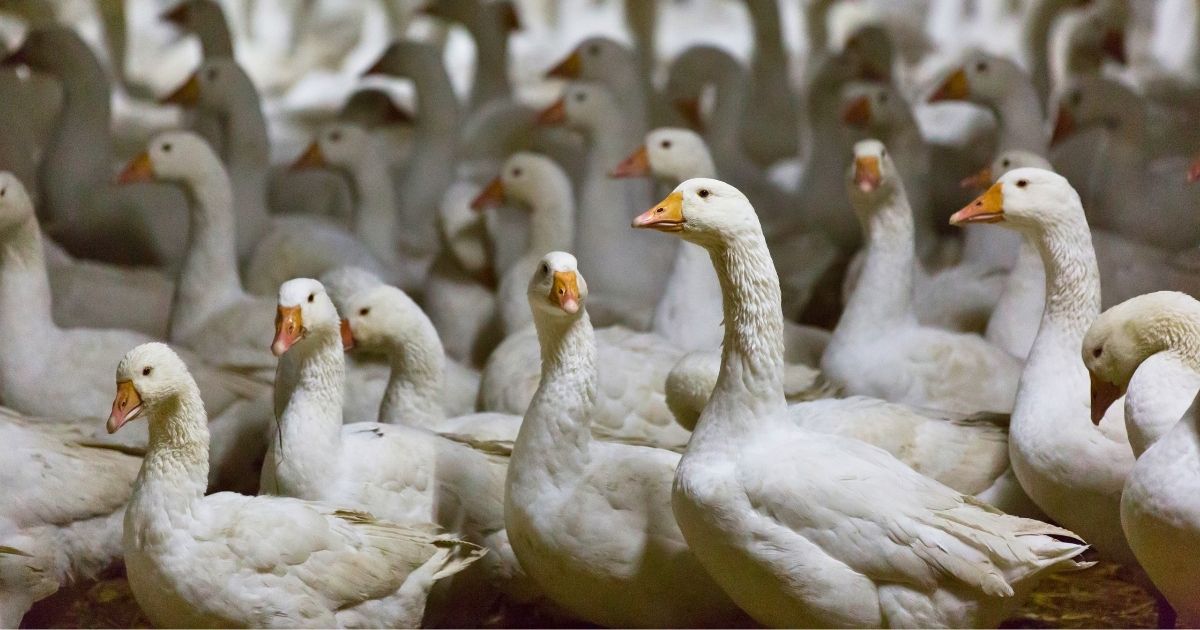
What a great move!💚
Brazil joins India on this based side
What a great move!💚
Brazil joins India on this based side

 “God loves vegans more.”


TVP patties and seasoned tofu “egg”.
Recipe adapted from: theeburgerdude.com/vegan-egg-mcmuffins/
I love the occasional junk food and refuse to live without it. These are pretty good, although I continue to have difficulty with coherence of tvp based patties.
Grinding it up some improved it.
TVP patties and seasoned tofu “egg”.
Recipe adapted from: theeburgerdude.com/vegan-egg-mcmuffins/
I love the occasional junk food and refuse to live without it. These are pretty good, although I continue to have difficulty with coherence of tvp based patties.
Grinding it up some improved it.

The actual comic is about lactose intolerance
Panel 1
Gustopher and Douglas are at a gathering at a park and having lunch. Gustopher offers Douglas a slice pizza because sharing is caring.
Gustopher: DOUGLAS! Want some pizza?
Douglas: No, thank you. I can’t have dairy.
Panel 2
CAN’T HAVE DAIRY! Is that legal? Gustopher is trying grasp the meaning of this. He tilts the plate with the slice of pizza slightly.
*Gustopher: What about ice cream?
Douglas: I can’t have that.
Gustopher: Macaroni and cheese?
Douglas No.
Panel 3
Gustopher is shocked that there are people in the world who can’t enjoy dairy. He his hand tilts the plate even further causing the slice of pizza to start to slip off.
Gustopher: Grilled cheese? Milkshakes? Poutine?
Douglas: Any of that would make me sick.
Panel 4
Gustopher has gone off to sit on a stump to process this information. He hold his hands together under his chin to contemplate all this. He’s learning a lot about the world today

cross-posted from: hexbear.net/post/8908494
Why is the carnivore diet a thing? Why do Jordan Peterson, Gwyneth Paltrow, Joe Rogan, and Tucker Carlson care what you eat? What exactly is ‘slonking?’ And behind all the sillyness, why does this all actually really really matter?
To help fund future work: Patreon: / theleftistcooks
Librapay: en.liberapay.com/theLeftistCooks Ko-fi: ko-fi.com/theleftistcooksJoin our community: / discord
This video discusses food. Please take care (or consider skipping this one) if that’s a triggering topic for you.
Citations: docs.google.com/document/d/1q…
Featuring Interviews with: Olivia Wee: / dietitian_oliviawee
www.tiktok.com/@dietitian_oli… Lily Hi’ilani www.tiktok.com/@hiililylani?_… Rohan Davis @rohanxdavis Zoe Bee @zoe_bee ChrisWaves @chriswavesThank you to 7thGenRising for sensitivity reading. Find their work here: / 7thgenrising
Our quote readers are all extremely talented creators. Please check out their work: @rohanxdavis @QuestingRefuge @caelanconrad @squarecymbals @talistheintrovert @WillieMuse2 @LolaSebastian @PillarofGarbage @hootshootman @chriswaves @Ember_Green @Leadhead @LegalKimchi @MainelyMandy @FDSignifire @JoseMariaLuna @ForeignManinaForeignLand @zoe_bee @JohntheDuncan @HogandDice @COLORMIND.mp4 @bootstrap_paradox @elliotsangestevez @themorbidzoo @Rosencreutzzz @marsintheory @Aranock @Afterthoughts @SquidTips @alexander_avila @lily_lxndr @renegadecut @JoshWithParentheses
Chapters 00:00 Intro 00: 19 :41 Is It Good For You? 00:41:38 Meat and Masculinity 01:44:57 The Grift 02:26:30 The Pipeline 03:35:39 The Stakes 03:51:38 Absent Referents 04:06:36 Problems with Veganism 05:04:48 Ecofeminism 05:34:26 Final Thoughts
cross-posted from: lemmygrad.ml/post/11847612
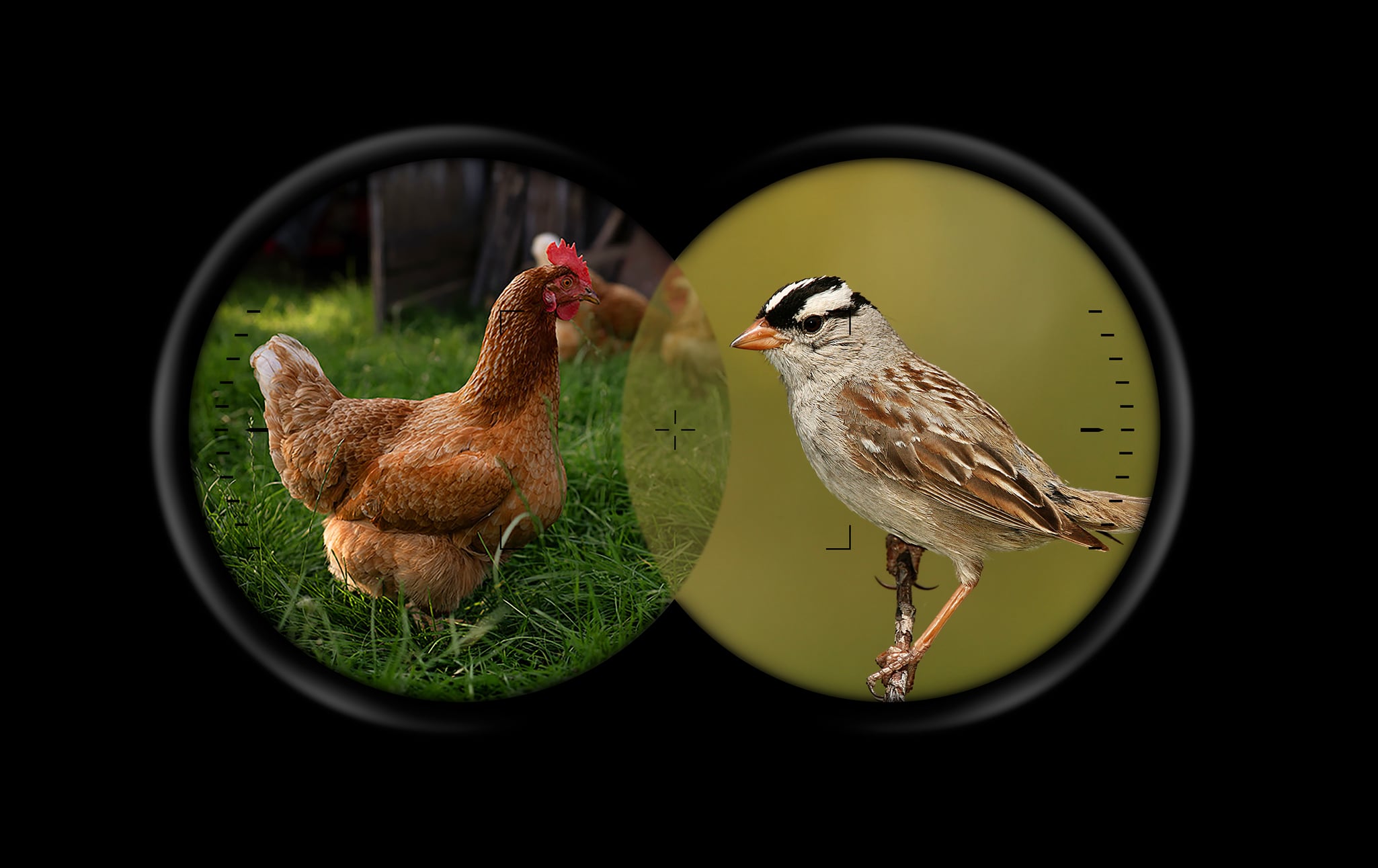
The first time I met him, the stranger didn’t have a name—he was “the zebra-stripey one.” A notch above “anonymous brown blob,” the species all unmet birds fall into. All I knew was that he was elusive. I chased him and ten of his closest friends down a San Diego hiking trail for 30 minutes trying for an ID. It was on the 61st branch that I managed a clear enough picture, shaken through my binoculars.
We had no relationship then. He was, to me, as unique as a default profile photo. A grey silhouette on a greyer background.
Seven months later, I moved out of downtown into a more suburban area—a home with a garden, space for my arms and legs to stretch, and far more flowers for inquisitive birds. That’s where zebra stripes found me again.
I thought him shy, at first. I’d only spotted him once in the first three months, but then I learned I’d been looking for him outside his social hours. How conceitedly human of me! Like insisting the world banks on my hours.
Before long, I had dug through the grey and found contours of an expansive inner world. The bird—the white-crowned sparrow—has favorite seeds, tones of voice, enemies, friends. I catalog intuitively, give him a nod of the head. I see him now. It took time, but I do.
This is how it goes with every bird I meet: a devotional practice. It starts with learning the species’ name, and the rest slots into place. I can tell you about the blue jay in upstate New York who threw tantrums whenever he didn’t get his way. Or the Anna’s hummingbird with such a strong preference for curled-petal flowers he’d chirp at the sight of one. Or the juvenile starling whose subtle hunger tell was putting his mother’s whole face in his beak.
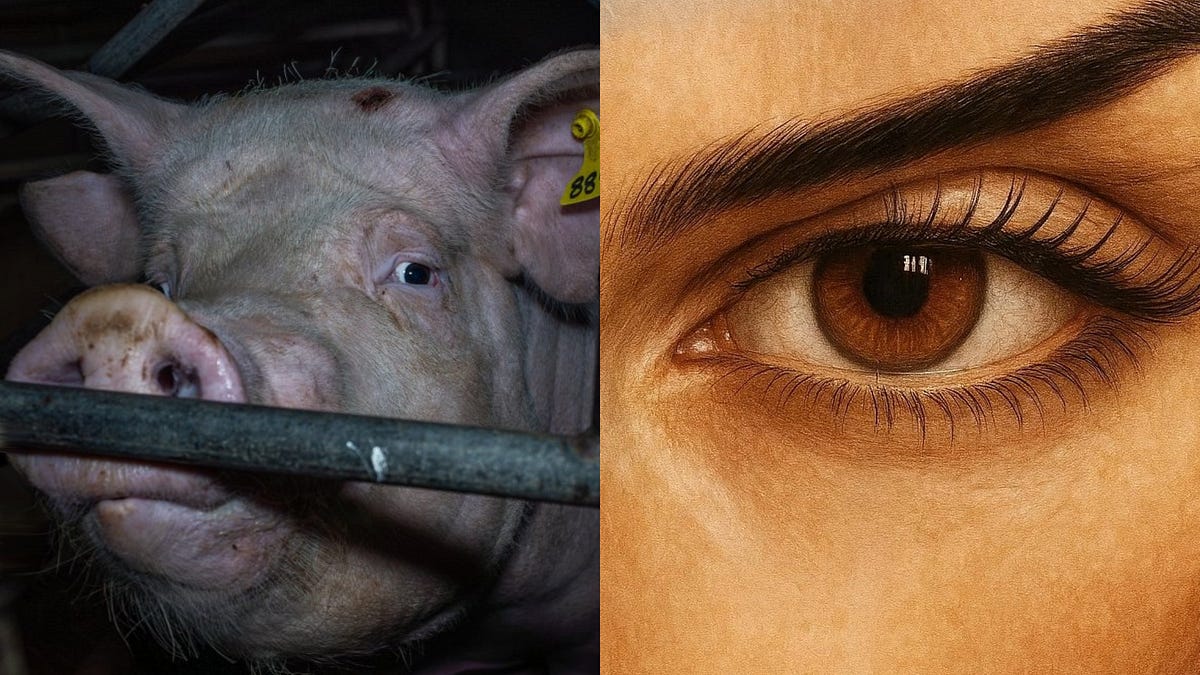
But what can I tell you about the bird I see most often? Ah… nothing. I can’t tell you her likes, dislikes, or quirks, even if I squinted through binoculars. And it’s not by choice, it’s because the system is designed so I could never stand at a feeder long enough to find out without the cops being called. It is, yes, the bird on the plates of everyone I love, whose dismembered legs and wings I’ve seen far more often than her feathered face: an ordinary chicken. Before we can ask who she is, the meat industry has already ensured we can’t find out.
Her life begins as one of 600 million chicks hatched annually in the U.S. egg industry. Half of these chicks—her sisters and female cousins—will live the same short life as her. The other 300 million males are considered useless to both the egg industry, since they can’t lay, and the meat industry, since they are leaner and unsuitable for efficient meat production. Instead, they are routinely ground up or gassed alive within their first day of life. On average, male chicks live to be one day old, and what’s left on the other side of the macerator gets turned into animal food, fertilizer, or biofuel.
Narrowly avoiding this fate, she is transported from hatchery to factory farm. In the 67 or so square inches she’s afforded—an area smaller than a sheet of printer paper—the only natural behavior left to her beak is pecking, and the only thing it can reach is other birds. So she pecks at them, and the industry reads it as damage to the product. Before she can grow into herself, a hot knife takes one third of her beak—her instrument of recognition and means of language—searing through a thin layer of highly sensitive soft tissue, similar to the quick of the human nail. In one slice, she is marooned from everything her Red Junglefowl ancestors passed on to her: the dust baths, the foraging, the full use of herself. No housing system—free-range, cage-free, or battery cage—meets all of her needs, so the industry manages a symptom of confinement, not the confinement itself.
There is a body she should have had, and a body she is given. The body she should have had lays 10-15 eggs per year. The body she is given lays around 300, far beyond what is biologically healthy. The body she should have had naturally tapers egg production as she ages. The body she is given is force-molted: starved for weeks until she loses a quarter of her body weight, then returned to a normal diet to rejuvenate egg production at the first sight of egg decline.
Or maybe she is a chicken raised for meat, in which case the body she is given grows 300 percent faster than the body she should have had. Genetic manipulation and breeding favor rapid weight gain and disproportionately large breasts. Though her body is adult-sized within weeks, her organs and bones cannot keep pace with muscles, so her heart strains, her lungs fall short of breath, her legs twist and buckle under her weight. Weak and heavy, she spends long hours lying on shed floors covered in her own waste, developing painful lesions that make movement even harder. She is, perpetually, starving. Her appetite regulation system is re-engineered so she cannot feel full. Stomach fullness is a hindrance to the machine. She must ravenously hunger to ensure fullness of “chicken breast,” instead.
The body she should have had could sustain her for up to 15 years. The body she is given is taken again at six weeks. It is held upside down by the feet, shackled to a conveyor line, run through an electrified bath to stun, slit at the throat, and immersed in scalding water to loosen feathers. Line speeds reach up to three birds every two seconds, which means stunning and slaughter are not always completed before the water. Around a million birds a year are boiled alive. A 2017 USDA inspector account at Southern Hens reads: “While performing a 500 bird count, I saw a live, non-stunned bird enter the scalder. The bird was flapping and attempting to right itself. As it entered and traveled half the length of the first scalder, the bird jerked violently while lifting itself until it was no longer in my immediate sight.”
If I could bring my binoculars to a factory farm, I would not see her. I would see the capitalism-perfected, efficiency-optimized machine of her. I couldn’t see her because even she couldn’t see herself. There is a witness problem here. And to witness that, you’d need a special lens that so-called “ag-gag” laws, a new class of legislation that has sprung up across the Midwest of the United States in the last decade, work hard to ensure you never look through.
In 2011, a Mercy for Animals activist known as “Scott” went undercover at Sparboe farms, the fifth-largest egg producer in the US supplying all McDonald’s eggs west of the Mississippi. His mission as an activist was similar to mine as a birder, though the tools were different: to see up close what’s far away. He spent months wearing a hidden camera in facilities across Iowa, Minnesota, and Colorado. Sparboe marketed its eggs as humane, claiming hens had “freedom from fear and distress” and “freedom to express normal behavior.” Scott found that this freedom looked like hens crammed in crowded cages, workers grabbing birds by the neck, slamming them in and out of cages, shoving them in pockets “apparently for fun,” pressing thumbs into the back of chicks’ necks until they broke.
The footage aired on ABC. McDonald’s announced it would no longer accept Sparboe eggs before the broadcast finished. Target pulled their eggs within hours. Then most grocery chains followed suit. In response, Sparboe fired employees and blamed everything on a few bad actors. The president and owner claimed to be “shocked and deeply disturbed.”
Within months, Iowa’s governor passed what would become the model for a new generation of ag-gag laws. It was not a response to the cruelty, but a response to the proof of it.
Agricultural gag—“ag-gag”—laws are a series of anti-whistleblower laws that make it nearly impossible to see inside a factory farm or slaughterhouse. Civil liberties lawyers fight them in court and often win. The industry adjusts the wording and passes them again. In Iowa, the whack-a-mole has lasted over four rounds:
The same pattern is repeated across many states—Idaho, Utah, and Wyoming among them. The industry doesn’t change its practices, only what is legal to document.
We know what the government’s own inspectors saw because someone had to sue to make it public. The USDA settled a Freedom of Information Act violation lawsuit in 2021, agreeing to publish inspection reports. Those reports described birds with heads engorged with blood, skin torn from their bodies, and live animals lying among carcasses on blood-soaked floors. All of it was on the government’s record the whole time; it was just hidden from public view
Sparboe’s farm was not especially cruel, just especially documented. Consumer ignorance is not a byproduct of the industry. It is the product—actively manufactured and legally enforced so the public never gets to meet her: the bird on the plates of everyone I love.
I still take a seat at the table. I see the plates and make no scene. The entire architecture—legal, cultural, linguistic—exists so that she stays invisible and we stay comfortable. The fortress of ignorance is so sturdy I don’t even try when I face it in the eyes of my brother or my best friend. How do I go against an almost universal silencing? Often, I don’t. I’m silent, too. I save my strongest attacks for when I’m safe behind a phone. Am I not, then, complicit too?
Across the table, sometimes, I think to ask: do you know what species you’re eating for lunch? Not “chicken”—which chicken? What kind? Did you know there are dozens of breeds, each with different temperaments? Four different species? Was she ever a stranger to you, or was she always a product? In another world, could she have been a visitor? A regular? A friend?
The anonymous brown lumps our forks interact with contain nothing to recognize. Bodies are drained bloodless, cut to the uniform shape of plastic containers, and stripped of anything that could rouse curiosity. We are organ-carrying, hot-blooded creatures with legs and hearts. She is caloric, inanimate flesh.
But it stays a thought. I reach for words, but the reason I’m so drawn to birding is I’ve always been more fluent in observation than speech.
I’ll tell you, then, what I’ve observed: the white crowned sparrow’s favorite perch is the second branch to the left. When he visits my feeder, he loves to shuffle his feet in the seeds before picking the first. Doesn’t scurry when a towhee or finch lingers on the trellis. Prefers the early sunset hour. Has something to say about every other bird’s song.
I can tell you nothing about the bird you ate for dinner. Maybe she would have loved the color yellow, if she were allowed to have eyes. Maybe she would have followed every bee to its flower, if she were allowed to have legs.
Manar Naboulsi is a creator, activist, and serial-hobbyist who can’t shut up about human and animal rights. You can find her on Instagram at @earth.to.manar.
cross-posted from: lemmygrad.ml/post/11575812
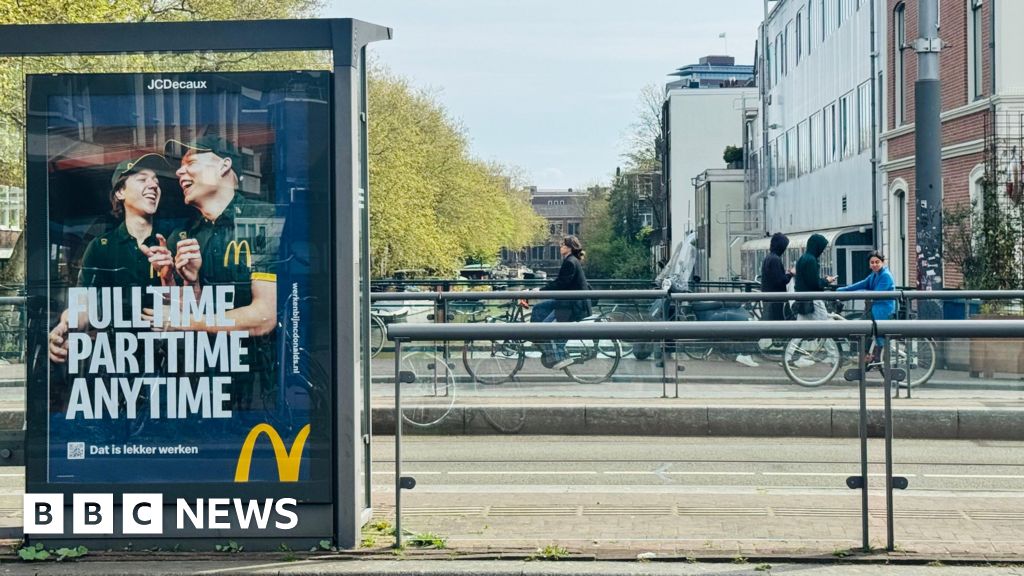
Amsterdam bans public adverts for meat and fossil fuels
BBC
Advertisements for meat products, such as beef burgers, have disappeared from Amsterdam’s streets
Amsterdam has become the world’s first capital city to ban public advertisements for both meat and fossil fuel products. Since 1 May, adverts for burgers, petrol cars and airlines have been stripped from billboards, tram shelters, and metro stations.
At one of the city’s busiest tram stops, adjacent to a grassy roundabout bursting with vibrant yellow daffodils and orange tulips, the poster advertising landscape has changed.
They now promote the Rijksmuseum, the national museum of the Netherlands, and a piano concert. Until last week it was chicken nuggets, SUVs and low-budget holidays.
Politicians in the city say the move is about bringing Amsterdam’s streetscape into line with the local government’s own environmental targets.
These aim for the Dutch capital to become carbon neutral by 2050, and for local people to halve their meat consumption over the same period.
“The climate crisis is very urgent,” says Anneke Veenhoff from the GreenLeft Party. "I mean, if you want to be leading in climate policies and you rent out your walls to exactly the opposite, then what are you doing?
“Most people don’t understand why the municipality should make money out of renting our public space with something that we are actively having policies against.”
This view is echoed by Anke Bakker, who is Amsterdam group leader for a Dutch political party that focuses on animal rights – Party for the Animals.
She instigated the new restrictions, and rejects accusations of them being nanny state.
“Everybody can just make their own decisions, but actually we are trying to get the big companies not to tell us all the time what we need to eat and buy,” says Bakker.
“In a way, we’re giving people more freedom because they can make their own choice, right?”
Removing that constant visual nudge, she says, both reduces impulse buying, and signals that cheap meat and fossil heavy travel are no longer aspirational lifestyle choices.
Meat was a relatively small slice of Amsterdam’s outdoor advertising market – accounting for an estimated 0.1% of ad spend, compared with roughly 4% for fossil related products.
The advertising was instead dominated by the likes of clothing brands, movie posters, and mobile phones.
But politically the ban sends a message. Grouping meat with flights, cruises and petrol and diesel cars reframes it from a purely private dietary choice to a climate issue.
Local politicians Anneke Veenhoff (left) and Anke Bakker say the ban was needed
Unsurprisingly, the Dutch Meat Association, which represents the industry, is unhappy at the move, which it calls “an undesirable way to influence consumer behaviour”. It adds that meat “delivers essential nutrients and should remain visible and accessible to consumers”.
Meanwhile, the Dutch Association of Travel Agents and Tour Operators says that the ban on advertising holidays that include air travel is a disproportionate curb on companies’ commercial freedom.
For activists like lawyer Hannah Prins and her environmental organisation Advocates for the Future, which worked closely with campaign group Fossil-Free Advertising, the ban on meat advertising is a deliberate attempt to create a “tobacco moment” for high carbon food.
“Because if I look now back at like old pictures, you have Johan Cruyff,” says Prins. "The famous Dutch footballer.
"He would be in advertisements for tobacco. That used to be normal. He died of lung cancer.
"That you were allowed to smoke on the train, on restaurants. For me, that’s like, whoa, why did people do that? You know, that feels so weird.
“So it really is like what we see in our public space is what we find normal in our society. And I don’t think it’s normal to see murdered animals on billboards. So I think it’s very good that that’s going to change.”
Lawyer Hannah Prins wants people to view meat in the same way as they do smoking
The Dutch capital is not starting from scratch.
Haarlem, 18km (11 miles) to its west, was in 2022 the first city in the world to announce a broad ban on most meat advertising in public spaces. It came into force in 2024, together with a prohibition on fossil fuel adverts.
Utrecht and Nijmegen have since followed with their own measures that explicitly restrict meat (and in Nijmegen’s case also dairy) advertising on municipal billboards, on top of existing bans on adverts for fossil fuels, petrol cars and flying.
Globally, dozens of cities have, or are moving to, ban fossil-fuel advertising. Such as Edinburgh, Sheffield, Stockholm and Florence. France even has a nationwide ban.
Campaigners hope that the Dutch approach - linking meat and fossil fuels - will act as a legal and political blueprint others can copy.
Stand at a tram stop in Amsterdam and you might no longer see a juicy burger or a 19 euro ($18.70; £14.90) flight to Berlin on the shelter.
Yet the same eye-catching offers can still pop up in your social media algorithm. And, let’s face it, many of us would be looking down at our screens until the tram trundles along.
If municipal bans leave digital platforms untouched, how much real world impact can they have on our habits or are they purely symbolic virtue-signalling?
Getty Images
Is the ban on outdoor adverts worthwhile if people can still see promotions for meat and fossil fuel online?
So far, there is no direct evidence that removing meat advertising from public spaces leads to a shift toward more plant-based societies.
However, some researchers are cautiously optimistic, such as Prof Joreintje Mackenbach who is an epidemiologist - a medical professional who investigates health patterns within populations.
She describes Amsterdam’s move as “a fantastic natural experiment to see”.
“If we see advertisements for fast food everywhere, it normalizes the consumption of behaviour of fast consumption,” says Mackenbach, who is from the Department of Epidemiology and Data Science at hospital Amsterdam University Medical Center.
“So if we take away those types of cues in our public living environments, then that is also going to have an impact on those social norms.”
She points to a study which claims that London Underground’s 2019 ban on junk food adverts led to less people buying such products in the UK capital.
Smiling on the banks of a canal in the centre of Amsterdam, Prins is adamant smaller specialist tradespeople in Amsterdam will benefit from the new advertising ban.
“Because like everything we love, festivals, nice cheese, a flower shop around the corner. All the stuff that we love, we don’t hear from through ads,” she says.
"It’s usually through people that we know, or we walk past the building. So I think local businesses will be able to thrive because of this.
“I think and I hope that big polluting companies will be extra scared. And maybe will rethink the kind of products they are selling. I think you can really see that change is possible.”
cross-posted from: lemmygrad.ml/post/11575812
Amsterdam bans public adverts for meat and fossil fuels
Advertisements for meat products, such as beef burgers, have disappeared from Amsterdam’s streets
Amsterdam has become the world’s first capital city to ban public advertisements for both meat and fossil fuel products. Since 1 May, adverts for burgers, petrol cars and airlines have been stripped from billboards, tram shelters, and metro stations.
At one of the city’s busiest tram stops, adjacent to a grassy roundabout bursting with vibrant yellow daffodils and orange tulips, the poster advertising landscape has changed.
They now promote the Rijksmuseum, the national museum of the Netherlands, and a piano concert. Until last week it was chicken nuggets, SUVs and low-budget holidays.
Politicians in the city say the move is about bringing Amsterdam’s streetscape into line with the local government’s own environmental targets.
These aim for the Dutch capital to become carbon neutral by 2050, and for local people to halve their meat consumption over the same period.
“The climate crisis is very urgent,” says Anneke Veenhoff from the GreenLeft Party. "I mean, if you want to be leading in climate policies and you rent out your walls to exactly the opposite, then what are you doing?
“Most people don’t understand why the municipality should make money out of renting our public space with something that we are actively having policies against.”
This view is echoed by Anke Bakker, who is Amsterdam group leader for a Dutch political party that focuses on animal rights – Party for the Animals.
She instigated the new restrictions, and rejects accusations of them being nanny state.
“Everybody can just make their own decisions, but actually we are trying to get the big companies not to tell us all the time what we need to eat and buy,” says Bakker.
“In a way, we’re giving people more freedom because they can make their own choice, right?”
Removing that constant visual nudge, she says, both reduces impulse buying, and signals that cheap meat and fossil heavy travel are no longer aspirational lifestyle choices.
Meat was a relatively small slice of Amsterdam’s outdoor advertising market – accounting for an estimated 0.1% of ad spend, compared with roughly 4% for fossil related products.
The advertising was instead dominated by the likes of clothing brands, movie posters, and mobile phones.
But politically the ban sends a message. Grouping meat with flights, cruises and petrol and diesel cars reframes it from a purely private dietary choice to a climate issue.
Local politicians Anneke Veenhoff (left) and Anke Bakker say the ban was needed
Unsurprisingly, the Dutch Meat Association, which represents the industry, is unhappy at the move, which it calls “an undesirable way to influence consumer behaviour”. It adds that meat “delivers essential nutrients and should remain visible and accessible to consumers”.
Meanwhile, the Dutch Association of Travel Agents and Tour Operators says that the ban on advertising holidays that include air travel is a disproportionate curb on companies’ commercial freedom.
For activists like lawyer Hannah Prins and her environmental organisation Advocates for the Future, which worked closely with campaign group Fossil-Free Advertising, the ban on meat advertising is a deliberate attempt to create a “tobacco moment” for high carbon food.
“Because if I look now back at like old pictures, you have Johan Cruyff,” says Prins. "The famous Dutch footballer.
"He would be in advertisements for tobacco. That used to be normal. He died of lung cancer.
"That you were allowed to smoke on the train, on restaurants. For me, that’s like, whoa, why did people do that? You know, that feels so weird.
“So it really is like what we see in our public space is what we find normal in our society. And I don’t think it’s normal to see murdered animals on billboards. So I think it’s very good that that’s going to change.”
Lawyer Hannah Prins wants people to view meat in the same way as they do smoking
The Dutch capital is not starting from scratch.
Haarlem, 18km (11 miles) to its west, was in 2022 the first city in the world to announce a broad ban on most meat advertising in public spaces. It came into force in 2024, together with a prohibition on fossil fuel adverts.
Utrecht and Nijmegen have since followed with their own measures that explicitly restrict meat (and in Nijmegen’s case also dairy) advertising on municipal billboards, on top of existing bans on adverts for fossil fuels, petrol cars and flying.
Globally, dozens of cities have, or are moving to, ban fossil-fuel advertising. Such as Edinburgh, Sheffield, Stockholm and Florence. France even has a nationwide ban.
Campaigners hope that the Dutch approach - linking meat and fossil fuels - will act as a legal and political blueprint others can copy.
Stand at a tram stop in Amsterdam and you might no longer see a juicy burger or a 19 euro ($18.70; £14.90) flight to Berlin on the shelter.
Yet the same eye-catching offers can still pop up in your social media algorithm. And, let’s face it, many of us would be looking down at our screens until the tram trundles along.
If municipal bans leave digital platforms untouched, how much real world impact can they have on our habits or are they purely symbolic virtue-signalling?
Is the ban on outdoor adverts worthwhile if people can still see promotions for meat and fossil fuel online?
So far, there is no direct evidence that removing meat advertising from public spaces leads to a shift toward more plant-based societies.
However, some researchers are cautiously optimistic, such as Prof Joreintje Mackenbach who is an epidemiologist - a medical professional who investigates health patterns within populations.
She describes Amsterdam’s move as “a fantastic natural experiment to see”.
“If we see advertisements for fast food everywhere, it normalizes the consumption of behaviour of fast consumption,” says Mackenbach, who is from the Department of Epidemiology and Data Science at hospital Amsterdam University Medical Center.
“So if we take away those types of cues in our public living environments, then that is also going to have an impact on those social norms.”
She points to a study which claims that London Underground’s 2019 ban on junk food adverts led to less people buying such products in the UK capital.
Smiling on the banks of a canal in the centre of Amsterdam, Prins is adamant smaller specialist tradespeople in Amsterdam will benefit from the new advertising ban.
“Because like everything we love, festivals, nice cheese, a flower shop around the corner. All the stuff that we love, we don’t hear from through ads,” she says.
"It’s usually through people that we know, or we walk past the building. So I think local businesses will be able to thrive because of this.
“I think and I hope that big polluting companies will be extra scared. And maybe will rethink the kind of products they are selling. I think you can really see that change is possible.”
np.reddit.com/r/AskReddit/comments/…/c5g8v4d/
I was curious about why honey is considered non-vegan and found this post. If any of this information is outdated then I’m happy to hear more about this
Ok, beekeeper, non-vegan here. I’ve got no horse in the vegan race, but I do know my bees and here is the sad truth: beekeeping is responsible for the decline of world-wide bee population for the last (roughly) 150 years, and for the precipitous decline since 1947.
Beekeeping as it has been done since the widespread adoption of the Langstroth hive has been bad for bees. This is mostly because the hive design has movable frames and opens from the top. These innovations led to highly interventionist beekeeping, and copious fucking with the bees.
The movable frame allows the beekeeper to easily remove, inspect, replace, and swap comb, and led to migratory beekeeping. Bees are now trucked by the tens of thousands of hives across the country with the seasons for the pollination business (which is a bigger than the honey business). The results is that diseases and bee pests move too. The biggest colony killer in the US right now is the Varroa mite, introduced from Asia by humans in 1988, and spread by humans to hives across the country.
The opening from the top destroys the bees’ carefully maintained nestduftwarmebingdung, the nest atmosphere. Bees maintain an anti-microbial sauna inside the hive, at a contant tempurature with a complex scent. They can go into fever-mode, raising the temp to kill off infection. The scent helps maintain communication and defenses. Opening the hive destroys the atmosphere. It takes the bees days to reestablish, and is a costly expense of energy they need for foraging, building, and preparing for winter. This weakens the bees, compromising their immune system and leaving them susceptible to infection and invaders.
Then there’s honey. Bees spend all season making honey stores so that they can survive the winter. The beekeeper comes along and takes it, then feeds the bees sugar syrup in the winter. This also weakens the bees. Honey is a complex, nutritious bee food. Sugar water is a simple, inadequate food. This is something like you farming all season and stocking up for the winter. You’ve canned and preserved your veg, and filled your freezer with meat, ready for the hard, unproductive winter. Then someone comes along, takes all your food, and replaces it with Twinkies. You’ll survive the winter on Twinkies, but you’ll be in pretty bad health come spring. (Although, like the bees with sugar, you’ll happily eat the Twinkies, because, yum.)
In the pursuit of larger honey harvest, beekeepers have been artificially increasing the size if the bee’s comb cell for about 100 years, by using comb foundation. Bigger cells is thought to mean more honey. So the bees you see today (with some exceptions) are “large-cell” bees, bigger than nature made them. Bigger cells means the workers are too big and the drones are too small (bees left on their own will make different sized cells for each type of bee). This weakens the bees. Some bees bred generations on foundation have lost their ability to create comb on their own.
These weak, immuno-compromised bees are then protected by the beekeepers with pesticides and anti-biotics placed in the hive to deal with the disease and pests that the bees can no longer fight off. This poisons the honey (yum!) and the bees, and breeds resistant pests.
Beekeeping is also dominated by artificial breeding of queens, which eliminates the Darwinian battle of the queens which nature uses to find the strongest queen. This weakens the genetics of the bees, for thousands of generations.
Most, in fact almost all, beekeeping is industrial farming, equivalent to factory farming chickens or cattle. And it has devastated the bees.
There are exceptions: look into vertical top bar hives (which open from the bottom except once a year); chemical-free beekeeping; and spring-harvest honey (taken from the surplus after winter is over).
A note about honey: most of the honey you buy at the grocery store is not. It is heated and filtered and pollen-free, removing the extraordinary health benefits of honey, cut eith corn syrup, beet syrup or other sweeteners, and laced with pesticides and anti-biotics. If you want honey, buy unfiltered, unheated honey, from a beekeeper you know. If you want honey and are concerned about the bees, buy from a beekeeper using Warré topbar hives, doing a surplus harvest.
A note about Colony Collapse Disorder: CCD is not a mystery, as is often reported. CCD is caused by industrial farming pesticides, which destroy bees’ navigational abilities, and they can’t find their way back to the hive. The whole “it’s mysterious” thing is a lie promoted by the chemical companies, primarily Bayer. But in the context of bees weakened by generations of industrial beekeeping, trying to forage on thousands of acres of monoculture crops, having been trucked thousands of miles from their home territory, it is an easy lie to sell.
that’s it that’s the post
that’s it that’s the post
Just finished reading Abbate’s 2020 essay, “Animal Rights and the Duty to Harm: When to be a Harm Causing Deontologist, and since I’ve also been thinking a lot about the de-sexing of animals (dogs and cats in specific; humans and all other animals in general), I read Abbate’s essay with that subject on my mind.
Anyways, I’m really not certain where I land on this subject, despite having read a number of arguments from all sides. I’m interested in hearing where members of this community stand (I’m aware that many, if not most, vegans are advocates for the sterilization of NHA), especially those members who have relationships with companion animals for which de-sexing is a common, socially acceptable and/or recommended practice.
Also, I know this can be a contentious subject, so I feel I should say I am approaching this in good faith, and I ask that anyone who contributes to this conversation does the same. I have no agenda other than genuinely trying to learn. If there is a better community for this question, I will gladly ask there. Thanks!
Recently saw an ad for a place that advertised themselves as both “plant based friendly” and “meat lover friendly”. 
I immediately reacted by saying “What kind of loser chud makes eating corpse a personality trait? Some sort of divorced dad quirk chungus that won’t shut up about bacon 20 years after that stopped being even remotely funny on reddit??”
And then I realized I do the same shit with beans, even with my carnist coworkers. Hell, I even do it on here. A-Am I fucking cringe for being too into beans, or am I still based because beans are worth the attention? My vegan partner thinks there’s no escape from being a cringey millennial either way. 
Recently saw an ad for a place that advertised themselves as both “plant based friendly” and “meat lover friendly”.
I immediately reacted by saying “What kind of loser chud makes eating corpse a personality trait? Some sort of divorced dad quirk chungus that won’t shut up about bacon 20 years after that stopped being even remotely funny on reddit??”
And then I realized I do the same shit with beans, even with my carnist coworkers. Hell, I even do it on here. A-Am I fucking cringe for being too into beans, or am I still based because beans are worth the attention? My vegan partner thinks there’s no escape from being a cringey millennial either way.

I made this comment on vegan@slrpnk.net and it feels like something I want to revisit at some point, or post at others who go on about “easing into veganism” But a random comment might get lost and also I’d like some feedback on it.
The problem with “Eventually affordable cruelty-free meat” is that it gives the fence sitters a cushion to delay making a commitment. And we need people to make a hard commitment, either against veganism (i. e. nothing changes) or for veganism (i. e. suffering reduces). There are a certain type of people that wear cruelty like a badge of honor. There was no convincing them anyway. But for most people I would think the cognitive dissonance “I don’t like being cruel vs. I am being cruel” simply has to outweigh the perceived amount of labor that goes into changing ones habits.
And I understand that meat-alternatives tip the scales by lessening the amount of labor required to change ones dietary habits, which is great. I am hugely in favor of that. But there are a couple things that I feel one needs to be mindful of.
a. The focus gets shifted away from the animals and to the “sacrifices” the (former?) oppressor has to make. E.g. This salami is good, but not as good as the “real” one
b. There is a constant reminder of the “sacrifices” the vegan makes. In contrast to the cruelty that is usually completely invisible to the consumer. E.g. every time I eat some vegan salami
c. Substituting meat with vegan alternatives means that if someone decides they are “done sacrificing” comfort, they can simply substitute back. E.g. It’s been such a stressful week, sick of all the vegan salami, just this once…
d. It makes it harder for children of vegan parents to recognise vegan food vs non-vegan food. E. g. Yeah we eat salami at home, so why shouldn’t I eat the salami in the kindergarden? I wish we had more of an alienation from non-vegan food from the beginning with our kids.
It’s the nicotine patches argument all over again. I’m not against meat-alternatives per se, but (here in Germany) there’s such a huge huge trend to offer all kinds of alternatives with little thought given to how we should be approaching this problem. Free nicotine patches to all addicts sounds great but there needs to be a movement for moving past “nicotine addiction” in general which I’m not seeing anywhere.
With the lab-grown flesh stuff I fear all the points above amplified 100fold. It’s functionally flesh, that’s the whole point. Plus since it’s not a practicable alternative it has, for the past 13 years, actually tipped the scales in favor of the “cruelty” cognitive dissonance, by giving it an “eventually”. The amount of (perceived) labor seems greater now than it will be once an “affordable(!) flesh-substitute” arrives, which is somehow always right around the corner. The “I’m too stressed to give up smoking right now” argument. Like yeah don’t quit smoking a week before a big exam, but don’t wait until you can afford a beach vacation either.
I hope that makes sense, in a vegan context it’s of course a bit different because the stakes are quite a bit higher. Do give up murdering as soon as possible. An exam is not more important than someones life. But if you’re so dependant on your current dietary habits that you couldn’t function without it due to some health concerns then lab-grown flesh or other alternatives might be an idea? It is kind of hard because here the oppressors have to police themselves. This is a situation where the oppressed cannot make their voices heard and so we must double and triple-check ourselves and when in doubt go with the more laborious option.
There’s also the point about the food traditions we pass on. (Which is the thread that sparked this argument)
Men make their own history, but they do not make it as they please; they do not make it under self-selected circumstances, but under circumstances existing already, given and transmitted from the past. The tradition of all dead generations weighs like a nightmare on the brains of the living.
Like yeah we are dealt this hand by the generations before us and we have to make the best of it, but lets also be mindful of how we are passing things on. Do we really want the next generation to have lab-grown flesh as a staple in their diet?

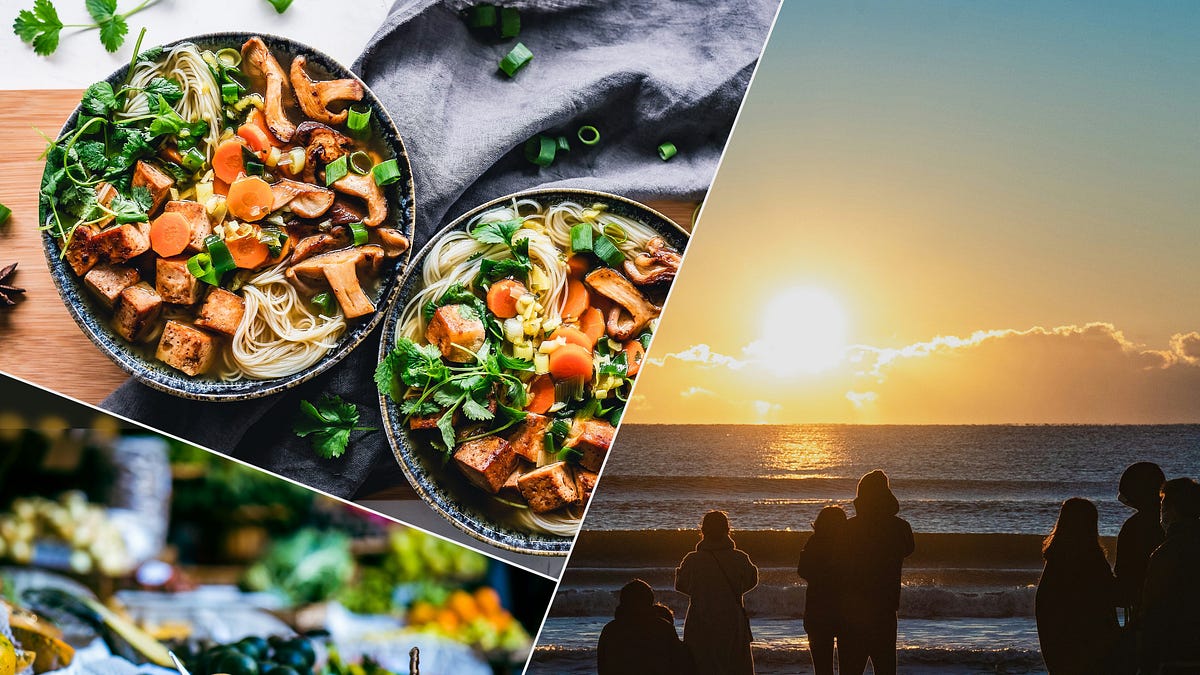

So I recently started and have been struggling to figure out the right amount of veggies to get without them going bad before I get to eating them. Are there any preservation tips or buying strategies you guys have used to prevent this? Also any other tips other than just plain preservation are welcome too since I am pretty new to this way of eating.
So I recently started and have been struggling to figure out the right amount of veggies to get without them going bad before I get to eating them. Are there any preservation tips or buying strategies you guys have used to prevent this? Also any other tips other than just plain preservation are welcome too since I am pretty new to this way of eating.
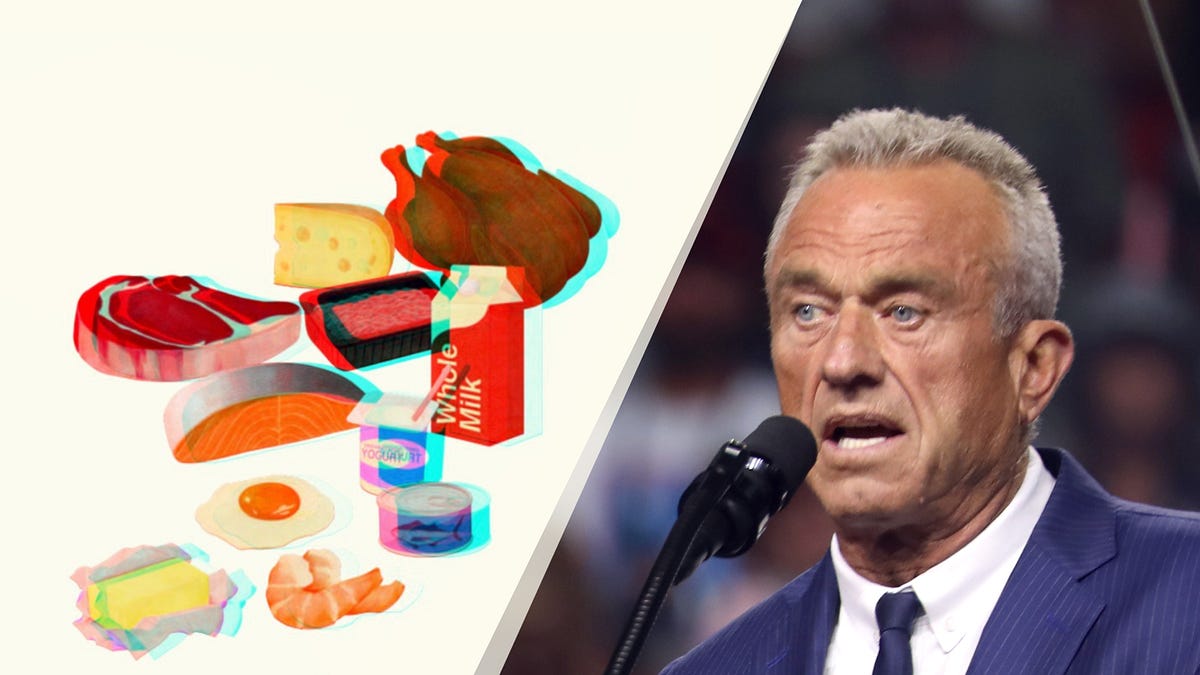
I am a Marxist and a materialist. Ideas and beliefs don’t arise ex nihilo. They emerge to fit the material reality in which they exist. What are the material realities that lead to carnism? I would argue that there are only two that matter:
Boil away the justifications, strip away the decorum, and this is what you get. But what if that person enters a situation where they benefit from objectifying me? What if I’m too weak to stop them? What barrier prevents them from doing so? My intelligence? My capacity for suffering? Their empathy and goodwill? None of that saves cattle, or pigs, or chickens. Why would it save me? I’m not foolish enough to think I’m special.
And look, survival situations are one thing. If you kill and eat an animal because the alternative is starvation, you have decided that the animal’s life is worth less than your life. If someone decided that my life was worth less than their life, and a situation came up where they had to act on that decision, I wouldn’t begrudge it. I wouldn’t like it, I’d fight it, but I wouldn’t begrudge it. The thought of someone deciding my life is worth less than their pleasure, though? Turns my blood to fucking ice.
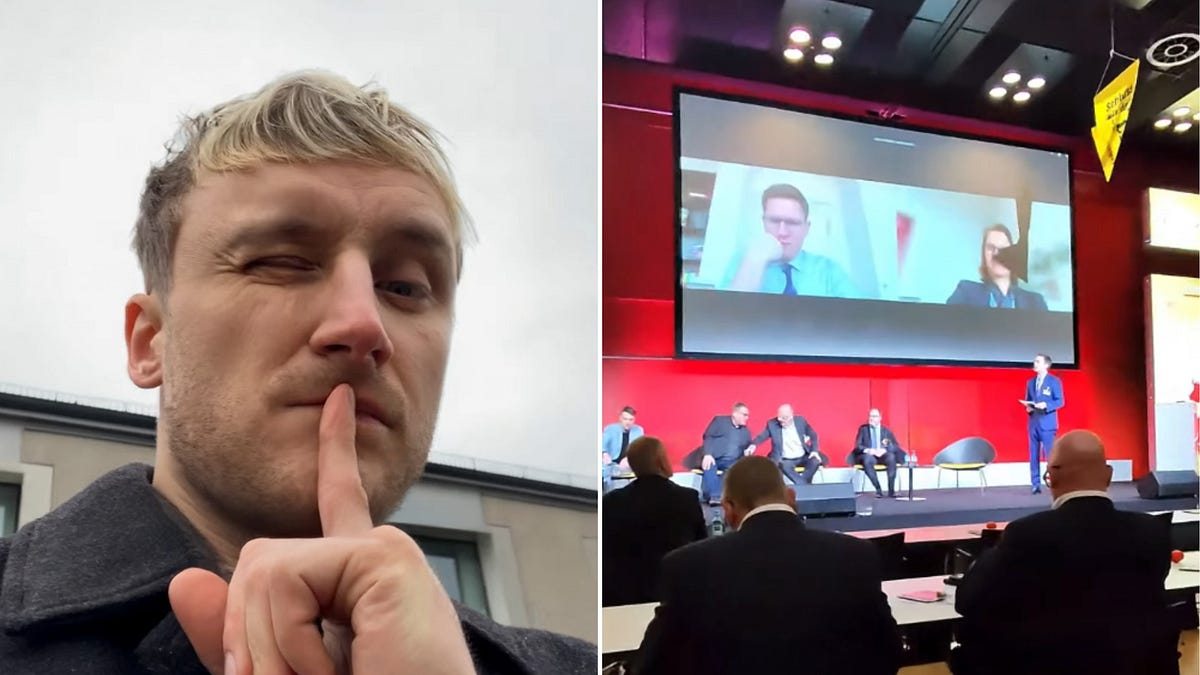
Would love some vegan breakfast options that feel breakfasty (USian). Avacado toast is great but avacados can be pretty pricey and I can’t eat that every day. Currently I just have a bunch of cashews in the morning and while I do love cashews I want something that has the right vibes and cashews just don’t.
Would love some vegan breakfast options that feel breakfasty (USian). Avacado toast is great but avacados can be pretty pricey and I can’t eat that every day. Currently I just have a bunch of cashews in the morning and while I do love cashews I want something that has the right vibes and cashews just don’t.
Folks…it’s good! I didn’t think I was going to like it since peas rank lower on my fav veggie list, but the Sicilian style split pea was banging. Very hearty and tasty with potatoes and pasta in it, along with carrot chunks. Will def. get again for the perfect lunch.
Folks…it’s good! I didn’t think I was going to like it since peas rank lower on my fav veggie list, but the Sicilian style split pea was banging. Very hearty and tasty with potatoes and pasta in it, along with carrot chunks. Will def. get again for the perfect lunch.
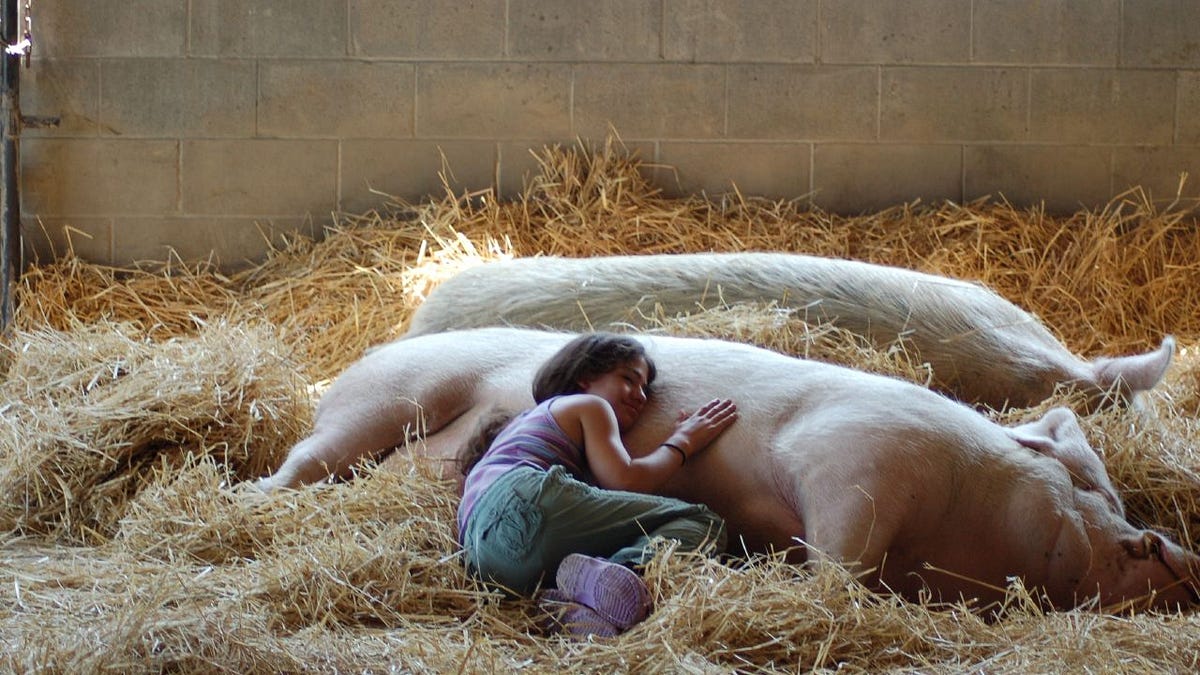
My therapist informed me I cant do anything vegan diet because its a “restrictive” diet and im diagnosed with anorexia. Currently in the psychward, told I can do it in residential but for two weeks I cant. Any advice on coping with this? ive been homeless and not eating and in an hour there will be meat staring at me.
My therapist informed me I cant do anything vegan diet because its a “restrictive” diet and im diagnosed with anorexia. Currently in the psychward, told I can do it in residential but for two weeks I cant. Any advice on coping with this? ive been homeless and not eating and in an hour there will be meat staring at me.


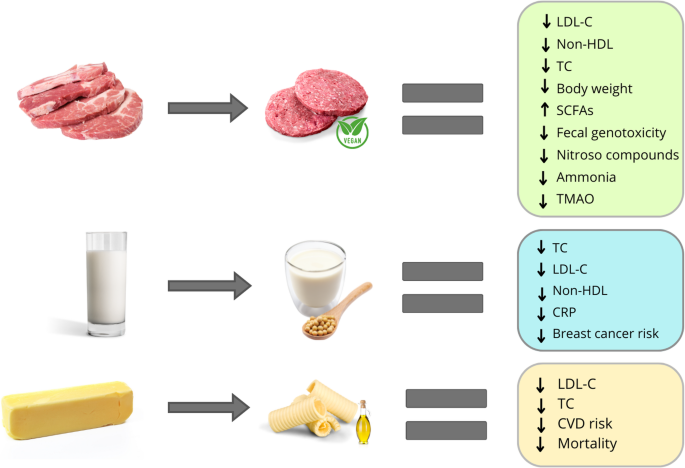

This post has been getting a lot of attention from both vegans and non-vegans, but it’s quite obviously bullshit. This video covers it pretty well.
This post has been getting a lot of attention from both vegans and non-vegans, but it’s quite obviously bullshit. This video covers it pretty well.
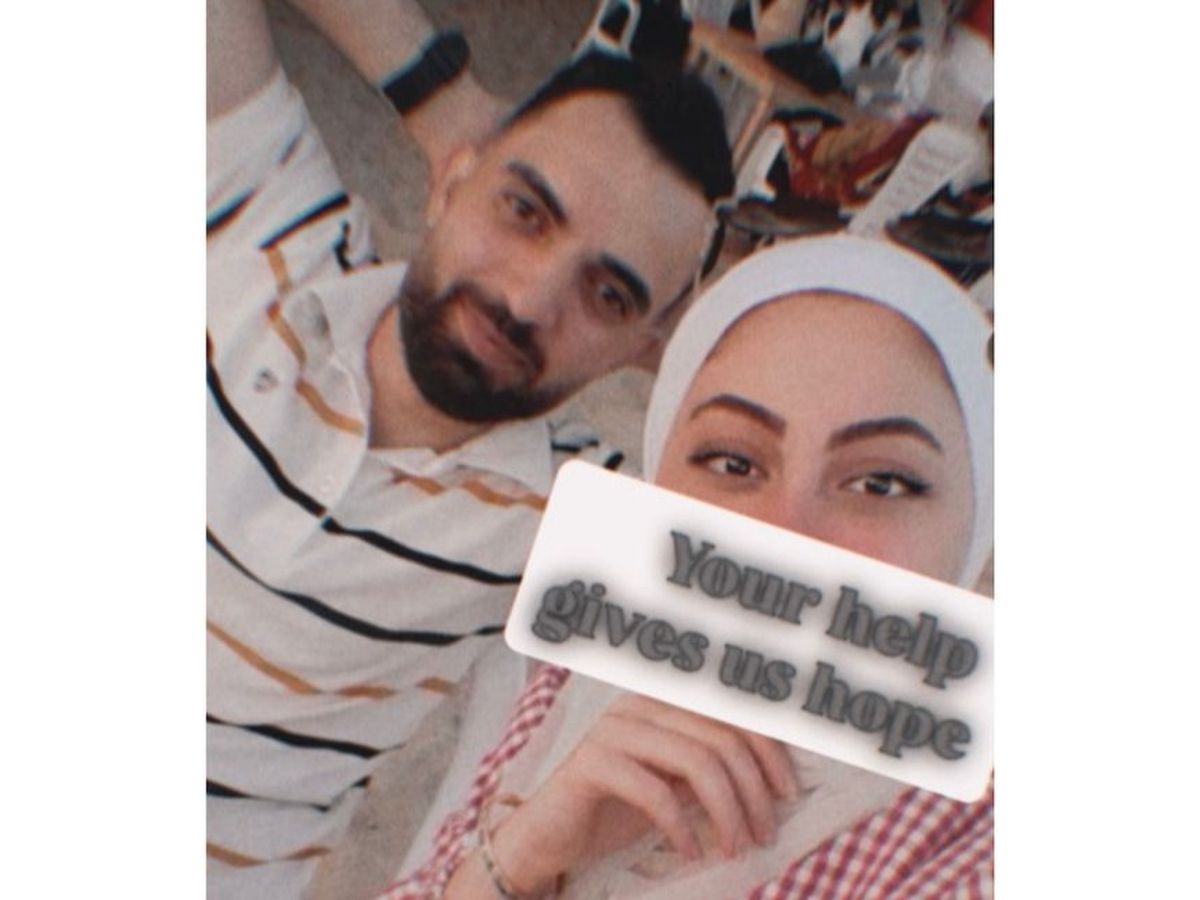

This was on a post asking “Is veganism apolitical?” or something like that, I believe. This is an older picture someone else sent me.
Here is a follow-up comment she made after someone asked her if she is vegan:

This was on a post asking “Is veganism apolitical?” or something like that, I believe. This is an older picture someone else sent me.
Here is a follow-up comment she made after someone asked her if she is vegan:

As you may or may not know, there are proposals to change/update the hexbear CoC here. This is an extension of the original discussion thread here.
The original CoC states:
Animal Liberation is essential to any leftist movement, including platforms like Hexbear. Volunteers, comments, and posts, should not be anti-vegan, although users and volunteers are not required to be vegan.
Any pictures of food containing animal products, including but not limited to meat, cheese, or egg, must be tagged nsfw along with food discussion content warnings (CW: Food).
The question I would like to pose to this community is:
I made a draft using placeholder text based on the original CoC line:
Animal liberation is part of the struggle against capitalism. While we don’t require everyone on hexbear be vegan, we do require everyone to observe basic decency. Users are required to use content warnings on any post, site-wide, that contains animal abuse content. This includes food and animal products.
- Do not debate about animal abuse.
- Do not antagonize vegans.
- Do not test this guideline or rule by posting increasingly abstract pictures of food or animal products.
- Do not pass off pictures of animal products as vegan, do not pass off pictures of vegan food as animal products.
Failure to use content warnings properly or failing to observe the principles of animal liberation can result in your post being removed and/or further moderator action.
However, I do not think this should be the final text. I would much rather this community choose something that you feel better represents you. Users who contribute will be cited as contributors in the draft of the updated CoC. I will share a summary of the results in the discussion thread here.