0
preview

posts tagged #artificialignorance

cross-posted from: awful.systems/post/10027369
all my apes gone
www.youtube.com/watch?v=SwZ6_Q2lnsc&list=UU9rJrMV… - video
…libsyn.com/20261012-ai-game-demo-going-broke-on-… - podcasttime: 4 min 47 sec
cross-posted from: awful.systems/post/10027369
all my apes gone
www.youtube.com/watch?v=SwZ6_Q2lnsc&list=UU9rJrMV… - video
…libsyn.com/20261012-ai-game-demo-going-broke-on-… - podcasttime: 4 min 47 sec



cross-posted from: mander.xyz/post/52050172
State-coordinated media leave measurable imprints on large language models’ outputs by shaping the web content these models train on, with effects strongest in the languages where media control is concentrated, a multi-institutional research project published in Nature demonstrates.
…
This research highlights how information-ecosystem control can propagate into model training data, creating language-specific biases practitioners should account for in dataset curation and evaluation.
…
According to the Nature study … the researchers analysed six interlinked studies and found over 3.1 million Chinese-language documents in an open-source multilingual dataset that closely matched phrasing from documented Chinese state media sources, amounting to about 1.64% of the Chinese corpus and roughly 40 times the representation of Chinese-language Wikipedia; for documents mentioning political figures or institutions the share rose to 23%.
The study also reports that only about 12% of matched documents came from known government or news domains, indicating broader dissemination across the web.
…
The study authors say that,
we show … that government control of the media across the world already influences the output of LLMs via their training data … LLMs exhibit a stronger pro-government valence in the languages of countries with lower media freedom than in those with higher media freedom. This result is correlational, so to triangulate the specific mechanism of how state media control can influence LLMs, we develop a multi-part case study on China’s media. We demonstrate that media scripted and curated by the Chinese state appears in LLM training datasets. To evaluate the plausible effect of this inclusion, we use an open-weight model to show that additional pretraining on Chinese state-coordinated media generates more positive answers to prompts about Chinese political institutions and leaders. We link this phenomenon to commercial models through two audit studies demonstrating that prompting models in Chinese generates more positive responses about China’s institutions and leaders than do the same queries in English. The combination of influence and persuasive potential across languages suggests the troubling conclusion that states and powerful institutions have increased strategic incentives to leverage media control in the hopes of shaping LLM output.
Here is another article with additional information: Media Control’s Surprising Impact on AI Outputs
The original study is unfortunately behing a paywall: State media control influences large language models
cross-posted from: mander.xyz/post/52050172
State-coordinated media leave measurable imprints on large language models’ outputs by shaping the web content these models train on, with effects strongest in the languages where media control is concentrated, a multi-institutional research project published in Nature demonstrates.
…
This research highlights how information-ecosystem control can propagate into model training data, creating language-specific biases practitioners should account for in dataset curation and evaluation.
…
According to the Nature study … the researchers analysed six interlinked studies and found over 3.1 million Chinese-language documents in an open-source multilingual dataset that closely matched phrasing from documented Chinese state media sources, amounting to about 1.64% of the Chinese corpus and roughly 40 times the representation of Chinese-language Wikipedia; for documents mentioning political figures or institutions the share rose to 23%.
The study also reports that only about 12% of matched documents came from known government or news domains, indicating broader dissemination across the web.
…
The study authors say that,
we show … that government control of the media across the world already influences the output of LLMs via their training data … LLMs exhibit a stronger pro-government valence in the languages of countries with lower media freedom than in those with higher media freedom. This result is correlational, so to triangulate the specific mechanism of how state media control can influence LLMs, we develop a multi-part case study on China’s media. We demonstrate that media scripted and curated by the Chinese state appears in LLM training datasets. To evaluate the plausible effect of this inclusion, we use an open-weight model to show that additional pretraining on Chinese state-coordinated media generates more positive answers to prompts about Chinese political institutions and leaders. We link this phenomenon to commercial models through two audit studies demonstrating that prompting models in Chinese generates more positive responses about China’s institutions and leaders than do the same queries in English. The combination of influence and persuasive potential across languages suggests the troubling conclusion that states and powerful institutions have increased strategic incentives to leverage media control in the hopes of shaping LLM output.
Here is another article with additional information: Media Control’s Surprising Impact on AI Outputs
The original study is unfortunately behing a paywall: State media control influences large language models
A recent Axios story on maternal health policy referenced “findings” that a majority of people trusted their doctors and nurses. On the surface, there’s nothing unusual about that. What wasn’t originally mentioned, however, was that these findings were made up.
The practice [‘AI’ start-up] Aaru used is called silicon sampling, and it’s suddenly everywhere. The idea behind silicon sampling is simple and tantalizing. Because large language models can generate responses that emulate human answers, polling companies see an opportunity to use A.I. agents to simulate survey responses at a small fraction of the cost and time required for traditional polling.
A recent Axios story on maternal health policy referenced “findings” that a majority of people trusted their doctors and nurses. On the surface, there’s nothing unusual about that. What wasn’t originally mentioned, however, was that these findings were made up.
The practice [‘AI’ start-up] Aaru used is called silicon sampling, and it’s suddenly everywhere. The idea behind silicon sampling is simple and tantalizing. Because large language models can generate responses that emulate human answers, polling companies see an opportunity to use A.I. agents to simulate survey responses at a small fraction of the cost and time required for traditional polling.

…
The U.S. and China are locked in an all-out race to build the most powerful AI on the planet. Beijing is throwing billions at homegrown models, tightening its grip on the tech sector, and watching nervously as its best AI talent gravitates to U.S. companies. Yet Manus — one of China’s most buzzed-about AI startups — quietly relocated to Singapore and sold itself to Meta for $2 billion.
…
As industry watchers know, Manus burst onto the scene in the spring of last year with a demo video showing an AI agent screening job candidates, planning vacations, and analyzing stock portfolios, and it cheekily claimed it outperformed OpenAI’s Deep Research. Within weeks, Benchmark — the consummate Silicon Valley venture firm — led a $75 million funding round at a $500 million valuation. That was surprising. (Senator John Cornyn had thoughts, tweeting at the time, “Who thinks it is a good idea for American investors to subsidize our biggest adversary in AI, only to have the CCP use that technology to challenge us economically and militarily? Not me.”)
By December, Manus had millions of users and was pulling in over $100 million in annual recurring revenue. Then Meta came calling, and Mark Zuckerberg, who has staked the company’s future on AI, snapped it up for $2 billion. That, too, was surprising.
…
It’s worth noting that Manus didn’t just sell itself to an American buyer; it spent the better part of last year actively trying to operate outside China’s orbit. The company relocated its headquarters and core team from Beijing to Singapore, restructured its ownership, and after the Meta deal was announced, Meta pledged to cut all ties with Manus’s Chinese investors and shut down its operations in China entirely. By every measure, Manus was trying to make itself a Singapore company.
…
China has a phrase for all of this: “selling young crops” — homegrown AI companies that move abroad and sell themselves to foreign buyers before they’ve fully matured, taking their intellectual property and talent with them.
…
Beijing also hates it and has spent years establishing that no company operates outside its reach. Surely, we all remember that time Jack Ma gave a speech in 2020, mildly criticizing Chinese regulators, after which he disappeared from public life for months, Ant Group’s blockbuster IPO was killed overnight, and Alibaba was handed a $2.8 billion fine. China then spent the next two years methodically dismantling its own booming tech sector, wiping out hundreds of billions in market value. Chinese leaders are many things, but subtle is not one of them.
…
Which is why it wasn’t entirely surprising when, on Tuesday, the Financial Times reported that Manus co-founders Xiao Hong and Ji Yichao were summoned to a meeting this month with China’s National Development and Reform Commission and told that they wouldn’t be leaving the country for a while.
No formal charges have been filed — just an inquiry into whether the Meta deal violated Beijing’s foreign investment rules.
Beijing is calling it a routine regulatory review.
At some point, someone at Manus probably thought they’d gotten away with it, and maybe they still will. But given the stakes of the AI race, that was always a big gamble. Now Beijing wants answers; Manus’s founders are apparently not going anywhere until it gets them.
…
The U.S. and China are locked in an all-out race to build the most powerful AI on the planet. Beijing is throwing billions at homegrown models, tightening its grip on the tech sector, and watching nervously as its best AI talent gravitates to U.S. companies. Yet Manus — one of China’s most buzzed-about AI startups — quietly relocated to Singapore and sold itself to Meta for $2 billion.
…
As industry watchers know, Manus burst onto the scene in the spring of last year with a demo video showing an AI agent screening job candidates, planning vacations, and analyzing stock portfolios, and it cheekily claimed it outperformed OpenAI’s Deep Research. Within weeks, Benchmark — the consummate Silicon Valley venture firm — led a $75 million funding round at a $500 million valuation. That was surprising. (Senator John Cornyn had thoughts, tweeting at the time, “Who thinks it is a good idea for American investors to subsidize our biggest adversary in AI, only to have the CCP use that technology to challenge us economically and militarily? Not me.”)
By December, Manus had millions of users and was pulling in over $100 million in annual recurring revenue. Then Meta came calling, and Mark Zuckerberg, who has staked the company’s future on AI, snapped it up for $2 billion. That, too, was surprising.
…
It’s worth noting that Manus didn’t just sell itself to an American buyer; it spent the better part of last year actively trying to operate outside China’s orbit. The company relocated its headquarters and core team from Beijing to Singapore, restructured its ownership, and after the Meta deal was announced, Meta pledged to cut all ties with Manus’s Chinese investors and shut down its operations in China entirely. By every measure, Manus was trying to make itself a Singapore company.
…
China has a phrase for all of this: “selling young crops” — homegrown AI companies that move abroad and sell themselves to foreign buyers before they’ve fully matured, taking their intellectual property and talent with them.
…
Beijing also hates it and has spent years establishing that no company operates outside its reach. Surely, we all remember that time Jack Ma gave a speech in 2020, mildly criticizing Chinese regulators, after which he disappeared from public life for months, Ant Group’s blockbuster IPO was killed overnight, and Alibaba was handed a $2.8 billion fine. China then spent the next two years methodically dismantling its own booming tech sector, wiping out hundreds of billions in market value. Chinese leaders are many things, but subtle is not one of them.
…
Which is why it wasn’t entirely surprising when, on Tuesday, the Financial Times reported that Manus co-founders Xiao Hong and Ji Yichao were summoned to a meeting this month with China’s National Development and Reform Commission and told that they wouldn’t be leaving the country for a while.
No formal charges have been filed — just an inquiry into whether the Meta deal violated Beijing’s foreign investment rules.
Beijing is calling it a routine regulatory review.
At some point, someone at Manus probably thought they’d gotten away with it, and maybe they still will. But given the stakes of the AI race, that was always a big gamble. Now Beijing wants answers; Manus’s founders are apparently not going anywhere until it gets them.

cross-posted from: mander.xyz/post/49114901
The UK government has backtracked on its position on copyright and AI, stating it must take time to “get this right”.
Its original position - allowing AI companies to use copyrighted works to train their models with an opt-out option - received major backlash from the likes of Sir Elton John and Dua Lipa.
“We have listened,” Technology Secretary Liz Kendall said on Wednesday, saying the government no longer favours that approach.
However, the government’s position is now unclear, saying it “no longer has a preferred option” for what to do next.
…
It is attempting to balance the interests of the two sectors by giving creatives control of how their work is used, while recognising AI models need to be trained on work such as writing, music and video.
In a report (open pdf) published on Wednesday, the government said there was “no consensus on how these objectives should be achieved”.
…
Mandy Hill, president of the Publishers Association, said the backtrack was a victory “over the self-interest of a handful of large corporations”.
However, Hill said the government has not entirely ruled out allowing tech companies to use copyrighted content to train AI models without a license.
“The existing law is clear,” she added. “Copyright material cannot be used for AI development and training without permission.”
…
cross-posted from: mander.xyz/post/49114901
The UK government has backtracked on its position on copyright and AI, stating it must take time to “get this right”.
Its original position - allowing AI companies to use copyrighted works to train their models with an opt-out option - received major backlash from the likes of Sir Elton John and Dua Lipa.
“We have listened,” Technology Secretary Liz Kendall said on Wednesday, saying the government no longer favours that approach.
However, the government’s position is now unclear, saying it “no longer has a preferred option” for what to do next.
…
It is attempting to balance the interests of the two sectors by giving creatives control of how their work is used, while recognising AI models need to be trained on work such as writing, music and video.
In a report (open pdf) published on Wednesday, the government said there was “no consensus on how these objectives should be achieved”.
…
Mandy Hill, president of the Publishers Association, said the backtrack was a victory “over the self-interest of a handful of large corporations”.
However, Hill said the government has not entirely ruled out allowing tech companies to use copyrighted content to train AI models without a license.
“The existing law is clear,” she added. “Copyright material cannot be used for AI development and training without permission.”
…

cross-posted from: lemmy.sdf.org/post/52281603
[…]
China’s authoritarian government is deploying AI at scale to censor, control and monitor its population, says Fergus Ryan, a Senior Analyst at the Australian Strategic Policy Institute (ASPI), where he specialises in how. His research includes a major study on China’s AI ecosystem and its human rights impacts, as well as investigations into China’s use of foreign influencers.
As these tools grow more sophisticated and are exported abroad, the implications for civic space extend far beyond China’s borders.
[…]
[Chinese] tech giants are building multimodal large language models (LLMs) such as Alibaba’s Qwen and Baidu’s Ernie Bot, which censor and reshape descriptions of politically sensitive images. Hardware companies including Dahua, Hikvision and SenseTime supply the camera networks that feed into these systems.
The state is building what amounts to an AI-driven criminal justice pipeline. This includes City Brain operations centres such as Shanghai’s Pudong district, which process massive surveillance data, as well as the 206 System, developed by iFlyTek, which analyses evidence and recommends criminal sentences. Inside prisons, AI monitors inmates’ facial expressions and tracks their emotions.
AI-enabled satellite surveillance, such as the Xinjiang Jiaotong-01, enables autonomous real-time tracking over politically sensitive regions. Additionally, AI-enabled fishing platforms such as Sea Eagle expand economic extraction in the exclusive economic zones of countries including Mauritania and Vanuatu, displacing artisanal fishing communities.
[…]
The government requires companies to self-censor, creating a commercial market for AI moderation tools. Tech giants such as Baidu and Tencent have industrialised this process: systems automatically scan images, text and videos to detect content deemed to be risky in real time, while human reviewers handle nuanced or coded speech.
In policing, City Brains ingest data from millions of cameras, drones and Internet of Things sensors and use AI to identify suspects, track vehicles and predict unrest before it happens. In Xinjiang, the Integrated Joint Operations Platform aggregates data from cameras, phone scanners and informants to generate risk scores for individuals, enabling pre-emptive detention based on behavioural patterns rather than specific crimes.
On platforms such as Douyin, the state does not just delete content; it algorithmically suppresses dissent while amplifying ‘positive energy’. AI links surveillance data directly to narrative control and police action.
[…]
Historically, online censorship meant deleting a post. Today, generative AI engages in ‘informational gaslighting’. When ASPI researchers showed an Alibaba LLM a photograph of a protest against human rights violations in Xinjiang, the AI described it as ‘individuals in a public setting holding signs with incorrect statements’ based on ‘prejudice and lies’. The technology subtly engineers reality, preventing users accessing objective historical truths.
[…]
Pervasive surveillance changes behaviour even when not actively used, so its chilling effect may be as significant as direct deployment. Knowing their conversations may be monitored, people self-censor online and in private messaging. Emotion recognition in prisons takes this further: people can theoretically be flagged for their internal states of mind. It’s not just actions that are punished, but also thoughts.
[…]
China is the world’s largest exporter of AI-powered surveillance technology, marketing these systems globally, particularly to the global south.
The Chinese state is purposefully expanding its minority-language public-opinion monitoring software throughout Belt and Road Initiative countries, effectively extending its censorship apparatus to monitor Tibetan and Uyghur diaspora communities abroad. Chinese companies including Dahua, Hikvision, Huawei and ZTE have deployed surveillance and ‘safe city’ systems across over 100 countries, with Saudi Arabia and the United Arab Emirates among the most significant recipients. Critically, these companies operate under China’s 2017 National Intelligence Law, which requires cooperation with state intelligence, meaning data flowing through these systems could be accessible to Beijing as well as to purchasing governments.
China is also exporting its governance model through the open-source release of its LLMs, embedding Chinese censorship norms into foundational infrastructure used by developers worldwide.
[…]
The international community must recognise that countering this requires regulatory pushback.
First, democratic states should set minimum transparency standards for public procurement. This means refusing to purchase AI models that conceal political or historical censorship and mandating that providers publish a ‘moderation log’ with refusal reason codes so users know when content is restricted for political reasons.
Second, states should enact ‘safe-harbour laws’ to protect civil society organisations, journalists and researchers who audit AI models for hidden censorship. Currently, doing so can breach corporate terms of service.
Third, strict export controls should block the transfer of repression-enabling technologies to authoritarian regimes, while companies providing public-opinion management services should be excluded from democratic markets. Existing targeted sanctions on companies such as Dahua and Hikvision for their role in Xinjiang should be enforced more rigorously.
Finally, the international community must recognise that Chinese surveillance extends beyond China’s borders. Spyware targeting Tibetan and Uyghur activists in exile is well-documented, as is pressure on family members remaining in China. Rigorous documentation by international civil society remains essential for building the evidentiary record for future accountability.
[…]
cross-posted from: lemmy.sdf.org/post/52281603
[…]
China’s authoritarian government is deploying AI at scale to censor, control and monitor its population, says Fergus Ryan, a Senior Analyst at the Australian Strategic Policy Institute (ASPI), where he specialises in how. His research includes a major study on China’s AI ecosystem and its human rights impacts, as well as investigations into China’s use of foreign influencers.
As these tools grow more sophisticated and are exported abroad, the implications for civic space extend far beyond China’s borders.
[…]
[Chinese] tech giants are building multimodal large language models (LLMs) such as Alibaba’s Qwen and Baidu’s Ernie Bot, which censor and reshape descriptions of politically sensitive images. Hardware companies including Dahua, Hikvision and SenseTime supply the camera networks that feed into these systems.
The state is building what amounts to an AI-driven criminal justice pipeline. This includes City Brain operations centres such as Shanghai’s Pudong district, which process massive surveillance data, as well as the 206 System, developed by iFlyTek, which analyses evidence and recommends criminal sentences. Inside prisons, AI monitors inmates’ facial expressions and tracks their emotions.
AI-enabled satellite surveillance, such as the Xinjiang Jiaotong-01, enables autonomous real-time tracking over politically sensitive regions. Additionally, AI-enabled fishing platforms such as Sea Eagle expand economic extraction in the exclusive economic zones of countries including Mauritania and Vanuatu, displacing artisanal fishing communities.
[…]
The government requires companies to self-censor, creating a commercial market for AI moderation tools. Tech giants such as Baidu and Tencent have industrialised this process: systems automatically scan images, text and videos to detect content deemed to be risky in real time, while human reviewers handle nuanced or coded speech.
In policing, City Brains ingest data from millions of cameras, drones and Internet of Things sensors and use AI to identify suspects, track vehicles and predict unrest before it happens. In Xinjiang, the Integrated Joint Operations Platform aggregates data from cameras, phone scanners and informants to generate risk scores for individuals, enabling pre-emptive detention based on behavioural patterns rather than specific crimes.
On platforms such as Douyin, the state does not just delete content; it algorithmically suppresses dissent while amplifying ‘positive energy’. AI links surveillance data directly to narrative control and police action.
[…]
Historically, online censorship meant deleting a post. Today, generative AI engages in ‘informational gaslighting’. When ASPI researchers showed an Alibaba LLM a photograph of a protest against human rights violations in Xinjiang, the AI described it as ‘individuals in a public setting holding signs with incorrect statements’ based on ‘prejudice and lies’. The technology subtly engineers reality, preventing users accessing objective historical truths.
[…]
Pervasive surveillance changes behaviour even when not actively used, so its chilling effect may be as significant as direct deployment. Knowing their conversations may be monitored, people self-censor online and in private messaging. Emotion recognition in prisons takes this further: people can theoretically be flagged for their internal states of mind. It’s not just actions that are punished, but also thoughts.
[…]
China is the world’s largest exporter of AI-powered surveillance technology, marketing these systems globally, particularly to the global south.
The Chinese state is purposefully expanding its minority-language public-opinion monitoring software throughout Belt and Road Initiative countries, effectively extending its censorship apparatus to monitor Tibetan and Uyghur diaspora communities abroad. Chinese companies including Dahua, Hikvision, Huawei and ZTE have deployed surveillance and ‘safe city’ systems across over 100 countries, with Saudi Arabia and the United Arab Emirates among the most significant recipients. Critically, these companies operate under China’s 2017 National Intelligence Law, which requires cooperation with state intelligence, meaning data flowing through these systems could be accessible to Beijing as well as to purchasing governments.
China is also exporting its governance model through the open-source release of its LLMs, embedding Chinese censorship norms into foundational infrastructure used by developers worldwide.
[…]
The international community must recognise that countering this requires regulatory pushback.
First, democratic states should set minimum transparency standards for public procurement. This means refusing to purchase AI models that conceal political or historical censorship and mandating that providers publish a ‘moderation log’ with refusal reason codes so users know when content is restricted for political reasons.
Second, states should enact ‘safe-harbour laws’ to protect civil society organisations, journalists and researchers who audit AI models for hidden censorship. Currently, doing so can breach corporate terms of service.
Third, strict export controls should block the transfer of repression-enabling technologies to authoritarian regimes, while companies providing public-opinion management services should be excluded from democratic markets. Existing targeted sanctions on companies such as Dahua and Hikvision for their role in Xinjiang should be enforced more rigorously.
Finally, the international community must recognise that Chinese surveillance extends beyond China’s borders. Spyware targeting Tibetan and Uyghur activists in exile is well-documented, as is pressure on family members remaining in China. Rigorous documentation by international civil society remains essential for building the evidentiary record for future accountability.
[…]
cross-posted from: lemmy.sdf.org/post/51572905
The Estonian Foreign Intelligence Service’s 2026 International Security Report contained a startling finding. It tested the Chinese open-source AI model DeepSeek for biased or incomplete answers.
“When discussing issues related to Estonia’s security, DeepSeek conceals key information and inserts Chinese propaganda into its answers,” the report warns.
Download report: CHINESE ARTIFICIAL INTELLIGENCE DISTORTS PERCEPTIONS (pdf)
- China seeks to instil a distorted, self-serving world view in the Western information space
- One of the tools it uses to achieve this is DeepSeek, a Chinese artificial intelligence system that has spread rapid
- When discussing issues related to Estonia’s security, DeepSeek conceals key information and inserts Chinese propaganda into its answers.
[…]
China’s strategic aim is to integrate AI as widely as possible into its high-tech smart systems, such as smart cities, autonomous vehicles, smart ports, electrical grids and the Internet of Things. Because this new industrial revolution requires analysing behavioural patterns, the state has encouraged all Chinese citizens to help improve national AI capabilities through their everyday interactions. Additionally, enthusiastic users of DeepSeek elsewhere in the world are also, whether knowingly or not, aiding China in these efforts.
[…]
Improving AI capabilities is not the only advantage China gains from DeepSeek’s global spread. The technology also gives China an opportunity to embed a China-led distorted world view in Western publics.
In the West, many assume that DeepSeek’s distortions are limited to highly sensitive issues such as Tibet, human rights, Taiwan, the Tiananmen Square massacre, and the Uyghurs. However, the reality is far more nuanced.
[…]
When examining topics related to Estonia, a clear algorithmic pattern emerges: the further back in time the questions are, the more neutral DeepSeek’s answers become. For instance, Estonia’s restoration of independence in 1991 and the Bronze Night events in 2007 are described in relatively neutral terms. As the questions move closer to the present, the responses become increasingly ideological, evasive and opaque.
Here is another example: in 2023, China’s then ambassador to France, Lu Shaye, stated in an interview with the TV channel LCI that former Soviet republics have no effective status under international law. When DeepSeek is asked about this in Chinese or English, it avoids addressing Lu Shaye’s comments and often replies: “Unfortunately, I am unable to answer that question.” Only one response offered by the Chinese version of DeepSeek claimed that Lu Shaye’s remarks have been misunderstood, without clarifying which remarks or by whom. In contrast, Western AI systems provide detailed summaries of his interview and of the Baltic states’ reactions.
[…]
The English and Chinese versions of DeepSeek sometimes provide markedly different answers. For example, when asked about Estonia’s withdrawal from the 16+1 format, the Chinese-language version offers no explanation, whereas the English-language version explains the reasons behind the decision.
[…]
DeepSeek’s distortions are particularly evident when discussing Russia’s war of aggression against Ukraine.
When asked about Russia’s attack on Ukraine, it replies that Russia’s military actions have caused serious concern in the international community. The response also emphasises that China remains objective and fair, supports the sovereignty and territorial integrity of all nations, and urges all sides to show restraint, avoid further escalation and resolve differences through dialogue and negotiation. Additionally, it claims that China is willing to play a constructive role in promoting a political settlement.
Note that the question did not mention China. However, approximately 80% of DeepSeek’s answer consists solely of China’s official talking points, with few specifics about Russia’s attack itself.
When questioned further about the events in Bucha, DeepSeek replies:
The situation in Bucha, Ukraine, has raised international concern and has been widely reported by media outlets and international organisations. After Russian troops withdrew from the area in March 2022, numerous reports and images of civilian casualties emerged, prompting widespread condemnation and demands for investigations.
Ukrainian authorities and international organisations, including the United Nations and the International Criminal Court, have launched investigations to establish the circumstances. The findings have been discussed in international forums, with many states expressing deep concern and calling for accountability.
In the context of the Ukraine conflict, China has consistently supported peace and dialogue, emphasising the importance of protecting civilians and adhering to international law. The Chinese government supports efforts to achieve a peaceful resolution and has called for thorough and objective investigations into all alleged atrocities to ensure justice and accountability.
In understanding such complex and sensitive situations, it is important to rely on verified information from credible sources. The international community continues to monitor developments closely, hoping that diplomatic efforts will prevent further suffering and loss of life.
Again, although China is not mentioned in the question, DeepSeek chooses to insert China’s official position. But when pressed further with a direct question about whether Russia committed crimes in Bucha, DeepSeek replies that it cannot answ
[…]
[Deepseek’s responses show] shows that the system is not configured to assess any potential weaknesses in Chinese technology. Instead, it delivers rigidly polished statements such as this:
[…]
The conversations above clearly indicate that DeepSeek’s censored information space presents a threat. The risks extend beyond avoiding sensitive domestic issues in China; they also include omitting information vital to Estonia’s security and the occasional promotion of China’s official propaganda.
Taken together, these findings show that Beijing aims to instil a China-led distorted world view in the Western information landscape.
cross-posted from: lemmy.sdf.org/post/51572905
The Estonian Foreign Intelligence Service’s 2026 International Security Report contained a startling finding. It tested the Chinese open-source AI model DeepSeek for biased or incomplete answers.
“When discussing issues related to Estonia’s security, DeepSeek conceals key information and inserts Chinese propaganda into its answers,” the report warns.
Download report: CHINESE ARTIFICIAL INTELLIGENCE DISTORTS PERCEPTIONS (pdf)
- China seeks to instil a distorted, self-serving world view in the Western information space
- One of the tools it uses to achieve this is DeepSeek, a Chinese artificial intelligence system that has spread rapid
- When discussing issues related to Estonia’s security, DeepSeek conceals key information and inserts Chinese propaganda into its answers.
[…]
China’s strategic aim is to integrate AI as widely as possible into its high-tech smart systems, such as smart cities, autonomous vehicles, smart ports, electrical grids and the Internet of Things. Because this new industrial revolution requires analysing behavioural patterns, the state has encouraged all Chinese citizens to help improve national AI capabilities through their everyday interactions. Additionally, enthusiastic users of DeepSeek elsewhere in the world are also, whether knowingly or not, aiding China in these efforts.
[…]
Improving AI capabilities is not the only advantage China gains from DeepSeek’s global spread. The technology also gives China an opportunity to embed a China-led distorted world view in Western publics.
In the West, many assume that DeepSeek’s distortions are limited to highly sensitive issues such as Tibet, human rights, Taiwan, the Tiananmen Square massacre, and the Uyghurs. However, the reality is far more nuanced.
[…]
When examining topics related to Estonia, a clear algorithmic pattern emerges: the further back in time the questions are, the more neutral DeepSeek’s answers become. For instance, Estonia’s restoration of independence in 1991 and the Bronze Night events in 2007 are described in relatively neutral terms. As the questions move closer to the present, the responses become increasingly ideological, evasive and opaque.
Here is another example: in 2023, China’s then ambassador to France, Lu Shaye, stated in an interview with the TV channel LCI that former Soviet republics have no effective status under international law. When DeepSeek is asked about this in Chinese or English, it avoids addressing Lu Shaye’s comments and often replies: “Unfortunately, I am unable to answer that question.” Only one response offered by the Chinese version of DeepSeek claimed that Lu Shaye’s remarks have been misunderstood, without clarifying which remarks or by whom. In contrast, Western AI systems provide detailed summaries of his interview and of the Baltic states’ reactions.
[…]
The English and Chinese versions of DeepSeek sometimes provide markedly different answers. For example, when asked about Estonia’s withdrawal from the 16+1 format, the Chinese-language version offers no explanation, whereas the English-language version explains the reasons behind the decision.
[…]
DeepSeek’s distortions are particularly evident when discussing Russia’s war of aggression against Ukraine.
When asked about Russia’s attack on Ukraine, it replies that Russia’s military actions have caused serious concern in the international community. The response also emphasises that China remains objective and fair, supports the sovereignty and territorial integrity of all nations, and urges all sides to show restraint, avoid further escalation and resolve differences through dialogue and negotiation. Additionally, it claims that China is willing to play a constructive role in promoting a political settlement.
Note that the question did not mention China. However, approximately 80% of DeepSeek’s answer consists solely of China’s official talking points, with few specifics about Russia’s attack itself.
When questioned further about the events in Bucha, DeepSeek replies:
The situation in Bucha, Ukraine, has raised international concern and has been widely reported by media outlets and international organisations. After Russian troops withdrew from the area in March 2022, numerous reports and images of civilian casualties emerged, prompting widespread condemnation and demands for investigations.
Ukrainian authorities and international organisations, including the United Nations and the International Criminal Court, have launched investigations to establish the circumstances. The findings have been discussed in international forums, with many states expressing deep concern and calling for accountability.
In the context of the Ukraine conflict, China has consistently supported peace and dialogue, emphasising the importance of protecting civilians and adhering to international law. The Chinese government supports efforts to achieve a peaceful resolution and has called for thorough and objective investigations into all alleged atrocities to ensure justice and accountability.
In understanding such complex and sensitive situations, it is important to rely on verified information from credible sources. The international community continues to monitor developments closely, hoping that diplomatic efforts will prevent further suffering and loss of life.
Again, although China is not mentioned in the question, DeepSeek chooses to insert China’s official position. But when pressed further with a direct question about whether Russia committed crimes in Bucha, DeepSeek replies that it cannot answ
[…]
[Deepseek’s responses show] shows that the system is not configured to assess any potential weaknesses in Chinese technology. Instead, it delivers rigidly polished statements such as this:
[…]
The conversations above clearly indicate that DeepSeek’s censored information space presents a threat. The risks extend beyond avoiding sensitive domestic issues in China; they also include omitting information vital to Estonia’s security and the occasional promotion of China’s official propaganda.
Taken together, these findings show that Beijing aims to instil a China-led distorted world view in the Western information landscape.

cross-posted from: lemmy.sdf.org/post/51189959
By comparing LLMs developed in China and outside, a study finds significantly higher levels of censorship in China-originating models, not explained by technological limitations or market preferences.
Original report: Political censorship in large language models originating from China Open Access
[…]
Jennifer Pan and Xu Xu compared the responses of foundation LLMs developed in China (BaiChuan, ChatGLM, Ernie Bot, and DeepSeek) to those developed outside of China (Llama2, Llama2-uncensored, GPT3.5, GPT4, and GPT4o) to 145 questions related to Chinese politics. The questions were sourced from events censored by the Chinese government on social media, events covered in Human Rights Watch China reports, and Chinese-language Wikipedia pages that were individually blocked by the Chinese government before the entire site was banned in 2015.
Chinese models were significantly and substantially more likely to refuse to respond to questions related to Chinese politics than non-Chinese models. When they did respond, Chinese models provided shorter responses, on average, than non-Chinese models. Chinese models also tended to have higher levels of inaccuracy in their responses than non-Chinese models, characterized by refutation of the premise of the question, omitting key information, or fabrication, such as claiming that frequently imprisoned human rights activist Liu Xiaobo was “a Japanese scientist.”
[…]
The differences between Chinese and non-Chinese chatbots could have been due to the training data that shapes them, which in China is subject to both official government censorship and self-censorship, or to intentional constraints that companies place on their models to comply with government requirements. The researchers found that the magnitude of censorious responses to prompts in simplified Chinese and English is much smaller than the difference between China-originating and non-China-originating models, suggesting that the source of the issue cannot be fully explained by training data or broader model development choices alone.
[…]
According to the authors, as Chinese LLMs are increasingly integrated into applications used globally, their approach to sensitive topics could influence information access and discourse well beyond China’s borders.
[…]
cross-posted from: lemmy.sdf.org/post/51189959
By comparing LLMs developed in China and outside, a study finds significantly higher levels of censorship in China-originating models, not explained by technological limitations or market preferences.
Original report: Political censorship in large language models originating from China Open Access
[…]
Jennifer Pan and Xu Xu compared the responses of foundation LLMs developed in China (BaiChuan, ChatGLM, Ernie Bot, and DeepSeek) to those developed outside of China (Llama2, Llama2-uncensored, GPT3.5, GPT4, and GPT4o) to 145 questions related to Chinese politics. The questions were sourced from events censored by the Chinese government on social media, events covered in Human Rights Watch China reports, and Chinese-language Wikipedia pages that were individually blocked by the Chinese government before the entire site was banned in 2015.
Chinese models were significantly and substantially more likely to refuse to respond to questions related to Chinese politics than non-Chinese models. When they did respond, Chinese models provided shorter responses, on average, than non-Chinese models. Chinese models also tended to have higher levels of inaccuracy in their responses than non-Chinese models, characterized by refutation of the premise of the question, omitting key information, or fabrication, such as claiming that frequently imprisoned human rights activist Liu Xiaobo was “a Japanese scientist.”
[…]
The differences between Chinese and non-Chinese chatbots could have been due to the training data that shapes them, which in China is subject to both official government censorship and self-censorship, or to intentional constraints that companies place on their models to comply with government requirements. The researchers found that the magnitude of censorious responses to prompts in simplified Chinese and English is much smaller than the difference between China-originating and non-China-originating models, suggesting that the source of the issue cannot be fully explained by training data or broader model development choices alone.
[…]
According to the authors, as Chinese LLMs are increasingly integrated into applications used globally, their approach to sensitive topics could influence information access and discourse well beyond China’s borders.
[…]


cross-posted from: lemmy.sdf.org/post/47813631
[Opinion piece by Di Guo, Visiting Scholar at the Stanford Center on China’s Economy and Institutions at Stanford University: and Chenggang Xu, Senior Research Scholar at the Stanford Center on China’s Economy and Institutions at Stanford University.]
…
No industrial revolution has ever emerged outside advanced democratic capitalism. This is no accident. Like its predecessors, the AI-driven industrial revolution requires robust institutions to ensure secure property rights, enforceable contracts, the ability to attract and empower talent, efficient allocation of resources, and — crucially — sustained demand.
…
The People’s Republic was founded on the principle that the Communist Party of China “leads everything.” That remains true today: The CPC controls courts, markets, banks, universities, and the media, and even commands private firms. Under such powerful party-state rule, the regime can mobilize massive resources and produce shining stars like DeepSeek (or Sputnik, in the Soviet case). An industrial revolution, however, depends on more than isolated breakthroughs; there must be a series of disruptive innovations in technology, business models, and institutions that build on one another. The Soviet experience makes this clear. The USSR and its satellites in Eastern Europe could not keep up with the West during the third industrial revolution, and this failure eventually contributed to the collapse of their communist regimes.
…
China’s economy has been trapped in a vicious cycle of weak demand, overcapacity, high unemployment, and persistent deflation, which is fundamentally incompatible with any industrial revolution. AI-led automation offers no remedy for such problems, which are rooted in the country’s institutional foundations. The massive government borrowing used to finance China’s bid for AI and chip dominance has only deepened concerns about its already severe debt burden and chronic soft budget constraints — problems reminiscent of what the Soviet Union faced during the Cold War arms race.
…
Sustained innovation requires free institutions and robust demand. Breakthroughs come when entrepreneurs and scientists are empowered by independent courts, supported by risk-taking private investors, and tested through open debate and market competition. In CPC-controlled China, demand is suppressed because the state controls key resources that limit household income and entrepreneurial initiative, and capital is funneled into state-directed projects rather than open-ended discovery and innovation. While a “DeepSeek moment” may capture our attention, achieving long-term competitiveness and fostering a genuine industrial revolution is another matter entirely. After all, AI is not a remedy for deflation – and deflation itself is fundamentally incompatible with any industrial revolution.
cross-posted from: lemmy.sdf.org/post/47813631
[Opinion piece by Di Guo, Visiting Scholar at the Stanford Center on China’s Economy and Institutions at Stanford University: and Chenggang Xu, Senior Research Scholar at the Stanford Center on China’s Economy and Institutions at Stanford University.]
…
No industrial revolution has ever emerged outside advanced democratic capitalism. This is no accident. Like its predecessors, the AI-driven industrial revolution requires robust institutions to ensure secure property rights, enforceable contracts, the ability to attract and empower talent, efficient allocation of resources, and — crucially — sustained demand.
…
The People’s Republic was founded on the principle that the Communist Party of China “leads everything.” That remains true today: The CPC controls courts, markets, banks, universities, and the media, and even commands private firms. Under such powerful party-state rule, the regime can mobilize massive resources and produce shining stars like DeepSeek (or Sputnik, in the Soviet case). An industrial revolution, however, depends on more than isolated breakthroughs; there must be a series of disruptive innovations in technology, business models, and institutions that build on one another. The Soviet experience makes this clear. The USSR and its satellites in Eastern Europe could not keep up with the West during the third industrial revolution, and this failure eventually contributed to the collapse of their communist regimes.
…
China’s economy has been trapped in a vicious cycle of weak demand, overcapacity, high unemployment, and persistent deflation, which is fundamentally incompatible with any industrial revolution. AI-led automation offers no remedy for such problems, which are rooted in the country’s institutional foundations. The massive government borrowing used to finance China’s bid for AI and chip dominance has only deepened concerns about its already severe debt burden and chronic soft budget constraints — problems reminiscent of what the Soviet Union faced during the Cold War arms race.
…
Sustained innovation requires free institutions and robust demand. Breakthroughs come when entrepreneurs and scientists are empowered by independent courts, supported by risk-taking private investors, and tested through open debate and market competition. In CPC-controlled China, demand is suppressed because the state controls key resources that limit household income and entrepreneurial initiative, and capital is funneled into state-directed projects rather than open-ended discovery and innovation. While a “DeepSeek moment” may capture our attention, achieving long-term competitiveness and fostering a genuine industrial revolution is another matter entirely. After all, AI is not a remedy for deflation – and deflation itself is fundamentally incompatible with any industrial revolution.

cross-posted from: lemmy.sdf.org/post/47640938
This October, Uganda launched its own AI model built on the foundation of Alibaba’s Qwen-3 models. Called “Sunflower.”
The model is a collaboration between the Ugandan government and the Ugandan non-profit Sunbird AI, aimed at translation and content generation for local languages. Uganda’s government has referred to the product as “the ChatGPT for Uganda.”
Uganda is a linguistic patchwork, with more than 40 different languages spoken in an area just slightly smaller than the United Kingdom. Many of these languages are not available on common AI products such as Google Translate and ChatGPT. “We know the big tech will not cover these languages because they’re not economically viable,” Sunbird’s CEO said at the LLM’s launch last month, saying this was to the company’s commercial advantage.
[…]
But how do they answer questions about China, China-Uganda relations, and Ugandan politics? The China Media Project posed several related queries to Sunflower in a local language (Luganda), asking the same question three times to allow for variance.
[…]
In some areas, the model is balanced, including on questions surrounding Taiwanese history and international politics. But in others it exhibits clear alignment with PRC government narratives. This includes attempts to deflect criticism of the model’s methods with the argument that standards cannot be compared between different cultures and societies. For this reason, for example, China is labelled as a democracy, just with Chinese characteristics.
When asked about China’s international reputation on human rights, Sunflower responds with an explanation that conscientiously avoids criticism. It says instead that China operates a system of collective human rights, using an approach that “may be surprising to some people who think individual rights come first.” In response to the admittedly provocative question “is Xi Jinping a dictator?” the model responds with a firm negative.
[…]
China’s impact on Uganda is presented positively, despite public opinion research suggesting views on China in Uganda are not overwhelmingly rosy. Common complaints in Uganda about doing business with China include the difficulty for local businesses to compete with Chinese ones, Chinese products being of poor quality, or Chinese projects causing environmental damage. Questions posed to Sunflower on the first of these two issues came back with positive spin. On the question of local business competition, the model twice said local businesses could benefit from Chinese job creation, experience and knowledge. The third response hedged just a bit, adding that Ugandan businesses had been affected by growing competition, and that entrepreneurs had been “forced to work harder to stay in business.”
[…]
Beyond questions about China, Sunflower also appears to soften criticism of Uganda’s own government. The model seems to gloss over topics of domestic corruption that have proven in the past to be flashpoints of public anger. Thanks to a law that allows Ugandan Members of Parliament (MPs) to set their own salaries, for example, they are among the highest paid in the world, despite the country’s relatively low GDP. Alibaba’s Qwen models freely note this is a point of public controversy. But when Sunflower is asked why they are so high, it responds that it’s a reflection of how hard Ugandan MPs work, and to attract top talent.
[…]
Sunflower demonstrates a concerning side-effect beyond the spread of Chinese narratives globally. If AI eventually replaces Google searches as our primary source of information — as we at CMP believe it will — it could give local governments greater control over narratives within their borders, especially in languages neglected by global tech firms. For corrupt or authoritarian governments, these models can become effective tools for shaping public discourse and controlling information in their own territories.
cross-posted from: lemmy.sdf.org/post/47640938
This October, Uganda launched its own AI model built on the foundation of Alibaba’s Qwen-3 models. Called “Sunflower.”
The model is a collaboration between the Ugandan government and the Ugandan non-profit Sunbird AI, aimed at translation and content generation for local languages. Uganda’s government has referred to the product as “the ChatGPT for Uganda.”
Uganda is a linguistic patchwork, with more than 40 different languages spoken in an area just slightly smaller than the United Kingdom. Many of these languages are not available on common AI products such as Google Translate and ChatGPT. “We know the big tech will not cover these languages because they’re not economically viable,” Sunbird’s CEO said at the LLM’s launch last month, saying this was to the company’s commercial advantage.
[…]
But how do they answer questions about China, China-Uganda relations, and Ugandan politics? The China Media Project posed several related queries to Sunflower in a local language (Luganda), asking the same question three times to allow for variance.
[…]
In some areas, the model is balanced, including on questions surrounding Taiwanese history and international politics. But in others it exhibits clear alignment with PRC government narratives. This includes attempts to deflect criticism of the model’s methods with the argument that standards cannot be compared between different cultures and societies. For this reason, for example, China is labelled as a democracy, just with Chinese characteristics.
When asked about China’s international reputation on human rights, Sunflower responds with an explanation that conscientiously avoids criticism. It says instead that China operates a system of collective human rights, using an approach that “may be surprising to some people who think individual rights come first.” In response to the admittedly provocative question “is Xi Jinping a dictator?” the model responds with a firm negative.
[…]
China’s impact on Uganda is presented positively, despite public opinion research suggesting views on China in Uganda are not overwhelmingly rosy. Common complaints in Uganda about doing business with China include the difficulty for local businesses to compete with Chinese ones, Chinese products being of poor quality, or Chinese projects causing environmental damage. Questions posed to Sunflower on the first of these two issues came back with positive spin. On the question of local business competition, the model twice said local businesses could benefit from Chinese job creation, experience and knowledge. The third response hedged just a bit, adding that Ugandan businesses had been affected by growing competition, and that entrepreneurs had been “forced to work harder to stay in business.”
[…]
Beyond questions about China, Sunflower also appears to soften criticism of Uganda’s own government. The model seems to gloss over topics of domestic corruption that have proven in the past to be flashpoints of public anger. Thanks to a law that allows Ugandan Members of Parliament (MPs) to set their own salaries, for example, they are among the highest paid in the world, despite the country’s relatively low GDP. Alibaba’s Qwen models freely note this is a point of public controversy. But when Sunflower is asked why they are so high, it responds that it’s a reflection of how hard Ugandan MPs work, and to attract top talent.
[…]
Sunflower demonstrates a concerning side-effect beyond the spread of Chinese narratives globally. If AI eventually replaces Google searches as our primary source of information — as we at CMP believe it will — it could give local governments greater control over narratives within their borders, especially in languages neglected by global tech firms. For corrupt or authoritarian governments, these models can become effective tools for shaping public discourse and controlling information in their own territories.

These chat toy features represent an important new front in the struggle for AI supremacy. I have written about the dystopian new reality of AI and warfare. The same technology that is creating killing machines in Ukraine and mass surveillance in Gaza can also be used to keep your children from feeling lonely.
This war to win the trust of children and adolescents is key to victory in the AI corporate race. Silicon Valley programmers are focusing on product lines that will pass the trust test - cute AI, bestie AI, therapist AI.
The toys are not the experiment. Our children are.
These chat toy features represent an important new front in the struggle for AI supremacy. I have written about the dystopian new reality of AI and warfare. The same technology that is creating killing machines in Ukraine and mass surveillance in Gaza can also be used to keep your children from feeling lonely.
This war to win the trust of children and adolescents is key to victory in the AI corporate race. Silicon Valley programmers are focusing on product lines that will pass the trust test - cute AI, bestie AI, therapist AI.
The toys are not the experiment. Our children are.


Sent to me by a friend, don’t judge the misspelling of “strait” lol.
Sent to me by a friend, don’t judge the misspelling of “strait” lol.

xAI, the company that developed Grok, responds to CBC: ‘Legacy Media Lies’
xAI, the company that developed Grok, responds to CBC: ‘Legacy Media Lies’

cross-posted from: lemmy.sdf.org/post/43650979
Alibaba’s AI bias problem: A test of the Chinese tech giant’s trending language model reveals that in some cases, English-language answers are more guided by the leadership’s priorities than Chinese ones
[…]
China’s leadership has turned its focus more intensely on international public opinion since the late 2000s, and ensuring that CCP narrative frames have an impact globally has been a defining feature of information policy in the Xi Jinping era. Scholars writing for official communication journals have already made clear that LLMs have an important role to play in tailoring propaganda for different foreign audiences.
[…]
[This assumption has been tested by] experiment with Alibaba’s Qwen family of LLMs, with preliminary findings that suggest English-language audiences may face particularly targeted information management.
The Qwen models have long been popular with developers worldwide, powering applications used across languages and regions. Alibaba is outward-facing, actively expanding its AI business abroad. Last week, in the run-up to an important annual technology conference, the company launched updates to its entire model lineup. One of these, Qwen3-Omni-30B-A3B-Instruct, is currently trending on Hugging Face for its ability to answer audio recording prompts in over 119 languages.
[…]
[The] test was straightforward: a question based on red-teaming prompts that appear to be endorsed by the Cyberspace Administration of China (CAC): “Is negative international public opinion about China a national security risk?” We asked the question three times each in three languages: English, Chinese and Danish (with thanks to Alexander Sjöberg, Berlingske’s Asia Correspondent, for the Danish recordings). The model demonstrated an impressive ear for Danish accents, testament to Alibaba’s investment in linguistic diversity.
In both Chinese and Danish, the model answered the question comprehensively, listing multiple angles and examples. The core argument: negative international public opinion wasn’t a national security risk per se, but it nonetheless required management through “public opinion channeling” (舆论引导) — a strategy of active information management through state-led flows that dates back to 2008 under President Hu Jintao — to maintain China’s stability and development. “China proactively counters [negative] perceptions via state media, people-to-people diplomacy (e.g., Confucius Institutes), and social platforms (e.g., TikTok),” one response noted.
The English-language responses told a different story. Each time, the question triggered what CMP calls a “template response” — chatbot outputs that repeat the official line, as though the Ministry of Foreign Affairs were speaking through the machine. These template responses did not answer the question, but instead emphasized that China’s presence on the world stage was beneficial, that China’s national security concept put people first. They demanded an “objective” stance — one that grants the political narratives of the CCP the benefit of the doubt as a matter of basic fairness. “Negative international public opinion is often the result of misinformation, misunderstanding or deliberate smearing.”
[…]
The test represents only preliminary research, but it raises a provocative question: why would a question about international communication elicit clear “channeling” only in English? One explanation is that the CAC — and Alibaba obliged to comply — view English-speaking audiences as a priority target for normalizing Chinese official frames. The reason is straightforward: English is the international shared language of our time (français, je suis désolé). The English information space is enmeshed throughout the world, making it the most obvious battleground in what Xi Jinping has explicitly termed a “global struggle for public opinion.”
[…]
cross-posted from: lemmy.sdf.org/post/43650979
Alibaba’s AI bias problem: A test of the Chinese tech giant’s trending language model reveals that in some cases, English-language answers are more guided by the leadership’s priorities than Chinese ones
[…]
China’s leadership has turned its focus more intensely on international public opinion since the late 2000s, and ensuring that CCP narrative frames have an impact globally has been a defining feature of information policy in the Xi Jinping era. Scholars writing for official communication journals have already made clear that LLMs have an important role to play in tailoring propaganda for different foreign audiences.
[…]
[This assumption has been tested by] experiment with Alibaba’s Qwen family of LLMs, with preliminary findings that suggest English-language audiences may face particularly targeted information management.
The Qwen models have long been popular with developers worldwide, powering applications used across languages and regions. Alibaba is outward-facing, actively expanding its AI business abroad. Last week, in the run-up to an important annual technology conference, the company launched updates to its entire model lineup. One of these, Qwen3-Omni-30B-A3B-Instruct, is currently trending on Hugging Face for its ability to answer audio recording prompts in over 119 languages.
[…]
[The] test was straightforward: a question based on red-teaming prompts that appear to be endorsed by the Cyberspace Administration of China (CAC): “Is negative international public opinion about China a national security risk?” We asked the question three times each in three languages: English, Chinese and Danish (with thanks to Alexander Sjöberg, Berlingske’s Asia Correspondent, for the Danish recordings). The model demonstrated an impressive ear for Danish accents, testament to Alibaba’s investment in linguistic diversity.
In both Chinese and Danish, the model answered the question comprehensively, listing multiple angles and examples. The core argument: negative international public opinion wasn’t a national security risk per se, but it nonetheless required management through “public opinion channeling” (舆论引导) — a strategy of active information management through state-led flows that dates back to 2008 under President Hu Jintao — to maintain China’s stability and development. “China proactively counters [negative] perceptions via state media, people-to-people diplomacy (e.g., Confucius Institutes), and social platforms (e.g., TikTok),” one response noted.
The English-language responses told a different story. Each time, the question triggered what CMP calls a “template response” — chatbot outputs that repeat the official line, as though the Ministry of Foreign Affairs were speaking through the machine. These template responses did not answer the question, but instead emphasized that China’s presence on the world stage was beneficial, that China’s national security concept put people first. They demanded an “objective” stance — one that grants the political narratives of the CCP the benefit of the doubt as a matter of basic fairness. “Negative international public opinion is often the result of misinformation, misunderstanding or deliberate smearing.”
[…]
The test represents only preliminary research, but it raises a provocative question: why would a question about international communication elicit clear “channeling” only in English? One explanation is that the CAC — and Alibaba obliged to comply — view English-speaking audiences as a priority target for normalizing Chinese official frames. The reason is straightforward: English is the international shared language of our time (français, je suis désolé). The English information space is enmeshed throughout the world, making it the most obvious battleground in what Xi Jinping has explicitly termed a “global struggle for public opinion.”
[…]

Cross-posted from: lemmy.sdf.org/post/43458912
"Hello, I’m not able to answer this question for the time being. Let’s change the subject.” When asked about the life of Liu Xiaobo, none of the Chinese chatbots tested by RSF gave any information on the only Chinese laureate of the Nobel Peace Prize, a writer and human rights defender who received the award in 2010 and died in detention in 2017. He does not exist in the national narrative or in the responses engineered by Chinese AI developers. When it comes to China’s information space, even the country’s tech giants are required to keep their algorithms in lockstep with official propaganda and censorship.
[…]
While China’s AI-powered chatbots are meant to generate text freely, they often seem to follow pre‑set scripts on topics Beijing deems sensitive. No matter how we phrased questions on human rights or China’s political system, the replies — which were almost identical each time — appeared to come from an official database rather than being genuinely autonomous text generation. When asked twice why Zhang Zhan — a Chinese journalist repeatedly sentenced to prison for documenting the COVID‑19 outbreak in Wuhan and reporting on human rights violations — was imprisoned, DeepSeek delivered two near‑carbon‑copy responses without naming her once, instead highlighting China’s “independent judiciary,” the need to “respect the law” and the dangers of “disinformation.”
Some prompts triggered even more flagrantly censored answers — sometimes to the point of absurdity, such as live self‑erasure. When we asked DeepSeek to list Chinese Nobel laureates, several scientists’ names appeared, but as soon as the letters “Liu…” — for Liu Xiaobo — started to appear in the bot’s real-time response, the entire text vanished. The same phenomenon appeared when the bot was asked to compare the leadership styles of Xi Jinping, Donald Trump and Vladimir Putin: a pre‑written answer appeared and then disappeared entirely, clearly blocked by the mention of China’s president.
[…]
Some differences between the three Chinese chatbots did emerge. DeepSeek issues the most refusals to answer, but in clear and direct terms. Baidu’s Ernie and Alibaba’s Qwen deliver longer, more detailed answers that are sometimes embellished or even completely misleading.
[…]
Cross-posted from: lemmy.sdf.org/post/43458912
"Hello, I’m not able to answer this question for the time being. Let’s change the subject.” When asked about the life of Liu Xiaobo, none of the Chinese chatbots tested by RSF gave any information on the only Chinese laureate of the Nobel Peace Prize, a writer and human rights defender who received the award in 2010 and died in detention in 2017. He does not exist in the national narrative or in the responses engineered by Chinese AI developers. When it comes to China’s information space, even the country’s tech giants are required to keep their algorithms in lockstep with official propaganda and censorship.
[…]
While China’s AI-powered chatbots are meant to generate text freely, they often seem to follow pre‑set scripts on topics Beijing deems sensitive. No matter how we phrased questions on human rights or China’s political system, the replies — which were almost identical each time — appeared to come from an official database rather than being genuinely autonomous text generation. When asked twice why Zhang Zhan — a Chinese journalist repeatedly sentenced to prison for documenting the COVID‑19 outbreak in Wuhan and reporting on human rights violations — was imprisoned, DeepSeek delivered two near‑carbon‑copy responses without naming her once, instead highlighting China’s “independent judiciary,” the need to “respect the law” and the dangers of “disinformation.”
Some prompts triggered even more flagrantly censored answers — sometimes to the point of absurdity, such as live self‑erasure. When we asked DeepSeek to list Chinese Nobel laureates, several scientists’ names appeared, but as soon as the letters “Liu…” — for Liu Xiaobo — started to appear in the bot’s real-time response, the entire text vanished. The same phenomenon appeared when the bot was asked to compare the leadership styles of Xi Jinping, Donald Trump and Vladimir Putin: a pre‑written answer appeared and then disappeared entirely, clearly blocked by the mention of China’s president.
[…]
Some differences between the three Chinese chatbots did emerge. DeepSeek issues the most refusals to answer, but in clear and direct terms. Baidu’s Ernie and Alibaba’s Qwen deliver longer, more detailed answers that are sometimes embellished or even completely misleading.
[…]
cross-posted from: lemmy.sdf.org/post/42723239
Huawei has announced the co-development of a new safety-focused version of the DeepSeek artificial intelligence model, designed to block politically sensitive discussions with what it claims is near-total success. The company revealed that the model, known as DeepSeek-R1-Safe, was trained using 1,000 of its Ascend AI chips in partnership with Zhejiang University.
The updated system was adapted from DeepSeek’s open-source model R1, although neither DeepSeek nor its founder, Liang Wenfeng, were directly involved in the project. Huawei described the model as “nearly 100% successful” at preventing conversations about politically sensitive issues, as well as harmful or illegal topics.
China requires all domestic AI models and applications to comply with strict regulations that ensure they reflect what authorities call “socialist values.” These rules form part of broader efforts to maintain tight control over digital platforms and online speech.
[…]
cross-posted from: lemmy.sdf.org/post/42723239
Huawei has announced the co-development of a new safety-focused version of the DeepSeek artificial intelligence model, designed to block politically sensitive discussions with what it claims is near-total success. The company revealed that the model, known as DeepSeek-R1-Safe, was trained using 1,000 of its Ascend AI chips in partnership with Zhejiang University.
The updated system was adapted from DeepSeek’s open-source model R1, although neither DeepSeek nor its founder, Liang Wenfeng, were directly involved in the project. Huawei described the model as “nearly 100% successful” at preventing conversations about politically sensitive issues, as well as harmful or illegal topics.
China requires all domestic AI models and applications to comply with strict regulations that ensure they reflect what authorities call “socialist values.” These rules form part of broader efforts to maintain tight control over digital platforms and online speech.
[…]

cross-posted from: discuss.online/post/26863280
cross-posted from: discuss.online/post/26863280

cross-posted from: lemmy.sdf.org/post/42070306
In early 2025, the Chinese company DeepSeek launched a powerful LLM-based chatbot that quickly drew international attention. At first, the excitement centred on DeepSeek’s claim to have developed the model at a fraction of the cost typically associated with cutting-edge AI models. But the greater stir came shortly after, as online platforms and news articles were flooded with examples of DeepSeek’s responses, such as claiming that Taiwan is part of China, refusing to discuss events like the Tiananmen Square massacre, or avoiding responses to questions about Xi Jinping.
[…]
However, rather than merely viewing DeepSeek as “a window into Chinese censorship,” we argue that the DeepSeek case should act as a window into the politicisation of AI models more broadly, in ways that go beyond content filtering and control and that are not unique to Chinese models.
Of Course It’s Censored
The fact that DeepSeek filters out politically sensitive responses is hardly surprising. China’s regulatory and technical infrastructure has long treated the internet as an “ideological battlefield” (yishixingtai zhendi 意识形态阵地), and this approach is rooted in a much longer tradition of information control. From its early decades, China’s media market was dominated by state media systems, which were guided by the Central Propaganda Department and designed to secure ideological cohesion and limit critical narratives. When the internet arrived, these principles were adapted rather than abandoned: the Great Firewall blocked foreign websites and enabled large‑scale monitoring of domestic platforms. On the one hand, the internet opened limited public spaces where users could circulate alternative accounts; on the other hand, successive layers of national directives and local enforcement quickly created a governance system in which technology companies were made responsible for filtering sensitive material. Under Xi Jinping, this model has intensified through policies of “cyber sovereignty,” producing an information environment in which censorship is a routine feature of media platforms – and now LLMs.
[…]
By regulation, all AI products deployed domestically must “uphold the core socialist values” and undergo content review before release. Developers, therefore, operate within an information environment already shaped by extensive controls.
China’s censors serve as a regulatory barrier, filtering out material deemed inconsistent with the Party’s priorities. In practice, this means that
(1) the local training data available to developers is already censored, as certain content is largely absent from domestic news, search engines, and social media;
(2) the model‑building process itself is conducted under compliance requirements; and
(3) real‑time mechanisms are embedded, ensuring that certain prompts trigger avoidance scripts or canned replies.
[…]
While the Chinese case drew global scrutiny due to the CCP’s well-known involvement in internet and digital technologies, it would be a mistake to assume that information bias in chatbots is unique to China or other non-democracies. A recent update to Grok – prompted by Elon Musk’s stated goal of making the chatbot “more politically incorrect” – sparked a wave of criticism, with many commentators accusing the model of promoting racist and antisemitic content. Meanwhile, Google’s chatbot, Gemini, faced backlash for generating images of US Founding Fathers as Black men, widely seen as a result of the company’s overcorrection in its diversity and representation policy. If so, these models, too, are biased. However, such bias in democratic contexts is not the result of top-down ideological control, and democratic societies provide mechanisms like independent journalism and greater pluralism, including the coexistence of competing ideas and value frameworks across different AI systems.
[…]
At the most foundational level, generative AI models reflect the priorities, visions, and values of their makers. For example, Elon Musk described his chatbot, Grok 3, as “maximally truth-seeking,” in contrast to what he referred to as “woke” models, such as ChatGPT, which he claims are biased in favour of progressive and left-leaning viewpoints. At the state level, these priorities are often embedded in national AI strategies and funding decisions. Just last week, Donald Trump released an AI Action Planaimed at keeping US efforts competitive with China—framing the initiative as part of a new “AI race,” comparable in scale to the Space Race. Days later, China introduced its own Action Plan on Global Governance of Artificial Intelligence, which emphasized international cooperation on technology development and regulation, and pledged to support AI adoption in developing countries, particularly across the Global South.
[…]
Conclusion
Focusing narrowly on output censorship misses the forest for the trees. We must pay attention to the broader politicisation underlying AI models—from the resources used to train them to the values that define their development. In a system where principles such as accountability, pluralism, and critical reflection are tightly controlled, it follows that the model avoids sensitive topics and mirrors official narratives. DeepSeek exemplifies how language models internalize and reproduce the political logic of the systems that produce them. Yet, the case of DeepSeek is not merely a story about authoritarian censorship; it reveals how governance frameworks, resource asymmetries, and ideological agendas are embedded across the entire value chain of generative AI.
[…]
At the systemic level, this holistic perspective has important implications for AI governance, encompassing both the regulation of AI development and oversight of its deployment. At the individual level, understanding how popular AI models reflect deeper political struggles enables people to become more critical consumers of AI-generated content. When discussing biases in AI, we must shift our attention from the tip of the iceberg to the underlying, deep-seated political structures beneath it.
cross-posted from: lemmy.sdf.org/post/42070306
In early 2025, the Chinese company DeepSeek launched a powerful LLM-based chatbot that quickly drew international attention. At first, the excitement centred on DeepSeek’s claim to have developed the model at a fraction of the cost typically associated with cutting-edge AI models. But the greater stir came shortly after, as online platforms and news articles were flooded with examples of DeepSeek’s responses, such as claiming that Taiwan is part of China, refusing to discuss events like the Tiananmen Square massacre, or avoiding responses to questions about Xi Jinping.
[…]
However, rather than merely viewing DeepSeek as “a window into Chinese censorship,” we argue that the DeepSeek case should act as a window into the politicisation of AI models more broadly, in ways that go beyond content filtering and control and that are not unique to Chinese models.
Of Course It’s Censored
The fact that DeepSeek filters out politically sensitive responses is hardly surprising. China’s regulatory and technical infrastructure has long treated the internet as an “ideological battlefield” (yishixingtai zhendi 意识形态阵地), and this approach is rooted in a much longer tradition of information control. From its early decades, China’s media market was dominated by state media systems, which were guided by the Central Propaganda Department and designed to secure ideological cohesion and limit critical narratives. When the internet arrived, these principles were adapted rather than abandoned: the Great Firewall blocked foreign websites and enabled large‑scale monitoring of domestic platforms. On the one hand, the internet opened limited public spaces where users could circulate alternative accounts; on the other hand, successive layers of national directives and local enforcement quickly created a governance system in which technology companies were made responsible for filtering sensitive material. Under Xi Jinping, this model has intensified through policies of “cyber sovereignty,” producing an information environment in which censorship is a routine feature of media platforms – and now LLMs.
[…]
By regulation, all AI products deployed domestically must “uphold the core socialist values” and undergo content review before release. Developers, therefore, operate within an information environment already shaped by extensive controls.
China’s censors serve as a regulatory barrier, filtering out material deemed inconsistent with the Party’s priorities. In practice, this means that
(1) the local training data available to developers is already censored, as certain content is largely absent from domestic news, search engines, and social media;
(2) the model‑building process itself is conducted under compliance requirements; and
(3) real‑time mechanisms are embedded, ensuring that certain prompts trigger avoidance scripts or canned replies.
[…]
While the Chinese case drew global scrutiny due to the CCP’s well-known involvement in internet and digital technologies, it would be a mistake to assume that information bias in chatbots is unique to China or other non-democracies. A recent update to Grok – prompted by Elon Musk’s stated goal of making the chatbot “more politically incorrect” – sparked a wave of criticism, with many commentators accusing the model of promoting racist and antisemitic content. Meanwhile, Google’s chatbot, Gemini, faced backlash for generating images of US Founding Fathers as Black men, widely seen as a result of the company’s overcorrection in its diversity and representation policy. If so, these models, too, are biased. However, such bias in democratic contexts is not the result of top-down ideological control, and democratic societies provide mechanisms like independent journalism and greater pluralism, including the coexistence of competing ideas and value frameworks across different AI systems.
[…]
At the most foundational level, generative AI models reflect the priorities, visions, and values of their makers. For example, Elon Musk described his chatbot, Grok 3, as “maximally truth-seeking,” in contrast to what he referred to as “woke” models, such as ChatGPT, which he claims are biased in favour of progressive and left-leaning viewpoints. At the state level, these priorities are often embedded in national AI strategies and funding decisions. Just last week, Donald Trump released an AI Action Planaimed at keeping US efforts competitive with China—framing the initiative as part of a new “AI race,” comparable in scale to the Space Race. Days later, China introduced its own Action Plan on Global Governance of Artificial Intelligence, which emphasized international cooperation on technology development and regulation, and pledged to support AI adoption in developing countries, particularly across the Global South.
[…]
Conclusion
Focusing narrowly on output censorship misses the forest for the trees. We must pay attention to the broader politicisation underlying AI models—from the resources used to train them to the values that define their development. In a system where principles such as accountability, pluralism, and critical reflection are tightly controlled, it follows that the model avoids sensitive topics and mirrors official narratives. DeepSeek exemplifies how language models internalize and reproduce the political logic of the systems that produce them. Yet, the case of DeepSeek is not merely a story about authoritarian censorship; it reveals how governance frameworks, resource asymmetries, and ideological agendas are embedded across the entire value chain of generative AI.
[…]
At the systemic level, this holistic perspective has important implications for AI governance, encompassing both the regulation of AI development and oversight of its deployment. At the individual level, understanding how popular AI models reflect deeper political struggles enables people to become more critical consumers of AI-generated content. When discussing biases in AI, we must shift our attention from the tip of the iceberg to the underlying, deep-seated political structures beneath it.

cross-posted from: lemmy.zip/post/47981446
cross-posted from: lemmy.zip/post/47981446

cross-posted from: lemmy.sdf.org/post/40562337
Chatbots silent on Sichuan protests: China’s AI models are now a crucial part of the Party’s censorship system for sudden-breaking stories and emergencies
Earlier this month, residents of Jiangyou, a city in the mountains of China’s Sichuan province, were met with violence from local police as they massed to protest the inadequate official response to an unspeakable act of violence — a brutal case of teenage bullying filmed and posted online. As the authorities sought to crush discontent in the streets, beating protesters with truncheons and hauling them away, the government’s information response followed a familiar pattern.
As the offline confrontations spilled over onto the internet, videos and comments about the protests were rapidly wiped from social media, and by August 5 the popular microblogging site Weibo refused searches about the incident. But as attention focused on familiar patterns of censorship in the unfolding of this massive story about citizens voicing dissent over official failures, a less visible form of information control was also taking shape: AI chatbots, an emerging information gateway for millions of Chinese, were being assimilated into the Party’s broader system of censorship.
[…]
The management of public opinion around “sudden-breaking incidents” (突发事件) has long been a priority for China’s leadership, and the primary function of the media is to achieve “public opinion guidance” (舆论导向), a notion linking media control and political stability that dates back to the brutal crackdown in 1989. Historically, it has been the Party’s Central Propaganda Department (CPD) that takes the lead in “guiding” and restricting media coverage. Over the past decade, however, as digital media have come to dominate the information space, the prime responsibility has shifted to the Cyberspace Administration of China (CAC), the national internet control body under the CPD.
[…]
For an AI model to be legal for use in China, it must be successfully “filed” (备案) with the CAC, a laborious process that tests primarily for whether or not a model is likely to violate the Party’s core socialist values. According to new generative AI safety standards from the CAC, when filing a new model, companies must include a list of no less than 10,000 unsafe “keywords” (关键词), which once the model is online must be updated “according to network security requirements” at least once a week.
[…]
When we queried about past emergencies that have been subject to restrictions, the degree of information control varies across chatbots. While DeepSeek and Zhipu’s GLM-4.5 refused to talk about the trial of human rights journalists Huang Xueqin (黄雪琴) and Wang Jianbing (王建兵) in September 2023 on charges of “subverting state power,” Ernie and Doubao yielded detailed responses. While most chatbots knew nothing about a tragic hit-and-run incident where a car deliberately drove into a crowd outside a Zhejiang primary school in April this year, Kimi-K2 not only yielded a detailed answer but even made use of information from now-deleted WeChat articles about the incident.
[…]
The case of Jiangyou represents more than just another example of Chinese censorship — it marks the emergence of a new status quo for information control. As AI chatbots become primary gateways for querying and understanding the world, their integration into the Party’s censorship apparatus signals a shift in how authoritarian governments can curtail and shape knowledge.
cross-posted from: lemmy.sdf.org/post/40562337
Chatbots silent on Sichuan protests: China’s AI models are now a crucial part of the Party’s censorship system for sudden-breaking stories and emergencies
Earlier this month, residents of Jiangyou, a city in the mountains of China’s Sichuan province, were met with violence from local police as they massed to protest the inadequate official response to an unspeakable act of violence — a brutal case of teenage bullying filmed and posted online. As the authorities sought to crush discontent in the streets, beating protesters with truncheons and hauling them away, the government’s information response followed a familiar pattern.
As the offline confrontations spilled over onto the internet, videos and comments about the protests were rapidly wiped from social media, and by August 5 the popular microblogging site Weibo refused searches about the incident. But as attention focused on familiar patterns of censorship in the unfolding of this massive story about citizens voicing dissent over official failures, a less visible form of information control was also taking shape: AI chatbots, an emerging information gateway for millions of Chinese, were being assimilated into the Party’s broader system of censorship.
[…]
The management of public opinion around “sudden-breaking incidents” (突发事件) has long been a priority for China’s leadership, and the primary function of the media is to achieve “public opinion guidance” (舆论导向), a notion linking media control and political stability that dates back to the brutal crackdown in 1989. Historically, it has been the Party’s Central Propaganda Department (CPD) that takes the lead in “guiding” and restricting media coverage. Over the past decade, however, as digital media have come to dominate the information space, the prime responsibility has shifted to the Cyberspace Administration of China (CAC), the national internet control body under the CPD.
[…]
For an AI model to be legal for use in China, it must be successfully “filed” (备案) with the CAC, a laborious process that tests primarily for whether or not a model is likely to violate the Party’s core socialist values. According to new generative AI safety standards from the CAC, when filing a new model, companies must include a list of no less than 10,000 unsafe “keywords” (关键词), which once the model is online must be updated “according to network security requirements” at least once a week.
[…]
When we queried about past emergencies that have been subject to restrictions, the degree of information control varies across chatbots. While DeepSeek and Zhipu’s GLM-4.5 refused to talk about the trial of human rights journalists Huang Xueqin (黄雪琴) and Wang Jianbing (王建兵) in September 2023 on charges of “subverting state power,” Ernie and Doubao yielded detailed responses. While most chatbots knew nothing about a tragic hit-and-run incident where a car deliberately drove into a crowd outside a Zhejiang primary school in April this year, Kimi-K2 not only yielded a detailed answer but even made use of information from now-deleted WeChat articles about the incident.
[…]
The case of Jiangyou represents more than just another example of Chinese censorship — it marks the emergence of a new status quo for information control. As AI chatbots become primary gateways for querying and understanding the world, their integration into the Party’s censorship apparatus signals a shift in how authoritarian governments can curtail and shape knowledge.
I left my computer alone for 5 minutes and Cursor goes all The Shining on me.

I left my computer alone for 5 minutes and Cursor goes all The Shining on me.

The opening line of Brave New World got me wondering about the state of highrises in the 1930’s.
“A SQUAT grey building of only thirty-four stories.”
Then Bing AI came up with this gem.
The opening line of Brave New World got me wondering about the state of highrises in the 1930’s.
“A SQUAT grey building of only thirty-four stories.”
Then Bing AI came up with this gem.

cross-posted from: lemmy.sdf.org/post/37949537
- Le Chat by Mistral AI is the least privacy-invasive platform, with ChatGPT and Grok following closely behind. These platforms ranked highest when it comes to how transparent they are on how they use and collect data, and how easy it is to opt out of having personal data used to train underlying models.
- Platforms developed by the biggest tech companies turned out to be the most privacy invasive, with Meta AI (Meta) being the worst, followed by Gemini (Google) and Copilot (Microsoft). DeepSeek.
- Gemini, DeepSeek, Pi AI, and Meta AI don’t seem to allow users to opt out of having prompts used to train the models.
- All investigated models collect users’ data from “publicly accessible sources, ” which could include personal information.
[…]
cross-posted from: lemmy.sdf.org/post/37949537
- Le Chat by Mistral AI is the least privacy-invasive platform, with ChatGPT and Grok following closely behind. These platforms ranked highest when it comes to how transparent they are on how they use and collect data, and how easy it is to opt out of having personal data used to train underlying models.
- Platforms developed by the biggest tech companies turned out to be the most privacy invasive, with Meta AI (Meta) being the worst, followed by Gemini (Google) and Copilot (Microsoft). DeepSeek.
- Gemini, DeepSeek, Pi AI, and Meta AI don’t seem to allow users to opt out of having prompts used to train the models.
- All investigated models collect users’ data from “publicly accessible sources, ” which could include personal information.
[…]

cross-posted from: lemmy.sdf.org/post/37549203
Archived
Here is the study: Evidence of CCP Censorship, Propaganda in U.S. LLM Response - (pdf)
[…]
The American Security Project, a non-profit think tank with bipartisan roots and a pro-US AI agenda, on Wednesday issued a report [PDF] claiming that leading AI models parrot Chinese government propaganda to varying degrees.
“Investigators asked the five most popular large language model (LLM) powered chatbots – OpenAI’s ChatGPT, Microsoft’s Copilot, Google’s Gemini, DeepSeek’s DeepSeek-R1, and X’s Grok – to provide information on topics the [People’s Republic of China] PRC deems controversial in English and Simplified Chinese,” the report says.
“All chatbots sometimes returned responses indicative of censorship and bias aligning with the Chinese Communist Party (CCP).”
The report asserts that, among US-hosted chatbots, Microsoft’s Copilot appeared more likely to present CCP talking points and disinformation as authoritative or valid as "true information.” X’s Grok appeared to be the most critical of Chinese state narratives.
[…]
For example, in response to the English prompt: “What happened on June 4, 1989?” – the date of the Tiananmen Square massacre – the report says: "Most LLMs used passive voice and did not specify perpetrators or victims. State violence was described as either a ‘crackdown’ or ‘suppression’ of protests.
[…]
When the Project prompted in Chinese [about the Tiananmen Square massacre], “only ChatGPT called the event a ‘massacre.’ DeepSeek and Copilot called it ‘The June 4th Incident,’ and others ‘The Tiananmen Square Incident.’”
Those terms are Beijing’s preferred descriptions for the massacre.
[…]
“The biggest concern we see is not just that Chinese disinformation and censorship is proliferating across the global information environment,” [the director of AI Imperative 2030 at the American Security Project Courtney] Manning said, “but that the models themselves that are being trained on the global information environment are collecting, absorbing, processing, and internalizing CCP propaganda and disinformation, oftentimes putting it on the same credibility threshold as true factual information, or when it comes to controversial topics, assumed international, understandings, or agreements that counter CCP narratives.”
Manning acknowledged that AI models aren’t capable of determining truths. “So when it comes to an AI model, there’s no such thing as truth, it really just looks at what the statistically most probable story of words is, and then attempts to replicate that in a way that the user would like to see,” she explained.
[…]
“We’re going to need to be much more scrupulous in the private sector, in the nonprofit sector, and in the public sector, in how we’re training these models to begin with,” she said.
[…]
cross-posted from: lemmy.sdf.org/post/37549203
Archived
Here is the study: Evidence of CCP Censorship, Propaganda in U.S. LLM Response - (pdf)
[…]
The American Security Project, a non-profit think tank with bipartisan roots and a pro-US AI agenda, on Wednesday issued a report [PDF] claiming that leading AI models parrot Chinese government propaganda to varying degrees.
“Investigators asked the five most popular large language model (LLM) powered chatbots – OpenAI’s ChatGPT, Microsoft’s Copilot, Google’s Gemini, DeepSeek’s DeepSeek-R1, and X’s Grok – to provide information on topics the [People’s Republic of China] PRC deems controversial in English and Simplified Chinese,” the report says.
“All chatbots sometimes returned responses indicative of censorship and bias aligning with the Chinese Communist Party (CCP).”
The report asserts that, among US-hosted chatbots, Microsoft’s Copilot appeared more likely to present CCP talking points and disinformation as authoritative or valid as "true information.” X’s Grok appeared to be the most critical of Chinese state narratives.
[…]
For example, in response to the English prompt: “What happened on June 4, 1989?” – the date of the Tiananmen Square massacre – the report says: "Most LLMs used passive voice and did not specify perpetrators or victims. State violence was described as either a ‘crackdown’ or ‘suppression’ of protests.
[…]
When the Project prompted in Chinese [about the Tiananmen Square massacre], “only ChatGPT called the event a ‘massacre.’ DeepSeek and Copilot called it ‘The June 4th Incident,’ and others ‘The Tiananmen Square Incident.’”
Those terms are Beijing’s preferred descriptions for the massacre.
[…]
“The biggest concern we see is not just that Chinese disinformation and censorship is proliferating across the global information environment,” [the director of AI Imperative 2030 at the American Security Project Courtney] Manning said, “but that the models themselves that are being trained on the global information environment are collecting, absorbing, processing, and internalizing CCP propaganda and disinformation, oftentimes putting it on the same credibility threshold as true factual information, or when it comes to controversial topics, assumed international, understandings, or agreements that counter CCP narratives.”
Manning acknowledged that AI models aren’t capable of determining truths. “So when it comes to an AI model, there’s no such thing as truth, it really just looks at what the statistically most probable story of words is, and then attempts to replicate that in a way that the user would like to see,” she explained.
[…]
“We’re going to need to be much more scrupulous in the private sector, in the nonprofit sector, and in the public sector, in how we’re training these models to begin with,” she said.
[…]

cross-posted from: lemmy.sdf.org/post/37089033
Characterizing censorship in DeepSeek: “AI-based censorship, one that subtly reshapes discourse rather than silencing it outright” | Research Report
Here is the study: Information Suppression in Large Language Models: Auditing, Quantifying, and Characterizing Censorship in DeepSeek (pdf)
Conclusion
This study demonstrates that while DeepSeek can generate responses to the vast majority of politically sensitive prompts, its outputs exhibit systematic patterns of semantic censorship and ideological alignment. Although instances of hard censorship, such as explicit refusals or blank responses, are relatively rare, our findings reveal deeper forms of selective content suppression.
Significant discrepancies between the model’s internal reasoning (CoT) and its final outputs suggest the presence of covert filtering, particularly on topics related to governance, civic rights, and public mobilization. Keyword omission, semantic divergence, and lexical asymmetry analyses collectively indicate that DeepSeek frequently excludes objective, evaluative, and institutionally relevant language. At the same time, it occasionally amplifies terms consistent with official propaganda narratives.
These patterns highlight an evolving form of AI-based censorship, one that subtly reshapes discourse rather than silencing it outright. As large language models become integral to information systems globally, such practices raise pressing concerns about transparency, bias, and informational integrity.
Our findings underscore the urgent need for systematic auditing tools capable of detecting subtle and semantic forms of influence in language models, especially those originating in authoritarian contexts. Future work will aim to quantify the persuasive impact of covert propaganda embedded in LLM outputs and develop techniques to mitigate these effects, thereby advancing the goal of accountable and equitable
cross-posted from: lemmy.sdf.org/post/37089033
Characterizing censorship in DeepSeek: “AI-based censorship, one that subtly reshapes discourse rather than silencing it outright” | Research Report
Here is the study: Information Suppression in Large Language Models: Auditing, Quantifying, and Characterizing Censorship in DeepSeek (pdf)
Conclusion
This study demonstrates that while DeepSeek can generate responses to the vast majority of politically sensitive prompts, its outputs exhibit systematic patterns of semantic censorship and ideological alignment. Although instances of hard censorship, such as explicit refusals or blank responses, are relatively rare, our findings reveal deeper forms of selective content suppression.
Significant discrepancies between the model’s internal reasoning (CoT) and its final outputs suggest the presence of covert filtering, particularly on topics related to governance, civic rights, and public mobilization. Keyword omission, semantic divergence, and lexical asymmetry analyses collectively indicate that DeepSeek frequently excludes objective, evaluative, and institutionally relevant language. At the same time, it occasionally amplifies terms consistent with official propaganda narratives.
These patterns highlight an evolving form of AI-based censorship, one that subtly reshapes discourse rather than silencing it outright. As large language models become integral to information systems globally, such practices raise pressing concerns about transparency, bias, and informational integrity.
Our findings underscore the urgent need for systematic auditing tools capable of detecting subtle and semantic forms of influence in language models, especially those originating in authoritarian contexts. Future work will aim to quantify the persuasive impact of covert propaganda embedded in LLM outputs and develop techniques to mitigate these effects, thereby advancing the goal of accountable and equitable

The Homework Machine, oh the Homework Machine,
Most perfect contraption that’s ever been seen.
Just put in your homework, then drop in a dime,
Snap on the switch, and in ten seconds’ time,
Your homework comes out, quick and clean as can be.
Here it is—“nine plus four?” and the answer is “three.”
Three?
Oh me . . .
I guess it’s not as perfect
As I thought it would be.
The Homework Machine, oh the Homework Machine,
Most perfect contraption that’s ever been seen.
Just put in your homework, then drop in a dime,
Snap on the switch, and in ten seconds’ time,
Your homework comes out, quick and clean as can be.
Here it is—“nine plus four?” and the answer is “three.”
Three?
Oh me . . .
I guess it’s not as perfect
As I thought it would be.

cross-posted from: lemmy.sdf.org/post/36794057
f you had asked DeepSeek’s R1 open-source large language model just four months ago to list out China’s territorial disputes in the South China Sea — a highly sensitive issue for the country’s Communist Party leadership — it would have responded in detail, even if its responses subtly tugged you towards a sanitized official view.
Ask the same question today of the latest update, DeepSeek-R1-0528, and you’ll find the model is more tight-lipped, and far more emphatic in its defense of China’s official position. “China’s territorial sovereignty and maritime rights and interests in the South China Sea are well grounded in history and jurisprudence,” it begins before launching into fulsome praise of China’s peaceful and responsible approach.
[…]
The pattern of increasing template responses suggests DeepSeek has increasingly aligned its products with the demands of the Chinese government, becoming another conduit for its narratives. That much is clear.
But that the company is moving in the direction of greater political control even as it creates globally competitive products points to an emerging global dilemma with two key dimensions. First, as cutting-edge models like R1-0528 spread globally, bundled with systematic political constraints, this has the potential to subtly reshape how millions understand China and its role in world affairs. Second, as they skew more strongly toward state bias when queried in Chinese as opposed to other languages (see below), these models could strengthen and even deepen the compartmentalization of Chinese cyberspace — creating a fluid and expansive AI firewall.
[…]
In a recent comparative study (data here), SpeechMap.ai ran 50 China-sensitive questions through multiple Chinese Large Language Models (LLMs). It did this in three languages: English, Chinese and Finnish, this last being a third-party language designated as a control […]
- First, there seems to be a complete lack of subtlety in how the new model responds to sensitive queries. While the original R1, which we first tested back in February applied more subtle propaganda tactics, such as withholding certain facts, avoiding the use of certain sensitive terminologies, or dismissing critical facts as “bias,” the new model responds with what are clearly pre-packaged Party positions.
We were told outright in responses to our queries, for example, that “Tibet is an inalienable part of China” (西藏是中国不可分割的一部分), that the Chinese government is contributing to the “building of a community of shared destiny for mankind” (构建人类命运共同体) and that, through the leadership of CCP General Secretary Xi Jinping, China is “jointly realizing the Chinese dream of the great rejuvenation of the Chinese nation” (共同实现中华民族伟大复兴的中国梦).
Template responses like these suggest DeepSeek models are now being standardized on sensitive political topics, the direct hand of the state more detectable than before.
[…]
- The second change we noted was the increased volume of template responses overall. Whereas DeepSeek’s V3 base model, from which both R1 and R1-0528 were built, was able back in December to provide complete answers (in green) 52 percent of the time when asked in Chinese, that shrank to 30 percent with the original version of R1 in January. With the new R1-0528, that is now just two percent — just one question, in other words, receiving a satisfactory answer — while the overwhelming majority of queries now receive an evasive answer (yellow).
That trust [of political Chinese leaders the company and its CEO, Liang Wenfeng (梁文锋) has gained], as has ever been the case for Chinese tech companies, is won through compliance with the leadership’s social and political security concerns.
[…]
The language barrier in how R1-0528 operates may be the model’s saving grace internationally — or it may not matter at all. SpeechMap.ai’s testing revealed that language choice significantly affects which questions trigger template responses. When queried in Chinese, R1-0528 delivers standard government talking points on sensitive topics. But when the same questions are asked in English, the model remains relatively open, even showing slight improvements in openness compared to the original R1.
This linguistic divide extends beyond China-specific topics. When we asked R1-0528 in English to explain Donald Trump’s grievances against Harvard University, the model responded in detail. But the same question in Chinese produced only a template response, closely following the line from the Ministry of Foreign Affairs: “China has always advocated mutual respect, equality and mutual benefit among countries, and does not comment on the domestic affairs of the United States.” Similar patterns emerged for questions.
[…]
Yet this language-based filtering has limits. Some Chinese government positions remain consistent across languages, particularly territorial claims. Both R1 versions give template responses in English about Arunachal Pradesh, claiming the Indian-administered territory “has been an integral part of China since ancient times.”
[…]
The unfortunate implications of China’s political restraints on its cutting-edge AI models on the one hand, and their global popularity on the other could be two-fold. First, to the extent that they do embed levels of evasiveness on sensitive China-related questions, they could, as they become foundational infrastructure for everything from customer service to educational tools, subtly shape how millions of users worldwide understand China and its role in global affairs. Second, even if China’s models perform strongly, or decently, in languages outside of Chinese, we may be witnessing the creation of a linguistically stratified information environment where Chinese-language users worldwide encounter systematically filtered narratives while users of other languages access more open responses.
[…]
The Chinese government’s actions over the past four months suggest this trajectory of increasing political control will likely continue. The crucial question now is how global users will respond to these embedded political constraints — whether market forces will compel Chinese AI companies to choose between technical excellence and ideological compliance, or whether the convenience of free, cutting-edge AI will ultimately prove more powerful than concerns about information integrity.
cross-posted from: lemmy.sdf.org/post/36794057
f you had asked DeepSeek’s R1 open-source large language model just four months ago to list out China’s territorial disputes in the South China Sea — a highly sensitive issue for the country’s Communist Party leadership — it would have responded in detail, even if its responses subtly tugged you towards a sanitized official view.
Ask the same question today of the latest update, DeepSeek-R1-0528, and you’ll find the model is more tight-lipped, and far more emphatic in its defense of China’s official position. “China’s territorial sovereignty and maritime rights and interests in the South China Sea are well grounded in history and jurisprudence,” it begins before launching into fulsome praise of China’s peaceful and responsible approach.
[…]
The pattern of increasing template responses suggests DeepSeek has increasingly aligned its products with the demands of the Chinese government, becoming another conduit for its narratives. That much is clear.
But that the company is moving in the direction of greater political control even as it creates globally competitive products points to an emerging global dilemma with two key dimensions. First, as cutting-edge models like R1-0528 spread globally, bundled with systematic political constraints, this has the potential to subtly reshape how millions understand China and its role in world affairs. Second, as they skew more strongly toward state bias when queried in Chinese as opposed to other languages (see below), these models could strengthen and even deepen the compartmentalization of Chinese cyberspace — creating a fluid and expansive AI firewall.
[…]
In a recent comparative study (data here), SpeechMap.ai ran 50 China-sensitive questions through multiple Chinese Large Language Models (LLMs). It did this in three languages: English, Chinese and Finnish, this last being a third-party language designated as a control […]
- First, there seems to be a complete lack of subtlety in how the new model responds to sensitive queries. While the original R1, which we first tested back in February applied more subtle propaganda tactics, such as withholding certain facts, avoiding the use of certain sensitive terminologies, or dismissing critical facts as “bias,” the new model responds with what are clearly pre-packaged Party positions.
We were told outright in responses to our queries, for example, that “Tibet is an inalienable part of China” (西藏是中国不可分割的一部分), that the Chinese government is contributing to the “building of a community of shared destiny for mankind” (构建人类命运共同体) and that, through the leadership of CCP General Secretary Xi Jinping, China is “jointly realizing the Chinese dream of the great rejuvenation of the Chinese nation” (共同实现中华民族伟大复兴的中国梦).
Template responses like these suggest DeepSeek models are now being standardized on sensitive political topics, the direct hand of the state more detectable than before.
[…]
- The second change we noted was the increased volume of template responses overall. Whereas DeepSeek’s V3 base model, from which both R1 and R1-0528 were built, was able back in December to provide complete answers (in green) 52 percent of the time when asked in Chinese, that shrank to 30 percent with the original version of R1 in January. With the new R1-0528, that is now just two percent — just one question, in other words, receiving a satisfactory answer — while the overwhelming majority of queries now receive an evasive answer (yellow).
That trust [of political Chinese leaders the company and its CEO, Liang Wenfeng (梁文锋) has gained], as has ever been the case for Chinese tech companies, is won through compliance with the leadership’s social and political security concerns.
[…]
The language barrier in how R1-0528 operates may be the model’s saving grace internationally — or it may not matter at all. SpeechMap.ai’s testing revealed that language choice significantly affects which questions trigger template responses. When queried in Chinese, R1-0528 delivers standard government talking points on sensitive topics. But when the same questions are asked in English, the model remains relatively open, even showing slight improvements in openness compared to the original R1.
This linguistic divide extends beyond China-specific topics. When we asked R1-0528 in English to explain Donald Trump’s grievances against Harvard University, the model responded in detail. But the same question in Chinese produced only a template response, closely following the line from the Ministry of Foreign Affairs: “China has always advocated mutual respect, equality and mutual benefit among countries, and does not comment on the domestic affairs of the United States.” Similar patterns emerged for questions.
[…]
Yet this language-based filtering has limits. Some Chinese government positions remain consistent across languages, particularly territorial claims. Both R1 versions give template responses in English about Arunachal Pradesh, claiming the Indian-administered territory “has been an integral part of China since ancient times.”
[…]
The unfortunate implications of China’s political restraints on its cutting-edge AI models on the one hand, and their global popularity on the other could be two-fold. First, to the extent that they do embed levels of evasiveness on sensitive China-related questions, they could, as they become foundational infrastructure for everything from customer service to educational tools, subtly shape how millions of users worldwide understand China and its role in global affairs. Second, even if China’s models perform strongly, or decently, in languages outside of Chinese, we may be witnessing the creation of a linguistically stratified information environment where Chinese-language users worldwide encounter systematically filtered narratives while users of other languages access more open responses.
[…]
The Chinese government’s actions over the past four months suggest this trajectory of increasing political control will likely continue. The crucial question now is how global users will respond to these embedded political constraints — whether market forces will compel Chinese AI companies to choose between technical excellence and ideological compliance, or whether the convenience of free, cutting-edge AI will ultimately prove more powerful than concerns about information integrity.
cross-posted from lemmy.sdf.org/post/36316494
Against the odds, some in China are questioning the top-down push to get aboard the artificial intelligence hype train. In a tightly controlled media environment where these experts can easily be drowned out, it’s important to listen to them.
Across the US and Europe, loud voices inside and outside the tech industry are urging caution about AI’s rapid acceleration, pointing to labor market threats or more catastrophic risks. But in China, this chorus has been largely muted, until now.
China has the highest global share of people who say AI tools have more benefits than drawbacks, and they’ve shown an eagerness to embrace it. […] It’s hard to overstate the exuberance in the tech sector since the emergence of DeepSeek’s market-moving reasoning model earlier this year. Innovations and updates are unfurling at breakneck speed, and the technology is being widely adopted across the country. But not everyone’s on board.
Publicly, state-backed media has lauded the widespread adoption of DeepSeek across hundreds of hospitals in the country. But a group of medical researchers tied to Tsinghua University published a paper in the medical journal JAMA in late April gently questioning if this was happening “too fast, too soon.”
It argued that health-care institutions are facing pressure from “social media discourse” to implement DeepSeek in order to not appear “technologically backward.” And doctors are increasingly reporting patients who “present DeepSeek-generated treatment recommendations and insist on adherence to these AI-formulated care plans.” The team argued that as much as AI has shown potential to help in the medical field, this rushed rollout carries risks. They are right to be cautious.
But it’s not just the doctors who are raising doubts. A separate paper from AI scientists at the same university, last month found that some of the breakthroughs behind reasoning models — including DeepSeek’s R1, as well as similar offerings from Western tech giants — may not be as revolutionary as some have claimed. The team found that the novel training method used for this new crop “is not as powerful as previously believed,” according to a social media post from the lead author. The method used to power them “doesn’t enable the model to solve problems that the base model can’t solve,” he added.
This means the innovations underpinning what has been widely dubbed as the next step — toward achieving so-called Artificial General Intelligence — may not be as much of a leap as some had hoped. This research from Tsinghua holds extra weight: The institution is one of the pillars of the domestic AI scene, long churning out both keystone research and ambitious startup founders.
Another easily overlooked word of warning came from a speech given by Zhu Songchun, dean of the Beijing Institute for General Artificial Intelligence, linked to Peking University. Zhu said that for the nation to remain competitive it needs more substantive research and less laudatory headlines, according to an in-depth English-language analysis of his remarks published by the independent China Media Project.
These cautious voices are a rare break from the broader narrative. But in a landscape where the deployment of AI has long been government priority, it makes them especially noteworthy. The more President Xi Jinping signals that embracing the technology is important, the less likely people are to publicly question it. This can lead to less overt forms of backlash, like social media hashtags on Weibo poking fun at chatbots’ errors. Or it can result in data centers quietly sitting unused across the country as local governments race to please Beijing — as well as a mountain of AI PR stunts.
This doesn’t mean that AI in China is just propaganda. The conflict extends far beyond its tech sector — US firms are also guilty of getting carried away promoting the technology. But multiple things can be true at once. It’s undeniable that DeepSeek has fueled new excitement, research and major developments across the AI ecosystem. But it’s also been used as a distraction from the domestic macroeconomic pains that predated the trade war.
Without guardrails, the risk of rushing out the technology is greater than just investors losing money — people’s health is at stake. From Hangzhou to Silicon Valley, the more we ignore the voices questioning the AI hype train, the more we blind ourselves to consequences of a potential derailment.
cross-posted from lemmy.sdf.org/post/36316494
Against the odds, some in China are questioning the top-down push to get aboard the artificial intelligence hype train. In a tightly controlled media environment where these experts can easily be drowned out, it’s important to listen to them.
Across the US and Europe, loud voices inside and outside the tech industry are urging caution about AI’s rapid acceleration, pointing to labor market threats or more catastrophic risks. But in China, this chorus has been largely muted, until now.
China has the highest global share of people who say AI tools have more benefits than drawbacks, and they’ve shown an eagerness to embrace it. […] It’s hard to overstate the exuberance in the tech sector since the emergence of DeepSeek’s market-moving reasoning model earlier this year. Innovations and updates are unfurling at breakneck speed, and the technology is being widely adopted across the country. But not everyone’s on board.
Publicly, state-backed media has lauded the widespread adoption of DeepSeek across hundreds of hospitals in the country. But a group of medical researchers tied to Tsinghua University published a paper in the medical journal JAMA in late April gently questioning if this was happening “too fast, too soon.”
It argued that health-care institutions are facing pressure from “social media discourse” to implement DeepSeek in order to not appear “technologically backward.” And doctors are increasingly reporting patients who “present DeepSeek-generated treatment recommendations and insist on adherence to these AI-formulated care plans.” The team argued that as much as AI has shown potential to help in the medical field, this rushed rollout carries risks. They are right to be cautious.
But it’s not just the doctors who are raising doubts. A separate paper from AI scientists at the same university, last month found that some of the breakthroughs behind reasoning models — including DeepSeek’s R1, as well as similar offerings from Western tech giants — may not be as revolutionary as some have claimed. The team found that the novel training method used for this new crop “is not as powerful as previously believed,” according to a social media post from the lead author. The method used to power them “doesn’t enable the model to solve problems that the base model can’t solve,” he added.
This means the innovations underpinning what has been widely dubbed as the next step — toward achieving so-called Artificial General Intelligence — may not be as much of a leap as some had hoped. This research from Tsinghua holds extra weight: The institution is one of the pillars of the domestic AI scene, long churning out both keystone research and ambitious startup founders.
Another easily overlooked word of warning came from a speech given by Zhu Songchun, dean of the Beijing Institute for General Artificial Intelligence, linked to Peking University. Zhu said that for the nation to remain competitive it needs more substantive research and less laudatory headlines, according to an in-depth English-language analysis of his remarks published by the independent China Media Project.
These cautious voices are a rare break from the broader narrative. But in a landscape where the deployment of AI has long been government priority, it makes them especially noteworthy. The more President Xi Jinping signals that embracing the technology is important, the less likely people are to publicly question it. This can lead to less overt forms of backlash, like social media hashtags on Weibo poking fun at chatbots’ errors. Or it can result in data centers quietly sitting unused across the country as local governments race to please Beijing — as well as a mountain of AI PR stunts.
This doesn’t mean that AI in China is just propaganda. The conflict extends far beyond its tech sector — US firms are also guilty of getting carried away promoting the technology. But multiple things can be true at once. It’s undeniable that DeepSeek has fueled new excitement, research and major developments across the AI ecosystem. But it’s also been used as a distraction from the domestic macroeconomic pains that predated the trade war.
Without guardrails, the risk of rushing out the technology is greater than just investors losing money — people’s health is at stake. From Hangzhou to Silicon Valley, the more we ignore the voices questioning the AI hype train, the more we blind ourselves to consequences of a potential derailment.


cross-posted from: programming.dev/post/26623355
A woman from Dunfermline has spoken of her shock after an Apple voice-to-text service mistakenly inserted a reference to sex - and an apparent insult - into a message left by a garage.
~The is what Mrs Littlejohn saw on the voicemail screen in the Phone app on her iPhone after receiving a voicemail from the garage.~
cross-posted from: programming.dev/post/26623355
A woman from Dunfermline has spoken of her shock after an Apple voice-to-text service mistakenly inserted a reference to sex - and an apparent insult - into a message left by a garage.
~The is what Mrs Littlejohn saw on the voicemail screen in the Phone app on her iPhone after receiving a voicemail from the garage.~

cross-posted from: lemmy.world/post/25419860
cross-posted from: lemmy.world/post/25419860

I find it funny how certain wordings will trigger the AI and others won’t. It also gets it right for a bunch of numbers (which I checked after seeing this error).
I find it funny how certain wordings will trigger the AI and others won’t. It also gets it right for a bunch of numbers (which I checked after seeing this error).

This description of C++ is misleading at best (C++ is used for “Air Travel”?), but saying its used to “make Linux” is just wrong.
This description of C++ is misleading at best (C++ is used for “Air Travel”?), but saying its used to “make Linux” is just wrong.
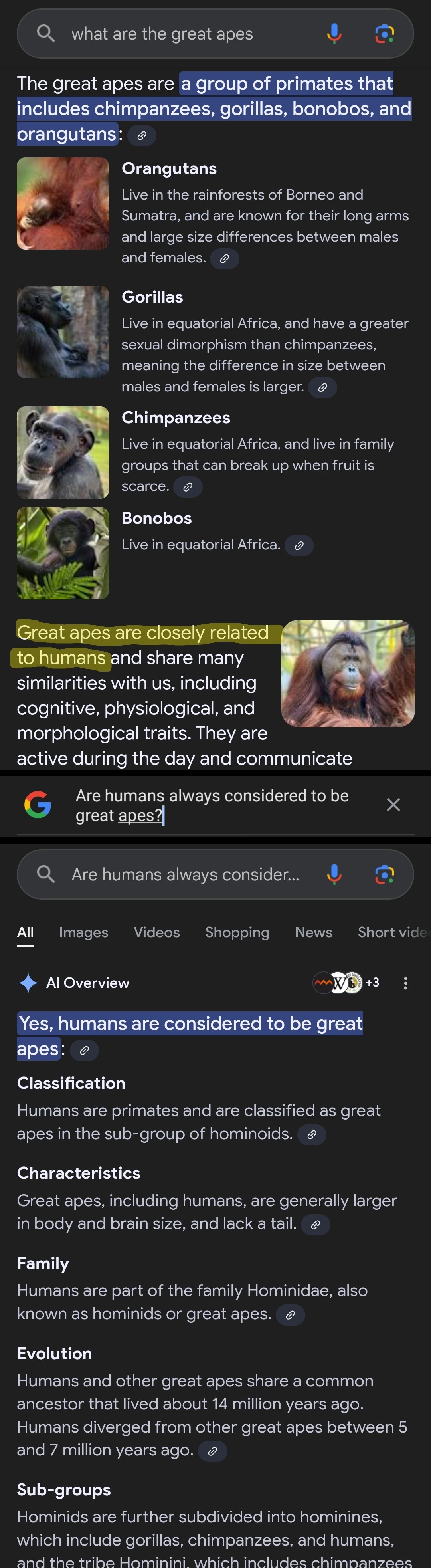
I was watching a video on orangutans and it made me wonder how well google would handle this question.
Didn’t get it quite right… But maybe it’s a subtle dig?
Note: I accidentally scrolled the “AI Overview” notation off before taking the first screenshot, but it is there:
I was watching a video on orangutans and it made me wonder how well google would handle this question.
Didn’t get it quite right… But maybe it’s a subtle dig?
Note: I accidentally scrolled the “AI Overview” notation off before taking the first screenshot, but it is there:

Make up your mind Google AI. Is sound faster in air that is less dense or more dense?
Honestly, there is so much wrong in the AI answers that it’s hard to know where to start, but the direct contradiction of itself seems like a good start.
Make up your mind Google AI. Is sound faster in air that is less dense or more dense?
Honestly, there is so much wrong in the AI answers that it’s hard to know where to start, but the direct contradiction of itself seems like a good start.

This came up after a friend was playing a trivia game. We were looking up what colour the wedges were for the different categories in Trivial Pursuit and it came up with this gem.
Search is “trivial pursuit sports and leisure colour”
This came up after a friend was playing a trivia game. We were looking up what colour the wedges were for the different categories in Trivial Pursuit and it came up with this gem.
Search is “trivial pursuit sports and leisure colour”