#china

posts tagged #china

0

"The riskiest place to dam a river": China’s Medog hydropower plant in Tibet, India’s Siang project could multiply disaster risks, a new report warns

preview

Archived

A new report by the advocacy group South Asia Network on Dams, Rivers and People (SANDRP) has warned that China’s proposed 60,000 MW Medog hydropower project and India’s proposed 11,000 MW Siang Upper Multipurpose Project (SUMP) are being planned in one of the world’s most geologically unstable and disaster-prone regions, potentially exposing millions of people downstream to serious risks.

The report, titled “The Riskiest Place to Dam a River: Medog, SUMP and the Untamed Yarlung Tsangpo Gorge”, has been authored by Parineeta Dandekar with Chintan Sheth. It argues that the combination of seismic activity, landslides, glacial lake outburst floods (GLOFs), extreme sediment flows and climate change makes the Yarlung Tsangpo gorge an exceptionally hazardous location for large hydropower infrastructure.

[…]

According to the report, China’s Medog project, described as the world’s largest hydropower project, is expected to have an installed capacity of approximately 60,000 MW in Tibet. However, Beijing has not made public essential details concerning the project’s precise locations, reservoir capacities, water discharge arrangements and operational objectives.

The report says that the lack of transparency is particularly concerning because the project is located close to India’s border and could have significant implications for downstream regions in Arunachal Pradesh and Assam.

[…]

It notes that China’s proposed project is being promoted on grounds of national security, energy production, ecological considerations and international cooperation, but the absence of reliable technical information makes it difficult for downstream countries to assess its potential consequences.

Against this backdrop, Arunachal Pradesh is advancing the proposed 11,000 MW SUMP, which Chief Minister Pema Khandu has described as a water-defence project. The proposed project is expected to involve a dam approximately 280-300 metres high, with a reservoir capacity of 9-10 billion cubic metres.

However, the report questions whether constructing another massive dam downstream is an appropriate response to the risks associated with China’s project.

It points out that the proposed SUMP could completely submerge 27 Adi tribal villages and partially affect another 40-45 villages. Thousands of orange and pineapple farms and traditional wet-rice terraces could also be affected, while more than 100,000 indigenous people could face displacement or loss of livelihoods and land.

[…]

The report describes the opposition of indigenous communities as a struggle over their land, livelihoods and future, arguing that the concerns of the Adi people cannot be overlooked in the pursuit of strategic and hydropower objectives.

Beyond the geopolitical concerns, the report identifies the geographical and geological characteristics of the Yarlung Tsangpo gorge as a major reason for questioning both projects.

[…]

Studies cited in the report estimate that 61-74 per cent of the sediment reaching Pasighat originates from the relatively small gorge region. Although this area constitutes less than three per cent of the Brahmaputra basin, it contributes approximately 45 per cent of the sediment reaching Bangladesh through the river system.

The report warns that large storage dams could substantially alter this natural sediment movement. Such dams can trap most of the sediment flowing into their reservoirs, affecting downstream river ecology, agriculture and the stability of river channels.

[…]

The authors argue that the absence of reliable information-sharing arrangements, combined with the possibility of sudden dam releases and natural river blockages, could significantly increase the risks for downstream communities.

[…]

The report concludes that the combination of geological instability, climate change, inadequate information-sharing arrangements and the absence of effective disaster-warning mechanisms makes the Yarlung Tsangpo-Siang region one of the most dangerous locations in the world for constructing mega hydropower projects.

[…]

0

Shenzhen AI Summit: Behind a carefully curated tour showcasing smart cities and autonomous systems, China's extensive surveillance networks and social monitoring systems are off the official itinerary

China's Shenzhen AI Summit: What World Leaders Won't See emergent.sh
preview

Archived

[…]

China is rolling out the red carpet for world leaders in Shenzhen, transforming the southern tech hub into a showcase of artificial intelligence innovation. Officially launched on November 16, 2026, this international summit presents visiting dignitaries with autonomous vehicles, AI-powered urban management systems, and sprawling innovation centers. Yet behind this carefully orchestrated display of technological prowess lies a parallel AI infrastructure that remains conspicuously absent from the official tour.

[…]

What Remains Off the Itinerary

The systems not included in official tours tell a different story. Extensive surveillance networks powered by AI operate throughout Shenzhen, analyzing pedestrian movements, monitoring online activities, and feeding data into social credit scoring systems. Facial recognition cameras track citizens continuously, while natural language processing algorithms scan digital communications for sensitive content.

These monitoring capabilities represent some of the world’s most sophisticated AI surveillance deployments. The technology enables real-time identification of individuals in crowds, predictive policing based on behavioral patterns, and automated enforcement of social norms. Human rights organizations have documented how these systems restrict freedom of movement and expression, particularly for minority populations and political dissidents.

[…]

The gap between public demonstrations and comprehensive disclosure of AI applications complicates international cooperation on AI standards and norms. Visiting leaders see impressive capabilities but gain limited insight into the full scope of AI deployment, particularly in sensitive domains like surveillance and social monitoring.

[…]

The technologies not on the tour may ultimately prove more consequential than those prominently displayed.

[…]

Archived

[…]

China is rolling out the red carpet for world leaders in Shenzhen, transforming the southern tech hub into a showcase of artificial intelligence innovation. Officially launched on November 16, 2026, this international summit presents visiting dignitaries with autonomous vehicles, AI-powered urban management systems, and sprawling innovation centers. Yet behind this carefully orchestrated display of technological prowess lies a parallel AI infrastructure that remains conspicuously absent from the official tour.

[…]

What Remains Off the Itinerary

The systems not included in official tours tell a different story. Extensive surveillance networks powered by AI operate throughout Shenzhen, analyzing pedestrian movements, monitoring online activities, and feeding data into social credit scoring systems. Facial recognition cameras track citizens continuously, while natural language processing algorithms scan digital communications for sensitive content.

These monitoring capabilities represent some of the world’s most sophisticated AI surveillance deployments. The technology enables real-time identification of individuals in crowds, predictive policing based on behavioral patterns, and automated enforcement of social norms. Human rights organizations have documented how these systems restrict freedom of movement and expression, particularly for minority populations and political dissidents.

[…]

The gap between public demonstrations and comprehensive disclosure of AI applications complicates international cooperation on AI standards and norms. Visiting leaders see impressive capabilities but gain limited insight into the full scope of AI deployment, particularly in sensitive domains like surveillance and social monitoring.

[…]

The technologies not on the tour may ultimately prove more consequential than those prominently displayed.

[…]

0

Hong Kong rolls out AI facial recognition across CCTV network

CNA Hong Kong rolls out AI facial recognition across CCTV network www.channelnewsasia.com
preview

Archived

Hong Kong rolled out AI-powered facial recognition functions across its camera surveillance system on Monday (Nov 16), expanding monitoring of public spaces in the name of national security and crime prevention.

China has tightened control over Hong Kong since huge pro-democracy protests swept the city in 2019, imposing a national security law on the finance hub that critics say has quelled dissent.

The new artificial intelligence tools, part of a police operation dubbed SmartView, will be a “safeguard for law-abiding citizens” and boost the capabilities of existing surveillance systems, police commissioner Joe Chow said over the weekend, announcing the Monday rollout.

Security chief Chris Tang told lawmakers last year that the AI functions will be used to monitor crowds and read licence plates, and “will naturally be applied to people, such as tracking a criminal suspect”.

[…]

Police have already installed roughly 5,000 closed-circuit television (CCTV) cameras across Hong Kong since SmartView launched in 2024, crediting their use in solving nearly 2,200 cases and more than 2,800 arrests.

Authorities plan to increase the number of cameras to 60,000 by 2028, according to documents submitted to the legislature.

Li, a Hong Kong finance worker in his 40s who declined to give his full name due to safety concerns, told AFP he was worried about the potential misuse of AI-powered surveillance.

“There are no secrets left anywhere; (many tools) have already collected your data and facial images,” he said.

Another resident named Saturday Zhou was less concerned, telling AFP that “there are already plenty of these (AI-powered CCTVs) in mainland cities and people have got used to them”.

Officials “must be open” about their use of the relevant data in order to maintain transparency, he added.

[…]

Mainland China already uses AI in its surveillance systems on a massive scale, drawing concern from international rights groups and NGOs.

A report released last year by the Australian Strategic Policy Institute warned the Chinese government’s use of AI tools enabled it to “automate censorship, enhance surveillance and pre‑emptively suppress dissent”.

Similar technology has also been adopted elsewhere, including in Britain. Critics argue that it grants the government unchecked power to invade privacy.

Concerns have also been raised over false matches leading to wrongful arrests and transparency surrounding the cameras.

In 2024, the European Union banned “the use of ‘real-time’ remote biometric identification systems in publicly accessible spaces for the purposes of law enforcement”, with some exceptions.

[…]

0

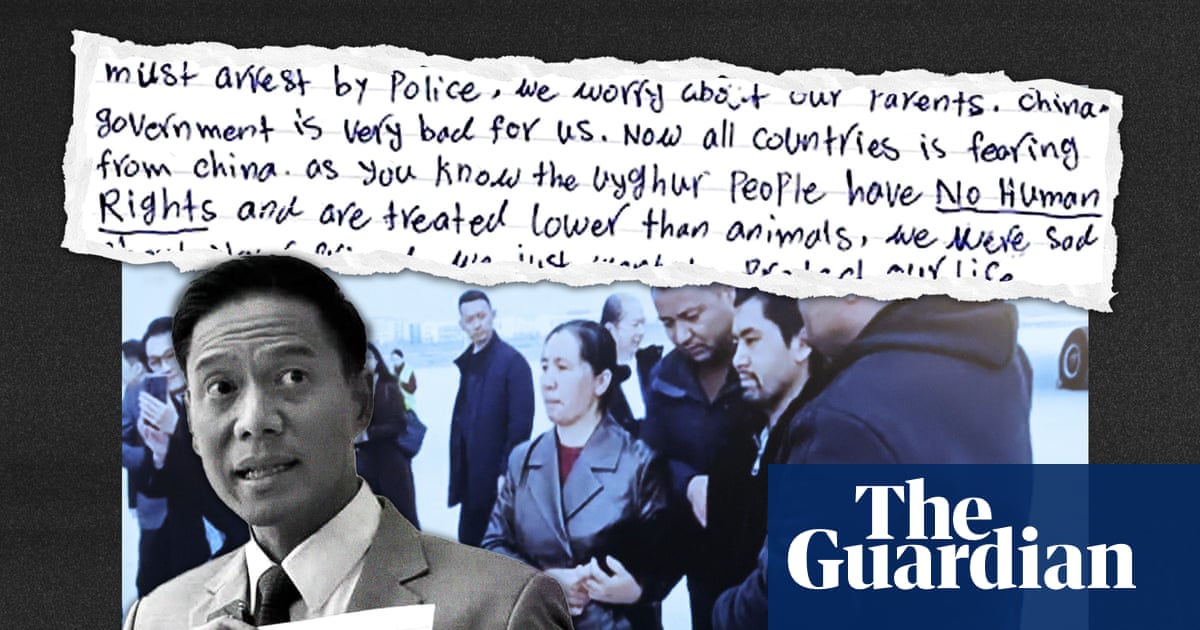
Uyghurs facing deportation by Thailand say they will be ‘like slaves’ in China

the Guardian Uyghurs facing deportation by Thailand say they will be ‘like slaves’ in China www.theguardian.com
preview

Archived

The deportation of two more Uyghurs to China from Thailand would put their lives in grave danger, activists have said, with one of the men saying he would be “like a slave” if he was sent back.

Last year, Thai authorities forcibly deported 40 Uyghur men to China despite pleas from the men themselves and the UN.

The US and Canada had reportedly offered to resettle them, but Bangkok appeared to want to avoid upsetting Beijing. The UN has said the returnees’ whereabouts remain unknown.

Now, two more men fear becoming the latest victims of Beijing’s repressive crackdown against the largely Muslim ethnic group, condemned by the UN as a potential crime against humanity.

The girlfriend of one of the men said her boyfriend, whose name is being withheld for security reasons, told the Guardian he wanted to go “anywhere else but China”.

[…]

0

China: Rahile Omer, the youngest Uyghur detainee in Chinese prisons, has died

preview

cross-posted from: lemmy.sdf.org/post/61937967

Imprisoned at the age of just 14, Rahile Omer has died at 23 after spending long years behind bars. She passed away in a prison in Peyzivat County (known as Jiashi in Chinese), in Kashgar Prefecture, Xinjiang Uyghur Autonomous Region, northwestern China.

Archived

Rahile Omer, a Uyghur woman from Konasheher, Kashgar, was incarcerated in 2017 while still a child.

The circumstances surrounding her death remain shrouded in mystery. Several advocacy groups representing the Uyghurs, a Muslim minority persecuted by the Chinese government, have launched independent enquiries to gather further information about her passing.

[…]

News of Omer’s death came to light on 25 October 2024, when the Chinese-language X account @luoxiangf shared the information, citing online reports that had appeared the previous day.

The post further claimed that the young woman had died as a result of severe depression and that both of her parents had also died in prison; however, these details have not been independently verified.

The account presented information attributed to researchers, describing how Chinese police had previously classified and monitored Omer following her family’s detention.

Her parents were reportedly arrested on 3 July 2017. According to law enforcement surveillance records, Omer had been designated as a “Class 12” individual, a category for persons linked to ongoing police investigations who are considered to be of potential security interest.

A photograph, dated 20 March 2018, appears to show Omer at a vocational training facility in Konasheher (Shufu) County. According to the account, the investigative documents available at the time contain no evidence that she committed any crime.

[…]

A Han Chinese officer serving at the Langgar township police station confirmed that Omer had passed away about a month earlier, though he did not specify the location or the circumstances of her death.

Another person, who answered a different phone call, estimated that she had died about two months earlier.

A judicial official from Toqquzaq provided further details regarding her detention. Omer was held at the Opal training centre in Konasheher from 2017 to 2019, before she was moved to the Toqquzaq detention centre, where she remained until 2021.

In October of that year, the authorities sentenced her to 12 years in prison and transferred her to a facility in Peyzivat County.

Another police officer attributed her death to a heart condition, though he provided no medical documentation or further clarification regarding the circumstances of her death.

[…]

Mamtimin Ala, president of the East Turkistan Government in Exile (ETGE), a political organisation founded in 2004 to serve as a representative body for the Xinjiang region and its peoples (Uyghurs, Kazakhs, Kyrgyz, Uzbeks, Tatars, Mongols), has spoken out on the case.

He expressed concern regarding what he describes as the death of a young Uyghur woman held in Chinese concentration camps.

[…]

0

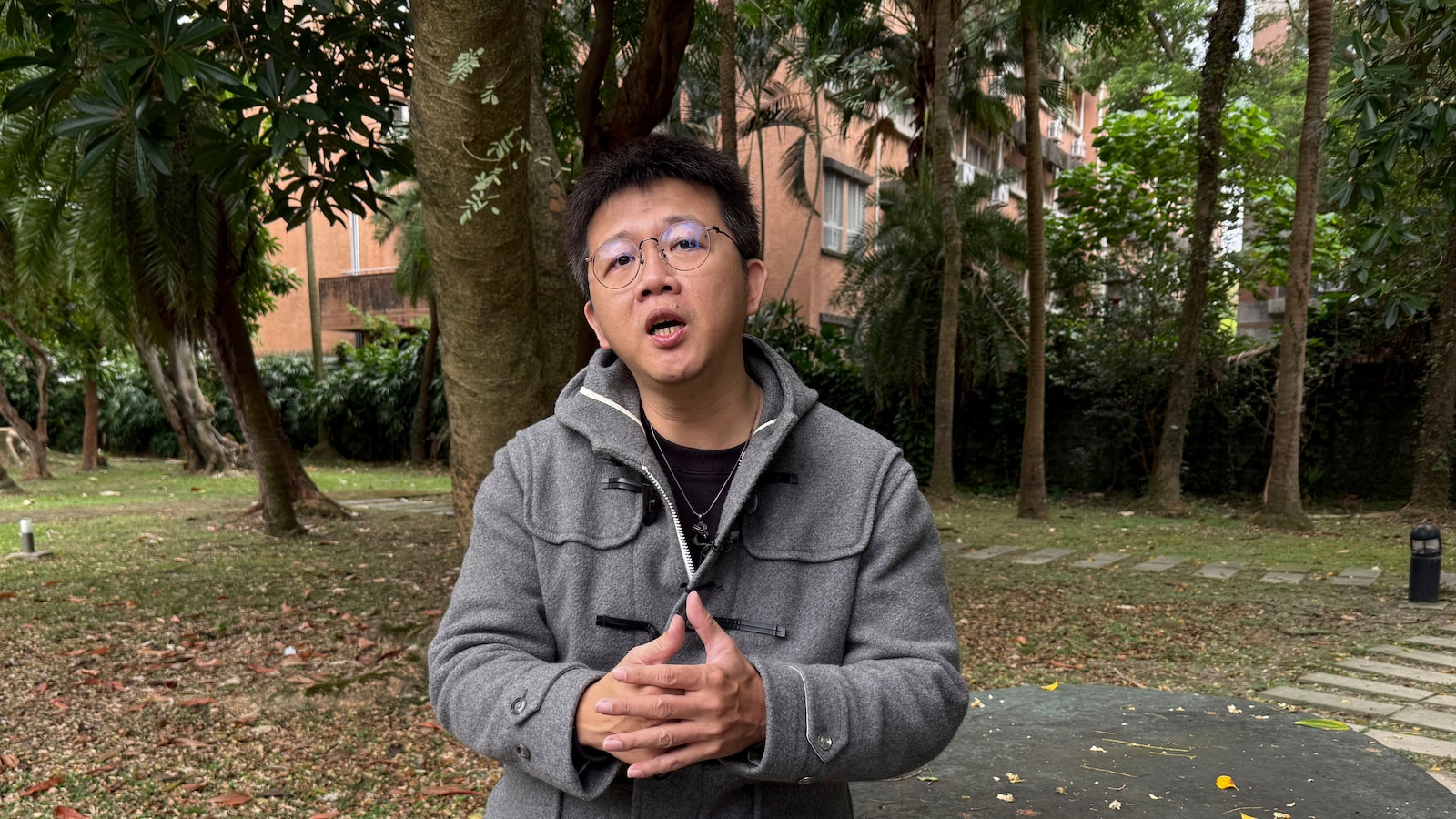
Violent attacks on critics of China in Taiwan raise concern over transnational repression

ABC News Violent attacks on critics of China in Taiwan raise concern over transnational repression abcnews.com
preview

cross-posted from: lemmy.sdf.org/post/61856846

Archived

In September, comedian Huang Yi-hao was involved in a car accident, something that could happen to anyone. But one thing stood out: the men in the other car were unusually polite, and even offered to cover his medical bills and the damage to his car.

Huang later received a call from Taiwanese police telling him it wasn’t an ordinary accident.

Taipei prosecutors in October charged five men for deliberately attempting to injure Huang in a case that has drawn attention across Taiwan. Authorities say it is part of a growing trend where operatives paid by China harass or attack people on the self-ruled island who are seen as critical of the government in Beijing.

“In the beginning, it was verbal harassment, then it morphed to pouring paint and property damage … to the level of causing a fake car accident," Chiu Shao-Chou, the commissioner of Taiwan’s Criminal investigation Bureau, said. "There’s a trend of increasing severity, and that’s something we have to take seriously.”

[…]

China’s tactics to harass, spy on or even harm dissidents abroad have come to light in recent years. In 2023, authorities in New York made arrests in connection with secret police stations set up on behalf of the Chinese government to surveil Chinese dissidents.

[…]

At the end of October, the rights organization Safeguard Defenders publishes a new report detailing how the Chinese party-state has been expanding its global network of illegal overseas police stations in dozen of countries.

In its new report, the NGO Safeguard Defenders finds nearly 1,250 formally designated liaisons in at least 91 countries which exist to carry out domestic grid functions abroad.

This number is based on a conservative methodology, and a likely underrepresentation of actual activity. The Party numbers its affiliated associations abroad in the tens of thousands, every one of them a potential grid liaison in the waiting.

[…]

0

Democracy corrects itself; Xi’s China can’t | The Strategist

The Strategist Democracy corrects itself; Xi’s China can’t | The Strategist www.aspistrategist.org.au
preview

Archived

Last week’s US midterm election furnished us with yet another example of the redemptive power of democracy. It’s a reminder that democracy’s greatest strength is not that it prevents political mistakes but that it gives citizens a way to challenge them and, sometimes, to change course.

Those who insist on applying false equivalence to the United States and China should consider that nothing like that is possible under the regime of President Xi Jinping.

Last month the Chinese Communist Party’s authoritarian model focused on punishing a French football star for daring to utter the truth about Mao Zedong’s dictatorship more than half a century after his death. Kylian Mbappe’s comment wasn’t a political statement, just a simple response to online references to his dictator-like dominance of games. Yet it received a full-throated CCP-orchestrated backlash.

[…]

Xi Jinping’s expansion of party control and suppression of dissent since becoming Communist Party general secretary in November 2012 have made him China’s most authoritarian leader since Mao, which further explains the enraged response to Mbappe’s comment.

[…]

This has been complemented by the CCP’s expanded control over public life. Under Xi, the party has rolled back previous civic and economic liberalisation, further restricting civil society, academia, independent activism, religious and ethnic groups, speech and media. It has used an increasingly extensive internet censorship and surveillance system and the party-controlled legal system to punish its critics.

[…]

Xi’s tenure has also seen the mass repression in Xinjiang, where the UN human-rights office found large-scale arbitrary detention of Uyghurs, restrictions on religious and other rights, credible allegations of torture or ill-treatment and indications of coercive birth-control and labour practices.

Xi’s China has dismantled Hong Kong’s political opposition by imposing national-security laws that enabled prosecution of pro-democracy figures, disqualifying legislators and changing election rules to restrict who could serve.

[…]

But it’s not only China’s domestic sphere where this increasingly authoritarian model threatens us. For what the party has perfected at home, it exports abroad. Xi’s China supports regimes resisting democratic ideals, helping spread surveillance technology, capacity and state-centred ideas about digital governance across the globe. And China’s securitisation of everything in pursuit of the party’s interests has infected our own systems, undermining open trade and globalisation and reintroducing geostrategic competition to our post-Cold War bliss. The unspoken truth of Xi’s national rejuvenation project is that it must come at other countries’ expense, whether that be territorially, economically or otherwise.

Most visibly egregious and revelatory is Xi’s no-limits partnership with Vladimir Putin, Russia’s kleptocratic strongman (or former strongman). China’s deep assistance to Russia’s imperialist and genocidal ambitions in Ukraine, and its prolonging of Europe’s largest conflict since 1945, is part of an anti-Western axis that seeks to weaken and reshape the global order more systematically than Trump’s America. Xi’s China is currently the only country with the intent and capability to supplant the post-1945 order, and it is laying the foundations for one that gives preference to its authoritarian interests.

[…]

For all the angst about Trump’s America – and there has been plenty to be angsty about – democracy has shown that a government’s worst impulses can be curbed, checked and held accountable. There’s nothing within China that can check Xi’s trajectory. In that sense, if one must compare the two great powers, US democracy, for all its imperfection, offers a far healthier model to which the world should aspire.

0

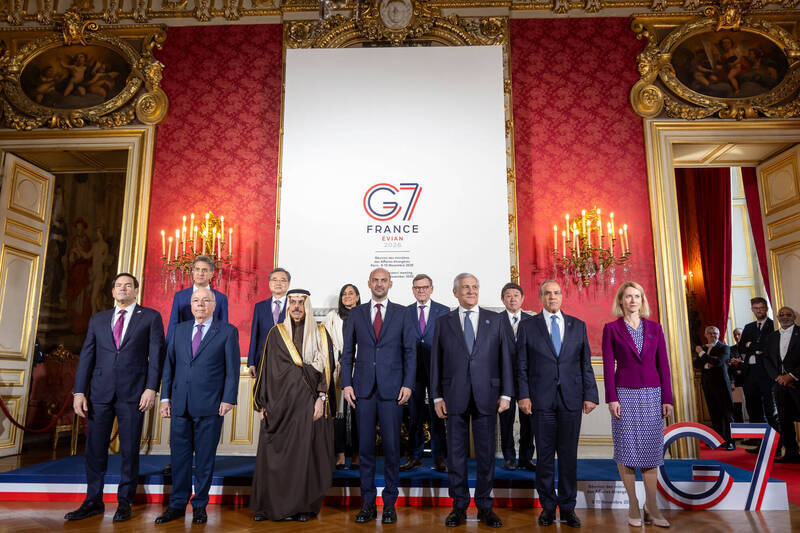
G7 foreign ministers say China’s actions east of Taiwan threaten stability

G7 foreign ministers say China’s actions east of Taiwan threaten stability - Taipei Times www.taipeitimes.com
preview

Archived

China’s increasingly assertive actions in the waters east of Taiwan threaten regional stability and freedom of navigation, G7 foreign ministers said in a joint declaration published late yesterday following a meeting ‌in Paris.

China, which claims Taiwan as its own, has stepped up activity off the nation’s east coast since June with regular coast guard patrols.

Officials in Taiwan say they believe China is practicing for a potential maritime blockade using overlapping military, paramilitary and civilian assets.

[…]

While France, Germany, the UK and the US have all previously expressed their concern about China’s actions off Taiwan’s east coast, the G7 statement is the strongest unified expression of concern to date about the Chinese activities.

[…]

Following the China Coast Guard’s latest patrol off the east coast last month, Taiwan said China was harassing shipping and trying to exert a fictional jurisdiction.

Taipei regards the area off its east coast as critical to wartime supply routes from allies in the event of a blockade or conflict. China’s military operates around Taiwan on a daily basis.

China is carrying out “area denial” drills in the Western Pacific involving one of its aircraft carriers and other naval formations, Minister of National Defense Wellington Koo (顧立雄) said on Tuesday, following a reported rise in Chinese activities.

0

From Self-censorship to Institutional Pressure: Mapping the Chinese Communist Party's Transnational Repression in Japan

preview

cross-posted from: lemmy.sdf.org/post/61679599

Archived

Here is a brief article by the study authors: How China’s Transnational Repression has Silently Taken Root in Japan’s Society

China’s transnational repression (often referred to as TNR) has attracted increasing international attention in recent years, particularly following revelations about Chinese overseas police stations operating all the way from Viña del Mar, Chile, to Rome, Italy.

[…]

However, while direct intimidation and surveillance have received considerable attention, subtler forms of repression remain largely overlooked.

Japan presents a particularly interesting case. Despite its geographical proximity to China, extensive economic relations, and large Chinese diaspora, the country has received comparatively little attention regarding the less visible forms of transnational repression. Japan’s democratic institutions and society reinforce the public assumption that individuals can safely express their political views, protected by academic freedom, the constitution, strong freedom of speech, and formal protection mechanisms. Only a few institutions, such as Human Rights Watch, have raised concerns over the issue.

[…]

A new report, “Mapping CCP Transnational Repression in Japan: From Self-Censorship to Institutional Pressure” (pdf), published by Sinopsis, a non-profit association in scholarly collaboration with the Department of Sinology at Charles University in Prague, Czech Republic, goes further in challenging these assumptions about the absence of TNR in Japan.

[…]

[Based on interviews with academics, journalists, students], the study identified three main mechanisms through which repression from Chinese individuals and institutions is experienced by critics in Japan:

  • direct intimidation,
  • institutional pressure, and
  • self-censorship.

The findings suggest that TNR does not require direct intervention. It can operate through existing social relationships, institutional incentives, and the fear of possible consequences.

[…]

Direct harassment and spam calll

Reports of harassment frequently involve phone calls that interviewees suspected were linked to the Chinese embassy, an experience described by several participants [such as university professors and journalists […] Such calls are not confined to Chinese nationals living in Japan, but also reach non-Chinese journalists reporting on sensitive issues and academics.

For Chinese nationals, the harassment often extends to family members remaining in China, creating additional pressure through familial connections. A particularly illustrative account comes from a Professor who reported that a student of hers from Inner Mongolia had been told that police officers contacted the student’s parents in China, pressuring the student to discontinue their research.

[…]

Surveillance and monitoring

Accounts of in-person surveillance describe a form of coercive pressure that leaves activists and members of ethnic minorities in Japan with the sense that they are being watched even outside China […] Chinese man in Japan approached the man’s daughter at her school and asked her to telephone her father, then used the call to press the community member to work as an informant for the Chinese government.

[…]

Academic institutions

Academics of Chinese, Japanese, and other nationalities […] attributed setbacks in career advancement to networks of influence they associated with the CCP [Chinese Communist Party] … [A] Professor at a national university, reported that her pre-nomination to a senior post within the institution was withdrawn; while she cannot establish causation, she attributes this primarily to her research on Chinese affairs. Another Professor similarly described being professionally marginalised when her profile was removed from the university’s Chinese studies website. Neither account can be independently corroborated, but both are consistent with a dynamic in which institutions distance themselves pre-emptively from politically sensitive scholarship.

[…]

[There are also] pressures on students in the classroom, which they observed to vary with the surrounding community. One Professor [said that] mainland Chinese students in the social sciences tend to be more critical of the CCP than those in STEM fields, while short-term exchange students are typically more vocal in supporting official Chinese positions than full-time international students.

[…]

Organising academic events emerged as a further site of difficulty. One Professor reported obstacles in inviting activists and researchers, while another Professor described professional isolation after organising Hong Kong–related events.

[…]

Chinese student associations

Chinese Student Associations (CSAs) occupy a central place in participants’ accounts of what we characterise as institutional complicity. Interviewees repeatedly described these associations as intermediaries between students and actors they understood to be linked to the Chinese state,

[…]

As one Chinese student said,

"the spy web of Chinese students in other Japanese Universities is deeply rooted and has strong influences. The Chinese embassy has connections with some of the students’ associations.”

[…]

[The report suggests that CSAs are experienced as part of a layered oversight structure resembling what is known as “long-distance authoritarian governance.”

[…]

Self-censorship

Self-censorship recurs across the interviews with Chinese dissidents, academics, and students in Japan, including among students with no connection to political activity. These accounts illustrate how repression may operate indirectly, shaping behaviour through anticipated consequences rather than direct threats. […]

The perceived presence of CCP-linked entities and individuals affects how Chinese students relate to fellow nationals and how they express themselves inside and outside the classroom.

[…]

[A Chinese student who] lived in Japan for five years [said that] he remains careful about whom he speaks to and avoids political discussion, preferring economic subjects. He acknowledged not feeling entirely safe in conversation, at times even with close friends, and said he refrains from voicing criticism even when he holds strong views.

[…]

[Several other Chinese students living in Japan say that they] avoid specific topics and limits her contact with other Chinese students [and they are] holding back their thoughts when conversing with Chinese citizens and even with “buddies,” avoiding revealing personal opinions.

[…]

Information gathering, mistrust, and the anticipation of surveillance

[There are] recurring patterns of information gathering directed at activists, academics, and diaspora communities in Japan [resembling] what scholars’ term “soft surveillance,” in which the collection of information operates less through overt coercion than through the uncertainty and psychological pressure it generates.

One Japanese professor described encounters with ”Chinese nationals asking her about her connection with Chinese research and activists,” including an occasion on which someone sought background information about a German journalist. She interpreted these approaches as purposeful and coordinated.

[…]

One [Hong Kong] activist recalled that acquaintances - former colleagues and friends from Hong Kong—travelled to Japan specifically to meet her every four to five months from 2023 onwards.

She did not regard these as isolated visits but as part of a pattern in which people from varied backgrounds approached her seeking similar information.

[Study participants] reported hearing of comparable cases among Taiwanese and Tibetan communities in Japan and among Hong Kong contacts in the United Kingdom and the United States.

[The Chinese student] believes some former members to be compromised, citing their appearances in pro-CCP media at the same time as they sought contact with the Hong Kong community in Japan.

She further noted that, while other activists’ families were subject to interrogation, the families of these individuals were not, which she read as evidence of coordination with the authorities.

[…]

[Chinese students in Japan] also raised concerns about digital infiltration. Alongside the WeChat monitoring described [in the study], several reported threatening online behaviour. One Hong Kong activist reported receiving messages from numerous accounts that he judged to be inauthentic. He described Hong Kong activist communities in Japan as living with a persistent fear of infiltration, which in his account generates internal disputes, exclusions, and in some cases the collapse of democratic initiatives.

[…]

0

Huawei says it’s made a 100 percent Chinese PC

theregister Huawei says it’s made a 100 percent Chinese PC www.theregister.com
preview

Huawei claims it’s built a desktop PC that uses only parts made in CHina.

The company launched the Qingyun HM650 last week and said it uses Huawei’s own Kirin X90 processor, a ten-core 20-thread machine with a clock speed of 2.3 GHz. The machine runs a newly developed enterprise version of HarmonyOS, the OS Huawei developed to end its dependence on Android and which it intends to run on most of the devices it makes.

theregister.com/systems/2026/1…
RE: social.freetalklive.com/users/…

0

Rich Country, Poor Citizens: China’s $20 Trillion Paradox Shows That For The Communist Party, A Few Thousand Tycoons Are Easier To Manage Than A Broad Middle Class

preview

Archived (removepaywall.com)

[…]

In 2021, President Xi Jinping triumphantly declared that the rising tide had lifted all boats — the Communist Party had won “complete victory” over absolute poverty — and pledged to pursue “common prosperity”1 for all. China does deserve credit: Since 1978 it has lifted close to 800 million people out of extreme poverty, three-quarters of the global total, according to the World Bank. But to claim that victory, Beijing used a poverty line of about $2.30 a day, which critics contend is too low.

Against the World Bank’s $8.30-a-day poverty line for households in upper-middle-income countries — China’s current group — more than one-fifth of its population remained poor as of 2022. Against the $30 a day that marks poverty in the rich-country cohort China will be joining, the average citizen falls well short. China, in other words, is becoming a high-income country whose people, by any rich-world measure, remain exceedingly poor.

[…]

Both sets of facts flow from the same political economy, and the tension between them will define China’s next quarter-century — turning less on whether the country grows rich, which by conventional measures it largely has, than on what it does about the millions left behind and the middle class it never allowed to form.

[…]

[When China entered] the WTO, the bet was that prosperity would beget a middle class that would demand a say. But Beijing has spent two decades ensuring that constituency never takes shape, since time and time again history has shown that a secure, propertied population is where pressure for a political voice collects.

The evidence on social activism is instructive. In November 2022 a deadly apartment fire in remote Urumqi set off street protests against zero-Covid lockdowns that swelled into the “white paper revolution,” named after the blank sheets of paper demonstrators held up in wordless dissent. But these protests erupted not on China’s poor periphery but in its bourgeois core — along Urumqi Road in Shanghai, the country’s wealthiest city, and across elite campuses like Beijing’s Tsinghua University. The demonstrations confirmed the Party’s operating assumption: It is not hardship that is politically dangerous, but a comfortable middle class.

[…]

On the institutions that underpin a secure middle class — most importantly a social safety net — China diverges sharply from its peers. Social spending sits near 10% of gross domestic product, roughly half the average for countries in the Organization for Economic Cooperation and Development. Xi often warns that welfare programs breed idleness, a surprising stance for an avowed Marxist. The underlying motivation is more likely that households forced to self-insure stay precarious and pliable.

A grinding property crisis has only heightened the sense of vulnerability. Chinese households hold about 47% of their assets in real estate, and prices have fallen roughly a fifth from their 2021 peak, erasing trillions of yuan in wealth. Because a family’s home is often their only form of insurance, the loss of value has made people cling to cash all the more.

[…]

Beijing has promised for years to rebalance the economy toward household consumption, so as to reduce the country’s reliance on the twin growth engines of exports and investment. Yet after two decades of jawboning and half measures, consumption is stuck at about 40% of GDP, compared with 55% to 70% across the rich world. Households save at extraordinary rates — deposits have roughly doubled since 2019, to some 165 trillion yuan ($24.7 trillion) — not from thrift but because the Chinese state offers thin retirement pensions, patchy healthcare coverage and unemployment insurance that reaches barely a third of the workforce. Jobless benefits are pegged to the local minimum wage — not to what a worker earned — and is capped at 90% of that: roughly 2,000 yuan a month. This year the minimum rural pension has increased by just 20 yuan, to 163 yuan a month. A people who cannot count on the government to care for them when they are ill, jobless or old will not spend.

[…]

Youth unemployment tells the same story. The rate for 16- to 24-year-olds who are not in school now stands at 18% — an indicator so politically sensitive that Beijing suspended its publication in 2023, and then revised the methodology. A generation that coined the term neijuan, “involution,” shorthand for running ever faster to stay in place, is not the confident spending cohort a middle class is built on.

[…]

The artificial intelligence boom deepens the divide between the government’s industrial ambitions and household welfare. Beijing is pouring trillions of yuan into the development of more advanced chips and data centers to support AI, and that spending is, for now, what is powering growth. But it funds those technology investments by** starving the basics: hospitals, schools and other elements of the already meager safety net in rural areas**, while the rewards accrue to the coastal, educated sliver.

The resulting inequality would look familiar to any American. With the poor and middle held down, one group has been allowed to grow: the rich. China’s richest 10% of the population hold about 68% of its national wealth, close to the US figure of 70%. In 2025 the 1,434 individuals worth at least 5 billion yuan saw their combined wealth soar 42% thanks to a powerful stock market rally, according to an annual list compiled by the Hurun Research Institute, a Shanghai-based firm that has tracked China’s rich since 1999.

[…]

Common prosperity, Xi’s supposed sequel to Deng’s “let some get rich first,” is turning out to mean shared restraint, not shared wealth: billionaires disciplined when convenient, the middle class asset-trapped, the poor pacified in 20-yuan increments. Everyone, in the end, is held equally in check.

[…]

During 14 years in power, [Xi Jinping] has chosen control over household welfare at every turn, and for the fourth presidential term he’s expected to claim in 2027, there’s no reason to expect a change of course. So the likeliest path is welfare that grows but stays minimal and conditional: enough to keep the peace, and calibrated to sustain dependence rather than end it.

The West wagered in 2001 [when China entered the WTO] that trade would make China rich and wealth would make it liberal. It got the first half. Whether a great power can hold the rest together while keeping most of its citizens poor is, at best, a formula for grinding stagnation — at worst, a slow-burning fuse.

[…]

0

Netizen Voices: “Mbappé Had No Idea That China is Still a Dictatorship”

China Digital Times Netizen Voices: "Mbappé Had No Idea That China is Still a Dictatorship." chinadigitaltimes.net
preview
  • French footballer Kylian Mbappé was widely condemned recently in China over its remarks that former Chinese leader Mao Zedong was "a dictator"
  • The ironic bit with this case is that Chinese media censored the word “dictator"and were just saying that Mbappé made ‘inappropriate remarks about China,’ while people inside China’s “Great Firewall” are unaware what exactly these inappropriate remarks were
  • Chinese AI were not helpful - until maybe Weibo’s “Comment Robot” joined in responding to a post asking “What did Mbappé do? Was what he said wrong?” with: “He told the truth, that’s all. Some people just don’t like to hear it.”

[…]

Archived

Last week saw the eruption of what The New York Times described as “one of the more improbable football-related storylines of recent times.” French footballer Kylian Mbappé was widely condemned in China over a comment from a months-old YouTube video, in which he expressed amusement at a meme featuring his own face superimposed onto that of “a guy—I think it was a Chinese dictator.” The meme is one of many playing on Mbappé’s nickname “the dictator,” bestowed for his allegedly heavy-handed behind-the-scenes behavior. He did not mention Mao Zedong by name, but a combined image of the two men was inserted into the video.

China may be a self-proclaimed people’s democratic dictatorship, but that formulation is conceptually and, in Chinese, terminologically distinct from that of personal dictatorship, and Chinese authorities reject the label’s application to Mao or other top leaders.

[…]

A complicating factor in this case, though, is that many in China did not know what the offending comment actually was. From Rebecca Bailey at The Guardian, on October 28:

[…] The [Chinese] football app Dongqiudi was among the first to release a statement condemning the “inappropriate remarks”, but said: “Because his comments were offensive to China and the Chinese people, we cannot translate them.” Chinese media have reported on reactions such as the brand desertions, and the China Football Association’s lodging of a “stern protest” with Real Madrid – who apologised on Wednesday “to the Chinese people for any offence caused” – but have generally steered clear of outlining Mbappé’s precise offence.

The topic was still trending on Chinese social media on Wednesday morning, with one hashtag relating to the superstar’s apology boasting more than 600m views. Some posts asked variations on a simple question: “What did he actually say?”

Manya Koetse, editor of the Eye on Digital China newsletter, said in a post on X: “Many netizens without a VPN are still left in the dark about why all the talk about boycotting Mbappé is actually happening.” [Koetse examined the controversy at greater length at What’s On Weibo.]

[…] Jennifer Pan, professor of communication at Stanford University, said the difficulty of doing independent social science surveys in the past decade meant “our understanding of what Chinese people actually think is weak”. Pan said: “Social media doesn’t fill that gap. It’s noisy, unrepresentative, and censored … What we see is that companies, platforms, broadcasters and the foreign ministry moved together quickly. Did this follow public anger, or did this produce public anger? Either is possible, and we can’t tell which came first.”

[…]

Recent translations have shown Chinese users turning to AI for help in navigating the mysteries of online censorship, but tests by fact-checkers at France 24 suggested that chatbots were able to offer little clarity on Mbappé’s comments.

The situation was discussed in some of the online commentary compiled by CDT Chinese. ”The funniest thing about this Mbappé situation is that all the media are saying he made ‘inappropriate remarks about China,’ and that a huge mob of people inside the [Great Fire]wall are up in arms,” said one comment. “But as for exactly what these inappropriate remarks actually were, those who don’t know can’t get a straight answer, and those who do know are talking in riddles." These riddles included: “[It’s about] the person on the 100-yuan note," and, “He said Tang Guoqiang was an art student." (Tang Guoqiang is an actor famous for portraying Mao; “an art student” is an apparent reference to Hitler as a symbol of dictatorship in general.)

Weibo’s controversial AI “Comment Robot” joined in, responding to a post asking “What did Mbappé do? Was what he said wrong?" with:

“He told the truth, that’s all. Some people just don’t like to hear it.”

[…]

Other collected social media comments are translated from Chinese:

luzelun134960: He wasn’t wrong! The whole world, apart from mainland China, knows Mao was a dictator.

Jammesavj: I’m not offended. Please don’t presume to speak for the Chinese people.

maihu8964: The pink maggots make memes of other countries’ leaders every day, but they’re not happy when the tables are turned.

Rongshen021116: What Mbappé said is a fact. Of course Mao Zedong was a dictator.

kiligulyanov: Bappé didn’t even say “Mao Zedong,” he just said “a Chinese dictator,” and everyone assumed he meant Mao. Couldn’t he have been talking about Chiang Kai-shek?

xr95718872: Telling the truth is an error these days.

mngshanqi: Milked again? [A pun on “insulted.”] Is it even possible to get through life without “insulting China”?

TENPHOENIX2018: When even the reply-bot Robert dares to say, “He just told the truth,” you know it’s not the algorithm being banned, but truth itself.

gaochao17lngs: Mbappé had no idea that China is still a dictatorship.

TianCai67: Pinks within the [Great Fire]wall amuse themselves Photoshopping gross memes of Takaichi Sanae, “The General,” and Trump all the time, and think they’re being hilarious. Then Mbappé drops one joke in passing, and they go nuts.

Luvsic0929: This Mbappé thing made me realise that Chinese higher education is a total failure, without a doubt.

lilaoshizuikeai: Imagine foreigners who’ve just observed China’s great flame wars with Brazil [over socialist perspectives on LGBT rights and drug policy] and Turkey [over Uyghur identity], and now see the spectacle of little pinks banding together to defend a dictator who killed tens of millions of their own compatriots. The stereotypes runneth over.

huang3feng: So here’s a crazy question: right now the Chinese internet is engulfed in a Cultural Revolution-style struggle session against Mbappé, even X is flooded with little pinks, the whole country’s performing dictatorship, and what Mbappé said was wrong?

ooopqoqjs: The three inevitable experiences in any foreigner’s life: birth, death, and insulting China.

cc14514: You can’t make jokes with insecure clowns around.

liuyifei1065: Doesn’t this just go to prove it’s a dictatorship? No dissenting voices … everyone marching in lockstep.

[Here are all the comment in Chinese.]

There is more in the linked article.

[…]

0

A formula for repression: A new report shows how the Chinese government has expanded its global grid of illegal police stations overseas, reaching 1,250 offices in at least 91 countries

A Formula for Repression safeguarddefenders.com
preview

Archived

Here is the full report: A Formula for Repression – China’s Global Grid for Community Control (pdf)

In 2022, Safeguard Defenders published 110 Overseas and Patrol & Persuade: two reports detailing the activity of over 100 overseas Chinese police stations operating in more than 50 countries.

After the report was published, many of the countries affected denounced the stations’ illegal operations. Some pursued criminal investigations. Beijing responded by claiming they had closed.

[…]

Now a new report exposes Beijing’s claim to be false. Far from closing, the evidence shows expansion.

[…]

Today, more than ten police forces from five Chinese provinces are engaged in the work of a global network of Chinese Communist Party operatives abroad. The police involvement is only the beginning, and these are not isolated initiatives by a few local governments in China.

Since late 2024, five new national policies instruct authorities across China to expand designated liaison activities abroad. The core aim is to export the domestic system of grid management to control the diaspora.

[…]

In China, the Party divides every city, town and village into grids, each square representing a few hundred households, and each with a grid manager who reports upward. The manager has ten tasks, nine of which have to do with surveillance and control. There is a file on every resident.

Anything seen as a threat to Party rule is escalated to a hub where enforcement stands ready to act.

Internationally, this system of mass surveillance, control and suppression is projected through a global grid of united front affiliated organizations or designated liaisons. They are run by the Party’s “bridge and bond” to the diaspora: the Overseas Chinese Federation.

These Party liaisons provide the infrastructure other Chinese authorities - police, prosecutors, courts, justice bureaus and others - simply plug into. Or, as the Party calls it: through which they “extend their tentacles”.

How the ‘grid’ extends abroad

The authorities sometimes use the word “grid” themselves when talking about overseas functions. In May 2019, eight months after opening their first “police-overseas-Chinese stations” [警侨驿站] abroad, the Qingtian county police, in Zhejiang Province, reported to the national police newspaper that they had hired 135 diaspora association leaders and chairs as center directors, deputies and liaison officers, and “put together an overseas grid-service informant corps of more than 1,000” [组建了1000余人的海外网格服务信息员队伍] …

[The report describes how the Chinese grid of police stations extends abroad. It is fairly impossible to paraphrased what the report calls “The machinery: 1 + n + X + Y(y)”. Everyone is stronglu encouraged to read the report (pdf).]

[…]

In its new report, the NGO Safeguard Defenders finds nearly 1,250 formally designated liaisons in at least 91 countries which exist to carry out domestic grid functions abroad.

This number is based on a conservative methodology, and a likely underrepresentation of actual activity. The Party numbers its affiliated associations abroad in the tens of thousands, every one of them a potential grid liaison in the waiting.

Included in this number are the very liaison stations Safeguard Defenders exposed years ago and were told “merely” provided services to the diaspora community. Yet the functions of service and control cannot be separated, as the official policies and public statements that form the basis for this report make clear. In fact, the power to provide or deny services directly adds to the Party liaisons’ ability to exercise control.

Every liaison designated and every task carried out by them are breaches of sovereignty. They are transnational repression embodied, affecting entire communities around the world. Their standing order to carry out any task as required by the Party represents an active national security threat.

[…]

Beneath it all sits one structure: the Party’s united front, and its global network of affiliated associations.

The names given to such designated liaisons may change; the underlying structure does not.

Policymakers must urgently devise strategies to confront this superstructure of CCP interference if the stations and their activities are to be shut down for good.

[…]

0

A loyal journalist takes the helm: Newly appointed to run the All-China Journalists Association, a union that puts the interests of the Chinese Communist Party first, Cui Shixin is the ideal candidate

China Media Project A Loyal Journalist Takes the Helm - China Media Project chinamediaproject.org
preview

Archived

At a meeting in Beijing last month attended by senior propaganda officials, Cui Shixin (崔士鑫), a veteran journalist with a storied career in the Party-run press system, was appointed head of China’s official association for working journalists. Cui, who most recently served as deputy editor-in-chief of the Chinese Communist Party’s flagship People’s Daily (人民日报), is in many respects the ideal media leader by the Party’s standards, and his appointment offers a reference point for how journalistic values are defined in China.

[…]

The October 24 meeting of the All-China Journalists Association (中华全国新闻工作者协会), or ACJA, promoted Cui to vice chair and secretary of its secretariat, formalizing his role as head of the association.

[…]

Under the leadership of the Party’s Central Propaganda Department, which sets the country’s media policy, the ACJA plays a key role in the training and discipline of journalists, including enforcing an ethics code that treats loyalty to Party principles as the first duty of the press.

[…]

Cui is not so much a journalist as a veteran Party media leader, a man honed and trained inside a newspaper that promotes the Party’s policies and serves as “the vanguard of the country’s news and public opinion front,” meaning that it guides and defines the lines that media across China hold.

His most important posting, and one celebrated by state media, came in 2007, when he volunteered and was sent to Tibet Daily (西藏日报), the Party-run “mouthpiece” of the Tibet region. He went under a 1994 program of “paired assistance” (对口支援) that sends staff from central institutions to work temporarily with counterparts in Tibet. The People’s Daily, the Central Committee paper, was paired with Tibet Daily, the regional Party committee’s paper. Cui stayed about seven years, first as deputy editor-in-chief and then, from 2012, as editor-in-chief.

[…]

A 2011 profile by People’s Daily Online says that Cui arrived “with the particular zeal of a People’s Daily reporter” (带着人民日报记者特有的热忱). In Party media language, that zeal means commitment to the paper’s role as the Party’s mouthpiece, and Cui’s job was to ensure that Tibet Daily would play that role in the region.

[…]

According to official profiles, he turned the paper [the Tibet Daily] into a regional copy of the People’s Daily. He built each page around regular columns, let commentary set the tone, and set rules on how to cover the news.

[…]

Cui’s zeal proved useful in March 2008, when protests led by monks erupted in Tibet, demanding freedom, respect for human rights, and a safe return for the Dalai Lama to China. Tibet has long been a sensitive topic for Chinese media, and state outlets ignored the peaceful protests, while authorities blamed the Dalai Lama for the unrest. Back in Lhasa, Cui wrote four “commentator articles” (评论员文章) — referring to unsigned pieces that speak for the paper as an institution — over a 10-day period. All blamed the “Dalai separatist forces” (达赖分裂势力).

[…]

[Back in the 2000s] one journalist who even ventured to openly question the censorship around Tibet was Chang Ping (长平), then deputy editor-in-chief of Southern Metropolis Weekly (南都周刊) in Guangzhou, a magazine under the Party-run Nanfang Daily Group […] Chang wrote an article for FTChinese (FT中文网) called “Tibet: Truth and Nationalist Sentiment” (西藏:真相与民族主义情绪). The article not only criticized the news blackout around protests in Tibet that year, but also asked, provocatively, whether China’s ethnic majority Han Chinese harbored the same sense of cultural superiority toward Tibetans and other minorities that they resented in Western coverage of China. After the piece was published, Chang was swiftly removed from his post and shuffled aside to a research job.

[…]

Eighteen years after Lhasa was gripped by violence, Cui Shixin’s zeal and loyalty have earned him a position at the top of China’s official journalism hierarchy. He now leads the organization that is meant to represent the Party in representing the country’s estimated one million journalists. Chang Ping, who in that same year represented a different sort of voice, of the journalist as a free-thinking professional, has long since moved on, living in exile in Germany.

[…]

0

China: United Nations Child Rights Committee Probes Beijing on Child Labor

Chinese Human Rights Defenders China: United Nations Child Rights Committee Probes Beijing on Child Labor - Chinese Human Rights Defenders www.nchrd.org
preview

cross-posted from: lemmy.sdf.org/post/61408526

Archived

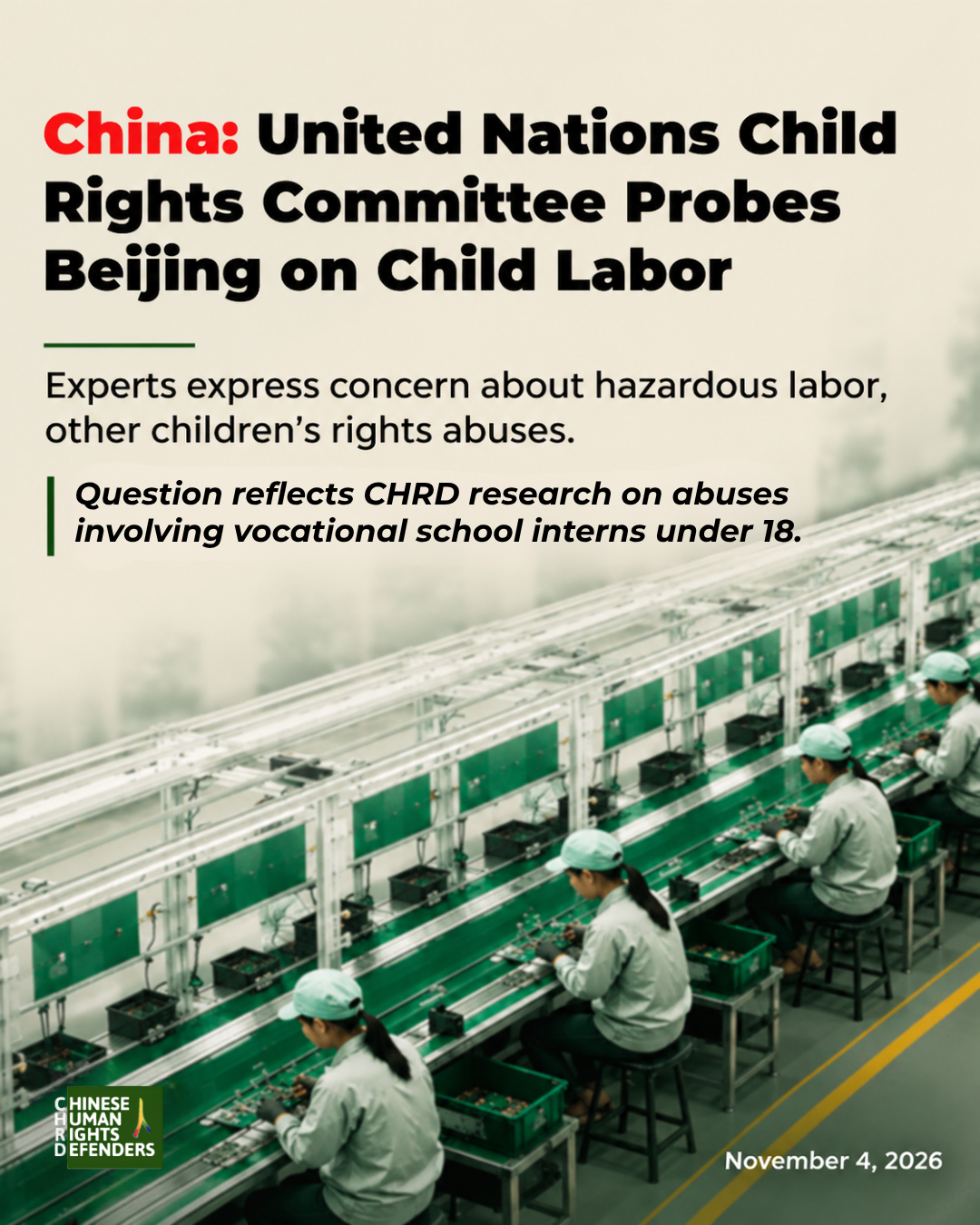
The United Nations Committee on the Rights of the Child has asked the Chinese government to explain how it protects children aged 16 to 18 from hazardous labor. The question, which is included in the formal List of Issues adopted by the Committee on October 2, 2026, reflects research by the Chinese Human Rights Defenders (CHRD), an NGO, documenting abuses of vocational school student interns under 18.

[…]

The CHRD report Genuine Free Choice? Child Labor and Mandatory Student Internships in China (opens pdf), published in May 2026. That research focuses on two overlapping issues: abuses within mandatory vocational school internship programs affecting students under 18, and the illegal hiring of children under 16. Despite domestic legislation and China’s ratification of the CRC and key International Labour Organization (ILO) conventions, abuses of child labor persist across industries.

[…]

The List of Issues covers a wide range of children’s rights concerns. The Committee asked the Chinese government critical questions about abuses including discrimination against Tibetan and Uyghur children, restrictions on their religious and linguistic rights, barriers to education, family separation, and reprisals against children who speak out. It also asked about the implications for children of laws adopted since China’s last review in 2013, including Hong Kong’s national security laws and the Law on Promoting Ethnic Unity and Progress, in effect since July 1, 2026.

[…]

CHRD’s findings call into question Chinese authorities’ willingness to enforce domestic laws, including the Law on the Protection of Minors and the Regulations on the Management of Vocational School Student Internships, to protect children. The violations also reflect non-compliance with the Chinese government’s obligations under the CRC and ILO conventions.

Chinese authorities should make child labor data publicly available—including complaints received through the national hotline and labor inspection findings on hazardous child labor—and investigate labor dispatch agencies that unlawfully broker student interns, CHRD says.

Reporting channels independent of school administrations are also needed, so that students do not fear that reporting abuse, or withdrawing from an internship, will jeopardize their ability to graduate.

0

Schooling China’s storytellers: Five Chinese universities opened international communication schools this year, turning Xi Jinping’s decade-long external propaganda push into a degree program

preview

Archived

[…]

Since August 2013, Xi Jinping has emphasized the importance of “telling China’s story well,” a euphemistic phrase for what he called “external propaganda” elsewhere in the same speech. The goal is to support China’s foreign policy goals — and the Chinese Communist Party’s legitimacy — by spreading positive narratives about China among international audiences. Now, a growing number of Chinese universities are leaping headlong into this whole-of-society project by opening international communication schools (国际传播学院) meant to train the country’s next generation of storytellers.

These schools are another key aspect of a rapidly expanding national system to support external propaganda. In 2021, Xi Jinping called on universities to cultivate “reserve talent” (后备人才) for international communication. The purpose is to train people who will carry China’s message abroad — including journalists, translators, and analysts for state media and think tanks.

[…]

Hang on, don’t other universities do this too?

Outside of China, the [the] American University in Washington, D.C., has been offering a master’s degree in Intercultural and International Communication since 1968. The program says it “examines the geopolitical, technological, economic, and cultural relations among peoples, societies, nations, and communities,” and trains students to work across cultures. In Taiwan, National Chengchi University (國立政治大學) has been offering an English-language master’s degree in international communication since 2006, which similarly focuses on cross-cultural communication with an Asia-Pacific regional focus.

China’s schools, by contrast, are clear about their primary role as facilitating communication for the Party-state. At the Communication University of China’s founding ceremony for its international communication institute this May, President Zhang Shuting (张树庭) pledged that the university would build “a new high ground in serving the country’s international communication capacity building” and “shoulder the mission of the national team” (扛起国家队使命).

Announcing a partnership with the government run Xinhua News Agency, Shanghai’s Fudan University said it would transform Xinhua’s global network into a “practical classroom” for students.

[…]

0

“Eventually, We All Learned to Keep Quiet”: How Censorship and Self-Censorship Interact to Erode Societal Discourse in China

China Digital Times Translation: “Eventually, We All Learned to Keep Quiet” chinadigitaltimes.net
preview

Archived

In mid-September, a man was arrested for stabbing and wounding an unknown number of women outside a hotpot restaurant in the GOGO Xintiandi shopping plaza in the southern Chinese city of Guangzhou. The man appeared to target only women, and images and footage posted online (much of it later deleted) showed police officers rushing into a shopping center, pedestrians scattering, a man with a face mask stabbing a woman in the face, and at least three women with wounds on their faces. Many Chinese social media users and bloggers noted online censorship of the topic and scant follow-up information from the authorities.

[…]

This has become the typical official response to such “indiscriminate” mass attacks: a brief police bulletin noting that the suspect was arrested and that the case “remains under investigation,” but little to no witness testimony, follow-up reporting, information on the victims, or details on the motive behind the attack.

Each new incident seems to be followed by at least some online censorship, and Chinese news outlets frequently decline to conduct any investigative reporting, preferring the safer course of “waiting for further statements from the police.” This issue of excessive reliance on official notices has drawn critical commentary in a variety of other contexts.

[…]

CDT [China Digital Times] editors have archived two pieces related to the Guangzhou stabbings. The first, a now-deleted article from WeChat account Li Yucheng, is partly translate into English in the linked site (here in Chinese).

The second one (here in Chinese) is fully translated in the linked article.

The second archived piece, an essay by WeChat blogger 昔平 (Xī Píng), is titled “Eventually, We All Learned to Keep Quiet.” Although the author does not mention the Guangzhou stabbings specifically in the text, the essay is bookended by screenshots of the statement issued by Guangzhou police. In light of this, the author discusses how censorship and self-censorship interact to erode societal discourse over time.

The essay, along with the screenshots, is translated in full in the linked article (archived version in Chinese).

It says, amongst others:

[…]

As children, we were taught to “speak freely, and hold nothing back,” but as adults, we discovered an even more profound wisdom: “Too much talk only leads to trouble.”

So when we encountered something odd, we didn’t ask questions; when we observed something unreasonable, we didn’t discuss it; when we heard others speak, it was safer to pretend we didn’t hear them. Over time, this culminated in a remarkably “stable” way of life: our eyes were in charge of seeing, our ears in charge of hearing, and our mouths in charge of staying silent …

And so society grew quiet. Eerily quiet.

Events in the news remained perennially “under investigation," punctuated by a satisfying full stop, and followed by a complete blank. People learned to appreciate this unique literary form: the article’s introduction told you what happened, the middle warned you not to over-interpret events, and the conclusion assured you that the whole thing was being properly investigated.

As for what the investigation uncovered, that was a topic for the next article.

Assuming there was a next article …

The safest mode of expression was no expression at all …

Asking too many questions makes you stick out from the crowd.

And so people began to self-censor in increasingly sophisticated ways. Before speaking a sentence, they would delete all the adjectives. Before writing a passage, they would delete all the opinions. Before venturing to express a viewpoint, they would delete themselves.

What remained was scrupulously cautious and hermetically sealed …

Not all silence is peaceful.

Sometimes silence is just emotion that lacks an outlet.

If someone suffers an injustice and vents about it, at least they’re still communicating with others. But if they don’t know who they can turn to, to whom they can vent, then all they can do is lock those feelings inside themselves …

A truly vibrant society is never silent.

When different voices are allowed to exist, we need not be afraid of any one particular voice.

As for when we’ll relearn how to speak … I’ll just leave that question for all of you to ponder.

After all, we’re still allowed to think.

For now …

[The whole essay is worth reading imo.]

0

China: A woman who went missing 26 years ago was now found being abused and forced into prostitution. While media reports were censored, police refused to help her saying it was "not our business"

China Media Project "Not Our Business" - China Media Project chinamediaproject.org
preview

Archived

[In September], the case of Sun Meihua (孫美華) rattled China before her name disappeared from the internet. The now 58-year-old Beijing-born woman was found in a village in Cao County, Shandong Province, by a Douyin vlogger, Chuxin (初心). After 26 years, videos of Sun appeared online, looking frail and hungry, eating a plate of noodles Chuxin had handed her.

Sun had been diagnosed with schizophrenia and went missing in August 2000 after her husband allegedly left her at an intersection near her parents’ house, reports the independent media outlet Free Nora (自由娜拉), which monitors human trafficking and abuse against minorities in China. According to another outlet, The Aquarian (水瓶紀元), her family tried to report her disappearance, but the police did not open a case.

Sun was found living with an elderly man villagers call “Uncle Long” (龍叔). In August, villagers told Du Xiaohua (杜小华), a Douyin vlogger who met Sun, that Uncle Long abused her and forced her into prostitution. When Du went to the police to try to file a report, an officer told him that they had found no evidence of abuse and that relocating her was “not their business,” according to Free Nora’s reporting.

[…]

Before media outlets could begin reporting, Chinese social media platforms were already widely discussing Sun Meihua’s case. According to data from Wisers, a media monitoring database, there were dozens to hundreds of posts about Sun every day between September 8 and 11. The number reached 345 in one day on September 9. But from September 13, the number of posts dropped to fewer than 10 per day, Wisers data shows. The posts are now inaccessible, having been either deleted or blocked for violating platform rules.

[…]

In terms of media coverage, Free Nora was the first Chinese media outlet to report on Sun’s case on September 18 […] The Chinese independent media outlet The Aquarian (水瓶紀元) followed on September 26, but its report on WeChat was deleted. No other Chinese media reports about the case were identified. The Douyin vloggers also deleted all videos related to Sun.

[…]

A familiar pattern

Netizens in China had been here before. The 2022 case of Xiaohuamei, **who later became known as the chained woman,” followed a similar pattern. After videos of a woman chained to a shed in Fengxian County, Jiangsu Province, circulated online, local officials released several statements initially identifying the woman as surnamed Yang, denying trafficking claims and attempting to explain her condition as mental illness-related. The local government blocked media from reporting at the scene before the city of Xuzhou later announced that it had discovered that the woman’s real name was Xiaohuamei, and that she was originally from Yunnan, arresting her husband on suspicion of illegal detention. Like in Sun’s case, authorities cracked down heavily on online discourse about the matter.

[…]

Also familiar in this case is where Sun was found. Cao County is located close to where Shandong, Henan, Jiangsu, and Anhui meet, an area identified by researchers as a trafficking “hotspot.” According to court judgments made public in 2024, most victims of human trafficking are rural women with mental or intellectual disabilities.

[…]

What distinguishes the Sun Meihua case from Xiaohuamei’s is the public silence from authorities. As of this writing, no official statement from Cao County or Beijing has been released — what seems to be a deliberate departure from four years ago, when police were forced to backtrack on their previous statements following nationwide online backlash.

[…]

In a column for Deutsche Welle (DW), Chang Ping (長平), editor of the China Digital Times, wrote that during the case of the chained woman, the public had hoped the government would investigate, but the authorities’ top priority was maintaining social stability. Information control today has only intensified. “Those who are punished are often not the traffickers, but the people who expose human trafficking,” he wrote.

[…]

[Edit typo.]

0

China: A testing video revealing serious safety issues with a new minivan spread on Chinese social media and terrified potential buyers. Hours later, the video vanished as if nothing had happened

China Media Project Who Hit the Brakes on Negative Public Opinion? - China Media Project chinamediaproject.org
preview

Archived

Recent security tests of a minivan jointly manufacutred by Chinese companies JAC and Huawei were enough to terrify potential buyers. In three live tests, the bracket mounting the brake pedal to the van’s frame snapped.

The test video was heavily shared on Chinese social media platforms like WeChat, Douyin and Bilibili. It was the worst possible news for the responsible firms.

[…]

But within 24 hours, the video had disappeared from Chinese platforms such as Bilibili, and several related online posts and reports had vanished too. Viewers on WeChat Video were informed the video could not be played due to an unspecified “violation.” The case prompted discussion of the benefits and limits of consumer reporting in China — a vibrant consumer society with some of the world’s strictest controls on information.

[…]

Many suspected Huawei, suggesting the tech giant, which has a growing interest in automated driving systems and other car technology, had applied pressure. Some went even further, speculating that the powerful Huawei was being shielded by authorities.

These questions were deepened by the disappearance of other critical posts. Among these was a post made on the WeChat public account Xinjiang Release (新疆发布), run by the government information office in China’s northwestern Xinjiang region. The post faulted Maextro for failing to address the real safety concerns head on, instead resorting to the citation of complex technical standards. It was called, “Can You Speak Like a Human When Responding to Product Safety Concerns?”

[…]

0

Why China's Social Credit System Is Facing Inside Warnings Over AI Surveillance

Iies Why China's Social Credit System Is Facing Inside Warnings O — Iies www.iies.gusec.edu.in
preview

The criticism and warnings are not new, but now they come from within China.

Archived

[…]

A recent government-funded study out of Sichuan University’s Law School published in the Journal of Sichuan Normal University has triggered a fresh wave of scrutiny regarding China’s social credit system. Authored by doctoral candidate Lin Jianxing, the paper cautions that pouring advanced artificial intelligence and predictive algorithms into social rating frameworks risks turning administrative tools into instruments for mass surveillance.

The core issue isn’t new, but the source is. Critics from Western nations have flagged privacy concerns for years. Now, internal legal scholars are pointing out the exact mechanical pitfalls from within the system’s own academic backyard.

[…]

When the social credit initiative first gained traction years ago, its stated goals sounded straightforward. Officials designed it to build market trust, crack down on corporate fraud, and help banks assess default risks for loans. Think of it as a corporate and financial reliability index, meant to keep bad actors out of public contracts and penalize contract breakers.

Over time, things shifted. Local governments began testing personal credit metrics that tracked minor infractions on public transit, school attendance, and everyday civic habits.

Lin’s research highlights a profound transition. By utilizing big data mining and predictive algorithms, administrative bodies can translate everyday online and offline choices into quantifiable scores. This process aims to forecast a person’s future actions before they happen. That predictive capability is where convenience crosses the line into surveillance.

[…]

When you hand regulatory decisions over to predictive algorithms, several distinct problems emerge.

  • Opaque Logic: When an algorithm lowers a score, finding out why can feel impossible. Citizens face automated restrictions without knowing which specific data point triggered the penalty.
  • Amplified Discrimination: Predictive models rely on historical data. If past enforcement favored certain demographics or penalized specific behaviors unfairly, the algorithm bakes those biases into future decisions.
  • Massive Surveillance Footprint: Real-time tracking requires constant data collection. Facial recognition feeds, smartphone logs, and financial transactions must flow continuously into a centralized scoring apparatus.

[…]

Internal critiques published in state-funded journals show that policy debates inside the country are far from monolithic. Legal scholars and researchers are actively pushing back against the overreach of automated systems, warning that hyper-efficient administrative control carries a steep societal cost.

If algorithms become the ultimate arbiter of who gets a loan, who boards a train, or who qualifies for public services, trust stops being a social contract between people. It becomes a compliance score issued by a machine.

[…]

0

Taiwan flags ‘obvious’ threat from 50 Chinese vessels across regional waters

preview

Archived

China has more than 50 naval and other official vessels operating in a wide swath of sea stretching from southern Japan down to Taiwan and off the Philippines, a senior Taiwan official has said, calling the threat level “obvious.”

[…]

“We’re staying vigilant about their activities,” said Joseph Wu, the secretary-general of Taiwan’s National Security Council. “The simultaneous threat to Taiwan, Japan and the Philippines is obvious.”

Wednesday’s remarks were accompanied by a map he posted on X showing the locations of 53 ships, 34 of them navy warships, including the aircraft carrier Liaoning.

The carrier and its accompanying battle group were positioned to the east of the Philippines, with other formations off Taiwan’s east and southeast, along with three off the southern coast of Japan, according to the map.

[…]

China’s ties with both Japan and the Philippines have tanked in recent months. Beijing has been upset by Japanese support for Taiwan, while embroiled in an increasingly bitter standoff with Manila in the South China Sea.

“We are not happy to see any attempt to project deterrence that could undermine peace and stability in the Indo-Pacific region,” Taiwan Defence Minister Wellington Koo said on Thursday.

In addition to intelligence exchanges with partners, his ministry was “maintaining appropriate awareness” of Chinese military warship activity, Koo told reporters at the parliament in Taipei.

China has never renounced the use of force to bring Taiwan under its control, though says it would prefer “peaceful reunification.”

[…]

“China has never abandoned the use of force to annex Taiwan,” [Koo] added.

[…]

0

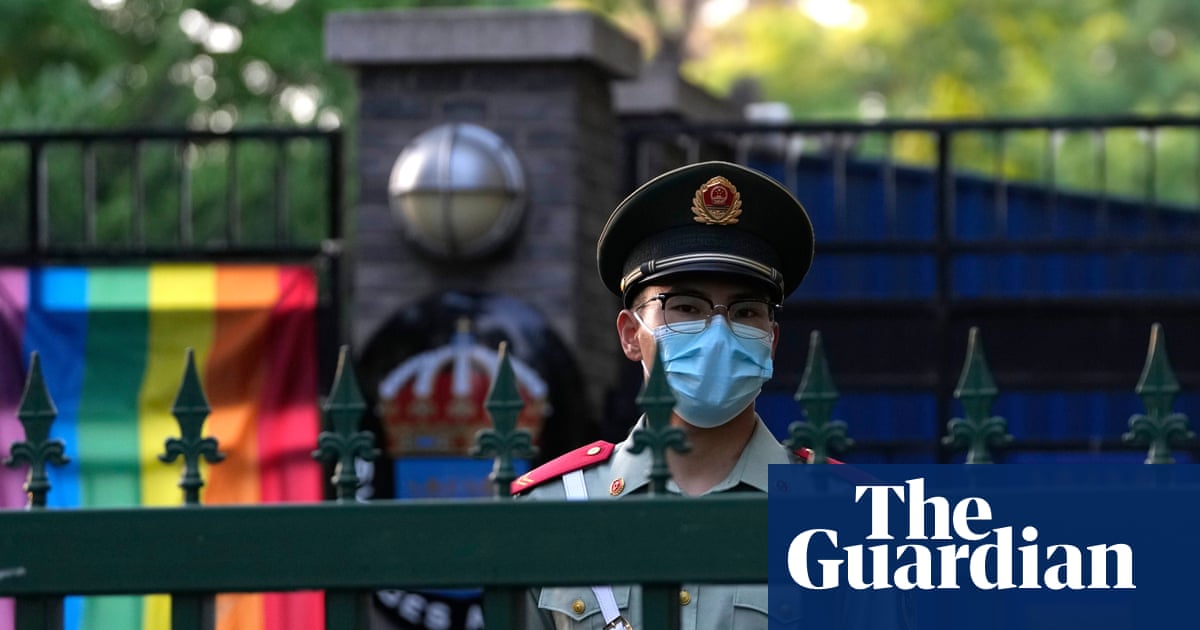
Beijing Queer film festival cancelled after harassment from authorities as forums for discussion of feminist and LGBTQ+ views face growing intolerance from Chinese state, say experts

the Guardian Beijing Queer film festival cancelled after harassment from authorities www.theguardian.com
preview

Archived

[…]

Chinese Police had increased pressure on the festival through repeated phone calls in recent weeks, it is understood.

[…]

The Chinese authorities have grown increasingly intolerant of open discussion of feminist or LGBTQ+ issues. Film festivals in particular attract particular scrutiny because they provide an opportunity to platform narratives that sit outside the Communist party’s worldview.

Beijing Independent film festival, China’s most prominent independent film festival, was closed down in 2014 after the authorities detained the founders and shut off the electricity supply to the venue. Last year, an independent Chinese film festival that was due to be held in New York was cancelled after harassment from the Chinese authorities, an incident which raised concern about transnational repression.

[…]

Hongwei Bao, a professor of Chinese studies at the University of St Andrews who focuses on LGBT issues, said that the festival was “a beacon for LGBT resilience” in China.

“The shutdown of the Love Queer Cinema Week has a chilling affect on the Chinese queer community,” Bao said.

In June this year, screenings of films with LGBTQ+ themes that were scheduled to be held in Beijing during Pride month at the Institut Français, a French cultural centre, were cancelled because of police harassment.

[…]

Despite the increased pressure, Beijing Queer film festival remains a popular event. Several international film-makers whose work had been selected for the festival had travelled to China to participate. Last year, the festival received 200 volunteer applications, four times the number received in 2024.

[…]

0

Mbappé’s Own Goal on Chinese Repression: His groveling apology for calling Mao a dictator will only embolden the regime to continue to bully anyone who calls out its bloody record

Fortify Rights Mbappé’s Own Goal on Chinese Repression - Fortify Rights www.fortifyrights.org
preview

Archived

The captain of the French national soccer team and Real Madrid star player Kylian Mbappé has attracted the ire of Beijing by innocently describing, on a French talk show, a meme of his face superimposed on an image of Mao. He said it was the meme that made him laugh the most, describing it as “a video of a guy, I think it’s a Chinese dictator.”

The subsequent furor illustrates three things about the regime in Beijing — as well as the naïveté of people such as Mbappé where China is concerned.

Beijing’s reaction — leading to at least three Chinese corporations dropping sponsorships of Mbappé — shows that the CCP hates the truth about its bloody past and repressive present being exposed; that it has no sense of humor; and that, although it likes to project strength, it is in fact profoundly paranoid, neurotic, and insecure.

[…]

The Chinese foreign ministry, along with the soccer forum Dongqiudi, condemned Mbappé’s comments, saying that they “hurt the feelings of Chinese people.” [Three Chinese companies] announced they would drop sponsorships of Mbappé, and the state broadcaster China Central Television said it would cease featuring content related to the French striker and stop showing Spanish soccer league matches.

But as absurd as the Chinese reaction is,it is the response by Mbappé, Real Madrid, and La Liga — the Spanish soccer league — that is even more troubling. Instead of standing by his factual remarks, Mbappé issued a groveling apology, describing his comment as “ill-judged” and saying he understands that it “hurt many people in China and in Chinese communities around the world.” La Liga also apologized, saying it “deeply regrets the offence that Kylian Mbappé’s recent comments have caused among Chinese fans.” Real Madrid issued a similar statement.

These apologies are profoundly dangerous because they play entirely into the CCP’s hands.

[…]

Mao was, in fact, one of history’s worst dictators. Saying so is not necessarily an insult, but a matter of record.

During his rule over China, from the founding of the People’s Republic in 1949 until his death in 1976, it is estimated that at least 40 million people, and perhaps as many as 70 million, died. His disastrous Great Leap Forward policy, designed to move China from an agrarian to an industrial economy, resulted in a famine causing tens of millions of deaths. This was followed by the decade-long Cultural Revolution, which saw books burned, intellectuals beaten, and several million people killed. Anyone who doubts the scale of the bloodshed under Mao should read historian Frank Dikötter’s powerful trilogy on his era. Mao killed more people than Joseph Stalin and Adolf Hitler. Calling him a dictator seems, if anything, an understatement.

Mao also paved the way for continued repression in China today.

[…]

Successive CCP dictators following Mao have presided over a system responsible for grave violations of human rights — including, most starkly, the massacre of thousands in Tiananmen Square on June 4, 1989, atrocities in Tibet, the targeting of Falun Gong practitioners for forced organ harvesting, the persecution of Christians, the crackdown in Hong Kong, and the genocide of the Uyghurs. The China Tribunal and the Uyghur Tribunal, both chaired by British lawyer Sir Geoffrey Nice, who prosecuted Slobodan Milošević, taken together with assessments by […] other governments and legislatures around the world and independent human rights experts, accuse the CCP of committing mass atrocity crimes for which it should be held to account.

When it feels aggrieved, the CCP usually deploys the line that the “feelings” of the Chinese people have been “hurt.” But in a society that does not allow independent opinion polls, let alone free elections or free speech, how can they know how 1.4 billion people really feel? It is quite likely that many of them, especially those who have suffered under Mao and his successors, would agree with Mbappé that Mao is a dictator — as is China’s current ruler, Xi Jinping.

[…]

Apologizing to Beijing risks whitewashing the CCP’s almost 80 years of mass murder, torture, and repression and will simply embolden the regime to continue to bully and threaten anyone who calls out its bloody record. It also undermines freedom of expression in democratic societies as a result.

The withdrawal of Chinese corporate sponsorships and television audiences will be financially painful for soccer players and their teams for a while. But Mbappé, Real Madrid, and La Liga should have stood their ground and, over time, sought alternative corporate sponsorship, instead of kowtowing. Their fans should feel ashamed, not by Mbappé’s original comments but by the failure to defend them.

[…]

0

Asian Submarine Cables at Risk from China: Report Finds Beijing Building Tools to Sabotage Cables Without Open Conflict

Asian Submarine Cables at Risk from China www.bankinfosecurity.com
preview

Damage to an undersea cable could severely disrupt internet routes between the United States and Taiwan, Japan or the Philippines and force traffic onto slower detours, according to a new report.

Archived

Researchers at the China Strategic Risks Institute published a recent report (opens pdf) for the U.S.-China Economic and Security Review Commission warning that Beijing is building the means to sabotage trans-Pacific cables without tipping into open conflict. The commission released the report in September after a string of cable incidents around Taiwan that included a Chinese work barge suspected of damaging a line to the Matsu Islands in March.

The report’s vulnerability index scores cables higher if they land in Taiwan or cross waters Beijing claims. Shallow, crowded shipping lanes can add risk too, since a dragged anchor there can pass for an accident.

Four of the 10 highest-scoring cables are still under construction, including Google’s TPU and Meta’s ORCA. The authors of the report said Chinese-free ownership leaves Beijing with little reason to spare the cables in the event of a targeted attack.

[…]

A geopolitical conflict over Taiwan that severed all four cables running directly between the U.S. and Taiwan could leave the broader trans-Pacific network with as little as 2% spare capacity at peak demand (see: China Could Coerce Taiwan by Hacking Comms, Think Tank Warns).

Losing only two cables, JUNO between Japan and the U.S. and the Pacific Light Cable Network, could push peak demand as much as 70% past the capacity operators have switched on.

[…]

0

"The People’s Republic of the Disappeared": China’s feared RSDL prisons are for foreigners too, newly released book says

Book release: China’s feared RSDL prisons are for foreigners too safeguarddefenders.com
preview

Archived

[…]

Residential Surveillance at a Designated Location (RSDL) is a long-established system the Communist Party of China (CCP) uses to torture prisoners into confessing to crimes imagined by the state.

At its heart, RSDL is a form of state-sanctioned disappearance.

  • RSDL is a form of secret detention where suspects are held in incommunicado detention for months without access to a lawyer, contact with their family, and with little to no prosecutor oversight, before formal arrest is made.

  • RSDL is so secretive that the disappeared are transported to the facility blindfolded or with a black bag placed over their heads.

  • The prisoner in RSDL is watched 24 hours a day by two or more guards. They are watched when they are sleeping and they are watched when they are awake. They are watched even when they are on the toilet, denying the prisoner the last vestiges of human dignity.

  • The RSDL cell is usually cut off from sunlight for the entire six months.

  • In RSDL, interrogations can happen at any time, day or night, and last for hours at a time.

[…]

The latest book edition of “The People’s Republic of the Disappeared” contains new evidence of foreigners disappeared into RSDL. Australian journalist Cheng Lei, Japanese former university lecturer Hideji Suzuki, Taiwanese human rights activist Lee Ming-che - with a foreword penned by Canadian former diplomat Michael Kovrig - reminds people that China is a country without rule of law and that a foreign passport is no protection.

[…]

Alongside their harrowing accounts are testimonies of Chinese RSDL prisoners, where the use of physical torture as well as psychological torture is part of their reality.

[…]

The stories in this book document the immense psychological as well as physical torture that the CCP inflicts on people in RSDL.

Cheng Lei writes:

“I couldn’t sleep. My hair fell out in bunches. I was sore from the endless sitting. I cried many times a day from missing my kids. I was anxious, frightened, lonely, humiliated, intimidated and almost going crazy from boredom.”

In the Foreword to this third edition, Michael Kovrig describes the isolation and mental torment of his RSDL—so intense it can drive prisoners to contemplate suicide. RSDL facility cells are usually suicide-proofed because of this very reason.

“Your captive body becomes an instrument through which the state security organs control your mind. Alone, powerless, humiliated and denied your intrinsic dignity, you begin to doubt your own humanity. The cells are padded because at some point nearly everyone’s mind begins to break down. The pain is too much to bear and you can see no end to it. Death would offer a yearned-for release, but even that choice is taken from you. With no way to die, you can only endure.”

[…]

Lee Ming-che often heard the sounds of gunfire in the early morning. It made him believe he was going to be executed.

“I was in a state of mental confusion, unable to distinguish whether I was thinking or dreaming. Combined with the physical weakness from my disrupted circadian rhythm, I was on the verge of a mental breakdown.”

Hideji Suzuki cried when his guard gave him a glimpse of sunlight through a window. It was the only time he saw the sky in his eight months of RSDL (the legal maximum is six).

[…]

Chinese women’s activist Li Qiaochu writes in her chapter:

“Even if the price of speaking out is losing my freedom again, I do not regret writing about my experiences, because I know that the moment I summoned the courage to tell the truth, those feelings of humiliation and fear the secret police tried to instil in me just disintegrated. If we cannot speak courageously, we cannot act freely. We must speak directly and not shy away from the difficulties. We must talk about the details, our traumas and our weaknesses. The things we avoid mentioning and keep hidden are precisely the truths they fear we might bring out into the open.”

[…]

0

Keeping China's Labor Misery Off the Record: the Chinese Communist Party is keen to ensure people do not speak up about economic pain that has become all too real

China Media Project Keeping China's Labor Misery Off the Record - China Media Project chinamediaproject.org
preview

Archived

n September, posts began circulating on social media raising concerns that labor rights activist and journalist Feng Rui (冯睿), known also as Xiao Wu (小五), had gone missing. Over the course of several weeks, independent outlets and social media accounts began reporting that Guangzhou police had detained him on September 14 for “picking quarrels and provoking trouble” (寻衅滋事), an often arbitrary and politically-motivated charge used against individuals who challenge Party rule through speech or demonstrations.

The Hong Kong daily Ming Pao (明報) confirmed on October 4 that Feng had been detained and had met with a lawyer, but did not specify charges. Some reports circulating online claim that Feng had become ill amid relentless interrogation by investigators and needed a wheelchair to be taken to and from questioning. According to Ming Pao, Feng was released on bail last week, but no official reports by Chinese authorities have been released as of this writing.

[…]

Feng’s detention seems to be part of a broader crackdown on labor rights-focused media and reporting in the past several weeks. In September, Hong Guangyu (洪广玉), a former reporter for Beijing Sci-Tech Report (北京科技报), was detained at his home in Xiamen by authorities from Dalian, also on suspicion of “picking quarrels and provoking trouble” (寻衅滋事). In a now-deleted report originally published on October 7, the business and current affairs outlet Caixin (财新) cited sources suggesting that his detention may have been linked to his efforts to defend the rights of farmers in Dalian, who had alleged that pesticides from a local agricultural company were responsible for the death of their cherry trees.

[…]

The crackdown is hardly exceptional or surprising. Labor-related protests have been among the most-documented grassroots mobilizations in the country. China’s economic liberalization created a host of new problems for Chinese workers, and a new class of migrant workers who left their countryside hometowns to pursue work in the cities; social benefits became dependent on precarious employers — or else were tied to their place of household registration. While labor conditions in factories have improved considerably over the years, wage arrears, unpaid overtime, and long working hours without breaks remain among the most common problems faced by Chinese workers today.

The rise of the gig economy — which now represents more than 40 percent of China’s overall workforce, according to one study — brought its own issues documented extensively by workers themselves online and by investigative journalists. A 2020 investigative report in Portrait magazine (人物), for example, found that food delivery apps were driving a sharp increase in driver accidents, injuries, and deaths through algorithms that placed unreasonable, even impossible, demands on riders. The government issued broad directives toward delivery app companies to ease the intensity of work schedules almost a year later, though extreme conditions continue to be an issue in the sector. Feng’s 2025 report, mentioned above, documented several problems among couriers and food delivery drivers, including sudden deaths after working consecutive excessive shifts.

[…]

The combination of a slowing economy and the growing number of highly-educated graduates that far exceeds job vacancies has driven many to gig work — yet even that sector is becoming overcrowded as both blue- and white-collar workers are losing their jobs to automation. After China’s youth unemployment rate rose to 21.3 percent in June 2023, the National Bureau of Statistics suspended the release of figures for several months. When new figures came out in early 2024, the official calculus had changed — with students removed from the count, lowering the headline figure.

[…]

This poor situation facing workers in China has made spontaneous labor unrest more likely, said Li Qiang (李强), the founder and executive director of China Labor Watch, in an interview with CMP. Now based in the U.S., Li had advocated for worker rights inside Chinese factories before fleeing his country of birth under fear of arrest. He now represents one of the few remaining organizations documenting labor incidents in China.

[…]

China’s suppression of labor mobilizations goes hand in hand with pressure on publications and NGOs that document labor incidents across China. The Hong Kong-based China Labour Bulletin, which had documented collective worker actions and strikes across China, shuttered suddenly in 2025, citing financial issues. Lu Yuyu (卢昱宇), an activist and journalist born in Guizhou, documented over 70,000 “mass incidents” (群体性事件), China’s term for protests, including labor strikes, through his outlet “Not the News” (非新闻). Lu was detained by authorities in 2016. He spent four years in prison for “picking quarrels and provoking trouble,” the same charge Feng is allegedly facing.

Lu believes the reason the CCP is placing such significance on Feng’s case — despite his relatively small platform — “is precisely because it is extremely fearful of his ability to ‘piece together’ fragmented and isolated labor incidents" … “By cracking down now, [the Party] is attempting to cut off information channels before workers’ anger gains broader social consensus, ensuring it retains control over the narrative.”

[…]

A Xinhua think tank report paints a romantic picture of benevolent low-wage workers through their online creations “rooted in the soil of reality,” […]

These recent efforts in the arts and media seek to co-opt workers’ voices, making them part of a narrative of personal sacrifice for the glory of the nation. The unfortunate reality, however, is that the CCP, which places China’s working class at the heart of its founding narrative and legitimacy, remains very keen to ensure that worker voices from below stay fragmented. Documentation of worker exploitation, or online campaigns to improve working conditions, are highly likely to be censored.

[…]

0

China's families are now supporting more old people than kids

China's families are now supporting more old people than kids www.bbc.com
preview

Archived

[…]

Official data released in the last week show the ratio of China’s dependent elderly people compared to the working age population rose to 23% last year, overtaking the figure for children, which stood at 22%.

The numbers are closely watched for signs of how China’s shrinking workforce will impact both the world’s second largest economy and global growth as a whole.

The latest figures mark a significant milestone as China grapples with an ageing population that could have implications for families, pensions and healthcare spending, analysts say.

[…]

The demographic shift is “symbolic” and could suggest more public spending will move from families and schools to pensions and healthcare, said Professor Stuart Gietel-Basten from The Hong Kong University of Science and Technology.

It may also pose a challenge to the country’s ambitions, as it could limit its economic growth as well as people’s spending power, said National University of Singapore sociology lecturer Mu Zheng.

[…]

China’s ageing population has been driven by a mix of factors, including rapid urbanisation and the effects of the controversial one-child policy, which was in place from 1980 to the end of 2015.

[…]

Despite easing restrictions on the size of families, Beijing has struggled to persuade couples to have more children, with birth rates hitting historic lows.

Other contributing factors include changing gender roles, rising living costs and higher education levels that have put pressure on fertility rates, Mu said.

[…]

As a result, China’s birth rate hits record low as population continues to shrink.

Government data on Monday showed that the country’s birth rate fell to 5.63 per 1,000 people – a record low since the Communist Party took power in 1949 – while its death rate rose to 8.04 per 1,000 people, the highest since 1968.

Its population fell 3.39 million to reach 1.4 billion by the end of 2025, marking a quicker decline than the previous year …

China has one of the lowest fertility rates in the world, at around one birth per woman, below the replacement rate of 2.1. Other economies in the region, such as South Korea, Singapore and Taiwan, have similarly low fertility rates …

China is also one of the most expensive countries in which to raise a child, according to a 2024 report by the YuWa Population Research Institute in Beijing …

0

Translation on the Maextro V800 Brake-Pedal Scandal: “The Counterattacks Against Dongchedi Have Begun”

China Digital Times Translation on the Maextro V800 Brake-Pedal Scandal: “The Counterattacks Against Dongchedi Have Begun” chinadigitaltimes.net
preview

The exposure of faulty brake-pedal brackets in the Maextro V800, a luxury EV manufactured by Huawei and JAC, has resulted in a wave of online censorship, deleted opinion pieces, a high-level government investigation, and what appears to be a coordinated campaign to undermine the credibility of Dongchedi (懂车帝, Dǒngchēdì), the automotive-review platform that brought the problem to light. The scandal has tested the boundaries of public criticism of vaunted national industries such as EVs, and highlighted the tendency among Chinese authorities and state media to “blame the messenger” when it comes to issues such as consumer product safety.


A Youtube copy of the vehicle test video in question: in Mandarin with Chinese subs, no English, but you can see the break pedal brackets snapping when the drivers push down hard (as you might in an emergency).


EDIT: Another copy on Youtube but with English voiceover:


In three live tests of the model with vehicles purchased from separate production batches, the bracket mounting the brake pedal to the van’s frame snapped.

0

Chinese Authorities Reportedly Carrying Out Demolition Drive at Historic Dza Sershul Monastery in Eastern Tibet

preview

Archived

[…]

Chinese authorities [are reportedly] in the process of carrying out a large-scale demolition drive targeting more than 200 residential homes belonging to monks at the historic Dza Sershul Monastery (མདོ་ཁམས་རྫ་སེར་ཤུལ་དགོན་ཐེག་ཆེན་དར་རྒྱས་གླིང) in Sershul County, Karze region of Kham, eastern Tibet.

According to the information received, the demolition is believed to have commenced on either 25 or 26 October 2026, although the exact date and extent of the operation remain unverified.

Information received also indicates that Chinese authorities have been conducting public meetings in the locality while imposing restrictions on internet access and the flow of information. This has made independent verification of the scale of the demolitions and the current situation at the monastery extremely difficult.

[…]

Chinese authorities have previously carried out large-scale demolitions at prominent Tibetan Buddhist learning institutions. At Serthar Larung Gar, major demolitions began on 20 July 2016. At Yachen Gar, demolitions commenced on 8 August 2017, followed by another major demolition campaign beginning on 19 July 2019.

In recent years, the Chinese government has also reportedly forced the closure of several Tibetan-language and educational institutions, including Ragya Gangjong Sherig Norbu Lobling School in July 2024. Ragya Jigme Gyaltsen Grassland Girls’ School was reportedly closed on 27–28 August 2026, and Golog Tadrak Orphan School was reportedly forced to close on 2 September 2026.

[…]

The reported demolition of more than 200 monks’ homes, together with the earlier incidents in Sershul, confirms the PRC government’s serious violations of religious freedom, the right to education, freedom of expression and peaceful assembly, and the right to cultural identity and its preservation of Tibetan people inside Tibet.

The forced removal of underage monks from monastic education threatens the intergenerational transmission of Tibetan Buddhist knowledge and traditions. The detention of monks and laypeople for opposing political propaganda, alongside reported surveillance and compulsory political education, restricts religious practice and dissent.

[…]

The reported detention of residents protesting gold-mining operations further establishes China’s unlawful and routine practice of arbitrary detention, denial of access to information, violation of environmental rights, and denial of the Tibetan people’s rights to traditional grazing lands and the protection of their pastoral livelihoods. It highlights the limited ability of Tibetan communities to express opposition to policies affecting their religious, cultural, social and environmental well-being.

0

China-appointed 'Tibetan leader' presides over a symposium on promoting ‘ethnic unity’ in Tibet

Tibetan Review China’s Panchen presides over a symposium on promoting ‘ethnic unity’ in Ngari Prefecture - Tibetan Review www.tibetanreview.net
preview

Archived

Gyaltsen Norbu, the “11th Panchen Lama” appointed by China to replace Gedhun Choekyi Nyima – who was kidnapped by it days after being recognized by the Dalai Lama in 1995 – has on Oct 17 presided over a symposium on “ethnic unity” held in western Tibet’s Ngari Prefecture.

[…]

Those who participated in discussions in the symposium were stated to include primary-level representatives from healthcare services, rural communities, public security, schools and monasteries. They were stated to have taken turns to speak, “sharing stories of friendship among ethnic groups and discussing unity and development.”

[…]

China-appointed Gyaltsen Norbu has begun by saying, “Since the new era began, Ngari has made significant progress in both material conditions and people’s mindsets. The prefecture has been designated a national demonstration area for ethnic unity and progress.”

The “new era” apparently referred to China’s armed invasion and illegal occupation of Tibet in the 1950s.

He has attributed what he sees as Ngari’s achievements to “the leadership of the Communist Party of China (CPC) and the concerted efforts of people of all ethnic groups.”

[…]

The price of not receiving and hosting Gyaltsen Norbu with the honour due to the 11th Panchen Lama could be devastating. In Mar 2025, Tulku Hungkar Dorje Rinpoche, the head lama of Lung-ngon Monastery in Gade Countyof Golog Prefecture, Qinghai province, was declared dead in Ho Chi Minh City, Vietnam, just days after a visiting team of Chinese police team took custody of him. He had fled there after being subjected to severe persecution by Chinese authorities for, among other reasons, not receiving and hosting Gyaltsen Norbu with the honour considered to be due to the Panchen Lama during the latter’s visit.

[…]

On May 17, 1995, Chinese authorities kidnapped a six-year-old Tibetan boy, Gedhun Choekyi Nyima, just days after the Dalai Lama recognized him as the Panchen Lama, one of Tibetan Buddhism’s most important leaders. While Tibetans in exile celebrated the Panchen Lama’s 37th birthday last month, neither he nor his parents have been seen in public since China abducted them in 1995.

[…]

[Edit typo.]

0

Chinese markets lose trillions as race for AI supremacy with US takes its toll

the Guardian Chinese markets lose trillions as race for AI supremacy with US takes its toll www.theguardian.com
preview

cross-posted from: lemmy.sdf.org/post/60999153

Archived

[…]

The Chinese government has invested heavily into AI, including a 60bn yuan state-backed AI investment fund which started pumping money into domestic developers this month. But Chinese consumers have proved stubbornly reluctant to part with their cash in many parts of the economy – including technology – meaning that many tech companies struggle to turn a profit.

[…]

Beijing has doubled down on robotics – also known as embodied AI – as the key to rolling out the technology across society. Robotics is also seen as the answer to China’s demographic problems, such as the ageing population and the shrinking workforce.

But the demand for robotics is being driven by government agencies and research institutions, rather than everyday consumers, for whom the products are still too expensive and not yet practical for home use. Humanoid robotics and robotic dogs have been popular in the entertainment industry but are yet to be useful in home settings.

[…]

This week the top officials in the Chinese Communist party are gathering for the fifth plenum, an important meeting that will lay the groundwork for next year’s 21st Party Congress. The Congress is expected to anoint Xi Jinping, China’s leader, for a fourth term. There is no appetite for risky or potentially destabilising policy measures before then, even if there is a chance they could boost the economy.

Any stimulus measure would be “high risk”, Wang said. “What if it doesn’t work out? Then whoever came up with that policy, that guy would be held accountable”.

[…]

0

China’s research ships linger longer than others near undersea cables, study shows

preview

cross-posted from: lemmy.sdf.org/post/60999037

Archived

[…]

China’s research vessels spend disproportionately more time near critical undersea communications cables across the Pacific than vessels from nearly 50 other nations, a new analysis found.

The findings demonstrate a “persistent pattern of activity in locations where undersea data could have significant military value,” according to the October 2026 analysis by the Center for Strategic and International Studies (CSIS).

[…]

The analysis, covering five years ending in December 2025, helps quantify rising alarm among Indo-Pacific nations over Chinese research vessels operating without permission in their waters.

[…]

The CSIS analysis covers more than 200 civilian research ships from 47 nations. It found that — other than those from China — the vessels did not spend much time near subsea cables on the high seas. China’s activity stood out during 2024, in particular, when seven of its vessels ranked above the 80th percentile for time spent near subsea infrastructure.

[…]

0

Taiwan: Hong Kongers collaborating with China to carry out transnational repression risk losing dual citizenship, residency permit

HK agents risk losing Taiwan status - Taipei Times www.taipeitimes.com
preview

Archived

Any Hong Kongers who collaborate with China to carry out transnational repression in Taiwan would have their Taiwanese citizenship or residency revoked, an official familiar with the matter said yesterday.

The comment came after the Taipei District Prosecutors’ Office on Oct. 7 issued arrest warrants for two Hong Kongers, who allegedly in 2024 hired a Taiwanese private investigation agency to surveil Democratic Progressive Party (DPP) Legislator Puma Shen (沈伯洋).

Two Taiwanese private investigators, Cheng Yung-chin (鄭永津) and Hsieh Yi-chen (謝乙辰), were indicted on charges of illegally collecting and using personal data under the Personal Data Protection Act (個人資料保護法), alongside two employees, Chiang Wen-hsin (江文鑫) and Hou Kai-han (侯凱瀚), over the surveillance of Shen, the DPP’s Taipei mayoral candidate in next month’s local elections.

[…]

0

A Potent Climate Super-Pollutant Is Surging in Beijing

Inside Climate News A Potent Climate Super-Pollutant Is Surging in Beijing - Inside Climate News insideclimatenews.org
preview

Archived

Climate pollutant concentrations in the Beijing region of northern China have plateaued or begun to decline—except for the world’s most potent greenhouse gas, new research concludes.

The findings, published in the journal Environmental Science & Technology, suggest a decades-long effort to clean Beijing’s air is beginning to pay off. But while it cites progress, the research also highlights a growing climate challenge, driven by the region’s surging electricity demand and the explosive growth of semiconductor manufacturing amid the AI boom.

Sulfur hexafluoride—known as SF6—is 24,300 times more effective at warming Earth’s atmosphere, pound for pound, than carbon dioxide, the leading driver of climate change. The synthetic gas is widely used as an electrical insulator in high-voltage equipment, making the power sector a key source of concern as electricity infrastructure expands. While SF6 emissions are declining in other parts of the world, they are rapidly rising in China, which accounts for more than half of global releases.

[…]

The country’s state-owned electric power companies recycle only about 30 percent of the gas they discard each year, with the remainder likely released into the atmosphere, a recent Inside Climate News analysis concluded.

The study, by researchers at the Chinese Academy of Sciences’ Institute of Atmospheric Physics in Beijing, […] found that semiconductor manufacturing, where the gas is used for etching and cleaning, is another fast-growing source of SF6 emissions in the Beijing region.

[…]

Artificial Intelligence, or AI, could fuel rising SF6 emissions by increasing semiconductor chip manufacturing and continuing the region’s power-grid buildout. The Beijing Municipal Committee is a government advisory body overseen by the Chinese Communist Party. The institute’s press release announcing the policy report’s adoption came less than a week after the study was published.

[…]

The semiconductor industry can rein that in. Among the options: optimizing production, using alternative fluorine sources and destroying waste gas.

From 1996 to 2010, the U.S. Environmental Protection Agency partnered with manufacturers in a voluntary effort to reduce emissions of SF6 and other fluorinated greenhouse gases.

[…]

The World Semiconductor Council, which represents industry associations in China, Taiwan, Europe, Japan, Korea and the United States, committed in June to continue gradually reducing the emissions intensity of SF6 and other climate super-pollutants in its products.

However, Avipsa Mahapatra, climate campaign director for the Environmental Investigation Agency US, a nonprofit organization based in Washington, D.C., argued the current study exposes a blind spot in decarbonization policies.

“Whatever measures currently exist are not yet bending the SF6 curve,” Mahapatra said.

[…]

0

Dalai Lama appointed by China 'is going to be a fake one', exiled former Tibetan leader says

France 24 Tête à tête - Dalai Lama appointed by China 'is going to be a fake one', exiled former Tibetan leader says www.france24.com
preview

Exiled former Tibetan leader Lobsang Sangay said any successor to the Dalai Lama appointed by China “is going to be a fake one”. He also likened Beijing’s ethnic unity law to “an ethnic erasure”, said Tibetan concerns had been “downgraded a bit” in US-China talks and accused China of failing to warn of the deadly August floods on the Nepal-Tibet border.

Speaking to FRANCE 24, Lobsang Sangay, who headed the Tibetan government-in-exile from 2011 to 2021, rejected Beijing’s claim to choose the 91-year-old Dalai Lama’s successor. “The one selected by his office and by our monks will be the real one,” he said, rather than “the one appointed by China, which is going to be a fake one”.

Beijing’s law on “promoting ethnic unity and progress”, which came into force on July 1, is “like an ethnic erasure or assimilation”, Sangay said, warning that it “can extend beyond China’s border”.

[…]

0

China Rebrands Tibet University to "Xizang" Amid Forced Assimilation Drive

preview

When China rebrands Tibet University to “Xizang” University, it is not just changing a label—it is a deliberate political move to replace the traditional name “Tibet” with the Mandarin term “Xizang” in order to reshape global and local perception, aligning the university’s identity with state-approved narratives.

Archived

The Chinese government is actively attempting to erase Tibetan identity, including its language, culture, and religion. To enforce this assimilation policy, authorities ban Tibetan language instruction in classrooms, shut down Tibetan-run schools, and arrest local intellectuals, teachers, and professors. Furthermore, the state is systematically replacing traditional names with Mandarin alternatives—such as forcibly rebranding Lhasa’s Tibet University as ‘Xizang University’—and removing Tibetan scriptures from public shops, restaurants, and schools.

Simultaneously, the Chinese government is attempting to rewrite Tibetan history by manufacturing false state narratives. Authorities actively penalize and accuse Tibetans of “separatism” when they present the truth in literature and cinema. A prominent recent example is Beijing’s heavy state-media condemnation of the groundbreaking independent “film Four Rivers Six Ranges”. Directed by Shenpenn Khymsar, the historical drama tells the authentic story of ordinary Tibetans who rose up in 1958 and 1959 to defend their homeland, Tibet and protect His Holiness the Dalai Lama’s escape to India—a true narrative that Chinese state media has aggressively accused of “distorting historical reality”.

[…]

Beyond removing public scriptures and renaming landmarks, the Chinese government is executing a deep, structural rebranding of Tibet by systematically dismantling the physical and spiritual foundations of its civilization. Under the guise of “Sinicizing religion” and enforcing “ethnic unity,” Beijing has deployed heavy machinery to demolish thousands of sacred monastic dwellings and stupas at world-renowned Buddhist institutes like Larung Gar, while mandating that ancient Tibetan sacred texts be forcibly translated into Mandarin. Monks and nuns are subjected to intense political re-education, forced to pledge allegiance to the Communist Party, and prohibited from possessing images of His Holiness the Dalai Lama, as the state aggressively asserts its own authority to appoint future spiritual leaders.

The Chinese government forcibly separated nearly one million Tibetan children—accounting for roughly 78% of school-aged youth—from their families and tradition, religion. Inside these highly regulated institutions, children as young as four years old are subjected to a total immersion environment where the Tibetan language is completely banned, traditional customs are restricted, and instruction is conducted exclusively in Mandarin alongside state-mandated political propaganda.

By severing the everyday connection between children and their parents, the state effectively halts the natural intergenerational transmission of Tibetan language, culture, and unique Buddhist spiritual values. This systemic model of forced separation has drawn severe international condemnation from the United Nations and human rights organisations, who warn that the primary objective of these schools is the permanent psychological and cultural re-engineering of the next generation of Tibetans into loyal, fully integrated subjects of the Chinese Communist Party.

0

Taiwan indicts 5 for attack on comedian who satirized China's Xi

preview

cross-posted from: lemmy.sdf.org/post/60737055

Taiwanese prosecutors indicted five people on Wednesday for plotting to run over with a car a comedian whose shows have poked fun at the Chinese government, including President ​Xi Jinping.

Taiwan, which China views as its own territory, has complained that Beijing is ‌trying to use “transnational repression” to go after people in Taiwan who the Chinese government views as separatists or are otherwise politically suspect.

[…]

In a statement, prosecutors in New Taipei said comedian Huang Yi-hao was hit and injured ​by a car last month after a Chinese individual, whom they only identified as “K,” ​paid another man to make sure Huang was seriously injured.

The defendants were paid ⁠to fake a car accident and “break the arms and legs” of Huang so he could ​not perform, but in the end he was only lightly injured, the statement said.

The statement did ​not provide the full names of those accused. China’s Taiwan Affairs Office did not respond to a request for comment. China’s government is not tolerant of criticism of its leadership.

[…]

Huang said in a statement on his Facebook page ​he had only mentioned Xi very briefly.

“If people are already treated this way for criticising ​the Chinese Communist Party before it rules Taiwan, how can we expect to keep our current freedom of ‌speech if ⁠the Communist Party ever does rule Taiwan?” he added.

Freedom of speech is constitutionally protected in Taiwan.

[…]

Huang also shared a video of his performance on social media on Wednesday, during which he poked fun at Xi.

In May, two people were prosecuted after spreading faeces and paint at a club ​in Taipei hours before ​Huang’s scheduled performance.

“This ⁠case involves a serious incident in which China is allegedly using cross-border repression to direct lawbreakers in Taiwan to suppress voices with opposing political ​views through extreme violence,” prosecutors said.

Taiwan’s Mainland Affairs Council said in a ​separate statement ⁠that anyone who accepts orders from China’s Communist Party or its collaborators to take part in transnational repression will be “pursued to the end, with no leniency.”

Other China critics in Taiwan have been attacked, including ⁠Hong ​Kong singer and activist Denise Ho. She was attacked in 2019 ​in Taipei by a masked man who threw red paint at her.

Taiwan’s government rejects Beijing’s sovereignty claims, saying only the ​Taiwanese people can decide their future.

0

Chinese women seek to break out of traditional roles, quietly fighting censorship of feminist content and questioning inequalities

EL PAÍS English Chinese women seek to break out of traditional roles english.elpais.com
preview

Archived

The conversations of small groups break the night’s calm in Wudaoying, one of the most popular hutong (alleyways) in Beijing’s old quarter. At the door of a concert hall, Shao, 27, and Qin, 28, chat with beers in their hands. “They treat me like a little girl and on top of that I have to smile so as not to cause trouble,” Shao complains. She takes a drag from her cigarette and nods toward a co‑worker standing a few meters away. “I’m sick of so much mansplaining,” Qin replies, referring to the condescending explanations by men who assume women know less.

[…]

Now that China’s population has fallen for four consecutive years and the People’s Republic has recorded its lowest birth rate in history, Beijing wants more births. In 2023, Chinese President Xi Jinping urged the All‑China Women’s Federation to “guide” women “to play a unique role in promoting traditional virtues and establishing good family customs.”

“I don’t want children. Much less so if I’m being pressured into it,” Qin says in a lower voice. “Any policy related to women is never for our benefit but for the national interest,” she stresses.

[…]

Talking about feminism in China is not banned per se, but independent activism linked to women’s rights operates in an increasingly narrow space. In that context, communities have sprung up in big cities where women share experiences, find mutual support and question what society expects of them. Shao demands tools to make choices about her life: “At university we’re not taught to develop critical thinking, nor is feminism discussed. We have to educate ourselves.” “In China, women are flowers in a garden where we cannot bloom,” she adds.

[…]

Authorities have focused on what they call “extreme feminism.” In 2025 and 2026, the Cyberspace Administration, the regulator responsible for digital censorship, launched month‑long campaigns coinciding with the Lunar New Year against content that encouraged rejection of marriage and motherhood or fomented confrontation between men and women. Amnesty International documented in its 2025 report the shutdown of feminist accounts that addressed sexual harassment and discrimination. Human Rights Watch, for its part, warns of growing government hostility toward feminism, while noting that gender debates are generally tolerated so long as they do not directly challenge the Communist Party.

Last month, the Beijing Institute of Technology fired law professor Pei Yi, citing “serious violations of professional ethics.” Pei had been accused of promoting “radical feminism” after a message in the course group for Protection of Women’s Rights in the Digital Era in which she warned it “could cause discomfort” and suggested canceling the class for students who had enrolled only for the credits. Her words were interpreted as an indirect slight against men, and a clip circulated online in which the teacher asked why none of the seven members of the Politburo Standing Committee (the party’s top leadership) could be women.

[…]

0

Founders of Z. ai - one of China's most promising AI firms - have "very strong ties" to Chinese spy agency, UK government says

The Straits Times Z.ai founders worked on research funded by China institute that Britain tied to spies www.straitstimes.com
preview

Archived (removepaywall.com)

Four founders of one of China’s most promising artificial intelligence companies, Z. ai [also known in China as Zhipu AI], worked on research in a joint project with a technology institute that the British government accused of having “very strong ties” to China’s main spy agency, according to publicly available research papers from China and an “espionage alert” from Britain.

The nearly four-year AI research project, which overlapped with the company’s start in 2019, was co-funded by Beijing-based China General Technology Research Institute (CGTRI) and the National Natural Science Foundation of China, according to a previously unreported 78-page report that the project’s leaders compiled to detail their findings.

A CGTRI engineer and one of Z ai’s founders were among the project’s leaders, and three other Z. ai founders contributed to the research, according to the report.

[…]

An additional report says Z. AI co-founder Li Juanzi, a professor at Tsinghua University, led the research alongside CGTRI engineer Cao Weibing and a Southeast University professor. Three additional Z. AI founders contributed to the work:

  • Tang Jie, listed as co-author on project papers
  • Xu Bin, named as co-inventor on related patents
  • Zhang Peng (current Z. AI CEO), holder of software copyrights from the project

[…]

Separate analysis by national security consulting firm Garnaut Global revealed troubling patterns in Z. AI’s handling of software vulnerabilities discovered by its AI models: According to the firm’s report, Z. AI established a public ledger on August 14, 2026 documenting 2,436 vulnerabilities found in software from Western technology companies, but disclosed only 5% to affected companies before routing data to Chinese government.

Rather than following standard responsible disclosure practices, Z. AI disclosed only 5% of these vulnerabilities to affected vendors. Ten days after posting the ledger, the company replaced it with a notice stating the Chinese government would manage vulnerabilities through databases including one operated by the Ministry of State Security.

James Mulvenon, who leads intelligence research at national security contractor Pamir Consulting, characterized the situation as giving China’s peak cyberespionage agency access to exploitable weaknesses in critical Western software systems.

[…]

0

Volkswagen bet on Xpeng to save its China business, it's not going to plan

ETAuto.com Volkswagen bet on Xpeng to save its China business, it's not going to plan auto.economictimes.indiatimes.com
preview

One former Volkswagen figure compared its predicament to that faced by Nokia, Kodak and BlackBerry: The automaker’s leadership assumed its brands would endure, even as the market shifted toward Chinese competitors with superior technology and faster innovation cycles.

One former Volkswagen figure compared its predicament to that faced by Nokia, Kodak and BlackBerry: The automaker’s leadership assumed its brands would endure, even as the market shifted toward Chinese competitors with superior technology and faster innovation cycles.

0

"Travelers be warned": The Chinese Communist Party's new regulations could subject innocent foreigners and citizens to exit bans or detention, rights group says

Human Rights Foundation China Casts a Wide Net for Travelers with New Exit and Entry Regulations hrf.org
preview

cross-posted from: lemmy.sdf.org/post/60683796

Archived

Travelers to China be warned: The Chinese Communist Party (CCP) just doubled down on regulations that could subject innocent travelers and citizens to exit bans or detention. China’s new entry and exit regulations expand immigration officials’ power to halt travelers and allow the state to impose exit bans for broadly defined “national security” concerns. Of course, these regulations are not the first to permit exit bans. Rather, they formalize and complement a sprawling web of legislation in China that permits the CCP to restrict the movement of citizens and visitors alike on the basis of vague political or national security interests.

[…]

Because Chinese laws such as the Criminal Code, the Counter-Espionage Law, the Law on the Protection of State Secrets, and the Ethnic Unity and Progress Law provide only vague definitions of terms like “espionage” or “state security,” CCP officials have wide discretion in categorizing innocent behaviors as criminal or otherwise banning them. Take, for example, the recent detention of American academic Min Zin, who traveled to China “at the invitation of the Chinese government,” according to the US State Department, to attend a conference. Zin’s family stopped hearing from him shortly after he arrived on June 3, and later discovered that he had been detained on vague accusations of engaging in “espionage,” with Chinese officials claiming he posed a “national security” threat. Although Zin has not been formally arrested or charged, the CCP is reportedly holding him in a windowless, constantly lit room and subjecting him to long interrogations.

[…]

A new report, Risks Beyond Wrongdoing: Traveling to China, also warns, travelers may face an exit ban not because they are accused of wrongdoing, but because restricting them creates leverage over another person, an investigation, or a foreign government. US government guidance warns that relatives of people under investigation — including minors — may themselves be prevented from leaving.

For example, Gao Zhen, a lawful US resident, was detained in China during a holiday trip, and his son, a US citizen, was also unable to leave due to an effective travel ban on Gao’s wife. Therefore, travel risk cannot be assessed solely by examining the traveler’s own conduct. Relatives and close associates of human rights defenders, dissidents, people sought by the Chinese government, or individuals involved in politically sensitive proceedings may have a higher risk exposure than ordinary travelers.

[…]

Travelers should not assume they are safe from the CCP. China’s web of laws can ensnare nearly anyone, and most travelers do not discover they are subject to an exit ban until they arrive at the airport. In a national context that represses ethnic groups and silences dissent, innocent activities like conducting research, working as a journalist, or simply posting to social media could be categorized as criminal. Individuals who have relatives that the CCP deems a threat may be at higher risk, along with those who previously held Chinese citizenship. The CCP does not recognize dual citizenship, so the state could choose to deny consular access or other rights afforded to foreign nationals.

[…]

0

"Assimilation And Political Re-Education": Tibet Loses Three More Schools as China Erases Tibetan-Medium Education

Tibet Rights Collective Golog Loses Three More Tibetan Schools as China Erases Tibetan-Medium Education www.tibetrightscollective.in
preview

An orphanage that sheltered 300 children, an award-winning school for nomad girls and a crowdfunded village school have all been closed in the space of a few weeks.

Archived

Chinese authorities have shut down at least three privately run Tibetan schools in Golog Tibetan Autonomous Prefecture since late August 2026, according to sources in the region cited by the Central Tibetan Administration’s Department of Information and International Relations (DIIR). All three were in Machen (Maqin) County. Together they taught well over a thousand Tibetan children in their own language. Those children are now being moved into state-run, Mandarin-medium institutions.

Sources say the closures are part of a deliberate drive to bring Tibetan children into government schools, where assimilation and political “re-education” are easier to enforce. Because phone and internet communications in the region are tightly monitored, news of each closure has taken weeks to reach the outside world.

[…]

On 2 September, authorities closed the Golog Tadrak Orphan School in Tabo Village. Founded in 2005 with support from the late Dr. Tawu Lobsang Palden and his wife, who lived in Germany, the school was both a home and a classroom for more than 300 children who had lost their parents or come from broken families. For these children, the school was their family, and Tibetan was the language of that family.

[…]

Days earlier, on 27 August, the Ra-Gya Jigme Gyaltsen Grassland Girls’ School (also known as Gangjong Tsathang Girls’ School) was forced to close. Established on 15 October 2005, it served around 800 girls from nomadic herding families across all three traditional Tibetan regions, Ü-Tsang, Kham and Amdo, with about 100 teachers and staff.

[…]

At the end of August, the Jasak village school in Ra-Gya Town was closed after officials verbally told staff that teaching in Tibetan was unacceptable. They were instructed to teach only in the “national common language”, meaning Mandarin Chinese. Villagers had founded the school themselves and kept it alive through crowdfunding so their children would grow up literate in Tibetan. Its roughly 300 students were sent to government boarding schools.

[…]

Not isolated incidents

These closures continue a pattern that has been building in Golog for years:

  • July 2021: Sengdruk Taktse School closed, followed by orders shutting seven more private schools in Darlag, Machen, Gade and Chikdril counties.
  • 2024: Ra-Gya Gangjong Sherig Norbu Lobling School closed.
  • 24 June 2026: Hungkar Dorje Vocational High School, which had taught Tibetan language and culture since 2008, permanently shut.
  • August–September 2026: Tadrak Orphan School, Ra-Gya Girls’ School and Jasak village school closed.

Each closure removes another independent space where Tibetan children can learn in their mother tongue.

[…]

In 2023, UN human rights experts warned that China’s colonial-style boarding school system already held around one million Tibetan children and described it as a policy of “forced assimilation.” The Golog closures push more children into that system.

[…]

[Edit typo.]

0

China's Transnational Repression: ‘My sister has been in a Chinese prison for eight years because I exercised my freedom of speech’

CIVICUS LENS CHINA: ‘My sister has been in a Chinese prison for eight years because I exercised my freedom of speech’ lens.civicus.org
preview

Archived

[…]

Rushan Abbas, an Uyghur human rights activist and founder and executive director of Campaign for Uyghurs and chair of the Executive Committee of the World Uyghur Congress, explains how the danger of China’s repression followed her into exile.

[…]

“[The repression] hit my family directly. In the early 1990s, as soon as I started working with US politicians, my father, a high-level academic in Ürümchi, lost his job at 59 in retaliation for my advocacy. In 2018, just days after I spoke publicly at the Hudson Institute, a Washington DC think tank, about the mass detentions, Chinese authorities abducted my sister Gulshan Abbas. She’s a retired physician, a mother of two and a grandmother of four, and she had never been political.”

In December 2019, Chinese state media outlet CGTN denied my sister existed and accused me of making up cases and spreading rumours overseas. In December 2020, the authorities finally acknowledged Gulshan had been secretly sentenced to 20 years in prison, obviously on fabricated charges. Her case is one of the clearest examples of how the Chinese Communist Party (CCP) uses kin punishment and transnational repression to silence Uyghurs. My sister turned 64 this June. She’s still in a Chinese prison because I exercised my freedom of speech. We have no picture or video of her. No one has been able to visit her and we have received no independent report on her health or wellbeing.

[…]

Transnational repression has followed me ever since, in the form of cyberattacks, defamation, fabricated court documents, harassment and intimidation. A video appeared on YouTube calling for my execution and that of my husband, Abdulhakim Idris. I have received emails asking what colour rifle I would prefer to be shot with. After I published my memoir, fake books claiming to tell my life story appeared on Amazon. My organisation, Campaign for Uyghurs, has experienced persistent cyberattacks. My case is not unique. Uyghurs in the diaspora and those who speak out continue to suffer transnational repression.

[…]

Governments should use existing sanctions tools, including the Global Magnitsky Act, which allows sanctions on individual human rights abusers, to hold officials responsible for the genocide accountable.

Governments should also refuse to extradite Uyghurs to China. No one should be sent back to a country where they may face genocide.

Governments and international institutions must keep individual cases and the broader human rights crisis on the agenda. They should keep existing official genocide determinations in place and secure the release of political prisoners such as my sister. Human rights should never be treated as secondary to broader relations with Beijing.

[…]

The CCP imposes forced labour, mass arbitrary detention and imprisonment, mass surveillance and restrictions on cultural and religious life. In 2025, there were 3.36 million forced labour transfers and over a million children were placed in state-run boarding schools, where they are raised cut off from their cultural heritage. The Uyghur language is banned in schools. Uyghur books and religious texts have been burned. Uyghur women are subjected to forced abortion, sterilisation and marriage to men from the dominant Han ethnic group.

China’s government claims these policies bring stability, but stability for who? This is a system where the government exercises unchecked power to detain, punish, silence and watch people for their beliefs, their identity and their demands for human dignity.

[…]

0

Nursery owner in China jailed for life after hundreds of children poisoned

BBC News Nursery owner in China jailed for life after hundreds of children poisoned www.bbc.co.uk
preview

A nursery owner and five members of her staff have been jailed after they were found to have poisoned more than 200 children with lead-tainted food.

Li Huifang, who operated the Heshi Peixin Kindergarten in Tianshui, in the Gansu province, was sentenced to life in prison for producing and selling toxic and harmful food, according to Chinese state media.

In July 2025, 247 pupils and staff at the nursery were found to have abnormally high blood lead levels after children began falling ill.

A report into the incident found that chefs at Heshi Peixin had used inedible paint to “enhance the look” of its meals to attract more students - despite the paint being being clearly marked as such.

0

Palau says flood of drugs brought by Chinese risks destabilization

Nikkei Asia Palau says flood of drugs brought by Chinese risks destabilization asia.nikkei.com
preview

cross-posted from: lemmy.sdf.org/post/60541382

Palau President Surangel Whipps Jr. claims the Pacific island nation of just 18,000 people is under assault from an influx of illegal drugs that threaten governmental and social stability. The culprits, he says, are Chinese nationals.

Removepaywall.com

“Drugs have been on the rise, especially crystal meth, and we now have 13 Chinese imprisoned in Palau,” Whipps told reporters during the Pacific Islands Forum Leaders Meeting (PIFLM) his country hosted from late August to early September, expressing exasperation at a situation that has compounded prison overcrowding.

[…]

Palau is one of few countries that maintain diplomatic relations with Taiwan rather than China and Whipps has been critical of Beijing. In 2024, he accused it of being behind a cyberattack on his country. China’s foreign ministry countered that the country “firmly opposes and cracks down on all forms of cyberattacks.”

[…]

In May 2025, a court in the Northern Mariana Islands sentenced a Chinese national to 25 years in prison in a methamphetamine case that stretched from Saipan and Guam to Palau, where he had fled and was convicted of manslaughter in the killing of another Chinese national before being extradited.

Whipps cited the case as an example of the problem’s cross-border nature and called for greater cooperation and improvement in sharing information in the Pacific region to prevent such “bad actors” from entering the region “because they are destroying our youth, destabilizing our countries.”

[…]

Palau, located east of the Philippines and north of Indonesia, is not the only Pacific country facing drug challenges, the causes of which vary. The leaders recognize the problem and agreed in their PIFLM communique last month to “strengthen cooperation against transnational organized crime and illicit drug trafficking through enhanced intelligence sharing, coordination and maritime security cooperation.”

[…]

David Manning, Papua New Guinea’s police commissioner, told Nikkei Asia that while meth and its precursors brought there arrive “mostly out of Asia,” the “large majority” of illegal drugs coming through is cocaine from Central and South America.

That route, commonly known as the Pacific Drug Highway, brings narcotics via yachts and semi-submersibles destined for the lucrative Australian and New Zealand markets. Between January and May, 17 metric tons of illicit drugs, mostly cocaine, were seized in the Pacific, compared to 4.6 tons in all of 2025, Australian Federal Police said in May.

[…]

Virginia Comolli, head of the Pacific Program at the Global Initiative against Transnational Organized Crime, said Chinese criminal groups are exploiting opportunities in Palau, as it “presents a combination of characteristics that can make it attractive to transnational criminal networks.” Those include its proximity to Asia and “limited law-enforcement, border-control and regulatory capacity.”

[…]

In January, Whipps declared 2026 as the year to Just Say No to Illegal Drugs and launched a national working group in February to coordinate a unified response. He signed a bill in May that expands drug testing and increases penalties for serious drug-related offenses.

Palau is also beefing up border security, from investing in airport X-ray machines to stationing narcotics officers in post offices. In June, Japan delivered new drug detection devices, expanding Palau’s customs screening capabilities at different points of entry. The U.S. has also provided drug-sniffing dogs.

“We’re sending a message out there that Palau is a nation of laws, and we are going to not just sit idly by while foreign influences come and bring the drugs to try and destroy our communities,” Olegeriil said. “This is my message: we’re coming after you.”

[…]

0

Indonesia’s Nickel Gambit: How Jakarta is Leveraging US-China Competition for Strategic Autonomy

THE GEOSTRATA Indonesia’s Nickel Gambit: How Jakarta is Leveraging US-China Competition for Strategic Autonomy www.thegeostrata.com
preview

cross-posted from: lemmy.sdf.org/post/60404850

Archived

Indonesia is the world’s largest nickel producer, accounting for a dominant share of global output and making the country increasingly central to the global critical-minerals supply chain.

[…]

Indonesia’s rise as a nickel power is inseparable from its resource nationalist downstreaming strategy. Jakarta restricted exports of unprocessed nickel ore and pushed companies to process the mineral domestically. The policy transformed Indonesia from a major raw-material supplier into a global processing hub.

But Indonesia did not build this transformation alone. Chinese capital, technology, and industrial expertise became deeply embedded in the country’s smelting and refining ecosystem. Today, Chinese firms control about 75% of Indonesia’s nickel-refining capacity, illustrating the depth of this dependence.

This creates Indonesia’s central paradox: Jakarta has greater control over the resource, but much of the capacity required to convert that resource into higher-value products remains connected to Chinese investment and technology. Resource nationalism therefore has not eliminated dependence; in some respects, it has created a more sophisticated form of it.

[…]

Indonesia is now trying to change that equation. President Prabowo Subianto’s government has tightened oversight of strategic commodities and is seeking greater control over how resources are priced and traded.

In August 2026, Prabowo announced plans to launch the Strategic Minerals and Commodities Exchange that would establish domestic reference prices for strategic resources including nickel, with operations expected to begin in January 2027.

[…]

He argued that Indonesia should move beyond being merely a resource exporter and become a price-setter. These policies have created friction with Chinese investors. In May 2026, Chinese companies operating in Indonesia warned that reduced nickel quotas, higher taxes and revised pricing arrangements were making operations more expensive. The China Chamber of Commerce in Indonesia raised concerns directly with the Indonesian government, with several major Chinese-linked companies also facing the impact of these policy changes. But this is where the story moves beyond Indonesia and China.

[…]

The United States increasingly sees Indonesia as important to its effort to build more diversified critical-mineral supply chains. In February 2026, Washington and Jakarta signed an Agreement on Reciprocal Trade containing a section 5 intended to align Indonesia with the U.S. on sanctions, export controls, investment security, and measures targeting third-country economic practices, strengthening bilateral economic-security cooperation on critical minerals.

[…]

This does not, however, mean that Indonesia has chosen America over China. Calling the relationship a US–Indonesia “alliance against China” would oversimplify Jakarta’s strategy. The agreement is fundamentally an economic and strategic partnership, while Indonesia continues to maintain substantial economic relations with Beijing. The distinction is crucial. Indonesia does not necessarily need to replace China; it needs alternatives to China.

If China remains Indonesia’s dominant source of investment, processing technology and industrial partnerships, Jakarta’s ability to impose tougher terms has limits. But if American, Japanese, Korean, European and other investors can provide additional capital, technology and markets, Indonesia acquires greater room to negotiate. This is the essence of Jakarta’s strategy: diversification as leverage.

[…]

Indonesia’s nickel policy is therefore not simply about who mines nickel or who owns a smelter. It is about who gets to set the terms of participation in the value chain. Indonesia may not be choosing between Beijing and Washington. It is attempting something more ambitious: making both compete for access while Indonesia strengthens its own position. The success of that strategy will ultimately depend on whether Jakarta can convert its geological advantage into industrial and technological capability. The real prize is not simply higher revenues from nickel but the ability to decide who participates, under what conditions, and how much value remains within Indonesia.

[…]