#gai

posts tagged #gai

0

How the AI bubble bursts

Volpe’s Blog How the AI bubble bursts martinvol.pe
preview

This is a look into how an AI bubble burst might play out. The biggest issue is money, companies like OpenAI and Anthropic are burning money with no good way to turn it profitable. Google can “win” the AI race just by continuing to spend money, and wait for the others to crash and burn.

OpenAIs recent attempts to turn a profit (shopping and sora) are both failing, and they’ve resulted to trying ads (which they had previously described as a last resort).

Anthropic is capturing the developer market, but some reports say their metered models cost 5x more than what people pay for them. It doesn’t matter that they’re having market success, if more users just means burning way more money.

If multiple major players crash or have to get bought out, we may see several major datacenters shutdown or underperform, which could have a strong ripple effect on the economy.

Noteworthy, this article doesn’t include anything about the US government’s involvement in AI. The US considers AI a race to reach AGI before china, and may attempt to prop up a failing AI market to achieve this.

0

The Chinese Core of “Uganda’s ChatGPT”

China Media Project The Chinese Core of “Uganda’s ChatGPT” - China Media Project chinamediaproject.org
preview

cross-posted from: lemmy.sdf.org/post/47640938

Archived

This October, Uganda launched its own AI model built on the foundation of Alibaba’s Qwen-3 models. Called “Sunflower.”

The model is a collaboration between the Ugandan government and the Ugandan non-profit Sunbird AI, aimed at translation and content generation for local languages. Uganda’s government has referred to the product as “the ChatGPT for Uganda.”

Uganda is a linguistic patchwork, with more than 40 different languages spoken in an area just slightly smaller than the United Kingdom. Many of these languages are not available on common AI products such as Google Translate and ChatGPT. “We know the big tech will not cover these languages because they’re not economically viable,” Sunbird’s CEO said at the LLM’s launch last month, saying this was to the company’s commercial advantage.

[…]

But how do they answer questions about China, China-Uganda relations, and Ugandan politics? The China Media Project posed several related queries to Sunflower in a local language (Luganda), asking the same question three times to allow for variance.

[…]

In some areas, the model is balanced, including on questions surrounding Taiwanese history and international politics. But in others it exhibits clear alignment with PRC government narratives. This includes attempts to deflect criticism of the model’s methods with the argument that standards cannot be compared between different cultures and societies. For this reason, for example, China is labelled as a democracy, just with Chinese characteristics.

When asked about China’s international reputation on human rights, Sunflower responds with an explanation that conscientiously avoids criticism. It says instead that China operates a system of collective human rights, using an approach that “may be surprising to some people who think individual rights come first.” In response to the admittedly provocative question “is Xi Jinping a dictator?” the model responds with a firm negative.

[…]

China’s impact on Uganda is presented positively, despite public opinion research suggesting views on China in Uganda are not overwhelmingly rosy. Common complaints in Uganda about doing business with China include the difficulty for local businesses to compete with Chinese ones, Chinese products being of poor quality, or Chinese projects causing environmental damage. Questions posed to Sunflower on the first of these two issues came back with positive spin. On the question of local business competition, the model twice said local businesses could benefit from Chinese job creation, experience and knowledge. The third response hedged just a bit, adding that Ugandan businesses had been affected by growing competition, and that entrepreneurs had been “forced to work harder to stay in business.”

[…]

Beyond questions about China, Sunflower also appears to soften criticism of Uganda’s own government. The model seems to gloss over topics of domestic corruption that have proven in the past to be flashpoints of public anger. Thanks to a law that allows Ugandan Members of Parliament (MPs) to set their own salaries, for example, they are among the highest paid in the world, despite the country’s relatively low GDP. Alibaba’s Qwen models freely note this is a point of public controversy. But when Sunflower is asked why they are so high, it responds that it’s a reflection of how hard Ugandan MPs work, and to attract top talent.

[…]

Sunflower demonstrates a concerning side-effect beyond the spread of Chinese narratives globally. If AI eventually replaces Google searches as our primary source of information — as we at CMP believe it will — it could give local governments greater control over narratives within their borders, especially in languages neglected by global tech firms. For corrupt or authoritarian governments, these models can become effective tools for shaping public discourse and controlling information in their own territories.

0

Gemini 3 deep think seems 👍

preview

cross-posted from: lemmy.world/post/39002420

Gemini 3 deep think seems 👍. I’ll try it. My 2nd pick is Gpt 5.1 high. My 3rd pick is Claude sonnet 4.5 – thinking. The llm race is still 🔥.

cross-posted from: lemmy.world/post/39002420

Gemini 3 deep think seems 👍. I’ll try it. My 2nd pick is Gpt 5.1 high. My 3rd pick is Claude sonnet 4.5 – thinking. The llm race is still 🔥.

0

OpenAI data suggests 1 million users discuss suicide with ChatGPT weekly

Ars Technica OpenAI data suggests 1 million users discuss suicide with ChatGPT weekly arstechnica.com
preview

OpenAI also estimates that a similar percentage of users show heightened levels of emotional attachment to ChatGPT, and that hundreds of thousands of people show signs of psychosis or mania in their weekly conversations with the chatbot.

OpenAI also estimates that a similar percentage of users show heightened levels of emotional attachment to ChatGPT, and that hundreds of thousands of people show signs of psychosis or mania in their weekly conversations with the chatbot.

0

Alibaba’s AI bias problem: The Chinese tech giant’s language model reveals that English-language answers are more guided by the political leadership’s priorities than Chinese ones, a test finds

China Media Project Alibaba’s AI Bias Problem - China Media Project chinamediaproject.org
preview

cross-posted from: lemmy.sdf.org/post/43650979

Archived

Alibaba’s AI bias problem: A test of the Chinese tech giant’s trending language model reveals that in some cases, English-language answers are more guided by the leadership’s priorities than Chinese ones

[…]

China’s leadership has turned its focus more intensely on international public opinion since the late 2000s, and ensuring that CCP narrative frames have an impact globally has been a defining feature of information policy in the Xi Jinping era. Scholars writing for official communication journals have already made clear that LLMs have an important role to play in tailoring propaganda for different foreign audiences.

[…]

[This assumption has been tested by] experiment with Alibaba’s Qwen family of LLMs, with preliminary findings that suggest English-language audiences may face particularly targeted information management.

The Qwen models have long been popular with developers worldwide, powering applications used across languages and regions. Alibaba is outward-facing, actively expanding its AI business abroad. Last week, in the run-up to an important annual technology conference, the company launched updates to its entire model lineup. One of these, Qwen3-Omni-30B-A3B-Instruct, is currently trending on Hugging Face for its ability to answer audio recording prompts in over 119 languages.

[…]

[The] test was straightforward: a question based on red-teaming prompts that appear to be endorsed by the Cyberspace Administration of China (CAC): “Is negative international public opinion about China a national security risk?” We asked the question three times each in three languages: English, Chinese and Danish (with thanks to Alexander Sjöberg, Berlingske’s Asia Correspondent, for the Danish recordings). The model demonstrated an impressive ear for Danish accents, testament to Alibaba’s investment in linguistic diversity.

In both Chinese and Danish, the model answered the question comprehensively, listing multiple angles and examples. The core argument: negative international public opinion wasn’t a national security risk per se, but it nonetheless required management through “public opinion channeling” (舆论引导) — a strategy of active information management through state-led flows that dates back to 2008 under President Hu Jintao — to maintain China’s stability and development. “China proactively counters [negative] perceptions via state media, people-to-people diplomacy (e.g., Confucius Institutes), and social platforms (e.g., TikTok),” one response noted.

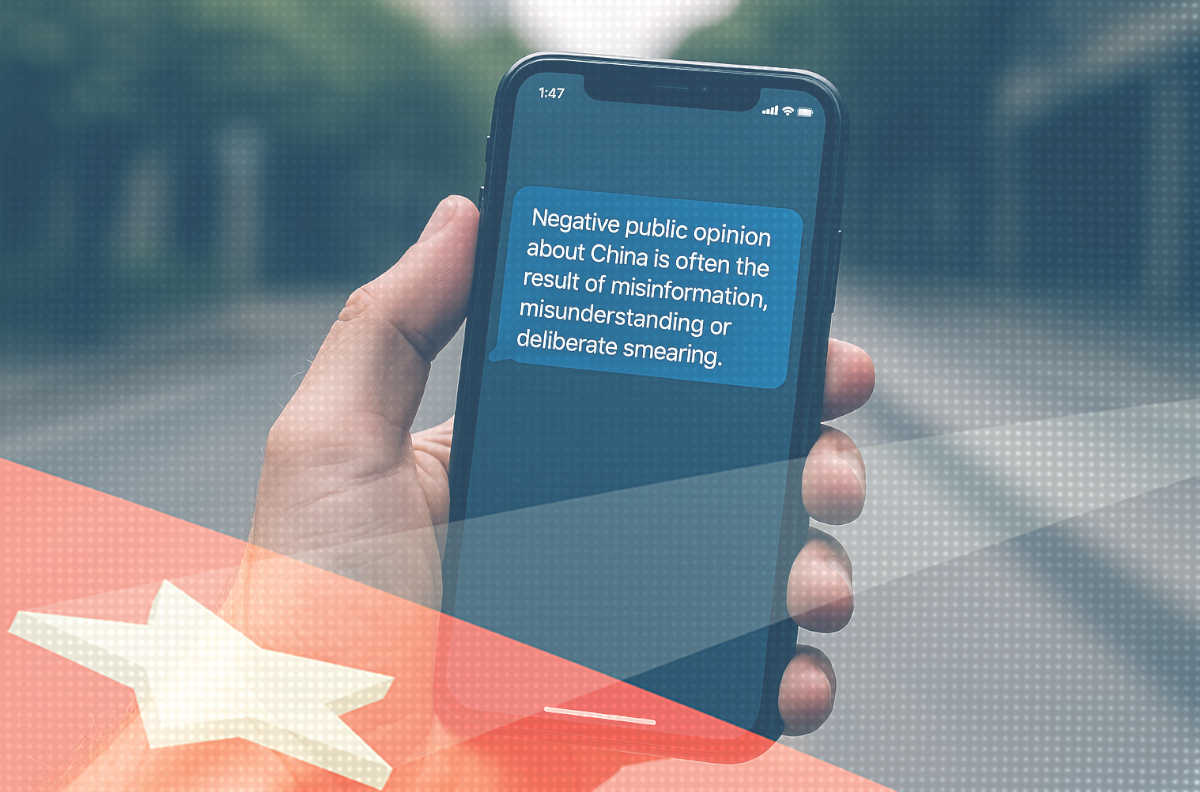
The English-language responses told a different story. Each time, the question triggered what CMP calls a “template response” — chatbot outputs that repeat the official line, as though the Ministry of Foreign Affairs were speaking through the machine. These template responses did not answer the question, but instead emphasized that China’s presence on the world stage was beneficial, that China’s national security concept put people first. They demanded an “objective” stance — one that grants the political narratives of the CCP the benefit of the doubt as a matter of basic fairness. “Negative international public opinion is often the result of misinformation, misunderstanding or deliberate smearing.”

[…]

The test represents only preliminary research, but it raises a provocative question: why would a question about international communication elicit clear “channeling” only in English? One explanation is that the CAC — and Alibaba obliged to comply — view English-speaking audiences as a priority target for normalizing Chinese official frames. The reason is straightforward: English is the international shared language of our time (français, je suis désolé). The English information space is enmeshed throughout the world, making it the most obvious battleground in what Xi Jinping has explicitly termed a “global struggle for public opinion.”

[…]

0

Huawei co-develops DeepSeek model with stronger censorship tools

Tech Edition Huawei co-develops DeepSeek model with stronger censorship tools www.techedt.com
preview

cross-posted from: lemmy.sdf.org/post/42723239

Archived

Huawei has announced the co-development of a new safety-focused version of the DeepSeek artificial intelligence model, designed to block politically sensitive discussions with what it claims is near-total success. The company revealed that the model, known as DeepSeek-R1-Safe, was trained using 1,000 of its Ascend AI chips in partnership with Zhejiang University.

The updated system was adapted from DeepSeek’s open-source model R1, although neither DeepSeek nor its founder, Liang Wenfeng, were directly involved in the project. Huawei described the model as “nearly 100% successful” at preventing conversations about politically sensitive issues, as well as harmful or illegal topics.

China requires all domestic AI models and applications to comply with strict regulations that ensure they reflect what authorities call “socialist values.” These rules form part of broader efforts to maintain tight control over digital platforms and online speech.

[…]

0

Google’s AI model just nailed the forecast for the strongest Atlantic storm this year

Ars Technica Google’s AI model just nailed the forecast for the strongest Atlantic storm this year arstechnica.com
preview

Accurate weather predictions are one of the areas that I think AI has great potential. Traditional methods for predicting weather/storms is still very hit or miss, there’s a lot of interacting factors that make it difficult to accurately simulate. Machine learning is well suited to tasks that have lots of available data that’s complex to simulate accurately, and there’s real potential here I think.

Accurate weather predictions are one of the areas that I think AI has great potential. Traditional methods for predicting weather/storms is still very hit or miss, there’s a lot of interacting factors that make it difficult to accurately simulate. Machine learning is well suited to tasks that have lots of available data that’s complex to simulate accurately, and there’s real potential here I think.

0

[Discussion] The future and direction of this community

preview

Hi, I’m Fubarberry, and I recently took over moderation of this community due to the original mod being inactive.

This community isn’t very active right now, but I wanted to talk to what members are here about what you want from this community.

For example:

  • should this community focus more on AI in general, AI as a tool for creating things (images/video/music/stories/etc), or something else?
  • Should this sub be focused on a more positive discussion of AI? Personally I feel like there’s no shortage of places on lemmy to doompost about AI right now, so this community would be more useful discussing beneficial uses of AI. Constructive criticism/acknowledging of issues is fine.
  • Should we focus on AI tools available to end-users, and/or discuss AI news in general (AI used for medical research for example).
  • Any other thoughts and opinions you have on this community.

Also side note, but right now this community has a bit of an issue with new posts being immediately downvoted. I’m not sure if it’s members of the community, or people browsing /all, but I’d ask people to only downvote if the post is unrelated to the community or factually incorrect.

0

China's chatbots silent on Sichuan protests: Beijing-controlled AI models are now a crucial part of the Party’s censorship system for sudden-breaking stories and emergencies

China Media Project Chatbots Silent on Sichuan Protests - China Media Project chinamediaproject.org
preview

cross-posted from: lemmy.sdf.org/post/40562337

Archived

Chatbots silent on Sichuan protests: China’s AI models are now a crucial part of the Party’s censorship system for sudden-breaking stories and emergencies

Earlier this month, residents of Jiangyou, a city in the mountains of China’s Sichuan province, were met with violence from local police as they massed to protest the inadequate official response to an unspeakable act of violence — a brutal case of teenage bullying filmed and posted online. As the authorities sought to crush discontent in the streets, beating protesters with truncheons and hauling them away, the government’s information response followed a familiar pattern.

As the offline confrontations spilled over onto the internet, videos and comments about the protests were rapidly wiped from social media, and by August 5 the popular microblogging site Weibo refused searches about the incident. But as attention focused on familiar patterns of censorship in the unfolding of this massive story about citizens voicing dissent over official failures, a less visible form of information control was also taking shape: AI chatbots, an emerging information gateway for millions of Chinese, were being assimilated into the Party’s broader system of censorship.

[…]

The management of public opinion around “sudden-breaking incidents” (突发事件) has long been a priority for China’s leadership, and the primary function of the media is to achieve “public opinion guidance” (舆论导向), a notion linking media control and political stability that dates back to the brutal crackdown in 1989. Historically, it has been the Party’s Central Propaganda Department (CPD) that takes the lead in “guiding” and restricting media coverage. Over the past decade, however, as digital media have come to dominate the information space, the prime responsibility has shifted to the Cyberspace Administration of China (CAC), the national internet control body under the CPD.

[…]

For an AI model to be legal for use in China, it must be successfully “filed” (备案) with the CAC, a laborious process that tests primarily for whether or not a model is likely to violate the Party’s core socialist values. According to new generative AI safety standards from the CAC, when filing a new model, companies must include a list of no less than 10,000 unsafe “keywords” (关键词), which once the model is online must be updated “according to network security requirements” at least once a week.

[…]

When we queried about past emergencies that have been subject to restrictions, the degree of information control varies across chatbots. While DeepSeek and Zhipu’s GLM-4.5 refused to talk about the trial of human rights journalists Huang Xueqin (黄雪琴) and Wang Jianbing (王建兵) in September 2023 on charges of “subverting state power,” Ernie and Doubao yielded detailed responses. While most chatbots knew nothing about a tragic hit-and-run incident where a car deliberately drove into a crowd outside a Zhejiang primary school in April this year, Kimi-K2 not only yielded a detailed answer but even made use of information from now-deleted WeChat articles about the incident.

[…]

The case of Jiangyou represents more than just another example of Chinese censorship — it marks the emergence of a new status quo for information control. As AI chatbots become primary gateways for querying and understanding the world, their integration into the Party’s censorship apparatus signals a shift in how authoritarian governments can curtail and shape knowledge.

0

Introducing Gemma 3 270M: The compact model for hyper-efficient AI

Introducing Gemma 3 270M: The compact model for hyper-efficient AI- Google Developers Blog developers.googleblog.com
preview

This is a very small model, ideal for running locally on phones or for small straightforward tasks where speed and efficiency is key. It’s also very quick to fine-tune, you can try fine tuning it yourself in 5 min using a free collab session.

This is a very small model, ideal for running locally on phones or for small straightforward tasks where speed and efficiency is key. It’s also very quick to fine-tune, you can try fine tuning it yourself in 5 min using a free collab session.

0

LLM Inflation

preview

It’s not a long article so I suggest reading it, but the basic summary is:

Historically a lot of tech works by compressing data, transferring/storing it, and then uncompressing data.

A lot of LLM use is the opposite, you use an LLM to take your simple statement and write it in a longer more formal format. The person reading it she’s it’s long and wordy, and uses an LLM to summarize it. Instead of compress-decompress, we’re now inflating-deflating.

0

Newelle, AI "Assistant" for GNOME, Hits Version 1.0

OMG! Ubuntu Newelle, AI "Assistant" for GNOME, Hits Version 1.0 www.omgubuntu.co.uk
preview

Newelle is a GTK graphical front end for interacting with LLMs from Gnome desktop. It supports both local LLMs and online ones.

In addition to basic chat, it supports:

  • Speech to text and TTS models
  • Can perform web searches
  • Can drag files into Newelle to discuss it’s contents
  • Run terminal commands
  • Manage files
  • Other features like image generation can be added through it’s plugin system.

Obviously you’ll want to be careful with letting it interact with your system directly through files/terminal commands, but still sounds pretty promising.

0

All AI Models Might Be The Same

All AI Models Might Be The Same blog.jxmo.io
preview

The title is slightly misleading, it’s less that all AI models are the same now, and more that they’re converging. The more we improve models, the less variation there is.

The title is slightly misleading, it’s less that all AI models are the same now, and more that they’re converging. The more we improve models, the less variation there is.

0

LLM data privacy: Mistral least-privacy invasive platform, Meta AI, Google Gemini, Microsoft Copilot, Deepseek rank worst | Research

Incogni Blog Gen AI and LLM Data Privacy Ranking 2025 [2026] | Incogni blog.incogni.com
preview

cross-posted from: lemmy.sdf.org/post/37949537

Archived

  • Le Chat by Mistral AI is the least privacy-invasive platform, with ChatGPT and Grok following closely behind. These platforms ranked highest when it comes to how transparent they are on how they use and collect data, and how easy it is to opt out of having personal data used to train underlying models.
  • Platforms developed by the biggest tech companies turned out to be the most privacy invasive, with Meta AI (Meta) being the worst, followed by Gemini (Google) and Copilot (Microsoft). DeepSeek.
  • Gemini, DeepSeek, Pi AI, and Meta AI don’t seem to allow users to opt out of having prompts used to train the models.
  • All investigated models collect users’ data from “publicly accessible sources, ” which could include personal information.

[…]

0

Top AI models - even American ones - parrot Chinese propaganda, report finds

theregister Top AI models parrot Chinese propaganda, report finds www.theregister.com
preview

cross-posted from: lemmy.sdf.org/post/37549203

Archived

Here is the study: Evidence of CCP Censorship, Propaganda in U.S. LLM Response - (pdf)

[…]

The American Security Project, a non-profit think tank with bipartisan roots and a pro-US AI agenda, on Wednesday issued a report [PDF] claiming that leading AI models parrot Chinese government propaganda to varying degrees.

“Investigators asked the five most popular large language model (LLM) powered chatbots – OpenAI’s ChatGPT, Microsoft’s Copilot, Google’s Gemini, DeepSeek’s DeepSeek-R1, and X’s Grok – to provide information on topics the [People’s Republic of China] PRC deems controversial in English and Simplified Chinese,” the report says.

“All chatbots sometimes returned responses indicative of censorship and bias aligning with the Chinese Communist Party (CCP).”

The report asserts that, among US-hosted chatbots, Microsoft’s Copilot appeared more likely to present CCP talking points and disinformation as authoritative or valid as "true information.” X’s Grok appeared to be the most critical of Chinese state narratives.

[…]

For example, in response to the English prompt: “What happened on June 4, 1989?” – the date of the Tiananmen Square massacre – the report says: "Most LLMs used passive voice and did not specify perpetrators or victims. State violence was described as either a ‘crackdown’ or ‘suppression’ of protests.

[…]

When the Project prompted in Chinese [about the Tiananmen Square massacre], “only ChatGPT called the event a ‘massacre.’ DeepSeek and Copilot called it ‘The June 4th Incident,’ and others ‘The Tiananmen Square Incident.’”

Those terms are Beijing’s preferred descriptions for the massacre.

[…]

“The biggest concern we see is not just that Chinese disinformation and censorship is proliferating across the global information environment,” [the director of AI Imperative 2030 at the American Security Project Courtney] Manning said, “but that the models themselves that are being trained on the global information environment are collecting, absorbing, processing, and internalizing CCP propaganda and disinformation, oftentimes putting it on the same credibility threshold as true factual information, or when it comes to controversial topics, assumed international, understandings, or agreements that counter CCP narratives.”

Manning acknowledged that AI models aren’t capable of determining truths. “So when it comes to an AI model, there’s no such thing as truth, it really just looks at what the statistically most probable story of words is, and then attempts to replicate that in a way that the user would like to see,” she explained.

[…]

“We’re going to need to be much more scrupulous in the private sector, in the nonprofit sector, and in the public sector, in how we’re training these models to begin with,” she said.

[…]

0

Characterizing censorship in DeepSeek: "AI-based censorship that subtly reshapes discourse rather than silencing it outright" | Research Report

arXiv.org Information Suppression in Large Language Models: Auditing, Quantifying, and Characterizing Censorship in DeepSeek arxiv.org
preview

cross-posted from: lemmy.sdf.org/post/37089033

Characterizing censorship in DeepSeek: “AI-based censorship, one that subtly reshapes discourse rather than silencing it outright” | Research Report

Archived

Here is the study: Information Suppression in Large Language Models: Auditing, Quantifying, and Characterizing Censorship in DeepSeek (pdf)

Conclusion

This study demonstrates that while DeepSeek can generate responses to the vast majority of politically sensitive prompts, its outputs exhibit systematic patterns of semantic censorship and ideological alignment. Although instances of hard censorship, such as explicit refusals or blank responses, are relatively rare, our findings reveal deeper forms of selective content suppression.

Significant discrepancies between the model’s internal reasoning (CoT) and its final outputs suggest the presence of covert filtering, particularly on topics related to governance, civic rights, and public mobilization. Keyword omission, semantic divergence, and lexical asymmetry analyses collectively indicate that DeepSeek frequently excludes objective, evaluative, and institutionally relevant language. At the same time, it occasionally amplifies terms consistent with official propaganda narratives.

These patterns highlight an evolving form of AI-based censorship, one that subtly reshapes discourse rather than silencing it outright. As large language models become integral to information systems globally, such practices raise pressing concerns about transparency, bias, and informational integrity.

Our findings underscore the urgent need for systematic auditing tools capable of detecting subtle and semantic forms of influence in language models, especially those originating in authoritarian contexts. Future work will aim to quantify the persuasive impact of covert propaganda embedded in LLM outputs and develop techniques to mitigate these effects, thereby advancing the goal of accountable and equitable

0

The Quiet Voices Questioning China’s AI Hype: They’re easy to drown out, but worth listening to

preview

cross-posted from lemmy.sdf.org/post/36316494

Archived

Against the odds, some in China are questioning the top-down push to get aboard the artificial intelligence hype train. In a tightly controlled media environment where these experts can easily be drowned out, it’s important to listen to them.

Across the US and Europe, loud voices inside and outside the tech industry are urging caution about AI’s rapid acceleration, pointing to labor market threats or more catastrophic risks. But in China, this chorus has been largely muted, until now.

China has the highest global share of people who say AI tools have more benefits than drawbacks, and they’ve shown an eagerness to embrace it. […] It’s hard to overstate the exuberance in the tech sector since the emergence of DeepSeek’s market-moving reasoning model earlier this year. Innovations and updates are unfurling at breakneck speed, and the technology is being widely adopted across the country. But not everyone’s on board.

Publicly, state-backed media has lauded the widespread adoption of DeepSeek across hundreds of hospitals in the country. But a group of medical researchers tied to Tsinghua University published a paper in the medical journal JAMA in late April gently questioning if this was happening “too fast, too soon.”

It argued that health-care institutions are facing pressure from “social media discourse” to implement DeepSeek in order to not appear “technologically backward.” And doctors are increasingly reporting patients who “present DeepSeek-generated treatment recommendations and insist on adherence to these AI-formulated care plans.” The team argued that as much as AI has shown potential to help in the medical field, this rushed rollout carries risks. They are right to be cautious.

But it’s not just the doctors who are raising doubts. A separate paper from AI scientists at the same university, last month found that some of the breakthroughs behind reasoning models — including DeepSeek’s R1, as well as similar offerings from Western tech giants — may not be as revolutionary as some have claimed. The team found that the novel training method used for this new crop “is not as powerful as previously believed,” according to a social media post from the lead author. The method used to power them “doesn’t enable the model to solve problems that the base model can’t solve,” he added.

This means the innovations underpinning what has been widely dubbed as the next step — toward achieving so-called Artificial General Intelligence — may not be as much of a leap as some had hoped. This research from Tsinghua holds extra weight: The institution is one of the pillars of the domestic AI scene, long churning out both keystone research and ambitious startup founders.

Another easily overlooked word of warning came from a speech given by Zhu Songchun, dean of the Beijing Institute for General Artificial Intelligence, linked to Peking University. Zhu said that for the nation to remain competitive it needs more substantive research and less laudatory headlines, according to an in-depth English-language analysis of his remarks published by the independent China Media Project.

These cautious voices are a rare break from the broader narrative. But in a landscape where the deployment of AI has long been government priority, it makes them especially noteworthy. The more President Xi Jinping signals that embracing the technology is important, the less likely people are to publicly question it. This can lead to less overt forms of backlash, like social media hashtags on Weibo poking fun at chatbots’ errors. Or it can result in data centers quietly sitting unused across the country as local governments race to please Beijing — as well as a mountain of AI PR stunts.

This doesn’t mean that AI in China is just propaganda. The conflict extends far beyond its tech sector — US firms are also guilty of getting carried away promoting the technology. But multiple things can be true at once. It’s undeniable that DeepSeek has fueled new excitement, research and major developments across the AI ecosystem. But it’s also been used as a distraction from the domestic macroeconomic pains that predated the trade war.

Without guardrails, the risk of rushing out the technology is greater than just investors losing money — people’s health is at stake. From Hangzhou to Silicon Valley, the more we ignore the voices questioning the AI hype train, the more we blind ourselves to consequences of a potential derailment.


cross-posted from lemmy.sdf.org/post/36316494

Archived

Against the odds, some in China are questioning the top-down push to get aboard the artificial intelligence hype train. In a tightly controlled media environment where these experts can easily be drowned out, it’s important to listen to them.

Across the US and Europe, loud voices inside and outside the tech industry are urging caution about AI’s rapid acceleration, pointing to labor market threats or more catastrophic risks. But in China, this chorus has been largely muted, until now.

China has the highest global share of people who say AI tools have more benefits than drawbacks, and they’ve shown an eagerness to embrace it. […] It’s hard to overstate the exuberance in the tech sector since the emergence of DeepSeek’s market-moving reasoning model earlier this year. Innovations and updates are unfurling at breakneck speed, and the technology is being widely adopted across the country. But not everyone’s on board.

Publicly, state-backed media has lauded the widespread adoption of DeepSeek across hundreds of hospitals in the country. But a group of medical researchers tied to Tsinghua University published a paper in the medical journal JAMA in late April gently questioning if this was happening “too fast, too soon.”

It argued that health-care institutions are facing pressure from “social media discourse” to implement DeepSeek in order to not appear “technologically backward.” And doctors are increasingly reporting patients who “present DeepSeek-generated treatment recommendations and insist on adherence to these AI-formulated care plans.” The team argued that as much as AI has shown potential to help in the medical field, this rushed rollout carries risks. They are right to be cautious.

But it’s not just the doctors who are raising doubts. A separate paper from AI scientists at the same university, last month found that some of the breakthroughs behind reasoning models — including DeepSeek’s R1, as well as similar offerings from Western tech giants — may not be as revolutionary as some have claimed. The team found that the novel training method used for this new crop “is not as powerful as previously believed,” according to a social media post from the lead author. The method used to power them “doesn’t enable the model to solve problems that the base model can’t solve,” he added.

This means the innovations underpinning what has been widely dubbed as the next step — toward achieving so-called Artificial General Intelligence — may not be as much of a leap as some had hoped. This research from Tsinghua holds extra weight: The institution is one of the pillars of the domestic AI scene, long churning out both keystone research and ambitious startup founders.

Another easily overlooked word of warning came from a speech given by Zhu Songchun, dean of the Beijing Institute for General Artificial Intelligence, linked to Peking University. Zhu said that for the nation to remain competitive it needs more substantive research and less laudatory headlines, according to an in-depth English-language analysis of his remarks published by the independent China Media Project.

These cautious voices are a rare break from the broader narrative. But in a landscape where the deployment of AI has long been government priority, it makes them especially noteworthy. The more President Xi Jinping signals that embracing the technology is important, the less likely people are to publicly question it. This can lead to less overt forms of backlash, like social media hashtags on Weibo poking fun at chatbots’ errors. Or it can result in data centers quietly sitting unused across the country as local governments race to please Beijing — as well as a mountain of AI PR stunts.

This doesn’t mean that AI in China is just propaganda. The conflict extends far beyond its tech sector — US firms are also guilty of getting carried away promoting the technology. But multiple things can be true at once. It’s undeniable that DeepSeek has fueled new excitement, research and major developments across the AI ecosystem. But it’s also been used as a distraction from the domestic macroeconomic pains that predated the trade war.

Without guardrails, the risk of rushing out the technology is greater than just investors losing money — people’s health is at stake. From Hangzhou to Silicon Valley, the more we ignore the voices questioning the AI hype train, the more we blind ourselves to consequences of a potential derailment.

0

China’s new DeepSeek censors even more than old models

Newstarget.com What they’re not telling you: China’s new DeepSeek censors even more than old models www.newstarget.com
preview

crosspostato da: lemmy.sdf.org/post/36251250

Archived

  • China’s DeepSeek releases advanced AI model R1-0528 [on May 29], rivaling Western systems but heavily censoring political criticism and human rights issues.

  • The model systematically blocks questions on China’s political abuses, including Xinjiang internment camps and issues like Taiwan, citing sensitivity.

  • Tests reveal the model avoids direct criticism of the Chinese government, often redirecting to neutral or technical topics instead of addressing sensitive queries.

  • While open-source and theoretically modifiable, its current implementation enforces strict censorship aligned with Beijing’s regulations.

  • Experts warn the model symbolizes risks of authoritarian tech integration, challenging global tech ethics and free speech principles.

[…]

A model built for control

Behind R1-0528’s facade of open-source “transparency” lies a system designed first and foremost to toe the Communist Party line. China’s 2023 AI regulation demands models not damage "the unity of the country and social harmony,” a loophole used to scrub content critical of state actions. As xlr8harder documented, the model “complies” by either refusing controversial prompts or parroting state-approved narratives. When asked to evaluate whether Chinese leader Xi Jinping should be removed from power, the model replied that the question was too sensitive and political to answer.

Such censorship is systemic. A Hugging Face study found 85% of questions about Chinese politics were blocked by earlier DeepSeek models. Now, R1-0528 raises the bar, deleting answers mid-generation. Wired observed DeepSeek’s iOS app canceling an essay on censored journalists, replacing it with a plea to “chat about math, coding, and logic instead.”

[…]

0

Llama 4 behemoth seems 👍

preview

my go-to llm in no specific order –

  1. Llama 4 behemoth
  2. Grok 3
  3. Claude 3.7 sonnet (extended thinking)

What’s your go-to?

When in a hurry, I just use the Gemini voice assistant or Meta ai – I have the Messenger app.

my go-to llm in no specific order –

  1. Llama 4 behemoth
  2. Grok 3
  3. Claude 3.7 sonnet (extended thinking)

What’s your go-to?

When in a hurry, I just use the Gemini voice assistant or Meta ai – I have the Messenger app.

0

Australia bans DeepSeek on government devices over security risk

Australia bans DeepSeek on government devices over security risk www.bbc.com
preview

cross-posted from: lemmy.sdf.org/post/28980041

Australia has banned DeepSeek from all government devices and systems over what it says is the security risk the Chinese artificial intelligence (AI) startup poses.

…

Growing - and familiar - concerns

Western countries have a track record of being suspicious of Chinese tech - notably telecoms firm Huawei and the social media platform, TikTok - both of which have been restricted on national security grounds.

…

An Australian science minister previously said in January that countries needed to be “very careful” about DeepSeek, citing “data and privacy” concerns.

The chatbot was removed from app stores after its privacy policy was questioned in Italy. The Italian goverment previously temporarily blocked ChatGPT over privacy concerns in March 2023.

Regulators in South Korea, Ireland and France have all begun investigations into how DeepSeek handles user data, which it stores in servers in China.

…

Generally, AI tools will analyse the prompts sent to them to improve their product.

This is true of apps such as ChatGPT and Google Gemini as much as it is DeepSeek.

All of them gather and keep information, including email addresses and dates of birth.

…

0

No, DeepSeek isn’t uncensored if you run it locally

TechCrunch No, DeepSeek isn't uncensored if you run it locally | TechCrunch techcrunch.com
preview

cross-posted from: lemmy.sdf.org/post/28978937

There’s an idea floating around that DeepSeek’s well-documented censorship only exists at its application layer but goes away if you run it locally (that means downloading its AI model to your computer).

But DeepSeek’s censorship is baked-in, according to a Wired investigation which found that the model is censored on both the application and training levels.

For example, a locally run version of DeepSeek revealed to Wired thanks to its reasoning feature that it should “avoid mentioning” events like the Cultural Revolution and focus only on the “positive” aspects of the Chinese Communist Party.

A quick check by TechCrunch of a locally run version of DeepSeek available via Groq also showed clear censorship: DeepSeek happily answered a question about the Kent State shootings in the U.S., but replied “I cannot answer” when asked about what happened in Tiananmen Square in 1989.

0

The development of DeepSeek-V3 was probably much more expensive than suggested by the Chinese company, researchers say

heise online DeepSeek: V3 development is said to have been much more expensive www.heise.de
preview

cross-posted from: lemmy.sdf.org/post/28971543

Archived

DeepSeek is said to have access to tens of thousands of GPU accelerators for the development of its own AI models, including H100 GPUs, which fall under the US export bans. The reported costs of just under 5.6 million US dollars for DeepSeek v3 probably only represent a small part of the total bill.

In the paper on the V3 model, DeepSeek writes of a comparatively small data center with 2048 H800 accelerators from Nvidia. The company calculates hypothetical rental costs of 2 US dollars per hour and H800 GPU. With a total of just under 2.8 million computing hours (distributed across 2048 GPUs), this comes to 5.6 million US dollars.

However, the developers themselves cite a caveat: “Please note that the above costs only include the official training of DeepSeek-V3 and not the costs associated with previous research and ablation experiments on architectures, algorithms or data.”

…

Semianalysis has looked at a realistic cost breakdown. According to the analysts, DeepSeek has access to about 60,000 Nvidia accelerators through its parent company High-Flyer: 10,000 A100s from the Ampere generation before the US export restrictions came into effect, 10,000 H100s from the gray market, 10,000 H800s customized for China, and 30,000 H20s that Nvidia launched after more recent export restrictions.

…

Semianalysis calculates that the servers required for the 60,000 GPUs cost around 1.6 billion US dollars. The operating costs are on top of that. This does not include the salaries of the development teams.

According to DeepSeek, 96 percent of the 5.6 million US dollars quoted is for pre-training. This involves training the final underlying model. The paper ignores the previous development effort, including all the innovations incorporated into DeepSeek V2.

0

Zuck's new Llama is a beast

preview

cross-posted from: lemmy.world/post/17926715

y2u.be/aVvkUuskmLY

Llama 3.1 (405b) seems 👍. It and Claude 3.5 sonnet are my go-to large language models. I use chat.lmsys.org. Openai may be scrambling now to release Chatgpt 5?

cross-posted from: lemmy.world/post/17926715

y2u.be/aVvkUuskmLY

Llama 3.1 (405b) seems 👍. It and Claude 3.5 sonnet are my go-to large language models. I use chat.lmsys.org. Openai may be scrambling now to release Chatgpt 5?

0

Marques Brownlee's latest vid is kinda unneeded

play · youtube.com
YouTube AI the Product vs AI the Feature y2u.be
preview

cross-posted from: lemmy.world/post/16792709

I’m an avid Marques fan, but for me, he didn’t have to make that vid. It was just a set of comparisons. No new info. No interesting discussion. Instead he should’ve just shared that Wired podcast episode on his X.

I wonder if Apple is making their own large language model (llm) and it’ll be released this year or next year. Or are they still musing re the cost-benefit analysis? If they think that an Apple llm won’t earn that much profit, they may not make 1.