I am trying to fold a bear using these instructions, and I am somewhat stuck at step 16.
My problem is that I seem to have some extra folds not shown in the diagram, and my trouble start somewhere around step 12. After step 12 my bear looks like the picture below (ignore all the extra creases, I unfolded it to take the picture):
And during step 16 it looks like this:
I seem to have this extra fold between the head and torso which makes the folds indicated in step 16 impossible, as far as I can tell. To me it seems like the edge of the paper on the head should be facing down, not up, if that makes sense? Similar to the torso. Then those folds would make sense to me. But I just don’t understand how to get there. If that were the case, I need to do something different during steps 11/12.
Am i missing something obvious?
I am trying to fold a bear using these instructions, and I am somewhat stuck at step 16.
My problem is that I seem to have some extra folds not shown in the diagram, and my trouble start somewhere around step 12. After step 12 my bear looks like the picture below (ignore all the extra creases, I unfolded it to take the picture):
And during step 16 it looks like this:
I seem to have this extra fold between the head and torso which makes the folds indicated in step 16 impossible, as far as I can tell. To me it seems like the edge of the paper on the head should be facing down, not up, if that makes sense? Similar to the torso. Then those folds would make sense to me. But I just don’t understand how to get there. If that were the case, I need to do something different during steps 11/12.
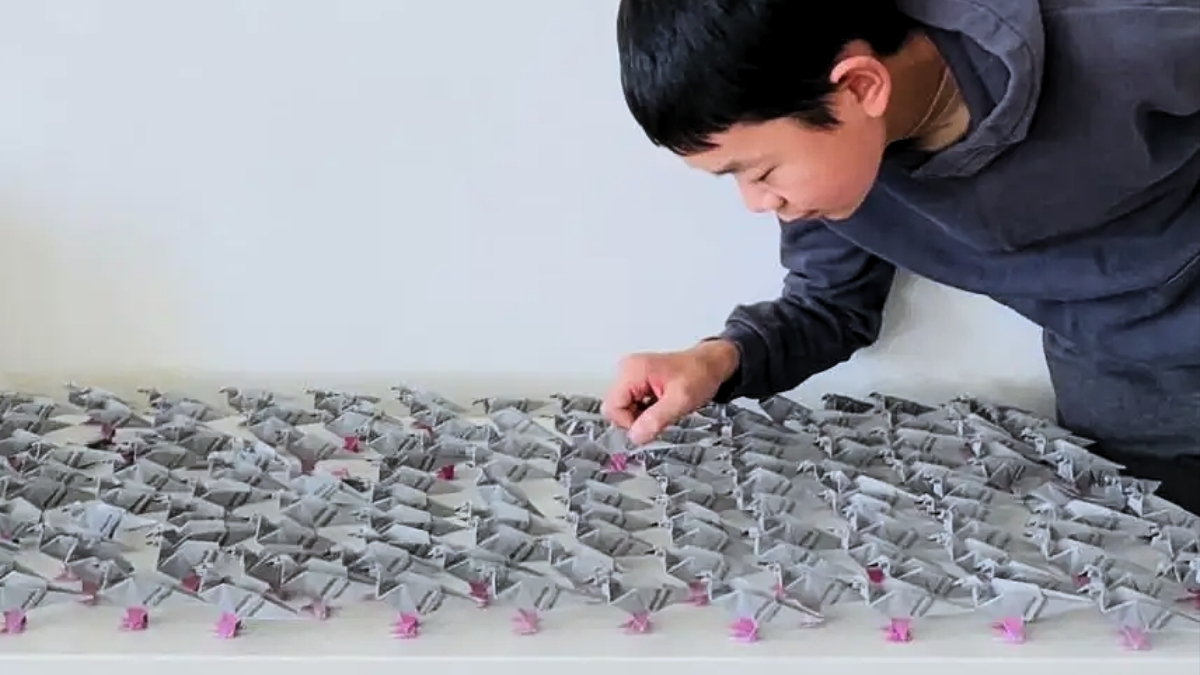
Sitting in his family’s living room in New York City, 14-year-old Miles Wu was astonished to find that a simple piece of paper, folded into a Miura-ori origami pattern, could hold 10,000 times its own weight. For a total of more than 250 hours, Wu had diligently designed, folded and tested copious variations of the technique—a series of tessellating parallelograms that can fold or unfold in one fell swoop—to find one that could be used to build deployable shelters for emergency situations like natural disasters.
“I was really shocked by how much [weight] these simple pieces of paper could hold,” says Wu, who’s currently a ninth-grade student at Hunter College High School in New York City.
Wu had always been fascinated with the ancient Japanese art of origami, but he really began indulging in it as a hobby about six years ago. In 2024, he started exploring paper folding beyond its appeal as a creative pursuit. “I started reading about how different types of geometric origami were being studied and applied in STEM for their various physical properties,” he says.
The teenager was researching the Miura-ori fold when Hurricane Helene made landfall in Florida and wildfires raged in Southern California. “I thought maybe these origami patterns, which are strong and collapsible, could be used as emergency shelters in these natural disasters—kind of like a tent,” he explains.
Wu noticed that existing structures were sturdy, easy to deploy or cost-efficient, but rarely all three. “This creates a problem during emergency situations, such as hurricanes or wildfires, as deployable shelters ideally need to be produced quickly, set up easily, and able to withstand the elements,” he says.
So, I’m kinda proud to share here a diagram I made for Riccardo Foschi’s standing gnome. It started as a personnal project, for me to remember the folding sequence.
I draw it from his YouTube tutorial.
But as I was quite satisfied with the outcome, I submitted it to Riccardo. And he agreed to make it public.
So here it is!
Feel free to share the diagram as much as you can.
And fold an army of gnomes!
Today I was talking with a musician friend and I realised that origami and music are more similar than I previously thought.
Often when someone asked me if I ever designed a model I answered that like in music not all musicians can compose a melody. Today, talking about a project I have in mind I realised that the similarities go a bit further in the sense that after I selected the models I want to use I’m having to fold them many times until I’m satisfied with the result, like a rehearsal, and the diagrams I’m following are like sheet music.
Whether you’re new at origami or a veteran folder, you should take a peek at these links. We gathered some useful sites where you’ll find astonishing diagrams.
We’ll update the list as well as we can.
Whether you’re new at origami or a veteran folder, you should take a peek at these links. We gathered some useful sites where you’ll find astonishing diagrams.
We’ll update the list as well as we can.