0

Linux sucks community

preview

I don’t know who is the mod of that community, but I suspect it’s the OP of the post.

My comment was a list of problems I’ve had lately on Windoz, pointing how in my recent experience I lost more time there than on Linux for an equivalent use.

I don’t remember my exact words and now they are erased, but it went along the lines of:

I have to use Windoz for work, and lately I lost more time on it than on Linux:

I’ve had several problems with teams (audio input/output switching unintentionaly, main audio output not controlled by keys/shortcuts, freezing, not answering calls)
Copilot freezing the complete OS so that a reboot was necessary.
Unable to scroll in a Copilot thread.
Locked by Bitlocker after update.
Task scheduler losing a task after sleep.
…

So pretty much a list of actual issues I met, not exactly what I would call being an evangelist saying Linux is superior blablabla. I’ve no idea (OK, maybe I have). I simply stated facts.

Is it possible to see who the mod was? Is it a temporary ban?

It’s a shame because I precisely created this account on lemmy.zip to see all instances and communities. /shrug Funny.

Edit: sorry I forgot the post: here
And some formatting edit.

0

SpeccyDate Breathes New Life Into ZX Spectrum Games on Playdate - Console Classics

Console Classics – Your Hub for Geek Culture 👾 SpeccyDate Breathes New Life Into ZX Spectrum Games on Playdate - Console Classics console-classics.com
preview

Relive the ZX Spectrum era on your Playdate with SpeccyDate, the emulator bringing classic games to this quirky handheld.

Relive the ZX Spectrum era on your Playdate with SpeccyDate, the emulator bringing classic games to this quirky handheld.

0

103-Jährige wirft falsche Handwerker aus ihrer Bremer Wohnung

buten un binnen Bremen: 103-Jährige wirft falsche Handwerker aus ihrer Bremer Wohnung - buten un binnen www.butenunbinnen.de
preview

Nachdem die Frau die Männer lautstark zum Verlassen ihrer Wohnung aufgefordert hatte, griff sie einem von ihnen nach Polizeiangaben “beherzt in den Nacken”.

Nachdem die Frau die Männer lautstark zum Verlassen ihrer Wohnung aufgefordert hatte, griff sie einem von ihnen nach Polizeiangaben “beherzt in den Nacken”.

0

How's your week been?

preview

If you are thinking about harming yourself — get immediate crisis support. Connect to a crisis counselor 24/7, 365 days a year, from anywhere in the U.S via text, chat, or phone. The Trevor Project is 100% confidential and 100% free.

www.thetrevorproject.org/get-help/

If you are thinking about harming yourself — get immediate crisis support. Connect to a crisis counselor 24/7, 365 days a year, from anywhere in the U.S via text, chat, or phone. The Trevor Project is 100% confidential and 100% free.

www.thetrevorproject.org/get-help/

0

Tesseract is gone. Are there any alternative alternative browser front ends besides Photon?

preview

Tesseract went away due to drama with the developer.

I’m glad that Photon still works, and that I can use it for moderator stuff.

Are there any other alternative front ends that I can use?

Tesseract went away due to drama with the developer.

I’m glad that Photon still works, and that I can use it for moderator stuff.

Are there any other alternative front ends that I can use?

0

Capture as Governance: A Revolutionary Intercommunal Mutualist reading of American mass incarceration

Capture as Governance: A Revolutionary Intercommunal Mutualist reading of American mass incarceration substack.com
preview

Posting a bit of theory from my own Anarcho-Pantherist tradition for you all today.


Capture as Governance: A Revolutionary Intercommunal Mutualist reading of American mass incarceration

Read distraction-free on Substack

A Revolutionary Intercommunal Mutualist reading of American mass incarceration

United Panther Party – U.S. | Ministry of Political Education

The United States holds roughly 1.97 million people in confinement and locks them up at about 580 per 100,000 residents, the highest rate of any independent democracy on Earth and among the highest of any nation on the planet. Only El Salvador, Cuba, and Turkmenistan cage more of their people per capita. The country carries a little over four percent of the world’s population and close to a sixth of the world’s counted prisoners. The whole apparatus runs on about 445 billion dollars a year.

Break the country into its parts and the picture sharpens. Two dozen states lock people up at rates that would top nearly every nation on Earth, and after El Salvador the nine highest incarceration rates on the planet belong to U.S. states, almost all of them in the South. The carceral core has a core, and it’s the ground Food Justice United organizes on. The growth engine has moved too. Immigration detention now drives almost all new confinement, with ICE detention up more than half in a single year, which puts the frontier of capture at the border rather than the drug corner.

It’s worth holding the country’s favorite line about itself up against that arithmetic. Land of the free, home of the brave. No nation that cages its people at this rate has any business calling itself free, and none that needs this many walls to feel safe has any business calling itself brave. By its own telling this is the freest place on Earth, and by the count it has built the most crowded prison system in the democratic world, then draped a flag over it and set the words to music. The anthem doesn’t describe a condition. It advertises one. And the advertising is paid for by the exact people the numbers just named: the freedom gets sung, and they get counted.

That’s where the numbers stand. What a Revolutionary Intercommunal Mutualist analysis asks isn’t whether the disproportion is real but what it’s for.

Dr. Huey Newton’s late theory argued that the nation-state had been overtaken by something larger: a single global order held together by the U.S. ruling class and its technologies of control, which he named reactionary intercommunalism. In that reading there aren’t really separate nations anymore so much as a network of communities administered from an imperial center. Revolutionary Intercommunalism was the answer, a world of liberated communities linked by mutual aid instead of domination. RIM inherits that map and adds the constructive economics the Panthers gestured at but didn’t finish: mutualism, the cooperative and anti-statist tradition, drawn through the Black radical tradition and Indigenous lifeways rather than borrowed whole from Proudhon.

Put mass incarceration on that map and it stops looking like a domestic policy problem. The prison isn’t the criminal legal system’s regrettable overreach. It’s one of the empire’s core instruments for managing the populations it has rendered surplus, dangerous, or in the way. Capture isn’t what the state does when governance fails. Capture is a form of governance. The cage is how the administrative center of reactionary intercommunalism handles the people it can neither fully employ nor openly kill: it holds them, moves them, rents them, and disappears them into a machine that runs on roughly 445 billion dollars a year.

There’s a familiar left explanation for all of this, and RIM treats it as half-right and therefore dangerous. The story goes like this: capitalism produces a surplus population it can’t employ, and prisons warehouse that surplus while extracting cheap labor from it. True as far as it goes. Prison labor is real, the profit is real, and the reserve-army logic is real. But if that were the whole story, the cage would fall on the poor at random, and it doesn’t. It falls along lines that class alone can’t draw.

RIM rejects class reductionism as a founding commitment, not a footnote. The carceral state is built at the intersection of forces that can’t be collapsed into one, and the doctrine reads it through four co-equal pillars: Anarcho-Pantherism and the Black radical tradition, the Black Feminisms, the anti-colonial tradition, and tribal and Indigenous traditions. Each names a dimension of capture the economic story leaves out. Together they explain the disproportion the pure political-economy account can only wave at.

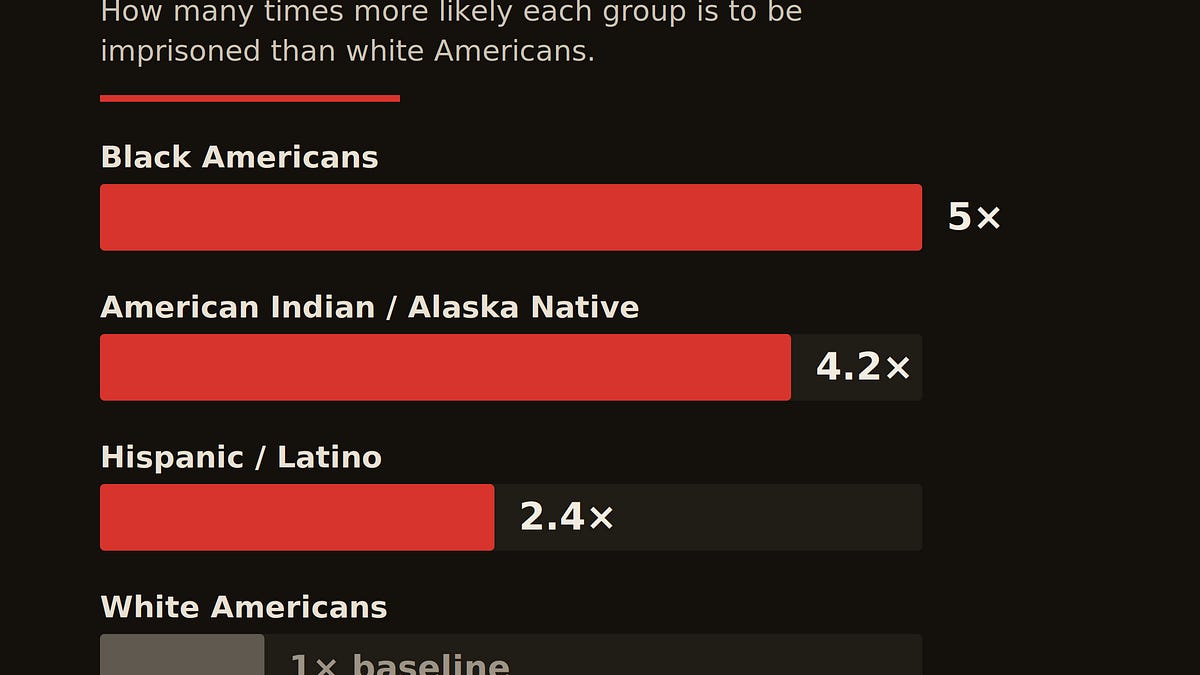
The clearest sign that this isn’t only about class is the color of the cages. Black Americans are about 13 percent of the country and roughly 37 percent of the people in its prisons and jails. Black adults are imprisoned at about five times the white rate. Among people serving life, life without parole, or sentences so long they amount to the same thing, nearly half are Black. One in 81 Black adults is in a state prison on any given day. No purely economic model produces those numbers.

The Black radical tradition supplies the through-line the numbers point at. The Thirteenth Amendment didn’t abolish slavery so much as relocate the exception, banning bondage “except as a punishment for crime.” Convict leasing filled the gap almost immediately, renting Black prisoners to the same industries that had bought Black slaves. The line runs unbroken from the plantation to the chain gang to the modern prison, and from the slave patrol to the police department that feeds it. Scholars in this tradition, Angela Davis, Ruth Wilson Gilmore, Michelle Alexander, Saidiya Hartman, have spent decades tracing it, and the shorthand they’ve handed us is exact: the prison is the afterlife of slavery. Gilmore’s definition of racism belongs here too, the production and exploitation of group-differentiated vulnerability to premature death, sanctioned by the state or permitted beside it. The cage is one of its primary engines.

The Anarcho-Panther reading adds the part liberals flinch from. The problem isn’t a broken system that better funding and better training will repair. The state’s claim to a monopoly on safety is the thing that manufactures the danger it then polices. An institution built to capture can’t be reformed into an institution that heals, any more than the slave patrol could have been sensitivity-trained into a mutual aid society. That’s why RIM’s horizon isn’t a kinder prison but the withering of the cage as a technology, replaced from below.

An analysis that stops at Black men misses half the machine and most of its cruelty. Women are among the fastest-growing groups behind bars, and Black women are imprisoned at over one and a half times the rate of white women. The Black Feminisms pillar reads the carceral state through what it does to survival itself: the woman who fights back against the man beating her and goes to prison for it, the mother whose poverty becomes a neglect charge, the survivor whose trauma becomes a drug case. Capture doesn’t just fall on the racialized poor. It criminalizes the things people do to stay alive inside conditions the same state created.

It also runs on family destruction, a form of social control the labor story can’t see. Every caged parent is a household torn open, children routed into foster systems that feed back into prisons, and the unpaid work of holding families together loaded onto the women left outside the walls. This is why RIM refuses carceral feminism, the belief that gender violence can be solved by adding police and prison cells. The state’s answer to harm against women has been to expand the very apparatus that cages their brothers, sons, and partners, and that same apparatus turns survivors themselves into defendants. Thinkers and organizers in this tradition, Beth Richie, Andrea Ritchie, Mariame Kaba, the Survived and Punished network, have shown that you can’t punish your way to safety for women, because the punishment system is itself a source of gendered violence. Safety for the most vulnerable has to be built, not sentenced.

The Panthers and the anti-colonial theorists they read, Fanon above all, described Black and colonized communities as internal colonies: territories inside the imperial state, policed like occupied ground, extracted from, and governed by force rather than consent. The carceral state is the occupying army’s logic turned inward. The war on drugs was never mainly about drugs. It was domestic counterinsurgency, a way to flood targeted neighborhoods with police, surveillance, and prison sentences under a public-health disguise. The tools move in a loop. Tactics, weapons, and training developed for imperial policing abroad come home to the reservation and the housing project, and what’s refined at home gets exported again.

Today the frontier of capture has moved to the literal border. Immigration detention is now the engine of nearly all growth in American confinement, with ICE detention rising by more than half in a single year. The racialized migrant is the newest population the empire captures to manage, held in a network of facilities that answers to no meaningful oversight. The prison and the detention center are two faces of one project: the administration of racialized populations the imperial core has decided it can neither absorb as equals nor leave alone. From an anti-colonial vantage the disproportion isn’t a scandal inside an otherwise sound republic. It’s what colonial administration looks like when the colony is domestic.

Native people are caged at rates that rival any group in the country: imprisoned at more than twice the national rate and over four times the white rate, jailed at nearly three times the white rate, held in dozens of jails scattered across Indian country under a jurisdictional maze designed in Washington. And the disproportion is the newest layer of the oldest capture on this continent. Before there were prisons here there was dispossession, the removal of nations from their land, and the two have always worked together: criminalize the people, clear the territory. The boarding school was a carceral institution in everything but name, built to confine Native children, sever them from family and language, and process them into something the settler order could use. “Kill the Indian, save the man” was a sentence in both meanings of the word.

But the Indigenous pillar in RIM isn’t only a record of harm, and this is where the analysis turns toward what comes next. Indigenous justice traditions across many nations never organized themselves around the cage at all. They oriented toward repair: restoring relationships, reintegrating the person who caused harm, making the injured whole, keeping the community intact rather than exiling its members. These aren’t theoretical alternatives waiting to be invented. They predate the prison by millennia and have survived every attempt to stamp them out. They’re proof, standing and breathing, that a people can meet harm without warehousing human beings, which is exactly what the carceral state insists is impossible.

Line the four pillars up and the disproportion resolves into a single picture. The cage manages the populations the empire has made: the descendants of the enslaved, the women criminalized for surviving, the internal colonies and the migrants at the frontier, the Indigenous nations it’s still dispossessing. Class is in there, woven through all of it, but class alone never drew these lines and never will. Capture is a mode of governance, and its targets aren’t random. They’re chosen. The disproportion isn’t the system malfunctioning. It’s the system doing precisely what it was built to do, which is why tinkering with sentencing guidelines and retraining the guards has never touched it and never will.

That’s the diagnosis. A Revolutionary Intercommunal Mutualist analysis doesn’t stop at diagnosis, because naming the machine is only worth doing if it clears the ground for building something in its place.

RIM’s strategy has a name for this, borrowed from an old labor slogan and taken seriously: rising inside the shell of the old. You don’t wait for permission to dismantle the cage, and you don’t expect the state to dismantle it for you. You build the community capacity to meet needs and harms directly, until the cage stands revealed as a choice rather than a necessity, and then as an obstacle to be removed. That’s dual power, growing the institutions of a liberated community alongside and against the ones that rule now.

The blueprint for it is the Community Infrastructure Stack, and it’s worth seeing that the whole thing is anti-carceral from the ground up. It runs in order. Food Sovereignty comes first, because a community that can feed itself has pulled the floor out from under a huge share of what gets criminalized as property and survival crime. Community Health and Harm Reduction comes next, and it’s the most direct daylight substitute for the cage there is: naloxone and overdose response in the hands of neighbors, care instead of arrest for the drug user, treating addiction and mental health crisis as health rather than as crime. This is ground Food Justice United already works, and every overdose reversed outside a jail cell is a small proof of the whole thesis. Climate Resilience follows, because a community that can hold together through disaster doesn’t have to be rescued and then policed by the state. Decolonized Technology comes after that, so the tools a community depends on aren’t the same surveillance systems that feed the cage. And the stack lands, deliberately, on Accountable Safety Systems, the fifth tier, the one that meets the carceral state head-on.

Accountable Safety Systems is where the abstract becomes concrete. It means community-based responses to harm that don’t route through capture: transformative justice and community accountability processes that address violence by changing the conditions that produce it and repairing the damage it does, rather than banishing a body to a cage and calling the matter closed. It’s the Indigenous repair tradition and the Black feminist insistence on real safety, built into working infrastructure. Nobody claims this is easy, and RIM doesn’t pretend the hardest cases have simple answers. The claim is narrower and firmer: the cage doesn’t answer them either. It only hides them. A community that has built the other four tiers has the standing and the capacity to take up the fifth, because safety turns out to be something you construct out of met needs, not something you sentence people into.

Come back to where this started. A country with a twentieth of the world’s people built the most extreme carceral apparatus in the democratic world, and it did so by narrowing, again and again, the circle of who counts as fully human and therefore worthy of freedom and safety. That narrowing is the deepest logic of the cage: some people are the public that safety protects, and others are the threat that safety is protected from. Every disproportion in the numbers is that line, drawn in flesh.

The answer isn’t a better-managed cage or a fairer line. It’s the refusal of the line itself. That refusal is the whole content of the phrase this movement organizes under, ALL Power to ALL People, said plainly so it can’t be narrowed to a chosen few. A world organized that way doesn’t need a fifth of anyone’s cages, because it doesn’t produce the surplus, the frontier, and the internal colony the cages exist to manage. Building that world, one tier of infrastructure at a time, inside the shell of this one, is the work.

ALL Power to ALL People.

Data and reporting:

Prison Policy Initiative, Mass Incarceration: The Whole Pie 2026 (national confined population near 1.97 million; rate of 580 per 100,000; roughly 445 billion dollars in annual system cost; immigration detention as the primary growth driver).

Institute for Crime and Justice Policy Research, World Prison Brief (global counted prison population above 11.5 million; comparative national rates; U.S. rate declining from a mid-2000s peak above 750 per 100,000).

The Sentencing Project, One in Five: Ending Racial Inequity in Incarceration and associated state data (Black imprisonment near five times the white rate; American Indian at 4.2 times and Latinx at 2.4 times the white rate; Black women at 1.6 times the white women’s rate).

Prison Policy Initiative, Racial and Ethnic Disparities research (Black share of population versus prison and jail population; Native prison rate of 763 versus 350 per 100,000 nationally; share of long-sentence populations).

Bureau of Justice Statistics, Prisoners in 2023, Statistical Tables (NCJ 310197, September 2025).

PolitiFact, “Webb says U.S. has 5 percent of world’s population, 25 percent of its ‘known’ prisoners” (December 2014), for the peak-era origin of the 5 percent and 25 percent figures.

Theory and tradition:

Huey P. Newton, writings and speeches on revolutionary intercommunalism.

Angela Y. Davis, Are Prisons Obsolete?

Ruth Wilson Gilmore, Golden Gulag: Prisons, Surplus, Crisis, and Opposition in Globalizing California.

Michelle Alexander, The New Jim Crow: Mass Incarceration in the Age of Colorblindness.

Saidiya Hartman, Lose Your Mother (the afterlife of slavery).

Beth E. Richie, Arrested Justice: Black Women, Violence, and America’s Prison Nation.

Andrea J. Ritchie, Invisible No More: Police Violence Against Black Women and Women of Color.

Mariame Kaba, We Do This ‘Til We Free Us, and the Survived and Punished organizing tradition.

Frantz Fanon, The Wretched of the Earth.

0

87 year old runs over 4 pedestrians and kills one after running red light.

https://www.kold.com One dead, multiple hospitalized after 87-year-old driver runs red light, police say www.kold.com
preview

This is why I support car free pedestrian streets in urban and highly populated areas.

This is why I support car free pedestrian streets in urban and highly populated areas.

0

Whales are dying in B.C. waters. Here's how 2 groups are trying to save them - An estimated 20K whales are killed worldwide by vessel strikes each year, research suggests

CBC Whales are dying in B.C. waters. Here's how 2 groups are trying to save them | CBC News www.cbc.ca
preview

Southern resident orcas are one of the most critically endangered marine mammals in Canada, according to the federal government’s Species at Risk Act, and the Centre for Whale Research says there are about 74 left in British Columbia’s waters — as well as a new calf not included in their numbers. Their main food source is the declining chinook salmon, primarily located in the Salish Sea, one of the busiest shipping corridors in North America.

Southern resident orcas are one of the most critically endangered marine mammals in Canada, according to the federal government’s Species at Risk Act, and the Centre for Whale Research says there are about 74 left in British Columbia’s waters — as well as a new calf not included in their numbers. Their main food source is the declining chinook salmon, primarily located in the Salish Sea, one of the busiest shipping corridors in North America.

0

Butterscotch

preview

Had to deal with a bit of copper coming of the still (if you do this ph balance it with some citric acid otherwise it’ll eat your copper still) but wow. All I can say is it’s worth it. I don’t think I’d call it butterscotch flavored but it’s extremely creamy off the still so when I toss some candies into the liquid afterwards it’ll be exactly what I’m looking for. I’ll have to make this again

Had to deal with a bit of copper coming of the still (if you do this ph balance it with some citric acid otherwise it’ll eat your copper still) but wow. All I can say is it’s worth it. I don’t think I’d call it butterscotch flavored but it’s extremely creamy off the still so when I toss some candies into the liquid afterwards it’ll be exactly what I’m looking for. I’ll have to make this again

0

Carbon fork on a steel bike?

preview

I’m looking for a new bicycle to replace my stolen gravel bike, and one of the options I have is a 12,6kg full CrMo steel framed gravel / trekking bike that seems cheap and robust enough. My only concern is that my previous bike was 9-10 kilos, with an aluminium body and carbon fork, and it rode really well, so i’m a bit worried it might not be as fun on longer rides.

So that got me thinking: how much weight could I reduce by switching from a steel fork to a carbon fork, and how easy is it to do it myself? Would it be worth it?

0

prolonged periods of time.

preview

I’m more of a “Calvin uses his imagination” guy now, but when I first read Calvin & Hobbes, I thought Hobbes came to life when no one except Calvin was looking, like Toy Story if Andy could see his toys come to life


(u/chnl-daz)

I’m more of a “Calvin uses his imagination” guy now, but when I first read Calvin & Hobbes, I thought Hobbes came to life when no one except Calvin was looking, like Toy Story if Andy could see his toys come to life


(u/chnl-daz)

0

𝑻𝒐𝒍𝒔𝒕𝒐𝒚'𝒔 "𝑴𝒆𝒏 𝒊𝒏 𝑻𝒉𝒆𝒊𝒓 𝑷𝒓𝒆𝒔𝒆𝒏𝒕 𝑪𝒐𝒏𝒅𝒊𝒕𝒊𝒐𝒏 𝑨𝒓𝒆 𝑳𝒊𝒌𝒆 𝒂 𝑺𝒘𝒂𝒓𝒎 𝒐𝒇 𝑩𝒆𝒆𝒔 𝑯𝒂𝒏𝒈𝒊𝒏𝒈 𝒊𝒏 𝒂 𝑪𝒍𝒖𝒔𝒕𝒆𝒓 𝒕𝒐 𝒂 𝑩𝒓𝒂𝒏𝒄𝒉"

preview

When Tolstoy speaks of Christianity, he’s referring to his more objective, philosophical, less supernatural interpretation of his translation of the Gospels, The Gospel in Brief. For context: Tolstoy’s Personal, Social, and Divine Conceptions of Life.


For a Christian to promise obedience to men, or the laws of men, is just as though a workman bound to one employer should also promise to carry out every order that might be given him by outsiders. One cannot serve two masters [Matt 6:24]. The Christian is independent of human authority, because he acknowledges God’s authority alone. His law, revealed by Christ, he recognizes in himself, and voluntarily obeys it.

And this independence is gained, not by means of strife, not by the destruction of existing forms of life, but only by a change in the interpretation of life. This independence results first from the Christian recognizing the divine law of love [seen in the sense of the laws of physics], revealed to him by his teacher [Jesus], as perfectly sufficient for all human relations, and therefore he regards all use of force as unnecessary and unlawful [a governments use of force to secure its power for example]; and secondly, from the fact that those deprivations and sufferings, or threats of deprivations and sufferings (which reduce the man of the social conception of life to the necessity of obeying) to the Christian from his different conception of life, present themselves merely as the inevitable conditions of existence. And these conditions, without striving against them by force, he patiently endures, like sickness, hunger, and every other hardship, but they cannot serve him as a guide for his actions. The only guide for the Christian’s actions is to be found in the divine principle living within him, which cannot be checked or governed by anything.

The Christian acts according to the words of the prophecy applied to his teacher: “He shall not strive, nor cry; neither shall any man hear his voice in the streets. A bruised reed shall not break, and smoking flax shall he not quench, till he send forth judgment unto victory” (Matt 12:19, 20). The Christian will not dispute with anyone, nor attack anyone, nor use violence against anyone. On the contrary, he will bear violence without opposing it. But by this very attitude to violence, he will not only himself be free, but will free the whole world from any external power. “Ye shall know the truth, and the truth will make you free.” If there were any doubt of Christianity being the truth, the perfect liberty, that nothing can curtail, which a man experiences directly he makes the Christian theory of life his own, would be an unmistakable proof of its truth.

Men in their present condition are like a swarm of bees hanging in a cluster to a branch. The position of the bees on the branch is temporary, and must inevitably be changed. They must start off and find themselves a habitation. Each of the bees knows this, and desires to change her own and the others’ position, but no one of them can do it till the rest of them do it. They cannot all start off at once, because one hangs on to another and hinders her from separating from the swarm, and therefore they all continue to hang there. It would seem that the bees could never escape from their position, just as it seems that worldy men, caught in the toils of the state conception of life, can never escape. And there would be no escape for the bees, if each of them were not a living, seperate creature, endowed with wings of its own. Similarly there would be no escape for men, if each were not a living being endowed with the faculty of entering into the Christian [divine] conception of life.

If every bee who could fly, did not try to fly, the others too would never be stirred, and the swarm would never change its position. And if the man who has mastered the Christian conception of life would not, without waiting for other people, begin to live in accordance with this conception, mankind would never change its position. But only let one bee spread her wings, start off, and fly away, and after her another, and another, and the clinging, inert cluster would become a freely flying swarm of bees. Just in the same way, only let one man look at life as Christianity teaches him to look at it, and after him let another and another do the same, and the enchanted circle of existence in the state conception of life, from which there seemed no escape, will be broken through.

But men think that to set all men free by this means is too slow a process, that they must find some other means by which they could set all men free at once. It is just as though the bees who want to start and fly away should consider it too long a process to wait for all the swarm to start one by one; and should think they ought to find some means by which it would not be necessary for every seperate bee to spread her wings and fly off, but by which the whole swarm could fly at once where it wanted to. But that is not possible; till a first, a second, a third, a hundredth bee spreads her wings and flies off of her own accord with it, there can be no solution of the problem of human life, and no establishment of a new form of life. - Leo Tolstoy, The Kingdom of God is Within You, Chapter Nine: “The Acceptance of the Christian Conception of Life Will Emancipate Men From the Miseries of Our Pagan Life”

The Bee That Stirred the Hive Is the Wise Man: lemmy.world/post/46662399


When Tolstoy speaks of Christianity, he’s referring to his more objective, philosophical, less supernatural interpretation of his translation of the Gospels, The Gospel in Brief. For context: Tolstoy’s Personal, Social, and Divine Conceptions of Life.


For a Christian to promise obedience to men, or the laws of men, is just as though a workman bound to one employer should also promise to carry out every order that might be given him by outsiders. One cannot serve two masters [Matt 6:24]. The Christian is independent of human authority, because he acknowledges God’s authority alone. His law, revealed by Christ, he recognizes in himself, and voluntarily obeys it.

And this independence is gained, not by means of strife, not by the destruction of existing forms of life, but only by a change in the interpretation of life. This independence results first from the Christian recognizing the divine law of love [seen in the sense of the laws of physics], revealed to him by his teacher [Jesus], as perfectly sufficient for all human relations, and therefore he regards all use of force as unnecessary and unlawful [a governments use of force to secure its power for example]; and secondly, from the fact that those deprivations and sufferings, or threats of deprivations and sufferings (which reduce the man of the social conception of life to the necessity of obeying) to the Christian from his different conception of life, present themselves merely as the inevitable conditions of existence. And these conditions, without striving against them by force, he patiently endures, like sickness, hunger, and every other hardship, but they cannot serve him as a guide for his actions. The only guide for the Christian’s actions is to be found in the divine principle living within him, which cannot be checked or governed by anything.

The Christian acts according to the words of the prophecy applied to his teacher: “He shall not strive, nor cry; neither shall any man hear his voice in the streets. A bruised reed shall not break, and smoking flax shall he not quench, till he send forth judgment unto victory” (Matt 12:19, 20). The Christian will not dispute with anyone, nor attack anyone, nor use violence against anyone. On the contrary, he will bear violence without opposing it. But by this very attitude to violence, he will not only himself be free, but will free the whole world from any external power. “Ye shall know the truth, and the truth will make you free.” If there were any doubt of Christianity being the truth, the perfect liberty, that nothing can curtail, which a man experiences directly he makes the Christian theory of life his own, would be an unmistakable proof of its truth.

Men in their present condition are like a swarm of bees hanging in a cluster to a branch. The position of the bees on the branch is temporary, and must inevitably be changed. They must start off and find themselves a habitation. Each of the bees knows this, and desires to change her own and the others’ position, but no one of them can do it till the rest of them do it. They cannot all start off at once, because one hangs on to another and hinders her from separating from the swarm, and therefore they all continue to hang there. It would seem that the bees could never escape from their position, just as it seems that worldy men, caught in the toils of the state conception of life, can never escape. And there would be no escape for the bees, if each of them were not a living, seperate creature, endowed with wings of its own. Similarly there would be no escape for men, if each were not a living being endowed with the faculty of entering into the Christian [divine] conception of life.

If every bee who could fly, did not try to fly, the others too would never be stirred, and the swarm would never change its position. And if the man who has mastered the Christian conception of life would not, without waiting for other people, begin to live in accordance with this conception, mankind would never change its position. But only let one bee spread her wings, start off, and fly away, and after her another, and another, and the clinging, inert cluster would become a freely flying swarm of bees. Just in the same way, only let one man look at life as Christianity teaches him to look at it, and after him let another and another do the same, and the enchanted circle of existence in the state conception of life, from which there seemed no escape, will be broken through.

But men think that to set all men free by this means is too slow a process, that they must find some other means by which they could set all men free at once. It is just as though the bees who want to start and fly away should consider it too long a process to wait for all the swarm to start one by one; and should think they ought to find some means by which it would not be necessary for every seperate bee to spread her wings and fly off, but by which the whole swarm could fly at once where it wanted to. But that is not possible; till a first, a second, a third, a hundredth bee spreads her wings and flies off of her own accord with it, there can be no solution of the problem of human life, and no establishment of a new form of life. - Leo Tolstoy, The Kingdom of God is Within You, Chapter Nine: “The Acceptance of the Christian Conception of Life Will Emancipate Men From the Miseries of Our Pagan Life”

The Bee That Stirred the Hive Is the Wise Man: lemmy.world/post/46662399


0

𝑻𝒐𝒍𝒔𝒕𝒐𝒚'𝒔 "𝑻𝒉𝒆 𝑺𝒐𝒍𝒆 𝑮𝒖𝒊𝒅𝒆 𝑾𝒉𝒊𝒄𝒉 𝑫𝒊𝒓𝒆𝒄𝒕𝒔 𝑴𝒆𝒏 𝒂𝒏𝒅 𝑵𝒂𝒕𝒊𝒐𝒏𝒔 𝑯𝒂𝒔 𝑨𝒍𝒘𝒂𝒚𝒔 𝑩𝒆𝒆𝒏 𝑷𝒖𝒃𝒍𝒊𝒄 𝑶𝒑𝒊𝒏𝒊𝒐𝒏"

preview

When Tolstoy speaks of Christianity, he’s referring to his more objective, philosophical, less supernatural interpretation of his translation of the Gospels: The Gospel in Brief. For context: lemmy.world/post/42151959


“They say that the Christian life cannot be established without the use of violence, because there are savage races outside the pale of Christian societies in Africa and in Asia (there are some who even represent the Chinese as a danger to civilization), and that in the midst of Christian societies there are savage, corrupt, and, according to the new theory of heredity, congenital [(of a disease or physical abnormality) present from birth] criminals. And violence, they say, is necessary to keep savages and criminals from annihilating our civilization. But these savages within and without Christian society, who are such a terror to us, have never been subjugated [bring under domination or control, especially by conquest] by violence, and are not subjugated by it now. Nations have never subjugated other nations by violence alone. If a nation which subjugated another was on a lower level of civilization, it has never happened that it succeeded in introducing its organization of life by violence. On the contrary, it was always forced to adopt the organization of life existing in the conquered nation. If ever any of the nations conquered by force have been really subjugated, or even nearly so, it has always been by the action of public opinion, and never by violence, which only tends to drive a people to further rebellion.

When whole nations have been subjugated by a new religion, and have become Christian or Mohammedan, such a conversion has never been brought about because the authorities made it obligatory (on the contrary, violence has more often acted in the opposite direction), but because public opinion made such a change inevitable. Nations, on the contrary, who have been driven by force to accept the faith of their conquerors have always remained antagonistic to it. It is just the same with the savage elements existing in the midst of our civilized societies. Neither the increased nor the diminished severity of punishment, nor the modifications of prisons, nor the increase of police will increase or diminish the number of criminals. Their number will only be diminished by the change of the moral standard of society. No severities could put an end to duels and vendettas in certain districts. In spite of the number of Tcherkessess executed for robbery, they continue to be robbers from their youth up, for no maiden will marry a Tcherkess youth till he has given proof of his bravery by carrying off a horse, or at least a sheep. If men cease to fight duels, and the Tcherkessess cease to be robbers, it will not be from fear of punishment (indeed, that invests the crime with additional charm for youth), but through a change in the moral standard of public opinion. It is the same with all other crimes. Force can never suppress what is sanctioned by public opinion. On the contrary, public opinion need only be in direct opposition to force to neutralize the whole effect of the use of force. It has always been so and always will be in every case of martyrdom.

What would happen if force were not used against hostile nations and the criminal elements of society we do not know? But we do know by prolonged experience that neither enemies nor criminals have been successfully suppressed by force. And indeed how could nations be subjugated by violence who are led by their whole education, their traditions, and even their religion to see the loftiest virtue in warring with their oppressors and fighting for freedom? And how are we to suppress by force acts committed in the midst of our society which are regarded as crimes by the government and as daring exploits by the people? To exterminate such nations and such criminals by violence is possible, and indeed is done, but to subdue them is impossible.

The sole guide which directs men and nations has always been and is the unseen, intangible, underlying force, the resultant of all the spiritual forces of a certain people, or of all humanity, which finds its outward expression in public opinion. The use of violence only weakens this force, hinders it and corrupts it, and tries to replace it by another which, far from being conducive to the progress of humanity, is detrimental to it.

To bring under the sway of Christianity all the savage nations outside the pale of the Christian world — all the Zulus, Mandchoos, and Chinese, whom many regard as savages — and the savages who live in our midst, there is only one means. That means is the propagation among these nations of the Christian ideal of society, which can only be realized by a Christian life, Christian actions, and Christian examples. And meanwhile, though this is the one only means of gaining a hold over the people who have remained non-Christian, the men of our day set to work in the directly opposite fashion to attain this result.

To bring under the sway of Christianity savage nations who do not attack us and whom we have therefore no excuse for oppressing, we ought before all things to leave them in peace, and in case we need or wish to enter into closer relations with them, we ought only to influence them by Christian manners and Christian teaching, setting them the example of the Christian virtues of patience, meekness, endurance, purity, brotherhood, and love. Instead of that we begin by establishing among them new markets for our commerce, with the sole aim of our own profit; then we appropriate their lands, i. e., rob them; then we sell them spirits, tobacco, and opium, i. e., corrupt them; then we establish our morals among them, teach them the use of violence and new methods of destruction, i. e., we teach them nothing but the animal law of strife, below which man cannot sink, and we do all we can to conceal from them all that is Christian in us. After this we send some dozens of missionaries prating [talk foolishly or at tedious length about something] to them of the hypocritical absurdities of the Church, and then quote the failure of our efforts to turn the heathen to Christianity as an incontrovertible proof of the impossibility of applying the truths of Christianity in practical life.

It is just the same with the so-called criminals living in our midst. To bring these people under the sway of Christianity there is one only means, that is, the Christian social ideal, which can only be realized among them by true Christian teaching and supported by a true example of the Christian life. And to preach this Christian truth and to support it by Christian example we set up among them prisons, guillotines, gallows, preparations for murder; we diffuse [spread or cause to spread over a wide area or among a large number of people] among the common herd idolatrous superstitions to stupify them; we sell them spirits, tobacco, and opium to brutalize them; we even organize legalized prostitution; we give land to those who do not need it; we make a display of senseless luxury in the midst of suffering poverty; we destroy the possibility of anything like a Christian public opinion, and studiously try to suppress what Christian public opinion is existing. And then, after having ourselves assiduously [showing great care and perseverance] corrupted men, we shut them up like wild beasts in places from which they cannot escape, and where they become still more brutalized, or else we kill them. And these very men whom we have corrupted and brutalized by every means, we bring forward as a proof that one cannot deal with criminals except by brute force.

We are just like ignorant doctors who put a man, recovering from illness by the force of nature, into the most unfavorable conditions of hygiene, and dose him with the most deleterious drugs, and then assert triumphantly that their hygiene and their drugs saved his life, when the patient would have been well long before if they had left him alone. Violence, which is held up as the means of supporting the Christian organization of life, not only fails to produce that effect, it even hinders the social organization of life from being what it might and ought to be. The social organization is as good as it is not as a result of force, but in spite of it. And therefore the champions of the existing order are mistaken in arguing that since, even with the aid of force, the bad and non-Christian elements of humanity can hardly be kept from attacking us, the abolition of the use of force and the substitution of public opinion for it would leave humanity quite unprotected.

They are mistaken, because force does not protect humanity, but, on the contrary, deprives it of the only possible means of really protecting itself, that is, the establishment and diffusion of a Christian public opinion. Only by the suppression of violence will a Christian public opinion cease to be corrupted, and be enabled to be diffused without hinderance, and men will then turn their efforts in the spiritual direction by which alone they can advance.” - Leo Tolstoy, The Kingdom of God Is Within You, Chapter Ten: “Evil Cannot Be Suppressed By the Physical Force of the Government — the Moral Progress of Humanity Is Brought About Not Only By Individual Recognition of Truth, But Also Through the Establishment of a Public Opinion”

0

𝑻𝒐𝒍𝒔𝒕𝒐𝒚'𝒔 "𝑻𝒉𝒆 𝑺𝒐𝒍𝒆 𝑮𝒖𝒊𝒅𝒆 𝑾𝒉𝒊𝒄𝒉 𝑫𝒊𝒓𝒆𝒄𝒕𝒔 𝑴𝒆𝒏 𝒂𝒏𝒅 𝑵𝒂𝒕𝒊𝒐𝒏𝒔 𝑯𝒂𝒔 𝑨𝒍𝒘𝒂𝒚𝒔 𝑩𝒆𝒆𝒏 𝑷𝒖𝒃𝒍𝒊𝒄 𝑶𝒑𝒊𝒏𝒊𝒐𝒏"

preview

When Tolstoy speaks of Christianity, he’s referring to his more objective, philosophical, less supernatural interpretation of his translation of the Gospels: The Gospel in Brief. For context: lemmy.world/post/42151625


“They say that the Christian life cannot be established without the use of violence, because there are savage races outside the pale of Christian societies in Africa and in Asia (there are some who even represent the Chinese as a danger to civilization), and that in the midst of Christian societies there are savage, corrupt, and, according to the new theory of heredity, congenital [(of a disease or physical abnormality) present from birth] criminals. And violence, they say, is necessary to keep savages and criminals from annihilating our civilization. But these savages within and without Christian society, who are such a terror to us, have never been subjugated [bring under domination or control, especially by conquest] by violence, and are not subjugated by it now. Nations have never subjugated other nations by violence alone. If a nation which subjugated another was on a lower level of civilization, it has never happened that it succeeded in introducing its organization of life by violence. On the contrary, it was always forced to adopt the organization of life existing in the conquered nation. If ever any of the nations conquered by force have been really subjugated, or even nearly so, it has always been by the action of public opinion, and never by violence, which only tends to drive a people to further rebellion.

When whole nations have been subjugated by a new religion, and have become Christian or Mohammedan, such a conversion has never been brought about because the authorities made it obligatory (on the contrary, violence has more often acted in the opposite direction), but because public opinion made such a change inevitable. Nations, on the contrary, who have been driven by force to accept the faith of their conquerors have always remained antagonistic to it. It is just the same with the savage elements existing in the midst of our civilized societies. Neither the increased nor the diminished severity of punishment, nor the modifications of prisons, nor the increase of police will increase or diminish the number of criminals. Their number will only be diminished by the change of the moral standard of society. No severities could put an end to duels and vendettas in certain districts. In spite of the number of Tcherkessess executed for robbery, they continue to be robbers from their youth up, for no maiden will marry a Tcherkess youth till he has given proof of his bravery by carrying off a horse, or at least a sheep. If men cease to fight duels, and the Tcherkessess cease to be robbers, it will not be from fear of punishment (indeed, that invests the crime with additional charm for youth), but through a change in the moral standard of public opinion. It is the same with all other crimes. Force can never suppress what is sanctioned by public opinion. On the contrary, public opinion need only be in direct opposition to force to neutralize the whole effect of the use of force. It has always been so and always will be in every case of martyrdom.

What would happen if force were not used against hostile nations and the criminal elements of society we do not know? But we do know by prolonged experience that neither enemies nor criminals have been successfully suppressed by force. And indeed how could nations be subjugated by violence who are led by their whole education, their traditions, and even their religion to see the loftiest virtue in warring with their oppressors and fighting for freedom? And how are we to suppress by force acts committed in the midst of our society which are regarded as crimes by the government and as daring exploits by the people? To exterminate such nations and such criminals by violence is possible, and indeed is done, but to subdue them is impossible.

The sole guide which directs men and nations has always been and is the unseen, intangible, underlying force, the resultant of all the spiritual forces of a certain people, or of all humanity, which finds its outward expression in public opinion. The use of violence only weakens this force, hinders it and corrupts it, and tries to replace it by another which, far from being conducive to the progress of humanity, is detrimental to it.

To bring under the sway of Christianity all the savage nations outside the pale of the Christian world — all the Zulus, Mandchoos, and Chinese, whom many regard as savages — and the savages who live in our midst, there is only one means. That means is the propagation among these nations of the Christian ideal of society, which can only be realized by a Christian life, Christian actions, and Christian examples. And meanwhile, though this is the one only means of gaining a hold over the people who have remained non-Christian, the men of our day set to work in the directly opposite fashion to attain this result.

To bring under the sway of Christianity savage nations who do not attack us and whom we have therefore no excuse for oppressing, we ought before all things to leave them in peace, and in case we need or wish to enter into closer relations with them, we ought only to influence them by Christian manners and Christian teaching, setting them the example of the Christian virtues of patience, meekness, endurance, purity, brotherhood, and love. Instead of that we begin by establishing among them new markets for our commerce, with the sole aim of our own profit; then we appropriate their lands, i. e., rob them; then we sell them spirits, tobacco, and opium, i. e., corrupt them; then we establish our morals among them, teach them the use of violence and new methods of destruction, i. e., we teach them nothing but the animal law of strife, below which man cannot sink, and we do all we can to conceal from them all that is Christian in us. After this we send some dozens of missionaries prating [talk foolishly or at tedious length about something] to them of the hypocritical absurdities of the Church, and then quote the failure of our efforts to turn the heathen to Christianity as an incontrovertible proof of the impossibility of applying the truths of Christianity in practical life.

It is just the same with the so-called criminals living in our midst. To bring these people under the sway of Christianity there is one only means, that is, the Christian social ideal, which can only be realized among them by true Christian teaching and supported by a true example of the Christian life. And to preach this Christian truth and to support it by Christian example we set up among them prisons, guillotines, gallows, preparations for murder; we diffuse [spread or cause to spread over a wide area or among a large number of people] among the common herd idolatrous superstitions to stupify them; we sell them spirits, tobacco, and opium to brutalize them; we even organize legalized prostitution; we give land to those who do not need it; we make a display of senseless luxury in the midst of suffering poverty; we destroy the possibility of anything like a Christian public opinion, and studiously try to suppress what Christian public opinion is existing. And then, after having ourselves assiduously [showing great care and perseverance] corrupted men, we shut them up like wild beasts in places from which they cannot escape, and where they become still more brutalized, or else we kill them. And these very men whom we have corrupted and brutalized by every means, we bring forward as a proof that one cannot deal with criminals except by brute force.

We are just like ignorant doctors who put a man, recovering from illness by the force of nature, into the most unfavorable conditions of hygiene, and dose him with the most deleterious drugs, and then assert triumphantly that their hygiene and their drugs saved his life, when the patient would have been well long before if they had left him alone. Violence, which is held up as the means of supporting the Christian organization of life, not only fails to produce that effect, it even hinders the social organization of life from being what it might and ought to be. The social organization is as good as it is not as a result of force, but in spite of it. And therefore the champions of the existing order are mistaken in arguing that since, even with the aid of force, the bad and non-Christian elements of humanity can hardly be kept from attacking us, the abolition of the use of force and the substitution of public opinion for it would leave humanity quite unprotected.

They are mistaken, because force does not protect humanity, but, on the contrary, deprives it of the only possible means of really protecting itself, that is, the establishment and diffusion of a Christian public opinion. Only by the suppression of violence will a Christian public opinion cease to be corrupted, and be enabled to be diffused without hinderance, and men will then turn their efforts in the spiritual direction by which alone they can advance.” - Leo Tolstoy, The Kingdom of God Is Within You, Chapter Ten: “Evil Cannot Be Suppressed By the Physical Force of the Government — the Moral Progress of Humanity Is Brought About Not Only By Individual Recognition of Truth, But Also Through the Establishment of a Public Opinion”

0

Is Proton experiencing problems right now?

preview

Trying to open Lumo in web browser, just stuck on “Loading Lumo…”, tried opening ProtonMail, also stuck on “Loading…”. Status on proton.me claims everything is operational and that webpage loads, but clicking “Report problem” won’t even load and it’s just loading forever. Dafaq is going on?!

Trying to open Lumo in web browser, just stuck on “Loading Lumo…”, tried opening ProtonMail, also stuck on “Loading…”. Status on proton.me claims everything is operational and that webpage loads, but clicking “Report problem” won’t even load and it’s just loading forever. Dafaq is going on?!