showing posts tagged #degoogle — clear

0

Don’t like Google maps renaming “Lake Ontario” → “Lake America”? Show your objection by changing your SSID

preview

Append “_nomap” to the end of your SSIDs to instruct Google not to use your wi-fi access point for their mapping services.

To do the same for Apple, add “_optout” to the end of your SSIDs¹.

To boycott both, the rumor is that Google’s “_nomap” must be last, but Apple’s “_optout” flag must be in the penultimate position if and only if Google’s token is at the end. So you might have an SSID like “boycottCloudflare_optout_nomap” to boycott the baddies, for example. But note that “boycottCloudflare” is merely symbolic, to raise awareness of the web’s most harmful enshitifier.

¹ sorry to say I have no reference to cite for the Apple rules. It’s just a rumor.

update

The Apple opt-out procedure has apparently changed to align with Google. Someone refers to this page for Apple.

update 2

Mapquest is suddenly gaining popularity.

0

Vivo Fold x 3/Iqoo Z11 Turbo en Pixel 10 pro

preview

I Went a little crazy with degoogling.

In general

  • From Chrome to Brave/Waterfox
  • Gmail to ProtonMail

Tablet:

  • Chromebook Lenovo Chromebook Duet 3 to Postmarket OS

Mobile I already had my old Pixel Fold running GrapheneOS, now I also installed it on the Pixelf 10 pro. This one I will use the coming weeks. I heard of rumors that the battery drain is terrible but I will experience that for myself.

I have two phones which run Chinese roms

  • The Iqoo z11 Turbo - This is my daily driver
  • Vivo Fold X 3 - This one does not run any google services this resulted in a very nice nice battery experience.

I do not want to change anything else on these Chinese phones, but I’m wondering what impact Android 17 will have on the Chinese models?

0

New Kid on the block: AtomicMail.io Cybersecurity & Strategic Analysis (2026)

preview

cross-posted from: lemmy.world/post/46687168

AtomicMail.io has recently emerged as a significant player among “next-generation” email services, specifically targeting the privacy and security-conscious demographic. From the perspective of an email security specialist, let’s analyze the platform’s promises of “unlimited capacity” and “free service,” alongside its corporate structure and technical foundation.

pdfhost.io/…/6VW4SA83NT_AtomicMail_io_Cybersecuri…

  1. Corporate Profile and Background Origin: The service is operated by AtomicMail Systems OÜ, based in Estonia. Estonia is a jurisdiction renowned for robust digital rights and strict data protection laws (fully GDPR compliant).

Server Location: Physical data servers are located in Germany. This is a positive indicator, as Germany maintains some of the world’s most stringent data privacy regulations. History: Unlike Gmail or Proton, which have decades of history, AtomicMail is a modern startup that gained significant popularity during the 2024–2025 period.

  1. Revenue Model: Why is it Free? While “free and unlimited” often serves as a red flag in tech, Atomic Mail utilizes the following model:

Freemium Model: Basic email features are free for everyone. However, “Plus” packages— including custom domain support, professional alias management, and priority support—are paid.

Prestige Alias Sales: The platform generates revenue by selling highly sought-after, short (1-4 character) email aliases through annual or three-year subscriptions.

No Data Harvesting: Unlike Gmail, the company declares that it does not scan user data or display ads; revenue is strictly derived from user subscriptions.

  1. Security and Infrastructure Features Zero-Access Architecture: Your messages are stored encrypted. Not even company employees can read the content without your password.

Crypto-Style Recovery: During account creation, you are provided with a Seed Phrase (recovery words). If you forget your password, this is your only way back in. The company cannot reset your password; this is a massive security asset, but a total risk for those who lose their phrase.

Advanced Encryption: They employ OpenPGP (4096-bit) and their proprietary Atomic Encryption (ECIES) systems.

Anonymity: No phone numbers or personal information are required during registration.

  1. Current User Sentiment (2026 Update) Pros (Positive) Cons (Negative) Unlimited Capacity: No more worrying about Gmail’s 15GB limit.

UI Deficiencies: Some users still complain about the lack of basic features like “Dark Mode.” Privacy: The ability to sign up without a phone number is a major draw for anonymity seekers.

Deliverability: As it is a newer domain, there are rare reports of emails occasionally landing in recipients’ spam folders.

Alias Support: Being able to create 10 free aliases on a single account is excellent for shielding your primary address.

Mobile App: While rated well (4.3+), some features like text selection/highlighting are limited compared to the web version.

  1. Technical Verdict and Strategic Advice Atomic Mail is a formidable alternative for those tired of Gmail’s surveillance-based model and storage fees.Critical Warning: You must physically write down the Seed Phrase provided during registration. If you lose it and forget your password, even a skilled hacker could not recover your emails; by design,the system allows no external intervention.

While it appears to be a “safe harbor” for privacy, I recommend using it for non-critical testing for a few weeks before making it your primary address.

AtomicMail.io and the Thunderbird/POP3/IMAP Relationship

  1. Current Status: Currently Inaccessible: As of May 2026, AtomicMail.io does not support standard POP3, IMAP, or SMTP protocols.

Why? Because of the “Zero-Access” end-to-end encryption, emails remain encrypted on the server. Standard clients like Thunderbird cannot natively decrypt this specific encryption type.

Solution: Currently, access is limited to their proprietary Web interface and native Mobile/ Desktop apps.

  1. Future Roadmap: The “Encryption Bridge”: A “Bridge” application is being developed for third-party apps like Thunderbird and Outlook.

Mechanism: Much like the Proton Mail Bridge, you will install a small software on your PC that decrypts emails in the background and presents them to Thunderbird as a local IMAP/ POP3 connection.

Will it be free? This remains unclear. Usually, these bridge tools are part of paid (Plus) packages. However, AtomicMail’s aggressive “everything free” policy might change this.

  1. Thunderbird Users: If Thunderbird integration is a “must-have” right now, AtomicMail may not be your first choice. For manual archiving, you can still export emails manually from the web interface. Direct synchronization is not yet active.

Email Forwarding Analysis Based on detailed research, the forwarding feature at AtomicMail.io differs from standard services.

  1. Automatic Forwarding: The free plan currently does not offer automatic forwarding to other addresses (like Gmail or Outlook).

Technical Obstacle: Gaining access to an email to forward it would break the “Zero- Access” promise, as the email would have to be decrypted to be sent to an unencrypted service.

  1. Aliases vs. Forwarding: AtomicMail provides 10 free aliases. These are 10 different addresses that all land in your single primary inbox. This feature is entirely free.

  2. Alternative: Password Protected Messages: If you want to send a secure message, you can send password-protected emails for free. The recipient gets a link and reads the mail via a portal using the password you set.

Complete Technology and Risk Analysis

  1. The Metadata Reality

Content: Fully encrypted.

Metadata: Who you talk to, when, and the Subject line may technically be visible to the server. AtomicMail claims to keep this to a minimum, but subject lines are usually not encrypted so they can be listed. Tip: Do not put sensitive info in the subject line.

  1. Is “Unlimited” Sustainable? Technical Trick (Deduplication): If a 100MB PDF is sent to 1,000 people, the system stores one copy but shows it to everyone. This slashes storage costs.

Economics: They are currently in a growth phase. “Unlimited” is often a marketing tactic. A “Fair Use Policy” (e.g., speed throttling after 500GB) is likely in the future.3. IP Reputation and “Spam” Risk

Risk: Anonymous and free services attract spammers. If AtomicMail’s IP addresses are blacklisted, your emails might land in the spam folder of other users. Currently, their reputation is moderate.

  1. Legal Shield: The Estonia Factor Estonia is a world leader in digital bureaucracy. If a foreign authority wants to inspect your emails,they must obtain a court order from Estonia—a notoriously difficult and lengthy process.

  2. User Experience Details File Size: Individual email attachments are likely limited to 25MB or 50MB. Search Function: Because content is encrypted, the server cannot search your emails. Searching only works for emails already indexed on your local device.

Final Recommendation: Professional Setup Strategy Primary Email Transition: Initially, test it for 3–6 months with newsletters and forums. Seed Phrase Discipline: Never store your recovery words in a digital notepad. Write it on paper and keep it in a secure physical location.

Own Your Domain: Connect your own domain for professional use. 2FA: Always use an Authenticator app.

Final Verdict: AtomicMail.io is a “rising star” for 2026. It is a digital fortress for private communication, but one should always maintain a backup plan.

Deep Technical Analysis: “Atomic Encryption”

AtomicMail’s “Atomic Encryption” is based on the ECIES (Elliptic Curve Integrated Encryption Scheme).

Zero-Knowledge Proof: Your password never reaches the server. Instead, an SRP (Secure Remote Password) key is used. Even if the servers are breached, your password remains safe.

Financial Sustainability: The Cost of “Unlimited”

Venture Capital: AtomicMail is likely burning through investment capital to acquire users. Expect an “archive quota” by 2027-2028.

Low Operational Cost: By utilizing efficient data centers in Germany, they maintain low overheads.

Comparison: Infomaniak vs. AtomicMail.io (2026)

Feature Infomaniak (Swiss Powerhouse) AtomicMail.io (Security Fortress) History Since 1994 (30+ years) vs Since 2024 (Modern Startup)

Location Switzerland (Geneva) vs Estonia / Germany Focus Complete Cloud Ecosystem Pure Anonymity & E2EE

Registration Requires Phone Number No Phone / Fully Anonymous Recovery SMS/Support Possible Only via Seed Phrase

Storage 20 GB (Fixed) Unlimited (Campaign)

Which should you choose?

Choose Infomaniak if: You want Swiss reliability and don’t mind providing a phone number.

Choose AtomicMail.io if: You want absolute anonymity and 100% encryption.

Backup and Account LimitsAccount Limits: Infomaniak usually limits users to one free account per phone number.

AtomicMail has no physical link to your identity, allowing multiple accounts, though anti-abuse AI monitors bulk creations.

Backup Strategy (3-2-1 Rule):

  1. 3 Copies: One on the server, one on your PC, one on an external drive.
  2. 2 Formats: Keep emails in the inbox and export important ones as .eml or PDF files.
  3. 1 Remote Backup: Keep one physical copy in a different location.

Summary: Infomaniak is like a high-security bank vault; AtomicMail is like an encrypted black box in an underground bunker.

0

simple/dumb Norwegian cloud storage?

preview

Jotta Cloud would be great except it’s trying to do too much and requires a proprietary client, even on the CLI

I just want a dumb drive that I can scp a big old xz of my backups, in a country that has decent privacy laws, that doesn’t cost a fortune

halp?

Jotta Cloud would be great except it’s trying to do too much and requires a proprietary client, even on the CLI

I just want a dumb drive that I can scp a big old xz of my backups, in a country that has decent privacy laws, that doesn’t cost a fortune

halp?

0

Realistic alternative to Youtube?

preview

Hi there everyone,

I’ve been paring away the hooks that Google’s got in me and although I feel I’m about at a level that I am comfortable with, Youtube remains a large part of my idle life(of which there’s sometimes a lot). No matter what I’m doing on the second screen, I’ve got my subscription list running basically full time. It’s pretty much my only viewing outet as I don’t consume any other visual media.

My use case is casual viewing. I don’t create any content, my interests are super-varied and none of it involves politics, news or the like. It’s more along the lines of guitars, drums, covers, automotive, classics, drag racing, antique rehabbing, miniature and diarama building, DIY, traveling, geoguessing, exploration, retro computing, including building, weird things like offroad towing, lawn care transformations, etc. It’s all over the place.

I’m posting this on Lemmy instead of Reddit or similar so I’m well aware of the trade-off to be made when choosing niche platforms. I know I’ll get a ton less in quantity of answers but I trade that for the quality of the answers. I’m not expecting a direct replacement that gives me everything I would like. I’m just hoping to find something that I can use if I choose to whittle down my usage on the media format.

The problem is that I can’t find a single platform that comes even remotely close to matching the usage of Youtube. 3rd party frontends are a completely lost cause as Google constantly breaks them intentionally. Peertube, the most suggested and my first-tried was comically unsuited to a viewer of content. The two platforms I tried to register to (so I could build sub lists, get recommendations, etc) refused my registration because they don’t allow “casual viewers” to register. I’m posting this on the Fediverse so I’m well aware of the additional hoops required to participate but peertube takes it to a whole new level of lack of intuitiveness. It feels like it’s actively designed to dissuade people from participating.

I tried Odysee but that’s just terrible. The front page that greeted me is even worse ragebait, extremism, clickbait, reaction and low effort videos. I did some searching for some of my interests and guitar cover for a band I like, for instance had a most recent video of 3 years ago offered. Rumble’s front page is a steaming pile of shit on a white background and not a single video was of interest to me so I know better than to waste my time trying to fit my square ass into a round hole.

I am not having any luck with this search, if anyone has any suggestions, I’d be greatly interested to hear them.

Thanks for your time!

0

Getting pixel 9, graphene?

preview

Hey y’all! So we are changing phone providers and they are forcing us into getting a new phone. I have an s23 which I hate anyway, and can get a pixel 9 or 10 now. I want the 9 since it seems better for me.

My question is, should I install graphene on it right away? I don’t wanna have to reset it again down the road. And I don’t care about warranties, if it dies I can afford another one.

Graphene seems to support the 9 and 10 from what I’m seeing

Edit Did some reading , it appears the at&t pixel 9 does have an unlocked boot loader ? Is it true ??

0

Are Google Photos/videos stored in Google Drive?

preview

I am attempting to transfer all of my data from my Google Drive to my local NAS. If I copy all of the files from drive, does that get everything from Google Photos?

I am attempting to transfer all of my data from my Google Drive to my local NAS. If I copy all of the files from drive, does that get everything from Google Photos?

0

The search for "best encrypted email host" would be irrelevant with wide adoption of PGP

OpenPGP Email Encryption www.openpgp.org
preview

There are dozens of options across all platforms to seamlessly integrate PGP email signing and encryption.

I use Gnome’s key manager with evolution and it’s ridiculously simple…

It’s been like 30 years – what’s holding us all back?

There are dozens of options across all platforms to seamlessly integrate PGP email signing and encryption.

I use Gnome’s key manager with evolution and it’s ridiculously simple…

It’s been like 30 years – what’s holding us all back?

0

It’s not okay that gov agencies use Twitter to support Elon -- or Youtube to push people into Google. How individual Europeans can use open data law to make a notable impact from small actions.

🇪🇺 It’s not okay that gov agencies use Twitter to support Elon. How individual Europeans can use open data law to make a notable impact from small actions. - SDF Chatter lemmy.sdf.org
preview

(crossposted from !exclusive_public_resources)

Musk’s changes to Twitter:

  • must register as a member to get read access to content
  • members no longer see a non-biased chronological linear timeline; an opaque algorithm decides what to prioritise on the timelines, subject to Elon’s hard-right manipulation

It’s perhaps fair enough that boot-licking pawns decide to subject themselves to quasi-brainwashing manipulation. But when GOVERNMENTS use Twitter, people with a legitimate interest in gov communication are forced to register on an exclusive walled garden where they will come under influence of the extreme right (and thus climate denial among other garbage; hence the crosspost to !climate_action_individual).

How to fix this using open data laws:

Public content published on Twitter legally must be openly accessible to all people. Perhaps not by default but certainly by request. This means individuals can submit an open data request to gov agencies who use Twitter, requesting a copy of all content they publish on Twitter. The gov legally must satisfy the request. All tweets must be in an open machine-readable format (csv, json, or xml).

The dataset is “dynamic”, so I believe future updates must be added to the open data. But what I’ve seen in practice is the gov is not diligent about pushing the updates. They may need to be nagged. If they are nagged enough, perhaps they will decide Twitter is not worth it.

BTW, all of this applies to Facebook as well, noting that Cambridge Analytica is why Trump took power in 2016.

Why this is in degoogle

European govs are using Youtube and thus force people into that access restricted walled garden. You need not register but you can only get access if you reveal your IP address to Google by not using Tor.

The same strategy of open data requests can perhaps be adapted to Google. Request that the gov agency put their videos in peertube or their own website.

0

GrayJay has allowed me to nearly de-youtube!

preview

For those that don’t know, GrayJay allows consuming media from many platforms, all in one app. Peertube, Odysee (lbry), twitch, kick, removedute, nebula, soundcloud, and more! You can also sync your playlists, watch list, subscriptions, and so on across devices.

I’ve discovered interesting creators across multiple platforms (peertube, odysee, billibi, dailymotion, …) and have reached the point now where I can just switch of the youtube source and just consume media from all other sources. Billibi (Chinese youtube) for example has accounts that just sync/copy/rip entire channels from youtube and there are some creators that sync their channels onto peertube, odysee, or elsewhere. With Grayjay, it doesn’t matter where anymore since it can probably access it.

What I enjoy a lot is not worrying about youtube updating and breaking the plugin because I just don’t consume it anymore. You can give it a shot too.

0

Help create a degoogled positioning service - no skills needed!

preview

Long story short: Everyone should consider downloading NeoStumbler on their phones and help collect degoogled geolocation data from the places they travel to.

Degoogled geolocation data?!

A big problem with degoogling is positioning services. Whenever your device doesn’t have a GPS signal but wants to know your position, it collects information about the wifi, cellular, and bluetooth networks around you. It then looks this up against a database of networks and their location, and returns to you your approximate position.

This has traditionally been crowd-sourced by Google for a closed database for them to use and abuse. Mozilla created and abandoned their own service a while back, as they tend to do. Their data was not anonymous enough for it to live on in open source, and for a while there was no real open source option out there. All location services would pretty much depend on Google. Thankfully, this is not the case any more.

Enter beaconDB!

A proper open source alternative has finally emerged in the form of beacondb (@beacondb@mapstodon.space), which currently contains location data for more than 75 million wifi networks and almost 4 million cellular towers, most of which in Europe and the US. This database allows degoogled devices to find their location in the world without relying on a Google service. It is still in its early days, but some open systems already use it by default.

How can you help?

Contributing to beaconDB is incredibly easy. The tl;dr on top of this post summarizes it, but here’s a more detailed overview:

  1. Install the open source app NeoStumbler
  2. Open the app and set it up. It’s a good idea to take a look at the settings. I have enabled movement detection (helps save battery on most devices) and passive data collection. I also enabled an option to send reports with less metadata, further increasing privacy.
  3. Press “play” in the app. You can also add a “wireless scanning” button to the sliding drawer menu in Android to make this option more accessible. I generally keep scanning on at all times as I don’t find it to drain the battery much, but of course it’s mostly useful when moving around in new areas.
  4. Walk around, live your life.

And, of course: Let people know about it! Contributions from people outside of Europe and the US would be particularly welcome, but it’s the early stages of the project and contributions are needed everywhere. Also feel free to cross-post (or boost!) this to anywhere you’d see fit.

Since the end of June I have collected information about more than 150 000 wifi networks and more than 10 000 cellular networks. It’s fun to keep track of how many new networks I’ve passed by at the end of the day.

Please join in! :)

0

IRC channel: ##degoogle on irc.libera.chat

preview

As a result of this discussion in !degoogle@lemmy.ml, there is now an IRC channel about degoogling!

/join ##degoogle on irc.libera.chat:6697 (TLS). The channel name begins with a double hashtag (according to the namespace policy).

Come on down and join us through your local IRC client or the web client web.libera.chat!

0

My degoogling journey

preview

Privacy pack

I use tuta mail and tuta calendar for mail and calendar, Vivaldi as browser on laptop, and Firefox on android. Bitwarden as password manager and bitwarden auth as 2fa. Use obsidian for notes and appstore is aurora store and droidify, I use archlinux. And for “cloud” storage, actually a backup I use This USB drive not cloud Buf works for me. Still kinda dependent on proprietary messaging platforms, but I have 1 friend on signal. Also I am trying to replace YouTube with fmhy.net not exactly YouTube alternative, but has so many resources for free to study, educate myself, or just watch something out of amusement.

0

De-Shittify your YouTube Experience with FreeTube

preview

FreeTube is an open-source standalone YouTube client that gives you control over what to see and what not to see on YouTube. Among my my favourite features are:

  • No Ads
  • Checkboxes to eliminate common distractions, e.g. Shorts, Trends, Live chat, Recommendations, Comments
  • Word filters and channel filters
  • Integrated SponsorBlock and DeArrow
  • History and subscriptions are saved locally, away from Google’s prying eyes
  • Easy download of videos, e.g. for securing videos or re-uploading them to a PeerTube instance (of course, only if it’s legal in your jurisdiction)

If you’re a parent, know that FreeTube also has several child safety features.

0

You're not alone: This email from Google's Gemini team is concerning

Android Authority You're not alone: This email from Google's Gemini team was concerning (Updated: Google statement) www.androidauthority.com
preview

cross-posted from: lemmy.world/post/31955478

Google’s Gemini team is apparently sending out emails about an upcoming change to how Gemini interacts with apps on Android devices. The email informs users that, come July 7, 2025, Gemini will be able to “help you use Phone, Messages, WhatsApp, and Utilities on your phone, whether your Gemini Apps Activity is on or off.” Naturally, this has raised some privacy concerns among those who’ve received the email and those using the AI assistant on their Android devices.

0

Google pushing Gmail users to transition to passkeys using biometric data

preview

cross-posted from: europe.pub/post/1236359

cross-posted from: lemmy.nz/post/23935860

Google warns “passwords are not only painful to maintain, but are also more prone to phishing and often leaked through data breaches.” And that’s the real issue. “It’s important to use tools that automatically secure your account and protect you from scams,” Google tells users, and that means upgrading account security now.

Google says “we want to move beyond passwords altogether, while keeping sign-ins as easy as possible.” That includes social sign ins, but mainly it means passkeys. “Passkeys are phishing-resistant and can log you in simply with the method you use to unlock your device (like your fingerprint or face ID) — no password required.”

This is just one of their excuses, to keep their users inside google’s walled-garden

0

Donate to Libre and Foss Projects

preview

I have some moeny set aside for donating to some open source projects. I was looking for some advice for the best way to determine the need of projects. With only a limited amount of money.

Also would it be better to give to a lot of things and a small amount of money or a large amount of money to a few.

Right now I was thinking of donating to the Lemmy intance I am on and Mastadon instance.

0

How can I send a GDPR request to Google if I am not a user/patron? How can Google ID me to process my request if I do not want them to have my name or mailing address?

preview

Sometimes a gmail user sends me an email. I object to that. In principle, I need be able to tell Google that I do not consent to them processing my personal data whatsoever.

If one of their users addresses an email to one of my email addresses, I do not want Google to store the message or even transmit it. They must refuse to handle my personal data, and thus refuse to process email traffic involving my email address.

I believe this falls under GDPR Art.18 or 21. But the question is, how can I submit my GDPR request to Google? I can write them a letter but I do not want Google to get my address. I don’t even want Google to know my name. The only thing I want Google to know is my email address, so that Google’s mail servers can refuse mail to that address. But the mere act of submitting a GDPR request inherently requires data subjects to prove their identity to data controllers.

0

Google's AI now listens to your English language phone conversations

Google New AI-Powered Scam Detection Features to Help Protect You on Android security.googleblog.com
preview

cross-posted from: lemmy.world/post/29777938

More than half of Americans reported receiving at least one scam call per day in 2024. To combat the rise of sophisticated conversational scams that deceive victims over the course of a phone call, we introduced Scam Detection late last year to U.S.-based English-speaking Phone by Google public beta users on Pixel phones.

We use AI models processed on-device to analyze conversations in real-time and warn users of potential scams. If a caller, for example, tries to get you to provide payment via gift cards to complete a delivery, Scam Detection will alert you through audio and haptic notifications and display a warning on your phone that the call may be a scam.

0

Repairers face an ultamatim: lick Google’s boots or create e-waste. How can local govs fix this problem?

preview

cross-posted from: slrpnk.net/post/21474523

Youtube was originally a match-making/dating site. Sadly it expanded beyond that into a technofeudal fiefdom that takes 45% of ad revenue from contributors. YouTube has amassed a rich collection of repair videos, both general repair and specific repairs to specific problems on particular appliances. It guts me that a protectionist unethical surveillance advertiser has exclusive control over repair information that they have jailed, restricted access to, and held hostage from all but their boot-licking pawns (3 billion of them). Google has recently locked down the platform to prevent the Tor network for fetching the content while also going around with a stick to swat the Invidious nodes that make fetching videos possible.

Google’s assault on user freedoms has ensured (for example) that I cannot go to the library (which has an uncapped Internet connection) and download videos covering how to repair my appliances so that I can go home and play them while repairing, as many times as needed. Google expects me to either drag my whole washing machine into the public library, or to memorize the steps. Try memorizing the steps to fix a Canon paper feeder. It’s probably 100 or so steps; so many steps that there is even a separate re-assembly video.

It is unreasonable to demand that repairers:

  • have an uncapped internet connection at home
  • watch copious commercial ads (some of us are ethically opposed to advertising)
  • support Google (we should have a right to boycott companies that were fined $170 million for collecting data non-consentually and exercising that right should not block repair when repair is in the public interest to avoid e-waste)

What is the fix here? Libraries are blocked by copyright that is designed to feed Google’s greed for ad revenue. Even if we could ask local govs to declare Google’s copyright on repair videos unenforcable, the videos still need to be obtained.

I think we need to invent a tech solution. Such as an app that combines the concept of bittorrent with a YouTube API whereby every peer who manages to access a video seeds it as a torrent and also grabs the transcript in a text file.

Any ideas what could reasonably be asked of a local gov to address this problem? In principle, it should involve public libraries because Google has ruined the service of the public library in this regard.

0

Infographic on Google Alternatives: Feedback?

preview

cross-posted from: hexbear.net/post/4729811

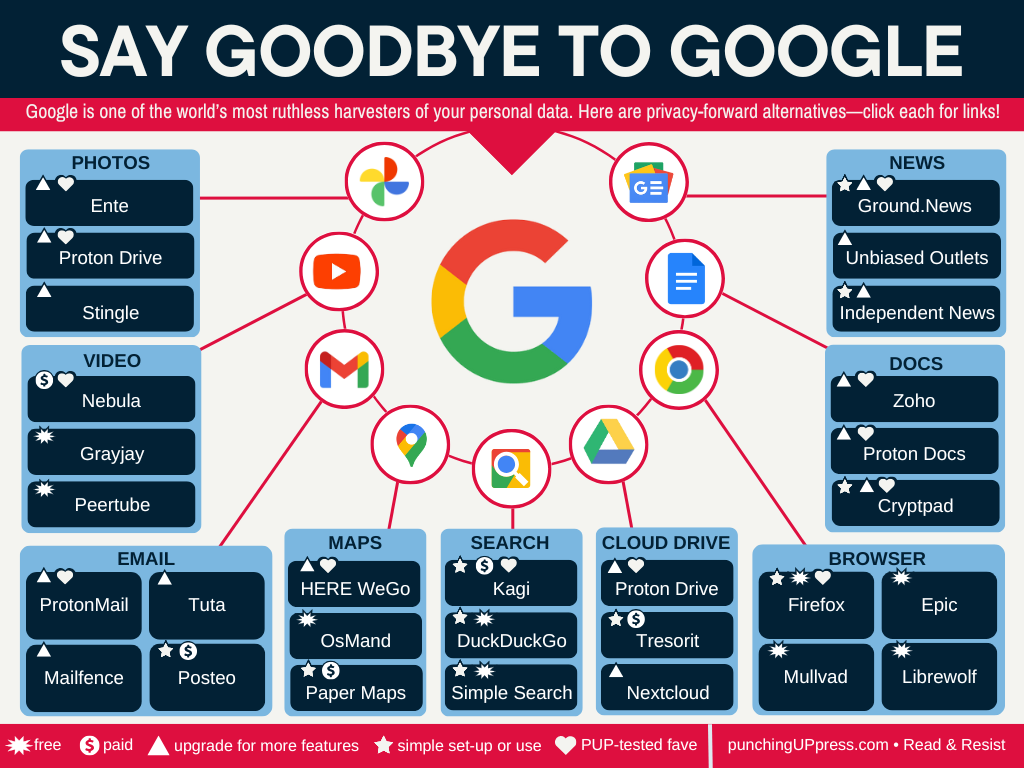
I created an infographic of privacy-forward alternatives to Google products…and would love your feedback.

Is it easy to use? Enough white space? Intuitive? Sharable? Is there anything I’m missing?

The infographic image in this post is NOT clickable. The link above will give you a downloadable PDF with working hyperlinks.

Re: the legend, “easy set-up/use” means either that this is a big part of the alternative product’s branding, or I’ve used it myself and found it easy.

0

6 ways Google Android uses common concepts to hide tracking in 2025

preview

cross-posted from: lemmy.world/post/27344091

  1. Persistent Device Identifiers

My id is (1 digit changed to preserve my privacy):

38400000-8cf0-11bd-b23e-30b96e40000d

Android assigns Advertising IDs, unique identifiers that apps and advertisers use to track users across installations and account changes. Google explicitly states:

“The advertising ID is a unique, user-resettable ID for advertising, provided by Google Play services. It gives users better controls and provides developers with a simple, standard system to continue to monetize their apps.” Source: Google Android Developer Documentation

This ID allows apps to rebuild user profiles even after resets, enabling persistent tracking.

  1. Tracking via Cookies

Android’s web and app environments rely on cookies with unique identifiers. The W3C (web standards body) confirms:

“HTTP cookies are used to identify specific users and improve their web experience by storing session data, authentication, and tracking information.” Source: W3C HTTP State Management Mechanism www.w3.org/Protocols/rfc2109/rfc2109

Google’s Privacy Sandbox initiative further admits cookies are used for cross-site tracking:

“Third-party cookies have been a cornerstone of the web for decades… but they can also be used to track users across sites.” Source: Google Privacy Sandbox privacysandbox.com/intl/en_us/

  1. Ad-Driven Data Collection

Google’s ad platforms, like AdMob, collect behavioral data to refine targeting. The FTC found in a 2019 settlement:

“YouTube illegally harvested children’s data without parental consent, using it to target ads to minors.” Source: FTC Press Release ftc.gov/…/google-youtube-will-pay-record-170-mill…

A 2022 study by Aarhus University confirmed:

“87% of Android apps share data with third parties.” Source: Proceedings of the ACM on Interactive, Mobile, Wearable and Ubiquitous Technologies dl.acm.org/doi/10.1145/3534593

  1. Device Fingerprinting

Android permits fingerprinting by allowing apps to access device metadata. The Electronic Frontier Foundation (EFF) warns:

“Even when users reset their Advertising ID, fingerprinting techniques combine static device attributes (e.g., OS version, hardware specs) to re-identify them.” Source: EFF Technical Analysis www.eff.org/…/googles-floc-terrible-idea

  1. Hardware-Level Tracking

Google’s Titan M security chip, embedded in Pixel devices, operates independently of software controls. Researchers at Technische Universität Berlin noted:

“Hardware-level components like Titan M can execute processes that users cannot audit or disable, raising concerns about opaque data collection.” Source: TU Berlin Research Paper arxiv.org/abs/2105.14442

Regarding Titan M: Lots of its rsearch is being taken down. Very few are remaining online. This is one of them available today.

“In this paper, we provided the first study of the Titan M chip, recently introduced by Google in its Pixel smartphones. Despite being a key element in the security of these devices, no research is available on the subject and very little information is publicly available. We approached the target from different perspectives: we statically reverse-engineered the firmware, we audited the available libraries on the Android repositories, and we dynamically examined its memory layout by exploiting a known vulnerability. Then, we used the knowledge obtained through our study to design and implement a structure-aware black-box fuzzer, mutating valid Protobuf messages to automatically test the firmware. Leveraging our fuzzer, we identified several known vulnerabilities in a recent version of the firmware. Moreover, we discovered a 0-day vulnerability, which we responsibly disclosed to the vendor.”

Ref: conand.me/publications/melotti-titanm-2021.pdf

  1. Notification Overload

A 2021 UC Berkeley study found:

“Android apps send 45% more notifications than iOS apps, often prioritizing engagement over utility. Notifications act as a ‘hook’ to drive app usage and data collection.” Source: Proceedings of the ACM on Human-Computer Interaction dl.acm.org/doi/10.1145/3411764.3445589

How can this be used nefariously?

Let’s say you are a person who believes in Truth and who searches all over the net for truth. You find some things which are true. You post it somewhere. And you are taken down. You accept it since this is ONLY one time.

But, this is where YOU ARE WRONG.

THEY can easily know your IDs - specifically your advertising ID, or else one of the above. They send this to Google to know which all EMAIL accounts are associated with these IDs. With 99.9% accuracy, AI can know the correct Email because your EMAIL and ID would have SIMULTANEOUSLY logged into Google thousands of times in the past.

Then they can CENSOR you ACROSS the internet - YouTube, Reddit, etc. - because they know your ID. Even if you change your mobile, they still have other IDs like your email, etc. You can’t remove all of them. This is how they can use this for CENSORING. (They will shadow ban you, you wont know this.)

0

The Google Lock-in Dilemma

preview

cross-posted from: lemmy.world/post/27440512

Trying to escape Google’s ecosystem, but past purchases keep pulling me back. #DeGoogled #GoogleLockIn #PrivacyStruggles #TechDilemma #FOSS #DigitalFreedom #AndroidAlternatives

cross-posted from: lemmy.world/post/27440512

Trying to escape Google’s ecosystem, but past purchases keep pulling me back. #DeGoogled #GoogleLockIn #PrivacyStruggles #TechDilemma #FOSS #DigitalFreedom #AndroidAlternatives

0

How Do You Solve a Problem Like Google Search? Courts Must Enable Competition While Protecting Privacy.

Electronic Frontier Foundation How Do You Solve a Problem Like Google Search? Courts Must Enable Competition While Protecting Privacy www.eff.org
preview

cross-posted from: programming.dev/post/27361675

Can we get from a world where Google is synonymous with search to a world where other search engines have a real chance to compete? The U.S. and state governments’ bipartisan antitrust suit, challenging the many ways that Google has maintained its search monopoly, offers an opportunity.

0

Google Gmail now filters email from EU to spam, which is deleted after one month

preview

cross-posted from: lemmy.world/post/27224563

I received mail from eures.europa.eu to Gmail for years before Google’s new “be evil” act.

Ban Google in EU. Don’t let citizens use enemy services in a cold war.

cross-posted from: lemmy.world/post/27224563

I received mail from eures.europa.eu to Gmail for years before Google’s new “be evil” act.

Ban Google in EU. Don’t let citizens use enemy services in a cold war.

0

Google Hijacks Restaurants Booking System Leading To No Reservations Being Available.

Search Engine Roundtable Google Hijacks Restaurants Booking System Leading To No Reservations Being Available www.seroundtable.com
preview

cross-posted from: programming.dev/post/27091124

Imagine you own a restaurant and you get all your reservations online through your booking system; you even tell people to book online when they call, via an automated message. But then, all of a sudden, Google decides to hijack that booking link and replace it with Google Assistant’s calling feature.

So instead of Google linking to the booking system you selected, let’s say OpenTable booking integration. Now Google uses Google Assistant to try to call the restaurant and speak to a person. But no person will answer the call, the call goes to a message to tell people to book online. So the next thing that happens is that Google gives up calling, thinks there are no reservations available and tells those trying to book online that there are no reservations available.