0

Trump pushes fighter jet sale to Turkiye despite Israeli opposition

Al Jazeera Trump pushes fighter jet sale to Turkiye despite Israeli opposition www.aljazeera.com
preview

Cross posted from sh.itjust.works/post/64310170

US President Donald Trump has again signalled support for selling F-35 fighter jets to Turkiye, brushing aside Israeli objections. The potential deal remains blocked by US legal restrictions after Ankara’s purchase of Russian air defence systems, while Israel argues the sale would undermine its military advantage in the region.

0

Is there a good tracker of strategic oil reserves?

preview

Now that the Iran conflict is heating up again, one thing I’m surprised doesn’t get talked about is where the oil reserves are at and where they are heading. Flow through the straits has been restricted for a long time, and once reserves get low enough it’s going to make a big mess of the economy, but somehow markets are ignoring it and no one is talking about it?


Now that the Iran conflict is heating up again, one thing I’m surprised doesn’t get talked about is where the oil reserves are at and where they are heading. Flow through the straits has been restricted for a long time, and once reserves get low enough it’s going to make a big mess of the economy, but somehow markets are ignoring it and no one is talking about it?

0

US Imperialist War in Iran Looks Like an Economic Rescue Mission

CounterPunch.org US Imperialist War in Iran Looks Like an Economic Rescue Mission www.counterpunch.org
preview

cross-posted from: lemmy.world/post/46819029

The question of why the U.S. government began a war with Iran is unsettled. The ostensible reasons, blocking Iran from developing nuclear weapons and protecting Iranians’ human rights, are not enough. Iran’s agreement not to build a nuclear arms program was in force…

…a U.S. government that so easily tolerates human rights abuses within the United States and in certain allied nations would seemingly have little zeal to fight Iran on that account, unless there were other inducements.

Strategic considerations as to U.S. economic sustainability and U.S. economic and political power in the world very likely impelled nervous U.S. decision-makers to start a war…

…The effective closure of the Strait of Hormuz might not be a strategic “mistake,” but rather a deliberate feature of the conflict…

…The argument is that the blockade of the straits is a deliberate move by Washington to choke off China’s energy “lifeline” and, in doing so, halt its geopolitical rise…

…“Because oil was and is so fundamental to nearly every industry, the ‘petrodollar’ became ubiquitous, and the dollar became the cornerstone of the global economy.” To preserve the petrodollar arrangement and predictability of the dollar’s value becomes a principal objective of this war…

0

‘We wasted a lot of lives’: CIA spymaster’s caution over past Iran intervention resurfaces from beyond the grave

the Guardian ‘We wasted a lot of lives’: CIA spymaster’s caution over past Iran intervention resurfaces from beyond the grave www.theguardian.com
preview

cross-posted from: sopuli.xyz/post/44443793

cross-posted from: sopuli.xyz/post/44443793

0

The roots of Europe's mental health crisis run deep | Eurofound

preview

The Great Recession in Europe, the economic downturn that began in 2008, resulted in job and income loss, which demonstrably contributed to a rise in poor mental health among those affected. The COVID-19 pandemic, and the measures put in place to contain the virus, similarly caused a spike in the prevalence of poor mental health due to job and income insecurity. Moreover, this crisis negatively impacted mental health through other factors, notably social isolation and the deterioration of working conditions in sectors such as care.

Question; these trends must somehow be worldwide anyone has a take on this from their region?

0

Why Escalation Favors: Iran America and Israel May Have Bitten Off More Than They Can Chew

Foreign Affairs Why Escalation Favors Iran www.foreignaffairs.com
preview

ROBERT A. PAPE is Professor of Political Science and Director of the University of Chicago Project on Security and Threats. He is the author of Bombing to Win: Air Power and Coercion in War.

…

FAR HORIZONS

Horizontal escalation occurs when a state widens the geographic and political scope of a conflict rather than intensifying it vertically in a single theater. It is especially appealing as a strategy for the weaker parties in a military contest. Instead of trying to defeat a stronger adversary head-on, the weaker side multiplies arenas of risk—drawing additional states, economic sectors, and domestic publics into the remit of the conflict. Iran cannot defeat the United States or Israel in a conventional military contest. It does not need to. Its objective is to gain greater political leverage.

The strategy of horizontal escalation follows a recognizable pattern. First, Iran has demonstrated resilience. U.S. decapitation strikes intended to paralyze the Iranian military. By launching large-scale retaliation within hours of losing the supreme leader and many senior commanders, Tehran signaled continuity of command and operational capacity.

Second, Iran has widened the conflict well beyond Iranian territory, effecting what scholars call “multiplication of exposure.” Rather than confining retaliation to just Israel, Iran struck or aimed at targets in at least nine countries, most hosting U.S. forces: Azerbaijan, Bahrain, Greece, Iraq, Jordan, Kuwait, Qatar, Saudi Arabia, and the United Arab Emirates. The message was unmistakable: those countries that host American forces would face severe consequences and the war that Israel and the United States started will spread.

Decapitation strikes create powerful incentives for horizontal escalation.

Third, Iran has politicized the conflict through its strikes. Iran’s retaliation has resulted in the closure of airports, the burning of commercial property, the killing of foreign workers, and the disruption of energy and insurance markets. Gulf leaders have been forced to reassure foreign investors and tourists. The war has migrated into boardrooms and parliamentary chambers. In the United States, the widening scope of the war has alarmed members of Congress. Numerous actors have now entered the conflict, each pursuing distinct interests, none fully coordinated, and all capable of altering the trajectory of escalation beyond Washington’s control.

The final dimension of Iran’s strategy is time. The longer multiple states feel pressure, the more that politics both within and among regional states can intensify the conflict. Without a version of NATO in the Middle East or a single American general effectively running the military operation for all the countries targeted by Iran, there is a high risk of wires getting crossed. U.S. officials have, for instance, floated the idea of stoking an ethnic rebellion in Kurdish parts of Iran to help target the Islamic Revolutionary Guard Corps. But that might provoke responses from Iraq, Syria, and Turkey, countries that would not welcome a powerful Kurdish insurgency in the region. The recent downing of three U.S. jets in a friendly-fire incident over Kuwait also illustrates the logistical and coordination problems that bedevil any attempt to fend off Iran’s escalation in the Gulf.

Iran’s foreign ministry reinforced this logic publicly, framing the missile barrages as legitimate responses against all “hostile forces” in the region. The phrasing has widened responsibility for the attack on Iran beyond Israel and the United States to encompass the broader U.S.-aligned order in the Gulf. Although Iranian President Masoud Pezeshkian has apologized to Gulf neighbors for the attacks, the installation of a new supreme leader aligned closely with the Revolutionary Guard suggests that such gestures are tactical rather than a signal that Tehran intends to abandon its strategy of horizontal escalation. Fundamentally, Iran’s horizontal escalation is a political strategy. It plays directly to the audience that Iran seeks to persuade: the Muslim populations across the region that may not be ideologically aligned with Iran but are generally poorly disposed toward Israel.

…

0

If I were Iran, I'd be bombing all the data centers around DC. I do suspect they would be planning that.

preview

It wouldn’t be that hard for them to pull off. I’d actually be shocked if they wouldn’t put assets in the area for exactly that thing. It would be a hindrance to all the defense firms that are indirectly supporting the US military. It would also be a massive annoyance to both corporate interests and voter interests domestically.

When what brought it about, speaking in a hypothetical future tense, was US involvement that benefits no person or company in the US it would quickly deflate the US’s political will or mandate from the people to pursue these wars. The current mandate that they have is that the current party technically controls the military, and so far it hasn’t negatively impacted the public. The second that’s not true, the American public will be asking questions about how we calculate who to attack. And there will be no answers besides open admission of corruption.

It would be very smart for Iran to do. It may even improve Iran’s popularity in the US because people don’t really like those data centers. And double smart when no one likes Israel at all in the US right now. How ironic will it be when Iran’s PR in the US is better than Israel’s, and we are fighting a war that only benefits Israel? It would divide the people from their government even more and knock out a strategic war resource.

But to protect PR, they’d have to somehow do it while minimizing deaths. These buildings have almost no personnel in them. But if there is one guard in the whole building, that will end up being the story. The news in the US that works for the military in times of war knows that US citizens don’t give a single fuck about an AWS blade server. But one single AWS guard might be enough to get the American public to actually care about the Iran issue. So that is the risk they have to balance with that kind of an attack.

They don’t need intercontinental missiles to do it. They only need rockets more crude than the ones they have given to Hamas or Hezbollah to target something 100 yards in front of them.

0

Predictive History: Geo-Strategy #8: The Iran Trap

play · youtube.com
YouTube Geo-Strategy #8: The Iran Trap www.youtube.com
preview

In his May 29, 2024 class, Jiang Xueqin explains that an American invasion of Iran would be a catastrophic mistake:

If Trump were to win a second term, he would likely contemplate invading Iran. While an initial invasion would seem successful, American forces would quickly become bogged down in Iran’s mountainous terrain.

The American invasion would be similar to Athens’ invasion of Sicily in 415 BCE, as described in Thucydides’ The Peloponnesian War. Despite its initial successes, the Athenians couldn’t re-supply themselves, and their entire expedition was wiped out.

This disastrous defeat turned the war in Sparta’s favor, and spelled the downfall of the Athenian empire.

Could the American empire in Iran suffer the same fate as the Athenian empire in Sicily?

0

The Great Unraveling Has Begun [Opinion]

Opinion | The Great Unraveling Has Begun www.nytimes.com
preview

Oona Anne Hathaway is an American legal scholar specialized in international law and U.S. foreign relations.

In conclusion:

" The decades of imperfect but transformative peace that the U.N. Charter helped create now faces the same fate. As the United States fails to abide by the underlying principle of the international legal system it once championed, the already ailing system faces total collapse."

0

Americans are waking up. A grand reckoning awaits us | Robert Reich [Opinion]

the Guardian Americans are waking up. A grand reckoning awaits us | Robert Reich www.theguardian.com
preview

It has been a “fucking nightmare”. But sometimes a nation needs a nightmare before it can fully awaken to long-simmering crises.

The US had to come to this point. We couldn’t go on as we were, even under Democratic presidents. For 40 years, a narrow economic elite has been siphoning off ever more wealth and power.

I’m old enough to remember when the US had the largest and fastest-growing middle class in the world. We adhered to the basic bargain that if someone worked hard and played by the rules, they’d do better than their parents, and their children would do even better.

I remember when CEOs took home 20 times the pay of their workers, not 300 times. When members of Congress acted in the interests of their constituents rather than being bribed by campaign donations to do the bidding of big corporations and the super-wealthy. Trump has precipitated a long-overdue reckoning.

That reckoning has revealed the rot.

It has also revealed the suck-up cowardice of so many CEOs, billionaires, Wall Street bankers, media moguls, tech titans, Republican politicians and other so-called “leaders” who have stayed silent or actively sought to curry Trump’s favor.

Note: I think this trend holds true for many recent crises in other countries as well, directly or indirectly. We need to reveal the rot and all do our own reckoning.

0

The Multipolar Mirage || Why America and China Are the World’s Only Great Powers

Foreign Affairs The Multipolar Mirage www.foreignaffairs.com
preview

Archive: archive.ph/iAXca

Highlight: “In East Asia, China will likely move to enforce its own version of the Monroe Doctrine. Beijing will continue to use incremental tactics and economic coercion against neighbors to pressure them to decouple or distance themselves from Washington. In coming years, the extent to which Beijing attempts to eject the United States from its region politically and militarily will likely define the principal arena of U.S.-Chinese strategic rivalry. “Don’t make us choose” has been the mantra of many East Asian countries, including some U.S. treaty allies. But under bipolarity, the luxury of choice is not one afforded to small countries in a superpower’s backyard. Countries will be forced to choose, and choose correctly according to their neighbor, or risk the consequences. The return of bipolarity means it’s time to remember—with regret and trepidation—the nature, intensity, and global reach of superpower competition.”

0

Gabrielius landsbergis why trump doesn't care about Europe- Decoding Geopolitics

play · youtube.com
YouTube Gabrielius Landsbergis: Why Trump Doesn't Care About Europe youtu.be
preview

Interesting shortened interview with Gabrielius Landsbergis former Lithuania’s Minister of Foreign Affairs.

Basically US has been saying for a while already that they cannot or won’t operate in two separate theaters anymore. Europe was slow in its response and unable to solve important internal issues because of discord.

Secondly, the way forward for Europe is to make a winning European Plan of it’s own.

0

The West’s Last Chance

Foreign Affairs The West’s Last Chance www.foreignaffairs.com
preview

“How to Build a New Global Order Before It’s Too Late”, Alexander Stubb, December 2, 2025.

-About Geopolitical analysis, ethics, reforms of Institutions and relations for the Global West.

You might notice that Stubb has references to Fukuyamas book.

Arch

“How to Build a New Global Order Before It’s Too Late”, Alexander Stubb, December 2, 2025.

-About Geopolitical analysis, ethics, reforms of Institutions and relations for the Global West.

You might notice that Stubb has references to Fukuyamas book.

Arch

0

Francis Fukuyama: 'Trump is the most disappointing thing that's happened' in decades

France 24 Tête à tête - Francis Fukuyama: 'Trump is the most disappointing thing that's happened' in decades www.france24.com
preview

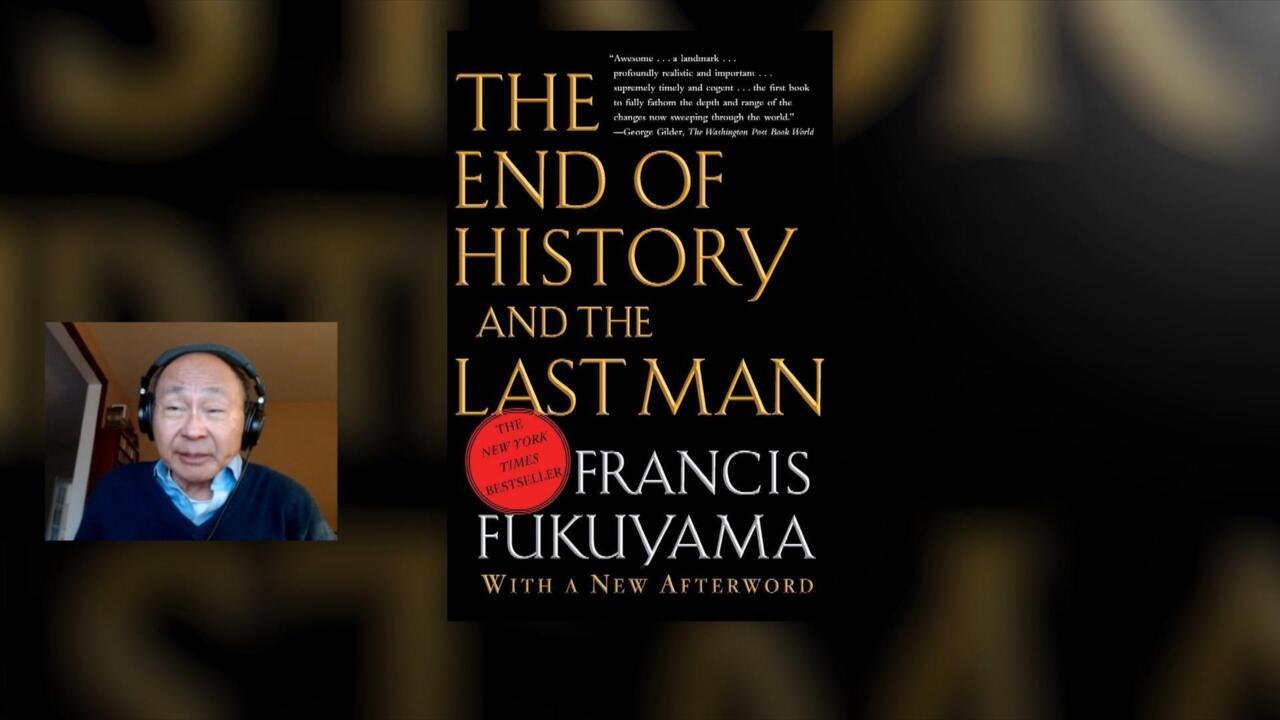
FRANCE 24 spoke to Francis Fukuyama, author of the 1992 book “The End of History and The Last Man”, in which he asserted that the end of the Cold War had established the dominance of liberal democracies. The Stanford University professor said that the election of US President Donald Trump is “the most surprising and the most disappointing thing that’s happened” since he wrote the book. “He’s clearly a leader with authoritarian instincts,” Fukuyama stated, adding that Trump “is in the process of trying to cut an extremely shameful deal with Russia over Ukraine”.

Francis Fukuyama author " The end of History and The Last Man" 1992. wiki

It’s also interesting to see in wiki how his views & philosophy have changed over the years.

0

US and Russian officials draft plan to end Ukraine war based on capitulation from Kyiv

the Guardian US and Russian officials draft plan to end Ukraine war based on capitulation from Kyiv www.theguardian.com
preview

cross-posted from: lemmy.world/post/39045912

It is unclear if Trump administration backs deal that would mean Kyiv giving up territory and slashing size of military

US and Russian officials have quietly drafted a new plan to end the war in Ukraine that would require Kyiv to surrender territory and severely limit the size of its military, it was reported on Wednesday as Russian drone and missile strikes killed at least 25 people in the city of Ternopil.

The draft plan, which was reportedly developed by Donald Trump’s envoy, Steve Witkoff, and the Kremlin adviser Kirill Dmitriev, would force draconian measures on Ukraine that would give Russia unprecedented control over the country’s military and political sovereignty. The plan is likely to be viewed as surrender in Kyiv.

0

Chinese travellers estimated to have cancelled 500,000 trips to Japan amid rising tensions

the Guardian Chinese travellers cancel hundreds of thousands of trips to Japan amid rising tensions www.theguardian.com
preview

cross-posted from: lemmy.world/post/38961720

Chinese travellers are estimated to have cancelled hundreds of thousands of flights to Japan amid reports of suspended visa processing and cultural exchanges as a diplomatic dispute over Japan’s stance on Taiwan continues.

Under pressure from business groups, Japan has sent a senior diplomat to Beijing in an attempt to calm tensions after Japan’s prime minister, Sanae Takaichi, said her country could get militarily involved if China attempted to invade Taiwan.

Her comments prompted fury from China’s government, which issued warnings against Chinese travellers and students going to Japan.

0

Taiwan's vice president calls for closer EU ties in rare address to international lawmakers

preview

cross-posted from: scribe.disroot.org/post/5522375

Archived version

Taiwan’s deputy leader urged the European Union to boost security and trade ties with the self-governing island and support its democracy in the face of growing threats by China, in a rare address to a group of international lawmakers in Brussels on Friday.

“Peace in the Taiwan Strait is essential to global stability and economic continuity, and international opposition against unilateral changes to the status quo by force cannot be overstated,” Vice President Bi-Khim Hsiao told lawmakers assembled for a China-focused conference in the European Parliament building.

While Hsiao did not formally address the whole EU Parliament — the European trade bloc does not have formal diplomatic relations with Taiwan — her visit drew ire from China.

“In an era marked by increasing fragmentation, volatility and rising authoritarianism, this gathering affirms something vital — that democracies, even when far apart, are not alone,” she added to a standing ovation in a small chamber of the European Parliament.

Hsiao also called on the lawmakers from countries including Germany and Spain to collaborate more on trusted supply chains and AI technology with Taiwan, the island off China’s east coast that Beijing claims as part of its territory and says must come under its rule.

…

0

"Biden Administration Policies Led to a 0% Market Share in China", Claims NVIDIA’s Jensen Huang, as He Hopes for a Breakthrough in the Region

Wccftech "Biden Administration Policies Led to a 0% Market Share in China", Claims NVIDIA’s Jensen Huang, as He Hopes for a Breakthrough in the Region wccftech.com
preview

cross-posted from: thelemmy.club/post/37828273

cross-posted from: thelemmy.club/post/37828273

0

The Ideal Disinformation Weapon: AI Companion Apps are being weaponized for hybrid warfare and stochastic terrorism

The Defence Horizon Journal The Ideal Disinformation Weapon - The Defence Horizon Journal tdhj.org
preview

Renowned Canadian hybrid warfare, AI and disinformation expert Blair Maddock-Ferrie of Carleton University writes on the serious threat to national security that AI Companion Apps and girlfriends like Replika, Character.ai, etc. pose today.

Renowned Canadian hybrid warfare, AI and disinformation expert Blair Maddock-Ferrie of Carleton University writes on the serious threat to national security that AI Companion Apps and girlfriends like Replika, Character.ai, etc. pose today.

0

Japan tells its companies in Taiwan ‘you’re on your own’ if China invades

preview

cross-posted from: lemmy.zip/post/44264978

archive.is/9kma5

Japanese diplomats told company risk officers that “you are on your own if you put significant assets in Taiwan”, said one person present at one of the conversations.

Foreign direct investment by Japanese companies — traditionally Taiwan’s third-largest source of FDI, after the EU and US — slumped 27 per cent last year to $452mn, and is down from a peak of $1.7bn in 2022.